A Local Anesthetics Infiltration Method Facilitates Airway Securing
in Deep Brain Stimulation for Parkinson’s Disease
Authors: Chia-Wen Chen1, Yang-Kee Chan2, Yu-Cheng Kuo3,4, Yu-Fang Liu1, Chi-Chen Ke1, Rick Sai-Chuen Wu1 Institute: 1Department of Anesthesia, Pain Service, and Critical Care Medicine, China Medical University Hospital , 2Department of Anesthesiology Jen Ai Hospital: Tali 3Department of Radiation Oncology China Medicial University
Implantation of deep brain stimulatiors is now widely accepted for the treatment of Parkinson’s disease (PD)(1-3). The most common anesthesia technique used for deep brain stimulation (DBS) procedures was monitored anesthesia care using light sedation because intraoperative evaluation of clinical signs ensures optimal placement of the electrodes(4). Airway, respiratory, neurologic, and psychologic/psychiatric complactions occurred. Especially, the fixed stereotactic head frame
2Department of Anesthesiology, Jen-Ai Hospital: Tali, 3Department of Radiation Oncology, China Medicial University Hospital, 4Department of Biomedical Imaging and Radiological Sciences, National Yang-Ming University
and psychologic/psychiatric complactions occurred. Especially, the fixed stereotactic head frame may make the access to the patient’s airway difficult and even impossible(5). DBS is a procedure which presents many anesthetic challenges.(4) )
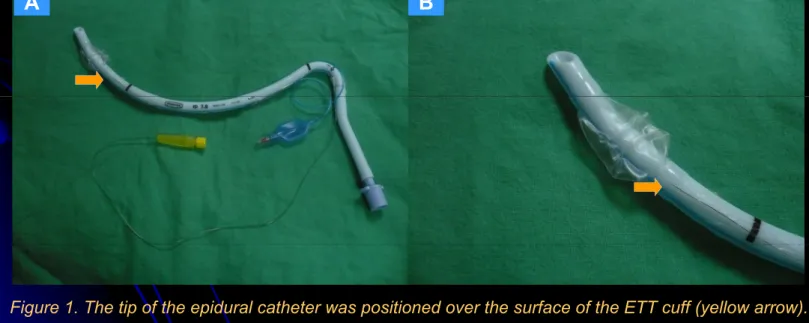
We reported a 67-year-old male was scheduled for DBS for Parkinson’s disease. The patient was intubated awakely under fiberscopic guidance and 2 ml of 2% lidocaine was infiltrated around the endotracheal tube (ETT) cuff intermittently via the epidural catheter (B|BRAUN,
Perfix®catheter, 20G) which tip was positioned over the surface of the cuff (Figure 1A, 1B). We use sedation during the peroids of nonintervention and testing with infusion of propofol, alfentanil, g p g p p , , and dexmeditomidine. The infusions are stopped before stimulation testing to allow the patient to be awake and cooperative. The whole course was smoothly completed in four-hour operation and the patient kept spontaneous breathing without bucking or coughing, and remained
hemodynamically stable. No hypoxemia or hypercarbia was noted. In this case, we maintained spontaneous ventilation using our simple application to infiltrate local anesthetics and inhibit cough reflex through the complete course of the operation. This simple method could reduce the stimulation of the ETT, and provide benefits to decrease intraoperative risk of airway obstruction p p y in patients undergoing DBS.
A
B
Figure 1. The tip of the epidural catheter was positioned over the surface of the ETT cuff (yellow arrow).
References
1 Deep-brain stimulation of the subthalamic nucleus or the pars interna of the globus pallidus in Parkinson's disease. N Engl J Med 2001; 345: 956-63.
2 Krack P, Batir A, Van Blercom N, et al. Five-year follow-up of bilateral stimulation of the subthalamic nucleus in advanced Parkinson's
disease. N Engl J Med 2003; 349: 1925-34.
3 Vingerhoets FJ, Villemure JG, Temperli P, Pollo C, Pralong E, Ghika J. Subthalamic DBS replaces levodopa in Parkinson's disease:
two-year follow-up. Neurology 2002; 58: 396-401.
4 Khatib R, Ebrahim Z, Rezai A, et al. Perioperative events during deep brain stimulation: the experience at cleveland clinic. J Neurosurg
Anesthesiol 2008; 20: 36-40.
5 Venkatraghavan L, Manninen P, Mak P, Lukitto K, Hodaie M, Lozano A. Anesthesia for functional neurosurgery: review of complications.