Elsevier Science Publishers B.V., Amsterdam
T e c h n i c a l N o t e
A L o w C o n t a m i n a t i o n C h e l e x - l O 0 Technique for
S h i p b o a r d P r e - c o n c e n t r a t i o n of H e a v y Metals in
S e a w a t e r
SU-CHENG PAI*, T I E N - H S I FANG
Institute of Oceanography, National Taiwan University, Taipei, Taiwan (Republic of China) CHENG-TUNG A. CHEN and KWUNG-LUNG JENG
Institute of Marine Geology, National Sun Yat-Sen University, Kaohsiung, Taiwan (Republic of China)
(Received September 25, 1989; revision accepted January 16, 1990 )
ABSTRACT
S.-C. Pai, T.-H. Fang, C.-T.A. Chen and K.-L. Jeng, 1990. A low contamination Chelex-100 tech- nique for shipboard pre-concentration of heavy metals in seawater. Mar. Chem., 29: 295-306. An easy to handle, on-board procedure is proposed which uses a Chelex-100 ion-exchange col- umn to pre-concentrate Cd, Co, Cu, Fe, Mn, Ni, Pb and Zn from seawater with minimal risk of contamination. Immediately after collection, the seawater sample is poured into a polyethylene terephthalate (PET) bottle containing ammonium maleate buffer at pH 6.5. The bottle is then connected to a pre-packed Chelex-100 column set, and hung upside-down to allow the sample to flow through the column in dust-free conditions. Finally, the whole batch of columns is brought back to the land-based laboratory for further elution and analysis. A concentration factor of 250 is achieved.
INTRODUCTION
The Chelex-100 chelating ion-exchange technique has a long history of ap- plication in trace metal analysis for seawater (Riley and Taylor, 1972; Abdul- lah et al., 1976; Bruland et al., 1985). Most investigators considered this tech- nique the easiest and cleanest method to pre-concentrate trace metals when compared with other methods such as solvent extraction and co-precipitation and it is as efficient as those methods (Bruland et al., 1985; Sturgeon et al., 1980; Boniforti et al., 1984). Also, as the Chelex-100 column method does not require specific reagents and fragile glassware, it has been recommended for on-board treatment of seawater samples immediately after collection (Boni- forti et al., 1984).
Surprisingly, a review of past literature revealed only a few cases of on-board application (Riley and Taylor, 1972; Bruland et al., 1979). This is mainly be-
*Author to whom correspondence should be addressed.
296 S.-C. PAI ETAL. cause the conventional Chelex-100 procedure cannot be carried out consis- tently under unpredictable weather conditions. T h e lack of clean environment also prohibits the on-board operation. As a result, many investigators stored samples after acidification, t h e n brought t h e m back to a land-based laboratory for further t r e a t m e n t (Hirota et al., 1985).
It should be noted that once seawater is acidified without filtration, the final result could be ambiguous because the measured concentrations cannot be classified as dissolved, total, or acid leachable. If the sample is filtered upon collection, the risk of contamination increases. Storage and transportation of large amounts of sample may give rise to other problems. Furthermore, to ad- just the acidified samples to the desired p H before pre-concentration is tedious and also subject to contamination. Direct on-board pre-concentration, without filtering, storing and transporting samples may provide a more straightforward resolution, even though the results can only be classified as 'labile' or 'extract- able' fraction and its definition depends solely upon the m e t h o d chosen.
This paper describes a routine procedure for on-board operation of the Chelex-100 pre-concentration, with minimal maneuver. T h e principle is based generally on the m e t h o d reported previously (Pai, 1988; Pai et al., 1988) but uses a m m o n i u m maleate as a buffer (Pai et al., 1990) instead of conventional a m m o n i u m acetate, and uses a more practical hanging bottle technique to avoid operational contamination. To demonstrate the applicability and precision of the method, a spiking experiment was carried out on board the R / V "Ocean Researcher I" at a station in the northern South China Sea, 100 k m from Ka- oshuing Harbour, Taiwan. T h e analysis by atomic absorption spectrometry
(AAS) was completed within 3 days after returning from the cruise.
MATERIALS
Distilled water (DDW): the water used to prepare reagents was double dis- tilled in a borosilicate vessel, and stored in a polypropylene ( P P ) tank.
A m m o n i u m hydroxide: a m m o n i a vapor was bubbled through distilled water until saturation was reached. T h e a m m o n i a concentration was checked by acid titration.
Nitric acid: Merck GR grade concentrated nitric acid was sub-boiled in a Pyrex glass container and stored in a Teflon bottle (Mattinson, 1972). The concentration of the sub-boiled nitric acid was checked by titration against a standard base.
A m m o n i u m maleate buffer: Merck GR grade maleic acid (58.03 g) was dis- solved in ~ 700 ml of distilled water in a 1-1 Pyrex beaker and filtered with W h a t m a n G F / C filter to remove particles. T h e p H was gradually adjusted to 6.5 using purified a m m o n i u m hydroxide. T h e final volume was made up to 1 1 with DDW.
A m m o n i u m acetate buffer: it was prepared by diluting 57 ml of glacial acetic acid in a 1-1 beaker, and the p H was adjusted to 6-6.5 with purified a m m o n i u m
2
(a)
12 1311
~ .
~~I0
(c)
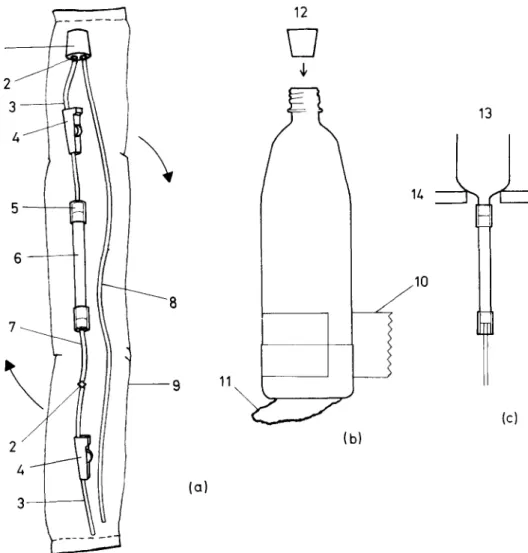
(b)Fig. 1. (a) T h e pre-packed Chelex-100 column set which was sealed in a P E bag, folded into three sections a n d placed in a carrying box to keep t h e column vertical. (b) T h e modified P E T bottle containing 30 ml of a m m o n i u m buffer. (c) T h e column on t h e working rack for packing a n d elution. 1- silicon rubber stopper, No. 7, w i t h holes; 2 - nipple; 3 - silicon rubber tubing, 15 × 0.2 cm i.d.; 4 - roller clamp; 5 - adaptor, made of Tygon tubing; 6 - Chelex-100 column, 12 × 0.794 cm i.d., packed with 2 g o f resin, 100-200 mesh, a m m o n i u m form; 7 - silicon rubber tubing, 4 X 0.2 cm i.d.; 8 - ventilation tube, 40X0.2 c m i.d.; 9 - P E bag; 10 - s t r e n g t h e n e d with a tape; 11 - hanging string; 12 - silicon rubber stopper, No. 7; 13 - Pyrex glass funnel; 14 - wooden rack, holding 20 columns in a row.
298 S.-C. PAI E T AL, hydroxide. T h e final volume was made up to I 1. After purification by a Chelex- 100 column, the p H of this buffer was adjusted back to 5.5 using sub-boiled nitric acid.
Purification of buffers: both maleate and acetate buffers were purified by passage through a Chelex-100 column containing 10 g of 100-200 mesh resin in a m m o n i u m form at a flow rate not more t h a n 2 ml rain-1. T h e first 20 ml of the effluent was discarded and the remaining effluent was stored in Teflon bottles.
Metal standards: a mixed metal standard solution was prepared by combin- ing and diluting Merck Titrisol Standards to a concentration equivalent to 1 ml = 10 #g each of Cd, Co, Cu, Fe, Mn, Ni, Pb and Zn. A 50-ttl micropipet was used for on-board spiking.
Instrument: a Hitachi Z-8000 Polarized Zeeman Effect atomic absorption spectrometer was used for the detection of trace metals. Two types of graphite furnace were used: a cup-type furnace was used to detect high-sensitivity ele- ments such as Cd, M n and Zn, and a pyro-coated tube-type furnace was used for other elements.
Chelex-100 column set: Chelex-100 resin (2 g, 100-200 mesh), manufac- tured by Bio-Rad Laboratories (Richmond, CA, U.S.A.), was weighed in a glass beaker, acidified with 1 ml of acid (this makes it easy to pack), and packed into a column made of Tygon tubing (12X0.794 cm i.d.). The column was washed in a stepwise m a n n e r with three 1-ml portions of 2 N nitric acid, five 1-ml portions of DDW, three 1-ml portions of 1 N a m m o n i u m hydroxide, and at least five 4-ml portions of DDW. T h e packed column was connected to adap- tors with silicon rubber tubings at both ends, fitted with roller clamps and a stopper plug, and sealed into a polyethylene (PE) bag (Fig. 1 ).
Sample reservoir: a 1280-ml polyethylene terephthalate ( P E T ) bottle (Coke bottle) was used as the sample reservoir. T h e bottom part of the bottle, strengthened by tape, was attached to a string (Fig. 1 ). The bottle was washed in sequence with detergent, mild acid and Dextran, and finally rinsed with DDW. To each bottle 30 ml of a m m o n i u m maleate buffer (pH 6.5) was added. The bottle was plugged with a silicon rubber stopper, and placed in a plastic bag.
PROCEDURE
Pre-boarding
Individually sealed Chelex-100 column sets and P E T bottles sets were all kept in a vertical position in a carrying box. Go-Flo sampling bottles (2.5 l Type 1080 General Oceanics Inc., Miami, FL) were acid cleaned in the labo- ratory and wrapped with P E film.
On-board
Twelve Go-Flo bottles were installed onto a rosette sampler (General Oceanics Inc., Miami, FL, U.S.A. ) which was attached to an SBE-9 conductiv- i t y - t e m p e r a t u r e - d e p t h (CTD) unit (Seabird Electronics Inc., Bellevue, WA ). Seawater samples were collected at required depths.
W h e n the rosette was retrieved, the valve of the Go-Flo sampler was opened and at least 100 ml of seawater was allowed to flush through the outlet. T h e sample was then'poured directly into the P E T bottle, filling it to the neck. The bottle was immediately plugged with a Chelex-100 column set (still wrapped in a P E bag, with only the stopper and the outflow tubing pulled out). The ventilation tubing was tied to the bottle with a rubber band and the whole combination was hung upside-down on a hook (Fig. 2). T h e rolling clamps were then opened and the seawater outflow was adjusted to ~ 4-5 ml rain- 1. Each sample took 4-6 h to finish. T h e column sets were disconnected from the bottles (kept hanging until the ship returned), folded to keep the column in a vertical position, and t h e n packed into the carrying box.
Fig. 2. The layout of the hanging bottle technique for passing the sample through the Chelex-100 column, which was protected by a PE bag throughout the expedition.
300 s.-c. PAI ET AL.
In the laboratory
W h e n the Chelex-100 column sets were brought back to the land-based lab- oratory, they were disconnected from tubings and the adaptor, fLxed on a wooden rack with room for 20 columns, and washed sequentially with the following solutions: five 1-ml portions of DDW, four 5-ml portions of 1 M a m m o n i u m acetate at p H 5.5 and five 1-ml portions of DDW. Stepwise elution was carried out with 1-ml portions of 2 N nitric acid. T h e effluent of the first two portions was discarded (to reduce the void bed volume), and the effluent of the further five 1-ml portions of 2 N nitric acid was collected into a previously calibrated Pyrex glass test tube which was kept u n d e r n e a t h the column until the final yield reached exactly 5.0 ml. The heavy metal contents were detected by graph- ite furnace atomic absorption spectrometry (GFAAS).
On-board spiking test
Deep ocean water was collected by 12 Go-Flo samplers at 1000-m depth in one cast, and water from each sampling bottle was poured into separate P E T bottles. To four of the bottles 0.02 ml of the mixed standard solution had al- ready been added by micropipet, so the spiked concentration was equivalent to 0.2/zg of each metal in 1250 ml of seawater (or 0.16/~g 1-1); another four bottles were spiked with 0.1 ml of the mixed standard to give a spiked concen- tration of 2 #g of each metal in 1250 ml (or 0.8/~g 1-1 ). T h e remaining bottles were unspiked. All samples were immediately treated by Chelex-100 columns following the procedures described above.
Preparation of analytical blank
T h e Chelex-100 column effluent of the non-spiked seawater sample was col- lected and was considered as the theoretical blank seawater. It was poured directly into another P E T bottle containing 30 ml of ammonium maleate buffer, and allowed to pass through a new Chelex-100 column in the same m a n n e r as for other samples. T h e final eluate from this column was detected by GFAAS and the signals produced for each element were accounted for as the analytical blank. Four replicates were made.
R E S U L T S A N D D I S C U S S I O N
Contamination
T h e possible sources of reagent contamination were from distilled water, nitric acid, maleic acid, acetic acid, a m m o n i a and the resin itself. All these reagents had been carefully purified and thus gave very low reagent blanks. T h e risks of operational contamination came from the sampler, the P E T bot- tle, the column set and the test tube. As the preparation of the columns, the elution, and the final determination were all carried out in a dust-controlled laboratory, and during the deck operation all bottles and columns were pro-
T A B L E 1
D e t e r m i n a t i o n of heavy m e t a l s in seawater from 1000-m d e p t h a t a s t a t i o n in t h e S o u t h C h i n a Sea E l e m e n t Analytical b l a n k (/~g l - 1 ) M e a n sd ( n = 4) C o n c e n t r a t i o n s found (/~g 1-1)a D e t e c t e d b sd ( n = 4 ) Corrected c rsd ( % ) Cd 0.006 0.002 0.078 0.004 0.072 6 Co 0.011 0.005 0.015 0.007 0.004 ( n d ) 175 Cu 0.013 0.004 0.131 0.012 0.118 11 Fe 0.06 0.02 0.21 0.04 0.14 28 M n 0.030 0.006 0.111 0.01C 0.081 12 N i 0.076 0.011 0.529 0.014 0.453 3 P b 0.027 0.010 0.040 0.015 0.013 ( n d ) 116 Zn 0.115 0.014 0.521 0.021 0.406 5
"All m e a s u r e m e n t s were replicated four times.
b C o n c e n t r a t i o n s were e s t i m a t e d directly from t h e s t a n d a r d a d d i t i o n curves.
c C o n c e n t r a t i o n s were corrected by deducting t h e analytical blanks. ( n d ) : considered as ' n o t de- tectable', i.e. less t h a n 4.65 t i m e s t h e s t a n d a r d deviation of t h e analytical blank.
tected by P E bags from aerosols and seawater splashing, the chance of opera- tional contamination was also very small. Additional tests showed that the P E T bottle did not absorb or release detectable heavy metals over 48 h when filled with seawater at p H 6.5.
Although the contaminations from these possible sources were not identified individually, the total analytical blanks are shown in Table 1. T h e possible contamination from the Go-Flo sampler, however, was not included.
Stepwise washing and elution
Several washings were necessary before the final recovery of heavy metals from the column. The washing with distilled water was to get rid of seawater or reagent residues from the resin bed. The rinsing of a m m o n i u m acetate was to remove major ions from the resin (Kingston et al., 1978). After these wash- ings, the final elution with nitric acid recovered heavy metals in the absence of interfering major ions. As the 100-200 mesh resin bed held liquid under hydrostatic pressure without letting the column dry out, a stepwise washing or elution technique was applied.
In practice, the eluent liquid was added in small portions to the top of the resin bed using a dispenser. T h e liquid was allowed to drain before the second portion was added, thus mixing could be kept to the minimum. Figure 3 shows the elution profiles of Na, K, Mg, Ca, NH + , NO~ and M n from a Chelex-100 column (1280 ml of sample had passed through previously). Other elements,
302 S.-C. PAI E T A L Z ' Z ,3 luenlJ.J.a u! LIO!]DJ].UaOUO O I c o n ~
o ~
~
"I- u_ ~'~ o ~ Z ~ o . ~ g 0',4 +.~ +.,~2
. ~
~
N~ N
such as Cd, Cu and Pb, were also monitored in the same effluent portions, but as their eluting positions were identical to that of Mn, for simplicity they are not plotted. T h e elutions were made by measuring the concentrations of the analytes in the effluent after each 1-ml portion of elution. It can be seen that elution with small portions gave reasonably good results. For instance, the residue seawater could be washed out by three 1-ml portions of distilled water, but would give a longer tailing if 2-ml or 5-ml portions were used.
The removal of Na, K, Mg and Ca from the Chelex-100 column could be nearly completed by stepwise elution with 20 1-ml portions of 1 M a m m o n i u m acetate at p H 5.5. However, this would be too tedious in practice. For simpler operation, elution with four 5-ml portions of 1 M a m m o n i u m acetate is rec- ommended; this removed > 99% of Na and K and > 95% of Mg and Ca from the column.
T h e volume of nitric acid required for complete recovery of heavy metals from a Chelex-100 column has been discussed in several earlier publications. Pakalns et al. (1978) suggested t h a t a m i n i m u m of 25 ml of diluted acid was necessary to elute the Chelex-100 column for complete recovery of metals. Sturgeon et al. (1980) discussed the difficulties of quantitative recovery of heavy metals by up to even 100 ml of acid, and finally abandoned the column operation. However, results of this work show t h a t it is possible to obtain com- plete recovery using small amounts of acid in a stepwise manner. It has been observed that if a large volume of nitric acid is loaded on the column, vertical convection occurs in the top layer, which leads to long tailing of the eluate. The elution in 1-ml steps proved to give very little mixing effect; complete recovery could be achieved with 10 1-ml portions of acid using a 100-200 mesh resin in an 0.8-cm bore column. T h e elution profiles shown in Fig. 3 illustrate that nearly 99% of the trace metals were collected in the fractions from 43 to 47 of the acid elutions with 1-ml portions. If the first two fractions of the eluate were discarded, the final eluate volume could be reduced to 5 ml. Additional tests using 2- and 5-ml portions of acid showed that the m i n i m u m elution volume required would be 7 and 20 ml respectively.
The matrix in the final yield (5 ml) consisted of ~ 1.4-1.6 M of nitrate, ~ 0.2 M of a m m o n i u m ions, not more t h a n 1 m M of Ca and 0.5 m M of Mg. T h e effect of such matrix may interfere strongly with the absorption signals of the atomic absorption spectrometer (Danielsson et al., 1982). To compensate for matrix interference in the quantitative determination, the standard addition tech- nique was applied to a solution of the same matrix composition, i.e. the ana- lytical blank. Noise or background effects were corrected by the Zeeman effect optical system of the spectrometer.
Analysis of the non-spiked and spiked seawater
Trace metals in seawater from 1000-m depth in the South China Sea (lo- cated at 22°00'N, 119°25'E) were pre-concentrated on board by the Chelex-
304 S.-C. PAIETAL.
100 column using the proposed hanging bottle technique, and were detected by GFAAS. The results for the reagent blank and for the non-spiked samples are shown in Table 1. The results for the spiked samples are presented as standard addition curves as shown in Fig. 4. The concentrations of heavy metals that are estimated directly from the standard addition curves are considered as 'de- tected', and the concentrations that are deducted from the analytical blanks are considered as 'corrected'. It should be emphasized that the analytical and the reagent blanks are different in definition, and are difficult to distinguish from each other in practice. For example, in Table 1 the analytical blank for Cd is 0.006/Lg 1-1, which means that the GFAAS signal produced by the blank sample is equivalent to a Cd concentration of 0.75 #g 1-1 {after 125-fold pre- concentration). The blank signal includes the possible contamination from reagents and containers during the operation, as well as the background noise of the instrument.
Five elements, i.e. Cd, Cu, Ni, Mn and Zn, were measured with good preci-
0.5 ¸ 0.1'
0116
0'~ t a f - 0 ,< M no'.m c~:8
02 01-co
/
/
/
02C u /
/
0'.16 018 0'.16 018Ni
{ Pb
0 1036 o'.8 olin ols Spiked concentration (ug I -~)
/
o'.m o:8
o:16 o:8
Fig. 4. Standard addition curves of trace metals for South China Sea water from 1000-m depth. Amounts of 0.2 and 1 #g of each metal were added to 1.25-I aliquots of sample, to give spiked concentrations of 0.16 and 0.8 ~g l-~ respectively. Absorbance readings were not deducted from the analytical blanks. Vertical bars represent the standard deviation of four measurements.
sion (rsd 3-11% ), and the concentration levels measured were all higher than the analytical blanks; this indicates that this technique is suitable for on-board measurement of these five elements. The precision for iron was only fair (rsd 28% ) at the 0.14 pg 1-1 level, but the result could still be considered as 'detect- able'. For Co and Pb, even after 250-fold pre-concentration, GFAAS appar- ently was not sufficiently sensitive for the determination of these elements at their natural concentrations below 0.013/lg l-1. Nonetheless, this technique may still be useful for measuring Co, Fe and Pb in nearshore waters at higher concentrations.
SUMMARY
The proposed hanging bottle technique provides a fast, clean and easy to handle means to perform Chelex-100 pre-concentration on board a research vessel. As the seawater sample is directly poured into the reservoir bottle, and the pH is precisely controlled by the ammonium maleate buffer, the need for volumetric measuring and transfers and for a pH-meter are all eliminated. The only actions which need to be taken on board are to collect the sample and pour it into the bottle, connect the column set, hang it upside-down, and let it flow. Thus problems usually associated with rough weather no longer exist. The whole pre-concentration scheme is designed to be contamination-protected at low cost, and may be recommended for routine fieldwork.
ACKNOWLEDGMENT
This work was sponsored by the National Science Council of the Republic of China. The authors are grateful to the captain and crew of the R / V "Ocean Researcher r ' and Miss Tsai-Chu Chen for their kind assistance.
R E F E R E N C E S
Abdullah, M.I., EI-Rayis, O.A. and Riley, J.P., 1976. Reassessment of chelating ion-exchange resins for trace metal analysis of sea water. Anal. Chim. Acta, 84: 363-368.
Boniforti, R., Ferraroli, R., Frigieri, P., Heltai, D. and Queirazza, D., 1984. Intercomparison of five methods for the determination of trace metals in sea water. Anal. Chim. Acta, 162: 33-46. Bruland, K.W., Franks, R.P., Knauer, G.A. and Martin, J.H., 1979. Sampling and analytical meth- ods for the determination of copper, cadmium, zinc, and nickel at nanogram per liter level in sea water. Anal. Chim. Acta, 105: 223-245.
Bruland, K.W., Coale, K.H. and Mart, L., 1985. Analysis of seawater for dissolved cadmium, copper, and lead: an intercomparison of voltammetric and atomic absorption methods. Mar. Chem., 17: 285-300.
Danielsson, L.G., Magnusson, B. and Zhang, K., 1982. Matrix interference in the determination of trace metals by graphite furnace A A S after Chelex-100 preconcentration. At. Spectrosc., 3(1): 39-40.
3 0 6 S.-C. PAl E T AL.
Hirota, I., Okabe, S., Tsuruoka, T. and Komakine, T.J., 1985. Vertical distribution of dissolved cadmium and copper in sea water of Ogasawara and Mariana areas. J. Fac. Mar. Sci. Technol., Tokai Univ., 21: 31-45.
Kingston, H.M., Barnes, I.L., Brady, T.J., Rains, T.C. and Champ, M.A., 1978. Separation of eight transition elements from alkali and alkaline earth elements in estuarine and sea water with chelating resin and their determination by graphite furnace atomic absorption spectrom- etry. Anal. Chem., 50: 2064-2070.
Mattinson, J.M., 1972. Preparation of hydrofluoric, hydrochloric, and nitric acids at ultralow lead levels. Anal. Chem., 44: 1715-1716.
Pai, S.C., 1988. Pre-concentration efficiency of Chelex-100 resin for heavy metals in seawater, Part 2. Distribution of heavy metals on a Chelex-100 column and optimization of the column efficiency by a plate simulation method. Anal. Chim. Acta, 211: 271-280.
Pai, S.C., Whung, P.Y. and Lai, R.L., 1988. Pre-concentration efficiency of Chelex-100 resin for heavy metals in seawater, Part 1. Effects of pH and salts on the distribution ratios of heavy metals. Anal. Chim. Acta, 211: 257-270.
Pai, S.C., Chen, T.C., Wong, G.T.F. and Hung, C.C., 1990. Maleic acid/ammonium hydroxide buffer system for pre-concentration of trace metals from seawater. Aiaal. Chem., 62: 774-777. Pakalns, P., Batley, G.E. and Cameron, A.J., 1978. The effect of surfactants on the concentration
of heavy metals from natural waters on Chelex-100 resin. Anal. Chim. Acta, 99: 333-342. Riley, J.P. and Taylor, D., 1972. The concentrations of cadmium, copper, iron, manganese, mo-
lybdenum, nickel, vanadium and zinc in part of the tropical north-east Atlantic Ocean. Deep- Sea Res., 19: 307-317.
Sturgeon, R.E., Berman, S.S., Desalniers, A. and Russell, D.S., 1980. Pre-concentration of trace metals from sea-water for determination by graphite furnace atomic absorption spectrometry. Talanta, 27: 85-94.