Heat-treated platinum nanoparticles embedded in
nitrogen-doped ordered mesoporous carbons: Synthesis,
characterization and their electrocatalytic properties toward
methanol-tolerant oxygen reduction
Shou-Heng Liu
*
, Shih-Che Chen, Wun-Hu Sie
Department of Chemical and Materials Engineering, National Kaohsiung University of Applied Sciences, Kaohsiung 80778, Taiwan
a r t i c l e i n f o
Article history: Received 11 April 2011 Received in revised form 23 August 2011
Accepted 27 August 2011
Available online 21 September 2011 Keywords:
Nitrogen-doping Mesoporous carbon Oxygen reduction reaction Methanol resistance Platinum
a b s t r a c t
Fabrication of N-doped ordered mesoporous carbons containing well-dispersed and methanol-tolerant Pt nanoparticles (Pt-NOMC) via an easy route is reported in this paper. These Pt-NOMC samples invoke the pyrolysis of co-fed carbon sources and Pt precursor with various carbonization temperatures (Pt-NOMC-T) in 3-[2-(2-Aminoethylamino)ethylamino] propyl-functionalized mesoporous silicas which were simultaneously used as N sources and hard templates. A series of different spectroscopic and analytical techniques was performed to characterize these Pt-NOMC-T catalysts. Combined the results from X-ray diffraction, N2
adsorptionedesorption isotherms, transmission electron microscopy and elemental anal-ysis show that ca. 0.7e2.2 wt% of nitrogen was successfully doped on the high surface areas of ordered mesoporous carbon rods. Further studies by X-ray photoelectron spectroscopy indicated that Pt-NOMC-T catalysts with different ratios of quaternary-N and pyridinic-N were observed. Among various Pt-NOMC-T samples, the Pt-NOMC-1073 sample, which may be due to moderate electrical conductivity of ordered mesoporous carbons, unique nanostructure between Pt nanoparticles and N-doped carbon supports, and presence of more pyridinic-N atoms, was found to possess superior electrocatalytic activity for methanol-tolerant oxygen reduction in comparison with the typical commercial electro-catalyst (Pt/XC-72).
Copyrightª 2011, Hydrogen Energy Publications, LLC. Published by Elsevier Ltd. All rights reserved.
1.
Introduction
Direct methanol fuel cells (DMFCs) and polymer electrolyte membrane fuel cells (PEMFCs) have been recognized as two of next-generation electrical power sources for light-duty vehi-cles and stationary or portable applications[1]as an alternative to conventional power sources, for instance, internal combustion engines and secondary batteries[2]. In the last few
decades, much effort from government, industry, and academy has been devoted to developing PEMFCs and great advances have been achieved; however, two major remaining challenges to widespread use, viz. costs and durability, make DMFCs/PEMFCs far from market launch[3]. In terms of the former, progressive increase on price of Pt[4]that is the active species in the most of the presently used electrocatalysts requires a decrease in the usage of Pt and/or an increase in the
* Corresponding author. Tel.:þ886 7 381 4526x5152; fax: þ886 7 3830674. E-mail addresses:[email protected],[email protected](S.-H. Liu).
Available online at
www.sciencedirect.com
journal home page: www.elsevier.com/loca te/he
i n t e r n a t i o n a l j o u r n a l o f h y d r o g e n e n e r g y 3 6 ( 2 0 1 1 ) 1 5 0 6 0e1 5 0 6 7
0360-3199/$e see front matter Copyright ª 2011, Hydrogen Energy Publications, LLC. Published by Elsevier Ltd. All rights reserved. doi:10.1016/j.ijhydene.2011.08.083
mass specific activity of the active species. Thus, supporting materials with high surface area conducive to Pt dispersion, proper textural properties favor to kinetics of both anode and cathode reactions, and high electronic conductivity are highly desirable[5]. With respect to the latter[6], structural stability and surface properties of the catalyst supports as well as the methodologies invoked in incorporating Pt catalyst onto the support are crucial for the dispersion and stability of the metal nanoparticles during DMFCs/PEMFCs operations in terms of eliminating CO-poisoning and methanol crossover[7e9] at anode and cathode, respectively.
Recently, apart from the standard commercial support (Vulcan XC-72) used in electrocatalysts for DMFCs/PEMFCs, carbon nanotubes (CNTs), carbon nanofibers (CNFs), and ordered mesoporous carbons (OMCs) have been shown to be pertinent support materials for fabricating efficient anodic/ cathodic electrocatalysts[2]. However, owing to their chemi-cally inert nature, most nanostructured carbon materials normally lack desirable functional groups on their surfaces, consequently, the Pt nanoparticles supported on these supports are vulnerable to aggregation during the electro-catalytic reactions, due to weak interaction between Pt nanoparticles and supports, which, in turn, debases whole lifetime of DMFCs/PEMFCs. To deal with these problems, various heteroatoms (e.g., N, B, and S) have been incorporated into carbon materials to improve their physicochemical properties [10,11]. Among them, N-doped carbons [12e14] have attracted significant attentions due to the properties: first, the strong electron donor behavior of N leads to the enhanced p bonding, which would result in the improved durability of carbon supports and the increased electron transfer rate of the carbons during electrocatalytic processes [15]; second, the presence of N with affinity to Pt on the surfaces of the carbon supports is conducive to providing nucleation sites to facilitate a high dispersion of Pt nano-particles[16]. In general, N-doping can be achieved by either direct synthesis of nanostructured carbon materials using N-rich precursors[17e19]or post-treatment of pre-synthesized nanostructured carbon materials with N-containing chem-icals[20]. It should be noted that certain severe modification treatments are needed to attain N-doping during post-doping procedures, which normally accompanied by degradation of surface properties and/or collapse of ultrafine nanostructures of the carbons[15].
In this study, we report a simple method for the synthesis of well-dispersed and nanosized Pt supported N-doping ordered mesoporous carbons (denoted as Pt-NOMC-T, T represents the carbonization temperatures). As proposed inScheme 1, 3-[2-(2- Aminoethylamino)ethylamino]propyltrimethoxysilane-mod-ified SBA-15 (AEPTMS-SBA-15), which would have a homoge-neous distribution of amino-functional groups on the silica walls, were prepared by a co-condensation method. Direct replication of AEPTMS-SBA-15 (as N source and hard template) into Pt-NOMC-T was carried out by co-feeding carbon sources and Pt precursors in the nano-channels of AEPTMS-SBA-15. The resultant sample was then subjected to carbonization at various temperatures under vacuum, followed by removal of the silica template to obtain the NOMC-T samples. The Pt-NOMC-T catalysts so-fabricated were characterized by various spectroscopy and analysis techniques and utilized as
electrocatalysts for oxygen reduction reaction (ORR) at cathode of DMFC, aiming to improve the electrocatalytic activity and, particularly, durability related to the tolerance to methanol crossover.
2.
Experimental method
2.1. Sample preparation
The siliceous SBA-15 mesoporous template was synthesized according to the procedures reported earlier[21]The amine-functionalized mesoporous silica templates (denoted as AEPTMS-SBA-15) were prepared by co-condensating 3-[2-(2-Aminoethylamino)ethylamino]propyltrimethoxysilane (AEP-TMS; Acros) with tetraethyl orthosilicate (TEOS; Acros), as described elsewhere[22]and also shown in the Supplemen-tary data. Subsequent direct replication of various AEPTMS-SBA-15 samples into Pt-NOMC-T (where T denotes the various carbonization temperatures (K)) was accomplished by adopting the stepwise method as below. Firstly, ca. 0.5 g of AEPTMS-SBA-15 was degassed at 333 K for 12 h by a vacuum system. A known amount of platinum acetylacetonate (Pt(a-cac)2; 98%, Acros) was dissolved in furfuryl alcohol (FA; 98%,
Acros) and trimethylbenzene (TMB; 98%, Acros) (volume ratio of FA/TMB is 0.7) using the ultrasonication machine. In addition, the FA solution was polymerized by the addition of oxalic acid (98%, Acros). Secondly, the resultant solution was mixed with AEPTMS-SBA-15 by incipient wetness
template removal
carbonization co-condensation
silica walls surfactant silica source
AEPTMS fill with Pt and
carbon precursors AEPTMS AEPTMS-SBA-15 N-doped carbon Pt-NOMC-T Stable Pt surfactant removal template removal carboni co-condensation silica source
AEPTMS fill with
carbon precurs A N-doped carbon Stable Pt surfactant removal
Scheme 1e Schematic illustrations of synthesis procedure for Pt-NOMC-T samples.
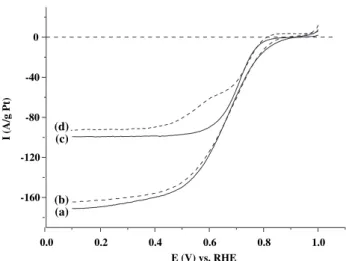
Unlike the conventional PtM (M¼ second metals)[7,31]and non-noble metal [32] systems, the surpassing methanol-tolerance during the ORR observed for the Pt-NOMC-1073 electrocatalyst, as compared with the JM-Pt/C, can be primarily due to our unique synthesis procedure involving the pyrolysis of co-fed carbon sources and Pt precursor in amino-functionalized template. As shown in Fig. 4b, the Pt nano-particles in Pt-NOMC-1073 were found to be studded on the surface of the carbon rods and stabilized by N functionalities which are similar to the synthesized PtNx/C catalysts[33]via
thermal treatment of the chelated platinum precursors. Accordingly, the partial surface of the Pt nanoparticles was overlaid by carbon films and only accessible to O2due to the
fact that methanol was hindered from approaching the activity sites because of the carbon films enveloping the Pt nanoparticles [34]. Moreover, pyridinic-N atoms have been reported to have electrocatalytic activity to ORR[10,11], thus, the existence of pyridinic-N atoms in Pt-NOMC-1073 may be
another contribution to the high performance for the ORR even in the presence of the methanol in the electrolyte.
4.
Conclusions
A series of mesostructured Pt-NOMC-T catalysts with different N contents, well-dispersed and highly stable Pt nanoparticles has been prepared by using N-containing organo-functionalized SBA-15 as the primary N sources and hard templates under various carbonization temperatures. The resultant Pt-NOMC-T catalysts so fabricated were thoroughly characterized by a variety of different spectroscopic and analytical techniques and were tested for applications as electrocatalysts during ORR for DMFC at cathode. It was found that the presence of pyridinic-N species, whose concentration increases as the carbonization temperature increases to 1073 K in the Pt-NOMC-1073 sample, is favorable for the Pt metal dispersion, and hence, for the higher eletrocatalytic activity observed among the Pt-NOMC-T catalysts. The stability of the Pt nanoparticles in mesostructured Pt-NOMC electrocatalysts is also found to be likely related to the fact that they are partial studded in the carbon matrix containing a hexagonal array of nanorods. As a result, the Pt-NOMC-1073 supported catalyst with a Pt and N content of ca. 8.3 and 2.2 wt%, respectively, was found to exhibit the optimal electrocatalytic activity and methanol-tolerance stability during ORR superior than that of a commercial JM-Pt/C catalyst containing 20 wt% Pt. Thus, the synthesized Pt-NOMC-1073 catalysts should have an oppor-tunity for future practical and cost-effective applications as electrocatalysts for DMFCs and PEMFCs.
Acknowledgments
The financial support of the Taiwan National Science Council (NSC 99-2221-E-151-044-MY2 and 99-2221-E-151-023-MY2) is gratefully acknowledged.
Appendix. Supplementary information
Supplementary Information associated with this article can be found, in the online version, atdoi:10.1016/j.ijhydene.2011. 08.083.
r e f e r e n c e s
[1] Service RF. Transportation research hydrogen cars: fad or the Future? Science 2009;324:1257e9.
[2] Khosravi M, Amini MK. Carbon paper supported Pt/Au catalysts prepared via Cu under potential deposition-redox replacement and investigation of their electrocatalytic activity for methanol oxidation and oxygen reduction reactions. Int J Hydrogen Energy 2010;35:10527e38.
[3] Kim JW, Lim B, Jang HS, Hwang SJ, Yoo SJ, Ha JS, et al. Size-controlled synthesis of Pt nanoparticles and their
electrochemical activities toward oxygen reduction. Int J Hydrogen Energy 2011;36:706e12.
(d) (a) (b) (c) E (V) vs. RHE I (A/g Pt) 0.0 0.2 0.4 0.6 0.8 1.0 -200 -160 -120 -80 -40 0
Fig. 6e Polarization curves for the O2reduction on (a)
Pt-NOMC-873 (b) Pt-NOMC-1073 (c) Pt-NOMC-1273 (d) JM-Pt/C in O2saturated 0.1 M H2SO4solution at room temperature.
0.0 0.2 0.4 0.6 0.8 1.0 -160 -120 -80 -40 0 E (V) vs. RHE I (A/g Pt) (d)(c) (b) (a)
Fig. 7e Polarization curves for ORR on Pt-NOMC-1073 with (a) 0 M and (b) 0.5 M CH3OH in O2saturated 0.1 M H2SO4
solution. Commercial JM-Pt/C for ORR in O2saturated 0.1 M
H2SO4solution containing (c) 0 M and (d) 0.5 M CH3OH.
i n t e r n a t i o n a l j o u r n a l o f h y d r o g e n e n e r g y 3 6 ( 2 0 1 1 ) 1 5 0 6 0e1 5 0 6 7
[4] Wang JX, Inada H, Wu L, Zhu Y, Choi YM, Liu P, et al. Oxygen reduction on well-defined core-shell nanocatalysts: particle size, facet, and Pt shell thickness effects. J Am Chem Soc 2009;131:17298e302.
[5] Ramos SG, Moreno MS, Andreasen GA, Triaca WE. Facetted platinum electrocatalysts for electrochemical energy converters. Int J Hydrogen Energy 2010;35:5925e9. [6] Chung CG, Kim L, Sung YW, Lee J, Chung JS. Degradation
mechanism of electrocatalyst during long-term operation of PEMFC. Int J Hydrogen Energy 2009;34:8974e81.
[7] Wang JJ, Yin GP, Wang GJ, Wang ZB, Gao YZ. A novel Pt/Au/C cathode catalyst for direct methanol fuel cells with simultaneous methanol tolerance and oxygen promotion. Electrochem Commun 2008;10:831e4.
[8] Nekooi P, Akbari M, Amini MK. CoSe nanoparticles prepared by the microwave-assisted polyol method as an alcohol and formic acid tolerant oxygen reduction catalyst. Int J Hydrogen Energy 2010;35:6392e8.
[9] Borja-Arco E, Sandoval OJ, Escalante-Garcı´a J, Sandoval-Gonza´lez A, Sebastian PJ. Microwave assisted synthesis of ruthenium electrocatalysts for oxygen reduction reaction in the presence and absence of aqueous methanol. Int J Hydrogen Energy 2011;36:103e10.
[10] Tang YF, Allen BL, Kauffman DR, Star A. Electrocatalytic activity of nitrogen-doped carbon nanotube cups. J Am Chem Soc 2009;131:13200e1.
[11] Maldonado S, Stevenson KJ. Influence of nitrogen doping on oxygen reduction electrocatalysis at carbon nanofiber electrodes. J Phys Chem B 2005;109:4707e16.
[12] Stein A, Wang ZY, Fierke MA. Functionalization of porous carbon materials with designed pore architecture. Adv Mater 2009;21:265e93.
[13] Popov BN, Li X, Liu G, Lee JW. Power source research at USC: development of advanced electrocatalysts for polymer electrolyte membrane fuel cells. Int J Hydrogen Energy 2011; 36:1794e802.
[14] Oh HS, Oh JG, Lee WH, Kim HJ, Kim H. The influence of the structural properties of carbon on the oxygen reduction reaction of nitrogen modified carbon based catalysts. Int J Hydrogen Energy 2011;36:8181e6.
[15] Shao YY, Sui JH, Yin GP, Gao YZ. Nitrogen-doped carbon nanostructures and their composites as catalytic materials for proton exchange membrane fuel cell. Appl Catal B Environ 2008;79:89e99.
[16] van Dommete S, de Jong KP, Bitter JH. Nitrogen-containing carbon nanotubes as solid base catalysts. Chem Commun; 2006:4859e61.
[17] Su FB, Tian ZQ, Poh CK, Wang Z, Lim SH, Liu ZL, et al. Pt nanoparticles supported on nitrogen-doped porous carbon nanospheres as an electrocatalyst for fuel cells. Chem Mater 2010;22:832e9.
[18] Liu G, Li X, Ganesan P, Popov BN. Development of non-precious metal oxygen-reduction catalysts for PEM fuel cells based on N-doped ordered porous carbon. Appl Catal B 2009; 93:156e65.
[19] Li H, Liu H, Jong Z, Qu W, Geng DS, Sun XL, et al. Nitrogen-doped carbon nanotubes with high activity for oxygen reduction in alkaline media. Int J Hydrogen Energy 2011;36:2258e65. [20] Wu G, Li DY, Dai CS, Wang DL, Li N. Well-dispersed
high-loading Pt nanoparticles supported by shell-core nanostructured carbon for methanol electrooxidation. Langmuir 2008;24:3566e75.
[21] Zhao D, Feng J, Huo Q, Melosh N, Fredrickson GH, Chmelka BF, et al. Triblock copolymer syntheses of mesoporous silica with periodic 50 to 300 angstrom pores. Science 1998;279:548e52.
[22] Wang XG, Lin KSK, Chan JCC, Cheng SF. Direct synthesis and catalytic applications of ordered large pore aminopropyl-functionalized SBA-15 mesoporous materials. J Phys Chem B 2005;109:1763e9.
[23] Hsin YL, Hwang KC, Yeh CT. Poly(vinylpyrrolidone)-modified graphite carbon nanofibers as promising supports for PtRu catalysts in direct methanol fuel cells. J Am Chem Soc 2007; 129:9999e10010.
[24] Joo SH, Choi SJ, Oh I, Kwak J, Liu Z, Terasaki O, et al. Ordered nanoporous arrays of carbon supporting high dispersions of platinum nanoparticles. Nature 2001;412:169e72.
[25] Patterson AL. The Scherrer formula for x-ray particle size determination. Phys Rev 1939;56:978e82.
[26] Hsu CH, Wu HM, Kuo PL. Excellent performance of Pt0on
high nitrogen-containing carbon nanotubes using aniline as nitrogen/carbon source, dispersant and stabilizer. Chem Commun; 2010:7628e30.
[27] Zhou YK, Neyerlin K, Olson TS, Pylypenko S, Bult J, Dinh HN, et al. Enhancement of Pt and Pt-alloy fuel cell catalyst activity and durability via nitrogen-modified carbon supports. Energy Environ Sci 2010;3:1437e46. [28] Bore MT, Pham HN, Ward TL, Datye AK. Role of pore
curvature on the thermal stability of gold nanoparticles in mesoporous silica. Chem Commun; 2004:2620e1.
[29] Liu SH, Wu JR. Nitrogen-doped ordered mesoporous carbons as electrocatalysts for methanol tolerant oxygen reduction in acid solution. Int J Hydrogen Energy 2011;36:87e93. [30] Pels JR, Kapteijn F, Moulijn JA, Zhu Q, Thomas KM. Evolution
of nitrogen functionalities in carbonaceous materials during pyrolysis. Carbon 1995;33:1641e53.
[31] Lima FHB, Lizcano-Valbuena WH, Teixeira-Neto E, Nart FC, Gonzalez ER, Ticianelli EA. Pt-Co/C nanoparticles as electrocatalysts for oxygen reduction in H2SO4and H2SO4/
CH3OH electrolytes. Electrochim Acta 2006;52:385e93.
[32] Pe´rez G, Pastor E, Zinola CF. A novel Pt/Cr/Ru/C cathode catalyst for direct methanol fuel cells (DMFC) with
simultaneous methanol tolerance and oxygen promotion. Int J Hydrogen Energy 2009;34:9523e30.
[33] Oh JG, Kim H. Synthesis and characterization of PtNx/C as
methanol-tolerant oxygen reduction electrocatalysts for a direct methanol fuel cell. J Power Sources 2008;181:74e8. [34] Wen ZH, Liu J, Li JH. Core/shell Pt/C nanoparticles embedded in
mesoporous carbon as a methanol-tolerant cathode catalyst in direct methanol fuel cells. Adv Mater 2008;20:743e7.