國
立
交
通
大
學
資訊科學與工程研究所
碩
士
論
文
高 效 能 雲 端 儲 存 管 理 策 略 之 研 究
A Management Strategy of Replica Compression
for Hadoop
研 究 生:郭文俊
指導教授:蔡文能 教授
高 效 能 雲 端 儲 存 管理 策 略 之 研 究
A Management Strategy of Replica Compression for Hadoop
研 究 生:郭文俊 Student:Wen-Jun Guo
指導教授:蔡文能 Advisor:Wen-Nung Tsai
國 立 交 通 大 學
資 訊 科 學 與 工 程 研 究 所
碩 士 論 文
A ThesisSubmitted to Institute of Computer Science and Engineering
College of Computer Science
National Chiao Tung University
in partial Fulfillment of the Requirements
for the Degree of
Master
in
Computer Science
June 2011
Hsinchu, Taiwan, Republic of China
i
高效能雲端儲存管理策略之研究
學生:郭文俊
指導教授:蔡文能
國立交通大學資訊科學與工程研究所碩士班
摘要
我們提出一個雲端儲存副本管理策略,其利用少量儲存空間來保持資料可靠 性。為了儲存海量的資料,雲端儲存系統通常使用分散式檔案系統當作它的後端 儲存系統。自Google提出GFS(Google File System)後,Apache軟體基金會開發 了一個 Hadoop Distributed File System (HDFS),其是一個提供Map/Reduce 框架計算的開放原始碼專案。為了改善系統可用性,檔案系統的架構採用資料複 製和機櫃感知的方法,當有節點掛掉時,至少仍可保持一份的資料副本在系統 中。然而,有兩個重要的問題需被考量,包含如何放置副本,以及如何減少因為 為了維持可用性所使用的資料複製而帶來的大量空間消耗。 在本篇論文中,我們提出一個副本管理策略來確保資料可用性以及減少空間 消耗。我們的方法根據自動地偵測網路拓墣,求出每個副本的適當位置。至於空 間消耗的問題,我們壓縮額外的副本在背景運作中,使得系統增加更多可用空 間。我們實作此策略在HDFS中,結果顯示此策略可以有效減少儲存空間,且不影 響系統效能。ii
A Management Strategy of Replica Compression for
Hadoop
Student:Wen-Jun Guo
Advisor:Wen-Nung Tsai
Institute of
Computer Science and Information EngineeringNational Chiao-Tung University
Abstract
We propose a replica management strategy for cloud computing, which consumes minimum cost to keep data reliability for cloud storage. To store massive data, cloud storage usually adopts distributed file system as its backend due to the concern of scalability. With the GFS (Google File System) proposed by Google, the Apache Software Foundation developed HDFS (Hadoop Distribute File System), which is a primary storage system for computing with Map/Reduce framework. To improve system availability, the file system architecture adopts data replication and rack-awareness to preserve at least one copy when node crashes. However, two important issues should be considered. These include how to place the replicas, and how to reduce the large space consumption comes with duplicate replicas for the data availability.
In this thesis, we present a replica management strategy to ensure the data availability and to reduce the space consumption. Our method determines proper places of each replica according to the network topology which is detected automatically. As for the problem of space consumption, we compress the additional copies of data in background. This makes the system increase more available space. We implemented the strategy on HDFS. The results show that the proposed strategy can effectively reduce the storage space, and will not affect system performance.
iii
誌謝
研究所兩年生活最要感謝的是我的老師-蔡文能教授,無論是課業還是研究 上,給了許多幫助以及寶貴的意見。在課業不順利時,盡其所能的幫助我在課業 上順利過關;在研究遇到瓶頸時,引導我如何去突破障礙,找到繼續研究的動力。 從老師身上,我學到了嚴謹的學術態度以及艱深的專業能力,這些將是我面臨未 來挑戰時用來突破困境的必備能力。 另外,還要感謝系計中的工作夥伴,在你們身上學到了高深的技術,以及認 真的處事態度,能與你們一起工作是我這生最快樂的時光。還有,感謝實驗室學 弟、同學熱心的建議,解決我許多研究的盲點。還有,感謝智瑋學長,在研究議 題以及學術論文寫作上提供專業的諮詢,才使得論文最後能順利完成。 最後,我要感謝我的家人,謝謝你們不求回報的關懷。在研究所的這段時間, 無論是精神上或是物質上,給了莫大的支持,使得我能無後顧之憂,順利完成我 的學業。在此,我由衷的感謝曾經幫過我的人,若沒有你們,也就沒有今天的我。Table of Contents
1 Introduction 1 2 Background 3 2.1 The Goal of HDFS . . . 3 2.2 HDFS Architecture . . . 4 2.2.1 NameNode . . . 4 2.2.2 DataNode . . . 5 2.2.3 HDFS Client . . . 6 2.3 Data Replication . . . 7 2.4 Replica Placement . . . 7 3 Related Work 8 3.1 Hadoop’s Rack Awareness . . . 83.2 System Parameter Based Replication Management . . . 9
3.2.1 Model-Driven Replication . . . 9
3.2.2 System Model . . . 10
3.2.3 Cost-Effective Dynamic Replication Management . . . 11
3.3 Network RAID: DiskReduce . . . 13
3.3.1 Encoding Type . . . 13
3.3.2 Background Encoding . . . 14
3.4 Summary . . . 15
4 A Management Strategy of Replica Compression 17 4.1 Replica Placement . . . 17
4.1.1 Obtain location of DataNodes by using a topology detector . . . 19
4.1.2 Partition Network . . . 20
4.2 Replica Management . . . 22
4.2.1 Background Compression . . . 22
4.2.2 Real-Time Decompression . . . 24
5 Implementation and Experimental Results 27 5.1 Implementation . . . 27 5.1.1 Topology Detector . . . 27 5.1.2 Compressor . . . 29 5.2 Emulation Environment . . . 30 5.3 Evaluation Criteria . . . 31 5.3.1 Disk Space . . . 31 5.3.2 Compression Time . . . 32
5.3.3 Performance of Reading Data . . . 32
5.4 Comparison . . . 33
5.5 Issues . . . 34
5.5.1 Compressing Entire Replicas versus Partial Replicas . . . 34
5.5.2 The Difference Between Rack-based and Network-based . . . 35
5.5.3 Space Balancing . . . 35 6 Conclusion and Future Work 37
List of Tables
3.1 The System Parameters of Model-Driven . . . 10
3.2 The System Parameters of CDRM . . . 12
4.1 The Parameters of the Probability for Data Reliability . . . 18
List of Figures
2.1 Hadoop Distributed File System Architecture . . . 5
3.1 Hadoop Rack-Awareness . . . 9
3.2 The RAID5 and RAID6 Scheme in DiskReduce . . . 14
4.1 An Example to Explain the Risk of the Cluster in the Network . . . 18
4.2 Example: Partitioning Switch-level Network . . . 20
4.3 Example: Partitioning Router-level Network . . . 21
4.4 Example: Client Sends a Request for Compressing the Files . . . 23
4.5 Example: Decompressing in Time and Replicating . . . 25
4.6 Example: Full Scenario in an Environment of Network Layer 3 . . . 26
5.1 The Behavior of the Topology Detector in the L2 Network Environment . . . . 28
5.2 The Behavior of the Topology Detector in the L3 Network Environment . . . . 28
5.3 The Design of Compressor . . . 29
5.4 The Comparison of Saved Space with Different Data . . . 31
5.5 Comparing the Compression Time of System Logs and Web Pages . . . 32
5.6 Performance of Reading Data . . . 32
5.7 The Compression to MSRC and the Studies . . . 33
5.8 The Structure of the Well-planed Environment . . . 35
Chapter 1
Introduction
In recent years, cloud storage has become a popular research topic. With the rapid develop-ment of the Internet, more and more storage requiredevelop-ments are moved to the Internet. Typically, the storage that is accessed from the Internet is called the cloud storage. The ability of space expansion in classic central storage is limited for single server architecture.
Storing data on the Internet that has many advantages. First, it is convenient for mobile users. The users can access their data from anywhere via web and special supported client if the network is available. Furthermore, The storage must guarantee to protect user privacy and prevent data loss. The cloud storage vendors provide the features, which let users concentrate on their work without worrying about data backup, protection and recovery. On the other hand, the design on the architecture of cloud storage must be expandable. With the increase of data storing requirement, a single central storage will encounter a bottleneck for storing a huge amount of data. A single central storage will encounter the bottleneck for storing a huge amount of data. The storage of the classic file system relies on the disk space of a single server. So, the scalability depends the number of the slots on a centralized file server or RAID system. Therefore, the classic file system is no longer adequate for large data storage.
In the general case, the cloud storage usually adopts a distributed file system as its back-end because the distributed file system has many advantages can overcome the problems such as fault tolerance, scalability and availability. The file system can store unlimited data if the design is scalable to arbitrarily extend the space. So, The distributed file system is composed of nodes, which is known as multiple servers. The distributed file system access files stored on nodes via the network. Neither writing or reading, transmission with nodes that contains desirable
data needs to be done over network. Usually, a client which accesses the file may be able to be treated as a node in the distribution system. The file system can aggregate the bandwidth of the nodes. In theory the transmission capacity of a distributed system is the sum of the nodes bandwidth. Besides, the good design of distributed system does not have the problem of a single point of failure, which can be easily solved by the mechanism of tolerating partial nodes failure. So, these features ensures the service that is always being is available during data transmission. In 2003, Google proposed GFS (Google File System) [4], designed for scalability, availabil-ity, and reliability. The design regards servers failed in the system as a normal behavior. The distributed file system is composed of thousands of servers, so the probability of servers fail-ure is higher. According to this, GFS replicates multiple copies of a block info different chunk server for data reliability and availability. Based on the publication of Google’s MapReduce and GFS , Apache foundation launches the Apache Hadoop project [13] as a version of open source implementation. Apache Hadoop is a programming framework for MapReduce computing. It uses the Hadoop Distributed File System (HDFS) [12] as its low-level file system. So, HDFS is a special purpose of file system for Hadoop distributed programming . HDFS also implements a few POSIX standards to provide the operation which is similar to the classic file system, but its performance is lower because it is designed for MapReduce programming. Both of GFS and HDFS are designed for data-intensive computing purpose. Because of HDFS is open source and a clone of GFS. Neither replicas placement or replica management the design is very similar. Thus, we choose HDFS as our research platform and implement on it for system evaluation.
In order to meet the data availability and reliability, the architecture of HDFS adopts data replication, which keeps at least one copy of a block when some nodes have no response. How-ever, the replicas placement, which is a key problem, ensures the replicas of the data are not in the critical or closed node while network cable is broken or machines failure. Besides, although the storage pool can be arbitrarily and dynamically extended space, which stored data for fault tolerance, but both of the cost of the space and space utilization are disproportionate.
In this thesis, we aim to save disk space and effectively divide up critical groups of a net-work for placing replicas. The proposed method only costs small space to provide the feature of fault tolerance, and it can automatically determine better replicas location in any network environments. Thus, the system administrator does not require to manually maintain a list for server location.
Chapter 2
Background
Since Google has published Google File System (GFS) and MapReduce papers, Apache launched a project named Apache Hadoop, which is used for data-intensive computing. Hadoop’s storage system is called Hadoop Distributed File System (HDFS), which is designed for storing large amount of data. In this requirement, many challenges in the distributed environment that should be overcame. So the following sections will introduce the goal, design and how to meet the issues of HDFS.
2.1
The Goal of HDFS
The goal of HDFS is to compute large amounts of data. That is very different than a classic file system such as Ext2, Ext3 and UFS. The major programming on HDFS is called Map/Reduce programming. The applications are written by using Map/Reduce framework that can employ the powerful capacity to process datasets (e.g., system log analysis, machine learn-ing, data mining). Thus, the features for the computing will be described as the following three points.
Tolerance to Server Failure
In the past, a single server has a problem of single point of failure (SPOF). When a central-ized server fails, the whole system does not service anymore. So as to overcome the problem, HDFS adopts distributed architecture and data replication. When a node is non-functional, one
of nodes will take over and recover the data. The action of detection and recover action is auto by system-self. So the system has a high degree of capacity of self repair.
Large Data Storing
The capacity of a single server which stores large data is limited because the expanded ca-pacity of disks is limited. So, HDFS cascades nodes space via network, and effectively manages the index which maps the blocks of file to a node. Therefore, HDFS has enough ability to handle the processing for large amount of data.
Portability and Scalability
Because of storing data in network nodes, the design considers the software that may run on different operating system and hardware architecture. For the portability, HDFS is written by Java such that easily migrate to various systems.
2.2
HDFS Architecture
The HDFS is composed of two types of nodes: NameNode and DataNode. Usually, The number of DataNodes is greater than the number of NameNodes. The section will explain the role and responsible job of the nodes.
2.2.1
NameNode
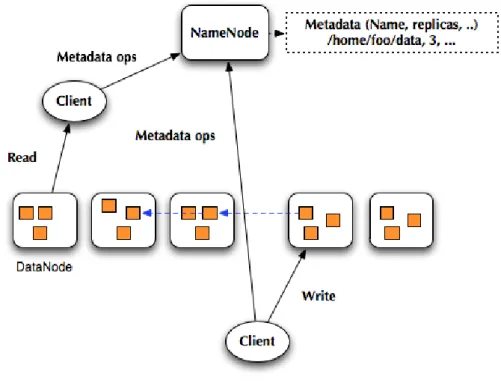
The NameNode maintains a file system namespace to record a structure of file and directo-ries. The structure is tree hierarchy, which means it is similar to a classic file system composed of files and directories. HDFS also uses inode to represent some file attributes, such as permis-sion, modification and access times. A file on HDFS is split into multiple block to store into DataNods. Each block size is 64MB by default. The unit of data replication is a block instead of a file. In addition to namespace, The NameNode is also responsible to maintain a table, which maps the blocks of files to DataNodes. The entire namespace and block map are stored in
Figure 2.1: Hadoop Distributed File System Architecture
the NameNode’s memory. Too many small files would cause more overhead to the NameNode. The namespace is persistently stored on disk which is calledFsImage. Every modification of a file would be recorded onEditLog, called Journal. When the NameNode starts, it constructs the namespace from reading FsImage, then read EditLog to redo all transactions. The EditLog will be truncated because the recorded transactions are applied. The FsImage is to store local file system after applying transactions that is calledcheckpoint. Thus, when the NameNode crashes, it uses EditLog and FsImage to recover the namespace in the next start.
The original HDFS version has a single failure point problem. When the NameNode crashes or hangs out, all functions of HDFS will not work. In the current release, HDFS allows over two NameNodes to manage the system.
2.2.2
DataNode
The DataNode responsible to store a block split from a file. Each block stores two files into DataNode’s local file system. First one is a data block, which contains the data on file. The second file is called metadata, which records the checksum and generation stamp. If the last piece of split block is lack of default block size, the size of stored block is equal to the size of last remained block.
2.2.3
HDFS Client
HDFS provides a series operations similar to the classic file system (e.g., read, write, delete). A file or directory is accessed according to the path in the namespace. The HDFS is transparent to the client. That means it does not know how HDFS works and where the block are stored. They only concentrate on run their job. If an application wants to use HDFS, they must through API provided by HDFS. HDFS , which exposes interfaces (HDFS API) for any applications, are easy to use operations of HDFS. For instance, A Map/Reduce program can use the API to schedule tasks for improving performance.
Reading
When a client sends a request of reading files, first it will communicate with the NameN-ode for which blocks constitute the file and where the replicas of the blocks. By default, one communication will ask NameNode for ten blocks information. Yet, the replicas of the block are sorted by NameNode according to the location of client and replicas. The client refers the replica location information, then send a block reading request to the DataNode. Now begin to transfer the desired block.
Writing
Writing procedure is similar to reading procedure. When a client sends a request of writing, it also asks the NameNode for available DataNodes first. The NameNode replies the DataNodes information to client. Then, the client writes a block of data to first DataNode which is from the information. After writing a first block, the block will be replicated to the other DataNodes by received DataNodes, until the current number of the replicas equals to replica factor of file. This process is called Pipeline Writing. Therefore, although the blocks have many copies, the client only write one time. Neither reading or writing, when the desired DataNode has error, the client will choose another available DataNodes to continue the job. Each failure in reading or writing the pipeline will be re-organized as new pipeline.
2.3
Data Replication
Most distributed file systems usually split a file into multiple blocks to store. Either reading or writing is through multiple storage source to increase system performance like RAID5. Data replication is one of methods which ensures data always has at least one copy available. The function is quite useful and straightforward to implement. It can make data protection in block-level. Block-level protection has many benefits. One is when the partial data are corrupt or unavailable, only missed blocks must be rebuilt or re-sent.
Typically, more than two copies are put on different storage that can improve data reliabil-ity. When a client reads blocks of data from multiple sources, the performance is better than accessing from only one source. Thus, what is the number of replicas is better in HDFS that is a key problem. If replica factor is set too high, that may increase performance and availability but actually free space is reduced and increase the cost of storage. Moreover, it may exhaust the network bandwidth so that performance is not as expected result. The optimal situation is to use minimum replica to satisfy requirement of performance and availability.
2.4
Replica Placement
The current HDFS replica placement strategy follows a simple rule. That attempts to im-prove data reliability and access performance. So, Apache released version of Hadoop uses three copies of a block as a default replica factor.
The first copy is put on local DataNode. That means the block is written on local disk because the client is usually regarded as DataNode. The speed of local disk access is faster than the speed network transmission. After first copy written completely, it will be replicated to the other DataNodes by using pipeline. The second copy will be chosen to locate at the far distance to store. The distance factor is compared to location of DataNodes which has first one. This idea is a concerns for data reliability because the data which are put on two nodes with farthest distance is the safest. In contrast, the two nearest is unsafe because both of them are able connected to the same network device or power supply. If the device crashes or the power is cut off, the data would be loss. The third copy is located on a different DataNode at first the rack but different host than first one. Because of second copy has ensured data reliability, the location concern of the last copy is main for performance. The nearest copies can improve the read/write performance.
Chapter 3
Related Work
This chapter will introduce the work whose goal is relative to our work. Hadoop’s pro-posed method will present at the first section, and then present the proposal that deals with data reliability, and the last section will show the method which solves the problem of space consumption.
3.1
Hadoop’s Rack Awareness
Hadoop uses rack-awareness [14] method to increase system availability and performance. This idea was first proposed on the website of the project, and then implemented into Hadoop software as a basic function eventually.
The feature assumes HDFS must run on the environment constructed as tree hierarchical network topology. Specifically, the network devices, server and rack must be structured as a Hadoop cluster beforehand rather than arbitrarily construct that. So, one rack only has one switch and devices link with the switch in the rack. The layout forms a tree logically hierarchical structure. Each DataNodes has an identical default ID in rack-awareness method. To use the method,the DataNodes must be configured with an unique ID. The ID consists of data center and rack number which implies the location of the DataNode. When a DataNode requests to join a cluster, it sends its ID to the NameNode. The NameNode confirms the node which wants to join the cluster whether exists in the map, and then add entry or update the map. If a DataNode does not provide its ID, it uses the default ID and belongs to default group in the map. After all DataNodes have joined the cluster successfully, the NameNode is responsible to maintain the
map of the location of DataNodes. The NameNode can refers this map to know the distance of the DataNode to each other and place replicas. The unit for replica placement based on
Figure 3.1: Hadoop Rack-Awareness
rack-aware is a block but not a file. The placement strategy is summarized as the following: • 1st Replica: placed a DataNode which is a client, also know as local node
• 2nd Replica: placed a node at a different rack with 1st Replica
• 3rd Replica: placed a local rack but different node which store first replica
3.2
System Parameter Based Replication Management
This section describes the methods based on system and network parameter. During system operating or network transmission, system availability and performance are affected by many environmental characteristics. Usually, solving problem for a reasonable value of setting can use calculating the environment factors to determine the accurate value. The following subsections will introduce two studies which use parameter calculation as their basis.
3.2.1
Model-Driven Replication
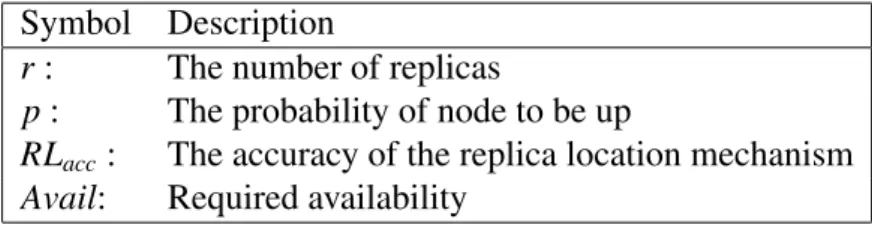
The model-driven approach by K. Ranganathan et al. was published in 2002 [3]. This work focuses on peer-to-peer (P2P) network. The P2P network also widely uses data replication to ensure data reliability on file sharing because the clients may have identical files. The paper addressed two problems as the following:
Symbol Description
r : The number of replicas
p : The probability of node to be up
RLacc: The accuracy of the replica location mechanism
Avail: Required availability
Table 3.1: The System Parameters of Model-Driven • What is the number of replicas of a file is optimal?
• How to determine a node to store an additional replica?
3.2.2
System Model
The relation between the parameters and the value of desired availability can be formulated as the following:
RLacc∗ (1 − (1 − p)r)>= Avail
This paper assumes there is a resource discovery mechanism, which provides a set of can-didate domains for file locating. The domain is a collection of nodes which across different geographical areas. Any two nodes in the same domain are regarded as they have the same transmission speed and storage cost. The criteria of a candidate domain returned to a client are:
• Do not have the file copies • The storage is available
• The transmission speed is enough to the user
The paper provides a formula to model the cost of domains.
cost= s(F, N2)+ trans(F, H1, N2)
s(F, N) that means the storage cost of F at N, and trans(F, N1, N2) is transmission cost from N1
to N2.
The simulation results show the desired availability 1.0 requires five replicas of a file. The three replicas in a peer-to-peer system can obtains 0.95 availability. The study presents, dynamic creating replicas based on calculating the parameters, is effective to increase availability.
3.2.3
Cost-E
ffective Dynamic Replication Management
Cost-Effective Dynamic Replication Management by Q. Wei et al. was published in 2010 [9]. The paper addressed two problems in the replicas management:
• How many replicas should be kept to satisfy high availability requirement? • How to place replicas to maximize system performance and balance loading?
For solving these problems, the authors formulate the parameters from two aspects, which are availability and block probability. Using the formulations can derive the best value such as the number of replica and replica location.
System Model
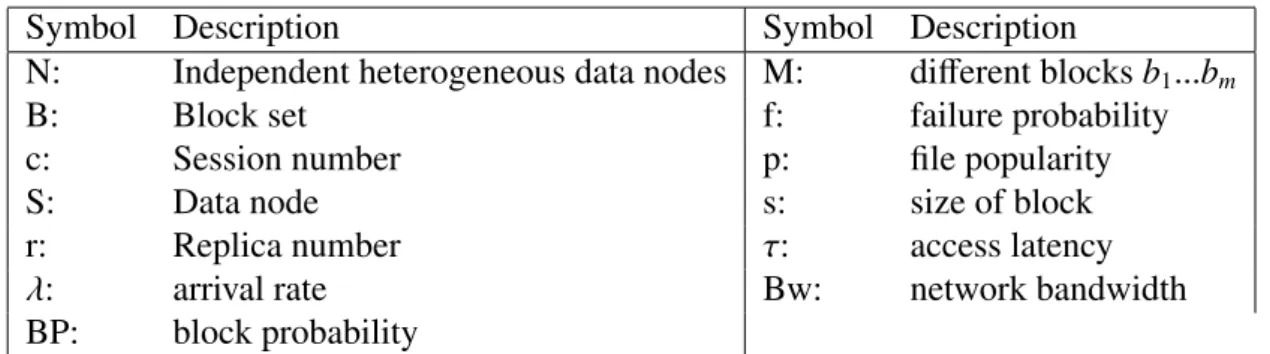
The distributed file system can be separated several different components to model in order to derive the accurate result. The system consists of N independent nodes, which store M different blocks. b1,b2,...bM denotes blocks. The Bi = bi1, bi2, ...biM is denoted the set of
the node Si stores M different blocks. bj = (pi, sj, r j, τa) denotes a set of attribute of block
bj. They denotes popularity, size, replica number and access latency of a block, respectively.
Sj = (λj, τ, fj, bwj) denote a set of attributes of node Si, which are request arrive rate, average
service time, failure probability, and network bandwidth respectively.
The paper provides a formulation to decide how large the network bandwidth is sufficient to the performance requirement of the node.
bwi ≥ ci ∑ j=1 sj τj
It indicates the bandwidth of the each session is calculated by sj/τj. So the bandwidth
re-quirement of data node Sj is greater equal than the bandwidth of all sessions the node serves.
Availability
The probability of node availability is denoted as P(NA). P( ¯NA) is the opposite of meaning.
Symbol Description Symbol Description
N: Independent heterogeneous data nodes M: different blocks b1...bm
B: Block set f: failure probability c: Session number p: file popularity S: Data node s: size of block r: Replica number τ: access latency λ: arrival rate Bw: network bandwidth BP: block probability
Table 3.2: The System Parameters of CDRM
block availability. In the contrast, P( ¯Bi) indicates the probability of block unavailability. The
probability of file availability is denoted as P(FA), and the contrary is P( ¯FA). After a series of
mathematical variable substitution, The formulation which derives the number of replicas is:
1− m ∑ j=1 Cmj(−1)j+1( rj ∏ i=1 fi)≥ Aexpect
Minimum replica number rminis reasonable value in the expected availability of a file. By using
the formulation, the system dynamically determines the number of replicas of each file.
Block Probability
The second issue is to place replicas for obtaining a balance between maximizing perfor-mance and minimizing system loading.To that end, blocking probability is the only parameter referred. Blocking probability implied that a node with probability to block or drop service requests.
The probability of accessing a node Siis
∑
j=1MiPrji. According to Poison process theorem,
λ is assumed to total arrival rate. An arrival rate of a node Si is:
λi = Mi ∑ j=1 Pi rj λ
The average service time of node Siis:
τ = 1 Mi Mi ∑ j=1 τj
Finally, The blocking probability of node is Simodelled as M/G/ci system BPi = (λiτj)ci ci! ci ∑ k=0 (λiτj)k k! −1
A node with low blocking probability has high priority to be chosen as a replica location due to the node has a lower loading than the others. The NameNode uses B+ tree to store BP (Block Probability) for accelerating search speed. The value of blocking probability is a key and node ID is a value are stored in the structure. Thus, the NameNode can quickly find the node with low BP value in the record of the thousands of nodes. The blocking probability is a useful criterion for replica placement and load balancing.
The strategy is implemented to Hadoop for emulation. The experimental results show, the system has greater than 0.9 availability is required to keep about four replicas. Moreover, the difference of the system utilization is very smaller than the unmodified version of Hadoop. That means, the study efficiently balances the nodes loading, and uses less replicas to keep availability than the the previous studies.
3.3
Network RAID: DiskReduce
DiskReduce by B.Fan et al. was published in 2010 [8]. In the paper, the aim is to reduce disk space based on Redundant Array of Independent Disks (RAID) data storage scheme. DiskRe-duce is a kind of network RAID. Due to the performance concern, DiskReDiskRe-duce executes the data encoding in the background. The redundant blocks are not deleted during an encoding phase until the encoding phase completes. Thus, the available space in the system will grow after encoding process.
3.3.1
Encoding Type
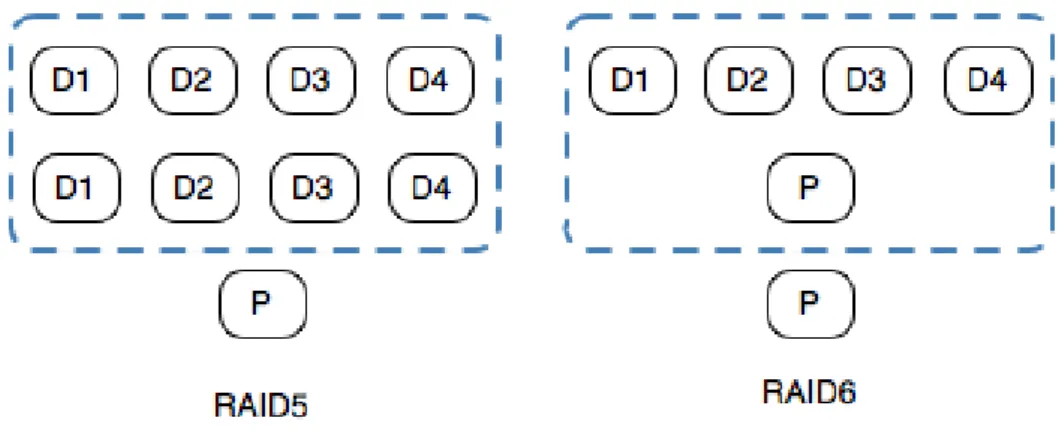
The study proposes two prototypes: RAID5 and RAID6. Each scheme has different capacity of reducing the space. By default, three copies are used in the system.
Figure 3.2: The RAID5 and RAID6 Scheme in DiskReduce RAID5
This scheme maintains a fully mirror version and a RAID5 parity set. The parity set is required to recover the data if all mirrored copies of the block are not available. In a nutshell, one of the copies of the block is encoded as a parity set. The reduced storage overhead is 1+1/N, where N indicates how many blocks are calculated as a parity set.
RAID6
The difference between RAID5 and RAID6 is the number of full backups of blocks. The feature of RAID is encoding additional copies instead of the full backup. The scheme can also tolerate double copies failed like RAID5 scheme. It maintains one copy and double parity set. The storage overhead only remains 2/N, where N denotes how many blocks are calculated as a parity set. Both of them are implemented on userspace of HDFS. The results show, RAID5
scheme can reduce 40% overhead in storage capacity, and RAID6 can reduce 70% overhead because RAID6 have two parity set instead of two full backs.
3.3.2
Background Encoding
HDFS replicates the block in the background. The concern of running in the background is to facilitate the overhead of implementation. The process spends little time during encoding. In general, increasing the number of copies can improves performance. The paper describes
three issues to discuss because the copies in DiskReduce implementation are less than or orig-inal HDFS. The below will shows three reason reduce copies number might cause low perfor-mance. First reason is duplicated tasks. During Map/Reduce processing, once the computing node crashes or long time to response, the job which the node have that will be taken by an-other node. Above is called Backup task. The attention is, the choice is prefer the node which have local copies which same the original node. Otherwise, that will consume much network bandwidth because the backup task will occupy part of the bandwidth. Finally the computing performance will decrease more than no backup task mechanism. Second reason is disk band-width. According this paper, popular file usually is small size data. If decreasing the number of copies, a part of nodes which have the popular file will become a bottleneck. The GFS design allows a file have many copies that over three copies if necessary. Third reason is load balanc-ing. The data are randomly distributed within the nodes, but it may not be evenly distributed. The result causes execute Map/Reduce with choosing node has local copies preferably is load-ing unbalance. If have many copies, the job tracker can efficiently assign tasks such that nodes loading will be balanced.
The method is implemented on Hadoop. The experimental result shows, it reduces the overhead of space from 200% 125% to by using RAID6 scheme. Even if only one copy of blocks serves the requests, the performance gets little penalty. Hence the study is very practical and useful to reduce the high overhead of space.
3.4
Summary
The studies solve the problem of availability, performance and space respectively on a clus-ter. Implementing on HDFS is mainstream because HDFS is a very popular platform for build-ing a cloud storage. The researches have the common goal is how to minimize cost to maximize performance under guaranteeing the availability situation.
Hadoop Rack-Awareness
Although the study solves the problems, there are some issues are not being considered or bring new issue. Through well-planing DataNodes location, replicas will be placed into appro-priate node. If the network structure is built with the racks layout, the system has the ability to handle power outage or network accidents. However, the network environment and servers
should match the assumption constructed as tree hierarchical network topology. Furthermore, manager manually maintains a list to record the location of DataNodes in racks. Unfortunately, many environments are non-structural, which implies general network environments with lim-ited cost have no well-planed physical network environment. To recode the location of servers, maintaining thousands of servers is trouble for system administrators.
System Parameter based
The studies of system parameter based can accurately measure various factors in a system by using network and system characteristics. The result shows it requires many replicas to improve performance and availability. In contrast, high replica number comes with several times space overhead is a serious problem. Although raising replica factor of popular file or lowering replica factor of unpopular file is dynamic. On average the number of replicas is greater than four. That is, only less than a quarter of the real space can be used. Furthermore, the method does not consider the location of the node that cannot guarantee availability. Once all replicas of a block of a file are placed in identical node, the file will lose when the node crashes. Thus, placing replicas according to the nodes location is better than increasing replica factor for availability.
DiskReduce
DiskReduce applies the concept of RAID in HDFS. By using data encoding that effectively reduces the space overhead spending additional space to store replicas for data protection. Spe-cially, performance is not reduced too much. However, DiskReduce has the lack of flexibility which cannot let a user specify which file has to be encoded. On the other hand, decoding the encoded file is difficult because the system cannot control which files to be grouped for RAID encoding.
According to the drawbacks, next chapter we present our method, whose one of functions enhances Hadoop’s rack-awareness, and the function of reducing disk space is more flexible than DiskReduce.
Chapter 4
A Management Strategy of Replica
Compression
This chapter describes the detailed management strategy of our scheme named MSRC (Management Strategy of Replica Compression). The strategy is divided into two parts, replica placement and replica management respectively. The section of replica placement describes how to choose a location for replicas is appropriate, and the section of replicas management presents the method to increase the free space of the storage.
4.1
Replica Placement
The placement idea is mainly inspired by Hadoop’s rackaware, but based on the network topology instead of the location of physical racks. Replica location is more crucial than in-creasing the number of replicas to protect data. However, any network can be seen as multiple sub-networks groups. The links between the core device and a sub-network group is a criti-cal path. If any criticriti-cal path breaks, at least one host will disappear in the network and some replicas will be lost for the distributed system.
For instance, Figure 4.1 is a cluster whose servers are distributed in the network. Logically, the network is considered as three sub-network groups. To keep data reliability, how to avoid placing the replicas of a block in the identical group is a major issue. If the placement is
non-Figure 4.1: An Example to Explain the Risk of the Cluster in the Network
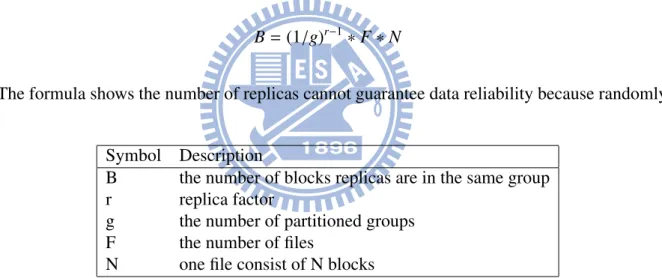
location-based, the relation of a network and replica can be modelled as the following formula.
B= (1/g)r−1∗ F ∗ N
The formula shows the number of replicas cannot guarantee data reliability because randomly
Symbol Description
B the number of blocks replicas are in the same group r replica factor
g the number of partitioned groups F the number of files
N one file consist of N blocks
Table 4.1: The Parameters of the Probability for Data Reliability
placing replicas causes all replicas of some file is in an identical sub-network. The system can-not serve users with high availability. So, our method is network-location-based that attempts to locate DataNodes in order to avoid the situation happening. It consists of three order phases.
• Obtain location of the DataNodes by using a topology detector • Partition network
4.1.1
Obtain location of DataNodes by using a topology detector
The topology detector provides administrators with two options of network type, switch level (Layer 2 Network) and network level (Layer 3 Network) based on OSI (Open System Interconnection) model. Because different network types use various bases to be logically sep-arated into sub-network groups, the administrator must pre-configure the used network type before using the detector.
In a switch-level network, in order to obtain information about the relation of DataNodes’s MAC (Media Access Control) address and the switch port, the top-level switch must enable SNMP agent for managing the network device. The topology detector collects switch’s CAM (Content Addressable Memory) table via SNMP (Simple Network Management Protocol) and MAC address from ARP (Address Resolution Protocol). The following example is CAM table: SNMPv2-SMI::mib-2.17.4.3.1.2.0.1.215.27.251.129 = INTEGER: 27
SNMPv2-SMI::mib-2.17.4.3.1.2.0.2.179.2.246.123 = INTEGER: 80 SNMPv2-SMI::mib-2.17.4.3.1.2.0.2.179.153.80.195 = INTEGER: 80 SNMPv2-SMI::mib-2.17.4.3.1.2.0.2.179.155.22.88 = INTEGER: 80 SNMPv2-SMI::mib-2.17.4.3.1.2.0.3.186.35.246.252 = INTEGER: 109
The postfix of SNMPv2-SMI::mib-2.17.4.3.1.2. is MAC address which is represented as mul-tiple decimals separated by dot. The first line shows 00:01:d7:1b:fb:81 is mapped index 27, and then the index 27 is mapped to an InterfaceIndex table in SNMP. That is, the MAC address appears on the port with index 27. One MAC address only maps single index, but one port can map to several MAC addresses. In a network-level network, IP can be used to decide the location of a host, The topology detector only collects IP of Datanodes because the information is enough to partition network.
There are two occasions require to update the location data. The first occasion is, when HDFS starts, the NameNode calls the topology detector to collect the location of DataNodes whom the NameNode connect. The second occasion is when a new DataNode requests for joining the cluster, the NameNode requires to obtain its location to update the location list. In these occasions NameNode executes the topology detector to update the list which contains location information of DataNode.
4.1.2
Partition Network
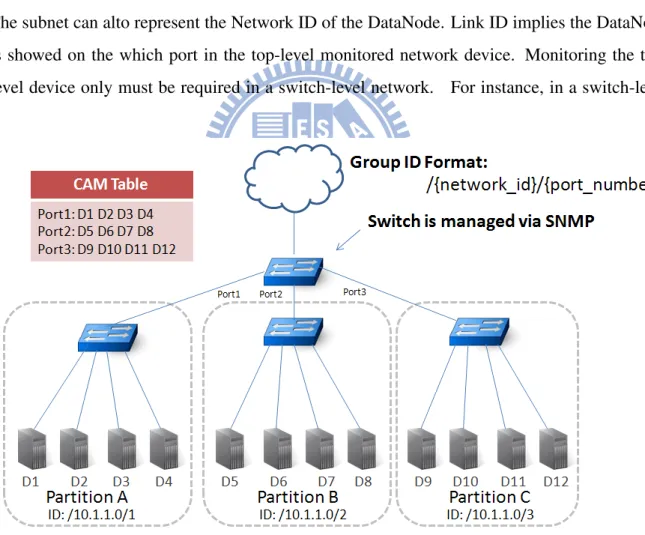
This phase introduces how to group adjacent DataNodes. On the physical network topology, the adjacent DataNodes are linked to the identical network device. If the port which the DataN-odes linked is failed, these DataNDataN-odes will break simultaneously. So, the objective of the phase is to partition the network into multiple sub-network groups as a unit for the replica placement. When the data have been collected by the NameNode at the previous phase, the NameNode tags each DataNode with a group ID for indenting which group the DataNode belongs. If the DataNodes have the same group ID, it implies that the DataNodes belong to the identical network group. For identifying a group, the group ID is composed of Network ID and Link ID. Network ID is the result of IP address of the DataNode masks with the subnet mask. In short, The subnet can alto represent the Network ID of the DataNode. Link ID implies the DataNode is showed on the which port in the level monitored network device. Monitoring the top-level device only must be required in a switch-top-level network. For instance, in a switch-level
Figure 4.2: Example: Partitioning Switch-level Network
network environment, Network ID of all DataNodes is the same because all of them belong to one subnet. To classify it, the MAC address appears which switch port (the top-level switch) is
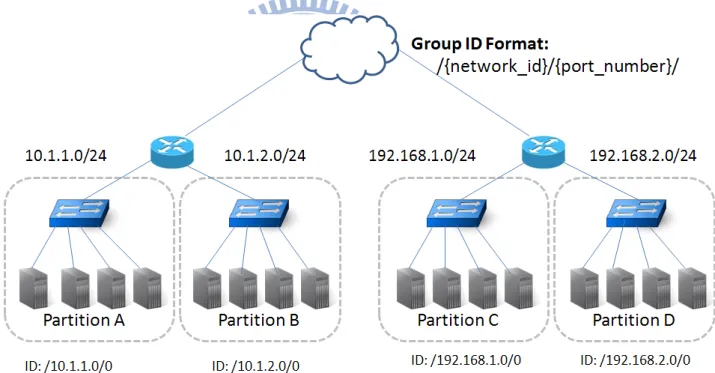
the basis. The DataNodes in the different ports that implies the DataNodes belongs to various network groups. In a router-level network environment, Network ID is calculated by IP of the DataNode and default subnet netmask 255.255.255.0 with AND operation. The Link ID of all of DataNodes is the same because there is no the monitored network device. Thus, Link ID is a default value (zero). Obviously, Partitioning a switch-level network only uses MAC address for DataNodes classification, and a router-level network only uses IP to partition.
As shown in Figure 4.2, only a top-level network device (switch1) is monitored via SNMP by the topology detector. In this case, the NameNode sends an SNMP request to the device for obtaining CAM table, D1, D2, D3 and D4 appeared on the first switch port, and are labelled as an identical group ID "/10.1.1.0/1". D5, D6, D7 and D8 appeared on the second switch port, and labelled as an identical group ID "/10.1.1.0/2", and so on. Finally, the network is to be partitioned into three network groups logically by three group IDs. As Figure4.3 shows, the
Figure 4.3: Example: Partitioning Router-level Network
network is partitioned by DataNodes’ IP and netmask 255.255.255.0. Servers within a subnet are labelled as a group ID. There are four sub-networks, where the DataNodes locate are labelled as "/10.1.1.0/0", "/10.1.2.0/0", "/192.168.1.0/0" and "/192.168.2.0/0". Notice that Link ID value is zero. In short, the grouping basis is according to the links of the router in this example.
4.1.3
Locate Replicas
After partitioning the network, the NameNode decides how to place the replicas of a block into multiple DataNodes. Due to data reliability, three copies are used as a default replica factor to avoid data loss when DataNodes crash or no response. Hadoop’s placement policy is straightforward, so the rule of MSRC follows original rule of HDFS.
The first block is placed on local storage due to file locality. Typically, the speed of local transmission is faster than the speed of network transmission. The second copy of the block is placed on a DataNode in different network groups with respect to the first copy. The third copy of the block is placed on local network group but different from the node which has the first copy. The difference between Hadoop’s Rack-Awareness and MSRC is the unit of DataNodes group is changed from rack to network group.
4.2
Replica Management
Whereas block replication can protect data for reliability, it also raises a problem of wasting space. To solve the problem, MSRC uses the compression method to decrease the overhead of the space. This section will introduce what the occasion to compress and decompress additional replicas, and give examples to explain the detailed flow.
4.2.1
Background Compression
In order to increase more free space, the redundant replicas on DataNodes must be com-pressed. Hadoop adopts a block of a file with three copies, which are placed into different DataNodes to prevent data loss when DataNode is broken. The number of replicas that depends on configuration setting. The user can increase the value for high data protection. This is the simplest and effective way to ensure the data are always available.
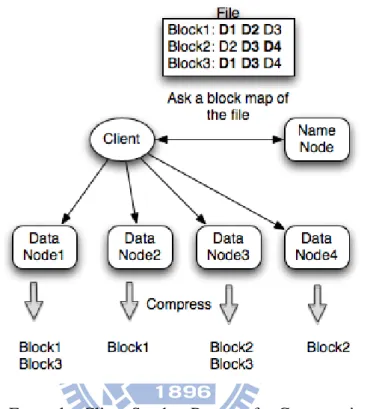
To ease the overhead, MSRC provides a role named Compressor. The Compressor provide client specifies the files which match some file attributes to be compressed, such as file/directory name and access time. The reason of providing access time to be specified is if the files have
not been accessed for a long time, the possibility is very high that the files will not be accessed anymore. These arguments are flexibility to decide which files should be compressed for users. Typically, a file has many replicas. So, the Compressor provides an argument of the number of replicas for how many replicas of the files that should be compressed. The unit on DataNodes is
Figure 4.4: Example: Client Sends a Request for Compressing the Files
block, which size usually is 64KB. The information of blocks location is stored in the NameN-ode’s memory. So, when NameNode receives the request of compressing replicas, it requires to finds the location of blocks of the files and commands the DataNodes to compress the specified blocks. To retain at least one uncompressed replicas of a block, determining which replicas of a block require to be compressed is random selection. After the procedures, the duplicated blocks are compressed make increase more free space to be used.
Due to performance concern, LZO (Lempel-Ziv-Oberhumer) data compression algorithm [15] is applied for the algorithm if file compression. It has the advantages of fast speed on compression and decompression, and is a kind of lossless compression algorithm. Despite its compression ratio is not the best, it is sufficient to compress text data. Therefore, it is very suitable to be implemented on HDFS for not only reducing disk space utilization but also having lower loading.
4.2.2
Real-Time Decompression
After completing replica compression, the available replicas of a block for access remain a limited number of the replicas. The response from the NameNode to the client is changed. The NameNode only replies the location of the uncompressed replicas to the client. Only in the two conditions, the compressed data should be transmitted to the client for access:
• The DataNode is failed
If the DataNodes which contain the replicas of the block is unavailable, there is no un-compressed block can service the request for the client. So, the NameNode attempts to return the location of the compressed replicas to the client, and then the client sends a request to the DataNode which contains the compressed replica for block access. At this time, DataNode transmits compressed data to the client. The client decompresses the compressed block in time and reads the content. Thus, the client will not miss any data even if DataNodes cannot service the request of accessing block.
• Supplying replica
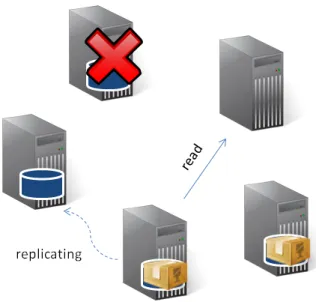
In the previous condition, DataNode crashing that cause some replicas missing. The number of current replica is lower than a replica factor of the setting. So, in this situation MSRC will automatically start replicating block until the number of replicas is equal to the replica factor in the setting. If no uncompressed block can be sent to another host for supplying replica, there are only compressed block can serve it. The DataNode transmits the compressed block to another DataNode, and then the received DataNode uncompress the block and stores again. The replication procedure still requires to meet the placement strategy of MSRC.
After introducing MSRC, Figure 4.6 is a full example of MSRC to completely explain the flow. The environment is a kind of router-level network, which are composed of two routers and four switches. Each router connects two switches within an absolute subnet. and each switch connects fours DataNodes. The client has two files, which are split into three blocks, called block A, B and C respectively. The default replica factor is three copies so the used space of the cluster is three times as big as the total size of the files.
Figure 4.5: Example: Decompressing in Time and Replicating
By using the topology detector, the network is logically partitioned into four networks as partition A, B, and C according to group ID. The client places replicas of the block of File A in different network group. So, the principle is, A node does not contain two identical blocks. A network group does not contain three identical blocks. Finally, File1 and File2 are distributed into DataNodes evenly. After all data are stored in HDFS, the administrator executes a compres-sion command to reduce the used space. In this case, comprescompres-sion factor is set as two replicas. The compressor randomly chooses two replicas of the blocks to compress and re-store into the DataNode again. The space of the file will only decrease from triple of the size of the file to one time approximately.
Summarizing the above, the system has the better replica placement by using network topol-ogy detector. Effectively and dynamically avoiding all replicas of a file are placed in close lo-cation, and can apply in various environments. Furthermore, compressing additional replicas cans save more space. The backup efficiency is equal to the full backup of files.
Chapter 5
Implementation and Experimental Results
This chapter introduces the detailed implementation of MSRC, which separated into topol-ogy detector and compressor. Furthermore, we evaluate and analyze the benefit of MSRC by the evaluation criteria described in section 5.3.
5.1
Implementation
MSRC has two parts in the implementation. The role of detecting network topology is called Topology Detector, and the role of compressing replicas is called Compressor. This section will shows how to implement the roles.
5.1.1
Topology Detector
Hadoop Rack-Awareness provides users with customizing the location of DataNodes, so the topology detector is implemented as a script, which is used in Hadoop to build the list. The NameNode executes the script when the system starts. It collects the necessary information for determining the nodes location. Figure 5.1 shows, the script sends an SNMP request to the top-level switch and ARP broadcast in the subnet. The NameNode obtains the replies of the switch and the DataNodes, and then matches them. After the processing, each DataNode will be labelled an group ID, which implied its location. Figure 5.2 shows, the script only
obtain the IP of the DataNodes, and then calculates the network ID by AND operation with pre-defined network mask. After the process, each node will be labelled an group ID. Finally, the an assigned ID and DataNodes information are returned to the NameNode.
The labelled ID consists of network ID and link ID. According to the labelled ID, the Na-meNode will group the DataNodes which has have an identical group ID by internal Hadoop design. The DataNodes with an identical prefix of ID that are regarded as the same group. Be-cause partitioning network and replica placement are original behavior in HDFS, the effort of the implementation is to accurately determine the opportune group ID for the replica placement.
Figure 5.1: The Behavior of the Topology Detector in the L2 Network Environment
5.1.2
Compressor
Figure 5.3: The Design of Compressor
The compressor is designed to run in the background, and decompresses blocks n in time on client side rather than DataNodes. As Figure 5.3 shows, for obtaining better performance, nei-ther client’s decompression or the DataNodes’ compression are via JNI (Java Native Interface) to combine LZO C library. So the client determines the data whether to read directly or read with decompressing. The judgement of decompressing is based on the NameNode’s memory whose contains a map for recording blocks location. We add a field to the map for flagging a block if the block is compressed. The compressor is integrated into HDFS shell command. It provides users with some flexible options.
Execution Command
"-t n" indicates the file or directory how long is not be accessed time. Typically, the file which has not been accessed for a long time that has lower probability of being used in the future.
"-r n" specifies how many replica should be compressed. To increase performance or save space, the option is a trade off.
Command Format:
> hadoop compressor [-R] [-time day] [-r num] [file/directory]
5.2
Emulation Environment
The cluster is built on five machines for experimental analysis because the resource is lim-ited. We adopt a common architecture to apply the modified HDFS. The system is constructed by one NameNode and four DataNodes and all hosts connect to one switch. By using MSRC, the network is partitioned into four groups logically. The HDFS is configured on Linux to em-ulate with default settings, such as block size is 64MB and default replica is three replicas. The Map/Reduce usually is used to process text data so we collect two text types of data as our test data. The first data are system logs collected from a lot of servers, which is located at NCTU department of computer science. The second data are web pages grabbed from the Internet. The total size of both of them are 50GB.
5.3
Evaluation Criteria
For analyzing the study, there are three evaluation criteria to measure the result such as disk space, compression time and access performance.
5.3.1
Disk Space
Figure 5.4: The Comparison of Saved Space with Different Data
Figure 5.4 shows, the data of system log can save 56% disk space, and the data of web page is about 40%. The reason of system logs is better than web pages is the compression ratio depends how many duplicated keyword in the data. So, system logs usually have such duplicated vocabularies that it can be compressed with high ratio. As for web page, the size of files is very small. The number of duplicated keyword in web pages is limited. So, saved space on the web pages is less than the saved space on the system logs. Because of the size of data may affect the number of duplicated keyword, we run a compression test with different block size. But, the result shows the block size has no effect.
However, binary files almost have the worst compression ratio and will not reduce the con-sumption of disk space. The files is not suitable to be compressed due to its file characteristics. In current use of Hadoop, the most applications used for text processing, because the data which processed by MapReduce, must can be divided for distributed computing. The characteristics of data that limits the application on Hadoop. Nevertheless, MSRC is still very suitable to deal with storing text files.
5.3.2
Compression Time
Figure 5.5: Comparing the Compression Time of System Logs and Web Pages
The Figure 5.5 shows, the large smaller file will spend more time for replica compression. The major reason is that before to make compressing replicas of the blocks, the client asks the NameNode for the location of the blocks. Because only a single NameNode replies the request and the files consume too much memory, the response time causes the compression time longer. Thus, the action of compressing runs in the background. Executing the compressor is best as the system is at off-peak hours.
5.3.3
Performance of Reading Data
Figure 5.6: Performance of Reading Data
is partial data which is read by using decompressing blocks in time. The size of transmitted data is such very smaller than the original data that to accelerate the data transmission. Due to compression algorithm is lightweight and decompression is fast, spending a few CPU resources to tolerate server failure is very cost-effective.
5.4
Comparison
From Table 5.7, the minimum overhead of MSRC is about 1.5 times the space of one replica. In text-based data the result can close to DiskReduce. The text data are very suitable to do compression in Hadoop because its content may have many duplicate words. The difference between MSRC and DiskReduce is the design of MSRC provides user with specifying whether the files should be compressed or not. As to load balancing and performance, MSRC does not consider the happening of popular file. Because Hadoop is a storage for computing usage, it is almost impossible that too many users access the identical files. Moreover, increasing the number of copy is able to uniformly distribute replicas, but the improved performance is limited. The main reason is computing power, which are composed of servers, is fixed.
Our study is very practical that using Hadoop to process large amount of data. Administrator can arbitrarily adjust the resource according to files utilization. For keep data reliability, admin-istrator do not deal with recoding the location of servers because the system will automatically detect the DataNodes location.
5.5
Issues
There are a few issues in regards to whether compressing all replicas, and space balancing. We will discuss them in this section.
5.5.1
Compressing Entire Replicas versus Partial Replicas
The additional replicas whether always be compressed that is a trade off. Increasing replica factor that come with high performance because the loading is shared onto the DataNodes evenly. Moreover, The data availability of using many replicas is higher that a few replicas in the system. But, the space is not always unlimited. The penalty of high replicas is the higher overhead of the space. HDFS is not designed for general use such as FTP and HTTP. The us-age of HDFS is only suitable for writing once and read many times. So, only considering the system is for MapReduce computing purpose. There is no hot files because computed data are not frequently shared among the users. Further, the probability of multiple users, which require the same data to process, is very low. Replicas are compressed that can increase the speed of block transmission via network because the blocks size is the smaller. But, Compressing and decompressing replicas pays the penalty, which implies the Nodes that must spend computing power rather than concentrating on MapReduce jobs. In our design, it has no extra CPU cost to deal with compressing or decompressing replicas in normal time. When the DataNode crashs, the client receives compressed replicas and then decompress it with few CPU consumption. Processing the decompressed files is faster than compressing file, because the access speed of the disk is much slower than memory and the compression algorithm we used that has a very high decompression speed. Spending a few computing resource to do block compression that can accelerate the speed of block transmission. But, when in a environment which has many computed jobs, block compression is bound to cost some computing resource such that the throughput of the jobs is down. So, we design a flexible option for users. The users can execute a compression command according their computing utilization. They can also compress the files which the partial users have, because their priority is lower, can also compress files with old modification time because the access probability of files is lower.
5.5.2
The Di
fference Between Rack-based and Network-based
In the well-planed environment, a rack only has one network device. Thus, the result of network-based partitioning is equal to rack-base partitioning, but the overhead to administrator is different. The network-based has an advantage that can detect a map of physical link via net-work protocol such as SNMP or ARP. The map records physical connections between netnet-work devices and hosts. Whatever, the result of detecting the device location that is equal to detect the rack location.
In the general environment, the concern of grouping hosts is power-based in the rack-based method, because every host has an identical power system or circuit in the rack. In contrast, the concern of network-based is network link-based, because network device is also a critical point. The port of network device may happened software or hardware failure. The incidence of network failure is higher than the incidence of power failure, because UPS can handle most of the power system problems. Therefore, our purpose is to improve the lack of solving ability in network accidents.
Figure 5.8: The Structure of the Well-planed Environment
5.5.3
Space Balancing
Because of storing replica is to find the group first, and then randomly place replicas. The result will cause space unbalancing among DataNodes. The problem causes the inefficient utilization in part of DataNodes and makes system obtain lower access performance.
In the well-planed environment, the problem of storage unbalancing that can use Hadoop’s Balancer to rebalance by calculating balance factor. Based on our detection of DataNodes
location and Balancer function, the unbalancing possibility in most network environments is very low. As Figure 5.9 shows, the result is acceptable that the chosen possibility of a host in the first group is 1/4N. However, there is no solution to balance the worst environment with keeping availability. Thus, we use a simple way to solve it that like HDFS’s balancer. The concept of
Figure 5.9: The Case for Space Unbalancing
the way is re-compressing the file. The current block map that shows one or two copies of block are compressed. So, re-choosing replica to compress in the principle of balancing the space of the node.
Chapter 6
Conclusion and Future Work
In this thesis, we proposed a management strategy of replica compression for improving data reliability and saving disk space. Our method dynamically detects the topology of DataNodes in any layer 2 and layer 3 network. That makes administrator no longer to manually maintain a list for servers location, and the placement policy makes the files are always available even nodes fail. Moreover, in the strategy the compressor compresses the additional replicas such that storage reduced. The results demonstrate our work is effective in text-based computing usage.
In the future, the compressor can integrate with other compression algorithm for various situations. Usually, the access frequency of the third copy is less than the frequency time of the second copy. Thus, it can consider to be compressed with high ratio compression algorithm so the much space can be saved.
REFERENCE
[1] T. White, Hadoop: The Definitive Guide. O’Reilly Media, Yahoo! Press, June 5, 2009. [2] J. Venner, Pro Hadoop. Apress, June 22, 2009
[3] K. Ranganathan, A. Iamnitchi, and I. Foste. Improving data availability through dynamic model-driven replication in large peer-to-peer communities. In In 2nd IEEE/ACM Inter-national Symposium on Cluster Computing and the Grid, pages 376381, 2002
[4] S. Ghemawat, H. Gobioff, and S.-T. Leung, "The google file system," SIGOPS Oper. Syst. Rev., vol. 37, no. 5, pp. 29-43, 2003.
[5] J. Dean and S. Ghemawat, "MapReduce: Simplified Data Processing on Large Clusters," Proc. 6th Symp. Operating System Design and Implementation (OSDI), Usenix Assoc., 2004, pp. 137-150.
[6] H. Lamehamedi, B. Szymanski, Z. Shentu, and E. Deelman, "Data replication strategies in grid environments," in Proceedings of the Fifth International Conference on Algorithms and Architectures for Parallel Processing. Press, 2002, pp. 378383.
[7] R.M Rahman, K Barker and R Alhajj, "Replica selection strategies in data grid", Journal of Parallel and Distributed Computing, Volume 68, Issue 12, Pages 1561-1574, December 2008.
[8] B. Fan, W. Tantisiriroj, L. Xiao, and G. Gibson, "DiskReduce: RAID for data-intensive scalable computing," in PDSW ’09: Proceedings of the 4th Annual Workshop on Petascale Data Storage. New York, NY, USA: ACM, 2009, pp. 610.
[9] Q. Wei, B. Veeravalli, B. Gong, L. Zeng and D. Feng, "CDRM: A Cost-Effective Dy-namic Replication Management Scheme for Cloud Storage Cluster," IEEE International Conference on Cluster Computing, 2010, pp.188-196.
[10] K. Shvachko, H. Huang, S. Radia, and R. Chansler, "The hadoop distributed file system," in 26th IEEE (MSST2010) Symposium on Massive Storage Systems and Technologies, May 2010.
[11] J. Leverich and C. Kozyrakis, "On the energy (in) efficiency of hadoop clusters," ACM SIGOPS Operating Systems Review, vol. 44, no. 1, pp.6165, 2010.
[12] D. Borthakur, "The Hadoop Distributed File System: Architecture and Design," The Apache Software Foundation, 2007.
[13] The Apache Software Foundation. Hadoop. http://hadoop.apache.org/core/, 2009 [Jun. 25, 2011].
[14] H. Kuang, "Rack-aware Replica Placement," https: //issues.apache.org/jira/browse/HADOOP-692, 2006 [Jun. 25, 2011]
[15] M. Oberhumer, "LZO - a real-time data compression library," http://www.oberhumer.com/opensource/lzo/, April 2008. [Jun. 25, 2011]