
介系詞In/On片語語意分析:以母語及學習者語料庫為基礎之研究 - 政大學術集成
152
0
0
全文
(2) 立. 政 治 大. ‧. ‧ 國. 學. n. er. io. sit. y. Nat. al. Ch. engchi. i Un. v.
(3) Semantic Analysis of In/On Prepositional Phrases: A Study Based on English Native Speaker Corpus and Learner Corpus. A Master Thesis Presented to Department of English. 立. 政 治 大. National Chengchi University. ‧. ‧ 國. 學. n. er. io. sit. y. Nat. al. iv n C In h ePartial hi U n g cFulfillment. Of the Requirements for the Degree of Master of Arts. by Yu-Wen Tseng April, 2012.
(4) Acknowledgements. With the completion of the thesis, my life as a student is coming to an end. Throughout the process of struggling with it, I received a lot of assistance and support from the following people, to whom I would like to show my greatest gratitude for helping me to complete this work. My greatest thanks go to my advisor, Dr. Siaw-Fong Chung, for her inspiring guidance and encouragement throughout the process of working on my thesis. With. 治 政 her rigorous attitude toward research, she provided me with 大a lot of helpful advice and 立 constructive feedback in inspiring the direction of this research, enriching its content, ‧ 國. 學. and shaping my writing skill in the development of ideas and refining of this work.. ‧. Moreover, joining the corpus research group makes me find the pleasure in. sit. y. Nat. conducting research, through which I could broaden my scope of research and shape. io. al. er. my thoughts from the numerous discussions in the meeting. What I learnt from her is. n. not merely the ways of conducting a better research, but a different attitude in dealing with things.. Ch. engchi. i Un. v. I also want to express my gratitude to my committee members of the thesis defense, Professor Huei-Ling Lai and Professor Shu-Kai Hsieh, and my committee members of the proposal defense, Professor Chao-Lin Liu and Professor Ying-Hsueh Hu. I greatly appreciate their detailed suggestions and comments to refine my thesis, which make this study more complete. I would also like to thank all my teachers in the Department of English in National Chengchi University for their instructions in the past three years of studying. I also thank National Science Council and the NCCU Foreign Language Learner Corpus Project for supporting part of the research herein. ii.
(5) I feel so grateful to have a group of wonderful lab members and classmates—Yi-Chen Hsieh, Liang-Chun Wang, Linda Lee, Angel Chen, Lynn Lin, Dick Hsieh, Nancy Yang, Emily Hung, Jeremy Chen, and Mandy Huang—who generously gave me invaluable comments on my work, and with whom I can share the worries and joys I had. Lastly, I would like to dedicate my greatest thanks to my family. I thank them for understanding me when I fully concentrated on my study and for giving me confidence unceasingly. Without their unconditional support, I would not be able to focus on my study without pressure and make this work possible.. 立. 政 治 大. ‧. ‧ 國. 學. n. er. io. sit. y. Nat. al. Ch. engchi. iii. i Un. v.
(6) Table of Contents. Acknowledgements.................................................................................................... ii. Chinese Abstract........................................................................................................ x. English Abstract......................................................................................................... xii. Chapter 1 INTRODUCTION.................................................................................................... 1. 1.1 Background and Motivation of the Study...................................................... 1. 治 政 1.2 Significance of the Study.............................................................................. 大 立 1.3 Organization.................................................................................................. 學. ‧ 國. 5 7 9. 2.1 Semantic Analysis of Prepositions................................................................. 9. 2.1.1 Cognitive perspective on the sense of preposition................................ 10. ‧. 2 LITERATURE REVIEW…..................................................................................... sit. y. Nat. io. al. er. 2.1.2 The semantic network of prepositions.................................................. n. 2.1.3 Related studies on prepositions from other perspectives...................... Ch. n engchi U. iv. 2.2 De Vega et al.’s (2002) Study........................................................................ 13 19 21. 2.3 Corpus-based Studies on Native Speaker and Learner’s Use of English Prepositions.................................................................................................... 23. 2.4 Experimental Studies of the Learning of English Prepositions..................... 25. 2.5 Summary of the Chapter................................................................................ 28. 3 METHODOLOGY................................................................................................... 31. 3.1 Material.......................................................................................................... 31. 3.2 The Tool for Extracting Data......................................................................... 33. 3.3 Semantic Feature Analysis............................................................................. 36. iv.
(7) 3.3.1 Identifying the figure and ground noun phrases................................... 37. 3.3.2 Encoding the semantic features of figure and ground.......................... 41. 3.3.3 Data analysis......................................................................................... 44. 3.4 Sense Analysis............................................................................................... 45. 3.4.1 Categorization of sense......................................................................... 45. 3.4.2 Coding errors in the learner corpus....................................................... 48. 3.5 Summary of the Chapter................................................................................ 49. 4 RESULTS................................................................................................................. 51. 4.1 Results of the Sense analysis......................................................................... 51. 治 政 4.2 Results of the Semantic Feature Analysis..................................................... 大 立 4.2.1 The Comparison of semantic features between in and on................... 學. ‧ 國. 62 63 63. 4.2.1.2 Between ground nouns of literal expressions.......................... 66. 4.2.1.3 Between figure nouns of metaphorical expressions................. 68. ‧. 4.2.1.1 Between figure nouns of literal expressions............................ sit. y. Nat. 74. io. er. 4.2.1.4 Between ground nouns of metaphorical expressions............... al. 4.2.1.5 The comparison of relative size and contact in literal. 79. 4.2.2 Semantic features for in and on between BNC and NCCU.................. 81. 4.2.2.1 Figure nouns of in: Between BNC and NCCU........................ 81. 4.2.2.2 Ground nouns of in: Between BNC and NCCU...................... 83. 4.2.2.3 Figure nouns of on: Between BNC and NCCU…................... 86. 4.2.2.4 Ground nouns of on: Between BNC and NCCU…................. 88. 4.3 Error Analysis................................................................................................ 91. 4.4 Summary of the Chapter................................................................................ 95. 5 DISCUSSION........................................................................................................... 99. n. iv n C expressions.............................................................................. hengchi U. v.
(8) 5.1 Major Findings............................................................................................... 99. 5.2 Discussion of the Results............................................................................... 105. 5.3 Summary of the Chapter................................................................................ 113. 6 CONCLUSION, LIMITATION, AND PEDAGOGICAL SUGGESTIONS........... 115. 6.1 Overall Summary........................................................................................... 115. 6.2 Pedagogical Suggestions................................................................................ 117. 6.3 Limitations, Suggestions for Future Studies, and Conclusion....................... 119. Appendix..................................................................................................................... 122. Appendix I: Encoding Instruction........................................................................ 122. 治 政 Appendix II: Statistic Results of the Comparison 大 of Semantic Features 立 Between Data from BNC and NCCU............................................................... 學. ‧ 國. 124 127. References................................................................................................................... 130. ‧. Appendix III: Errors of Prepositional Phrases in the Learner Corpus................. n. er. io. sit. y. Nat. al. Ch. engchi. vi. i Un. v.
(9) List of Tables and Figures. TABLES Table 2.1 Explanation of Senses in Evans and Tyler’s (2004) Semantic Network of in..... 15. Table 2.2 Explanation of Senses in Ho’s (2007) Semantic Network of on......................... 17. Table 3.1 The Raw Frequency of the Top Fifteen Figures and Grounds in BNC............... 38. Table 3.2 The Raw Frequency of the Top Fifteen Figures and Grounds in NCCU............ 39. Table 3.3 The Coding Scheme for the Semantic Features of Figure and Ground............... 41. Table 3.4 The Example of Encoding Instruction................................................................. 政 治 大 Table 3.5 Categorization of the Sense of in (from Merriam-Webster’s Online 立. 42. Dictionary............................................................................................................. 45. ‧ 國. 學. Table 3.6 Categorization of the Sense of on (from Merriam-Webster’s Online 46. Table 4.1 Raw Frequency and Percentage of Literal and Metaphorical in and on.............. 52. ‧. Dictionary............................................................................................................. sit. y. Nat. io. al. er. Table 4.2 Hypothesized Prominent Features of ‘Figure’ and ‘Ground’ in Prepositional. v ni. n. Phrase of in and on............................................................................................... Ch. engchi U. 54. Table 4.3 Sense Distribution of in....................................................................................... 57. Table 4.4 Sense Distribution of on....................................................................................... 60. Table 4.5 The Comparison of Semantic Feature of Figure Nouns in Literal Preposition Expressions in BNC............................................................................................. 64. Table 4.6 The Comparison of Semantic Feature of Ground Nouns in Literal Preposition Expressions in BNC............................................................................................. 67. Table 4.7 The Comparison of Semantic Feature of Figure Nouns in Metaphorical Preposition Expressions in BNC......................................................................... Table 4.8 The Comparison of Semantic Feature of Ground Nouns in Metaphorical vii. 69 74.
(10) Preposition Expressions in BNC......................................................................... Table 4.9 Comparison of relative size and contact feature in nouns of literal phrase in BNC..................................................................................................................... 81. Table 5.1 List of Statistically Prominent Features in BNC................................................. 101. FIGURES Figure 2.1 The Partial Semantic Network of in................................................................... 15. Figure 2.2 The Partial Semantic Network of on.................................................................. 17. 政 治 大. Figure 3.1 The Query Result Page of BNCweb................................................................... 立. Figure 3.2 The Interface of AntConc 3.2.1w....................................................................... 33 36. 學. 37. Figure 3.4 Encoding Format in the MS Excel File.............................................................. 44. ‧. 52. y. ‧ 國. Figure 3.3 The Figure and Ground in MS Excel.................................................................. Figure 4.2 The Partial Semantic Network of in................................................................... 56. Figure 4.3 The Partial Semantic Network of on.................................................................. 59. Figure 4.1 The Layout of the Datasets in the Analysis........................................................ n. er. io. sit. Nat. al. i Un. v. Figure 4.4 The Graphic Representation of Figures in Metaphorical Prominent Senses of. Ch. engchi. in in BNC......................................................................................................... 70. Figure 4.5 The Graphic Representation of Figures in Metaphorical Prominent Senses of on in BNC........................................................................................................ 72. Figure 4.6 The Graphic Representation of Grounds in Metaphorical Prominent Senses of in in BNC..................................................................................................... 76. Figure 4.7 The Graphic Representation of Grounds in Metaphorical Prominent Senses of on in BNC.................................................................................................... 77. Figure 4.8 The Comparison Between BNC and NCCU of Semantic Features of Figure. 82. viii.
(11) Nouns in Literal and Metaphorical Constructions of Preposition in.............. Figure 4.9 The Comparison Between BNC and NCCU of Semantic Features of Ground Nouns in Literal and Metaphorical Constructions of Preposition in............... 84. Figure 4.10 The Comparison Between BNC and NCCU of Semantic Features of Figure Nouns in Literal and Metaphorical Constructions of Preposition on............... 86. Figure 4.11 The Graphic Representation of Figures in Metaphorical Prominent Senses of on in NCCU................................................................................................. 87. Figure 4.12 The Comparison Between BNC and NCCU of Semantic Features of Ground Nouns in Literal and Metaphorical Constructions of Preposition. 治 政 on..................................................................................................................... 大 立 Figure 4.13 The Graphic Representation of Grounds in Metaphorical Prominent Senses ‧ 國. 學. of on in NCCU................................................................................................. 89. 90. ‧. Figure 5.1 The Comparison of Semantic Features Between BNC and NCCU................... 103. sit. y. Nat. Figure 5.2 The Diagram of Figure and Ground Nouns in the co-text of Preposition In in 107. io. er. Influencing the Senses of Prepositions.............................................................. al. Figure 5.3 The Diagram of Figure and Ground Nouns in the co-text of Preposition On. n. iv n C in Influencing the Senses hofePrepositions......................................................... ngchi U. 108. Figure 5.3 The Model of the Interaction among the Figure and Ground Nouns and the Prepositions In and On……………….............................................................. 109. ix.
(12) 國立政治大學英國語文學系碩士班 碩士論文提要. 論文名稱:介系詞 In/On 片語語意分析:以母語及學習者語料庫為基礎之研究. 指導教授:鍾曉芳博士. 研究生:曾郁雯. 立. 論文提要內容:. 政 治 大. ‧. ‧ 國. 學. 過去多數英文介系詞語意之研究皆以介系詞為多義詞,並藉由語意網絡去分 析其詞義(e.g. Lindner, 1983; Tyler and Evans, 2001) ,或透過意象圖式理論(image schema theory)來探究介系詞語意,依不同的前景名詞(figure)與背景名詞 (ground)組成可產生不同的形貌結構,從而衍生出其特殊語意(e.g. Lakoff, 1987)。然而,有關介系詞片語中詞彙搭配詞組如何影響介系詞使用之研究則較. y. Nat. sit. n. al. er. io. 不多見。故本論文著重在分析前景與背景名詞等搭配詞組之語意特徵,探究其對 介系詞 in 和 on 語意及介系詞片語組成之影響。以英國國家語料庫(British National Corpus)和政治大學外語學習者語料庫(The NCCU Foreign Language Learner Corpus)作分析,比較學習者與以英語為母語者使用 in 和 on 介系詞片語 在語意上的差異。 本研究共分三部分。第一部分的詞義分析比較學習者與母語人士在使用 in 與 on 之詞義之異同,在介系詞 in 的部分,學習者與母語人士語料相較之下僅有 細微的差異,多數語料皆為原型場景(proto-scene)之詞義的使用。介系詞 on 的詞義使用則稍有不同;學習者較傾向作具體位置的指涉,然母語者則較傾向呈 現此介系詞的抽象意涵。第二部分的語意特徵分析則比較介系詞 in 和 on 在具體. Ch. engchi. i Un. v. (literal)與抽象(metaphorical)片語組成上,前景與背景語意特徵之異同。研 究結果顯示不同的介系詞片語會由特定類型的前景與背景名詞組成,故在組成不 同語意之介系詞片語時,特定語意特徵出現的頻率會呈現顯著性地差異。第三部 分為學習者語料的錯誤分析,探究學習者誤用 in 和 on 介系詞片語之情形。 綜合上述研究結果可得知,組成介系詞片語的名詞詞組會依上下文語意而產 生不同之語意偏好(semantic preferences),介系詞的語意除了會受到後接名詞 的影響,周圍名詞也可能造成語意上的差異。這些名詞可能會選擇特定的介系詞 x.
(13) 來使用,亦會影響介系詞在片語中之語意。 本論文深入地探討了介系詞片語詞組之組成,透過大量的語料分析,為英語 介系詞複雜的語意層面提出了一個較系統化且完整之解釋,期能將研究發現應用 於教材設計上,希望能在學習介系詞使用上有所幫助,也供未來介系詞相關研究 作為參考。. 關鍵字:第二語言習得、BNC 英國國家語料庫、英文介系詞、學習者語料庫、 語意分析. 立. 政 治 大. ‧. ‧ 國. 學. n. er. io. sit. y. Nat. al. Ch. engchi. xi. i Un. v.
(14) English Abstract The meanings of English preposition have been explored greatly through vast directions of research. Most studies agree that preposition is a polysemous lexical item whose senses can be construed from the semantic network (e.g. Lindner, 1983; Tyler and Evans, 2001). Its senses has also been examined under the image-schema theory from the cognitive perspective (e.g. Lakoff, 1987), in which the figure (or trajector) and ground (or landmark) interact differently to form various configurations that contribute to sets of distinct senses. Though these studies attempt to provide a comprehensive network for the meanings of prepositions, how the semantic features of the figure and ground might influence the choice of a preposition and the construction of a prepositional phrase is hardly seen. The thesis adopted a native speaker corpus (British National Corpus, BNC) and a learner corpus (The NCCU Foreign Language Learner Corpus, NCCU) to probe into how the semantic features of. 立. 政 治 大 help explicate the semantic. ‧. ‧ 國. 學. the figure and ground nouns can profiles of the preposition in and on, and to compare learners’ understanding of them with that of the native speakers’. Based on the corpora, the study is composed of three major analyses. The sense analysis compared the sense distributions of in and on, from which similarities and differences may be found between BNC and NCCU. The result of this analysis showed that in the sense categories of in, the distribution did not differ greatly since. y. Nat. sit. n. al. er. io. most of the data were categorized into the proto-scene sense in both BNC and NCCU, and only slight variations could be found in other categories. In the sense categories of on, in senses that refer to location, higher frequency could be found in NCCU, while more metaphorical constructions of on were identified in BNC. In the second analysis, the semantic feature analysis, the distribution of the semantic features are compared between literal and metaphorical constructions of in and on and between BNC and NCCU respectively. For the comparison of in and on, the statistical results showed that different types of nouns could be observed in the data of particular prepositions. Thus, for nouns in prepositions of different meanings, there may be. Ch. engchi. i Un. v. significant differences in the semantic features identified in these nouns This result implied that the nouns surrounding a preposition might have some influences toward the meaning of this preposition. In the third analysis, the errors in the learner data were identified and examined. Based on the results, we proposed that in a prepositional phrase formed by a particular meaning of a preposition, there exist a range of semantic preferences shown in their co-text. The meanings of a preposition are influenced by the lexical words surrounding the preposition, rather than by the word that goes after the preposition xii.
(15) (the ground). This thesis extends from the previous studies on the semantics of prepositions and includes the important linguistic elements in forming the prepositional phrases in the analysis. By incorporating a large amount of data, it also provides a systematic analysis and a more comprehensive explanation toward the complex semantics of English prepositions. The findings can be applied to the design of English teaching materials and techniques and may hopefully bring some insights to further preposition-related studies.. Keywords: second language acquisition, BNC, English prepositions, learner corpus, semantic analysis. 立. 政 治 大. ‧. ‧ 國. 學. n. er. io. sit. y. Nat. al. Ch. engchi. xiii. i Un. v.
(16) 立. 政 治 大. ‧. ‧ 國. 學. n. er. io. sit. y. Nat. al. Ch. engchi. xiv. i Un. v.
(17) CHAPTER 1 INTRODUCTION. 1.1 Background and Motivation of the Study English prepositions (e.g. in, on, across) are lexical items used preceding nouns, pronouns and gerunds, or after verbs, to show the relationship between them and words surrounding it (Richards, Platt, & Platt, 1992; Oxford English Dictionary, 2009). They are called differently according to their function in the context being used.. 治 政 For example, they are called ―particles‖ when they大 occur as an element in phrasal 立 verbs, or verb-particle construction (e.g. Morgan, 1997; Darwin & Gray, 1999; Dirven, ‧ 國. 學. 2001). They are also called ―adverbial particles‖ (Gardner & Davies, 2007), ―spatial. ‧. particles‖ (Tyler & Evans, 2003; Ho, 2007) and ―spatial prepositions‖ (Goddard, 2002;. sit. y. Nat. Van der Gucht, Willems & De cuypere, 2007) in different studies. As the current. io. er. study focuses on the meaning of prepositions instead of their grammatical structure, the term ―preposition‖ is used to refer to any positions of this lexical item.. al. n. iv n C Each preposition carries a number which are usually listed as lexical h e nofgmeanings chi U. entry of the dictionary. For instance, on Merriam-Webster Learner‘s Online Dictionary, the entry for in contains 21 meanings and on contains 32 meanings, which may even differ from dictionary to dictionary. When learners learn the meanings of preposition, they may refer to the entry listed on the dictionary whenever they encounter meanings unclear in context. Moreover, the meanings may cause confusion in use for English learners, and this confusion mainly comes from the complexity of the meaning and usage of prepositions (e.g. Armstrong, 2004; Wierzbicka, 1993), which may be clearly known by native speakers of English but not by nonnative 1.
(18) speakers, including language teachers. This complexity may also cause difficulty in comprehension as some of their senses are obscure from the context, as in (1.1).. (1.1) ?Because many times I thought I could not to get the goal and I would give in before I try. (NCCU_E030007). According to the context given, it seems confusing whether what the writer intended to say was give in or give up. Moreover, it is not obvious to specify the meaning of in and the verb-particle expression in this case unless learners have learned the particular verb-particle construction before.. 立. 政 治 大. Due to the semantic complexity of prepositions, efforts have been devoted to the. ‧ 國. 學. analysis of their meanings. Researchers attempt to explain the meanings through a. ‧. more systematic way under the framework of image-schema theory (Lakoff, 1987;. sit. y. Nat. Kreitzer, 1997; Tyler & Evans, 2001, or see Ungerer & Schmid, 2002), in which the. io. er. concept of trajector (or figure) and landmark (or ground) is adopted to explicate the. al. meanings. The former one refers to the moving entity while the latter is where this. n. iv n C entity moves toward or locates. The interaction them may help greatly in h e n gbetween chi U. explaining the various meanings each preposition contains. Some other studies have identified prepositions as polysemous items and have presented semantic networks based on their own categorization (Dirven, 1993; Evans & Tyler, 2004; Goddard, 2002; Taylor, 1993). In addition, many studies have probed into particles or adverbs in the construction of phrasal verbs, especially the seemingly random combination of the verb and the particle (e.g. Armstrong, 2004; Darwin and Gray, 1999; Gardner and Davies 2007; Machonis, 2008; Side, 1990; Villavicencio, 2005). These studies show that the combination of phrasal verbs is not unsystematic, as the meaning of 2.
(19) verb-particle constructions could be systematically related to the meaning of verbs and particles. Rudzka-Ostyn (2003) clarifies particles in phrasal verbs and compounds using the cognitive approach, in which he claims that to understand a phrasal verb, it not only involves comprehending how the verbs of physical or spatial motion could be used for abstract motion, but also the meanings of particles which denote various metaphorical meanings. The complexity of how the senses of particles help explicate the meanings and combinations of phrasal verb has also motivated investigations into avoidance strategy used by language learners in their language production. Avoidance strategy usually occurs when the language structure or usage seems unfamiliar to the. 治 政 learner, and learners might underproduce them to lower 大 their mistakes (Odlin, 1989). 立 Previous studies have proposed different causes for this avoidance phenomena, ‧ 國. 學. including L1-L2 differences (e.g. the structural differences between learners‘ native. ‧. language and target language), L1-L2 similarity (e.g. L2 word combinations that have. sit. y. Nat. equivalents in L1 with identical or specific meaning), and L2 complexity (e.g. the. io. er. literal and figurative semantic differences that exist in the same structure) (Dagut &. al. Laufer, 1985; Hulstijn & Marchena, 1989; Laufer & Eliasson, 1993; Liao & Fukuya,. n. iv n C 2004). For example, Dagut andh Laufer found that U e n g c h i the structural differences between Hebrew and English may have negative influence on Hebrew learners producing. English phrasal verbs. They have addressed different levels of avoidance by language learners varying in different language systems. Though these studies suggested how the meanings of particle play a role in the comprehension of the whole verb-particle construction, they did not specify how particles are chosen for a particular combination. For example, as out and up can both denote the sense of ―completion‖ (c.f. Neagu, 2007), we say fill out instead of fill up. In other words, the choice of when to use a particle in a particular linguistic context is still left unresolved, and this 3.
(20) indeterminancy may cause difficulty for learners to correctly use them in appropriate linguistic contexts. Previous research has attempted to probe into learners‘ performance on using and choosing prepositions via different methods. They investigated into learners‘ difficulty in using English prepositions through a particular form of diagnostic tests, (e.g. multiple-choice questions in Cheng (2006) and Khampang (1974); corpus-based analysis in Chung & Tseng (2011)), grammaticality judgment test (Tang, 2009), translation or rephrase task (Boers & Demecheller, 1998), and some instructional approaches from various perspectives, including prototype semantics (Lindstromberg,. 治 政 1996), cognitive semantic approach (Condon, 2008; Hsu, 2005; 大 Morimoto & Loewen, 立 2007), and polysemous network (Ho, 2007). These studies revealed learners‘ ‧ 國. 學. difficulty in using English prepositions and suggested that certain approach may. ‧. indeed facilitate the learning of them. However, though they provide implications for. sit. y. Nat. the improvement in teaching, they are not based on a large quantity of language data. io. er. produced by language learners under a systematic analysis procedure, which may. al. reflect learners‘ knowledge of the sense and usage of prepositions. De Vega et al.. n. iv n C (2002) proposed an Integration Hypothesis claimed that a multiple-constraint h ewhich ngchi U process should be activated to comprehend locative sentences with the sensory-motor features of the objects retrieved and fitted into a simulation that facilitates comprehension. A research method analyzing semantic features of the preceding and following nouns was adopted and the result was used to predict the semantic profiles of the selected prepositions. Inspired by this approach, the present study intends to analyze the semantic meanings of prepositions through the semantic feature analysis. Two of the most frequently used prepositions, in and on, will be analyzed and compared. 4.
(21) Based on the research purposes of the study, the research questions will be addressed as the following: (1) How do corpora help explicate the senses of the prepositions in and on through semantic feature analysis? (2) Is there any significant difference in learners‘ understanding of prepositions from that of the native speakers‘ in terms of the semantic meanings the prepositions denote?. 1.2 Significance of the Study. 治 政 Previous studies have indicated the importance 大of comprehending and learning 立 the meaning of prepositions through a certain approach that categorized the meanings ‧ 國. 學. more systematically (e.g. Lindstromberg, 1996; Morimoto & Loewen, 2007). A large. ‧. quantity of research on the senses of preposition was conducted from the cognitive. sit. y. Nat. perspectives, utilizing the concept of image schema, trajector and landmark to. io. er. describe the interaction of trajector and landmark and the meanings motivated from. al. (e.g. Tyler & Evans, 2003; Neagu, 2007). As the senses of preposition are so complex. n. iv n C and difficult to discern, error analysis performance of English h e nonglearners‘ chi U. prepositions has been carried out on learners of different language backgrounds, which further testified that the senses of preposition are still confusing for nonnative speakers of English, especially when a set of prepositions can be translated similarly in learners‘ native language (e.g. Khampang, 1974). With the advent of corpus-based study, researchers compared learners‘ use of preposition with native speakers‘ via adopting native speaker corpus and learner corpus as the research tool, through which the frequencies of preposition can be explored, and further semantic and syntactic analysis can be implemented and may possibly provide pedagogical implications for 5.
(22) teachers to improve their teaching (e.g. Chung & Tseng, 2011). However, the sense analysis done by the previous researchers was rather intuitive as they intended to explain the meanings through their self-constructed network based on some semantic theories. The corpus-based study was mostly done through calculating the frequencies prepositions occur in the data without exploring further into their meanings. As De Vega et al.‘s (2002) study presented a systematic method of explicating the semantics of preposition through a large quantity of data, the present study intends to follow their hypothesis and adopts a native speaker corpus (the British National Corpus) and a learner corpus (the NCCU Learner Corpus) in. 治 政 order to carry out semantic feature analysis on the nouns that 大play the role of figures 立 and those that are grounds in the formation of prepositional phrases with in and on. ‧ 國. 學. Furthermore, as previous studies tend to suggest that a polysemy network can be built. ‧. for the meanings of preposition, the current study looks into their senses, which will. y. sit. io. er. systematic distribution.. Nat. be compared with the results of semantic feature analysis to examine if there is any. al. The significance of the present study is that through quantitative and systematic. n. iv n C analysis of the nouns involved in the construction prepositions, it can be used to h e n g cwith hi U reflect their holistic semantic profiles and distinctive senses of preposition. Through comparing learners‘ data with that of the native speakers', researchers can grasp a better understanding of language users‘ semantic knowledge of this small element in sentence constructions. Moreover, focusing on two of the most frequently used. prepositions in and on may provide suggestions on how to distinguish their senses and the contexts of using them in language teaching and learning.. 6.
(23) 1.3 Organization This chapter provides a general introduction of this thesis. In Chapter 2, important studies of the semantic analysis of prepositions, including the sense of prepositions from the cognitive perspective, the semantic network of prepositions and other related studies, are presented. Experimental studies on the learning of English prepositions and the corpus-based studies on native speaker and learners‘ use of prepositions are also reviewed. Chapter 3 is concerned with the research method of this thesis, which utilizes the semantic feature analysis and sense analysis to analyze the semantics of prepositions. The results of the analyses are presented and discussed. 治 政 in Chapter 4, which are further summarized and discussed 大 in Chapter 5. Chapter 6 立 concludes the whole thesis with the achievement and limitations of this study as well ‧ 國. 學. as the suggestions for pedagogy and future studies.. ‧. n. er. io. sit. y. Nat. al. Ch. engchi. 7. i Un. v.
(24) 立. 政 治 大. ‧. ‧ 國. 學. n. er. io. sit. y. Nat. al. Ch. engchi. 8. i Un. v.
(25) CHAPTER 2 LITERRATURE REVIEW. As the present study intends to conduct a research on the semantics of preposition in and on in writing, related studies will be reviewed in this section. Moreover, as De Vega et al.‘s (2002) Integration Hypothesis provides the suggestion for viewing the semantic meanings of prepositions comprehensively, the overview of this study will also be given in this chapter. The organization of this section is as the. 治 政 following: how the meanings of preposition were explained 大 (2.1), De Vega et al.‘s 立 (2002) study (2.2), corpus-based studies on native speaker‘s and learners‘ uses of ‧ 國. 學. prepositions (2.3), experimental studies of the learning of English prepositions (2.4),. io. sit. 2.1 Semantic Analysis of Prepositions. er. Nat. y. ‧. and the summary of this chapter (2.5).. al. This section provides an overview of previous studies on the sense analysis of. n. iv n C prepositions. As most of the studies into the sense of preposition from h e probed ngchi U. cognitive perspective, Section 2.1.1 focuses mainly on this direction of research. Section 2.1.2 reviewed studies that emphasize prepositions as polysemy and construct semantic network for the distinctive senses in order to distinguish the senses and contexts of using a particular preposition. In addition to studies from cognitive perspective, those centered on the analysis of sense from other points of view are also reviewed in Section 2.1.3.. 9.
(26) 2.1.1 Cognitive Perspective on the Sense of Preposition For high frequency word as preposition, the meanings of it have been interpreted with different approaches. In Tyler and Evans‘ (2003) review of the distinct meanings of prepositions, the traditional view, which claimed that these meanings are unrelated or are treated as different meanings that accidentally share the same lexical form, was evaluated. For the meaning entries of prepositions in the dictionary, Lindstromberg (2001) examined how the preposition on is presented in five advanced learner‘s monolingual dictionaries. Lindstromberg observed that the sense information listed in the dictionary is misleading, insufficient and sometimes with mismatched examples.. 治 政 The traditional approach was greatly challenged as it ignores 大the possibility of the 立 relationships among these seemingly distinct meanings of a single lexical form. The ‧ 國. 學. following studies thus tried to construct a semantic network that investigates the. ‧. senses of prepositions from a polysemous point of view (e.g. Lakoff, 1987;. sit. y. Nat. Pustejovsky, 1995), which will be discussed in the following section. With regard to. io. er. polysemization, Taylor (1993) attended to the meaning extension of English. al. prepositions and attempted to distinct prepositional expressions into three important. n. iv n C categories: place, path and goal. After this process, the current h epolysemization ngchi U. researcher suggested three factors that help readers or listeners disambiguate the polysemy of prepositions, including a person‘s knowledge of the world, the thematic structure of other constituents in a sentence, and the aspectual character of this sentence. The meaning of prepositions is greatly explored through the image schema theory (Johnson, 1987; Lakoff, 1987) from the cognitive perspective. Based on the spatial constructs they correspond to, as those enumerated by Johnson (1987), including CONTAINER, PATH, PART-WHOLE, POINT, SURFACE, etc., the 10.
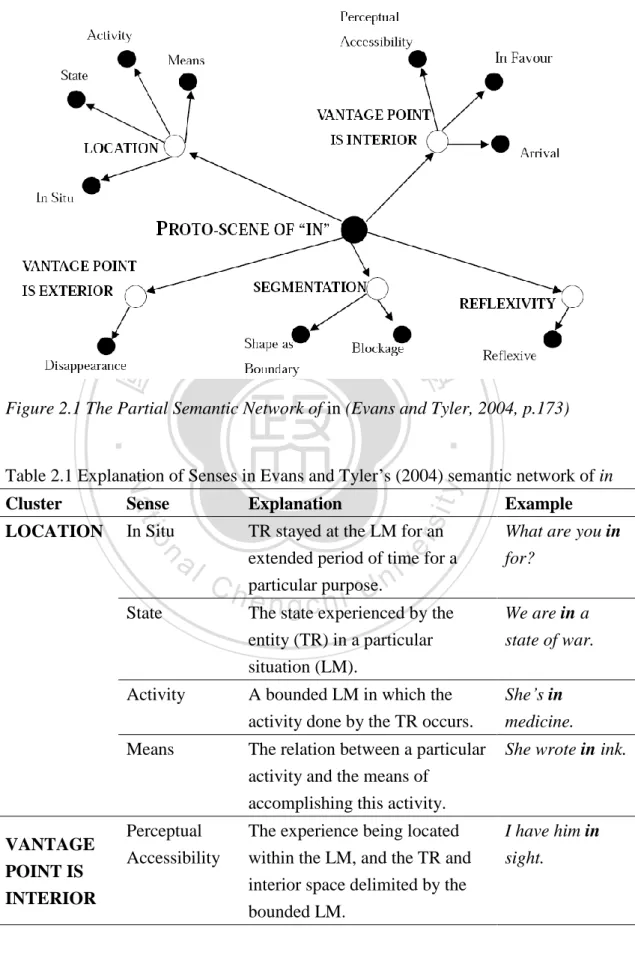
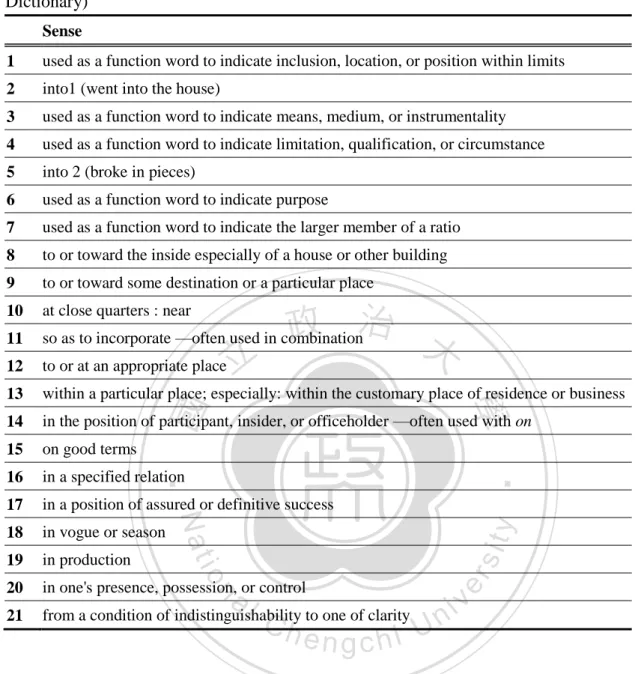
(27) senses of prepositions can be revealed. Basically, there is a schematic pattern with an internal structure which exists in every image-schema; for example, for the CONTAINER schema it requires INTERIOR, BOUNDARY and EXTERIOR to construct its framework. Cognitive perspective further claims that metaphorical expressions are instantiated from some basic image-schemata, which will project more abstract concepts and metaphors from its central meaning (Lakoff, 1987). In addition to the theory of image schema, previous studies on prepositions have focused widely on prepositions as polysemous lexical items whose meanings are mediated from the spatial configuration of trajector (TR, or figure) and landmark (LM,. 治 政 or ground), deriving from its central meaning (e.g. 大 Lakoff, 1987; Kreitzer, 1997; 立 Tyler & Evans, 2001). Trajector (TR) is a moving entity or the most prominent ‧ 國. 學. element in the relational structure, while landmark (LM) is the other entity in this. ‧. relation and is where this entity moves toward or locates. Landmark thus acts as a. sit. y. Nat. reference point for the trajector; it can be a surface, a container, or some other schema. io. er. functioning as a background (Langacker, 1987; Herskovits, 1988). For preposition in. al. and on, according to Rudzka-Ostyn (2003), the GROUND (LM) noun phrase for. n. iv n C prepositional constructions withhin is seen as a container e n g c h i U in which the FIGURE (LM) noun phase enters, moves away, or being inside. For prepositional constructions with on, the GROUND noun phase acts like a surface for the FIGURE noun phase to stay, move onto or away from. They are usually connected with image schema theory to mediate the sense of prepositions. Peña (1998) examined metaphors with the prepositions in and out that express emotions from the aspects of the CONTAINER image-schema. The results indicated that there are mainly three metaphorical systems (PEOPLE ARE CONTAINERS FOR EMOTIONS, ABSTRACT ENTITIES ARE CONTAINERS, and EMOTIONS/EMOTIONAL STATES ARE CONTAINERS) 11.
(28) that instantiate emotional usages with in and out, and there exists an image-schema interaction for dynamic uses of the CONTAINER metaphor. The image schema theory has been applied to the explanation of the meanings of particles in phrasal verbs. For example, in Lindner‘s (1983) study, counter to Fraser‘s (1976) claim that particles are meaningless in the construction of phrasal verbs, she hypothesized that they carry some part of the meanings in the verb-particle construction. In this study, she analyzed out and up within the patterns of schematic hierarchy, in which the meanings are unified under a network of semantic extensions. Neagu (2007) further presented a study on up and out, attempting to analyze them via. 治 政 the cognitive approach. She probed into how the meanings大 of these two particles are 立 derived from the source domain of space to figurative semantic extensions. For ‧ 國. 學. example, for up, in addition to its spatial senses of a motion moving from a lower to a. ‧. higher place and an object in a position higher than others, other senses can be. sit. y. Nat. extended from these basic ones. The first derived sense is ―reaching a goal, an end, a. io. er. limit‖, as in rush up the bus and ran up to somebody. Upward is usually related to the. al. positive evaluation, as in cheer up and brighten up (which is opposite to downward. n. iv n C that tends to go with negative evaluation). can be also derived from the h eExpressions ngchi U metaphor MORE IS UP, LESS IS DOWN, as in speed up and swell up. Another sense can be derived from the idea that ―higher up is more visible, accessible, known‖, as in examples like show up and turn up. It may also indicate an object being affected by an action, as in burn up and mess up. In addition to discussing how the senses can be derived from the basic ones, she further compared the differences between up and out when they go with turn. Slight differences lie within these two phrases, as the former one conveys the idea of spontaneity and unexpectedness, while the latter one relates to the notion of a boundary that has something to do with the sense of privacy. The 12.
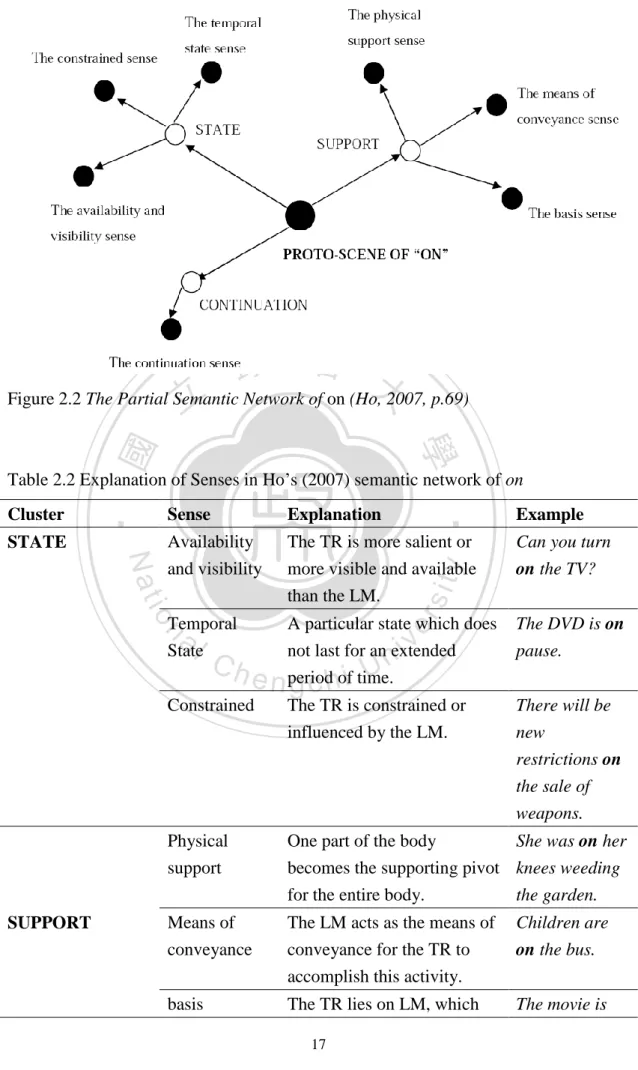
(29) similarity and differences between the two particles may be the most confusing part for language learners, and the analysis from the cognitive approach can provide a more systematic way of understanding their senses, which may provide implications in learning these particles.. 2.1.2 The Semantic Network of Prepositions As there is an agreement among studies on the senses of spatial preposition that it is polysemous and polyfunctional, several studies attempted to provide the semantic network for prepositions from different perspectives, though there is little consensus. 治 政 on the details of which sense should be included in大 a network (Sandra and Rice, 1995). 立 A review of the semantic network can reveal that previous studies tended to share the ‧ 國. 學. assumption that there is a primary sense associated with the preposition, from which. ‧. other distinct senses can be extended in a principled way. For example, Lakoff (1987). sit. y. Nat. examined the senses of the preposition over and established a chain connected by. io. er. various schemas that shows the relations among spatial senses of over as well as some. al. metaphorical senses extended from the spatial senses. He also elaborated on the. n. iv n C importance of natural image-schema that form different categories of h e ntransformations gchi U senses, for example, the transformation from path focus to end-point focus. In response to Lakoff‘s categorization, Kreitzer (1997) tried to constrain the senses of over within the polysemy network in a more consistent way via proposing the three levels of schematization, that is, the component level, the relational level, and the integrative level. Kreitzer constrained the complex image-schemata categorized by Lakoff to three image-schemata that are connected at the relational level. In other words, each additional conceptual primitive which is at the component level is viewed as a distinct sense in Lakoff‘s study, but for Kreitzer these components apply 13.
(30) compositionally at the relational level. Therefore, instead of forming a new distinct sense, the transformations of image-schema simply widen the applicability of a particular sense. However, the three image-schemata and the three basic distinct senses represented were questioned by Tyler and Evans (2001) in that these senses are arbitrarily connected without sharing some common configuration. Moreover, in response to Lakoff and Kreitzer‘s work, they also claimed that one‘s understanding of spatial senses of a word is derived from the linguistic antecedents, yet actually it is the contributions of sentential context and our knowledge of the world that construct complex and distinct interpretations of the dynamicity of spatial senses. Therefore,. 治 政 Tyler and Evans posited a principled polysemy framework大 with the primary sense of 立 over as a proto-scene and other distinct senses derived from it. ‧ 國. 學. In addition to those mentioned above, Vandeloise (1994) has provided a detailed. ‧. comparison of the approaches, including the geometrical, topological and functional. sit. y. Nat. approach, for analyzing the senses of prepositions in which the case of in was taken as. io. er. an example for illustration. The geometrical approach focuses on the dimensionality. al. of the preposition, so in is usually interpreted to be three-dimensional. The topological. n. iv n C approach proposes the inclusion of TR h within the LM. The e n g c h i Ufunctional approach intends to extend further from the previous two in claiming that there is a force. exerted between the container and the contained. Evans and Tyler (2004) further claimed that the lexical structure and organization of words is actually systematic, and meaning extension is a highly motivated process which is grounded in spatial-physical experience. They analyzed the preposition in and proposed a partial semantic framework based on the motivated process. In this network, the proto-scene of in and other clusters of sense which go beyond the meaning of proto-scene was mapped out, as in Figure 2.1, and a brief explanation of the senses within each cluster 14.
(31) is presented in Table 2.1.. 政 治 大. 立. ‧ 國. 學. Figure 2.1 The Partial Semantic Network of in (Evans and Tyler, 2004, p.173). ‧ y. In Situ. TR stayed at the LM for an extended period of time for a particular purpose.. What are you in for?. The state experienced by the entity (TR) in a particular situation (LM).. We are in a state of war.. Activity. A bounded LM in which the activity done by the TR occurs.. She‟s in medicine.. Means. The relation between a particular activity and the means of accomplishing this activity.. She wrote in ink.. Perceptual Accessibility. The experience being located within the LM, and the TR and interior space delimited by the bounded LM.. I have him in sight.. n. al. State. VANTAGE POINT IS INTERIOR. sit. Explanation. io. LOCATION. Sense. er. Cluster. Nat. Table 2.1 Explanation of Senses in Evans and Tyler‘s (2004) semantic network of in. Ch. engchi. 15. i Un. v. Example.
(32) In Favour. Arrival. The TR gains access to certain. He managed to. kinds of bounded LM.. get in the stadium, even though places were limited.. The experience located inside LM, seeing the TR coming from outside to be located in LM.. The train is finally in.. VANTAGE POINT IS EXTERIOR. Disappearance The boundary of the LM obstructs the observer‘s view of the interior and its content.. Angela rubbed in the lotion.. SEGMENTATION. Shape As Boundary. The shape of the LM constitutes both the entity and the boundary.. Can you get in line.. Blockage. The boundary LM prevents the TR from moving beyond it.. Oxygen must be held in a sealed container.. 立 Reflexive. The sides (TR) of the container move inwards and eventually occupy the original interior space (LM).. The walls of the sandcastle fell in.. Nat. sit. y. ‧. ‧ 國. 學. REFLEXIVITY. 政 治 大. n. al. er. io. Following Evans and Tyler‘s (2004) semantic network of in, Ho (2007) combined. i Un. v. different proposals (Beitel et al., 1997; Evans, 2006; Garrod et al., 1999;. Ch. engchi. Lindstromberg, 1996, 1998) for the senses of on and developed a semantic network for on, as in Figure 2.2, and the explanations of each sense within the clusters of Ho‘s this network are briefly introduced in Table 2.2.. 16.
(33) 政 治 大 Figure 2.2 The Partial Semantic Network of on (Ho, 2007, p.69) 立. ‧ 國. 學 The TR is more salient or. and visibility. more visible and available than the LM.. io. Availability. sit. Nat. on the TV?. Explanation. Temporal State. Can you turn. A particular state which does not last for an extended period of time.. The DVD is on pause.. Constrained. The TR is constrained or influenced by the LM.. There will be new restrictions on the sale of weapons.. Physical support. One part of the body She was on her becomes the supporting pivot knees weeding for the entire body. the garden.. Means of conveyance. The LM acts as the means of conveyance for the TR to accomplish this activity.. Children are on the bus.. basis. The TR lies on LM, which. The movie is. al. n SUPPORT. Example. Sense. er. STATE. ‧. Cluster. y. Table 2.2 Explanation of Senses in Ho‘s (2007) semantic network of on. Ch. engchi. 17. i Un. v.
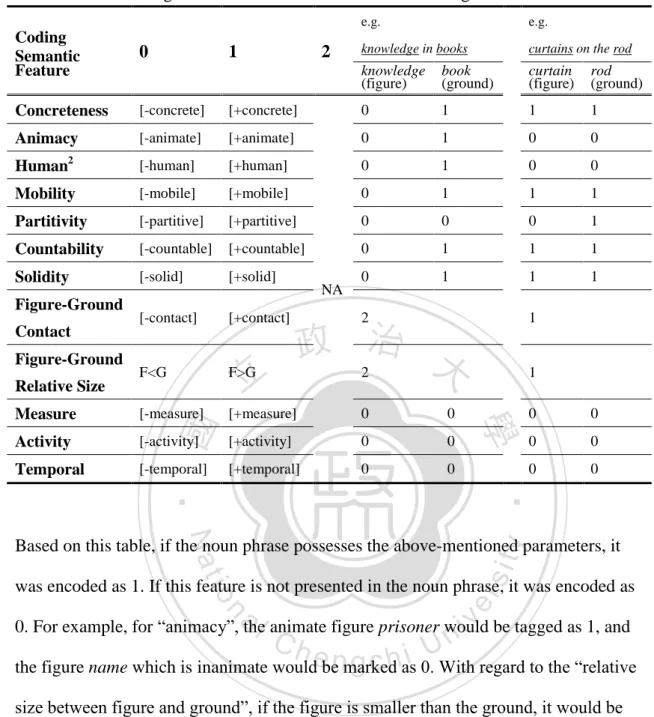
(34) provide strong foundation for based on the. CONTINUATION Continuation. the TR to be believed or proved.. true story.. The TR is undergoing the locomotion along the path on the same LM.. Please don‟t stop, keep on talking.. Both Evans and Tyler (2004) and Ho (2007) intended to provide an explanation of the senses for a particular preposition through the lexical semantic network; however, the categorization of each cluster seems to be based on their intuition and observation of. 政 治 大. the phrase with in or on, which still lacks systematicity in identifying the distinct senses of a particular preposition.. 立. Goddard (2002) investigated the polysemy network of the senses of on using. ‧ 國. 學. Anna Wierzbicka‘s natural semantic metalanguage (NSM) framework, which. ‧. provided an alternative way of analyzing the polysemy network through verbal. sit. y. Nat. explications. Four categories were provided with verbal explication: (1) simple. io. er. contact and resulting stability of position, e.g. ―X is touching Y somewhere for some time‖; (2) ―part to part‖ contact, attachment, and resulting stability of position, e.g.. al. n. iv n C ―part of X is touching part of Y in somehway time‖; (3) ―part to part‖ contact e nforgsome chi U and resulting part-whole relation, e.g. ―part of X is touching part of Y in some way for some time‖ and (4) visual feature with resemblance to simple contact, e.g. ―when someone sees Y, this person can see X at the same time‖. The interrelationships between the four categories were also discussed; for example, construction (1) ―simple contact and resulting stability of position‖ serves as the model for others, from which the ―stability of position‖ component is shared with (2) ―part to part contact‖ and is related to (4) ―visual feature with resemblance to simple contact‖ directly through visual resemblance. Through verbal explication of the polysemy 18.
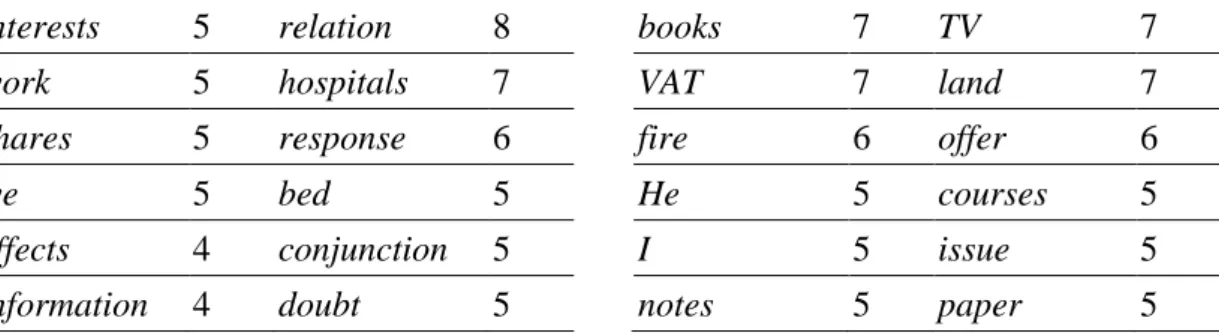
(35) network, this study contributed greater explicitness to the components in the lexical semantic network. Though these previous studies provided possible ways to clarify the meanings of prepositions, they mainly focused on the interaction between the figure and the ground in sentence construction with prepositions. However, the semantic features of the figure and the ground and how they influence the choice of prepositions in the construction of prepositional phrase were rarely seen in the previous studies, which should be systematically examined under a quantitative analysis. The only study that the current researcher has found so far is a study conducted by De Vega et al. (2002),. 治 政 who proposed the Integration Hypothesis which intends 大 to provide particular semantic 立 profiles for prepositions of different dimensions. This methodology and the major ‧ 國. 學. results of this study will be introduced and discussed in detail in the following section.. ‧. sit. y. Nat. 2.1.3 Related Studies on Prepositions from Other Perspectives. io. er. The analysis of the senses of preposition usually starts from the disambiguation. al. of a set of lexical items that are similar in meaning. For example, Wierzbicka (1993). n. iv n C discussed temporal in, on, and at distinctive meanings, which may motivate h and e ntheir gchi U the choice of a particular preposition. At implies ―sameness of time‖, in implies the concept of ―part‖ and ―duration‖, while on implies ―clear, identifiable, and self-contained entity‖. These implications may be used to explain why we do not say *at morning (morning designates time as succession), *in Thursday (Thursday is like a unit, not having discernible parts), and *on summer (summer is composed of three months). The result testified that the use of different prepositions is motivated by the meaning, which further supports the concept that grammar is motivated by semantics. In addition to the analysis of sense, prepositions have been involved in the study 19.
(36) of ―multi-word sequence‖, as in Stubbs‘ (2007) clarification of three related definitions, it may be a study of n-gram ―a recurrent string of uninterrupted word forms‖, phrase-frame ―an n-gram with one variable slot‖, or PoS-gram ―a string of part of speech categories‖. For example, Forchini and Murphy (2008) conducted a study on 4-grams headed by prepositions in English and Italian corpus. They reported that at the end of can be said the most frequent 4-gram headed by a preposition and has the temporal meaning. Compared with other synonymic phrases, such as at the bottom of and at the close of, they have different semantic preferences and collocations and cannot be easily exchanged with at the end of, because these phrases. 治 政 tend to occur with nouns of particular semantic fields or meanings. 大 立 Another facet which was rarely attended to for the analysis of prepositions in the ‧ 國. 學. literature is how type coercion (Pustejovsky, 1995) can be adopted to the. ‧. interpretation of the sense of prepositions. He classified prepositions into locational. io. er. preposition selects in a linguistic context, as shown in (2.1).. sit. y. Nat. and functional categories, and he exploited the qualia structure to analyze what a. al. n. iv n C (2.1) (a) …my parents would send my younger and I to my grandparents' h e n gbrother chi U house… (NCCU_E004009) (b) …we don't neglect those who do small things but helpful to our society. (NCCU_E004002). In (2.1a), the preposition to selects locations which have a TELIC role of qualia structure; in other words, the location my grandparents‟ house is where my younger brother and I will arrive at, which is the goal of this sentence. As the goal is a location, the sense of to may involve a movement toward this place. In (2.1b), the noun phrase 20.
(37) our society after to is no longer a concrete location where the subject can reach, but an abstract description where people stay together. Therefore, the sense of to should be a direction without an actual movement. Through the concept of coercion, we can observe how the senses of the preposition are influenced by the words surround it.. 2.2 De Vega et al.‘s (2002) Study Previous studies which focus on the semantics of prepositions pay more attention to the figures and grounds as very schematic geometric entities that nearly ignore the interaction between each feature of the entities in locative sentences. In response to. 治 政 these studies, De Vega et al. (2002) proposed the Integration 大 Hypothesis to explain 立 the semantics of prepositions, as will be introduced in this section. ‧ 國. 學 ‧. The integration Hypothesis. sit. y. Nat. As the authors pointed out that the comprehension of a given locative sentence. io. er. may be the integration of both ―what‖ and ―where‖ representations of the object. al. referred to, they proposed the Integration Hypothesis, claiming that one must go. n. iv n C through the multiple-constraint h process to comprehend e n g c h i U locative sentences. The. process depends on the locative construction, the directional preposition, and the retrieving of the sensory-motor features of the objects. The construction follows this format: [NOUN 1 – VERB – LOCATIVE PREPOSITION – NOUN 2]. NOUN 1 corresponds to the figure and NOUN 2 acts as the ground, and the LOCATIVE PREPOSITION shows the relationship between these two components. To understand the meaning of the locative construction, one does not simply add the meanings of the nouns and preposition together. According to the authors, a simulation has to be fitted, as the authors explained how this process works: 21.
(38) …the sensory-motor features of the objects (e.g., animacy, solidity, part-whole, size, etc.) are retrieved from memory, they are placed into the slots for figure and ground, provided by grammar, the topological region marked by the preposition is mapped into the ground features, and then the simulation of the layout is run.. If the features of the figure and ground and the direction of the preposition fit well together, then the simulation works, indicating that the locative construction can be. 治 政 comprehended. Therefore, the features of these objects become 大 very decisive in the 立 comprehension of the locative construction. Based on this hypothesis, the authors ‧ 國. 學. predict that some object properties may be associated with certain prepositions, and. ‧. that the variation of the semantic profiles of figure and ground may be greater. al. Semantic Parameters of the Figure and Ground. er. io. sit. y. Nat. between prepositions from different dimensions than those from the same dimension.. n. iv n C In this study, a number of semantic animacy, partitivity, U hparameters e n g c harei analyzed:. countability, mobility, solidity, the contact between the figure and ground, the relative size between the figure and ground, and the speakers‘ projective point of view in the layout. The NOUN 1 and NOUN 2 in the locative sentences were tagged according to the parameters they correspond to in each feature. The distribution of these semantic features will be used as predictors of the presence of vertical-direction term (above or below) versus horizontal-direction term (front or back). Between-dimension (e.g. above vs. front, below vs. back) contrasts and within-dimension (above vs. below, front vs. back) contrasts can also be shown through using the semantic features as 22.
(39) predictors in a sentence. In addition to the analysis of the corpora, the authors conducted the second study, preposition-choice task, to test the Integration Hypothesis, employing the results obtained from the first study. However, due to limitation of space, only the first study is reviewed in this section. The results of the first study show that the nouns that precede or follow prepositions from different dimensions tend to differ on more semantic features than nouns that associate with prepositions from the same dimension. For example, for above and front, six features are displayed differently to distinguish the nouns associated with them. Sentences contain above are more likely to involve partitive. 治 政 figures, figure-ground contact, while those that contain 大 in front of are more likely to 立 be solid figures, countable grounds, solid grounds, and a projective point of view. ‧ 國. 學. This analysis not only shows the systematic choice of figures, grounds, and. ‧. prepositions in locative sentences, these features can serve as predictors for. sit. y. Nat. prepositions from certain dimension. The results also support the originally proposed. io. er. Integration Hypothesis, through which a multiple-constraint process can successfully. al. n. proceed through the information from locative construction, preposition, and the. i n sensory-motor features of theCfigure and ground. U hengchi. v. 2.3 Corpus-based Studies on Native Speaker and Learner‘s Use of English Prepositions Studies of English prepositions that compare native speaker‘s and learner‘s use of English based on corpora, though appeared not much in the literature, can still be found. For example, Wang (2007) analyzed 15 most frequent English prepositions used by Chinese learners of English and found that no significant difference was found in the number of prepositions used in Chinese Learner English Corpus and 23.
(40) Brown Corpus. However, for specific prepositions, some prepositions seem to be overused by learners, such as to, in, and about, while some others seem to be underused, such as with and by. This study also probed into the causes for the discrepancy in the use of prepositions, including the interference of L1, overgeneralization and unawareness of collocational restrictions, and avoidance strategy in prepositions uncertain to them. Ho-Abdullah (2010) implemented a large-scale study, investigating into the ranges of use of preposition in, on, and at in three corpora, Malaysian English, New Zealand English, and British English, which represent different varieties of English. This study was carried out through a. 治 政 combination of quantitative and qualitative analyses in which 大it calculated the 立 frequencies of word forms and classified the semantic usage types based on cognitive ‧ 國. 學. linguistic framework. A number of important finds was addressed; first, the. ‧. twenty-five prepositional items that appear most frequently in these three corpora. sit. y. Nat. show significant difference at the word-form level. Second, for the semantic type. io. er. identified in this study, significant differences can also be found among these three. al. corpora. The result of this study acts as a demonstration of lexical variation among. n. iv n C nonnative usages of English, remindinghteachers of nonnative e n g c h i U English speaking. contexts to be aware of the possibility of variation in terms of usage or sense level of lexical items. Chung and Tseng (2011) also conducted a study of the preposition to based on their self-constructed learner corpus, in which the distribution of the collocates and the analysis of sense were discussed. They observed that most of the collocates are used correctly by the learners, and the erroneous use only appears in low frequency. Difficulties of analyzing the senses of a preposition were also proposed in this study as it is sometimes difficult to distinguish the semantic meaning from the syntactic 24.
(41) meaning. Moreover, as errors were rarely found in the two-word combinations, the authors suggested that three- or four-word combinations might be worth exploring.. 2.4 Experimental Studies of the Learning of English Prepositions As prepositions usually have a rather small section in textbooks but account for numerous sub-sections in the dictionary entry, Lindstromberg (1996) proposed a new approach of teaching prepositions that intends to apply the concept of prototype semantics to the teaching of these complicated meanings. Extending from the prototypical meaning, a number of literal and metaphorical meanings can be identified. 治 政 and the methods of facilitating students‘ learning of大 these meanings are illustrated 立 within this article. ‧ 國. 學. Teaching preposition via introducing its cognitive semantic definitions may have. ‧. positive effect in facilitating learners‘ comprehension. As in Boers and Demecheleer‘s. sit. y. Nat. (1998) study, they intended to explore how L1 interference occurs in French learners. io. er. of English when learning the prepositions behind (which has near equivalence in. al. French) and beyond (no equivalence in French) and how comprehension of. n. iv n C expressions with these two can h be facilitated. TheU e n g c h i authors tested how subjects comprehended the prepositions with figurative senses by asking them to translate and rephrase them. Four experiments were conducted and the results in overall showed that the sense which is absent from French causes difficulty in comprehension and that subjects who received the vocabulary list with cognitive semantic definitions performed significantly better than those who received traditional definitions. The concept of image schema has also been developed as an approach for vocabulary teaching, as in Morimoto and Loewen‘s (2007) study, the relative effectiveness of image-schema-based and translation-based instruction on teaching polysemous words 25.
(42) was compared. They invited 58 Japanese learners of English and divided them into two experimental groups that received image-schema-based and translation-based instruction respectively, and one control group for comparing the result. Each experimental group received twenty minutes of treatment for teaching the target words break and over. Though the results were mixed and no significant difference was found between the image-schema based and translation-based groups, this study provided evidence to show that there are positive effects on learners‘ use of polysemous words like preposition over under explicit instruction. In Condon‘s (2008) study, she examined the effect of integrating a cognitive. 治 政 linguistics (CL) approach to the teaching and learning of phrasal 大 verbs. Students in 立 the experimental group received instructions of CL motivations for particular sets of ‧ 國. 學. phrasal verbs while those in the control group received traditional approach. ‧. (translation and explanation) in teaching phrasal verbs. The result shows that students. sit. y. Nat. who received the CL approach yield superior results in the retention of phrasal verbs. io. er. taught. Students performed better in phrasal verbs of literal meaning than in those of. al. abstract CL motivations. However, no evidence of strategy transfer of their. n. iv n C knowledge of CL motivation to the learning phrasal verbs can be found. h e nofgnew chi U However, in recent domestic studies, the results of whether there is positive effect on learners given the cognitive semantic definitions of prepositions vary. In Hsu‘s (2005) study, she intended to compare the effect of teaching prepositions through the cognitive semantic approach and the traditional preposition instruction approach on senior high school students. For the control group who received traditional approach, the participants were instructed the whole pack of definitions of prepositions in, on, and at, along with some prepositional phrases, from the English dictionary. Students in the experimental group received the same input from the 26.
(43) dictionary; however, the definitions and expressions of in, on, and at were introduced and categorized according to their metaphoric abstractness and relatedness. No significant difference was found between the effect of these two approaches, and students seem to respond more positively to the traditional approach. However, in Ho‘s (2007) study that focused on prepositions in and on, she carried out an empirical research on teaching prepositions through introducing the polysemous network. This research lasted two months, involving two groups of subjects in which one was taught by the polysemous-network approach, while the other group received instruction through the images of sense without introducing their relatedness. Though the. 治 政 statistical result does not differ significantly in post-tests, 大 the verbal think-aloud 立 protocol which was administered four months after the instruction showed that ‧ 國. 學. learners who received polysemous-network approach can retain the network. ‧. knowledge longer and better.. sit. y. Nat. In addition to studies that focus on the learning outcome of implementing. io. er. different approaches to teaching prepositions, some others examine learners‘. al. performance from different perspectives through the designed questionnaire. For. n. iv n C example, Khampang (1974) utilized test, comprised of three parts, h e na diagnostic gchi U including multiple choice, error correction, and cloze test, to test if particular. prepositions are more difficult for Thai learners of English, and further compared the results done by other language groups to explore if any significant difference in the choice of English prepositions may be found. Though from the test scores the author found that there is no significant difference in the choice of English preposition among different language groups and other moderate factors, such as sex, age, number of years, and number of hours per week spent in learning English, this study has implications in the teaching of English prepositions, as it suggested that 27.
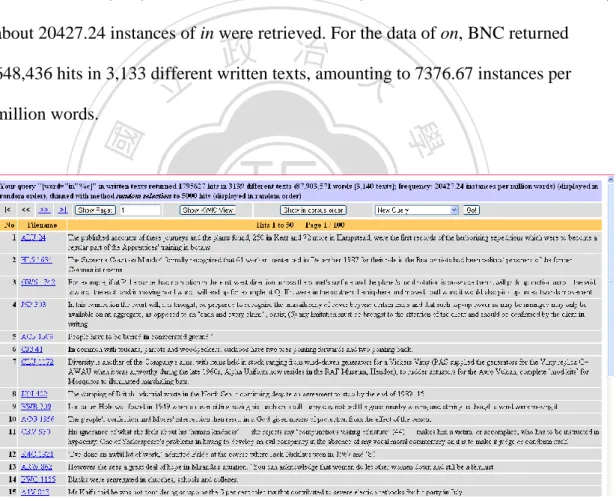
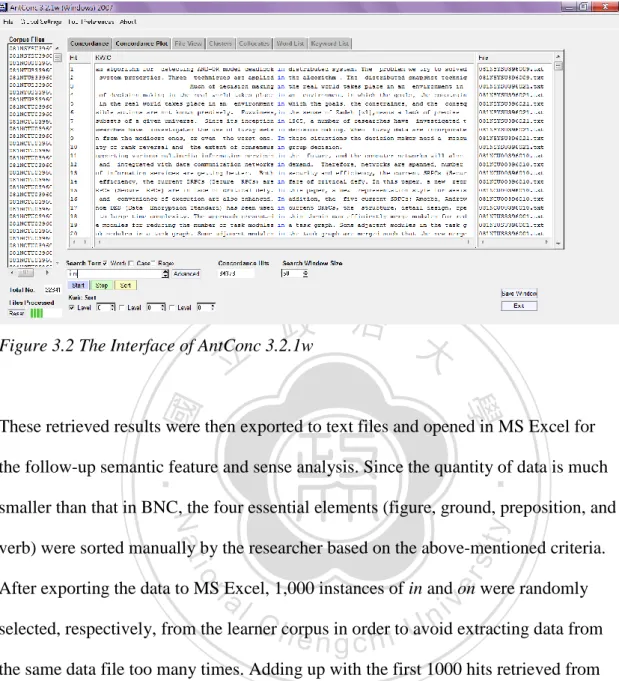
(44) placement test and diagnostic test seem to be more effective than the above-mentioned moderate factors in investigating learners‘ performance on the use of prepositions. For different language groups, they shared similar difficulty in learning English, so the author suggested that the teaching of English place and temporal prepositions should be conducted in the same way for these groups. For error analysis on the use of prepositions by Taiwanese learners of English, Cheng (2006) analyzed students‘ performance on prepositions in, on, and at, using a set of 55 multiple-choice questions to test how they performed when these items were used as prepositions in prepositional phrases and as particles in phrasal verbs. The. 治 政 result showed that learners performed significantly worse on 大in, on, and at particles 立 than prepositions. Within prepositions, learners‘ performance on temporal ones is ‧ 國. 學. worse than their performance on spatial prepositions. Tang (2009), on the other hand,. ‧. analyzed the preposition on from the syntactic perspective, investigating learners‘ use. sit. y. Nat. of preposition-like elements in verb particle constructions and aiming to reveal the. io. er. cause of difficulty through error analysis. At the first stage, verbal phrases with on. al. were selected from senior high school English textbooks, and native speakers of. n. iv n C English judged the grammaticality based on the syntactic U properties of prepositional he ngchi elements. The second stage involved 154 senior high school students to do the grammaticality judgment test and gap-filling test. Through analyzing the result, the author would like to remind language teachers that both lexical feature and functional feature are important in learning prepositions.. 2.5 Summary of the Chapter In this chapter, studies on the senses of preposition were discussed from different perspectives. De Vega et al‘s (2002) Integration Hypothesis along with the analysis 28.
(45) employed to test this hypothesis is reviewed that examines the semantic features of nouns that precede and follow the preposition, which may influence the choice of a particular preposition in a sentence, counter to recognizing the meanings of preposition through cognitive approach that form a semantic network. Due to the semantic complexity of prepositions, approaches that facilitate L2 acquisition are another focus. However, previous studies on the semantics of preposition tended to focus on a single preposition and developed a semantic network based on a particular theory. They focused more on the influence of the landmark in constructing the meaning without attending to all the elements in the construction. Moreover,. 治 政 learners‘ productions were restricted to elicitation from 大 experiments which are usually 立 composed to sentences being independent from context. In this study, we attempted to ‧ 國. 學. utilize the semantic feature analysis to analyze the construction of English. ‧. prepositions in and on, which involves the analysis of the figure, ground, and the. sit. y. Nat. senses of prepositions in and on, in order to establish a systematic approach in. io. er. disambiguating the semantics of preposition and analyzing learner‘s actual. al. performance on using prepositions. In addition, as the semantic networks constructed. n. iv n C in the previous studies are not comprehensive the semantics of particular U h e n g c hini describing prepositions, this study will be a corpus-based one that includes data naturally produced by native speakers and learners. In Chapter Three, the methodology of conducting this research would be introduced in order to provide the detailed information with regard to the materials and procedure for data collection and approach for analysis.. 29.
(46) 立. 政 治 大. ‧. ‧ 國. 學. n. er. io. sit. y. Nat. al. Ch. engchi. 30. i Un. v.
(47) CHAPTER 3 METHODOLOGY. This chapter contains four major parts, in which the first section describes the two corpora adopted in this study, the second section introduces tools employed to retrieve the data and criteria of sorting the data, and the last two sections present the procedure of conducting semantic feature analysis and sense analysis, respectively. Through the comparison of the native speaker corpus and learner corpus, similarities. probe into the similarities and differences in meaning.. 學. ‧ 國. 治 政 and differences in the construction of sentences with 大preposition may be shown. 立 Moreover, the analysis of sense and semantic features may be a systematic way to ‧. Our hypothesis is that: As preposition in and on denote different meanings, the. sit. y. Nat. figure and ground nouns in the construction of prepositional phrase may have. io. er. different representations of semantic feature. Therefore, we hypothesized that. al. significant differences may be found between the distributions of semantic features of. n. iv n C nouns in literal in and on prepositional phrase as well as between metaphorical in and heng chi U on. Moreover, as L2 learners may feel uncertain for the usages of in and on due to. their semantic complexity, there may be significant differences in semantic features of nouns in prepositional phrases and senses of preposition used by native speakers and L2 learners.. 3.1 Materials In order to investigate how Integration Hypothesis (De Vega et al., 2002) can be applied to explain the distinction between prepositions in and on, one native speaker 31.
數據
+7



相關文件
The first row shows the eyespot with white inner ring, black middle ring, and yellow outer ring in Bicyclus anynana.. The second row provides the eyespot with black inner ring
Health Management and Social Care In Secondary
printing, engraved roller 刻花輥筒印花 printing, flatbed screen 平板絲網印花 printing, heat transfer 熱轉移印花. printing, ink-jet
Enrich the poem with a line that appeals to this missing sense.. __________________imagery that appeals to the sense of____________has not been used in the description
identify different types of tourist attractions and examine the factors affecting the development of tourism in these places;.4. recognize factors affecting tourist flows and the
However, Humanistic Buddhism’s progress in modern times has occurred in the means of reforms, thus the author believes that we can borrow from the results of the analytical
• Each student might start from a somewhat different point of view and experience the encounters with works of art and ideas in a different way... Postmodern
To complete the “plumbing” of associating our vertex data with variables in our shader programs, you need to tell WebGL where in our buffer object to find the vertex data, and
