Department of Business Administration
I-Shou University
Master Thesis
Evaluating the satisfaction of business about public
administrative service applying ISO standards in
Ben Cat Industrial Zones Management Board
Advisor: Dr. Chiao Ping Bao
Co-Advisor: Dr. Ho Sy Tan
Graduate Student: Nguyen Hong Khanh
July, 2015
C
Department of Business Administration
I-Shou University
Signature Page
This is to certify that the thesis prepared by
t•ItlYge-NtrOIN4
K.tt-A-N Hentitled " EvAltoitNA The smis
.TIory of D.V.C11.1.6(c Pig a 1/1- Public_ AO Nil14STkAlive-
eik.vi r e rk 1'P LYiNG ISO C.:1-18.1.1 DARDS IN euet‘1 CAT INED)ritict L ZOWEC IMAri4ENEZ•fr 646,4u)
has been approved by his/her committee as satisfactory completion of the
thesis requirement for the degree of Master of Business Administration.
Supervising Committee:
Advisor(s): C
Department Chair:
yue-ra
AA.ACKNOWLEDGEMENTS
First, I would like to express sincerely thanks the teachers of ISHOU University has equipped me with wide valuable knowledge over time.
I special thank Professor Chiao Ping Bao has guided scientific dissertation, help me practical approach to detect topics and has dedicated instructions to complete this thesis. In particular, I am extremely grateful and thankful to Professor Chiao Ping Bao has always interested, follow my learning process, guidelines and suggestions for my thesis was complete.
Finally, I sincerely thank my family, colleagues, friends and relatives were enthusiastic support, suggestions and help during my study and research.
Please send sincere thanks to everyone.
ABSTRACT
The purpose of this subject is to measure the Satisfaction of business about public administrative service applying ISO standards in Ben Cat Industrial Zones Management Board. On that basis, a number of measures is recommended to help the Ben Cat Industrial Zones Management Board to further improve the quality service and satisfaction of business about public administrative service applying ISO standards in Ben Cat Industrial Zones Management Board.
The recommended research model was built on the basis of the theory of the satisfaction and loyalty of customer. Inheritance and selective discovered from studies of SERVQUAL scale by Parasuraman (1988) the five components of the quality service affecting the satisfaction of business about public administrative service applying ISO standards in Ben Cat Industrial Zones Management Board: (1) Reliability factors, (2) Responsiveness factors, (3) Assurance factors, (4) Empathy factors, (5) Tangibles factors, (6) Administrative procedures factors. A quantitative study with a sample size 160 customer in Ben Cat Industrial Zones is carried out to assess the scale and test theoretical models. Cronbach Alpha reliability results and explored factor analysis (EFA) showed that the scale will meet the reliability, value and acceptance. Thus, based on the research findings, policy makers, managers of Ben Cat Industrial Zones will further understand the level of interest, satisfaction of customer; proposing recommendations and solutions to increase customer satisfaction for Ben Cat Industrial Zones.
Results after testing scale by Cronbach Alpha, we have identified six factors affecting to Satisfaction of customers (Reliability factors; Responsiveness factors; Assurance factors; Empathy factors; Tangible factors; Administrative procedures factors) regression analysis results six components scale satisfaction of customer are: Reliability; Tangibles; Responsiveness; Assurance; Empathy; Administrative procedures have statistically significant and affects the satisfactionof customers, proved that the six hypothesis of the study is acceptable. Most powerful factor to the satisfaction are Reliability; Tangibles; Responsiveness.
TABLE OF CONTENTS
ACKNOWLEDGEMENTS ... i
ABSTRACT ... ii
CONTENTS ... iii
LIST OF TABLES ... vii
LIST OF FIGURES ... viii
CHAPTER 1 INTRODUCTION... 1
1. BACKGROUND AND RESEARCH PROBLEM ... 1
2. OBJECTIVES OF THE PROJECTS ... 2
3. RESEARCH SUBJECTS AND SCOPE OF RESEARCH ... 3
4. RESEARCH METHODOLOGY ... 7
5. RESEARCH SIGNIFICANCE ... 7
6. STRUCTURE OF THE PROJECT ... 8
CHAPTER 2 LITERATURE REVIEW ... 9
2.1. PUBLIC ADMINISTRATIVE SERVICE ... 9
2.2. DEFINITION OF QUALITY SERVICE AND PUBLIC ADMINISTRATIVE SERVICE ... 10
2.2.1. Definition of service ... 10
2.2.2. Characteristics of Service ... 11
2.2.3. Quality Service of Public administration based on ISO 9001:2008 in Viet Nam ... 13
2.2.4. Model quality assessment services ... 14
2.3. THE SATISFACTION OF PUBLIC ADMINISTRATIVE SERVICE ... 18
2.3.1. Satisfaction ... 18
2.3.2. Public administrative service’s roles in meeting the satisfaction of business19 2.3.3. The relationship between public administrative service quality and citizen satisfaction ... 20
2.4. ISO 9000 ... 21
2.4.1. Overview of ISO 9000 - ISO 9001:2008 ... 21
2.4.2. Primary content of ISO 9000- ISO 9001:2008 ... 22
2.4.3. Quality management principles-ISO 9001:2008 ... 22
2.5. Applications of ISO 9001:2008 in public administration service... 24
2.6. LITERATURE REVIEW AND SUGGESTED MODEL RESEARCH ... 26
2.6.1. Previous researches’ relevant results ... 26
2.6.2. Research design, model building ... 27
2.7. THE CURRENT STATUS OF ADMINISTRATION REFORMING PROCESS AND CITIZEN SATISFACTION SURVEY WITH RESPECT TO PUBLIC ADMINISTRATIVE SERVICE IN CAT LAI INDUSTRIAL ZONE’S MANAGEMENT DEPARTMENT ... 33
2.7.1 THE CURRENT STATUS OF ADMINISTRATION REFORMING PROCESS IN CAT LAI INDUSTRIAL ZONE’S MANAGEMENT DEPARTMENT ... 33
2.7.1.1. Some public administrative services using ISO standard in Ben Cat Industrial Zones Management Board ... 33
2.7.1.2. Administration reforming process in Ben Cat Industrial Zones management board ... 38
2.7.2. EVALUATING ADMINISTRATION REFORM IN BEN CAT INDUSTRIAL ZONE’S MANAGEMENT DEPARTMENT ... 42
2.7.2.1. Pros ... 42
2.7.2.2. Cons ... 43
2.7.3. MEASURING THE CITIZEN SATISFACTION IN BEN CAT INDUSTRIAL ZONE’S MANAGEMENT DEPARTMENT ... 44
2.7.4. EVALUATING THE MEASUREMENT OF CITIZEN SATISFACTION 51 2.7.5. SURVEYING CITIZEN SATISFACTION IS AN OBJECTIVE DEMAND ... 51
Chapter 3 RESEARCH METHODOLOGY ... 53
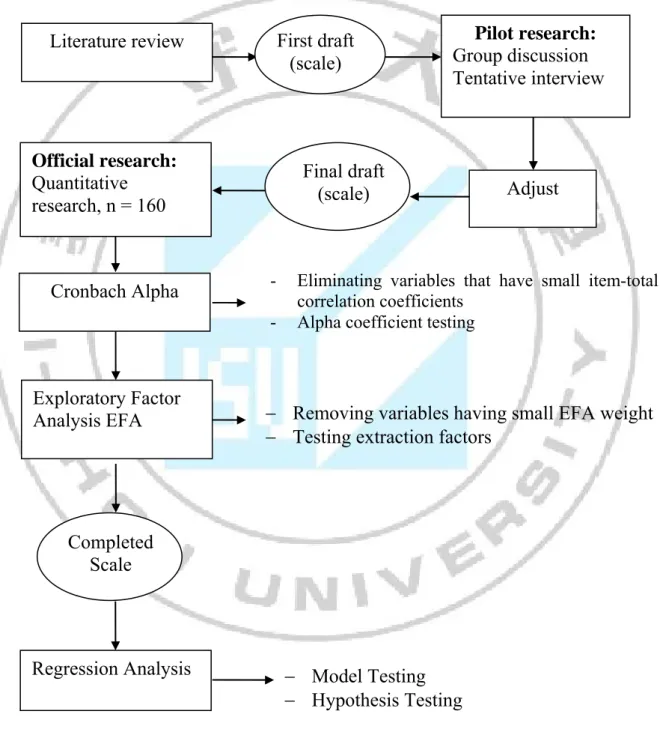
Figure 3.1: The process of implementing research ... 53
3.2. THE PRELIMINARY RESEARCH ... 54
3.2.1. Research objectives ... 54
3.2.2. Methods ... 54
3.2.3. Results ... 54
3.3. OFFICIAL RESEARCH (QUANTITATIVE RESEARCH) ... 55
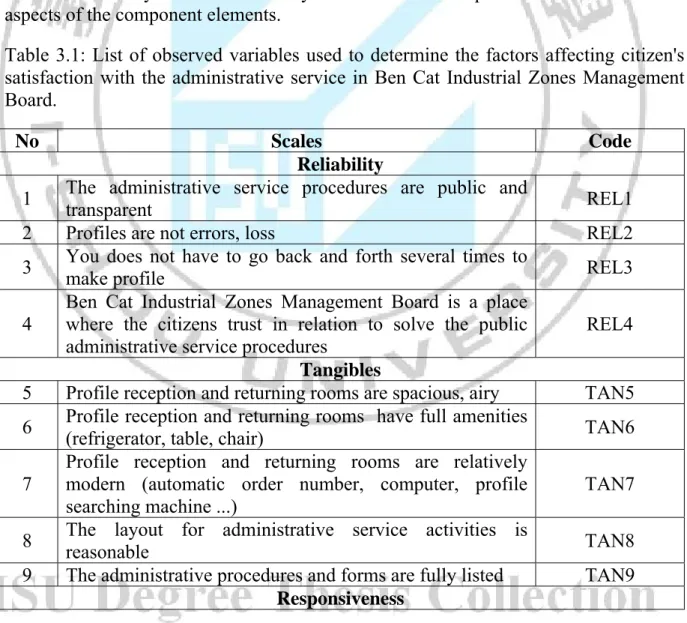
3.3.1. Scales ... 55
3.3.2. The method collecting information and sample size ... 58
3.3.3. Technical analysis of the data ... 58
Chapter 4 RESEARCH RESULTS ... 61
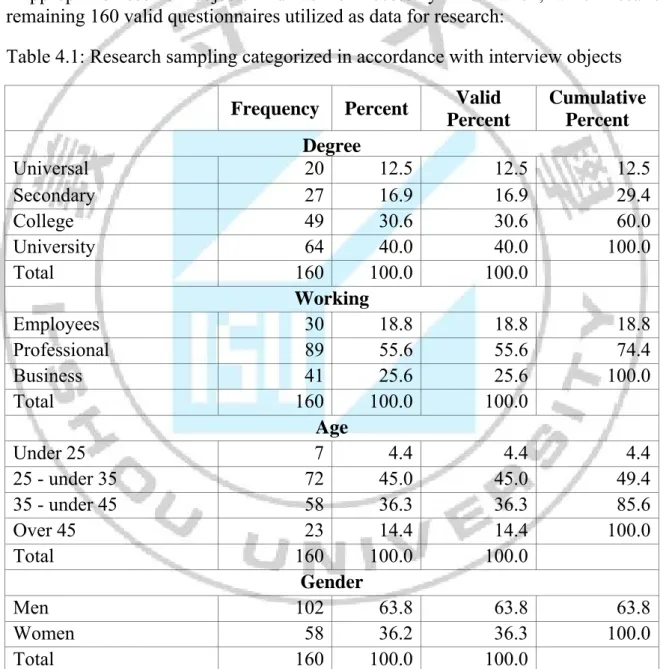
4.1. DESCRIPTIVE RESEARCH SAMPLING ... 61
4.2. EVALUATING SCALE BASED ON CRONBACH ALPHA ... 62
4.3. EVALUATING SCALE BY USING EXPLORATORY FACTOR ANALYSIS EFA ... 64
4.3.1. The components scale ... 64
4.3.2. Satisfaction Scale ... 69
4.4. OFFICIAL RESEARCH MODEL ... 70
4.5. TESTING RESEARCH MODEL THROUGH REGRESSION METHOD71 4.5.1. Testing correlation between the variables ... 71
4.5.2 Regression analysis ... 72
CHAPTER 5 IMPLICATIONS FOR POLICIES IMPROVING PUBLIC ADMINISTRATIVE SERVICE IN BEN CAT ... 74
5.1. CONCLUSIONS ... 74
5.2. POLICY OBJECTIVES ... 74
5.3.1 Reliability:... 75
5.3.2 Tangibles ... 75
5.3.4 Assurance, Empathy ... 79
5.3.5 Administrative procedures ... 80
5.4 CONCLUSIONS ... 82
5.5 THE LIMITATIONS OF THIS THESIS ... 83
REFERENCES ... 85
APPENDIX ... 87
APPENDIX QUESTIONNAIRE ... 87
APPENDIX CRONBACH ALPHA ... 90
APPENDIX EFA ... 94
LIST OF TABLES
Table 4.1: Research sampling categorized in accordance with interview objects ... 61
Table 4.2: The Cronbach alpha coefficients of components ... 62
Table 4.3: the KMO and Bartlett's component measurement coefficient of factors affect the satisfaction ... 64
Table 4.4: Variance criticism ... 66
Table 4.5 Exploratory Factor Analysis 1st ... 67
Table 4.7 Satisfaction scale KMO and Bartlett's coefficient ... 69
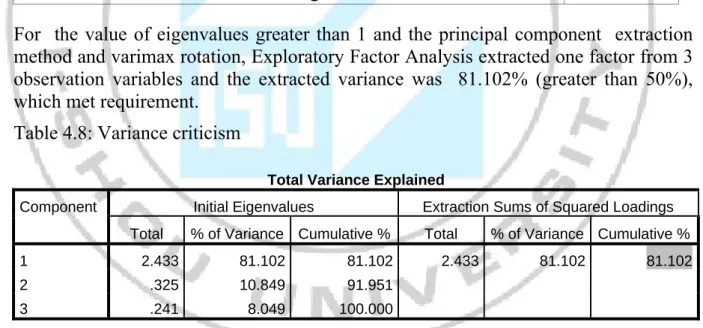
Table 4.8: Variance criticism ... 69
Table 4.9 the Results of factor analysis of satisfaction scale ... 69
Table 4.10 Correlation matrix between the variables ... 71
Table 4.11: Regression analysis ... 72
LIST OF FIGURES
Figure1.1: Suggested research model ... 30 Figure 3.1: The process of implementing research ... 53 Figure 4.1: The research model studying factors affecting satisfaction of business about public administrative service applying ISO standards in Ben Cat Industrial Zones Management Board ... 70
CHAPTER 1
INTRODUCTION
1. BACKGROUND AND RESEARCH PROBLEM
State administrative reform is an urgent and long task, to gradually build a sustainable and transparent administration foundation effectively and vigorously promote the reform and development of the country, the administrative procedures (AP) in Binh Duong (BD) in general and in particular Ben Cat (BC) Industrial Zones Management Board (IZMB) always put a request: Continuing completion, improving further citizen service quality, administrative activities towards to more fast, stability, efficiently and lawfully. Administrative reform is one of the key programs of the National. The BD province in 2010 continues promoting administrative reform program, completes the implementation of Phase 2 Project 30 in terms of administrative reform, reduces at a minimum of 30% number of inappropriate administrative procedures, which has contributed to improve the quality of citizen’s life and reduced costly waste of money and time, companies have been satisfied, and more closely in contact with the public authorities. Currently, the administrative reform process (ARP) in BD IZMB has created standards in serving business’ requests, especially in the field of application of ISO standards; the system of administrative procedures is built with clear and simple. The business is facilitated and easy to solve some issues relating to the state agencies, such as issuing and adjustment of investment certificate, verification and validation report of assessment of environmental impart, building permitting certificate, CO level ... In addition, ARP has contributed to changes in management thinking, leadership mind, executive and administration of administrative agencies, improving the capacity, efficiency and effective on administration of the state agencies. Even through the important results have been achieved, but compared to the requirements of the innovation, socio-economic development and international integration initiative, the rate of change in ARP is slow than the rate of change in the actual requirements, so the ARP is not effectively conducted. Administrative background of our country also exposes some existing weaknesses as follow:
- Legal institutional system is still incompletion and inconsistent, which is shown by a number of legal documents that are promulgated slowly than compared to the actual needs of the society. Many government agencies still tend to hold favorable management activities rather than meeting the needs of business, facilitating the organizations and citizen.
- Administrative procedures reform has not been thoroughly simplified, it’s transparent, openness is low, there are still no proper administrative procedures that are complex, further troubling the organization and citizen.
- The organization of the state administration remains cumbersome. The hierarchy of sectors between the central and local state, among local governments has been slow. - The position and the important central role of a country's industrial zones, Ben Cat Industrial Zones Management Board always lead in reforming administrative procedures. Through the process of implementation, the execution of administrative
reform in the area has made progress, creating positive changes in the systems of government. Renewal of public service, improving the quality of administrative service executed inside of state sector is very importance. Regardless of the functions of state management, the serving function of the state providing the necessary services for citizen so that citizen does well their rights and their obligations should be focused now more than ever. Therefore, the assessment of the quality of public administrative service applying ISO standards by state agencies is still the remaining question. Therefore, the problem of "Evaluating the satisfaction of business about public administrative service applying ISO standards in Ben Cat Industrial Zones Management Board" is a reason from which the authors select as problem research, in order to assess how administrative service quality of Ben Cat Industrial Zones Management Board is in the innovation process.
For the preceding reasons, this topic is given to study, identify solutions to improve the quality of public administrative service in Cat Industrial Zones Management Board, with a desire to create more satisfaction for citizen in terms of the administrative service, thereby create citizen’s trust for the state agencies. Therefore, the research is necessary to determine the answer to the research questions as follow:
1. What is the current status of administrative service quality of Ben Cat Industrial Zones Management Board?
2. Which factors influence the satisfaction of citizens on the public administrative service applying ISO standards when the state agencies implement administrative procedures for citizens?
3. Implications increase administrative service quality, simultaneously further improve the level of satisfaction of citizens using public administrative services provided by Ben Cat Industrial Zones Management Board?
2. OBJECTIVES OF THE PROJECTS
This study focused on assessing the current State administrative reform, measure business satisfaction about the State administrative reform in Ben Cat Industrial Zones Management Board
- Build a research model about job satisfaction of business in Ben Cat Industrial Zones Management Boar.
- Adjust the scale of the job satisfaction of business to accord with the conditions Ben Cat Industrial Zones Management Boar.
- Test the hypothetical model and identify the components affecting the satisfaction of business in Ben Cat Industrial Zones Management Board.
- Based on the survey results, solution and petition was proposed to improve the satisfaction of business in Ben Cat Industrial Zones Management Board.
3. RESEARCH SUBJECTS AND SCOPE OF RESEARCH
Research subjects: Surveying citizens when they transact PAS in Ben Cat Industrial Zones Management Board.
Studying at the current administrative procedures in the departments, agencies of Ben Cat Industrial Zones Management Board (IZMB), Ben Cat IZMB’s leaders, the specialized departments, and officers. The legal documents relating to the administrative procedures are applied in local.
Scope of Study: This thesis studies in the fields of PAS in Ben Cat Industrial Zones Management Board, including:
1. Opinion Process in terms of the primary design. 2. Construction permit process.
3. The process of extending construction permit. 4. Building permit adjustment process.
5. The process of Confirmation of land sublease contract.
6. The process of Confirmation of land sublease annex contract. 7. The process of liquidation of sublease contract.
8. The process of Confirmation of the mortgage contract of land using rights and assets, attached to land.
9. The process of Confirmation of the mortgage contract of land using rights. 10. The process of Confirmation of the mortgage contract of assets attached to land. 11. The process of Confirmation the mortgage contracts of future assets.
12. The process of Confirmation the mortgage contracts of land using rights and future assets.
13. Appraisal Process and approval report, assessment the impact on environment (ĐTM).
14. Appraisal Process and approval report, assessment the impact on environment (additional ĐTM).
15. Confirmation process Registration is committed to protecting the environment (CKBVMT)
16. Registration, confirmation process on the commitment of additional environment protection (CKBVMT).
17. The confirmation Process of implementation of the report's contents and requirements of the decision in approving the report about environmental impact assessment
18. The process of work permit for foreign workers
19. The process of work permit reissuing for foreign workers 20. The process of extending work permits for foreign workers 21. The process of issuing labour book for Vietnam employees
22. The process of registration for sending workers to overseas internship under 90 days
23. The process of announcement, registration about labor regulations
24. The process of announcement, registration about labor regulations for second time
25. The process of announcement, registration about collective labor agreements 26. Registration process of the system of scale - payroll
27. The process of issusing goods certificate about origin form ASEAN, D (C / O Form D)
28. Reissue Process certificate of origin form ASEAN D (C / O Form D)
29. Registration process allows the use of cards APEC business travel (ABTC card) 30. Licensing process established representative offices of foreign traders.
31. Permits Process Re-establishment of representative offices of foreign traders. 32. Amendment Process, additional licenses for the establishment of representative
offices of foreign traders.
33. The license renewal process established representative offices of foreign traders. 34. Deactivation process of branches, representative offices, business places.
35. Renewal Process Annual General Assembly meeting of shareholders for company shares.
36. Deactivation process of the project investment.
38. Registration process operations branch transactions, representative offices. 39. Registration process investment certificate (associated with the establishment of
01 members Ltd.).
40. Registration process investment certificate (associated with limited liability companies established 02 or more members)
41. Registration process investment certificate (associated with the establishment of a joint stock company)
42. Registration process investment certificate (associated with the establishment of a partnership)
43. Registration process investment certificate (associated with the establishment of private enterprises)
44. Process Registration certificate in case the investment associated with the establishment of a branch
45. Process Registration certificate in case the investment is not associated with establishment of enterprise or branch
46. Investment registration process for investment projects in the country do not recommend investment certificates.
47. Reissued Registration Process certificates of investment in case of loss, fire ... 48. Adjustment process Registration certificate in case the investment is not
associated with establishment of enterprise or branch.
49. Adjustment process Registration certificate in case of investment adjusts the content of business registration certificates or registration of investment activities of the branch
50. Adjustment process Registration certificate in case the investment associated with the establishment of a branch.
51. Adjustment process Registration certificate in case the investment associated with the establishment of the enterprise.
52. Adjustment process Registration certificate recognized investment branch, representative office.
53. Adjustment process name registration business. 54. Process Registration adjusted capital.
56. Adjustment process Registration headquarters address. 57. The registration process changing lines of business. 58. Changing Process legal representative of the enterprise. 59. The process of adjustment in changing investment.
60. Adjustment process Registration certificate of business investment to carry out the transfer of capital, transfer projects.
61. Adjustment process Registration certificate-based investment split, consolidation, merger or acquisition.
62. The registration process, and business transformation projects (licensed prior to 01/7/2006).
63. Process Registration for investment certificate for investment projects in the form of BCC (licensed prior to 01/7/2006).
64. The process of registration, adjustment in investment certificate (for business investment licenses granted prior to 01/7/2006 but not registered).
65. The process of verification, issuing investment certificate for cases not associated with establishment of enterprise or branch (over 300 billion project). 66. The process of verification, issuing investment certificate for cases associated
with establishment of branches (over 300 billion project).
67. The process of verification, issuing investment certificate for cases associated with established businesses (over 300 billion project).
68. The process of verification, issuing investment certificate for cases not associated with the establishment or branch business (less than 300 billion projects in the fields of investment and conditional).
69. The process of verification, issuing investment certificate for cases associated with establishment of branches (less than 300 billion projects in the fields of investment and conditional).
70. The process of verification, issuing investment certificate for cases associated with established businesses (less than 300 billion projects in the fields of investment and conditional).
71. The process of verification, issuing investment certificate for cases not associated with establishment of enterprise or branch (greater than 300 billion on projects in the fields of investment and conditional).
72. The process of verification, issuing investment certificate for cases associated with establishment of branches (greater than 300 billion on projects in the fields of investment and conditional).
73. The process of verification, issuing investment certificate for cases associated with established businesses (greater than 300 billion on projects in the fields of investment and conditional).
74. The process of verification, issuing investment certificate for cases not associated with establishment of enterprise or branch (projects approved under the authority of the Prime Minister).
75. The process of verification, issuing investment certificate for cases associated with establishment of a branch (projects approved under the authority of the Prime Minister).
76. The process of verification, issuing investment certificate for cases associated with established businesses (projects approved under the authority of the Prime Minister).
77. The process of verification, and adjustment in investment certificate.
Survey destination: Ben Cat Industrial Zones Management Board, the companies in the Industrial Park,
4. RESEARCH METHODOLOGY
The procedure for this research was carried out through two main steps: a preliminary study using qualitative methods and formal study using quantitative methods.
Preliminary study was done by qualitative research with group discussion and interviewing technique. The purpose of this study was to calibrate and supplement the scale service quality.
Formal study was done by quantitative research methods. Direct interviewing technique was used to gather information from members.
The collected information is processed by SPSS 21 software. Scale was assessed by Cronbach alpha reliability coefficient and exploratory factor analysis (EFA), and then regression analysis was used to test the research model.
5. RESEARCH SIGNIFICANCE
Through the surveys of citizen satisfaction, public administrative procedures, we not only determine the level of satisfaction of citizen on the administrative service, but also assess the level of public service of provincial government, so that suggested solutions can be applied to improve the efficiency, effective activities to serve the citizen by the state administrative agencies.
This thesis can be used as a reference for agencies, units researching and applying administrative service reform.
6. STRUCTURE OF THE PROJECT
Besides the introduction and conclusion, the thesis is divided into five chapters as follows:
Chapter 1: Literature Review
Chapter 2: The current status of administration reforming process and citizen satisfaction survey with respect to public administrative service in Ben Cat Industrial Zone’s Management department
Chapter 3: Research Methodology
Chapter 4: Research Results and Analysis Chapter 5: Conclusions and Recommendations
CHAPTER 2 LITERATURE REVIEW
Based on the objectives mentioned in the previous chapter, the theoretical model with the assumptions and preliminary scale for this topic will be discussed in the next chapter.
2.1. PUBLIC ADMINISTRATIVE SERVICE
Public administrative service is the type of public service provided by the state agencies to serve the specific requirements of citizens and organizations based on the provisions of the law. The administrative works executed by state agencies are in the implementation of the public service category, in the relationship between the state and citizens, the citizens will not have a choice, but to accept public service as mandatory by state regulations. The product of service is usually the kind of documents that organizations and individuals need to be met. (Le Chi Mai, 2006: page 31)
Public administrative service implemented by state agencies through two basic functions: the state management functions for all areas of economic life - social and supply functions for the organization and citizen. In other words, "the public administrative service is the activities serving the fundamental rights and duties of citizens and organizations, by state administrative agencies made based on the competent administrative legal" (Le Chi Mai, 2006: page 452). However, some countries do not use the concept of public administrative service, but they use the term "public service" for all kinds of service, however, it implicitly acknowledges the public service by state agencies supplying administrative service for their citizens and business.
The administrative service has its own characteristics, distinguishing it from other types of public services:
Firstly: The public administrative service and always connected with the competent and activities of state administrative agencies taking nature jurisdictions in the implementation of the rights and obligations of legal and civic organizations as the granting of licenses, birth certificates, notary public, civil status... Legal administrative competence expresses in the form of the administrative service to address the legitimate rights and interests of the citizen, the activities serving citizens from state administrative agencies. These administrative activities may not authorize any organization other than the state administrative agencies implementing and take effect only when the state administrative agencies implement only. Therefore, the supply needs of administrative service for the citizen (customer) is not in itself of their needs that stem from the provisions of the mandatory nature of the State. State mandatory and encourage people to implement these provisions in order to ensure orderly and safe society, perform management functions in all aspects of social life.
Second: The public administrative service is to serve the state management activities. The public administrative service themselves do not belong to the state management
function, but it operates to serve the function of state management. So today in legal scientific research, issues surrounding the separation of administrative functions and management functions in state agencies’ activities are raised.
Thirdly, the public administrative service is the non-profit activities, and charging fees for the state budget (under strict regulations of state agencies authorized). Service workplace not directly benefit from this revenue source.
Fourth: All citizens and organizations have equal rights in receiving and using the the public administrative service as a service object of government. State responsibility and obligation of citizens to serve on the principle of equity, ensuring stability, equity and efficiency of social management activities. From the basic features mentioned above, we can easily identify the basic types of public administrative services as follows:
First, the administrative activities provides legal documents, such as building permits, digging permits, investment certificate, work permit ...
Second, the administrative activities provide the type certificate, certified as certified land lease certificate, CO Form D...
Third, the administrative activities collect finance contributions into the state budget and funds
Fourth, the administrative activities involve in solving denunciation from of citizens and handling administrative violations. Products of the above types of public administrative service require various legal administrative documents. They reflect the main concrete result of the public administrative service. On the basis of analysis and comparison of public administrative service to state management activities and the types of services in the field of serving the public interest, we can see that the public administrative service is activities solving specifical works related to the basic rights and obligations of organizations and citizens made based on the state of administrative jurisdiction - legal.
2.2. DEFINITION OF QUALITY SERVICE AND PUBLIC ADMINISTRATIVE SERVICE
2.2.1. Definition of service
Service is a popular concept. There are many ways to define service. According to Zeithaml & Britner (M. J. Bintner, Zeithaml V. A., 2000) service is the action, process and method of performing a certain task in order to create value in use to satisfy the demands and expectations of customers
According to Kotler & Armstrong (Kotler,P & Amstrong, G, 2004), services are activities or benefits that enterprises offer to customers to establish, consolidate and expand relationships and long-term cooperation with customers.
Christian Grönroos defines service as one or a series of intangible activities that occurs in the interaction between customers and service employees / resources / goods or system of service providers. All of those provide solutions of the problems that customers encounter.
According to Bui Nguyen Hung & Nguyen Thuy Quynh Loan (Bui Nguyen Hung, Nguyen Thuy Quynh Loan, 2004), service includes back stage activities and front stage activities where customers and suppliers come into contact with each other. The purpose of this contact is to satisfy the needs and demands of customers in the way they expect, as well as create value in use for customers.
In general, services are usually intangible activities created to serve the needs of customers.
2.2.2. Characteristics of Service Service intangibility
The literature highlights intangibility as one of the key characteristics of services. Regan (1963) introduced the idea of services being “activities, benefits or satisfactions which are offered for sale, or are provided in connection with the sale of goods”.
Services are intangible and insubstantial: they cannot be touched, gripped, handled, looked at, smelled or tasted. Thus, there is neither potential nor need for transport, storage or stocking of services. Furthermore, a service can be (re)sold or owned by somebody, but it cannot be turned over from the service provider to the service consumer. Solely, the service delivery can be commissioned to a service provider who must generate and render the service at the distinct request of an authorized service consumer. In the case of a eatery KFC (Kenttuky Fried Chicken), the owner has placed signed photographs of celebrities that frequent and enjoy the cuisine that is offered by the restaurant. In that way, the perception of good taste and high standards that is projected by the celebrity endorsement shines a positive light on the menu and subsequent patronage of the customers.
Inseparability of Services
Inseparability is taken to reflect the simultaneous delivery and consumption of services (Regan 1963; Wyckham et al 1975; Donnelly 1976; Grönroos 1978; Zeithaml 1981; Carman and Langeard 1980; Zeithaml et al 1985; Bowen 1990 and Onkvisit and Shaw 1991) and it is believed to enable consumers to affect or shape the performance and quality of the service (Grönroos, 1978; Zeithaml, 1981).
Services are produced and consumed during the same period of time. Services are perishable in two regards as follows.
The service relevant resources, processes and systems are assigned for service delivery during a definite period in time. If the designated or scheduled service consumer does
not request and consume the service during this period, the service cannot be performed for him. From the perspective of the service provider, this is a lost business opportunity as he cannot charge any service delivery; potentially, he can assign the resources, processes and systems to another service consumer who requests a service. Examples: The hair dresser serves another client when the scheduled starting time or time slot is over. An empty seat on a plane never can be utilized and charged after departure.
When the service has been completely rendered to the requesting service consumer, this particular service irreversibly vanishes as it has been consumed by the service consumer. Example: the passenger has been transported to the destination and cannot be transported again to this location at this point in time.
Heterogeneity of Services
Heterogeneity reflects the potential for high variability in service delivery (Zeithaml et al 1985). This is a particular problem for services with a high labour content, as the service performance is delivered by different people and the performance of people can vary from day to day (Rathmell, 1966; Carman and Langeard, 1980; Zeithaml, 1985; Onkvisit and Shaw, 1991). Onkvisit and Shaw (1991) consider heterogeneity to offer the opportunity to provide a degree of flexibility and customisation of the service. Wyckham et al (1975) suggest that heterogeneity can be introduced as a benefit and point of differentiation.
The service provider is indispensable for service delivery as he must promptly generate and render the service to the requesting service consumer. In many cases the service delivery is executed automatically but the service provider must preparatorily assign resources and systems and actively keep up appropriate service delivery readiness and capabilities. Additionally, the service consumer is inseparable from service delivery because he is involved in it from requesting it up to consuming the rendered benefits. Examples: The service consumer must sit in the hair dresser's shop & chair or in the plane & seat; correspondingly, the hair dresser or the pilot must be in the same shop or plane, respectively, for delivering the service.
Perishability of Services
The fourth characteristic of services highlighted in the literature is perishability. In general, services cannot be stored and carried forward to a future time period (Rathmell, 1966; Donnelly, 1976; and Zeithaml et al, 1985). Onkvisit and Shaw (1991) suggest that services are “time dependent” and “time important” which make them very perishable. Hartman and Lindgren claim that the “issue of perishability is primarily the concern of the service producer” and that the consumer only becomes aware of the issue when there is insufficient supply and they have to wait for the service.
2.2.3. Quality Service of Public administration based on ISO 9001:2008 in Viet Nam
Service quality is an important measure for the operation of the state administrative agencies, and is one of the main results from these agencies’ activities. However, profit is not the primary purpose of the agency, because they also have to perform other functions such as support for growth, adjusted growth rate and growth orientation (Arawati et al, 2007) [18]. Based on some of the concepts, terminology, scientists study and apply TCVN, VietNam standards, ISO 9001: 2008 [17] on the public administrative service such as quality systems, quality planning, quality control ... It is able to understand quality of administrative service as the ability to satisfy the requirements of the organization and the individual in terms of serving the public administrative service products namely the administrative decisions.
Criteria for assessing the service quality are also diverse, including:
- Create trust people joining service used as records are resolved in time (based on the rate of settlement administrative documents punctually), no lost or misplaced, creating confidence when citizens contact for settlement administrative procedures.
- Create a favorable environment, facilitate the transaction with the tools necessary support like: The rooms spacious, air-take sequence number (to ensure fairness), computer help process applications fast soon...
- Employees have the expertise and related fields to ensure the settlement of the area in which they are in charge, along with professional operational skills.
- The service attitude of courtesy, respect for people, not cause harassment, troublesome people participating in the transaction.
- Flexible, caring and sharing solve logical profile of the people. There is a link between citizens using services and administrative personnel.
- Administrative procedures are simple, compact settlement record time reasonable, properly regulated by law. Issues related to quality and quality criteria assessing the administrative service in accordance with the provisions of law, the provisions of ISO Standards (if service is applicable), namely the provisions on the commitment of administrative agencies; emphasis on statutory requirements; Customer driven by exploration of customer satisfaction; corrective and preventive continuous improvement of quality systems ... This shows, administration activate in accordant with law, the rules, the procedures prescribed by law, combining the scientific organization of labor in the workplace to effective quality, to meet the requirements of the people. Today, most countries have focused on improving the quality of public administrative service, so the democratic society that are considered to meet the needs of the masses is the first duty and important of the Government.
-The higher level the quality of the administrative services for citizen is, the higher democracy is expressed. We can say the initial assessment of the people for the
government is in the quality of the services provided by public administrative agencies. The relationship between citizens and state administrative agencies are pulled closer together with the trend of improving public service quality. The advanced technology enables people to express their needs to the society; People are more educated with the requirements of a democratic society requires more transparency, more efficient state administrative sector.
2.2.4. Model quality assessment services 2.2.4.1. Five gap model
One of the basic characteristics of service quality is difficult to measure and define quality standards because of depending primarily on the human element. First of all, service quality is the human qualities. Products of services are intangible. The customer, not the supplier, defines the quality. Customers evaluate the quality of a service provided by evaluating service representatives of companies through their subjective feelings.
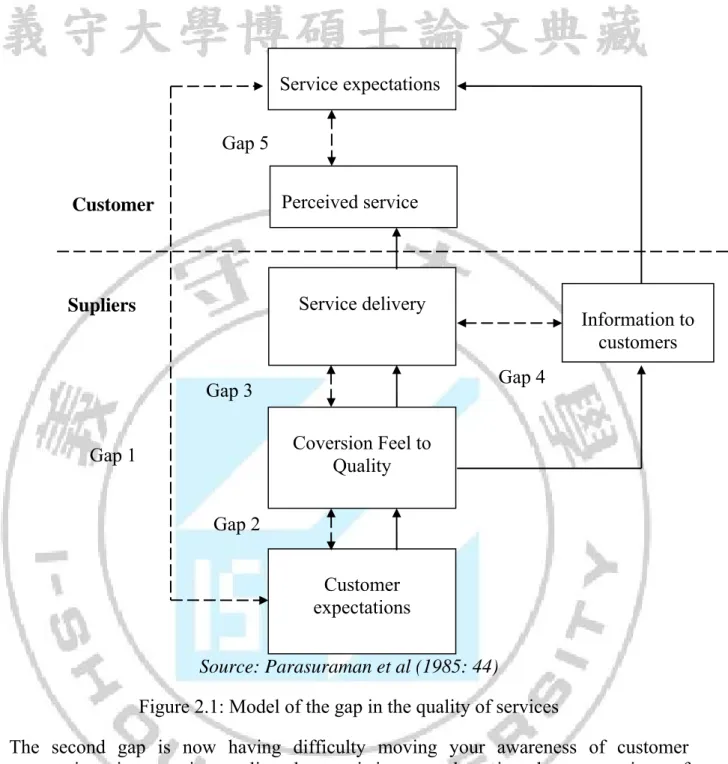
About service products in general and services of convenient stores in particular, we can measure the service quality by the distinct characteristics of the product based on the model of service quality Parasuramanet et al (1985, 1988) (Figure 2.1).
The model offers five service quality gaps:
The first gap appears when there is a difference between customer expectations of service quality that executives feel about the expectations of customers. This distance is in place now don’t know all the characteristics that make up the quality of its services as well as the method of transferring them to customers to satisfy their needs. For instance – hospital administrators may think patients want better food, but patients may be more concerned with the responsiveness of the nurse. Key factors leading to this gap are:
Insufficient marketing research
Poorly interpreted information about the audience's expectations Research not focused on demand quality
Source: Parasuraman et al (1985: 44)
Figure 2.1: Model of the gap in the quality of services
The second gap is now having difficulty moving your awareness of customer expectations into service quality characteristics even knowing the expectations of customers by a number of subjective reasons. An example here would be that hospital administrators may tell the nurse to respond to a request ‘fast’, but may not specify ‘how fast’. Gap 2 may occur due to the following reasons:
• Insufficient planning procedures
• Lack of management commitment
• Unclear or ambiguous service design
• Unsystematic new service development process Customer Gap 1 Gap 2 Gap 3 Gap 4 Service expectations Information to customers Perceived service Service delivery Coversion Feel to Quality Customer expectations Supliers Gap 5
Third distance, occurs when employees of the enterprise does not transfer service to customers according to specific criteria that have been determined leadership. Employees are part plays an important role in creating quality business services, if some employees do not complete the task according to the criteria set out will affect the quality of business services. The possible major reasons for this gap are:
• Deficiencies in human resource policies such as ineffective recruitment, role ambiguity, role conflict, improper evaluation and compensation system
• Ineffective internal marketing
• Failure to match demand and supply
• Lack of proper customer education and training
The promise of advertising will increase the expectations of our customers, when they have not been made as to what was promised, it will reduce the quality that customers perceive. This is the fourth distance. For example – The hospital printed on the brochure may have clean and furnished rooms, but in reality it may be poorly maintained – in this case the patient’s expectations are not met. The discrepancy between actual service and the promised one may occur due to the following reasons: • Over-promising in external communication campaign
• Failure to manage customer expectations • Failure to perform according to specifications
The fifth gap is the gap between expected service and experienced service. This gap arises when the consumer misinterprets the service quality. The physician may keep visiting the patient to show and ensure care, but the patient may interpret this as an indication that something is really wrong.
As mentioned, the difference between the expected quality and their quality feel. This the fifth distance depends on four previous distance. Parasuraman et al (1985) suggested that service quality depends on the distance Thursday, to reduce this gap, the right down four distances above (Parasuraman & et al, 1988).
Model of service quality in the present study can be represented as follows: Service quality = F ((Gap_5 = f (Gap_1, Gap_2, Gap_3, Gap_4))
2.2.4.2. SERVPERF scale
Parasuraman et al introduced the SERVQUAL scale consists of 10 components: (1) Tangibles; (2) Reliability; (3) Responsiveness; (4) Competence; (5) Access; (6) Courtesy; (7) Communication; (8) Credibility; (9) Security; (10) Understanding customer. Is evident from the figure as follows:
1. Tangibles: shown through appearance, dress of service personnel, equipment and support services.
2. Reliability: refers to the ability to perform services appropriately and timely right the first time.
3. Responsiveness: to express the desire and willingness of service personnel to provide services to customers.
4. Competence: Talking to the qualifications to perform the service. Ability to serve is expressed when the employees communicate with customers, employees directly engaged in the provision of services, research ability to capture relevant information necessary for customer service.
5. Access: related to making things easier for customers to access services such as shortening the waiting time of customer locations in service and convenient opening hours to customers.
6. Courtesy: refers to warm character, respect and friendly staff.
7. Communication: related to communication with customers in the language they (customers) easily understand, listening to the issues related to their service such as explanation about services, costs and settlement of complaints and inquiries.
8. Credibility: refers to the ability to create trust from customers in the company. This capability is demonstrated by the company's name and reputation and dignity of service personnel to communicate directly with customers.
9. Security: related to the ability to ensure the safety of customers, expressed through the physical safety, financial and information security.
10. Understanding customer: demonstrates the ability to understand and grasp the needs of customers through understanding the requirements of customers, concerns customers individually and identifies regular customers.
This scale covers most services. Its limit, however, shows complexity in measure and difficulty to achieve distinct value in some cases. Afterwards, the researchers combined and collapsed the scale SERVQUAL into 5 factors, namely: (1) Tangible Means, (2) Reliability, (3) Responsiveness, (4) Guarantee and (5) Empathy, according to the as follows:
1. Reliability: refers to the ability to perform services appropriately and timely right the first time.
2. Responsiveness: to express the desire and willingness of service personnel to provide services to customers.
3. Assurance: The knowledge and courtesy of staff; their ability to inspire trust and confidence.
4. Empathy: The caring individualized attention you provide your stakeholders.
5. Tangibles: shown through appearance, dress of service personnel, equipment and support services.
In fact, the SERVQUAL measurement consists of three segments. In the first two segments, each segment is 22 observed variables measuring the quality of service that customers expect and realistic feel. Variables using Likert 7 point scale. Difference (perceived minus expected) of the assessment indicate the quality of service. Measurement model is called non-assert (disconfirmation model). The third segment customer requirements assess the importance of the five components.
After much research expertise as well as the application, SERVQUAL was admitted as a scale that is practical as well as theoretical value. However SERVQUAL measurement procedure is quite lengthy. Thus, there appears a variant of SERVQUAL SERVPERF.
This scale was introduced by Cronin & Taylor (1992, led by Thongsamak, 2001). They defined service quality by measuring only perceived service quality (instead of measuring both perceived quality and expectations as SERVQUAL). The two men said that service quality is best reflected by the perceived quality without quality expectations as well as evaluating the weights of the five components.
Originating from the SERVQUAL scale, the components and observed variables of the SERVPERF same scale SERVQUAL. Measurement model is called model sense (perception model).
According SERVPERF model: quality = level of perceived service
This conclusion has been agreed by other authors such as Lee et al (2000), Brady et al (2002). The SERVPERF scale also used 22 similar state ment as the customer asked for comments in the SERVQUAL model, skip the question about expectations.
2.3. THE SATISFACTION OF PUBLIC ADMINISTRATIVE SERVICE 2.3.1. Satisfaction
Satisfaction is the reaction of consumers to get the desired response (Oliver, 1997), the response of customers on the difference between desired and perceived levels after using the product/service (Tse and Wilton, 1988). Thus, satisfaction is a function of the difference between getting results and expectations (Kotler, 2001). Parasuraman et al (1993) that between service quality and customer satisfaction existed some differences, the basic difference is the problem of "cause and effect". Also Zeithalm & Bitner (2000) argue that customer satisfaction is a general concept and is affected by many factors such as: product quality, service quality, price, situation factors, personal factors, and quality of services focused specifically on the service component. Currently there is no consensus among researchers about the concept, however, between service quality and satisfaction are always linked to each other (Cronin and
Taylor, 1992; Spreng & MacKoy, 1996) but there is little research focused on examining the level of interpretation of the quality of service components for satisfaction, especially for specific services (Lassar et al, 2000).
Applied in public administration, the satisfaction of the people for the Service of this is the satisfaction of what this service supply can meet the above or below their expected level. As mentioned aspects service quality or satisfaction of the people they set out requirements for administrative agencies is to shorten the distance between people's expectations and the actual satisfaction met by administrative agencies. On the other hand, people's satisfaction is a subjective state, should not quantifiable measurement will be incorrect, requiring sampling and statistical analysis.
2.3.2. Public administrative service’s roles in meeting the satisfaction of business To maintain stable operation and development of an organization that deals with customers to pay attention to their studies to meet the needs of customers more new customers and maintain existing customers. In order to achieve that goal, the organization must make customer satisfaction. Almost all activities, programs and policies of an organization need to be assessed in terms of customer satisfaction.
The measurement of customer satisfaction help achieve the following objectives: - Understand the satisfaction of the people to decide which activities to enhance the satisfaction. If the results are not achieved or the level of satisfaction of the people below to find the cause can be understood and corrective actions can be implemented. - Knowing opinions objectively, quantitative people's overall quality of the organization. The people have benefits from service, so the assessment of people to ensure objectivity because service results directly impact their rights or in other words they feel their assessment of the service results they receive.
- To know the will of the people, in many cases, people's behavior influences how exposed by the process using the preceding services.
- To determine the features of the product/service had the most impact on the quality of the comments received from the people, the state agencies are able to see the certain administrative procedures that are cumbersome, complex and needs for improvements, problems arising in society, that the provisions of the law should be adjusted to match reality, in order to ensure people's rights and social management of the State.
- To determine whether people receive good faith or bad faith of the specific features. Administrative procedure mandatory, so through the survey we know the attitude of the people joining service from that used appropriate methods as propaganda for the people to understand the rights and responsibilities when they participate in using service or adjust procedures accordingly.
- To predict the important improvements to achieve quality be most appreciated. Through evaluation of the people, administrative agencies can predict demands or
suggestions that social practical requirements, which have driven reform suitable for development.
- The result of the survey the needs of people on service, the agency said people tend to evaluate the quality of the organization, which has adapted to this trend has secured rights people and state administration.
- To compare the quality of work of the department in the organization. Through the survey results show leadership service quality of parts which have adjusted accordingly
- To identify the expectations and quality requirements by which people usually evaluate each product organizations/institutions provide.
For the public sector, elike Tony Bovaird & Löffler (1996) says: Public administration with high quality not only increase customer satisfaction but also construct honesty in public administration through the transparency, accountability and democracy through dialogue. Evaluate the public sector in providing public administrative service must be understood by the responsible catalyst of dynamic civil society, through the activities of citizens and other interest groups.
Therefore, the importance of improving people's satisfaction with a administrative service agencies, public organizations is the foundation, the public sector motivation to carry out their regular activities, improve the effectiveness and efficiency of operations management apparatus of state. Because of the nature of the rights to a number of cases the agencies taking advantage of that power to not provide the best service quality or arising bureaucracy and corruption. Measuring the satisfaction of the people is a solution to clean up and improve the efficiency of operations for the organization, ensuring the best administrative services are offered, accelerate the process of administrative reform, modernization apparatus state, strengthen and maintain the stability of social development.
2.3.3. The relationship between public administrative service quality and citizen satisfaction
The relationship between the administrative service quality and satisfaction of the people on the subject of administrative service are discussed by researchers in the past decade. Many studies of customer satisfaction in the service industry has done and generally concluded that quality and satisfaction are the two concepts are distinguished (Bitner, 1990; Boulding et al, 1993) (quoted from Lassar et al). Customer satisfaction that customers understood here is that people get benefits from administrative service is a general concept to express their satisfaction as a consumer service, service quality also said to be interested in Specific components of the service (Zeithaml & Bitner, 2000) According to Parasuraman (1985, 1988). Service quality and satisfaction, though the two concepts are different but closely related to each other in the study of service. He said that service affects the quality level of customer satisfaction. ie, service quality - is determined by many different factors - is part determinant of
satisfaction. Many serious empirical work on the relationship between service quality and customer satisfaction. Cronin & Taylor (1992) tested this relationship and concluded that perceived service quality leading to customer satisfaction. The study concluded that the quality of service is the premise of satisfaction (Cronin & Taylor, 1992; Spreng & Mackoy, 1996) and is the main factor affecting customer satisfaction. 2.4. ISO 9000
To better understand the effectiveness of administrative reform which contributed to the application of ISO in the field of administrative service, in this section we generalize the standards ISO 9000 - ISO 9001:2008 Standard.
2.4.1. Overview of ISO 9000 - ISO 9001:2008
Organization for International Standardization (ISO) was first enacted in 1987, to date, revised edition 3rd - ISO 9001:2008 has been issued, Vietnam was accepted and published with ISO 9001:2008 is widely applied in the fields of business and service (administrative service-related, finance, insurance, stock market, tourism, transport, training ...). ISO 9000 is a new management technology that brings together the best management practices have been implemented in many countries and regions, and accepted national standards in many countries. Quality Management System according to ISO 9000 based management model according to the process of taking preventive main motto throughout the product lifecycle, contributing added to the technical standards of products to satisfy best customer requirements. ISO 9001-2008 is the new latest international standard for quality systems was organized international standardization (ISO) issued on 11/2008. ISO 9001-2008 outlines the basic requirements of the quality management system of an organization, can be used internally by the organization.
This standard focuses on the validity and effectiveness of the quality management system in meeting customer requirements. Such as the ISO 9000 standard for quality management, aims to ensure the provision of products and service can follow, but here is the applicable standard for an organization's management, job management reasonable response might compare with the requirements of the quality system according to ISO 9000 is a set, review and standardize oriented achievements and management experience of many countries, many organizations, corporations as well as the top managers in the world, aims to help businesses manage, managing a public institution effectively.
The ISO 2008 version 9000 includes 4 main criteria are as follows:
Version 1994, 2000 revision. Versions in 2008. Names to ISO 9000:1994, ISO 9000:2000, ISO 9000:2005, Quality Management System - Fundamentals & Vocabulary ISO 9001:1004, ISO 9002:1994, ISO 9003:1994, ISO 9001:2000 (including ISO 9001/9002/9003), ISO 9001:2008. Quality Management System (Quality Management System) - The requirements of ISO 9004:1994, ISO 9004:2000 quality management system has not been changed - improved ISO 10011:1990
Guidance / 1, ISO 19011: 2002 is no change in guideline QMS/ Environment. Source: Introduction to ISO 9001:2008, 2009
2.4.2. Primary content of ISO 9000- ISO 9001:2008
The basic content of the ISO 9000 standard - ISO 9001:2008 reflected in the following objectives:
- Effective quality is a common problem of the entire organization. To be able to create a product, a service quality, competitive high when the system is well organized - it's the combination to improve the way work completed. Do it right, do well right from the start.
- If the role is primary prevention in all activities of the organization. Understanding and analyzing the causes affecting the performance of the system and precautions are regularly conducted with the effectiveness checking tools. - Satisfying the needs of the consumer, the social purpose of the quality management system, so that the role of research and product improvement or new product research is very important.
- Enhancing the role of service in general sense, that is of interest to soft part products, the service to the sale. The construction of systems sales and after sales service of goods is an important part of product strategy, competitive strategy of an enterprise. Through the services, the credibility of a growing business and profits will increase naturally.
- Responsibility for the performance of the organization belongs to each person. To clearly define the responsibilities and authorities of each person in the organization, the work will be done more efficiently.
- Interested in cost to satisfy demand - particularly for the price. Must find ways to reduce hidden costs of production, such as losses due to inappropriate activity, not quality caused, not by input costs. It highlights throughout the ISO 9001:2008 is the problem related to humans. Not creating the conditions for everyone to be aware of the correct role and importance of quality directly affects their rights and not giving them any conditions promote the system capabilities quality will not achieve the desired results.
2.4.3. Quality management principles-ISO 9001:2008
ISO 9001:2008 Standard gives 10 basic quality management principles as follow: 1 - Orientation to the client (in the administrative sector clients here means people and organizations): Quality creates value for customers and evaluated by customers. Therefore, organizations must know who your customers are, current needs and their future? Therefore, customers need to focus on a specific strategy. This principle requires expanding the scope of customer satisfaction not only in products but also in service and service attitude, the relationship between organizations and customers (Empathy). Requires continuous improvement in management and engineering.
2 - Leadership: For successful implementation of the quality management system, the most important thing is the thought leader. Leaders have absolute belief in the philosophy of quality management (QM). Because the leader is the person responsible for determining objectives, quality policy. Being organized and operated, they have created a system of preventive work to eliminate the negative effects and create confidence for customers. Leaders must organize an effective information system to ensure people are free to exchange ideas, understand and effectively implement the goals of the organization (factors related to reliability).
3 - The participation of all members: Quality is formed during the process of creating the product. Therefore, requiring the strict management, especially in the management of human resources, in order to maximize the relevant parts. It should always common knowledge to everyone, so that they understand and then strive together for the purpose of company (factors related to service capacity).
4 - Focus management under process: "The process is a collection of resources and activities related to each other to transform inputs into outputs". The entire process in an organization will form a system. Manage the operation of the system is actually managing the process and the relationship between them (factors relating to procedures).
5 - The system: The system shown in the consideration of all factors a systematic, comprehensive and holistic, harmonious coordination of these factors and is based on review of customer perspective goods. Method system is to mobilize and coordinate all the resources to accomplish the overall objectives of the organization (factors relating to procedures).
6 - Principles of Testing: Testing is an important part of any managed system. QM with prevention as the main guideline for management. So also need to check yourself not plan exactly? The precautions in the process of planning enough?
7 - Decisions based on facts, real data: The success or failure of an organization depends very much on the source of information. Therefore, in order to give a decision best, most effective need to collect data, analyze and use information. In quality management people often apply quality control methods in statistics - SPC (Statistical Process Control) or SQC (Statistical Quality Control).
8 - Continual improvement: Continual improvement is the goal of the method is also all organizations. In order to increase competition and achieve the highest quality, leadership must have a commitment to continuous improvement.
9 - Develop cooperative relationship of mutual benefit: To develop quickly and steadily, organizations need to establish collaborative relationships with internal and external. The internal relationships: leadership and staff, staff to staff, the network of relationships between parts of the organization. The external relationships: relationships with customers, suppliers, competitors, the training organization...
10 - Legal principle: This principle requires quality management activities in the organization must comply with the legislation of the state of quality management and product quality. ISO standards are developed based on the analysis of the relationship between customer and service supplier, service providers rely on to apply and build a quality assurance system in the organization, effective means to assure clients. Although the extent and application of ISO 9001:2008 to build a system in each unit, not the same organization, but the construction and application are ensured its primary role.
2.5. Applications of ISO 9001:2008 in public administration service
It is the administrative agencies building and implementing a quality management system, based on the principles of fundamental quality management, to create a scientific working methods, systematic, service quality assurance, satisfy the requirements of the people, but still ensure laws and regulations of the particular requirements of that organization. The application of this enhanced properties serve to create trust and attachment between people and the state. To ensure the quality administrative service, regardless of the following basic elements:
- Reliability: the administrative service agencies provide the guarantee to realize what was the deal with people. Includes: Solving records on time as promised, ensure safety record, not misplaced or lost. Guide procedures consistently clear, easy to understand and help people not have to go back several times ... From additional procedures that created the trust of the people participating in the transaction.
- Physical conditions (housing, work facilities): Creating a suitable environment for conducting transactions. Depending on the level of units to accommodate different equipment, but all must ensure the minimum level required: The rooms must be ventilated enough working space to avoid misleading, full tables, chairs people in the meantime, get some order to ensure fairness, machine lookup records (records check be addressed anywhere ...), air conditioning ...
- The capacity to serve: Expressing ready attitude in the work of public officers. The state officers must ensure sufficient professional competence to perform professional and operational skills.
- The service attitude: proper manners, clear instructions straightforward, friendly and respectful people, listened patiently and said restraint ... to create a trust for the people, it is essential directly influences the satisfaction of the people participating in service. It is extremely hydrophobic for public employee’s apathy, indifference, machinery, impatient, insensitive, disrespectful people.
- Empathy: A mutual understanding during exposure, resolving service. Administrative officers have to quickly grasp the requirements of the people, from which the appropriate resolution. In summary, the administrative service will achieve high efficiency: the official standard titles (qualified expert knowledge) and ensure
that the technical factors (proficiency in professional skills, meet demand for facilities), besides technological applications will contribute very important.
When applying the ISO 9001:2000 standard in build quality management system in administrative agencies will bring practical benefits:
- Helping organizations identify all the main work process. In other words, the application of ISO, managers must determine the systematic organization. This really meaningful in practice, corresponds to the principles of ISO "get it right from the start" is "write what to do" and "do what was written" on the basis of laws and regulations functions and tasks assigned by the organization.
- On the basis of the process is determined, which helps administrative agencies build specific procedures.
- Helping the administrative agencies build material system to control the established process. Administrative requires agencies to set up a system to be effective, efficient, ensure public administrative service with high-quality work.
- Arranging legal documents in a scientific manner that is easy to recognizes, quick lookup.
- Quality system stability, the needs of the citizens is best satisfied.
- Indicating a leadership role through a specific quality objectives and quality policy. Any organization applying ISO standards also have to be performed to ensure accordance with regulations drafted procedures, work instructions have been established, and there are remedies, preventive spots not suitable for continuous improvement procedures. Thereby the relationship between people and state public administrative agencies is more friendly and approachable image in the eyes of the public authority more and more people thanks to the work of improving the solving of the citizens’ administrative needs in accordance with the legal provisions. Based on the relationship between tight satisfaction of the people on the public administrative service applying ISO and public administrative service quality. We see unity between the SERVQUAL scale factors of service quality and administrative service quality assurance factors applying ISO, including the following elements:
- Reliability - Facilities
- Capability to serve - The service attitude - Empathy.
These factors affect the quality of administrative service as well as the citizens’ feel about the service