Abstract
. Agaricus blazei Murrill (ABM) popularly known
as ‘Cogumelo do Sol’ in Brazil, or ‘Himematsutake’ in
Japan, is a mushroom native to Brazil and widely cultivated
in Japan for its medicinal uses and is now considered one of
the most important edible and culinary-medicinal
biotechnological species. This study is the first tumor growth
model to evaluate the amelioratory effect of ABM extract
using HT-29 human colon cancer cells in severe combined
immunodeficiency (SCID) mice. Forty SCID mice were
inoculated with HT-29 cells to induce tumor formation and
were then divided into four groups. All the four groups
(control, low, medium and high concentration treatment) of
mice were separately orally administered 0 mg, 1.125 mg,
4.5 mg or 45 mg ABM extract daily. After six weeks of
treatment, 8 out of the 40 mice had not survived including
one mouse which scored +++ (tumor up to 15 mm diameter)
and four mice which scored ++++ (tumor over 15 mm
diameter) in the control group and three mice which scored
++++ on the low-dose ABM treatment. After high- or
medium-dose treatment, all ten mice in each group survived.
The oral administration of ABM does not prevent tumor
growth, as shown by increased tumor mass, but compared
with the control group, the tumor mass seems to grow more
slowly depending on the ABM dose.
For males and females in Taiwan, the colon/rectum is the third
leading primary cancer site because of the poor prognostic
outcome of colorectal cancer due to its resistance to current
therapies, it is the leading cause of cancer-related death.
A number of phytochemicals present in medicinal plants
are known to possess substantial anticarcinogenic and
anti-mutagenic activities (1-8). Successful treatment with
chemotherapeutic agents is largely dependent on their ability
to trigger cell death in tumor cells; therefore, novel inducers
of apoptosis provide a new anticancer therapeutic approach,
and certain phytochemicals present in medicinal herbs have
demonstrated apoptosis induction in cancer cells (9-10).
Mushrooms and primarily basidiomycetous fungi are a
popular and valuable food, low in calories and high in
minerals, essential amino acids, vitamins and fiber (11);
some ‘medicinal’ mushrooms produce substances having
potential medical effects. Among the mushroom species of
Basidiomicetes, Agaricus blazei Murrill (ABM), a species
native to Brazil, where it is generally known as ‘sun
*These Authors contributed equally to this study.Correspondence to: Jing-Gung Chung, Department of Biological Science and Technology, China Medical University, No. 91, Hsueh-Shih Rd., Taichung 404, Taiwan, R.O.C. Tel: +886 422053366 ext. 2161, Fax: +886 422053764. e-mail: [email protected] and Hsu-Feng Lu, Department of Clinical Pathology, Cheng-Hsin General Hospital, No.45, Cheng Hsin St., Taipei 112, Taiwan, R.O.C. Tel: +886 228264400 ext 5850, Fax: +886 228264517, e-mail: [email protected]
Key Words: Agaricus blazei Murrill, antitumor effects, HT-29 colon cancer cells, SCID mice.
Effect of Agaricus blazei Murrill Extract on HT-29
Human Colon Cancer Cells in SCID Mice In Vivo
MING-FANG WU
1*, YUNG-LIANG CHEN
2*, MEI-HUI LEE
3, YUNG-LUEN SHIH
4,
YU-MING HSU
1, MING-CHU TANG
1, HSU-FENG LU
2,5,6, NOU-YING TANG
7,
SU-TSO YANG
7,8, FU-SHIN CHUEH
9and JING-GUNG CHUNG
10,111
Animal Medicine Center, College of Medicine, National Taiwan University, Taipei, Taiwan, ROC;
2Department of Medical Laboratory Science and Biotechnology, Yuanpei University, Hsinchu, Taiwan, ROC;
3
Department of Genetic Counseling Center, Changhua Christian Hospital, Changhua Taiwan, ROC;
4Department of Pathology and Laboratory Medicine, Shin Kong Wu Ho-Su Memorial Hospital, Taipei Taiwan, ROC;
5
Department of Clinical Pathology, Cheng-Hsin General Hospital, Taipei Taiwan, ROC;
6Department of Restaurant, Hotel and Institutional Management, Fu-Jen Catholic University, New Taipei;
7
Department of Radiology, China Medical University Hospital, Taichung Taiwan, ROC;
8School of Chinese Medicine,
10Department of Biological Science and Technology,
China Medical University, Taichung Taiwan, ROC;
Departments of
9Health and Nutrition and Biotechnology and
11Biotechnology,
Asia University, Taichung, Taiwan, R.O.C.
mushroom’, is often consumed as food and tea in different
parts of the world recently (12-13). It has traditionally been
used for the prevention of a range of diseases, including
cancer, hepatitis, atherosclerosis, hypercholesterolemia,
diabetes and dermatitis (14-19).
ABM antitumor activity has been shown in some reports
(20-22), but there are few reports regarding HT-29 human
colon cancer in severe combined immunodeficiency (SCID)
mice. The purpose of this research was to examine whether
ABM extract was effective against HT-29 tumor-bearing
SCID mice and to determine whether the treatment effect
was dependent on the concentration of ABM extract.
Materials and Methods
Experimental animals and housing conditions. SCID male mice, specific pathogen-free and 5 weeks old, were obtained from the Animal Medicine Center, College of Medicine, National Taiwan University (our own breeding colony). The animals were kept in polypropylene cages (five animals/cage) covered with metallic grids in a room maintained under constant environmental conditions, with air filter tops in a filtered laminar air flow-controlled room, with an ambient temperature of 20±2˚C, relative humidity 75±15%, and with a 12-h light-dark cycle. The mice were raised and cared for on laboratory pellet chow, given autoclaved water and fed ad libitum following the animal procedures approved up by the National Science Council of the Republic of China. The experiments were performed according to the law, regulations and guidelines for animal experiments in Taiwan, which are in agreement with the Helsinki declaration.
ABM extract and administration. Powdered ABM was obtained from S. Canaan Biotechnology Development Co. (Taipei, Taiwan, ROC) and 22.5 and 90 or 900 mg were separately suspended in 6 mL distilled water at 60˚C for 10 min, then cooled to room temperature and left for 5 h with stirring at 200 rpm to form the low, medium and high concentration aqueous extracts.
Colon cancer formation and experimental treatment. Forty mice in this study were inoculated with HT-29 human colon cancer cells in the dorsal area (2×10⁷cells/mouse). Around 2-5 weeks after inoculation,
the mice with carcinomas of 3 mm in diameter as measured by using caliper were divided into 4 groups of 10 mice each. The mice were fed with regular diet and double-distilled water. All the four groups (control, low, medium and high concentration treatments) of mice were separately orally administered 0 mg, 1.125 mg, 4.5 mg or 45 mg ABM extract daily. After 6 weeks of treatment, all the survivors were sacrificed under anesthesia by CO2. The colon tumor size was scored under gross examination. The tumor status was categorized into: +, tumor diameter up to 5 mm; ++ and +++, tumor diameter up to 10 mm and 15 mm respectively, and over 15 mm diameter scored ++++.
Results
Effect of ABM extract on colon cancer formation. HT-29
cells inoculation induced 3 mm diameter tumors after around
2-5 weeks in all forty mice. After 6 weeks’ treatment, 8 out
of the 40 mice had not survived, including one mouse scored
+++ and four mice scored ++++ in the control group and
three mice scored ++++ in the low-dose ABM treatment.
After the high- or medium-dose treatments, all ten mice in
each group survived.
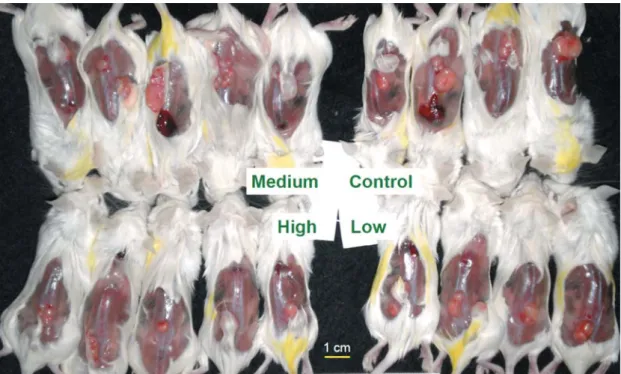
By naked eye, the 40 mice had obvious tumor masses in
the colon without full dissection (Figure 1). All ten mice of
the control group were scored +++/++++, showing that the
size of the tumor mass increased sharply to around 10 mm
to over 15 mm during the 6 weeks of incubation. After
low-dose ABM treatment, five mice still scored ++++, showing
that low-dose treatment was not very effective. After the
high- or medium-dose treatments, no mouse was scored
++++ (Table I). The oral administration of ABM did not
prevent tumor growth since the tumor masses increased, but
compared with the control group, the tumor mass seemed to
grow more slowly with ABM treatment. Tumor growth
inhibition was dependent on the ABM dose.
Discussion
Whole-mushroom extracts contain compounds including an
α-1,6- and α-1,4-glucan complex and α glucomannan with
a main chain of β-1,2-linked D-mannopyranosyl residues
that may modulate tumorigenesis and carcinogenesis at
different stages and/or may act at the same stage through
different mechanisms (23, 24). A combination of distinct
downstream responses involving different cell subsets could
conceivably provide greater tumor inhibition than could be
induced by a single polysaccharide. However, the wide
number of different and only partially homogeneous ABM
extracts used represents a difficult challenge for establishing
the best extract and active substances. Moreover additive, or
even synergistic, effects may occur while increasing
fractionations of one ABM extract enhanced some biological
activities, but abolished others (25).
Whilst to have anticlastogenic properties with a 100%
reduction of chromatid and 144.4% reduction of
isochromatid breaks, is apparently really important for
cancer prevention in humans since it is usually consumed in
its natural form as tea or as food (26). A aqueous extracts of
ABM have variously demonstrated no clastogenic activity.
While an n-butanolic extract was both anticlastogenic and
clastogenic (26) and at different concentrations, hexane
extracts were genotoxic, cytotoxic and anticlastogenic,
suggesting further studies are needed (27). A strong
protective effect (28-30), activation, of apoptosis (31) and no
protective effect have been shown in some cell types (32-34).
Additionally, differences in the cultivation, storage and
extract preparation might influence the effectiveness of
aqueous extracts of ABM (34).
Thus lineages and pre-treatment influence the
pharmacological anticancer activity of ABM extracts and as
confirmed by Manzi and Pizzoferrato (35), β-glucans,
apparently the most important constituent, are distributed
variably in mushrooms, both in the soluble and in the
insoluble fraction. Luiz et al. (33) also suggested that fatty
acids (especially linoleic and eicosapentanoic acid) in
ethanol and chloroform/ methanol extracts could have a role
in the antimutagenic activity.
In the present study, while ABM treatment did not stop the
growth of HT-29 tumor masses, it did inhibit rapid growth.
Aqueous ABM extracts given in the drinking water have
demonstrated protection at the initiation step of liver
carcinogenesis in rats and mice, but were ineffective when
administered in the post-induction period (32, 36-37). Our
next study may investigate ABM treatment prior to cancer
induction. ABM fed in dry powdered form to Wistar rats
exhibited significant chemopreventive influence on the
promoting phase of chemical hepatocarcinogenesis (38).
Among nearly 40 articles directly associated with ABM in
animal studies, this study was the first to evaluate the effect
of ABM extract on HT-29 cell colon cancer growth in SCID
mice, and this tumor growth model performed well because
colon cancer was successfully induced in all forty mice.
Although the results point to effective treatment by ABM,
one should be very cautious about applying these data to
human clinical studies, because this study was performed on
a specific strain of mice using a HT-29 colon cancer cell line.
Which substance in ABM inhibits the cells needs to be
established. Moreover, a more detailed study of its specificity
to organs or any other cell inoculation may be valuable in
terms of clarifying its mode of action, and its antitumor
effectiveness should be studied in different tumor inoculation
Figure 1. The size of tumor mass varied widely after 6-week treatment with or without ABM. Representative mice of the four groups are shown.Table I. Tumor size score at death or after 6-week treatment of SCID mice with or without ABM. Tumor status categorized as: +: up to 5 mm; ++: up to 10 mm, +++: up to 15 mm; ++++: over 15 mm. Low: 1.125 mg; medium: 4.5 mg; high: 45 mg ABM orally daily.
Treatment + ++ +++ ++++
Survived Died Survived Died Survived Died Survived Died
Control 5 1 4
Low 1 4 2 3
Medium 1 4 5
models. Careful clinical studies comparing the activity of
isolated compounds, whole-mushroom extracts and
epidemiological data are still necessary to determine whether
ABM can provide real clinical benefits. Dose–response
studies and isolation, as well as chemical identification and
quantification of specific compounds responsible for the
potential benefit from ABM should be fully developed.
In conclusion, ABM extracted by hot water led to tumor
growth rate decline in the tumor growth model, in vivo. The
treatment effect and survivor rate are dependent on the ABM
dose used.
References
1 Lu HF, Lai KC, Hsu SC, Lin HJ, Yang MD, Chen YL, Fan MJ, Yang JS, Cheng PY, Kuo CL and Chung JG: Curcumin induces apoptosis through FAS and FADD, in caspase-3-dependent and -independent pathways in the N18 mouse-rat hybrid retina ganglion cells. Oncol Rep 22(1): 97-104, 2009.
2 Wu SH, Hang LW, Yang JS, Chen HY, Lin HY, Chiang JH, Lu CC, Yang JL, Lai TY, Ko YC and Chung JG: Curcumin induces apoptosis in human non-small cell lung cancer NCI-H460 cells through ER stress and caspase cascade- and mitochondria-dependent pathways. Anticancer Res 30(6): 2125-2133, 2010.
3 Su CC, Yang JS, Lu CC, Chiang JH, Wu CL, Lin JJ, Lai KC, Hsia TC, Lu HF, Fan MJ and Chung JG: Curcumin inhibits human lung large cell carcinoma cancer tumour growth in a murine xenograft model. Phytother Res 24(2): 189-192, 2010. 4 Huang WW, Chiu YJ, Fan MJ, Lu HF, Yeh HF, Li KH, Chen PY,
Chung JG and Yang JS: Kaempferol induced apoptosis via endoplasmic reticulum stress and mitochondria-dependent pathway in human osteosarcoma U-2 OS cells. Mol Nutr Food Res 54(11): 1585-1595, 2010.
5 Lu CC, Yang JS, Huang AC, Hsia TC, Chou ST, Kuo CL, Lu HF, Lee TH, Wood WG and Chung JG: Chrysophanol induces necrosis through the production of ROS and alteration of ATP levels in J5 human liver cancer cells. Mol Nutr Food Res 54(7): 967-976, 2010.
6 Chiang JH, Yang JS, Ma CY, Yang MD, Huang HY, Hsia TC, Kuo HM, Wu PP, Lee TH and Chung JG: Danthron, an anthraquinone derivative, induces DNA damage and caspase cascades-mediated apoptosis in SNU-1 human gastric cancer cells through mitochondrial permeability transition pores and BAX-triggered pathways. Chem Res Toxicol 24(1): 20-29, 2011. 7 Lin HJ, Su CC, Lu HF, Yang JS, Hsu SC, Ip SW, Wu JJ, Li YC, Ho CC, Wu CC and Chung JG: Curcumin blocks migration and invasion of mouse-rat hybrid retina ganglion cells (N18) through the inhibition of Mmp-2, -9, Fak, Rho A and Rock-1 gene expression. Oncol Rep 23(3): 665-670, 2010.
8 Lu HF, Yang JS, Lai KC, Hsu SC, Hsueh SC, Chen YL, Chiang JH, Lu CC, Lo C, Yang MD and Chung JG: Curcumin-induced DNA damage and inhibited DNA repair gene expressions in mouse-rat hybrid retina ganglion cells (N18). Neurochem Res 34(8): 1491-1497, 2009.
9 Moore MA and Tsuda H: Chronically elevated proliferation as a risk factor for neoplasia. Eur J Cancer Prev 7(5): 353-385, 1998.
10 Mori H, Sugie S, Yoshimi N, Hara A and Tanaka T: Control of cell proliferation in cancer prevention. Mutat Res 428(1-2): 291-298, 1999.
11 Mattila P, Salo-Vaananen P, Konko K, Aro H and Jalava T: Basic composition and amino acid contents of mushrooms cultivated in Finland. J Agric Food Chem 50(22): 6419-6422, 2002. 12 Tang NY, Yang JS, Lin JP, Hsia TC, Fan MJ, Lin JJ, Weng SW,
Ma YS, Lu HF, Shen JJ, Lin JG and Chung JG: Effects of Agaricus blazei Murrill extract on immune responses in normal BALB/c mice. In Vivo 23(5): 761-766, 2009.
13 Endo M, Beppu H, Akiyama H, Wakamatsu K, Ito S, Kawamoto Y, Shimpo K, Sumiya T, Koike T and Matsui T: Agaritine purified from Agaricus blazei Murrill exerts antitumor activity against leukemia cells. Biochim Biophys Acta 1800(7): 669-673, 2010.
14 Wasser SP and Weis AL: Therapeutic effects of substances occurring in higher Basidiomycetes mushrooms: a modern perspective. Crit Rev Immunol 19(1): 65-96, 1999.
15 Hetland G, Johnson E, Lyberg T, Bernardshaw S, Tryggestad AM and Grinde B: Effects of the medicinal mushroom Agaricus blazei Murrill on immunity, infection and cancer. Scand J Immunol 68(4): 363-370, 2008.
16 Lima CU, Cordova CO, Nobrega Ode T, Funghetto SS and Karnikowski MG: Does the Agaricus blazei Murrill mushroom have properties that affect the immune system? An integrative review. J Med Food 14(1-2): 2-8, 2011.
17 Yu CH, Kan SF, Shu CH, Lu TJ, Sun-Hwang L and Wang PS: Inhibitory mechanisms of Agaricus blazei Murrill on the growth of prostate cancer in vitro and in vivo. J Nutr Biochem 20(10): 753-764, 2009.
18 Hsu CH, Liao YL, Lin SC, Hwang KC and Chou P: The mushroom Agaricus blazei Murrill in combination with metformin and gliclazide improves insulin resistance in type 2 diabetes: a randomized, double-blinded, and placebo-controlled clinical trial. J Altern Complement Med 13(1): 97-102, 2007. 19 Chen L, Shao HJ and Su YB: Coimmunization of Agaricus
blazei Murrill extract with hepatitis B virus core protein through DNA vaccine enhances cellular and humoral immune responses. Int Immunopharmacol 4(3): 403-409, 2004.
20 Ohno N, Furukawa M, Miura NN, Adachi Y, Motoi M and Yadomae T: Antitumor beta glucan from the cultured fruit body of Agaricus blazei. Biol Pharm Bull 24(7): 820-828, 2001. 21 Firenzuoli F, Gori L and Lombardo G: The medicinal mushroom
Agaricus blazei Murrill: review of literature and pharmaco-toxicological problems. Evid Based Complement Alternat Med 5(1): 3-15, 2008.
22 Itoh H, Ito H, Amano H and Noda H: Inhibitory action of a (1-->6)-beta-D-glucan-protein complex (F III-2-b) isolated from Agaricus blazei Murrill (‘himematsutake’) on Meth A fibrosarcoma-bearing mice and its antitumor mechanism. Jpn J Pharmacol 66(2): 265-271, 1994.
23 Mizuno M, Morimoto M, Minato K and Tsuchida H: Polysaccharides from Agaricus blazei stimulate lymphocyte T-cell subsets in mice. Biosci Biotechnol Biochem 62(3): 434-437, 1998. 24 Mizuno T: The extraction and development of antitumor-active polysaccharides from medicinal mushrooms in Japan (review). Int J Med Mushrooms 1: 9-30, 1999.
25 Cooper EL: Commentary on CAM and NK cells by Kazuyoshi Takeda and Ko Okumura. Evid Based Complement Alternat Med 1(1): 29-34, 2004.
26 Bellini MF, Angeli JP, Matuo R, Terezan AP, Ribeiro LR and Mantovani MS: Antigenotoxicity of Agaricus blazei mushroom organic and aqueous extracts in chromosomal aberration and cytokinesis block micronucleus assays in CHO-k1 and HTC cells. Toxicol In Vitro 20(3): 355-360, 2006.
27 Machado MP, Filho ER, Terezan AP, Ribeiro LR and Mantovani MS: Cytotoxicity, genotoxicity and antimutagenicity of hexane extracts of Agaricus blazei determined in vitro by the comet assay and CHO/HGPRT gene mutation assay. Toxicol In Vitro 19(4): 533-539, 2005.
28 Martins de Oliveira J, Jordao BQ, Ribeiro LR, Ferreira da Eira A and Mantovani MS: Anti-genotoxic effect of aqueous extracts of sun mushroom (Agaricus blazei Murrill lineage 99/26) in mammalian cells in vitro. Food Chem Toxicol 40(12): 1775-1780, 2002.
29 Menoli RC, Mantovani MS, Ribeiro LR, Speit G and Jordao BQ: Antimutagenic effects of the mushroom Agaricus blazei Murrill extracts on V79 cells. Mutat Res 496(1-2): 5-13, 2001. 30 Shimizu S, Kitada H, Yokota H, Yamakawa J, Murayama T,
Sugiyama K, Izumi H and Yamaguchi N: Activation of the alternative complement pathway by Agaricus blazei Murrill. Phytomedicine 9(6): 536-545, 2002.
31 Jin CY, Choi YH, Moon DO, Park C, Park YM, Jeong SC, Heo MS, Lee TH, Lee JD and Kim GY: Induction of G2/M arrest and apoptosis in human gastric epithelial AGS cells by aqueous extract of Agaricus blazei. Oncol Rep 16(6): 1349-1355, 2006. 32 Delmanto RD, de Lima PL, Sugui MM, da Eira AF, Salvadori
DM, Speit G and Ribeiro LR: Antimutagenic effect of Agaricus blazei Murrill mushroom on the genotoxicity induced by cyclophosphamide. Mutat Res 496(1-2): 15-21, 2001.
33 Luiz RC, Jordao BQ, da Eira AF, Ribeiro LR and Mantovani MS: Mechanism of anticlastogenicity of Agaricus blazei Murrill mushroom organic extracts in wild type CHO (K(1)) and repair deficient (xrs5) cells by chromosome aberration and sister chromatid exchange assays. Mutat Res 528(1-2): 75-79, 2003.
34 Guterrez ZR, Mantovani MS, Eira AF, Ribeiro LR and Jordao BQ: Variation of the antimutagenicity effects of water extracts of Agaricus blazei Murrill in vitro. Toxicol In Vitro 18(3): 301-309, 2004.
35 Manzi P and Pizzoferrato L: Beta-glucans in edible mushrooms. Food Chem 68: 315-318, 2000.
36 Barbisan LF, Miyamoto M, Scolastici C, Salvadori DM, Ribeiro LR, Eira AF and de Camargo JL: Influence of aqueous extract of Agaricus blazei on rat liver toxicity induced by different doses of diethylnitrosamine. J Ethnopharmacol 83(1-2): 25-32, 2002. 37 Barbisan LF, Spinardi-Barbisan AL, Moreira EL, Salvadori DM,
Ribeiro LR, da Eira AF and de Camargo JL: Agaricus blazei (Himematsutake) does not alter the development of rat diethylnitrosamine-initiated hepatic preneoplastic foci. Cancer Sci 94(2): 188-192, 2003.
38 Ito H, Shimura K, Itoh H and Kawade M: Antitumor effects of a new polysaccharide-protein complex (ATOM) prepared from Agaricus blazei (Iwade strain 101) ‘Himematsutake’ and its mechanisms in tumor-bearing mice. Anticancer Res 17(1A): 277-284, 1997.
39 Pinheiro F, Faria RR, de Camargo JL, Spinardi-Barbisan AL, da Eira AF and Barbisan LF: Chemoprevention of preneoplastic liver foci development by dietary mushroom Agaricus blazei Murrill in the rat. Food Chem Toxicol 41(11): 1543-1550, 2003.