因應氣候變遷作物育種
及生產環境管理研討會專刊
Proceedings of the Workshop on Crop Breeding and Management of
Agricultural Environment for Coping with Climate Change
主編
吳東鴻、陸明德、曾東海、王怡玎、蕭巧玲
Edited by
Dong-Hong Wu, Ming-Te Lu, Tong-Hai Tseng,
Yee-Ting Wang, and Chiao-Ling Hsiao
行政院農業委員會農業試驗所
Taiwan Agricultural Research Institute, COA
中華民國一百年十二月
Agricultural Environment for Coping with Climate Change
目錄 Catalogue
研討會序文Workshop introduction --- i
研討會歡迎詞Welcome address--- ii
農業氣象學應用現況:例釋與最新趨勢Applied agrometeorology of today: some case studies and new trends
Kees Stigter --- 1
在 21 世紀中面臨氣候變遷下從永續經營看作物育種趨勢
Plant breeding for sustainable agriculture in the face of climate change in the 21
stcentury
Molly Jahn --- 13
選育具氣候調適能力之水稻:其育種目標、策略與演進
Breeding for climate-ready rice: needs, strategies, and progress
Hei Leung --- 15
氣象災害因應策略
Response strategies for agrometeorological disasters
申雍、陳守泓、姚銘輝
Yuan Shen, Shou-Hung Chen
, and Min-Hwi Yao --- 17
氣候變遷與土壤質量管理
Climate changes affect Taiwan soil quality and the management strategies
郭鴻裕
Horng-yuh Guo --- 29
氣候變遷與植物病原消長
Climate change and dynamics of plant diseases
鄧汀欽、安寶貞、鄭櫻慧、林子凱、蔣國司
石憲宗、黃毓斌、林鳳琪、謝雨蒔、張宗仁、黃守宏、江明耀、王清玲、高靜華
Hsien-Tzung Shih, Yu-Bing Huang, Feng-Chyi Lin, Yi-S Shieh, Chung-Jan Chang,
Shou-Horng Huang, Ming-Yau Chiang, Chin-Ling Wang, and Cing-Hua Kao --- 49
因應非生物逆境之栽培及育種策略:以台灣環境之思考
Adaptation of crop cultivation and breeding to abiotic stresses: with aspect of Taiwan's
environment
盧虎生
Huu-Sheng Lur --- 61
全球暖化下台灣耐逆境水稻之育種策略與發展
The breed strategy and development on stress tolerance of Taiwan rice under global
warming
林彥蓉、吳永培
Yann-rong Lin, and Yong-pei Wu --- 65
逆境對玉米生長產量之影響及育種栽培因應之道
Effects of stress on the growth responses of corn and related operations in breeding
and cultures
謝光照
Guang-Jauh Shieh --- 79
因應氣候變遷之甘藷育種及栽培管理策略
The breeding and cultivation practices of sweet potatoes for the responses of climates
changes
賴永昌、黃哲倫、羅筱鳳、林冠宏
Y.C. Lai, J.L. Hwang, Hsiao F. Lo, and Kuan H. Lin --- 105
因應氣候變遷毛豆育種及生產環境管理
The breeding and cultivation practices of soybeans for the responses of climates changes
周國隆
Kuo-Lung Chou --- 131
氣候變遷對十字花科蔬菜育種的挑戰
Cruciferous vegetables breeding to meet challenges of climate change
王三太、許秀惠、陳甘澍、邱金春、李碩朋、林楨祐、羅惠齡、林照能、 許淼淼、洪爭坊
San-Tai Wang, Shiow-Huey Hseu, Kan-Shu Chen, Chin-Chun Chiou, Shuo-Peng Li,
Chen-Yu Lin, Hui-Ling Lo, Jaw-Neng Lin, Miao-Miao Hsu, and Cheng-Fang Hong ---- 135
environment
王毓華、林子凱、林照能
Yu-Hua Wang, Tzu-Kai Lin, and Jaw-Neng Lin --- 153
因應熱帶氣候變遷挑戰之亞蔬茄科育種
Solanaceous vegetable breeding at AVRDC to meet the challenges of climate change
in the tropics
Peter Hanson, Paul Gniffke, Jin Shieh, Shu-fen Lu, and Chee-wee Tan--- 163
因應氣候變遷之菇類育種與栽培管理
Breeding and cultivation management of mushroom for mitigation and adaptation to
climate change
石信德、陳美俓、李瑋崧、呂昀陞、陳錦桐、吳寬澤Hsin-Der Shih, Mei-Hsing Chen, Wei-Sung Li, Yun-Sheng Leu, Jin-Tong Chen, and
Kaun-Tzer Wu --- 173
台灣熱帶果樹產業因應氣候變遷之調適
Realignment of tropical fruit production to climate change in Taiwan
顏昌瑞Chung-Ruey Yen --- 187
氣候變遷對台灣亞熱帶果樹之影響
Impacts of climate change to subtropical fruits in Taiwan
呂明雄Ming-Hsiung Lu --- 189
溫帶果樹對氣候變遷的育種及生產管理應變
The strategies of breeding and production management of temperate fruits for
climate change
施昭彰Jau Chang Shih --- 191
綜合討論
Panel discussion --- 201
糧食議題討論
Group discussion of venue-food session --- 203
蔬菜議題討論
Group discussion of venue-vegetable session --- 206
果樹議題討論
Group discussion of venue-fruit session --- 208
為因應氣候變遷提升國內農業生產調適能力,行政院農業委員會農業試驗所於8月31 日(星期三)上午9時在本所國際會議廳舉辦 因應氣候變遷作物育種及生產環境管理 研討 會 為期一天半的學術盛會中,來自美國、荷蘭及菲律賓等多國著名學者與16位國內研究 專家,將針對全球氣候變遷下糧食、蔬菜及果樹等作物育種與環境管理發表成果回顧及評 論 除了國內各試驗場所及大專院校從事農業研究的專家學者外,亦包含民間種苗業者及 關心農業發展的農民與農企業團體將齊聚一堂,希望藉由本研討會相互討論及意見交流, 導引與會人員針對本次議題凝聚共識,以研擬因應氣候變遷國內作物生產之調整策略 近來全球氣候極端異常,很多地區受到洪水、乾旱、冰雪風暴、熱浪和寒潮等肆虐的 發生次數日益頻繁且加劇,整體氣溫趨向暖化並導致病蟲害大規模流行,對人類造成的威 脅與農產損失日趨嚴重,使得農民對具有高逆境調適能力品種的需求性更為迫 為穩定 我國農糧產業之發展,國內各農業研究單位持續不斷創新,以培育出能兼具各項優良性狀 的農作物新品種及研發出優質生產環境管理技術,提供我國農糧產業最佳生產基石與因應 未來衝擊之能量 但是氣候變遷的速度似乎比預期來得快,亟待各農業研究單位及早籌畫 因應措施 如何能有效應用遺傳研究與生產環境管理,提高作物品種的逆境耐受性及育種 效率,將是目前農業研究單位面臨的嚴峻挑戰 本次研討會第1天議程主要係針對 氣象災害因應策略 、 氣候變遷與土壤質量管 理 、 氣候變遷與病害之消長 、 氣候變遷對農業昆蟲直接與間接影響之研究回顧 及 台 灣因應非生物逆境之栽培及育種策略 等廣泛性議題進行專題報告及綜合討論,第2天議 程則針對糧食、蔬菜與果樹等各類作物議題分組作更深入探討與意見交換,讓各領域專家 藉此公開場合能充份分享彼此見解,擬定國內因應氣候變遷之作物育種及生產管理的調整 策略,包含水稻、玉米、甘藷與毛豆等糧食作物,十字花科、葫蘆科、茄科蔬菜與菇類等 蔬菜作物,以及熱帶、亞熱帶及溫帶等果樹作物的具體因應措施,為我國農糧產業發展貢 獻良策
行政院農業委員會農業試驗所
所長
中華民國一○○年十二月
ii
陳駿季 所長
農委會農業試驗所
農業委員會陳主任委員、國家實驗研究院科技政策研究與資訊中心鄒顧問、諸位參與 專題演講的國內外貴賓、各位與會農業先進們、各位女士、先生,大家好! 為了緩解與調適氣候變遷對農業生產及糧食安全的多元衝擊,行政院農業委員會特別 於去(99)年 6 月中召開 因應氣候變遷農業調適政策會議 ,會中獲得 43 項策略共計 208 項對應措施 又於本(100)年 5 月間舉行 全國糧食安全會議 ,規劃五大議題綜合討論, 亦得到 14 項關鍵策略及 55 項擬採措施 本會陳主任委員更進一步要求本所籌備本項 因 應氣候變遷作物育種及生產環境管理研討會 ,邀請國內外專家學者針對 作物育種 及 生產環境管理 兩項議題再予深入探討,期以歸納出相關解決方向,並據以研擬行動方 案來因應氣候變遷的可能影響 承蒙本會 陳主任委員親自蒞臨指導和提示,諸位專家學者和農業先進們踴躍參與, 尤其三位國外專家學者分別從荷蘭、美國、菲律賓國際稻米研究所遠道而來,本人謹代表 籌備單位農業試驗所表達十二萬分的感謝和歡迎之意 企盼本所寬闊的空間、新鮮的空氣 和好客的熱情,陪伴 您愉快的度過兩天會期 從農作物育種與生產的觀點,農糧作物的品種改良及栽培管理必須加強,並強化具潛 力作物的耐/抗逆境能力,以確保糧食安全供應;而從生產環境調適的角度,應當發展環境 親和/友善的耕作方式,改善生物性及非生物性的逆境,以促進農業永續經營 本研討會即 以此主軸規劃各項主題,邀請合適的國內外專家學者提供研究結果、經驗與心得,復希望 與會農業先進們能夠慷慨的提出寶貴意見,讓本研討會可以獲得豐碩研討成果,助益於農 業試驗研究單位未來研提具體行動方案 籌備單位會將本研討會的論文彙集成冊,合併會議整理的各項意見一起出版,一方面 作為本所未來研究重點的規劃參考,另方面提供本會其他試驗研究單位參採,以延廣研討 會成效 最後,謹再一次向全體與會的專家學者、農業先進和女士、先生表示由衷的感謝, 特別是千里遠道前來三位國外朋友,祝福大家健康快樂,事業鴻圖大展,謝謝Applied Agrometeorology of Today: Some Case Studies
and New Trends
C.J. (Kees) Stigter1 1
Agromet Vision, P.O. Box 16, 68208 Bondowoso, East Java, Indonesia and Groenestraat 13, 5314 AJ Bruchem, Netherlands. E-mail: [email protected]
Abstract
One of the most important trends in agrometeorology is the development of agrometeorological services with and for farmers. The issue is that they must be explained to and discussed with these farmers and then must be applied in cultivation planning/actions and finally also evaluated with them. The second trend therefore is a “farmers first” paradigm in a participatory approach. An important class of services is the design of new cropping/farming systems that can face new requirements of the “farmers first” paradigm. Three examples of intercropping farming systems have been selected and climate change and cultivation aspects of these designs will be dealt with. Dryland intercropping with heterogeneous mixtures in semi-arid Nigeria is the first example. Demonstration and extension of relay intercropping of late rice into lotus in Guangchang County, Jiangxi Province, China is the second. Land scarcity forcing farmers in semi-arid Kenya to cultivate more sloping land is the third. The next trend to be discussed is generating and supporting a rural response to climate change in agrometeorology. We use case studies from Indonesia. Collection and generation of on-farm knowledge will very much help. If we succeed in creating such weather services, consequences of climate change can be faced with much more confidence. In Indonesia experiments have taken place with local Climate Field Schools (CFSs) as a new trend in agrometeorology. We finally have experimented there with so called “Science Field Shops”, which should become a new trend. The applied agrometeorology of today is what scientifically supports those trends.
INTRODUCTION
One of the most important trends in agrometeorology is the development of agrometeorological services with and for farmers (Stigter, 2010). We consider that to agrometeorological services belong all agrometeorological and agroclimatological knowledge and information that can be directly applied to try to improve and/or protect the livelihood of
2
farmers. This means protection of yield quantity and quality and farmers’ income, while safeguarding the agricultural resource base from degradation (e.g. Stigter, 2010; WMO, 2011).
An obvious example is of course a specific weather forecast for agriculture, but the issue with actual agrometeorological services is that such a forecast must be explained to and discussed with these farmers and then must be applied in cultivation planning/actions with them and finally also must be evaluated with them (Murthy, 2008). The same applies to other agrometeorological services such as simple seasonal climate predictions, early warning messages and other disaster preparedness attempts (Stigter, 2010). Such an approach fits the “farmers first” paradigm excellently. The second trend therefore is a “farmers first” paradigm in a participatory approach (e.g. Stigter, 2011a).
Another class of such services is the design of new cropping/farming systems that can face new requirements of the “farmers first” paradigm. The organizers asked me to exemplify cases of multiple cropping systems. Three examples of intercropping farming systems will be dealt with below and climate change and cultivation aspects of these designs will be dealt with (Stigter, 2010). The next trend discussed is that of generating and supporting a rural response to climate change in (among others) agrometeorology (Winarto and Stigter, 2011). We discuss it for agrometeorology using case studies from Indonesia. An example of the latter is the research we do in Yogyakarta and west Java, Indonesia, stimulating farmers since 2007 to measure rainfall patterns in their own fields and to follow the consequences for their crops and fields, growing season by growing season (Winarto et al., 2008; Winarto et al., 2010). These on-farm data and information are then discussed among themselves and with supporting scientists. If we succeed in creating such weather services, consequences of climate change can be faced with much more confidence. In Indonesia experiments have taken place with local Climate Field Schools (CFSs) as a new trend in agrometeorology. However, the top down approach with the curricula, “teaching” farmers agrometeorology, left much to be desired. We therefore advocate bottom up agrometeorological learning processes, focused on weather and climate vulnerabilities of the farming systems concerned (Winarto and Stigter, 2011). To that end we have experimented in Indonesia with so called “Science Field Shops”, which should become a new trend. The applied agrometeorology of today is what scientifically supports those trends (Stigter, 2010).
INTERCROPPING EXAMPLE FROM SEMI-ARID NIGERIA
The major cereals adapted to the rainfed region of the Nigerian Sudan savannah are pearl millet (Pennisetum glaucum (L.) R.Br) and sorghum (Sorghum bicolor (L.) Moench). These cereals are predominantly intercropped with cowpea (Vigna unguiculata (L.) Walp) and/or
groundnut (Arachis hypogaea (L.)). The most dominant crop mixtures are millet/cowpea, millet/ sorghum/cowpea, millet/cowpea/groundnut, sorghum/cowpea and sorghum/cowpea/groundnut. Cowpea has a dual purpose: the grain is used for human consumption and the remaining biomass as fodder for animals. Some cowpea varieties are planted specially within the intercrops for fodder production, producing little or no grain, to take care of animal feed during the dry season. The cowpea component of the mixtures also often consists of two types, i.e. fodder and grain types that differ in growth habit and maturity period (Stigter et al., 2005).The cereals are grown for consumption and cash (Beets, 1990). Intercropping components adopted by farmers are grown at low densities, to minimize risks and exploit resources in a good cropping season. They are grown on soils too low in water holding capacity for the precipitation - falling in heavy showers - to meet evaporative demands of the atmosphere (Oluwasemire et al., 2002). High year-to-year variability of rainfall (Ati et al., 2009), serious deep percolation (Oluwasemire et al., 2002) and high wet soil evaporation losses (Kinama et al., 2005) are additional stresses. There is need for better understanding of the traditional intercropping systems. This would improve the possibility of mitigating the limiting factors, as well as making optimum use of the limited resources (Stigter et al., 2005), while it serves also to face the changing climate conditions (Stigter, 2010).
Because of intensification of land use over the years, there have already been long lasting changes in surface microclimate. The efficient use of the limited effective rainfall in this zone is therefore a crucial factor for future increases in crop production, which should come primarily from increased yield per unit area of land (Jagtap and Chan, 2000). Low harvest indexes (HI) may result from the reduction in the supply of assimilates, when competition for water in the root zone occurs during the yield production stage (Fukai and Trenbath, 1993).
Sorghum root production was greater than for millet, while both cereals produced greater root density than cowpea. Cowpea produced greater root densities and achieved deeper rooting when intercropped with millet and/or sorghum than sole, suggesting adaptation and competitive ability under intercropping conditions. Rooting depths of crops were shallower in a relatively wet season than when water was limiting. Root densities and proliferation of the cereals below the surface layer were much higher in low fertility soils than when nutrients were readily available. This is useful knowledge for designing such systems.
Millet was the dominant crop in dry matter production in the intercrops. This was due to the faster growth and high tillering rates of millet, especially when sown at low density. The soil fertility treatments did not create any statistical significant differences in yield and yield components of millet at harvest in all the cropping systems. To fight land degradation, a consistent incorporation of organic manure at seasonal level is a way of improving soil physical
4
and chemical conditions aimed at conserving soil water. The improvement of the soil nutrient status by an increased application of organic manure may also encourage the manipulation of the intercrop components, such that an increase in plant densities would make better use of soil water that would otherwise have been lost to soil evaporation and deep percolation beyond the rooting zones (Stigter et al., 2005). Such designs nicely fit a “farmers first” paradigm.
The farmers’ practice of planting millet and/or sorghum earlier in the intercropping systems relative to the cowpea components affords the cereal components, especially millet, with a relatively faster rate of assimilate accumulation, more competitiveness for resources than the other crops in association. The implication of this practice are the negative effects on cowpea yields as shown in our case. The density and morphological characteristics of crops in association influence the microclimate within the various cropping systems. The reduction of soil radiative and heat exchanges (reduced surface soil temperature fluctuation), by a well developed low growing cowpea component in an intercropping system, is capable of reducing soil evaporation better than in the sole cereal systems and hence offers a better soil water conservation practice in the arid and semi-arid zone of Nigeria.
An answer with a view of improving the cereal/legume systems in the Nigerian arid and semi-arid zones should therefore include genetically superior crop cultivars and the manipulation of the component densities along with the improvement of microclimatic variables. An amelioration of the cereal/legume intercropping systems may involve a reduction in plant density of the tillering and faster dry matter accumulating millet component, while the low growing and ground covering cowpea component density is increased. The results learn that abundant organic manure in combination with agrometeorological services on intercrop manipulation related microclimate improvements may control near surface land degradation in northern Nigeria under acceptable sustainable yields. Appropriate policy environments, in economics and research, must enhance this (Stigter et al., 2005). When these issues are attended to, consequences of climate change can be confidently faced as well in a “farmers first” paradigm.
INTERCROPPING EXAMPLE FROM GUANGCHANG, JIANGXI PROVINCE,
CHINA
Stigter (2010) recently argued that the issues to attend to appear to be (i) what multiple cropping systems have as defence strategies to extreme meteorological events that are less efficient or not available in monocropping and (ii) what science can contribute to understanding and developing such strategies. Where knowledge is operational at all in agrometeorological services, it is mainly for monocropping, perhaps for sequential cropping, but it remains marginal
for mixed (inter)cropping and relay (inter)cropping, with the exception of the long recognized but insufficient exploited protection functions of trees in agroforestry applications (e.g. Stigter, 2011c).
In the area concerned, a double rice crop (early rice and late rice) used to be grown everywhere and is still abundantly grown. Because of the slow global warming, the seasons become longer. Now into lotus, that is sown by the end of March, early April, and gradually harvested between July and September, late rice is transplanted as a relay crop, roughly between 10 and 20 August. Because of the lotus, the rice is 45 days in the nursery, 10 days longer than normal, so the rice is transplanted later than usual. But the land is now occupied after the lotus, that is harvested till September, while the later sown early maturing rice variety occupies the land till into November.
In Stigter’s (2008; 2011b) categorization of agrometeorological services, this example should mainly be seen as from the category “Development and validation of adaptation strategies to changes”. However, it has also elements of “Advices such as in design rules on above and below ground microclimate management and manipulation”, where it shows “fitting the crop to the season” aspects of microclimate management, as in Stigter’s earlier categorization of microclimate related work in agriculture in the early eighties (e.g. Stigter, 1994). This also comes back in the choice of earlier maturing varieties of late rice, and in microclimate issues of the lotus crop, such as in positive shading, that should be further researched.
The lotus normally fetches a high prize and the rice is an additional bonus. The lotus may lose 10% of its harvest because of the rice but under land scarcity the late rice is a useful addition. In the seventies this would not have been possible, but climate change makes it possible. Of course under early cold waves the rice will lose in production. During the demonstration, Meteorological Bureaus signed contracts with farmers, according to which the former subsidized seeds and fertilizers. They would also compensate any losses compared with growing sole white lotus or a double rice crop in case of failure of the interplanting.
For extension, here eight times a kind of Climate Field Classes was organized to demonstrate and popularize the method with the target groups concerned and a class room was available for training.. As we earlier indicated, a comparison of such an approach (e.g. Winarto et al., 2008) with the “cascade” down coming of extension information in China would be a great last phase of the pilot projects started there in 2004 (Stigter, 2009a; 2009b).
Another important lesson learned here is the economically successful adaptation that is provided to a changing climate. Only some decades ago, the present development would not have been feasible in this farming system. This is a warning against any trend of scenarios
6
projecting present cropping systems into the future and then detailing their suffering from climate change (Stigter et al., 2008). There are many ways for adaptation through agrometeorological services and farmers are keen to innovate and follow up (e.g. also Winarto et al., 2008). By sticking to a “farmers first” paradigm, such errors would not be made.
LAND SCARCITY IN KENYA FORCING FARMERS TO CULTIVATE
SLOPING LAND
One way to fight land degradation without using expensive inputs could be the use of agroforestry systems, particularly alley cropping (hedgerow agroforestry). Mungai et al. (2001) showed that for flat land, without fertilizers, yield increases from mulch incorporation in semi-arid Kenya were insufficient when maize rows were replaced by trees. Below a threshold rainfall, yields were even less than those in the controls (Mungai et al., 2001). As below ground resources become more depleted with colonizing ageing systems, tree growth occurs even more at the expense of crop production (Kinama et al., 2007).
Contour hedgerows on sloping land should be able to capture the runoff and soil, which would otherwise be lost from hillside cultivation, and thereby compensate at least in the long run for the extra resources required for tree growth (Stigter et al., 2005). Contour plantings of trees on hill slopes are highly effective in reducing water caused soil erosion and have provided more encouraging results than alley cropping on flat lands. Tillage and mulching reduce rain impacts on cropped soil and provide roughness that slows losses of soil and water. Infiltration beneath the hedgerows was greatly improved, due partly to the physical barrier effect of the stems and partly by an increase in macropores under the hedgerows. More water appeared to be stored and to a greater depth under the hedges than elsewhere (Kiepe, 1995).
However, high water losses from soil evaporation have been reported (Kinama et al., 2005), while Mungai et al. (2001) proved patterns and densities of overlapping roots between maize and Senna siamea to be involved in lower yields in middle rows. For such reasons beneficial effects on crop yield are seen as often unpredictable and insufficient to attract widespread adoption. Initial enthusiasm for contour hedgerows was dampened by their slow and sporadic adoption, even in humid and sub-humid regions. Few farmers can afford to invest in any soil conservation measures which do not improve their crop yields, let alone sacrifice crop yields in drought seasons (Garrity et al., 1999).
“On-station” comparison was made of erosion control from contour Senna siamea hedgerows and Panicum maximum grass stripson a 14% Alfisol, intercropped in rotation with maize and cowpea, without the use of fertilizers and with hedge/strip spacings of 4m. Kinama et al. (2007) quantified multi-season trends in runoff, soil loss and productivity of the S. siamea
contour hedgerow systems first successfully used by Kiepe (1995) from 1989-1992 with the use of fertilizers. They examined the trade-offs between soil conservation and crop productivity without fertilizers for these now mature systems, from 1993-1995.
Cumulative runoff was reduced from close to 100 mm to only 20 mm. Cumulative soil loss reduced from more than 100 ton/ha to only 2 ton/ha. But this was at the expense of 35% of the maize yields and 25% of the cowpea yields due to competition. The presence of surface mulch was clearly the most important factor in reducing runoff since their removal resulted in an additional cumulative loss of 56 mm. On the other hand, the presence of the hedgerows was much less important in reducing runoff, e.g. only an extra 23 mm was saved by this treatment as compared to the controls (Kinama et al., 2007). This is not in line with the results with the younger system, where hedges were still more important than mulches in the runoff control, but for the hedges the lower soil loss compared to mulches remained in line with the younger system (Kiepe, 1995).
The grass strip results for runoff and soil loss reduction were halfway between the values for the hedges with and without mulches. But the yield reductions were highest for the grass strips. The grass strips were more effective in preventing soil erosion than the hedgerows (without mulch) because of the compactness and thickness of the grass strips. The latter are more effective in reducing runoff speed and trapping soil than the thinner and appreciably less dense hedgerows. The high soil losses under low crop cover also illustrate again that mulch cover alone (here of only 2 t ha–1) is insufficient in capturing particles. The tree mulch occupies micro-depressions on the tilled soil surface and increases hydraulic roughness, reducing flow velocity, and therefore increases flow depth, while it also protects the soil from impacting raindrops. The hedgerow barriers on the other hand trap runoff water by reducing bare slope length and give runoff water time to deposit soil sediments and infiltrate into the soil. The competitive effects of hedgerows on crops generally exceed the benefits gained by the answer to land degradation of preventing the often small and only infrequently serious amounts of runoff commonly found in the semi-arid tropics. Nevertheless, cultivation of crops on hill slopes induces unacceptable amounts of soil loss (Stigter et al., 2005), which are commonly prevented by terracing or ditches in the Machakos area (Kinama et al., 2007). The protective function of the mulch being so important, an advice on greater distances between hedgerows can only work jointly with increase of the numbers of trees and/or bringing in additional mulch material from outside the system. Little amounts of mulch, in our case around 2 t ha-1, that generally is accepted as the minimum of making agronomically sense, are known to have a reasonable physical influence, by increasing roughness, on water conservation (e.g. Oteng’i et al., 2007). The results obtained here suggest that it also is a sufficient level for keeping the tolerable
8
soil loss, the maximum erosion for sustainable crop yields, under control (Kinama et al., 2007). As a system design consequence of these results, provided as an agrometeorological service, frequent rejuvenation of economically preferred hedge rows and greater distances between double or triple rows, in combination with fertilizer use or more mulch, will greatly reduce competition with intercrops. The results learned that to reduce the trade-offs between crop productivity and erosion control on sloping land in the semi-arid tropics is the crux of the matter. It is crucial to select hedgerows and to design hedge and tree spacings that minimize competition and provide adequate erosion control.
Although it was confirmed that it is difficult to increase LEISA crop yields in the semi-arid tropics with alley cropping on sloping land, it was also observed that these strong trade-offs need not be a major deterrent to adoption by farmers, in case grass or trees provide other direct and significant benefits to farmers (Stigter et al., 2005). This are again other aspects of the “farmers first” paradigm in a participatory approach. As to climate change aspects of these agroforestry systems: their protective functions make them even more suitable for conditions with increasing climate variability and more, and more severe, extreme events (e.g. Stigter, 2011c).
GENERATING AND SUPPORTING A RURAL RESPONSE TO CLIMATE
CHANGE
The next trend to be discussed is generating and supporting a rural response to climate change in (among others) agrometeorology. We discuss it for agrometeorology using case studies from Indonesia. On-farm knowledge collection will very much help in tying research and teaching to meteorological disaster impact experience and to improved preparedness of farmers in different land use and cropping patterns. An example of the latter is the research we do in Yogyakarta and west Java, Indonesia, stimulating farmers since 2007 to measure rainfall in their fields. Simultaneously they observe crops, soils, water, pests and diseases in this agrometeorological learning. We see this as a start to a rural response to climate change, planning to validate climate adaptation issues (water management, cropping alternatives), using very basic climate information and validating its use or non-use by various farmers (Stigter and Winarto, 2011). This research again very well fits a “farmers first” paradigm in a participatory approach. So far, climate prediction science has, by default, driven the development of climate application tools. Experience over the last decade indicates the need for a user-oriented approach to applications development that is characterized by participatory approaches.
Vulnerable communities across the world are already feeling the effects of a changing climate. These communities are urgently in need of assistance aimed at building resilience and at undertaking climate change adaptation efforts as a matter of survival and in order to maintain
livelihoods (e.g. Mergeai, 2010; OXFAM, 2011). They are in need of an urgent rural response to climate change. The reality of climate change calls for a need to understand how it might affect a range of natural and social systems, and to identify and evaluate options to respond to these effects (e.g. Ionescu et al., 2009). This should lead to in-depth investigations of vulnerability and adaptation to climate change, which has become central to climate science, policy and practice. But capacity to conduct vulnerability and adaptation assessments is still limited (Pulhin, 2011).
For example the International Research Institute for Climate and Society (IRI, 2011) indicates to use a science-based approach to enhance society's capability to understand, anticipate and cope with the impacts of climate in order to improve human welfare and the environment. We want to extend this approach to the rural communities of Indonesia and elsewhere. The basis of our approach is listening to the farmers concerned, to better understand their vulnerabilities and needs the way they see them, in a “farmer first” paradigm in a participatory approach, to be able to generate support with them and for them in facing the consequences of increased climate variability and climate change in their livelihoods (Stigter, 2010).
However, applied scientists can not do that all by themselves (Stigter, 2010). They should basically be the connection between applied science (developing agrometeorological services such as maps, forecasts, warnings, design proposals, response proposals etc. etc.) and the actual production environment. To that end these applied scientists would in fact be most useful to back up well educated (in service trained) extension intermediaries to train, on an almost daily basis, farmers, farmer facilitators and ultimately farmer trainers and farmer communities. Unfortunately, extension services are very often virtually absent and where they still do exist they are badly trained and have received little or no upgrading regarding the fast changes that are occurring in the agricultural production environment and about the actual crises in the livelihood of farmers (Stigter, 2011b). This has not yet become a trend anywhere.
In Indonesia experiments have taken place with so called Climate Field Schools (CFSs) (Winarto et al., 2008; Stigter, 2009a; Winarto and Stigter, 2011). This is another new trend, derived from the highly successful Farmer Field School approach. However these CFSs were set up “to teach farmers” instead of having a dialogue on their vulnerabilities, problems and questions. We have noted a gap in “training the trainers” for such CFSs (Winarto and Stigter, 2011).
We finally have experimented with so called “Science Field Shops”, in which scientists meet with farmers and the former listen to the latter (Stigter and Winarto, 2011; Winarto and Stigter, 2011). Questions on climate change and its consequences for farmers are answered, vulnerabilities and possibilities/choices/options to tackle them using agrometeorology etc. are discussed. In fact I would like to propose today that a “Science Field Shops” approach would become a new trend in applied agrometeorology and other applied fields of agriculture. If we
10
could start here, we could derive better curricula to “train the trainers” and show how to organize new CFSs to meet the needs of farmers (for agrometeorological services etc.) in their rural response to climate change.
The new agrometeorology of today is what supports those trends: - Stigter (2010) for services and for the “farmer first” paradigm;
- Winarto, Stigter et al. (2008-2011) for generating and supporting a rural response to climate change; and
- the same literature for a renewal of CFSs, including curricula for “training the trainers”, the extension intermediaries.
REFERENCES
Ati, O.F., Stigter, C.J., Iguisi E.O. and Afolayan, J.O. 2009. Profile of rainfall change and variability in northern Nigeria, 1953-2002. Res. J. Environm. Earth Sci. 1:58-63.
Beets, W.C. 1990. Raising and Sustaining Productivity of Small Holder Farming Systems in the Tropics. AgBe’publishing, Singapore.
Fukai, S. and Trenbath, B.R. 1993. Processes determining intercrop productivity and yields of component crops. Field Crops Res. 34:247-271.
Garrity, D.P., Stark, M. and Mercado, A. 1999. Natural vegetative strip technology: a “no cost” paradigm that may help transform tropical smallholder conservation. Proc. First Asia-Pacific Conference on Ground and Water Bioengineering for Erosion Control and Slope Stabilization. International Erosion Control Association. Manila, Philippines, p.95-102. Ionescu, C., Klein, R.J.T., Hinkel, J., Kavi Kumar, K.S. and Klein, R. 2009. Towards a formal
framework of vulnerability to climate change. Environ. Model. Assess. 14, 1-16. IRI, 2011. The International Research Institute for Climate and Society.
http://webcache.googleusercontent.com/search?hl=nl&q=cache:xMyAlVW9iMMJ:http://p ortal.iri.columbia.edu/+International+Institute+for+climate+and+society&ct=clnk
Jagtap, S.S. and Chan, A. 2000. Agrometeorological aspects of agriculture in the sub-humid and humid zones of Africa and Asia. In: M.V.K. Sivakumar, C.J. Stigter and D. Rijks (eds.) Agrometeorology in the 21st Century: Needs and Perspectives. Agric. For. Meteorol. 103: 59-72.
Kiepe, P. 1995. No runoff, no soil loss: soil and water conservation in hedgerow barrier systems. Tropical Resource Management Papers 10. Wageningen Agricultural University, The Netherlands.
from soils below sparse crops in contour hedgerow agroforestry in semi-arid Kenya. Agric. For. Meteorol. 130: 149-162.
Kinama, J.M., Stigter, C. J., Ong, C.K., Ng’ang’a, J.K. and Gichuki, F.N. 2007. Contour hedgerows and grass strips for erosion and runoff control in semi-arid Kenya. Arid Land Res. Mgt. 21: 1-19.
Mergeai, G., 2010. Agriculture as a motor of pro-poor growth: Potentials and constraints of conservation agriculture to fight rural poverty in Sub-Saharan Africa. An Editorial. Tropicultura 28:129-132.
Mungai, D.N., Stigter, C.J. Coulson, C.L. Ng’ang’a, J.K. Netondo, G.W.S. and Umaya, G.O. 2001. Understanding yields in alley cropping maize (Zea mays L) and Cassia siamea (Lam) under semi-arid conditions in Machakos, Eastern Kenya. J. Environm. Sci. (China) 13:291-298.
Murthy, V.R.K. 2008. Field exercise on “ Murthy’s daily weather-agriculture ( connection)”. Asia, India, submitted on 6/4/’08. In: C.J. Stigter (ed.), “Hands on” training for response farming. Reactions to calls for information collection and exchange. Version 1, June 2008. Available at the INSAM website (www.agrometeorology.org) from the homepage. Oluwasemire, K.O., Stigter, C.J., Owonubi, J.J. and Jagtap, S.S. 2002. Seasonal water use and
water yield of millet based cropping systems in the Nigerian Sudan Savanna near Kano. Agric. Water Mgt. 56:207-227.
Oteng’i, S.B.B., Stigter, C.J. Ng’ang’a, J.K. and Liniger, H.-P. 2007. Soil moisture and its consequences under different management in a six year old hedged agroforestry demonstration plot in semi-arid Kenya, for two successive contrasting seasons. African J. Agri. Res. 2:89-104.
OXFAM. 2011. Owning adaptation. Country-level governance of climate adaptation finance. OXFAM Briefing Paper 146.
http://www.oxfam.org/sites/www.oxfam.org/files/bp146-owning-adaptation-130611-en.pdf Pulhin, J.M. 2011. Scientific capacity building for climate impact and vulnerability assessments
(SCBCIA). Final Report. Capacity development on integration of science and local knowledge for climate change impacts and vulnerability assessments.
http://www.apn-gcr.org/newAPN/activities/CAPaBLE/2009/CIA2009-02-Pulhin/CIA2009-02 Pulhin_FinalReport.pdf
Stigter, C.J. 1994. Management and manipulation of microclimate. p.273–284 in: J.F. Griffiths (ed.), Handbook of Agricultural Meteorology, Oxford University Press.
Stigter, K. 2008. Operational agrometeorology: problems and perspectives. Invited contribution (Souvenir Paper) to a Souvenir Booklet for an International Meeting on Agrometeorology
12
and Food Security. CRIDA, Hyderabad, India, pp. 41- 47.
Stigter, K. 2009a. A plea for Climate Field Schools in China. Part I. Fitting the farmer field school history.Available on the INSAM website (http://www.agrometeorology.org/) under “Educational Aspects of Agrometeorology” of 19 November. [A Chinese translation appeared in LEISA (China), 2010 (1) pp. 33-36. Also available at the INSAM website under “Chinese”, from the home page.]
Stigter, K. 2009b. A plea for Climate Field Schools in China. Part II. Agrometeorological Services in China. Available on the INSAM website (http://www.agrometeorology.org/) under “Educational Aspects of Agrometeorology” of 19 November. [A Chinese translation appeared in LEISA (China), 2010 (2) pp.9-11. Also available at the INSAM website under “Chinese”, from the home page.]
Stigter, K.(ed.) 2010. Applied Agrometeorology. Springer, Berlin etc.
Stigter, K. 2011a. Agrometeorological services: reaching all farmers with operational information products in new educational commitments. World Meteorological Organization Brochure in the Series “Weather and climate information for sustainable agricultural development”, WMO, Geneva, in print.
Stigter, K. 2011b. Reaching farmers in a changing climate. Roving Seminar Nr. 3. Material handed out to participants. Available form the author on request ([email protected]).
Stigter, K. 2011c. Agroforestry in coping with meteorological and climatological risks. The Overstory 233, 17 January. http://www.overstory.org
Stigter, K. and Winarto, Y.T. 2011. Science field shops may precede climate field schools but simple adaptation to climate should be validated as part of both. Available on the INSAM website (http://www.agrometeorology.org/) under “Educational Aspects of Agrometeorology” of 3 January.
Stigter, C.J., Oteng’i, S.B.B., Oluwasemire, K.O., Al-Amin, N.K.N, Kinama J.M. and Onyewotu, L.O.Z. 2005. Recent answers to farmland degradation illustrated by case studies from African farming systems. Ann. Arid Zone 44 (3): 255-276.
Winarto, Y.T. and Stigter, K. (eds.) 2011. Agrometeorological Learning to Better Cope with Climate Change. LAP LAMBERT Academic Publishing GmbH & Co. KG, Saarbrucken, in prep.
Winarto, Y.T., Stigter, K., Anantasari, E. and Hidayah, S.N. 2008. Climate Field Schools in Indonesia: coping with climate change and beyond. LEISA Mag. 24(4):16-18.
Winarto, Y.T., Stigter, K., Anantasari, E., Prahara, H. and Kristyanto 2010. “We’ll continue with our observations”: Agro-meteorological learning in Indonesia. Farming Matters (formerly LEISA Mag.) 26(4):12-15.
Crop Breeding for Sustainable Agriculture and Food
Security in the face of Climate Change
Molly Jahn
University of Wisconsin-Madison, E-mail: [email protected]
The twentieth century saw remarkable growth in agricultural productivity as a consequence of successes in plant breeding and supporting technologies and agronomic practices. The last century closed with growing awareness of the possibility of yield plateaus in major cereal crops, unintended consequences of agriculture and unsustainable resource use. As we enter the 21st century, plant breeding investments remain a focal point of our strategy towards global food security and continued gains in crop productivity. We must achieve these goals in the face of rapidly increasing human population and climate change producing generally warmer temperatures and more frequent extreme weather. In addition to gains in yield potential and nutritional content, we understand that we will need to accelerate our progress towards abiotic stress tolerance including crop nutrition and to prepare for new patterns of biotic stresses. It is estimated that agriculture may account for approximately 1/3 of global greenhouse gas emissions. If we are to stabilize our planetary climate, mitigation of climate change in our agricultural systems will require further innovations in crop improvement and our food systems. I will describe the challenges that lie ahead as we aim to bring our agricultural practices towards balance with our planet's ecological and physical boundaries that contribute to planetary stability, food sufficiency and global health.
14
Breeding for Climate-Ready Rice: Needs, Strategies,
and Progress
Hei Leung
International Rice Research Institute, E-mail: [email protected]
Climate change is expected to significantly affect the abiotic and biotic environments where rice is grown. Changes in temperature and availability of water in quantity (too much or too little) and in quality (salinity) will directly impact rice productivity. Such climatic conditions are in fact prevalent in regions of the world where food security is a major concern. Consequently, many rice breeding programs for the unfavorable ecosystems have included tolerance to drought, salinity, submergence, and high temperature as important breeding targets. Major genes and large-effect QTL have been identified for addressing submergence, salinity, and drought conditions. Examples include the submergence tolerance gene (Sub1), salt tolerance gene (Saltol1), and several QTL for sustaining yield under drought stress. Heat tolerance research is still at its infancy but useful genetic variation in germplasm has been identified. Due to the dynamic nature of pathogen and insect populations, it is more difficult to predict the impact of climate change on the biotic environment. We are interested in establishing “bio-stations” in diverse environments to gather empirical data on the influence of climatic extremes on pest-pathogen-host interactions. Such endeavor should be a priority for international collaboration. On the germplasm side, we are exploring the approach of creating a gene pool enriched for resistance to multiple biotic stresses. This involves intermating parental lines with disease and insect resistance to create highly recombined populations with adaptability and resilience to multiple biotic stresses. As a foundation for all breeding work, we are building a genetic diversity research platform to enable efficient use of the rice Genebank. This involves a) the use of 2,000 diverse rice lines in genome-wide association studies to discover gene-phenotype relationships, and b) sequencing 10,000 germplasm accessions (10% of the IRRI Genebank) to identify rare alleles for use in breeding. For the long-term, we are exploring the engineering of C4-photosynthetic machinery into rice to make it more efficient in capturing radiation energy and using nutrients and water. The newly established Global Rice Science Partnership (GRiSP, http://irri.org/our-science/global-rice-science-partnership-grisp) can provide a mechanism to promote collaboration in genetic research and breeding to help
16
sustain rice productivity in new climatic regimes and to reduce impact of rice production to the environment.
農業氣象災害因應策略
申雍1,* 陳守泓2 姚銘輝3 1中興大學土壤環境科學系 2中國文化大學地理學系 3農業試驗所農業工程組 *通訊作者: [email protected] Fax: 04-22862943摘 要
台灣地區境內生產的糧食作物已無法滿足國人需求,對於境外輸入的依賴度很高 全球暖化預期將導致全球極端天氣發生頻率增加,由於不穩定之災變性天氣對全球農 作生產的影響超過平均氣溫的上升,因此如何因應由農業氣象災害所引發的糧食危機, 對滿足國人糧食安全需求至關重要 相關因應策略可概分為四大方向,1.提高境內糧食 生產能力,2.減少境內農業氣象災損,3.確保境外糧食輸入,4.提升糧食生產預測能力 本篇報告主要著重於第 2 和第 4 方向的闡述,指出提供災害發生機率資訊以供進行適 栽作物和地點之選擇、研發經濟有效之防護措施、以及依據土壤內部排水能力規劃旱 作區域,是減少境內農業氣象災損必須重視的方向;利用遙測技術進行國內和國外主 要糧食輸出和輸入國之作物生產狀況和受災情形之監測,以及可能之產量的推估,提 供決策者必要的相關情報,提早採行必要之應變措施,將可減輕我國在全球糧食危機 發生時所遭受的衝擊前 言
聯合國糧農組織(Food and Agriculture Organization, FAO)對糧食安全的定義是 不 論其社會與經濟地位,所有人民都能充分獲得符合其飲食需求與食物偏好的安全且營 養的糧食,以維持具有活力與健康的生活 (FAO, 2002) 此定義指出糧食安全具有四 個 關 鍵 面 向 : 供 應 能 力 、 穩 定 程 度 、 可 取 得 性 與 可 利 用 性 (availability, stability, accessibility, and utilization)
全球突然發生的自然災害(如洪水、颱風等)佔全部自然災害的比例,由 1980 年代 的 14%,逐漸上升至 1990 年代的 20%,而此比例在 2000 年後已增加至 27% (FAO, 2008) IPCC (2007a)亦指出,未來全球發生更多災害性豪雨事件的機率超過 90%,發生更多災
害性乾旱事件的機率超過 66% 而氣候變遷對未來全球的糧食安全的影響,主要將來
18 (FAO, 2008)指出,由於全球主要穀物生產國家近年農業政策的轉變,全球穀物儲存量 與消耗量的比值在 2007/2008 年已降到 19.4%,是近 30 年來的最低點,而偏低的穀物 儲存量容易導致穀物價格的大幅波動 例如,2005 至 2006 年間,全球有多次災害性的 氣象事件發生,導致全球穀物產量在 2005 年減少 3.6%,在 2006 年減少 6.9%;全球水 稻、小麥、玉米的市場價格隨即在 2006 和 2007 年間不停上漲 2010 年中亞的乾旱和 南亞的水災,2011 年澳洲的水災更助長全球糧食價格的快速上漲(FAO, 2011)
應用全球循環模式(Global Circulation Models, GCM)預測的氣候情境,對農業生產 潛力進行評估的結果顯示,由於全球暖化,穀類生產將會向高緯度地區移動(Fischer et al., 2002),高緯度國家除可耕地面積有很大的擴張潛力外,穀類生產的潛力也隨之增 加,估計總產量將可增加 6%到 9%;相反的,在所有模擬狀況中,低緯度地區國家的 穀類生產力將下降,最嚴重的損失將發生在亞洲的開發中國家,其減產範圍大約是 4% 到 10% 全球的穀物輸入國家多位於低緯地區,穀物產量易受全球氣候暖化影響再降 低(Fischer et al., 2002),因此預期未來將需進口更多穀物;主要的穀物輸出國家多位於 高緯度地區,其穀物生產會受益於全球 CO2濃度升高與溫度升高,可能仍足以滿足未 來全球對穀物的需求(Bruinsma, 2003) 然而,這些國家不會僅因為全球對穀物的需求 增高就盡力增產,主要還需視能否獲利而定 此外,全球對穀物的需求增高不僅來自 於人口的增加,也來自於當人民經濟收入增加時,對食物品質的要求也會提高,因此 崛起中的新興大國(如中國大陸、印度),為滿足其人民的需求,勢將進一步提高全球對 穀物的需求
糧食安全脆弱度分析
申(2010)分析我國農產品供需現況指出,國內水稻、蔬菜、水果、畜產品和水產品 的產量雖然能滿足國人的基本需求,但稻米年產量約 118 萬公噸且僅佔國人每日穀物 消耗量的 54%,而畜牧生產所需的飼料幾乎全部需要進口;農產品進口值年平均約 US$100.4 億,其中以農耕產品(飼料玉米 477 萬公噸、大豆 227 萬公噸、薯類 145 萬公 噸、小麥 116 萬公噸)占 60.4%最多,其次為畜產品占 19.4% 由於穀物和油料作物是 我們身體所需能量、蛋白質和脂肪直接或間接(經由畜產品)的主要來源,因此以熱量為 基礎計算的整體糧食平均自給率約為 32%,國人糧食供應依賴進口的比重甚大 柳等 (2008)指出未來國內發生水災和乾旱等極端性天氣的頻率也將因全球持續暖化而提高 國內農業生產的不穩定性將因而增高,勢必加更加依賴進口糧食以補足國人的需求 申(2007,2010)分析台灣地區農業部門受全球氣候暖化之影響指出,氣候暖化除將 抵銷 CO2濃度增高對作物生產的潛在效益外,也將導致病蟲害損失增加,以及畜產品和水產品的生產減少;農耕土地面積將會因海平面上升、地層下陷、土壤鹽化以及平 地造林等因素逐年減少;耕地土壤品質將會因土壤有機質加速分解、過量施肥而酸化 以及重金屬污染等因素而下降,導致農地生產力的減少;由於民生和工業用水需求增 加,農業生產受灌溉水量減少與灌溉水質惡化之影響也將更為顯著,因此未來國內糧 食自給能力將繼續惡化 全球穀物生產的不穩定性將因災變性天氣發生頻率增加而增 高;忽視溫室氣體減量的重要性,將導致出口外匯收入面臨貿易障礙而減少,進而降 低在國際穀物市場的購買/競爭能力,因此依靠進口糧食補足國人需求的風險也會升 高
因應策略
為滿足國人糧食安全需求,相關因應策略可概分為四大方向,1.提高境內糧食生產 能力,2.減少境內農業氣象災損,3.確保境外糧食輸入,4.提升糧食生產預測能力 在 提高境內糧食生產能力方面,申(2007,2010)曾論及與農地資源和水資源的適 保護和 調配,以及生產技術提升等方面有關的因應策略;申等(2011)則依據 WTO 有關農業境 內支持之規範,提出可以提高糧食自給率,分攤農業天然災害風險,且同時減少國家 溫室氣體排放量之有關農業生產政策調整方案的基本架構 在確保境外糧食輸入方面, 申(2007,2010)和申等(2011)則已說明農業部門可如何協助降低國家溫室氣體排放量, 希望能降低我國產品輸出所遭遇的貿易障礙,避免影響我國在國際穀物市場的購買/競 爭能力 本篇報告則主要著重於減少境內農業氣象災損和提升糧食生產預測能力兩方 向進行闡述,說明如何減輕我國糧食供應遭受農業氣象災害的為害 減少境內農業氣象災損 陳等(2006)分析臺灣地區年際異常氣象狀況對農業生產之影響指出,颱風和雨害是 台灣地區首要的農業氣象災害,分別佔全部農業氣象災害損失的 66%和 17% 然而農 作物是否發生嚴重的颱風災損,與侵台颱風總數或強烈颱風數目是否異常增多間的關 係較不密 ,反而與是否導致異常強烈之日降雨強度有較高的相關性 嚴重雨害災損 與大雨日數異常增多的關係較密 ,除可能因地面排水宣洩不及造成傷害外,雨日增 多導致土壤長期處於水分飽和狀態,作物因根系缺氧受害也是一個重要致災因素(陳等, 2004) 各地農作物是否罹害、以及罹害的程度並不相同,除具有顯著的地域性及季節 性差異外,也與是否採行人為避險措施,以及避險措施效能差異等多項因素有關(李等, 2003,2007;陳等,2007) 目 前 農 政 單 位 提 供 給 農 民 有 關 減 輕 農 業 氣 象 災 損 的 建 議 , 多 著 重 於 災 前20 和 災 後 作 物 栽 培 管 理 措 施 的 調 整 ( 相 關 資 料 已 整 理 於 下 列 網 址 http://amis.tari.gov.tw/MapManager/Observation/Disaster.aspx) 依據災變天氣發生時的氣 象條件,開發適當的微氣象防護技術(例如,申與章,1994;申與詹,1997;申等,1998; 李等,2011),可以減輕災變天氣所造成的災損,惟所開發的微氣象防護技術不僅必須 適合國內的小農栽培制度,同時也必須符合經濟效益,因此比較適合高經濟價值的園 藝作物使用 對於水稻、玉米等大宗糧食作物,進行抗逆境品種的選育(例如,Leung , 2011; Lur, 2011),對於減輕災變天氣災損之效果會比較好 台灣農地土壤多屬於沖積土, 不均勻的質地層理和常伴隨之土壤壓實問題會影響土壤水分的向下移動(孫與楊,1989) 旱作種植於內部排水不良的土壤,在雨季期間極易受害,除可利用深層翻土技術改善 土壤內部排水不良的問題外(蔡,1990;黃,1992),李(1996)指出進行旱作區域規畫時 若能參考楊(1986)所提出之土壤之內部排水能力分級,也可以有效降低遭逢雨害的風 險 臺灣地區氣候資源豐富,可以生產之作物種類繁多,農民為利用所擁有的氣候和 土地資源,通常無法兼顧氣候上的安全性,所以經常會因農業氣象災害而蒙受損失 若能依據歷年之氣象觀測資料,提供可能遭受之氣象災害損失的風險評估(申與陳, 1994a,1994b),並提供相關之防護與栽培管理措施建議,對於減輕農民災損會有很大 的 幫 助 申 與 陳 (2006)基 於 上 述 之 看 法,曾 開 發 相 關 農 業 氣 象 專 家 諮 詢 系 統,可 提 供 台 灣 各 地 區 氣 候 特 性 、 農 業 氣 象 災 害 發 生 頻 率 、 以 及 簡 易 的 災 害 風 險 和 經 濟 效 益 評 估 等 資 訊 , 目 前 該 系 統 已 可 經 由 網 際 網 路 進 行 相 關 查 詢 (http://amis.tari.gov.tw/MapManager/Default.aspx),並正繼續擴展其功能中(圖 1) 未來 在加入必要之作物和土壤相關資料庫和查詢界面後,將可以結合既有的農業氣象查詢 功能,進行適栽作物和適栽地點的推薦,除可以有效分散作物產地,減輕因農業氣象 災害所引發的糧食供應危機外,還可以協助解決國內部分作物因栽培生產面積常不斷 擴大,所引發生產過剩的問題,以及促進農地活化,避免因加入 WTO 導致優良農地逐 漸荒廢和損失 提升糧食生產預測能力 如前述,我國非常依賴進口糧食以補國內生產之不足,因全球不斷增長之需求以 及頻頻發生之災變性天氣所引起國際穀物市場價格的上漲和波動,都將危及國人的糧 食安全,其中又以因糧食進口國搶購所造成的價格激增,以及糧食出口國對糧食存量 及產量認知不足所設下的出口禁 ,導致國際糧價不合理的波動危害最大 因此可以 即時並準確預測國內和國外關鍵地區(主要來源國和競爭國家)糧食生產狀況的能力就 非常重要
2011 年 6 月 23 日 G-20 農業部長會議通過 針對糧食價格波動和農業之行動方案 Action Plan on Food Price Volatility and Agriculture ,將建立一個農業市場資訊系統 Agricultural Market Information System, AMIS ,以監測小麥、玉米、稻米和大豆等主 要糧食資訊,其目的就在於提高全球農業市場相關數據之可靠性、即時性及監測頻率, 並透過該機制加強各國政策協調之能力,以因應可能的糧食危機
遙感探測具有可快速進行大面積調查之優點,因此可通過適當的衛星遙測影像, 調查主要糧食作物的栽培面積(例如,Gallego, 2004; Xiao et al., 2005; Pittman et al., 2010)、監測作物生長情形(例如,Doraiswamy et al., 2004; Sakamoto et al., 2005; Busetto et al., 2008)、預測糧食生產狀況(例如,Doraiswamy et al., 2003; ecker-Reshef et al., 2010)、 以及分析天然災害受害面積與受損程度(例如,Qin et al., 2008; Becker- Reshef et al., 2010; Tapia-Silva et al., 2011) 目前有 USDA FAS, JRC MARS, IRSA CropWatch 和 UN FAO Global GIEWS 等四個機構會定期公開其針對全球多個國家糧食生產狀況所做的 分析,然而這些資訊的準確度仍有待進一步檢驗(GEO, 2009) 此外,若完全依賴他人 提供相關資訊,不僅資訊取得時機將受制於人,尤其當資訊完全公開後,也將失去可
以妥適利用的 先機
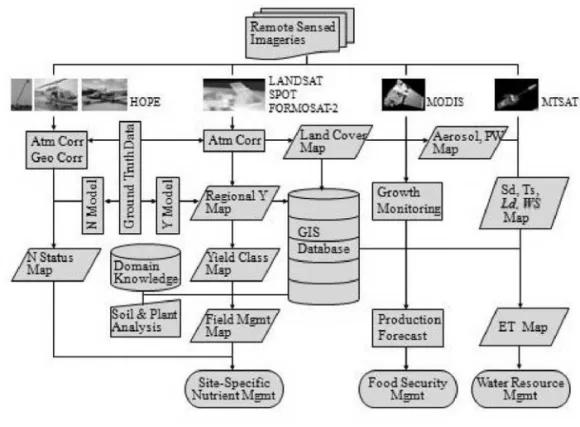
目前我國已初步建立利用遙感探測技術進行稻作栽培面積調查(例如,Lei et al., 2008; Wan et al., 2010)、水稻產量預測(例如,Chang et al., 2005; 章等,2006;Wang et al., 2010)、水稻氮營養狀態(例如,Lee et al., 2007, 2008, 2011)以及稻作受災程度分析的能 力(例如,申與李,1998) 目前與農業生產有關之遙測技術的發展規劃藍圖如圖 2 所示, 其中除包含與糧食安全有關之生長監測和產量預估技術外,由於農業生產未來勢必遭 受水資源不足的影響,因此也需發展估計地表蒸發散量的遙測技術,提供進行水資源 調配和管理時必要的資訊 此外,發展中之特定位址養分管理(site-specific nutrient management)相關的遙測技術仍須持續開發,以便能減少我國肥料施用,獲得包含減緩 土壤酸化和協助降低我國溫室氣體排放量等的多重效益
結 論
台灣境內生產的糧食作物已無法滿足國人需求,對於境外輸入的依賴度很高 全 球暖化預期將導致全球極端天氣發生頻率增加,由於不穩定之災變性天氣對全球農作 生產的影響超過平均氣溫的上升,因此如何因應台灣及全球農業氣象災害所引起的糧 食危機,對滿足國人糧食安全需求至關重要 本篇報告指出提供災害發生機率資訊以 供進行適栽作物和地點之選擇、研發經濟有效之防護措施、以及依據土壤內部排水能 力規劃旱作區域,都是減少境內農業氣象災損必須重視的方向;利用遙測技術進行國22 內和國外主要糧食輸出和輸入國之作物生產狀況和受災情形之監測,以及可能之產量 的推估,提供決策者必要的相關情報,提早採行必要之應變措施,將可減輕我國在全 球糧食危機發生時所遭受的衝擊
引用文獻
申雍、陳守泓 1994a 臺灣西南部地區梅雨期間大雨發生機率空間分佈之研究 氣象 學報 40: 160-167 申雍、陳守泓 1994b 梅雨期間作物承受豪雨風險機率之估算 中華農學會報 新 168: 93-99 申雍、章國威 1994 東勢地區葡萄園霜害發生之機制及風扇防霜方法之初步試驗 中華農業氣象 1: 93-99 申雍、詹文揚 1997 新社地區枇杷植冠降溫方法之探討 中華農業氣象 4: 165-169 申雍、詹文揚、郭同慶 1998 屏東地區蓮霧園寒害防護措施之評估 中華農業氣象 5: 7-13 申雍、李佩玲 1998 應用 SPOT 衛星影像區分水稻旱害等級與受災範圍之初步研究 中華農業氣象 5: 203-208 申雍、陳守泓 2006 農業氣象資訊在專家決策系統之應用與發展方向 作物、環境 與生物資訊 3: 51-63 申雍 2007 台灣地區農業部門受全球氣候暖化之影響及調適策略 環境工程會刊 18: 9-16 申雍 2010 全球暖化對台灣農業資源衝擊及因應策略思考方向 全球氣候變遷與台 灣農業因應調適策略座談會專刊 pp.1-1~1-18 行政院農業委員會、中興大學農 業自然資源學院 申雍、陳吉仲、蘇宗振 2011 我國農業生產政策調整方略芻議 農業經濟叢刊(已投 稿) 李炳和、廖志翔、申雍 2003 蓮霧及番荔枝氣象災害及防護方法問卷調查初步分析 中華農業氣象 10:39-52 李炳和、廖志翔、申雍 2007 高屏地區蓮霧與台東地區番荔枝氣象災害及防護方法 之調查研究 作物、環境與生物資訊 4: 89-108 李炳和、官青杉、唐佳惠、蔡惠文、申雍 2011 鳳梨日燒與寒害發生機制及防護措 施之初探 氣象學報 (已接受)李崇瑞 1996 台灣農地利用與生產力評估的模式 國立中興大學土壤環境科學系碩 士論文 柳中明、吳明進、林淑華、陳盈蓁、楊胤庭、林瑋翔、曾于恆、陳正達 2008 臺灣 地區未來氣候變遷預估 臺灣大學全球變遷研究中心 章國威、王淑姿、申雍、羅正宗、黃鼎名、蔡和霖 2006 應用多光譜航照影像預估 水稻產量之研究 航測及遙測學刊 11: 27-38 孫存禮、楊策群 1989 台灣沖積土排水不良問題之發生 中國農業化學會誌 27: 38-45 陳守泓、張簡水紋、申雍 2004 降雨特性對西螺地區蔬菜生產之影響及因應對策分 析 中華農學會報 5(3): 218-233 陳守泓、李炳和、姚銘輝、申雍 2007 中部地區農業氣象環境與災害發生潛勢 作 物、環境與生物資訊 4: 345-352 陳守泓、李炳和、姚銘輝、申雍 2006 臺灣地區年際異常氣象狀況對農業生產之影 響 作物、環境與生物資訊 3: 307-316 黃菊美 1992 木瓜根系環境及其改良對策之研究 國立中興大學土壤研究所碩士論 文 楊策群 1986 排水不良土壤之特性與管理 土壤資料應用訓練班講義 pp.1-5 國立 中興大學農學院土壤調查試驗中心 蔡東耀 1990 深層翻土改良土壤排水和壓實的效果 國立中興大學土壤研究所碩士 論文
Becker-Reshef, I., C. Justice, M. Sullivan, E. Vermote, C. Tucker, A. Anyamba, J. Small, E. Pak, E. Masuoka, J. Schmaltz, M. Hansen, K. Pittman, C. Birkett, D. Williams, C. Reynolds, and B. Doorn. 2010. Monitoring global croplands with coarse resolution earth observations: The global agriculture monitoring (GLAM) project. Remote Sens. 2: 1589-1609.
Becker-Reshef, I., E. Vermote, M. Lindeman, C. Justice. 2010. A generalized regression-based model for forecasting winter wheat yields in Kansas and Ukraine using MODIS data. Remote Sens. Environ. 114: 1312-1323.
Bruinsma, J. (ed.) 2003. World Agriculture: Towards 2015/2030, An FAO Perspective. Earthscan Publications Ltd, London, United Kingdom, 432pp.
Busetto, L., M. Meroni, and R. Colombo. 2008. Combining medium and coarse spatial resolution satellite data to improve the estimation of sub-pixel NDVI time series. Remote Sens. Environ. 112: 118-131.
24
Chang, K.W., Y. Shen, and J.C. Lo. 2005. Predicting rice yield using canopy reflectance measured at booting stage. Agron. J. 97:872-878.
Doraiswamy, P.C., S. Moulin, P.W. Cook, and A. Stern. 2003. Crop yield assessment from remote sensing. Photogramm. Eng. Remote Sens. 69: 665-674.
Doraiswamy, P.C., J.L. Hatfield, T.J. Jackson, B. Akhmedov, J. Prueger, A. Stern. 2004. Crop condition and yield simulations using Landsat and MODIS. Remote Sens. Environ. 92: 548-559.
FAO. 2002. The State of Food Insecurity in the World 2001. Food and Agriculture Organization, Rome.
FAO. 2008. The State of Food Insecurity in the World 2008. Food and Agriculture Organization, Rome.
FAO. 2011. FAO Food Price Index.
http://www.fao.org/worldfoodsituation/wfs-home/foodpricesindex/en/
Fischer, G., M. Shah, H. van Velthuizen. 2002. Climate Change and Agricultural Vulnerability. International Institute for Applied Systems Analysis. pp. 160.
Gallego, F. J. 2004. Remote sensing and land cover area estimation. Int. J. Remote Sens. 25: 3019-3047.
GEO. 2009. Summary and Recommendations. in the Workshop on Developing an Agricultural Monitoring System of Systems. Group on Earth Observation. February 11-13, 2009. Beijing, China.
Hanuschak, G.A., R. Sigman, M.E. Craig, M. Ozga, R.C. Luebbe, P.W. Cook, D.D. Kleweno, and C.E. Miller. 1980. Crop-area estimates from Landsat; Transition from research and development to timely results. IEEE Trans. Geosci. Remote Sensing GE-18: 160-219. IPCC. 2007a. Summary for Policymakers. in: Climate Change 2007: The Physical Science
Basis. Contribution of Working Group I to the Fourth Assessment Report of the Intergovernmental Panel on Climate Change [Solomon, S., D. Qin, M. Manning, Z. Chen, M. Marquis, K.B. Averyt, M.Tignor and H.L. Miller (eds.)]. Cambridge University Press, Cambridge, United Kingdom and New York, NY, USA.
IPCC. 2007b. Summary for Policymakers. in: Climate Change 2007: Impacts, Adaptation and Vulnerability. Contribution of Working Group II to the Fourth Assessment Report of the Intergovernmental Panel on Climate Change, M.L. Parry, O.F. Canziani, J.P. Palutikof, P.J. van der Linden and C.E. Hanson, Eds., Cambridge University Press, Cambridge, UK, 7-22.
Lee, Y.J., Chang, K.W, Shen, Y., Huang, D.M., Tsay, H.L., 2007. A handy imaging system for precision agriculture studies. Int. J. Remote Sens. 28: 4867-4876.
Lee, Y.J., Yang, C.M., Chang, K.W., Shen, Y., 2008. Field test of the simple spectral index using 735nm in mapping nitrogen status of rice canopy. Agron. J. 100: 205-212.
Lee, Y.J., Yang, C.M., Chang, K.W., Shen, Y., 2011. Rice canopy reflectance spectrum affected by changes in leaf anatomical structure and chlorophyll content. Bot. Stud. 52: 295-303.
Lei, T. C., Wan, S., Chou, T.Y., 2008. The comparison of PCA and discrete rough set for feature extraction of remote sensing image classification - A case study on rice classification, Taiwan. Comput. Geosci. 12: 1-14.
Leung, H. 2011. Breeding for climate-ready rice: needs, strategies, and progress. in the Workshop on Crop Breeding and Management of Agricultural Environment for Coping with Climate Change. August 31-Spetember 1, 2011. Taiwan Agricultural Research Institute, Taichung, Taiwan.
Lur, H.S. 2011. Adaptation of crop cultivation and breeding to abiotic stresses: with aspect of Taiwan’s environment. in the Workshop on Crop Breeding and Management of Agricultural Environment for Coping with Climate Change. August 31-Spetember 1, 2011. Taiwan Agricultural Research Institute, Taichung, Taiwan.
Pittman, K., M.C. Hansen, I. Becker-Reshef, P.V. Potapov, and C.O. Justice. 2010. Estimating global cropland extent with multi-year MODIS data. Remote Sens. 2: 1844-1863.
Qin, Q., A. Ghulam, L. Zhu, L. Wang, J. Li, and P. Nan. 2008. Evaluation of MODIS derived perpendicular drought index for estimation of surface dryness over northwestern China. Int. J. Remote Sens. 29: 1983-1995.
Sakamoto, T., M. Yokozawa, H. Toritani, M. Shibayama, N. Ishitsuka, H. Ohno. 2005. A crop phenology detection method using time-series MODIS data. Remote Sens. Environ. 96: 366-374.
Tapia-Silva, F.O., S. Itzerott, S. Foerster, B. Kuhlmann, and H. Kreibich. 2011. Estimation of flood losses to agricultural crops using remote sensing. Phys. Chem. Earth 36: 253-265.
Wan, S., Lei, T. C, Chou, T. Y., 2010. An enhanced supervised spatial decision support system of image classification: consideration on the ancillary information of paddy rice area. Int. J. Geogr. Inf. Sci. 24: 623-642.
26
Wang, Y.P., K.W. Chang, R.K. Chen, J.C. Lo, and Y. Shen. 2010. Large area rice yield forecasting using satellite imageries. Int. J. Appl. Earth Obs. Geoinf. 12: 27–35.
Xiao, X., S. Boles, J. Liu, D. Zhuang, S. Frolking, C. Li, W. Salas, B. Moore III. 2005. Mapping paddy rice agriculture in southern China using multi-temporal MODIS images. Remote Sens. Environ. 95: 480-492.