DOI:10.6245/JLIS.2015.411/645
Developing an App-Based Library Programme to
Support Early Childhood Learning
Hui-Yun Sung
Assistant Professor, Graduate Institute of Library and Information Science,
National Chung Hsing University, Taiwan (R.O.C.)
E-mail: [email protected]
John Siraj-Blatchford
Visiting Scholar, Research Center for the Humanities and Social Sciences,
National Chung Hsing University, Taiwan (R.O.C.)
E-mail: [email protected]
Shun-Der Chen
Associate Professor, Department of Library and Information Science,
Fu-Jen Catholic University, Taiwan (R.O.C.)
E-mail: [email protected]
Keywords: Early Childhood; Public Libraries; Apps; Technology
【
Abstract】
The aim of this research project has been to
develop a mobile app-based library programme
to support early childhood learning. The app
-based library programme involved the design,
implementation and evaluation of six workshops
between July and September 2014 in a medium
-sized public library in north Taiwan. This research
contributes to a growing literature that provides
evidence of the value of handheld devices and
apps in contributing to early childhood learning,
particularly in the context of public libraries. The
potential of apps for fostering early childhood
learning in public libraries in Taiwan is recognised
and it is suggested that library staff need time for
professional development and experimentation if
they are to respond appropriately to new digital
technologies. Limitations of this research project
are acknowledged and suggestions for future
research in this area are also provided.
Introduction
Heckman (2006), a Nobel prize-winner in economics, has shown that investments in early childhood programmes are justified by the returns provided to society as a whole. In line with this endeavour, public libraries have a long history of providing collections, services and programmes for children. Meeting community needs has been the focus of library service policy directives worldwide.
In studying pre-school experience of children with technology, it is essential to understand parental attitudes, perceptions and beliefs towards technology use (Vittrup,
Snider, Rose, & Rippy, 2014). Taiwanese parents are increasingly faced with the dilemma as to whether it is appropriate to use Information Communications and Technology (ICT) with their children and also how to select appropriate tools and make good use of them. One possible cause that may contribute to this dilemma may be a lack of parental awareness regarding technology usage by their children, as found in prior research (Rideout, Vandewater & Wartella, 2003; Vittrup, 2009).
As information professionals, children’s librarians are well suited to serve as ‘media mentors’ (Guernsey, 2014; Campbell, 2014), offering constructive recommendations on how to carefully select, critically evaluate and effectively use ICTs with/for children. Whilst some major public libraries in Taiwan provide tablet technologies for loan to children within the library, none have provided pedagogical support so far. Merely providing access to ICTs tools for children is arguably not enough to positively contribute to skills development in this key area. As shown in the research of Flewitt, Messer and Kucirkova (2014), well-planned, iPad-based literacy activities stimulate positive attitudes and behaviours in children. Thus, it is the activity in which children participate, not the ICTs tools per se, that matters. Whilst the practice of using iPads in library storytimes for children is seen in North America (see http://littleelit. om/), systematic research into this area remains premature. Emerging research on the use of iPads with children tends to use the classroom (e.g. Roskos, Burstein & You, 2012; Falloon & Khoo, 2014) and home (e.g. Kucirkova, Sheehy & Messer, 2014) as the research setting. Campana and Dresang’s (2011) research suggested that public libraries can play a significant role in bridging the large gap between children’s readiness to read by providing early literacy training for caregivers. Considering the rapidly changing nature of technology, gaps in the literature point to a need to explore how public libraries could engage with parents to meet their needs for using ICTs with children (Sung & Siraj-Blatchford, 2014a, b). Given the universal mission of the public library to meet community needs, librarians can have a role as
media mentors to select appropriate media collections and provide effective ICTs activities and services, and this could provide a role model for families to observe, imitate and learn how to effectively use ICTs with children. This research project aims to develop a mobile app-based library programme to support early childhood learning. Instead of providing training/lectures to caregivers, the programme takes the form of workshops, which involve both parents and their children. This research simultaneously explores both child attitudes and experiences of working with selected ICTs tools.
This paper begins with a review of the literature on early childhood learning; affordances of educational apps for childhood learning; and educational benefits of effectively utilising apps for childhood learning. It goes on to describe and explain the methods used for data collection and analysis in this research project. Findings derived from a thematic analysis of the data collected are presented. Finally, the paper discusses the practical implications for public libraries when using handheld devices and apps to foster early childhood learning, concluding with suggestions for future research.
Literature review
Early childhood learning
Siraj-Blatchford (2007) emphasised the importance of creativity, communication and collaboration (hereinafter referred to as ‘three Cs’) for the early years. Underpinning the three areas is Vygotsky’s (1978) learning theory, Zone of Proximal Development (ZPD), which suggests that learning takes place in interaction with other people and that the individual may reach a higher potential of development through adult guidance or in collaboration with more capable peers. In accordance with this, theories that view learners as active constructors, with various levels of assistance and interaction within social and cultural contexts that directly influence what and how participants learn, include: ‘guided participation’ (Rogoff, Mistry, Goncu, & Mosier, 1993), ‘inter-thinking’ (Mercer, 2000), and ‘dialogic teaching’ (Alexander, 2004).
It is argued that early childhood learning can be developed through not only physical materials but also new technologies. Indeed, it is the educational content that matters, not the format in which it is presented (Wainwright & Linebarger, 2006). Robust research has suggested that ICTs can support children’s development of three Cs (Crook, 1994; Shahrimin & Butterworth, 2002; Sylva, Melhuish, Sammons, Siraj-Blatchford, & Taggart, 2004; Siraj-Blatchford & Siraj-Blatchford, 2006; Korat & Shamir, 2008; Yelland & Gilbert, 2012; Flewitt, Messer & Kucirkova, 2014). To this end, this research intends to support children as ‘digital natives’ growing up in a new literacy culture, where adults may be considered digital immigrants.
Affordances of educational apps for
childhood learning
Similar to television programmes and computer software, not all apps are created equally. Compounding this complexity, a lot of apps that claim to be educational for children in the market fail to have educational potentials in reality. Research has begun to focus upon the app design and content for supporting childhood learning. For example, Falloon’s (2013, p.519) research identified the importance of apps, including: (a) clearly communicating learning objectives; (b) providing smooth and distraction -free pathways towards achieving goals; (c) including accessible and understandable instruction and teaching elements; (d) incorporating formative, corrective feedback; (e) combining an appropriate blend of game, practice and learning components; and (f) providing interaction parameters matched to the learning characteristics of the target student group. Chau’s (2014) research further suggested that app content must be designed to promote children’s development in the areas of cognition, academic skills, social-emotional skills, and physical development.
In addition to preparing children for school readiness (through developing their literacy and numeracy skills), this research, drawing upon Vygotsky’s learning theory (1978), encouraged children’s three Cs through apps. Siraj-Blatchford and Siraj-Blatchford (2003), citing Doise
and Mugny (1984) and Light and Butterworth (1992), concluded that the best applications are those that provide a valuable means of encouraging collaboration. It is anticipated that children could develop their skills for creative thinking, critical thinking, meaning making, decision making and problem solving through collaboration. More recently, the research of Kucirkova, Messer, Sheehy, & Panadero (2014) suggested the extent to which an app supports opportunities for open-ended content as a critical index of an app’s educational value, because it helps encourage exploratory talks among peers. Therefore, the two evidence-based criteria of encouraging collaboration and supporting open-ended content inform the selection of the educational apps used in this research project.
Educational benefits of effectively utilising
apps for childhood learning
In recent years, ICT has been claimed to have a negative impact on children’s learning and development (Cordes & Miller, 2000; Anderson & Pempek, 2005; Palmer, 2006; Tomopoulos et al., 2010). It is argued that such negative views of ICTs for children are not supported by systematic research evidence (Yelland, 1999; Marsh, 2010; Plowman, McPake & Stephen, 2010). In fact, substantial research has provided evidence that ICTs can provide good contexts for playful exploration and encourage children’s creativity and imagination (Siraj -Blatchford & Siraj-Blatchford, 2006; Yelland & Gilbert, 2012), and offer rich opportunities for communication and collaborative interaction (Shahrimin & Butterworth, 2002; Flewitt, Messer & Kucirkova, 2014). National Association for the Education of Young Children (NAEYC) and the Fred Rogers Center (FRC) summarized this very well, “When used intentionally and appropriately, technology and interactive media are effective tools to support learning and development for children” (2012). Close examination of the literature also identified the important factors that influence children’s skill acquirement through ICTs; the factors are the activity the children are engaged in and the support from adults or more knowledgeable other that they have for this. Indeed,
emerging research has shown the positive outcomes of effectively using tablet technologies (e.g. iPads) with children through adult-child collaboration (Kucirkova, Sheehy & Messer, 2014; Sung & Siraj Blatchford, 2014a) and peer collaboration (Falloon & Khoo, 2014; Kucirkova et al., 2014). Hence, an app based library programme is developed based on pre determined activity units to support collaborative interactions between adults and children and among children. Discussion of children’s independent learning through apps is outside the scope of this research.
Methods
Description of the app-based library
programme
The app-based library programme took place during the school summer vacation (between July and September) in 2014 in a medium-sized public library (with a dedicated area for children’s services) in north Taiwan. In response to library users’ requests, the library intended to explore the viability of hosting app-based programmes. However, the library did not have prior experience of running relevant programmes and librarians were not familiar with using tablet technologies with children in the library. To this end, the app-based programme was designed, implemented and evaluated by the researchers.
The aim of the app-based library programme was to support early childhood learning. In order to achieve the aim, the following objectives were set to be addressed:
(a) identifying parental information needs required to support childhood learning through apps; (b) developing training and resources for parents to
support children’s new forms of learning through apps; and
(c) working with parents to explore learning opportunities that will enable parents to effectively incorporate apps into children’s everyday life. The programme involved six workshops, which were divided into three different activity units. The
topic of each activity unit was selected and considered by the researchers to be appropriate for childhood learning in Taiwan. In the first activity unit, apps that promoted children’s memory and concentration abilities were introduced to workshop participants. In the second activity unit, apps that supported children’s English letter recognition were selected. In the third activity unit, apps that fostered children’s creativity and logical thinking through story-making were selected.
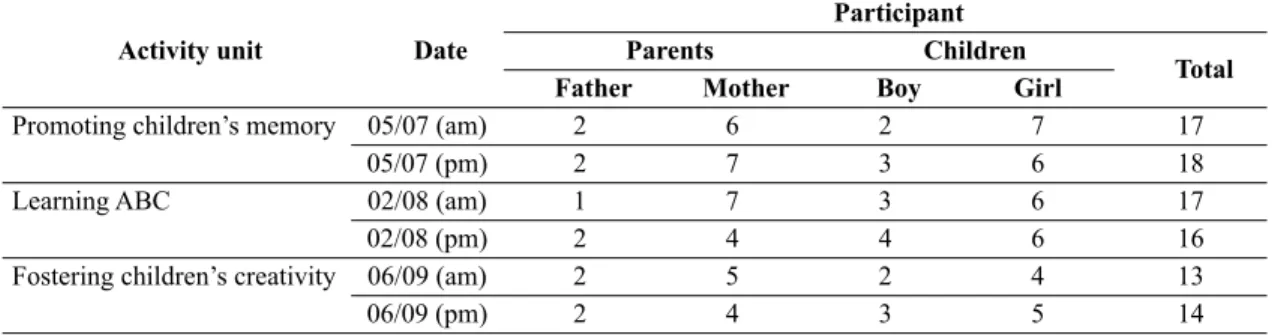
The workshop participants included children aged two to six years and their parents. See Table 1 for a breakdown of workshop participant numbers. Each workshop lasted one and a half hours and consisted of a lecture (approximately 15 minutes), focus group (approximately 15 minutes), interaction session through apps (approximately 50 minutes), and programme evaluation (approximately 10 minutes). The majority of the activities were designed to involve both children and their parents together, except for the focus group where parents and the researcher sat around to discuss parental information needs for supporting childhood learning through apps. Children were taken aside by a research assistant to do warm-up exercises to prepare them for later app-based exercises. For example, in the unit of ‘promoting children’s memory’, children were learning different colours and positions. In the unit of ‘learning ABC’, children were introduced English letters. Tools used in the warm-up exercises were paper-based colour boards and letter cards.
During the interaction session in each workshop, the researcher borrowed techniques from ‘dialogic reading’ in order to increase children’s learning skills: asking open-ended questions; following the child’s answers with questions; repeating and expanding what the child says; giving praise, encouragement, and feedback; following the child’s lead and interests; and have fun (Whitehurst et al., 1988). ‘Thinking aloud’ was another technique used by the researcher while explaining how to use and navigate specific apps to both parents and children. Furthermore, off-screen activities were
Table 1 Breakdown of workshop participant numbers
Activity unit Date
Participant
Parents Children Total
Father Mother Boy Girl
Promoting children’s memory 05/07 (am) 2 6 2 7 17
05/07 (pm) 2 7 3 6 18
Learning ABC 02/08 (am) 1 7 3 6 17
02/08 (pm) 2 4 4 6 16
Fostering children’s creativity 06/09 (am) 2 5 2 4 13
06/09 (pm) 2 4 3 5 14
implemented in the end of the workshop to showcase children’s learning. For instance, in the unit of ‘learning ABC’, children were asked to match letters (e.g. A) to images (e.g. Alligator). In the unit of ‘fostering children’s creativity’, children were asked to share their stories made from Our StoryTM on the stage with the workshop
participants.
The handheld devices (including smartphones and tablets) were specifically used as a tool to support childhood learning. While participants were encouraged to bring their own handheld devices, the project provided three iPads for use during the workshop and two for loan after the workshop. All the apps selected for use in workshops remained installed upon the iPads, so workshop participants could borrow the iPad to practice pre-downloaded apps of their choice in the library.
Selection of Apps
The selection of apps used for this research project focused upon the three areas of content, quality and developmental appropriateness. In terms of the content, apps were purposefully selected to match the topic of each activity unit. In terms of the quality, the researchers selected apps that received high ratings (at least four out of five stars) or positive comments in one of the three app review websites, including: Common Sense Media Review (https://www.commonsensemedia.org/ app-reviews), Children’s Technology Review (http:// childrenstech.com/) and Little eLit (http://littleelit.com/). In terms of ensuring that the selected apps were
developmentally appropriate, the researchers employed the seven general principles developed by Siraj-Blatchford and Siraj-Blatchford (2000). They are: ensuring an educational purpose, encouraging collaboration, integrating with other aspects of curriculum, ensuring the child is in control, choosing applications that are transparent, avoiding applications containing violence or stereotyping, and being aware of health and safety issues.
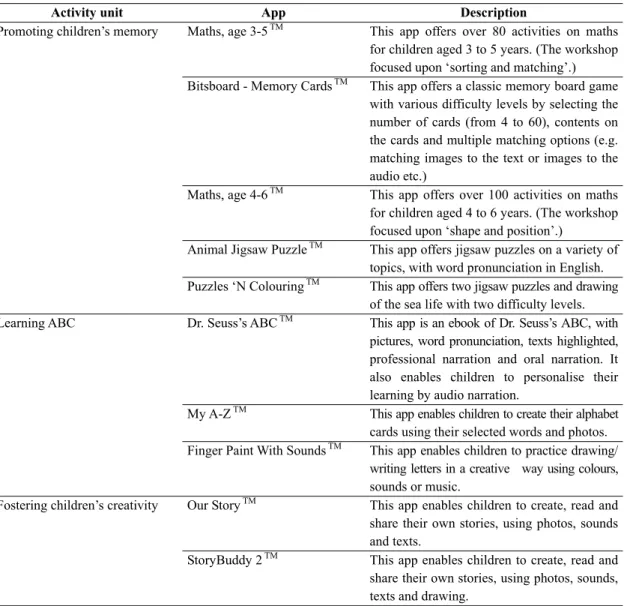
See Table 2 for a list of apps selected for use and their descriptions. Two to three apps were used for each workshop. Due to the fact that the workshops took place in a public library, it was hard to predict child participants’ age and learning ability. To this end, all apps selected for use were embedded with various difficulty levels or open-ended content, so the app-based activity could be adjusted according to the individual learning progress. Tips for parental involvement in the app-based activities were offered in the workshops.
Data collection
Data were collected through a mix of methods in order to corroborate and substantiate the data evidence, as follows.
Focus group was held at the beginning of each workshop in order to identify parental information needs required to support childhood learning through apps. Mind-mapping techniques were used to facilitate the discussion. In total, six focus groups were audio recorded and fully transcribed for later data analysis.
Table 2 The selected apps and their descriptions
Activity unit App Description
Promoting children’s memory Maths, age 3-5 TM This app offers over 80 activities on maths
for children aged 3 to 5 years. (The workshop focused upon ‘sorting and matching’.) Bitsboard - Memory CardsTM This app offers a classic memory board game
with various difficulty levels by selecting the number of cards (from 4 to 60), contents on the cards and multiple matching options (e.g. matching images to the text or images to the audio etc.)
Maths, age 4-6 TM This app offers over 100 activities on maths
for children aged 4 to 6 years. (The workshop focused upon ‘shape and position’.)
Animal Jigsaw PuzzleTM This app offers jigsaw puzzles on a variety of
topics, with word pronunciation in English. Puzzles ‘N ColouringTM This app offers two jigsaw puzzles and drawing
of the sea life with two difficulty levels. Learning ABC Dr. Seuss’s ABCTM This app is an ebook of Dr. Seuss’s ABC, with
pictures, word pronunciation, texts highlighted, professional narration and oral narration. It also enables children to personalise their learning by audio narration.
My A-Z TM This app enables children to create their alphabet
cards using their selected words and photos. Finger Paint With SoundsTM This app enables children to practice drawing/
writing letters in a creative way using colours, sounds or music.
Fostering children’s creativity Our Story TM This app enables children to create, read and
share their own stories, using photos, sounds and texts.
StoryBuddy 2 TM This app enables children to create, read and
share their own stories, using photos, sounds, texts and drawing.
Participant observation was conducted during each workshop in order to interact with children and parents while observing the actual behaviours of workshop participants, and to describe the process and their perspectives. All workshops were video recorded; field notes were written up within 24 hours after the completion of each workshop.
Questionnaires were administered at the end of each workshop to evaluate if parental information needs were satisfied in the current programme, and to identify parents’ suggestions for future app-based library programmes and incorporate the feedback into the next workshop design. In total, 32 questionnaires were collected for analysis.
Semi-structured interviews were conducted at the end of the app-based library programme in order to obtain library staff’s viewpoints on the programme. Two interviews were conducted with frontline library staff in person, each of which lasted approximately 20 minutes. Both interviews were audio recorded and fully transcribed for later data analysis.
The public library and study participants provided consent for data to be collected, and were informed of their rights to withdraw from the activities at any point. All information provided by study participants was kept confidential and anonymous.
Data analysis
The qualitative data collected from focus group and participant observation were inductively analysed and coded, using a thematic analysis procedure (Braun & Clarke, 2006). This involved: familiarization with the data, generation of initial codes, searching for themes, reviewing themes and applying codes, defining and naming themes, and writing a report. All data were entered into the QSR NVivo 10 data management programme for analysis. The validity and reliability of the research findings were enhanced through the choice of methods appropriate to the research problems (Higgs, 2001), triangulation of the different data sources of information (Creswell, 2009), and constant comparisons between data sets (Glaser, 2002).
Results and discussion
Parental information needs for supporting
childhood learning through apps
In accordance with the Survey report of young children’s using 3C products (Child Welfare League Foundation, 2012), this research project has shown an evidence of the integration of apps into children’s everyday life. Approximately 90 percent of adult workshop participants possessed handheld devices. A few parents indicated that it would be difficult to prevent children from accessing handheld devices. As a mother explained, “adults constantly use it [a tablet/smartphone], and
children would copy. Unless you [an adult] don’t use it at all, or children would argue why adults can use it but they can’t.”
Additionally, it was clear that most parents and children were familiar with the navigation of handheld devices. As observed from the interaction sessions, more than 70 percent of children spontaneously tapped to access pre-downloaded apps on the iPads and explored the apps through trial and error. Despite the popularity of apps with children, mixed results were obtained in terms of parents’ attitudes towards children’s using ICTs. Whilst some parents regarded apps as new opportunities for
children’s learning, others were anxious about children’s health problems that could be caused by excessive usage of such technologies.
A thematic analysis revealed three main areas of parental information needs in terms of supporting childhood learning through apps. First was concerned with child health issues. A most-mentioned problem was short-sightedness in children and a lot of parents claimed that this was caused by excessive screen time. While many parents were aware of the importance of communicating with their children about the screen time, a mother helplessly stated “communication just
can’t solve the problem.” Second was related to the
educational value of apps for childhood learning. As a father stated, “I’m aware that apps have more to offer
than games. But, I’d like to know what are good apps in terms of educational value.” Indeed, the educational
content really matters (Wainwright & Linebarger, 2006). Third was pertinent to supporting parents’ practical skills in this area. Some parents expressed their interests and willingness to learn “how to select age-appropriate
apps and how to use them”, “how to utilise the appeal of technologies to stimulate children’s learning motivation”,
and “how to effectively use apps to enhance children’s
learning environment”. A father asked “Is there any platform where we can access such information?”
Informed by the aforementioned concerns and practical needs expressed by parents, some misconceptions and stereotypes of misusing ICTs with children from mass media were presented, and guidance on how to and how not to use ICTs with children was offered in lectures. Techniques from ‘dialogic reading’ (Whitehurst et al., 1988) were applied to the interaction sessions. An online community of practice (through Facebook) was also developed for workshops participants to share their experiences and exchange ideas.
Adult-child collaboration through apps
Based on Vygotsky’s (1978) learning theory of ZPD, learning takes place in interaction with other people
and the individual may reach a higher potential of development through adult guidance. Evidence that supported the theory was substantial in the workshop. An obvious finding was that adults acted as facilitators in childhood learning through apps, in terms of offering hints to answer questions (as seen in the use of Maths, age 3-5TM), offering tips to solve problems (as seen in
the use of Jigsaw PuzzleTM), adapting the complexity level to children’s abilities (as seen in the use of Matching GameTM), and creating a positive learning environment (e.g. offering compliments). Accordingly, children sustained their concentration on the activity and gained a sense of achievement from successfully completing tasks, as reflected in their physical engagement (e.g. clapping, jumping, laughing and shouting ‘Yeah!’).
Research on iPads and children’s talk has emerged recently (Kucirkova et al., 2014; Falloon & Khoo, 2014). This research concurred with their findings and argued that children’s talk can be stimulated by purposefully selected apps and sustained by adults’ guided interaction (Plowman & Stephen, 2007). The following extract illustrated how discussion could be expanded from the app of Jigsaw PuzzleTM, with an adult’s facilitation.
[A boy, age 4, completed a sea world jigsaw puzzle and put the iPad aside. The researcher picked it up and asked him relevant questions.]
R: What can you see in the picture? B1: I don’t know.
R: [pointing at fish] What is this? B: Fish.
R: How many fish can you see in the picture? B1: Two.
R: That’s right. What colour are they? B1: One is orange and the other is pink.
R: Well down. What do you think the two fish are doing? B1: Talking to each other.
R: What are they talking about? B1: They are planning their summer trip.
R: Very good. What else can you see in the picture? B1: [pointing at different objects in the picture] A
pipe, seaweed, wheels, bubbles…
The researcher first guided the boy into an imaginary sea world by establishing two main characters (i.e. two fish) in the completed jigsaw puzzle. The boy then added actions (e.g. talking) to the two characters.
This research recognised children as ‘digital natives’ growing up in a new literacy culture, where adults may be considered digital immigrants. As observed in the workshops, children spontaneously and naturally tapped, touched, swiped and dragged the screen when they got handheld devices. However, a mother raised an issue that “They [children] only focus upon play [tapping their fingers on the screen], not learning.” It was reasoned that parents’ lack of skills for effectively interacting with their children through apps might cause their ignorance of the potential of educational apps and their association of apps with play only, which echoed the findings of Rideout, Vandewater and Wartella (2003) and Vittrup (2009). Indeed, observation of different adult-child couples showed that children tended to talk more when their parents intervened their learning and asked them open-ended questions than children whose parents only spectated children’s interaction with apps.
Furthermore, the affordance of apps per se can influence the quantity and the quality of children’s talk. As observed in the workshops, when using apps of a consumption design (e.g. Jigsaw PuzzleTM, Matching GameTM), children tended
to be quiet and focus upon how to get a right answer. On the other hand, using apps that supported content creation (e.g. Our StoryTM, StoryBuddy 2TM) allowed children to get
involved in story making and discuss with their parents (Sung & Siraj-Blatchford, 2014a, b; Kucirkova, Sheehy & Messer, 2014). The following extract showed such communication and interactions when adults and children used Our StoryTM together.
[A mother patiently guided her son, age 2, to choose photos and narrate the photos chosen, asked him questions, and held his finger to type Chinese words.]
M2: How would you like to start your story? [The boy started to look at photos in the photo library.] M2: Which one would you like to put in the beginning of
your story?
[The boy selected one photo.] M2: May I borrow your little finger?
[M2 held his finger to touch and drag the photo from the photo library to the storyboard. The boy went on to select five more photos for his story.]
M2: I’d like to ask you if these photos are enough or
would you like to select more? How about the one with your feet in?
B2: [Shaking his head] No. M2: Why not?
B2: I’ll continue tomorrow.
[The researcher encouraged the mother to ask open -ended questions regarding the photos chosen by the boy.]
M2: Have a look at this photo and think about what
to say. Okay? I’m going to do the audio-recording for you. Whatever you say will be recorded. Start!
B2: Fish.
M2: What do you see in the photo? B2: A book.
M2: Who is holding the book? B2: Me.
M2: What’s your name? B2: [Bob]
M2: Okay. I will press the button stop now. Let’s
listen to your audio-recording. May I borrow your ears?
B2: Okay. [The boy placed his ear close to the iPad.] M2: Are you happy about it?
B2: That’s fine.
M2: What words shall we type here? B2: ABC.
M2: But, the words should be related to our photo.
Have a look at this photo. I’m going to type some words here to let people know what this photo is about. So, what do you think this photo is about?
B2: The boy is reading a book.
M2: I will type “The boy is reading a book at the
library”. Okay?
B2: Okay.
[The mother held the boy’s hand to write the Chinese words.]
It is clear that the photo served as the basis for the mother-son conversation. In addition to encouraging the boy to think and talk, the mother also guided the boy to read and write through Our StoryTM.
Peer collaboration through apps
Childhood learning can be enhanced not only through adult guidance but also in collaboration with more knowledgeable peers (Vygotsky, 1978). Various types of peer collaboration through ICTs were found in previous research. These included: joint planning; taking turns; asking for and providing opinions; sharing, changing and integrating of ideas; arguing their points of view; negotiating and coordinating perspectives; adding, revising, reformulating and elaborating on the information under discussion and seeking of agreements (Rojas-Drummond, Albarrán & Littleton, 2008; Kucirkova et al., 2014). Some of these activities were also evident in this research.
Generally speaking, taking turns was not an issue with the majority of children when they were well instructed in the beginning of any app-based activities.
Sometimes a child reminded his/her teammates to pass the handheld devices to him/her by saying “it’s my turn”. However, a couple of very young children (2-3 years of age) did not appreciate the concept of sharing when playing with others. The following extract provided a snapshot of such a scenario.
[A two-year-old girl played one app after another without passing the iPad to her older sister.]
M3: You’ve played and it’s your older sister’s turn now. G3: I haven’t played.
M3: You have played, and you can’t be so unreasonable. [When the mother tried to take the iPad away from the girl, the girl burst out crying.]
It was observed that when parents encountered such a situation, they tended to take the iPad away from the children or take children away from the workshop, instead of communicating the value of taking turns and sharing. Mapped on to one of the parents’ needs in terms of supporting children’s learning through apps identified in this research project, how to control child access to screen time has become a key issue for some parents. It is suggested parents take a proactive approach to communicate the rule of taking turns or set the screen time (using the alarm function) at the outset of any iPad-based activities.
Sharing tips to complete tasks on apps was another common phenomenon when children played in pairs or in a group. For instance, a couple of brothers figured out how to take photos and record voices through discussion and by exploring the app of My A-ZTM together. The younger boy was very excited when he saw his photo and heard his voice on the app.
Vicarious learning takes place when individuals observe, retain and are able to replicate the actions of others (Morgan & Siraj-Blatchford, 2013). As seen in the workshops, younger children learnt a great deal from observing and modelling older children’s use of apps. For instance, a three-year-old girl started to
appreciate the rules of playing Jigsaw PuzzleTM by
observing other older children’s play; she went on to practice more puzzles and became acquainted with the navigation of the app. It was also observed that peer play helped support a collaborative learning environment, which attracted children’s interest, encouraged dialogues, and sustained their engagement in the activity.
Evaluation of the app-based programme
Generally speaking, an analysis of the data collected showed that the app-based library programme has met the aim set at the outset of this research, that is, to support early childhood learning. As identified in the Introduction section, children’s librarians can have a role as media mentors for parents who are faced with difficulties as to how to select appropriate media collections and make use of them with/for their children. Therefore, the focus of the programme evaluation is twofold: firstly there is a focus upon meeting parental information needs and secondly there is a focus upon meeting the needs of the library.
First was related to meeting parental information needs for supporting childhood learning. As shown in the questionnaires collected, about 95 percent of the participants thought that the content of the selected apps was instrumental for their children’s learning. Echoing this, some parents regarded the recommendation of appropriate apps as their favourite parts of the activity, because theses apps “encourage interactivity”, “stimulate
children to think and explore”, “support effective English learning”, “encourage children to express their ideas and thoughts”, and “let children become protagonists of the apps”. Furthermore, some parents positively
commented on “the researcher’s interaction with children
through apps” and “the design of the adult-child interaction session”, because they could observe,
remember and imitate (Bandura, 1977). However, there remained some challenges to be overcome, e.g. “how
to control screen time”, “how to select appropriate apps for children”, and “what are complementary measures of using apps with children”.
Second was related to meeting the library’s needs for supporting childhood learning. A library staff member stated “the app-based library programme is
the first of its kind in the library.” Similarly, another
library staff member considered the app-based library programme “innovative” and “different” from their prior activities. Indeed, the library’s endorsement of the app-based library programme partly resided in exploring its viability. As a library staff member explained, “we would provide users with different
information and services, and they can choose for themselves.” However, when it came to the role that
library staff could play in developing such an app-based programme, both library staff members positioned themselves as facilitators in terms of promoting the event, offering the space, setting up equipment, and working as a bridge between the researcher and users. They also reflected on their lack of professional knowledge and skills for delivering such an app-based programme. The researchers, built on previous research (Sung & Siraj-Blatchford, 2014a, b) and the current research project, argued that close academic-practice partnership and offering training for library staff and volunteers to deliver such workshops are needed in order to make a longer impact on childhood learning in the real-world practice.
Conclusions and suggestions
This research project set out with the aim of supporting early childhood learning. The aim was achieved by designing, implementing and evaluating an app-based library programme, involving six workshops in a medium-sized public library. From a practical perspective, the app-based library programme worked in terms of its usefulness, workability and practicality in response to parental information needs identified. Furthermore, this research contributed to a growing literature that provides evidence of the value of handheld devices and apps in contributing to the development of early childhood learning, particularly in the context of public libraries.
Based on the findings derived from this research, practical implications for public libraries when using handheld devices and apps to foster childhood learning are proposed. Also, limitations of this research are acknowledged and suggestions for future research are listed.
Suggestions for the public library
This research project saw the potential of handheld devices and apps for promoting enjoyment in learning by enhancing motivation and engagement in learning. The evidence of this research project suggested that children’s learning with handheld devices went far beyond developing skills such as tapping, touching, swiping and dragging the screen. When their experiences with handheld devices and apps are effectively supported by adult facilitation and peer interaction, there is potential to promote the three Cs. Therefore, this research project makes the case for a wider recognition of the role of apps in fostering childhood learning in public libraries in Taiwan.
Facing emerging and unsolved parental information needs (e.g. “how to control screen time”, “how to select appropriate apps for children”, and “what are complementary measures of using apps with children”), it is suggested that library staff serving children proactively take up the role of digital ‘media mentors’ (Campbell, 2014), where they incorporate apps into library programmes, provide recommendations for app content and activities, and set up a model of healthy media consumption for both adults and children. A starting point could be incorporating apps into existing storytimes in the library, where the apps need to be carefully selected to match the topic of the story to be told.
It was observed that Taiwanese public libraries’ storytimes have been conducted by volunteers or storytellers from professional associations (Tseng, 2005), which may run the risk of devaluing the professional role of a librarian and decreasing the opportunity of identifying children’s information needs
through interaction with them. Handheld devices and apps could serve to facilitate less qualified librarians in supporting childhood learning. As suggested in the research of Pitchford (2014), in contexts where there is a shortage of qualified and effective teachers, iPads can be a cost-effective means of delivering individualized, up-to-date learning content which is aligned with innovative teaching practices. Although Pitchford’s (2014) research was conducted at a school, given the educational role of teachers and librarians, her suggestion arguably could be applied to the library setting. However, this research recognises that library staff needs time for professional development and experimentation if they are to respond appropriately to new digital technologies.
Suggestions for future research
Several limitations of this research project are acknowledged and suggestions for future research are provided. One of the limitations was the small samples, including the very small number of apps selected and used, the low number of participants involved, and the focus upon only one public library. It needs to be remembered that the apps were carefully and purposefully selected to meet the evidence-based criteria (e.g. encouraging collaboration and supporting opportunities for open-ended content), to match the topics of different activity units (e.g. promoting children’s memory, learning ABC, and fostering children’s creativity), and to respond to parental information needs identified in the workshops. For wider impact, it is suggested that future research involve more public libraries in order to make comparisons between and generalisations of the research findings.
Due to the exploratory nature of this research project, the three activity units varied in terms of their nature and objectives, which could influence study participants’ experiences with and responses to different activities and apps used. It was also acknowledged that non-repeated measurement methods were adopted to evaluate the outcomes of the app-based library programme. It is suggested that future research critically evaluate and
statistically measure the potential of using iPads to support early literacy programmes in public libraries. Randomised controlled trials could provide a robust methodology to identify the cause-effect relationship between an intervention and outcome (Kucirkova, 2014).
In reviewing the outcomes from this research and prior research, it was found that emerging research on apps and children tend to focus upon supporting the acquisition of literacy and numeracy skills through apps. As identified in this research, parental information needs regarding apps and children also involved child health issues, media consumption methods, and social and emotional development. To this end, it is suggested that future research look into under-researched areas such as self-regulation, theory of mind and emotion management when using handheld devices and apps in the early years.
Another promising area for future research is the possibility of establishing strong partnerships with public libraries. McDowell, Stevenson and Mabbott (2014) worked in partnership with Douglass Branch of the Champaign Library to close the digital divide in the unserved communities through utilising tablets, apps and ebooks in the library during the summer vacation.
Acknowledgements
The authors thank two anonymous reviewers for their constructive comments on an early version of this article. Thanks also extend to an anonymous public library for providing the research setting and to Taiwan Ministry of Science and Technology for funding this research [MOST 103-2410-H-005-050].
References
Alexander, R. (2004). Towards dialogic teaching: Rethinking classroom talk. York, England: Dialogos.
Anderson, D. R., & Pempek, T. A. (2005). Television and very young children. American Behavioral Scientist, 48(5), 505-522.
Bandura, A. (1977). Social learning theory. Englewood Cliffs, NJ: Prentice Hall.
Braun, V., & Clarke, V. (2006). Using thematic analysis in psychology. Qualitative Research in Psychology, 3(2), 77-101.
Campana, K., & Dresang, E. T. (2011, October ). Bridging the early literacy gulf. In ASIS&T Annual Meeting, New Orleans, USA.
Campbell, C. (2014, April 14). Children’s librarians as digital media mentors. In Fred Rogers Center (FRC) for Early Learning and Children’s Media. Retrieved from http://www.fredrogerscenter.org/blog/childrens -librarians-as-digital-media-mentors
Chau, C. L. (2014). Positive technological development for young children in the context of children’s mobile apps (Unpublished doctoral dissertation). Tufts University, United States.
Child Welfare League Foundation (2012). Survey report of young children’s using 3C products. Taipei: CWLF. [In Chinese]
Cordes, C., & Miller, E. (2000). Fool’s gold: A critical look at computers in childhood. College Park, MD: Alliance for Childhood.
Creswell, J. W. (2009). Research design: Qualitative, quantitative, and mixed methods approaches (3rd ed.). Thousand Oaks: Sage.
Crook, C. (1994). Computers and the collaborative experience of learning. London, England: Routledge. Doise, W., & Mugny, G. (1984). The social development
of the intellect. Oxford, England: Pergamon Press. Falloon, G. (2013). Young students using iPads: App
design and content influences on their learning pathways. Computers & Education, 68, 505-521. Falloon, G., & Khoo, E. (2014). Exploring young
students’ talk in iPad-supported collaborative learning environments. Computers & Education, 77, 13-28. Flewitt, R., Messer, D., & Kucirkova, N. (2014). New
directions for early literacy in a digital age: The iPad. Journal of Early Childhood Literacy. doi: 10.1177/ 1468798414533560
Glaser, B. G. (2002). Constructivist grounded theory. Forum: Qualitative Social Research, 3(3), Art. 12. Retrieved from http://nbnresolving.de/urn:nbn:de: 0114-fqs0203125
Guernsey, L. (2014). TEDxMidAtlantic: How the iPad affects young children, and what we can do about it [video]. Retrieved from https://www.youtube.com/ watch?v=P41_nyYY3Zg
Heckman, J. J. (2006). Skill formation and the economics of investing in disadvantaged children. Science, 312(5782), 1900-1902.
Higgs, J. (2001). Charting stand-points in qualitative research. In H. Bryne-Armstrong, J. Higgs, & D. Horsfall (Eds.), Critical moments in qualitative research (pp. 46-67). Oxford, England: Butterworth Heinemann. Korat, O., & Shamir, A. (2008). The educational
electronic book as a tool for supporting children’s emergent literacy in low versus middle SES groups. Computers & Education, 50(1), 110-124.
Kucirkova, N. (2014). iPads in early education: Separating assumptions and evidence. Frontiers in Psychology, 5(715). Retrieved from http://journal.frontiersin.org/ article/10.3389/fpsyg.2014.00715/full
Kucirkova, N., Messer, D., Sheehy, K., & Panadero, C. F. (2014). Children’s engagement with educational iPad apps: Insights from a spanish classroom. Computers & Education, 71, 175-184.
Kucirkova, N., Sheehy, K., & Messer, D. (2014). A Vygotskian perspective on parent-child talk during iPad story sharing. Journal of Research in Reading. doi: 10.1111/1467-9817.12030
Light, P., & Butterworth, G. (1992). Context and cognition: Ways of learning and knowing. New York: Harvester Wheatsheaf.
Marsh, J. (2010). Young children’s play in online virtual worlds. Journal of Early Childhood Research, 8(1), 23-39.
McDowell, K., Stevenson, D., & Mabbott, C. (2014, October). Closing the app gap: From plan to project I. In ASIS&T Annual Meeting, Seattle, USA.
Mercer, N. (2000). Words and minds: How we use language to think together. London, England: Routledge. Morgan, A., & Siraj-Blatchford, J. (2013). Using ICT
in the early years: Parents and practitioners in partnership. London, England: Practical Pre-School Books. National Association for the Education of Young Children
(NAEYC) & Fred Rogers Center (FRC) for Early Learning and Children’s Media (2012). Technology and interactive media as tools in early childhood programs serving children from birth through age 8. Retrieved from http://www.naeyc.org/content/technology-and -young-children
Palmer, S. (2006). Toxic childhood. London, England: Orion Press.
Pitchford, N. (2014). Unlocking talent: Evaluation of a tablet-based masamu intervention in a Malawian primary school. Nottingham: University of Nottingham Report. Retrieved from https://onebillion.org.uk/downloads/ unlocking-talent-final-report.pdf
Plowman, L., McPake, J., & Stephen, C. (2010). The technologisation of childhood? Young children and technology in the home. Children & Society, 24(1), 63-74.
Plowman, L., & Stephen, C. (2007). Guided interaction in pre-school settings. Journal of Computer Assisted Learning, 23(1), 14-26.
Rideout, V. J., Vandewater, E. A., & Wartella, E. A. (2003). Zero to six: Electronic media in the lives of infants, toddlers, and preschoolers. Menlo Par, CA: Kaiser Family Foundation.
Rogoff, B., Mistry, J., Göncü, A., & Mosier, C. (1993). Guided participation in cultural activity by toddlers and caregivers. Monographs of the Society for Research in Child Development, 58(8), 1-179.
Rojas-Drummonda, S. M., Albarrána, C. D., & Littletonb, K. S. (2008). Collaboration, creativity and the co-construction of oral and written texts. Thinking Skills and Creativity, 3(3), 177-191.
Roskos, K., Burstein, K., & You, B. (2012). A typology for observing children’s engagement with ebooks at
preschool. Journal of Interactive Online Learning, 11(2), 47-66.
Shahrimin, M. I., & Butterworth, D. M. (2002). Young children’s collaborative interactions in a multimedia computer environment. Internet and Higher Education, 4(3-4), 203-215.
Siraj-Blatchford, I. (2007). Creativity, communication and collaboration: The identification of pedagogic progression in sustained shared thinking. Asia-Pacific Journal of Research in Early Childhood Education, 1(2), 3-23.
Siraj-Blatchford, I., & Siraj-Blatchford, J. (2003). More than computers: Information and communications technology in the early years. London: The British Association for Early Childhood Education.
Siraj-Blatchford, I., & Siraj-Blatchford, J. (2006). Towards a future for early years: ICT curriculum. In M. Hayes, & D. Whitebread (Eds.), ICT in the early years of education (pp. 152-161). Buckingham, England: Open University Press.
Sung, H., & Siraj-Blatchford, J. (2014a). Supporting family learning and interaction through information and communications technology in public libraries in Taiwan. Journal of Librarianship and Information Science. doi: 10.1177/0961000614528967
Sung, H., & Siraj-Blatchford, J. (2014b, August). Adults and children creating personalised stories together through information and communications technology in public libraries. In IFLA WLIC 2014 - Lyon - Libraries, Citizens, Societies: Confluence for Knowledge, Lyon, France. Retrieved from http://library.ifla.org/828/ Sylva, K., Melhuish, E.C., Sammons, P., Siraj-Blatchford, I.,
& Taggart, B. (2004). The Effective Provision of Pre- School Education (EPPE) project: Final report. London: DfES/ University of London, Institute of Education. Tomopoulos, S., Dreyer, B. P., Berkule, S., Fierman, A.
H, Brockmeyer, C., & Mendelsohn, A. L. (2010). Infant media exposure and toddler development. Archives of Pediatrics & Adolescent Medicine, 164(12), 1105-1111.
Tseng, S. (2005). The employment, management system and education training of library volunteers. Information Management for Buddhist Libraries, 42, 10-22. [In Chinese] Vittrup, B. (2009). What U.S. parents don’t know
about their children’s television use: Discrepancies between parents’ and children’s reports. Journal of Children and Media, 3(1), 51-67.
Vittrup, B., Snider, S., Rose, K.K., & Rippy, J. (2014). Parental perceptions of the role of media and technology in their young children’s lives. Journal of Early Childhood Research. doi: 10.1177/1476718X14523749 Vygotsky, L.S. (1978). Mind in society: The development
of higher psychological processes. Cambridge, MA: Harvard University Press.
Wainwright, D. K., & Linebarger, D. L. (2006). Ready to learn: Literature review. Part 1: Elements of effective educational TV. Philadelphia, PA: Annenberg School for Communication, University of Pennsylvania; American Institutes for Research.
Whitehurst, G. J., Falco, F. L., Lonigan, C. J., Fischel, J. E., DeBaryshe, B. D., & Valdez-Menchaca, M. C. (1988). Accelerating language development through picture book reading. Developmental Psychology, 24, 552-559.
Yelland, N. (1999). Technology as play. Early Childhood Education Journal, 26(4), 217-220.
Yelland, N., & Gilbert, C. (2012). iPlay, iLearn, iGrow. London, England: International Business Machines