國立交通大學
材料科學與工程學研究所
博士論文
側鏈含有菲 基 –1,3–二 氮 雜 茂 之 予體-受體結構規
則之聚噻 吩 運 用 於 異質接面太 陽 能 電 池 上 之 合 成
與 研 究
Synthesis and Characterization of Side Chain
Tethered Donor–Acceptor Regioregular
Polythiophene Presenting Phenanthrenyl-Imidazole
Moieties for Heterojunction Solar Cell Applications
博 士 生 :張 耀 德
指 導 教 授 :韋光華 博士
側鏈含有菲 基 –1,3–二 氮 雜 茂 之 予體-受體結構規則之聚
噻 吩 運 用 於 異質接面太 陽 能 電 池 上 之 合 成 與 研 究
Synthesis and Characterization of Side Chain Tethered
Donor–Acceptor Regioregular Polythiophene Presenting
Phenanthrenyl-Imidazole Moieties for Heterojunction Solar
Cell Applications
研究生:張耀德 Student:Yao-Te Chang
指導教授:韋光華 Advisor:Kung-Hwa Wei
國立交通大學
材料科學與工程學研究所
博士論文
A Thesis
Submitted to Department of Materials Science and Engineering
College of Engineering National Chiao Tung University
in Partial Fulfillment of the Requirements
for the Degree of
Doctor of Philosophy
In
Materials Science and Engineering
February 2009
Table of Content
Abstract IX 摘要 XII 誌謝 XIVC
C
h
h
a
a
p
p
t
t
e
e
r
r
1
1
:
:
I
I
n
n
t
t
r
r
o
o
d
d
u
u
c
c
t
t
i
i
o
o
n
n
11-1 Introduction of Polymer Solar Cell 1
1-2 The Basis Principle of Polymer Solar Cell 2
1-3 Materials of Polymer Solar Cell 6
1-4 Motivation 11
C
C
h
h
a
a
p
p
t
t
e
e
r
r
2
2
:
:
S
S
o
o
l
l
u
u
b
b
l
l
e
e
P
P
h
h
e
e
n
n
a
a
n
n
t
t
h
h
r
r
e
e
n
n
y
y
l
l
-
-
I
I
m
m
i
i
d
d
a
a
z
z
o
o
l
l
e
e
-
-
P
P
r
r
e
e
s
s
e
e
n
n
t
t
i
i
n
n
g
g
R
R
e
e
g
g
i
i
o
o
r
r
e
e
g
g
u
u
l
l
a
a
r
r
P
P
o
o
l
l
y
y
(
(
3
3
-
-
o
o
c
c
t
t
y
y
l
l
t
t
h
h
i
i
o
o
p
p
h
h
e
e
n
n
e
e
)
)
C
C
o
o
p
p
o
o
l
l
y
y
m
m
e
e
r
r
s
s
h
h
a
a
v
v
i
i
n
n
g
g
T
T
u
u
n
n
a
a
b
b
l
l
e
e
B
B
a
a
n
n
d
d
g
g
a
a
p
p
s
s
f
f
o
o
r
r
S
S
o
o
l
l
a
a
r
r
C
C
e
e
l
l
l
l
A
A
p
p
p
p
l
l
i
i
c
c
a
a
t
t
i
i
o
o
n
n
s
s
14 2-1. Introduction 15 2-2. Experimental 202-3. Results and Discussion 29
2-4. Conclusions 45
C
C
h
h
a
a
p
p
t
t
e
e
r
r
3
3
:
:
I
I
n
n
t
t
r
r
a
a
m
m
o
o
l
l
e
e
c
c
u
u
l
l
a
a
r
r
D
D
o
o
n
n
o
o
r
r
–
–
A
A
c
c
c
c
e
e
p
p
t
t
o
o
r
r
R
R
e
e
g
g
i
i
o
o
r
r
e
e
g
g
u
u
l
l
a
a
r
r
P
P
o
o
l
l
y
y
(
(
3
3
-
-
h
h
e
e
x
x
y
y
l
l
t
t
h
h
i
i
o
o
p
p
h
h
e
e
n
n
e
e
)
)
s
s
P
P
r
r
e
e
s
s
e
e
n
n
t
t
i
i
n
n
g
g
O
O
c
c
t
t
y
y
l
l
p
p
h
h
e
e
n
n
a
a
n
n
t
t
h
h
r
r
e
e
n
n
y
y
l
l
-
-
I
I
m
m
i
i
d
d
a
a
z
z
o
o
l
l
e
e
M
M
o
o
i
i
e
e
t
t
i
i
e
e
s
s
E
E
x
x
h
h
i
i
b
b
i
i
t
t
E
E
n
n
h
h
a
a
n
n
c
c
e
e
d
d
C
C
h
h
a
a
r
r
g
g
e
e
T
T
r
r
a
a
n
n
s
s
f
f
e
e
r
r
f
f
o
o
r
r
H
H
e
e
t
t
e
e
r
r
o
o
j
j
u
u
n
n
c
c
t
t
i
i
o
o
n
n
S
S
o
o
l
l
a
a
r
r
C
C
e
e
l
l
l
l
A
A
p
p
p
p
l
l
i
i
c
c
a
a
t
t
i
i
o
o
n
n
s
s
46 3-1. Introduction 47 3-2. Experimental 533-3. Results and Discussion 66
3-4. Conclusions 90
C
C
h
h
a
a
p
p
t
t
e
e
r
r
4: Intramolecular Donor–Acceptor Regioregular
4
Poly(hexylphenanthrenyl-imidazole thiophene) Exhibits
Enhanced Hole Mobility for Heterojunction Solar Cell
4-1. Introduction 92
4-2. Experimental 96
4-3. Results and Discussion 104
4-4. Conclusions 116
Chapter 5. Conclusions
117References
120Publications
136Figure Lists
C
C
h
h
a
a
p
p
t
t
e
e
r
r
1
1
:
:
I
I
n
n
t
t
r
r
o
o
d
d
u
u
c
c
t
t
i
i
o
o
n
n
Figure 1-1. Schematic drawing of the working principle and Current-
Voltage characteristics of an organic photovoltaic cell. 4-5
Figure 1-2. Donor and acceptor materials used in polymer-fullerene bulk-
heterojunction solarcells. 7
C
C
h
h
a
a
p
p
t
t
e
e
r
r
2
2
:
:
S
S
o
o
l
l
u
u
b
b
l
l
e
e
P
P
h
h
e
e
n
n
a
a
n
n
t
t
h
h
r
r
e
e
n
n
y
y
l
l
-
-
I
I
m
m
i
i
d
d
a
a
z
z
o
o
l
l
e
e
-
-
P
P
r
r
e
e
s
s
e
e
n
n
t
t
i
i
n
n
g
g
R
R
e
e
g
g
i
i
o
o
r
r
e
e
g
g
u
u
l
l
a
a
r
r
P
P
o
o
l
l
y
y
(
(
3
3
-
-
o
o
c
c
t
t
y
y
l
l
t
t
h
h
i
i
o
o
p
p
h
h
e
e
n
n
e
e
)
)
C
C
o
o
p
p
o
o
l
l
y
y
m
m
e
e
r
r
s
s
h
h
a
a
v
v
i
i
n
n
g
g
T
T
u
u
n
n
a
a
b
b
l
l
e
e
B
B
a
a
n
n
d
d
g
g
a
a
p
p
s
s
f
f
o
o
r
r
S
S
o
o
l
l
a
a
r
r
C
C
e
e
l
l
l
l
A
A
p
p
p
p
l
l
i
i
c
c
a
a
t
t
i
i
o
o
n
n
s
s
Figure 2-1. The 1H NMR spectra of M2, P00, P37, P55, and P82. 30
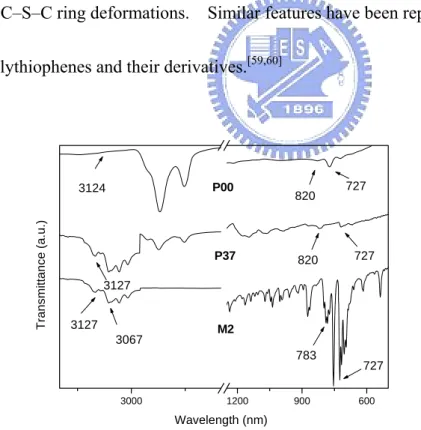
Figure 2-2. FTIR spectra of M2, P00, and P37. 31
Figure 2-3. The thermal degradation temperature of synthesized polymers 33
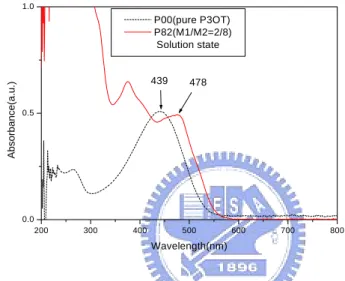
Figure 2-4. UV–Vis spectra of P00 and P82 recorded in THF solution. 34
Figure 2-5. The UV–Vis spectra of P00 and P82 recorded in the solid state. 36
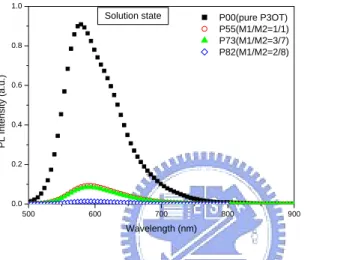
Figure 2-6. PL spectra, normalized to the number of absorbed photons,
of all seven polymers in solution state. 37
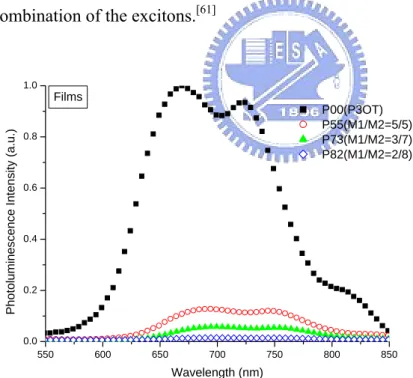
Figure 2-7. PL spectra, normalized to the number of absorbed photons,
of synthesized polymers in the solid state. 38
Figure 2-8. Current density–voltage characteristics of illuminated (AM
1.5G, 100 mW/cm2) polymer solar cells incorporating P00, P55, P73, and
P82 and PCBM. 39
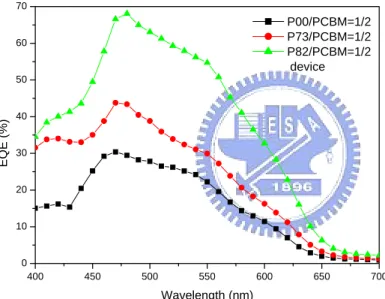
Figure 2-9. (a) The external quantum efficiency of P00, P73 and
P82/PCBM solar cells. 42
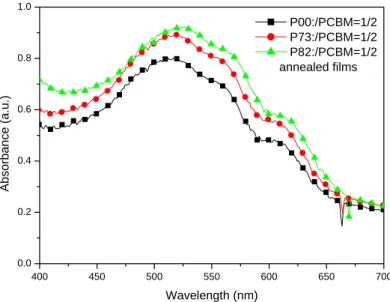
experience the same annealing condition as that of the device. 44
C
C
h
h
a
a
p
p
t
t
e
e
r
r
3
3
:
:
I
I
n
n
t
t
r
r
a
a
m
m
o
o
l
l
e
e
c
c
u
u
l
l
a
a
r
r
D
D
o
o
n
n
o
o
r
r
–
–
A
A
c
c
c
c
e
e
p
p
t
t
o
o
r
r
R
R
e
e
g
g
i
i
o
o
r
r
e
e
g
g
u
u
l
l
a
a
r
r
P
P
o
o
l
l
y
y
(
(
3
3
-
-
h
h
e
e
x
x
y
y
l
l
t
t
h
h
i
i
o
o
p
p
h
h
e
e
n
n
e
e
)
)
s
s
P
P
r
r
e
e
s
s
e
e
n
n
t
t
i
i
n
n
g
g
O
O
c
c
t
t
y
y
l
l
p
p
h
h
e
e
n
n
a
a
n
n
t
t
h
h
r
r
e
e
n
n
y
y
l
l
-
-
I
I
m
m
i
i
d
d
a
a
z
z
o
o
l
l
e
e
M
M
o
o
i
i
e
e
t
t
i
i
e
e
s
s
E
E
x
x
h
h
i
i
b
b
i
i
t
t
E
E
n
n
h
h
a
a
n
n
c
c
e
e
d
d
C
C
h
h
a
a
r
r
g
g
e
e
T
T
r
r
a
a
n
n
s
s
f
f
e
e
r
r
f
f
o
o
r
r
H
H
e
e
t
t
e
e
r
r
o
o
j
j
u
u
n
n
c
c
t
t
i
i
o
o
n
n
S
S
o
o
l
l
a
a
r
r
C
C
e
e
l
l
l
l
A
A
p
p
p
p
l
l
i
i
c
c
a
a
t
t
i
i
o
o
n
n
s
s
Figure 3-1. The 1H NMR spectra of M2, P3HT, P46, P82, and P91. 67
Figure 3-2. UV–Vis spectra of P3HT and P91 in the solid state. 68
Figure 3-3. The chemical structure diagram of HT and
octylphenanthrenyl-imidazole moiety. 70
Figure 3-4. PL spectra, normalized to the number of absorbed photons,
of the synthesized polymers in the solid state. 72
Figure 3-5. Normalized fluorescence transients of (A) P3HT and
(B) P91 coated on quartz, recorded at values of lex and lem at 440 and 600
nm, respectively. 76
Figure 3-6. Time-resolved transients of (A) P3HT, (B) the blend of P3HT and PCBM, (C) P91, and (D) the blend of P91 and PCBM coated on
quartz at values of lex and lem of 440 and 600 nm, respectively. 77
Figure 3-7. Time-resolved transients of (A) P3HT, (B) the blend of P3HT and PCBM, (C) P91, and (D) the blend of P91 and PCBM coated on
quartz at values of lex and lem of 440 and 620 nm, respectively 77
Figure 3-8. Time-resolved transients of (A) P3HT, (B) the blend of P3HT and PCBM, (C) P91, and (D) the blend of P91 and PCBM coated on
quartz at values of lex and lem of 440 and 660 nm, respectively. 78
Figure 3-9. External quantum efficiencies of the copolymer/PCBM solar
cells. 78
P3HT, P64, P82, and P91 and PCBM. 84
Figure 3-11. The current density vs. wavelength diagram of self-made
P3HT/PCBM, P64/PCBM, P82/PCBM, and P91/PCBM devices. 84
Figure 3-12. The atomic force microscopy images of a) self-made
P3HT/PCBM and b) P91/PCBM films. 99
C
C
h
h
a
a
p
p
t
t
e
e
r
r
4: Intramolecular Donor–Acceptor Regioregular
4
Poly(hexylphenanthrenyl-imidazole thiophene) Exhibits
Enhanced Hole Mobility for Heterojunction Solar Cell
Applications
Figure 4-1. a) UV–Vis spectra of P3HT/PCBM as cast and PHPIT/PCBM
annealed at 120 °C in the solid state, and the solar spectrum.
b) CV bandgap data for PHPIT, PEDOT, PCBM, Al, and ITO. 105
Figure 4-2. Current–voltage characteristics of illuminated (AM 1.5G,
100 mW/cm2) polymer/PCBM (1:1, w/w) solar cells. 107
Figure 4-3. Photocurrents of diodes that were illuminated at AM 1.5G
and 100 mW/cm2 after annealing at various temperatures for 30 min. 108
Figure 4-4. Atomic force microscopy (AFM) images of PHPIT/PCBM
films a) as cast and annealed at 120 °C for b) 20, c) 30, and d) 45 min. 110
Figure 4-5. EQEs of devices containing PHPIT/PCBM blends (1:1,
w/w) annealed at 120 °C for various times. 112
Figure 4-6. Dark J–V curves for a) electron- and b) hole-dominated carrier
devices incorporating PHPIT/PCBM (1:1, w/w) annealed at 120 °C for
Schemes and Table Lists
C
C
h
h
a
a
p
p
t
t
e
e
r
r
1
1
:
:
I
I
n
n
t
t
r
r
o
o
d
d
u
u
c
c
t
t
i
i
o
o
n
n
Scheme 1-1. General mechanism for photoenergy conversion in excitonic
solar cells. 3
Scheme 1-2. Elementary steps in the process of photoinduced charge
separation for a donor (D) and an acceptor (A). 4
Scheme 1-3. The schematic draw of the five contributions of the bandgap of
polyaromatic linear conjugated systems. 12
C
C
h
h
a
a
p
p
t
t
e
e
r
r
2
2
:
:
S
S
o
o
l
l
u
u
b
b
l
l
e
e
P
P
h
h
e
e
n
n
a
a
n
n
t
t
h
h
r
r
e
e
n
n
y
y
l
l
-
-
I
I
m
m
i
i
d
d
a
a
z
z
o
o
l
l
e
e
-
-
P
P
r
r
e
e
s
s
e
e
n
n
t
t
i
i
n
n
g
g
R
R
e
e
g
g
i
i
o
o
r
r
e
e
g
g
u
u
l
l
a
a
r
r
P
P
o
o
l
l
y
y
(
(
3
3
-
-
o
o
c
c
t
t
y
y
l
l
t
t
h
h
i
i
o
o
p
p
h
h
e
e
n
n
e
e
)
)
C
C
o
o
p
p
o
o
l
l
y
y
m
m
e
e
r
r
s
s
h
h
a
a
v
v
i
i
n
n
g
g
T
T
u
u
n
n
a
a
b
b
l
l
e
e
B
B
a
a
n
n
d
d
g
g
a
a
p
p
s
s
f
f
o
o
r
r
S
S
o
o
l
l
a
a
r
r
C
C
e
e
l
l
l
l
A
A
p
p
p
p
l
l
i
i
c
c
a
a
t
t
i
i
o
o
n
n
s
s
Scheme 2-1. The synthetic scheme of M1 and M2; NBS:
N-bromosuccinimide. 18
Scheme 2-2. The Grignard Metathesis polymerization of M1 and M2; THF:
tetrahydrofuran. 19
Table 2-1. Molecular weights and thermal properties of synthesized
polymers. 33
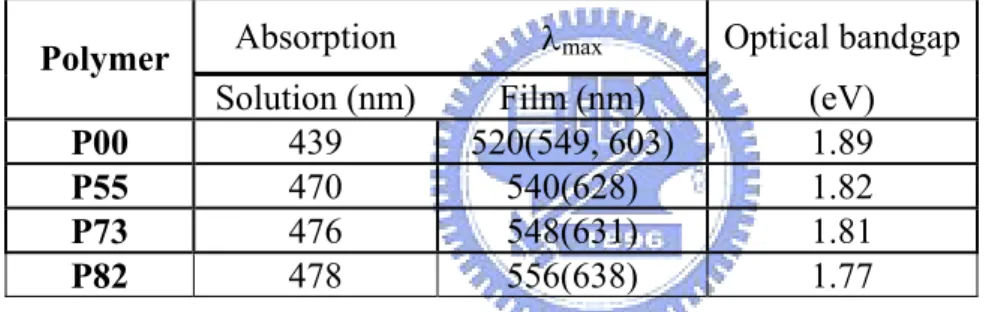
Table 2-2. UV-Visible absorption peaks and optical bandgaps of synthesized
polymers. 36
Table 2-3. Redox data, HOMO, LUMO energy levels, and band gap energies
of our synthesized polymers. 36
C
C
h
h
a
a
p
p
t
t
e
e
r
r
3
3
:
:
I
I
n
n
t
t
r
r
a
a
m
m
o
o
l
l
e
e
c
c
u
u
l
l
a
a
r
r
D
D
o
o
n
n
o
o
r
r
–
–
A
A
c
c
c
c
e
e
p
p
t
t
o
o
r
r
R
R
e
e
g
g
i
i
o
o
r
r
e
e
g
g
u
u
l
l
a
a
r
r
P
P
o
o
l
l
y
y
(
(
3
3
-
-
h
h
e
e
x
x
y
y
l
l
t
t
h
h
i
i
o
o
p
p
h
h
e
e
n
n
e
e
)
)
s
s
P
P
r
r
e
e
s
s
e
e
n
n
t
t
i
i
n
n
g
g
O
O
c
c
t
t
y
y
l
l
p
p
h
h
e
e
n
n
a
a
n
n
t
t
h
h
r
r
e
e
n
n
y
y
l
l
-
-
I
I
m
m
i
i
d
d
a
a
z
z
o
o
l
l
e
e
M
M
o
o
i
i
e
e
t
t
i
i
e
e
s
s
E
E
x
x
h
h
i
i
b
b
i
i
t
t
E
E
n
n
h
h
a
a
n
n
c
c
e
e
d
d
C
C
h
h
a
a
r
r
g
g
e
e
T
T
r
r
a
a
n
n
s
s
f
f
e
e
r
r
f
f
o
o
r
r
H
H
e
e
t
t
e
e
r
r
o
o
j
j
u
u
n
n
c
c
t
t
i
i
o
o
n
n
S
S
o
o
l
l
a
a
r
r
C
C
e
e
l
l
l
l
A
A
p
p
p
p
l
l
i
i
c
c
a
a
t
t
i
i
o
o
n
n
s
s
Scheme 3-1. Synthesis of M1 and M2; NBS: N-bromosuccinimide. 51
Scheme 3-2. Grignard metathesis polymerization of M1 and M2; THF:
tetrahydrofuran.
52
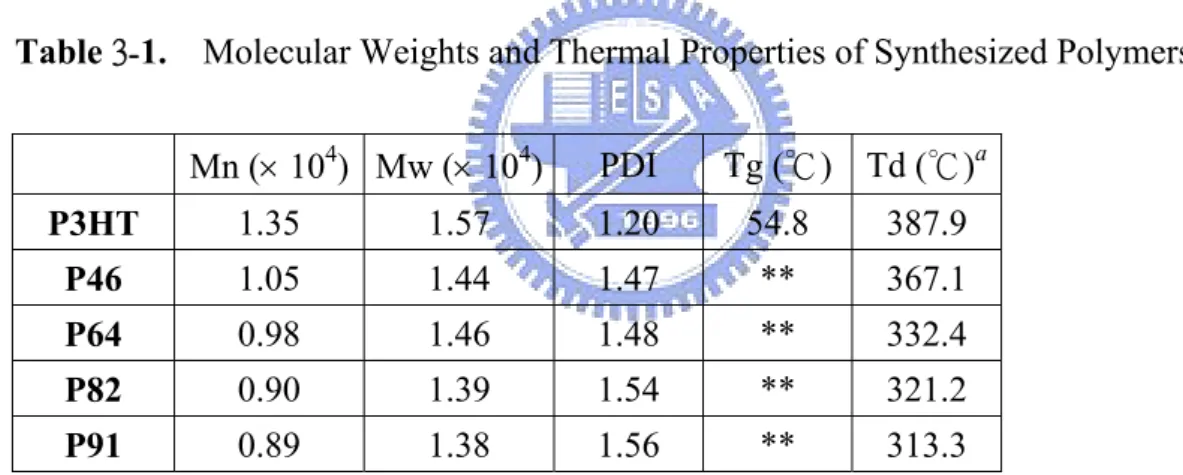
Table 3-1. Molecular Weights and Thermal Properties of Synthesized
Polymers. 68
Table 3-2. UV–Vis Absorption Peaks and Optical Bandgaps of Synthesized
Polymers. 71
Table 3-3. Redox data, HOMO, LUMO energy levels, and band gap energies
of our synthesized polymers. 71
Table 3-4. Rate Constants for the Polymer, its Blend with PCBM, and
Electron Transfer for P3HT and P91 at Different Wavelengths. 79
Table 3-5. Photovoltaic Properties of the Polymer Solar Cells. 85
Table 3-6. Redox data, HOMO, LUMO energy levels, and band gap energies
of our synthesized polymers 88
C
C
h
h
a
a
p
p
t
t
e
e
r
r
4: Intramolecular Donor–Acceptor Regioregular
4
Poly(hexylphenanthrenyl-imidazole thiophene) Exhibits
Enhanced Hole Mobility for Heterojunction Solar Cell
Applications
Scheme 4-1. Synthesis of the monomer and polymer; NBS:
N-bromosuccinimide; THF: tetrahydrofuran; dppp:
1,3-bis(diphenylphosphino)propane. 95
for various lengths of time and of P3HT/PCBM annealed at 120 °C for 30
min. 107
Table 4-2. Hole mobilities, electron mobilities, and hole-to-electron-mobility
ratios of P3HT/PCBM annealed at 120 °C for 30 min and PHPIT/PCBM
annealed at 120 °C for various lengths of time. 115
Abstract
In this dissertation, a series of polythiophene copolymers have been
synthesized to study to photovoltaic characteristics. First of all, we have used
Grignard metathesis polymerization to successfully synthesize a series of regioregular
polythiophene copolymers that contain electron-withdrawing and conjugated
phenanthrenyl-imidazole moieties as side chains. The introduction of the
phenanthrenyl-imidazole moieties onto the side chains of the regioregular
polythiophenes increased their conjugation lengths and thermal stabilities and altered
their band gap structures. The band gap energies, determined from the onset of
optical absorption, could be tuned from 1.89 eV to 1.77 eV by controlling the number
of phenanthrenyl-imidazole moieties in the copolymers. Moreover, the observed
quenching in the photoluminescence of these copolymers increases with the number
of phenanthrenyl-imidazole moieties in the copolymers, owing to the fast deactivation
of the excited state by the electron-transfer reaction. Both the lowered bandgap and
fast charge transfer contribute to the much higher external quantum efficiency of the
poly(3-octylthiophene)-side-chain-tethered phenanthrenyl-imidazole than that of pure
poly(3-octylthiophene), leading to much higher short circuit current density. In
particular, the short circuit current densities of the device containing the copolymer
mA/cm2 for the device of pure poly(3-octylthiophene), P00, an increase of 62%. In
addition, the maximum power conversion efficiency improves to 2.80% for P82 from
1.22% for P00 (pure P3OT). Second, intramolecular donor–acceptor structures
prepared by binding conjugated octylphenanthrenyl-imidazole moieties covalently
onto the side chains of regioregular poly(3-hexylthiophene)s exhibit lowered
bandgaps and enhanced electron transfer. For instance, conjugating 90 mol%
octylphenanthrenyl-imidazole moieties onto poly(3-hexylthiophene) chains reduced
the optical bandgap from 1.91 to 1.80 eV, and the electron transfer probability was at
least twice than that of pure poly(3-hexylthiophene) when blended with
[6,6]-phenyl-C61-butyric acid methyl ester. The lowered bandgap and the fast charge
transfer both contribute to the much higher external quantum efficiencies—and, thus,
much higher short-circuit current densities—for the copolymers presenting
octylphenanthrenyl-imidazole moieties, relative to those of pure
poly(3-hexylthiophene)s. In particular, the short-circuit current density of a device
containing the copolymer presenting 90 mol% octylphenanthrenyl-imidazole moieties
improved to 13.7 mA/cm2 from 8.3 mA/cm2 for the device containing pure
poly(3-hexylthiophene)—an increase of 65%. In addition, the maximum power
conversion efficiency was 3.45% for the copolymer presenting 90 mol%
intramolecular D–A side-chain-tethered hexylphenanthrenyl-imidazole polythiophene
has been synthesized. The visible light absorption of the PHPIT/PCBM blend is
enhanced by the presence of the electron-withdrawing hexylphenanthrenyl-imidazole.
The EQE of the device was maximized when the PHPIT/PCBM blend experienced
annealing at 120 °C for 30 min. The more-balanced electron and hole mobilities and
the enhanced visible and internal light absorptions in the devices consisting of
annealed PHPIT/PCBM blends both contributed to a much higher short-circuit
current density, which in turn led to a power conversion efficiency as high as 4.1%,
摘要
本論文乃研究探討利用 Grignard metathesis 來合成一系列聚噻 吩 高 分 子 來 探 討 高 分 子 本 身 之 光 電 效 應。而 論 文 的 第 一 部 份,是 以 合 成 出 一 系 列 聚 (辛 基 -噻 吩 )(P3OT)衍 生 物,而 在 其 側 鏈 上 導 入 一 菲 基 -1,3-二 氮 雜 茂 (phenanthrenyl-imidazole),希 望 藉 由 導 入 此 官 能 基 之 後 可 以 增 加 高 分 子 本 身 主 鏈 的 共 軛 長 度 , 不 但 可 以 將 高 分 子 本 身 的 能 隙 (bandgap) 降 低 , 且 具 有 電 子 傳 輸 的 效 果 , 而 且 在 光 激 發 光 方 面 , 因 為 隨 呃 導 入 菲 基 -1,3-二 氮 雜 茂 比 例 增 加 , 發 光 淬 息 (quenching)現 象 就 越 來 越 明 顯 , 也 因 為 如 此 促 使 了 高 分 子 的 製 作 成 元 件 之 後 , 外 部 量 子 效 率 (external quantum efficiencies)增 加 , 相 對 的 在 含 有 比 較 高 比 例 的 菲 基 -1,3-二 氮 雜 茂 聚 (辛 基 -噻 吩 )高 分 子 之 光 電 流 (short-circuit current density)也 提
升 了 (由 8.7 mA/cm2提 升 到 14.2 mA/cm2, 提 升 了 約 62%), 光 電 轉 換 效 率 也 增 加 了 (由 1.22%提 升 到 2.80%)。 第 二 部 份 則 是 , 利用 Grignard metathesis 來合成一系列聚(己基-噻 吩 )(P3HT)高 分 子 衍 生 物 , 然 後 將 菲 基 -1,3-二 氮 雜 茂 末 端 作 了 修 飾 導 入 了 兩 個 辛 基 長 碳 鏈 提 升 溶 解 度,相 同 的 , 導 入 了 辛 基 -菲 基 -1,3-二 氮 雜 茂 之 後 , 高 分 子 本 身 的 能 隙 降 低 , 發 光 淬 息 (quenching)現 象 就 越 來 越 明 顯,而 此 系 列 之 高 分 子 開 路 光 電 流 也 提 升 了 (由 8.3 mA/cm2提 升 到 13.7 mA/cm2, 提 升 了 約 65%), 光 電 轉 換 效 率 改 善 到 3.45%。 第 三 部 份 , 則 是 合 成 一 高 分 子 , PHPIT,
在 菲 基 -1,3-二 氮 雜 茂 末 端 修 飾 導 入 了 三 個 己 基 官 能 基 到 單 體 本 身 之 中 , 而 此 高 分 子 與 [6,6]-苯 基 -C6 1-丁 酸 甲 酯 ([6,6]-phenyl-C6 1-butyric acid methyl ester) (PCBM)掺 混 之 後,對 於 可 見 光 之 吸 光 能 力 增 強,而
製 作 成 元 件 之 後 發 現,在 迴 火 溫 度 為 120 o
C,持 續 30 分 鐘 的 情 況 下 , 其 外 部 量 子 效 率 最 高,而 在 此 條 件 下,也 因 為 較 為 平 衡 的 電 子 電 動 流 動 率 也 促 使 了 較 高 的 光 電 流 密 度,因 此,此 高 分 子 在 此 條 件 下 之 光 電 轉 換 效 率 約 為 4.1%。
誌謝
終於也輪到我寫誌謝了,一直以來看到數位實驗室先輩的博士論文的完成 總是花上了一千多個日子,而我比較辛苦花了兩千多個日子來完成,當然期間的 酸甜苦辣的往事也歷歷在目,激勵了我能夠在最後完成了這部論文。要感謝的人 實在太多了,謹以此文表達我衷心的謝意。 首先我得感謝指導教授韋光華老師,沒有他提供舒適的研究環境,已及充分 的經費已經儀器的支持,這部論文是無法完成的。而且他對於研究上的要求以及 指導叮嚀,除了激勵我成長之外更讓我體會到做研究的酸甜苦辣,並且也給予我 再外來發展上一些比較客觀的批與指教讓我學會了人生中做人做事的道理。也很 感謝刁維光老師在論文研究過程中的幫忙與教導,以及碩士班時期諄諄教誨的許 慶豐老師使我在有機合成這條路上可以研究比較平順。也因為有諸位師長朋友的 幫助,讓我可以渡過諸多困難與挫折。以及最後能來參加我口試的各位口試委員 們:黃華宗、林建村、陳文章、林宏洲以及郭宗枋諸位師長給予我的意見與鼓勵。 實驗室畢業的學長田運宜 (帥帥)、呂奇明 (Mickey)、翁錦成 (小猪)、葉孝蔚、 李中斌學長,感謝他們讓我體會到做研究就是要一股作氣的完成,以及他們的不 服輸人生觀。以及實驗室的夥伴們:我已畢業同窗室友兼實驗室夥伴嘉宏、比我 早畢業的學弟清茂、擅於提供意見以及解決問題的旭生、快樂過生活的茂源、知 識淵博以及籃球球友碩麟、阿彌佗佛的陳冠宇、製造歡樂的陳振平、認真開朗的 李紹睿、實事求是積極進取的蘇明鑫、籃球狂熱紀傑元、陳紘揚、世紀帝國高手 阿川、KTV 歌友璨丞、實驗室的諸、位美女們琬琪、靜宜、孟婷、慧玫、含章、 世莉、姿吟、曉文、大姊頭級行事作風阿莎力的克瑤、熱心助人天真樂觀的美女 助理克瑜、實驗室諸位碩士班的新生、林宏洲老師實驗室球友小吳、許慶豐老師 實驗室的芳奕、冷翰與黃華宗老師實驗室的籃球夥伴們、系辦的諸位助理小姐琳 婷、蕙馨、素瓊、印度博士後研究員 Dina 與 Dahna。 衷心的感謝你們,沒有你們一路上的陪伴,就沒有在這學校裡面的許多回憶以及 感動。 最後,僅以本論文獻給我最親愛的母親以及家人,感謝他們在我求學過程中 給予我的一些意見以及精神上與生活上的支持使我可以無後顧之憂得以順利完 成這部論文得以畢業。 張耀德 2009. 2. 27
C
C
h
h
a
a
p
p
t
t
e
e
r
r
1
1
:
:
Introduction
1-1 Introduction of Polymer Solar Cell
The development of conjugated polymers that possess extended delocalized π-electrons for use in organic optoelectronic devices has been an area of extensive investigation, with some studies having focused on solar cell devices based on bulk heterojunctions using conjugated polymers.[1–7] Recently, research into conjugated polymers containing electron donor–acceptor pairs has become quite active[8] because such materials exhibit specific optical, electrical, and electronic properties. Polymer solar cells have attracted considerable attention in the past few years owing to their potential of providing environmentally safe, flexible, lightweight, inexpensive, efficient solar cells. Especially, bulk-heterojunction solar cells consisting of a mixture of a conjugated donor polymer with a methanofullerene acceptor are considered as a promising approach. Here a brief introduction and overview is given of the field of polymer solar cells. In the more than 20 years since the seminal work of Tang,[2] organic solar cells have undergone a gradual evolution that has led to energy
conversion efficiencies (η, see Figure 1)of about 5%.[3–8] Two main approaches have been explored in the effort to develop viable devices: the donor–acceptor bilayer,[8–10] commonly achieved by vacuum deposition of molecular components,[11] and the so-called bulk heterojunction (BHJ),[12, 13] which is represented in the ideal case as a
bicontinuous composite of donor and acceptor phases, thereby maximizing the all-important interfacial area between the donors and acceptors.
1-2 The Basis Principle of Polymer Solar Cell
Efforts to optimize the performance of organic solar cells should find their basis in the fundamental mechanism of operation. Scheme 1-1 illustrates the mechanism by which light energy is converted into electrical energy in the devices. The energy conversion process has four fundamental steps in the commonly accepted
mechanism:[14] 1) Absorption of light and generation of excitons, 2) diffusion of the excitons, 3) dissociation of the excitons with generation of charge, and 4) charge transport and charge collection. Figure 1-1 shows a schematic representation of a typical BHJ solar cell, illustrating the components involved in the mechanistic steps as well as a current–voltage curve defining the primary quantities used to validate the performance of a solar cell. The elementary steps involved in the pathway from photoexcitation to the generation of free charges are shown in Scheme 1-2.[15, 16] The processes can also occur in an analogous fashion in the case of an excited
acceptor, and the details of these mechanistic steps have been described extensively in the literature.[16] The key point is that electron transfer is not as simple as depicted in Scheme 1-1. The process must be energetically favorable to form the geminate pair in step 3 of Scheme 1-2 and an energetic driving force must exist to separate this
electron–hole pair. The open circuit voltage (Voc) is also governed by the energetic relationship between the donor and the acceptor (Scheme 1-1) rather than the work functions of the cathode and anode, as would be expected from a simplistic view of these diode devices. Specifically, the energy difference between the HOMO of the donor and the LUMO of the acceptor is found to most closely correlate with the Voc value.[18, 19]
Scheme 1-2. Elementary steps in the process of photoinduced charge separation for a
donor (D) and an acceptor (A): 1) Photoexcitation of the donor; 2) diffusion of the exciton and formation of an encounter pair; 3) electron transfer within the encounter pair to form a geminate pair; 4) charge separation.
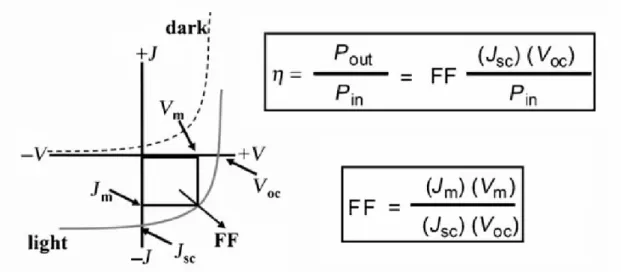
Figure 1-1. Schematic drawing of the working principle of an organic photovoltaic
cell. Illumination of donor (in red) through a transparent electrode (ITO) results in the photoexcited state of the donor, in which an electron is promoted from the highest occupied molecular orbital (HOMO) to the lowest unoccupied molecular orbital (LUMO) of the donor. The typical current–voltage characteristics for dark and light current in a solar cell illustrate the important parameters for such devices: Jsc is the short-circuit current density, Voc is the open circuit voltage, Jm and Vm are the current and voltage at the maximum power point, and FF is the fill factor. The efficiency (h) is defined, both simplistically as the ratio of power out (Pout) to power in (Pin), as well as in terms of the relevant parameters derived from the current–voltage relationship.
1-3 Literature Review of Polymer Solar Cell Materials
In combining electron donating (p-type) and electron accepting (n-type)
materials in the active layer of a solar cell, care must be taken that excitons created in either material can diffuse to the interface, to enable charge separation. Due to their short lifetime and low mobility, the diffusion length of excitons in organic
semiconductors is limited to about ~10 nm only. While the best currently available devices are composed of P3HT/PCBM and MDMO-PPV/PCBM composites as shown in Figure 1-2,[20-22] much effort is being devoted to enhancing the efficiency of BHJ solar cells by developing a deeper understanding of the processes and
interactions that dominate the performance of solar cells and developing new materials that are more effective for device operation. In the following sections, several key areas that have been examined in an attempt to improve solar energy conversion will be discussed along with key concepts that ought to be considered in the search for high efficiency. The prototypical polymer solar cells based on
MDMO-PPV/PCBM and P3HT/PCBM composites discussed above show the extent of optimization that is required to generate efficient polymer–fullerene solar cells. However, a variety of other approaches have been used in attempts to overcome some of the inherent limitations of these typical examples. These limitations can largely be gleaned directly by a consideration of the fundamental mechanism for
photoconversion in these excitonic solar cells (Scheme 1-1), which begins with light absorption.
Figure 1-2. Donor and acceptor materials used in polymer-fullerene
bulk-heterojunction solar cells. Donors: MDMO-PPV =
poly[2-methoxy-5-(3´,7´-dimethyloctyloxy)-p-phenylene vinylene]; P3HT=
poly(3-hexylthiophene); Acceptors: PCBM: [6,6]-phenyl-C61-butyric acid methyl ester.
The photon flux reaching the surface of the earth from the sun occurs at a maximum of approximately 1.8 eV (700 nm); however, neither MDMOPPV (Eg=2.2 eV) nor P3HT (Eg=1.9 eV) can effectively harvest photons from the solar spectrum. It is calculated that P3HT is only capable of absorbing about 46%of the available solar photons[23] and only in the wavelength range between 350 nm and 650 nm. The limitation in the absorption is primarily due to limited spectral breadth rather than
absorption coefficients on the order of 105 cm-1.[24] Developing a polymer that could capture all of the solar photons down to 1.1 eV would allow absorption of 77% of all the solar photons.[25] Expanding the spectral breadth of absorption in
polymer–fullerene composites has most commonly been pursued by extending (or shifting) the polymer absorption spectrum into the near-infrared region. This is primarily achieved through the use of low-bandgap polymers, which has led to efficiencies as high as 3.5%[23] in polymer–fullerene composite solar cells. While low-bandgap polymers have often been touted as the solution of this problem, merely having a lower energy onset for absorption is not sufficient to harvest more solar photons. What is needed is to extend the overlap with the solar spectrum to gain broader coverage while also retaining high absorption coefficients at relevant wavelengths and suitable energy levels for interaction with PCBM.
The first approach towards these goals focused on broadening the absorption of known polymers through the UV and visible regions. An excellent example is
afforded by poly(3-vinylthiophenes), such as 1.[26] The incorporation of chromophores that are conjugated to the backbone through the 3-vinyl linkage leads to a broadening of the wavelengths at which high photoconversion efficiencies can be achieved. In a direct comparison with P3HT/PCBM devices, cells with polymer 1 afforded 3.2% efficiency versus 2.4% with P3HT under the same conditions. The enhanced
performance of polymer 1 can be attributed to the increased photocurrent in the 400–500 nm range.
The second approach to increase the spectral breadth of the absorbed photons is
to synthesized the so-called low-bandgap polymers;[27] which is loosely defined as polymers with a bandgap less than 1.5 eV.Compounds 2–7[28-33] represent a few of the more successful polymers employed to-date. The most common synthetic technique used to achieve low-bandgap polymers is the donor–acceptor approach, in which alternating electron-rich and electron-poor units define the polymer backbone.[34] The best examples of this class reported thus far are based almost exclusively on benzothiadiazole (or analogues) as the acceptor in combination with several different donor groups. In addition, the APFO polymers (such as 3) are reported to afford efficiencies as high as 2.8%[29] and EQE values greater then 50% in the 350–600 nm region in 1:3 or 1:4 blends with PCBM.[35]
The third approach is to synthesize a variety of soluble C60 derivatives have been synthesized (8–10)[36-38] and employed in BHJ solar cells with varying success. The focus in this case was not to increase the absorption of visible light, but rather to improve miscibility, the mobility of the charge carriers, and other aspects of
performance that are influenced by the structure of the soluble fullerene employed. A further motivation for testing new soluble C60 derivatives is the development of a fundamental structure–property relationship and a guiding design principle for
fullerene acceptors. For example, the simple benzoate derivative 10 gave the best performance with (un-optimized) efficiencies of 4.5% reported in P3HT solar
cells at a polymer/fullerene ratio of 1:0.82, whereas P3HT/PCBM devices prepared in a parallel study showed 4.4% efficiency at an optimal ratio of 1:0.67.
1-4 Motivation
The bandgap of polyaromatic linear conjugated systems is determined by five contributions i.e. the energy related to bond length alternation, Eδr the mean deviation from planarity Eθ, the aromatic resonance energy of the cycle ERes, the inductive or mesomeric electronic effects of eventual substitution ESub, and the intermolecular or
interchain coupling in the solid state Eint.(as shown in Scheme 1-3)
Eg = Eδr + Eθ + ERes + ESub + Eint
Probably the most important feature of this equation is that it makes clear the various structural variables that have to be mastered in order to control the gap of linear conjugated systems. Consequently, the main synthetic strategies adopted for the design of small bandgap linear conjugated systems will be focused on the reduction of the energetic contribution of one or more of these parameters.[39]
Scheme 1-3. The schematic draw of the five contributions of the bandgap of
The side-chain effect and the regioregularity affect the absorption wavelength of the conjugation polymers. The side-chain effect has been studied for a period of time but they just used a spacer such as alkyl chain to link the bulky side chain to the polymer main chain, leading to photoluminescene quenching.[40] Therefore, to introduce an electron withdrawing group such as phenanthrenyl-imidazole as the side chain and to conjugated to the polymeric main chain would be a curios case for the synthesis of the conjugated polymers (donors) which can maintain the
photoluminescene quenching effect and tune the bandgap of the pokymers. For bulk heterojunction solar cell, the power conversion efficiency can be tuned by the
differences of the regioregularity of alkyl polythiophene such as
poly(3-hexylthiophene). This would destroy the crystalinity of the polymeric main chain resulting in the decrease of short-circuit current density. Therefore, to
introduce a bulky coplanar moiety such as phenanthrenyl-imidazole as the side chain which is directly conjugated to the polymeric main chain might increase the
intramolecular donor-acceptor effect between the polymeric main chain and side chain and the Grinard Metathesis was used to maintain the regioregularity.
C
C
h
h
a
a
p
p
t
t
e
e
r
r
2
2
:
:
Soluble Phenanthrenyl-Imidazole-Presenting
Regioregular Poly(3-octylthiophene) Copolymers having Tunable
Bandgaps for Solar Cell Applications
A new family of regioregular copoly(3-octylthiophene) side chain tethered phenanthrenyl-imidazol that possess lowered bandgap and enhanced electron transfer property were synthesized for heterojunction polymer/PCBM solar cell applications. The short circuit current density and the power conversion efficiency of the
copolymer having 80 mole% phenanthrenyl-imidazole group device improved to 14.2 mA/cm2 and 2.8%, respectively, from 8.7 mA/cm2 and 1.22% for pure
MeO O S S C8H17 N N n m -0.2 -0.1 0.0 0.1 0.2 0.3 0.4 0.5 0.6 0.7 -25 -20 -15 -10 -5 0 5 10 15 20 25 J (m A/ cm 2 ) Voltage (V) P00 P55 P73 P82 MeO O MeO O MeO O e- h+ hυ IT PEDOT O Ca A1
2-1. Introduction
The development of conjugated polymers that possess extended delocalized π-electrons for use in organic optoelectronic devices has advanced dramatically in recent years. In particular, there have been extensive studies into solar cell devices based on bulk heterojunctions formed using conjugated polymers.[41–48] The structures of bulk heterojunction polymer solar cells have been prepared from a thin film of the electron-donating conjugated polymer and an electron-accepting species, which has been either another polymer or a set of nanoparticles. Polythiophene derivatives are recognized as being among the most promising materials for solar cell applications because of their excellent light absorption and electronic conductivity. Polymer solar cells containing blends of poly(3-hexylthiophene) and the
buckminsterfullerene derivative [6,6]-phenyl-C61-butyric acid methyl ester (PCBM) have been studied in depth; recent reports[43] have indicated that power conversion efficiencies of around 1% ~ 2% under standard solar conditions (AM 1.5G, 100 mW/cm2, 25 °C ). There are a number of ways to proceed toward improving the power conversion efficiencies of these polymer solar cells. For example, varying the annealing temperature and time—to lower the electrical resistance of the
devices—and introducing a lower-work-function electrode have been reported.[49–53] Alternatively, copolymerization with different conjugated monomers has also been
investigated, but with limited success in improving the power conversion efficiency.[50]
Semiconducting conjugated polymers that are used presently in light emitting diodes typically absorb in the range between 300 and 500 nm, which is only a small portion of the spectrum of sunlight. Thus, another approach toward
higher-efficiency polymer solar cells is the use of conjugated polymers that absorb light more effectively. There are two main ways to tackle this problem. The first involves introducing chromophores that have different energy bandgaps into the conjugated polymers, thereby increasing the bandwidth of absorption. This method usually leads to some synthetic difficulties resulting from the typical bulkiness and low reactivity of functionalized chromophores or dyes. The second way is to incorporate electron-withdrawing moieties into side chains that are in conjugation with the main polymer chains. In this way, not only the electron transfer efficiency of the excitons of the side-chain-tethered phenanthrenyl-imidazole polymers can be improved but also their bandgaps can be lowered for matching the wavelength of the maximum photon flux of sunlight (700 nm), which is ca. 1.77 eV.[54] The extent of the reduction in the bandgap of the side-chain-tethered phenanthrenyl-imidazole polymers will depend on the effective conjugation length of the system, which are sometimes reduced by steric hindrance. Previously, oxadiazo-, triazole-,
quinoxaline-, imidazole-, and triazine-containing moieties are used in semiconducting polymers for other applications.[55] In this present study, we designed an extended conjugated molecular structure in which phenanthrenyl-imidazole moieties were attached covalently to the side chain of thiophene units to form regioregular copolymers that had lowered bandgaps—which were tunable depending on the content of phenanthrenyl-imidazole moieties—and enhanced electron transferring abilities. Because of the poor solubility of the phenanthrenyl-imidazole moiety, we used a thiophene monomer (3-octylthiophene) presenting a long alkyl chain to form copolymers exhibiting improved solubility. Scheme 1 displays our synthetic approaches toward the 2,5-dibromo-3-octylthiophene and the planar
phenanthrenyl-imidazole moiety monomer. We expected that the presence of phenanthrenyl-imidazole moieties conjugated to the thiophene units would enhance the electron transfer of polythiophene and alter the energy levels of the highest occupied molecular orbitals (HOMOs) and lowest unoccupied molecular orbitals (LUMOs) of our polymers, thereby decreasing the bandgap and enhancing their photovoltaic properties. Scheme 2-2 displays the copolymerization of the 2,5-dibromo-3-octylthiophene M1 and
2-(2,5-dibromothiophen-3-yl)-1-phenyl-1H-phenanthro[9,10-d]imidazole monomer
Scheme 2-1. The synthetic scheme of M1 and M2; NBS: N-bromosuccinimide. S Br S C8H17 S C8H17 Br Br S H O S N N S N N Br Br O O NH2 2 eq NBS 2eq NBS Ni(dppp)Cl2 C8H17MgBr Ether M1 M2 1 2 CH3COOH/ CH3COONH4 90% 95% 92% 88% a b c d e g h f
Scheme 2-2. The Grignard Metathesis polymerization of M1 and M2; THF: tetrahydrofuran. S C8H17 Br Br S N N Br Br S N N m S n C8H17
M1
M2
+
1.CH3MgBr/THF 2. Ni(dppp)Cl2 Grignard MetathesisPolymer molar ratio P00 P55 P73 P82
Molar fraction of M1 100% 50% 30% 20%