
A Flexible Network Management Environment using Mobile Agent Technology
9
0
0
全文
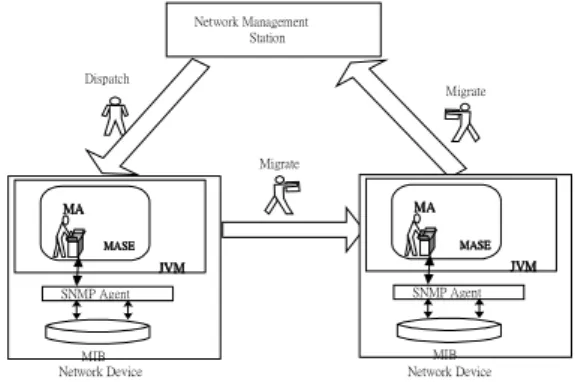
(2) Management [3], Intelligent Agents [4], Active. reducing the loading at the manager site.. Networks [5], and Mobile Agent [6]. By the. The remainder of this paper is organized as. definition by Martin-Flatin et al [7], these. follows. In section 2, we describe the proposed. solutions can be classified into three different. network management architecture. A prototyped. categories:. weakly. distributed. hierarchical. network management system based on the. paradigm,. strongly. distributed. hierarchical. proposed architecture is proposed next. Two. paradigm, and distributed cooperative paradigm.. applications: Monitor Agent and Information. In the weakly distributed hierarchical paradigm,. Retrieval Agent are included. Finally, summaries. a management application is spread over several. and conclusions are presented.. machines. In this way, scalability could be. 2 The Proposed Architecture. management. Our proposed architecture is comprised of. functions could lead to the limitation of. three components: Network Management Station. robustness and flexibility. In the strongly. (NMS), Mobile Agent Service Environment. distributed hierarchical paradigm, management. (MASE), and Mobile Agent (MA). The NMS. stations are no longer restricted to a small set of. can launch mobile agents with management. powerful machines. All agents are capable of. tasks, policies and travel plans. It also plays the. performing managing role. Scalability, flexibility. role of displaying the returned results. The. and robustness can be easily satisfied, however,. MASE provides a running environment for. to have all managed node get ready in. mobile agents. It also provides an interface to. participating management operations is costly. allow MAs can communicate with the local. and. Unlike. managed resources. A mobile agent plays the. distributed. role in actually carrying out the management. enhanced. but. could. the. be. aforementioned. predefined. too. idealistic.. paradigms,. the. A. services. It can migrate between the managed. manager can simply send the “what and “why”,. entities to perform a given task based on a. and expect managed agents to know “how” to. pre-defined policy. The whole architecture is. react. Although they can also meet the. shown in Figure1. In the following, we will. management requirements, such as scalability,. briefly. flexibility, and robustness, they are too complex. components of proposed architecture.. cooperative. paradigm. is. goal-oriented.. describe. to implement.. the. constitution. of. each. Network Management Station. In this paper, we propose a flexible network. Dispatch. Migrate. management environment using mobile agent Migrate. technology. By applying the technology of the mobile agent, the computing load and the data. MA. MA. MASE. MASE. JVM. JVM. processing can be moved from the manager site to managed devices. This is a feasible solution. SNMP Agent. MIB Network Device. SNMP Agent. MIB Network Device. for dealing with the growing size of network. In addition, the attractive feature of mobility is just right for solving the flexibility problem and. Figure 1 The Proposed Architecture 2.1 Network management station.
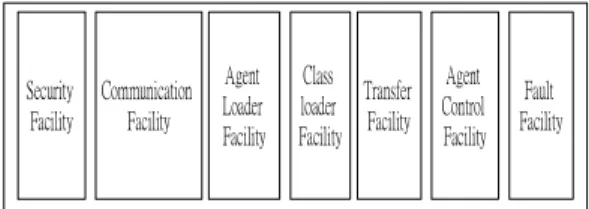
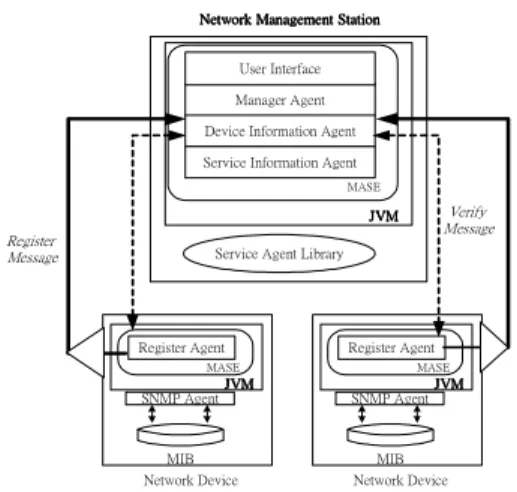
(3) In our architecture, NMS consists of five. interface for an agent to communicate with local. components: user interface, manager agent,. managed resources. As shown in Figure 3, the. device information agent, service information. MASE consists of seven components: security. agent and service agent library. User interface. facility, communication facility, agent loader. provides a user-friendly interface for network. facility, class loader facility, transfer facility and. administrator.. agent control facility.. It. governs. the. displays. of. information collected by the MAs. Manager agent is the main agent in the NMS. It takes charge of the communication with the user. Security Facility. Communication Facility. interface to provide the necessary information and. perform. the. instructions.. Agent Loader Facility. Class Transfer loader Facility Facility. Agent Control Facility. Fault Facility. Device. information agent keeps the information of managed devices. When a managed device starts,. Figure 3 Structure of Mobile Agent Service Environment. it sends a message to device information agent. Security facility: Mobile agents need to be. for the registration. Service information agent. authenticated at each managed device before any. manages the Service Agent Library in the NMS.. task is performed. This will prevent the. Once a manager asks for a service, it will offer. unauthorized mobile agents.. the up-to-dated service agent’s information,. Communication facility: The MASE provides. which are currently in the service agent library,. an interface for an agent to send a message to. to the manager. Service agent library stores. another agent Communication is very important,. service agents that are defined in advance. The. especially, when a task must be cooperated by. constitution of NMS is illustrated in Figure 2.. several mobile agents. Agent loader facility: When a new agent is. User Interface. generated, the MASE has to load the agent into. Manager Agent Device Information Agent. the memory and starts execution.. Service Information Agent. Class loader facility: There are some common. MASE. classes, which are desired by a general mobile. JVM. agent, and they can be loaded into the local class. Service Agent Library. library. This can minimize the size of the mobile agent and reduce the traffic load of the network.. Figure 2 NMS’s Constitution 2.2 Mobile Agent Service Environment. Transfer facility: The MASE is also responsible. (MASE). for sending and receiving mobile agents. A. In our architecture, every managed device. mobile agent needs to be serialized and encoded. runs a Java Virtual Machine (JVM) [8], which is. before starting migration. Similarly, an agent. well fit for the distributed network management,. needs to be deserialized and decoded, after the. and. migrating.. executes. a. Mobile. Agent. Service. Environment (MASE) that enables the execution. Agent control facility: The managed device. of mobile agents. The MASE provides an. strictly specifies the interactions between the.
(4) local environment of the managed device and the. send a verification message to the register agent. mobile agent. The MASE provides a mechanism. to make sure the managed device is alive, if. which the local resources can be accessed by a. required. Network Management Station. mobile agent. The MASE program specifies the policy. that. governs. the. mobile. User Interface. agent’s. Manager Agent Device Information Agent. interaction with the local resources. At the same. Service Information Agent. time, MASE has the authority to deny any service for the mobile agent that violates the. MASE. Verify Message. JVM. Register Message. Service Agent Library. trust. Register Agent. Fault facility: It deals with the faulty situations,. Register Agent. MASE. MASE. JVM SNMP Agent. including connection error, transfer error and other error among others.. JVM SNMP Agent. MIB. MIB. Network Device. Network Device. Figure 4 Register Agents. 2.3 Management agents Management tasks are accomplished by a set. Service Agents. of mobile agents in our architecture. They are. Service agents are responsible for performing. collaborated to support various tasks delegated. the given task from manager. Service agents. by network manager. Agents are distributed and. have the knowledge of task domain, which other. run across different managed network devices.. relevant agents participate in performing part of. In our architecture, other than the agents existed. the. in the NMS, three different types of agent, which. formulating problem, solving plans, executing. are named register agent, service agent and. plans, querying, exchanging information with. information. the. other agents, can be predefined by the manager.. management process to perform management. This makes service agents with the ability to. tasks.. perform most of the autonomous problem. Register Agents. solving.. agent,. get. involving. in. task.. The. service. contents,. such as. When a managed device comes up, it. The relationship between service agent and. automatically starts the mobile agent service. the NMS is shown in Figure 5. When the. environment. When a MASE has been set up, it. manager asks for a service through the user. will create a register agent, as shown in Figure 4.. interface, the manager agent loads service agent. The register agent then sends the registration. from the service agent library and lunches it to. message to the device information agent within. the indicated device. After passing the process of. the NMS. The device information agent in turn. authentication, the service agent can interacts. adds this device into the list of the active devices.. with the SNMP agent on the local device to. With the assistance of register agent, network. execute the given request. The service agent can. manager can keep the newest topology of. stay on this managed device or migrate to. managed devices and provide the device. another managed device according to whatever. information. applications.. defined in the service contents. It also has the. Meanwhile the device information agent can. ability to communicate with the manager agent. for. management.
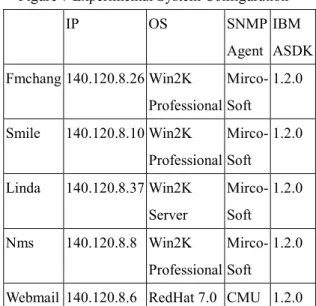
(5) on the NMS, if necessary. With the ability to stay. 3 A Prototyped Network Management System. on the managed device and interact with the. We have developed a prototyped network. SNMP agent, the service agent can perform. management system based on the proposed. designated service given by the manager.. network. Consequently, this significantly reduces the. distributed system laboratory at the department. traffic load of network and the computation load. of applied mathematic, National Chung-Hsing. of NMS.. University. The system contains a network management. Network Management Station Dispatch Service Agent. Dispatch Service Agent. User Interface. management. station. architecture. and. several. in. the. managed. devices with different operating systems. Each. Manager Agent Device Information Agent. managed device contains a mobile agent. Service Information Agent MASE. execution environment (described later) and an. JVM Service Agent Library. SNMP [9] agent. The experimental system is. Notification Message. configured as shown in Figure 7 with related MASE. system attributes listed in Table 1.. MASE. JVM SNMP Agent. JVM SNMP Agent. MIB Network Device. MIB Network Device. Network Management Station. Figure 5 Service Agents Information Agents. NMS Ethernet. An information agent can be dispatched by network manager through the manager agent on the NMS to aggregate the information from the Linda. Smile. WebMail. Fmchang. service agents on various devices, as shown in. Network Device. Figure 6. Information agents can intelligently. Figure 7 Experimental System Configuration. access the related management information on. Network Device. IP. Network Device. OS. managed device through the service agent. With the. appropriate. scheduling. mechanism,. Fmchang 140.120.8.26 Win2K. Mirco- 1.2.0. Professional Soft Smile. 140.120.8.10 Win2K. the network management more intelligent.. Mirco- 1.2.0. Professional Soft. Network Management Station. Linda. $. $. $. $. $. $. SNMP IBM Agent ASDK. interaction rules, and traveling plan, information agents reduce the network traffic load and make. Network Device. 140.120.8.37 Win2K. Mirco- 1.2.0. User Interface. Dispatch. Server. Manager Agent. Soft. Device Information Agent. Nms. Service Information Agent MASE. 140.120.8.8 Win2K. JVM. Mirco- 1.2.0. Professional Soft. Service Agent Library. $. Webmail 140.120.8.6 RedHat 7.0 CMU 1.2.0 $. $. $. $. MASE. JVM. $. $. $. $. MASE. MASE. JVM. Table 1 Experimental System Attributes. JVM. SNMP Agent. SNMP Agent. SNMP Agent. MIB Network Device. MIB Network Device. MIB Network Device. Figure 6 Information Agents. 3.1 System Implementation Based. on. the. concern. of. practice. implementation, we choose the free mobile agent.
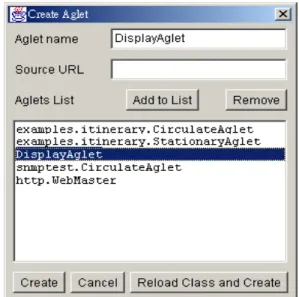
(6) development. tool,. ASDK. [10],. which is. downloaded from the IBM website. The ASDK provides tools for developing mobile agent called Aglet [11,13], which is a Java object. There is a mobile agent execution environment, named Aglet server, running within JVM. We also set up the Java running environment by the JDK of Sun Microsystem. In order to integrate the SNMP agent into our managed device, we adopt the AdventNet SNMP utilities API from the AdventNet [12] in the development of mobile agents. In the following, we will address the details of the components of the system. Network Management Station. Figure 9 Creation of a mobile agent Register Agent. Network management station is the kernel of. In order to keep the information and the. network management system and it must provide. topology of managed devices, a register agent. a friendly user interface for network manager. In. automatically creates when the managed device. our experimental system, we adopt the software. starts. The register agent sends a registration. named Tahiti developed from IBM ASDK to. message to the device information agent on the. play the role of a mobile agent execution. NMS. The device information agent keeps the. environment. It provides a graphical interface. managed device information and provides it to. (Figure 8) for monitoring, creating, dispatching. the manager when needed. As shown in the. and disposing the agents and for setting the. Figure 10, managed device (Linda) creates a. agent access privilege for the agent environment.. register agent and sends the registration message to the NMS (NMS).. Figure 8 Graphic interface When network manager needs to launch a new mobile agent to perform the management task, he(she) can create a predefined mobile agent from the service agent library and dispatch it to the destination network device as shown in Figure 9.. Figure 10 Register Agent 3.3 Management Applications In our architecture, mobile agents with management tasks can be classified into service.
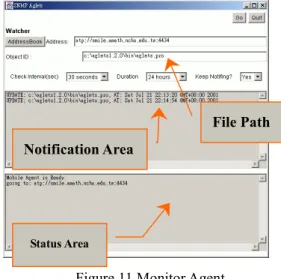
(7) agents and information agents. We presented two management applications: monitor agent and information retrieval agent, which belong to the service agent and information agent respectively. Monitor Agent An. important. File Path mission. of. the. network. Notification Area. management is to keep monitoring the network devices or the application programs to make sure that they are working properly. One of the Status Area. solutions is to monitor on the log file or the particular data, hence we designed a monitor agent, which is an example of service agents. A. Figure 11 Monitor Agent Information Retrieval Agent. monitor agent is a mobile agent which can be. An. information. retrieval. agent. is. an. sent by a network manager or a management. application of information agents. Network. application to perform the monitoring task on the. manager can initiate an information agent. managed device. The monitor agent in this. manager to perform the information retrieval. example is to monitor the assigned file on the. task. The manager assigns different tasks for. destination network device. As shown in Figure. various devices, as shown in Figure 12. We have. 11, the manager can chose a destination network. predefined three functions for the information. device and assign the file with the full path. The. retrieval. check interval and duration are made variously. getLocalInfo and printResult. The function of. which are 10 seconds and 1 minute, respectively. getMibValue is to gather the system information. by default.. of the destination device. After arriving at the. agent. including. getMibValue,. For example, as shown in Figure 11, the. managed device, the agent communicates with. manager fills in the task for the monitor agent.. the SNMP agent and asks for the value of. The agent is asked to monitor the assigned file of. sysDescr, sysObjectID, sysUpTime, sysName. the destination device (Smile). The monitor. and sysService. The function of getLocalInfo is. agent creates a notifier agent and dispatches to. to. the NMS. After arriving the destination, the. environment information including, username,. notifier agent will check the assigned file on the. home directory, current working directory,. local host to get the initial time stamp. Then, the. machine architecture, OS name, OS version and. notifier agent will ask the SNMP Agent for the. Java version. The function of printResult is to. same object every 30 seconds for a duration of. print whatever the results that information. 24hours for monitoring the file changes. The. retrieval agent has collected.. result is in turn sent back to the monitor agent and displayed on the manager’s window.. gather. the. mobile. agent. execution. In our demonstration, as shown in Figure 12, the agent was assigned to retrieve various information from different network devices, as shown in Figure 13, and prints the result on the.
(8) NMS (NMS). The first destination of the Result from Smile. information retrieval agent is “Smile” and the task is to communicate with the SNMP agent to collect the values of the getMibValue. After. Result from Fmchang. completion, the agent migrates to the second destination “fmchang” with the results collected from “Smile” to continue the given task. Result from Linda. “getLocalInfo”. The information retrieval agent continues the traveling by visiting “Linda” and “Webmail” for Mib Values. After visiting all destined devices, the information retrieval agent. Result from Webmail. goes back to the NMS and displays the results, as shown in Figure 14.. Figure 14 Result of the Information Retrieval Agent 4 Conclusions As the number of network devices increases, the. network. management. becomes. more. complicated. Due to the problems of poor. Destination. Function List. scalability, flexibility, and robustness in the traditional management. Task Area. manager-agent. based. network. system,. new. network. a. management system should be simple enough to cope with the problems mentioned above. In this Figure 12 Information Retrieval Agent.. research, we take the advantageous features of mobile agent technology and implement a. Create and Lunch. GetMib Values. Migrate GetMib Values. Migrate JVM. GetLo calInf. system. In the system, we can delegate the. JVM. Migrate. SNMP Agent. Migrate. MASE. management. manager agent existed in NMS, there are three. MASE. SNMP Agent. Smile. network. management functions. In addition to the M A. MASE. M A. agent-based. management task to a mobile agent to perform. Information Retrival Agent. M A. MIB. mobile. PrintR esult. NMS. MIB. JVM. Webmail. SNMP Agent. GetMib Values. and service agent. All agents execute in MASE (Mobile. MIB. Fmchang. other agents: register agent, information agent,. M A MASE. JVM SNMP Agent. Agent. Service. Environment). to. cooperate with each other to accomplish a management task.. MIB. Linda. Figure 13 Task of the Information Retrieval Agent. We also include two management applications, monitor agent and information retrieval agent, to demonstrate the advantages of the mobile agent.
(9) technology. A monitor agent monitors the. Communication Magazine, 36(7): 26-37,. assigned file on the network device that reduces. 1998.. the polling frequency. An information retrieval. [7] J.P. Martin-Flatin, S. Znaty, and J.P. Hubaux.. agent reduces the traffic load and makes the. "A. management more flexible. The management. Network. application scenarios give a demonstration of. Paradigms".. applying the proposed architecture to build a. Systems Management, 7(1): 9-26, March. flexible and efficient network management. 1999. system. The experimental system reveals the. Survey. of. and. Distributed Systems. Journal. of. Enterprise Management. Network. and. [8] Sun Microsystems, “Java Language. applicability of our architecture to meet the. Overview-White Paper”,. requirements of efficiency, extensibility and. http://www.javasoft.com/docs/white/index.h. flexibility.. tml [9] J.Case, M Fedor, M. Schffstall, J. Davin,. References [1] G. Goldszmidt, "Distributed Management. “ A Simple Network management protocol. by Delegation", Ph.D thesis, Columbia. (SNMP)”, RFC 1157, May 1990.. University, New York, NY, USA, December. [10] http://www.trl.ibm.com/aglets/. 1995.. [11] IBM Tokyo Research Laboratory, “About. [2] J. Pavon, J. Tomas, "CORBA for Network. Aglet Workbench”,. and Service Management in the TINA Framework",. IEEE. Communication. Magazine, 36(3): 72-79, 1998.. http://www.trl.ibm.co.jp/aglets/about.html [12] http://www.adventnet.com [13] M. Oshima, “Programming and Developing. [3] J.P. Thompson, "Web-Based Enterprise Management. Architecture",. Java Mobile Agent with Aglets”,. IEEE. Communication Magazine, 36(3): 80-86,. Addison-Wesley, 1998. [14] M. Kahani,H.W. P. Beadle, “Decentralized. 1998.. Approaches for Network Management”,. [4] T. Magedanz, K. Rothermel, S. Krause, "Intelligent Technology. Agents: for. Telecommunications?",. An Next. ACM Computer Communication Review. Emerging Generation. Proceedings. journal, July 1997. [15] T. Shu, C. Yang, Y. Jianhua, X. Ning “A. of. Mobile Agent Based Approach for Network. INFOCOM'96, March 24-28, 1996, San Francisco, CA, USA.. Management”, IEEE 2000. [16] W.J Buchanan., M. Naylor, A.V. Scott. ,. [5] D. L. Tennenhouse, J. M. Smith, W. D.. “Enhancing network management using. Sincoskie, D. J. Wetherall, G. J. Minden, "A. mobile agents “, Engineering of Computer. Survey of Active Network Research", IEEE. Based. Communications Magazine, 35(1): 80-86,. Proceedings. Seventh IEEE International. 1997.. Conference and Workshop on the , 2000 ,. [6] V. A. Pham, A. Karmouch, "Mobile Software Agents: An Overview", IEEE. Systems,. Page(s): 218 –226 .. 2000,. (ECBS. 2000).
(10)
數據
+4

相關文件
You are a property agent working for the Quality Property Company. A potential client has contacted you from Australia because he will soon be moving to Hong Kong with
Keywords: Mobile ad-hoc network, Cluster manager electing, Fuzzy inference rule, Workload sharing, Backup manager... 致謝 致謝
Reinforcement learning is based on reward hypothesis A reward r t is a scalar feedback signal. ◦ Indicates how well agent is doing at
Agent learns to take actions maximizing expected reward.. Machine Learning ≈ Looking for
Transfer the P-CSCF address with the PDP Context Activation signaling to the UE. GGSN acts as a DHCP Relay Agent 1.Create PDP context bearer ( TS 23.060) 2.UE requests a
(2007), “Selecting Knowledge Management Strategies by Using the Analytic Network Process,” Expert Systems with Applications, Vol. (2004), “A Practical Approach to Fuzzy Utilities
The content of questionnaire contains five major categories provided by telecommunications industry, including fixed network communication service, mobile
This thesis adopts GUI (Graphic User Interface ) user's figure interface method, to created a figure interface that integration testing, correspondent with the change that digital
