行政院國家科學委員會補助專題研究計畫成果報告
期末報告
漢語高功能自閉症兒童的敘事能力:敘事表現與心智理論
能力之關係
計 畫 類 別 : 個別型計畫 計 畫 編 號 : NSC 101-2410-H-004-162- 執 行 期 間 : 101 年 08 月 01 日至 102 年 10 月 31 日 執 行 單 位 : 國立政治大學英國語文學系 計 畫 主 持 人 : 薩文蕙 共 同 主 持 人 : 童寶娟 計畫參與人員: 碩士班研究生-兼任助理人員:葉侃彧 碩士班研究生-兼任助理人員:陳妍靜 大專生-兼任助理人員:張簡佳怡 報 告 附 件 : 出席國際會議研究心得報告及發表論文 處 理 方 式 : 1.公開資訊:本計畫涉及專利或其他智慧財產權,2 年後可公開查詢 2.「本研究」是否已有嚴重損及公共利益之發現:否 3.「本報告」是否建議提供政府單位施政參考:否中 華 民 國 103 年 01 月 29 日
中 文 摘 要 : 本研究以 Frog, where are you?為題材,針對敘事中心智理 論能力的展現做質量並重的分析。我們以自閉症兒童為實驗 組,以正常發展兒童為對照組;兩組兒童就性別、語言理 解、語言表達、智商等基本能力指標配對,以比較兩組兒童 在敘事中相關能力表現的異同,並釐清導致差異的可能因 素。除編碼量化情感、慾望、認知等類別之心智語彙出現的 種類及分布外,我們藉由故事中的「麋鹿場景」,觀察自閉 症兒童如何在敘事表達中處理「錯誤表徵」及「外表-真實 關係」等心智理論的核心概念。研究結果顯示:兩組兒童在 語句總數與詞彙豐富性方面的表現相仿,其於情感與慾望兩 類心智語彙的使用上差異亦不大,然自閉症兒童對認知狀態 的描述顯著地多於對照組兒童。此外,絕大多數的兒童均無 法成功處理「錯誤表徵」,統計檢驗顯示此項能力與語言能 力及智商呈正相關。本研究凸顯自閉症相關研究中實驗對象 配對的重要性,並讓我們對漢語自閉症兒童使用心智語彙的 能力有進一步認識。 中文關鍵詞: 自閉症、心智語彙、錯誤表徵、敘事
英 文 摘 要 : This study aims to explore the ability of Mandarin-speaking children with ASD to attribute psychological states to story characters in narratives. We provided an analysis of narratives from 16 children with high-functioning ASD and 16 typically developing children matched on gender, linguistic and cognitive
abilities. The narrative data were based on a wordless picture book Frog, where are you? Participants' performance on attribution of psychological states was assessed by focusing on lexical terms referring to emotions, desires, and cognitive states. The `deer episode' of the frog story was particularly chosen for further analysis for it involves contrast between reality and
appearance and the related misrepresentation. Given the putative impairments in theory of mind in
children with ASD, we hypothesized that, compared with the typical controls, children with ASD would be less likely to talk about psychological states and would be less likely to encode misrepresentation for the deer episode.
Our data suggest that, when matched on both
exhibited no significant group differences regarding basic narrative measures. Contrary to the hypothesis, however, there are no significant group differences in the use of mental terms for emotions and desires, while children with ASD were more likely to encode cognitive states. The majority of children failed to appropriately interpret the deer episode by encoding misconception. Nevertheless, qualitative analysis indicates that typical children provided more elaboration for this episode. The findings are discussed in relation to linguistic and cognitive factors in narrative construction.
英文關鍵詞: ASD, narrative, psychological states, misrepresentation, frog story
漢語高功能自閉症兒童的敘事能力:敘事表現與心智理論能力之關係 研究報告
Abstract
This study aims to explore the ability of Mandarin-speaking children with ASD to attribute psychological states to story characters in narratives. We provided an analysis of narratives from 16 children with high-functioning ASD and 16 typically developing children matched on gender, linguistic and cognitive abilities. The narrative data were based on a wordless picture book Frog, where are you? Participants’ performance on attribution of psychological states was assessed by focusing on lexical terms referring to emotions, desires, and cognitive states. The ‘deer episode’ of the frog story was particularly chosen for further analysis for it involves contrast between reality and appearance and the related
misrepresentation. Given the putative impairments in theory of mind in children with ASD, we hypothesized that, compared with the typical controls, children with ASD would be less likely to talk about psychological states and would be less likely to encode misrepresentation for the deer episode.
Our data suggest that, when matched on both linguistic and cognitive abilities, the participants exhibited no significant group differences regarding basic narrative measures. Contrary to the hypothesis, however, there is no significant group differences in the use of mental terms for emotions and desires, while children with ASD were more likely to encode cognitive states. The majority of children failed to appropriately interpret the deer episode by encoding misconception. Nevertheless, qualitative analysis indicates that typical children provided more elaboration for this episode. The findings are discussed in relation to linguistic and cognitive factors in narrative construction.
1. Introduction
The core diagnostic features of autism are their difficulties in social development, problems in communication and insistence on sameness (American Psychiatric Association [APA], 1994). Communication always involves social understanding. Given that narrative ability involves an integration of social-emotional, cognitive, and linguistic knowledge, studies of narratives produced by individuals with autism are likely to reveal rich information about their difficulties in social communication.
The theory of mind (ToM) hypothesis of autism is probably the most-documented theoretical construct to account for the social-communicative deficits in individuals with autism. ToM refers to individuals’ ability to attribute psychological states—such as desires, emotions, beliefs and intentions—to themselves and others so as to explain and predict behavior. A variety of studies have revealed ToM deficits in individuals with autism (e.g.,
Baron-Cohen, 1995; Baron-Cohen, Leslie, & Frith, 1986; Frith, 2003; Perner, Frith, Leslie & Leekam, 1989). Several studies particularly investigated the understanding of psychological states by children with autism (Baron-Cohen, 1991; Baron-Cohen, Leslie, & Frith, 1985; Hobson, 1989; Ozonoff, Pennington, & Rogers, 1990). From them, an uneven pattern was revealed: children with autism were intact in understanding about desire and simple emotions but showed deficits in their knowledge about cognitive states. These studies mainly probed the comprehension of these psychological states by children with autism; nevertheless, it is important to gather converging evidence based on different research paradigms (such as narrative production) so as to confirm whether the detected uneven pattern is valid or this clinical population show across-the-board impairments in their knowledge of psychological states.
While encoding psychological states in fictional narratives, a narrator needs to go beyond him-/her-self to interpret the story character’s internal states so as to provide psychological motivations to account for the actions of the character (Chafe, 1994). A successful shift between the narrator’s own stance and the story character’s perspective requires ToM ability. With this capacity, one can comprehend the mind in relation to human behavior, and thus establish connections between mental states and related behavior. As indicated by
Tager-Flusberg and Sullivan (1995), ToM is essential to narrative construction, for a
successful narrator relies on this ability not only to elaborate the psychological states of story characters to account for their actions, but also to take account of listeners’ knowledge and perspectives.
Given the significant role of ToM ability in narrative construction, a body of research particularly attempted to relate ToM deficits to narrative practices by addressing a wide variety of indices of narrative ability, ranging from measures of story length, story organization, cohesion and narrative evaluation (e.g., Capps, Losh, & Thurber, 2000;
Loveland, McEvoy, Tunali, & Kelly, 1990; Tager-Flusberg, 1995; Tager-Flusberg & Sullivan, 1995). Tager-Flusberg and Sullivan (1995), for instance, detected significant correlation between ToM performances and the narrative measures such as emotion and cognitive expressions and story length. This connection is also evident in the study by Loveland et al. (1990), in which the inappropriate utterances produced by participants with autism were taken as instances of pragmatic violations and later were interpreted as reflecting a ToM deficit (Bruner & Feldman, 1993). ToM deficits were also found to be significantly correlated with proportion of evaluation and evaluative diversity employed by individuals with autism (Capps et al., 2000). Capps et al. reckoned that individuals with autism had limited, but not entirely absent, appreciation about the need to engage listeners in narrative discourse. Additionally, ToM deficits were held as possible explanations for the subtle but significant impairments in referential use of pronouns and temporal marks, where the listener’s point of view was required, in narratives produced by individuals with autism (Colle, Baron-Cohen,
Wheelwright, & van der Lely, 2008). The insensitivity in mindreading of individuals with autism was also considered relevant to the insufficient causal connections encoded in their narratives (Diehl, Bennetto, & Young, 2006).
Hobson (1989) argued that children with autism had a primary deficit in their understanding of emotions. In a later study, however, Baron-Cohen (1991) reported that children with autism were able to understand simple emotions caused by situations. This experimental finding is complemented by Tager-Flusberg’s (1992) data based on naturalistic, spontaneous narratives, which revealed that children with autism were able to talk about emotions, along with desires and perceptions. Despite the converging evidence suggesting the clinical population’s elementary capacity for understanding and encoding simple emotions, there is still a wide range of variation in findings about their ability to encode other
psychological states. For instance, while Baron-Cohen et al. (1986) noted that children with autism used significantly less mental state language than did the control groups,
Tager-Flusberg (1995) found no group differences on this measure. This discrepancy was considered task-related, for the material she chosen failed to elicit many mental states from participants. To test this hypothesis, Tager-Flusberg and Sullivan (1995) examined how children with autism attributed psychological states to story characters on the basis of a different picture book; nevertheless, no significant group difference was found for the use of mental state terms. The researchers, therefore, concluded that children with autism were comparable to control groups on measures of narrative length, cohesion devices and mental state terms, because the groups of participants were strictly language-matched
(Tager-Flusberg & Sullivan, 1995). Unveiling the uneven pattern in knowledge about different classes of mental states aside (Baron-Cohen, 1987; Baron-Cohen, 1991; Baron-Cohen et al.,1986), some studies have noted that individuals with autism have impaired knowledge about the appearance-reality (A-R) distinction (Baron-Cohen, 1989). They seemed to be dominated by their perception, rather than making judgment based on their knowledge.
The number of incidence and prevalence of autism spectrum disorders (hereafter ASD) has increased markedly worldwide (Blumberg et al., 2013; Chien, Lin, Chou, & Chou, 2011). Despite the rapid increase in incidence and prevalence, however, there have been only few detailed investigations about narrative abilities of Mandarin- speaking children with ASD (Chen,2007; Chen & Chang, 2005; Hsu, 2009;Sah & Torng, 2012; Tsou & Cheung, 2007; Tsou, Chang, & Cheung, 2009). Though these studies provided considerable knowledge about the clinical children’s ability to establish narrative structure, to use evaluative devices and to maintain narrative coherence; nevertheless, how ASD use mental state language is
comparatively much less understood. It is, however, important for us to understand more about children with ASD regarding their ability to relate psychological states in narratives, for such ability is integral to narrative construction, and relevant to their communication as well as social understanding.
Previous research on English-speaking children underlined the importance of matching variables to select groups of participants and that of an appropriate narrative task to meet research goal (Losh & Capps, 2003; Tager-Flusberg & Sullivan, 1995). Following this, the present study aims to explore Mandarin-speaking autistic children’s ability to talk about psychological states in narratives by strictly matching groups of participants. One central question to ask is whether Mandarin-speaking children with ASD talk about mental states as typically-developing children do. Moreover, we examined the difference between two groups of participants in encoding the psychological state involving a discrepancy between the apparent and the real identity of an object. Given the ToM deficits associated with children with ASD, we hypothesized that, compared with the typical controls, children with ASD would be less likely to talk about psychological states and would be less likely to encode the A-R distinction embedded in the research task.
2. Method 2.1 Participants
16 children with ASD (mean age: 8.25) and 16 typically developing children (mean age: 7.16), attending various elementary schools in the Taipei City and the New Taipei City, participated in the present study. The control group comprised typically developing children, with no concerns about autism, learning disabilities or language delays. For the clinical group, diagnoses were established with the school records and clinical judgment by qualified
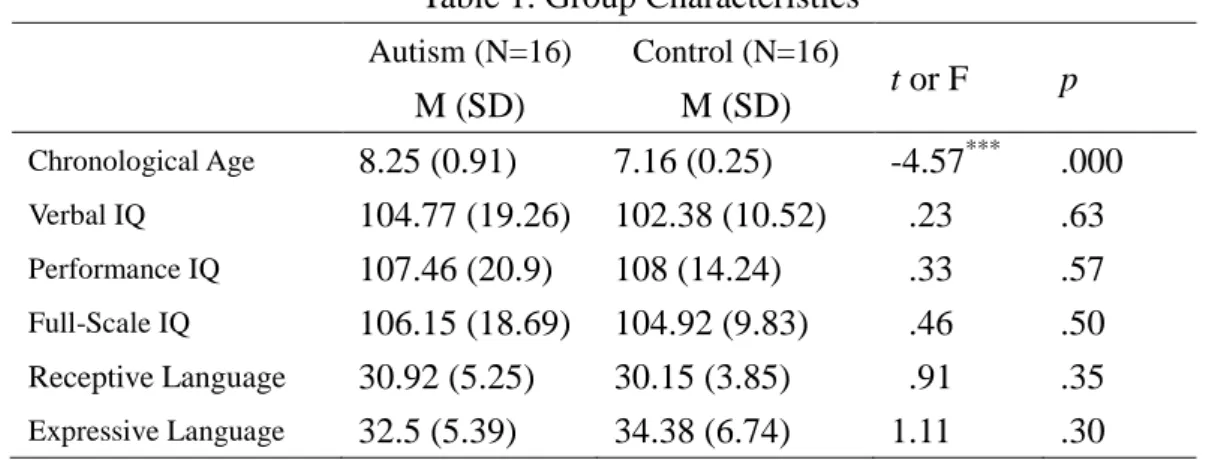
clinicians. All children with ASD met DSM-IV (APA, 1994) criteria for Autistic Disorder based on the Autism Diagnostic Interview—Revised (ADI-R, Lord, Rutter & LeCouteur, 1994). In addition, the children with ASD were all high-functioning with the Full Scale IQs (FSIQs) above 80 (Chen, 1997), and with sufficient language abilities to create narratives. The two groups of participants were all male. They were matched on FSIQs and on both receptive and expressive language abilities, based on scores from the Revised Language Impairment Checklist for School Children (Lin et al., 2009) (Table 1).
Table 1. Group Characteristics Autism(N=16) M (SD) Control (N=16) M (SD) t or F p Chronological Age 8.25 (0.91) 7.16 (0.25) -4.57*** .000 Verbal IQ 104.77 (19.26) 102.38 (10.52) .23 .63 Performance IQ 107.46 (20.9) 108 (14.24) .33 .57 Full-Scale IQ 106.15 (18.69) 104.92 (9.83) .46 .50 Receptive Language 30.92 (5.25) 30.15 (3.85) .91 .35 Expressive Language 32.5 (5.39) 34.38 (6.74) 1.11 .30 *** p< .001
2.2 Material
To control the content of the narratives, we used a wordless picture book Frog, where are you? (Mayer, 1969) to elicit a story narrative from each participant. This book was chosen because it has been used to tap narrative ability of not only typically-developing children from
different language backgrounds (e.g., Bamberg & Damrad-Frye, 1991; Berman & Slobin, 1994), but also a variety of developmentally disordered populations (e.g., Botting, 2002; Colle et al., 2008; Diehl. et al., 2006). The frog story is a typical children’s story with a hero, a problem, a series of actions following the problem, and a happy ending.
2.3 Data Collection
Rapport was first established in the observation period. The interviews were carried out individually with each participant, and consisted of an initial warm-up conversation followed by a narrative task based on Frog, Where are You. Prior to the story-telling, the experimenter explicitly said to the participants that she had no knowledge about this particular story book. Then, the participants were first asked to look through the entire book and to tell a story while looking at the pictures. The entire interviews were audio- and video-taped and subsequently transcribed.
2.4 Data Analysis
Clauses were used to quantify story length. A clause consists of a verb and its arguments, and corresponds roughly to a single event. In addition, number of different words was also considered as an index for basic narrative measures. CLAN (Child Language ANalysis) programs were used to compute these measures. On the basis of previous research, we hypothesized that children with ASD would not differ from typical controls on basic narratives measures (Diehl et al., 2006; Tsou & Cheung, 2007).
Children’s narratives were analyzed for references to three kinds of psychological states: desire, emotion, and cognition. To compare our results with the findings of earlier studies, we adapted from previous research the definitions for these mental state terms (Bretherton & Beeghly, 1992; Sah, 2011; Tager-Flusberg, 1992). In our coding scheme, for instance, want and wish were classified as references to ‘desire’, while the elaboration for emotional state includes the terms happy, sad, worried, anxious, etc. The lexical terms judged to refer to cognitive states include belief, know, think, understand, wonder, etc. Related examples are given below:
(1) Reference to desire
xiao nanhai xiang yao yige chong wu ‘The little boy wishes to have a pet.’
(2) Reference to emotion
xiao nanhai jiu hen shangxin ‘The little boy is very sad.’
(3) Reference to cognitive state
ta xiangxin xiao qingwa hai zai fujin
‘He believes that the little frog is still around.’
wo yiwei na shi wo de qiu ‘I thought it was my ball.’
Investigating children’s talk about psychological terms aside, we further analyzed their ability to encode the mismatch between appearance and reality, namely, misrepresentation (hereafter, MR). To this end, the deer episode of the story (Pictures 14-16) was chosen to be the focus of analysis, since a competent verbalization of this episode is expected to include the boy protagonist’s misconception (Berman & Slobin, 1994). This episode is considered to be the most challenging episode in the frog story, for even nine-year-olds failed to display fully mature ability to interpret it (Aksu-Koç & Tekdemir, 2004; Berman & Slobin, 1994). Given its complexity, the deer episode has been used to tap narrators’ abilities to infer story characters’ mental states (Aksu-Koç & Tekdemir, 2004; Chou & Chang, 2008). Based on the framework in previous research and the data collected in the present work, we categorized narrators’ interpretation of the deer episode into three types: a) explicit mention of MR; b) implicit mention of MR; c) no mention of MR. Examples are provided below:
(4) Explicit mention of MR 01 小 男孩 站上 大 石頭.
xiao nanhai zhanshang da shitou…
‘The little boy stands on the huge rock….’
02 小 男孩 也 在 一個 像 樹 但 不是 樹的 東西 上面
xiao nanhai ye zai yige xiang shu dan bushi shude dongxi shangmian
‘The little boy steps on something which seems like a tree, though (it) is not.’ 03 沒 想到 那是 一隻 鹿.
mei xiangdao nashi yizhi lu
‘(He) doesn’t realize that is actually a deer.’
(5) Implicit mention of MR
xiao nanhai xiang yao paodao yige da yanshi shang… ‘The little boy wants to run onto a huge rock….’
02 然後 小 男孩 摸到 一枝 以為 是 小 樹枝 的 東西.
ranhou xiao nanhai moudao yizhi yiwei shi xiao shuzhi de dongxi
‘Then the little boy touches something he believes to be a small tree branch.’ 03 然後 原來 是 馴鹿.
ranhou yuanlai shi xunlu ‘And actually it is a reindeer.’
(6) No mention of MR
01 後來 他 就 爬到 石頭 上 叫 青蛙. houlai ta jiu padao shitou shang jiao qingwa ‘Then he climbs onto a rock to call the frog.’ 02 後來 他 就 掉到 一隻 鹿 上面.
houlai ta jiu diaodao yizhi lu shangmian ‘Then he falls onto a deer.’
In order to verify the accuracy of transcriptions, a second trained examiner checked each transcript. Then, 25% of the narratives were randomly chosen and coded by a second coder for reliability. Inter-rater agreement for all measures ranged between 92% and 96% (Cohen’s Kappa coefficient).
3. Results
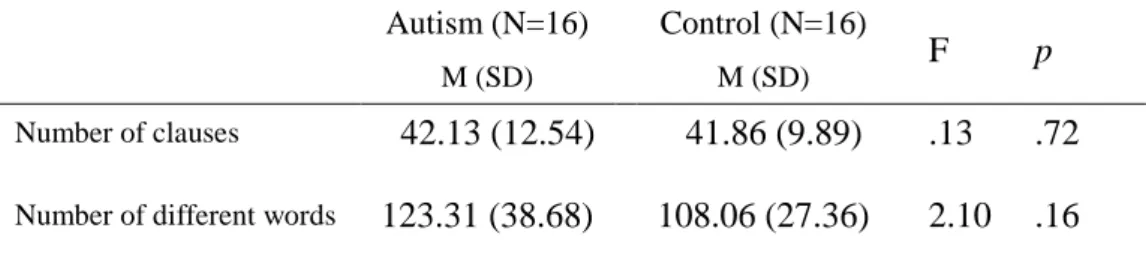
Given that the frequencies of references to psychological state were considered in relation to story length, the overall story length for the two groups of participants was first established. To this end, the number of clauses was used as an indication of story length. The results revealed that children with ASD were similar to controls both in number of clauses and in number of different words used in their narratives. As expected, a repeated measures analysis of covariance (ANCOVA), with age as the covariate, did not yield significant differences between the two groups of participants (Table 2).
Table 2. Number of clauses and number of different words Autism (N=16)
M (SD)
Control (N=16)
M (SD) F p Number of clauses 42.13 (12.54) 41.86 (9.89) .13 .72
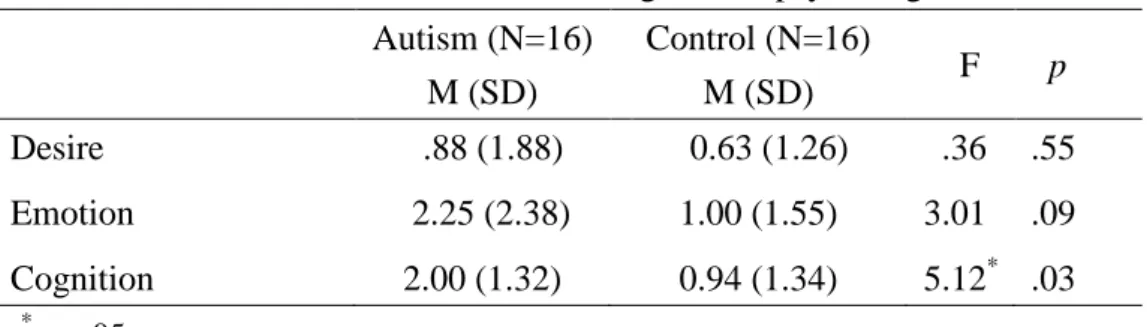
Next, children’s ability to talk about psychological state was examined. Table 3 provides the mean number of terms referring explicitly to desire, emotion and cognitive state. The use of mental state language was analyzed on the basis of relative frequency. To assess relative frequency, mental-state terms in each participant’s narrative were coded for each of the three categories and then divided by the total number of clauses in that narrative. Mann-Whitney tests were performed on the data. Similar results were revealed for the desire and emotion categories: for desire, there was no significant group difference (U = 94.00, p = .17), and similarly for the category of emotion (U = 79.50, p = .07), which indicating that children in both groups spoke equally about these two categories of psychological state. On the other hand, a significant group main effect was obtained for the category of cognition (U = 67.5, p = .02), as children with ASD using significantly more cognitive terms than the typical controls did. Inspection of the narratives showed that among the 16 children with ASD, a total of 32 cognitive terms was produced by 80% of the participants from this group. For the control group, a total of 15 cognitive terms was used, from 50% of the participants.
Table 3. Means of different lexical categories of psychological-state terms Autism (N=16) M (SD) Control (N=16) M (SD) F p Desire .88 (1.88) 0.63 (1.26) .36 .55 Emotion 2.25 (2.38) 1.00 (1.55) 3.01 .09 Cognition 2.00 (1.32) 0.94 (1.34) 5.12* .03 * p < .05
More conceptually complicated than the mental state terms examined above is the encoding of the misrepresentation in the deer episode. Table 4 presents the number and percentage of two groups of participants, respectively, who interpreted the misrepresentation in each way. Most children did not mention the misrepresentation. Of the different categories, explicit MR is found only in one child, while two children hinted at the MR. It is interesting to note that the results from point-biserial correlation showed statistically significant
correlations between the encoding of explicit MR and VIQ (rpbi = .50), and between that and
FIQ (rpbi = .49), implying the relationship between verbal and general intelligence level and
the ability to explicitly formulate the misrepresentation (Table 5).
Table 4. Numbers and percentages of children per group encode each MR category
No mention Implicit MR Explicit MR
Autism 14 (87.50%) 1 (6.30%) 1 (6.30%)
Table 5. Correlations between MR, IQ and language abilities No mention Implicit MR Explicit MR
VIQ -.41* .14 .50** PIQ -.08 -.10 .26 FIQ -.31 .02 .49** receptive -.23 .06 .26 expressive -.16 -.04 .25 * p < .05; **p <.01 4. Discussion
This study examined the mental language used by Mandarin-speaking children with ASD by particularly focusing on the terms of emotion, desire and cognition. Consistent with our hypothesis, there were no significant differences in basic narrative measures such as narrative length and variety of words. This replicates prior research that revealed intact performance if participants with autism were matched strictly with typical controls on language abilities (Diehl et al., 2006; Tager-Flusberg & Sullivan, 1995; Tsou & Cheung, 2007).
Additionally, our data on the use of mental language by children with ASD support and complement earlier findings (Baron-Cohen, 1991; Ozonoff, Pennington, & Rogers, 1990; Tager-Flugsberg, 1992, 1995; Tager-Flusberg & Sullivan, 1995). In particular, children with ASD were found to be comparable to the control children in their talk about emotions and desires (Tager-Flugsberg, 1992, 1995; Tager-Flusberg & Sullivan, 1995). Put another way, the results imply that children with ASD still have rudimentary knowledge about simple emotions and desires, as suggested in Baron-Cohen (1993). Surprisingly, however, the pattern of
cognitive state terms was not consistent with the previous research findings. Instead of using less or equal amount of cognitive state terms (cf. Tager-Flugsberg, 1992, 1995;
Tager-Flusberg & Sullivan, 1995), the children with ASD in the present study used significantly more language to refer to cognitive mental state than did the control group.
To explicate the discrepancy in research finding about the use of cognitive state terms, we examined how such terms were used by the two groups of children. It is noted that the
majority of the typical children mainly referred to the cognitive state of the boy protagonist, while children with ASD tended to describe the cognitive state of not only the main
protagonist but also other story characters. This seemingly more flexibility in
perspective-shifting, however, led to unrelated, discrete descriptions and rendered their narratives in lack of coherence. This deficiency in adhering to narrative coherence may be relevant to the weak central coherence (WCC) account in which individuals with autism are considered to have the tendency to value piecemeal details at the expense of the whole picture
of things (for review, see Noens & van Berckelaer-Onnes, 2005). A growing body of empirical studies of language processing has provided evidence for the WCC account of autism. For instance, Jolliffe and Baron-Cohen (2000) showed that high-functioning adults with autism encountered problems in arranging sentences coherently. Losh and Capps (2003) found that participants with autism had difficulties in producing thematically integrated
narratives. In more recent research, Colle et al. (2008) noted that adults with autism preferably used discrete sentences but failed to integrate them with contextual information, while Sah and Torng (2012) suggested that the less causally-connected narratives produced by children with ASD reflected that they did not strive for coherence. Further research is needed to probe the plausible links between the WCC account and deficiencies in narratives produced by individuals with ASD.
We further examined the participants’ ability to encode misrepresentation in the deer episode which involves A-R distinction and perceptual role-taking. Research has shown that children younger than four years old have difficulties in distinguishing between appearance and reality, even though they can attribute to others the mental states like perceptions,
emotions and desires (Wellman, Phillips & Rodriguez, 2000). As Flavell et al. (Flavell, Green, & Flavell, 1986) reported, though children between six and seven years of age showed
knowledge about the A-R distinction, they, nevertheless, were found to have difficulty in encoding the A-R concepts. Given the complexity of the A-R distinction embedded in the deer episode, it is not surprising to find that a majority of our participants failed to encode the MR. Our data provide support to another frog-story-based study by Aksu-Koç & Tekdemir (2004), in which few children could recognize the boy protagonist’s misconception and the explicit MR was found almost only in adults and in a few nine-year-olds. Together, this implies that it is very challenging for children under nine to encode the A-R distinction.
In addition to the cognitively demanding nature of the A-R distinction involved, the sequence of deer episode itself also imposes considerable burdens on information processing. To be precise, mature rendering of this sequence requires “backtracking” in perceptual, conceptual and on-line linguistic processing. It is thus considered the most challenging and complicated episode in the story, for even nine-year-olds failed to display fully mature ability to interpret it (Aksu-Koç & Tekdemir, 2004; Berman & Slobin, 1994; Manhardt & Rescorla, 2002; Sah, 2013). The present study, thus, supports the observation by Roth and Spekman (1986) that the ability to successfully interpret a complicated sequence of events might not fully unfold before preadolescent stage.
Unexpectedly, however, the only explicit MR in the present study came from one child with ASD, for which we presume may relate to this particular child’s excellent cognitive ability, as indexed by his FIQ ranked the highest among all participants. This also gains support from the significant correlation between encoding of explicit MR and FIQ scores. This interpretation is, however, speculative and open to further empirical inquiry with large
sample.
Although the majority of children failed to appropriately interpret the deer episode by encoding misconception, qualitative analysis reveals that typical children provided more elaboration for this episode than children with ASD did. As illustrated below:
(7) typical child
01 後來 小男孩 想要 躲到 老鷹 看不到的 地方
houlai xiao nanhai xiangyao duodao laoying kanbudaode defang
‘Then the little boy wants to hide somewhere the eagle cannot see him.’ 02 後來 他 躲到 石頭 後面
houlai ta duodao shitou houmian ‘Then he hides behind a rock.’ 03 然後 他 看到 一個 東西
ranhou ta kandao yige dongxi ‘Then he sees a thing’
04 好像 可以 走的 樣子 haoxiang keyi zoude yangzi
‘which seems to be able to walk.’ 05 後來 才 發現 是 一隻 公的 鹿
houlai cai faxiang shi yizhi gongde lu ‘Then (he) realizes that it is a stag.’
(8) typical child
01 然後 小 男孩 想要 跑到 一個 大 岩石 上
ranhou xiao nanhai xiangyao paodao yide da yanshi shang ‘Then the little boy wants to run onto a big rock.’
02 可是 貓頭鷹 卻 緊追著 她 不放.
keshi maotouying que jinzhuizhe ta bufang ‘But the owl is chasing after him.’
03 然後 小 男孩 摸到 一枝 小 樹枝 的 東西
ranhou xiao nanhai modao yizhi xiao shuzhi de dongxi ‘Then the little boy touches a branch.’
04 然後 原來 是 馴鹿. ranhou yuanlai shi xunlu
‘Then (it) turns out to be a reindeer.’
05 然後 馴鹿 很 生氣地 說: 「你 幹嘛 摸 我的 角」 ranhou xunlu hen shengqidi shuo ni ganma mo wode jiao
(9) child with ASD
01 然後 貓頭鷹 一直 追他 的 時候. ranhou maotouying yizhi zhuita de shihou ‘Then when the owl is chasing after him,’ 02 他 就 跑到 這個 上面.
ta jiu paodao zhege shangmian ‘he runs onto this.’
03 然後 走到 這個 上面.
ranhou zoudao zhege shangmian ‘then (he) walks onto this’ 04 呼叫 小 青蛙.
hujiao xiao qingwa
‘calls out for the little frog.’ 05 然後 後來
ranhou houlai ‘Then…’ 06 馴鹿 就 起來.
xunlu jiu qilai
‘the reindeer gets up.’
(10) child with ASD
01 然後 貓頭鷹 俯衝 下來 攻擊.
ranhou maotouying fuchong xialai gongji ‘Then the owl dives and attacks (the boy).’ 02 跳到 岩石 上 然後 躲 起來.
tiaodao yanshi shang ranhou duoqilai ‘jumps onto the rock then hides.’ 03 遇到 麋鹿.
yudao milu
‘runs into a reindeer.’
(11) child with ASD
01 這個 小 男孩 就 爬上 大 石頭頭. zhege xiao nanhai jiu pashang da shitou ‘This little boy climbs onto a big rock.’ 02 抓 了 那些 野生 動物 東西.
‘(He) grabs these wild animal things.’ 03 他 就 爬上去 抓 那個 野生 東西.
ta jiu pashangqu zhua nage yesheng dongxi ‘He then climbs up to grab that wild thing.’ 04 他 就 上 麋鹿.
ta jiu shang milu
‘He then (sits down) on the reindeer.’
Taken together, the results of this study suggest that children with ASD show knowledge about various psychological states such as emotions, desires and cognitions, as reflected in their narratives. These findings, however, contrast with other studies of narratives produced by individuals with ASD in which a range of deficits have been identified (e.g., Baron-Cohen, Leslie, & Frith, 1986; Loveland et al., 1990). It is likely that some of the reported differences in narrative measures between children with ASD and typical controls were eliminated since we carefully matched children with ASD and control groups on cognitive and language abilities, both expressive and receptive abilities. Our results complement most findings in Tager-Flusberg and Sullivan’s (1995) study with evidence based on a typologically different language and a different research material. More importantly, the results underlie the
importance of the selection of matching variables in developmental studies, as claimed by Tager-Flusberg and Sullivan.
Another way of looking at the results is our children with ASD may be more advanced than those in previous studies in terms of cognitive and linguistic abilities (cf. Tager-Flusberg, 1992; Tager-Flusberg & Sullivan, 1995). Their comparable ability to talk about a range of psychological states in narratives reveals that children with ASD have richer knowledge about theory of mind than presumed. In addition, these high-functioning verbal children with ASD are of particular value in that they enabled us to examine the higher-level communicative abilities in the presence of intact general intelligence and expressive as well as receptive linguistic capacities. The findings reported here seem to suggest that cognitive and linguistic abilities are important for constructing narrative discourse.
References
Aksu-Koç, A., & Tekdemir, G. (2004). Interplay between narrativity and mindreading: A comparison between Turkish and English. In S. Strömqvist & L. Verhoeven (Eds.),
Relating events in narrative: Typological and contextual perspectives (pp. 307-327).
Mahwah, NJ: Lawrence Erlbaum.
American Psychiatric Association. (1994). Diagnostic and statistical manual of mental
disorders (4th ed.). Washington, DC: Author.
Further explorations of children’s narrative competences. Journal of Child Language,
18, 689-710.
Baron-Cohen, S. (1987). Autism and symbolic play. British Journal of Developmental
Psychology, 5, 139-148.
Baron-Cohen, S. (1989). Are autistic children behaviourists? An examination of their mental-physical and appearance-reality distinction. Journal of Autism and
Developmental Disorders, 19, 579-600.
Baron-Cohen, S. (1991). Do people with autism understand what causes emotion? Child
Development, 62, 385-395.
Baron-Cohen, S. (1993). The development of a theory of mind, and its dysfunction. In S. Baron-Cohen, H. Tager-Flusberg, & D. J. Cohen (Eds.), Understanding other minds:
Perspectives from autism (pp. 59-82). Oxford: Oxford University Press.
Baron-Cohen, S. (1995). Mindblindness: An essay on autism and theory of mind. Cambridge, MA: MIT Press.
Baron-Cohen, S., Leslie, A. M., & Frith, U. (1985). Does the autistic child have a “theory of mind”? Cognition, 21, 37-46.
Baron-Cohen, S., Leslie, A. M., & Frith, U. (1986). Mechanical, behavioral and international understanding of picture stories in autistic children. British Journal of Developmental
Psychology, 4, 113-125.
Berman, R., & Slobin, D. (1994). Relating events in narrative: A crosslinguistic
developmental study. Hillsdale, NJ: Lawrence Erlbaum.
Blumberg, S. J., Bramlett, M. D., & Kogan, M. D., et al. (2013). Changes in prevalence of parent-reported autism spectrum disorder in school-aged U.S. children: 2007 to 2011–2012. National Health Statistics Reports, 65, 2013-1250. Retrieved from
http://www.cdc.gov/nchs/data/nhsr/nhsr065.pdf
Botting, N. (2002). Narrative as a tool for the assessment of linguistic and pragmatic impairments. Child Language Teaching and Therapy, 18(1), 1-22.
Bretherton, I., & Beeghly, M. (1982). Talking about internal states: The acquisition of an explicit theory of mind. Developmental Psychology, 18, 906-921.
Bruner, J., & Feldman, C. (1993). Theories of mind and the problem of autism. In S. Baron-Cohen, H. Tager-Flusberg, & D. J. Cohen (Eds.), Understanding other minds:
Perspectives from autism (pp. 267-291). Oxford: Oxford University Press.
Capps, L., Losh, M., & Thurber, C. (2000). “The frog ate the bug and made his mouth sad”: Narrative competence in children with autism. Journal of Abnormal Child Psychology,
28(2), 193-204.
Chafe, W. (1994). Discourse, consciousness and time. Chicago: University of Chicago Press. Chen, C. T. (2007). Gaogongneng zibizheng xilie zhangai huantong xushin engli chutan
(Master’s thesis). National Yang Ming University, Taipei, Taiwan.
Chen, R. H. (1997). Weishi ertong zhili liangbiao disanban (Wechsler intelligence scale for
children, WICS-III). Taipei: Zhongguoxing Kexueshe.
Chen, K. H., & Chang, C. F. (2005). Guoxiao dinianji gaogongneng zibizheng xuesheng kouyu xushi nengli zhi yanjiu (The narrative ability of the 1st and 2nd grade elementary school pupils with high function autism). Teshu Jiaoyu Yu Fujian Xuebao (Bulletin of
Special Education and Rehabilitation), 13, 209-235.
Chien, I. C., Lin, C. H., Chou, Y. J., & Chou, P. (2011). Prevalence and incidence of autism spectrum disorders among national health insurance enrollees in Taiwan from 1996 to 2005. Journal of Child Neurology, 26(7), 830-834.
Chou, Y. J., & Chang, C. J. (2008). qinzi gongdu dui youer xushuo gushi zhujiao xinzhi zhuangtai de yinxiang xiaogou [Effects of joint book reading on young children’s
narration of the mental states of story characters]. Bulletin of Educational Psychology, 40 (2), 261-282.
Colle, L., Baron-Cohen, S., Wheelwright, S., & van der Lely, H. K. (2008). Narrative discourse in adults with high-functioning autism or Asperger syndrome. Journal of
Autism and Developmental Disorders, 38(1), 28-40.
Diehl, J., Bennetto, L., & Young, E. (2006). Story recall and narrative coherence of
high-functioning children with autism spectrum disorders. Journal of Abnormal Child
Psychology, 34(1), 87-102.
Flavell, J. H., Green, F. L., & Flavell, E. R. (1986). Development of knowledge about the appearance-reality distinction. Monographs of the Society for Research in Child
Development, 51.
Frith, U. (2003). Autism: Explaining the enigma. Oxford: Blackwell.
Hobson, R. P. (1989). Beyond cognition: A theory of autism. In G. Dawson (Ed.), Autism:
New perspectives on diagnosis, nature, and treatment (pp. 22-48). New York: Guilford.
Hsu, S. C. (2009). Yasibogezheng ‘ertong kouyu xushi nengli zhi tantao (The investigation of
oral narrative skill of children with Asperger syndrome) (Master’s thesis). National Taipei
University of Education, Taipei, Taiwan.
Jolliffe, T., & Baron-Cohen, S. (2000). Linguistic processing in high-functioning adults with autism or Asperger’s syndrome: Is global coherence impaired? Psychological Medicine,
30(5), 1169-1187.
Lin, B.G., Huang, Y. Z., Huang, G. J., & Xuang, C. H. (2009). Xiuding xueling ertong yuyan zhangai pingliangbiao bianzhi baogao. (Report on the revised Language Impairment Checklist for School Children). Zhonghua goutong zhangai jiaoyu xuehui 2009 nian
nianhui ji goutong zhangai jiaoyu xueshu yantaohui lunwenji (Proceedings for the 2009
Conference of the Communicative Disorders Association of R.O.C.) (pp. 77-95). Taipei, Taiwan.
Lord, C., Rutter, M., & Le Couteur, A. (1994). Autism Diagnostic Interview—Revised: A revised version of a diagnostic interview for caregivers of individuals with possible pervasive developmental disorders. Journal of Autism and Developmental Disorders, 24, 659-685.
Losh, M., & Capps, L. (2003). Narrative ability in high-functioning children with autism or Asperger's Syndrome. Journal of Autism and Developmental Disorders, 33(3), 239-251. Loveland, K. A., McEvoy, R. E., Tunali, B., & Kelley, M. L. (1990). Narrative story telling in
autism and Down's syndrome. British Journal of Developmental Psychology, 8, 9-23. Manhardt, J., & Rescorla, L. (2002). Oral narrative skills of late talkers at ages 8 and 9.
Applied Psycholinguistics, 23, 1–21. DOI: 10.1017.S0142716402000012
Mayer, M. (1969). Frog, where are you? New York: Dial Press.
Noens, I. L., & van Berckelaer-Onnes, I. A. (2005). Captured by details: Sense-making, language and communication in autism. Journal of Communication Disorders, 38(2), 123-141.
Ozonoff, S., Pennington, B. F., & Rogers, S. J. (1990). Are there emotion perception deficits in young autistic children? Journal of Child Psychology and Psychiatry, 31, 343-361. Perner, J., Frith, U., Leslie, A.M., & Leekam, S. (1989). Exploration of the autistic child’s
theory of mind: Knowledge, belief, and communication. Child Development, 60, 689-700.
Sah, W. H. (2011). Emotion expressions and knowledge of story structure: A study of Mandarin-speaking children’s narrative development. Taiwan Journal of Linguistics, 9 (2), 67-110.
Sah, W. H. (2013). Global and local connections in Mandarin-speaking children’s narratives: A developmental study based on the frog story. In Allysa McCabe and Chien-ju Chang (Eds.), Chinese Language Narration: Culture, Cognition, and Emotion, 85-114. John Benjamins.
Sah, W. H., & Torng, P. C. (2012). Narrative coherence in high-functioning children with autism spectrum disorders: An investigation of causal relatedness. Paper presented at the 20th Annual Meeting of the International Association of Chinese Linguistics (IACL-20), Hong Kong, August 28-31.
Tager-Flusberg, H. (1992). Autistic children’s talk about psychological states: Deficits in the early acquisition of a theory of mind. Child Development, 68, 161-172.
Tager-Flusberg, H. (1995). ‘Once upon a ribbit’: Stories narrated by autistic children. British
Journal of Developmental Psychology 13, 45-59.
Tager-Flusberg, H., & Sullivan, K. (1995). Attributing mental states to story characters: A comparison of narratives produced by autistic and mentally retarded individuals. Applied
Psycholinguistics, 16(3), 241-256.
xiangguan yinxiang yinsu yanjiu (Narrative story telling of high-functioning children with autism spectrum disorders). Teshu Jiaoyu Yanjiu Xuekan (Bulletin of Special
Education), 32(3), 87-109.
Wellman, H. M, Phillips, A.T., & Rodriguez, T. (2000). Young children's understanding of perception, desire, and emotion. Child Development, 71(4),895-912.
國科會補助專題研究計畫出席國際學術會議心得報告
日期:102 年 10 月一、參加會議經過與心得
近年來,自閉症患者心智理論能力缺陷之研究蔚為顯學,而歐洲不僅為兒童心智理 論能力發展研究之濫觴,許多重要的兒童發展研究中心亦位在歐洲。兒童心智理論能力 研究的重要人物 J. Piaget 與瑞士洛桑大學(University of Lausanne)就有很深的淵源。本次 European Conference on Developmental Psychology (ECDP)會議即由洛桑大學傾全力籌畫, 其內涵規劃上對兒童語言及認知發展障礙之研究,著墨甚多,並有European Association for Developmental Psychology、Institute of Psychology、Brain Mind Institute of the Federal Institute of Technology 等知名研究單位共同推動,實為學術界一大盛事。每兩年舉辦一次的ECDP 已邁入第 16 屆,該會為發展心理學(developmental
psychology)領域重量級的國際學術會議。ECDP 秉持跨領域合作之精神,推動發展心理 學研究領域的國際交流,其主要範疇涵蓋:child development, perceptive and cognitive development, language development, education, neuro-plasticity, developmental
psychopathology, methods in developmental psychology 等。今年該會除論文發表、round table discussions 及工作坊外,亦精心規劃數場專題討論會(symposia) ,探討
developmental sciences各個面向之重要議題,並邀請歐洲、美國、澳洲、日本等地國際
知名學者發表專題演說。我們由上述工作坊、專題討論會以及專家演說中領受許多啟發, 累積了更多研究能量。
本屆 ECDP 會議聚焦在臨床研究、發展科學(developmental sciences)與大腦認知等主 計畫編號
NSC 101-2410-H-004-162
計畫名稱 漢語高功能自閉症兒童的敘事能力:敘事表現與心智理論能力之關係出國人
員姓名
薩文蕙
服務機
構及職
稱
政大英文系副教授
會議時間 102 年 9 月 3 日至 102 年 9 月 7 日 會議地點瑞士
會議名稱 The 16th European Conference on Developmental Psychology (ECDP)
發表題目 Mandarin-speaking Autistic Children’s References to Psychological States: An Investigation Based on the Frog Story
題,會議的主旨與本研究議題十分契合。本團隊針對自閉症兒童心智理論能力與敘事表 現的研究是為會議核心議題,我們藉由語言學與發展心理學跨領域合作的方式,並以漢 語自閉症兒童的敘事語料為據的分析,得到許多迴響。透過此次會議發表,一方面我們 就研究心得與來自各地的專家交流討論,對研究結果的詮釋助益匪淺,對後續研究的進 行亦有重大啟發;更重要的是,得以在許多知名發展心理學家聚集的會議中發表研究成 果,讓國際學界瞭解我國於此方面研究的進展與投入。
二、建議
ECDP 此一跨領域的研討會,讓與會人士受到多方面的啟迪,使相關學門的研究人 員有許多交流的機會,希望國內日後多舉辦類似的跨領域研討會,帶動相關領域的整體 發展。三、發表論文摘要
This study aims to explore the ability of Mandarin-speaking children with ASD to attribute psychological states to story characters in narratives. We provided an analysis of narratives from 16 children with high-functioning ASD and 16 typically developing children matched on gender, linguistic and cognitive abilities. The narrative data were based on a wordless picture book Frog, where are you? Participants’ performance on attribution of psychological states was assessed by focusing on lexical terms referring to emotions, desires, and cognitive states. The ‘deer episode’ of the frog story was particularly chosen for further analysis for it involves contrast between reality and appearance and the related
misrepresentation. Given the putative impairments in theory of mind in children with ASD, we hypothesized that, compared with the typical controls, children with ASD would be less likely to talk about psychological states and would be less likely to encode misrepresentation for the deer episode.
Our data suggest that, when matched on both linguistic and cognitive abilities, the participants exhibited no significant group differences regarding basic narrative measures. Contrary to the hypothesis, however, there are no significant group differences in the use of mental terms for emotions and desires, while children with ASD were more likely to encode cognitive states. The majority of children failed to appropriately interpret the deer episode by encoding misconception. Nevertheless, qualitative analysis indicates that typical children provided more elaboration for this episode. The findings are discussed in relation to linguistic and cognitive factors in narrative construction.
國科會補助專題研究計畫出席國際學術會議心得報告
日期:102 年 10 月一、參加會議經過與心得
近年來,自閉症患者心智理論能力缺陷之研究蔚為顯學,而歐洲不僅為兒童心智理 論能力發展研究之濫觴,許多重要的兒童發展研究中心亦位在歐洲。兒童心智理論能力 研究的重要人物 J. Piaget 與瑞士洛桑大學(University of Lausanne)就有很深的淵源。本次 European Conference on Developmental Psychology (ECDP)會議即由洛桑大學傾全力籌畫,其內涵規劃上對兒童語言及認知發展障礙之研究,著墨甚多,並有European Association for Developmental Psychology、Institute of Psychology、Brain Mind Institute of the Federal Institute of Technology 等知名研究單位共同推動,實為學術界一大盛事。
每兩年舉辦一次的ECDP 已邁入第 16 屆,該會為發展心理學(developmental
psychology)領域重量級的國際學術會議。ECDP 秉持跨領域合作之精神,推動發展心理 學研究領域的國際交流,其主要範疇涵蓋:child development, perceptive and cognitive development, language development, education, neuro-plasticity, developmental
psychopathology, methods in developmental psychology 等。今年該會除論文發表、round table discussions 及工作坊外,亦精心規劃數場專題討論會(symposia) ,探討
developmental sciences各個面向之重要議題,並邀請歐洲、美國、澳洲、日本等地國際
知名學者發表專題演說。我們由上述工作坊、專題討論會以及專家演說中領受許多啟發, 累積了更多研究能量。
本屆 ECDP 會議聚焦在臨床研究、發展科學(developmental sciences)與大腦認知等主 計畫編號
NSC 101-2410-H-004-162
計畫名稱 漢語高功能自閉症兒童的敘事能力:敘事表現與心智理論能力之關係出國人
員姓名
薩文蕙
服務機
構及職
稱
政大英文系副教授
會議時間 102 年 9 月 3 日至 102 年 9 月 7 日 會議地點瑞士
會議名稱 The 16th European Conference on Developmental Psychology (ECDP)
發表題目 Mandarin-speaking Autistic Children’s References to Psychological States: An Investigation Based on the Frog Story
題,會議的主旨與本研究議題十分契合。本團隊針對自閉症兒童心智理論能力與敘事表 現的研究是為會議核心議題,我們藉由語言學與發展心理學跨領域合作的方式,並以漢 語自閉症兒童的敘事語料為據的分析,得到許多迴響。透過此次會議發表,一方面我們 就研究心得與來自各地的專家交流討論,對研究結果的詮釋助益匪淺,對後續研究的進 行亦有重大啟發;更重要的是,得以在許多知名發展心理學家聚集的會議中發表研究成 果,讓國際學界瞭解我國於此方面研究的進展與投入。
二、建議
ECDP 此一跨領域的研討會,讓與會人士受到多方面的啟迪,使相關學門的研究人 員有許多交流的機會,希望國內日後多舉辦類似的跨領域研討會,帶動相關領域的整體 發展。三、發表論文摘要
This study aims to explore the ability of Mandarin-speaking children with ASD to attribute psychological states to story characters in narratives. We provided an analysis of narratives from 16 children with high-functioning ASD and 16 typically developing children matched on gender, linguistic and cognitive abilities. The narrative data were based on a wordless picture book Frog, where are you? Participants’ performance on attribution of psychological states was assessed by focusing on lexical terms referring to emotions, desires, and cognitive states. The ‘deer episode’ of the frog story was particularly chosen for further analysis for it involves contrast between reality and appearance and the related
misrepresentation. Given the putative impairments in theory of mind in children with ASD, we hypothesized that, compared with the typical controls, children with ASD would be less likely to talk about psychological states and would be less likely to encode misrepresentation for the deer episode.
Our data suggest that, when matched on both linguistic and cognitive abilities, the participants exhibited no significant group differences regarding basic narrative measures. Contrary to the hypothesis, however, there are no significant group differences in the use of mental terms for emotions and desires, while children with ASD were more likely to encode cognitive states. The majority of children failed to appropriately interpret the deer episode by encoding misconception. Nevertheless, qualitative analysis indicates that typical children provided more elaboration for this episode. The findings are discussed in relation to linguistic and cognitive factors in narrative construction.
國科會補助計畫衍生研發成果推廣資料表
日期:2014/01/29國科會補助計畫
計畫名稱: 漢語高功能自閉症兒童的敘事能力:敘事表現與心智理論能力之關係 計畫主持人: 薩文蕙 計畫編號: 101-2410-H-004-162- 學門領域: 心理語言學無研發成果推廣資料
101 年度專題研究計畫研究成果彙整表
計畫主持人:薩文蕙 計畫編號:101-2410-H-004-162- 計畫名稱:漢語高功能自閉症兒童的敘事能力:敘事表現與心智理論能力之關係 量化 成果項目 實際已達成 數(被接受 或已發表) 預期總達成 數(含實際已 達成數) 本計畫實 際貢獻百 分比 單位 備 註 ( 質 化 說 明:如 數 個 計 畫 共 同 成 果、成 果 列 為 該 期 刊 之 封 面 故 事 ... 等) 期刊論文 0 0 100% 研究報告/技術報告 0 0 100% 研討會論文 0 0 100% 篇 論文著作 專書 0 0 100% 申請中件數 0 0 100% 專利 已獲得件數 0 0 100% 件 件數 0 0 100% 件 技術移轉 權利金 0 0 100% 千元 碩士生 2 2 100% 博士生 0 0 100% 博士後研究員 0 0 100% 國內 參與計畫人力 (本國籍) 專任助理 0 0 100% 人次 期刊論文 0 1 100% 研究報告/技術報告 0 0 100% 研討會論文 1 1 100% 篇 論文著作 專書 0 0 100% 章/本 申請中件數 0 0 100% 專利 已獲得件數 0 0 100% 件 件數 0 0 100% 件 技術移轉 權利金 0 0 100% 千元 碩士生 0 0 100% 博士生 0 0 100% 博士後研究員 0 0 100% 國外 參與計畫人力 (外國籍) 專任助理 0 0 100% 人次其他成果
(
無法以量化表達之成 果如辦理學術活動、獲 得獎項、重要國際合 作、研究成果國際影響 力及其他協助產業技 術發展之具體效益事 項等,請以文字敘述填 列。) 無 成果項目 量化 名稱或內容性質簡述 測驗工具(含質性與量性) 0 課程/模組 0 電腦及網路系統或工具 0 教材 0 舉辦之活動/競賽 0 研討會/工作坊 0 電子報、網站 0 科 教 處 計 畫 加 填 項 目 計畫成果推廣之參與(閱聽)人數 0國科會補助專題研究計畫成果報告自評表
請就研究內容與原計畫相符程度、達成預期目標情況、研究成果之學術或應用價
值(簡要敘述成果所代表之意義、價值、影響或進一步發展之可能性)
、是否適
合在學術期刊發表或申請專利、主要發現或其他有關價值等,作一綜合評估。
1. 請就研究內容與原計畫相符程度、達成預期目標情況作一綜合評估
■達成目標
□未達成目標(請說明,以 100 字為限)
□實驗失敗
□因故實驗中斷
□其他原因
說明:
2. 研究成果在學術期刊發表或申請專利等情形:
論文:□已發表 □未發表之文稿 ■撰寫中 □無
專利:□已獲得 □申請中 ■無
技轉:□已技轉 □洽談中 ■無
其他:(以 100 字為限)
已於 European Conference of Developmental Psychology 中發表, 目前值潤稿修飾之 最後階段, 修改完成後將投稿國外相關學術期刊.