
1
Issues Associated with Epidemiology
Studies on PM2.5 in Taiwan
Wen-Chao Ho
1, Meng-Hung Lin
1, Hwa-Lung Yu
2,
Hsien-Ho Lin
3, Kuen-Yuh Wu
4, Pau-Chung Chen
4,
Tsun-Jen Cheng
41Department of Public Health, China Medical University, Taichung, Taiwan, 2Department of Bioenvironmental Systems Engineering, National Taiwan University, Taipei, Taiwan,
3Graduate Institute of Epidemiology and Prevention Medicine, National Taiwan University, Taipei, Taiwan,
4Institute of Occupational Medicine and Industrial Hygiene, National Taiwan University, Taipei, Taiwan.
2
Content
Background
Objective
First Year Brief Summary (Methods, Analysis
Steps, and Results)
On-going Second Year Study
Further
3
Background
In recent years, Taiwan EPA air quality monitoring station data show that there is an improving trend in air quality, but the particles (particular matter, PM)
concentration compared with the standard value is still high.
The impact of fine particle (PM2.5) on the environment and human health is more widely concerned recently. Although the health effects of suspended particles have
been studied, fine particle (PM2.5) is not well assessed.
4
Objective
Exposure assessment of fine particle (PM2.5).
Assessing the health effects of short-term and
long-term fine particle (PM2.5) exposure on the
5
First Year Brief Summary
Methods
Analysis Steps
Results
6Methods
Research framework: 7Methods (cont.)
The main sources of the database include:
1. Air pollution data: Hourly air pollution data were
collected by using air monitoring stations from Taiwan EPA during 2006-2008.
2. Death registration database: Mortality data were
collected from death registry system in Taiwan during 2006-2008.
8
Analysis steps
Study database: Death registration database from Department of Health Study period: 2006-2008
Study area: The townships which haveair quality stations, total 64
townships.
Units of study period:
Long term:Cardiovascular diseases mortality per monthin study area during 2006-20008.
Short term:Using case-crossover design, lagperiods were 1, 2, 3, 7
days, and the same week date of lag periods within one monthas the control group (1:4 matching)
Statistical Methods:
Long term:Repeated-Poisson regression Short term:Conditional logistic regression
Controlling risk factors:sex, age, degree of urbanization, density of
9
Results
Figure 1. Air quality monitoring network in Taiwan
10
Results (cont.)
11Results (cont.)
12Results (cont.)
13
Results (cont.)
14
Results (cont.)
15 Figure2. Risk and 95% confidence interval of cardiovascular and respiratory disease mortality by increasing an inter-quartile range of fine particle (PM2.5) monthly average concentration.
Results (cont.)
16 Figure 3. Risk and 95% confidence interval of cardiovascular and respiratory disease mortality by increasing an inter-quartile range of fine particle (PM2.5) daily average concentration
17
Long term effect(monthly):
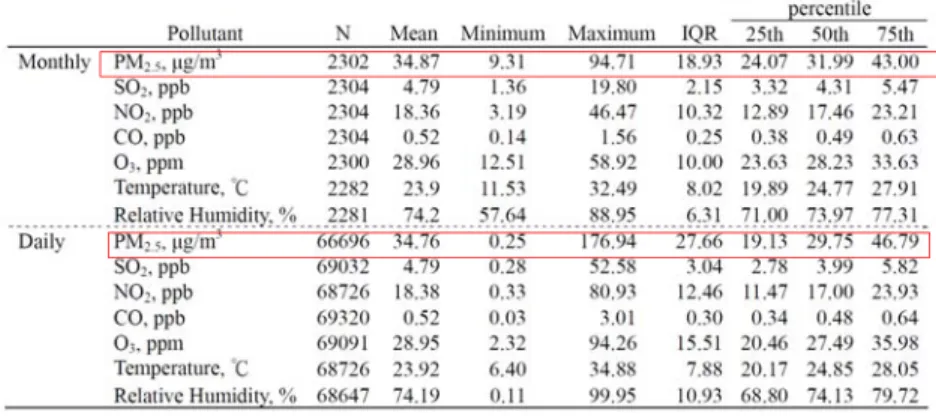
The results of fine particle related to health impact at cool seasonshowed more consistent on all cause, cardiovascular diseases, and respiratory diseases deathin Taipei city. Increasing an interquartile of fine particle concentration (IQR: 9.29μg/m3) related to increasing the mortality risk of
the all cause, cardiovascular diseases, and respiratory diseases, 7%, 15%, and 18%respectively.
Short term effect(daily):
The results also showed consistency at cool season in Taipei city. Increasing an interquartile of fine particle concentration (IQR:18.13μg/m3), the mortality risk was increased 10-12%.
Results (cont.)
18
Brief Summary of First Year Results
The results showed more consistent in Taipei city, it
could be the index city.
There were some city-specific seasonal diseases
should be consider, especially in Kaohsiung (in the warm season) and Taichung (in the cold season).
The results oflong-term (monthly average mortality)
and short-term(daily average mortality) showed highly comparable.
19
Brief Summary of First Year Results (cont.)
WHO Taiwan**
Interim target-1 (IT-1)
75 75 About increase 5%
mortality over the AQG value*
Interim target-2 (IT-2)
50 50 About increase
2.5% mortality over the AQG value*
Interim target-3 (IT-3)
37.5 37.5 About increase
1.25% mortality over the AQG*
Air quality guideline (AQG)
25 25 Based on WHO
and Taiwan data*
WHO air quality guidelines and interim targets for fine particle: daily concentrations (μg/m3)
*: WHO air quality guidelines and interim targets. It is potentially consistent with the result of all cause, cardiovascular diseases and respiratory diseases mortality analyses in Taiwan
**: Taipei city may have higher relative risk, similar to the previous report (Eftim et al. 2008)
20
On-going Second Year Study
Integrating fine particle (PM2.5) module simulation data, the Health Insurance data and other relevant cohort data to assess the short/ medium/ long term health impact of fine particle exposure, especially the relatively sensitive and vulnerable groups.
21
On-going Second Year Study (cont.)
Air Pollution (PM2.5)
Daily Average Monthly Average Annual Average1
Health Outcomes
Mortality2 Morbidity3 Cohort4
Daily: Case Crossover, Conditional logistic regression Monthly: Repeated-Poisson regression Annual: Repeated-Poisson regression Daily: Case Crossover, Conditiona l logistic regression Monthly: Repeated-Poisson regression Annual: Repeated-Poisson regression Annual: Cox Proportion Hazard Model
1. Retrospective prediction: PM2.5/PM10 and PM2.5/Ozone Ratio, and validated by superstations. 2. Data resource: Taiwan Death Registry (TDR), Department of Health (DOH).
3. Longitudinal Health Insurance Database 2005 (LHID2005).
4. Cancer Cohort Database.
Blue: Analyzed, Purple: Analyzing, Green: Going to analyze
22
Issues of On-going PM2.5 Epidemiology
Studies
1. Air Pollution Data: PM2.5 not being available nationwide
until 2005.
→ Using ratio estimation of PM2.5/PM10 and PM2.5/Ozone to fit annual average analysis models (retrospective prediction) →The
ratiowill be also validated by several superstations that has been starting to collect PM2.5 concentration before 2005.
23
Issues of On-going PM2.5 Epidemiology
Studies (cont.)
2. Address: In the NHIRD, it does not provide personal
address information.
→ The most frequent district of medical treatment will be used as a proxy measure of residential area of each subject.
24
Issues of On-going PM2.5 Epidemiology
Studies (cont.)
3. Nationwide Analysisversus City-specific Analysis
25
Issues of On-going PM2.5
Epidemiology Studies (cont.)
4. Control of Related Risk Factors →
1. Acute: Case cross-over, self-control.
2. Long-term: In addition to controlling social economic status,
medical accessibility, environmental tobacco smoking, gender, age, related air pollutants and weather variablesin the analysis of TDR and LHID2005, a prospectus cancer cohort databasewill be also used to assess and control further potential personal risk factors.
26
Further
Long-term follow up study.
Advancing further assessment of the recommended
criteriafor environment protection and environmental regulations based on Taiwan research data.
Promoting environment protection and sustainable development for public health and welfarefor all the people.
27
![TraditionalMLCalgorithmsmainlytacklethebatchMLCproblem,wheretheinputdataarepresentedinabatch[24,28].Nevertheless,inmanyMLCapplicationssuchase-mailcategorization[22],multi-labelexamplesarriveasastream.Onlineanalysisistherefore dimensionreducermotivatedbyma](data:image/gif;base64,R0lGODlhAQABAIAAAP///wAAACH5BAEAAAAALAAAAAABAAEAAAICRAEAOw==)