科技部補助專題研究計畫成果報告
期末報告
漢語高功能自閉症兒童敘事中指涉策略之運用: 形式與功
能
計 畫 類 別 : 個別型計畫 計 畫 編 號 : MOST 102-2410-H-004-097- 執 行 期 間 : 102 年 08 月 01 日至 103 年 10 月 31 日 執 行 單 位 : 國立政治大學英國語文學系 計 畫 主 持 人 : 薩文蕙 計畫參與人員: 碩士班研究生-兼任助理人員:張簡佳怡 講師級-兼任助理人員:葉侃彧 其他-兼任助理人員:王詩涵 報 告 附 件 : 出席國際會議研究心得報告及發表論文 處 理 方 式 : 1.公開資訊:本計畫涉及專利或其他智慧財產權,2 年後可公開查詢 2.「本研究」是否已有嚴重損及公共利益之發現:否 3.「本報告」是否建議提供政府單位施政參考:否中 華 民 國 104 年 01 月 27 日
中 文 摘 要 : 國內外自閉症敘事能力的研究均指出:自閉症患者之敘事較 少運用心智語彙、指涉能力不足、及未能顧及聽者需求。這 些觀察與患者心智理論能力的缺陷關析密切。Tager-Flusberg 與 Sullivan(1995)認為心智理論能力是敘事中不 可或缺的工夫:因為成功的敘事者須符合言談溝通的條件, 體認到聽眾的需求。心智理論能力和語言能力之間的關聯主 要在言談語用的層面。在諸多語用議題中,指涉策略的運用 與敘事表達的關係尤其密切。指涉運用能力關係到敘事者對 言談中新、舊訊息的區分,對聽者所須信息量的推論,及對 交談合作原則的掌握。因此,有關指涉運用的分析,可反映 出敘事者對聽者需求的敏感程度。 鑒於指涉運用在言談語用研究上的重要性,及其與心智 理論能力的關聯性,指涉運用能力成為國外自閉症研究的重 要議題。然而國內於此針對自閉症敘事中指涉運用的分析甚 為稀少;對於漢語零形詞(null forms)的特殊性亦未加以 探討。漢語因無詞尾屈折變化,主詞、受詞均可省略,致容 許零形詞的存在等特性,使漢語言談中的指涉運用深具跨語 言比較的意義。 為驗證與檢視國外針對自閉症族群指涉能力的研究發 現,本研究採語言形式與功能並重的取向,有系統地分析漢 語自閉症兒童敘事中指涉之運用。我們以 Frog, where are you?為語料根據。以自閉症兒童為實驗組,典型發展兒童為 對照組;兩組兒童就生理年齡、性別、語言理解、語言表 達、智商等基本能力指標配對。我們計算受試者之單位子句 平均長度與不同語詞數等數據,作為其基本敘事能力的指 標。除編碼量化指涉語詞的種類及分布,我們亦檢視指涉語 詞與敘事言談功能之關係,進而比較兩組兒童指涉運用之異 同,並探討敘事者的指涉運用與其他各項基本能力間的關 係。 研究結果顯示:兩組兒童在初次介紹與再次引介故事人 物時,均以使用名詞詞組為主。而敘事中須持續指稱同一人 物時,兩組兒童則以零形詞為優先考量。除以零形詞為主 外,自閉症兒童比典型發展兒童使用更多的代名詞作持續指 稱;而典型發展兒童則多運用名詞詞組。依此研究發現,我 們推論自閉症兒童對聽者需求仍有相當的敏感程度,而零形 詞的凸顯則進一步呈現漢語結構上之特性。 中文關鍵詞: 漢語高功能自閉症兒童、敘事能力、指涉運用、形式與功能 英 文 摘 要 : ToM deficits were held as possible explanations for
the listener's point of view was required, in individuals with ASD.
There have been few detailed investigations about narrative abilities of Chinese-speaking children with ASD. However, we still lack of knowledge about how Chinese children with ASD use referential terms in narratives. Without case markers, Mandarin's pronominal system is very simple; moreover, it allows null forms, the omission of arguments in both subject and object positions. While null forms might be unacceptable in many languages, they are used very frequently by Chinese speakers. Given this particular feature in Mandarin Chinese, the present study aims to investigate the referential choice in Chinese-speaking children with ASD.
This study analyzed narratives from 16 Chinese-speaking children with ASD and 16 typically
developing children matched on gender, linguistic and cognitive abilities. The narrative data were based on a wordless picture book Frog, where are you?
Participant's referential choice was examined. To this end, the subject and object arguments of
children's utterances were coded for the categories of referential forms and pragmatic functions. The referential forms included: (1) nominal forms, (2) pronominal forms, and (3) null forms. The pragmatic functions were examined when a referential form is used to (1) introduce, (2) maintain, or (3)
reintroduce a character in the story. Given the putative ToM deficits in children with ASD, we predicted that, compared with the typical children, children with ASD would exhibit different referential preference.
Our results indicated that, when matched on both linguistic and cognitive abilities, the participants exhibited no significant group differences regarding basic narrative measures. Both groups displayed a preference to introduce and to reintroduce story characters with nominal forms, though children with ASD used a significantly larger percentage of
pronominal forms than typical controls did for the purpose of reintroduction. For maintaining reference,
however, null forms were preferred by both groups, and the ASD group used significantly more pronominal forms than the controls did. The findings are
discussed in relation to social-communicative
deficits in ASD, and linguistic as well as cognitive factors in narrative construction.
英文關鍵詞: Mandarin-speaking HF children with ASD, narrative ability, referential choice, form and function
1
An investigation of the referential choice in narratives of Chinese-speaking Children with Autism Spectrum Disorders
1. INTRODUCTION
The core features of autism spectrum disorders (ASD) are their difficulties in social communication and insistence on sameness (American Psychiatric Association [APA], 1994). Communication always involves social understanding. Given that narrative ability involves an integration of social-emotional, cognitive, and linguistic knowledge, studies of narratives produced by individuals with autism are likely to reveal rich information about their difficulties in social communication.
The theory of mind (ToM) hypothesis of autism is probably the most-documented theoretical construct to account for the social-communicative deficits in individuals with autism. A body of research particularly attempted to relate ToM deficits to narrative practices by addressing a wide variety of indices of narrative ability, ranging from measures of story length, story organization, cohesion and narrative evaluation (e.g., Capps, Losh, & Thurber, 2000; Loveland, McEvoy, Tunali, & Kelly, 1990; Tager-Flusberg, 1995; Tager-Flusberg & Sullivan, 1995). Tager-Flusberg and Sullivan (1995), for instance, detected significant correlation between ToM performances and mental terms and story length in narratives. This connection is also evident in the study by Loveland et al. (1990), in which the inappropriate utterances produced by participants with autism were taken as instances of pragmatic violations and later were interpreted as reflecting a ToM deficit (Bruner & Feldman, 1993). Additionally, ToM deficits were also found to be correlated with amount and diversity of evaluative devices in used by individuals with autism (Capps et al., 2000) and relevant to the insufficient causal connections encoded in their narratives (Diehl, Bennetto, & Young, 2006).
As indicated by Tager-Flusberg and Sullivan (1995), ToM is essential to narrative construction, for a successful narrator relies on this ability not only to elaborate the
psychological states of story characters to account for their actions, but also to take account of listeners’ knowledge and perspectives. Accordingly, narrative discourse is likely to reveal a narrator’s ability to employ a ToM. Among various indices of narrative ability, referential choice is regarded as an important window to show a speaker’s sensitivity to
discourse-pragmatic factors and to a listener’s point of view (Huang, 2011). In the study by Colle and colleagues (2008), for instance, the subtle but significant impairments in referential use of pronouns in individuals with ASD are considered relevant to their insensitivity to what listeners need.
2
Referential strategies have been believed to constitute an important connection between grammar and discourse, for language users are found to be sensitive to discourse-pragmatic factors when they use referential forms (e.g., Chafe, 1994; Du Bois, 1985, 1987). In particular, research has indicated that both adults’ and children’s referential choices are closely
associated with the informativeness status of discourse referents (Allen, 2000; Huang, 2011; Greenfield & Smith, 1976). As Chafe (1994) explained that the accessibility of a given referent would change as a function of the level of activation state1; referents with different levels of accessibility are associated with different referential forms (Huang, 2011). Therefore, a speaker’s referential choice is likely to reflect the speaker’s assumption about the
information status of a given referent in the listener’s mind. Regarding the dynamic
relationship between information status of a given referent and referential forms, research has indicated that arguments whose referents are not highly accessible are more likely to be realized overtly than arguments with highly accessible referents. Put another way, arguments with newly introduced referents, which are considered to be informative arguments, are more likely to be realized overtly than arguments with previously established referents (Huang, 2011). For instance, speakers tend to use zero anaphora to mark the most accessible referent, while referential indefinite NPs are used for the most inaccessible referent (Givón, 1983). Similarly, Gundel, Hedberg, and Zacharski (1993) noted that null forms (zero anaphora), personal pronouns, and demonstratives are associated with accessible referents, while nominals are for inaccessible ones.
Analyses of narrative production also found correlation between referential choice and informativeness features of discourse referents. For example, it has been noted that nominal forms are more frequently used for introducing the main protagonist in a story, while pronominal forms are more likely to be used for maintenance of reference to previously mentioned referents (Bamberg, 1987; Kail & Hickmann, 1992; Hichmann & Hendriks, 1999). Given the fact that the speakers’ referential choice is a function of mutual knowledge (Kail & Hickmann, 1992), Colle and her colleagues (2008) extended the study on referential choice to individuals with ASD since they considered that referential choice in narrative discourse is likely to reveal how well individuals with ASD employ a ToM so as to assume a listener’s knowledge and needs. Their results indicated that individuals with ASD used fewer referential expressions than the typical controls did. More significantly, the ASD group showed subtle difficulty in using anaphoric pronouns to maintain reference to a character where the listener’s knowledge is required.
Unlike languages such as German or English, Mandarin Chinese has no inflection, and permits omitted arguments in both subject and object positions. Hickmann and Hendriks
1 There are three levels of activation states: active, semiactive, and inactive. According to Chafe (1994), an active referent is the focus of interest and is salient in the listener’s consciousness at a particular period of time. A semiactive referent resides in the listener’s peripheral consciousness for it is not the focus of interest. In contrast, an inactive referent is neither introduced linguistically nor physically present.
3
(1999) examined children’s ability to organize cohesive anaphoric relations in discourse on the basis of cross-linguistic data.2 They placed particular attention on the determining factors for the use of referential expression in the maintenance of reference to the animate characters in narratives. The researchers suggested that the use of referential forms is determined by universal pragmatic principles and by language-specific properties. In particular, they noted that, compared with other languages, null forms occurred most frequently in
Mandarin-Chinese. It leads us to speculate which referential forms would be preferred for other discourse purposes, namely introducing or reintroducing reference. Therefore, Mandarin Chinese appears to be an interesting testing ground for the relationship between referential forms and pragmatic functions. In view of this, studies on the referential choice of
Chinese-speaking individuals with ASD may reveal not only the connection between linguistic forms and pragmatic functions but pragmatic ability in this population. Purpose of the Study
The number of incidence and prevalence of ASD has increased markedly worldwide (Blumberg et al., 2013; Chien, Lin, Chou, & Chou, 2011). While many investigations have examined narrative performance of English-speaking individuals with ASD, the data on narrative abilities of Chinese-speaking children with ASD are relatively sparse (Chen, 2007; Chen & Chang, 2005; Hsu, 2009; Tsou & Cheung, 2007). Most of these studies on Chinese ASD were concerned with the structure or the evaluative part of narratives and suggested that children with ASD failed to provide enough information to meet the needs of listeners; nevertheless, how they use referential expressions is comparatively much less understood. There have been merely two studies about the referential choice of Chinese-speaking children with ASD. One of the studies focused on the use of nominal and pronominal forms to refer to the main protagonist in a set of pictures (Chen & Chang, 2005). However, the study failed to examine the likely contribution of null forms to a narrator’s referential choice and did not address the pragmatic functions along with referential forms. Moreover, the referential forms are not rigorously defined as in discourse-pragmatic approach, which thus limits our
understanding of the referential strategies in this population. The other study (Chen, 2007) examined only the use of pronominal forms by means of the Narrative Assessment Profile (McCabe & Bliss, 2003). Chen indicated that the difference between the ASD and typical children is statistically non-significant, though she reported that some of the ASD children did not refer to characters in a proper way. Nevertheless, Chen did not clearly state how
‘appropriateness’ in referential choice is defined and computed, which makes it difficult for subsequent research to replicate the finding. As seen above, more studies are required to advance our understanding about the referential choice in Chinese-speaking individuals with
2
Hickmann and Hendriks’ (1999) study included four languages: English, German, French and Mandarin Chinese.
4
ASD. More significantly, the studies on this from the discourse-pragmatic perspective are needed so that viable comparisons can be made with earlier findings of children speaking other languages. In addition to this, much prominent research on English-speaking individuals with ASD examined narrative data based on the frog story (e.g., Diehl et al., 2006; Losh & Capps, 2003; Tager-Flusberg, 1995), whereas only two studies on Chinese children with ASD used this material (Chen, 2007; Tsou & Cheung, 2007), which renders cross-linguistic
comparisons unfeasible and thus limits our understanding of the narrative abilities in this population.
The present study was an attempt to address these concerns by examining the referential choice in children with ASD and by eliciting narratives based on the frog story, which when combined makes it possible to compare with findings of the previous, frog-story-based studies on children with ASD (Chen, 2007; Diehl et al., 2006; Losh & Capps, 2003; Tager-Flusberg, 1995; Tsou & Cheung, 2007). Previous research on English-speaking children underlined the importance of matching variables to select groups of participants (Tager-Flusberg & Sullivan, 1995). Following this, the present study explored how Chinese-speaking children with ASD use referential expressions in narratives by strictly matching groups of participants. One central question to ask is to what extent that the ASD children’s referential choice is comparable to that of the typically-developing children. Given individuals with ASD associated with ToM deficits, we hypothesized that, compared with the typical controls, children with ASD would have difficulty in using anaphoric pronouns to maintain reference to characters in the story.
2. METHOD 2.1 Participants
Sixteen children with ASD (Mage= 8.25) and 16 typically developing children (hereafter as TD) (Mage= 7.16), attending various elementary schools in the Taipei City and the New Taipei City, participated in the present study. All the participants were male. Children with ASD were referred by special education teachers affiliated with eight different elementary schools in Taipei City and New Taipei City. Their diagnoses were established from school records and clinical judgment by qualified clinicians. All the children with ASD met DSM-IV (APA, 1994) criteria for Autistic Disorder based on the ASD Diagnostic Interview--Revised (ADI-R; Lord, Rutter & LeCouteur, 1994); they were all high-functioning with Full Scale IQs (FSIQs) above 80 on the WISC-III (Chinese version) (Chen, 1997), and with sufficient language abilities to create narratives.
The control group comprised typically developing children, with no concerns about ASD, learning disabilities or language delays. The two groups of participants were matched on FSIQs using WISC-III and on receptive and expressive language scores from the Revised Language Impairment Checklist for School Children (Lin, Huang, Huang, & Xuang, 2009).
5
Participants’ intelligence and language abilities were evaluated by a multidisciplinary team consisting of speech-language pathologists and clinical psychologists.
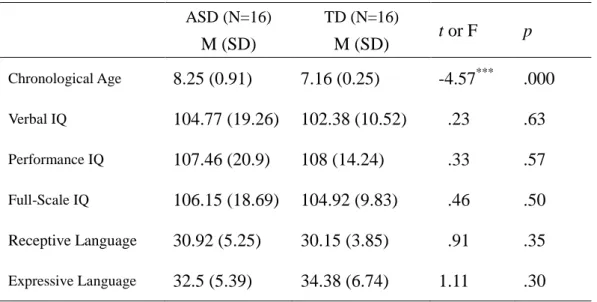
A t test showed that children with ASD were significantly older than typical controls. A repeated measures analysis of covariance (ANCOVA), with age as the covariate, detected no significant differences between groups on intelligence quotient and language abilities. Details about the two groups of participants are shown in Table 1.
Table 1. Group Characteristics
ASD(N=16) M (SD) TD (N=16) M (SD) t or F p Chronological Age 8.25 (0.91) 7.16 (0.25) -4.57*** .000 Verbal IQ 104.77 (19.26) 102.38 (10.52) .23 .63 Performance IQ 107.46 (20.9) 108 (14.24) .33 .57 Full-Scale IQ 106.15 (18.69) 104.92 (9.83) .46 .50 Receptive Language 30.92 (5.25) 30.15 (3.85) .91 .35 Expressive Language 32.5 (5.39) 34.38 (6.74) 1.11 .30 *** p< .001 2.2 Material
To control the content of the narratives, we used a wordless picture book Frog, where are
you? (Mayer, 1969) to elicit a story narrative from each participant. The frog story is a typical
children’s story with a hero, a problem, a series of actions following the problem, and a happy ending. This book was chosen because it has been used to tap narrative ability of not only typically-developing children from different language backgrounds (e.g., Bamberg & Damrad-Frye, 1991; Berman & Slobin, 1994), but also a variety of developmentally disordered populations (e.g., Botting, 2002; Colle et al., 2008; Diehl. et al., 2006). 2.3 Data Collection
Rapport was first established in the observation period. The interviews were carried out individually with each participant, and consisted of an initial warm-up conversation followed by a narrative task based on Frog, Where are You. Prior to the story-telling, the experimenter explicitly said to the participants that she had no knowledge about this particular story book. Then, the participants were first asked to look through the entire book on their own and to tell a story while looking at the pictures. The entire interviews were audio- and video-taped and subsequently transcribed.
6
Basic narrative measures. Participants’ basic narrative measures include narrative length and variety of words. Clauses were used to quantify story length. A clause consists of a verb and its arguments, and corresponds roughly to a single event. The total number of clauses in each narrative was tallied to quantify narrative length. The variety of words was analyzed in terms of the total number of different words used in each narrative. CLAN (Child Language ANalysis) programs were used to compute these measures.
Referential forms. Following Clancy (1997) and Huang (2011), we used a three-way classification. And based on the classification frameworks of previous studies (Colle et al. 2008; Huang, 2011; Li & Thompson, 1981;Tsai & Chang, 2008; van der Lely, 1997), the categories of referential forms were stated as below:
(i) Nominal form: including bare nouns, noun phrases, and proper names (ii) Pronominal form: including pronouns and demonstratives
(iii) Null form: absence of overt form
Discourse functions. Three particular discourse functions are differentiated in this study. To compare our results with the findings of earlier studies, we adapted from previous research the coding system for the discourse functions (Colle et al., 2008;Van der Lely, 1997), which were coded according to whether a referential expression is used to (i) introduce a story character when they were mentioned for the first time; (ii) maintain reference to a character who has been mentioned in the same episode or in the previous episode ; (iii) reintroduce characters after a different character had been mentioned.
3. RESTULS
Basic narrative measures
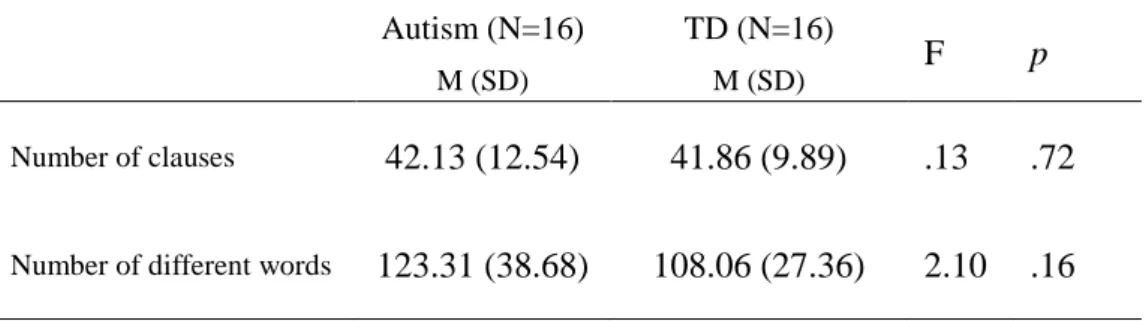
The results revealed that children with ASD were similar to the typical controls both in number of clauses and in number of different words used in their narratives. As expected, a repeated measures analysis of covariance (ANCOVA), with age as the covariate, did not yield significant differences between the two groups of participants (Table 2).
Table 2. Number of clauses and number of different words
Autism (N=16)
M (SD)
TD (N=16)
M (SD) F p Number of clauses 42.13 (12.54) 41.86 (9.89) .13 .72
Number of different words 123.31 (38.68) 108.06 (27.36) 2.10 .16
7
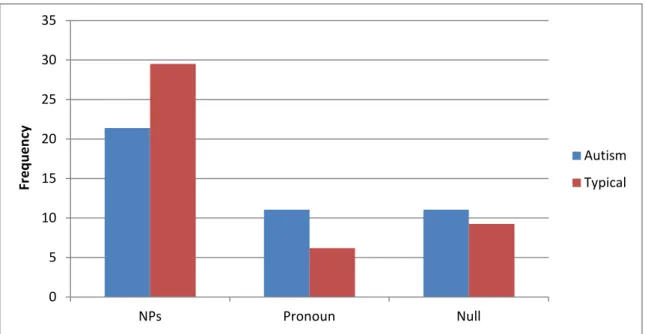
We firstly pooled together the introduction, maintenance and reintroduction of referents to examine the total amount of nominal, pronominal, and null forms used in narratives by the two groups of participants. As shown by the mean numbers of referential forms displayed in Figure 1, the TD group used markedly larger amount of nominals to make references than did the ASD group. A repeated measures analysis of variance (ANOVA) yielded significant interaction between subject groups and referential forms. Further analyses revealed that the TD group used significantly more nominals than the ASD group did ( t(30) = 2.27, p = .03). The difference between subject groups in either pronominal or null forms, however, failed to reach significance.
Figure 1. Mean total numbers of nominal, pronominal and null forms used by ASD group versus TD group
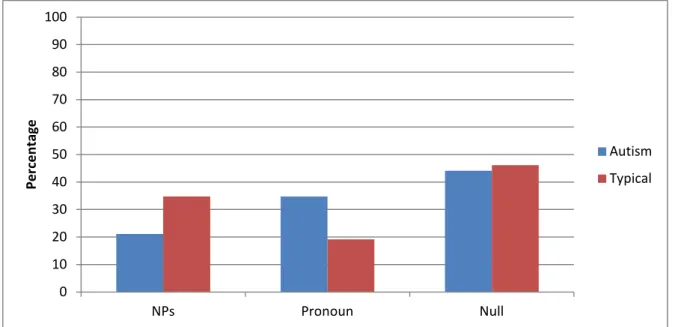
With regard to the percentages of all three referential forms irrespective of their functions, Figure 2 shows larger differences between subject groups for the nominal and pronominal forms. An ANOVA yielded significant interaction between subject groups and referential forms (F(2,60)= 6.21, p < .01). Further analyses revealed that the TD group used significantly more nominals than the ASD group did (t(30) = 2.80, p < .01). A reverse pattern, however, occurs for pronominal references (t(30) = -2,67, p = .01), in that percentage of the pronominal form used by the ASD group outnumbered that by the TD controls.
0 5 10 15 20 25 30 35 NPs Pronoun Null Fre qu en cy Autism Typical
8
Figure 2. Percentages of each referential form used by ASD group versus TD group
Introducing reference
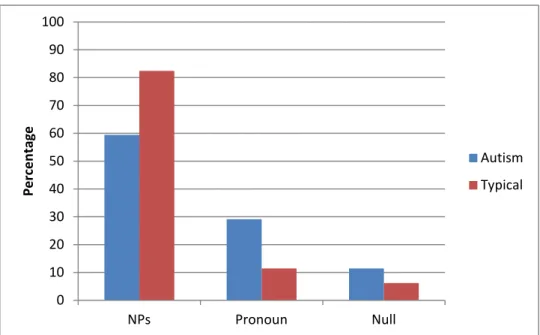
The results of the introductory reference are presented in Figure 3. When establishing a referent for the first time in the story, both groups used a markedly higher rate of nominals. While no significant main effect of subject group yielded, an ANOVA revealed a significant main effect for referential forms (F(2,60)= 803.43, p < .001). Post hoc analyses confirmed that the percentage of nominal forms is significantly larger than those of the other two forms. The difference between pronominals and null forms, however, is non-significant.
Figure 3. Percentages of referential forms for introductory reference used by ASD group versus TD group 0 10 20 30 40 50 60 70 80 90 100 NPs Pronoun Null Per cen ta ge Autism Typical 0 10 20 30 40 50 60 70 80 90 100 NPs Pronoun Null Per cen ta ge Autism Typical
9
Maintaining reference
With regard to the distribution of referential forms for subsequent mention of a given referent, Figure 4 shows that the null form is preferred by both groups of participants. When it comes to nominal and pronominal forms, however, the two groups behave differently. An ANOVA yielded a significant interaction between subject groups and referential forms,
F(2,56)= 3.52, p = .04. A repeated measures ANOVA indicated significant effects of referential forms for both groups (TD: F(2,30)= 7.30; ASD: F(1,30)= 4.33, p < .001). The predominance of null forms is statistically significant, as post hoc analyses showed that null forms were used significantly more often than other forms by both groups. In terms of referential forms, analysis by means of independent T tests revealed that the ASD group used a significantly larger percentage of pronominal forms to maintain reference than the TD group did (t(30) = -2,71, p = .01), while no significant difference between groups yielded for nominal and null forms.
Figure 4. Percentages of referential forms for maintaining reference used by ASD group versus TD group
Reintroducing reference
The distribution of referential forms for reintroducing a previously established referent is presented in Figure 5. As illustrated, the nominal form appears to be the preferred device for both groups of participants. An ANOVA yielded a significant interaction between subject groups and referential forms, F(2,60)= 5.48, p < .01. A repeated measures ANOVA indicated significant effects of referential forms for each group (TD: F(2,30)= 123.06; ASD: F(1,30)= 9.1, p < .001). Post hoc analyses further revealed that nominal forms were used significantly more
0 10 20 30 40 50 60 70 80 90 100 NPs Pronoun Null Per cen ta ge Autism Typical
10
than the other forms by both groups of participants. In terms of referential forms, analysis by means of independent T tests indicated that the TD group used nominals significantly more often than the ASD group ( t(30) = 2.68, p = .01), while a reverse pattern displays for
pronominals (t(30) = -2,25, p = .03). The difference between the two groups of participants in using null forms to reintroduce a referent is nonsignificant.
Figure 5. Percentages of referential forms for reintroducing reference used by ASD group versus TD group
General Discussion
The number of incidence and prevalence of ASD has increased markedly worldwide (Blumberg et al., 2013; Chien et al., 2011). While many investigations have examined narrative performance of English-speaking individuals with ASD, the data on narrative abilities of Chinese-speaking children with ASD are relatively sparse (Chen, 2007; Chen & Chang, 2005; Hsu, 2009; Tsou & Cheung, 2007). Most of these studies on Chinese ASD were concerned with the structure or the evaluative part of narratives and suggested that children with ASD failed to provide enough information to meet the needs of listeners; nevertheless, how they use referential expressions is comparatively much less understood. The present work thus attempted to fill the gap by investigating the referential choice in Chinese-speaking children with ASD by eliciting connected narratives based on the frog story, which combined makes it possible to compare and validate significant findings of previous, frog-story-based studies on children with ASD.
Our first analysis indicates that the two groups did not differ in the basic narrative measures such as story length and variety of words. Given this is the case, any differences performance on referential choice cannot be ascribed to either of these factors.
0 10 20 30 40 50 60 70 80 90 100 NPs Pronoun Null Per cen ta ge Autism Typical
11
Overall, the norminal forms are preferred by both ASD and TD groups, irrespective of their discourse functions in narratives. We further provided detailed investigation of children’s referential choice from the discourse-pragmatic perspective. For newly introduced referents, both groups tend to use nominal forms. The predominance of nominal forms for introducing reference is consistent with previous finding for English-speaking children with ASD (Colle et al., 2008). For maintaining reference, however, the null forms appear to be the dominant device for Chinese-speaking children, both ASD and TD. According to Chafe’s (1994) levels of informativeness status, a subsequently mentioned referent is the active referent and it is expected to be realized by means of pronominal forms. Our data, however, displayed a pattern different from what was expected. One possible reason for this discrepancy is that null forms are the most preferred device for this maintaining function for Chinese children. As previous studies have suggested that the null forms occurred most frequently in Mandarin Chinese than in other languages (Gundel et al., 1993; Hickmann & Hendriks, 1999). Another related
finding about the preponderance of null forms is noted in the report on Japanese narratives (Clancy, 1982), in which preschoolers appeared to use null forms as a standard way for maintaining reference (Bamberg, 1987: 41). With respect to reintroducing a previously mentioned referent, both groups of participants tend to use nominal forms for this discourse purpose. However, the TD group used a higher percentage of nominals than the ASD, while ASD used pronominal forms at a higher percentage than the TD group.
To sum up, the children with ASD are sensitive to discourse functions and listeners’ needs while making referential choice in narrative discourse, which shows that their
perspective-taking ability is better than what was expected. Both groups tend to use nominal forms for the purposes of introducing and reintroducing referents, which suggests that they would make efforts to reduce the potential uncertainty regarding the referents they are talking about. It is interesting to note that null forms, rather than the pronominals, appear to be the least effortful way for both ASD and TD children to maintain reference. This particular finding is relevant to the characteristic feature of Mandarin Chinese. Given the fact that Chinese allows arguments to be grammatically null, referents that can be understood from context, then, do not need to be overtly specified. As Huang (2011) suggested, Mandarin Chinese serves as a promising testing ground for the discourse-pragmatic account of children’s referential choice.
REFERENCES
許舜杰。2009。亞斯柏格症兒童口語敘事能力之探討。國立台北教育大學特殊教育學系 碩士論文。
Allen, Shanley. (2000). A discourse-pragmatic explanation for argument representation in child Inukitut. Linguistics, 38, 483-521.
12
American Psychiatric Association. (1994). Diagnostic and statistical manual of mental
disorders (4th ed.). Washington, DC: Author.
Bamberg, M. (1987). The acquisition of narratives: learning to use language. Berlin: Mouton de Gruyter.
Bamberg, M., & Damrad-Frye, R. (1991). On the ability to provide evaluative comments: Further explorations of children’s narrative competences. Journal of Child Language, 18, 689-710.
Berman, R. A., & Slobin, D. I. (1994). Relating events in narrative: A crosslinguistic
developmental study. Hillsdale, NJ: Lawrence Erlbaum Associates.
Blumberg, S. J., Bramlett, M. D., & Kogan, M. D., et al. (2013). Changes in prevalence of parent-reported autism spectrum disorder in school-aged U.S. children: 2007 to 2011–2012. National Health Statistics Reports, 65, 2013-1250. Retrieved from http://www.cdc.gov/nchs/data/nhsr/nhsr065.pdf
Botting, N. (2002). Narrative as a tool for the assessment of linguistic and pragmatic impairments. Child Language Teaching and Therapy, 18(1), 1-22. doi:
10.1191/0265659002ct224oa
Capps, L., Losh, M., & Thurber, C. (2000). “The frog ate the bug and made his mouth sad”: Narrative competence in children with autism. Journal of Abnormal Child Psychology,
28(2), 193-204.
Chafe, Wallace. (1994). Discourse, consciousness, and time: The flow and displacement of
conscious experience in speaking and writing. University of Chicago Press, Chicago.
Chen, C. T. (2007). Gaogongneng zibizheng xilie zhangai huantong xushin engli chutan
(Narrative Abilities in High-functioning Children with Autism Spectrum Disorder)
(Master’s thesis). National Yang Ming University, Taipei, Taiwan.
Chen, K. H., & Chang, C. F. (2005). Guoxiao dinianji gaogongneng zibizheng xuesheng kouyu xushi nengli zhi yanjiu (The narrative ability of the 1st and 2nd grade elementary school pupils with high function autism). Teshu Jiaoyu Yu Fujian Xuebao (Bulletin of
Special Education and Rehabilitation), 13, 209-235.
Chien, I. C., Lin, C. H., Chou, Y. J., & Chou, P. (2011). Prevalence and incidence of autism spectrum disorders among national health insurance enrollees in Taiwan from 1996 to 2005. Journal of Child Neurology, 26(7), 830-834.
Clancy, Patricia M. (1982) Written and spoken style in Japanese narratives. In Deborah
Tannen (ed.), Spoken and written language: Exploring orality and literacy. Norwood, NJ.: Ablex, pp. 55-76.
Colle, L., Baron-Cohen, S., Wheelwright, S., & van der Lely, H. K. (2008). Narrative discourse in adults with high-functioning autism or Asperger syndrome. Journal of
Autism and Developmental Disorders, 38(1), 28-40.
13
high-functioning children with autism spectrum disorders. Journal of Abnormal Child
Psychology, 34(1), 87-102.
Du Bois, John. (1985). Competing motivations. In: Haiman, J. (Ed.), Iconicity in Syntax. John Benjamins, Amsterdam, pp. 343-365.
Du Bois, John. (1987). The discourse basis of ergativity. Language, 63, 805-855.
Givón, Talmy. (1983). Topic continuity in discourse: An introduction. In Greenberg, J. H., Givón, T. (Series Eds.), Givón, T. (Vol. Ed.), Typological studies in language: Vol. 3.
Topic continuity in discourse: A quantitative cross-language study. John Benjamins,
Amsterdam.
Gundel, Jeanette, Hedberg, Nancy, & Zacharski, Ron. (1993). Cognitive status and the form of referring expressions in discourse. Language, 69, 274-307.
Greenfield, Patricia Marks, & Smith, Joshua. H. (1976). The structure of communication in
early language development. New York: Academic Press.
Hickmann, M., & Hendriks, H. (1999). Cohesion and anaphora in children’s narratives: A comparison of English, French, German, and Mandarin Chinese. Journal of Child
Language, 26, 419-452.
Huang, C. C. (2011). Referential choice in Mandarin child language: A discourse-pragmatic perspective. Journal of Pragmatics, 43, 2057-2080.
Kail, M. & Hickmann, M. (1992). French children’s ability to introduce referents in narratives as a function of mutual knowledge. First Language, 12, 73-94.
Li, Charles N. & Thompson, Sandra A. (1981). Mandarin Chinese: a functional reference grammar. Berkeley: University of California Press.
Losh, M., & Capps, L. (2003). Narrative ability in high-functioning children with autism or Asperger's Syndrome. Journal of Autism and Developmental Disorders, 33(3), 239-251. Loveland, K. A., McEvoy, R. E., Tunali, B., & Kelley, M. L. (1990). Narrative story telling in
autism and Down's syndrome. British Journal of Developmental Psychology, 8, 9-23. McCabe, A. & Bliss, S. L. (2003). Patterns of Narrative Discourse: A Multicultural, Life
Span Approach. Boston, MA: Allyn & Bacon.
Mayer, M. (1969). Frog, where are you? New York: Dial Press.
Sah, W. H., & Torng, P. C. (2012). Narrative coherence in high-functioning children with autism spectrum disorders: An investigation of causal relatedness. Paper presented at the 20th Annual Meeting of the International Association of Chinese Linguistics (IACL-20), Hong Kong, August 28-31.
Tager-Flusberg, H., & Sullivan, K. (1995). Attributing mental states to story characters: A comparison of narratives produced by autistic and mentally retarded individuals. Applied
Psycholinguistics, 16(3), 241-256.
Tager-Flusberg, H. (1995). ‘Once upon a ribbit’: Stories narrated by autistic children. British
14
Tsai, W., & Chang, C. J. (2008). "But I first… and then he kept picking" : Narrative skill in Mandarin-speaking children with language impairment. Narrative Inquiry, 18(2), 349-377.
Tsou, C. Z., & Cheung, H. (2007). Gaogongneng zibizheng ertong suogushi nengli yu xiangguan yinxiang yinsu yanjiu (Narrative story telling of high-functioning children with autism spectrum disorders). Teshu Jiaoyu Yanjiu Xuekan (Bulletin of Special
Education), 32(3), 87-109.
van der Lely, H. K. J. (1997). Narrative discourse in grammatical specific language impaired children: A modular language deficit? Journal Child Language, 24, 221-256.
國科會補助專題研究計畫出席國際學術會議心得報告
日期:103 年 7 月
一、參加會議經過與心得
IASCL 是兒童語言研究領域中的重量級國際學術會議。筆者此次應知名心理學家Allyssa McCabe之邀,與Dr. McCabe 本人、國內學者張鑑如教授、香港Hong Kong Institute of Education 的張顯達教授、以及南京師範大學的Zhang Fangfang教授等兩岸三地的幾位教授共同擔綱一場專 題討論會(symposium)。除與數位學者合作的難得經驗外,值得一提的是我們這個場次的討論會, 由重量級學者Dr. Jean Berko Gleason給予講評。Dr. Berko-Gleason十分肯定有關漢語兒童敘事能 力研究之重要性與學術貢獻。Dr. Berko-Gleason的參與及肯定,對筆者而言實為莫大殊榮,而對 筆者近年來有關漢語兒童敘事能力之研究耕耘,更是意義非凡。
每三年舉辦一次的 IASCL 為學術界一大盛事,該會為兒童語言發展(study of child language)
領域重量級的國際學術會議。今年的會議中 Dan Slobin、Brian MacWhinney、Jeannette Schaeffer、 Kenneth N. Wexler、Debbie Mills、Morten Christiansen、Ann Senghas 等許多國際知名學者均與會 發表論文或專題演說,其主要範疇涵蓋:Neurobiology in typical and/or atypical language acquisition、 Cultural and social factors in child language development、Child bilingual language development、 Language development in atypical populations、New methods in child language research、Sign language acquisition and gestures、 Literacy and language等。今年該會除論文、海報發表及工作 坊外,亦精心規劃專題討論會(symposia) ,探討 child language study 各個面向之重要議題,並邀 請歐美等地國際知名學者發表專題演說。筆者由上述工作坊、專題討論會以及專家演說中領受 許多啟發,累積了更多研究能量。 筆者針對台灣說漢語兒童敘事表現的研究,得到許多迴響。透過此次會議發表,筆者就研 究心得與來自各地的專家交流討論,對研究結果的詮釋助益匪淺,對後續研究的進行亦有重大 啟發;更重要的是,得以在許多知名語言學家、發展心理學家、特教學者等相關領域專家聚集 的會議中發表研究成果,讓國際學界瞭解我國於兒童敘事能力研究的進展與投入。
二、建議
計畫編號 NSC 102 - 2410 - H - 004 - 097 - 計畫名稱 漢語高功能自閉症兒童敘事中指涉策略之運用: 形式與功能 出國人員姓名薩文蕙
服務機構及職稱政大英文系副教授
會議時間 103 年 7 月 14 日至 103 年 7 月 18 日 會議地點Amsterdam (阿姆斯特丹)
會議名稱 The 13th International Congress for the Study of Child Language (IASCL 2014)
發表題目 Global and Local Connections in Mandarin-speaking Children’s Narratives: A
IASCL 雖以兒童語言的研究為主,但聚集了語言學家、發展心理學家、兒童語言病理專家、 特教學者、教育心理學家等相關領域的專家學者, 此一跨領域的研討會,讓與會人士受到多方 面的啟迪,使相關學門的研究人員有許多交流的機會,希望國內日後多舉辦類似的跨領域研討 會,帶動相關領域的整體發展。
三、發表論文摘要
When relating story events, a narrator needs to attend to both local and global aspects of the story. The local aspect involves horizontal alignment of linearly-ordered narrative events, while the global aspect emphasizes interconnecting and integrating events along the vertical dimension. Previous research has relied on a variety of schemes to explore how narrators relate information in a narrative and found age-related differences (e.g., Berman & Slobin, 1994; Trabasso & Rodkin, 1994). However, we still lack knowledge about Mandarin-speaking children’s development in this regard. Even less is known about whether they use goal-plan knowledge to construct narratives. Given the significant role of narratives in children’s development, this study investigated Mandarin-speaking children’s
development in relating both locally- and globally-connected narrative events.
We examined narratives from 30 Mandarin-speaking five-year-olds, 30 nine-year-olds and 30 adults. The narrative data were elicited using Frog, where are you? We adopted the plot-structure and goal-plan schemes to analyze participants’ ability to maintain global connections, and used a complex event and a sequence of events in the story to assess local connections. The results displayed children’s significant progress in establishing global connections and in employing goal-plan knowledge.
Regarding local connections, children exhibited increasing ability to encode and to integrate essential event components. Findings suggest that five-year-olds had insufficient ability to establish both global and local connections. Nine-year-olds were more advanced in encoding global connections; however, they were inadequate in integrating event components and in chaining a sequence of events at the local level. Adults could properly relate narrative events at both levels and were more likely to encode characters’ internal responses to enhance thematic coherence. Results were considered in relation to capacities for working memory, theory of mind and integration. Narrators’ differences in
科技部補助計畫衍生研發成果推廣資料表
日期:2015/01/24科技部補助計畫
計畫名稱: 漢語高功能自閉症兒童敘事中指涉策略之運用: 形式與功能 計畫主持人: 薩文蕙 計畫編號: 102-2410-H-004-097- 學門領域: 心理語言學無研發成果推廣資料
102 年度專題研究計畫研究成果彙整表
計畫主持人:薩文蕙 計畫編號:102-2410-H-004-097-計畫名稱:漢語高功能自閉症兒童敘事中指涉策略之運用: 形式與功能 量化 成果項目 實際已達成 數(被接受 或已發表) 預期總達成 數(含實際已 達成數) 本計畫實 際貢獻百 分比 單位 備 註 ( 質 化 說 明:如 數 個 計 畫 共 同 成 果、成 果 列 為 該 期 刊 之 封 面 故 事 ... 等) 期刊論文 0 1 100% 研究報告/技術報告 1 1 100% 研討會論文 0 0 100% 篇 論文著作 專書 0 0 100% 申請中件數 0 0 100% 專利 已獲得件數 0 0 100% 件 件數 0 0 100% 件 技術移轉 權利金 0 0 100% 千元 碩士生 2 2 100% 博士生 0 0 100% 博士後研究員 0 0 100% 國內 參與計畫人力 (本國籍) 專任助理 0 0 100% 人次 期刊論文 0 0 100% 研究報告/技術報告 0 0 100% 研討會論文 1 1 100% 篇 論文著作 專書 0 0 100% 章/本 申請中件數 0 0 100% 專利 已獲得件數 0 0 100% 件 件數 0 0 100% 件 技術移轉 權利金 0 0 100% 千元 碩士生 0 0 100% 博士生 0 0 100% 博士後研究員 0 0 100% 國外 參與計畫人力 (外國籍) 專任助理 0 0 100% 人次其他成果
(無法以量化表達之成
果如辦理學術活動、獲 得獎項、重要國際合 作、研究成果國際影響 力及其他協助產業技 術發展之具體效益事 項等,請以文字敘述填 列。)筆者與 Allyssa McCabe、張鑑如、張顯達、與 Zhang Fangfang 等四位學者合作, 於 2014 年 7 月同赴荷蘭參加 The 13th International Congress for the Study of Child Language (The 2014 meeting of IASCL)研討會,就漢語敘事研究中文化,認知與情 感之主題進行專題討論(Symposium)。 成果項目 量化 名稱或內容性質簡述 測驗工具(含質性與量性) 0 課程/模組 0 電腦及網路系統或工具 0 教材 0 舉辦之活動/競賽 0 研討會/工作坊 0 電子報、網站 0 科 教 處 計 畫 加 填 項 目 計畫成果推廣之參與(閱聽)人數 0