國立交通大學
英語教學研究所碩士論文
A Master Thesis Presented to Institute of TESOL, National Chiao Tung University In Partial Fulfillment of the Requirements
for the Degree of Master of Arts
英語課堂上中英文使用的情況和理念之探討:以台灣
兩位大學英語教師為例
Teachers’ Practice and Beliefs of L1 and TL Use
in the Foreign Language Classroom: A Case Study of
Two College Teachers in Taiwan
研究生:施斐文
Graduate: Fei-Wen Shih
指導教授:鄭維容
Advisor: Dr. Stephanie W. Cheng
中華民國 九十九年八月
August 2010
i 論文名稱:英語課堂上中英文使用的情況和理念之探討:以台灣兩位大學英語教 師為例 校所組別:國立交通大學英語教學研究所 畢業時間:九十九學年度第一學期 指導教授:鄭維容教授 研究生:施斐文 中文摘要 母語(L1)在教室的使用長期以來一直是研究第二語言(L2)和外語(FL)學習的 探討重點之一, 而最近相關研究也提出教師理念對語言教學的重要性。然而仍少 有實驗性的研究提出教師語言使用理念與實際語言教學之間的關聯。因此,本研 究旨在探索教師在外語教室內母語與目標使用的情形,以及教師語言使用理念與 實際語言教學的關聯。 本研究目的在探索兩位台灣的大學英語教師在課堂上使用母語(中文)和目 標語(英文)的情形及兩位教師語言使用的理念。以下為四個研究問題: 第一, 教 師在英語教室內使用多少的母語和目標語? 第二, 教師使用母語和目標語在功 能上有甚麼不同? 第三, 教師的語言使用理念為何? 第四, 教師語言使用理念 和實際教室內語言教學情形有何關聯? 兩位台灣大學英語教師參與本研究。研究 資料的蒐集是透過課堂觀察與訪問教師的語言使用理念。教室觀察以及教師訪問 皆以錄音的方式作為日後分析的資料。本研究的資料分析方法參考及使用Kim and Elder (2005)的跨語言語碼分析系統 ‘FLAATT’ (Functional Language
Alternation Analysis of Teacher Talk)(教師語言轉換的功能分析)。
研究結果顯示兩位教師在母語和目標語使用的數量以及功能上皆有很大的 不同。此外,兩位教師亦呈現分歧的語言使用信念,差異的理念解釋為何以及如 何兩位教師在同一教學情境下有如此不同的母語及目標語的使用。整體而言,兩 位教師的語言使用理念和實際的教室語言使用呈現一致的結果。本研究希望能解 釋影響教師語言使用的選擇以及教師的理念如何對實際的語言教學產生深遠的 影響,也希望能讓外語教師了解自身的語言使用理念和實際語言教學的關聯。
ii ABSTRACT
Research of second and foreign language (FL) learning have been interested in the issue of first language (L1) use in classrooms and recently have suggested a critical role of teacher belief in practice of teaching. However, research which has empirically documented the link between teachers’ beliefs of language use in
classrooms and their practice of teaching is still scant. Therefore, this study attempts to explore teachers’ actual language use (the L1 and the TL) in the classrooms as well as the relationship between their beliefs of language use and their actual language teaching behaviors in classrooms.
The present study aims to explore two Taiwanese English teachers’ L1 (Chinese) and TL (English) use in class and their beliefs of language use. Four research
questions guide the investigation of the study: (1) What are the amounts of teachers’ uses of the L1 and the TL in the FL classroom? (2) How do teachers differ in the functions of their code-switching between the L1 and the TL? (3) What are the teachers’ beliefs of language use in FL classrooms? and (4) What is the relationship between teachers’ beliefs of language use and their actual code-switching behavior in the classrooms? Two Taiwanese college English teachers participated in the study. Data was collected through classroom observation and teacher interview concerning teacher’s beliefs of language use in the context of FL teaching. Both classroom observation and teacher interview were audio recorded for analyzing. The study adopted the cross-linguistic coding system ‘FLAATT’ (Functional Language
Alternation Analysis of Teacher Talk) developed by Kim and Elder (2005) to analyze classroom data.
Results of the study showed a very different language use between the two teachers both in the amount of TL and L1 use and in the functions language
iii
performed. Moreover, the two teachers’ beliefs of language use in FL classrooms are divergent in some degree as well, which explains how and why teachers in the same EFL teaching context act distinct in terms of TL and L1 use. Overall, both teachers’ language uses in the classrooms are in consistent with their self-reported beliefs. To conclude, the study may be of importance in explaining what may influence teachers’ decision-making of language use and how teachers’ beliefs have profound impact on their actual language teaching behaviors, as well as in providing FL teachers with a better understanding of how beliefs of language use are related to their language teaching behaviors.
iv
ACKNOWLEDGEMENTS
To complete a thesis is by no means easy. For revising this thesis is coming to an
end, I would like to express my gratefulness to those who have given me a helping hand on the road of getting MA degree.
First and foremost, I would like to thank my advisor, Professor Stephanie Cheng, for her support and guidance throughout this meal. Professor Cheng dwells at great length in revising my thesis draft and does not mind taking the trouble to repeatedly discuss all the details with me, which lead me to the right direction of the study. Without her complete devotion and encouragement, completing this thesis would be arduous and tortuous.
My heartfelt gratitude also goes to the committee members, Dr. Yu-Chih, Sun and Dr. Wen-Hsing, Luo, who offered insightful suggestions and comments that help improve my thesis. I would also like to express my deep thankfulness to those who are generous in helping me collect data. Their cordial attitudes toward participation in the study make the process to a success.
Last but not the least, I would like to dedicate this thesis to my dearest parents for they support me to the best of their ability and always stand by my side.
Meanwhile, my dear friends in TESOL of NCTU who gave me numerous indescribable helping cannot be ignored. Because of their company and
encouragement in all the three years, I was not knocked down by all the difficulties confronted in the process of writing the thesis.
vi
TABLE OF CONTENTS
中文摘要 ... i ABSTRACT... ii ACKNOWLDGEMENTS ... .iv TABLE OF CONTENTS... vLIST OF TABLES ... viii
LIST OF FIGURES ... ix
CHAPTER ONE: INTRODUCTION ... .1
Background and Rationale ... 1
Purpose of the Study... 4
Research Questions... 4
Significance of the Study ... 5
Definition of Terms ... 5
CHAPTER TWO:LITERATURE REVIEW ... 7
Introduction ... 7
Teachers’ Uses of TL and L1 in Language Classrooms... 7
Avoiding Use of L1 in Language Classrooms ... 8
Support the Use of L1 in Language Classrooms ...11
Empirical Studies on Teachers’ Uses of TL and L1 in Language Classrooms.... 14
The Amounts and Factors of Teachers’ Uses of L1... 14
The Functions of Teachers’ Uses of L1 ... 19
The Analytical Approach of Teachers’ Use of TL and L1 ... .23
Coding System ‘FLAATT’... 24
The Unit of Analysis ‘AS-Unit’... 26
Teachers’ Beliefs of Language Use in Language Classrooms... 27
CHAPTER THREE:METHODOLOGY ... 31
Introduction ... 31
Participants... 31
vi
Classroom Observation... 33
Teacher Interview... 34
Data Analysis ... 35
The Unit of Analysis ‘AS-Unit’... 35
The Coding System ‘FLAATT’... 38
The Teacher Interveiw... 39
CHAPTER FOUR:RESULTS... 40
Introduction... 40
Teachers' Use of Language in the Classrooms ... 40
Amounts of TL and L1 Use... 40
Functions of TL and L1 Use... 44
Goal Orientation... 44
Teaching Acts ... 54
Teachers' Beliefs of Language Use in the Classrooms... 60
Teachers' Beliefs of Language Use ... 60
Teachers' Use of Language and Their Beliefs ... 65
CHAPTER FIVE: DISCUSSION AND CONCLUSION... 68
Introduction ... 68
Teachers' Use of Language and Their Beliefs... 68
Amount of TL and L1 Use in the Classrooms... 68
Amount of TL and L1 Use... 69
Factors Influencing the Teachers' Language Use ... 69
TL and L1 Use in Performing Different Functions... 74
Core Goal and Mode/Correct/Scaffold (MCS)... 75
Framework Goal and Starter (Sta) ... 77
Social Goal ... 79
Teachers' Reflection of Beliefs on Language Use in the Classrooms ... 81
Pedagogical Implications ... 83
vii
Framework Goal Instruction ... 85
Social Goal Instruction ... 86
Teacher Belief Exploration ... 86
Suggestions and Future Research... 86
REFERENCES... 88
APPENDICES ... 97
Appendix A: Consent form... 97
Appendix B: Observation scheme... 98
Appendix C: Interview questions with teachers ... 99
Appendix D: Coding categories of teaching acts...102
Appendix E: Frequency of Amount of AS-Units by Goal Orientation in Two Classes ...106
viii List of Tables
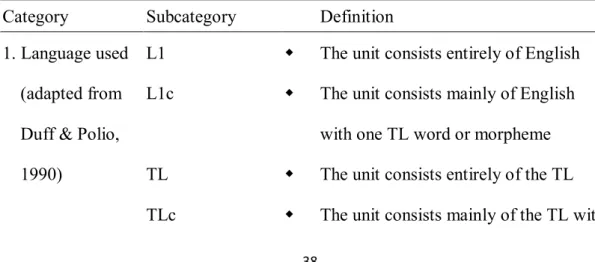
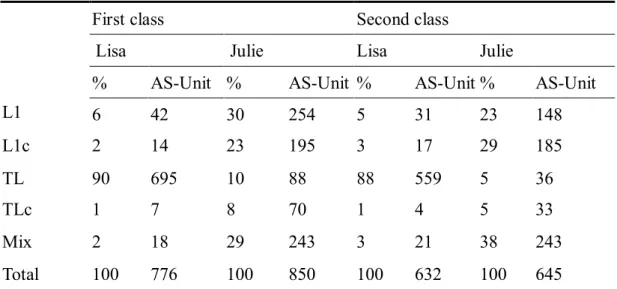
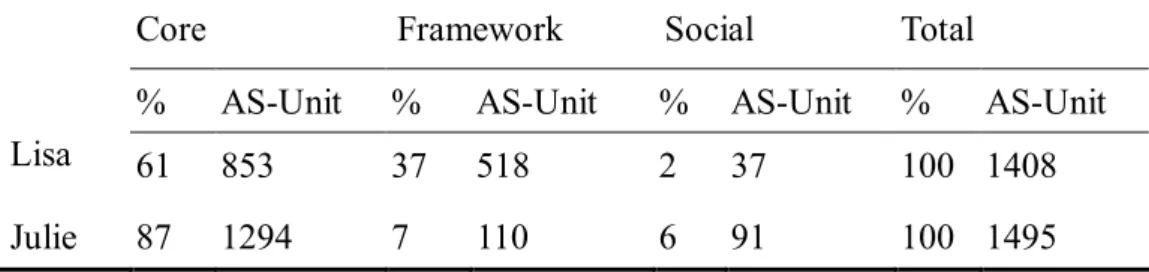
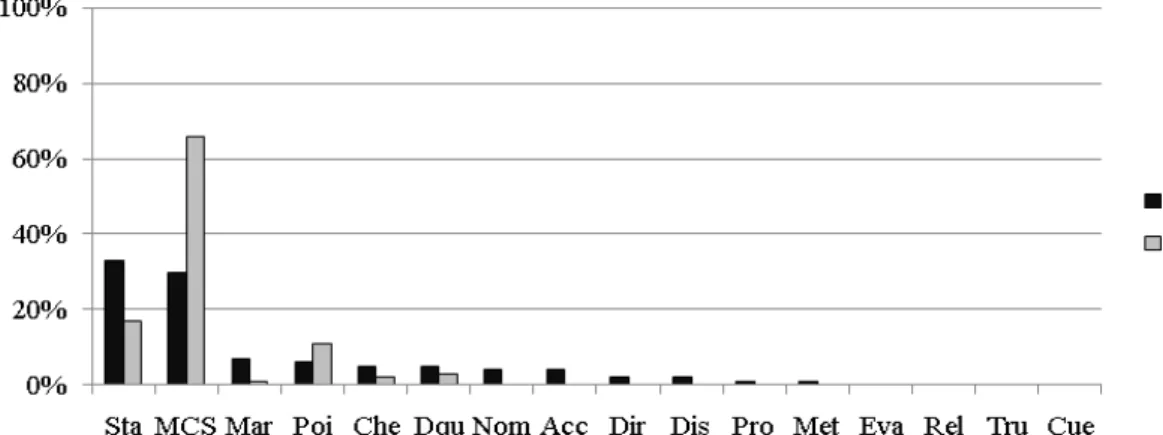
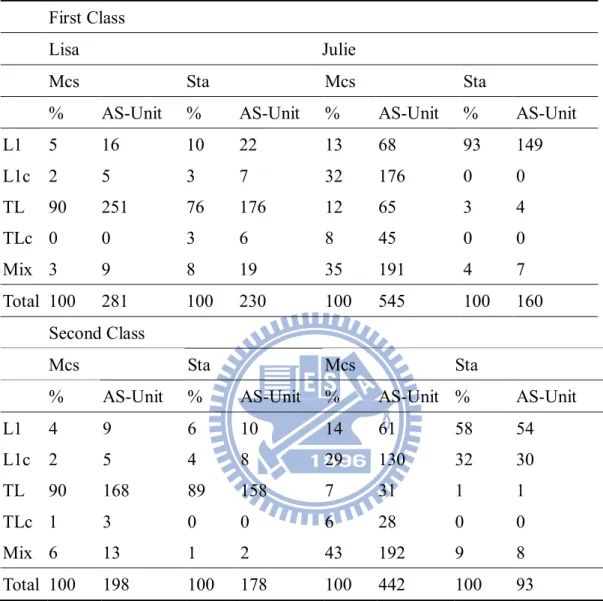
Table 3.1 Teaching Procedure of the Two Teachers’ Classes... 33 Table 3.2 Coding Categories and Definitions of Subcategories in the FLAATT... 38 Table 4.1 Frequency of Overall Amount of AS-Units by Language Used ... 42 Table 4.2 Frequency of Amount of AS-Units by Language Used in Two Classes .... 42 Table 4.3 Frequency of Overall Amount of AS-Units by Goal Orientation ... 45 Table 4.4 Overall AS-Unit within the Category of Teaching Acts in Two Teachers’ Classes……….47 Table 4.5 The Teachers’ Language Use within the Two Most Frequent Used Teaching Acts ……….56
ix List of Figures
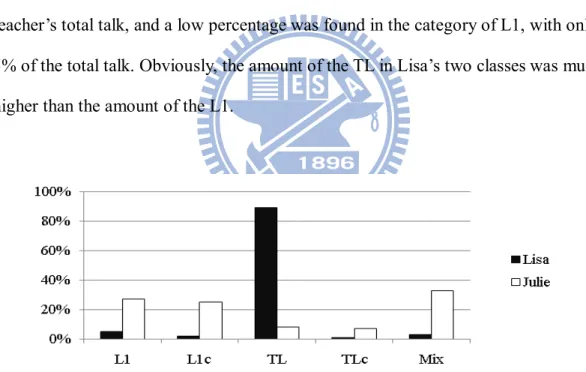
Figure 4.1 Overall Amounts of the Teachers’ L1 and TL Use in Two Classes... 41
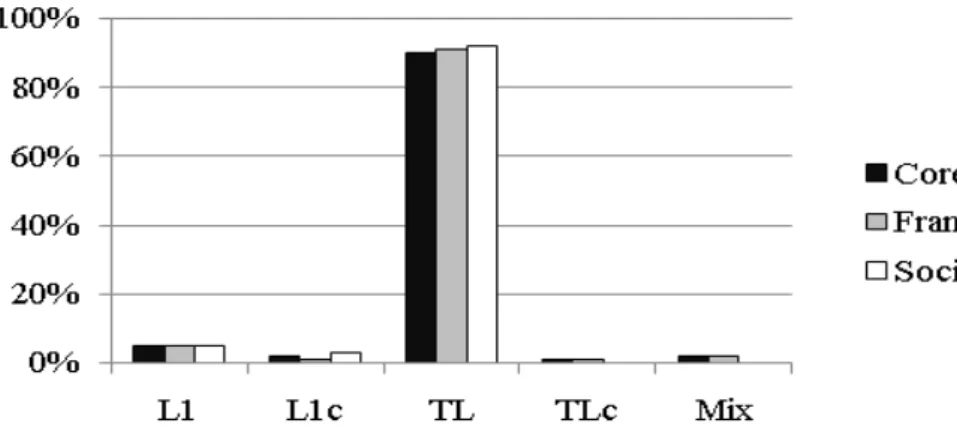
Figure 4.2 Frequency of Overall Amount of AS-Units by Goal Orientation ... 45
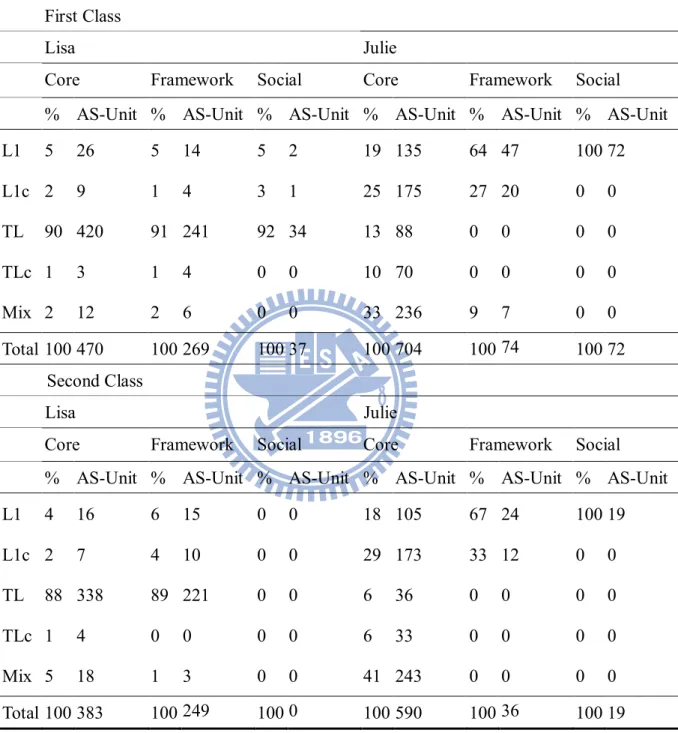
Figure 4.3 Lisa’s Language Uses within Goal Orientation in the First Class ... 48
Figure 4.4 Julie’s Language Uses within Goal Orientation in the First Class... 48
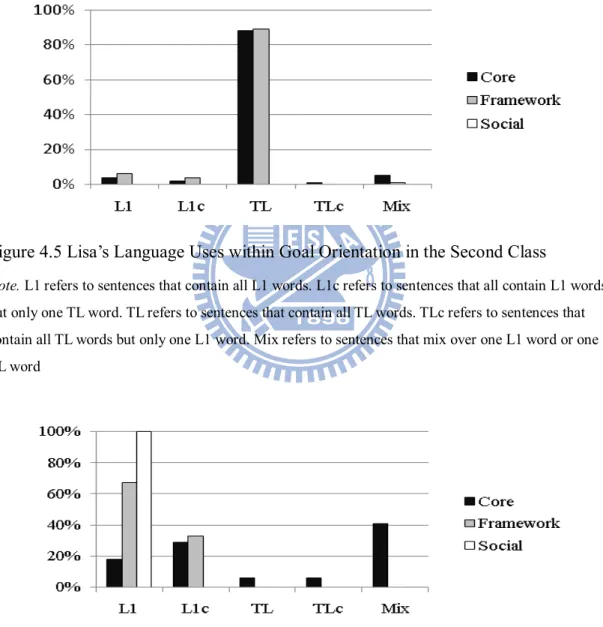
Figure 4.5 Lisa’s Language Uses within Goal Orientation in the Second Class ... 49
Figure 4.6 Julie’s Language Uses within Goal Orientation in the Second Class ... 49
CHAPTER ONE
INTRODUCTION
Background and Rationale
The trend of globalization has made a huge impact on many aspects of societies at various levels, including language policies of many non-English-speaking countries (Kirkgöz, 2009), such as Taiwan, Korea, Japan and Turkey. Recently, many language policies on English education at various levels are recommended in order to enhance students’ English proficiency and have them be internationally competitive (中央社, 2007). Some language educators suggest that we should provide enrich English environment at various education levels in Taiwan by encouraging courses taught entirely in English.
At the level of college education, it is suggested that content courses taught in English should be provided for international students so as to become
internationalized university. Therefore, in recent years, more and more college courses are instructed entirely in English in order to confirm the needs. Under the claim of creating enrich English environment for students and under the trend that content courses are to be taught in English, without saying, English language courses are examined more strictly than ever. The concept that English should be the
predominant language in language classrooms is gradually admitted of no doubt, which lead the practice of using L1 to teach English class to receive criticisms from societies. The issue of whether teachers should use students’ mother tongue to teach English in classrooms thus has been examining and received more attention in recent years.
The issue of teachers’ L1 use in language classrooms is always controversial and has been debated by many language teachers and researchers for last decades.
Research on teachers’ L1 uses in the second language (SL) and foreign language (FL) classroom has been a fruitful endeavor in the last two decades. Whether teachers should use students’ L1 in FL classrooms has been discussed from various language teaching and learning perspectives. Some researchers believe that using only target language (TL) in SL and FL classrooms makes the language real and that switching to the L1 undermines language learning process (Ellis, 1985). On the other hand, L1 was claimed for a role in learning and teaching another language in that L1 not only facilitates students’ understanding of complicate grammar rules, but also reduces students’ anxieties of learning a foreign language (Swain & Lapkin, 2000).
In earlier studies of teachers’ language use in SL and FL classrooms (Duff & Polio, 1990; Gass & Madden, 1985; Guthrie, 1987; Polio & Duff, 1994; Stern, 1992), the quantity of teachers’ L1 and target language (TL) use is the research focus; many educators and researchers aim to find out an optimal amount of L1 use in order to establish principles of teachers’ language uses. Various studies indicate that the amount of teachers’ L1 and TL use varies according to different course objectives and different teaching contexts (Duff & Polio, 1990; Macaro, 2001). Many factors that influence teachers’ L1 and TL use have also been identified such as language policy, classroom activities and teachers’ beliefs of language use (Liu, Ahn, Baek, & Han, 2004; Macoro, 2001; Rolin-Ianziti & Brownlie, 2002). Among these factors, teacher belief of language use is especially evidenced to be one of the significant factors that influence teachers’ language choices between the L1 and the TL (Duff & Polio, 1990; 1994; Kim & Elder, 2005; 2008).
Recently, the research focus of teachers’ language use in classrooms has been shifted from the debate on how much L1 should be used to the exploration on when teachers use students’ L1 and for what purposes. Similar functions have been found on teachers’ uses of L1, such as in situation when teachers explain complicated
content, manage students’ behaviors and build relationship with students (Levine, 2003; Rolin-Ianziti & Brownlie, 2002). Rolin-Ianziti and Brownlie (2002) found that teachers increase their use of students’ L1 to explain grammatical forms. Levine (2003) also found that teachers regarded L1 as a useful tool when communicating about grammar usage, tests or assignments. However, the coding schemes used in previous studies are not cross-linguistic consistent, and more contextual factors should be taken into consideration when analyzing the functions of teachers’ L1 use (Kim & Elder, 2005; 2008).
In addition to the actual language use in the classrooms, teachers’ perceptions and beliefs of L1 and TL use in the classrooms have been received a lot of attention. Many studies show that teacher belief of language use is a key factor influencing their language choices (Duff & Polio, 1990; Kim & Elder, 2005; Liu, Ahn, Baek, & Han, 2004; Macoro, 2001). Some researchers further examine teachers’ beliefs of language use to explain why teachers use L1 in certain situations. It is generally agreed that English teachers have certain preconceived ideas and individualized approach about teaching English (Levine, 2003; Liao, 2007). Teachers’ beliefs of language teaching might come from previous pedagogical training, knowledge of language learning theories, official policy, and classroom experience ( Levine, 2003). Hence teachers’ knowledge and beliefs play critical roles in their professional practice of teaching (Ellis, 2004); these beliefs about English teaching help understand how teachers implement their teaching and their instructional procedure (Liao, 2007). However, although teachers’ beliefs of language use are critical for the practice and
decision-making, some researchers pointed out that language teachers show different language teaching behaviors from their self-reported beliefs of language use in class. In other words, language teachers may be unaware of their use of L1 and TL during class, even though they each have unique sets of beliefs about how to best approach
English teaching (Liao, 2007).
Although there is a growing number of research conducted on teachers’ L1 and TL use in FL classrooms, more specific principles about teachers’ language use such as when and how to use the TL or the L1 and for what purposes still need to be established in Taiwan, especially at the university level. In addition, comparing to studies on the amount and the functions of teachers’ uses of L1, research on the relationship between teachers’ beliefs of language use and their practice of teaching deserves more attentions. Therefore, the present study takes a step further to examine the relationship between teachers’ beliefs of language use and their practice of teaching.
Purpose of the Study
The purposes of the study are mainly to explore the relationship between FL teachers’ beliefs of language use and their actual teaching behaviors in class. The specific purposes are:
1. To examine how much L1 and TL the teachers used in class,
2. To realize the functions of the teachers’ code-switching between TL to L1, 3. To explore the teachers’ beliefs of L1 and TL use in FL classroom,
4. To investigate the relationship between the teachers’ beliefs and actual practice in teaching.
Research Questions
The following four research questions guided the investigation of the present study:
1. What are the amounts of two college English teachers’ uses of the L1 and the TL in foreign language classroom?
2. How do teachers differ in the functions of their code-switching between the L1 and the TL?
3. What are the teachers’ beliefs of language use in foreign language classrooms? 4. How teachers’ beliefs of language use are related to their actual code-switching
behavior in the classrooms?
Significance of the Study
It is hoped that by answering questions of the present study, it will contribute to our understanding of the relationship between FL teachers’ beliefs of language use and their practice in language teaching. The values of the study are manifested from two perspectives. First, the examination of the amount and the functions of teachers’ uses of L1 and TL provide teachers’ actual teaching behaviors in class, which allows the comparison of teachers’ beliefs of language use and their practice. Second, there is a further discussion on how teachers’ beliefs of language use influence their actual teaching behaviors in class, which may provide insights of the relationship between teachers’ beliefs and practices of language use. Finally, such an examination may lead to a better understanding of how FL teachers in university level reflect their beliefs of language use on their practice in teaching.
Definition of Terms
Code-switching: “‘Code-switching’ is generally used to cover the shift of one
language (or code) to another at both inter-sentential and intra-sentential levels” (Ho, 2008, p. 18). Inter-sentential code-switching is the switch to another language at the sentence boundary, and intra-sentential code-switching refers to the switch to another language within a sentence (Myers-Scotton, 1993).
speaker’s utterance consisting of an independent clause, or sub-clausal unit, together with any subordinate clauses(s) associated with either” (Foster et al., 2000).
FLAATT: ‘The Functional Language Alternation Analysis of Teacher Talk’ (FLAATT)
is a multiple-category coding system designed for the analysis of teacher talk in terms of a range of pedagogic functions (Kim & Elder, 2005).
CHAPTER TWO
LITERATURE REVIEW
Introduction
In second and foreign language (SL/FL) classrooms, teacher use of learners’ first language is a controversial issue. Many researchers have debated on this issue for a long period of time and different viewpoints toward the use of learners’ L1 in
language classrooms are proposed. The present study first discusses theories and reasons for avoiding and supporting the use of students’ L1 in classrooms. Secondly, previous studies that investigate teachers’ code-switching between TL and L1 in the classroom are reviewed. Thirdly, the approaches of analyzing the amount and the functions of teachers’ TL and L1 use are presented. Lastly, studies that describe teachers’ beliefs of TL and L1 use in language classrooms are addressed.
Teachers’ Uses of L1 and TL in the Classroom
When researchers address the issue of first language (L1) and target language (TL) use in SL and FL classrooms, especially the idea of exclusive TL use, there is always a debate for whether students’ L1 should be used in language classrooms (Cook, 2001; Macaro, 2001; Storch & Wigglesworth, 2003; Turnbull, 2001). Two opposing positions claim their ideas toward this issue; on one side of the issue, it is believed that teachers’ use of L1 undermines the language learning process (Macaro, 2001) and thus L1 should be avoided in the classroom; on the other side of the issue, students’ L1 is claimed for a role since it serves numerous functions for learning a second and foreign language from several learning perspectives (Cook, 2001; Storch & Wigglesworth, 2003; Greggio & Fil, 2007). In the following section, I’ll first review literature avoiding use of L1 in language classrooms, and then those support
the use of L1 in language classrooms.
Avoiding Use of L1 in Language Classrooms
For the opposition that discourages the use of students’ L1 in language classrooms, Cook (2001) proposed three versions of teachers’ use of L1. For the ‘strongest’ version, the L1 is totally banned in the class; for the ‘weakest’ version, the L1 is claimed to use as little as possible in the class. Another version, ‘maximize the TL in the classroom,’ is claimed by most researcher and educators nowadays which stresses the importance of the TL instead of emphasizing the detrimental effect of L1 on TL learning or acquisition.
The TL-only position can date back to the end of the 19th century, when the exclusive use of TL in language classrooms was advocated in many teaching methods (Cook, 2001; Liu, Ahn, Baek & Han, 2004; Storch & Wigglesworth, 2003). It was believed that teachers should perform every classroom task in the TL which allows learners to exposure to the TL maximally and to have enough opportunities to practice the language being learned (Çelik, 2008). The teaching methods such as the Direct Method, the Total Physical Response Method and the Natural Approach were influenced by Chomsky’s theory of innate language acquisition, believing that
comprehensible language input occupies an indispensable role in language acquisition (Liu, Ahn, Baek & Han, 2004). The role of L2 input was thus believed to be denied when teachers used the L1; therefore, using L1 was regarded as deterioration in language acquisition process (Liu, Ahn, Baek & Han, 2004). Among the teaching methods, the Communicative Approaches, designed for learners to maximize the use of the TL in the classroom, were widespread and adopted by many language teachers. Students’ mother tongue is therefore suggested to use as little as possible (Storch & Wigglesworth, 2003). Therefore, the mainstream and the trend in twentieth-century
language teaching methodology is this anti-L1 attitude and the ideal language classroom is to minimize the use of L1 (Cook, 2001).
According to Cook (2001), there are some arguments for avoiding using L1 in language learning classrooms. The unwillingness of using L1 in language classrooms can be traced back to some language learning theories. One of the original reasons of using TL maximally in language classrooms is that second language learning is believed to be processed as monolingual children acquire their mother tongue; that is, L2 learners should not rely on their L1. However, Cook (2001) claims that this justification for maximizing the TL use and avoiding the L1 use based on L1
acquisition is not a convincing one. Moreover, it is claimed that the proper model for learning another language should be based on the natural acquisition of a second language rather than the L1 acquisition (Butzkamm, 2003). It is also claimed that children who grow up with two languages actually employed both languages to facilitate their acquisition or learning of the other language; bilingual children not only used two languages to help clarify meanings, but also practiced the two languages at the same time consciously (Butzkamm, 2003).
Another reason for avoiding L1 use in classrooms is that successful L2
acquisition is believed to be achieved only if the L2 is separated from the L1, that is, L2 should be learned for its only existence instead of connecting with the L1 (Cook, 2001). In this way, the two languages are regarded as two distinct systems in learners’ mind and the L2 is built up as a separating system (Weinreich, 1953). However, several researchers claim that the two languages are actually interwoven in L2
learners’ mind no matter in the aspect of vocabulary, syntax, phonology or pragmatics (Beauvillain & Grainger, 1987; Cook, 1994; 2001; Locastro, 1987; Obler, 1982). It is also argued that learners use one single conceptual system to store L1 and L2
from the L1 meanings in learners’ mind (Cook, 1997b).
The notion of avoiding the use of L1 in SL and FL classrooms apparently supports Krashen’s (1981) hypothesis, the Acquisition-Learning Hypothesis and the Input Hypothesis, for instance. It was believed that language ‘acquisition’ is different from language ‘learning’ in that acquisition is a more integral process and it can only happen in a target language environment; in other words, the mother tongue is impossible to play any role in this acquisition process (Çelik, 2008). As Krashen and Terrell (1983) stated, “Adult also can acquire: they do not usually do it quite as well as children, but it appears that language acquisition is the central, most important means for gaining linguistic skills even for an adult” (p.18). It was also argued that input is the indispensable element in the L2 curriculum in that the classroom is a place for language students to obtain comprehensible inputs that are indispensable for language acquisition.
Moreover, the viewpoint of the maximal use of the TL is also evidenced in part of the second language acquisition (SLA) research that is related to classroom input and interaction, in which teachers’ and students’ uses of L1 are always not the issue under discussion (Levine, 2003). It is a well-known belief that SLA is strongly
influenced by the students’ L1 and that the role of L1 in SLA is negative (Ellis, 1985). Ellis (1985) argued that SL or FL teachers should not overuse students’ mother tongue since it decreases students’ opportunities to receive valuable TL input. The strongest theoretical rationale for teachers’ maximized TL use seems to expose learners to TL input (Turnbull, 2001). Several studies have shown that input is crucial for SL learning (Seliger, 1977; Wong-Fillmore, 1985; Turnbull, 2001). It was widely
assumed in the late twentieth-century of the SLA research field that the quantity of the TL is one of the important variables in the successful acquisition of the TL; in other words, students could acquire another language successfully if they receive more SL
or FL input (Day, 1984). Seliger (1977) claims that those ESL students who were more proficient in English obtain significantly more TL input either inside or outside classrooms than those who receive low level of TL input. Wong-Fillmore (1985) also suggests that teachers help students’ comprehension by translating to students’ L1 lead to students’ ignorance of the TL since they find that it is not necessary to pay attention to the language being learned.
It is these justifications for using the TL maximally in language classrooms that lead students’ L1 as a negative element in SL and FL learning process; the mother tongue is used as a helpful tool only in emergencies (Butzkamm, 2003, p. 29).
Support the Use of L1 in Language Classrooms
Although the role of L1 is perceived as an obstacle for learning another language in part of the early viewpoints of SLA, a conviction that the L1 has a necessary and facilitating role in SL and FL classrooms increasingly appears among a number of later research (Antόn & DiCamilla, 1998; Butzkamm, 1998; Cook, 2001 & 2005; Cole, 1998; Çelik, 2008; Gass, 2005; Macaro, 2001; Schweers, 1999; Turnbull, 2001). Dulay (1982) claims that in recent years the L1 is no longer considered as a negative ‘interference’ in learners’ acquisition of a second language; on the contrary, for bilinguals, both the first and second language are regarded as selections of their communicative repertoire.
Many of professionals in the field of SLA argue against the L2-only proponents from numerous language learning perspectives (Antόn & DiCamilla, 1998; Brooks & Donato, 1994; Cole, 1998; Swain & Lapkin, 2000; Villamil & De Guerrero, 1996). From the sociocultural perspective, L1 apparently facilitates learners’ SL and FL learning process. Antόn & DiCamilla (1998) examined the social and cognitive functions of L1 use in the L2 learners’ collaborative speech of in the classroom. They
claimed that within the theoretical framework of Vygotskian psycholinguistics, students’ use of L1 was found to provide scaffolded help to peers and to construct a shared knowledge of the task which enabled the zone of proximal development (ZPD) worked effectively; in addition, L1 was used in the form of private speech to solve problems by learners in which L1 was supported as a cognitive tool (Antόn & DiCamilla, 1998). Cole (1998) suggests that students’ shared knowledge of the L1 benefit them in learning a new language; teachers can help students increase the understanding of L2 by uncovering their previous L1 learning experience. Brooks and Donato (1994) also found that students’ L1 facilitates their negotiation of meaning and communication successfully in the TL; the use of L1 enables learners initiate and sustain verbal interaction with one another. Villamil & De Guerrero (1996) claimed that using the L1 was an important strategy to gain control of the task in that “the L1 was an essential tool for making meaning of text, retrieving language from memory, exploring and expanding content, guiding their action through the task, and
maintaining dialogue” (pp. 60). It seems that the L1 is used naturally by L2 learners when they engage in the process of interactions and problem-solving tasks (Villamil & De Guerrero, 1996). Swain and Lapkin (2000) also contend that students are able to accomplish their tasks more effectively by accessing to the L1 input. Therefore, it was argued that “judicious use of the L1 can indeed support L2 learning and use. To insist that no use be made of the L1 in carrying out tasks that are both linguistically and cognitively complex is to deny the use of an important cognitive tool” (pp. 268-269).
Aside from the cognitive learning theories, still many others suggest from several different perspectives about the value of the L1, such as from linguistic, psychological and strategy using perspectives (Atkinson, 1987; Auerbach, 1993; Butzkamm, 2003; Cole, 1998; Çelik, 2008; Harbor, 1992; Storch & Wigglesworth, 2003). The L1 is claimed to be an indispensable tool for learners to compare the linguistic differences
between the two languages such as syntactic features (Cole, 1998; Çelik, 2008). It is also suggested that students are able to be aware of the language learning process and reduce potential L1 interference by comparing and contrasting the forms and
meanings of the L1 and the TL (Butzkamm, 2003; Çelik, 2008). Storch &
Wigglesworth (2003) also claimed that using the L1 is a normal psychological process for learners since they share understanding of the performed tasks and which allow them to initiate and sustain verbal interaction successfully; learners can provide each other the meaning of the unknown words more directly in their L1. Moreover, Atkinson (1987) proposes some advantages of mother tongue uses from three perspectives. One of the significant advantages of using the L1 is the translation technique which is regarded as a ‘learner-preferred strategy’; it is a natural process for learners to correlate the syntactic structure and vocabulary of TL to their familiar mother tongue (Harbor, 1992). Another advantage is described from a humanistic approach in that learners’ L1 helps establish their identities if their culture background is valued and respected by teachers (Çelik, 2008), as Atkinson (1987) stated,
“Common sense suggests that a belief in the way one approaches a task is likely to affect one’s chances of success” (p. 242). Additionally, the L1 may provide learners a sense of security and past living experiences which lead them to express ideas freely and thus are willing to take a chance to perform tasks in the TL (Auerbach, 1993; Çelik, 2008). The last advantage is from the time-saving perspective; the use of the L1 is sometimes efficient in terms of saving time which is needed to achieve a specific purpose (Atkinson, 1987; Harbor, 1992).
The L1 seems to provide a familiar and effective way either in enhancing learners’ comprehension of the TL by connecting to their previous L1 learning
knowledge or in establishing their confidence of learning a new language. Cook (2001) suggests that teachers should maximize the use of TL without avoiding the L1 ‘at all
costs’. L1 and TL should be used complementary according to the stages of the language learning process; besides, the purposes of the organization where the language is being learned are also crucial factors (Stern, 1992). However, it should also be defined clearly the maximal and optimal TL use in terms of the quantity and the quality; how much TL use is appropriate for students in different stage of language learning process and when it is acceptable for teachers to use students’ L1 (Turnbull, 2001).
Empirical Studies on Teachers’ Uses of TL and L1 in Language Classrooms An examination of teachers’ uses of TL and L1 in language classrooms had been a fruitful endeavor in the mid 1990’s. Researchers aimed to describe teachers’ code-switching between TL and L1 in SL and FL classrooms; the quantity of teachers’ TL and L1 use, the functions of teacher using students’ L1, the factors influencing teachers’ language choices, and teachers’ beliefs and attitude toward their use of the L1. The following section will discuss issues related to teachers’ uses of TL and L1 in bilingual or multilingual educational contexts around the world.
The Amounts and Factors of Teachers’ Uses of L1
Several studies have been conducted on the amount of teachers’ TL use in the SL classroom. The quantity of TL input is regarded as crucial since there is little
opportunity for learners to receive TL outside the classrooms, especially in foreign language learning contexts (Duff & Polio, 1990). Linguistic input and interaction in the ESL classroom have both been described by many researchers; however, the FL classroom, an area which deserves much more attention, has not been fully examined so far (Polio & Duff, 1994). Noticing that few studies have addressed the issue of input in FL learning contexts either theoretically or empirically, several researchers
recently quantified teachers’ uses of students’ L1 and TL in FL classrooms and analyzed factors influencing their language choices (Duff & Polio, 1990; Liu, Ahn, Baek & Han, 2004; Kim & Elder, 2005;2008; Levine, 2003; Macaro, 2001;
Rolin-Ianziti & Brownlie, 2002). Duff and Polio (1990) studied thirteen different FL classes at the university level; Macaro (2001) investigated 6 student teachers in 14 FL lessons in a secondary school; Rolin-Ianziti and Brownlie (2002) examined four college teachers teaching beginning French; Levine (2003) conducted an
Internet-based questionnaire study on university-level FL classes; Liu, Ahn, Baek & Han (2004) investigated secondary school teachers in South Korea; Kim and Elder (2005) examined seven foreign language teachers at the university level.
Although it is generally agreed that the classroom must create an input-rich environment in which learners have optimal opportunities to use the TL meaningfully through many types of interaction, there is much research evidence of teachers’ frequent use of students’ L1 in FL classrooms (Kim & Elder, 2008). Different degrees of L1 use by teachers were reported in several studies; varied extent of L1 use (Duff & Polio, 1990; Liu, Ahn, Baek & Han, 2004; Kim & Elder, 2005;2008) and relatively low levels of L1 use (Macoro, 2001; Rolin-Ianziti & Brownlie, 2002; Levine, 2003) were both found. Numerous factors that influenced the quantity of teachers’ use of L1 and their decision making of language use were thus discussed in these studies.
Duff and Polio (1990) reported the amount of TL and L1 found in thirteen different university-level foreign language classes. The teachers were all
native-speakers of the language being taught, and English was the students’ L1. A broad range of TL use by the teachers was found; the ratio of the TL use was from 10 percent to 100 percent. The researchers further suggested several possible
factors/variables related to the teachers’ language use according to the teacher interview, including a) language type; b) departmental policy; c) lesson content; d)
materials; and e) formal teacher training. The teachers used the L1 in administrative announcement instead of using the TL. The researchers believed the teachers were able to use as much TL as possible since using L1 in these contexts deprives students of many opportunities to receive and practice in the TL. Moreover, the researchers found that language proficiency may not be a key factor in limiting teachers’ use of the TL since even FL native-speaker teachers who have a high level of TL proficiency tend to use students’ L1 during classes. Similar results were found in Kim and Elder (2005). Kim and Elder (2005) examined the language choices made by seven
native-speaker teachers of Japanese, Korean, German and French in foreign language classrooms in New Zealand secondary schools. English was the L1 of the students. All the teachers were found using L1 in class, but the amount of their use of the TL and L1 varied to a great extent; the proportion of TL use ranged from 23% to 88%. In accordance with Duff and Polio (1990), the researchers concluded that being native speakers of TL did not guarantee a high proportion of TL use. On the other hand, Liu, Ahn, Bae, & Han (2004) pointed out that non-native FL teachers seemed to agree that limited TL proficiency was one of the reasons that restricted their use of the TL (Liu, Ahn, Bae, & Han, 2004). Liu, Ahn, Bae, & Han (2004) investigated 13 high school English classrooms and found that, although the amount of TL use was similar to Duff and Polio (1990) in that the percentage varied from 10 percent to 90 percent, one of the main reasons that the teachers were not using as much English as they could was because of the lack of oral proficiency or confidence in using the TL (Liu, Ahn, Baek, & Han, 2004). Although it cannot be fully evidenced that language proficiency is the significant factor influencing teachers’ use of TL and L1 from these study results, Duff and Polio (1990), Kim and Elder (2005) and Liu, Ahn, Bae, & Han (2004) do indicate that teacher code-switches from the TL to students’ L1 to facilitate students’ understanding and to enhance their comprehension of the content.
Students’ L1 seems to be perceived as a more effective medium than the TL when the teachers perform complicated instructions and teaching activities. Several studies show that activity type seems to be one of the factors that affect teachers’ choices of instructional language (Duff & Polio, 1990; 1994; Kim & Elder, 2005; 2008; Liu, Ahn, Baek, & Han, 2004; Macoro, 2001; Rolin-Ianziti & Brownlie, 2002; Levine, 2003). The following research reveals that teachers tend to use more L1 when performing more complicated teaching activities. Rolin-Ianziti and Brownlie (2002) conducted a project in a FL context in which teachers used L1 to actively promote an immersion approach to FL teaching. The language uses of four college teachers of beginner French were examined. The results showed relatively low percentages of L1 use; the percentage of L1 use among the four teachers in listening activities varied from 0 percent to 18.15 percent. The researchers further discovered that the amount of L1 was higher in grammar activities than in listening activities. In other words,
explaining grammatical forms seems to be a motivator that led the teachers to significantly increase their use of the L1. Similar findings were also revealed by Macoro (2001) and Levine (2003). Although a relatively low level of L1 use was discovered in both studies, Macoro (2001) and Levine (2003) indicated that teachers code-switched to students’ L1 to perform certain teaching activities. Macaro (2001) examined how six student teachers made decisions about L1 and TL use in their FL classes after they had been exposed to theoretical positions and empirical studies on the issue of code-switching in a 36-week training program. The findings revealed a relatively low level of L1 use by the student teachers; there was only a 6.9 percent (Mean) use of the L1 in teachers’ total talk. The teachers tended to resort to L1 when providing meanings of lexical items, enhancing comprehension and promoting interactions. Levine (2003) conducted an Internet-based questionnaire study in university-level FL classes in which 600 FL students and 163 FL teachers responded
to questions on the Internet according to their estimations of the TL use in the class. In accordance with previous studies, activity type was a factor influencing their use of the L1; the teachers perceived L1 to be a more effective medium than the TL for communicating about grammar usage, tests or assignments. Kim and Elder (2005) also found FL teachers tended to use L1 when the lesson involved more
communicative peer interaction which required more complicated instructions to set up the activities. Considering the low proportion of L1 use and functional use of the L1, Macoro (2001) concluded that there is little reason to exclude the use of L1 in classrooms; L1 could be a valuable tool to facilitate L2 learning when making L1 and TL associations at either a semantic level or at a morphosyntacic level (Macoro, 2001). Moreover, rather than denying a role of L1 in the classroom, teachers should accept the fact that the L1 serves numerous functions in the FL class; in the meantime, some principles need to be established by understanding the functions and consequences of code-switching in FL classrooms (Macoro, 2001; Levine, 2003). Liu, Ahn, Baek, and Han (2004) also suggest that rather than using English exclusively in the classroom, code-switching may provide a useful and necessary tool for educators at all levels if L1 and TL are used based on clear-established guidelines. As Macoro (2001) stated, “As a teaching community we need to provide, especially for less experienced teachers, a framework that identifies when reference to the L1 can be a valuable tool and when it is simply used as an easy option. In this way we may work towards a theory of optimality for the use of code-switching by the teacher” (p, 545).
Another crucial factor that influenced the different degrees of L1 and TL use in the classrooms is teachers’ beliefs and attitude toward language use. In Duff and Polio (1990), it was the teachers’ varied attitudes that affected their different degrees of TL use; teachers who had been trained to use more of the TL and who believed such use effective used higher ratios of TL (Duff & Polio, 1990). In Macoro (2001), teachers’
varied attitudes also well explained the wide range of ratio of TL use. Several teachers conveyed their reservations about using more of the TL than they currently use. A few mentioned that it took too long to get their point across in the TL. Furthermore, Liu, Ahn, Baek, and Han (2004) indicate that teachers’ beliefs and attitudes appeared to influence their decisions to switch codes; the teachers who spoke far less TL than others were those who did not feel the need or the pressure to use TL. Kim and Elder (2005) agreed that the factor of teacher belief needs to be further examined since teachers’ beliefs and attitudes about language learning may determine the content and the structure of the lesson.
The Functions of Teachers’ Uses of L1
The proportion of teachers’ uses of L1 and TL is not the only critical variable that explains the L2 acquisition process. Chaudron (1988) stated that “as several have argued and attempted to demonstrate in their data, it is the functional allocation of the TL relative to the L1 which would indicate to the learner the priorities of the extended social environment those schools and teachers represent” (p. 124). That is to say, to describe teachers’ uses of L1 in different classroom contexts, understanding only the quantitative estimation of L1 use is oversimplified and insufficient. Therefore, several researchers further examined the functions of teachers’ uses of L1 in FL classrooms by analyzing teacher talk in class and by interviewing the teachers to fully explain teachers’ language uses (Ferguson, 2003; Greggio & Fil, 2007; Liu, Ahn, Baek, & Han, 2004; Polio & Duff, 1994; Rolin-Ianziti & Brownlie, 2002; Storch &
Wigglesworth, 2003). A more qualitative perspective is specifically used to illustrate the functions of teachers’ uses of L1 in FL classrooms.
In a FL learning context, Polio and Duff (1994) found that teachers’ uses of students’ L1 were mainly to (a) explain grammar, (b) manage the class, (c) index a
stance of empathy or solidarity towards students, (d) translate unknown vocabulary items and (e) help students when they have problems understanding. Ianziti &
Brownlie (2002) also found similar functions of teachers’ switching to L1. In an EFL context, Ianziti & Brownlie (2002) adopted Polio and Duff’s (1994) coding categories of functions and found that teachers used learners’ L1 mainly for (1) translating and contrasting; (2) commenting, managing the class, and answering student requests and (3) expressing state of mind. Greggio & Fil (2007) further analyzed the functions of teachers’ two-way code-switching in an EFL context, that is, the functions of the switching from TL to L1 or from L1 to TL. They investigated the use of English and Portuguese in two groups, a beginner group and a pre-intermediate group. The results showed that teachers’ code-switching in the two groups were to: (a) mark the
beginning of class (L1 to L2); (b) get the learner’s attention (L2 to L1); (c) maintain the planned structure of the class (L1 to L2); (d) facilitate/clarify understanding of grammatical rules and structures (L2 to L1); (e) provide equivalent meaning in L1/translate vocabulary(L2 to L1) and (6) give advice (L2 to L1).
Similar functions were found in several studies of FL teachers’ code-switching from TL to L1. Regarding to these functions of L1 use proposed by several
researchers, Ferguson (2003) classified these functions into three categories which provided an overview of FL teachers’ code-switching behavior in language
classrooms. FL teachers’ switching to L1 was mainly for (a) curriculum access; (b)
classroom management discourse; and (c) interpersonal relation. Curriculum access
refers to teaching behaviors that help students understand the content of the lesson; teachers tended to switch from TL to L1 to provide explanation and instruction which were more difficult to comprehend for students when performed in TL (Ferguson, 2003). Many researchers had found FL teachers used L1 to achieve the function of
(1) instruct grammar, (2) translate unknown TL vocabulary and (3) remedy students’ apparent lack of comprehension; Rolin-Ianziti and Brownlie (2002) also found that the functions of (1) translation and (2) comment about forms were performed in L1 by teachers; Liu, Ahn, Baek, & Han (2004) also revealed that L1 was used to (1) explain vocabulary and grammar, (2) overcome difficulty expressing in the TL. Rolin-Ianziti and Brownlie (2002) and Liu, Ahn, Baek, & Han (2004) both agreed that FL teachers’ switching to L1 should be used as a strategy which contributed to students’
comprehension either in grammar rules or vocabulary items. Using L1 strategically in clarifying concept may affect TL learning positively; the function of ‘Translation’, for example, may help enhance comprehension by relating meaning with other speech modification and may also draw students’ attention to specific words by highlighting the meaning in L1 (Rolin-Ianziti & Brownlie, 2002).
L1 was also found used frequently for classroom management discourse by teachers; teachers’ switching to L1 was served the functions of negotiating task instructions, inviting student contributions, disciplining students, specifying a particular addresses, and so on (Ferguson, 2003). Rolin-Ianziti and Brownlie (2002) found that the teachers switched to the L1 to motivate students to speak in the TL by encouraging students to perform a role play in the TL. Liu, Ahn, Baek, & Han (2004) also found that some teachers used the L1 to reprove and manage students’ behavior when it failed to achieve these functions in the TL. Storch & Wigglesworth (2003) also found that the L1 was used mainly for task management and task clarification. It was also indicated that teachers gave instructions related to classroom management in the L1 in Polio and Duff (1994).
In addition, switching to L1 was regarded as a medium that facilitated
interpersonal relation between teachers and students; Polio and Duff (1994) pointed
L1 was used to achieve interpersonal and rapport-building purposes; the teachers switched to L1 to joke with students which made teachers’ roles as empathetic peers (Polio & Duff, 1994). Ferguson (2003) also claimed that TL indexed a more distanced and formal teacher-student relationship; to create a warm and closer relationship with students, teachers may switch to the local language (L1) to encourage greater student involvement. The idea that code-switching served the function of promoting
teacher-student interaction was also proposed by several researchers (Greggio & Fil, 2007; Rolin-Ianziti & Brownlie, 2002). Greggio and Fil (2007) suggested that teachers’ code-switching occupied an important role in FL classrooms in terms of facilitating the interaction among classroom participants and FL learning in general. Code-switching was an interactive process between teachers and students; in other words, teachers’ switching to L1 was motivated by the classroom participants
(Rolin-Ianziti & Brownlie, 2002). Üstunel and Seedhouse (2005) also mentioned that code-switching used by teachers and learners in L2 classrooms should be regarded as an interactional resource, which made the teaching and learning environment fluid and dynamic.
The investigation of the functions of teachers’ uses of L1 in language classrooms had been a fruitful endeavor so far; however, the fact that different languages taught in different contexts were not considered in the coding schemes used for analyzing TL or L1 use in previous studies. In response to this lack of cross-linguistic applicability of the coding schemes, Kim and Elder (2005, 2008) developed a multiple-category coding system, ‘Functional Language Alternation Analysis of Teacher Talk’
(FLAATT), which allowed a cross-linguistic comparison of the relationship between teachers’ language choices and particular pedagogic functions. Moreover, Kim and Elder (2005) made a distinction between ‘classroom’ functions and ‘pedagogic’ functions, who stated that “the assumption that every utterance the FL teachers
produce can be in the TL and has a potential to become intake for the learner and thus has a pedagogic function, the functions realized in the participating FL classrooms will hereafter be treated as ‘pedagogic’ functions” (Kim & Elder, 2005, p, 378). The researchers examined the language choices of seven native-speaker teachers of Japanese, Korean, German and French in FL classrooms in New Zealand secondary schools. The results showed that there was no systematic relationship between the teachers’ language choices and particular pedagogic functions. Furthermore, the teachers were found using variable degrees of TL when performed the most frequent functions; the teachers who used higher TL amount did not use TL consistently in their most frequently used functions. In line with Polio and Duff (1994), Kim and Elder (2005, 2008) claimed that FL teachers did not aware of their language choice during teaching process; there was an inconsistency of teachers’ beliefs of language uses and their actual language teaching behaviors in classrooms.
Kim and Elder (2005) claim that more evidence documenting teachers’ language choices for particular pedagogic functions in different languages and different classroom environments is needed. To judge the linguistic quality of the classroom environment, various contextual factors should be taken into consideration (Guthrie, 1987; Kim & Elder, 2005). Therefore, the coding scheme should be
cross-linguistic consistency since the FL instruction was offered in a range of different languages in different contexts; besides, it is important if any general principles of language uses are to be established (Kim & Elder, 2005).
The Analytical Approach of Teachers’ Use of TL and L1
Since there was a rapid growth of interest in classroom-oriented research during the past decade, especially the aspect of language teaching and learning process, different analytical approaches were used and a large number of observational
instruments were designed to describe and analyze what goes on in the classroom (Allen et al., 1984). On the aspect of teachers’ uses of TL and L1 in language classrooms, a unit for the segmentation of oral data is necessary and an objective descriptive tool is also essential to help realize the teaching and learning process. The following section will introduce the analytical approach used in Kim and Elder (2005; 2008), the AS-unit and the FLAATT system, which provide useful means to analyze classroom data objectively and cross-linguistically in terms of classroom language use and pedagogic functions in different classroom contexts.
Coding System ‘FLAATT’
The general framework of the coding system ‘FLAATT’ was adopted from COLT (Communicative Orientation of Language Teaching) created by Allen et al. (1984), which involved four coding categories: (1) language used (Duff & Polio, 1990), (2) goal orientation (Ellis, 1984), (3) teaching acts (Sinclair & Coulthard, 1992; Tsui, 1985), and (4) addressee (Kim & Elder, 2008). Language used refers to the classification of teacher talk according to the degree to which the TL is mixed with the L1 (Kim & Elder, 2005); in other words, it is a category that determines the amount of teachers’ TL and L1 uses. Goal orientation is the classification of
classroom interactions, which includes three types of goals: (a) core goals, (b) framework goals, and (c) social goals (Ellis, 1984, 1994). Teaching acts refer to teachers’ talks that achieve certain teaching purposes and functions. Addressee refers to “the audience for the teacher utterances which may be either the whole class or a particular individual” (Kim & Elder, 2008, p.172). The categories of goal orientation,
teaching act and addressee will be discussed in detail in the bellowing section.
When numerous well-developed coding systems have been proposed, there has been a shift of attention from the study of the linguistic features of input to the nature
of the interaction between native-speakers and L2 learners (Tsui, 1985). The importance of examining interaction in understanding L2 acquisition and in
considering what is necessary and efficient in L2 instruction were pointed out (Tsui, 1985). Ellis (1984) suggested that types of classroom interaction may occupy important roles in classroom second/foreign language development (SLD/FLD) and thus proposed a framework to investigate types of classroom interaction. Three types of interactive goals that motivated interaction in the language classroom were
distinguished: (a) core goals, (b) framework goals and (c) social goals. Core goals are “Goals where the teacher’s primary target is the teaching of the TL” (Ellis, 1984, p. 102).In other words, teachers’ uses of L1 or TL are to teach the TL itself. Framework
goals are goals that get pupils to respond to the organizational requirements of the
lesson; for example, the communication about the materials and tools required to carry out an activity and routines of classroom business, etc (Ellis, 1984). Social goals refer to the social needs in that the TL is used as the medium of everyday
communication in the language classroom (Ellis, 1984). The three subcategories of
goal orientation help analyze the purposes and functions of teachers’ language uses
more systematically.
Attempting to analyze certain aspects such as the verbal interaction pattern in language classrooms, Tsui (1985) developed a Seventeen-Category System by
combing several observational systems, including Flanders (1970), Barnes (1969) and Sinclair and Coulthard (1975). Totally seventeen categories of ‘acts’ were contained in this coding category. The seventeen categories of ‘acts’ were all speech acts defined according to the function they perform in classroom interaction (Tsui, 1985). Each category is provided a clear definition which contributes to the analytical approach of classifying classroom discourse in different classroom contexts.
‘FLAATT’ that is developed by Kim and Elder (2005), and which will be adopted by the present study to analyze transcribed classroom data since these clear-defined categories provide a useful tool to help understand teaching procedures inside the language classroom.
The Unit of Analysis ‘AS-Unit’
Foster et al. (2000) stated the importance of the unit of analyzing speech data: The analysis of spoken language requires a principled way of dividing transcribed data into units in order to assess features such as accuracy and complexity. If such analyses are to be comparable across different studies, there must be agreement on the nature of the unit, and it must be possible to apply this unit reliably to a range of different types of speech data.
(p. 354)
According to Foster et al. (2000), the units used to analyze speech data in earlier studies were not clearly-defined and were defined in different ways. A unit for the segmentation of oral data should be definable and can be applied reliably to a range of different types of speech data. Foster et al. (2000) therefore proposed a unit of analysis, the Analysis of Speech Unit (AS-Unit) and provided a clear definition of this unit: “The unit termed AS-unit is a mainly syntactic unit. An AS-unit is a single speaker’s utterance consisting of an independent clause, or sub-clausal unit, together with any subordinate clauses(s) associated with either (p. 365).”
Followings are the definition of each clause adapted from Foster et al. (2000).
An independent clause refers to a clause including a finite verb, ‘That’s right’, for
example, is an independent clause. The independent sub-clausal unit was also
one or more phrases that can be elaborated to a full clause by means of recovery of ellipted elements from the context of the discourse or situation, or (2) a minor
utterance (p. 366). A subordinate clause will consist minimally of a finite or non-finite verb element plus at least one other clause element (Subject, Object, Complement or Adverbial) (p. 366).
Kim and Elder (2005) suggested that because of the definition of sub-clausal units, the AS-unit could also be applied to both the Asian and European languages. Therefore, the AS-unit is adapted to analyze in the present study.
Teachers’ Beliefs of Language Use in the Classroom
Teachers’ underlying beliefs of pedagogical principles occupy crucial roles in mediating their on-going decision-making and actions with a particular class of learners in a particular teaching situation (Breen, Hird, Milton, Oliver & Thwaite, 2001). Recently, teachers have been encouraged to reflect on every aspect of their teaching since many of them are often unaware of their teaching behaviors and how the teaching behaviors influence their students’ learning either positively or
negatively (Farrell, 2008). During the 1980s, a number of studies interested in discovering the beliefs and knowledge of novice and experienced teachers across subject areas and levels in the education system (Breen, Hird, Milton, Oliver & Thwaite, 2001). A growing attention about teachers’ beliefs had also been paid to the phenomenon of teachers’ code-switching between the TL and the L1 in language classrooms. Among the code-switching research, aside from the amounts and the functions of teachers’ uses of L1, teachers’ beliefs and perceptions about TL and L1 use in the classrooms were gradually received attentions.
Although it is indicated that teachers’ beliefs of language use is one of the significant factors that influence their language choice in the class, their beliefs of
language use are not always in consistent with the actual language use during teaching process. Polio and Duff (1994) provided an important insight of the relationship between teachers’ perceptions of language use and their actual teaching behaviors in the FL classrooms. They found that some teachers seemed to be unaware of how much L1 they use, why and when they actually use L1. Those teachers stated in the interview that they used English, the L1, for giving instructions; however,
corresponding instances of this behavior could not be found. It was pointed out that although L1 words were used most common for administrative elements such as “midterm,” and “homework” in spoken utterances, none of the teachers acknowledged the use of L1 words, which showed a lack of awareness of language uses among the teachers.
Since teacher beliefs of language use are indispensable elements in determining teachers’ language choices and since the inconsistency of teachers’ perceptions of language use and their language teaching behaviors was found, some researchers conducted studies about teachers and students’ perceptions and beliefs of L1 use in language classrooms (Ellis, E, 2004; Edstrom, 2006; Levine, 2003; Macaro, 2001). Macaro (2001) investigated six student teachers’ uses of code-switching in classrooms and their beliefs of L1 use. It was found that two student teachers whose teaching behaviors were influenced by different reasons and beliefs. One student teacher who used high proportion of TL was found highly influenced by the National Curriculum guidelines rather than by language learning theories and empirical evidences she had learned and known. On the other hand, the other student teacher believed in the value of the L1 in promoting a deeper understanding of semantic and syntactic equivalents and in avoiding the breakdown of the interaction reflected her beliefs on her teaching practice. Levine (2003) investigated how students and teachers perceived the L1 and the TL use in foreign language classes by using a comprehensive questionnaire.
Teachers and students answered the questions according to their perceptions and estimations of the TL use in class. A consistency between students’ and teachers’ responses about the amount of TL was found; both students and teachers agreed that the TL was used most of the time by the teachers. Nevertheless, their findings were not based on samples of actual classroom interaction but were based on respondents’ perceptions and beliefs. Edstrom (2006)self-recorded her teaching process of a university-level Spanish course. The researcher contended that although she believed the importance of maximizing TL use in the language classroom because of her past experience of being a language learner and the training of being a language teacher, her beliefs were not always in equivalent with the practice. Her perception of L1 use is approximately 5 to 10 percent, which is far less than her actual L1 use in class.
When teachers used TL and L1 inconsistently, students would not know how and when to use the TL and the L1 at appropriate situation. When teachers regulated students to use TL exclusively, they themselves did not reflect on their language uses (Duff & Polio, 1994). Therefore, the examination of only the quantity of teachers’ L1 use in language classroom is not in itself the most important in SL and FL learning, what critical for language learning is weather teachers aware their own language uses by reflecting their beliefs on the practice of teaching. Kim and Elder (2005) suggested that teachers need to be aware of their language choices in order to provide FL
learners rich TL inputs that help language acquisition occur whether they advocate or oppose the use of L1 in FL classrooms.
Although some studies have investigated teachers’ beliefs of language use, in general, the examination of the relationship between teachers’ beliefs of language use and their practice of teaching in class is still a neglected area. Within the extensive literature on teachers’ code-switching between L1 and TL, comparatively little
teaching behaviors. It calls for more research to discuss how FL teachers’ beliefs related to their teaching behavior and weather the teachers are aware of their language use in class. The present study, therefore, is primarily concerned with how teachers reflect their beliefs on practices of teaching and what factors affect their language choices between TL and L1 by examining and interpreting their actual language teaching behaviors in class and their beliefs about language use in the FL classroom.
CHAPTER THREE
METHODOLOGY
Introduction
The study aims to investigate teachers’ code-switching between the TL and the L1 and their beliefs of language use in FL university-level classrooms in Taiwan. The research questions addressed are:
1. What are the amounts of teachers’ uses of the L1 and the TL in the foreign language classroom?
2. How do teachers differ in the functions of their code-switching between the L1 and the TL?
3. What are the teachers’ beliefs of language use in foreign language classrooms? 4. What was the relationship between teachers’ beliefs of language use and their
actual code-switching behavior in the classroom?
This chapter is organized in three sections: (a) participants, (b) data collection, and (c) data analysis.
Participants
To explain teachers’ uses of code-switching between the TL and the L1 in EFL classrooms, the participants in the present study were two Taiwanese English teachers, Lisa and Julie, who were proficient in both English (TL) and Chinese (L1). Lisa and Julie taught Freshman English reading courses in one university in Taiwan. The following presents the two teachers’ background information and the teaching procedure of their two classes.
The Teachers’ Background Information
The background information of the two teachers were described in terms of their
previous major subject in school and teaching experiences before they entered the current college for teaching.
Lisa had been abroad to English country for Master Degree, and majored in Teaching English as Second or Other Language (TESOL) for one year and three months. Before this college, Lisa had taught English to children and courses of English certificate test such as IELTS and GEPT for two years.
Julie had been abroad to English country for Master degree as well, and also majored in TESOL for two years. The teacher had taught English courses at another college for one year before entered this college. The overall year for teaching English was one and half a year.
The Teaching Procedure of the Two Teachers’ Classes
To understand how the two teachers used the L1 and the TL in their classes, this section introduces the teaching procedure of the first and the second class. Both classes are reading classes, and different textbooks are selected for class use. Lisa’s textbook contains short reading articles and is more dialogue-oriented, while Julie’s textbook contains long reading articles and difficult vocabulary.
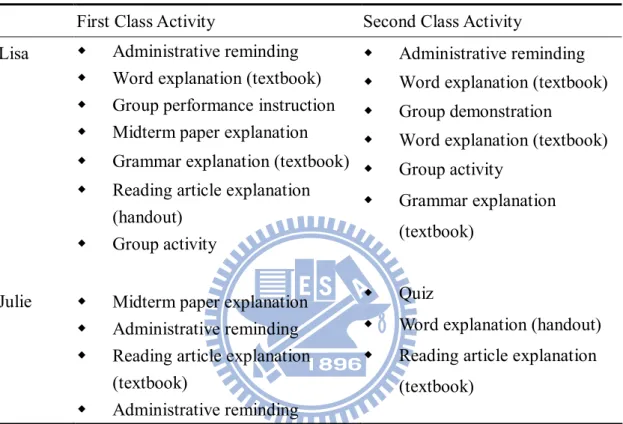
Table 3.1 is a summary of the teaching activities of the two teachers’ two classes.
Lisa usually had an administrative reminding about assignments or examines before started the class. The class started by explaining content on the textbook and then followed by students’ group performances such as role plays which were related to class content. A handout with reading articles was used to supplement the class content.