科技部補助專題研究計畫成果報告
期末報告
大學課室國際化之教與學: 挑戰與機會(第2年)
計 畫 類 別 : 個別型計畫 計 畫 編 號 : MOST 102-2410-H-004-205-MY2 執 行 期 間 : 103年08月01日至104年09月30日 執 行 單 位 : 國立政治大學外文中心 計 畫 主 持 人 : 陳彩虹 計畫參與人員: 大專生-兼任助理人員:單珮萱 大專生-兼任助理人員:王孟媛 大專生-兼任助理人員:溥志成 報 告 附 件 : 出席國際會議研究心得報告及發表論文 處 理 方 式 : 1.公開資訊:本計畫涉及專利或其他智慧財產權,2年後可公開查詢 2.「本研究」是否已有嚴重損及公共利益之發現:否 3.「本報告」是否建議提供政府單位施政參考:否中 華 民 國 104 年 12 月 25 日
中 文 摘 要 : 目前全球有超過四百萬學生正在國外接受高等教育(OECD, 2013),這使得高等教育課室中學生母語及文化的多樣性與日俱增 ,直接衝擊到老師的教學與學生的學習。這個兩年期計畫探討在有 一定數量非亞裔外籍生課程中,台灣教師、外籍生和台灣學生的教 與學之經驗。參與者為9位教師、14位外籍生,及31位台灣學生。藉 由深度和追蹤訪談,本研究發現資深與資淺教師們教授此類課程的 經驗有很明顯的差異,外籍生則是整體來說有適應困難,且並未隨 時間而改變。最後,本研究中的大部分本地生似乎沒有因修習此類 課程而在文化或課業方面有明顯受益。 中 文 關 鍵 詞 : 外籍生、高等教育、國際化、英語授課
英 文 摘 要 : More than 4 million students are currently enrolled in higher education abroad (OECD, 2013). The growing cultural and linguistic heterogeneity in classroom demographics poses a great challenge to university teaching and learning. This 2-year study investigated teaching and learning practices in classes that enroll a significant number of Western students at a Taiwanese university through in-depth interviews with 9 Taiwanese teachers, 14 foreign students, and 31 Taiwanese local students.
Preliminary findings show distinct differences in the experiences between experienced and less experienced teachers, general ill-adaptation of foreign students over the course of their study, and little cultural or academic impact on Taiwanese students.
英 文 關 鍵 詞 : foreign students, higher education, internationalization, English-taught programs, EMI
Challenges and opportunities for teaching and learning in internationalized
university classrooms
BACKGROUND TO THE STUDY
The latest statistic released by the OECD indicates that 4.3 million students were enrolled in higher education abroad in 2011 (OECD, 2013). With classroom demographics becoming increasingly heterogeneous, university teachers are faced with the challenge of educating learners who may embrace different conceptions of learning than their own. The challenge can be particularly daunting when a teaching context involves students sojourning between the East and the West, as abundant evidence has indicated that educational beliefs and practices in these two parts of the world are distinctly different (Chen & Bennett, 2011; Li, 2010). A heterogeneous class population means that students enter the learning context with “different identities, understandings and habits of meaning-making” (Hyland, 2006). This can also present a great challenge to students when they are trying to interact with their peers, especially in contemporary higher education, which stresses collaborative learning. While most students recognize the benefits of learning in an internationalized environment, particularly for their own future employability and personal intellectual development, research concerning interactions between domestic and international students has shown that university students are inclined to work with those from similar cultural backgrounds for high-stakes group work (Leask, 2010; Osmond & Roed, 2010). This raises the question of how an internationalized curriculum, which is warmly embraced and more and more widely practiced at the institutional level, is being carried out at the micro level of the classroom. In sum, the teaching staff’s and domestic students’ experiences of university internalization are intertwined with those of international students, and should be given due attention in discussions of student mobility.
The direction of student mobility has traditionally been from East to West. However, the past decade has seen many East Asian countries, including China, Singapore, Japan, Malaysia and Taiwan, actively and strategically positioning themselves as receiving countries of international students. Ambitious initiatives have been launched by these countries to transform themselves from being on the periphery to becoming major players in the international student market (Li & Zhang 2011). China, in particular, is making high-profile attempts to attract Western students from prestigious universities in the U.S., the U.K. and Australia, which it views as one way to demonstrate its “education power” (Sharma, 2012). In short, growth in the West-to-East migration may be expected in the years to come (Bhandari, Belyavina & Gutierrez, 2011).
Taiwan’s educational system, its recent educational reforms and aspirations to internationalize higher education parallel those of its East Asian counterparts (Chou & Ho, 2007; Roberts, Chou, & Ching, 2010). The government is seeking to double its international
student number by 2014 to reach the level as Japan, Malaysia, Singapore and South Korea in the foreign-local student ratio (Liu, 2011). Substantial funding has been injected into scholarship programs and projects for supporting universities to provide English-taught courses. These courses often enroll both international and domestic students. On the one hand, they accommodate international students who are not equipped with sufficient Chinese language abilities to take courses taught in Chinese. On the other hand, the courses provide opportunities for Taiwanese students to receive content and language integrated instruction, which is believed to enhance Taiwanese students’ global competitiveness. Although currently, the international students in Taiwan are mainly from the Asian region, the number of Western students is steadily growing. Given the aforementioned differences between Eastern and Western views of education, it could be expected that Western students’ increasing presence on Taiwanese campuses may pose new challenges to Taiwanese teachers and students.
In a preceding study (Chen, 2014), I investigated international students’ academic adaption at a Taiwanese university, which found that Western and Hispanic students encountered a major culture clash in their learning experiences in Taiwan. They experienced the teaching practices as characterized by a relatively highly insulated curriculum and strongly controlled pedagogy. According to them, the course content focused on content knowledge and the teacher’s interpretations of this knowledge, both strongly confined to the educational context. The course content was then taught to learners through carefully planned and often inflexible procedures, which prioritized teacher lecturing and highly organized class interaction. The study concluded that the students did not see this form of teaching practice as conducive to their learning, as they felt unable to obtain the type of knowledge they deemed to be particularly valuable. While the study provided important insights into how Taiwanese teaching practices were experienced by students who came from a different learning culture, it only shed light on international classrooms in Taiwan from one perspective, that of international students. To fully understand what happens in Taiwan’s international classrooms, the perspectives of teachers and domestic students need to be examined. Moreover, half of the international students in the study were in the first year of their study programs. It is tenable to say that their experiences and perceptions may change over the course of their study. These changes should be investigated as they are a crucial element of cross-cultural adaption (Berry, 1990). The present study, therefore, aims to help bridge this gap in the research.
METHOD
Research question
I conducted the study at one of the major host universities for international students in Taiwan (hereafter, the University). In this study, an “international classroom” or an “international class” was defined as a course taught in English (also widely known as an English-as-a-medium-of-instruction, or an EMI course) in which at least 10% of the students
were non-Asian international students. (The reason why Asian international students were excluded from the present study was that my previous research found Asian students had little difficulty adapting to their study in Taiwan thanks to the great similarities between their previous and current learning environments.) The following research questions anchored the study:
1) What are Taiwanese teachers’ experiences of teaching an international class? 2) How do international students’ learning experiences change over time? 3) What are Taiwanese students’ learning experiences in international classes?
Participants
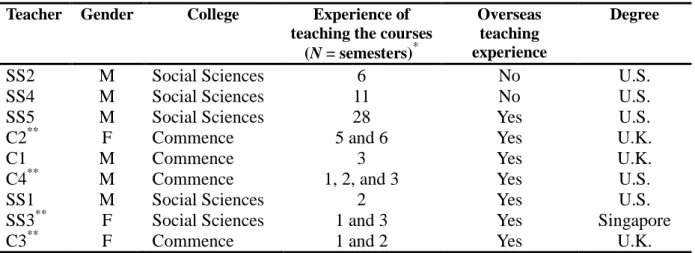
Participants were 9 teachers, 14 international students and 31 local Taiwanese students. The criteria for selecting the teachers were that they were, or had experience of, teaching an international class at the University, and that they were teaching in the colleges from which the international students in my prior study (Chen, 2014) were drawn. The teacher participants recruited were 6 males and 3 females, who were from College of Commerce (n = 4) and College of Social Sciences (n = 5). Their experiences of teaching international students at the University ranged from 1 to 14 years. Most of them had experience teaching overseas when they were teaching assistants in the US or England. Table 1 presents the information about the teachers.
Table 1. The Taiwanese teachers
Teacher Gender College Experience of teaching the courses
(N = semesters)*
Overseas teaching experience
Degree
SS2 M Social Sciences 6 No U.S. SS4 M Social Sciences 11 No U.S. SS5 M Social Sciences 28 Yes U.S. C2** F Commence 5 and 6 Yes U.K. C1 M Commence 3 Yes U.K. C4** M Commence 1, 2, and 3 Yes U.S. SS1 M Social Sciences 2 Yes U.S. SS3** F Social Sciences 1 and 3 Yes Singapore C3** F Commence 1 and 2 Yes U.K.
*
N refers to the number of semesters in which the participant taught at least one international class at the time when they were interviewed;**The participant was interviewed multiple times.
The criteria for selecting the international students were that they were degree-seeking students, had provided rich data in the preceding study, and could be more easily accessed during the duration of the present study. Because the students were recruited for the purpose of examining the longitudinal changes in their experiences over time, priority was given to those who were first-year students in their study programs when participating in my previous
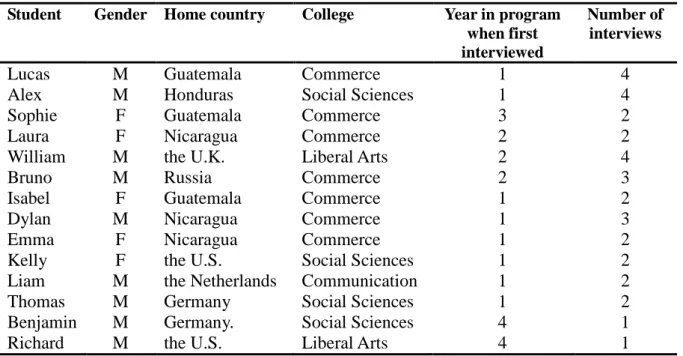
study. The 14 student selected comprised 9 males and 5 females, and their study programs were commerce (n = 7), social sciences (n = 4), liberal arts (n = 2) and communication (n = 1). The students were from Central America (n = 7), Europe (n = 5) and North America (n = 2). Table 2 outlines information about these students. The two fourth-year students, Benjamin and Richard, were selected because although they were finishing their study programs when I interviewed them, both of them were able to report their experiences over the course of their study during the interviews.
Table 2. The international students
Student Gender Home country College Year in program when first interviewed
Number of interviews
Lucas M Guatemala Commerce 1 4 Alex M Honduras Social Sciences 1 4 Sophie F Guatemala Commerce 3 2 Laura F Nicaragua Commerce 2 2 William M the U.K. Liberal Arts 2 4 Bruno M Russia Commerce 2 3 Isabel F Guatemala Commerce 1 2 Dylan M Nicaragua Commerce 1 3 Emma F Nicaragua Commerce 1 2 Kelly F the U.S. Social Sciences 1 2 Liam M the Netherlands Communication 1 2 Thomas M Germany Social Sciences 1 2 Benjamin M Germany. Social Sciences 4 1 Richard M the U.S. Liberal Arts 4 1
The third group of participants was local students. Among the 31 Taiwanese students, about one third (n = 10) were males and two thirds (n = 21) were females. They were 10 second-year, 3 third-year and 18 fourth-year students. About one third of the students (n = 10) had taken one course that qualified as an international class, half of them had taken two (n = 8) or three (n = 7) courses, and the remaining (n = 6) had taken more than 3 such courses. About two thirds of the students were from the College of Commerce, and the majority of the students who had taken more than one course reported taking courses offered by the College of Commerce and the College of Social Sciences, the two colleges from which the teacher participants were drawn.
Data collection and analysis
Data was collected mainly through individual interviews, supplemented by a short survey and document review. I conducted all the interviews, using Chinese with local participants and English with international students. Each interview with the teachers and international
students lasted for about 1 hour, and each interview with local students was between 30 and 40 minutes. All interviews were semi-structured, with the questions being open-ended and developed based on the research questions and the literature.
As some of the teacher participants had only taught one international class when interviewed, I invited them for followed-up interviews to examine whether their experiences and perceptions changed after they accumulated more experience of teaching such classes. As a result, half of the teachers were interviewed multiple times. They were asked about their experiences of teaching the courses, including their perceived benefits and challenges; their interaction with the students; and their observation of student learning in the courses.
Each international student was interviewed 1 to 4 times, depending on their availability. In the majority of cases, they were interviewed once every year during their course of study at the University. The total number of interviews with each student depended on the length of their study program (see Table 2). As most of the interviews were followed-up interviews, I started each interview by providing the student with a summary of the previous interview and asked for their feedback. Then the student was asked to compare their current experience with the prior one.
All local students were interviewed only once. They were asked about their reasons for taking the courses, and their perceived benefits and challenges in taking those courses. They were also asked to compare the teaching approaches they encountered in those courses and in their other courses where there were no international students. Example questions were: “In terms of the teaching methods, how do the courses differ from your other courses?”, “What was it like to study with international students?”, and “When doing group work, would you prefer to work with local or international students?”. All interviews were transcribed verbatim for analysis.
RESULTS AND DISCUSSION
This section presents and briefly discusses some preliminary results that address the first two research questions. Data analysis concerning the third question was still in progress at the time of writing.
Teachers’ experiences
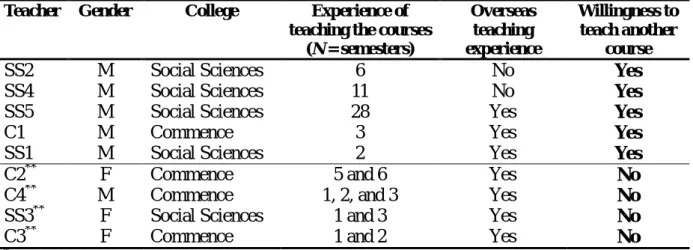
To understand whether each teacher participant perceived their teaching experiences in the courses as generally positive or negative, in each interview, the teacher was asked whether they would be willing to teach an English-taught course again. Table 3 presents the results with demographic information about the teachers. As shown, 5 of them said yes, and 4 said no. The former attributed their positive evaluation of their experiences to international students’ contributions to class interaction, which according to two of the teachers (SS4, SS5), made their teaching “enjoyable and rewarding.” On the other hand, those who stated they preferred
not to teach another international class spoke unfavorably of their overall experiences during their interviews, with all of them describing the classes as “a burden” and “not worth the effort” they put in to the teaching. It was revealed in the interviews that this perception was largely due to the less favorable course evaluation results of these classes compared with the results of the teachers’ other classes. As one (C3) mentioned, the difference between the results of the two types of classes could be as great as 20%: “my other classes normally attracted an average mark of above 90%, but the marks for my international classes were usually between 70% and 80%. That was … frustrating, considering the great amount of effort I needed to make for the classes” (C3-2).
Table 3. Teachers’ responses to the question of whether they would teach another international
class
Teacher Gender College Experience of teaching the courses
(N = semesters) Overseas teaching experience Willingness to teach another course
SS2 M Social Sciences 6 No Yes
SS4 M Social Sciences 11 No Yes
SS5 M Social Sciences 28 Yes Yes
C1 M Commence 3 Yes Yes
SS1 M Social Sciences 2 Yes Yes
C2** F Commence 5 and 6 Yes No
C4** M Commence 1, 2, and 3 Yes No
SS3** F Social Sciences 1 and 3 Yes No
C3** F Commence 1 and 2 Yes No
*
N refers to the number of semesters in which the participant taught at least one English-taught course at the time they were interviewed;**The participant was interviewed multiple times.
In terms of the positive side of their experiences, the teachers reported two major benefits of the courses. The first was they found teaching the courses benefited themselves in terms of the courses’ providing them with opportunities to sharpening their English language skills. This was considered a significant benefit by all teacher participants because, they stated, possessing good English language abilities gave them an advantage professionally in the globalized world. The second benefit of the courses reported by the teachers was the courses enhanced local Taiwanese students’ verbal participation in class. As this teacher said,
When I ask questions, there were always responses from international students. I noticed at the beginning of the semester, some local students seemed a little intimidated and they didn’t know how to react to that. But I found once they knew international students better, a couple of them, who were quiet before, would try to share their opinions in class. Although they still weren’t as eloquent as international students, I think that was good peer learning. (SS4)
Questions in relation to challenges of teaching the courses generated enthusiastic discussion in all interviews. The teachers’ remarks fell into three categories: challenges caused by language, by local students and by foreign students. Regarding language, first, the teachers felt the quality of their teaching was compromised due to language barriers. One reason mentioned was they tended to give fewer spontaneous examples to elaborate on difficult concepts in class because it took them time to organize their thoughts in a foreign language. As a result, as one (C4-2) noted, he often relied on the examples he had prepared beforehand. The other negative impact caused by the language factor was the reduced opportunities for experiential learning in the course. Teacher C3 emphasized her belief in the importance of connecting theory to practice, and her accompanied frustration of implementing this belief in her international classes. As she explained, “Taiwan is not an English-speaking country, so it’s almost impossible for me to arrange for my international students to do projects in companies, which I’m able to do in my other courses” (C3-2).
A further challenge imposed by language was the teachers’ self-identity. Teacher SS3 was particularly bothered by her felt inability to show her students in her international courses the kind of person she really was. In the following quotes, she talked about changing into a different person in those classes, and how she would uncharacteristically avoid her international students outside class:
When my friends heard I had to teach in English, their first reaction was it was a shame because, they said, my students wouldn’t be able to see the comedian side of me. (SS3-2)
When I hear my international students chatting outside class, I don’t feel I can join them because … I know the conversation would get to the point where I don’t know what they are talking about. So I normally say goodbye to them as soon as the class finishes. Even when taking the elevator, I’ll take the one at the far end which few students take to avoid embarrassing situations like this. It’s a shame because I wouldn’t do this to my Taiwanese students. (SS3-2)
The second category of challenges encountered by the teachers related to Taiwanese students’ criticism of their English in the course evaluation. Although this issue ostensibly concerns language, I did not classify it as a challenge caused by language as the teachers unanimously expressed the opinion that the criticism stemmed from Taiwanese students’ unrealistic expectation of teachers’ perfect language abilities in these courses. Several teachers mentioned they had never received international students’ complaints about their English, and neither had they had this problem when teaching in English overseas. Despite the assertive statements, experienced teachers were clearly more able to deal with this student expectation, while novice teachers still seemed to be affected by it. For example, after
expressing confidence in his language ability to teach the course, a novice teacher commented, “but once they dismiss my English abilities, they seem to dismiss my professional capabilities as well” (C4-2).
In relation to challenges posed by international students, the teachers reported having to deal with cultural differences in the view of discipline and learning motivation. One teacher shared a typical observation of the differences between international and Taiwanese students regarding this challenge,
International students tend to be too laidback about their study. They don’t seem to spend a lot of time studying…. Also, I found even when they see me have already entered the classroom, they would sometimes still be sitting at the windowsill. Taiwanese students wouldn’t do this. At least, they would go back to their seats as soon as they see me walking in. They show you more respect. (C2-1)
Relevant to this theme was the teachers also found international students had great difficulty adapting to the Taiwanese educational system. A teacher participant (SS-5) who had immense experience of teaching international students attributed the students’ ill-adaptation to their perceived inability to adapt to the testing measures. In this illuminating quote, he discussed how international students’ learning attitudes gradually changed from active to passive after they realized they could never excel in the course:
Our exams often contain many multiple choice questions because we follow American system and use standardized tests. This type of test is a great challenge for our international students. And when they don’t do well, they complain about the exam system being unfair…. I’ve noticed usually after the mid-term, many of them start to give up on their study. Their attitudes change. They speak less, and move to sitting at the back… . It’s sad to see them changing from being so confident and so keen on their study to giving up after they find it’s hard to excel on the exams. (SS-5)
Changes in international students’ experiences
Before the results regarding the international students’ adaptation at the University are presented, it should be mentioned at the outset that the South American participants’ remarks on their past learning experiences back home did not reflect a realistic picture of an average student’s educational experience there. In the participants’ accounts, those who obtained an opportunity to study abroad tended to come from a privileged family and had a privileged education. In fact, many of the South American participants in this study attended their local American high schools, and as one student put it, they “kind of have the American education” (Emma, Interview 2). Nevertheless, in spite of their differing experiences compared with most students in their countries, these participants’ prior educational experiences appeared to be typical among the South American student sojourners in Taiwan.
The results indicated there were few changes in the 14 international students’ overall perceptions of their learning environments. However, several students reported some changes in their learning behaviors or attitudes, which led to their different degrees of adaptation. This section provides a selection of examples. It is divided into two parts. The first part reports the changes that resulted in successful adaption, and the second part presents the changes that indicated ill-adaption.
Changes that led to adaptation
Changes that contributed to successful adaptation were observed in several students’ experiences, although their degrees of adaptation vary greatly. Due to space considerations, only two students’ experiences, Isabel’s and Emma’s, will be included in this section.
Isabel’s experience indicated she not only adapted well but also developed a deep appreciation for the Taiwanese learning culture. In the first year of her study, Isabel’s observation of the Taiwanese learning and teaching styles was similar to that of the other participants; that is, the teaching generally followed a transmission model with relatively little teacher-student interaction. However, in the second year, unlike the other participants, Isabel expressed an understanding and genuine acceptance of this form of practice. As she recalled, one of her Taiwanese friends had explained to her they preferred not to speak much in class because “teachers had a lot of knowledge of the subject that they can teach you, so students should make the most of the class time by absorbing the information and learning.” Isabel admitted she did not agree with the friend when she heard it in the first year but she now came to the realization that constant interaction with the teacher in class is not necessarily conducive to learning:
Now I see that maybe we were missing the time we have with the professors back home by us as students always interacting or sharing experiences or sharing information … now I think about it, maybe we missed a lot of time, precious time or precious information that the professor could have told us during the class. We missed that time because we were always asking questions. (Last interview)
Isabel was the only participant that reported having more Taiwanese friends than international student as close friends. In the following quote, she explained how she was able to see behind her Taiwanese classmates’ ostensible passiveness and benefit from her interaction with them:
I think they retract themselves a little bit more if they see foreigners or other students being more aggressive. But if you … give them time to talk I think they are not afraid to speak and they have really good ideas… . If you are just talking, talking, talking and never allow them to … I think it’s a good, very good investment of a few more seconds because you can get so much more from them. I've seen some
amazing ideas coming out of them. I think if you do not allow them the opportunity to speak or if you’re not interested enough in knowing their comments then you would never know. (Last interview)
What set Isabel apart from the other participants was she felt her values and interests were more similar to Taiwanese values than the values held by students who shared the same cultural background with her. She said her Taiwanese friends had commented that she was “very Taiwanese.” According to her, like Taiwanese students, she also believed the importance of “being disciplined in class,” and she was “afraid of making mistakes.” She also appeared to have been affected by the Taiwanese environment to become more reserved in providing her thoughts in class. As she described,
I think I’ve changed now. I’m a little bit more reserved now. Back home no one cares about others’ reactions when they speak out. They don’t think about “Oh they’re going to see me this way or that way” or something like that. Now I’m more like I think before I speak. I’m more cautious about things. I think this is something interesting. But I like it this way now that I think about it.” (Last interview)
Emma adapted to the Taiwanese learning environment in a very different way from Isabel. While both shared the experience of becoming more friendly with local students in the second year of their study, Emma’s relationships with local students did not develop into close friendship. She commented that her Taiwanese classmates became more open to foreign students, which made her feel more comfortable studying in the environment by giving an example of how they would respond to her complaints about the classes in the second year while they never seemed willing to reveal their feelings in the first year.
Although there was little change in Emma’s perceptions of the learning environment she experienced throughout the course of her study, she reported developing the skills to excel in the system. For example, she said she started to use the memorization skill, which successfully enabled her to achieve good marks in many of the exams. When asked if she was happy about this change, she unhesitatingly gave a positive response in relation to the exam outcomes, then adding, “But I mean, it doesn’t really count because I don’t remember it anymore” (Last interview). She also shared her observation of how other international students made the same adjustment in their study behaviors:
And I know all the foreign students memorized it in the end. I remember we were all at the student lounge with our PPTs and then we kept asking the others [questions] and then five minutes later, you would forget [the answers], and you would say, ‘What was this?’ and you could tell, it was hard for us to memorize. Maybe I understand something better and you understand something better so I can explain it to you and by explaining it, you can memorize it better. Or at least, you know, when you see the choices [in the multiple choice questions], you might think of ‘hey, it’s this one’. [Last interview]
Changes that impeded adaption
The longitudinal interviews indicated the unfamiliar educational system and environment gradually took its toll on several of the students. For illustration, this section focuses on two students: Alex and Laura. Compared with the other participants, Alex encountered the greatest difficulties in his adaption. He came from a different family background than the typical South American international student at the University. As he stated, his family was frugal, and he did not have many luxuries in his life. His interviews sent a very strong message that he had always been a high-achiever throughout his education, and that he had expected his overseas education to equip him with the ability to seek a career outside his country. Another unique characteristic of Alex’s experience was he was one of the few international students in his program. In his first interview, Alex appeared to be very ambitious, disciplined and self-motivated although seemingly stressed; at the time, he took the difficulties he experienced in his program as challenges:
I was like I had my rules like I wouldn’t, I would never go without sleep or study after midnight, that kind of thing, because it’s not efficient. I mean I would have my homework done the day before and everything.
However, his subsequent three interviews showed his attitudes gradually turned from persistence into capitulation and despair. The last interview with Alex was imbued with words such as “disappointed”, “overwhelmed” and “unmotivated”. When describing the change in his attitudes towards his study in the last two years of his study, he noted it was “a very confusing time” for him to feel the emotions he had never experienced before. He quoted his friends commenting he had “lost hope”. The following statement illustrates his loss of motivation to study:
It was tough for me to go to class. It’s very hard to get out of my house and go sit in class. I felt like I didn’t want to and then I had a hard time getting things done. I did get them done but I did not have the same, you know, attitude and motivation as I had the first year. I was like I couldn’t really tell why it changed. I was so motivated in the first year. I could do so much. I really had done so much. And despite just having 10 credits right now, it is so hard in the last semester. I had a tough time. (Last interview)
Most of the time, Alex seemed reserved in expressing his negative emotions about the learning environment. Unlike most of the other participants who tended to attribute their dissatisfaction with their study to external factors, Alex blamed himself:
I guess I was a bit disappointed, yeah, with myself, perhaps, that I don’t feel like that motivated anymore and yeah it’s very confusing for me. I’m like what am I doing, you know. I really worry about that. What is
it that I’m getting done here? I mean I’m getting my degree yeah, but I thought I would get something more you know. A little bit more experience or something and I have very little to show. (Last interview)
It seemed that emotionally, Alex was torn between two feelings: one was his gratitude for the scholarship and abundant resources he was given at the University, which he would never get if he had stayed in his country. This is evidenced by his repeated statement that he “had everything here.” The other feeling that seemed reluctant to express was his frustration with the environment not being able to challenge him intellectually. He mentioned that what used to stimulate him when he was studying in his country were not in place for him in his current environment. Three possible factors emerged from the interviews. The first was he was alone most of the time in his academic pursuit at the University:
It’s not my type of environment I guess. I’m very competitive sometimes, but it’s not useful when I don’t have collaboration or friendship with my classmates, and I don’t have that here. I’m always by myself so always alone especially in my program and my major. So it’s not as motivating you know and you’re always alone. So yeah I can do it. I know I can do it but, it’s just myself. So I do deliver but it’s not the same motivation.
He explained that with time, he saw less and less of his classmates, which he attributed to the irreconcilable gap between him and his local classmates, “We’re very different, and for me it’s very difficult to reconcile those differences. I tried but it’s hard.” Unfortunately, unlike other international students, Alex did not find comfort in the international student group although he did hang out with them. On further probing, it was found this was because he could not find people as driven academically as he was. As he remarked, “I don’t like the attitude that we just settle down you know, just relax”.
The second factor that demotivated Alex in his learning was he felt no matter how hard he tried, his academic performances stayed at the same level. He said,
I remember in earlier semesters I would go like “Yeah I’m going to get a lot of things done this time,” but now I saw my grades… I mean I am not bad but those are the marks I cannot go beyond, you know. Improvement cannot go beyond that point... . So I guess I’m not that bad but I thought I could be better and yes so after a while I’m like no matter what I do it’s still going to be about the same, about the same.
It should be emphasized that Alex said his academic performances had always remained within the first half of his class, with his best performance of being Number 3 in his class.
Thirdly, the strong boundary between Alex’s study and the outside world bored him. As he said, the study became “monotonous,” and “there was very little [he] could do outside the university.” As can be seen in the following quote, towards the end of Alex’s study, he had
withdrawn from his study and isolated himself from his friends. As he reluctantly admitted, he was “a little depressed” and the few friends who knew about the situation had to drag him out of the house and try to make him eat. In the following statement, he narrated an experience of consulting a doctor about the situation:
Three or four weeks ago I went to see a doctor because my roommate insisted it, but I had no intention of going. I explained to [the doctor] that sometimes I have this mood swings, sometimes I feel like very energetic, sometimes I feel very low, sometimes I just stay there … for days you know three days, four days. She said well you’re about to leave, so I’m not going to give you medication except some vitamins but maybe you need some mood stabilizer. And I was like maybe. I really don’t want to take any pills.
Despite the ordeal Alex underwent in his study sojourn, he said compared with his peers who stayed at home, he still felt the experience benefited him in some ways,
I went abroad, I learned a lot. I did learn a lot. So I was thinking I do have my academic formation. I did study. I did learn a lot now I look back. And I also learned a lot of you know life lessons, practical experience. I know how to live by myself now. I know how to budget and control my expenses, etcetera, etcetera. I travelled a lot and I’m probably very different from the person I would’ve been if I had stayed back home. So I think in a lot of regards this experience really helped. So we’ll see about how when I get back home but I’m sure it has.
The second example of ill-adaption to be discussed in the remainder of this section is Laura’s experience. Like Alex, Laura was ambitious, and stated she was a high-achiever in her prior study back home. Their interviews revealed they were not satisfied with their study at the University. However, while Alex’s emotional reaction to his experience was sadness, Laura’s reaction was exasperation. Both appeared to give up trying to cope in the end. Laura’s way of dealing with her frustration with her study was that she “stopped caring as much.” She argued it did not mean she became indifferent to her surroundings, but she ceased aspiring to be the best academically:
You can’t let failure get to you and keep you down. You have to be stronger than that and just keep on going and keep on going, but not keep on going just to try to be the best. It’s … about not staying down and letting your spirit go down and when I was in freshman year, I let it go down all the way. I was very sad because it was just not working and I didn’t know why it wasn’t working because I had always done my best. (Last interview)
Nevertheless, Laura’s description of her life indicated a touch of indifference, which later became clear was due to her self-preservation among her Latin American peers, whom she
hung out with. In her experience, the Latin American students she met at the University were overly competitive in their academic performances, which made her feel “judged,” “uncomfortable”, and unable to trust people. Consequently, she became “very protective” and went into a “stage of somewhat isolation” in the second half of the junior year, which lasted for the rest of her sojourn.
As for her relationship with local students, she said she had none. Similar to Alex, she felt there was a gap that she could never cross:
There was never a bond, and there was never closeness. There was always a barrier. Sure they are going to tell you … you are nice, you are so adorable, and they are going to be in your Facebook or whatever, and everything is so happy and perfect but at the end of the day, am I ever going to have a conversation with this person that’s going to have any value like personal or philosophical or about life existential, anything, no, I won’t. (Last interview)
She admitted she did not make great effort to involve herself in the Taiwanese local life, which she noticed some international students would do. In the following quote, she gave the reason why she chose not to do so, especially in the second half of her study:
I see other people who really get involved and I think that is okay… . I wish I could do it, but then I know that I can’t because I know that some things are going to frustrate me and I am not gonna tolerate it, so I was just like I gave up. I gave up a little. I give on people and I gave us internationals and Taiwanese, everything, I gave up because I don’t want to be bothered anymore. (Last interview)
In fact, she questioned whether international students’ interest in the local culture was a form of “defense mechanism” since they did not obtain what they expected to gain in their study.
In contrast to her disappointing social relationships, Laura said she felt she had adapted to the learning environment: “The regrets I have are about the people I deal with, which I cannot control, but I don’t have regrets about stuff that I could control.” She meant she was able to adjust her study behaviors to meet the requirements. This is despite the fact that she considered the changes she made in order to improve her grades “counterproductive” and that she insisted she did not like the “mindset” behind the changes, as shown in the following statement. Rather than spending time reading the entire book and trying to understand it in the freshman year, in the fourth year:
I found practice tests, I found homework of other schools and I did them and I practiced, and I did better and that’s because I went outside my usual preference of school work to look for other resources, and I put more effort into trying to figure out what they were going to ask me in the exam. I do not like that because it’s kind of counterproductive to only think about the results and think about what they are going to ask you
instead of just knowing everything well. (Last interview)
This, she said, she saw Taiwanese did and learned from them.
Against the backdrop of her ill-adaptation, Laura acknowledged in the junior and senior years, she had more freedom to choose courses, and had taken good elective courses, in which she felt intellectually challenged and inspired by the professors. She described one of these professors as follows:
He was experienced in that area. He was teaching something he knew and had experienced for a long time. He didn’t need slides. He didn’t need a book. He was just talking and when he talked, it made sense and when he talked, it was relatable and inspiring.
Unfortunately, it appeared having such inspiring classes in the last year of her study was too late to rekindle her passion about her academic pursuit. She admitted even though she knew the classes were excellent, she still had difficulty waking up in the morning to attend the classes, hence not benefiting as much as she should have from them. As she noted, it was because she had been acclimatized to the mentality that attending classes did not help her learn better as well as an accompanied lifestyle developed over the first two years, although she added, “It was me, that was me, that was my fault. That was completely my fault and I see it now.”
CONCLUSION
A number of preliminary findings can be drawn from the preceding discussion about Taiwanese teachers’ and international students’ experiences in international classrooms. First, the teachers considered teaching the classes benefited their own professional development and local Taiwanese students’ class participation. However, the benefits for international students were not addressed by the teachers. Secondly, whereas the international students reported adapting to their teachers’ instructional approaches as their main challenge, the teachers were more concerned about international students’ learning attitudes and language issues. When teaching methods were mentioned as a challenge, the teachers were often referring to a lack of resources from the industries to facilitate teaching (for example, there were few English-speaking companies where students could conduct projects), or the great diversity in international students’ disciplinary backgrounds and differing levels of prior professional knowledge.
In terms of language issues, interestingly, it appeared to be local students, rather than international students, that triggered some teachers’ self-consciousness about their language proficiency. It was revealed through the teacher interviews that Taiwanese students’ criticism of their teachers’ English abilities contributed to the relatively unsatisfactory course
evaluation results. While experienced teachers were assertive in their view that students’ expectation of their teachers to speak English without a foreign (Taiwanese) accent or mistakes was unrealistic, novice teachers seemed frustrated by the expectation. Given that course evaluation results were used as a main criterion for assessing teaching performances at the University, it is not surprising that unsatisfactory course evaluation results made teachers reluctant to continue to offer such courses. Note that Taiwanese students’ opinions of the courses determined the evaluation results since they often outnumbered international students in the classes; also, international students tended not to participate in the evaluation as there was no incentive for them to do so. Another significant consequence of this phenomenon is international students’ views of the courses and their needs remained unheard. To improve teaching and learning experiences in international classes, this study suggests, as the first step, the University adopt a tailored-made teaching evaluation method for these courses. In addition, it is advised the University establish selection and reward measures to encourage willing teachers to teach these courses rather than requiring novice teachers to teach them.
Finally, most of the international students in this study did not report major changes in their perceptions or experiences over time, with many of them simply finding their own ways to cope with the learning environment. The few students who experienced changes that contributed to their successful adaption were those who took the initiative in establishing relationships with their local classmates, whether it was because they could identify with the learning culture, thereby being able to relate to the people, or because they had a strong interest in learning the language. On the other hand, those who reported negative changes in their attitudes or behaviors, which appeared to encumber their adaption, tended to be those frustrated in both social and academic domains.
REFERENCES
Berry, J. W. (1990). Psychology of acculturation: Understanding individuals moving between cultures. In R. W. Brislin (Ed.), Applied cross-cultural psychology. Newbury Park, Calif.: Sage Publications.
Bhandari, R., Belyavina, R., & Gutierrez, R. (Eds.). (2011). Student mobility and the
internationalization of higher education: national policies and strategies from six world regions New York: Institute of International Education.
Chen, R.T.-H., & Bennett, S. (2012). When Chinese learners meet constructivist pedagogy online. Higher Education, 64(5), 677-691.
Chou, C.P., & Ho, A.-H. (2007). Schooling in Taiwan. In G. A. Postiglione & J. Tan (Eds.), Going to school in East Asia (pp. 344-377).
Hyland, K. (2006). English for academic purposes: An advanced resource book. New York: Routledge.
Leask, B. (2010). ‘Beside Me Is an Empty Chair’: The student experience of
internationalization. In E. Jones (Ed.), Internationalisation and the student voice: Higher education perspectives (pp. 3-17). New York: Routledge.
Li, J. (2010). Learning to self-perfect: Chinese beliefs about learning. In C. K. K. Chan & N. Rao (Eds.), Revisiting the Chinese learner: Changing contexts, changing education (pp. 35-69). Dordrecht: Springer Netherlands.
Li, M., & Zhang, Y. (2011). Two-way flows of higher education students in Mainland China in a global market: Trends, characteristics and problems. In S. Marginson, S. Kaur & E. Sawir (Eds.), Higher education in the Asia-Pacific: Strategic responses to globalization (pp. 309-327). Dordrecht: Springer Netherlands.
Liu, K. (May 26, 2011). Taiwan’s Cabinet OKs higher education development plan. Taiwan Today. Retrieved from http://www.taiwantoday.tw/ct.asp?xItem=165600&ctNode=445
OECD. (2011). How many students study abroad and where do they go? In Education at a Glance 2013: Highlights, OECD Publishing.
http://dx.doi.org/10.1787/eag_highlights-2013-en
Osmond, J., & Roed, J. (2010). Sometimes It Means More Work…: Student Perceptions of Group Work in a Mixed Cultural Setting In E. Jones (Ed.), Internationalisation and the student voice: Higher education perspectives (pp. 113-124). New York: Routledge.
Roberts, A., Chou, P., & Ching, G. (2010). Contemporary trends in East Asian higher education: Dispositions of international students in a Taiwan university. Higher Education, 59(2), 149-166.
Sharma, Y. (August 14, 2012). Foreign students are part of ‘soft power’, but targets are ambitious. University World News, Issue No:235. Retrieved from
http://www.universityworldnews.com/article.php?story=20120814135723490
國科會補助專題研究計畫項下出席國際學術會議心得報告
日期:103年 3 月 21日 一、參加會議經過 今年度的亞太國際教育協會(APAIE)年會由韓國十四所大學共同主辦。由於適逢 APAIE 成立十周年,大會於安排了盛大的開幕典禮,除了 APAIE 主席香港中文大學的 Gordon Cheung 教授,和主辦的十四所大學代表,韓國中央大學的校長 Yong-goo Lee 教授的致 詞之外,聯合國秘書長 Ban Ki-moon 先生也捎來祝賀詞,由亞太經社會東亞和東北亞 辦事處(UNESCAP, EAST and North-East Asia Office) 主任 Dr. Kilaparti Ramakrishna 代 表他在會上宣讀。在該祝賀詞中 Ban Ki-moon 秘書長強調教育是他的國家(韓國)由受戰 亂摧殘發展成今日能擠身經濟強國的力量,他也說這股力量是全世界共通的,全世界 每個受到天災或戰亂的地方,父母們仍都有個共同願望,即是讓他們的小孩繼續上學。 大會也特別製作了一段回顧 APAIE 十年的影片,其中包括了 2011 年於台北舉行的片 段。在致詞之後,大會安排了 APAIE 創始人,韓國大學 Doo-Hee Lee 教授的演講,演 講中敘述了 APAIE 成立的緣由,他表示對 APAIE 從 2004 年成立時僅有 13 位成員到 今日有 1,300 位感到欣慰。 論文發表於開幕典禮結束後開始,本次會議依主題不同,每個時段有六個場次同時 進行,因此與會者有許多選擇。每一場次安排三篇文章發表,我的論文排在第一天下 午的第二個場次發表。在我的場次之前,我先去聆聽了一個地區性報告(regional reports),內容是台灣和美國的高教國際化現況。我的場次的主題為學生、教師、研究 者的流動性 (Mobility of Students, Educators and Researchers),除了我之外的兩篇研究論 文,分別由來自香港中文大學和澳洲 Griffith 大學的學者發表,內容關於中國大陸學生 在香港留學的語言認同問題,與澳洲大學旅遊/飯店餐飲管理科系所設定的畢業生能力 指標是否符合中國大陸學生畢業後回國就業需求的問題。 我發表完後,便專心聆聽其他學者的發表。其他場次中,令我最為受益的是隔天早 上關於如何測量國際化的一場演說。來自瑞典的學者 Dr. Hans Pohl 提出一個以語言 (language),地區(region),經濟能力(economy)差異性的三個面向來測量國際化程度的 方法,他用瑞典的例子來解說他們發展出來的公式。在觀眾提問中,他解釋由於每一 個國家情況不同,國際化的重點亦不同,因此沒有一定的數字標準可以顯示國際化是 計畫編號 NSC 102-2410-H-004 -205 -MY2 計畫名稱 大學課室國際化之教與學: 挑戰與機會 出國人員 姓名 陳彩虹 服務機構 及職稱 政治大學外文中心助理教授 會議時間 103 年 3 月 17 日- 103 年 3 月 20 日 會議地點 韓國首爾 會議名稱 (中文)2014 年亞太國際教育協會年會(英文)2014 Asia-Pacific Association for International Education (APAIE 2014) Conference and Exhibition
發表論文 題目
(中文)到亞洲上大學:英語及西班牙語系國家學生的個案經驗 (英文) Going to university in Asia: A case study of Anglo and Hispanic students
否成功,而這個測量方式最有用的地方是在於比較某一個國際化策略實施前後,在所 設定的面向中,國際化程度是否增加。我也遇到前一日與我一同發表的澳洲學者,在 茶敘時間討論了我們的研究。茶敘之後,我聽了一個關於幫助本地生國際化的場次, 其中,澳洲 Deakin 大學在推行的 Global Citizenship program 我覺得很有潛力。之後的 場次中,我印象較深刻的是跟日本的大學英語授課有關的場次,其中福岡大學(Fukuoka University)的講者比較日、中、韓學生對學習與使用英語的看法,他的研究檢視在一所 亞洲國際學生比例很高的日本大學就學的學生是否會因為該國際化的環境而對英語的 看法與非該所大學的學生有所不同。另外,明治大學(Meiji University)的講者的研究則 是探討在日本 Global 30 Project 國際化策略的經費補助下,兩所大學如何建構英語授課 課程。由於這個研究與我的研究相關性高,我也在提問時間與該講者有了較多的互動。 二、與會心得 這是我第二次參加 APAIE,我參加這個會議的目的與上次相同,除了分享我的研究結 果之外,也想了解亞太地區的學者對於在該地區的國際化正在做些甚麼研究,各國正 在推行甚麼政策,以及成效如何。本次會議在安排場次上很用心,例如在投稿階段就 要求投稿人說明設定觀眾對象為哪類人士,我覺得是很好的做法,這樣一來,觀眾的 期望與場次內容符合度較高。我的場次中三篇論文性質相同,都屬於學術研究,在提 問階段,自然產生了互動性較高的對話。此外,大會主席 Gordon Cheung 教授也在會 議之前就寄信給我們同場次的發表人,鼓勵我們先行連絡彼此,亦在各場次主持人確 認後,再次寄發信件給我們。在我自己這一場次,我們的確事先就有了聯繫。我猜想 其他場次或許也都如此,因為我感受到許多場次的講者似乎都已認識彼此,現場的氣 氛十分不錯。跟某些其他會議,講者各講各的,有很大的不同。此外,與兩年前大致 相同,本會議來自歐美國家的代表仍然占著相當大的比例,原因自然是亞洲學生仍是 他們國際化中極重要的一環。由於多數國家高等教育的經費都在逐年縮減,國際合作 成了許多大學繼續生存的重要方法之一,因此許多場次的發表內容與國際合作或國際 化策略有關。這類議題固然很重要,但由於我的興趣在於學術研究,我也很想看到對 這類議題的研究成果。我觀察到此次會議已比兩年前有了較多的研究論文發表,這是 好現象,但我期望在未來 APAIE 中,兩者的比例可以漸趨平衡。我也希望隨著 APAIE 邁入第二個十年,亞太地區除了從事國際化事務的行政人員之外,會有越來越多研究 人員參與這個會議。我認為 APAIE 是個很重要的會議,也呼籲亞太地區學者要踴躍參 與,將研究結果在此發表,以對亞太地區國際化貢獻一己之力。 三、論文摘要
Asian countries’ continuous efforts to transform themselves from being sending to receiving countries of international students have led to a steady increase in the number of international students in the Asia-Pacific region. Currently, discussions about international education in the region have focused on the macro and meso levels, such as national policies and university strategic plans, whilst the micro level of classroom practices has received relatively little attention. This paper, therefore, addresses one dimension of classroom practices in relation to internationalization: international students’ perspectives on, and their adaption to, Asian teaching practices.
The paper first presents findings from a study investigating non-Asian international students’ perceptions of the teaching practices they encountered at a university in Taiwan. Based on interview data collected from 22 Anglo and Hispanic students, the study found that despite the university’s initiatives to foster less traditional teaching approaches, a transmission model of instruction still dominated classroom practices. It was also found
that the participants were ill-adapted to this form of teaching practice. However, since adaption is a process, a follow-up, longitudinal study involving half of the participants is currently being undertaken to examine whether and how the students’ views change over time. Preliminary data from the study indicates limited change in the students’ perceptions of the teaching practices, although several students have been found to be more able to cope with the learning environment than when they were first interviewed in the predecessor study. More detailed results will be available for report at the conference. 四、建議
(1) APAIE 可設立博士論文獎或 travel grant,以鼓勵研究生從事這方面研究及發表優秀 論文。(2)國內大學可參考澳洲 Deakin 大學的 Global Citizenship program 做法,鼓勵國 內學生增進自己的跨文化知識與能力。
五、攜回資料名稱及內容
Conference program: "Enhancing Cross-Border Education Cooperation with Universities in Asia-Pacific: From Past to Present and the Future"
國科會補助專題研究計畫項下出席國際學術會議心得報告
日期:104 年 7 月 12日
一、參加會議經過
今年度的國際學習研討會於西班牙馬德里 San Pablo CEU 大學舉行。我於會議開始前 兩天就到達馬德里,以便適應時差和專心準備我的論文發表。會議開始前一天,我參 加了主辦單位舉行的歡迎會暨新書發表會。歡迎會暨新書發表會由 Common Ground 出 版社 The Learner Collection 期刊主編,伊利諾州大學的 Bill Cope 教授主持,會中他簡 述了研討會的歷史及特色,當日所發表的新書為 Capturing Creativity through Creative Teaching。
會議首日之開幕典禮亦是由 Cope 教授主持,他的致詞強調 Common Ground 對維 繫學習領域學者建立知識分享團體(Learner Knowledge Community)的決心,除了辦理年 度研討會外,Common Ground 並透過出版期刊、書籍、與線上學術社群平台 Scholar, 讓學者們可持續對話。開幕致詞後是兩場 Diane Laurillard 教授與 Pierpaolo Limone 教 授的專題演講。
本次會議的論文分成十個主題,每個發表時段有七至八個場次同時進行,每一場次 安排三至四篇文章發表。我的論文在第一天下午發表。在我發表之前,我聆聽了其他 論文發表,其中印象較深刻的是 “Debates in the EFL Classroom: A way to Develop Students’ Argumentative Competence”。我的場次的主題為「變化中的課室」(The Changing Classroom),與我同場次的兩篇研究論文分別由來自美國和澳洲的學者發表,其中澳洲 學者的論文講述其大學實施教師透過 peer review 方式增進教學能力,該論文讓我省思 台灣狀況。這天我也碰到在澳洲念博士班時的朋友,與他聊了學校近況與彼此學術生 活。
會議第二、三天,我專心聆聽其他學者的發表。第二天令我最為受益的是下午場次 由香港 Baptist 大學 Dr. Elizabeth Bankowski 發表,關於其大學建置學生自學書寫學術 論文網站的論文“Using e-Learning Materials to Enhance Students’ Discipline Specific English”。第三天令我最為受益的則是 Bill Cope 與 Mary Kalantzis 教授的專題演講, 我並參加了他們當天臨時增加針對該專題演講內容的討論場次,與他們對該主題有深 入的討論。 二、與會心得 「國際學習研討會」由 Cope 與 Kalantzis 教授於三十年前創始,他們在第三天的專題 演講中提到兩人當時是充滿理想的年輕學術人,在體認到教育者必須要能影響官僚 計畫編號 NSC 102-2410-H-004 -205 -MY2 計畫名稱 大學課室國際化之教與學: 挑戰與機會 出國人員 姓名 陳彩虹 服務機構 及職稱 政治大學外文中心助理教授 會議時間 104 年 7 月 9 日~ 104 年 7 月 11 日 會議地點 西班牙馬德里 San Pablo 大學 會議名稱 (中文)第 22 屆國際學習研討會
(英文)The 22nd International Conference on Learning 發表論文
題目
(中文)國際化課室中之教與學
(英文) Teaching and Learning in the International Classroom
(Practitioners need to influence bureaucrats)的心境下草創此研討會,三十年來,研討會 由澳洲(兩人皆為澳洲學者)擴展為國際性研討會,由第五屆起,每年在不同國家舉行, 近幾年並發展成英語與西班牙語雙語研討會。在 Kalantzis 教授很含蓄的談話中,我仍 可清晰感受到兩位教授至今仍對他們起初理念的堅持與熱情,令人感動。這是我第一 次參加這個學術研討會,三天下來,我對研討會的多元性印象深刻,該多元性展現於 許多方面,例如:鼓勵學術人持續對話的多元管道,研討會主題,研討會論文發表方 式等。主辦單位各項安排十分有組織性,譬如,San Pablo CEU 大學離馬德里市區有一 段距離,大會將住宿安排在市中心,提供兩地間往來班次頻繁的全日接駁公車。雖然 整個研討會期間我都全天待在研討會地點,但我覺得這樣的安排讓其他因故無法趕上 每日會議開始與結束時間接駁公車的學者很大的方便。 另外,此會議以「學習」為中心主旨,跨領域但又不失焦的議程內容也讓我印象深 刻。對我來說,我的研究探討國際化課室中的教與學,我蒐集到的資料顯示除了外籍 生跨文化學習經驗、台灣教師與學生英語語言能力層面之外,台灣高等教育實施國際 化教學的困境也與教師的教學理念、教法與現實環境,與台灣學生的學習方式和對老 師教學的期望有很大的關係。這些主題牽涉層面廣,而此研討會與學習相關的多元主 題提供了我了解這些主題的機會。
至於各學者演說內容,Laurillard 教授的專題演講題目為 Our Challenge: Teachers Must Own the Learning Analytics that Will Solve Education Problems,她強調任何科技平 台或系統雖可以提供我們 Big Data,告知我們學生的學習狀況,但並無法幫助我們明 白為什麼(Learning analytics tell us “what happens” but do not tell us why.),因此,對課室 教師的教學貢獻有限。我們必須知道要問甚麼問題,且有理論支持,才能解釋為什麼, 而這必須有教師的參與。如她所說 “Whoever sets the goals sets the data”,而扮演這個 角色的人顯然必須是教師。由教師主導的 learning analytics 才有辦法解釋為甚麼,進 而解決教育問題 (Teacher-directed analytics explain why.)。Laurillard 教授認為教學是一 種「設計科學」(design science),教師透過決定那些學習資料是他們的目標(deciding the data for their goal),協同創新(working as collaborative innovators),分享課室中產生的學 習數據 (sharing locally sourced data),發現如何改善學習(discovering how to improve learning) 成為了「設計科學家」 (design scientists)。而由於這個設計過程牽涉到每項 設計必須被測試、改編、改善、審查、公佈、再利用(tested, adapted, improved, reviewed, published, reused),Laurillard 教授把它等同為研究員出版學術文章。Laurillard 教授賦 予教師研究學生學習問題責任,並將他們的貢獻類比為學術研究出版的觀點發人深省。
Cope 教授的專題演說題目是 Big Data Comes to School: Learning and Assessment in the Era of Technology-Mediated Learning,此演說強調我們可以透過使用科技,運用適 當教學方法看到學生學習證據(evidence of learning),這些證據應做為評量學生的方 法。傳統考試之所以存在是因為教師必須透過給學生考試才能知道學生有沒有學到教 學的內容,此評量學習方式重具體知識的獲得(How did you answer the question right?), 強調「認知」(cognition)。而科技輔助教學的目標是要學生像領域專業人士一樣建構知 識 (How successfully do you construct knowledge like a professional in the field would?), 重抽象知識的學習,強調「後設認知」(metacognition)。在後者中,評論(review)和反 思(reflection)是重要概念,教師對學生的提問不再是一問一答,而是每位學生都必須對 教師的提問回應,且評論彼此發言或作品(peer review),這些互動把學生的思考過程透 明化,同時產生了學習證據。教師透過檢視這些證據可以評量學習,Cope 教授把這種 評量方式稱為 knowledge survey (知識調查)。與傳統考試不同的地方是 knowledge survey 在學習過程中重複發生,而傳統考試是在學習結束後發生。Cope 教授在他演
說最後提出兩個結論:一是教學與評量兩者間應沒有差別 (There is no distinction between instruction and assessment),二是有了學習分析,我們已不需要考試 (We don’t need tests; we have learning analytics)。這兩個理念在今日聽來前衛,但希望它們有朝一 日能實現。
三、論文摘要
More than 4 million students are currently enrolled in higher education abroad (OECD, 2013). The growing cultural and linguistic heterogeneity in classroom demographics poses a great challenge to university teaching and learning. This 2-year study investigated teaching and learning practices in classes that enrol a significant number of Western students at a Taiwanese university. Through in-depth interviews with 8 Taiwanese teachers, 22 Anglo and Hispanic students, and 33 Taiwanese local students, the study explored the teachers’ pedagogical beliefs, the educational dispositions of both the foreign and local students, and how the three parties involved negotiated the international academic environment. Preliminary findings show differences in the teachers’ experiences. In addition, the Anglo and Hispanic students were found to be generally ill-adapted to the teaching practices due to a clash between the educational cultures they had experienced in their home countries and those they experienced at the Taiwanese university. Some even reported experiencing negative psychological effects. Finally, the experience of being in an international classroom appeared to have little impact on Taiwanese local students.
四、建議
此會議跨領域但共同焦點(即「學習」)的特色值得其他國內外學術研討會參考。這樣的 研討會可以擴展與會者的視野,並探索其他研究主題的可能性。
五、攜回資料名稱及內容
Conference program: "What Counts as Learning? Big Data, Little Data, Evidence & Assessment"
科技部補助計畫衍生研發成果推廣資料表
日期:2015/10/05科技部補助計畫
計畫名稱: 大學課室國際化之教與學: 挑戰與機會 計畫主持人: 陳彩虹 計畫編號: 102-2410-H-004-205-MY2 學門領域: 課程與教學無研發成果推廣資料
102年度專題研究計畫研究成果彙整表
計畫主持人:陳彩虹 計畫編號:102-2410-H-004-205-MY2 計畫名稱:大學課室國際化之教與學: 挑戰與機會 成果項目 量化 單位 備註(質化說明 :如數個計畫共 同成果、成果列 為該期刊之封面 故事...等) 實際已達成 數(被接受 或已發表) 預期總達成 數(含實際 已達成數) 本計畫實 際貢獻百 分比 國內 論文著作 期刊論文 0 1 100% 篇 研究報告/技術報告 2 2 100% 研討會論文 0 0 100% 專書 0 0 100% 章/本 專利 申請中件數 0 0 100% 件 已獲得件數 0 0 100% 技術移轉 件數 0 0 100% 件 權利金 0 0 100% 千元 參與計畫人力 (本國籍) 碩士生 0 0 100% 人次 博士生 0 0 100% 博士後研究員 0 0 100% 專任助理 0 0 100% 國外 論文著作 期刊論文 0 2 100% 篇 研究報告/技術報告 0 0 100% 研討會論文 2 2 100% 專書 0 0 100% 章/本 專利 申請中件數 0 0 100% 件 已獲得件數 0 0 100% 技術移轉 件數 0 0 100% 件 權利金 0 0 100% 千元 參與計畫人力 (外國籍) 碩士生 0 0 100% 人次 博士生 0 0 100% 博士後研究員 0 0 100% 專任助理 0 0 100% 其他成果 (無法以量化表達之 成果如辦理學術活動 、獲得獎項、重要國 際合作、研究成果國 際影響力及其他協助 產業技術發展之具體 效益事項等,請以文 字敘述填列。) 無成果項目 量化 名稱或內容性質簡述 科 教 處 計 畫 加 填 項 目 測驗工具(含質性與量性) 0 課程/模組 0 電腦及網路系統或工具 0 教材 0 舉辦之活動/競賽 0 研討會/工作坊 0 電子報、網站 0 計畫成果推廣之參與(閱聽)人數 0