This article was downloaded by: [National Chiao Tung University 國立交通大 學]
On: 27 April 2014, At: 23:53 Publisher: Taylor & Francis
Informa Ltd Registered in England and Wales Registered Number: 1072954 Registered office: Mortimer House, 37-41 Mortimer Street, London W1T 3JH, UK
Ferroelectrics
Publication details, including instructions for authors and subscription information: http://www.tandfonline.com/loi/gfer20
Physical characterization
and electrical properties of
chelating-agents added PZT
films
Te-Cheng Mo a & San-Yuan Chen a a
Department of Materials Science and Engineering , National Chiao-Tung University , Hsinchu, Taiwan, R.O.C.
Published online: 26 Oct 2011.
To cite this article: Te-Cheng Mo & San-Yuan Chen (2001) Physical characterization and electrical properties of chelating-agents added PZT films, Ferroelectrics, 259:1, 305-310, DOI: 10.1080/00150190108008752
To link to this article: http://dx.doi.org/10.1080/00150190108008752
PLEASE SCROLL DOWN FOR ARTICLE
Taylor & Francis makes every effort to ensure the accuracy of all the information (the “Content”) contained in the publications on our platform. However, Taylor & Francis, our agents, and our licensors make no
representations or warranties whatsoever as to the accuracy, completeness, or suitability for any purpose of the Content. Any opinions and views
expressed in this publication are the opinions and views of the authors, and are not the views of or endorsed by Taylor & Francis. The accuracy of the Content should not be relied upon and should be independently verified with primary sources of information. Taylor and Francis shall not be liable for any losses, actions, claims, proceedings, demands, costs, expenses, damages, and other liabilities whatsoever or howsoever caused arising directly or
indirectly in connection with, in relation to or arising out of the use of the Content.
This article may be used for research, teaching, and private study purposes. Any substantial or systematic reproduction, redistribution, reselling, loan, sub-licensing, systematic supply, or distribution in any form to anyone is expressly forbidden. Terms & Conditions of access and use can be found at http://www.tandfonline.com/page/terms-and-conditions
Ferme/wtric.\. 2001. Vol. 259. pp. 305-310 Reprint, available directly from the publisher
Phouropying permilled hy license only
PHYSICAL CHARACTERIZATION AND ELECTRICAL PROPERTIES OF CELATING-AGENTS ADDED PZT FTLMS
TE-CHENG MO and SAN-YUAN CHEN
Department of Materials Science and Engineering, National Chiao-Tung University, Hsinchu, Taiwan, R.O.C.
(Received in final form August 3, 2001)
In this study, the chelating agents including ethylene glycol, formamide, glycerol and acetylacetone were used to investigate their effect on perovskite formation, microstructure evolution and electrical properties of PZT films. Two different kind of heating profiles were used for comparison. With fast heating rate, PZT films added with either ethylene glycol or acetylacetone form a dense larger-grained microstructure and show a maximum Pr of -31 pC/cm’. On the other hand, in the heating schedule with a heating rate of 10”C/min, Pr reduction was observed except the glycerol-added PZT films because the addition of glycerol can much reduce the formation temperature of perovskite phase.
Keywords: PZT; sol-gel; chelating agents; perovskite; remanent polarization
I
”
PZT films prepared by sol-gel method have displayed ferroelectric properties comparable to those of bulk ceramics. [I1 Recently, much attention has been paid to the “hybrid” sol-gel processes with multidentate solvents such as acetic acid.[241 Some authors have reported that the chemistry of the alkoxide solution can be further modified for a thick PZT film by adding chelating agents to decrease the hydrolysis rate such as acetylacetone, ethylene glycol, acetic acid or
g l y c e r ~ l . ~ ~ ~ ~ Other authors have mentioned that ethylene glycol and
306 TE-CHENG MO and SAN-YUAN CHEN
formamide are very effective as drying agents for the preparation of
uniform and dense films.[*-91 Apparently, the ligand characteristics of either chelating or drying agents, which include ligand steric size and multidentate bridging ligands has played an important role in the precursor properties and crystallization behavior of the films. Therefore, the effect of the structural differences in chelating agents on phase transformation, microstructure evolution and electrical properties of PZT films added with various chelating agents will be studied in this work.
ERWIENTAT PROCEDURE
Fabncabon of
. .
Thm
. F h . SFollowing the inverted mixing order (IMO) sol-gel method proposed by Schwartz et. al.", Pbl.l5(Zro.52Ti0.48)03 (PZT) films were prepared with zirconium n-propoxide, titanium iso-propoxide and lead acetate precursors. To the final 1.0
mol%
PZT solutions, a variety of chelating agents including ethylene glycol, formamide, glycerol and acetylacetone was added to modify the precursor chemistry.enzatlon of Th
DTA was performed to analyze the thermal decompositions of precursor solutions. The crystal phase of the films was determined by X-ray diffraction (XRD) method. The microstructure of the films was examined using scanning electron microscopy. RT66A ferroelectric test system was used to obtain ferroelectric hysteresis loops.
L2!
ChaJ-act.
.
in Films(1) Ph ase Transfcmutmn of Precur sor Solutions
Figure 1 shows the DTA curves for PZT precursors added with chelating agents (CA) at a heating rate of 10"C/min. The broad exothermic peak between 450-500 "C corresponding to no additional weight loss should be probably related to the formation of pyrochlore phase according to XRD analysis. It was noted that the exothermic
peak
in acetylacetone (acac)-added FYT precursor is very weak and extends from 450 to60OoC, reflecting a less reactive or toward cross-linking. Following the second peak, a broad exothemic peak starting around
-
500°C wasPROPERTIES OF CHELATING-AGENTS ADDED FYT 307
observed in glycerol (GL)-PZT precursor, which shows the formation of perovskite phase. c: a v
I
6
a GL PM 0 200 4M) 600 800 11 Temperature (T)FIGURE 1. DTA curves of CA-added
PZT
precursors.I?.)
Phase CP-. .
For pure PZT
film,
XRD indicated that pymchlore phase was developed into perovskite phase at around 550-600"C.The crystallization temperature of perovskite phase is strongly influenced by precursor characteristics, which was in turn correlated with the function number and steric size. AsPZT
film added with the addition of glycerol (GL),Fig. 2 shows that perovskite phase can be crystallized below 500°C.
40
'~~
20 0 400450 500 550 600 650 700 750 800
Temperature ("C)
FIGURE 2. Normalized relative perovskite content for CA-added PZT films fired under 500-700°C for 0.5 h.
Similar enhanced phase transformation was also observed in EG-added PZT films.
Tahan
et. al. reported that the addition of EG can decrease308 TE-CHENG MO and SAN-YUAN CHEN
crystallization temperature of (Ba,Sr)TiO, thin films."o1 For both ethylene glycol (EG) and formamide (FM)-added PZT films, the starting formation temperature is around 520-550°C. However, in the case of acac-added PZT
films,
thef
i
l
m
was required to anneal above570°C
to initiate the formation of perovskite phase due to the greatest steric characteristic of the acac ligands.(3) Microstructure De velo pment $4) Hatin? schedule 1
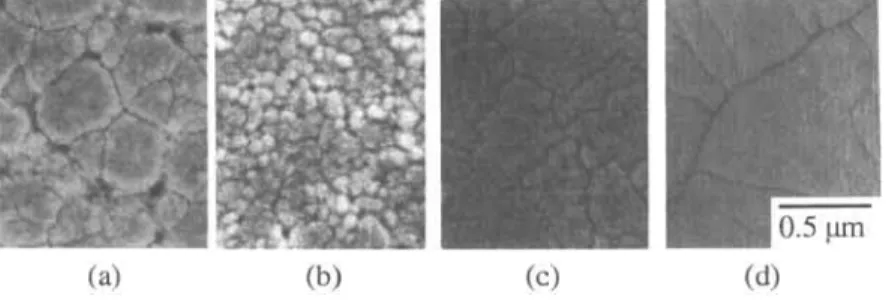
Under heating schedule I, the surface microstructure of
FM(0.022
mo1)- added PZTfilms,
Fig. 3(a), was composed of fine grains. For GL(0.016 mo1)-added PZTfilm,
small grain-size (0.05-
0.1 pm) microstructure with several micropores (Fig. 3(b))was
observed. On the other hand, as0.016
mol EG was added into PZT precursor, a dense microstructure shown in Fig. 3(c) with larger grain size around 0.2-
0.3 p was obtained. for acac-added PZT films, the resulting microstructure for 0.02mol acac, Fig. 3(d), displayed a heterogeneous nucleation with larger grains surrounded by a few fine-grained pyrochlore phase. The larger grain may also reflect the higher crystallization temperature and decreased surface nucleation."'
FIGURE 3.
SEM
micrographs of PZT films added with (a) FM,(b) GL, (c) EG, and (d) acac under schedule I.
@) Heatin? schedule I1
Under heating schedule
II,
the microstructure ofF'M-added
PZT film presents rosettes structure and further -tion promotes the formation of nanocrystalline pyrochlore. Similar microstructure evolution to FM-PROPERTIES OF CHELATING-AGENTS ADDED PZT 309
added PZT film was also found in the case of EG-added PZT. As GL was used, a microstructure composed of small grains and some grain- clusters were observed. However, for acac-added PZT
films,
it presents spherical aggregates of polycrystalline. A further addition formed regions of light and dark contrast where no discerned grain structure could be identified.Under heating schedule I, the measured Pr values shown in Fig. 4(a) slightly increase with the addition of
FM
from 23.7 to 25.6 pC/cm*. A further addition of FM causes the decrease ofPr value. For the
addition of EG, the Pr ofPZT
film rapidly raises up to 31.5 pC/cm2 at EG-
0.016 mol and then decreases. On the other hand, for GL-addedPZT
films, a maximumPr
value was obtained at thePZT
film with the addition of 0.016 mol GL, above that the measured Pr value was rapidly reduced. In addition, a fatty P-E curve was observed, which implies that there exist a certain of current leakage. In the case of acac, the Prwas apparently increased from 19.7 to 32.3 pC/cm2. The increase in Pr is possibly attributed to the promotion of grain growth.
35
-
1 0 - 3 "4 CA (mol%) 0 I 2 3 4 CA (molYo) (a> (b)FIGURE 4. Effect of CA content on Emanent polarization (Pr) of PZT
films under heating schedule (a) I and (b) 11.
On the other hand, under heating schedule
It,
shown in Fig. qb), the addition ofFM
causes Pr reduction due to the suppression of perovskite phase formation. NoPr
value could be obtained at 0.033 mol. Similar variation was also found in EG-added PZT films. The Pr disappears at 0.024 moL For acac-added PZT films, the reduction ofFV
is observed310 TE-CHENG MO and SAN-YUAN CHEN
with increasing acac amount. In contrast, in the case of GL, the Pr was slightly increased from 17.4 to 20.6 pC/cm2 due to the lower crystallization temperature and then decreased.
CONCLUSIONS
PZT fiLms added with ethylene glycol and acac form a dense larger- grained microstructure and show a maximum
P, value around 31-
32 pC/cm* under fast heating rate. However, a heating rate of 10"C/rnin gives poor electrical properties due to the suppression of perovskite formation except the addition of GL because PZT perovskite phase can be crystallized at temperature below 500°C.Acknowledgments
The authors gratefully acknowledge the support by the National Science Council of R.O.C. through NSC-88-2218-E-009-011 contract.
References [l] [2]
K. D. Budd, S. K. Dey and D. A. Payne, B r . a m . Proc., 36,107 (1985).
R. W. Schwartz, B. C. Bunker, D. B. Dimos, R. A. Assink, B. A. Tuttle, D. R. Tallant, and I. A. Weinstock, m t e d Ferroelectrics, 2,243 (1992).
[3] G. Yi,
2.
Wu and M. Sayer,L&&Q&
64,2717 (1988). [4] C. K. Kwok, S. B. Desu and D. €? Vjay, Ikroelectrics 1 etters ,16,143 (1993).
[5] R. W. Schwartz, R. A. Assink, D. B. Dimos, M. B. Sinclair, and C. D. Buchheit, M a t e r . s . SOC. S m361,377 (1995).
[6] S .
P.
Faure,P.
Barboux,P.
Gaucher, and J. P. Canne, Ferraelectrics,128, 19 (1992).
[7] M. J. Lefevere, and J. S. Speck, J. Mater. Bes, , 11,2076 (1996).
[8] D. A. Chang, W. F. Hsieh, P. Lin and T.
Y.
Tseng-r.
Sci., 28, 6691 (1993).191 N. Uchida, N. Ishiyama, Z. Kato, and K: Uematsu, J. Mater. Sci. 29, 5188 (1994).
[ 101 D. M. Tahan, A. Safari, and L. C. Klein,