Solution-Processible Small Molecular Organic
Light-Emitting Diode Material and Devices Based on the
Substituted Aluminum Quinolate
Jung-An Cheng,
†Chin H. Chen,*
,‡and Chi Hung Liao
†Department of Applied Chemistry, and Display Institute, Microelectronics and Information System Research Center, National Chiao Tung University, Hsinchu, Taiwan 30050
Received December 11, 2003. Revised Manuscript Received May 19, 2004
We have discovered a new type of small molecular host material based on aluminum(III) 8-hydroxyquinolates, Al(Saq)3, which was synthesized with three 5-(N-ethylanilinesulfona-mide)-8- quinolinoline as bidentate ligands. By X-ray diffraction crystallographic analysis, the crystals of meridional Al(Saq)3 are monoclinic, space group P21/c, a ) 17.952(3) Å, b ) 17.716(3) Å, c ) 17.080(3) Å, β ) 99.895(4)°. Its peak photoluminescence in solid phase appears at 488 nm. Its LUMO/HOMO (-3.13/-6.04 eV) and optical band gap (Eg2.91 eV) were determined by cyclic voltammetry . In solid thin film morphological investigation, it shows good thermal properties and high quantum efficiency. When doped with 0.7 wt % of the high fluorescent green dopant 10-(2-benzothiazolyl)-1,1,7,7-tetramethyl-2,3,6,7-tetrahy-dro-1H,5H,11H-benzo-[l]pyrano[6,7,8-ij]quinolizin-11-one (C-545T), energy transfer from Al-(Saq)3to dopant will occur and high green light emission can be achieved. For fabrication of OLEDs using spin-coating techniques, its electroluminescence is at 1931 CIEx,y(0.21, 0.41).
Introduction
Since high-efficiency small-molecule-based hetero-junction organic light-emitting diodes (OLEDs) were reported by Tang et al. in 1987,1 most of the small-molecule-based OLEDs have been fabricated by multi-layer vacuum thermal evaporation techniques. Because of the relative ease of synthesis, purification, and RGB color-control by chromophoric design, small molecules of guest-host dopant systems based on Alq3 are par-ticularly suitable for fabrication of full-color OLEDs2 and commercialization of this technology is well under-way.3 On the other hand, solution-processed small-molecule OLEDs are rare except for some large dendri-atic molecules,4polymers,5 and oligomers.6Therefore, development of fabrication technology of OLEDs via solution-processible small-molecule materials would of-fer an attractive alternative to vacuum techniques and also open up the exciting possibilities of fabrication similar to that demonstrated in PLEDs.7
One of the most attractive features of organic EL devices, relative to inorganic devices, is the ability to easily tune the emission wavelength by modifying substituents in organic materials. In the aluminum(III) complex of 8-hydroxyquinoline (Alq3), placing electron-withdrawing substituents in C-5 of the quinoline ring is predicted to increase the energy difference between the highest occupied molecular orbital (HOMO) and the lowest unoccupied molecular orbital (LUMO).8,9 This kind of host with larger energy gap will enhance its capacity to sensitize various singlet dopants to achieve full color emission with higher efficiency. 8-Hydroxy-5-quinolinesulfonate esters would appear to be one of the attractive functional groups for these properties, since the corresponding precursor, 8-hydroxyquinoline-5-sul-fonyl chloride,10 is known and can be readily synthe-sized.11 However, quinolinesulfonate esters are rela-tively rare and unstable compared to other aromatic sulfonate esters.12Sulfonamide substituents offer greater stability and retain the electron-withdrawing character of the sulfonate substituent.
In this paper, we report the discovery of a new type of small-molecule host materialshereby abbreviated as Al(Saq)3sfor fabrication of OLEDs using spin-coating * Corresponding author. Tel: 3-5712121 #59200. Fax:
+886-3-5737681. E-mail: [email protected]. †Department of Applied Chemistry.
‡Display Institute, Microelectronics and Information System Re-search Center.
(1) Tang, C. W.; VanSlyke, S. A. Appl. Phys. Lett. 1897, 51, 913. (2) Tang, C. W.; VanSlyke, S. A.; Chen, C. H. J. Appl. Phys. 1989, 65, 3610.
(3) Rajeswaran, G.; Itoh, M.; Boroson, M.; Barry, S.; Hatwar, T. K.; Kahen, K. B.; Yoneda, K.; Yokoyama, R.; Yamada, T.; Komiya, N.; Kanno, H.; Takahashi, H. SID ‘00 Digest 2000, ISSN0000-0966X/00/ 3101-0974.
(4) Markham, J. P. J.; Lo, S.-C.; Magennis, S. W.; Burn, P. L.; Samuel, I. D. W. J. Appl. Phys. 2002, 80, 2645.
(5) Male, N. A. H.; Salata, O. V.; Christou, V. Synth. Met. 2002, 126, 7.
(6) Crispin, A.; Crispin, X.; Fahlman, M.; Cornil, J.; Johansson, N.; Bauer, J.; Weissortel, F.; Salbeck, J.; Bredas, J. L.; Salaneck, W. R. J. Chem. Phys. 2002, 116, 8159.
(7) Haskal, E. I.; Buechel, M.; Sempel, A.; Heeks, S. K.; Athanas-sopoulou, N.; Carter, J. C.; Wu, W.; O’Brien, J.; Fleuster, M.; Visser, R. J. Asia Display/IDW ‘01; Society for Information Display: San Jose, CA, 2001; OEL2-2, p 1411.
(8) Chen, C. H.; Shi, J. Coord. Chem. Rev. 1998, 171, 161. (9) Albright, T. A.; Burdett, J. K.; Whangbo, M.-H.; Orbital Interac-tions in Chemistry; Wiley: New York, 1985.
(10) Yanni, A. S.; Abdel-Hafez, A. A.; Moharram, A. M. J. Ind. Chem. Soc. 1990, 67, 487.
(11) Hopkins, T. A.; Meerholz, T. K.; Shaheen, S.; Anderson, M. L.; Schmidt, A,; Kippelen, B.; Padias, A. B.; Hall, H. K.; Peyghambarian, N., Jr.; Armstrong, N, R. Chem. Mater. 1996, 8, 344.
(12) Jpn. Kokai Tokkyo Koho JP 5877, 864. 10.1021/cm035313i CCC: $27.50 © 2004 American Chemical Society
techniques. According to Scheme 1, 5-(N-ethyl-N′ -phen-yl-sulfonamide)-8-quinolinoline as bidentate ligands can be synthesized from commercially available 8-hydroxy-quinoline.10 By molecular design, the six-coordinated aluminumquinolate with sulfonate substituents can be used as wide band gap host materials (Eg≈ 2.9 eV) for various singlet dopants to tune the emission and ef-ficiency of OLEDs.
Experimental Section
1H NMR was recorded with a Varian Unity-300 Hz spec-trometer. Elemental analysis was obtained by using a Heraeus CHN-OS Rapid analyzer. PL and EL spectra were carried out by Acton Research Spectra Pro-150 and PhotoResearch PR-650, respectively. Optical absorption was measured by a Hewlett Packard 8453 absorption spectrometer. The thermal properties of Al(Saq)3was determined by means of thermo-gravimetric analysis (TGA) and differential scanning calorim-etry (DSC).
8-Hydroxyquinoline-5-N-ethylanilinesulfonamide (3). In a 100-mL round-bottom flask fitted with a magnetic stirrer, condenser, and N2 inlet were placed 8-hydroxyquinoline-5-sulfonyl chloride (2)10 (2.00 g, 8.21 mmol) with 10 mL of dichloromethane. Triethylamine (3.41 mL), N-ethylaniline (1.17 g, 9.85 mmol), and dichloromethane (10 mL) mixtures were added slowly into the reactor. The suspension was heated to reflux for 24 h. The reaction solution was filtered, and the solid byproduct was also removed. Solvent was stripped off by rotary vapor and the solid was sublimed at 2.0× 10⁻²mm Torr at 150 °C. White crystals were collected to yield 2.15 g (80%).1H NMR (300 MHz, CDCl 3) δ 8.774 (1H, dd, J ) 4.4 Hz); 8.530 (1H, d, J ) 11.1 Hz); 8.109 (1H, dd, J ) 8.4 Hz); 7.364 (1H, dd, J ) 4.2 Hz); 7.335 (1 H, dd, J ) 4.2 Hz); 7.188-7.262 (2H, m); 7.146 (1H, dd, J ) 8.1 Hz); 7.006 (2H, d, J ) 8.3 Hz); 3.643 (2 H, q); 1.077 (3H, t). Mp 136-137 °C. IR (KBr) 3288 (br), 3057, 2970, 2929, 2868, 1622, 1572, 1509, 1493, 1336, 1285, 1202, 1149, 1060, 958 cm-1. The product was characterized by mass spectrum which revealed no extraneous peak other than the desired parent m/e ) 328 (M+); 329 (M+ + 1) (for C17H16N2O3S). Anal. Calcd for C17H16N2O3S: C, 62.18; H, 4.91; N, 8.53; O, 14.62; S, 9.76. Found: C, 62.31; H, 5.04; N, 8.44.
the desired parent m/e ) 1010. IR (KBr) 3467 (br), 3098, 3057, 3011, 2975, 2924, 2868, 1603, 1567, 1498, 1463, 1393, 1373, 1335, 1229, 1168, 1147, 1091, 1060, 978, 891 cm-1. Anal. Calcd for C51H48N6O9S3Al: C, 60.70; H, 4.49; N, 8.33; O, 14.27; S, 9.53; Al, 2.67. Found: C, 60.28; H, 4.72; N, 8.45.
X-ray Diffraction. A suitable yellow crystal with dimen-sions of 0.20× 0.10 × 0.05 mm3was selected for indexing and intensity data collection on a Siemens SMART CCD diffrac-tometer equipped with a normal-focus, 3-kW sealed-tube X-ray source. Intensity data were collected at room temperature in 1271 frames with ω scans (width 0.30° per frame). Empirical absorption corrections based on symmetry equivalents were applied (Tmin, max ) 0.816, 0.952)13 of the 38142 reflections collected (2θmax ) 56.56°), 2594 unique reflections were considered observed [I > 2σ - (I)] after data reduction. The structure was solved by direct methods: the Al atom was first located and the O, S, C, and N atoms in the framework were found in difference Fourier maps. There are four Al(Saq)3 molecules per unit cell. The final cycles of least-squares refinement included atomic coordinates and anisotropic ther-mal parameters for all non-hydrogen atoms. The final differ-ence Fourier maps were flat (∆Fmax,min) 0.61, -0.37 e/Å3). All calculations were performed using the SHELXTL Version 5.1 software package.14Figure 1 shows the final Rietveld refine-ment plot. A summary of crystal data and refinerefine-ment param-eters can be found in Table 1.
Photoluminescence. For the solution investigation, the compound was dissolved in 1,2-dichloroethane (c ) 10-3-10-4 mol/L). For the solid-phase investigations of the pure com-pounds, thin films of 1,2-dichloroethane solution (4 wt %) were spin-coated. UV-Vis absorption spectra were measured with a HP spectrophotometer by using either the solutions in cuvettes of 10-mm path length or the solid thin film coated on quartz plates. The PL spectra were recorded with an Acton Research Spectra Pro-150 spectrometer. For the PL experi-ments, the excitation wavelength was set at the absorption maximum of the complex.
Device Fabrication. The three different device structures, ITO/PEDOT:PSS/Al(Saq)3blend/LiF/Al, were prepared in the following manner for EL measurement. For all structures the indium-tin-oxide (ITO, sheet resistance is 20 Ω//0) glass substrates were cleaned ultrasonically with detergent, deion-ized water, 2-propanol, and methanol. After cleaning, poly-(3,4-ethylenedioxythiophene)/poly(styrene)-sulfonate (PEDOT: PSS, obtained from Bayer) aqueous solution was spin-coated at 3000 rpm onto the cleaned ITO substrates and baked at 110 °C for 4 h. Neat Al(Saq)3or blend LEDs were subsequently spin-coated on the PEDOT layer at 2500 rpm to give films typically 70 nm thick; a 1-nm layer of lithium fluoride (LiF) and a 200-nm layer of Al were sequentially deposited at 1× 10⁻⁶Torr. The emitting area of the device was 3 mm× 3 mm. The voltage-current-luminance characteristics were mea-sured using an optical power meter (PR-650) and digital source meter (Keithley 2400). The EL spectra were measured under ambient atmosphere after encapsulation.
(13) Sheldrick, G. M. SADABS; Siemens Analytical X-ray Instru-ment Division: Madison, WI, 1995.
(14) Sheldrick, G. M. SHELXTL Programs, version 5.1; Bruker AXS Gmbh: Karlsruhe, Germany, 1998.
Results and Discussion
Synthesis and Characterization of Al(Saq)3 Com-plex. An aluminum(III) complex, Al(Saq)3, with three 5-(N-ethyl-N′-phenyl-sulfonamide)-8-quinolinoline (3) as bidentate ligands was synthesized as shown in Scheme 1. Commercially available 8-hydroxyquinoline was re-acted with chlorosulfonic acid to afford 5-chlorosulfonyl-8-hydroxyquinoline (2) which was reacted further with N-ethylaniline to obtain
8-hydroxyquinoline-5-N-ethyl-anilinesulfonamide (3). It was found that compound 3 is easily hydrolyzed with silica gel during purification by column chromatography. Therefore, it was purified by controlled sublimation to avoid side reaction. Finally, reacting ligand 3 with triethylaluminum produced a total yield of more than 64% of the desired six-coordinated Alq3derivative. In general, six-coordinated aluminum (III) complexes are often prepared by using aluminum chloride or aluminum alkoxide to chelate 8-hydroxyquinolines. But in our synthesis, sulfonamide groups introduced at C-5 of the bidentate ligand were sensitive to pH. If this kind of aluminum (III) salts were used as reagents, side products will be produced at the expense of decreasing yield and purity. Compared to a similar synthesis reported by Hopkins et al.,11 this synthesis is not only simpler to prepare, but also higher in yield. In regard to solubility, it was known that poor solubility often reacts in ligands when sulfonamide groups were introduced to 8-hydroxyquinoline at C-5.10,12 In our study, we varied amide groups to improve solubility in common organic solvents. Initially, we added different amines, such as R1dR2dphenyl and R1d phenyl, R2dH, on the sulfonyl group. Although the solubility was improved, it was still not as good as that of Al(Saq)3. Therefore, the improvement in the solubility of the complex is insignificant by capping the N-ethylamine on sulfonyl group. The complex is soluble in commercially available solvents such as 1,2-dichlo-roethane, THF, dimethylforamide (DMF), and dimethyl sulfoxide (DMSO).
Description of the Structure. The single-crystal structure of molecules and relative information in bond lengths and angles are important for understanding intermolecular interaction, fluorescence, and molecular film characteristics. It’s shown by X-ray diffraction that Al(Saq)3 is a tris-chelate organometallic complex in which the metal atom (Al) has a distorted octahedral coordination. Figure 2 shows the molecular plot of
Al-Figure 1. Rietveld refinement plot of the X-ray diffraction pattern of the Al(Saq)3phase. Calculated profiles and peak markers are shown.
Table 1. Crystal Data and Summary of Intensity Data Collection and Structure Refinement
Al(Saq)3 empirical formula C51H45AlN6O9S3
fw 1009.14
temp, K 294(2)
wavelength, Å 0.71073
cryst syst monoclinic
space group P21/c
unit cell dimensions
a (Å) 17.952(3) b (Å) 17.716(3) c (Å) 17.080(3) β (deg) 99.895(4) vol, Å3 5351.5(16) Z 4 density (calcd), mg/m3 1.292 ABS coeff, mm-1 0.215 F(000) 2184
θ range for data collection, deg 1.15 to 28.28
index ranges -18 e h e 23
-23 e k e 22 -22 e l e 21
reflns collected 38142
indep reflns 13232 [R(int) ) 0.3427] refinement method full-matrix least-squares on F2 data/restraints/parameters 13232/0/652 GOF on F2 0.615 Final R indices 0.0592a wR2 0.1296b aR1 )∑|F o| - |Fc|/∑|Fo|.bwR2 ){∑[w(Fo2- Fc2)2]/∑[w(Fo2)2]}1/2, w ) 1/[σ2(F
o2) + (aP)2+ bP], P] [Max(Fo,0) + 2(Fc)2]/3, where a ) 0.0474 and b ) 6.44.
(Saq)3, and crystallographic data are given in Table 1.15 It can exist in either of the two geometrical isomers: the “meridional” (C1symmetry) isomer or the “facial” (C3 symmetry) isomer, which differ in the relative positions of the oxygens and nitrogens of the metal coordination shell. In X-ray diffraction analysis, the meridional form was obtained. The determined crystal structures and solid-state packing of Al(Saq)3are very similar to Alq3in which it crystallizes in the monoclinic space group P21/c with a unit cell content of four formula units. Three oxygen atoms and an aluminum atom form the equatorial plane and three nitrogen atoms occupy the apical positions. Three molecules of the bidentate ligand, 8-hydroxyquinoline-5-N-ethylanilinesulfona-mide, are therefore coordinated to the aluminum. The selected bond lengths (Å) and angles (deg) for Al(Saq)3 and Alq3are presented in Table 2. The average distance of Al-O and Al-N bonds are 1.849 and 6.149 Å, respectively. The average bond angle of O-Al-N is 82.5°. In comparison, these bond lengths and angles listed in Table 2 are almost the same as those of the Alq3 chemical structure in the literature.16
Absorption and Photoluminescence (PL). The normalized absorption and PL spectra (with excitation at the absorption maximum) obtained from thin films of Alq3and Al(Saq)3as the pure compounds are shown in Figure 3. By regiospecific derivatization of Alq3 at one of its LUMO sites of C-5, sulfonamide groups removing electron density to the phenol ring will result in an increase in the energy of the π-π* transition which hypsochromic shifts the emission of Alq3to the blue.8Solutions were also investigated in 1,2-dichloro-ethane. The maximum absorption and emission wave-lengths are summarized in Table 3. Their relative positions are 382/483 nm, in solution, and 382/488 nm, in solid, respectively. As expected, the introduction of the sulfonamide substituent to the C-5 of the quinoline ring system leads to blue-shifts of 8 and 31 nm in the absorption and emission maximums, respectively, of 1,2-dicholoethane solutions of Al(Saq)3as compared to those of Alq3. The same blue shift was also observed in absorption and emission maximums (11 and 31 nm) in thin film phase. This shift is consistent with the electron-withdrawing nature of the sulfonamide sub-stituent. The Stokes shift of Al(Saq)3 is smaller than that of Alq3 due to the lower intermolecular packing between Al(Saq)3molecules which suppresses the for-mation of excimers between molecules.
Net Thin Films of Al(Saq)3Formed by Solution Process. Figure 4 shows the atomic force microscope (AFM) image of the solid thin film coated from 3 wt % (15) Cheng, J. A.; Chan, C. C.; Chen, C. H.; Chen, J. F. Anal. Sci.
2004, 20, 37.
(16) Fujii, I.; Hirayama, N.; Ohtani, J.; Kodama, K. Anal. Sci. 1996, 12, 153.
Figure 2. ORTEP drawings of Al(Saq)3. The thermal el-lipsoids represent a 50% probability limit. Hydrogen atoms are omitted for clarity.
Table 2. Selected Bond Distances (Å) and Angles (deg) for Al(Saq)3and Alq3
Al(Saq)3 Alq316 Bond Distances (Å) Al(1)-O(2) 1.844(5) 1.849(3) Al(1)-O(1) 1.849(5) 1.863(3) Al(1)-O(3) 1.855(6) 1.858(3) Al(1)-N(1) 2.034(6) 2.033(4) Al(1)-N(2) 2.047(6) 2.035(4) Al(1)-N(3) 2.068(7) 2.078(4) O(1)-C(2) 1.344(8) 1.317(5) O(2)-C(11) 1.310(8) 1.318(5) O(3)-C(20) 1.322(8) 1.322(5) Angles (deg) O(1)-Al(1)-N(1) 82.7(3) 83.0(2) O(2)-Al(1)-N(2) 83.0(3) 83.9(1) O(3)-Al(1)-N(3) 81.7(3) 71.7(1) N(1)-Al(1)-N(2) 172.9(3) 173.2(2) N(1)-Al(1)-N(3) 94.0(2) 92.4(1) N(2)-Al(1)-N(3) 91.4(3) 90.6(1)
Figure 3. Comparison of optical properties of Al(Saq)3and Alq3. Photoluminescence spectra: (a) Al(Saq)3in
1,2-dichlo-roethane, (b) Al(Saq)3thin solid film, and (c) Alq3thin solid
film. UV-Vis absorption: (d) Al(Saq)3thin solid film, and (e)
Alq3thin solid film.
Table 3. Absorption and Photoluminescence Results for Solutions and Films of Alq3and Al(Saq)3
solution investigation solid film investigation ABS λmax (nm) PL λmax (nm) Stokes shift (nm) ABS λmax (nm) PL λmax (nm) Stokes shift (nm) Alq3a 390 514 124 393 519 126 Al(Saq)3b 382 483 101 382 488 106
aThe solid thin films were made by thermal deposition.bThe solid thin films were made by spin-coating.
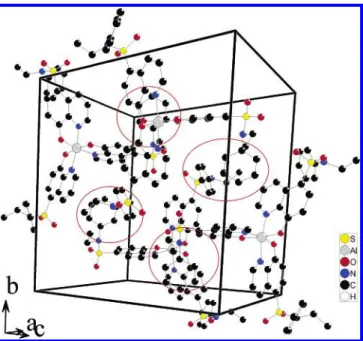
Al(Saq)3in 1,2-dichloroethane. The AFM image reveals that the film was pinhole free. Its root mean square (rms) and mean roughness (Ra) are 0.288 and 0.229 nm, respectively. Thin film phase prepared by spin-coating is presumably possible for most small molecular materi-als due to formation of intermolecular hydrogen bonding or physical entanglement. For understanding the mech-anism of thin film formation, molecular packing from X-ray is shown in Figure 5. The intermolecular forces are mainly from the packing of sulfonamide groups at C-5 of quinolate ring. The intermolecular distance of adjacent phenyl rings in sulfonamide group is estimated at 3.4 Å (as shown by the circle). Because of the hook-like nature of sulfonamide group at C-5, the molecules of Al(Saq)3 are randomly dispersed in the solvent matrix. The intermolecular hook-like sulfonamide groups will be tangled physically and form physical bonding. Therefore, thin film phase could be formed very well on ITO glass or silicon wafer via spin coating. The adhesion of these films on substrates was also tested to be relatively strong by using the stick-tape test.
In addition, from the packing diagram it is clear that the formation of Al(Saq)3 crystalline is caused by the packing of phenyl rings on the sulfonamide. However, the density of the packing of phenyl rings in the globular
complex is low. Therefore, when the film is spin-coated on the substrate using solution process method, crystal-lization of Al(Saq)3by intermolecular phenyl ring pack-ing is difficult. Figure 6 shows the PL of Al(Saq)3solid thin films after annealing for 48 h at temperatures of 70, 110, and 140 °C. The structure of Al(Saq)3solid film phase can suppress intermolecular packing and ag-gregation. It is clear from the graph that λmaxvalues at different temperatures do not change (488-489 nm), and the quantum efficiency has dropped 5% at 140 °C. These phenomena can be explained by the differential scanning calorimetry (DSC) measurement shown in Figure 7, which shows that the melting point peak at 190-200 °C was absent during the first heating step, and the recrystalization peak was absent as well as during the first cooling step. The result is the same as those in the second heating and cooling step. Under an optical microscope with polarizer, recrystallization phe-nomena of the sample were not observed during the heating and cooling process. Because the annealing temperature (140 °C) is very close to the Tgof Al(Saq)3 (Tg ) 143 °C), small vibronic motion of molecules will be expected under this temperature. A long period of annealing will cause intermolecular rearrangement, but because sulfonamide is hook-like, it will suppress orderly intermolecular arrangement. Here, the full width at half-maximum (fwhm) of PL spectra for three thin films are the same as 79 nm. All of the phenomena showed the formation of Al(Saq)3crystalline is not easy and most of the solid Al(Saq)3exists as amorphous state. Study of Host-Guest Energy Transfer. In various studies of host-guest system, we found that various ratios of 10-(2-benzothiazolyl)-1,1,7,7-tetramethyl-2,3,6,7-tetrahydro-1H,5H,11H-benzo-[l]pyrano[6,7, 8-ij]quino-lizin-11-one (abbreviated as C-545T) blended into Al-(Saq)3produced good quantum efficiency. As shown in Figure 8, the excited Al(Saq)3could transfer its energy to C-545T by Fo¨rster energy-transfer in solid films. When C-545T was doped into Al(Saq)3, the most promi-nent peak at 489 nm was quenched and replaced by the sharper narrow emission at λmax521 nm of C-545T. The energy transfer is optimized when 0.75 wt % of C-545T is doped into Al(Saq)3. Its relative quantum yield is 1.75 times that of neat Al(Saq)3film under the integral area of PL curves. The quantum efficiency has improved and a more saturated green light with 1931 CIEx,y (0.31, 0.65) is observed.
Figure 4. AFM image of Al(Saq)3thin film, spin-coated from 1,2-dichloroethane.
Figure 5. Crystal packing of Al(Saq)3based on the X-ray diffraction pattern. There are four molecules in the unit cell.
Figure 6. Solid PL of Al(Saq)3annealing at various temper-atures for 48 h.
Electroluminescence. A single layered device based on this new material was evaluated by the structure of glass/ITO (20 nm)/PEDOT: PSS (70 nm)/Al(Saq)3 (70 nm)/LiF (1 nm)/Al (200 nm). It initially produced a navy blue emission of CIEx,y) (0.21, 0.41) with relatively low luminance efficiency. By examination of the energy band diagram shown in Figure 9, it can be seen that the HOMO energy level of Al(Saq)3is too low compared to that of the ITO anode to inject the holes into the Al-(Saq)3 efficiently. To improve hole injection and lower the HOMO energy barrier between PEDOT and Al-(Saq)3, NPB and PVK were used and introduced into the emitting layer of Al(Saq)3. For comparison purpose, single-layer devices with the structure of glass/ITO/
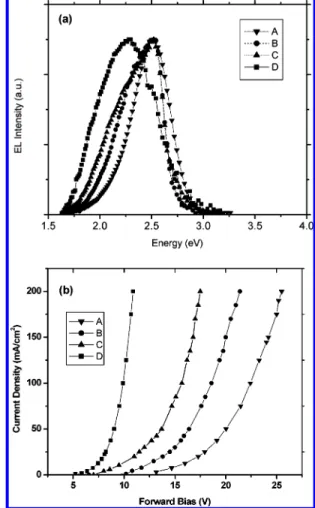
PEDOT:PSS (70 nm)/Al(Saq)3(40 wt %):β-NPB (x wt %): PVK (60-x wt %) (70 nm)/LiF (1 nm)/Al (200 nm) were also made. Figure 10 shows their EL properties. The device (A) with the PVK:Al(Saq)3 blend showed blue-green emission and single peak during electrolumines-cence process in Figure 10a. Its chromaticity and emission wavelength were also similar to that of the EL spectrum of Al(Saq)3without PVK. For the I-V curves shown in Figure 10b, the turn-on voltage was droped efficiently with the addition of β-NPB. From EL spectra,
Figure 7. DSC spectra of Al(Saq)3in cyclic annealing. The heating and cooling rate are the same at 5 °C/min.
Figure 8. Solid PL of C-545T doped in Al(Saq)3with various concentrations.
Figure 9. Energy diagram of materials in device fabrication.
Figure 10. (a) Electroluminescence device glass/ITO/PEDOT:
PSS/PVK (60-x wt %):β-NPB(x wt %):Al(Saq)3(40 wt %)/LiF
(1 nm)/Al (200 nm). (b) I-V curves. Device A, x ) 0; device B, x ) 10; device C, x ) 20; device D, x ) 30.
emission from exciplex at 2.23 eV (556 nm) generated by Al(Saq)3and β-NPB was observed. By CV measure-ment, the LUMO and HOMO energy levels of Al(Saq)3 and β-NPB are -3.13 eV, -6.04 eV and -2.50 eV, -5.40 eV, respectively. The difference of energy level between Al(Saq)3’s LUMO and β-NPB’s HOMO is around 2.27 eV. By estimation, the exciplex appeared at 2.23 eV which is only 0.04 eV away from 2.27 eV. Therefore, it’s highly possible for both holes and electrons to recombine at the Al(Saq)3/β-NPB interface, which will cause the emission of orange light as well as efficiency reduction. Furthermore, in the single-layer device, holes and electrons are expected to recombine at the cathode/ emitter interface due to mobility and reduce the ef-ficiency of the electroluminescent. Further improve-ments have been recently obtained by fabricating multilayer devices and will be reported later.
Conclusion
We have synthesized and fabricated one of the first small-molecule, spin-coated single-layer devices based
on the novel blue Al(Saq)3 host materials. In single-crystal diffraction and thermal characterization, the meridional form of Al(Saq)3 thin films not only sup-presses intermolecular packing, but also exists mainly in amorphous state. Because the IP level is around -6.04 eV, the EL efficiency is poor. It could be enhanced by introducing suitable hole transporting material to inhibit exciplex formation. This type of solution-proces-sible material would be of interest to the OLED com-munity for development of the next generation of small-molecule fabrication technology.
Acknowledgment. We thank Ms. Liao and Ms. Hung, Department of Crystallography, National Tsing-Hua University, Taiwan for single-crystal X-ray mea-surement. J.-A.C. is grateful to Dr. H. L. Yang of Toppoly Optoelectronics Co. for valuable discussion. This work was supported by NSC and the Ministry of Education of Taiwan, Republic of China (PPAEU 91-E-FA04-2-4-(B)).