以介面投入時間評估不同遊戲平台之遊戲表現
凃林大偉
摘要
本研究關心遊戲玩家面對同一款遊戲在不同遊戲平台採用不同遊戲介面的遊戲表 現。32 位受測者根據觸控螢幕、鍵盤和手把 3 種遊戲介面的年度累計投入時間(簡稱 介面投入時間)來進行分群,共同參與由被視為自變數的 4 種遊戲介面搭配被視為實 驗任務的 6 款平台遊戲的實驗任務,其遊戲得分被視為依變數。結果顯示:(a) 整體來 看,介面投入時間的多寡顯著影響遊戲表現;(b) 單一介面投入時間越多,則受測者 使用該介面之遊戲表現越好;(c) 單一介面投入時間越多,受測者不一定越容易適應其 他三種遊戲介面,但鍵盤除外;(d) 重度遊戲者也往往熟悉各式遊戲介面而具備跨遊 戲平台的特質。據此,本研究建議,介面投入時間可以被視為遊戲表現的重要受測者 分群基礎。 ☉關鍵字:介面投入時間、玩家經驗、遊戲介面、遊戲表現 ☉本文作者林大偉為國立臺北藝術大學動畫學系教授。 ☉聯絡方式:Email :[email protected];通訊處:11201台北市北投區學園路1號。 ☉收稿日期:2018/08/24 接受日期:2018/12/27An Analysis of Gaming Performance on Different Game
Platforms Utilizing Interface Engaging Time
Ta-Wei Lin
Abstract
This study focuses on the gaming performances of gamers playing the same game using differing gaming interfaces. 32 subjects were grouped according to their annual accumulated time spent (interface engaging time for short) on three-game interfaces: touch-screen, keyboard, and gamepad. The subjects participated in research involving four types of game interfaces viewed as independent variables. Results show: (a) Interface engaging time has a significant influence on gaming performance. (b) The longer the engaging time on a certain interface, the better the gaming performance on said interface. (c) Except for the keyboard, a longer engaging time does not necessarily lead to easier adaptation to other interfaces. (d) Heavy gamers are familiar with all gaming interfaces and have the potential to play across interfaces. In view of the above, this study suggests that interface engaging time can be considered as a prominent method of subject categorization for research on gaming performance.
☉Keywords: gamer experience, gaming interface, gaming performance, interface engaging time
☉Corresponding author: Ta-Wei Lin is a Professor in the Department of Animation at Taipei National University of the Arts, Taipei, Taiwan, e-mail: [email protected], address: No.1, Xueyuan Rd., Beitou Dist., Taipei City 112, Taiwan (R.O.C.), 11201
Introduction
From the 1970s, people have witnessed an astonishing eight game generations over a short period of 50 years (Beck & Wade, 2004). With the ongoing evolution of electronic games, computer game developers should strive to increase the believability of game characters and game environment to increase gamer engagement (Bianchi-Berthouze, Kim, & Patel, 2007). To achieve this goal, creating more suitable game interfaces should be taken under consideration. However, the researches of interaction between games and gamers have been undergoing relatively slow development in the realm of Human-Computer Interaction (HCI). It was not until recent years as technology advanced and created increasingly complicated game controllers, that the importance of game controllers was gradually seen (Brown, Kehoe, Kirakowski, & Pitt, 2015; Gilleade & Allanson, 2003). However, most researches focus either on the casual gamer’s subjective experience (Birk & Mandrk, 2013; Gerling, Klauser, & Niesenhaus, 2011; Mueller & Bianchi-Berthouze, 2015) or objective information (Mueller & Bianchi-Berthouze, 2015; Nacke, 2010; Purkayastha, Eckenstein, Byrne, & O’Malley, 2010) on different game interfaces. In contrast, research focusing on gamer characteristics and exploring the adaptability of gamers of differing levels on different game interfaces are few and far between (Bernhaupt, 2015).
The astounding retail number of iPads (including the iPhone, hereto referred to as “the iPad platform”) has motivated many classic games that were popular on console and PC platforms to try to port to the iPad platform; however, the main obstacle these classic games face is the colossal challenge of rewriting the code, and the appropriateness of interface transformation. Crenshaw, Orzech, Wong, and Holloway (2011a) and Crenshaw, Holloway, Orzech, and Wong (2011b) believes the main concerns of interface transformation to be as follows: (1) How to simplify the complex controls used on the PC or console platform to fit the iPad platform; and (2) How to integrate the original controls onto a new interface that uses the same source for output and input (e.g., fingers will cover where the target needs to be moved to). The first matter of concern is often addressed by redesigning the Graphic
User Interface (GUI), whereas the second issue remains a daunting dilemma. The reason behind this dilemma is because veteran players who are accustomed to a specific input interface will often be disappointed when using a slippery touch screen that just doesn’t feel right. According above, a lack of research exploring whether or not gaming performance is affected when older generation gamers accustomed to complex controls play classic platform games transferred to new platforms with simplified game interfaces designed for new generation gamers, which is the main issue of concern in this study.
Background
Gaming Interface Revolution and Gamer Adaptability
Control systems are a crucial part of a majority of games (Johnson & Wiles, 2003). At the same time, with the ongoing development of electronic games, gamers are pursuing smoother gameplay, and increasing sophisticated visual effects. Therefore, most game developers are oriented towards providing better performing CPUs and graphic cards (Claypool, 2009). Due to these circumstances, besides designing game interfaces for games with specific needs (e.g., force feedback steering wheels), most game interface designs hinge on standard game controllers with similar control methods (e.g., joysticks and buttons for arcade machines, the D-pad and buttons on console controllers, and keyboards and mouses for PCs.) (Brown et al., 2015). The concept of standardized controllers is beneficial to both game designers and gamers, because a unified game interface will greatly lower problems of adaptability which may occur when alternating between game platforms.
Most game designers were willing to predominately follow the ground rules set by these game platforms (Rabin, 2010), until the emergence of the Wii, Kinect, and the iPad. These devices broke the long established understanding between game designers and game platforms. The Wii was the first to renounce the pursuit for game speed and image quality, and announce the concept of body movement (Bianchi-Berthouze et al., 2007). Kinect announced the disappearance of an input interface, but gamers must still play within a
certain area (Nacke, 2010). The iPad (and iPhone) combines input and output interfaces. They are ubiquitous, and show potential for unprecedented affordance (Melhuish & Falloon, 2010). Especially, the advantage of formless input interfaces such as the Kinect and iPad is that gamers will not need to put on or carry any input interface. However, the price they will have to pay is the need to adapt to the changes brought on by an entirely different gaming interface. In light of the current trend of this particular interface, this study aims to understand the problems new and veteran players face when playing games ported to a new interface, along with their causes.
Evaluating Game Performance through Game Interface
Past researches on electronic games mostly approached user experience from aspects such as game content, graphics, interactivity, and game plot. Rarely is user experience explored from the perspective of a specific input modality (Bodén, Jegers, Lidstrom, Wiberg, & Wiberg, 2007). Now with an increasing number of multiple platform games, game designers face two new challenges worthy of attention: integrating the different interaction paradigms of console gamers and PC gamers while maintaining the core mechanics, and understanding the suitability of game interfaces from gamer experience and gaming performance (Gerling et al., 2011). In general, the method of studying gamer experience can be divided into two stages: (1) Post-playing evaluation (e.g., Interviews or questionnaires). (2) In-playing evaluation (e.g., Quantitative analysis of behavior, or physiological measurement) (Mueller & Bianchi-Berthouze, 2015). Among these methods, questionnaires are the most commonly used. Questionnaires often utilize existing game-related theories, including flow (Novak, Hoffman, & Yung, 2000), immersion (Brown & Cairns, 2004), affective ludology (Nacke & Lindley, 2009), and heuristic evaluation (Pinelle, Wong, & Stach, 2008). Brockmyer et al. (2009) even designed a questionnaire specifically for surveying gamer experience known as the GEnQ (Game Engagement Questionnaire)(Fox & Brockmyer, 2013). However, questionnaire surveys are considered an explicit measure of investigation. No matter if the questionnaire is issued during or after participants play the game, the results
of the survey will often be drastically influenced by objective cognitive differences, which will in turn seriously impact the results of this research. In comparison, gaming performance generated from subjective data can effectively rule out interfering variables such as cognitive difference, even through there will be differences in the players’ skills. Therefore, this study will utilize the implicit measure of analyzing gaming performance as its method of research.
Gaming performance is another important factor in evaluating game interface (Gerling et al., 2011). Most game input devices lean towards being pointed devices. In cases where experimental conditions can be adequately controlled by the researcher, a common research strategy would be to use Fitts’ Law along with the ISO 9241-9 experimental paradigm to evaluate different non-keyboard input devices (MacKenzie & Teather, 2012; Zaranek, Ramoul, Yu, Yao, & Teather, 2014). The main dependent variable being observed would be the throughput calculated from the index of difficulty and movement time (Pinelle et al., 2008). In practice, Fitts’ Law has long since been used in the field of HCI (Fitt, 1954; Soukoreff & MacKenzie, 2004), and is an iconic method utilizing experimental tasks combining target width and movement distance, and is often used to observe the usability of input devices. For example, Klochek and MacKenzie (2006) used five indicators gained through extending the throughput, and found that the acceleration rate of mouse outperform that of gamepad in First Person Shooter (FPS) games. Research done by Natapov and MacKenzie (2010b) use the throughput to prove how the prototype of a trackball gamepad outperformed the standard gamepad.
However, Fitt’s Law is not applicable to all studies on game interface evaluation. A popular alternative for recording gaming performance is done by utilizing the by-products of gamer-game interaction, and quantitative data that can be recording during the course of the game. For example, studies done by Natapov and MacKenzie (2010a) view target hits as gaming performance in FPS games, and have found the performance of keyboard-mouse combinations to be better than standard gamepads. Natapov and MacKenzie (2010a) also observed game performance in another FPS game using completion time, in this study, the keyboard-mouse combination again surpassed standard gamepads. A study of Zaman,
Natapov, and Teather (2010) used both completion time and character death to evaluate the gaming performance in Action-adventure games (A-AVG), and found that physical buttons on the NDS outperformed virtual buttons on the iPhone. Bodén et al. (2007) observed the scores of mobile games, and discovered how gamers using buttons would score higher than gamers using the stylus. The research results mentioned above seem to imply two trends: (1) Complex controllers are superior to simple controllers, and (2) Physical interface is better than virtual interface. But is this really the case? A study by Gerling et al. (2011) showcases comparative experiences: 45 subjects felt challenged when facing a new game platform, and are more comfortable playing on familiar game platforms. Therefore, gaming experience should be considered as another variable when evaluating game interface.
Basis of Gamer Grouping
To understand how gamers adapt to different gaming interfaces, gamers are primarily grouped based on their levels. In game-related studies, gamer experience is usually employed as the basis of subject grouping (Hoysniemi, 2006; Lopes & Bidarra, 2001); for example: expert, good, so-so, and beginner. This method is used to observe the opinions and performance of different level gamers within the same circumstances (Sun, Lin, & Ho, 2003). But this method often provides results overly reliant on the subjective perception of subjects. For example, beginners do not necessarily perform so-so. Another grouping method leaning towards quantification is to group subjects based on gaming seniority. This method is based on the accumulated time the subject started to gaming (Wu, Wang, & Tsai, 2010). But it has difficulty accurately assessing game spent time, and frequency is another independent variable that should be accounted for. Therefore, these two methods of grouping are either overly general or too subjective to be viewed as reliable, thus unable to clearly illustrate the distinguishing characteristics of the grouped subjects.
For this reason, a grouping basis that could further illustrate the characteristics of the grouped subjects was considered. One approach was to refine the method of grouping subjects based on spent time. For example: Asking subjects about their time distribution
of everyday activities that included gaming (Anand, 2007), and the amount of time they spent on gaming during the weekdays and the weekend (Skoric, Teo, & Neo, 2009). Another approach is to evaluate subject characteristics through game grading, which is often employed to explore subject exposure to violent games. The usual procedure is to ask subjects to choose three most commonly played games, and then grade the games by their violence rating (Ferguson, Colwell, Mlacic, Milas, & Miklousic, 2011; Jackson, von Eye, Fitzgerald, Witt, & Zhao, 2011). However, Gauntlett (2005) considers this method to pose certain difficulties and flaws. On one hand, most commonly played is based solely on the subjects’ judgment; there are no means for comparison with other subjects. On the other hand, the limitation on the number of games will make it difficult to expose the diversity of games the subjects have played.
In light of this situation, Ventura, Shute, and Kim (2012) defined gamers’ style of video gameplay based on spent time and number of played games. As shown in Table 1, there are three categories: (1) habitual players: based on how many hours the subject plays games per week, (2) selective players: based on the accumulative time the gamer spent playing his or her favorite game, and (3) diverse players: based on the number of different games played in a year. Data about spent time inferred from habitual players and data regarding number of played games known from diverse players can be respectively used to illustrate the depth and breadth of gaming experience. However, it cannot showcase the time spent on a certain game. While selective players can make up for this shortcoming, it is limited to demonstrating the total time gamers have spent on their favorite game. On the other hand, in related studies focusing on game interface, the subjects’ gaming experience will often be perceived as supplementary information for analyzing research results. There will only be vague descriptions of how many (Zaman & Mackenzie, 2013) or how often (Nacke & Lindley, 2009) subjects play on specific gaming platforms, and the subjects’ level (Zaman, et al., 2010). Only a small number of studies view gaming experience as the basis for subject grouping to further understand the difference between gamers (Natapov & Mackenzie, 2010a, 2010b). Therefore, according to the three methods of subject grouping proposed by
Ventura et al. (2012), the difference between experience on various game interfaces can be illustrated as the concept of habitual players, then the total time gamers have spent on a specific interface can be seen as interface engaging time (which is discussed in the Subject and Grouping subsection), and may be used to further understand how game interface adaptability is influenced by the gamers’ experience on different platforms.
Methods
This quasi-experimental research measured the gaming performances of gamers playing the same game using four-gaming interfaces: touch-screen, joystick, keyboard, and gamepad. The gaming performances were compared by gamer experience based on their annual accumulated time spent on three-game interfaces: touch-screen, keyboard, and gamepad.
Independent Variable, Dependent Variable, and Hypothesis
This study draws on the style of video gameplay proposed by Ventura et al. (2012), which cross multiplies the subjects’ average time spent on gaming per week with the percentage of number of games played on different game platforms to determine interface
engaging time (see the Subject and Grouping subsection for details). After organization,
subjects were then groups into three types: keyboard, gamepad, and touch-screen, also viewed as gaming experience. According to the varying degrees of experience, subjects in the gamepad group were divided according to their engagement levels as no-engaging and
low-engaging. In the keyboard group and touch-screen group, there are two additional levels moderate-engaging and high-engaging. The four gaming interfaces observed in this study
Table 1
Three Styles of Video Gameplay According to Cumulative Hours of Play and Number of Games Played
Style of video gamepla Cluster base Low Moderate High
Habitual players Average hours per week 0~1 hr. 2~6 hrs. Above 7 hrs. Selective players Total hours on favorite games 1~10 hrs. 11~50 hrs. 51 hrs. Diverse players Number of games per year 0~3 games 4~6 games Above 7 hrs.
are: touch-screen, joystick, gamepad and keyboard. The four interfaces are viewed as the four levels of the independent variable, as can be seen in Figure 1.
To observe the subjects’ gaming performance on the four interfaces, six classic games from the platform game period were utilized: Pac-man, Galaxian, Tank Battle, Sonic, Bomberman and Street-fighter. However, the scoring and control methods of the six games are entirely different, resulting in a lack of an objective basis for comparison between games. Therefore, the six games can only be viewed as experimental tasks, and not variables. To effectively observe the subjects’ gaming performance, each subject must begin from the easiest level of every game, and play until resources such as health power, lives, and the time limit have run out, thus ending the game. The Score was viewed as the dependent variable. According to the above statement, the interface engaging time subjects spend on specific game interfaces on different game platforms are seen as the main basis for subject grouping. This between-subject design is used to observe whether or not there is significant difference between the gaming performance of subjects in different groups. Moreover, subjects from each group must undergo a series of experiments employing all four interfaces and six games, which can be labeled as a within-subject design. To avoid the sequence effect, the orders of the 24 tasks are presented using the Latin square to avoid repetition. To avoid order effects, the 24 tests were split into two categories: interface (4 types) and game (6 titles). The tests were then organized in a Latin Square Design before being distributed to participants.
Participants were given 10-minute breaks or “intervals” when switching between the 4 interfaces to prevent fatigue. Each subject is also given a 30 second adaptation time in the beginning of each task before the task is re-started, and officially recorded. The research methods mentioned above are centered around the three topics of research explored in the literature mentioned above: gamer adaptability, game performance, and gamer grouping. This study focuses on gamer adaptability to gaming interfaces. Gamers will be classified based on interface engagement time, and gamer performance will be observed through gaming performance in lieu of a subjective questionnaire survey. The purpose of the study is to analyze how gamers of different skill levels adapt to different gaming interfaces. This study proposes one hypothesis:
H1: Interface engaging time significantly affects the scores obtained from the same game on different interfaces.
Subject and Grouping
This study employs 32 subjects between the ages 20 to 22. To understand the subjects’ gaming experience, this study draws on the grouping basis proposed by Ventura et al. (2012) to explore the total time spent on a specific game interface per year, which is the interface engaging time, similar to selective players in Ventura et al. (2012). Accordingly, the subjects were asked to answer three questions related to game interface before the experiment: (1) The average hours spent on gaming each week, (2) The number of games played each year, (3) The number of game platforms corresponding to the games played every year. The answers to the three questions were then cross-multiplied. The results are as shown in Table 2. In total, there are five game platforms, PC, Xbox, the Wii, the iPad, and the iPhone. From the perspective of game interfaces, the results can be further divided as three groups: keyboard, gamepad, and touch-screen.
Table 2
Summary of All 32 Subjects’ Annual Interface Engaging Time Based on Cumulative Hours, Games and Platforms
Platforms PC Xbox Wii iPad iPhone
Cumulative subjects Annual cumulative hours 22 2 6 6 23 3681.17 (33.31%) 101.38(0.92%) 643.96(5.83%) 466.30(4.22%) 6156.74(55.72%) Grouping base Keyboard
(33.31%) Gamepad(6.75%) Touch-screen(59.94%)
According to Table 2, from both the perspective of Cumulative subjects and Annual
cumulative hours, the 32 subjects were engaged in the touch-screen the longest (6623.04
hrs.), followed by the keyboard (3681.17 hrs.). Subjects spent the least time playing on the gamepad (745.35 hrs.). With the data obtained in Table 2, Cluster Analysis was done on the touch-screen, keyboard and gamepad. Subject grouping was based on the coefficient of variation after integration, and observing icicle diagrams. The results are as shown in Table 3. It is worth pointing out that in all three gaming interface groups, there are subjects who have never played on the specific interface before, which are viewed as the no-engaging subgroup. The subjects in the touch-screen and keyboard group have a longer accumulated interface engaging time, and can thus be clearly divided into four subgroups. The situation with the gamepad is more particular; the group has a shorter accumulated interface engaging time due to a smaller number of subjects who have played on the interface. The cumulative number of subjects is also relatively less, thus it is only divided into two subgroups.
Table 3
Grouping Base of he Subjects’ Annual Interface Engaging Time on Three Gaming Interfaces and Corresponding Number of All 32 Subjects
Grouping base Non-engaging Low-engaging Moderate-engaging High-engaging Touch-screen 6 (0 hr.) 11(17.33~93.6 hrs.) 11(104~364 hrs.) 4(650~1872 hrs.) Keyboard 10 (0 hr.) 11(17.33~78 hrs.) 7(104~260 hrs.) 4(416~650 hrs.) Diverse players 25 (0 hr.) 7(3.71~280 hrs) -
-Stimulation
After comparing the game performance of the 32 subjects on the four game interfaces, six games that have been released during the arcade period were chosen as research stimuli. The six games are: Pac-man, Galaxian, Tank Battle, Sonic, Bomberman, and Street Fighter. Release information and features of the games are as seen in Table 4. The six games have completely different scoring and control methods, and lacks an objective basis for comparison, thus the games are viewed as only experimental tasks, and not as variables. The six games were selected with three principles in mind: platform games, uniformity of hardware, and uniformity of controlled conditions. First, because the research objective of this study is in relation to the possible issues with controls that may occur when platform games are adapted to the iPad, games must first meet the criteria of being a platform game. Secondly, considering the hardware limitations of playing six games on the iPad, relatively simple and easily observable platform games were primarily chosen. Finally, for the consistency of the controlled conditions, the app Blutrol was used to connect the various game interfaces to the iPad, and used to minimize lag during the process of gameplay.
Table 4
Summary of Six Games’ Release Information and Prominent Features
Game First
release Genre Defaultplatform Defaultinterface ScoringApproach Gameplay goals
Pac-man 1980 Maze Arcade Joystick eaten dots Gamers control Pac-man to eat all the dots in a maze without being caught by the ghosts.
Galaxian 1979 Shooter Arcade Joystick destroyed
aliens Gamers control the ship to move left and right, and fire bullets at alien invaders attacking from above. Tank Battle 1980 Shooter,
Maze Arcade Joystick destroyedenemies Gamers control the tank and shoot ammunition to eliminate all enemy controlled tanks and to protect the home base. Sonic 1991 Racing,
Sports Console Gamepad collected rings Gamers control Sonic to reach the goal in minimal time, collect rings along the way, and fight the Boss at the goal.
Equipment
As shown in Figure 6, four types of equipment were used in this study: (a) The 4th generation Apple iPad 32GB with Retina Display and Wi-Fi, 2048x1536 pixel screen resolution, and iOS7.1. 2 operating system. The black model was chosen to reduce light reflection. The purpose is to allow subjects to concentrate on the screen without being distracted. (b) The wireless joystick iCade Core from ON Audio. (c) The wireless gamepad PS3 Dual Shock 3 from Sony. (d) A wireless keyboard from Apple. All four types of equipment are wireless, and connect through Bluetooth. The app Blutrol was installed in the iPad to ensure all four experiment equipment will be able to connect to the interfaces required to play the six games. What’s worth mentioning is, the wireless PS3 gamepad offers two choices for direction control: analog sticks and a D-pad. The analog sticks on both the left and right side were purposely turned off to keep the subjects focused on the D-pad, and lower chances of data contamination caused by confusion between the PS3 gamepad and the iCade Core wireless joystick.
Figure 2. Experiment equipment: (a) touch-screen, (b) wireless joystick, (c) wireless
gamepad (d) wireless keyboard. Bomberman 1983 Action,
Maze Console Gamepad destroyedenemies Gamers control Bomberman to place bombs that explode in four directions in mazes to blow up obstacles or to eliminate the enemy.
Street-fighter 1987 Fighting Arcade Joystick beat rivals Two characters engage in a two out of three battle with a time limit, and try to lower the opponent’s HP to zero.
Figure 3. The three experiment environments constructed by connecting the joystick,
Environment
This study was conducted in a darkroom devoid of light; the only source of light came from the screen. The purpose is also to allow subjects to concentrate on the screen without being distracted. For the sake of understanding the gaming experience of subjects using direction controls on different gaming interfaces, the environment of this study should logically emulate the four gaming interfaces perceived as independent variable on the arcade machine, console platform, PC platform and iPad platform. However, this study is limited by two current situations: (1) The same game may not simultaneously be available for the four game platforms. Even if they do exist, the versions of the games may be different. This might lead to independent variable not controlled under the same experimental conditions, and produce many uncontrollable confounded variables. (2) The hardware of different game platforms may be designed depending on various requirements, especially the CPU and graphics card, therefore creating a huge gap between computing capacity and display performance. There is also the chance of producing confounded variables that are difficult to control. Therefore, in order to effectively control variables, and ensure the experimental conditions are constructed under the same basis, this study utilizes the iPad as the main experimental equipment. The three gaming interfaces shown in Figure 2, wireless joystick, wireless gamepad, and wireless keyboard, were connected to the iPad through Bluetooth, as shown in Figure 3.
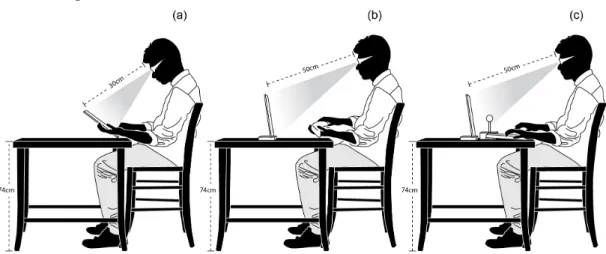
To faithfully illustrate the habitual usage of the four gaming interfaces, and to maintain the principle of consistent experimental conditions, subjects were asked to view the iPad as an output device. The iPad was placed on a table using an iPad stand in all three conditions (as shown in Figure 3b and Figure 3c) except for the touch-screen condition, during which subjects were allowed to hold the iPad. At the same time, the observation distance between the subjects’ eyes and the screen were strictly regulated, but not forcefully fixated, as to ensure the subjects’ pleasant mood and freedom during the gaming process. As can be seen in Figure 3a, the subjects were merely asked to place both hands holding the iPad evenly on the table, and view the screen from a distance of 30cm. Using Figure 3b and Figure 3c as further examples, all subjects were able to maintain a viewing distance of 50cm when the iPad was secured on the table. Viewing angle of game screen varied depending on the type of games. The angle was controlled at 30o if the game was to be played on a vertical display, and 35o if
the game was to be played on a horizontal display.
Data Analysis
The gaming performance of subjects is presented through Score. Because the games chosen in this study all possess different scoring models and standards, the difference analysis between games are unable to be conducted based on the raw scores. Assessment could only be made on the difference between the scores obtained by subjects playing the same game on different interfaces.
Results
Differing Gaming Performance Caused by Difference of Interface
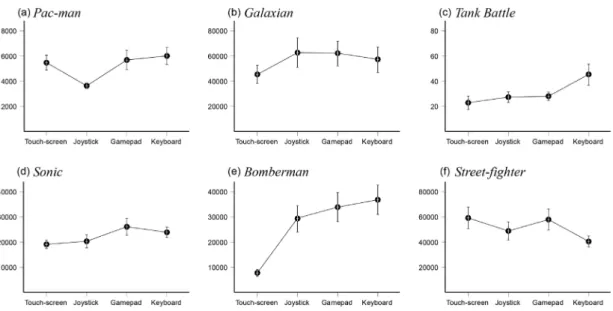
From the perspective of difference between game interfaces affecting gaming
performance, The gaming performances of all 32 subjects (without grouping) on the
four different interfaces were analyzed using the Analysis of Variance (ANOVA)
as shown in Figure 4. Significant difference can be seen between four out of the six
games: Pac-man ( F
(3, 93
)= 4.764, p = 0.004), Tank Battle ( F
(3, 93
)= 4.134, p =
0.008), Sonic ( F
(3, 93
)= 2.893, p = 0.039), and Bomberman ( F
(3, 93
)= 11.911, p
= 0.000). The results display how different gaming interfaces do in fact significantly
affect the subjects’ gaming performance, which partially supports the hypothesis
purposed in this study. Further Least Significant Difference (LSD) post-hoc analysis
showed numerous interesting situations: (1) Gaming performance on Pac-man was
significantly worse on the joystick than the other three interfaces, as shown in Figure
4a. (2) Gaming performance on Tank Battle was significantly better on the keyboard
than the three other interfaces, as shown in Figure 4c. (3) Gaming performance on
Sonic was significantly worse on the touch-screen than on the joystick and keyboard,
while gaming performance on the gamepad was significantly better than both
touch-screen and joystick, as shown in Figure 4d. (4) Gaming performance on Bomberman
was significantly worse on the touch-screen than the three other interfaces, as shown
in Figure 4e.
Figure 4. Gaming performance of subjects’ in six games using four gaming interfaces
(Error bars show ± 1 SE).
In summary, situation (2) and (3) are in line with expectations. The keyboard is better suited for Tank Battle, a slow-paced and strategic game. Sonic, a fast and complicated game, proves harder to control on touch-screens, and is best played on the gamepad, which was designed specifically for these types of games. However, situation (1) and (4) were surprising. It would be logical to expect that the joystick is best suited for Pac-man since both were developed during the arcade era, however, it proved to yield the worst gaming performances. On the other hand, from the perspective of reaction needs, the touch-screen should be better suited for Bomberman, which is slow-paced and strategic, but results proved otherwise. The reason for this may be because Bomberman has a relatively complex control system (to place bombs that explode in four directions in mazes to blow up), which could be difficult to control through a screen without the game being fully adapted to the touch-screen.
Subject Difference Shown through Interface Engaging Time
From the perspective of subject difference affecting gaming performance, interface
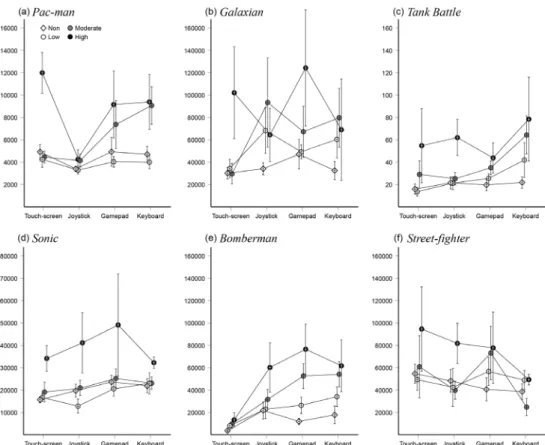
engaging time in Table 3 is used as the basis for grouping. The subjects’ mean of scores on
the four gaming interfaces were analyzed using ANOVA in order to observe whether or not there existed significant difference between subjects in differing groups. The results are as shown in Figure 5. Firstly, the four touch-screen engaging time groups are indicated using white dots, there is significant difference can be found between the gaming performances of four games: Pac-man ( F (3, 124) = 4.642, p = 0.004), Tank Battle ( F (3, 124) = 5.644, p = 0.001), Bomberman ( F (3, 124) = 6.796, p = 0.000), and Street-fighter ( F (3, 124) = 3.296,
p = 0.023), as can be seen in Figure 5a, Figure 5c, Figure 5e, and Figure 5f. This indicates
that the amount of time the subjects are engaged in the touch-screen markedly affects gaming performance. Secondly, the four keyboard engaging time groups are indicated using gray dots, there is significant difference between the gaming performances of five games: Pac-man ( F (3, 124) = 11.120, p = 0.000), Galaxian ( F (3, 124) = 4.499, p = 0.005), Tank Battle ( F
124) = 9.654, p = 0.000), as displayed in Figure 5a ~ Figure 5e. This illustrates that engaging time on the keyboard notably influences gaming performance. Lastly, the two gamepad engaging time groups are indicated using black dots, only show significant difference in gaming performance of three games: Galaxian ( t (126) = 2.319, p = 0.023), Tank Battle ( t
(126) = 2.882, p = 0.005), and Street-fighter ( t (126) = 2.573, p = 0.011), as shown in Figure 5b, Figure 5c, and Figure 5f. This reveals that subject engagement time on the gamepad significantly influence gaming performance.
What’s interesting is, it can be seen through Scheffe’s post hoc analysis that
high-engaging subjects who were grouped based on touch-screen high-engaging time had significantly
better gaming performance than low-engaging and moderate-engaging subjects in three games: Pac-man, Tank Battle, and Bomberman. This result shows that the more the subject is engaged in the touch-screen the better the gaming performance. However, it is baffling to observe how no-engaging subjects have better gaming performances than low/
moderate-engaging subjects. A similar situation is recognized amidst conditions utilizing Figure 5. Gaming performance of subject groups based on touch-screen, keyboard, and
keyboard engaging time and gamepad engaging time as subject grouping basis. Although no significant difference between the two groups exists, the two display shocking similarities. The results above show when observing the data obtained from the four game interfaces, there is significant difference between the gaming performance of subjects grouped based on interface engaging time, which partially supports H1 purposed by this study. However, do differences exist between the gaming performance of different subjects when playing on familiar (longer engaging time) or unfamiliar (shorter engaging time) game interfaces? To answer this question, the gaming performance on four game interfaces of subjects grouped based on interface engaging time on three interfaces must be observed separately.
The Gaming Performances Differing by Interface Engaging Time
The following uses the performance of subjects of varying levels on four different interfaces to observe gaming performance from the perspective of the three types of interface engaging time. Firstly, the gaming performances of subjects grouped based on touch-screen engaging time were analyzed using ANOVA. There were four groups in all, and gaming performances on four different interfaces were obtained. The results are as shown in Figure 6. No significance difference between performances in all six games was found between the
moderate-engaging and high-engaging subjects, which prove how the two groups are highly
adaptive to the four gaming interfaces. On the other hand, there is significant difference between the performance of no-engaging subjects in two games: Tank Battle ( F (3, 15) = 3.496, p = 0.042) and Bomberman ( F (3, 15) = 3.785, p = 0.033), as shown in Figure 6c and Figure 6e. As for low-engaging subjects, significant difference was found between the gaming performances of two games: Sonic ( F (3, 30) = 4.442, p = 0.011), and Bomberman ( F (3, 30) = 4.316, p = 0.012), as shown in Figure 6d and Figure 6e. Compared with the
moderate/high-engaging subjects, the no/low-engaging subjects show relatively inconsistent
adaptation abilities. By using Fisher's LSD post-hoc test, it can be seen that no-engaging subjects perform better when playing Tank Battle and Bomberman on keyboards than on touch-screens. Low-engaging subjects have better gaming performance when playing
Sonic using gamepads and keyboards instead of touch-screens. Gaming performance in Bomberman was best when playing on the keyboards. The above results suggest how
no-engaging and low-no-engaging subjects in the touch-screen no-engaging group might specialize in
game interfaces other than the touch-screen. Meanwhile, the keyboard stands out from all other game interfaces.
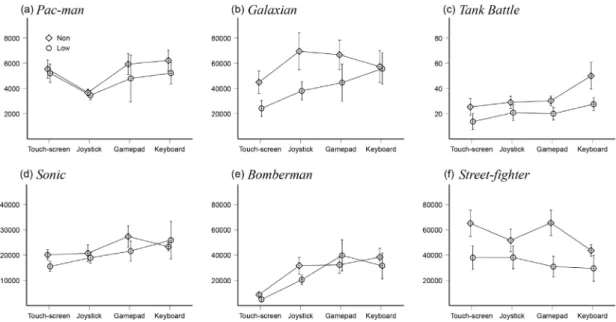
Secondly, the gaming performances of the four groups of subjects grouped based on keyboard engaging time was analyzed using ANOVA. Results are as shown in Figure 7. There is no significant difference between the gaming performances of no-engaging and
high-engaging subjects. This indicates that gaming performances on different interfaces Figure 6. Gaming performances of subjects grouped by touch-screen engaging time on
in these two groups have a certain degree of stability. On average, high-engaging subjects have better gaming performance, suggesting that high-engaging subjects might be adept at controlling all four types of game interface. In addition, significant difference can be seen between the gaming performance of moderate-engaging subjects in the games Pac-man ( F (3, 18) = 3.338, p = 0.043) and Bomberman ( F (3, 18) = 8.126, p = 0.001), as shown in Figure 7a and Figure 7e. There is also significant difference between the low-engaging subjects’ gaming performance in Bomberman ( F (3, 30) = 3.609, p = 0.025), as shown in Figure 7e. By using the LSD post-hoc test, it can be seen that moderate-engaging subjects have better gaming performance when playing Pac-man using keyboards as opposed to touch-screens and joysticks. When playing Bomberman, both keyboard and gamepad outperforms the touch-screen. And low-engaging subjects perform better in Bomberman when using gamepads and keyboards instead of touchscreens. The above results indicate that keyboards might be more suitable for complicated maze-based games.
Figure 7. Gaming performance of subjects grouped based on keyboard engaging time on
Finally, the gaming performances of the two groups of subjects grouped based on gamepad engaging time were analyzed using ANOVA. The results are as shown in Figure 8. There is significant difference between the gaming performances of no-engaging subjects in three games: Pac-man ( F (3, 72) = 3.962, p = 0.011), Tank Battle ( F (3, 72) = 3.401, p = 0.022), and Bomberman ( F (3, 72) = 8.594, p = 0.000), as shown in Figure 8a, Figure 8c, and Figure 8e. There is also significant difference between the gaming performances of
low-engaging subjects in the game Bomberman ( F (3, 18) = 4.594, p = 0.015). By using the LSD post-hoc test, it can be seen that out of the three game interfaces, no-engaging subjects have the worst gaming performance when playing Pac-man using joysticks. They also performed better in Tank Battle when using keyboards as opposed to joysticks and gamepads. Both
no-engaging and low-engaging subjects performed worst when playing Bomberman using
touch-screens.
Figure 8. Gaming performances of subjects grouped based on gamepad engaging time on
Discussion
Interface Adaptability Affected by Interface Engaging Time
After subsequent observation of subjects grouped by the three types of interface engaging time in 4.3, three phenomena are worth noting: (1) No-engaging and low-engaging subjects in the touch-screen engaging time group are unskilled at using the touch-screen when playing some of the games. (2) Low-engaging and moderate-engaging subjects in the keyboard engaging time group were still adept at using the keyboard to play some of the games. (3) No-engaging and low-engaging subjects in the gamepad engaging time group are also inept at using the gamepad to play some of the games. In other words, besides the keyboard, subject who spend less time engaging with touch-screens and gamepads are noticeably unskilled at using the two interfaces. These three phenomena do not completely correspond to the observation made in Gerling et al. (2011): feeling challenged when facing a new game platform, and comfortable with a familiar platform. Presumably, there are two reasons for these phenomena: (1) The subjects might have more than one familiar interface, (2) Gamers from different generations differ greatly when it comes to interface familiarity, similar to the phenomenon discussed in Differing Gaming Performance Caused by Difference of Interface subsection. Therefore, the subject’s gaming performance cannot be observed from a unidimensional perspective.
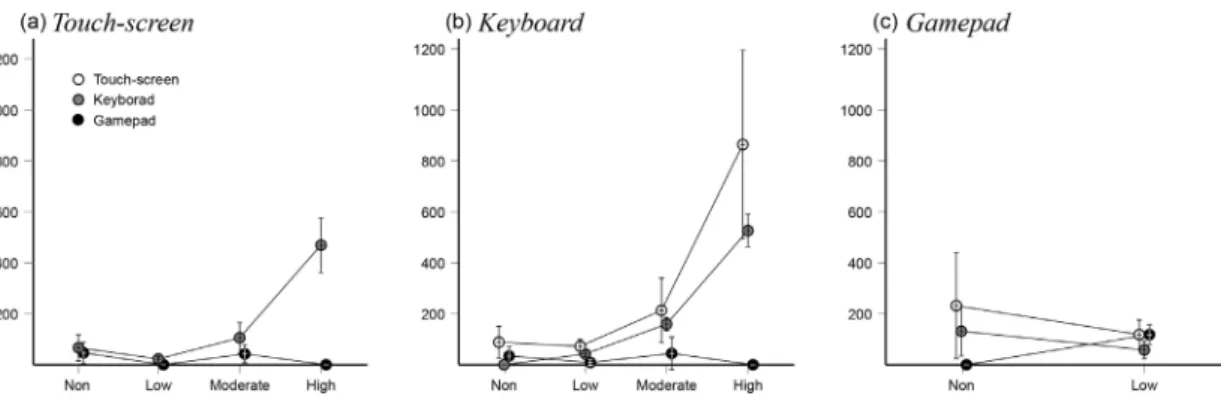
Using gamepad engaging time as an example, in terms of gamepad engaging time, the seven low-engaging subjects are engaged in the gamepad for a range of 3.71 to 208 hours annually. However, the 25 no-engaging subjects might be more engaged in other game interfaces, thus accumulating experience and skill through the process of being engaged in alternative gaming interfaces. Therefore, it is possible for no-engaging subjects to deliver better gaming performance than low-engaging subjects. This reasoning may also be used to explain the condition of the subjects grouped based on the other two interfaces. Accordingly, as shown in Figure 5, if the gaming performances of no-engaging subjects of both
touch-screen and keyboard are excluded, it can be seen that the locus consisting of the touch-touch-screen engaging time (indicated by white dots) and keyboard engaging time (indicated by gray dots) of the six games moves upward towards the upper right corner. This indicates that interface engaging time contributes significantly to gaming performance, and thus supports H1. However, the reason no-engaging causes the trajectory to be reversed may be because the subjects have spent a considerable amount of time on other game interfaces. But this remains to be further analyzed and explained.
Further analysis was performed on the engaging time of subjects who were grouped based on single interface engaging time regarding the two other gaming interfaces. The results are as shown in Figure 9. Firstly, in both groups touch-screen and keyboard engaging time, subjects relatively lack engaging time on the gamepad, as shown in Figure 9a and Figure 9b. This observation can be used to explain why when grouped based on gamepad engaging time, no-engaging subjects have significantly better gaming performances than
low-engaging subjects, as can be seen from the black dots in Figure 5. As a matter of fact,
most no-engaging subjects on the gamepad invest their time in the other two interfaces, as shown in Figure 9c. A similar situation can be seen from the gaming performances of subjects grouped based on touch-screen and keyboard engaging time. No-engaging subjects again invest a certain amount of time on other gaming interfaces, as shown in Figure 9a and Figure 9b. Secondly, for the touch-screen and keyboard groups, as the engaging time on a certain interface increases, so will the engaging time on another gaming interface. In other words, subjects spending more time on the keyboard will equally spend more time on the touch-screen. This also provides an explanation as to why three types of high-engaging (or
heavy for short) gamers have a better average gaming performance across interfaces. The
reason does not lie simply in game engaging time, but also the time being exposed to a wide range of gaming interfaces. Namely, these heavy gamers often possess the ability to play across the game platforms. What’s interesting is, this trait is especially visible in subjects grouped based on keyboard engaging time.
Figure 9. The amount of time subjects grouped based on mean of engaging time of three
interfaces are engaged in other interfaces (Error bars show ± 1 SE).
Interface Adaptability Affected by Generation Difference
The younger gamers’ unfamiliarity with the classic games of previous generations (ages 20 to 22) highlighted is though the comparatively worse gaming performance when using joysticks and gamepads. Discussing the joystick first, from the overall observation of the 32 subjects’ game performance on different game interfaces made in Differing Gaming Performance Caused by Difference of Interface subsection, it was found that the joystick, which should be the most suitable for controlling Pac-man to roam around the maze, resulted in the worst gaming performance. However, it was further revealed in The Gaming Performances Differing by Interface Engaging Time subsection that all subjects, regardless of being grouped based on touch-screen, keyboard, or gamepad, demonstrated the worst gaming performance playing Pac-man using the joystick. The relatively low standard deviation showcases stability among the subjects. Post hoc interviews conducted with the 32 subjects aged between 20 to 22 found that for the younger generation, the fast-emerging new game interfaces lead them to be unfamiliar with the previously popular game interface. Some subjects even had no experience with the joystick, and as a result, displayed relatively poor gaming performance when using the joystick to play games with complex controls like Pac-man.
subjects’ engaging time on gamepads illustrated in Table 2 and 3. Only seven people were grouped as low-engaging, and 25 people were grouped as no-engaging. This exhibits how console games are not commonly played by the 32 subjects, and results in unfamiliarity with the gamepad. However, looking at overall performance, subjects did not perform too poorly on the games originally compatible with gamepads, Sonic and Bomberman; most subjects performed better than when playing on the touch-screen or with the joystick. When playing Bomberman, subjects performed better using the keyboard than the gamepad. The reason behind this observation may be inferred from the keyboard engaging time in Table 2: the total keyboard engaging time of the 32 subjects (3681.17 hrs.) is second to only the touch-screen (6623.04 hrs.). From the post hoc interviews, it was found that subjects who spend more time playing PC games think: Keyboards have the advantage of having more keys, making it able to control more functions, and suiTable for games with complicated controls like Bomberman. Furthermore, besides gaming, keyboards are also used for clerical work and social networking, which enhances familiarity, and makes it easier for keyboards to replace gamepads as the preferred controller. The same phenomenon can be seen in Differing Gaming Performance Caused by Difference of Interface subsection and The Gaming Performances Differing by Interface Engaging Time subsection, from how subjects perform significantly better when playing Pac-man, Tank Battle, and Bomberman using keyboards.
Finally, curiously, according to Table 2, the 32 subjects’ accumulated the most time on the screen, meaning the generation of gamers aged between 20 to 22 engage in screens the most. However, in some games, the subjects do not perform better on the touch-screen. On the contrary, subjects will perform worse than using other interfaces, especially when playing Bomberman. The possible reasoning behind the relatively poor performance on touch-screens might not be only be generation difference, but also partially caused by game features, which will be discussed in Interface Adaptation Affected by Game Features subsection.
The above discussion and analysis in relation to joysticks, gamepads, and keyboards is in accordance with observations made in Gerling et al. (2011): being more comfortable
playing on familiar game platforms. However, the findings in this study might further add to the discussion on how familiarity brought on by time is not the only reason gamers perform better on platforms they are used to. The difference between game generations might serve as a hidden factor worthy of attention and discussion.
Interface Adaptation Affected by Game Features
As Brown et al. (2015) suggested the concept of a standardized controller (Rabin, 2010), when a game is designed, the most suitable game interface is usually related to the default game platform and game interface. For example, games developed in the era of arcades usually use joysticks as the main game interface, and games developed during the era of consoles use gamepads. However, the game features derived from the rules of the game might lead later developed game interfaces to become more suitable for the game, and therefore replace the original interface. A few interesting examples of this phenomenon can be found in this study: (1) Compared with joysticks, keyboards are more suitable for playing Pac-man. (2) Keyboards outperform joysticks when playing Tank Battle. (3) Bomberman is easier to control using a keyboards instead of a gamepads. It can be seen from Table 3 that Pac-man, Tank Battle, and Bomberman are all maze-based games. The subjects need to rapidly control the characters to move in four directions to either avoid or defeat the enemy. Using Bomberman as an example, gamers must place strategically bombs that will explode in four directions in the maze. Therefore, the keyboard, with its large number of keys and corresponding complex functions, makes it easier to play maze-based games. The phenomenon is similar to observations made in Isokoski and Martin (2007) and Natapov and MacKenzie (2010a): The keyboard-mouse combination outperforms the gamepad.
Furthermore, better performance in Sonic when using the gamepad is in accordance with the game features listed in Table 4. The reason might be due to how Sonic gameplay values speed, high scores are earned by collecting the most rings and defeating the Boss at the goals in the shortest amount of time. In this situation, the core movement of the game is the acceleration key controlled by the right hand, and directions are only slightly adjusted.
The design of gamepads is able to suit these needs. In comparasion, Pac-man, Tank Battle, and Bomberman put more emphasis on agilely roaming through the mazes, with the core movement being controlling direction. Therefore, keyboards are best game interfaces for these three games.
Conclusion
According to the results of this study, after multidimensional cross-comparison and discussion, interface engaging time does significantly affect the subjects’ gaming performance in a number of games, thus partially supporting H1. Moreover, both generation difference and game features affect the subjects’ gaming performance to a certain extent, in traceable patterns, but can only be sustained within the scope of this study. Furthermore, interface engaging time affect subjects’ performance due to how mastery of an interface comes alongside accumulated engaging time, an observation that can be commonly proved. The results of this study can be easily extended to related research on game interface. Thus it is suggested that interface engaging time be viewed as an important basis for gamer grouping.
To sum up the above, when focused on how gaming performance is affected by interface engaging time, this study shows: (a) Interface engaging time significantly affects gaming performance. (b) The more time spent on a specific interface, the better the subject’s gaming performance using that interface. (c) Apart from the keyboard, increased engagement time on a specific interface will not enhance gaming performance on other interfaces. (d) Subjects that are high-engaging in all interfaces are usually also familiar with other interfaces. In addition, although game difficulty is often closely linked with subject characteristics, it is challenging to control, especially in released games, and therefore has not been adopted in this study. Future game interface related studies are recommended to view game difficulty as an independent variable to further observe its influence on game performance.
Last but not least, due to the recent surge of cloud gaming brought on by the prevalence of mobile devices and cloud technology (Cai, Leung, & Chen, 2013; Cai, Chen, & Leung,
2014; Chuah, Yuen, & Cheung, 2014; Huang, Hsu, Chang, & Chen, 2013; Jurgelionis et al., 2010; Wang & Dey, 2010), gamers can play through games previously unfinished using the same account on different platforms. Therefore, how gamers of differing gaming skills adapt to the same game on different platforms will become an increasingly complex problem in need of a solution. The author hopes that the results presented in this study can serve as a base for future studies on relevant gaming practices.
Acknowledgments
This study was supported by the MOST research projects (102-2410-H-119-004), Republic of China.
References
Anand, V. (2007). A study of time management: The correlation between video game usage and academic performance markers. Cyber Psychology & Behavior, 10(4), 552-559. doi: 10.1089/cpb.2007.9991
Beck, J. C., & Wade, M. W. (2004). Got game: How the gamer generation is reshaping
business forever. Boston, MA: Harvard Business Press.
Bernhaupt, R. (2015). Evaluating user experience in games: Concepts and methods. In R. Bernhaupt (Ed.), Game user experience evaluation (pp. 1-5). New York, NY: Springer International Publishing. doi: 10.1007/978-1-84882-963-3
Bianchi-Berthouze, N., Kim, W. W., & Patel, D. (2007, September 12-14). Does body
movement engage you more in digital game play? and why? Paper presented at
International Conference on Affective Computing and Intelligent Interaction, Lisbon, Portugal. doi:10.1007/978-3-540-74889-2_10
Birk, M., & Mandryk, R. L. (2013, April 27 - May 2). Control your game-self: Effects of
controller type on enjoyment, motivation, and personality in game. Paper presented at
the SIGCHI Conference on Human Factors in Computing Systems, Paris, France. doi: 10.1145/2470654.2470752
Bodén, J., Jegers, K., Lidstrom, M., Wiberg, C., & Wiberg, M. (2007, May 13-19). Point or
click? Evaluation of two input modalities for mobile entertainment. Paper presented
at the Internet and Web Applications and Services (ICIW) International Conference, Morne, Mauritius. doi 10.1109/ICIW.2007.47
Brockmyer, J. H., Fox, C. M., Curtiss, K. A., McBroom, E., Burkhart, K. M., & Pidruzny, J. N. (2009). The development of the game engagement questionnaire: A measure of engagement in video game-playing. Journal of Experimental Social Psychology, 45(4), 624-634. doi: 10.1016/j.jesp.2009.02.016
Brown, E., & Cairns, P. (2004, April 24-29). A grounded investigation of game immersion. Paper presented at the CHI Extended Abstracts on Human Factors in Computing
Systems, Vienna, Austria. doi: 10.1145/985921.986048
Brown, M., Kehoe, A., Kirakowski, J., & Pitt, I. (2015). Beyond the gamepad: HCI and game controller design and evaluation. In R. Bernhaupt (Ed.), Game user experience
evaluation (pp. 263-285). New York, NY: Springer International Publishing. doi:
10.1007/978-1-84882-963-3_12
Cai, W., Leung, V. C., & Chen, M. (2013, March 25-28). Next generation mobile cloud
gaming. Paper presented at the Service Oriented System Engineering (SOSE), IEEE
International Symposium, San Francisco, CA.
Cai, W., Chen, M., & Leung, V. C. (2014). Toward gaming as a service. IEEE Internet
Computing, 18(3), 12-18. doi: 10.1109/MIC.2014.22
Chuah, S. P., Yuen, C., & Cheung, N. M. (2014). Cloud gaming: a green solution to massive multiplayer online games. IEEE Wireless Communications, 21(4), 78-87. doi: 10.1109/ MWC.2014.6882299
Claypool, M. (2009, April). Motion and scene complexity for streaming video games. Paper presented at the International Conference on Foundations of Digital Games, Port Canaveral, FL. doi: 10.1145/1536513.1536529
Crenshaw, N., Orzech, S., Wong, W.S., & Holloway, A. (2011a, June 29-July 1). On
creating a native real-time-strategy game user interface for multi-touch devices. Paper
presented at theInternational Conference on Foundations of Digital Games (FDG), Bordeaux, France. doi: 10.1145/2159365.2159413
Crenshaw, N., Holloway, A., Orzech, S., & Wong, W.S. (2011b, June). One-handed
interface for multitouch-enabled real-time strategy games. Paper presented at the
Game Accessibility: Xtreme Interaction Design (GAXID), Bordeaux, France.
Ferguson, C. J., Colwell, J., Mlacic, B., Milas, G., & Miklousic, I. (2011). Personality and media influences on violence and depression in a cross-national sample of young adults: Data from Mexican–Americans, English and Croatians. Computers in Human
Behavior, 27(3), 1195-1200. doi: 10.1016/j.chb.2010.12.015
the amplitude of movement. Journal of Experimental Psychology, 47(6), 381. doi: 10.1037/0096-3445.121.3.262
Fox, C. M., & Brockmyer, J. H. (2013). The development of the game engagement questionnaire: A measure of engagement in video game playing: Response to reviews.
Interacting with Computers, 25(4), 290-293. doi: 10.1093/iwc/iwt003
Gauntlett, D. (2005). Moving experiences, understanding television's influences and effects
(2nd Ed.). Bloomington, IN: Indiana University Press.
Gerling, K. M., Klauser, M., &Niesenhaus, J. (2011, September 28-30). Measuring the
impact of game controllers on player experience in FPS games. Paper presented
at the International Academic MindTrek Conference: Envisioning Future Media Environments,Tampere, Finland. doi: 10.1145/2181037.2181052
Gilleade, K., & Allanson, J. (2003, June). A toolkit for exploring affective interface
adaptation in videogames. Paper presented at the HCI International 2003, Crete,
Greece.
Hoysniemi, J. (2006). International survey on the dance dance revolution game. Computers
in Entertainment (CIE) - Theoretical and Practical Computer Applications in Entertainment, 4(2), 8. doi: 10.1145/1129006.1129019
Huang, C. Y., Hsu, C. H., Chang, Y. C., & Chen, K. T. (2013, February 28-March 1).
Gaming anywhere: An open cloud gaming system. Paper presented at the ACM
Multimedia Systems Conference, Oslo, Norway. doi: 10.1145/2537855
Isokoski, P., & Martin, B. (2007, June). Performance of input devices in FPS target
acquisition. Paper presented at the International Conference on Advances in Computer
Entertainment Technology, Salzburg, Austria. doi: 10.1145/1255047.1255104
Jackson, L. A., von Eye, A., Fitzgerald, H. E., Witt, E. A., & Zhao, Y. (2011). Internet use, videogame playing and cell phone use as predictors of children’s body mass index (BMI), body weight, academic performance and social and overall self-esteem.
Computers in Human Behavior, 27(1), 599-604. doi: 10.1016/j.chb.2010.10.019
Ergonomics, 46(13-14), 1332-1345. doi: 10.1080/00140130310001610865
Jurgelionis, A., Bellotti, F., De Gloria, A., Laulajainen, J. P., Fechteler, P., Eisert, P., & David, H. (2010, April 20-23). Testing cross-platform streaming of video games over
wired and wireless LANs. Paper presented at the IEEE International Conference on
Advanced Information Networking and Applications Workshops, Perth, Australi. doi: 10.1109/WAINA.2010.186
Klochek, C., & MacKenzie, I. S. (2006, June). Performance measures of game controllers
in a three-dimensional environment. Paper presented at the Graphics Interface,
Québec, Canada.
Lopes, R., & Bidarra, R. (2011). Adaptivity challenges in games and simulations: A survey.
IEEE Transactions on Computational Intelligence and AI in Games, 3(2), 85-99. doi:
10.1109/TCIAIG.2011.2152841
MacKenzie, I. S., & Teather, R. J. (2012, October 14-17). Fitts tilt: The application of Fitts'
law to tilt-based interaction. Paper presented at the Nordic Conference on
Human-Computer Interaction: Making Sense through Design, Copenhagen, Denmark. doi: 10.1145/2399016.2399103
Melhuish, K., & Falloon, G. (2012, October 14-17). Looking to the future: M-learning with the iPad. Computers in New Zealand Schools: Learning, Leading, Technology, 22(3), 1-16. doi:10.1145/2399016.2399103
Mueller, F., & Bianchi-Berthouze, N. (2015). Evaluating exertion games. In R. Bernhaupt (Ed.), Game user experience evaluation (pp. 239-262). New York, NY: Springer International Publishing. doi: 10.1007/978-1-84882-963-3_11
Nacke, L. E., & Lindley, C. A. (2009). Affective ludology, flow and immersion in a first-person shooter: Measurement of player experience. Feature Issue: Futureplay 2009
Edition of Loading..., 3(5), 1-21.
Nacke, L. E. (2010, May 6-7). Wiimote vs. controller: Electroencephalographic
measurement of affective gameplay interaction. Paper presented at the International
Canada. doi: 10.1145/1920778.1920801
Natapov, D., & MacKenzie, I. S. (2010a, May 6-7). Gameplay evaluation of the trackball
controller. Paper presented at the International Academic Conference on the Future of
Game Design and Technology, Vancouver, Canada. doi: 10.1145/1920778.1920802 Natapov, D., & MacKenzie, I. S. (2010b, May). The trackball controller: Improving the
analog stick. Paper presented at the International Academic Conference on the Future
of Game Design and Technology, Vancouver, Canada. doi: 10.1145/1920778.1920803 Novak, T. P., Hoffman, D. L., & Yung, Y. F. (2000). Measuring the customer experience in
online environments: A structural modeling approach. Marketing Science, 19(1), 22-42. doi: 10.1287/mksc.19.1.22.15184
Pinelle, D., Wong, N., & Stach, T. (2008, April). Heuristic evaluation for games: usability
principles for video game design. Paper presented at the SIGCHI Conference on
Human Factors in Computing Systems, Florence, Italy. doi: 10.1145/1357054.1357282 Purkayastha, S. N., Eckenstein, N., Byrne, M. D., & O'Malley, M. K. (2010, July 6-9).
Analysis and comparison of low cost gaming controllers for motion analysis. Paper
presented at the IEEE/ASME International Conference on Advanced Intelligent Mechatronics, Montreal, Canada. doi: 10.1109/AIM.2010.5695830
Rabin, S. (2010). Introduction to game development (2nd Ed.). Rockland, MA: Charles River Media. Inc.
Skoric, M. M., Teo, L. L. C., & Neo, R. L. (2009). Children and video games: Addiction, engagement, and scholastic achievement. Cyber Psychology & Behavior, 12(5), 567-572. doi: 10.1089/cpb.2009.0079
Soukoreff, R. W., & MacKenzie, I. S. (2004). Towards a standard for pointing device evaluation, perspectives on 27 years of Fitts’ law research in HCI. International
journal of human-computer studies, 61(6), 751-789. doi: 10.1016/j.ijhcs.2004.09.001
Sun, C. T., Lin, H., & Ho, C. H. (2003, November). Game tips as gifts: Social interactions
and rational calculations in computer gaming. Paper presented at the Digital Games
Ventura, M., Shute, V., & Kim, Y. J. (2012). Video gameplay, personality and academic performance. Computer & Education, 58(4), 1260-1266. doi: 10.1016/ j.compedu.2011.11.022
Wang, S., & Dey, S. (2010, December 6-10). Rendering adaptation to address
communication and computation constraints in cloud mobile gaming. Paper presented
at the Global Telecommunications Conference (GLOBECOM), Miami, FL. doi: 10.1109/GLOCOM.2010.5684144
Wolf, M. J. (2008). The video game explosion: A history from PONG to Playstation and
beyond. Westport, CT: Greenwood Press.
Wu, J. H., Wang, S. C., & Tsai, H. H. (2010). Falling in love with online games: The uses and gratifications perspective. Computers in Human Behavior, 26(6), 1862-1871. doi: 10.1016/j.chb.2010.07.033
Zaman, L., Natapov, D., & Teather, R. J. (2010, May 6-7). Touchscreens vs. traditional
controllers in handheld gaming. Paper presented at the International Academic
Conference on the Future of Game Design and Technology, Vancouver, Canada. doi: 10.1145/1920778.1920804
Zaman, L., & MacKenzie, I. S. (2013, July). Evaluation of nano-stick, foam buttons, and
other input methods for gameplay on touchscreen phones. Paper presented at the
International Conference on Multimedia and Human-Computer Interaction-MHCI, Toronto, Canada. doi: 10.1.1.417.8650
Zaranek, A., Ramoul, B., Yu, H. F., Yao, Y., & Teather, R. J. (2014, April 26-May 1).
Performance of modern gaming input devices in first-person shooter target acquisition.
Paper presented at the CHI Extended Abstracts on Human Factors in Computing Systems, Toronto, Canada. doi: 10.1145/2559206.2581291