
針對新加坡人口老化課題之公共衛生服務雲端運算系統的隱喻學研究 - 政大學術集成
103
0
0
全文
(2) Acknowledgements I would like to express my heartfelt gratitude to the following people who have been extremely kind to render their support throughout the entire research and writing process of this Master thesis. First of all, I would like to thank my thesis advisor, Professor Sun Se-wen, for her continuous guidance and invaluable advice. Her patience and encouragement during the research process has been a tremendous driving force for me to strive towards achieving my research goals. She was always willing to share her unsurpassed knowledge in metaphorical studies, which has provided crucial insights towards making this thesis more meaningful and valuable.. 治 政 I would also like to thank Professor Hsu Mei-Ling and Professor 大 Liu Wen-Ying, who have 立 taken precious time off their busy schedule to provide me with suggestions to improve on my ‧ 國. 學. thesis during my oral defense. Their constructive criticism has given me new perspectives in. ‧. my subsequent progress in my research for the thesis.. sit. y. Nat. Last but not least, I would like to show my appreciation to my family and friends, for their. io. er. unwavering encouragement during my pursuit in this thesis research. Special thanks to my friends, Chien-yi, Singing and Jacqueline, who spurs me on during difficult times, Tian Min. al. n. v i n C h for interviews U who has lent a helping hand in arranging with medical professionals, and my engchi family who have been very supportive throughout.. i.
(3) Abstract This study attempts to investigate the issues of aging population in the context of Singapore through metaphorical approach and the potential of tapping on the collaborative characteristics of a health service cloud computing system to meet the needs in elderly care, hence allowing active aging. The use of electronic health records (EHR) in various countries, particularly the meaningful use of EHR in USA is examined to understand its current features and usage. By employing conceptual mapping and blending of metaphorical study, the concepts in cloud computing are probed to gain better understanding on the characteristics of the technology. Similarly, with concepts drawn from an eco-system blended with concepts in. 治 政 a health service system, the characteristics of EHR and finally 大 the characteristics of a health 立 service cloud computing system are illustrated. With understanding in aging population, ‧ 國. 學. present usage of EHR and potential of cloud computing in Singapore, multi-methods research. ‧. consisting of intensive interviews and archival document collations are employed.. sit. y. Nat. Triangulation amongst the datasets collated using open coding via ATLAS.ti resulted in 6. io. er. issues of concern in aging population pertaining to the Singapore context to arise, namely (i) primary care, (ii) familial support, (iii) awareness in health maintenance and transparency in. al. n. v i n C hand accuracy in healthcare information, (iv) improved efficiency with seamless transfer of engchi U. care and (v) intermediate care and (vi) collaboration between stakeholders. Further analysis of the results draws up the possibilities for enhancing meaningful use of health service cloud computing system for active aging, which criteria are: (i) empowerment and ownership, (ii) sustainable homecare and (iii) seamless transfer of care. Finally, a conceptual mapping of health service cloud computing system and the criteria for effective aging give rise to a model framework that is set for active aging.. ii.
(4) TABLE OF CONTENTS Pg 1 – 3. 1.. Introduction. 2.. Literature Review 2.1. Electronic Health Records (EHR). Pg 4 - 16. 2.1.1. The development of EHR. 2.1.2. Shifting the Paradigm - USA’s initiative towards a patient-centered healthcare system. 2.1.3. A patient-centered approach to tackling issues of aging population. 2.1.4. Cloud computing in EHR. 2.1.5. Concepts of metaphor. Pg 17 - 23. 學. ‧ 國. Using metaphors for new inventions. 2.2.2. Conceptual metaphor. 2.2.3. Conceptual blending in metaphors. 2.2.4. Applying conceptual metaphor of ‘cloud’ on ‘computing. ‧. 2.2.1. n. 2.4. Characteristics of ecosystem. Ch. engchi. er. io. The Dossia Health Service System. y. Nat. al. 2.3. sit. 2.2. 政 治 大 Delivery modes of cloud computing 立. i n U. v. 2.4.1. Determining if a health service system satisfy the characteristics of an ecosystem. 2.4.2. Sustaining the effectiveness of an ecosystem. 2.4.3. Concept of keystone metaphor in ecosystem. 2.4.4. Conceptual blending of cloud computing technology and electronic health records system. 2.4.5. The component that links – Water as a metaphor for data and information. Pg 24 - 28 Pg 29 - 40. iii.
(5) 2.4.6 2.5. 2.5.1. Problems of aging population in Singapore. 2.5.2. Importance of familial support in Singapore. 2.5.3. Present EHR system in Singapore. 2.5.4. Tapping on cloud computing for healthcare in Singapore. Research Methodology: Multi-methods research 3.1. Data Collection. 3.2. Triangulation. Results. Pg 48 - 52. 政 治 大. 立. Pg 53 - 64. Primary Care. 4.2. Familial Support. 4.3. Awareness in health maintenance and transparency in information. 4.4. Improved efficiency and accuracy in healthcare with seamless transfer of care. 4.5. Intermediate care sectors. 4.6. Collaboration between stakeholders. ‧. y. n. al. Ch. engchi. sit. io. Discussion. 學. 4.1. Nat. 5.. Pg 41- 47. er. 4.. Aging population in Singapore. ‧ 國. 3.. Opening possibilities – Entailments of water. i n U. v. 5.1. Empowerment and ownership. 5.2. Homecare as key pillar of support for effective aging. 5.3. Primary and intermediate care support for seamless transfer of care Collaboration through health service cloud computing system for effective aging. 5.4. Pg 65 - 77. 6.. Conclusion. Pg 78 - 80. 7.. References. Pg 81 - 86. 8.. Appendix 1: Intensive interview questions. Pg 87 - 88. 9.. Appendix 2: Results of research data. Pg 89 - 97 iv.
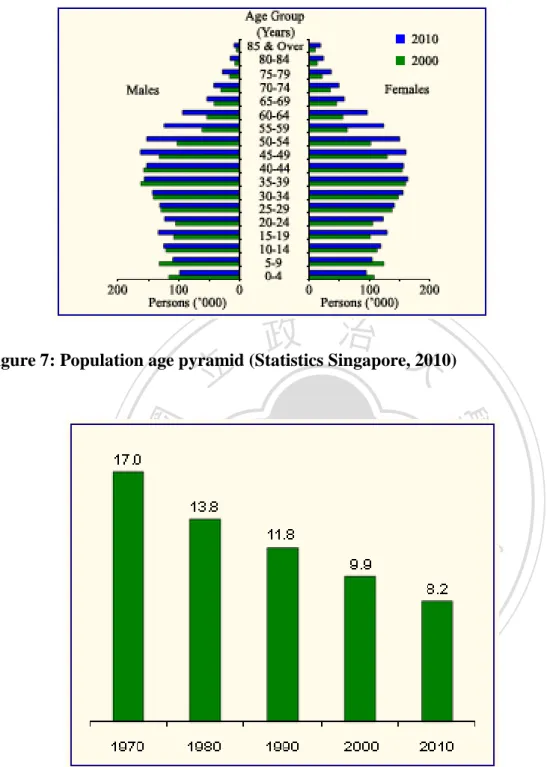
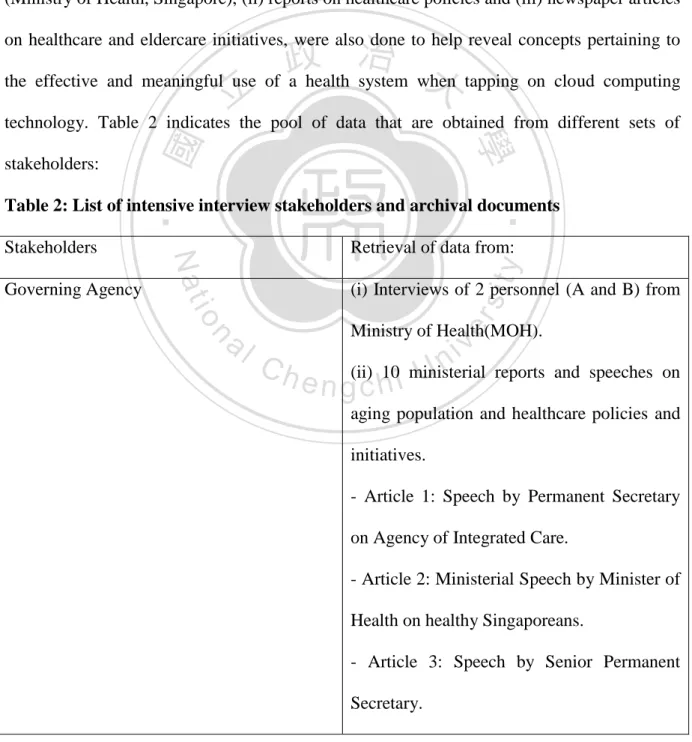
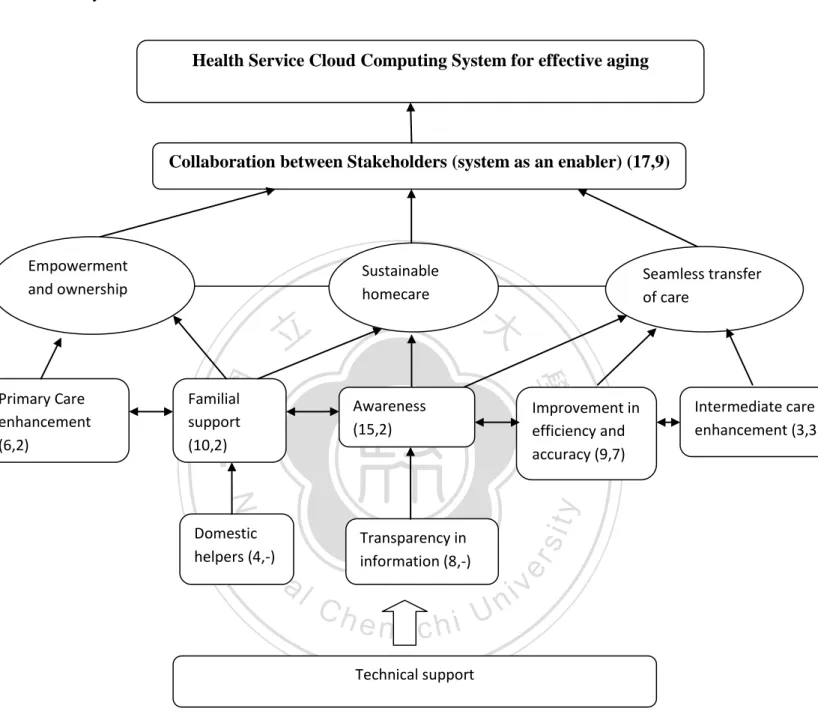
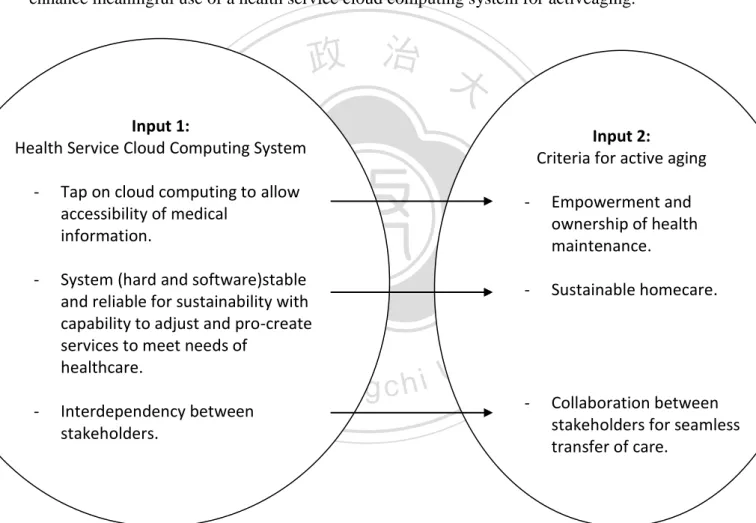
(6) List of Figures and Tables. Figure 1: Standards of cloud computing taxonomy (Cloud Computing case use white paper, 2010). Pg 15. Figure 2: The architecture of cloud computing (Boroujerdi & Nazem, 2009). Pg 16. Figure 3: Conceptual blending between cloud and computing technology. Pg 22. Table 1: Players and their responsibilities in Dossia Health Service System. Pg 24. 政 治 大. Figure 4: Pictorial representation of system in Dossia Health Service System. Pg 26. Figure 5: Conceptual Blending between health service system and ecosystem. Pg 32. Figure 6: Conceptual blending between cloud computing technology and Electronic Health Records (EHR). Pg 37. 立. Pg 42. sit. Pg 42. y. Nat. Figure 8: Old age support ratio (Statistics Singapore, 2010). ‧. ‧ 國. 學. Figure 7: Population age pyramid (Statistics Singapore, 2010). n. al. er. io. Table 2: List of intensive interview stakeholders and archival documents Pg 49 – 51. i n U. v. Figure 9: Inter-relationships between concepts derived from coding and analysis of data. Pg 66. Table 3: Possible stakeholders in health service cloud computing system for elderly care in Singapore. Pg 67. Ch. engchi. Figure 10: Conceptual mapping between health service cloud computing Pg 77 system and criteria for active aging. v.
(7) Chapter 1: Introduction. With the increasing affluence of people in developed countries, public health has become one of their major concerns. „Public health is the science and the art of preventing disease, prolonging life and promoting physical health and efficiency through organized community efforts for the sanitation of the environment, the control of community infections, the education of individual in principles of personal hygiene, the organization of medical and nursing service for the early diagnosis and preventive treatment of disease, and the development of social machinery which will ensure to every individual in the community a standard of living adequate for the maintenance of health.‟ (Winslow, 1920, p.23). Based on. 治 政 statistics collated by World Health Organization updated大 till March 2010, it is clear that 立 developed countries such as the United States of America and Canada, various parts of ‧ 國. 學. Europe such as United Kingdom and Norway and numerous countries in the Asia-Pacific. ‧. which includes Australia, are having the highest expenditure in the world of about US$1001 to more than US$5000 per capita in terms of public health (World Health Organization, 2010).. y. Nat. health across affluent countries in the world.. al. er. io. sit. These figures have undoubtedly displayed the huge emphasis on the development of public. n. v i n Indeed, while public health problems faced by developed countries may not be as glaring as Ch engchi U those of the less developed, there too exists some trying and teething crisis. According to. statistics by the United Nations (2009), the recurring problem of aging population is definitely much more pronounced among the more developed countries as compared to the lesser developed. With higher life expectancy yet low fertility rate in these developed countries, health maintenance is of utmost importance as contribution of healthy older communities in the country‟s economy becomes essential. The issue of health maintenance has thus risen to a global concern. The idea of „active aging‟, defined by WHO as the process of optimizing opportunities for health, participation and security in order to enhance quality. 1.
(8) of life as people age, is a goal that countries facing the silver tsunami hope to achieve. Together with capabilities to tap on the rapid developments in technology, affluent countries are able to put in substantial investments to find ways in taking care of their peoples‟ wellbeing. In 2008, some 50 Forbes companies in United States pooled in their resources in the construction of a non-profit online health service system, Dossia, using the latest cloud computing technology. The construction of this online health service system is to fulfill the objective of providing Americans a more systematic way to monitor their health and also that of their family members, which will in turn empower employees to keep their families‟ health. 治 政 大of health condition. Soon after, efficiency will predictably increase with better maintenance 立. in check. This created a win-win situation for both employers and employees as work. commercial companies like Microsoft and Google also discovered the potential of such health. ‧ 國. 學. service systems and thereafter, with their vast knowledge in cloud computing, started to. ‧. improvise and establish partnerships with relevant vendors to create an even more well-. sit. y. Nat. rounded health service system. While the Dossia system wasn‟t targeted at aging population. io. al. er. but public healthcare for all Americans, the concept of having ownership in monitoring health for oneself and family can help improve efficiency, faster and prompt medical advice,. n. v i n C h problems, thereby enhance preventive measures to health e n g c h i U fulfilling the essentials of good. public health support. Other than USA, many other countries such as Denmark and Canada have also been constantly looking into turning the effective use of cloud computing into the area of healthcare. Hence, the tapping of the enormous potential of using IT in healthcare is one key factor to improving healthcare in today‟s world. With American‟s system as a basis for investigation and using the ecosystem as a metaphor to examine the critical characteristics between the stakeholders and processes to be in place to devising a successful health service cloud computing system for varying context, with specific attention to how the cloud computing technology contributes to filling up the gaps of. 2.
(9) the current system to tackle the issue of aging population in Singapore. In the literature review section of this research, the development and use of electronic health records in various countries will first be studied, with particular attention in the USA‟s approach, which has provided documentation of how a system can be attuned towards meaningful use of electronic health records. Cloud computing technology, which is the key component that makes the electronic health records system possible, will then be discussed. The use of concepts of metaphors is then applied to further comprehend the characteristics of cloud computing use in electronic health records. With understanding of electronic health records and cloud computing technology, the case study of USA‟s Dossia Health Service. 治 政 大to decipher the various services System will make use of the metaphor of cloud computing 立. and stakeholders which ensure the functionality of a patient-centered health service system.. ‧ 國. 學. This then leads to the appreciation of a functional health service cloud computing system apt. ‧. for active aging intended by mapping onto the unique characteristics of a metaphorical. sit. y. Nat. conceptual blend between cloud computing and ecosystem. Finally, the issue of aging. io. al. er. population in the context of Singapore will be discussed to provide a better picture of. n. predicted situation brought about by aging population in the profile of Singapore society, and current electronic health record. v i n C h used in Singapore system e n g c h i U will. be looked into. These. background knowledge then lay the foundation towards formulation of three research questions that can be investigated in this study on how the application of a health service cloud computing system can assist in achieving the needs of elderly care in Singapore, thereby allowing active aging to take place.. 3.
(10) Chapter 2: Literature Review 2.1 Electronics Health Records (EHR) With the relentless technological advancements and the increasing emphasis in health maintenance, the use of electronic health records have been one of the latest innovation to be pushed forward in many developed countries, though still at its infancy stage. Some countries, such as the United States of America (USA) and countries in Europe, have put in tremendous efforts to link up the entire country pertaining to healthcare. Electronic Health Records systems may bring about multiple benefits to healthcare, similar to other industries such as banking or online retail which provide convenient, efficient, and customer-centered services. 政 治 大. (Detmer, 2009). Indeed, electronic health records promise to improve and modernize. 立. 2.1.1 The development of EHR. 學. ‧ 國. healthcare worldwide (Kushniruk et al., 2010).. ‧. The first EHR in USA, one of the pioneering countries in this field, began in the 1960s, where a vast number of hospitals and clinics initiated projects to suggest way for storage of. y. Nat. er. io. sit. large amount of medical records which were previously in paper-form (National Center for Research Resources, 2006). These medical records are important for the fundamental goal in. al. n. v i n the retrieval of accurate health information as to arrive at the correct diagnosis. C h of patients so U engchi However, EHR provided more dimensions for improvements in healthcare services other than. rectifying the initial storage problem. EHR can also provide additional functions such as interactive alerts and order system within medical field. These were some functions served in the early days of EHR usage. Hence, an EHR at this stage is a computerized version of an individual‟s health record that may contain a person‟s full health and medical record or other health results, in conjunction with a more traditional paper-based patient chart (Urowitz et al., 2008).. 4.
(11) As EHR continued its development, its functionality in response to the development of information technology led to further expansion of its utility. The widespread use of internet allowed more cross-functional interaction, and improves efficiency in health services, such as advance booking of medical appointment by patients, or access to medical history of patients in different care settings. In USA, according to NCRR‟s review (2006), the components of EHR were focused mainly on (i) administration, (ii) nursing, (iii) laboratory, (iv) clinical, (v) radiology and (v) pharmacy, in which better coordination between caregivers could be established to provide more efficient medical care to patients. The effectiveness of adoption. 治 政 大 health records system initiated and treatment. One such use was the employment of electronic 立 of shared information via EHR in USA was observed in several studies on medical diagnosis. by the New York City Department of Mental Health and Hygiene (DOHMH) for the. ‧ 國. 學. monitoring of patients with Sexually Transmitted Diseases (STD). Data were inputted via. ‧. electronic health records to drive medical and programmatic decisions. Results have shown. sit. y. Nat. that the electronic health records system has helped to facilitate access to medical records. io. al. er. across and within clinics and to allow assessments of patient characteristics and service provision, as well as has provided readily analyzable data that have led to changes in clinical. n. v i n practices, including more effective C staff disease detection, and increased clinic huse, e nincreased gchi U. capacity (Paneth-Pollak et al., 2010). Also, a study on cancer had also been enhanced through the effective use of data mined from records of cancer-stricken patients, making more effective analysis and research possible (Poh, 2009). Studies of effective adoption of EHR were also evident in Europe. An example was the case of EHR usage in Denmark, whereby its electronic healthcare system within the country helped to provide a more comprehensive and all-rounded healthcare service to its people. Its „Connected Digital Health in Denmark‟ is an organization which aims to create a coordinated health service between the caregivers such that information can be made readily available. 5.
(12) when necessary via the national e-health portal that caregivers and citizens can have access to. Citizens could log onto the portal “to book appointments electronically, request for renewal of medications, review their own patient summary including medications, discharge summaries and laboratory results over the Internet” (Kushniruk et al., 2010). The input and updating of patients‟ record was made easy due to a standardized procedure and forms used throughout the whole country.. It could be observed that the utilization of EHR was. emphasized mainly on medical information of patients for caregivers, while the participation of patients was limited to the administrative component. Electronic health records at this present stage are defined as repositories of patients‟ health data and information which allows. 治 政 大 different locations by different the mobility i.e. the possibility of accessing information from 立. users in the management of patient care and healthcare resources (Kushniruk et al., 2010).. ‧ 國. 學. These information may come from different systems and can be made available for a. ‧. longitudinal view of the patient‟s health history.. sit. y. Nat. Today, primary healthcare has been identified as an element which needs to be reinforced. io. al. er. such that patients and their close ones can play an active role in taking charge of their health conditions. A patient-centered health system has been widely regarded as the solution to. n. v i n various delivery gaps of the currentC primary processes, which are more often than h e nhealthcare gchi U. not, presently still focused on the convenience and responsibilities of caregivers. However, to achieve the full impact and fully exploit the potential of EHR, improvements must be made to the current system to increase engagements of patients themselves. Medical results must flow back to clinical professionals and patients so that well-informed decisions can then be made with the most current findings (Detmer, 2009). Hence, a safe, timely, efficient, effective, equitable and patient-centered system should evolve to improve the current state of electronic healthcare system. Also, the idea of a „medical home‟, which are highly-integrated team-based practices that enhance patient-centered care through routine patient feedback and. 6.
(13) better access, is believed to be able to improve clinical efficiency and quality with better coordination amongst various players in health maintenance. According to Bates and Bitton (2010), this patient-centered care system builds on the central idea of electronic health records, yet transformed to fully utilize the functionality of the present usage of electronic health records to better tackle healthcare problems especially in the area of chronic illnesses which requires constant monitoring. Several studies have also proven that the involvement of patients can increase the effectiveness of healthcare. A study on involving diabetic patients in their health monitoring process by providing access rights to an interactive electronic health. 治 政 health conditions of the diabetic patients (Ralston et al.,大 2004). In addition, another study 立 records in Washington, United States, have shown positive results in maintaining better. which focused on cognitive heart failure patients also proved to improve monitoring of health. ‧ 國. 學. conditions through participation in the online health records system (Ross et al., 2004). These. ‧. proposed patient-centered components to be included to improve current EHR systems are. sit. y. Nat. crucial to reduce cost of healthcare while at the same time improve the quality and safety of. io. al. er. care. In Canada, there is also a growing shift into the use of e-health, with noticeable increase in the adoption of electronic health records, having a target of 50% of Canadians. n. v i n C h to their health Uproviders available engchi. having their health records. (Urowitz et al., 2008).. Canadians have also recognized the importance and advantage of making patients and their family take charge of their own health status, and is looking at ways in which a shift of EHR usage can be done to include the self-monitoring component, thereby creating a Personal Health Record (PHR). However few and trivial they may be, features of a patient-centered healthcare are indeed evident in many health systems. With rapid improvements in today‟s technology, it is obvious that countries are putting in effort to push the use of EHR to a higher level such that. 7.
(14) larger involvement of patients and primary care units can be tapped upon to create a more effective and meaningful use of EHR. 2.1.2 Shifting the Paradigm - USA’s initiative towards a patient-centered healthcare system With President Obama‟s pledge to pump in US$50 billion to achieve the goal of creating a electronic health record for each American, USA can be regarded being one of the most advanced users the of electronic health records. Indeed, USA has realized the importance, and definitely the lack of primary care within the healthcare system. A patient-centered healthcare. 治 政 大 model (Bates & Bitton, prevalent in the common medical providers-centered healthcare 立 system has been identified as a crucial model to address the delivery gaps that have been. 2010). Yet, even today‟s leading electronic health records system is unable to fully explore. ‧ 國. 學. the functionality of a patient-centered healthcare system. According to a study done by the. ‧. National Research Center of America, Stead and Lin (2009, pp. 20-24) has organized a list of. sit. y. Nat. expectations in which the electronic health records system should meet:. -. Cognitive support for healthcare professionals and patients to help integrate patient-. -. Cognitive support for healthcare professionals to help integrate evidence-based. al. er. Comprehensive data on patients‟ conditions, treatments and outcomes.. io. -. n. v i n specific data where possibleC and any uncertainties that remain. haccount e n g for chi U practice guidelines and research results into daily practice.. -. Instruments that allow providers to manage a portfolio of patients and highlight problems as they arise within both individual patients and populations.. -. Rapid integration of new instrumentation, biological knowledge, treatment modalities, etc., into a “learning” healthcare system that encourages early adoption of promising methods but also analyzes all patient experience as experimental data.. 8.
(15) -. Accommodation of growing heterogeneity of locales for provision of care, including home instrumentation for monitoring and treatment, lifestyle integration, and remote assistance.. -. Empowerment of patients and their families in effective management of healthcare decisions and execution, including personal health records (as contrasted to medical records held by care providers), education about the individual‟s conditions and options, and support of timely and focused communication with professional healthcare providers.. 治 政 大 electronic health records indication of the necessary development of a patient-centered 立 With reference to the final criterion on empowerment of patients and families, it is a clear. system to enhance its meaningful use.. ‧ 國. 學. Also, to ensure meaningful use of funds pumped into the establishment of IT into healthcare. ‧. in America, the Centers for Medicare and Medicaid Service in USA published a Proposed. sit. y. Nat. Rule on Meaningful Use of Electronic Health Records and began a 60-day public comment. io. er. period on December 2009 (Murphy, 2010). With consolidation of more than 2,000 comments, the final criteria for meeting “meaningful use” were divided into five initiatives:. al. n. v i n C hefficiency, and reduce 1. Improve quality, safety, and e n g c h i U health disparities. 2. Engage patients and families. 3. Improve care coordination. 4. Improve population and public health.. 5. Ensure adequate privacy and security protections for personal health information. Based on the above two studies on the objectives of the revised electronic health records implementation in USA, some coherence in their goals can be observed. The key guidelines directing the system are mainly the fulfilment of having more coordination within the major stakeholders in healthcare and most importantly, to engage the patients and families by taking. 9.
(16) ownership of their health, which then in turn improve the quality and efficiency of public health. These health organizations in USA have identified the future of healthcare system – increased effectiveness with the assistance of IT. The electronic health records system of the future shifts a caregivers-centered paradigm, one which more often than not, deals with acute remediation, to a patient-oriented system, which thus gives more time and space for effectual treatments and at the same time, shares the responsibility between the stakeholders. As observed, the USA‟s electronic health records system lead the way for the international big picture of healthcare systems of the future with the rapid progression of IT capabilities,. 治 政 implementation of the electronic health records systems in大 America, studies have shown that 立. which encompass more forward-looking objectives to be satisfied. Also, since the. workflow (Shield et al., 2010).. 學. ‧ 國. they have helped improve and maintain the strong patient-doctor trust while improving. ‧. In this study, we will be selecting the USA electronic health records system as a reference for. sit. y. Nat. the subsequent prototyping of a general electronic health record system suitable for. io. al. er. adaptation in different settings, particularly the Dossia Health Service System set up by some 50 Fortune companies. Their objectives echo that of the above, and this non-profit. n. v i n C cloud organization created a health service platform which addresses the several h e ncomputing gchi U. health maintenance issues of the American society. It is essential to understand how the recently cloud computing technology helps realize the objectives pertaining to a meaningful usage of EHR. 2.1.3 A patient-centered approach to tackling issues of aging population With the increasing global attention given to issues that are expected to arise due to the silver tsunami, many studies have also focused their attention on the necessary elements which can aid in the healthy aging of the elderly members of the society. One of the most significant aspects of effective future development in healthcare of aging population is the decreasing. 10.
(17) reliance on hospitals or medical institutions, but rather regular and effective care coordination and communication between professional healthcare and home healthcare, such as the success of the John Hopkins Home Care Group Geriatric Team (Frock & Barnes, 2003). In Canada, research has also shown the need for more competent and smoother integration primary care into its healthcare system for more effective care of the elderly (Bergman et al, 1997). SIPA, a system which focuses on integrated primary care for frail elderly in Canada, aims to provide professional advice and assistance for elderly patients and family in terms of home care which in turn empower patients and their family in choosing institutional health. 治 政 大 the concept of „home care‟ enhancing competency of primary care. Examples above indicated 立 care, relieve hospitals in acute treatments and last but not least, reduce social costs by. in the Western culture: presence of professional care in a home-based setting where sound. ‧ 國. 學. medical treatments can be administered. However, the Eastern culture may have its variation. ‧. pertaining to the idea of „home care‟. In a study on needs of Chinese elderly care indicated. sit. y. Nat. that with emphasis in the mandatory responsibility of children to take care of their elderly. io. al. er. parent and hence with old age revered as enjoying support of family and even multigenerational system (Dong & Simon, 2009), elderly without family members by their side. n. v i n and C psychological Familial h e n g cburden. hi U. faced higher socioeconomic. support in the Chinese. culture will hence constitute a large part of its primary care. This variation in culture also highlights the dissimilar needs in elderly care. In addition, the maintenance of healthy behaviours of elderly has also been indicated as one of key areas to ensure active aging. Active maintenance, which aims to incorporate the concept of ownership and tertiary prevention, especially in the area of sustaining functionality in times of chronic illnesses, thereby taking the initiative to maintain healthy lifestyle even before reaching “old age”(65 years old), is deemed as one important way to successful aging (Marquez et al., 2010).. 11.
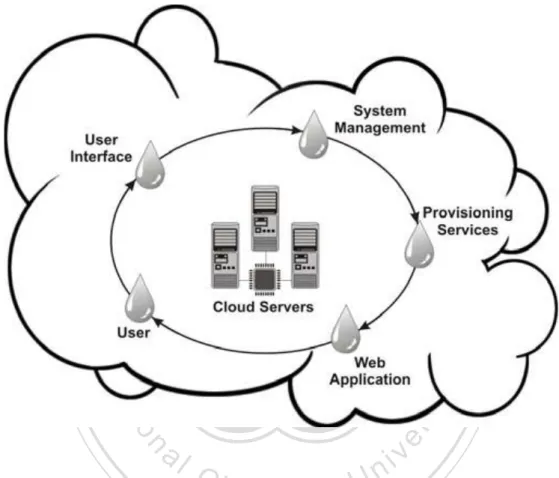
(18) As such, to promote and achieve a more effective form of aging, a patient-centered approach is one important strategy to adopt such that needs of the elderly are appropriately taken care of. While the idea of „home care‟ and „ownership of own‟s health‟ are key purposes to building a patient-centered system, needs of elderly in varying cultures, such as that of the Singapore‟s aging population, may differ. It is thus essential to identify the requirements of Singaporean elderly before structuring a functional patient-centered health service system. 2.1.4 Cloud Computing in EHR To assure success in the use of electronic health records, the participants of medical care, a. 治 政 desirable results expected of the health system (Stead, 大 2009). Also, the key element of 立 well-planned set of processes and a sound IT structure have to be present to produce the. electronic health records is its function to enable prompt and real-time communication which. ‧ 國. 學. hence encourages team care. This functionality of electronic health records is made possible. ‧. with the use of cloud computing technology.. sit. y. Nat. The term „cloud‟ in information technology, is a network of servers or even individual PCs. io. al. er. interconnected in a grid (Boroujerdi & Nazem, 2009). To put it simply, with the emergence and extensive usage of internet, the hardware and software placed together to make data. n. v i n C h known as the „cloud‟. transmitted within them useful is typically e n g c h i U Several researches on cloud computing bore different types of definitions for the newly inaugurated technology. A more technical definition would be:. „Cloud computing is a model for enabling ubiquitous,. convenient, on-demand network access to a shared pool of configurable computing resources (e.g., networks, servers, storage, applications, and services) that can be rapidly provisioned and released with minimal management effort or service provider interaction.‟(Armhein et al, 2010, p.6). In other cases, „a cloud‟ is referred to as “a network of servers that run the services that can be used as collaborative platforms”, whereby a server farm is simply a set of servers linked together to provide more storage and more computing power than a single. 12.
(19) server can provide (Hastings, 2009, p.10). Another simpler definition states that „Cloud Computing refers to both the applications delivered as services over the Internet and the hardware and systems software in the data centres that provide those services‟ (Armbrust et al, 2010, p.50). Whichever the definitions are, one consistent characteristic of cloud computing in employing the concept of „cloud‟ to metaphorically describe the new computer technology, is the capability to now make use of a „Internet network‟ to provide „services‟ with shared data across the entire network without the need of human management in the technical aspects.. 治 政 dimensions of cloud computing which makes a health大 service cloud computing system 立. Considering the various aspects of meaningful use of EHR, these are important features and. possible to accomplish its goals. The extreme storage space allows for massive exchange of. ‧ 國. 學. information and resources which then aids in the collaboration between the many different. ‧. users improves the ease of utilizing the platform. Finally, the mobility and the capability for. sit. y. Nat. prompt feedback having employment of cloud computing technology are two critical aspects. io. al. er. which appeals one towards its use. These features are also essential elements which makes. n. effective home care and self-monitoring of health conditions, especially in chronic illnesses possible in elderly care.. Ch. engchi. i n U. v. In terms of today‟s electronic health records‟ performance, the weakest domains of the present operations are its team care component, which is the care given by the cooperation of different caregivers including doctors, nurses, social workers, specialists etc, and its care transition component, which is the movement of patients‟ records as they transfer from one place to another (Bates and Bitton, 2010). Timely communication is effectively the most important aspect to be rectified in order to increase the functionality of these two domains. As mentioned, the features of cloud computing are its capability to allow storage and sharing of large amounts of information, and more crucially its mobility and capability for instant. 13.
(20) feedback are the very elements which remediate the shortcomings of the current EHRs, and are essential in the construction of a patient-centered system that consequently improves healthcare yet saves social cost in elderly care. 2.1.5 Delivery modes of cloud computing To understand how cloud computing plays a role making a patient-centered health platform useful for elderly care possible, it is necessary to understand the information delivery model of cloud computing. There are basically three delivery models for cloud computing services, namely „Software as a Service‟ (Saas), „Platform as a Service‟ (Paas) and „Infrastructure as a Service‟ (Iaas). Saas is a form of software service where consumer uses an application but. 治 政 大 infrastructures that supports has no idea and control over the operating system or any network 立. it. In Paas, consumer uses a hosting environment for their application, having control over the. ‧ 國. 學. applications but no control of operating system or supporting network infrastructures. For. ‧. Iaas, consumer uses the fundamental computing tools such as storage, processing power and. sit. y. Nat. networking components, and has control over the operating system, storage, applications, but. io. er. has no control over the cloud infrastructure supporting its functions. As observed from these three delivery models, the „cloudy‟ features of cloud computing lies in the infrastructures that. al. n. v i n C hprocesses, where consumers‟ are engaged to execute the computing requests are transmitted engchi U to the cloud of infrastructures, vast and unknown. In addition, soft, amorphous and opaque in nature, we certainly could not see what has happened within them, as our job was simply to use them to perform our necessary tasks. To understand the metaphor of „cloud‟ in computing, it will be useful to look at the taxonomy of cloud computing to understand the interaction of the cloud clusters at different levels of cloud computing. Figure 1 is a taxonomy diagram from the Cloud Computing Use Cases Whitepaper proposed by the discussion groups supported by Creative Commons Attribution Share Alike 3.0 Unported License.. 14.
(21) 政 治 大. Figure 1: Standards of cloud computing taxonomy (Cloud computing case use white paper, 2010). 立. The emergence of cloud computing allows better efficiency and has made the idea of. ‧ 國. 學. „sharing‟ easily executable. Users from different communities benefit from the ability to. ‧. share information and applications via the internet (Du, 2009). By allowing the possibility of. sit. y. Nat. a group of computers to be linked together, the users in the network will be aware of one. io. al. er. another and hence, will be able to share resources and information across the network. Enabling sharing of information between different stakeholders in a healthcare system is one. n. v i n important feature to allow a more C wholesome to be given to elderly care. Referring to h e n gcare chi U Figure 2, we can understand the basic architecture of cloud computing. A user interface has to be established for ease of usage for users and consolidation of list of available services and information. User will then select a service in which the system management selects the appropriate service and hence forth, data is launched and web application activated. It is not difficult to observe the heavy interdependency that existed within all the components in the. cloud, and also with information and data linking them together. Such properties of cloud computing allows the possibility of coordination of various stakeholders in healthcare to have access to timely medical information, which hence enhance the efficiency of medical services.. 15.
(22) With respect to the issue of achieving active aging, the possibility that cloud computing technology can uncover in terms of the various types of services that can be incorporated into an electronic health system, lends a helping hand towards fulfilling the possible needs of effective elderly healthcare.. 立. 政 治 大. ‧. ‧ 國. 學. n. er. io. sit. y. Nat. al. Ch. engchi. i n U. v. Figure 2: The architecture of cloud computing (Boroujerdi & Nazem, 2009) With some understanding on the properties of EHR and the features of cloud computing which can then be put together to enhance the system, it is necessary to look deeper into the potential of such a marriage of the two segments. In the later chapters, a metaphorical approach will be employed to probe further on the aspects of both EHR and cloud computing technology that finally results in a health service cloud computing system.. 16.
(23) 2.2 Concepts of metaphor. According to James C. Maxwell in the late 18th century, metaphors (of images and models) are instruments of a creative mind, which are products of science as well as tools with capabilities in generating science. There has been a growing conviction in recent times that metaphor, despite being non-literal, vague and cannot be directly verifiable, still plays a large part in the scientific conceptualizations and functions which constitute scientific discovery. Metaphors found in science language serves as descriptive purposes most of the time, usually that of a primary system of the intended formula of „A is B‟ (Radman, 1997). Metaphors have the capability to stretch a particular idea into a meaning which is much more far-reaching. 治 政 than its literal one, which will assist in the generation of大 more innovative and newer ideas. 立 Hence, it is undeniable that the usage of metaphors will be the path towards inciting more 2.2.1 Using metaphors for new inventions. ‧. ‧ 國. 學. creativity and innovations.. sit. y. Nat. Metaphors should not be treated exclusively as verbal instruments but more importantly,. io. er. should be regarded as instruments of thought and tools which are capable of conveying new cognitive contents (Radman, 1997). In fact, the job of metaphors is to rearrange existing. al. n. v i n Cmetaphor meanings of referents in the intended that new significations which have yet to U h e n gsuch i h c exist evolved. According to MacCormac in 1971, metaphors have a hypothetical nature because they are able to suggest new meanings. The metaphorical bridging of the new and old is the precise mechanism to make cognitive shifts possible as metaphor is able to fulfil the need to explain the new in terms of the old. New concept formation is usually a recombination of old facts and ideas rather than the formation of new ones, which is the combinatory matching of existing elements (Radman, 1997). This mediation old knowledge to gain and acquire new knowledge is the key purpose of using metaphor for generation of new meanings and inventions. An exemplary view by Petrie (1979) which states that. 17.
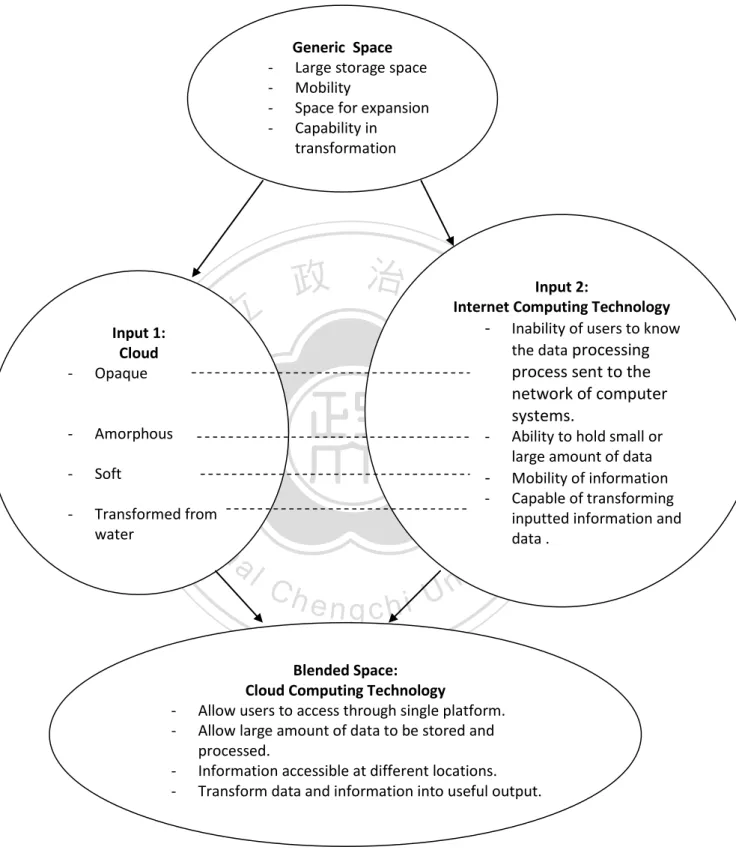
(24) „metaphor can provide a rational bridge from the known to the radically unknown, from a given context of understanding to a changed context of understanding‟ (p.440), very well summarizes the cognitive link between the old and new ideas generated from metaphors. As we understand and seek new sense in the regions of possible signification, these meanings are liberated from the constraints of their most evident and this crucial step allows the establishments of new semantic standards. As we have seen, metaphors serve various functions. They may be used to assist us in the understanding of abstract and complex ideas and concepts, or they may be used for. 治 政 1993). On a more constructive basis, metaphors can also 大 serve as a „trigger point‟ for more 立 communication purposes, helping to transfer ideas from one domain to another (Ortony,. conceptual developments, and may offer greater scope for generating novelty and innovation,. ‧ 國. 學. known as a „live‟ metaphor (Hardy & Pablo, 2009), Metaphors become a „driver‟, which are. ‧. used to generate innovation and change by stimulating different ways of thinking and acting.. sit. y. Nat. Alternatively, new metaphors may be an outcome (Rodrigues, 2006).. io. al. er. Thus, the use of metaphor to decipher and understand the workings of new systems and ideas are effective ways to elicit and spark off newer possibilities which can be central towards the. n. v i n C hof the health services birth of effective initiative. In the study e n g c h i U cloud computing system aimed at aging population, a metaphorical approach will be adopted to investigate the effectiveness, operationability and the maintenance of stability in the system. 2.2.2 Conceptual metaphor Concepts are important in our daily functioning as we allow the concepts which we have accumulated through experiences to play a large part the way we perceive the world. Our conceptual system play a crucial role in defining our everyday realities and more often than not, it is essentially a metaphorical way in which we think, experience and deal with our everyday lives (Lakoff & Johnson, 1980). The correspondence between two frames with a. 18.
(25) systematic connection of basically an “A is B” relationship, where A is the concept to be comprehended and B is the concept used for comprehension of A, is known as conceptual metaphor (Koveces, 2006). Presence of the source domain in explanation of the target domain is prevalent in conceptual metaphor. Relations of the dimensions of concepts and experiences which construct the final conceptual system that explains a particular phenomenon make up the possibility of fitting a concept into an experience (Lakoff & Johnson, 1980). Hence, it is necessary to pick out the relevant and important aspects of an experience, then categorize and understand it by fitting into existing dimensions of concepts. 治 政 大 2.2.3 Conceptual blending in metaphors 立 which were previously acquired.. When the coming together of two or more concepts do not result in mapping onto one another,. ‧ 國. 學. but are integrated to form new perspectives, we talk about conceptual blending (Koveses,. ‧. 2006). Conceptual blending, first introduced by Fauconnier and Turner in 1998, saw that. sit. y. Nat. metaphor comprehension requires the transformation rather than transfer of properties from. io. al. er. one concept to another. Conceptual blending suggests that the metaphorical correlation of concepts sets up a number of blending processes in which the imaginative capacities of. n. v i n meaning construction are evoked C to h produce emergentUmeaning (Cornelissen, 2006). engchi. To. understand the idea of conceptual blending, the idea of mental spaces has to be investigated. Mental spaces are smaller constructions of concepts evolved for the purpose of understanding and action (Fauconnier & Turner, 2002). Among the mental spaces, they are further divided into several roles: the input spaces which contains the concepts, the cross-space mapping which connects counterparts in the input spaces, the generic space which maps onto each of the inputs and contains what the inputs have in common and finally the blended space which is the new space that contains the emergent concept that maps the counterparts that links all input spaces and the generic space.. 19.
(26) With a generic space encompassing the basic features of our metaphors, we merge the characteristics of our inputs spaces, thereby creating a blended space which uniquely fits our conceptual needs. The strengths of conceptual blending theory are that it provides an account of how metaphorical meanings are actively constructed and that the „products‟ of metaphorical mappings are more influential when they adhere to a set of specific principles known as the „optimality principles‟: a set of constraints under which metaphors are most effective. We shall make use of the integration principle, which states that representations in the metaphorical blend can be manipulated as a single unit (Cornelissen, 2006).. 治 政 ideas by looking in-depth the concepts within each unit of大 representation. We shall make use 立. Conceptual blending is used in this study to understand the arising of innovation and new. for further innovations and new meanings.. 學. 2.2.4 Applying conceptual metaphor of ‘cloud’ on ‘computing’. ‧. ‧ 國. of the theory of conceptual blending as a start to understand how the process can be utilized. sit. y. Nat. Cloud clusters exist among the three delivery models and a massive cloud across all the. io. al. er. vendors, providing services for the enterprise (Jaeger et al, 2008). This can also be observed in Figure 1, which illustrates the relationship between the cloud clusters. These cloud clusters. n. v i n Cofhservices on the internet, gave a metaphorical idea of a cloud e n g c h i U which is flexible enough to. accommodate different levels of sophistication, and is evolving all the time, rapid and furious. Other than its „opaque‟, „soft‟ and „amorphous‟ nature in the services provided through the internet as mentioned earlier, there also exist different layers of the „clouds‟, within each, serving varied functions and having different forms of interaction between the cloud clusters. In fact, the clouds referred to in cloud computing are so alive and unpredictable that they can be as small as a piece cirrus cloud, servicing a simple application, or be combined to become a massive cumulus humilis, huge enough to undertake some mammoth computing and storage facilities. Because of its flexibility, these services on the internet, like the moving. 20.
(27) clouds in the sky, can also form links and connections within one another, increasing their capabilities and functionality and ability to travel across the globe. Enter the cloud, which spreads computing resources across a swath wide enough to achieve major increases in efficiency and utilization. With access to IT resources increasing and costs decreasing, a perfect storm for transformation on a massive scale is forming (Murray, 2010). This, is the very idea of the evolvement of cloud computing. A source and target mapping of the concept of „Cloud‟ as the source domain and this latest „Internet Computing Technology‟ as the target domain can be seen as follows: Source: CLOUD. 立. Opaque. Inability of users to know the data-processing process sent to the network of computer systems.. ‧ 國. ‧. Ability to hold small or large amount of data. Mobility of information and applications at different locations.. of. sit. n. al. Capable of transforming inputted information and data.. er. io. Transformed from water. use. y. Nat. Soft. COMPUTING. 學. Amorphous. INTERNET 治 政 TECHNOLOGY 大 Target:. Ch. engchi. i n U. v. A conceptual blending done between cloud and computing technology allows for more detailed and specific features of both inputs to be sifted out and placed into a generic space. In this case as shown in Figure 3, both inputs allows operating procedures of system to be unknown to users, ie. an opaque system, has massive space for storage and also expansion in terms of technology advancements, and finally the nature of mobility of clouds can also be mapped onto this particular advantage of mobility that the computing technology can now allow with possible usages in any venues that has computers and internet accessibility. Specific to supporting successful aging, these features of the generic space opens up possibilities in giving more ownership to the users and family members in maintaining a 21.
(28) healthy lifestyle with increased mobility and easier timely access to information on healthcare issues.. -. 立. Generic Space Large storage space Mobility Space for expansion Capability in transformation. 政 治 大 Input 2: Internet Computing Technology -. -. Amorphous. -. -. Soft. -. -. Transformed from water. ‧ 國. process sent to the network of computer systems.. n. al. y. er. io. -. Ability to hold small or large amount of data Mobility of information Capable of transforming inputted information and data .. sit. -. ‧. Nat. -. Inability of users to know the data processing. 學. -. Input 1: Cloud Opaque. Ch. engchi. i n U. v. Blended Space: Cloud Computing Technology Allow users to access through single platform. Allow large amount of data to be stored and processed. Information accessible at different locations. Transform data and information into useful output.. Figure 3: Conceptual blending between cloud and computing technology. 22.
(29) Cloud Computing Technology henceforth evolved in the blended space, where these specific features are included to provide the winning edge of this technology. While users and services forms the major part of the system, one of the crucial ingredient to ensure the operationability of the system is the data inputs from each players. From the concept of cloud, it can be understood that the element „water‟ is the main component which make up the cloud. Indeed, as elderly care involves largely on the availability of clear information such that proper primary or home care can be given. Similarly, the main constituent for the computing technology to function is the presence of data. mapping which is as follows evolved: Source: Cloud. 立. Water. Another. 政 治 Target: 大 Computing Technology Data from participants in the system. ‧ 國. 學. With understanding in the main features of EHR and key characteristics of cloud computing. ‧. technology based in its metaphorical understanding, the Dossia Health System can now be. y. sit. io. n. al. er. fulfilled.. Nat. explored to identify vital stakeholders and their roles such that its functionality can be. Ch. engchi. i n U. v. 23.
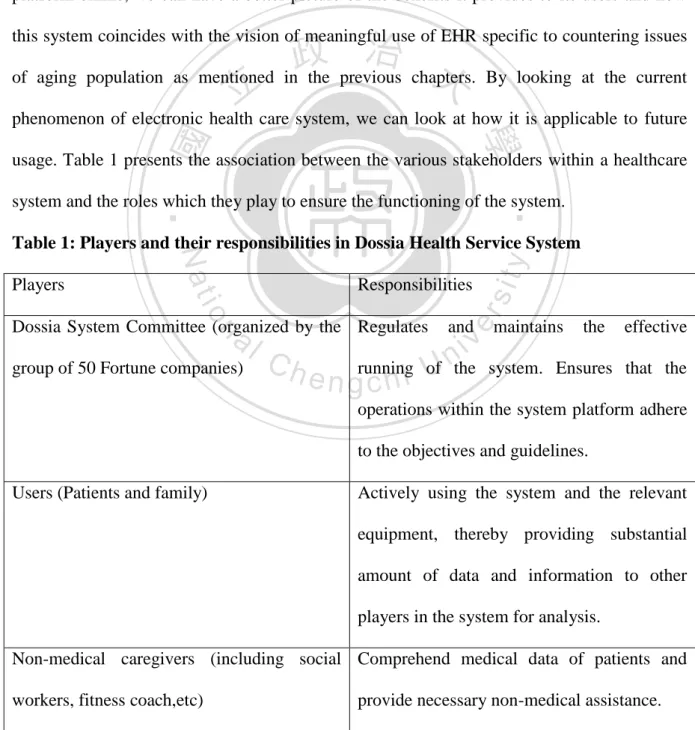
(30) 2.3 The Dossia Health Service System Initiated by 50 Fortune companies in USA, the vision of Dossia is to transform the American healthcare system by reducing waste and facilitating better care by developing and making widely available a lifelong personally-controlled health record. Dossia hopes to achieve their aim through empowering the people and their doctors to be active partners via a comprehensive and secure access in individual health information. By understanding the Dossia Health system including its functions, services and operating platform online, we can have a better picture of the benefits it provides to its users and how. 治 政 大 By looking at the current of aging population as mentioned in the previous chapters. 立. this system coincides with the vision of meaningful use of EHR specific to countering issues. phenomenon of electronic health care system, we can look at how it is applicable to future. ‧ 國. 學. usage. Table 1 presents the association between the various stakeholders within a healthcare. ‧. system and the roles which they play to ensure the functioning of the system.. io. y. al. n. Dossia System Committee (organized by the Regulates group of 50 Fortune companies). Ch. of e n grunning chi U. sit. Responsibilities. er. Players. Nat. Table 1: Players and their responsibilities in Dossia Health Service System. and. v ni. maintains. the. effective. the system. Ensures that the. operations within the system platform adhere to the objectives and guidelines. Users (Patients and family). Actively using the system and the relevant equipment, thereby providing substantial amount of data and information to other players in the system for analysis.. Non-medical caregivers (including social Comprehend medical data of patients and workers, fitness coach,etc). provide necessary non-medical assistance.. 24.
(31) Medical Providers (including family doctors, Analyse relevant data (from users, vendors or hospitals, etc). within medical providers) and transform them into useful health information, which can then be utilized by users, thereby providing superior medical care. Consolidate medical. information. for. research. enhancements. Health. equipment. vendors. (medical Provide equipment and devices which can be. 政 治 大 measuring collated from. instruments such as blood pressure monitors, synced with the Dossia online platform. Data heart-rate. monitors,. calorie. 立. machine, pedometers, etc). equipment. should. be. transformed into useful information which. ‧ 國. 學. can then be utilized by users or other players. ‧. in the system (e.g. for analysis by medical. sit. y. Nat. providers). io. al. supports the technology of the various. n. technology). er. Technology Providers (cloud computing Create a cloud computing system which. Ch. e n gplayers chi. iv n inUthe system.. Ensures the smooth. transmission of data and into the system for analysis and finally useful information back to the rest of the players with sound web applications for all players within the system.. By understanding the mechanism behind cloud computing comprising of Paas, Saas and Iaas components and the elements present in the Dossia system, Figure 4 presents the interdependent relationships amongst the players.. 25.
(32) Cross-Clouds. Hospitals (Emergency). Non-medical caregivers (social workers, fitness coach). 立. 政 治 大. Iaas. 學 ‧. io. sit. y. Nat. al. er. Saas. Health devices (Eg. Blood pressure monitors, pedometer, Weight Scale). Health Services Platform. Family Doctors. ‧ 國. Across Vendors in Clouds. Paas. Figure 4: Pictorial representation of system in Dossia Health Service Platform. n. v i n The concept of Paas, Saas and IaasC adopted cloud computing allow the meaningful use h e nfrom gchi U of cloud computing stated by USA policy to be realized. While the responsibilities of the stakeholders in Dossia system as shown in Table 1 assemble the healthcare system in place, the functionality of these stakeholders are made workable due to the operating structure of cloud computing system. In the Paas segment where a service platform has to be established, the Dossia System Committee played a crucial role in creating a model in which the objectives of an effective healthcare system are realized by setting rules and regulations and determining the vision and mission of the Dossia Personal Health System.. 26.
(33) The Saas segment, which is one of the largest and vital segments of the cloud computing system, is determined by a number of players in the Dossia system. Firstly, the medical providers such as doctors, hospitals, nurses, pharmacists etc, are the key stakeholders who ensure that the necessary services are available for users. In addition, the non-medical caregivers such as social workers and fitness coaches also provide services to accomplish the non-medical assistance needed by users, which include patients and their family. Finally, in the Iaas segment, the key role has to be played by the technology providers, who are responsible for the building of the healthcare services cloud computing infrastructure.. 治 政 大platform, technology providers in the system to the friendliness of user-interface of service 立 From the interface of the service platform, necessary linkages between various stakeholders. are accountable for tapping onto the advantages of the interdependent relationship between in. ‧ 國. 學. the system. Most importantly, the timely communication and prompt feedback feature at any. ‧. time and place has to be executed seamlessly to fully exploit the advantage of cloud. sit. y. Nat. computing technology.. io. al. er. As the fundamental goal of the Dossia system is to reduce wastage and facilitate better healthcare for the Americans, the users of the Dossia system inevitably shape all three. n. v i n C h system. Indeed, Uthe needs of users be it in terms of segments of the health cloud computing engchi practical healthcare services or health information, affects decisions in objectives setting of the hosting platform, the healthcare services to be provided and the infrastructure to support the requirements. Thus, a patient-centered healthcare system evolved. The sustainability and stability of a system requires specific rules and principles which help to maintain its functions and guarantee its worth of existence. With a comprehensive understanding of Dossia Health Service Platform and the background behind the USA‟s. move to develop its EHR system, the role of cloud computing technology to realize a betterrounded patient-centered healthcare system becomes apparent.. 27.
(34) In the context of this study, the objective of a patient-centered healthcare system is to address the needs of major stakeholders in the elderly care system. While the stakeholders in the Dossia Health Service System may be serving a different purpose, their intention to enable a more wholesome healthcare system within the American society, though may not be regarded as a perfect system, may still serve to shed some light regarding the key criteria necessary for a functioning electronic healthcare system catered to confront the silver tsunami in time to come. The functioning structure of Dossia Health System has also revealed one important factor. 治 政 大 modes. Next, we attempt to various stakeholders responsible for the three main delivery 立. which contributes to its proper functioning: the interdependent association between the. apply „ecosystem‟ as a metaphor to appreciate this co-reliant structure that makes an. ‧ 國. 學. operational health service cloud computing system possible.. ‧. n. er. io. sit. y. Nat. al. Ch. engchi. i n U. v. 28.
(35) 2.4 Characteristics of ecosystem processes Ecosystem is a biological environment in which dynamic interactions happen between plants, animals, and microorganisms and their environment working together interdependently as a functional unit. Ecosystems, being open systems, are constantly changing due to internal or external influences, thereby causing imbalance (Donavan, 2010). Two key elements of a biological ecosystem is (i) the interaction between the different respective elements of the physical environment, and (ii) the relationship between the different elements of the environment. Also, ecosystem can be seen as having a dynamic and complex dimension, with. 治 政 大 with each other, performing Each member within the ecosystem are related and will interact 立 ecological interactions within elements via free flow of energy and matter among them.. their specific roles to ensure all mutual benefits to every single living thing the system and to. ‧ 國. 學. enable the proper function of the process, equilibrium has to be maintained. In other words,. ‧. ecosystem processes worked together to ensure that the particular ecosystem is able to. sit. y. Nat. operate and perform its function effectively. The „cooperative‟ nature of ecosystem can. io. al. er. evolve in an endless reciprocal cycle through the process of co-evolution (Bateson, 1983), where each element of the ecosystem is of relevance to the other members, and as such,. n. v i n variations in one element will resultC inh evolutionary responses e n g c h i U of others (Corallo, 2007).. 2.4.1 Determining if a health service system satisfy the characteristics of an ecosystem With our knowledge in the „source and target‟ domains relationships in understanding conceptual metaphor, we can investigate if the health service system can be metaphorically represented with the concept of ecosystem. Based on the understanding of ecosystem and the characteristics within the ecosystem processes, three main characteristics (i) the interdependency (cooperative) nature, (ii) the co-evolution process, (iii) the openness and dynamism with free flow of energy or matter present in ecosystems are an important characteristics which can be observed in ecosystems. In fact, many business systems and. 29.
(36) structures employ the concepts of ecosystems‟ unique characteristics. For the case of a health service system, the three characteristics have to be observed for the ecosystem metaphor to stand. (i). Interdependency (Cooperation) nature of the system. Interaction is exceptionally critical in the case of an ecosystem, where the idea of „shared fate‟ is of utmost importance. This interdependency is the foundation to a stable, productive and creative system (Iansiti and Levien, 2004). Each element in the ecosystem will contribute essential inputs which are vital for the survival of the other elements. In the case of a health. 治 政 大 include the users who are essential for the functioning of the system. These elements 立 service system to tackle elderly care, relationships are built between various elements. empowered to monitor their health and provide critical health information to the system, the. ‧ 國. 學. medical providers such as the family doctors and hospitals which provide medical services. ‧. and advices to the users, the technology service providers which collect information and. sit. y. Nat. digest them into useful figures, which are then disseminated to the other members of the. io. al. er. system for appropriate actions. Also, the element which regulates the health service system (such as the 50 Fortune companies which initiated Dossia) plays one of the most crucial roles. n. v i n C h in the system, known that enable the operation and innovation e n g c h i U as the keystone element. In the case of Singapore‟s aging population issue, the governing agency takes on the role of the. keystone player in the health service system. Each element depends on one another‟s proper actions such that they, too can function, which then also facilitates the effective running of the health service system. (ii). Co-volution. Closely related to the interdependency and the cooperative nature between elements in the ecosystem, co-volution emphasizes the close relation between all elements in the ecosystem. In a health service system, since one action of an element will affect the other, adaptation. 30.
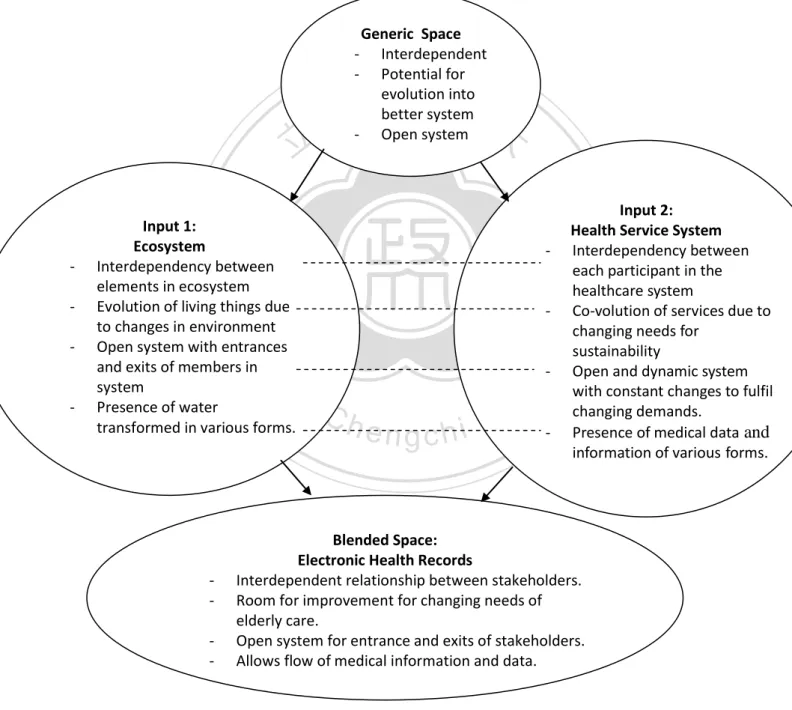
(37) become a crucial step to take such that proper functioning of the system can continue. For example, changes in demographics will influence the services provided by medical providers, thereby generating response actions within the system. Also, differences in lifestyle, habits, cultures and policies will also trigger co-volution to happen to sustain the system. This also answers the high possibility of changes in lifestyles that can occur to elderly and their caregivers due to elderly or chronic health problems. (iii). Openness and dynamism of system. A biological ecosystem, being an open system, will encounter entries and exits of elements. 治 政 the nature‟s system, a health service system is also open大 to providing assistance to health 立. from time to time, resulting in the free dynamic flow of matter or energy within it. Just like. solutions according to needs, and will experience increase of decrease in number of users and. ‧ 國. 學. allow entry of enhanced services with the adherence of regulations. Hence, a dynamic system. ‧. is formed with constant changes in services, objectives and regulations due to changing. sit. y. Nat. environment and needs. This openness in system once again plays an important role in. io. al. er. sustaining an effective healthcare network when needs and demands of users change. The. n. mappings between these 3 main features can be seen as follows: Source: ECOSYSTEM. v i n Ch HEALTH SERVICE SYSTEM e n gTarget: chi U. Interdependency between elements in the ecosystem.. Interdependency between each participant in the healthcare system.. Evolution of living things due to changes in environment for sustainability.. Co-volution of services due to changing needs for sustainability.. Open system with entrances and exits of members in the system.. Open and dynamic system with constant changes to fulfil changing demands and needs.. Presence of water transformed in various forms. Presence of medical data and information of various forms.. 31.
(38) Once again, looking into the specific features of a health service system and an ecosystem, several important characteristics can be taken from the two input spaces into the generic space. Both health service system and the ecosystem rely on the interdependent nature of participants in each system to support and maintain their functions. Also, both have the potential and capability of evolution, thereby improving the operations of the systems. Finally, the openness of both systems allows for entrance and exit of different players in the systems.. Generic Space Interdependent Potential for evolution into better system - Open system -. 立. sit er. n. al. -. -. -. y. ‧ 國. -. Input 2: Health Service System Interdependency between each participant in the healthcare system Co-volution of services due to changing needs for sustainability Open and dynamic system with constant changes to fulfil changing demands. Presence of medical data and information of various forms.. ‧. io. -. Input 1: Ecosystem Interdependency between elements in ecosystem Evolution of living things due to changes in environment Open system with entrances and exits of members in system Presence of water transformed in various forms.. Nat. -. 學. -. 政 治 大. Ch. engchi. i n U. v. -. -. Blended Space: Electronic Health Records Interdependent relationship between stakeholders. Room for improvement for changing needs of elderly care. Open system for entrance and exits of stakeholders. Allows flow of medical information and data.. Figure 5: Conceptual blending between health service system and ecosystem. 32.
(39) The electronic health records system that can be established to counter issues of aging population is the result of the blend and encompasses these three specific characteristics in the generic space as shown in Figure 5, which are crucial for the functioning of a system to cater to successful aging. The three main characteristics in the generic space are focused on features of co-operation and possibility for more collaboration, which adheres to the spirit of public health service. With the satisfaction of the three main characteristics of biological ecosystem, it can be concluded that a health service system to successful aging can be metaphorically explained. 政 治 大. by the behavior of a biological ecosystem, forming linkages and evolutions which mimic the nature.. 立. 2.4.2 Sustaining the effectiveness of the ecosystem. ‧ 國. 學. Many studies have been done on the use of ecosystem as a metaphor in business structures.. ‧. Just like a biological ecosystem, a firm is not simply a member of a single industry but part of. sit. y. Nat. a business ecosystem that crosses a variety of industries (Moore, 1993). Firms are able to co-. io. al. er. evolve, bringing new creativity and innovations. They are also able to cooperate with one another to attain a particular goal. This is in line with the characteristic of a biological. n. v i n ecosystem, where each member of C theh business ecosystemUshares the fate of the network as a engchi. whole. Like biological ecosystem, a business system is made up of a large number of participants which are interconnected and dependent on one another for mutual benefits and effectiveness. According to Iansiti and Levien in 2004, the effectiveness and health of a business ecosystem depends on: (i) niche creation – which is the ability of the ecosystem to exhibit capability of variety and support for diversity of species, (ii) productivity – which is the ability to transform technologies and other raw materials of innovation consistently into lower costs and new products and. 33.
(40) (iii) robustness – which measures how much the business ecosystem is able to maintain or survive any changes or disruption caused. In the case of a health service cloud computing system for elderly care, while it may not be a profit-earning business system, the three specific features of an effective business ecosystem are also evident in its function. By studying the Dossia system of USA, we understand that the objective of the companies which initiated the health service system is to empower the public a higher ownership in health maintenance, which is also one main aspect towards better elderly healthcare. The health service cloud computing system has to perform its health maintenance functions based on the materials available in order to be on an „up and. 治 政 大of health information of users, running‟ condition. These raw materials come in the form 立 which are then converted into useful information via the updated modern technologies from. ‧ 國. 學. different medical providers and from cloud computing technologists. Needless to say, the. ‧. objective of the functions that this health system can provide for elderly care has to be clear. sit. y. Nat. and realistic, which will then help shape the productivity aspect of the system. Just like a. io. al. er. nature ecosystem, a constructed health service cloud computing system should be able to withstand the changes that may be encountered, such as the onset of chronic diseases. n. v i n C h Hence, each Urespective stakeholder, particularly commonly seen in elderly health ailments. engchi the medical providers, of the system has to perform their role to their best ability such that the system can execute its utility without being affected by modification. In fact, these stakeholders have to build mechanisms which are robust enough to counter adjustments in the system. Finally, to fulfill the objective of self-monitoring and ownership of health maintenance, the numerous features of the system have to display capabilities to support a diverse pool of users, with different health concerns and having different needs and assistance. In addition, it was believed that the use of an ecological metaphor in the deciphering of business is effective in the explanation of the lack of boundaries and the need for a systematic. 34.
(41) vision (Moore, 1997; Iansiti & Levien, 2004). This is in line with the idea of ecosystem as an open system, susceptible to constant changes due to niche creations, thus improve productivity and boost the robustness of the system. 2.4.3 Concept of keystone metaphor in ecosystem The concept of keystone metaphor, which in a biological ecosystem, is the member which exerts the greatest influence on an ecosystem. The role of biological keystones is to maintain the proper healthy functioning of the ecosystems via specific behaviors with effects that will propagate throughout the entire system (Iansiti & Levien, 2004). In a business ecosystem, the. 治 政 大 of niche creations within the productivity, enhancement of robustness and encouragement 立. use of keystone metaphor can be matched with the particular element that is central to the. system. They provide a stable and predictable platform which other participants in the system. ‧ 國. 學. can depend on. The removal of keystone member of an ecosystem will be detrimental to the. ‧. entire system, which may eventually lead to the collapse. Also, the keystone member will act. sit. y. Nat. to improve the system, which also ensures its own survival. In the case of Dossia system, the. io. al. er. 50 Fortune companies which initiated the setting up of the health service cloud computing system with the aim of increasing the ownership of Americans on health maintenance, took. n. v i n on the role of a keystone memberC of h the Dossia system.UThey specify the objective of the engchi system and regulate the „members of the system‟, which are the medical providers such as. hospitals, family doctors, health fitness monitoring vendors, etc, such that the system is adhering to rules and regulations and fulfilling its purpose. In the case of a system for aging population issues in Singapore, there too exist a keystone member who can ensure that needs of various stakeholders in the system are met. Hence, the role of the keystone member holds a crucial role in ensuring the functionality of the system.. 35.
數據
+5
Outline
Applying conceptual metaphor of ‘cloud’ on ‘computing’
Determining if a health service system satisfy the characteristics of an ecosystem With our knowledge in the „source and target‟ domains relationships in understanding
Tapping on cloud computing for healthcare in Singapore
Data collection
Familial Support
Collaboration between stakeholders
Empowerment and ownership
Collaboration through health service cloud computing system for effective aging From the three key concepts that are crucial to the building of an integrated healthcare system
相關文件
Including government health establishments such as public health centres, Medical Check-up Centre for Civil Servants, etc., and private clinics including establishments of health
Atendimentos de cuidados de saúde primários nos consultórios particulares, por tipo de consultas (2021) Primary Health Care Consultations at Private Clinics by Type of
Including government health establishments such as public health centres, Medical Check-up Centre for Civil Servants, etc., and private clinics including establishments of health
“Social welfare” if defined in a narrow sense refers to the services provided by the Social Welfare Department (SWD) and Non-governmental Organisations (NGOs),
The elderly health centres provide people aged 65 or above with comprehensive primary healthcare services which include health assessments, physical check-ups, counselling,
They are: Booklet (6) – Healthy Community, exploring the communicable and non- communicable diseases and how they affect community health so that students are able to
between the roles of the individuals (private sector) and the public or government in the provision of social care and health services responsibility of the government, e.g.
Examples of relevant concepts: equality, discrimination, cultural differences, community resources, self-concept, vulnerable groups, community work, community support
