國
立
交
通
大
學
電子工程學系電子研究所
碩
士
論
文
仿酢漿草結構為感測振膜之高性能音源定位麥克風
的設計與製作
Design and Fabrication of High Performance Sound-Localized
Microphone Using Oxalis-like Sensing Diaphragm
研 究 生:景 文 澔
指導教授:鄭 裕 庭 教授
仿酢漿草結構為感測振膜之高性能音源定位麥克風的設計與製作
Design and Fabrication of High Performance Sound-Localized
Microphone Using Oxalis-like Sensing Diaphragm
研 究 生:景文澔 Student:Wen-Hao Ching 指導教授:鄭裕庭 Advisor:Yu-Ting Cheng 國 立 交 通 大 學 電子工程學系電子研究所 碩 士 論 文 A Thesis
Submitted to Department of Electronics Engineering & Institute of Electronics College of Electrical and Computer Engineering
National Chiao-Tung University in Partial Fulfillment of the Requirements
for the Degree of Master in
Electronics Engineering October 2006
Hsinchu, Taiwan, Republic of China
仿酢漿草結構為感測振膜之高性能音源定位麥克風的設計與製作
學生:景文澔 指導教授:鄭裕庭教授 國立交通大學電子工程學系暨電子研究所碩士班摘 要
科學家發現中文學名為奧米亞棕蝇的聽覺器官可經由一種獨特的橋型 結構將振膜相互連接來定位出微小的聲音梯度。在此篇論文中,我們利用 中央平衡環支撐式圓形結構 [5-8] 並且模仿酢漿草的結構,提出了一個全 新發展的微機械仿生物式麥克風。這種仿酢漿草的振膜能夠經由減少感測 振膜之間的交互影響來改善其位移量,並且能夠利用中央平衡環結構的最 佳化設計來提升音源定位的能力。此外,相較於中央平衡環支撐式圓形振 膜的設計,仿酢漿草的設計可提供3.7 倍大的淨位移量,而且,仿酢漿草的 振膜能表現出小於10 度的空間分辨率。文中所有的設計與模擬是利用有限 元素分析法的模擬軟體 ANSYS 來完成的。最後利用標準的 MUMPs( Multi-User MEMS Precesses )製程以及表面微加工技術製作出單一晶片的 仿生物式麥克風。
Design and Fabrication of High Performance Sound-Localized
Microphone Using Oxalis-like Sensing Diaphragm
Student : Wen-Hao Ching Advisor : Yu-Ting Cheng
Department of Electronics Engineering & Institute of Electronics National Chiao Tung University
Abstract
Researchers found the Ormia Ochracea’s auditory organ can locate a small sound gradient via a unique intertympanal bridge structure. In this thesis, we propose a newly developed micromachined biomimetic microphone by utilizing the central gimbals-support circular structure [5-8], and mimicking the structure of the oxalis. The oxalis-like diaphragm can not only improve the displacement by decoupling the sensing diaphragm but also enhance the capability of sound source localization with the optimum design of the central gimbals structure. Moreover, the net displacement of the diaphragm with the oxalis-like design has 3.7 times larger than that of the diaphragm with the central gimbals-support circular diaphragm design, and the oxalis-like diaphragm performs the spatial resolution with opening angle smaller than 10 degrees. The design and FEM simulation are analyzed by ANSYS simulator. The process of the single-wafer biomimetic microphone is fabricated by the standard Multi-User MEMS Processes (MUMPs) with three poly-silicon layers and two sacrificial layers.
Acknowledgments
First and foremost I would like to thank my advisor, Dr. Yu-Ting Cheng, for the thoughtful guidance, encouragement, and valuable discussion during the course of this study. Also, I would like to thank all my colleagues of our group in the past two years. Moreover, I would like to express my appreciations to the Nano Facility Center of National Chiao-Tung University, Prof. Hsu’s group in Department of Mechanical Engineering in National Chiao-Tung University for providing technical supports and measurement facilities.
This work was supported by the NSC 95-2220-E-009-036 project and in part by MediaTek research center and FY95 ITRI/STC/JDRC at National Chiao Tung University.
誌 謝
首先要感謝我的家人,謝謝辛苦賺錢的老爸,「爸,沒有一個員工早 上六點就起床上班的,連周未也是如此!!」,謝謝一直伸手要零用錢的 老媽,「媽,家裡的東西不要再捨不得丟了,我買新的給妳!!!」還有謝 謝一起亂花錢的老哥,「哥,一起努力賺錢吧!!」。謝謝你們從小到大 對我的包容與支持。對於一個生長在幸福家庭的小孩,卻不懂得珍惜這一 切,但在人生的另一個重要的開始,還是要跟你們說一聲謝謝,沒辦法早 點畢業,讓你們擔心了。 另外要感謝我的指導老師鄭裕庭教授,謝謝你在這段期間對我的指 導,在畢業的前夕讓你擔了,也謝謝你對我的鼓勵,You couldn't give up until the last day!!再來要感謝機械所徐文祥實驗室的學長們,讓我能順利完成 實驗,也要謝謝交大奈中心的技術員,范秀蘭小姐和徐秀鑾小姐的代工幫 忙,我才能順利畢業。 最後要謝謝實驗室的每一位,電鍍達人光哥、不再憂鬱的瑋哥、帶便 當上學的川哥、BT 達人凱哥、最帥的達叔、製程達人子元、消失的胖子健 章、褲底插針的chando、十分有主見的思穎、Allen 的朋友昱文、還有剛升 碩二的睿婉、濬誠、文駿、以及碩一的學弟們、最後當然是過很爽的助理 小筑,謝謝你們囉,雖然我沒能為這個實驗室留下什麼,能留下的只有對Contents
摘要 i Abstract ii Acknowledgments iii 誌謝 iv Contents v Figure Captions viContents
Chapter 1 Introduction
1
Chapter
2
Design
and
Analysis
4
2.1 Design Concept of the Biomimetic Microphone 4
2.2 Finite Element Analysis 8
2.3 Fabrication Process of the Biomimetic Microphone 13
Chapter
3
Results
and
Discussions
15
3.1 Result of the Optimum Design 15 3.2 Influence of the Serpentine Spring 16 3.3 Scanning Electro Microscope (SEM) Photographs 18
3.4 The Vibration Mode 19
Chapter
4
Summary
and
Future
Work 21
4.1 Summary 21
4.2 Future Work 21
Figure Captions
Chapter 2
Fig. 2-1 A picture of the three leaves oxalis 4 Fig. 2-2 The design of the oxalis-like sensing diaphragm 5 Fig. 2-3 A schematic of the boundary condition with a pressure load applied at
0° in the ANSYS 7
Fig. 2-4 (a), (b) and (c) show the polar patterns of the net, ipsilateral, and contralateral displacement with Ono’s design (blue line) and 4 leaves oxalis-like diaphragms (red line) 8 Fig. 2-5 The net displacement of the Ono’s design with 3 inner and 3 outer
beams The maximum displacement is about 0.737μm 10 Fig. 2-6 The net displacement of the Ono’s design with 4 inner and 4 outer
beams The maximum displacement is about 0.491μm. 11 Fig. 2-7 An optimum oxalis-like diaphragm with 6 inner and 6 outer supporting
beams and each beam is 10μm wide and 65μm long. The thickness of
sensing diaphragm is 5μm. 12
Fig. 2-8 Process flow of the biomimetic microphone 14
Chapter 3
Fig. 3-1 The analysis results of the proposed optimum oxalis-like biomimetic
microphone 15
Fig. 3-2 The relation between the springs and beams 16 Fig. 3-3 Comparison the radius of the ring 17
Fig. 3-4 (a), (b), and (c) show the Scanning Electro Microscope (SEM)
photographs 18
Fig. 3-5 (a), (b) and (c) show in-phase, y-axis and x-axis reversed-phase modes
Chapter 1 Introduction
It had been a grand challenge to miniaturize a sound source localizing system due to minute interaural intensity and time differences occurring in its acoustic sensing components. Until 1992, the related acoustic sensing mechanism of small insect like parasitoid fly (Orima Ochracea) was fully investigated and realized that the interaction between ipsilateral and contralateral pressures can increase effective interaural distance via a mechanical intertympanal bridge structure that resulting in an expanded interaural time difference for locating the sound field [1,2]. In 2001, Yoo et al presented the first biomimetic microphone based on a hinge-supported diaphragm behaving like the intertympanal bridge for sound localization. They utilized DRIE (Deep Reactive Ion Etch) process to form a corrugated polysilicon diaphragm that attached with single crystal silicon proof masses and solid stiffeners on a SOI wafer for the fabrication of a directional microphone [3-5]. The developed technique can not only provide high design flexibility over conventional etch-stop approach but also simplify the fabrication of corrugate structure that designed for sensing diaphragm with better mechanical sensitivity. The microphone started realizing the possibility of directional hearing purpose for hearing aid application. Since then, a variety of biomimetic microphones with improved structural designs have been proposed and fabricated using silicon micromachining technology for better performance.
For example, Ono et al demonstrated a biomimetic microphone based on a center-supported gimbal circular diaphragm structure which provides a 360 degree of freedom for better directional identification with a spatial resolution as well as 15° [6-9]. Cui et al. implemented an integrated optical readout in the sensing membrane of the directional microphone. Via the diffraction-based optical interferometric detection, the device can avoid thermal noise problem imposed by capacitive sensing [10].
Meanwhile, for a hearing system, surrounding sound is first sensed and transformed into electrical signals via a microphone or microphone array. The electrical signals are then processed, amplified, and reformed by integrated signal processing chips. Finally, the reshaped electrical signals are transformed into an acoustic wave then transmitted into patient’s eardrum via a microspeaker. Because the hearing aids must be portable and adaptive to satisfy the needs from a variety of patients, several characteristics including low powered, low noise, miniature, and programmable, must be included in the device design. In order to satisfy these requirements, the aforementioned micromachined biomimetic microphone for sound localization could play a key role in terms of low power, low noise, and small form factor criteria. As long as the origin of sound source can be located, the signal-to-noise ratio (SNR) of a certain acoustic sensor can be effectively enhanced by the noise source removal from the sensed signal since the other sound sources will be treated as background noise which can be
effectively eliminated via signal processing.
Nevertheless, the existing biomimetic microphones still exhibit several deficiencies, like the trade-off necessity of structural sensitivity and rigidity in Ono’s design and process complexity increase for optical readout integration. Optimum design is still required for further applications. Therefore, in this paper, we will present a newly developed biomimetic microphone based on the combined structural of ormia ochracea and oxalis to further enhance the capability of sound source localization. Since the microphone can be fabricated using conventional surface micromaching process, low manufacturing and small form factor will make the device fascinating for hearing aid applications.
Chapter 2 Design and Analysis
2.1 Design Concept of the Biomimetic Microphone
The proposed microphone still follows the Ono’s design with a
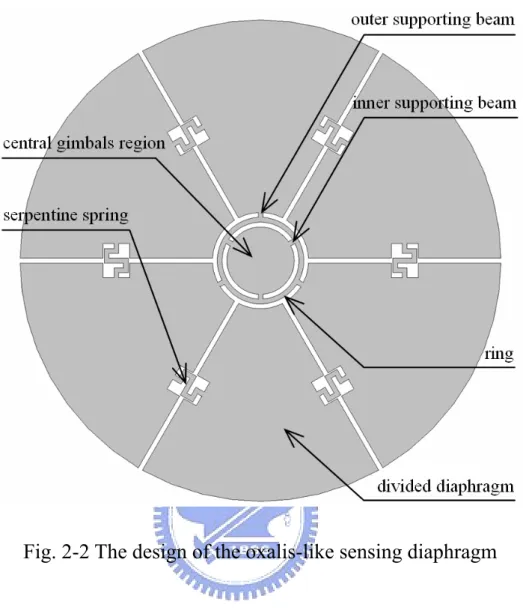
gimbals-supported circular sensing diaphragm. The difference, however, is that a full circular diaphragm will be divided into several parts like oxalis leaves as shown in Fig. 1 which can increase the sensitivity in each sensing area due to the diaphragm disintegration. Meanwhile, for keeping the diaphragm vibrate
in-phase and reversed-phase modes like the auditory organ of the parasitoid fly, the divided sensing diaphragms are connected to each other by serpentine springs. Fig. 2 depicts a whole structure of the microphone with a capacitive sensing design.
Fig. 2-2 The design of the oxalis-like sensing diaphragm
In the structure, sensitivity relies on the gimbals flexibility, the size of sensing leaf, and the spacing between the leaf and the number of the electrode underneath the sensing leaf. In order to improve the spatial resolution for sound localization, the simplest way is to increase the number of bottom electrodes which would result in the decrease of sensing area, i.e. the reduction of capacitance change (ΔC). In addition, since the circular diaphragm is an axial symmetry structure, simultaneously increasing the supporting beams is required at the central gimbals region for a symmetrical acoustic response at each sensing
leaf which would result in the decrease of sensitivity due to the increase of structural rigidity, i.e. the increase of effective spring constant of supporting beams. Thus, in this thesis, an optimum design of oxalis-like biomimetic microphone is analyzed and proposed in the following using ANSYS simulator [12]. In addition, because the sensitivity of a capacitive microphone is defined by mV/Pa which is contributed by the distance change between the sensing diaphragm and its bottom electrode that caused by applied sound pressure, we will use the maximum displacement of sensing diaphragm as an indicator for the microphone sensitive comparison in the following analysis.
As derived by beam theorem [13], the moments of inertia and the deflection of a cantilever beam while a force is applied on the edge of the beam can be calculated as the following equations
.
….………...Eq.(2) o
the beam, and t is the thickness. Combined with Eq.(1) and (2), we can get
3) y could be realized with a larger deflection via
12 3 t W I = b ...…………...………Eq.(1) F EI L d b B ⎟⎟ ⎠ ⎞ ⎜⎜ ⎝ ⎛ = 3 3 …
where E is the Y ung’s Modulus, Lb is the length of the beam, Wb is the width of ………Eq.( 3 3 3 3 4 4 b b B L t EW L t EW ⎟ ⎠ ⎞ ⎜ ⎝ ⎛ b b k d x k F = × =⎜ ⎟× ⇒ =
adjusting the length, width, and number of supporting beams to reduce the
ig. 2-3
ANSYS.
effective spring constant of the center-supported structure. For the structural sensitivity analysis, a 0.02Pa sound pressure load which is about 60dB SPL (Sound Pressure Level), the most comfortable sound volume for human beings, will be applied on the half of the sensing diaphragm at 0° as shown in Fig. 3 then the load will be rotated counter-clockwise for 360°.
F
0° in the
2.2 Finite Element Analysis
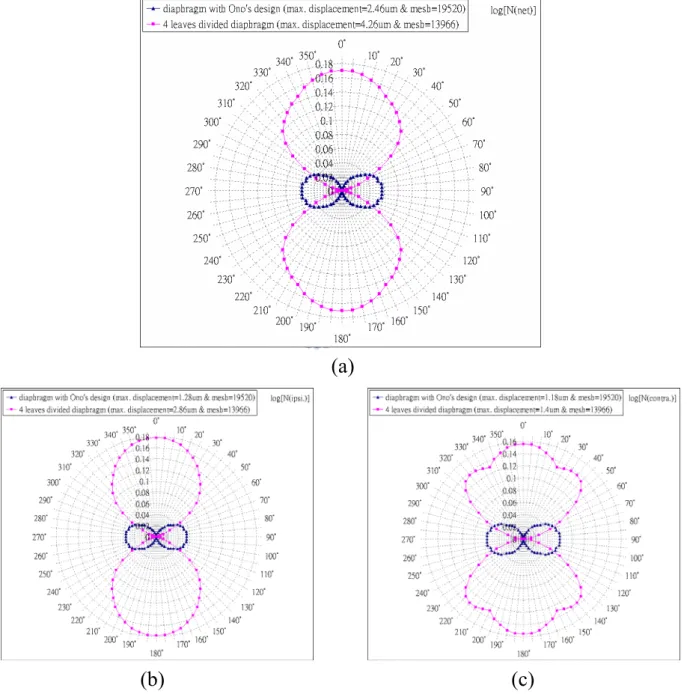
Fig. 4 shows a normalized displacement comparison of sensing diaphragms same design but with oxalis leaves in a polar patt
patterns of the net, ipsilateral, and s design (blue line) and 4 leaves oxalis-like between the Ono’s design and the
ern plot. The polar pattern plot is a logarithm of the normalized displacements which can also show the directivity of the microphone.
(a)
(b) (c) Fig. 2-4(a), (b) and (c) show the polar
Fig. 4 depicts two kinds of sensed di design and the oxalis-like design, resp designed with 2 inner and 2 outer pivots, 20 supporting beams. The radius of diaphra shown in Fig. 4(a) indicate that the tota
oxalis-like design (red line) has 1.73 times lar
aphragms which are based on the Ono’s ectively. Both central gimbals are
μm wide, 65μm long, and 5μm thick gms is 2500μm. The polar patterns l displacement of the diaphragm with the
ger than that of the diaphragm with the Ono’s design (blue line) while a 0.02Pa pressure load is applied on the alf of both diaphragms. Fig. 4(b) and (c) show the maximum displacements long ipsilateral and contralateral sides for each design, respectively. The
aximum displacements of Ono’s design are about 1.28μm in the ipsilateral side nd 1.18μm in the contralateral side both occurring at 90° and 270°. The
aximum displacements of oxalis design are about 2.86μm in the ipsilateral side nd 1.4μm in the contralateral side both occurring at 0° and 180°. In the analysis,
the Ono’s and oxalis-like diaphragms, their mash sizes are h a m a m a
though the total amounts of mesh elements are not equal to each other due to the area difference between
controlled with the similar size. The disintegration designs indeed amplify the displacement of sensing diaphragm.
The two-fold symmetrical polar patterns shown in Fig. 4 also reveal an important message that the sensing response is directional dependent. An open area resulted by minute displacement is about 40°~50° wide. The opening will lessen the ability of microphone to sound localization in terms of limited spatial
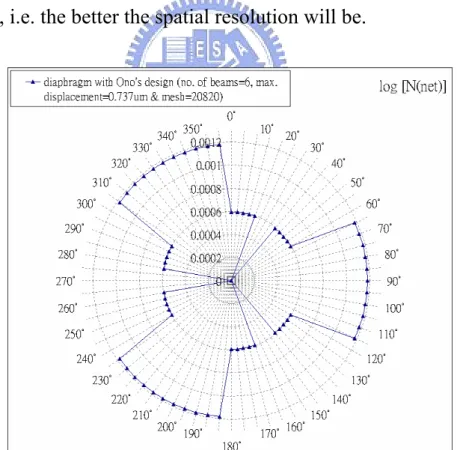
resolution and it can be attributed to the non-axially symmetrical distribution of spring constant which can be resolved by increasing the number of the inner and outer beams. Figure 5 shows the polar pattern of the sensing diaphragm with the Ono’s design under the same as the aforementioned loading condition. The opening angle can be effectively reduced from 40° to 20°. Meanwhile, it has been found that the opening angle can be reduced to 0° as shown in Fig. 6 once the number of total supporting beams has been increased to 8 or more that should be equally divided for the number of inner and outer supporting beam. Thus, the higher the number of supporting beam is, the smaller the opening angle will be, i.e. the better the spatial resolution will be.
Fig. 2-5 The net displacement of the Ono’s design with 3 inner and 3 outer beams The maximum displacement is about 0.737μm.
F beam
ig. 2-6 The
s The maximum displacement is about 0.491μm.
On the other hand, for the central supporting gimbals structure being loaded, e deformation will be concentrated at the regions of supporting ring and beams.
hen the number of inner and outer beams is increased for the reduction of
results in th
2.46μm to 0.737 angle is reduced while the
number of supporti
the beam based on
even though the beam num
net displacement of the Ono’s design with 4 inner and 4 outer
th W
opening angle, the effective spring constant would also be increased that will e reduction of the maximum displacement in the diaphragm structure. Thus, as shown in Fig. 5, the maximum displacement has been reduced from
μm although about 20° opening
ng beams increases from 4 to 6. Nevertheless, via an appropriate adjustment of the length, width, or thickness of
equation (3), the effective spring constant can still be kept at the same value ber is increased.
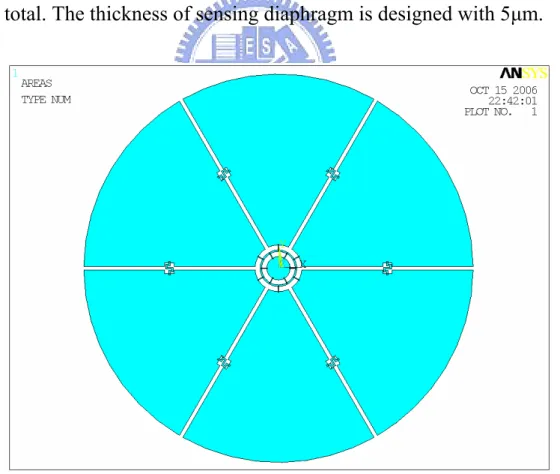
According to these analyses, a high performance biomimetic microphone hould be designed with a center-supported circular microphone diaphragm eing dissected into several parts like oxalis leaves, with a larger numbers of
aximizing its the sensitivity and spatial resolution. Fig. 7 shows an optimum oxal
beams and each beam is 10μm wide and 65μm long. The thickness of sensing s
b
supporting beams with smaller width, thickness, or larger length, for m
is-like biomimetic microphone which is designed with 6 leaves coupled with 6 serpentine springs, 6 bottom electrodes, and 12 supporting beams, which are 6 inner and 6 outer supporting beams, respectively. Each supporting beam is 10μm wide and 65μm long and each serpentine spring is 20μm wide and 300μm long in total. The thickness of sensing diaphragm is designed with 5μm.
2.3 Fabrication Process of the Biomimetic Microphone
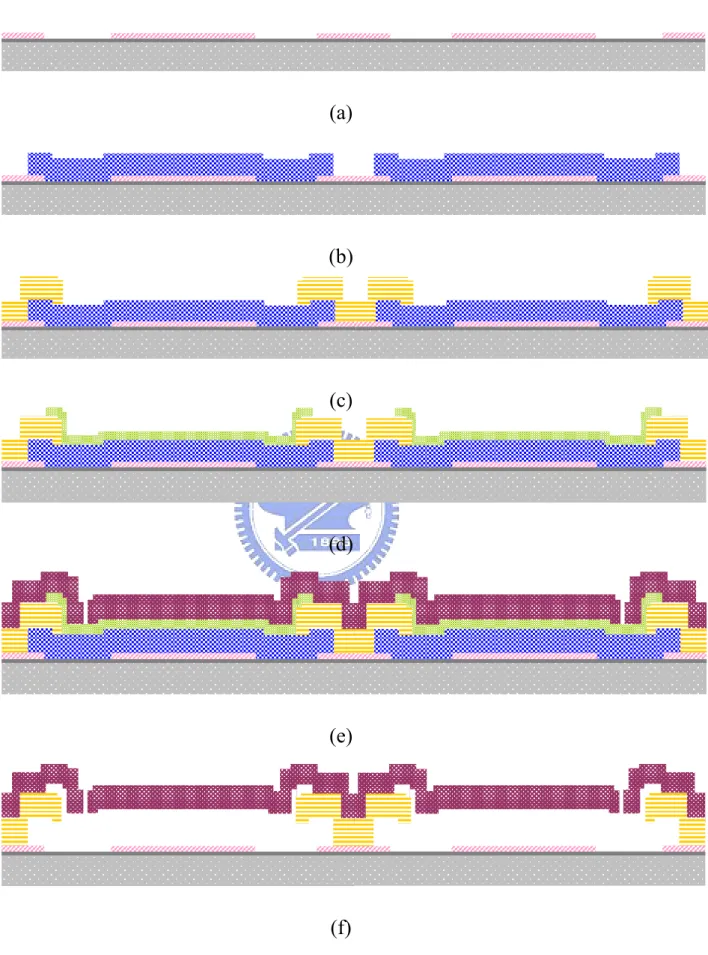
The designed biomimetic microphone can be realized using a standard Multi-User MEMS Process (MUMP) with three poly-silicon layers and two sacrificial layers. Fig. 8 shows process flow for the microphone fabrication.
t
CVD low
St
Step3:
ter supporting structure, the second layer of heavily doped poly-Si is deposited and etched (Fig. 8c).
ed and etched (Fig. 8d).
deposited by S ep1: After standard RCA clean, a 4” silicon wafer is deposited with
0.6μm thermal wet oxidation at 1050°C and 0.6μm LP stress Si3N4 at 850°C for electrical isolation.
ep2: A 0.5μm LPCVD N-type doped poly-Si is deposited at 585°C and patterned as the bottom sensing electrode (Fig. 8a).
A 2μm thick HDPCVD SiO2 is deposited at 300°C and patterned as the first sacrificial layer (Fig. 8b).
Step4: In order to realize the cen
Step5: The second sacrificial layer of 0.75μm thick HDPCVD SiO2 is deposit
Step6: Finally, the 1.5μm heavily doped poly-Si diaphragm is LPCVD and etched (Fig. 8e).
Step7: The last step is release the diaphragm by B.O.E. wet etching (Fig. 8f).
(e)
(f)
Fig. 2-8 Process flow of iomimetic microphone (a)
(b)
(c)
(d)
Chapter 3 Results and Discussions
3.1 Result of the Optimum Desig
Fig. 9 shows the analysis results of the proposed optimum oxalis-like biomimetic microphone. The maximum net displacement is about 1.267μm and the opening angle is only 10°. In the gn, the higher the number of sensing leaf is, the better the spatial resolution will be. Nevertheless, instead of 8 or more sensing leaves, the number of 6 determined by the minimum sensing capacitance which depends on the sensing circuit limitation. Since the minimum detected capacitance change is propor l to the overlapped area between the top sensing diaphragm and the bottom electrode, the area cannot be infinitesimal due to the limitation of S/N ratio (Signal-to-Noise ratio) of sensing circuit. The leaf number is restricted. shown in the Fig. 9 and Fig. 10.
microphone
n
desi
is
tiona
3.2 Influence of the Serpentine Spring
In addition, for a six-leaves diaphragm design, the number of total supporting beams can be 6 or more. However, in order to ensure a symmetrical acoustic response, each sensing leaf is designed to connect a supporting beam, i.e. outer supporting beam. Therefore, a total 12 supporting beams are designed. However, in comparison with the aforementioned Ono’s design with more than 8 supporting, the oxalis-like diaphragm design still exhibi
t a 10° opening even
ough the diaphr nce. Since the opening
ould be related to the disintegration design, the coupling springs can be odified from a serpentine shape into a simple beam design but with the same idth and thickness. Fig. 10 shows that about 2° open angle reduction can be alized. Because the diaphragm becomes more rigid due to stronger coupling, e net displacement has been reduced from 1.267μm to 1.245μm which is 3.7 mes larger than that with Ono’s design (0.333μm).
th agm has better displacement performa c m w re th ti
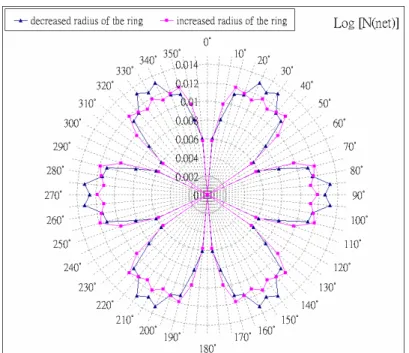
Moreover, in the Fig. 9, each polar pattern is not smooth enough that will make some errors for sensing circuit caused by the same sound pressure with different response. We need to improve the oxalis-like biomimetic diaphragm. Therefore, we adjust the position of the ring with different radius and the ring is designed with 20μm wide. If we move the ring outward, i.e. the length of the inner beam (100μm) is longer than outer beam (30μm), the polar pattern becomes smoother (red line). Oppositely, if we move the ring inward with 30μm long inner beam and 100μm long outer beam, the polar pattern is rough (blue line). The result is shown in Fig. 1 e net displacement is reduced
when mo and stress
concentrat .e. the effect
spring constant is lar However,
1. Meanwhile, th
ving the ring outward. According to the beam theorem ion, the loaded leaf applies a force on the shorter beam, i
ger than longer one, and the displacement will be reduced. the net displacement is still larger than Ono’s design.
3.3 Scanning Electro Microscope (SEM) Photographs
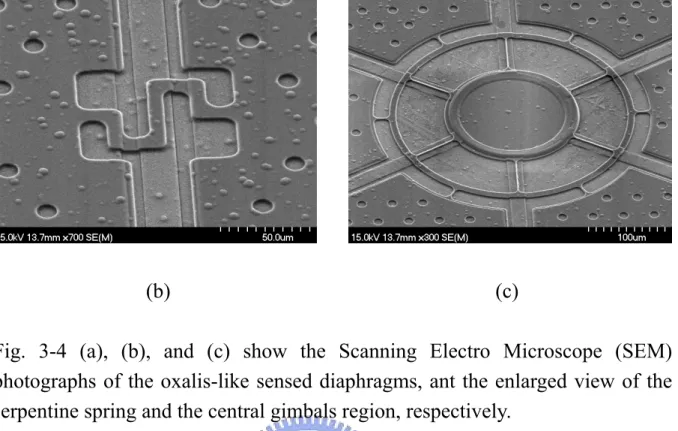
Fig. 12(a), (b), and (c) depict the Scanning Electro Microscope (SEM) photographs of the oxalis-like sensed diaphragm, and the enlarged view of the serpentine spring and the central gimbals region, respectively. In order to release more easily, we arrange the layout of etching holes which the diameter is 10μm and the distance between each hole is 40μm on each leaf. The performance and reliability of the oxalis-like sensing diaphragm will be affected due to the limitation of the instrum ng by RIE and the surface roughness by LPCVD.
ent, such as the over etchi
between the two sides of the divided diaphragm. Nevertheless, the ratio between the ipsilateral and contralateral displacem . This problem can be solved by designing the size of the MOS-FET in the differential
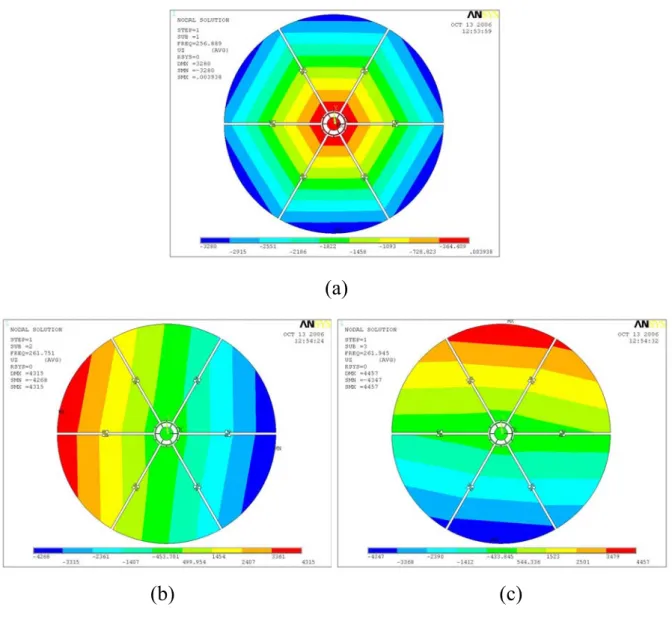
diaphragm can vibrate in-phase and re organ of the parasitoid fly. Thus, we u analysis to obtain the resonant frequencie x-axis reversed-phase vibration mode
(b) (c)
Fig. 3-4 (a), (b), and (c) show the Scanning Electro Microscope (SEM) photographs of the oxalis-like sensed diaphragms, ant the enlarged view of the serpentine spring and the central gimbals region, respectively.
3.4 The Vibration Mode
In Fig. 4(b) and (c), we find the ipsilateral and contralateral sides vibrate the opposite direction (reversed-phase vibration mode) when a pressure difference
ents is not approach to unity
amplifier circuit. Furthermore, because of the serpentine springs, the oxalis-like versed-phase modes like the auditory se the ANSYS to simulate the modal s, and show the in-phase, y-axis and s which their resonant frequencies are
256.998 Hz, 261.7 lacement of the
Fig. 3-5(a), (b) and (c) show in-phase, y-axis and x-axis reversed-phase modes 261.945 Hz spectively.
51 Hz and 261.945 Hz respectively. The disp diaphragm along z-axis is represented by different color in Fig. 13.
(a)
(b) (c)
and their resonant frequencies are 256.998 Hz, 261.751 Hz and re
Chapter 4 Summary and Future Work
4.1 Summary
central gimbals-support circular structur the oxalis is proposed. The net displ oxalis-like design is 3.7 times larger than gimb
performs the spa an 10 degrees.
um design of the central gimbals structure. ulation are analyzed by ANSYS simulator. The process
imetic microphone is fabricated by the standard three poly-silicon layers and two
rk
We need to verify the FEM analysis and the experimental result via the acoustic measurement system and realize the integration of the biomimetic microphone and CMOS circuit for low power hearing aid application.
A newly developed micromachined biomimetic microphone by utilizing the e [5-8], and mimicking the structure of acement of the diaphragm with the
that of the diaphragm with the central als-support circular diaphragm design, and the oxalis-like diaphragm
tial resolution with opening angle smaller th
Therefore, the oxalis-like diaphragm can not only improve the displacement by decoupling the sensing diaphragm but also enhance the capability of sound source localization with the optim
The design and FEM sim of the single-wafer biom
Multi-User MEMS Processes (MUMPs) with sacrificial layers.
References
[1] D. Robert, J. Armoroso, and R. R. Hoy, “The Evolutionary Convergence of Hearing in a Parasitoid Fly and Its Cricket Host,” Science, Vol. 258, pp. [2] R. N. Miles, D. Robert, and R. R. Hoy, “Mechanically coupled ears for directional hearing in the parasitoid fly Ormia ochracea,” J. Acoust. Soc. [3] Kyutae Yoo, J.-L. A. Yeh, N. C. Tien, C. Gibbons, Q. Su, W. Cui, and R. N.
Miles, “Fabrication of a Biomimetic Corrugated Polysilicon Diaphragm and Actuators, Transducers’01, pp. 130-133, Jun. 2001.
[4] K. Yoo, C. Gibbons, Q.T. Su, R.N. Miles, and N.C. Tien, “Fabrication of Biomimetic 3-D str
1135-1137, Nov. 1992.
Am, Vol. 98, No. 6, pp. 3059-3070, Dec. 1995.
with Attached Single Crystal Silicon Proof Masses,” Solid-State Sensors
uctured Diaphragms,” Sensors and Actuators A, Vol. 97-98, pp. 448-456, Apr. 2002.
] Kyutae Yoo, Quang Su, Ronald N. Miles, and Norman C. Tien “Biomimetic ve MicroMachined Diaphragm for Ultrasonic Transducers,” IEEE Ultrasonics Symposium, Vol. 2, pp. 887-890, Oct. 2001. [6]
Ochracea,” SICE, Vol. 4, pp. 2159-2162, Aug. 2002.
periments ion Sensor with Gimbal-Supported hragm,” Solid-State Sensors and Actuators, Transducers’03, pp. 939-942, Jun. 2003.
[5
Direction-Sensiti
Akihito Saito, Nobutaka Ono, and Shigeru Ando, “Micro Gimbal Diaphragm for Sound Source Localization with Mimicking Ormia [7] Nobutaka Ono, Akihito Saito, and Shigeru Ando, “Design and Ex
of Bio-mimicry Sound Source Localizat Circular Diap
[8] Nobutaka Ono, Akihito Saito, and Shigeru Ando, “Bio-mimicry Sound Source Localization with Gimbal Diaphragm,” T.IEE Japan, Vol. 123-E, No. 3, pp. 90-97, Mar. 2003.
[9] N. Ono, T. Arita, Y. Senjo, and S. Ando, “Directivity Steering Principle for Biomimicry Silicon Microphone,” Solid-State Sensors and Actuators,
[10]
, pp. 614-617, Jan. [11]
[12] / 9.0 version
Weili Cui, Baris Bicen, and Neal Hall, “Optical Sensing in a Directional MEMS Microphone Inspired by the Ears of the Parasitoid Fly, Ormia Ochracea,” IEEE international Conference on MEMS
2006.
http://aiforum.cse.ttu.edu.tw/plant/guide.htm ANSYS, http://www.ansys.com
Vita
名 姓 :景文澔 (Wen-Hao Ching) 生日期 出 :中華民國七十一年四月十九日 生 地 出 :台北市 - mail E :[email protected] 歷 學 : 台北市立復興高級中學 (1998.9~2000.6)(Taipei Municipal Fu-Hsing Senior High School)
國立中央大學電機工程學系 (2000.9~2004.6) (Department of electrical Engineering, Nation Central University)
國立交通大學電子工程所碩士班 (2004.9~2006.10) (Department of electronics Engineering & Institute of Electronics,
![Fig. 2-1 A picture of the three leaves oxalis [11].](https://thumb-ap.123doks.com/thumbv2/9libinfo/8137412.166491/13.892.171.745.542.1057/fig-picture-leaves-oxalis.webp)