國立交通大學
經營管理研究所
博士論文
No. 128
企業形象對組織人才吸引力之影響:
以應徵者個人差異為干擾變數
The effect of corporate image on organizational
attractiveness: Exploring the moderating roles of
applicant individual differences
研 究 生:楊文芬
指導教授:蔡維奇 教授
企業形象對組織人才吸引力之影響:
以應徵者個人差異為干擾變數
The effect of corporate image on organizational attractiveness:
Exploring the moderating roles of applicant individual
differences
研 究 生:楊文芬 Student:Irene Wen Fen Yang 指導教授:蔡維奇教授 Advisor:Dr. Wei Chi Tsai
國立交通大學 經營管理研究所
博士論文
A Dissertation
Submitted to Institute of Business and Management College of Management
National Chiao Tung University in Partial Fulfillment of the Requirements
for the Degree of Doctor of Philosophy
in
Business and Management June 2009
Taipei, Taiwan, Republic of China 中華民國九十八年六月
企業形象對組織人才吸引力之影響:
以應徵者個人差異為干擾變數
研究生:楊文芬
指導教授:蔡維奇教授
國立交通大學經營管理研究所博士班
摘要
近年來,招募領域的學者對於企業形象如何影響應徵者吸引力已有初步瞭 解。但是,相關文獻中關於企業形象內涵之瞭解,以及企業形象與組織人才吸 引力之間的關係,會受到哪些限制條件(boundary condition)的影響,仍為少見。 本文延伸過去研究,就電腦製造業之出缺工作為例,採用 538 名員工及學生求 職者,以實驗法探討企業形象各構面對於組織人才吸引力的影響,並檢視應徵 者個人特質變數—從屬需求、對環境敏感性及物質主義—的干擾效果。研究結 果顯示企業產品形象、企業公民形象及企業信譽形象對組織人才吸引力皆有正 向影響。此外;結果亦顯示對環境敏感性會干擾企業公民形象與組織人才吸引 力間的關係,亦即,當應徵者具有較高的對環境敏感性時,企業公民形象對於 組織人才吸引力的效果越強。關鍵詞:企業形象、組織人才吸引力、個人差異
The effect of corporate image on organizational attractiveness:
Exploring the moderating roles of applicant individual
differences
Student:Irene
Wen
Fen
Yang Advisor:Dr. Wei Chi Tsai
Institute of Business and Management
National Chiao Tung University
ABSTRACT
Although research has identified positive influence of corporate image on applicant attraction, little recruitment research has examined the boundary conditions of the relationship between corporate image and organizational attractiveness. In a sample of 538 potential applicants, we examined the relationship between corporate image and organizational attractiveness. Applicants’ characteristics including need for affiliation, environmental sensitivity, and materialism were considered as possible moderators. The results showed that corporate product image, corporate citizenship image, and corporate credibility image were positively associated with organizational attractiveness. Moreover, we found that applicants who were more environmentally sensitive were more attracted to organizations with higher corporate citizenship image.
Keywords:Corporate image, organizational attractiveness, individual differences
致 謝
To My Dearest Dad and Mom
To Angela
To My Advisor, Dr. Wei-chi Tsai
To Those Who Love and Support Me in These Days
And…
To My Heavenly Father
I am really very grateful for being able to learn, to love, to have knowledge and wisdom, to laugh, to cry, to carry
on and be strong, to face trials, to travel, and to enjoy and share life with those who are so important to me.
Thank you.
Irene W. F. Yang
目 錄
中文提要 ……….……… i
英文提要 ……….……… ii
致謝 ……….……… iii
目錄 ……….……… iv
表目錄 ……….……… vi
圖目錄 ……….……… vii
符號說明 ……….……… viii
I、INTRODUCTION ……...………...………1
II、THEORY ………..……….……… 5
2.1 Organizational Attractiveness …………..………. 5
2.2
The Relationship between Corporate Image and
Organizational Attractiveness ………...………… 6
2.2.1 Corporate
Product Image ……….. 8
2.2.2 Corporate
Service Image ………9
2.2.3 Corporate
Citizenship Image ………..9
2.2.4 Corporate Credibility Image ………..10
2.3
The Moderating Roles of Applicant Individual
Differences …...……….. 11
2.3.1 Need for Affiliation ……….……….. 11
2.3.2 Environmental Sensitivity ………..13
2.3.3 Materialism ……….14
III、METHODS ...……….………… 18
3.2 Procedures …………...…………..……….………18
3.3
Individual Variable Manipulation ………. 20
3.4 Measures ………...………..………... 21
3.4.1 Need for Affiliation ………21
3.4.2 Environmental Sensitivity ………..22
3.4.3 Materialism
……….22
3.4.4 Organizational
Attractiveness
……….23
3.4.5 Control Variables ………23
3.5
Image Manipulation Check Items .………...……….. 28
IV、RESULTS …....….………..……… 25
4.1
Manipulation Check ….……….….25
4.2
Hypothesis Testing ..…...………. 25
V、DISCUSION ...……….………..… 31
5.1
Theoretical Implications ….…...……… 31
5.2
Limitation …………..…....……….... 32
5.3
Direction for Future Research and Implication for
Practice ……….. 34
5.4
Conclusion .……… 36
REFERENCE .…….……….………..……… 38
APPENDIX 1 ……….……….………... 46
APPENDIX 2 ………. 50
APPENDIX 3 ………...…….…. 55
自傳 ……….……….…. 56
表
目 錄
Table 1 The Semantic Differential Scale for Corporate Image
Manipulation Check …..……….……….24 Table 2 Means, Standard Deviations, and Correlations for the
Variables ……..……….………..………..27 Table 3 Results of Regression Analysis of Organizational
圖
目 錄
Figure 1 Theoretical Model and Hypotheses ………..….….24 Figure 2 The Interactive Effect of Environmental Sensitivity and
Corporate Citizenship Image on Organizational
符 號 說 明
χ2 : chi-aquare F : f value p : p value s.d. : standard deviation t : t value df : degree of freedomCFI : Bentler’s comparative fit index
NNFI:Bentler & Bonnett’s non-normed index RMSR:root mean square residual
I.INTRODUCTION
For years, researchers have devoted to examining factors that make an organization more attractive than others. Not only do applicants need to persuade their future employers that they are perfect candidates for job vacancy, but the companies also have to distinguish themselves from various competitors in order to obtain high quality human resource. Several organizational or job-related factors, such as organizational size, organizational culture, rewards, and so on, have been found to influence organizational attractiveness and may facilitate the success of corporate recruitment (Cable & Judge, 1994; Judge & Bretz, 1992; Judge & Cable, 1997; Lievens, Decaesteker, Coetsier, & Geirnaert, 2001).
Among various organizational factors, the concept of “corporate image” has been identified as a critical factor to recruitment success (Chapman, Uggerslev, Carroll, Piasentin, & Jones, 2005; Collins & Stevens, 2002), and researchers have defined the concept as “the set of beliefs that job seekers hold about the attributes of an organization” (Cable & Turban, 2001:125). Recent research suggests that corporate image is crucial to potential job applicant while searching for a job (e.g., Gatewood, Gowan, & Lautenschlager, 1993; Highhouse, Zickar, Thorsteninson, Stierwalt, & Slaughter, 1999). Owing to the lack of public accessible information about targeted companies, potential job applicants may infer the employment conditions of the organization by relying on various organizational attributes, such as corporate image (Ehrhart & Ziegert, 2005). Although past research has explicitly acknowledged the role of corporate image in affecting organizational attractiveness, scholars still call for further exploration in this research stream (Barber, 1998; Ployhart, 2006).
the linkage between corporate image and organizational attractiveness, and the boundary condition of the aforementioned relationship. We conducted an experiment study to test the contention that corporate image is a multidimensional organization-level construct containing four dimensions, namely corporate product image, corporate service image, corporate citizenship image, and corporate credibility image. We expect that each of the four corporate image dimensions should predict organizational attraction. Furthermore, we consider three applicant individual difference variables (i.e., need for affiliation, environmental sensitivity, and materialism) to be potential moderators of the relationship among various dimensions of corporate image and organizational attractiveness.
By examining the relationship between corporate image dimensions and organizational attractiveness, we hope to contribute to this research stream in three ways. First, as argued by Highhouse, Thornbury, and Little (2007), research examining the determinants of organizational attractiveness (e.g., image, organizational personality traits, and so on) has been mostly inductive. They suggest that more theory-based empirical studies should be conducted in this research stream. To close this gap, we try to incorporate a framework of corporate image introduced by marketing scholars (Keller, 2000; Keller & Aaker, 1992). According to Hinkin (1995), research resting on a deductive approach also begins with relatively clear definitions and theoretical foundation. This type of research may also reduce the difficulty of interpreting or labeling factors/dimensions (Ford, MacCallum, & Tait, 1986). Therefore, we think this approach should be appropriate and may help delve into the insights of corporate image and its impacts on organizational attractiveness.
Second, very little research has explored both the image dimensions of companies and linked these dimensions to organizational attractiveness. For
example, Highhouse et al. (1999) identified several important dimensions of corporate employment image (e.g., product image, advertising, and hearsay) by using a forced-choice inductive methodology. As noted by Highhouse et al. (1999), the linkages between the dimensions of corporate employment image and recruitment outcomes have yet been tested and should be further examined in the future. Responding to such a research call, the present study focuses on establishing the linkages between corporate image dimensions and organizational attractiveness. In sum, it is our intention to clarify the relationship between corporate image and organizational attractiveness and to enrich the literature by applying a deductive approach to our examination of corporate image dimensions. We believe that the use of an “a priori theory” framework may shed considerable light on the aforementioned relationship.
Furthermore, according to Barber (1998), a deeper understanding on factors that may constrain or alter hypothesized relationship among variables should be further addressed in recruitment research. A review of extant research on organizational attractiveness reveals that several applicant-related individual variables, such as Big Five personality traits (e.g., Lievens et al., 2001), need for achievement, and self efficacy (e.g., Bretz, Ash, & Dreher, 1989; Turban & Keon, 1993), materialism (Cable & Judge, 1994), and so on, have been treated as moderators in examining the effects of different organizational characteristics on organizational attractiveness. As noted by Schneider, Smith, Taylor, & Fleenor (1998), personal preferences and needs may affect the way one is attracted to the organizations. Therefore, we propose that individual difference variables may affect or alter the relationships between each corporate image dimension and organizational attractiveness.
need for affiliation, environmental sensitivity, and materialism) which were considered as possible moderators on the effects of the corporate image dimensions on organizational attractiveness. Through identifying possible individual difference moderator, this study may draw a clearer picture of what constrains the relationship between corporate image and organizational attractiveness and add knowledge to the literature concerning the effects of organizational characteristic (i.e., corporate image) on organizational attractiveness. Moreover, by implementing an experimental research design, we may further clarify the causal relationship between corporate image dimensions and organizational attractiveness with control of other influential factors. The uses of the mixed sample composition and the manufacturing industry target in this study also help generalize our findings to the literature.
II. THEORY 2.1 Organizational Attractiveness
The creation of an organization’s attractiveness is considered crucial to the successful recruitment of high quality human resources. Scholars have introduced the concept of organizational attractiveness and examined this concept both empirically and theoretically in the last two decades. Integrating the definitions from past literature (e.g., Lievens, Van Hoye, & Schreurs, 2005; Turban & Keon, 1993), we defined organizational attractiveness as applicants’ willingness to pursue jobs and to accept job offers in an organization.
Turban, Forret, and Hendrickson (1998) addressed the importance of organizational attractiveness because any loss of highly qualified applicants may decrease the utility of the selection system. Besides studying the effects of individual behavior (e.g., recruiter behavior) or job related factors (e.g., job autonomy) on organizational attractiveness, the exploration of the importance of organizational factors in influencing organizational attractiveness has received attention from some scholars. For example, Turban (2001) investigated factors related to organizational attractiveness and found that organizational attractiveness was influenced by recruitment activities (e.g., corporate recruitment advertisements). However, these activities rarely disclose sufficient information about important organizational attributes with which applicants can try to evaluate a firm. As little is known by job applicants about organizational characteristics, the conjecture of individuals regarding conditions of employment is often based on subjective perceptions (Cable & Turban, 2001). Rynes (1991) labeled these perceptions “organizational image” and argued that this concept may be used by job applicants who are trying to determine organizational attractiveness.
2.2 The Relationship between Corporate Image and Organizational Attractiveness Applying ideas from marketing literature to the recruitment context, some research has posited that corporate image influences organizational attractiveness (Ehrhart & Ziegert, 2005). In the present paper, we treated corporate image as an organization-level construct. Previous recruitment research also considered corporate image to be individuals’ shared perceptions of a given organization (e.g., Barber, 1998; Lemmink, Schuijf, & Streukens, 2003). These shared perceptions are associated with the name or property of the organization and are held by job seekers. Therefore, in the present study, we do not consider corporate image a unique belief that each applicant holds toward an organization. Instead, we believe that corporate image exists at the organization-level and may lead to positive organizational attractiveness.
A variety of theoretical perspectives may serve to explain the influences of organizational characteristics on organizational attractiveness, and two such theoretical perspectives are social identity theory (Tajfel & Turner, 1985) and signaling theory (Breaugh, 1992). In this research, we adopt these two major perspectives.
Social identity theory suggests that employees can obtain self-enhancement and social approval when they perceive the organization for which they work to be rather favorable. Individuals who mention the organization for which they work may consequently receive favorable recognition from others; alternatively, negative images may bring unfavorable comments from others and lead to depression and pressure (Ashforth & Mael, 1989). Empirical evidence also shows that firms with positive images have been considered to be more attractive employers and that corporate image has been positively related to applicants’ intentions to pursue
further contact (Gatewood, Gowan, Lautenschlager, & Mayfield, 1990).
In addition to adopting social identity theory to explain the effects of corporate image on organizational attractiveness, we use signaling theory to explain the aforementioned relationships. Applicants may infer employment environment from the behaviors of the company (Breaugh, 1992) and interpret values and rules of the organization through their (i.e., the applicants’) perceptions of these signals (Greening & Turban, 2000). Past research has showed that potential applicants’ perceptions of corporate image come from corporate advertisements or from the applicants’ own experiences of having used the goods or the services provided by the company (Gatewood et al.,1993; Lemmink et al., 2003). Therefore, individuals may easily react or link information to companies whose images have been previously developed by the individuals (Brooks, Highhouse, Ressell, & Mohr, 2003).
In the present study, we adopt the framework from marketing literature in explaining how images are perceived and evaluated when examining the links between corporate image and organizational attractiveness. At this point, we should note that the leverage of knowledge and research from the existing marketing literature is commonly accepted in the recruitment literature (Barber, 1998; Breaugh, 2008). For example, Cable and Turban (2001) applied brand equity and brand knowledge concepts from marketing literature to developing a concept of employer knowledge. Lemmink et al. (2003) also adopted the framework of brand equity to study application intention. Moreover, both the purposes of marketing activities and the purposes of recruitment activities function to share specific information with individuals, to attract interest, and to persuade individuals to take further action. Regarding organizations’ attempts to attract individual targets and to shape their
reaction to different sources of information, it should be reasonable to parallel the recruitment and marketing processes or theories (Cable & Turban, 2001).
According to Keller (2000), the most important associations that consumers perceive regarding a given company fall into one of four dimensions: product images (i.e., common product attributes, benefits, or attitudes), service images (i.e., people and relationships), citizenship images (i.e., value and programs related to social welfare), and credibility images (i.e., credibility and expertise). These images may also affect applicants if we consider these applicants to be potential consumers in the job market. Therefore, we propose four corporate image dimensions (corporate product image, corporate service image, corporate citizenship image, and corporate credibility image) and we test them in relation to organizational attractiveness.
2.2.1 Corporate product image
Keller (2000) argued that benefits or attributes associated with products may provide customers with crucial information in determining the images of the company. For example, high quality and innovativeness have been identified as important product related attributes. When a firm presents to the public a high-quality product image, the firm normally enjoys competitive advantage. At the same time, such a firm may receive more attention and even earn positive appraisal from employees and potential applicants. In addition, organizations that are widely considered to be more innovative in product production may, by virtue of this perception, deliver a signal to applicants that the organizations search for and reward individuals who are willing to try to learn new knowledge and skills necessary for the implementation of innovative tasks. The applicants may also feel that the company desires to hire applicants of relatively high quality and offers considerable
opportunity for employees’ personal growth (Herman & Gioia, 2000).
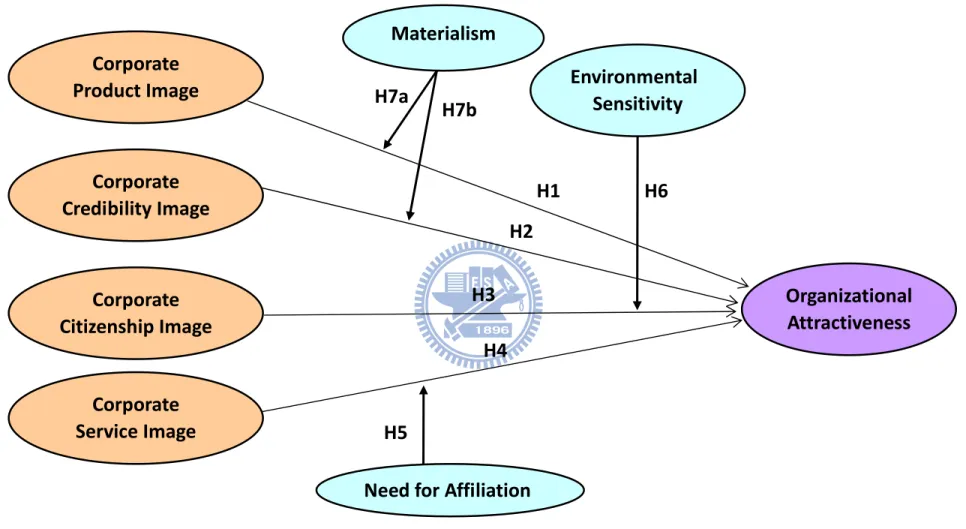
Hypothesis 1: Corporate product image will be positively related to organizational attractiveness.
2.2.2 Corporate service image
Keller (2000) pointed out that employee behavior is an important factor influencing customers’ formation of favorable corporate images. Among the various types of such behavior, service related actions are particularly influential on customers’ formation of positive impressions. A corporate service image represents an organization focusing on customer needs and feelings and emphasizes customer satisfaction. Similarly, the attention that employers pay to employees may be an important signal that applicants receive. When making job choice decisions, applicants look not only for a suitable employer but also for a future partner (Herman & Gioia, 2000). Applicants may refer to their observation of employee and employer behaviors in order to determine whether or not a group of would-be future colleagues are amicable. An organization possessing both a group of customer-focused employees and an attentive employee-care program (e.g., an employee counseling program or workshop) will easily enhance positive images that customers as well as potential applicants have of the organization.
Hypothesis 2: Corporate service image will be positively related to organizational attractiveness.
2.2.3 Corporate citizenship image
Environmentally sound or socially responsible corporate behaviors are the most popular ways for organizations to manage corporate citizenship images. Firms disclose their positive behaviors in media and in other public relation activities to obtain positive recognition from outsiders (Keller, 2000; Greening & Turban, 2000).
Empirical evidence has revealed that large firms often consider their presentation of positive social values to be an important recruitment strategy (Highhouse, Hoffman, Greve, & Collins, 2002). Firms will conduct green marketing (e.g., The Body Shop’s environmentally safe product lines) to create positive images of environmental protection, social welfare, and concern for community. In addition, employees are proud of this kind of corporate marketing activity and, as a result, are more committed to the firm (Keller, 2000). The recent ground swell of environmental protection concern has, for example, prompted applicants to consider environment-protecting companies to be an employer of choice.
Hypothesis 3: Corporate citizenship image will be positively related to organizational attractiveness.
2.2.4 Corporate credibility image
Corporate credibility is highly related to company expertise and trustworthiness (Keller, 2000). When a firm is considered professional, people may normally associate such a professional impression with a group of elite employees in the firm. Because of the functioning of social identification, a positive image of expertise will attract applicants of high quality to the corresponding organization. Trustworthiness is the moral standard for a company and is one of the salient features for an employer of choice (Ahlrichs, 2000). Lack of trustworthiness will encumber the continuance of the business and may cause applicants to fear that their future work will be unstable and insecure. In contrast, a firm that is perceived to be trustworthy will be in a strong position to convince potential applicants that the firm treats its employees sincerely and fairly. Moreover, according to research in social psychology, credibility is the best way to convince others and earn trust (e.g., Birnbaum & Stegner, 1979). Consequently, a firm with a high corporate credibility
image will have a pronounced ability to attract relatively high-quality applicants.
Hypothesis 4: Corporate credibility image will be positively related to organizational attractiveness.
2.3 The Moderating Roles of Applicant Individual Differences
As described above, the proposed corporate image dimensions may lead to positive attractiveness. The way job applicants are attracted to the organization may not just depend on the image it holds. Given the uniqueness of each individual, individuals may perceive certain images in different ways (Chartrand, 2005). That is, individual differences may predetermine the way applicant perceived different corporate image and as a result interact with the effects of corporate images on organizational attractiveness. According to signaling theory, individuals may collect indirect information to infer the true situation when they are under ambiguous circumstances or have limited information for judgment. In addition, when pursuing a job, explicit organizational attributes (e.g., corporate image, firm size, profitability, and so on) may be treated as signals of organizational values or employment conditions. Indeed, the way job applicants decode and interpret information to infer the real situation within the organization may also be different. The effects of these signals may vary due to the influences of such individual differences.
In the present research, we consider three applicant individual difference variables (i.e., need for affiliation, environmental sensitivity, and materialism) to be possible factors that may moderate the relationship between corporate image dimensions and organizational attractiveness. The theoretical rationales of these moderating effects are introduced as follows.
2.3.1 Need for affiliation
association to their needs and personal goals. One individual difference variable that is specifically relevant to corporate image and may lead to positive organizational attractiveness is need for affiliation.
While need theory was fully developed by McClelland (1987), the number of research about how these needs (i.e., achievement, affiliation, power, and autonomy) affect personal or organizational behavior and performance in the workplace has burgeoned rapidly from then on. Until now, researchers have well implemented relevant ideas and research topics in various research arenas (Steers, Mowday, & Shapiro, 2004). Need for affiliation, defined as the need to establish friendly and sociable relationships with others, represents activity-engagement behaviors that develop a direct relationship between the person engaging in the behavior and others (McClelland, 1987). People who prioritize affiliation treat the maintenance of companionship or membership as an important daily task and may seek contexts facilitating a stable relationship with others (Wieseufeld, Raghuram, & Garud, 2001). People high on need for affiliation may treat the maintenance of companionship or membership within the group as an important daily task. They may seek information or exchange resources to help ensure a stable relationship with others.
By creating recognition to those who treasure specific affiliation needs, an organization’s possession of a positive corporate service image may constitute a strong signal persuading applicants that the organization promotes the maintenance of preferred human relationships. For example, if an organization is concerned about its relationships with its customers and employees, a spillover effect may lead to an inference that the organization is willing to provide a positive and stable environment for social interaction. For applicants high on need for affiliation, the effect of such a positive corporate image in caring people within or outside the organization on
attractiveness may be strengthened. On the other hand, applicants low in need for affiliation prefer greater social distance from other groups of people and thus may be less interested in the organizations promoting interactive working atmosphere and positive corporate service image.
In addition, as the organization devotes itself to maintaining desirable connections with different stakeholders, the organization may appreciate such desirable behavior involved in employees’ daily work. Applicants who highly value affiliation may have stronger desire of working within a supportive organization than for those scoring low. Thus, applicants who score low in need for affiliation may consider themselves incompetent at this potential job requirement. Consequently, organizations with high corporate service image may not be so attractive to them.
Hypothesis 5: The higher the job applicants score on need for affiliation, the stronger the relationship will be between corporate service image and organizational attractiveness.
2.3.2 Environmental sensitivity
Environmental sensitivity represents a person’s concern for the environment. The specific concerns that individuals hold for the environment may affect their personal decisions (Chawla, 1998). For example, Berger and Kanetkar (1995) found that individuals were influenced by the environmental attributes and individuals’ experiences with allegedly environmentally sound products could moderate the relationship between these individuals’ perceptions of the brand and their purchasing behaviors. Moreover, individuals who rate highly on environmental sensitivity might be more attentive to organizations’ efforts to protect the environment and might be more likely to act in ways that support these organizations.
behavior, organizations with a positive corporate citizenship image demonstrate their willingness to serve other members of the society (Donaldson & Preston, 1995). Based on stakeholder theory, individuals are considered as members of the society, so as the organizations. As a member of the society, organizations have obligation to behave in socially responsible ways to benefit the society and that may help the organization receive support from other stakeholder groups (Goll & Rasheed, 2002). If job applicants are aware of and sensitive to these behaviors or efforts, desirable associations toward the organization may lead to positive attraction. In addition, people who concern or commit more to the environmental issues are more likely to actualize their supports in buying green products or voting for environmentally concerned parties (Scott & Willits, 1994). For job applicant who are less sensitive to such issue may not even consider it necessary for an organization to concern with. However, such issue has comparatively less discussed in the literature and need further exploration.
Following this vein, applicants with higher environmental sensitivity may have greater desire to recognize these efforts; however, applicants with lower environmental sensitivity may see the efforts as unnecessary for organizational operation. Overall, the more environmentally sensitive the applicants are, the more likely they are to believe that organizations with a good corporate citizenship image will benefit the applicants.
Hypothesis 6: The higher the job applicants score on environmental sensitivity, the stronger the relationship will be between corporate citizenship image and organizational attractiveness.
2.3.3 Materialism
the belief that acquisition of possessions is a necessary or desirable form of conduct relative to the end state of happiness. They also noted that three important themes may represent the insights of the concept of materialism: 1) acquisition centrality shows that “materialists place possessions and their acquisition at the center of their lives” (Richins & Dowson, 1992; p.304); 2) acquisition as the pursuit of happiness point out that materialists “view possessions as essential to their satisfaction and well-being in life” (Richins & Dowson, 1992; p.304); and 3) possession-defined success represents materialists’ intention to judge their own and others’ success by the number and quality of possessions accumulated” (Richins & Dowson, 1992; p.304).
The amount and the quality of accumulated possessions may be the standard by which materialists judge the success of other people (i.e., possession-defined success). Individuals may draw inferences about, and evaluate other people in terms of the value of these other people’s possessions. As noted by Campbell (1987) and Richin and Dowson (1992), the judgment of material success may provide important hints for materialists to compare the status and well-being among people. Materialists also tend to acquire valuable means which can project their desired self-image and life. For example, high-quality products may be explained as valuable invisible assets which in turn may create a certain amount of profits and provide competitive advantages for the companies (Aaker, 1991). As the company enjoys a high-quality product image, it may acquire conceivable earnings and publicity that can satisfy materialists’ desire of being recognized as successful by others. Thus, for applicants score high on materialism, organizations carrying positive corporate product image may be more attractive.
accessible meaning are important to pronounced materialists. Organizations that appear to adequately maintain corporate credibility may, consequently, exhibit expertise and trustworthiness valuable to members and stakeholders of the organizations. According to Clarke and Micken (2002), materialists enjoy being validated and respected by other people and possession representing such “external value” may be considered vital to the materialists. As operations of the organization receive wide recognition, materialists may infer that the organization is in continuous possession of highly valuable visible and invisible assets. These inferences may persuade materialists to form, maintain, or strengthen a sense of distinctiveness about the firm (Kreiner, Hollensbe, & Sheep, 2006). Such a distinct perception may enhance the associations toward a future employer as the materialists are looking for the jobs. Besides, the image of superior expertise and trustworthiness may help materialists obtain or enhance favorable self-image. In general, if job applicants rate high as materialists, the organizations that enjoy a positive product image and a positive credibility image may be more attractive to this population.
Hypothesis 7a: The higher the job applicants score on materialism, the stronger the relationship will be between corporate product image and organizational attractiveness.
Hypothesis 7b: The higher the job applicants score on materialism, the stronger the relationship will be between corporate credibility image and organizational attractiveness.
Figure 1. Theoretical model and hypotheses
H1
H2
H3
H4
Corporate
Product Image
Corporate
Service Image
Corporate
Citizenship Image
Corporate
Credibility Image
Materialism
Need for Affiliation
Environmental
Sensitivity
Organizational
Attractiveness
H5
H7a
H7b
H6
III. METHODS 3.1 Participants
Data were collected from the final-year student applicants and from the experienced employees. According to the human resource demand survey conducted by Cheers Magazine, organizations in the manufacturing industry (i.e., the target industry of the present study) would normally recruit both final-year students and experienced employees. Moreover, recruitment scholars also call for more future research collecting data from experienced workers (e.g., Ployhart, 2006). We therefore determine to collect data from two samples, final-year student applicants and experienced employees in this industry. Of the 962 individuals contacted, 745 (77%) responded and completed our questionnaire. To ensure that these participants either were actually involved in a job search process or would pursue a job in the near future, we asked all would-be participants one question (i.e., “Are you going to apply a new job in the near future? If so, when will you apply?” Please see “section 2” of
the questionnaire attached in Appendix 1 and Appendix 2 for details) that would eliminate
anybody not planning to search for a job. This step resulted in 538 participants involved in the present study (including 429 final-year students and 109 experienced employees), yielding a response rate of 72 percent. For this sample, the mean age was 25.3 years and 67.5 percent were male.
3.2 Procedures
In the present study, we choose the computer manufacturing industry as the target industry in examining the relationships among corporate image dimensions and organizational attractiveness. In contrast to other industries, manufacturing industry companies normally tend to release more information about themselves to the public owing to these companies’ need either to accelerate the transfer of
technology or to meet government regulations. The applicants may acquire relevant information easily. Moreover, considering the highly related nature of corporate product image and corporate service image in certain industries (e.g., service industry), it is likely that choosing a target industry with clearer corporate product image and service image may facilitate the manipulation in the experiments. We therefore chose the computer manufacturing industry as our target. Referring to the information disclosed in the mass media of several famous computer manufacturing companies in Taiwan, we formed the corporate image stimuli and each of the scenarios.
Questionnaires were distributed to final-year undergraduate and graduate students in class at eight universities and to experienced employees from eleven companies in Taiwan. After filling out the first section of the questionnaire containing items related to individual difference variables and demographic information, the participants were randomly assigned to one of sixteen recruitment scenarios. Participants were instructed to adopt the role of an applicant. The instructions provided general information about the conditions of organizations and job vacancy. Then, the participant would read a half-page featuring written comments purported to have been made in a famous business magazine regarding a computer manufacturing company. After reading the comments, the participants completed the designated questionnaire including items related to organizational attractiveness and the manipulation checks. Participation was voluntary and anonymous
To minimize concerns about the effects of different participant-group characteristics, we conducted a series of analyses to ensure there were no statistical differences in the demographic profiles between students and experienced
employees. The results showed that, except for age and willingness to apply (i.e., applicant willingness to apply for jobs in the near future), there was no significant difference in either gender (χ2 = .67, p > .05) or another application willingness variable, “willingness to apply for jobs in the computer manufacturing industry” (F = .71, p > .05). Therefore, the two variables (i.e., age and willingness to apply) were statistically controlled in this study.
3.3 Independent Variable Manipulations
We manipulated four types of corporate images (i.e., corporate product image, corporate service image, corporate citizenship image, and corporate credibility image) by changing the information attributable to the magazine’s commentary reports on the images of corporations at two levels (i.e., high or low). Referring to previous research, we took an approach similar to the approach for testing the effects of different organizational characteristics on individuals (e.g., Aquino, Tripp, & Bies, 2006; Lievens et al., 2005).
We used a 2*2*2*2 between-subject factorial design, which thus formed sixteen scenarios. We created corporate image stimuli based on the original framework and definitions proposed by Keller (2002) and also referred to real company image information disclosed in mass media. The stimuli were further revised by three senior marketing and HR managers and two I-O psychology professors. It should be noted that for the manipulated corporate image variables, four dummy variable was created (coded 0 = “low image,” 1 = “high image”). The following is a sample of image manipulation (the level of the manipulated image stimuli is in brackets).
high-quality products to its customers. It also keeps developing a broad range of innovative and high-performance products boasting all the latest features and practical functionality [high corporate product image]. In serving and supporting customer needs, this company maintains quality services and also sustains a culture of continuous improvement to ensure customer satisfaction. Well-established training programs and communication channels for employees greatly improve and strengthen the company’s services [high corporate service image]. We found that this company uses resources and handles waste efficiently. Its present facilities are certified for ISO-9001 and ISO-14001 international standards to ensure workplace safety and environmental protection. The company has also devoted itself to community activities, helping people in need, and is dedicated to becoming a leading corporate citizen through active sponsorship of educational, charitable, and cultural activities in Taiwan [high corporate citizenship image]. Committed to premium professional performance, the company has received industry-wide recognition and is considered trustworthy and reliable by customers. It has also been awarded the National Excellence Award for expertise in operations. These accomplishments elevate the company’s reputation among customers and vendors alike [high corporate credibility image].
3.4 Measures
3.4.1 Need for affiliation
We used a 5-item scale adapted from Steers and Braunstein (1976) to assess this construct. Reviewing past research, we found that a comparatively low alpha for
the five-item need for affiliation measure indicated the need to increase the number of items. Thus, we added two items based on the calculation of Spearman-Brown formula and the conceptual definition of the variable. Two sample items used here are “I enjoy belonging to groups and organizations” and “I tend to build close relationship with others.” Subjects were asked to indicate their agreement using a 6-point Likert scale (1 = strongly disagree; 6 = strongly agree). The coefficient alpha was .81 for this seven-item measure.
3.4.2 Environmental sensitivity
We measured this construct by using a 15-item scale adopted from Berger and Kanetkar (1995). The scale used by Berger and Kanetkar (1995) was adapted from a part of Antil and Bennett’s (1979) Socially Responsible Consumer Behavior scale (SRCB). The original scale in Berger and Kanetkar (1995) contained 20 items. However, four items concern specific consumer behavior (e.g., consumer interests and environmentally sound product characteristics). Moreover, the content of another item has been emphasized in the environmental protection laws in Taiwan and is well known as the prerequisite for the operation of each company. In order to prevent no variation in response, these items were removed. Two sample items used in the present study are “Pollution is presently one of the most critical problems facing this nation” and “Natural resources must be preserved even if people must do without some products.” Subjects were asked to indicate their levels of agreement using a 6-point Likert scale (1 = strongly disagree; 6 = strongly agree). The Cronbach’s alpha for this fifteen-item measure was .84 in the present study.
3.4.3 Materialism
Following the recommendation of Richins (2004), we used a revised shorter version of the Material Values Scale (MVS; Richins and Dawson, 1992) to measure
how respondents rated the degree to which they rated both possessions and acquisition of possessions as necessary or desirable in reaching goals. According to Richins (2004), the shorter version of the MVS is designed to assess the construct at a general level and has good psychometric properties. Therefore, we adopted the 9-item scale to measure materialism. Two sample items are “I admire people who own expensive homes, cars, and clothes” and “The things I own say a lot about how well I’m doing in life.” Respondents were asked to indicate their levels of agreement using a 6-point Likert scale (1 = strongly disagree; 6 = strongly agree). The Cronbach’s alpha for this measure was .79 in the present study.
3.4.4 Organizational attractiveness
Organizational attractiveness was measured at the individual level, in line with the measurements used by Collins and Stevens (2002) and Lievens et al. (2005). Three items from Turban and Keon (1993) and Highhouse et al. (1999) were used to measure an applicant’s willingness to pursue jobs in an organization. Items include: “I’d prefer a job there over a job in most other companies,” “If I were looking for a job, a job there would be very appealing,” and “If I were looking for a job, I would have strong motivation to apply for a job there.” Subjects were asked to base their responses on 6-point Likert scale (1 = strongly disagree, 6 = strongly agree). The Cronbach’s alpha for this measure was .90 in the present study.
3.4.5 Control variables
“Willingness to apply for jobs in the near future” was controlled. Subjects were asked to state whether or not they were going to apply for a job in the near future (1 = Yes, I plan to apply for a job in six months, 4 = No, I’m not planning on applying
for a job in the near future). Age was also controlled based on the results described
3.5 Image Manipulation Check Items
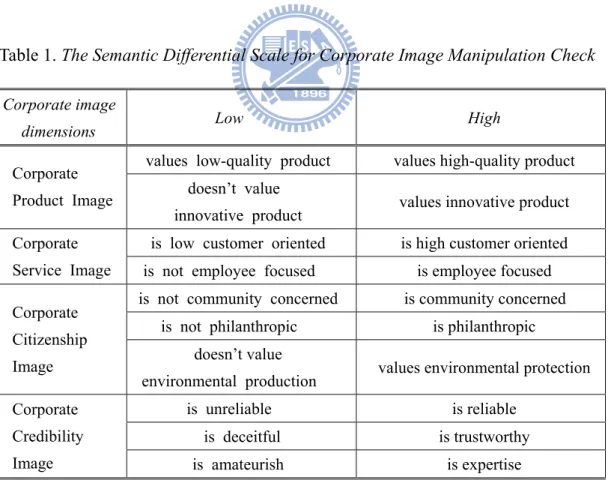
Following the definitions proposed by Keller (2000) and Goldberg and Hartwick (1990), ten items were constructed to assess whether or not the participants differed from one another regarding their perceptions of the described four corporate image dimensions. Each corporate image dimension was measured with a semantic differential scale with 6 points (please see Appendix 1 for details regarding 6-point semantic differential scale format and anchor). On a 6-point semantic differential scale, individuals rated the extent to which these adjectives described the manipulated company. The similar approach has been adopted in previous studies (e.g., Smidt, Pruyn, & Van Riel, 2001). The samples of semantic differential item are listed in Table 1.
Table 1. The Semantic Differential Scale for Corporate Image Manipulation Check
Corporate image
dimensions Low High
values low-quality product values high-quality product
Corporate
Product Image doesn’t value
innovative product values innovative product
is low customer oriented is high customer oriented
Corporate
Service Image is not employee focused is employee focused
is not community concerned is community concerned
is not philanthropic is philanthropic
Corporate Citizenship
Image doesn’t value
environmental production values environmental protection
is unreliable is reliable
is deceitful is trustworthy
Corporate Credibility
IV. RESULTS 4.1 Manipulation Check
To test whether or not the four corporate images were successfully manipulated, we conducted a series of t-tests. The results showed that the company possessing a high rating for corporate product image received significantly higher ratings from the participants (mean = 4.56, s.d. = .91) than did the company possessing a low rating for corporate product image (mean = 3.65, s.d. = .96; t[536] = 10.07, p < .01). Second, the company possessing a high rating for corporate service image received significantly higher ratings from the participants (mean = 4.50, s.d. = .96) than did the company possessing a low rating for corporate service image (mean = 4.04, s.d. = .94; t[536] = 5.60, p < .01). Third, the company possessing a high rating for corporate citizenship image received significantly higher ratings from participants (mean = 4.68, s.d. = .83) than did the company possessing a low rating for corporate citizenship image (mean = 3.98, s.d. = .94; t[536] = 9.14,
p < .01). Finally, the company possessing a high rating for corporate credibility
image received significantly higher ratings from participants (mean = 4.50, s.d. = .81) than did the company possessing low ratings for corporate credibility image (mean = 4.13, s.d. = .87; t[536] = 4.42, p < .01). On the basis of these results, we deemed that the manipulations of corporate image variables had been successful.
4.2 Hypothesis Testing
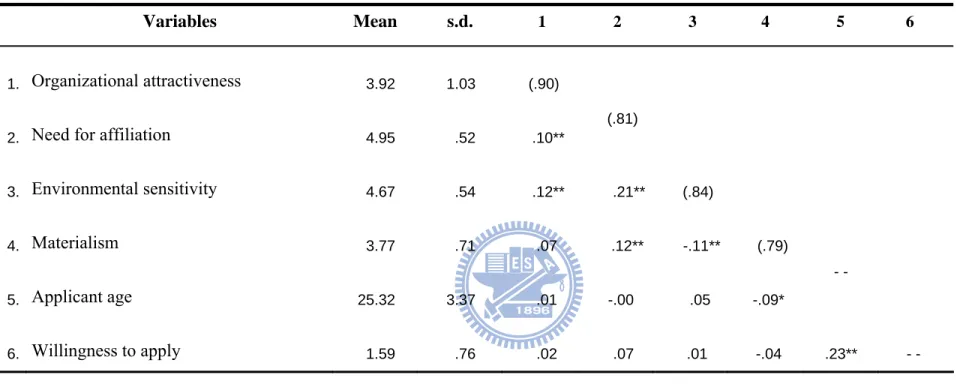
The descriptive statistics and the correlations among variables are reported in Table 2.
A confirmatory factor analysis (CFA) using maximum likelihood estimation showed that the moderators and dependent variable did not fit well with the 4-factor model (chi-square = 908.96, df = 521, p < .01, chi-square/df = 1.74, CFI = .80,
NNFI = .78, and RMSR = .10). However, the fit of this 4-factor model was also compared with the fit of twelve alternative models (i.e., a null model, a 1-factor model, six different 2-factor models, and four 3-factor models). The fit of the current 4-factor model was significantly better than the fit of any alternative model, which indicates that the proposed 4-factor structure should be acceptable. The factor loadings ranged from .08 to .88 with an average loading of .50. This provided some evidence of convergent validity of the constructs (Bagozzi & Yi, 1988). Furthermore, we assessed discriminant validity by constraining inter-construct correlations in the measurement model to unity one at a time and by measuring the difference in the chi-square statistic (Anderson & Gerbing, 1988). The results show that all changes in chi-square (ranging from 134.84 to 596.51, Δdf = 1) were significant at the .01 level; hence, discriminant validity was achieved.
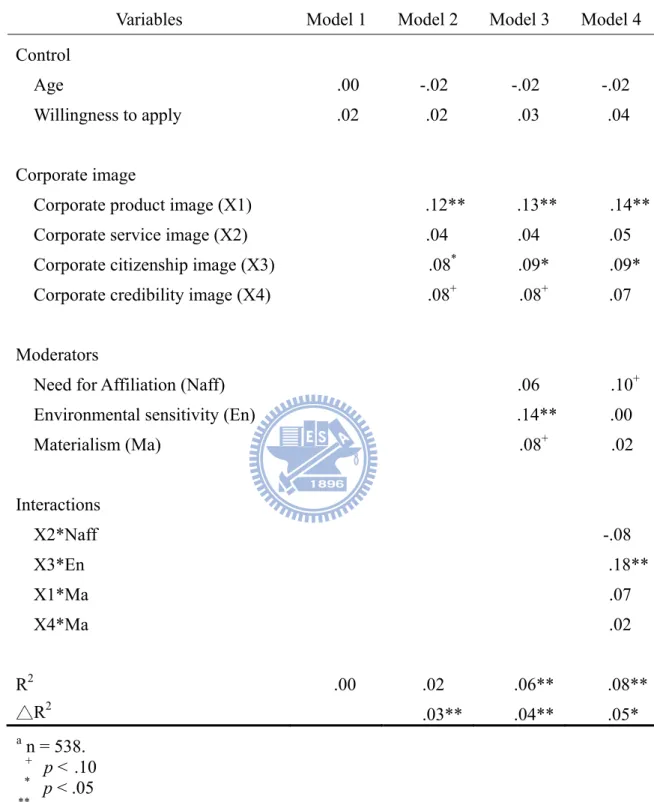
To test the hypotheses, we regressed organizational attractiveness on four corporate image dimensions and three moderators, after controlling for applicant age and willingness to apply for jobs. The results are presented in Table 3.
In model 2, four corporate image variables were entered into the regression. As shown in model 2, we found that corporate product image (β = .12, p < .01), corporate citizenship image (β = .08, p < .05), and corporate credibility image (β = .08, p < .1) were positively associated with organizational attractiveness. However, the results showed that corporate service image was not significantly associated with organizational attractiveness (β = .04, p > .05). With respect to corporate product image (X1), we found that organizations possessing high ratings for corporate product image (X1) were more likely to attract the potential applicants (β = .13, p < .01), providing support for Hypothesis 1. We also found that organizations
Table 2. Means, Standard Deviations, and Correlations for the Variablesa
Variables Mean s.d. 1 2 3 4 5 6
1. Organizational attractiveness 3.92 1.03 (.90)
2. Need for affiliation 4.95 .52 .10**
(.81) 3. Environmental sensitivity 4.67 .54 .12** .21** (.84) 4. Materialism 3.77 .71 .07 .12** -.11** (.79) 5. Applicant age 25.32 3.37 .01 -.00 .05 -.09* - - 6. Willingness to apply 1.59 .76 .02 .07 .01 -.04 .23** - -
a n = 538. Alpha coefficients appear on the diagonal in parentheses. * p < .05
possessing high ratings for corporate citizenship image (X3) were more likely to attract the potential applicants (β = .09, p < .05), providing support for Hypothesis 3. As shown in model 3, corporate credibility image (X4) was positively associated with organizational attractiveness (β = .08, p = .06), providing marginal support for Hypothesis 4. Corporate service image (X2) was not significantly associated with organizational attractiveness (β = .04, p > .10), failing to support Hypothesis 2.
In model 3, four corporate image variables and three moderators—need for affiliation (Naff), environmental sensitivity (En), and materialism (Ma)—were added to the regression. As shown in Table 3, the standardized regression weight was significant for environmental sensitivity (β = .14, p < .01) and materialism (β = .08, p < .1).
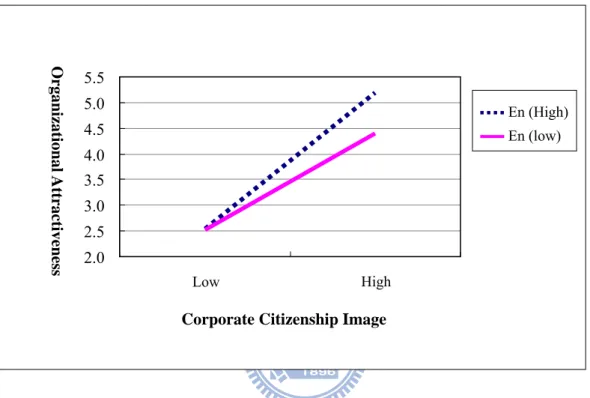
In model 4, we performed a moderated regression in which we added four possible two-way interaction terms about need for affiliation (i.e., X2 x Naff), environmental sensitivity (i.e., X3 x En), and materialism (i.e., X1 x Ma and X4 x Ma). To counter multicollinearity problems in our testing of the interaction terms, we centered all moderating variables before creating the interaction terms (Jaccard, Turrisi, & Wan, 1990). The interaction terms accounted for a significant amount of unique variability in organizational attractiveness (ΔR2 = .05, p < .05). As shown in Table 3, the interaction of X2 x Naff was not significant in relation to organizational attractiveness, thereby failing to support Hypothesis 5. Furthermore, there were insignificant two-way interactions between X1 x Ma and X4 x Ma, thereby failing to support Hypothesis 7a and Hypothesis 7b. There was a significant two-way interaction between environmental sensitivity and corporate citizenship image (β = .18, p < .01). To better understand the form of the moderating effect, we followed Aiken and West (1991) and Cohen and Cohen (1983) and drew an interaction-effect
plot. As shown in Figure 1, the positive relationship between corporate citizenship image and organizational attractiveness was stronger when applicants rated high on the environmental sensitivity scale, providing support for Hypothesis 6.
Figure 2. The interactive effect of environmental sensitivity and corporate
citizenship image on organizational attractiveness.
2.0 2.5 3.0 3.5 4.0 4.5 5.0 5.5 Low High
Corporate Citizenship Image
Organizational Attractiveness
En (High) En (low)
Table 3. Results of Regression Analysis of Organizational Attractivenessa
Variables Model 1 Model 2 Model 3 Model 4
Control
Age .00 -.02 -.02 -.02
Willingness to apply .02 .02 .03 .04
Corporate image
Corporate product image (X1) .12** .13** .14**
Corporate service image (X2) .04 .04 .05
Corporate citizenship image (X3) .08* .09* .09* Corporate credibility image (X4) .08+ .08+ .07
Moderators
Need for Affiliation (Naff) .06 .10+
Environmental sensitivity (En) .14** .00
Materialism (Ma) .08+ .02 Interactions X2*Naff -.08 X3*En .18** X1*Ma .07 X4*Ma .02 R2 .00 .02 .06** .08** △R2 .03** .04** .05* a n = 538. + p < .10 * p < .05 ** p < .01
V. DISCUSIONS 5.1 Theoretical Implications
In the present paper, we examined the effects of corporate image dimensions on organizational attractiveness, specifically taking into account the effects of applicant individual differences. As expected, we found that corporate images relevant to product, social and environmental responsibility, and credibility are important determinants of organizational attractiveness, and this is generally true in the manufacturing industry contexts. Moreover, the results also showed that applicant environmental sensitivity moderates the relationship between corporate citizenship image and organizational attractiveness.
In the present study, we uncovered an interesting finding concerning the effect of corporate service image. Originally, corporate service image and corporate product image were treated separately in Keller’s (2000) model of corporate image. The results of the present study showed that corporate service image cannot predict organizational attractiveness. One possible reason is that individuals tend to embellish service-relevant performances when they have pre-established positive images toward the organizations (Martinez & Pina, 2005). The effect of corporate service image may be embedded in other corporate image dimensions and may, for this reason, have exhibited no unique influence on attractiveness.
Another possible explanation is rooted in the prior research on corporate communication and advertising. For example, research has shown that individuals considered prints and ads, placed by organizations, to be the least credible source of information (Cable & Yu, 2006). And according to Van Hoye and Lievens (2005), applicants place relatively little importance on the recruitment-information sources that organizations strongly influence. In contrast to other corporate images, service
image seems to involve perceptions of many regulatory behaviors and work-required performances that organizations control relatively easily. In the manufacturing industry, where most product production and customer service operations are separate, applicants may rather clearly discern information relevant to after-sales or maintenance services. While comparing multiple information sources in order to choose a future employer, applicants may naturally ignore information thought to be lacking in credibility. As a result, applicants may not consider corporate service image to be important to their assessments of organizational attractiveness.
In addition, our data did not support the hypotheses regarding the moderating effects of materialism. One possible explanation is that the applicants who rated high on the materialism scale may have perceived high quality and innovativeness (corporate product image) or trustworthiness and expertise (corporate credibility image) as being subtle symbolic attributes, not as being obvious evaluable attributes. According to Lievens and Highhouse (2003), symbolic attribute to attractiveness reflects an individual’s self-identity or the individual’s desire to express deeply personal thoughts. Even though materialists may be inclined to assign symbolic meanings to these images, symbolic meanings do not guarantee the success of organizations. A similar rationale may apply to the insignificant finding in the moderating effect on corporate credibility image. Applicants who rate low on the materialism scale may also notice the influences of a strong corporate credibility image, whereas applicants who rate high on the materialism scale may appreciate the professional and reliable performance of the organization but not relate such performance to their material preferences.
5.2 Limitations
student participants. As the research focus was to examine how corporate image influenced potential applicants’ levels of attractiveness, the data should have reflected an authentic applicant population. While much past research has used the student sample to examine how various organizational characteristics affected job applicants (e.g., Cable & Judge, 1996), it has been suggested that more research should use real applicant samples or experienced workers in studying the effects of organizational characteristics on recruitment outcomes (Ployhart, 2006).While we made an effort to collect data from experienced workers in this research, we finally combined student samples and experienced employee samples owing to the relatively small sample size on employees. However, while combining the student participants and the experienced employee participants, we performed statistical analyses to ensure that there was no significant difference between the characteristics of each of the two groups.
Another limitation of the present research concerns our decision to use a relatively lenient standard (i.e., α = .10) when testing the main effects of corporate image in model 2 of the regression analysis. According to Murphy and Myors (2003), if we make it very difficult to reject the null hypothesis in order to minimize Type I errors, the possibility of the occurrence of Type II errors may increase at the same time. Considering the comparatively smaller effect sizes (d values ranged from .03~ .141) of the corporate image dimensions, we believed that the use of a more lenient alpha may help ensure the statistical power of the study.
Besides the limitations addressed above, one important concern should be noted ____________________________
1According to Cohen (1988), d values below .20 are considered to be relatively small
here. The current research focuses on addressing the important role of organizational characteristics in predicting organizational attractiveness. As a result, we neither considered nor controlled for job specific variables in the present studies. One may argue that the effects of corporate image dimensions examined in the present study may be less important than, or even trivial in comparison with, the effects of other determinants of organizational attractiveness. In fact, Chapman et al. (2005) indicated that organizational image has a medium effect size in predicting attraction (ρ = .48, 95% confidence interval not including zero) after correcting for all statistical artifacts; they also found that this effect is also stronger than the influences of overall job characteristics on attraction (ρ = .30). In sum, we agree that the inclusion of job specific variables would endow them with ecological validity. However, in this research, with the experimental control for a set of job-related characteristics (e.g., salary, job content, job title), certain efforts are made when we consider the influences of corporate image dimensions. Therefore, we believe that, even if under fully controls for job related characteristics, corporate image dimensions could still influence organizational attractiveness.
5.3 Directions for Future Research and Implication for Practice
In this research, we have adopted social identity theory and signaling theory to explain the possible mechanism whereby corporate image dimensions may influence organizational attractiveness; however, we have not tested any mediating processes via the proposed theoretical mechanisms (e.g., social identity). Thus, we suggest that future research should address such an interesting and important issue to further flesh out the literature on attraction.
relationships of corporate image dimensions and organizational attractiveness in the present study. However, there may be other potential individual differences moderators which can alter the relationship between specific corporate image dimension and organizational attractiveness. We also suggest that more research can explore the effects of individual differences in order to realize whether specific corporate image may have commensurate impacts on attracting job applicants.
For instance, the characteristics of conscientiousness have been found to affect job seeker’s organizational preference (Judge & Cable, 1997). According to Costa and McCrae (1992) and Goldberg (1990), people with high conscientiousness tend to be more practical, risk averse, and cautious. Applicants with such characteristics may be more attentive to information regarding the operation performance of the organization because this kind of information may imply the organizational ability to compete with others and ensure the possibility of business continuality. For conscientious applicants, organizations with superior expertise and being trusted by the public (high corporate credibility image) may be perceived as an ideal employer that can provide secure and stable job opportunity. On the other hand, consciousness individuals are less adaptable to the changes and challenges (LePine, Colquitt, & Erez, 2000) and are less attentive to organizations with innovative culture (Judge & Cable, 1997).Similarly, applicants score high on conscientiousness may be less likely to be attracted by the organizations carried highly innovative corporate product image. In sum, we believe that more research is needed in exploring relevant issues.
Moreover, because applicants’ processing of organization-related information is important, the sources that applicants use to collect information regarding different corporate images may affect the effectiveness of image disclosure. For example, Collins and Stevens (2002) found that applicants mostly relied on recruitment
information from word-of-mouth sources, and information disclosed by an organization is considered less credible. Although the variance of information credibility affects the influences of corporate images on potential applicants, organizations can still actively manage their corporate image through indirect recruitment activities or through in-time media responses to rapidly surfacing media-fueled opinions about corporate performance. The findings of Van Hoye and Lievens (2007) provide some support for our inferences by suggesting that—regarding influence on organizational attraction—general organizational messages from a source unrelated to the company are more effective than employee testimonials. Future research, we suggest, should test the mediating mechanism that can effectively deliver to applicants the information regarding corporate image dimensions.
5.4 Conclusion
Despite its potential limitations, the present research presents a framework to explain the composition and the effects of corporate image and examines the moderating effects of applicants’ characteristics. We found that corporate product image, corporate citizenship image, and corporate credibility image were important antecedents to organizational attractiveness and that the applicants’ environmental sensitivity moderated the relationship between corporate citizenship image and organizational attractiveness. The present study may add further understandings to the literature about what conditions may enhance or alter the relationship between organizational characteristics (i.e., corporate image) and organizational attractiveness. Moreover, with the implementation of an experiment research design, the results of the present research may also help clarify the causal relationship between corporate image dimensions and organizational attractiveness while controlling for other
REFERENCE
Aaker, D. A., Developing Business Strategy, John Wiley, New York, NY, 1991. Ahlrichs, N. S., Competing for Talent, Davies-Black, Palo Alto, CA, 2000.
Aiken, L. S., West, S. G.., Multiple Regression: Testing and Interpreting Interactions, Sage, Newbury Park, CA, 1991.
Antil, J. H., Bennett, P. D., “Construction and validation of a scale to measure socially responsible consumption behavior”, The Conserver Society, pp. 51-68, Henion, K. E., Kiinear, T. C.(eds), American Marketing Assocaition, Chicago, 1979. Aquino, L., Tripp, T. M., Bies, R. J., “Getting even or moving on? Power, procedural
justice, and types of offense as predictors of revenge, forgiveness, reconciliation, and avoidance in organizations”, Journal of Applied Psychology, 91, pp. 653-668, 2006.
Ashforth, B. E., Mael, F., “Social identity theory and the organization”, Academy of Management Review, 14, pp. 20-39, 1989.
Barber, A. E., Recruiting Employees: Individual and Organizational Perspectives. Sage, Thousand Oak, CA, 1998.
Berger, T. E., Kanetkar, V., “Increasing environmental sensitivity via workplace experiences”, Journal of Public Policy and Marketing, 14, pp. 205-216, 1995. Birnbaum, M. H., Stegner, S. E., “Source credibility in social judgment: Bias,
expertise, and the judge's point of view”, Journal of Personality and Social Psychology, 37, pp. 48-74, 1979.
Breaugh, J. A., Recruitment: Science and Practice, PWS-Kent, Boston, 1992.
Breaugh, J. A., “Employee recruitment: Current knowledge and important areas for future research”, Human Resource Management Review, 18, pp. 103-118,
2008.
Bretz, R. D., Ash, R. A., Dreher, G. F., “Do people make the place? An examination of the attraction-selection-attrition hypothesis” Personnel Psychology, 42, 3, pp. 561-581, 1989.
Brooks, M. E., Highhouse, S., Russell, S. S., Mohr, D. C., “Familiarity, ambivalence, and firm reputation: Is corporate fame a double-edged sword?”, Journal of Applied Psychology, 88, pp. 904-914, 2003.
Cable, D. M., Judge, T. A., “Pay references and job search decisions: A person-organization fit perspective”, Personnel Psychology, 47, pp. 317-348, 1994.
Cable, D. M., Judge, T. A., “Person-organization fit, job choice decisions, and organizational entry”, Organizational Behavior and Human Decision Processes, 67, pp. 294-311, 1996.
Cable, D. M., Turban, D. B., “Establishing the dimensions, sources, and value of job seekers’ employer knowledge during recruitment”, Research in Personnel and Human Resource Management, 20, pp. 115-163, 2001.
Cable, D. M., Yu, K. Y. T., “Managing job seekers’ organizational image beliefs: the role of media richness and media credibility”, Journal of Applied Psychology, 91, pp. 828-840, 2006.
Chapman, D. S., Uggerslev, K. L., Carroll, S. A., Piasentin, K. A., Jones, D. A., “Applicant attraction to organizations and job choice: A meta-analytic review of the correlates of recruiting outcomes” Journal of Applied Psychology, 90, pp. 928-944, 2005.