科技部補助專題研究計畫成果報告
期末報告
結合社群平台之耐延遲網路,其散播興趣資訊的方法
計 畫 類 別 : 個別型計畫 計 畫 編 號 : MOST 103-2221-E-004-013-執 行 期 間 : 103年08月01日至104年10月31日 執 行 單 位 : 國立政治大學資訊科學系 計 畫 主 持 人 : 蔡子傑 計畫參與人員: 碩士班研究生-兼任助理人員:劉亭侁 碩士班研究生-兼任助理人員:陳柏錡 博士班研究生-兼任助理人員:詹賀翔 報 告 附 件 : 出席國際會議研究心得報告及發表論文 處 理 方 式 : 1.公開資訊:本計畫可公開查詢 2.「本研究」是否已有嚴重損及公共利益之發現:否 3.「本報告」是否建議提供政府單位施政參考:否中 華 民 國 105 年 01 月 30 日
中 文 摘 要 : 智慧型行動裝置的普及程度愈來愈高,又加上藍芽4.0與Wi-Fi Direct 的技術不斷更新、進步,使得智慧型行動裝置之前能夠很容 易做到點對點連線,而這樣的技術成長,能夠開發不同於以往的 APP,具有創新的服務與應用,甚至透過點對點連線能得到智慧型裝 置彼此交換資訊的狀況。 現今的網路資訊氾濫,每天都會有各種不同廣告資訊在散播,但漫 無目的散播資訊,會引起接收資訊的使用者覺得反感及不悅。資訊 一定會帶有關鍵的屬性,而透過這些關鍵的屬性能夠投遞到是目標 的接收者的話,將能夠提升資訊傳遞率,減少不必要的傳輸成本。 在耐延遲網路環境下,移動模型的建立,會是影響設計路由演算法 的一個重要因素,本研究計畫開發一個Android APP命名為”NCCU Trace Data”用來收集實際的人在真實生活移動的狀況。我們鎖定 在校園學生移動的情境為例,匯入到模擬器用以模擬評估現有的路 由演算法效能,並且用多數學者常用的數學合成移動模型與本研究 計畫收集的真實移動模型來呈現傳輸效能上的差異。 本研究的議題如下:針對耐延遲網路環境下開發一個Android APP來 收集真實生活人的移動資料、欲基於興趣訊息散播路由方法。依據 收集來的移動資料建立一個真實校園的移動模型,並且依照耐延遲 網路訊息傳遞的特性儲存後轉發,提出基於興趣訊息散播路由方法 ,以解決訊息濫伐產生不必要的浪費,最終將收集得來的真實移動 模型匯入到模擬器並模擬所提的方法驗證其效能。 中 文 關 鍵 詞 : 耐延遲網路、移動模型、Android、訊息興趣散播、NCCU Trace Data 英 文 摘 要 : 英 文 關 鍵 詞 :
科技部補助專題研究計畫成果報告
(□期中進度報告/□期末報告)
結合社群平台之耐延遲網路,其散播興趣資訊的方法
計畫類別:□個別型計畫 □整合型計畫
計畫編號:MOST 103 - 2221 - E - 004 - 013 -
執行期間: 103 年 8 月 01 日至 104 年 10 月 31 日
執行機構及系所:國立政治大學資訊科學學系
計畫主持人:蔡子傑
共同主持人:
計畫參與人員:碩士班研究生-兼任助理人員 : 劉亭侁
碩士班研究生-兼任助理人員 : 陳柏錡
博士班研究生-兼任助理人員 : 詹賀翔
本計畫除繳交成果報告外,另含下列出國報告,共 _1_ 份:
□執行國際合作與移地研究心得報告
□出席國際學術會議心得報告
期末報告處理方式:
1. 公開方式:
□非列管計畫亦不具下列情形,立即公開查詢
□涉及專利或其他智慧財產權,□一年□二年後可公開查詢
2.「本研究」是否已有嚴重損及公共利益之發現:否 □是
3.「本報告」是否建議提供政府單位施政參考 □否 □是, (請列舉提供
之單位;本部不經審議,依勾選逕予轉送)
中 華 民 國 104 年 12 月 31 日
附件一一、摘要
智慧型行動裝置的普及程度愈來愈高,又加 上藍芽 4.0 與 Wi-Fi Direct 的技術不斷更新、進 步,使得智慧型行動裝置之前能夠很容易做到點 對點連線,而這樣的技術成長,能夠開發不同於 以往的 APP,具有創新的服務與應用,甚至透過 點對點連線能得到智慧型裝置彼此交換資訊的狀 況。 現今的網路資訊氾濫,每天都會有各種不同 廣告資訊在散播,但漫無目的散播資訊,會引起 接收資訊的使用者覺得反感及不悅。資訊一定會 帶有關鍵的屬性,而透過這些關鍵的屬性能夠投 遞到是目標的接收者的話,將能夠提升資訊傳遞 率,減少不必要的傳輸成本。 在耐延遲網路環境下,移動模型的建立,會 是影響設計路由演算法的一個重要因素,本研究 計畫開發一個 Android APP 命名為”NCCU Trace Data”用來收集實際的人在真實生活移動的狀況。 我們鎖定在校園學生移動的情境為例,匯入到模 擬器用以模擬評估現有的路由演算法效能,並且 用多數學者常用的數學合成移動模型與本研究計 畫收集的真實移動模型來呈現傳輸效能上的差異。 本研究的議題如下:針對耐延遲網路環境下 開發一個 Android APP 來收集真實生活人的移動 資料、欲基於興趣訊息散播路由方法。依據收集 來的移動資料建立一個真實校園的移動模型,並 且依照耐延遲網路訊息傳遞的特性儲存後轉發, 提出基於興趣訊息散播路由方法,以解決訊息濫 伐產生不必要的浪費,最終將收集得來的真實移 動模型匯入到模擬器並模擬所提的方法驗證其效 能。 關鍵詞: 耐延遲網路、移動模型、Android、訊息 興趣散播、NCCU Trace Data二、緣由與目的、結果與討論
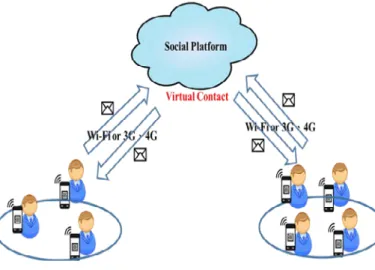
智慧型行動裝置的普及,使得一些新的創新 服務及應用,值得去開發。進而相對的技術、系 統與硬體的支援,也要徹底的研究,以便能最有 效率地達到創新的特色功能。 由於行動網路的發達與普及,只要使用者能 接收到行動網路的地方就能收到網路資訊,每天 都會有各種不同的廣告訊息在散播,漸漸取代傳 統的實體發送傳單(DM)的方式,透過網路變成電 子式(無紙化)的散播方式。當使用者收到不感興 趣且漫無目的的隨意散播資訊,無論是實體發送 傳單或是透過網路濫伐資訊,都會令人感到厭惡 及不悅。 訊息會帶有屬性類別,例如:運動、藝文等屬 性類別,而每位使用者都有自己的喜好,有的使 用者喜歡運動所以對於傳單帶有運動屬性的內容 會感到有興趣接收,也可能會是一個不錯協助散 播的使用者,因為使用者可能會遇到興趣相似的 朋友們。 而這樣儲存後轉送的方式,很符合在耐延遲 網 路 環 境 (Delay/Disruption Tolerant Networks, DTN)應用,因為每一個使用者都有各自的移動的 軌跡,所接觸或碰到的人並非能一直保持連線通 訊,在很多時候只能建立間歇性的連線傳送訊息 給相遇的彼此。因此,每一個使用者的移動情境 會影響到路由演算法的設計。許多的學者研究中, 明確的指出在耐延遲網路環境下,移動的模型會 影響到路由演算法的效能,而先前的研究以數學 合 成 的方 法製 作 一 個模 仿 人 的 移動 模型 , 例 如:Random Walk model、Random Waypoint model 等,試圖採用數學合成的移動模型,表示人的移 動情境。但實際上,人移動的狀況,不應該是沒 有特定的方向性隨機的移動,或是給予一個固定 的停留時間,然後再隨機性的移動。在真實的日 常生活情境,每個人移動的狀況應該會根據自己 的日常生活(如:上課時間、上班時間)、喜好或是 行為來移動。譬如:學生每天會根據各自的課表到 學校上課,而下課後,部分的人會直接回家,部 分的人會因為自己的喜好參與社團活動或是去看 電影、唱歌等其他活動。這些移動的情境,都是 根據每個人的日常活動、喜好和行為得來的移動 情境,而非隨機產生的移動結果。近年來,有愈 來愈多的學者朝向收集真實的移動資料,並製作 一個移動模型做為模擬的依據。但收集真實移動 資料困難點為不容易取得個人的移動資料且受限 於智慧型行動裝置的硬體狀況,很難執行。先前 的研究中,欲收集真實的個人移動資料,實驗環境侷限在參與同一場研討會或是相同的科系的學 生情況。這樣的實驗環境,參與實驗的使用者的 移動狀況很多時間會在同一棟建築物移動,並非 真實呈現學生日常生活的移動情境。在本研究中, 收集學生以各自的喜好或是行程移動的資料,能 突破這樣收集個人移動資料的上述研究限制,開 發一個Android APP來收集學生的個人移動資料, 不侷限於同一科系、不限定某一場研討會的情境, 而是學生依據自己日常生活的行為來收集他們的 移動資料,我們所開發的APP安裝在他們的手機 裡,並且不影響他們正常使用手機的行為,在背 景執行收集資料。 此外,本研究除了考量收集移動模型以外, 也設計一個在耐延遲網路環境下訊息散播的路由 演算法,基於人與訊息帶有的屬性相關來辨別是 否適合作為散播的依據。先前大多數的研究,考 量訊息傳遞的情況,以”人與人”之間的關聯來做 為判斷依據。例如:帶有要傳遞訊息的節點 A,遇 到其他可傳遞節點 B,考量相遇的節點 B 與欲傳 遞到的目的節點 D 的關聯,如:節點 B 比節點 A 有更多的機率遇到節點 D,所以節點 A 會將訊息 傳遞給節點 B。但上述的例子,若是能到真實情 況會有不一樣的結果,節點 A 要傳遞的是傳單或 是廣告訊息時,在真實環境下,節點 B 對於收到 不感興趣的訊息是覺得煩人,即使收下訊息,也 有可能收下隨即在訊息丟棄,造成傳遞成本變高 且沒有效率。本研究認為除了”人與人”之前的關 聯外,應該多加以考量”人與訊息”之間的屬性來 做傳遞、轉送判斷的依據。在訊息或是傳單上, 會帶有屬性類別,例如:運動相關屬性、學術相關 屬性等,而每個人亦有喜好的屬性類別,例如:熱 愛運動屬性、喜好美食等,我們樂於接收到我們 喜好的相關訊息或是優惠的傳單,當我們收到這 些訊息或是傳單後,也會樂於分享給我們的社群 關係的朋友或是親屬,本研究將這類訊息散播的 方法稱為 Direct Contact disseminate。經由這個概 念,本研究設計相關的問卷收集學生的喜好與興 趣,並且也透過來社群平台來獲取學生的喜好與 使用習慣。當訊息需要散播時,附有這些興趣屬 性,訊息在散播的同時,我們能屏除到對於訊息 內容完全不喜歡的節點,減少訊息傳遞的成本。 此外在本研究訊息散播演算法中,當節點當下遇 到的節點雖然對要散播的訊息不感興趣,但該節 點仍可能是一個合適的協助訊息散播的節點。舉 例來說:當節點 A 有一個關於運動賽事的訊息需 要被散撥給很多人知道,而遇到的節點 B 對於運 動相關訊息是不感到興趣,但該節點 B 知道或是 曾經遇到過某些節點對於運動相關訊息是相當熱 衷,節點 B 將會是不錯的協助轉送的中繼節點, 本 研 究 將 這 類 訊 息 散 播 的 方 法 稱 為 Indirect Contact disseminate。本研究所設計的訊息散播演 算法,相較於現有的演算法,有不錯傳遞成功率 及較低的傳輸成本,且較貼近實際人與人之間訊 息散播的判斷依據。 本研究後續將釋出更多真實的社群資料用以 評估在耐延遲網路環境下的效能如圖 1 所示: 圖1: 真實的社交關系資料與上線區間 現階段在耐延遲網路環境下研究,最為人詬 病的就是模擬數據並非真實資料所跑出來的效能 評估結果,而本研究的後續則是將更多的真實社 群資料釋出,可供在研究耐延遲網路環境下的學 者做為效能評估的重要依據使用,並且可與之前 使用非真實資料的研究做為對比。 而在許多研究著重於節點基於地理位置下, 節點之間移動後接觸來判斷訊息是否傳遞,對於 社群的定義上,認為兩兩節點若是常常接觸的情 況,代表兩節點彼此社群關聯度高,關係是很密 切的。本研究認為,節點之間關係密切並非絕對 在地理位置下是常常相遇的情況,本研究經由 Facebook 平台存取各個參與實驗的學生好友清 單,並且透過問卷的方式取得學生每天上線至 Facebook 平台的情形。 本研究認為需探討在網路上,”虛擬相遇”的 情況,若是兩兩節點社群關係密切,但兩節點地 理位置上很難常常相遇,但兩節點很有可能在網 路上相遇, 經由虛擬相遇的情境,透過社群平台 將訊息傳遞給社群關係密切的朋友。當互為社群 朋友的節點有可能同時上線在社群平台中相遇, 而此時能將訊息傳遞給社群朋友,請社群的朋友 將訊息轉發。本研究認為,訊息傳遞與散播的行 為,除了地理位置上的相遇外,亦需考量到訊息
在網路上相遇,傳遞與轉送的行為。雖然在地理 位置上,兩節點有可能不常相遇,但基於社群關 係密切,兩節點反而在網路上很頻繁到相遇,反 而能有較佳訊息傳遞率與較少的轉傳次數。虛擬 相遇示意圖 2 如下所示: 圖 2:Virtual Contact 訊息傳遞示意圖 目前本研究已有不錯的效能成果評估,本研 究與耐延遲網路下經典的路由方法 Epidemic 分 別 評 估 Delivery Success Ratio 、 Overhead 與 Delivery Delay。Delivery Success Ratio 如圖 3 所 示:
圖 3: Delivery Success Ratio
在 圖 中 很 明 顯 的 可 以 看 出 , 在 Delivery Success Ratio 效能上,本研究的效能與 Epidemic 有相似的效能,勝過 PRoPHET 與 Spray and Wait 路由方法,本研究基於社群關係並在虛擬相遇的 訊息傳遞方法有較佳的傳遞率,若是節點持有訊 息要傳遞給目的節點,透過虛擬相遇的方式,上 線與節點的社群朋友相遇時,即可將訊息傳遞、 分享過去,也許愈傳遞的朋友並非目的節點,但 朋友經由自己的社交圈會再次將訊息轉送、傳遞 給目的節點。而這樣傳遞設計,相當符合真實世 界的訊息傳遞方法。當我們有新的資訊或是訊息 想要分享、傳遞時,會先從社群關係密切的朋友 或家人來傳遞,而關係密切的朋友或家人日常生 活可能不會在同一個區域活動,本研究認為透過 網路上相遇的傳遞方法,能有較好的訊息傳遞率, 模擬結果顯示證明本研究設計與其他方法相較之 下,有較好的效能。 如圖 4 所示,可以發現本研究所設計的經由 虛擬相遇傳遞的方式能有較低的 overhead 相對於 Epidemic 與 PRoPHET 路由方法。主要的原因是, 擁有要傳遞訊息的節點,僅有自己的社群好友關 係才有可能會在網路上相遇並且將愈傳遞的訊息 轉送給中繼節點或是如果好友為目的節點即可直 接送達,如此一來能夠減少 relay 次數,減少不必 要的成本而造成浪費。相反的,由於 Epidemic 路 由方法只要遇到相遇的節點就會傳送一份,遇到 愈多的節點,也將會訊息分送給各個節點擁有, 而有些節點可能永遠遇不到目的節點,導致成本 浪費。模擬結果顯示本研究設計與其他方法相較 之下,能有效的降低 overhead。 圖 4: Overhead 如圖 5 所示,可以看出本研究所提的方法有 較短的 delivery delay,主要是因為擁有訊息要傳 遞的節點,與其他節點在網路上相遇了,可以直 接轉送或是傳遞,而在此同時,有許多節點也在 網路上,所以訊息的傳遞近乎沒有時間的延遲轉 送好幾次,甚至能夠直接傳遞到目的節點。這樣 0 0.2 0.4 0.6 0.8 1 1 2 3 4 5 6 7 D el iv er y S u cc es s R a ti o Time (day)
Delivery Success Ratio
Epidemic(EP) Spray and Wait(SW)
Virtual Contact(VC) PRoPHET(PP)
0 50 100 150 1 2 3 4 5 6 7 O ve rh ea d Ra ti o Time (day)
Overhead
Epidemic(EP) Spray and Wait(SW)
傳遞訊息的方式,非常符合真實世界在網路上資 訊的傳遞,例如:節點 A、節點 B 與節點 D 同時 在線上,而節點 A 愈傳遞一個訊息給節點 D,若 是節點 A 與 D 為社群好友則可以直接傳遞,若不 是好友但節點 B 與節點 A 和節點 D 為好友,則 節點 A 能透過社群好友節點 B 轉傳給節點 D。所 以在 delivery delay 最佳的情況為節點都在線上, 能近乎無延遲狀態傳送到,否則需要等待好友節 點上線接收到再做轉傳的動作。而其他的路由方 法都是依據地理位置的移動狀況來做傳送的動作, 有可能一直遇不到適當的節點協助傳送或是遇不 到目的節點造成 delivery delay 較長。 圖 5: Delivery Delay 本研究成果目前已有兩篇paper發表於國際, 研究成果受國際學者的肯定與認同,本研究團隊 將會緊接已有的研究成果,繼續為未來的研究。 接下來分別節錄其研究成果做之摘要重點:
1. NCCU Trace: Social Network aware Mobility
Trace, 發 表 於 IEEE Communications
Magazine, Oct 2015.
1.1 Abstract
Delay Tolerant Networks (DTNs) is a network architecture that is characterized by the lack of continuous connectivity. Messages are delivered by moving nodes in a store and forward manner. In such a network, the mobility models of nodes play an important role in DTNs, because messages can only be delivered when one or more nodes contacts with each other. In general, mobility models can be categorized into the two: synthetic and trace models. Synthetic models are based on mathematical models
that generate the mobility models. Trace models record people’s daily movements in the real world; these models faithfully rendered the actual situation of people’s movements in their lives. However, there is a challenge in studying human mobility, and the mobility models of human affect the performance of routing protocols in DTNs. In this article, we designed an Android application to collect the mobility traces of college students in the campus environment, called: NCCU Trace Data. We designed a mobility model that traces the students’ movement, and this model can be imported into The ONE simulator to verify routing protocols. More importantly, it can be used to evaluate the performance of social-based routing method. Finally, we evaluated our routing method and compared it to other routing methods in the different mobility models. The simulation results showed that our newly designed mobility model made a step closer to the real environment.
1.2 Main result
In our mobility model, we consider students’ movement on campus. Each student can have a sporadic schedule on a daily basis. It is natural for a student to move to any place on campus, and to stay for different lengths of time at each place. In order to collect the data of these different movements, we designed an Android APP named “NCCU Trace Data.”
Chengchi University students who participated in our experiment installed our designed Android APP. This allowed us to obtain their movement on campus via our APP and system. The participants were not restricted to any specific department, and were free to move around the campus. Therefore, the data we collect will be the real data of students’ movement on campus. A total of 115 participants participated in the experiment. Their Global Positioning System (GPS) data, application usage, Wi-Fi access points, and Bluetooth devices in proximity are recorded while the participants were on campus over the period of two weeks.
Since our Android APP records personal information, privacy concerns are essential in the context of our technology. In order to safeguard potential privacy threats resulted from leakage of personal data, we provided consent forms for
0 2000 4000 6000 8000 1 2 3 4 5 6 7 D el a y ( sec) Time (day)
Delivery Delay
Epidemic(EP) Spray and Wait(SW)
students. Moreover, their personal information will be encrypted to ensure further protection.
Our Android APP “NCCU Trace Data” referred to previous works [9] and designed a locational aware and behavioral aware to collect the daily trace data of college students. Considering smart handheld device’s power consumption, our App collects data once every ten minutes, and uploads the collected data to our server every day. This APP is run in the background, and does not interfere with the normal usage of the smart handheld device. The following describes what trace data our APP collected:
1) Position
We collect students’ location via their smart handheld device’s GPS. If the students happens to be indoor (classroom, library, gym etc.), our APP would switch to Wi-Fi or 3G/4G to facilitate positioning, allowing us to obtain the students’ movement data in the campus environment.
2) Wi-Fi access points proximity
Our APP records how many Wi-Fi access points available nearby, and their detailed information, such as MAC address, SSID, and RSSI of each access point.
3) Bluetooth-based devices proximity
The number of available nearby Bluetooth devices, and their detailed information, such as MAC address and RSSI, are recorded. With this data, it is possible to find the students’ social relations when they are in the communication range of Bluetooth devices. Thus, the community relations of students can be obtained.
4) Students behavior of using the smart handheld device
Our APP records how frequent and how long students use APPs (Google Map, WhatsApp, Tweet etc.) in their smart handheld devices. We can find the students’ behavior of usage on their smart handheld devices through the data our APP recorded.
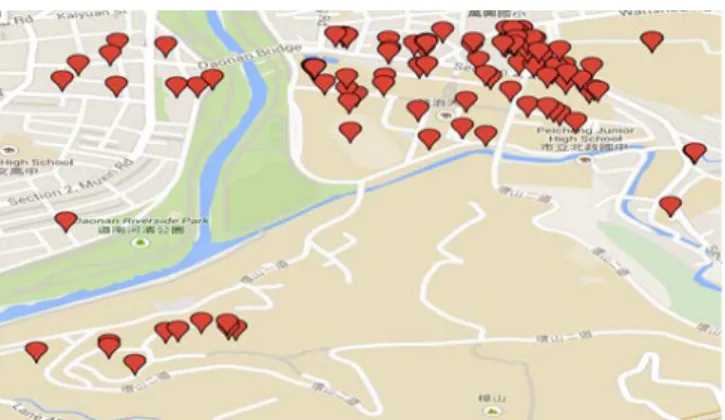
We filter out movement data that are not on the campus, and also import the collected position data of 115 participants to a map, as shown in Figure 6.
Figure 6: NCCU campus environment
In our movement model, we use GPS to collect the trace data. GPS requires a strong signal in order to be accurate. Accurate GPS signals may not be received inside most buildings. In other words, the interval between two available GPS data may be more than 10 minutes (which is our measurement interval). This may mean the device is not moving (stays inside the building) during the period, or, it really moves but the GPS data is just lost. To this end, we make up the missing data by assuming that the device was moving at the same speed between the two positions during the period. Take figure 7 for example, in the range R, we consider the student S at the same location. When the time interval that student S goes to location Li+1 from location Li is
more than 10 minutes, the virtual path will be added to the shortest path. At time t1, t2 and t3, the dashed line indicates the real route of the student S. Our APP does not record the movement completely, and we only record student S at position Li+1 at time t4.
Finally, we use the following equation to calculate the interval and the average distance.
Figure 7: Movement Model
The following performance metrics are used in the simulation:
1) Delivery Success Ratio: the ratio of the number of successfully delivered to the interested destinations to the total number of potentially interested destinations.
2) Delivery Overhead: the average number of relays used for one successflly delivered to the interested destination.
3) Delivery Delay: the average delay for all succesfully delivered interested destinations.
Simulation results show the performance of various routing methods in different mobility models. We compared our proposed interest-based message dissemination method with Epidemic, PRoPHET, and Spray and Wait routing methods.
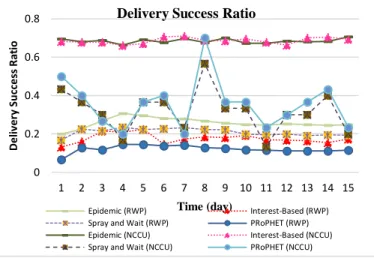
In Figure 8, we can see the delivery success ratio of all the routing methods in random waypoint mobility model presented a stable curve each day. In the features of this mobility model, Epidemic has the best delivery success ratio out of the other three routing methods. This is due to the fact that Epidemic routing method would forward messages to every student that is encountered. The method does not consider the cost of sending out how many copies of messages, thus most of the students will possibly have the same message.
The PRoPHET routing method uses previous contact of nodes to calculate who has the higher probability to be in contact with other students. Even if the student has a higher probability of encountering the destination, it is difficult to guarantee that encountering the destinations and then forwarding message in the random waypoint mobility model can simultaneously occur. In this mobility model, it cannot be justified that the probability of encountering is able to model the chance of meeting the destination nodes. The performance of delivery success ratio of our method lies between PRoPHET and Epidemic.
However, the delivery success ratio is not close to the real situation, the delivery success ratio of all routing methods cannot show a stable curve. We can see that all routing methods have a higher delivery success ratio in our NCCU Trace Data than that of the random waypoint mobility model. This may be due to the reason that our mobility model is based on the students’ class schedule or their extracurricular activities, and students’ movement may be connected to their social relations, not solely random movement. Especially on the 4th day and the 11th day, we can clearly see that the curve obviously declined in the Spray and Wait routing method and PRoPHET routing method. Being the 4th day and 11th day fell
on a Saturday, most of the students don’t go to campus during weekends. This leads to the result that fewer students meet other students on campus,
making it a difficult thing to find a student to forward or deliver messages. Furthermore, Spray and Wait routing method controls the number of copies of messages. In the wait phase, student may have never contacted with any destination node before the message’s time to live limit have exceeded. PRoPHET routing method is based on the students’ movement situation to compute the probability of which student having a higher chance of encountering more destinations. When fewer students walk on campus, it is difficult to find the appropriate relay students to forward messages, and the messages hits their time to live limit, similar to the result of Spray and Wait routing method.
It can be observed from the results that mobility model does affect the performance for all routing methods.
Figure 8: Delivery Success Ratio
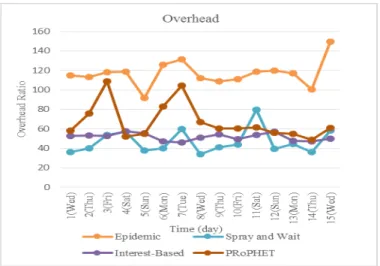
In figure 9, we can see the overhead of all routing methods is lower in the random waypoint mobility model than that in our NCCU Trace Data. Because the random waypoint mobility model is not movement-focused, most of the routing methods are unable to find the right person to forward the message. On the other hand, the students are frequently contacted with each other according to their social relations in the real environment, while exchanging messages that users are more likely to be interested in. Using our NCCU Trace Data, we can see that students who frequently forward messages have a relatively high overhead. It can be noticed that our interest-based message dissemination protocol reduced the message delivery overhead in our NCCU Trace Data, and outperforms the random waypoint mobility model. Since our method is to determine
0 0.2 0.4 0.6 0.8 1 2 3 4 5 6 7 8 9 10 11 12 13 14 15 Del iver y Su cc es s R at io Time (day)
Delivery Success Ratio
Epidemic (RWP) Interest-Based (RWP)
Spray and Wait (RWP) PRoPHET (RWP)
Epidemic (NCCU) Interest-Based (NCCU)
whether student is interested in the message, it can reduce any unnecessary forwarding of messages.
Figure 9: Overhead
In figure 10, we can see the delivery delay of all routing methods is higher in the random waypoint mobility model than that in our NCCU Trace Data. The main reason is the students' movement is towards randomly chosen direction, it is possibly difficult to meet any potential destinations. It takes a long period of time for the destinations to receive the message. In our NCCU Trace data is real human behavior model. Students tend to make friends who are similar to the other, so they may have the same interest. Friends with similar interest may be frequently to get along. Besides the message delivery with similar interest will increase the success ratio and decrease the Delay time. The 4th day which is
Saturday results in long delay time and low delivery ratio. This is because students do not go to school on Saturday. The simulation results show that our NCCU Trace Data is close to the real students’ movement situation with social relations.
Figure 10: Delivery Delay
2. Novel Scheme for the Distribution of Flyers using a Real Movement Model for DTNs, 發
表 於 The 4th International Conference on
Frontier Computing, Thailand, Sep, 2015.
2.1 Abstract
In delay tolerant networks (DTNs), simulations used to verify the performance of a routing algorithm usually employ a mobility model, either trace or synthetic. Trace models record the actual movement of individuals in the real world; however, obtaining data can be difficult. Synthetic models use mathematical modelling, which eliminates the need to obtain data from participants; however, this means that the results are not necessarily representative of the actual movement of individuals. We developed a method for the distribution of flyers only to individuals who express an interest in the content of that particular message who can then forward the flyers to others. Simulation results demonstrate that the proposed method is able to enhance the successful delivery ratio while reducing delivery overhead and thereby improve the dissemination of data on campus.
2.2 Main Results
Every day, numerous flyers are published and distributed to students on campus. Unfortunately, many students are annoyed by flyers that do not interest them. Thus, we developed a novel scheme for the distribution of flyers based on the personal interests of students.
In the proposed scheme, there are two situations in which students forward flyers to other students: 1. Direct Contact Distribution
When student SA, who has a flyer about a sporting
event, meets student SB, they first exchange
hobby-related information. If student SB is interested in
sports, then SA delivers the flyer to SB.
2. InDirect Contact Distribution
In some cases, student SA tries to send a flyer to
student SB; however, SB has no interest in sports.
Nonetheless, SB may is linked to student SC who is
interested in sports. In such cases, student SA is able
to deliver the flyer to Student SC via Student SB.
To determine whether a student is interested in a particular type of flyer, we employed m-dimensional cosine similarity for the calculation of
0 50 100 150 200 1 2 3 4 5 6 7 8 9 10 11 12 13 14 15 O v er h e a d R a ti o Time (day) Overhead Epidemic (RWP) Interest-Based (RWP)
Spray and Wait (RWP) PRoPHET (RWP) Epidemic (NCCU) Interest-Based (NCCU) Spray and Wait (NCCU) PRoPHET (NCCU)
0 5000 10000 15000 20000 1 2 3 4 5 6 7 8 9 10 11 12 13 14 15 D e la y ( sec ) Time (day) Delay Epidemic (RWP) Interest-Based (RWP)
Spray and Wait (RWP) PRoPHET (RWP)
Epidemic (NCCU) Interest-Based (NCCU)
attribute similarity between students and flyers. When student come into contact with other students, they exchange interest-related data and store it within a matrix. In this study, we used questionnaires to collect information related to the interests of 115 volunteers, which was then imported into a simulation program for the calculation of similarity between personal interests and flyers.
Interests are divided into community (I1),
academics (I2), athletics (I3), arts (I4), and social
activities (I5) as well as into five preference levels:
strongly like, like, neutral, dislike, strongly dislike. For example, student SA likes community, strongly
likes academics, strongly dislikes athletics, dislikes arts, and likes social activities. These are represented using the following values: 0.75, 1, 0, 0.25, and 1, and are then shared with contacts.
When, student SA, who has k number of flyers
to distribute, meets student SB, m-dimensional cosine
similarity is used to calculate the similarity of attributes between the personal interests expressed by student SB and the flyers that student is holding
FK, as follows:
(1) The resulting similarity ranges from 0 to 1. A result of 0 indicates that the individual is not interested in flyer FK. A result of 1 indicates that the
individual is very interested in the flyer. Intermediate values indicate moderate levels of interest. The calculation of similarity enables the distribution of the flyer FK only to students who are genuinely
interested in it.
This algorithm is outlined in the following: Algorithm Used in Flyer Distribute Scheme Input: Simulation_Finished_Time SFT , x-th
Students’ Interest attribute Sx(I), k-th
Flyer attribute Fk(I)
Output: Distribute Flyer
Meta_Data: {list of Student Sx’s contacts
Sx_meetlist, Flyers’ index Fk }
Interest threshold = 0.75 1: 2: 3: 4: 5: While(SFT !=System_current_time){ If (Connect_Student SB) Exchange_Meta_Data(); Compute Cos(SB(I), Fk(I));
6: 7: 8: 9: 10: 11: 12: 13: 14: 15: 16: 17: 18: 19: 20: 21: 22: 23: 24: 25:
If (Cos(SB(I), Fk(I)) > Interest
threshold)
Delivery one copy to SB // Direct Contact Spread EndIf Else For(int x =0 ; x < x_meetlist.size(); x++)
Compute Cos(Sx(I), Fk(I));
If (Cos(Sx(I),
Fk(I)) > Interest threshold)
Forwarding one copy to Student SB // InDirect Contact Spread EndIf EndFor Increase(current_time); EndIf EndWhile
The original version of the Epidemic, Spray and Wait and PRoPHET routing schemes include only a single destination. Thus, to ensure a fair comparison, we modified the flyer to enable delivery to multiple destinations in a DTN.
As shown in Fig. 11, the performance of the proposed scheme is similar to that of the Epidemic routing scheme and clearly outperformed Spray and Wait and PRoPHET with regard to delivery success ratio. Our objective was to eliminate instances of scanning by limiting delivery only to students with an expressed interest in the content of the messages. Thus, unlike Epidemic routing, which floods every student that it meets with flyers, the proposed scheme enables the selection of students to whom specific flyers should be directed, thereby decreasing network overhead. In addition, the performance of the Spray and Wait and PRoPHET routing schemes dropped noticeably on Saturdays, because the stored movement patterns do not match the actual movement of students on weekends. On weekends, few students encounter one another on campus, which makes it difficult to deliver or forward flyers. The Spray and Wait routing scheme limits the number of flyer copies that can be forwarded and fails to take into account the specific attributes of the flyers. Thus, in the spray phase, the flyers are
forwarded indiscriminately and in the wait phase, flyers cannot be delivered. Eventually, the lifespan of the flyer is exceeded, and which point it is dropped. The PRoPHET routing scheme uses previous contact with students to identify individuals with the highest probability of reaching the contact destination. As with the Spray and Wait approach, when there are few students on campus, many of the flyers are dropped before they can be delivered.
Figure 11: Delivery Success Ratio
As shown in Fig. 12, the Spray and Wait routing scheme resulted in the lowest overhead ratio because this method limits the number of copies that can be made of each flyer, such that copies are not always forwarded to all of the students who are contacted. Compare this to the Epidemic routing scheme in which an unlimited number of copies of each flyer can be made. In Epidemic routing scheme, students replicate flyers and forward them to all students with whom they are in contact (including all new contacts), except those who already have a copy. This approach increases the number of relays and subsequently in delivery overhead.
The PRoPHET routing scheme forwards flyers in accordance with the movement of students, which results in heavy delivery overhead on school days, as shown in Fig. 3. The proposed scheme distributes flyers only to students with an expressed interest in the topic of the flyer, thereby reducing the number of unnecessary relays and decreasing delivery overhead. The proposed method reduces delivery overhead to a level far below that of Epidemic and PRoPHET routing schemes
Figure 12: Overhead
As shown in Fig. 13, all of the routing schemes have similar performance with regard to delivery delay. Particularly on Saturdays, all of the routing schemes are prone to serious delivery delays of approximately 13,000 s, due to a lack of students on campus.
The above simulation results demonstrate that the proposed NCCU Trace data can improve the performance of routing schemes on DTNs by taking into account the movement of potential targets. The efficacy of this approach was verified through a comparison with four existing routing schemes, which have particularly poor performance on weekends when students are not on campus. Our simulation results clearly demonstrate the superior performance of the proposed scheme with regard to delivery success ratio and reducing delivery overhead.
Figure 13: Delivery Delay
三、計畫成果自評
目前許多學者研究在 DTN 網路環境下訊息 散播的路由演算法中,影響路由演算法其中最重
要的移動模型多採用以數學合成計算出的移動模 型當作主要模擬依據。而有別以往的研究,本計 畫主要研究貢獻在於,提供真實的校園學生移動 資料製作成的移動模型,來做為模擬的移動模型, 而 這 項 重 要 的 研究 成果 , 已 發 表今 年 十 月在 IEEE Communication Magazine,現已出刊,可 見這部份的研究成果受到國際學者的肯定,並且 也將校園真實的移動模型放置網路上供人學者研 究使用及模擬評估各自的路由演算法效能。 另外重要的研究議題之一,是依”人對訊息” 感興趣為主的路由演算法設計,有別已往在 DTN 網路環境下,是採用”人對人”為主的路由演算法, 本研究認為,訊息的散播因以人對訊息內容為主 要判別依據,才不會導致訊息濫發。而這樣的設 計貼近真實生活中,每個人對於收到傳單的反應, 而興趣屬性的資料收集,本研究採用問卷並且搭 配社群平台來收集,這些興趣屬性資料都是真實, 並非電腦隨機產生的資料,貼近日常生活中情境, 這部份的研究成果也已經發表於國際會議,顯示 本研究的成果是受到國際的支持與肯定。 後續,本研究將結合實體與虛擬相遇的訊息 傳遞、散播方法,本研究認為常在地理位置上遇 到的節點,也許並非為關係密切的好友,但仍有 可能會是一個不錯協助訊息傳遞轉送的熱門節點。 而在網路上常相遇到的朋友,可能關係相當密切, 是ㄧ個協助轉送及散播的節點,而若是結合實體 與虛擬相遇的訊息傳遞、散播方法,將有機會能 有更好的傳遞及散播率,並且傳遞的成本會相較 以往經典路由方法來得低,也有可能有較少的訊 息傳遞延遲,後續仍有許多研究議題值得向下深 入探討,未來將把彙整的真實社群資料提供給學 者做研究使用,就有助於發現或是建置虛實整合 系統研究,給予後續研究學者有不錯的參考價值。
科技部補助專題研究計畫出席國際學術會議心得報告
日期: 104 年 09 月 16 日
一、 參加會議經過
今年投稿 The 4th International Conference on Frontier Computing 於泰國曼谷舉辦的研討會,paper 經審查接受後,於本年 9 月 8 日出發,在會議結束之後,參觀附近的名勝,於 9 月 12 號回國。參與 會議過程大致如下條列所敘述: 1. 9/8 啟程抵達泰國曼谷,並先行到會議地點的飯店,以防止隔天一早會議迷路。 2. 9/9 註冊,並且觀摩其他學者報告的狀況,並且準備隔天一早的報告。 3. 9/10-11 本人於 9 月 10 日上午 8:00~9:00 的場次發表論文,報告結束後,聽取其他有興趣的場次 研究成果,了解其他學者的研究概況。中午參與午宴和與會的學者交流、討論。 4. 9/11 晚上參觀會議地點附近的名勝。 5. 9/12 回程抵達台灣。 在會議進行中,每位演講者有 10 分鐘可以報告自己的研究,2 分鐘左右的時間為 QA 時間,整 體報告時間掌握得很好,而在 QA 時間,學者給予建議,對於我們團隊的研究給予肯定外,希望我 們團隊的研究能在更進一步的探討,後續能夠投稿至期刊。且模擬比較的方法,可以比較各個移動 模型的效能,突顯本研究團隊提出移動模型的貢獻。會後,也與其他學者交換聯絡方式,對後續的 研究能有更深入的探討。
二、 與會心得
本次在泰國曼谷的聖塔拉世貿中心大飯店 舉辦 The 4th International Conference on Frontier Computing,此次參與國際會議收穫良多,亦有許多學者給予寶貴建議,提供本人後續研究需要多加 注意的地方。
此次研討會聽到不少 Social Networking 的議題,例如:有學者透過現有的社群平台(如:Facebook、 Twitter 等)截取使用者使用社群平台的習性,用以評估學習的成效,並且分成兩個群組來對照其學習 效能。本人認為這樣的方式很具有學術且實務上的價值,透過使用者行為分析來增加使用者學習成
計畫編號
MOST 103-222-1-E-004-013
計畫名稱
(中文)結合社群平台之耐延遲網路,其散播興趣資訊的方法(英文) An Interest-Message Dissemination Approach in Social-platform combined Delay Tolerant Networks
出國人員
姓名
詹賀翔服務機構
及職稱
政治大學資訊科學系 博士班會議時間
104 年 09 月 09 日至 104 年 09 月 11 日會議地點
Bangkok, Thailand
會議名稱
The 4th International Conference on Frontier Computing發表題目
Novel Scheme for the Distribution of Flyers using a Real Movement Model for DTNs 附件五效。 另外,此次會議中,有學者報告利用智慧型行動裝置來做室內定位的方法,室內一直都是一個 很重要的議題,但其中有許多複雜的硬體或是訊號干擾的問題,以至於無法精確定位到每一個使用 者在各個樓層的位置。如果能像學者所報告的可以定位的很精確,那就可以延伸出很多新興的應用 服務,例如:年幼的小朋友在飯店活動,而若是小朋友迷路或是走失時,可藉由智慧型行動裝置來做 室內定位,我們可以精確知道每個人所在位置及樓層,不擔心走失問題。
在空檔休息時間時,有幸認識目前在日本 The University of Aizu 任職的 Neil 教授,Neil 教授未 來希望能往物聯網(Internet Of Things)方面研究,而本人也有興趣了解目前 Neil 教授所做的研究成 果,彼此互相留下聯絡資訊,期望下次能促成台日雙方的學術研究合作,彼此互相學習。
圖一:參與會議
圖二:報告進行中
圖三:報告進行中
三、 發表論文全文或摘要
Abstract-In delay tolerant networks (DTNs), simulations used to verify the performance of a routing
algorithm usually employ a mobility model, either trace or synthetic. Trace models record the actual movement of individuals in the real world; however, obtaining data can be difficult. Synthetic models use mathematical modelling, which eliminates the need to obtain data from participants; however, this means that the results are not necessarily representative of the actual movement of individuals. This study collected information related to the movement of university students using a specially designed APP featuring location aware and behavior aware functionality. This APP tracks the movement of students in a campus environment and then exports the data for simulation. We also developed a method for the distribution of flyers only to individuals who express an interest in the content of that particular message who can then forward the flyers to others. Simulation results demonstrate that the proposed method is able to enhance the successful delivery ratio while reducing delivery overhead and thereby improve the dissemination of data on campus.
四、 建議
由衷地感謝科技部提供差旅費,能夠出國參與國際會議認識其他國家的學者,彼此交流各自學 術近況,開拓自我的視野,有助於提升研究品質。建議能多補助經費並且多鼓勵國內學者參與國際 研討會,促進國內學者與國際學者學術交流、合作。建議國內也能主辦相關國際會議,廣邀國際人 士來參與,一方面可增進國內學者學術交流的機會,提升台灣在國際學術研究的能見度。另一方面 亦可以帶動相關會議地點的觀光機會。五、攜回資料名稱及內容
此次大會提供最重要的資料內容包括會議議程、講題內容、場次、時間和隨身碟,隨身碟內容 為參與此次研討會所發表的論文內容等,大會所提供的相關資訊,對於從事相關研究的學者有很 大的幫助,可以了解目前及未來的研究趨勢走向,並且增加此次參與會議學術視野。 3科技部補助計畫衍生研發成果推廣資料表
日期:2016/01/30科技部補助計畫
計畫名稱: 結合社群平台之耐延遲網路,其散播興趣資訊的方法 計畫主持人: 蔡子傑 計畫編號: 103-2221-E-004-013- 學門領域: 計算機網路與網際網路無研發成果推廣資料
103年度專題研究計畫研究成果彙整表
計畫主持人:蔡子傑 計畫編號: 103-2221-E-004-013-計畫名稱:結合社群平台之耐延遲網路,其散播興趣資訊的方法 成果項目 量化 單位 備註(質化說明 :如數個計畫共 同成果、成果列 為該期刊之封面 故事...等) 實際已達成 數(被接受 或已發表) 預期總達成 數(含實際 已達成數) 本計畫實 際貢獻百 分比 國內 論文著作 期刊論文 0 0 100% 篇 研究報告/技術報告 1 1 100% 研討會論文 0 0 100% 專書 0 0 100% 章/本 專利 申請中件數 0 0 100% 件 已獲得件數 0 0 100% 技術移轉 件數 0 0 100% 件 權利金 0 0 100% 千元 參與計畫人力 (本國籍) 碩士生 2 2 100% 人次 博士生 1 1 100% 博士後研究員 0 0 100% 專任助理 0 0 100% 國外 論文著作 期刊論文 1 1 100% 篇 研究報告/技術報告 0 0 100% 研討會論文 1 1 100% 專書 0 0 100% 章/本 專利 申請中件數 0 0 100% 件 已獲得件數 0 0 100% 技術移轉 件數 0 0 100% 件 權利金 0 0 100% 千元 參與計畫人力 (外國籍) 碩士生 0 0 100% 人次 博士生 0 0 100% 博士後研究員 0 0 100% 專任助理 0 0 100% 其他成果 (無法以量化表達之 成果如辦理學術活動 、獲得獎項、重要國 際合作、研究成果國 際影響力及其他協助 產業技術發展之具體 效益事項等,請以文 字敘述填列。)計畫的很重要的成果之一就是,我們發表的NCCU Trace被IEEE Communications Magazine所接受,這個期刊是在網路通訊領域中歷史非常悠久且很重要的期刊 之一,閱讀者眾且Impact factor很高。刊登一個多月後,就有很幾個國際學者 來信詢問,如何採用我們所發表的Trace File,可見其對國際影響力是不容小 覷的。因為DTN的效能重要的關鍵就是行動裝置的相遇,而其移動性模型就很關 鍵了。因此我們的NCCU Trace File就是很真實的資料檔,對這個領域的貢獻度 是相當大的,可以讓所研究的演算法作最擬真的驗證。
成果項目 量化 名稱或內容性質簡述 科 教 處 計 畫 加 填 項 目 測驗工具(含質性與量性) 0 課程/模組 0 電腦及網路系統或工具 0 教材 0 舉辦之活動/競賽 0 研討會/工作坊 0 電子報、網站 0 計畫成果推廣之參與(閱聽)人數 0