Multistep Microwave-Assisted Divergent
Synthesis of Indolo-Fused Pyrazino-/
Diazepinoquinoxalinones on PEG Support
Jin-Ji Lai, Deepak B. Salunke, and Chung-Ming Sun*
Laboratory of Combinatorial Drug DiscoVery, Department of Applied Chemistry, National Chiao Tung UniVersity, Hsinchu, 300-10, Taiwan
[email protected] Received February 21, 2010
ABSTRACT
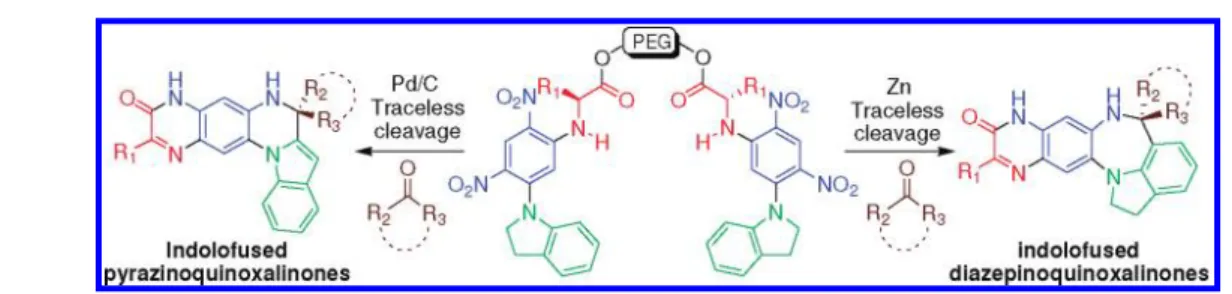
Synthesis of amino acid and indoline-substituted dinitrobenzene on a soluble polymer support (PEG) and its further reductive double-ring closure to afford structurally diverse indolo-fused pyrazino-/diazepinoquinoxalinones is described. Traceless synthesis of quinoxalinones coupled with application of the Pictet-Spengler-type condensation reaction furnished these novel scaffolds. These hitherto novel heterocycles are synthesized in shorter times under microwave irradiation conditions in comparison with that of classical reaction conditions.
The CAS registry database consists of more than 24 million organic chemical substances; however, half of these mol-ecules can be described by just 143 shapes.1This scenario demands the clear need of new scaffold design from the virtual chemical space to explore newer dimensions in drug discovery process. Fused heterocyclic ring systems are often considered as important privileged structures to identify the novel leads in drug discovery.2To speed up this discovery process and maintain the balance between new chemical entity syntheses and screening, several new techniques such as parallel or combinatorial synthesis3and multicomponent reactions4have been developed. Still, there is a need for new tools to provide a fast and more efficient way to synthesize novel chemical compounds.
In our view, by reducing in-pot reaction time and reloading time (Figure 1), a multistep synthetic process on a polymer support can become a powerful tool to provide numerous
(1) Lipkus, A. H.; Yuan, Q.; Lucas, K. A.; Funk, S. A.; Bartelt, W. F., III; Schenck, R. J.; Trippe, A. J. J. Org. Chem. 2008, 73, 4443–4451.
(2) Horton, D. A.; Bourne, G. T.; Smythe, M. L. Chem. ReV. 2003, 103, 893–930.
(3) Lawrence, R. N. Drug DiscoV. Today 2000, 5, 172–175.
Figure 1. In-pot and reloading reaction time.
ORGANIC
LETTERS
2010
Vol. 12, No. 10
2174-2177
10.1021/ol100436r 2010 American Chemical Society
compounds in a short time. Furthermore, a diversity-oriented synthesis5of newly designed scaffolds using this technique may provide suitable compound libraries with additional complexity in the structures. This paper describes the first diversity-oriented traceless synthesis of new indolo-fused pyrazino- and diazepi-noquinoxalinone libraries using such a multidisciplinary syn-ergistic approach. No hits were found in Chemical Abstracts with more than 80% similarity to the newly designed scaffolds. Incorporation of tetrahedral carbon atoms in present ring systems was intended to disrupt the typical one-dimensional planarity of aromatic skeletons.6 This may create multidimensional
concave and convex surfaces in the molecule and can make these skeletons privileged structures to design high affinity ligands for future drug discovery.
These scaffolds incorporate the structural features of many pharmacologically important heterocycles such as pyrazinone, quinoxalinone, diazepine, diazepinoquinoxaline, N-fused indole, pyrazinoquinoxaline, and diazepino-/pyrazinoindole.7The closely
related molecules demonstrated high affinity for benzodiazepine receptors,8whereas Glamkowski observed potential antidepres-sant, analgesic, as well as anti-inflammatory effects in in-dolobenzodiazepine-related structures.9
A synthetic route to the targeted indolo-fused pyrazino-or diazepinoquinoxalines is described in Schemes 1 and
2. The strategy involved synthesis of amino acid and indoline-substituted dinitrobenzene 4 on a poly(ethylene
glycol) (PEG, mol wt≈ 6000) support using 1,5-difluoro-2,4-dinitrobenzene (DFDNB) and its further reductive double-ring closure to structurally diverse skeletons in a divergent fashion. DFDNB is preferred to construct the designed skeletons because of its easy accessibility for two directional elongations via utilization of two fluoro groups which could be successively substituted by different nucleophiles. This symmetric scaffold has been utilized for the construction of various bioactive-fused heterocycles.10Previously, we dem-onstrated the use of this bifunctional cross-linker for the synthesis of imidazoquinoxalinones on PEG support.11The present multistep process was executed using both classical as well as microwave irradiation conditions.12
Esterification of the commercially available Fmoc-protected amino acids with PEG in the presence of catalytic p-toluenesulfonic acid (PTSA) in CH2Cl2under microwave
irradiation (100 °C for 10 min) furnished Fmoc-protected amino ester conjugates 1 (Scheme 1). Using this recipe and following the conventional protocol reaction took several hours for complete conversion. Similarly, a microwave-mediated esterification reaction using DCC and catalytic
(4) Zhu, J.; Bienayme, H., Ed. Multicomponent reactions; Wiley-VCH Verlag GmbH & Co. KGaA: Weinheim, Germany, 2005; 468 pp.
(5) Schreiber, S. L. Science 2000, 87, 1964–1969.
(6) Lovering, F.; Bikker, J.; Humblet, C. J. Med. Chem. 2009, 52, 6752– 6756.
Scheme 1.Synthesis of Amino Acid and Indoline-Substituted Dinitrobenzene on a PEG Support
Scheme 2.Reductive Double-Ring-Closure Reactions
DMAP in CH2Cl2in an open vessel system11,13required 15
min of irradiation at a 150 W power output, whereas the coupling reaction at room temperature14took 48 h for the complete disappearance of the starting materials.
To monitor the progression of the reaction, a small portion of the reaction mixture was pulled out, the compound was precipitated and washed with cold ether and dried, and the proton NMR spectrum was recorded. Upon completion of the reaction, the polymer-bound compound mixtures were purified using a similar protocol, by precipitation and washing with cold ether to remove excess reagents and dried under vacuum. The crude product obtained was used as is for reloading of next reaction mixtures. As we observed, use of this PEG supported protocol drastically reduced the reloading time.
In the next step, the amino functionality in compound 1 was unmasked using 10% piperidine in CH2Cl2 at room
temperature. The desired Fmoc deptotection using micro-waves was achieved within 90 s (40°C) leaving the polymer support intact.15 The regenerated polymer bound amine 2 was then reacted with DFDNB in refluxing CH2Cl2 in the
presence of Et3N for 6 h to give polymer-bound
dinitrofluoro-substituted aniline compounds 3, ready for second ipso-fluoro displacement. Because of probable low reactivity of the immobilized aminoester-linked fluorodinitrobenzene 3, no further double displacement was observed during this reac-tion.
Our several efforts for the second aromatic substitution on compound 3 by indoline using refluxing CH2Cl2resulted
in an incomplete reaction (monitored by1H NMR), whereas
in refluxing acetonitrile the reaction took 8 h for complete conversion. It is noteworthy to mention that the microwave-mediated acceleration in both ipso-fluoro displacement reactions was also observed. The first aromatic displacement using polymer-bound aminoester 2 was achieved in 8 min, whereas the indoline substitution took 20 min for the complete conversion in a microwave cavity. During all these transformations, no yield loss was observed, suggesting the presence of intact polymer support. Reaction progress and stepwise transformations on a polymer support were cleanly observed in proton NMR spectra.16
From this point onward, the process is diversified to accomplish reductive cyclizations to furnish aminoquinox-alinones 5/6 with indole and indoline substitutions, respec-tively (Scheme 2). Exposure of 4 to the catalytic transfer hydrogenation conditions using palladium and ammonium formate in refluxing methanol for 8 h or under microwave irradiation (20 min, 180°C) furnished indolylquinoxalinone
5 in a traceless fashion. Four transformations, (i) reduction
of two nitro functionalities, (ii) amide formation leading to cyclative cleavage from the polymer support, (iii) oxidation of newly generated dihydroquinoxalinone to quinoxalinone, as well as (iv) oxidation of indoline to indole were observed during this reaction. It should be mentioned that under these conditions no additional oxidants17 or further air oxidation
step18is required for the transformation of dihydroquinox-alinone to quinoxdihydroquinox-alinone.
The expected indolinylquinoxalinone 6 was obtained from the same intermediate 4 with the conventional protocol using Zn and ammonium formate in methanol at room temperature. This controlled reaction condition prevented the additional oxidation of indoline to indole which was observed during the earlier palladium-catalyzed transformation. The complete cyclative cleavage during this reaction was monitored by recording the proton NMR and IR spectrum of the recovered polymer support. The upfield shift of the R-methylene protons from δ 4.3 to 3.6 as well as disappearance of any carbonyl stretching frequency confirmed the absolute trace-less transformation. The polymer-free compounds 5 and 6 were obtained in excellent yields. The proton NMR monitor-ing toward the formation of 5a and 6a from the key intermediate 4a on a PEG support is shown in Figure 2. Six
distinct sets of aromatic protons (Ha-f, as observed in 4a)
and two sets of methylene protons (Hgand Hh) were observed
(7) (a) Li, X.; Yang, K.; Li, W.; Xu, W. Drugs Future 2006, 31, 979– 989. (b) Gupta, L.; Talwar, A.; Chauhan, P. M. S. Curr. Med. Chem. 2007,
14, 1789–1803. (c) Ramajayam, R.; Giridhar, R.; Yadav, M. R. Mini ReV. Med. Chem. 2007, 7, 793–812. (d) Dunlop, J.; Marquis, K. L.; Lim, H. K.;
Leung, L.; Kao, J.; Cheesman, C.; Rosenzweig-Lipson, S. CNS Drug ReV.
2006, 12, 167–177.
(8) Dodd, R. H.; Ouannes, C.; Potier, M. C.; de Carvalho, L. P.; Rossier, J.; Potier, P. J. Med. Chem. 1987, 30, 1248–1254.
(9) Glamkowski, E. J.; Fortunato, J. M.; Ong, H. H.; Allen, R. C.; Wilker, J. C.; Geyer, H. M., III. J. Med. Chem. 1984, 27, 81–83.
(10) (a) Yuan, Y.; Liu, G.; Li, L.; Wang, Z.; Wang, L. J. Comb. Chem.
2007, 9, 158–170. (b) Zhang, L.; Liu, G.; Zhang, S. D.; Yang, H. Z.; Li,
L.; Wu, X. H.; Yu, J.; Kou, B. B.; Xu, S.; Li, J.; Sun, G. C.; Ji, Y. F.; Cheng, G. F. J. Comb. Chem. 2004, 6, 431–436.
(11) Lin, M. J.; Sun, C. M J. Comb. Chem 2006, 8, 455–458.
(12) All the microwave-assisted polymer-supported reactions were performed in a CEM Discover Microwave in closed vessel system.
(13) Lin, M. J.; Sun, C. M. Tetrahedron Lett. 2003, 44, 8739–8742. (14) Chen, C. H.; Chang, C. M.; Chen, H. Y.; Lai, J. J.; Sun, C. M.
J. Comb. Chem. 2007, 9, 618–626.
(15) We reported microwave-mediated Fmoc deprotection under open vessel conditions: Wu, C. Y.; Sun, C. M. Synlett 2002, 1709–1711.
(16) The stepwise1H NMR monitoring toward the formation of key
intermediates 4 on a PEG support is included in the Supporting Information.
(17) Aoki, K.; Obata, T.; Yamazaki, Y.; Mori, Y.; Hirokawa, H.; Koseki, J.; Hattori, T.; Niitsu, K.; Takeda, S.; Aburada, M.; Miyamoto, K. Chem.
Pharm. Bull. 2007, 55, 255–267.
(18) Krchn`a´k, V.; Szabo, L.; Va´gner, J. Tetrahedron Lett. 2000, 41, 2835–2838.
Figure 2.Proton NMR monitoring toward the formation of 5a and 6a from key intermediate 4a.
for 6a, whereas the disappearance of these methylene protons confirmed the additional palladium-mediated oxidation19in compound 5a.
Recently, while working on very similar substrates, Soural et al.20observed an interesting resistance of the nitro group
toward various reducing agents attributed to the presence of ortho, para electron-donating amino substitutions in the ring causing a double-resonance effect. In our hands, using Pd/C or Zn and ammonium formate in methanol, no such resistance was observed during this reductive cyclization.
The final step was to accomplish the second heterocy-clization. Compound 5 on treatment with several ketones in the presence of TFA in refluxing CHCl3 (8 h) or in a
microwave cavity (20 min, 150 °C) furnished the desired novel indolo-fused pyrazinoquinoxalinone 7, whereas with a similar recipe, compound 6 yielded an indolo-fused diazepinoquinoxalinone 8 scaffold. During this Pictet-Spengler-type condensation, 6 underwent an electrophilic cyclization with ketones at the phenyl ring,9,21 while compound 5 cyclized onto its electron-rich pyrrole ring22to furnish the required heterocycles in good to excellent yields (80-92%, Table 1). Lower yields with pentan-3-one (63-67%; Table 1, entries 7c and 8c) were attributed to the additional steric hindrance, whereas an expected poor yield with acetophenone (45%, entry 8g) confirmed the modest reactivity of aromatic ketones toward the formation of iminium intermediate with anilinic amines. An interesting spirocyclic ring skeleton was also added to these novel scaffolds using cyclic ketones such as cyclopentane and cyclohexane.
In conclusion, two novel heterocyclic library scaffolds consisting of indole-fused pyrazino- and diazepinoquinox-alinone skeletons with a two-point diversity were synthesized in good to excellent yields. Our envisioned strategy to utilize variable electron densities of indole and indoline rings of compound 5 or 6 during the Pictet-Spengler-type cyclization to furnish six-membered pyrazino or seven-membered di-azepino rings was the key feature behind the success of this diversified process. The total in-pot reaction time for the synthesis of these newly designed molecules was drastically reduced to ∼1.5 h under microwave irradiation conditions in comparison with that of the classical reaction conditions (total in-pot reaction time ∼60 h).
Acknowledgment. We thank the National Science Council
of Taiwan for financial assistance.
Supporting Information Available: Experimental
pro-cedures, characterization data for all new compounds, stepwise proton NMR monitoring toward the formation of key intermediate 4a on a PEG support, and copies of 1H
and13C NMR spectra for polymer free substrates 5 and 6
and products 7 and 8. This material is available free of charge via the Internet at http://pubs.acs.org.
OL100436R
(19) Beller, M.; Breindl, C.; Riermeier, T. H.; Tillack, A J. Org. Chem.
2001, 66, 1403–1412.
(20) Krupkova, S.; Soural, M.; Hlavac, J.; Hradil, P. J. Comb. Chem.
2009, 11, 951–955.
(21) Zhang, L. H.; Meier, W.; Wats, E.; Costello, T. D.; Ma, P.; Ensinger, C. L.; Rodgers, J. M.; Jacobson, I. C.; Rajagopalan, P. Tetrahedron Lett.
1995, 36, 8387–8390.
(22) Zheng, L.; Xiang, J.; Dang, Q.; Guo, S.; Bai, X. J. Comb. Chem.
2005, 7, 813–815.
Table 1. Indolo-Fused Pyrazino-/Diazepinoquinoxalinones (7/8)a
aOnly the representative examples are shown in Table 1. A library of
total 30 compounds is included in the Supporting Information.bYields were
determined on weight of purified samples.