
應用於WCDMA/WLAN異質網路之乏晰邏輯允諾控制
112
0
0
全文
(2) 應用於 WCDMA/WLAN 異質網路之 乏晰邏輯允諾控制 Call Admission Control for WCDMA/WLAN Heterogeneous Networks Using Fuzzy Logic Theorem 研究生:陳詠翰. Student: Yung-Han Chen. 指導教授:張仲儒 博士. Advisor: Dr. Chung-Ju Chang. 國立交通大學 電信工程學系 博士論文 A Dissertation Submitted to Department of Communication Engineering College of Electrical and Computer Engineering National Chiao Tung University in Partial Fulfillment of the Requirements for the Degree of Doctor of Philosophy in Communication Engineering Hsinchu, Taiwan 2007 年 7 月.
(3) 應用於 WCDMA/WLAN 異質網路之 乏晰邏輯允諾控制 研究生:陳詠翰. 指導教授:張仲儒 博士. 國立交通大學電信工程學系 中文摘要 藉由整合不同無線通訊網路所構成的異質網路(heterogeneous network)是 有效提升整體服務容量與品質的方法之一。本篇論文所研究之寬頻分碼多重進 接(WCDMA)系統與無線區域網路(WLAN)共存之異質網路,除兩者皆為 現今使用最廣泛的通訊標準外,其個別之通訊特性更具有高度的互補性。 WCDMA 通訊覆蓋範圍大,支援高速移動通訊服務,並且具備完整之信令架構 與核心網路,提供無線資源管理極佳的平台,唯其網路建置成本高,而且面對 日益精緻之多媒體服務,但各通道之最高資料傳輸速率仍不足;雖有如多用戶 偵測(multiuser detection)等進階機制可提昇系統容量,但所需的高運算量仍 是實際必須考量之處。而 WLAN 則具備高傳輸速率以及網路建置成本低之優 勢,但一般覆蓋範圍較小且多為區域性,再加上行動服務支援度低,因此無法 有效提供行動用戶無縫式之寬頻服務。由此可知,在設計 WCDMA/WLAN 異 質網路資源管理機制時,可針對彼此之特性截長補短,提供更優良的寬頻行動 網路服務。 允諾控制(admission control)是 WCDMA/WLAN 異質網路資源管理中極 為重要的管理機制之一。面對使用者所提出的連線與服務品質(QoS)要求, 允諾控制必須能有效掌握各個網路之通訊品質狀態以及資源利用之程度,對於 行動用戶經由換手(handoff)而產生的連線要求,更必須考慮該原有服務之連 續性。因此本篇論文首先提出在 WCDMA 系統中應用多用戶偵測方法時的呼叫 允諾控制器設計。利用序列式干擾消除(successive interference cancellation; SIC)而達成多用戶偵測的目的可大幅提昇系統容量,也由於接收訊號經過 SIC 再處理後特性已有改變,主要干擾源將變成來自於鄰近細胞。因此在我們所提 出之呼叫允諾控制將鄰近細胞干擾的影響比例提高,並且引進乏晰邏輯技術, 針對多變之系統狀態作出最佳之允諾決策。 其次,本篇論文也針對 WLAN 系統提出一結合允諾控制與排程之機制設 計,其中針對訊號品質與服務要求,為使用者上下鏈路傳輸安排適當之傳輸機 會(transmission opportunity)。另外鑑於 WLAN 中缺乏迅速有效之換手方式, 因此我們也提出一套相容於 IEEE 802.11e 標準之快速換手協定(fast handoff protocol;FHP),以消除換手要求封包在競爭傳輸通道時的延遲不確定性,以 利於換手預先動作(pro-active)啟動時機的選擇。 i.
(4) 最後,本篇論文整合考慮 WCDMA 與 WLAN 共存異質網路中的允諾控制 器設計。其中考慮兩系統個別之系統狀態、使用者 QoS 要求、以及使用者移動 狀態估測等關鍵量測值,並利用具適應能力之類神經-乏晰推論系統(neuralfuzzy inference system)與 Q-learning 自我學習機制,決定新進使用者或換手使 用者連線要求的允諾與否,以及允諾之最適合網路。故此一設計不但具備允諾 控制功能,同時也能作為 WCDMA/WLAN 異質網路中的網路選擇(network selection)控制器。. ii.
(5) Call Admission Control for WCDMA/WLAN Heterogeneous Networks Using Fuzzy Logic Theorem Student: Yung-Han Chen. Advisor: Dr. Chung-Ju Chang. Department of Communication Engineering National Chiao Tung University. Abstract The heterogeneous network is a type of the most direct and efficient infrastructure to extend the system capacity and service quality for the demanding multimedia environment. In this dissertation, two of the most popular systems, wideband code division multiple access (WCDMA) system and wireless local area network (WLAN) system, are considered to form the heterogeneous network. As the global cellular system, the WCDMA system has almost universal coverage in the world with highmobility support and comprehensive core networks. But the cost of deployment and insufficient bandwidth for the growing multimedia services are its major disadvantages. WLAN system provides higher data rate to support multimedia services with lower cost, but the smaller service area and lack of complete handoff procedures restrict the mobility services. Hence, WCDMA and WLAN systems are highly complementary to each other. Basing on these features, we develop call admission control (CAC) schemes with fuzzy logic theorem for WCDMA and WLAN systems to achieve quality-of-service (QoS) guarantee and higher system utilization in the heterogeneous networks. iii.
(6) Multiuser detection (MUD) has been discussed and studied for a couple of years. Its impressive increase in capacity has attracted WCDMA systems to consider to adopt this technology. The capacity limit, however, still exists due to other cells’ multiple access interference (MAI) in a cellular system. As a result, a CAC scheme is essential to control the number of mobile users from the view of point of MUD. This dissertation proposes an outage-based fuzzy call admission controller with multiuser detection (OFCAC-MUD) for WCDMA systems. The successive interference cancellation (SIC) is used as MUD because it has lower complexity and more suitable for the fading channel with imperfect power control. The OFCAC-MUD determines the new call admission based on the uplink signal-to-interference ratios from home and adjacent cells and system outage probabilities. The OFCAC-MUD possesses both the effective reasoning capability of fuzzy logic system and the aggressive processing ability of MUD. Simulation results reveal that OFCAC-MUD without power control (PC) improves the system capacity by 70.5% as compared to an SIR-based CAC-RAKE with perfect PC. It also enhances the system capacity by 53.9% as compared to an OFCAC-RAKE with perfect PC, by 6.7% as compared to an SIR-based CAC-MUD without PC, and by 12.9% as compared to an OFCAC-MUD with perfect PC, given the same outage probability requirements. Moreover, OFCAC-MUD can prevent the violation of outage probability requirements in the hotspot environment, which is hardly achieved by SIR-based CAC. For the WLAN systems, we propose an intuitive scheduling and admission control (ISAC) scheme based on hybrid coordination function (HCF) mode in IEEE 802.11e cellular WLAN systems. The ISAC scheme considers admission control, based on not only the quality of service (QoS) required by each application but also the link quality of air interface influenced by the co-channel interference from adjacent cells. iv.
(7) Furthermore, we also propose a fast handoff protocol (FHP) for cellular IEEE 802.11e WLAN systems. The FHP, which is standard compatible, provides a controlled contention period (CCP) designated for handoff requests (HO-REQs), arranges these HO-REQs to contend sequentially in CCP, and proposes a fuzzy adjustment method (FAM) to determine a proper length for CCP. Simulation results reveal that the FHP can significantly decrease the forced termination rate of HO-REQ and enhance the system throughput of contention period for cellular IEEE 802.11e WLAN systems. Finally, a fuzzy Q-learning admission control (FQAC) mechanism is proposed for WCDMA/WLAN heterogeneous networks in this dissertation. The FQAC consists of dwelling estimation and admissibility estimation to consider the mobility pattern and essential system measures. The dwelling estimation can assess the dwell time length for a mobile user in the reachable subnetworks and output dwelling costs. The admissibility estimation can judge which reachable subnetwork(s) can support the required QoS and output admissibility costs. With Q-learning method, the FQAC can adaptively adjust the actions to output the costs without the knowledge of system state transition probability. In order to minimize the expected maximal impact (cost) of the user’s admission request, the decision maker applies the Minimax criterion for these costs and decides the most suitable subnetwork or reject the user request. Simulation results show that FQAC can almost maintain the system QoS because it can appropriately admit or reject the users’ admission requests. The dwelling estimation can significantly reduce the number of handoffs, which makes FQAC to have lower handoff blocking probability in those real-time services.. v.
(8) Acknowledgments First of all, I would like to express my sincere gratitude to my advisor, Dr. Chung-Ju Chang, for the patient guidance and concern over the research details and methodology. His attentive and professional attitude is always the quintessence of imitation. I also want to express my appreciation for the crew of my Lab and all my friends. Their assistance is always helpful and warm. This dissertation is dedicated to my parents. I am deeply indebted to them for their encouragement and cherish. Their wholehearted support is the prime momentum on my road of progress.. vi.
(9) Contents Chinese Abstract. i. English Abstract. iii. Acknowledgments. vi. Contents. vii. List of Figures. x. List of Tables. xii. 1 Introduction. 1. 1.1. Motivation . . . . . . . . . . . . . . . . . . . . . . . . . . . . . . . . .. 1. 1.2. Paper Survey . . . . . . . . . . . . . . . . . . . . . . . . . . . . . . .. 4. 1.3. Dissertation Organization . . . . . . . . . . . . . . . . . . . . . . . .. 8. 2 An Outage-Based Fuzzy Call Admission Controller with Multiuser Detection for WCDMA Systems. 11. 2.1. Introduction . . . . . . . . . . . . . . . . . . . . . . . . . . . . . . . .. 11. 2.2. SIC MUD and System Model . . . . . . . . . . . . . . . . . . . . . .. 15. 2.2.1. 16. System Outage Probabilities Estimator . . . . . . . . . . . . .. vii.
(10) 2.2.2. Home Cell Worst SIR Estimator . . . . . . . . . . . . . . . .. 17. 2.2.3. Adjacent Cells Worst SIR Estimator . . . . . . . . . . . . . .. 18. 2.3. OFCAC-MUD . . . . . . . . . . . . . . . . . . . . . . . . . . . . . . .. 18. 2.4. Simulation Results . . . . . . . . . . . . . . . . . . . . . . . . . . . .. 21. 2.5. Concluding Remarks . . . . . . . . . . . . . . . . . . . . . . . . . . .. 30. 3 An Intuitive Scheduling and Admission Controller with Fast Handoff Protocol for Cellular IEEE 802.11e WLAN Systems. 31. 3.1. Introduction . . . . . . . . . . . . . . . . . . . . . . . . . . . . . . . .. 31. 3.2. The Intuitive Scheduling and Admission Controller for IEEE 802.11e. 3.3. 3.4. WLAN Systems . . . . . . . . . . . . . . . . . . . . . . . . . . . . . .. 34. 3.2.1. System Model for ISAC . . . . . . . . . . . . . . . . . . . . .. 34. 3.2.2. Media Access Control in IEEE 802.11e WLANs . . . . . . . .. 36. 3.2.3. The Design of ISAC . . . . . . . . . . . . . . . . . . . . . . .. 37. The Design of Fast Handoff Protocol (FHP) in Cellular IEEE 802.11e WLANs . . . . . . . . . . . . . . . . . . . . . . . . . . . . . . . . . .. 39. 3.3.1. System Model for FHP . . . . . . . . . . . . . . . . . . . . . .. 39. 3.3.2. Performance Analysis of CCP . . . . . . . . . . . . . . . . . .. 42. 3.3.3. A Fuzzy Adjustment Method (FAM) . . . . . . . . . . . . . .. 45. 3.3.4. FHP Simulation Results and Discussions . . . . . . . . . . . .. 48. Concluding Remarks . . . . . . . . . . . . . . . . . . . . . . . . . . .. 52. 4 A Fuzzy Q-Learning Admission Controller for WCDMA/WLAN Heterogeneous Networks. 53. 4.1. Introduction . . . . . . . . . . . . . . . . . . . . . . . . . . . . . . . .. 53. 4.2. System Model . . . . . . . . . . . . . . . . . . . . . . . . . . . . . . .. 58. viii.
(11) 4.3. 4.4. 4.5. 4.2.1. WCDMA System Measures . . . . . . . . . . . . . . . . . . .. 59. 4.2.2. WLAN System Measures . . . . . . . . . . . . . . . . . . . . .. 60. 4.2.3. The Admission Request . . . . . . . . . . . . . . . . . . . . .. 61. Design of FQAC. . . . . . . . . . . . . . . . . . . . . . . . . . . . . .. 62. 4.3.1. The Fuzzy Q-Learning (FQL) Method . . . . . . . . . . . . .. 62. 4.3.2. NFIS for Dwelling Estimation . . . . . . . . . . . . . . . . . .. 64. 4.3.3. NFIS for Admissibility Estimation . . . . . . . . . . . . . . . .. 68. 4.3.4. The Decision Maker . . . . . . . . . . . . . . . . . . . . . . .. 72. Simulation Results . . . . . . . . . . . . . . . . . . . . . . . . . . . .. 73. 4.4.1. Simulation Environment . . . . . . . . . . . . . . . . . . . . .. 73. 4.4.2. Simulation Results . . . . . . . . . . . . . . . . . . . . . . . .. 75. Concluding Remarks . . . . . . . . . . . . . . . . . . . . . . . . . . .. 79. 5 Conclusions and Future Work. 81. Bibliography. 85. Vita. 98. ix.
(12) List of Figures 2.1. The strategy of SIC . . . . . . . . . . . . . . . . . . . . . . . . . . . .. 13. 2.2. A typical SIC MUD for K users . . . . . . . . . . . . . . . . . . . . .. 15. 2.3. The system model for the OFCAC-MUD . . . . . . . . . . . . . . . .. 17. 2.4. (a)Maximum long-term outage probabilities, and (b) Maximum shortterm outage probabilities in a 7-cell cluster . . . . . . . . . . . . . . .. 25. 2.5. The average number of using channels in a 7-cell cluster . . . . . . . .. 26. 2.6. (a) Average new call blocking rates, and (b) Average handover call blocking rates in a 7-cell cluster . . . . . . . . . . . . . . . . . . . . .. 2.7. 28. (a) Maximum long-term outage probabilities, and (b) Maximum shortterm outage probabilities in a 7-cell cluster without considering SIRaworst 29. 3.1. IEEE 802.11 WLAN cellular environment . . . . . . . . . . . . . . . .. 35. 3.2. HCF mode in IEEE 802.11e . . . . . . . . . . . . . . . . . . . . . . .. 37. 3.3. ISAC block diagram . . . . . . . . . . . . . . . . . . . . . . . . . . .. 38. 3.4. Cellular IEEE 802.11 WLAN environment . . . . . . . . . . . . . . .. 40. 3.5. The frame structure of the handoff controlled access broadcast (HOCAB) packet . . . . . . . . . . . . . . . . . . . . . . . . . . . . . . .. 42. 3.6. The controlled contention period (CCP) in the fast handoff protocol .. 42. 3.7. The number of HO-REQ arrivals in CCPs . . . . . . . . . . . . . . .. 43. x.
(13) 3.8. The fuzzy logic system for FAM . . . . . . . . . . . . . . . . . . . . .. 46. 3.9. Mean forced termination rate of HO-REQs . . . . . . . . . . . . . . .. 50. 3.10 System throughput of CP and CCP utilization . . . . . . . . . . . . .. 51. 4.1. The heterogeneous networks and the FQAC system . . . . . . . . . .. 59. 4.2. The block diagram of the fuzzy Q-learning method . . . . . . . . . .. 63. 4.3. A five-layered NFIS for dwelling estimation of subnetwork Sn . . . . .. 65. 4.4. A five-layered NFIS for admissibility estimation . . . . . . . . . . . .. 69. 4.5. The topology of WCDMA/WLAN subnetworks for simulations . . . .. 74. 4.6. QoS guarantee ratio . . . . . . . . . . . . . . . . . . . . . . . . . . . .. 76. 4.7. Average new user blocking rate for the service of (a) voice, (b) video, (c) data, and (d) best-effort . . . . . . . . . . . . . . . . . . . . . . .. 4.8. 4.9. 77. Average handoff user blocking rate for the service of (a) voice, (b) video, (c) data, and (d) best-effort . . . . . . . . . . . . . . . . . . . .. 78. Average number of handoff per minute . . . . . . . . . . . . . . . . .. 79. xi.
(14) List of Tables 2.1. The rule base of the fuzzy call admission controller . . . . . . . . . .. 21. 3.1. Fuzzy Rule Base for FAM . . . . . . . . . . . . . . . . . . . . . . . .. 47. 4.1. QoS Requirements . . . . . . . . . . . . . . . . . . . . . . . . . . . .. 75. xii.
(15) Chapter 1 Introduction. 1.1. Motivation. Internet has driven developments of networks and applications. People are more and more accustomed to acquire or share content information on Internet. Demands for high speed and multimedia services in wireless communications are growing rapidly. As the prevalence of Global System for Mobile Communications (GSM), which has shown the convenience in mobility, the requirements of the mobile Internet are also increasing. The GSM system, also called the second generation (2G) system, is designed for the circuit switch services, mainly voice services. In order to support Internet multimedia services, advanced wireless communication specifications are exceedingly desired. Both telecommunication and data-communication parties have been aware the trends, and their aggressive activities of global standardizations have brought the buds of truly broadband wireless communications. In the cellular systems, the General Packet Radio Service (GPRS) were introduced by the end of last century. It is an extended packet switch version over GSM construction to support 1.
(16) data services such as wireless application protocol (WAP), short message services (SMS), and etc. But its limited bandwidth restricts the types of services. Thus several telecommunication standard bodies established the 3rd Generation Partnership Project (3GPP) in 1998 to standardize the third generation (3G) mobile radio networks with code division multiple access (CDMA) technology to provide multimedia wireless services. Yet the maximum data rates of 3G cannot meet the increasing demands of services, and should use High Speed Packet Access (HSPA) [1] for both downlink and uplink to provides a possible solution for rapid transmission. On the other hand, the party of data-communications also aims the profitable campaign of broadband wireless communications. The most successful standards in recent years are IEEE 802.11 Wireless Local Area Network (WLAN) [2] and the amendments. The development of the WLAN system is growing rapidly because it uses unlicensed spectrum and provides high-speed wireless access in a small region. By using WLAN, many local area network (LAN)-based deployments can be simplified and the usage of networks would be very flexible. Users can access the network at any place within the coverage of WLANs. All they have to do is install the WLAN adapters properly. Therefore the widely deployed WLAN access points (APs) become the most common options of Internet ingress channels in the buildings, chambers, homes, indoor hotspots, or even at road sides. The WLAN adapters almost become the standard equipments in the personal computers now. Despite the poor mobility, WLAN provides sufficient bandwidth for the activities on Internet. The enormous popularity of WLAN attracts 3GPP’s attentions. The latest release of 3GPP has specified the direction on WCDMA system to 802.11 WLAN interworking [3,4]. which tries to combine both indoor and outdoor high speed communication systems to offer a comprehensive multimedia communication platform and provide 2.
(17) complete service coverage in future communication systems. Such heterogeneous networks are the most practical architecture to satisfy the variety of broadband service requirements. With different coverage ranges and physical designs, WCDMA and WLAN have their own features in transmissions. WCDMA, with lower data rate, covers larger area and has a superior support in mobility; WLAN supports higher data rates but smaller coverage and lower mobility. The combination of these two systems could bring their advantages together, and mobile users would have more chances to access more suitable networks for their services. From the standard development point of view, WCDMA/WLAN heterogeneous networks are indeed the most notable systems to provide broadband multimedia services. The major advantage of the heterogeneous network is that system can select the better networks and service modes to serve the users according to locations, quality of service (QoS) requirements, channel conditions, and etc. For example, when a user is in a building, in which the WLAN has been deployed densely, the system will tend to assign a WLAN channel for the user. If the user is moving, the system will automatically switch the connection to WCDMA system to support better mobility. The concept of network selection in heterogeneous networks is equivalent to the admission control of these networks. The admission results from these networks can be coordinated property and the most suitable network can be determined. Simple admission controls for WCDMA and WLAN can help systems to initiate a new access setup in either WCDMA or WLAN, but they cannot choose which system is a better one. Therefore in this dissertation, advanced call admission control (CAC) schemes are investigated and designed in WCDMA/WLAN heterogeneous networks. By means of fuzzy logic theorem, the CAC for both WCDMA and WLAN systems may take more realistic and time-variant system states into consideration to achieve 3.
(18) high system utilization while quality of service (QoS) guarantee.. 1.2. Paper Survey. Call admission control (CAC) is one of the most important issues in the radio resource management. It is the first checkpoint of the wireless systems to maintain the system QoS and prevent systems’ instability due to overloading. In order to govern the entrance of mobile users effectively, information of system states and user requirements are essential. Therefore CAC designs usually emphasize the types of information of system states and the approaches to check if the system’s resource could fulfill user requirements. As the category of services and user mobility increases, CAC has to face the challenge to catch the unsettled system states due to multipath, shadowing, noise, interference, etc. [5]. Especially when some advanced transmission technologies are used, such as multiuser detection (MUD) and orthogonal frequency division multiple access (OFDMA), the design of CAC is more critical to take advantage of spectrum efficiency and achieve high system utilization. Since WCDMA system adopts the code division multiple access (CDMA) technology, the system capacity is interference constrained and there is not a clear boundary of acceptable number of users. Gu´erin, etc. [6] and Gilhousen, etc. [7] provided mathematical approaches to evaluate CDMA capacity. MUD [8] is a kind of effective receiver to increase the capacity of WCDMA systems. It tries to suppress the local multiple access interference (MAI), and the signal can be treated as the single user communications, which is also the ideal result of MUD. As a result, the interference from other users will not be the constraint of the capacity. The concept could be achieved by two means of Linear Detection and Interference Cancellation [9,10]. The former is to detect the correlations among arbitrary two users’ signals. According to 4.
(19) the correlations, some kind of compensation method can help to reduce the MAI. The later is to regenerate the transmitted signals of every user and then perform signal cancellation procedure. Verd´ u [11] proved that the MUD with maximum-likelihood sequence detection (MLSE), which is a kind of linear detection, is the optimal solution. But its complexity is too high to be feasible. The linear detection provides another way to approach the optimal result of MUD, which forms a correlation matrix among all user and uses linear mapping approach to compensate the MAI. As the number of user increases, the correlation matrix, however, could grow rapidly and the computation of MAI compensation would be very high [12]. To solve this problem, the Decorrelating Detector algorithms proposed early in [13] and [14] are adopted to reduce the computation of correlation matrix. Xie, etc. [15] also mentioned the Minimum Mean-Squared Error Detector to reduce the computation complexity. Lupas and Verd´ u [16] proposed the analysis about near-far resistance in MUD. As compared to the linear detectors, the interference cancellation is more feasible, but the performance is suboptimal because it is very hard to precisely estimate the signal for cancellation. Two types of interference cancellation in MUD, the successive interference cancellation (SIC) [17] and parallel interference cancellation (PIC) [18], are considered to be feasible in the communication system today. Both of them try to estimate the interference and cancel it. The difference is the structure of the order of cancellation stages [9, 10]. The precision of the interference estimation almost determines the performance of SIC and PIC. The primitive SIC and PIC are also called ”hard” SIC and PIC because they intend to obtain the hard tentative decision of signal bits first and then regenerate the transmission waveforms as the estimated interference. A wrong decision will cause the doubling of the interference, and the performance will be worse when the 5.
(20) multistage of SIC or PIC is used because of the error propagation [19]. To avoid this problem, ”linear” SIC and PIC are mentioned in [20–22], which use the soft tentative decisions as the estimated interference. Each CS even does not need to know the signal amplitude and the phase shift, which are essential in the hard SIC and PIC. The performances of the linear SIC and PIC are shown in [20, 21, 23], and the results are better than hard SIC and PIC. The performance of SIC and PIC are determined mainly by the cancellation stages If the cancellation stages can subtract the precise information of the interference, the system will perform more similar to the single user case. In the uplink of code division multiple access (CDMA) system, the issue of power control (PC) is very important for conventional receiver and it is known that the perfect result is to achieve the equal received power of every user. In the cases of hard SIC and PIC, the conventional receivers (RAKE or matched filter) are used to obtain the tentative signal bits, so the PC will directly effect the accuracy of those tentative results. This is similar in the case of linear SIC and PIC. In addition to the advanced transmission technologies, multiple systems interworking is also an emerging direction to increase the overall system capacity. Such interworking infrastructure would establish a heterogeneous environment of wireless networks. Their heterogeneous properties are the key points of successful interworking. As the evolution of 2G, WCDMA system has the property of nearly universal accessibility. The system also has complete handoff/roaming infrastructure with mobility support. Its security management and charging regime are robust to sustain the reliable operations. Lower bit rate and higher cost are the major drawbacks. On the other hand, WLAN system has the features including high bit rate, hot-spot coverage, and lower cost. But the poor mobility support hinders its developments in 6.
(21) mobile applications. It can be found that WCDMA and WLAN systems are mutually complementary. Therefore 3rd Generation Partnership Project (3GPP) launches several technical specifications to establish the standards of WCDMA/WLAN interworking [3, 4, 24–26]. Generally, there are two architectures for WCDMA/WLAN interworking: tightly-coupled and loosely-coupled architectures [27]. In tightly-coupled architecture, WLAN router is connected to a serving GPRS support node (SGSN) as an alternative radio access network. In loosely-coupled architecture, WLAN is connected to a gateway GPRS support node (GGSN) as a separate network. WCDMA and WLAN networks could be managed by the radio network controller (RNC) of WCDMA systems in both architectures, thus mobile users can require for access through base stations (BSs) or access points (APs). There are two critical issues in WCDMA/WLAN interworking: the vertical handoff procedure and the network selection method. Vertical handoff means the handoff procedure between WCDMA and WLAN systems [28, 29]. These two issues are directly related to the design of CAC in the heterogeneous networks because the trigger criteria of vertical handoff and the conditions of network selection are usually the baselines of CAC for the destination or the selected network. Several researches have been proposed for vertical handoff and network selection. Yilmaz, etc. [30] proposed a geographical-based method, When the WLAN’s beacon strength is higher than a pre-defined threshold, the vertical handoff procedure from WCDMA to WLAN would be performed. It provides a simple and low-cost functionality, but there would be too many unnecessary handoffs if the beacon strength fluctuates across the threshold. Park, etc. [31] proposed a signal strength-based method for vertical handoff between cellular networks and WLANs. The strengths of pilot and beacon are compared to decide which network is better. Chan, etc. [32] proposed a utility-based method. The 7.
(22) average data rates are used to formulate the utility functions, which represent the satisfaction degree of mobile users. Without considering the physical channel effects, the proposed market model was used to solve the total utilities maximization problem for all networks to make the network selection decision. These mentioned researches, however, do not consider user mobility and more realistic system conditions such as channel fading, QoS guarantee, or optimized system utilization. Hence there still exist room of improvement in vertical handoff, network selection and call admission for WCDMA/WLAN heterogeneous networks.. 1.3. Dissertation Organization. In this dissertation, we discuss the call admission control of multimedia services with QoS guarantee in WCDMA/WLAN heterogeneous network. We first consider the admission control issues in WCDMA and WLAN systems. And the admission control for mobile users with joint considerations of WCDMA/WLAN heterogeneous environment is presented finally. In Chapter 2, an outage-based fuzzy call admission controller with multiuser detection (OFCAC-MUD) for WCDMA systems is introduced. It is the admission control of the cellular part in heterogeneous networks. Successive interference cancellation (SIC) is chosen as the MUD because it has better performance in the fading channel without perfect power control. SIC MUD can eliminate the intra-cell interference, so the inter-cell interference eventually becomes the dominant factor in CAC. To make accurate admission decisions, the OFCAC-MUD considers the worst signal-to-interference ratio (SIR) in home cell, the worst SIR in adjacent cells, and system outage probabilities at outputs of SIC MUDs. With fuzzy technology and an appropriate fuzzy rule base from the expert domain knowledge, the OFCAC-MUD 8.
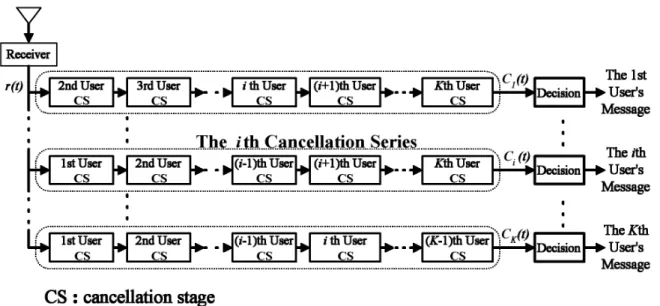
(23) can improve system utilization while maintaining QoS guarantee of all existing mobile users. requirements by constructing an appropriate fuzzy rule base based on the expert domain knowledge. In Chapter 3, we present an intuitive scheduling and admission control (ISAC) with fast handoff protocol (FHP) for cellular IEEE 802.11e WLAN systems. It contains the admission control of the WLAN part in heterogeneous networks. The WLAN’s QoS basic service sets (QBSSs) are cellularized, which is the simplest way to extend the coverage of WLAN services. In order to provide QoS guarantee for a mobile user, the ISAC will calculate the transmission opportunity (TXOP) of the requesting mobile user, and examine if there is sufficient room in the point coordination function (PCF) duration for the TXOP. Besides, IEEE 802.11 standards and the amendments do not consider the seamless handoff problem. Therefore we also proposed a FHP to provide a reliable method for the contention of handoff requests. By means of reserving time duration, the controlled contention period (CCP), for handoff requests, the uncertainty of handoff latency due to access contention in the WLAN system can be eliminated. Meanwhile, a fuzzy adjustment method (FAM) is proposed to adjust the period of CCP intelligently. It can help FHP to increase the CCP utilization and minimize the impact for other contention-based services. In Chapter 4, a fuzzy Q-learning admission control (FQAC) for WCDMA/WLAN heterogeneous networks is introduced. The FQAC consists of the dwelling estimation, the admissibility estimation, and the decision maker. The dwelling estimation will evaluate the moving status of the mobile user and generate the dwelling cost for every WCDMA or WLAN network near the mobile user. The admissibility estimation considers the measures of system states and QoS requirements of mobile users, and generate the admissibility cost for every WCDMA or WLAN network near the mobile 9.
(24) user. Both dwelling and admissibility estimations adopt fuzzy Q-learning (FQL) method to achieve automatic on-line learning for FQAC. With FQL, the correlation between system state and cost generation can be adaptively adjusted. According to the costs, the minimax theorem is adopted in the decision maker, and the ultimately chosen subnetwork is that with the minimal cost among all possible maximal costs. Finally, conclusions and future work are presented in Chapter 5.. 10.
(25) Chapter 2 An Outage-Based Fuzzy Call Admission Controller with Multiuser Detection for WCDMA Systems. 2.1. Introduction. Wideband code division multiple access (WCDMA) systems adopt the spread spectrum technology to achieve higher spectrum efficiency for wireless communications [33]. However, they exist multiple access interference (MAI) affecting the system capacity. If receivers in WCDMA systems can reduce MAI when detecting the signal of interest, the capacity will be markedly increased. Accordingly, methods of multiuser detection (MUD) for receivers in WCDMA systems are proposed. Verd´ u [11] proposed an optimal MUD solution, which used a maximum likelihood sequence (MLS) detector. Unfortunately, this method is too complex to be practical. Many simplified or suboptimal detectors have been developed and improved [9, 10].. 11.
(26) Usually, the suboptimal detectors are classified into two categories: linear detection and interference cancellation [10]. Interference cancellation in uplinks represents an important direction of MUD development because it is highly feasible in the base station (BS). There are two basic constructions of cancellations: successive interference cancellation (SIC) and parallel interference cancellation (PIC). The strategy of SIC, shown in Fig. 2.1, is to discriminate the messages (bits) of other users in series, regenerate the transmitting waveforms, and subtract them from the originally received waveform. PIC is similar to SIC, except in that the regenerated messages are subtracted simultaneously. The advantage of the PIC is its fast process speed, but its complexity makes its implementation difficult. The performance of SIC and PIC was analyzed in [9, 10, 20, 34–38]. According to the results in [10, 20, 34, 38], SIC performs better than PIC in the fading channel without power control (PC). Also the hardware requirement of SIC is fewer than that of PIC. Therefore, this dissertation considers SIC MUD for WCDMA systems. Generally speaking, the MAI of users at home cell plays a major role in determining the communication quality and the system capacity for WCDMA systems. When the WCDMA system adopts SIC MUD for receivers, the SIC MUD will help to mitigate the negative influence of the home cell interference when detecting the signal of interest. As a result, the admission of a new call request will cause the influence of interference more on existing calls in adjacent cells than on existing calls at home cell. Thus, the design of call admission control in WCDMA system using MUD would be different from traditional ones and should lay emphasis more on adjacent cell interference than on home cell interference. On the other hand, intelligent techniques, such as fuzzy logic techniques, have been proven to be capable for dealing with nonlinear and time-varying systems, which are 12.
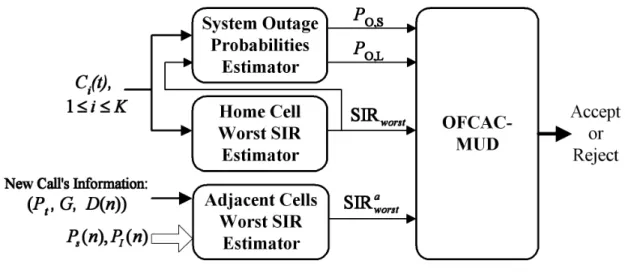
(27) Figure 2.1: The strategy of SIC. 13.
(28) difficult to analyze [39]. Results also show that such intelligent computations produce better performance than parametric models of dynamic and complicated systems. As noted, wireless channels could vary due to several factors such as channel fading, interference, noise, etc. The traffic controller for wireless communications should adopt intelligent techniques to adapt to changes of channels so as to improve system utilization. Therefore, in the chapter, an outage-based fuzzy call admission controller with multiuser detector (OFCAC-MUD) is proposed for WCDMA systems. The OFCACMUD makes call admission decision by considering the uplink worst signal-to-interference ratios (SIRs) from not only home cell but also adjacent cells and system outage probabilities at outputs of SIC MUDs. It can improve system utilization under the constraint of quality of service (QoS) requirements by constructing an appropriate fuzzy rule base based on the expert domain knowledge. Simulation results indicate that OFCAC-MUD achieves the system capacity more than the SIR-based CAC under the same QoS requirements. It is found that PC may not be essential for SIC MUD. Also, when the locations of users are uniformly distributed over cells, the capacity of OFCAC-MUD without PC, in satisfying the outage probability criteria, is improved by 70.5% over that of SIR-based CAC-RAKE with perfect PC. When the system is operated in an extremely unbalanced hotspot environment, OFCAC-MUD can still fulfill the QoS requirements of the outage probability, while SIR-based CAC-RAKE violates. In the following sections, the system model of SIC MUD and the design of OFCACMUD will be presented. Section 2.2 briefly introduces SIC MUD and describes the system model. Section 2.3 presents the OFCAC-MUD for WCDMA cellular systems. Section 2.4 shows simulation results and discusses the advantages and disadvantages 14.
(29) Figure 2.2: A typical SIC MUD for K users of the OFCAC-MUD design, as compared to SIR-based CAC-MUD and FCAC-RAKE (FCAC with the RAKE receiver). Conclusions are finally made in Section 2.5.. 2.2. SIC MUD and System Model. Figure 2.2 depicts a typical SIC MUD for K users [20, 34, 38]. Each cancellation stage (CS) in the cancellation series consists of RAKE receivers, a maximal power selector, a signal regenerator, and a subtractor. In the CS, the input signal is firstly passed through the RAKE receivers to detect individual signals of all users. Then the signal with the maximal power will be selected, and the signal regenerator reproduces its original signal according to the carrier frequency, the phase, the amplitude, and the delay profile. Finally, the subtractor will subtract the reproduced signal from the input signal of the CS. The order of CSs in SIC MUD are sorted according to the received powers of users; the first CS cancels the signal of the user who has the largest received power, and so on.. 15.
(30) Let r(t) be the baseband received signal at time t, which can be expressed as, r(t) =. K X. [Sk (t)ak (t)] + IOC (t) + n(t),. (2.1). k=1. where Sk (t) represents the signal transmitted by the kth user; ak (t) is the activity factor of the kth user, ak (t) ∈ {0, 1}; and IOC (t) and n(t) represent the aggregated MAI of the other cells and the AWGN channel noise, respectively. The SIC MUD will generate a signal at the output of the ith cancellation series for the ith user, Ci (t), 1 ≤ i ≤ K, given as, K X. Ci (t) = r(t) −. (i) (i) Sˆk (t)ˆ ak (t),. (2.2). k=1 k6=i (i) (i) where Sˆk (t)ˆ ak (t) is the signal regenerated by the kth CS. The Ci (t) will be sent to. the OFCAC-MUD for further processing. Figure 2.3 presents the system model for OFCAC-MUD, which contains four functional blocks - (A) system outage probabilities estimator, (B) home cell worst SIR estimator, (C) adjacent cell worst SIR estimator, and (D) OFCAC-MUD. Blocks (A), (B) and (C) generate system performance parameters, which will be used as linguistic variables for block (D).. 2.2.1. System Outage Probabilities Estimator. The system outage probabilities estimator generates two kinds of home cell’s system outage probability, long-term and short-term outage probability, denoted by PO,L and PO,S , respectively. The outage probability is defined as P r{SIR < SIR∗ }, where SIR is provided by the home cell worst SIR estimator described in the next subsection, and SIR∗ is the SIR threshold set by the system. Short and long sliding windows are used to collect the SIR values of every user. Generally, the short-term outage probability reflects the instant fluctuations of system traffic, while the long-term outage 16.
(31) Figure 2.3: The system model for the OFCAC-MUD probability indeed represents the average QoS of the system traffic. Traffic may violate the short-term outage criterion occasionally, but still satisfy the long-term outage criterion.. 2.2.2. Home Cell Worst SIR Estimator. The home cell worst SIR estimator produces the smallest SIR among all users at home cell, denoted by SIRworst . It first regenerates the ith user’s signal, Sˆ(i) (t)ˆ a(i) (t), from Ci (t) provided by the ith cancellation series of SIC MUD, 1 ≤ i ≤ K. Then it (i). derives the overall effective MAI of the ith user, Ief f (t), by, Ief f (t) = Ci (t) − Sˆ(i) (t)ˆ a(i) (t). (i). (2.3). The signal-to-interference ratio (SIR) of the ith user, SIR(i) , can be yielded as, R. SIR. (i). =. T. (Sˆ(i) (t)ˆ a(i) (t))2 dt R. (i). (Ief f (t))2 dt T. ,. (2.4). where T is a unit time interval. Consequently, the SIRworst at home cell can be obtained by, SIRworst = min{SIR(i) }. i. 17. (2.5).
(32) The signal power (numerator) and the interference power (denominator) of SIRworst , denoted by Ps and PI , respectively, are also provided to adjacent cells worst SIR estimators in adjacent cells.. 2.2.3. Adjacent Cells Worst SIR Estimator. The adjacent cells worst SIR estimator yields an output, SIRaworst , which denotes the worst SIR among all adjacent cells with the consideration of the new call’s interference influence if the new call request is accepted. The adjacent cells worst SIR estimator obtains Ps and PI of SIRworst from the nth adjacent cell, denoted by Ps (n) and PI (n). Then SIRaworst can be calculated by, . . Ps (n). . SIRaworst = min n. −γ. ,. (2.6). PI (n) + Pt G D (n) Ω. where Pt is the transmitted power of the new call, G is the miscellaneous gains of transmission [5], D(n) is the location distance between the new call and the BS of the nth adjacent cell, γ is the path-loss exponent decided by the terrain [40], and Ω is the random shadowing component. Note that the D(n) can be obtained by some existing −γ. positioning systems such as GPS, and the Pt G D (n) Ω is the amount of the new call’s interference effect on the nth adjacent cell. Because of the MUD adopted in the WCDMA system, SIRaworst is an important parameter in the call admission control. The performance of OFCAC-MUD for WCDMA system with/without considering SIRaworst will be shown in section 2.4 Simulation Results.. 2.3. OFCAC-MUD. The outage-based fuzzy call admission controller (OFCAC-MUD) takes PO,L , PO,S , SIRworst , and SIRaworst as its input linguistic variables. Term sets of fuzzy logic for 18.
(33) these input variables are defined as T(PO,L )={Low (L), Medium (M), High (H)}, T(PO,S )={Low (L), Medium (M), High (H)}, T(SIRworst )={Low (L), Medium (M), High (H)}, and T(SIRaworst )={Low (L), Medium (M), High (H)}. Also, membership functions for terms of linguistic variables use the trapezoid function given by, x−x0 +1 α 1. f (x; x0 , x1 , α, β) = . x1 −x. β 0. , x0 − α ≤ x < x0 , when α > 0. , x 0 ≤ x ≤ x1 . + 1 , x1 < x ≤ x1 + β, when β > 0. , otherwise.. (2.7). Thus, membership functions for T(PO,L ), T(PO,S ), T(SIRworst ), and T(SIRaworst ) are set, respectively, by, µL (PO,L ) = f (PO,L ; 0, aL P∗O,L , 0, (aH − aL )P∗O,L ). (2.8). µM (PO,L ) = f (PO,L ; aH P∗O,L , aH P∗O,L , (aH − aL )P∗O,L , (1 − aH )P∗O,L ). (2.9). µH (PO,L ) = f (PO,L ; aH P∗O,L , 1, (1 − aH )P∗O,L , 0). (2.10). µL (PO,S ) = f (PO,S ; 0, bL P∗O,S , 0, (bH − bL )P∗O,S ). (2.11). µM (PO,S ) = f (PO,S ; bH P∗O,S , bH P∗O,S , (bH − bL )P∗O,S , (1 − bH )P∗O,S ). (2.12). µH (PO,S ) = f (PO,S ; bH P∗O,S , 1, (1 − bH )P∗O,S , 0). (2.13). µL (SIRworst ) = f (SIRworst ; 0, SIR∗ , 0, (cL − 1)SIR∗ ). (2.14). µM (SIRworst ) = f (SIRworst ; cL SIR∗ , cL SIR∗ , (cL −1)SIR∗ , (cH −cL )SIR∗ )(2.15) µH (SIRworst ) = f (SIRworst ; cH SIR∗ , ∞, (cH − cL )SIR∗ , 0). (2.16). µL (SIRaworst ) = f (SIRaworst ; 0, SIR∗ , 0, (dL − 1)SIR∗ ). (2.17). µM (SIRaworst ) = f (SIRaworst ; dL SIR∗ , dL SIR∗ , (dL −1)SIR∗ , (dH −dL )SIR∗ )(2.18) µH (SIRaworst ) = f (SIRaworst ; dH SIR∗ , ∞, (dH − dL )SIR∗ , 0).. (2.19). The coefficients aL , aH , bL and bH are fuzzy set range ratios which are smaller than one. These values affect the ranges of their term sets and should be adjusted to 19.
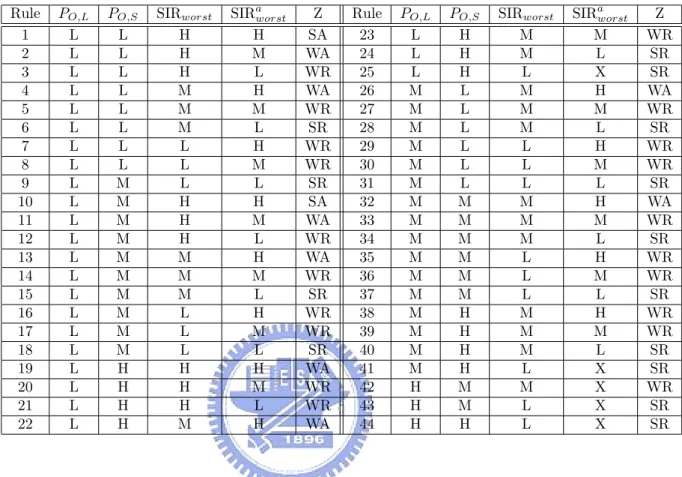
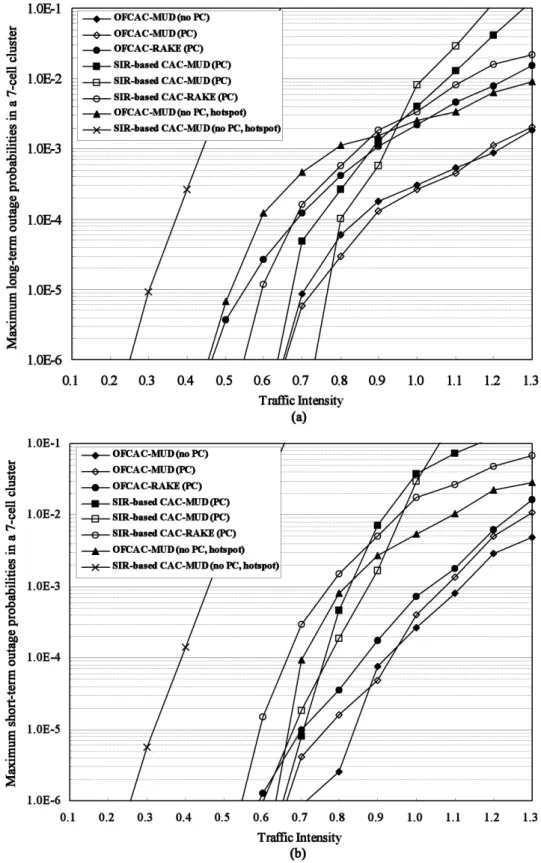
(34) optimize the system utilization. For example, in order to strictly control the average QoS behaviors in the system, the ranges of Low and Medium in PO,L should be made small because PO,L indicates the genuine traffic load situation. On the other hand, PO,S only reflects the instant fluctuation of traffic instead of the average QoS of the system, so the ranges of Low and Medium in PO,S can be set wide. Their thresholds, denoted by P∗O,L and P∗O,S , are the system QoS requirements. P∗O,L is usually set to be less than P∗O,S because it is also reasonable to leave a larger space for variation tolerance over a short time interval. Other two linguistic variables, SIRworst and SIRaworst , are the current worst SIRs of existing calls in home and adjacent cells. These two variables should not be lower than the threshold SIR∗ given by the system. The coefficients cL , cH , dL and dH are the fuzzy set range ratios for SIRworst and SIRaworst . These four coefficients are larger than one and also should be adjusted to achieve the best the system utilization. The output linguistic variable, Z, defined as the acceptability of the new call, has a term set given by T(Z)={Strongly Accepted (SA), Weakly Accepted (WA), Weakly Rejected (WR), Strongly Rejected (SR)}. Table 2.1 shows the fuzzy rule base, which is constructed according to expert domain knowledge. The notation X in this table represents any terms of the linguistic variable. This rule table includes all possibilities of making proper admission decisions. Take rule 10 in Table 2.1 for example. If PO,L is with term Low, PO,S is with term Medium, SIRworst and SIRaworst are with term High, it means the system still has the room for a new call, Z would be with term Strongly Accepted. Also take rule 37 for example. If SIRworst and SIRaworst are with term Low, which means the system should tend to reject the new call, thus Z would be with term Strongly Rejected. Finally, the fuzzy inference algorithm for the OFCAC-MUD adopts the max-min 20.
(35) Table 2.1: The rule base of the fuzzy call admission controller Rule 1 2 3 4 5 6 7 8 9 10 11 12 13 14 15 16 17 18 19 20 21 22. PO,L L L L L L L L L L L L L L L L L L L L L L L. PO,S L L L L L L L L M M M M M M M M M M H H H H. SIRworst H H H M M M L L L H H H M M M L L L H H H M. SIRaworst H M L H M L H M L H M L H M L H M L H M L H. Z SA WA WR WA WR SR WR WR SR SA WA WR WA WR SR WR WR SR WA WR WR WA. Rule 23 24 25 26 27 28 29 30 31 32 33 34 35 36 37 38 39 40 41 42 43 44. PO,L L L L M M M M M M M M M M M M M M M M H H H. PO,S H H H L L L L L L M M M M M M H H H H M M H. SIRworst M M L M M M L L L M M M L L L M M M L M L L. SIRaworst M L X H M L H M L H M L H M L H M L X X X X. Z WR SR SR WA WR SR WR WR SR WA WR SR WR WR SR WR WR SR SR WR SR SR. inference method [41], and the defuzzification scheme used here is the center of area defuzzification method [39].. 2.4. Simulation Results. In the simulations, the channel of the WCDMA system suffers inter-cell MAI, intra-cell MAI, AWGN noise, log-normal shadowing [42], and multipath fading; the multipath fading adopts the model of Case 2 in [43]. The path-loss exponent γ is 4.35 [40]. The spreading factor of the WCDMA in uplink is 64. The incoming call could be new or handover. The arrival of new calls is modeled as a Poisson with a mean arrival rate, λ. Two types of traffic are considered - voice and data. The 21.
(36) distribution of voice-call holding time is exponential with a mean of 50 seconds. The data packet length is also modelled as an exponential distribution with a mean of 110 bytes. Data call holding time is also exponentially distributed since the transmission rate and spreading factor of each channel are fixed in the simulations. The traffic intensity is defined as µλ , where. 1 µ. is the mean call holding time of a voice or a data. call. The simulations also consider the soft-handover. A soft-handover user chooses at most 3 BSs in its active set selection. The system adopts selection diversity [5] for the soft-handover. The number of outgoing handover calls in a call duration is also assumed to be 10% proportional to the number of users in a cell. Users are also assumed to be uniformly distributed in cells, and the probabilities of handover to all adjacent cells are equal. Furthermore, the 40% activity factor for a voice call is used [33]. The sampling interval for the outage probability is 5µs, and the sliding window size for long-term (short-term) outage probability is 100K (10K). Three QoS requirements are set to be: P∗O,L = 10−3 , P∗O,S = 10−2 , and SIR∗ = −17dB. We consider a 7-cell region as a ”cluster” and SIR-based CAC for comparisons. Here the SIR-based CAC is implemented to make admission decision for a new call according to the currently estimated SIR of the system. If the system’s SIR is higher than SIR∗ , then the call will be admitted; otherwise, the call will be rejected. In the implementation, parameters of SIR-based CAC, such as the margin of residual capacity [44] and the margin for handover [45] to tolerate the misjudged admissions, are finely tuned to maximize the system utilization and QoS-guarantee regions. Both perfect power control and no power control situations are investigated. Also, two cases of traffic load distribution: homogeneous case and hotspot case, are investigated. The homogeneous case has all cells given with the same traffic intensity; while the hotspot case has the traffic load in the central cell set to be five times heavier than that in other 22.
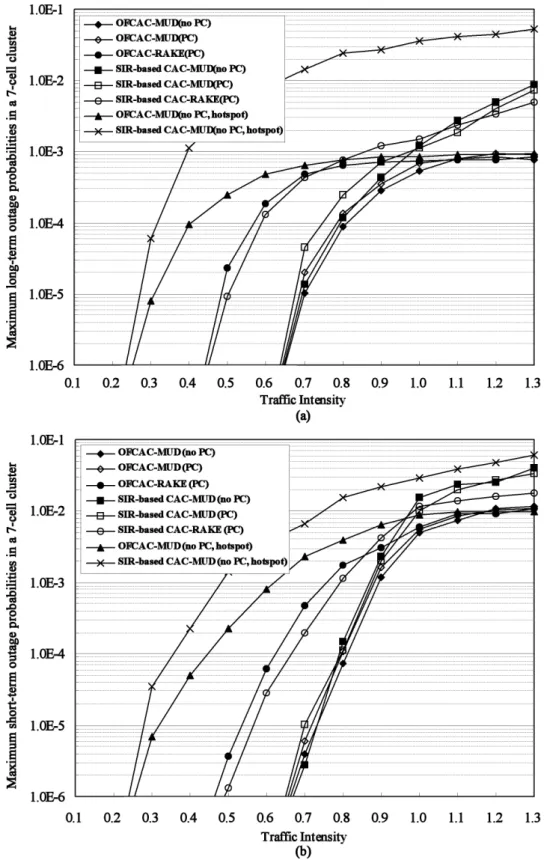
(37) cells. The following scenarios are observed. In the homogeneous environment, there are (i) OFCAC-MUD without PC, (ii) OFCAC-MUD with perfect PC, (iii) OFCAC using RAKE receiver (OFCAC-RAKE) with perfect PC, (iv) SIR-based CAC using MUD (SIR-based CAC-MUD) without PC, (v) SIR-based CAC-MUD with perfect PC, (vi) SIR-based CAC-RAKE with perfect PC; and in the hotspot environment, there are (vii) OFCAC-MUD without PC, and (viii) SIR-based CAC-MUD without PC. Figures 2.4(a) and (b) present the maximum long-term and short-term outage probabilities versus the traffic intensity, respectively. The figures reveal that when OFCAC is adopted (scenarios (i), (ii), (iii), and (vii)), the QoS requirements can be always guaranteed. The long-term and short-term outage probabilities of OFCAC grow as the traffic intensity increases, and eventually saturate to P∗O,L and P∗O,S requirements, respectively, in both homogeneous and hotspot environments. On the contrary, when SIR-based CAC is adopted (scenarios (iv), (v), (vi), and (viii)), the QoS requirements are violated. It is because fuzzy logic technology provides a robust mathematical method for admission control in realistic environments [46–48], especially when the mathematical model of the process is too complicated to find. By adopting expert systems to setup the bounded admission rules, the fuzzy approach has the capability to adapt to the dynamic and bursty traffic in multimedia environment to make the best decisions. Another reason is that we use outage probabilities instead of the instant SIR values. When the the system is at heavy load, it is possible to encounter the moments when some users are inactive and thus the instant SIR values are instantly low; then the SIR-based CAC may accept some call requests and the violation of QoS requirements occurs. However, the outage-based CAC can prevent the misjudgment because the outage probability is the average of many SIR 23.
(38) values. Figure 2.5 presents the average number of using channels versus the traffic intensity. It shows that, in homogeneous environment, the maximum capacity of OFCACMUD with perfect PC is 225 channels in a cluster, which is about 51% higher than the capacity (about 149 channels) of SIR-based CAC-RAKE with perfect PC before QoS violation (traffic intensity ≤ 0.83). The improvement is brought by the contributions from SIC MUD and OFCAC. SIC MUD obtains an improvement in capacity by 36.4% as compared to OFCAC-RAKE with perfect PC. The reason is that SIC MUD cancels the home cell’s MAI significantly. With perfect PC, OFCAC obtains an improvement in capacity by 5.6% as compared to SIR-based CAC-MUD with perfect PC. Without PC, OFCAC obtains an improvement in capacity by 6.7% as compared to SIR-based CAC-MUD without PC. This is because fuzzy logic techniques have the reasoning capability for resource monitoring and management and takes more aggressive strategies in CAC. It can also be found that OFCAC-MUD without PC in scenario (i) can accommodate 254 channels in a cluster. The capacity is improved by 12.9% as compared to OFCAC-MUD with perfect PC in scenario (ii). It also has the improvements in capacity by 70.5%, 53.9%, and 19.3% as compared to SIR-based CAC-RAKE with PC (scenario (vi)), OFCAC-RAKE with PC (scenario (iii)), and SIR-based CAC-MUD with PC (scenario (v)), respectively. This indicates that PC may not be suitable in the application of SIC MUD. The reason is that the difference among the users’ signals of the received signal for SIC MUD without PC would be more significant than that for SIC MUD with PC. Therefore, SIC MUD without PC can regenerate these MAI signals for cancellation more effectively than SIC MUD with PC. Consequently, few errors are generated in the case without PC. Note that SIC MUD cancels MAI 24.
(39) Figure 2.4: (a)Maximum long-term outage probabilities, and (b) Maximum shortterm outage probabilities in a 7-cell cluster 25.
(40) Figure 2.5: The average number of using channels in a 7-cell cluster. 26.
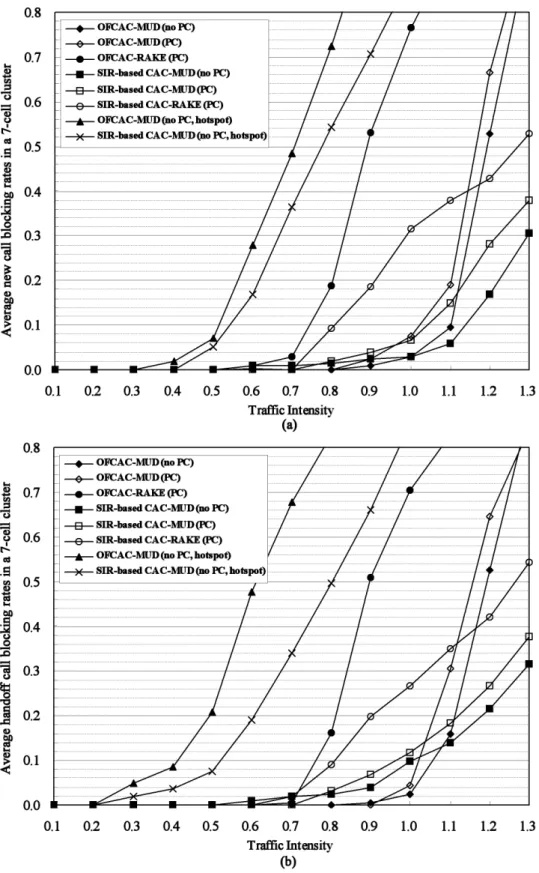
(41) of received signal in order. In the aspect of hotspot environment, the average number of using channels in OFCAC-MUD without PC (scenario (vii)) are much fewer than those of other cases in homogeneous environment. The OFCAC-MUD without PC accommodates 103 channels, while the SIR-based CAC-MUD without PC accommodates 82 channels before QoS violation (traffic intensity ≤ 0.35). We also simulate the following 2 scenarios: OFCAC-MUD with perfect PC and SIR-based CAC-MUD with perfect PC. Their average numbers of using channels are fewer than those of OFCAC-MUD without PC and SIR-based CAC-MUD without PC, which are quite similar to the phenomena happened in homogeneous environment. The results reveal again that OFCAC-MUD still has better utilization than SIR-based CAC-MUD in the hotspot case. Besides, it means that OFCAC can be applied in the dynamic and bursty traffic environment. Figures 2.6(a) and (b) present the new call and handover call blocking rates, respectively. Both figures reveal that, when the traffic intensity is smaller than 1.0, OFCAC-MUD without PC has the lowest blocking rates. When the traffic intensity is greater than 1.0, OFCAC-MUD with PC has higher blocking rate than SIR-based CAC-MUD and SIR-based CAC-RAKE because the SIR-based CAC has the risk to violate the QoS requirements and continues to accept call requests. Figures 2.7(a) and (b) depict the maximum long-term and short-term outage probabilities, respectively, for the WCDMA system with MUD but without considering the adjacent cells worst SIR, SIRaworst . It is found that the two outage probability requirements are greatly violated for all scenarios under heavy traffic intensity conditions. This verifies the fact, we stated previously, that the adjacent cell SIR plays an essential role in call admission control for WCDMA systems with MUD. 27.
(42) Figure 2.6: (a) Average new call blocking rates, and (b) Average handover call blocking rates in a 7-cell cluster 28.
(43) Figure 2.7: (a) Maximum long-term outage probabilities, and (b) Maximum shortterm outage probabilities in a 7-cell cluster without considering SIRaworst 29.
(44) 2.5. Concluding Remarks. This chapter first proposes an outage-based fuzzy call admission controller with multiuser detection (OFCAC-MUD) for WCDMA systems. The OFCAC-MUD considers the short-term outage probability, the long-term outage probability, the homecell worst SIR, and the adjacent-cell worst SIR including the interference influence of the new call request as the input linguistic variables. The worst SIR of adjacent cells plays an essential role among the input linguistic variables. It is because, when MUD is applied, the inter-cell interference plays a more dominant role than the intra-cell interference in call admission control. Simulation results show that OFCAC-MUD without PC achieves a significant improvement by 70.5% in system capacity as compared to SIR-based CAC-RAKE with PC. Also, OFCAC-MUD without PC can offer more channels for users by an amount of 12.9% than OFCAC-MUD with perfect PC. The reason is that, in the case of perfect PC, the phenomenon of the equal power signals received by SIC MUD will degrade the discrimination of interference of SIC MUD, and then results in the lower cancellation effect. Moreover, OFCAC-MUD can always keep QoS guaranteed, while SIR-based CAC-MUD or SIR-based CAC-RAKE may violate the QoS requirements. Besides, whenever without considering the intercell interference in CAC for WCDMA systems with MUD, the QoS violation would occur at heavy traffic intensity even if OFCAC is adopted. This illustrates the essentiality of taking the inter-cell interference into account when making call admission decisions. The OFCAC-MUD, combining the capabilities of the fuzzy logic system and the multiuser detection for call admission control, indeed achieves capacity improvement and QoS guarantee for WCDMA systems.. 30.
(45) Chapter 3 An Intuitive Scheduling and Admission Controller with Fast Handoff Protocol for Cellular IEEE 802.11e WLAN Systems. 3.1. Introduction. Wireless local area network (WLAN) is considered to be a good choice of high-speed wireless communication systems to offer a comprehensive multimedia communication platform. It is designed for an alternative access method for Internet applications. The original purpose of WLAN is to reduce the complexity of wiring deployment. Authorized users can access the local network without finding the LAN’s receptacles. The high transmission rate and the access flexibility of WLAN make it profitable to provide various services in low-tier coverage. It is known that some real-time services, such as voice over IP (VoIP) and video-stream, are gaining high momentum in WLAN systems. Because of the low cost and easy installation, WLANs are also. 31.
(46) widely deployed in the public domain. In order to provide broader coverage and continuous network access, the mobile service area of WLANs should be effectively extended, and the cellularized deployment of WLAN systems is one way to achieve this. The most popular system of WLAN is IEEE 802.11 [2], which provides physical and media access control layer standards for wireless access. In recent years, several enhancements of physical (PHY) and medium access control (MAC) layer in IEEE 802.11 are finished on after the other. The high-speed transmission rate of 802.11 makes many multimedia communications feasible through wireless access. For example, IEEE 802.11b [49] high-rate direct sequence spread spectrum (HR-DSSS) with complementary code keying (CCK) over 2.4GHz ISM band allows 11Mbps maximum transmission rate. IEEE 802.11a [50] and 802.11g [51] specify a higher data rate over U-NII bands and ISM bands, respectively. Both of them adopt orthogonal frequency division multiplexing (OFDM) technology and allows 54Mbps maximum transmission rate. On the other hand, IEEE 802.11 working group also accomplished the amendment for quality of service (QoS). The carry-sense multiple access / collision avoidance (CSMA/CA) procedure in in IEEE 802.11 MAC cannot provide the QoS guarantee. Thus, 802.11 Task Group e (IEEE 802.11e) [52] was established to define QoS parameters and enhanced coordination functions for the transmission opportunities (TXOP) of mobile users. In order to achieve QoS guarantee in IEEE 802.11e, the call admission controller and TXOP scheduler are essential for the resource management. Several scheduling methods for WLAN have been proposed in [53–57]. QoS or fairness disciplines over MAC are their major considerations. But the MAC layer fulfillment does not mean the actual QoS guarantee because the link quality of air interface between the QoS 32.
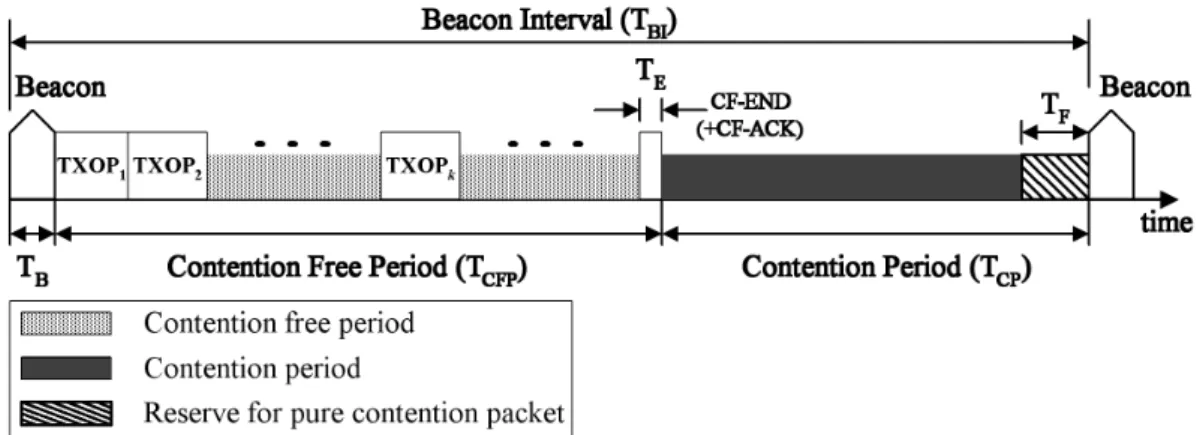
(47) access point (QAP) and QSTA will affect the error rates and throughput in uplink and downlink. In this chapter, we first propose an intuitive scheduling and admission control (ISAC) for contention-free services. The ISAC considers the factors of link quality, such as path loss, interference, noise, and QoS requirements, However, the cellularized WLANs have to face the handoff issue inevitably. the nature of the small coverage of a QoS basic service set (QBSS) in WLANs would lead handoffs of mobile users in the cellular environments. The handoff delay caused by both the scanning time and the medium access time is always a significant index of handoff efficiency. A recent work of IEEE 802.11 Working Group r (IEEE 802.11r) is defining a set of high-efficient frames for associations and authentications to shorten the scanning time [58]. But the medium access time of IEEE 802.11 [2] and 802.11e [52] still needs to be improved. It is because the handoff request (HO-REQ) issued by the handoff QoS station (QSTA) has to compete with other packets in the contention period (CP). The medium access delay is uncertain even if the HO-REQ is assigned as the voice access category (AC VO), which represents the highest priority in the enhanced distributed channel access (EDCA) [52]. An improved handoff protocol is therefore essential for handoff association in cellular WLAN systems to support inter-cell mobility and seamless services with delay bound guarantee. In this chapter, we also propose a fast handoff protocol (FHP) for cellular IEEE 802.11e WLAN systems. This FHP devises a controlled contention period (CCP), which is partitioned from CP in every beacon interval and designated for HO-REQs. Also, unlike using conventional EDCA in CP, these HO-REQs are arranged to contend sequentially in CCP, and a fuzzy adjustment method (FAM) is proposed to adaptively determine the length of CCP for high system utilization. The FHP, including CCP 33.
(48) and FAM, is standard-compatible. It can indeed attain low forced termination rate for HO-REQs and improve system throughput of CP, compared to the conventional EDCA. The organization of this chapter is as follows. In Section 3.2, the design of ISAC for the cellular IEEE 802.11e WLAN systems is introduced. The system model, media access control, and the design details for ISAC are included in this section. Section 3.3 presents the proposed FHP for cellular IEEE 802.11e WLAN systems. The concepts and details of FHP design are introduced. The simulation results of FHP are also illustrated in this section. Finally, the conclusions are given in Section 3.4.. 3.2 3.2.1. The Intuitive Scheduling and Admission Controller for IEEE 802.11e WLAN Systems System Model for ISAC. Consider a low mobility IEEE 802.11e cellular WLAN system with HCF mode. Figure 3.1 shows an IEEE 802.11e cellular WLAN environment. The path loss is proportional to the square of distance between transmitter and receiver [5]. The average signal-to-interference-noise ratio (SINR) in downlink (DL) for a kth home QoS mobile station (HQSTA(k)) in its home QoS access point (HQAP) can be given by SINRD k =. PA G/(4πdk )2 , IkD + N0. (3.1). where PA is the transmitted power from every QAP, G is the known aggregate devices’ gain, dk stands for the distance between HQSTA(k) to its HQAP, N0 is AWGN, and IkD is the interference measured by HQSTA(k). It is similar that the average SINR. 34.
(49) Figure 3.1: IEEE 802.11 WLAN cellular environment in uplink (UL) at HQAP can be obtained by SINRUk =. PS G/(4πdk )2 , IkU + N0. (3.2). where PS is the transmitted power of every STA, and IkU is the interference measured by HQAP, which consists of the interference from NQAP(i) and arbitrary NQSTA (NQSTA(i)) in NQBSS(i). The DL bit error probability in HQSTA(k), denoted as qkD , can be calculated by SINRD k , accordingly. By applying the improved Gaussian approximation method (IGAM) in [59, 60], the DL bit error probability in HQSTA(k), qkD , can be approximated as. v u u D qk = E Q t. . . PA G/(4πRdk )2 , 2V ar[PA G]/SINRD k. (3.3). where Q[·] is the Q-function, R denotes the physical transmission bit rate which is required in the traffic specification (TSPEC) in [52], and V ar[·] denotes the variance of the distribution. Thus we can obtain the DL packet error rate by D Pe,k = 1 − (1 − qkD )M ,. (3.4). where M is the number of bits in a packet. By the similar method, the UL bit error 35.
(50) probability from HQSTA(k) can be approximated as v u 2 u P (k)G/(4πRd ) k . qkU = E Q t S 2V ar[PS G]/SINRUk . (3.5). The UL packet error rate can be expressed by U Pe,k = 1 − (1 − qkU )M .. 3.2.2. (3.6). Media Access Control in IEEE 802.11e WLANs. Figure 3.2 depicts the HCF mode in IEEE 802.11e. In the figure, TBI is the beacon interval (BI) of the system, which can be separated into a duration of beacon, denoted by TB , and two periods: contention free period (CFP), denoted by TCFP , and contention period (CP), denoted by TCP . TE is the time duration of CF-END packet. TF is the reserved space for pure contention access in CP. It cannot be ignored because some management frames are transmitted through contention procedure [52]. TXOPi contained in TCFP is the transmission opportunity (TXOP) assigned to the ith real-time and QoS-guaranteed link. The concept of the TXOP is the basis to support QoS or real-time services. It represents a polling-based duration for a specific transmission. Therefore a proper scheduling of TXOP for each associated QSTA is essential to provide QoS services. Let the physical DL and UL transmission rates of a HQSTA be RD and RU , respectively. And let the required minimum DL and UL data bit rates of the kth U HQSTA be ρD k and ρk . The minimal required TXOP assigned to the kth HQSTA,. denoted by TXOPk , is Ã. TXOPk =. ρD ρUk k + RD RU. !. TBI + PIFS + SIFS.. (3.7). Since HQSTA has to require a minimum transmission rate, the system guarantees the minimal data rates on DL and UL. The TXOP can be regarded as the restrictions 36.
(51) Figure 3.2: HCF mode in IEEE 802.11e of both UL and DL data transmissions. If the system does not restrict both links, it is possible for the unrestricted one to occupy the resources of other QoS links. According to the principle that the QoS-based services are scheduled into CFP, an intuitive scheduling and admission controller is proposed in the next section.. 3.2.3. The Design of ISAC. Figure 3.3 depicts the ISAC scheme, which is divided into two phases. When a new HQSTA link request arrives with the required minimum DL and UL data rates, ρD and ρU , the system calculates its TXOPk by (3.7) first. Let TA = TBI − TB − TF , which is the current maximum available time for scheduling. In phase 1, the ISAC checks the remaining free time in CFP of the next BI for TXOPk of the new HQSTA link request, which uses the following inequality TXOPk ≤ TA −. X. TXOPi −. X. TXOPj ,. (3.8). j∈N. i∈S. where S is the set of existing associated HQSTAs in HQBSS, which can be known from the profiles database in HQAP, and N represents the set of newly accepted HQSTAs at present BI and will start to transmit from next BI. Note that a non-empty N means more than one new HQSTA request in this BI. All accepted HQSTAs are 37.
(52) Figure 3.3: ISAC block diagram. 38.
(53) treated according to FCFS principle. The inequality (3.8) judges whether there is any space of TXOP for new users by adjusting TCFP . If the inequality stands, then the procedure enters phase 2; otherwise the new request will be rejected directly. In phase 2, the ISAC procedure considers the delay bound and link quality of the new HQSTA, which is decided directly by TBI . Assume that the distance between the new HQSTA and HQAP is known. By using (3.1) and (3.2), we can estimate U D U SINRD k and SINRk of the new HQSTA(k). Then the packet error rates, Pe,k and Pe,k , D U can be obtained by (3.4) and (3.6). Then Pe,k and Pe,k are compared to the required. thresholds Pe∗D and Pe∗U , respectively. If both UL and DL packet error rates are D U fulfilled, that is Pe,k ≤ Pe∗D and Pe,k ≤ Pe∗U , then new HQSTA will be accepted. If. any one of these two inequalities is violated, which means that the channel quality is too low to allow the new required QoS service, the new HQSTA will be rejected. Note that if TXOPk exceeds the maximal allowed value of network allocation vector (NAV) in the system, it can be divided into more than one TXOPs in actual transmissions.. 3.3 3.3.1. The Design of Fast Handoff Protocol (FHP) in Cellular IEEE 802.11e WLANs System Model for FHP. The cellular WLAN system consists of multiple QBSSs as shown in Fig. 3.4. The QAP QBSS adopts IEEE 802.11a [50] OFDM technology as physical layer specification. The signal quality of the handoff request (HO-REQ) is affected by the channel fading, additive white Gaussian noise (AWGN), and interference. Since WLAN applies unlicensed band, the interference could be co-channel interference and unknown source interference. The co-channel inter-cell interference in the cellular WLAN environments could be reduced by cell-planning, which means that neighboring QBSSs 39.
(54) Figure 3.4: Cellular IEEE 802.11 WLAN environment use different channels. With cell planning, all QAPs can operate asynchronously and do not have to pay extra efforts to synchronize beacons. If it is inevitable for all QAPs to use the same channel, the transmissions of handoff requests must use other unused channels. In addition, channel fading and AWGN affects the signal of the HO-REQ. Zheng and Miller have analyzed OFDM’s performance over Rayleigh fading channels [61]. If the number of OFDM sub-carriers is large enough, the OFDM symbol error probability, denoted by Pe (¯ γ ), can be approximated by L−1 X 1 RL Pe (¯ γ ) ≈ 1 − exp − m(1 − R)¯ γ k=0 k!. Ã. RL m(1 − R)¯ γ. !k. ,. (3.9). where γ¯ is the average signal-to-interference-noise ratio (SINR), R is the code rate, L is the number of multipaths, and m is 1.24. The average SINRs of DL and UL,. 40.
(55) denoted by γ¯D and γ¯U , respectively, can be estimated by γ¯D =. SD , ID + N0. (3.10). γ¯U =. SU , IU + N0. (3.11). and. where SD and SU are received DL and UL signal power; ID and IU are measured DL and UL interference; N0 is the power of AWGN. By applying (3.9), both DL and UL symbol error probabilities of OFDM can be obtained. The fast handoff protocol (FHP) assumes that the QoS access point (QAP) of every QBSS will issue a handoff controlled access broadcast (HOCAB) packet in every BI right after the CF-End packet of the CFP and the point coordination function (PCF) interframe space (PIFS). The HOCAB packet is designed to indicate a start of the controlled contention period (CCP). Its packet format, shown in Fig. 3.5, is similar to the CF-Poll packet format defined in [52] but with the fields of broadcast destination address (DA) and N , where N denotes the number of time slots in CCP. The CCP, partitioned from CP, can be regarded as a kind of controlled access phase (CAP) [52]. As shown in Fig. 3.6, new and failed (retried) HO-REQs will contend for handoff association or authentication in these N time slots. Each slot time equals to the sum of an HO-REQ symbol duration, a short interframe space (SIFS), an acknowledgment (ACK) symbol duration, and a PIFS. As a result, the network allocation vector (NAV) claimed by the CCP can be calculated by multiplying N and the slot time. Also, the time interval between two consecutive HOCABs is called a superframe time. Every new or retried HO-REQ will access for handoff association in the next CCP. Noticeably, the new HO-REQs include those HO-REQs arriving during the previous superframe time, while the retried HO-REQs are the failed HO-REQs 41.
(56) Figure 3.5: The frame structure of the handoff controlled access broadcast (HOCAB) packet. Figure 3.6: The controlled contention period (CCP) in the fast handoff protocol due to collisions or packet errors in the previous CCP.. 3.3.2. Performance Analysis of CCP. Figure 3.7 shows the state of the number of handoff requests. We define the ith observed superframe to be the duration from the HOCAB of the ith BI to that of the (i + 1)th BI. During the ith observed superframe, denote the random variable N r(i) to be the total number of unsuccessful requests in the ith CCP, the random variable A(i) to be the number of new arrivals, and the random variable H(i) to be the number of departures, 0 ≤ H(i) ≤ N r(i). Thus we can obtain N r(i + 1) = (N r(i) − H(i))+ + A(i),. (3.12). where (c)+ = max(0, c). (3.12) means that there are N r(i+1) requests contending 42.
(57) Figure 3.7: The number of HO-REQ arrivals in CCPs in the (i+1)th CCP. Hence, the matrix of transition probabilities given with H(i) = h during the ith observed superframe, denoted by Φh , can be expressed by . α0 α1 . .. .. . α0 α1 Φh = 0 α0 0 0 0 0 .. .. . .. α2 α3 .. .. . . α2 α3 α1 α2 α0 α1 0 α0 .. .. . .. ··· ··· ··· ··· ··· ··· .. .. h + 1 rows . (3.13). where 0 ≤ h ≤ N r(i). Note that αx is the probability of x arrivals during the ith observed superframe. Assume that the arrival process is Poisson with mean arrival rate λ, hence we can obtain αx = Pr{A(i) = x} =. e−λTSF (λt)x , x!. (3.14). where TSF is the duration of the observed superframe. Given N r(i) = n, the limiting probability of N r(i) conditioned on H(i) = h, i = 0, 1, 2, ..., can be defined as follows pn|H=h = Pr(N r = n|H = h) = lim Pr(N r(i) = n|H(i) = h), i→∞. 43. (3.15).
數據

+7


相關文件
Zhang, “A flexible new technique for camera calibration,” IEEE Tran- scations on Pattern Analysis and Machine Intelligence,
F., “A neural network structure for vector quantizers”, IEEE International Sympoisum, Vol. et al., “Error surfaces for multi-layer perceptrons”, IEEE Transactions on
Kyunghwi Kim and Wonjun Lee, “MBAL: A Mobile Beacon-Assisted Localization Scheme for Wireless Sensor Networks,” The 16th IEEE International Conference on Computer Communications
Selcuk Candan, ”GMP: Distributed Geographic Multicast Routing in Wireless Sensor Networks,” IEEE International Conference on Distributed Computing Systems,
[7]Jerome M .Shapiro “Embedded Image Using Zerotree of Wavelet Coefficients”IEEE TRANSACTIONS ON SIGNAL PROCESSING, VOL,41,NO.12,DECEMBER 1993. [8 ]Amir Said Willam
Kyunghwi Kim and Wonjun Lee, “MBAL: A Mobile Beacon-Assisted Localization Scheme for Wireless Sensor Networks”, the 16th IEEE International Conference on Computer Communications
Chen, “Adjustable gamma correction circuit for TFT LCD,” IEEE International Symposium on Circuits and Systems, vol. Kan, “Implementation of the Gamma (γ) Line System Similar
Zhang, “ Face recognition using Laplacianfaces,” IEEE Transactions on Pattern Analysis and Machine Intelligence, vol. Zhang, “Orthogonal Laplacianfaces for face
