國 立 交 通 大 學
應用化學系
博 士 論 文
新穎含矽氧烷、醯亞胺聚氧代氮代苯并環己烷材料
製備及其特性之研究
Preparation of Novel Siloxane-Imide-Containing
Polybenzoxazines and Characterization of Their High
Performance Thermosets
研 究 生:陳凱琪
指導教授:孫建文 教授
張豐志 教授
新穎含矽氧烷、醯亞胺聚氧代氮代苯并環己烷材料
製備及其特性之研究
Preparation of Novel Siloxane-Imide-Containing
Polybenzoxazines and Characterization of Their High
Performance Thermosets
研 究 生:陳凱琪 Student:Kai-Chi Chen
指導教授:孫建文 Advisor:Kein-Wen Sun
指導教授:張豐志 Advisor:Feng-Chih Chang
國 立 交 通 大 學
應 用 化 學 系
博 士 論 文
A DissertationSubmitted to Department of Applied Chemistry College of Science
National Chiao Tung University in Partial Fulfillment of the Requirements
for the Degree of Doctor of Philosophy
in
Applied Chemistry January 2011
Hsinchu, Taiwan, Republic of China
誌謝
轉眼間在交大應化系修讀博士學位已經四年半了,曾經我認為自己的學生生 涯在台大材料所碩士班畢業後就劃下了句點,不過畢業後進入了工研院材化所就 職,工作的內容離不開新技術的研究與發展,唯有不斷的吸取新知、成為不生苔 的滾石方能勝任,很慶幸遇到了支持我繼續進修的長官,讓我得以在工作與學業 間並行兼顧、繼續進修。 首先,我要感謝指導教授孫建文老師與張豐志老師提供了這良好的研究環 境,不僅在專業知識的殿堂上給予我非常多的指導、也教導我在學校做的基礎研 究如果能夠在不久的將來找到適合的應用載具更可以賦予研究更高的價值。在回 到學校的初期,由於已經在工研院工作幾年了、對於重拾學術研究一開始有些不 適應,包括如何將實驗結果精簡扼要的以論文的方式完整的呈現,謝謝老師耐心 的指正、讓我能漸入佳境。 感謝口試委員:黃介銘教授、郭紹偉教授、陳建光教授、王志逢教授以及陳 俊太教授在學生論文上提供了寶貴的意見與指導,使得學生論文可以更加豐富與 完整。 感謝實驗室的學弟英傑、智嘉、didi,因為我在工研院上班,學校的事務常 常麻煩各位學弟,真的謝謝有你們的幫忙。謝謝春雄,在實驗合成初期是我重要 的左右手,來院內工讀時也常常互相交流討論實驗的方向,這對我幫助頗大喔。 謝謝懷廣,我還記得當年一同修課時你請囊相授了考試秘訣,相當受用;謝謝世 堅、宜弘、哲豪在實驗及論文上的幫忙。謝謝你們讓我的研究所生涯充滿溫馨的 回憶。 要非常感謝的是天哥,你是我就讀博士班的大推手,沒有你給我的信心我可 能至今還在原地踏步,我不會忘記當我實驗遇到瓶頸時你比我還用心的協助我解 決了一個又一個的難題,不管是實驗上的困難或是心理上的沮喪,你始終支持著 陪我走在這條道路上。再來要謝謝工研院材化所小李研究團隊的大家,禎姐、文 彬、嘉紋、志浩、語恒,我們有著革命式的情感一同在工研院共事了許久,雖然 常常彼此吐槽但是大夥兒都是互相幫忙,在我在學校公司兩頭跑時也常二話不說 的伸出援手,有你們這群相挺的好同事、我很幸運。 最後將這論文獻給我最愛的家人,謝謝老爸老媽對於我工作多年之後還要回 學校唸書給予無怨無悔的支持,謝謝三位姊姊及姊夫,曾經因工作學業兩頭忙而 動念想留職停薪先完成學業時、大姊第一時間的支持、我很是感動,有家人滿滿 的愛,最後我終於能兩邊兼顧的完成學業。Outline of Contents
Pages Acknowledgments Outline of Contents I List of Schemes IV List of Tables IV List of Figures V Abstract (in Chinese) IX Abstract (in English) XIChapter 1 Introduction
1.1 Overview on Benzoxazines and Polybenzoxazines 1
1.2 Chemical Methodologies for Synthesis of Benzoxazine Monomers 6
1.2.1 Mono-functional Benzoxazine Monomers 6
1.2.2 Di-functional and Multifunctional Benzoxazine Monomers 7
1.2.3 Allyl-containing Benzoxazine Monomers 8
1.2.4 Maleimide and Norbornane-containing Benzoxazine Monomers 9
1.3 Polymerization of Benzoxazines and Their Blends and Composites 10
1.3.1 Photoinitiated Polymerization of Benzoxazines 10
1.3.2 Thermal Polymerization of Benzoxazines 11
1.3.3 Properties of Epoxy- Polymbenzoxazine 15
References 17
Chapter 2 Synthesis of Siloxane-Imide-Containing Benzoxazines 2.1 Synthesis of Siloxane-Imide-Containing Benzoxazine (BZ-A1) 20
2.1.1 Materials and Characterization 20
2.1.2 Synthesis of the siloxane-containing dihydroxyl (A1-OH) 21
2.1.3 Synthesis of the siloxane-imide–containing benzoxazine ,N´-bis(N-phenyl- 3,4-dihydro-2H-benzo[1,3]oxazine)-5,5´-bis(1,1´,3,3´-tetramethyldisiloxane-1,3-diyl)-bis(norborane-2,3-dicarboximide) (BZ-A1) 22
2.2 Synthesis of Siloxane-Imide-Containing Benzoxazine (BZ-A6) 26
2.2.1 Materials 26
2.2.2 Synthesis of dinoborane anhydride terminated polydimethylsiloxane (A6) 26
2.2.4 Synthesis of siloxane-imide-containing benzoxazine (BZ-A6) 27
References 31
Chapter 3 Curing Behavior of Siloxane-Imide-Containing Benzoxazines 3.1 Curing behavior of the siloxane-imide–containing benzoxazine BZ-A1 32
3.2 Curing behavior of the siloxane-imide–containing benzoxazine BZ-A6 34
References 36
Chapter 4 Thermal/ Mechanical Properties of Siloxane-Imide-Containing Polybenzoxazines 4.1 Thermal stability of the poly-siloxane-imide–containing benzoxazine PBZ-A137 4.1.1 Materials and Characterization 37
4.1.2 TGA of the poly-siloxane-imide–containing benzoxazine PBZ-A1 38
4.2 Thermal stability of the poly-siloxane-imide–containing benzoxazine PBZ-A643 4.2.1 Materials and Characterization 43
4.2.2 TGA of the poly-siloxane-imide–containing benzoxazine PBZ-A6 44
4.2.3 DMA of the poly-siloxane-imide–containing benzoxazine PBZ-A6 48
References 51
Chapter 5 Extremely Low Surface Free Energy and UV Stability of Siloxane-Imide-Containing Polybenzoxazines 5.1 Introduction of Surface Free Energy 52
5.1.1 Interfacial Thermodynamics 52
5.1.2 Contact Angle Equilibrium: Young Equation 54
5.1.3 Determination of Surface Free Energy 57
5.1.4 Surface Free Energy of Polymer 63
5.2 Superhydrophobic Surfaces 69
5.2.1 Natural Examples 70
5.2.2 Synthetic Substrates 73
5.3 Surface behavior of siloxane-imide-containing polybenzoxazines 76
5.3.1 Surface behavior of PBZ-A1 and PBa 76
5.3.2 Surface behavior and thermal resistant of PBZ-A6, PBZ-A1 and PBa 80
5.3.3 Surface behavior and ultraviolet resistant of PBZ-A6, PBZ-A1 and PBa 83 References 85
Abstract 89
6.1 Introduction 90
6.2 Experiment 92
6.2.1 Materials 92
6.2.2 Synthesis of siloxane-imide-containing benzoxazine (BZ-A6) 93
6.2.3 Curing conditions of neat resin 93
6.2.4 Preparation of polybenzoxazine film 93
6.2.5 Characterization 94
6.3 Results and discussion 95
6.3.1 Curing behavior of benzoxazine with epoxy resin 95
6.3.2 FT-IR Characterization of copolymerization 97
6.3.3 Scanning DSC studies 99 6.3.4 Thermogravimetric analysis 104 6.3.5 UV stability properties 105 6.4 Conclusions 107 References 108 Chapter 7 Conclusions 110 List of Publications 112
List of Schemes
Pages
Scheme 1-1. The synthese and thermal curing of (A) monofunctional benzoxazines
and (B) difunctional benzoxazines 3
Scheme 1-2. Synthesis of 3,4-dihydro-2H-1,3-benzoxazines 6
Scheme 1-3. Ring opening of benzoxazine in acidic medium 7
Scheme 1-4. Synthesis of allyl containing benzoxazine monomers 9
Scheme 1-5. Photoinitiated polymerization of N-phenyl-3,4-dihydro-2H-1,3-benzoxazine 11
Scheme 2-1. Preparation of the siloxane-imide–containing dianhydride (A1) and dihydroxyl compound (A1-OH) 22
Scheme 2-2. Preparation of the siloxane-imide–containing benzoxazine monomer BZ-A1 from A1 and A1-OH 23
Scheme 2-3. Syntheses of compounds A6 and A6-OH 30
Scheme 2-4. Preparation of compound BZ-A6 30
List of Tables
Pages Table 1-1. Comparative polybenzoxazine properties of various high performance polymers 5Table 1-2. Di-functional benzoxazine monomers 8
Table 1-3. Maleimidyl and Norbornyl Functional Benzoxazines 10
Table 1-4. Thermal properties of polybenzoxazines 13
Table 3-1. Curing conditions for PBZs 33
Table 3-2. Curing conditions for PBZs 35
Table 4-1. Thermostabilities of the cured PBZs PBa and PBZ-A1 (in air) 41
Table 4-2. Thermostabilities of the cured PBZs PBa and PBZ-A1 (under N2) 43
Table 4-3. Thermostability of cured polybenzoxazine PBa, PBZ-A1 and PBZ-A6 (in air) 45
Table 4-4. Thermostability of cured PBZ PBa, PBZ-A1, and PBZ-A6 (in N2) 47
Table 4-5. Thermal mechanical analysis data for PBZ-A6 49
Table 5-2. Macleod’s exponent for some polymers 66
Table 5-3. Surface free energies of the cured and annealed PBa and PBZ-A1 78
Table 5-4. Advancing contact angles and corresponding surface free energies for PBZ films prepared from Ba, BZ-A1, and BZ-A6 81
Table 6-1. The kinetic parameters evaluated for the curing of benzoxazine/ epoxy copolymers 101
Table 6-2. Thermostability of cured resins from Ba/ DGEBA and BZ-A6/ GT-1000 105 Table 6-3. Contact angles of cured resins from Ba/ DGEBA and BZ-A6/ GT-1000 after UV exposure for various periods of time 106
List of Figures
Pages Figure 2-1. Structure of the bifunctional bisphenol A–type benzoxazine Ba 21Figure 2-2. IR spectrum of the siloxane-imide–containing benzoxazine BZ-A1 24
Figure 2-3. 1H NMR spectrum of the siloxane-imide–containing benzoxazine BZ-A1 24 Figure 2-4. LC/Mass spectrum of the siloxane-imide–containing benzoxazine BZ-A1 25 Figure 2-5. 1H-NMR spectrum of the siloxane-imide–containing benzoxazine BZ-A6 28 Figure 2-6. FT-IR spectrum of the siloxane-imide–containing benzoxazine BZ-A6 29 Figure 3-1. DSC thermograms of Ba and BZ-A1 33
Figure 3-2. Glass transition temperature (Tg) of PBZ-A1, determined from the DSC trace 34
Figure 3-3. DSC thermograms of BZ-A6 monomer and polymerized BZ-A6 (after curing) 35
Figure 4-1. Structure of the bifunctional bisphenol A–type benzoxazine Ba 38
Figure 4-2. Structure of the BZ-A1 38
Figure 4-3. Glass transition temperature (Tg) of PBZ-A1, determined from the DSC trace 40
Figure 4-4. TGA thermograms of PBa and PBZ-A1 (in air) 41
Figure 4-5. Residue and EDS analysis of PBZ-A1 after TGA testing 42
Figure 4-7. Structure of the BZ-A6 43
Figure 4-8. TGA thermograms of PBa, PBZ-A1 and PBZ-A6 (in air) 45
Figure 4-9. TGA thermograms of PBa, PBZ-A1 and PBZ-A6 (in N2) 47
Figure 4-10. DMA thermograms of PBZ-A6: (1) storage modulus (2) tan δ 49
Figure 4-11. Photograph of a thin film of PBZ-A6, a siloxane-imide–containing PBZ 50 Figure 5-1. Work of adhesion 53
Figure 5-2. Work of cohesion 53
Figure 5-3. Contact angle equilibrium on a smooth, homogeneous, planar, and rigid surface 54
Figure 5-4. Advancing contact angle 55
Figure 5-5. Receding contact angle 56
Figure 5-6. Comparison of surface energy and molecular weight between polymers with and without hydrogen bonds 65
Figure 5-7. Linear additively of surface tension of random copolymers of ethylene oxide and propylene oxide, and surface-active behavior of blends of poly(ethylene oxide) (PEG 300) and poly(propylene oxide) (PPG 425) 67
Figure 5-8. Surface tension versus composition for ABA block copolymers of ethylene oxide (A block) and propylene oxide (B block). Degree of polymerization are (1) DP = 16, (2) DP = 30, (3) DP = 56 68
Figure 5-9. Surface tension of blends of compatible homopolymers. (1) poly(ethylene oxide) (PEG 300) + poly(propylene oxide) (PPG 425), (2) PPG 2025 + polyepichlorohydrin (PECH 1500), (3) PPG 400 + PECH 2000 69
Figure 5-10. (Left) Surfaces without self-cleaning. (Right) Surfaces with self-cleaning 70
Figure5-11. Water droplets on lotus 71
Figure 5-12. The non-wetting leg of a water strider. (a) Typical side view of a maximal-depth dimple (4.38 mm) just before the leg pierces the water surface. Inset, water droplet on a leg; this makes a contact angle of 167.6°. (b), (c), Scanning electron microscope images of a leg showing numerous oriented spindly microsetae (b) and the fine nanoscale grooved structures on a seta (c). Scale bars: b, 20 μm; c, 200 nm 72
aligned nanoposts 73 Figure 5-14. SEM images of the fractal alkylketene dimmer (AKD) surface: (a,) top
view, (b) cross section. Water droplet on AKD surfaces: (c) fractal AKD surface; (d) flat AKD surface 74 Figure 5-15. The profile of a water drop on (a) a smooth i-PP surface (CA = 104°), (b)
a superhydrophobic i-PP coating on a glass slide (CA = 160°). (c) SEM picture of a superhydrophobic i-PP film 75 Figure 5-16. (a) Illustration of the solvent effect on the morphologies of PP-PMMA
copolymer surface. (b) The profile of a water drop on superhydrophobic polymer surface. (c) SEM images of superhydrophobic polymer. (d) Enlarged view of (c) 75 Figure 5-17. Contact angles of polybenzoxazines during different curing time 78 Figure 5-18. Surface free energies of PBZs after various curing and annealing hours at
230℃ 79 Figure 5-19. Surface free energies of PBZs after curing and annealing at 230 °C 82 Figure 5-20. Water contact angles of PBZ films after UV-A exposure for various
periods of time 84 Figure 5-21.UV resistant behavior of PBZ-A6 film 84 Figure 6-1. Structure of bi-functional bisphenol A type benzoxazine (Ba),
siloxane-imide-containing benzoxazine (BZ-A6) and siloxane-containing epoxy (GT-1000) 92 Figure 6-2. DSC thermogram of (a) Ba/ DGEBA copolymer and (b) copolymerized
Ba/ DGEBA 95 Figure 6-3. DSC thermogram of (a) BZ-A6/ GT-1000 copolymer and (b)
copolymerized BZ-A6/ GT-1000 96 Figure 6-4. Ring-opening reaction of benzoxazine with epoxy 97 Figure 6-5. FT-IR spectrum of Ba/ DGEBA copolymer (a) before reaction (b) 200℃/
1h (c) 200℃/ 2h (d) 200℃/ 2h + 230℃/ 1h (e) 200℃/ 2h + 230℃/ 2h 98 Figure 6-6. FT-IR spectrum of BZ-A6/ GT-1000 copolymer (a) before reaction (b) 150
℃/ 1h (c) 150℃/ 2h (d) 150℃/ 2h + 180℃/ 1h (e) 150℃/ 2h + 180℃/ 2h 99
rates: 5℃/ min., 10℃/ min., 15℃/ min. and 20℃/ min. 101 Figure 6-8. Plots for determination of the activation energy of Ba/ DGEBA copolymer
by the Kissinger method 102 Figure 6-9. Dynamic DSC exothermic curves of BZ-A6/ GT-1000 resin at different
scan rates: 5℃/ min., 10℃/ min., 15℃/ min. and 20℃/ min. 102 Figure 6-10. Plots for determination of the activation energy of BZ-A6/ GT-1000
copolymer by the Kissinger method. 103 Figure 6-11. TGA thermograms of cured resin from (a) Ba/ DGEBA (in air) (b)
BZ-A6/ GT-1000 (in air) (c) Ba/ DGEBA (in N2) (d) BZ-A6/ GT-1000
摘 要
在高分子研究領域中,化學性質與物理性質皆具有相當的重要性,且兩者是 相輔相成的,我們可藉由材料分子結構設計、化學改質/ 合成的方法來滿足某些 物理性質的需求、或以物理性質研究來延續合成產物的應用性與實用性。本論文 以 含 矽 氧 烷 、 醯 亞 胺 聚 氧 代 氮 代 苯 并 環 己 烷(siloxane-imide-containing polybenzoxazine)為研究主體,內容分列為三大主題:1. 新穎 Siloxane-imide-containing benzoxazine (BZ-A1 與 BZ-A6)單體合成
在以往的文獻中,polybenzoxaizne 聚合物有許多優點:優異的熱性質(高 Tg、 高裂解溫度)、無須催化劑即可進行聚合反應,在我們實驗室的先前研究中也發現 此聚合物具有較鐵氟龍更低的表面能,是一個新穎的疏水低表面能材料。此外, polybenzoxazine 較一般常見的含氟低表面能材料具有價格便宜與易於製程的優 點。此研究中,我們於benzoxazine 主體上導入 siloxane-imide 結構,選擇不同矽 氧烷鏈長的起始物合成出不同矽氧烷鏈長(分子量)的氧代氮代苯并環己烷單體 (BZ-A1, BZ-A6)。藉由 siloxane-containing 增加材料的柔軟特性(flexibility)與耐候
特性、藉由imide-containing 維持材料的熱性質、使 Tg 不因 siloxane 導入而下降。
2. Siloxane-imide-containing benzoxazine 硬化行為與聚合物特性探討
此部分針對 siloxane-imide-containing benzoxazine 硬化行為進行探討,BZ-A1
與 BZ-A6 不但具有一般 benzoxazine 自開環反應的優點,形成 polybenzoxazines
bisphenol A 型態的 polybenzoxazine 的 GPa 範圍降低了許多,而且當 siloxane 含 量較多時(PBZ-A6)可以得到一單獨的薄膜(a free-standing film),足見解決了現有 polybenzoxazine 過脆的缺點。而在此 benzoxaizne 主鏈上亦導入 imide 基團,因
此聚合物的 Tg 可以大於 180℃,不因 siloxane 軟鏈段的添加而降低 Tg。
Siloxane-imide-containing polybenzoxazines 也是一疏水材料,PBZ-A6 具有極低的
表面能(~12.4 mJ/m2),PBZ-A1 與 PBZ-A6 同時也展現了極佳的耐熱與耐紫外光特
性,有機會應用於自清潔與耐候材料上。
3. Siloxane-imide-containing polybenzoxazine/ epoxy 共聚合物(copolymer) 系統
探討
除了Siloxane-imide-containing benzoxazines 本身聚合反應與特性探討外,此部
分我們選擇siloxane-containing epoxy 與之進行共聚物反應(copolymerization),除
了發現共聚物中三級胺鹽含量可催化反應、降低反應溫度外,此共聚物仍具有良
好熱性質、耐熱與耐紫外等優異特性,本研究我們利用 Kissinger mthod 針對
Abstract
The physical and chemical properties are both important in the polymer researches. We can enhance many properties of polymers by chemical methods (i.e. variation of the functional groups, structure design and synthesis of polymers). By doing detailed studies of physical properties of polymers, we can discover numerous applications of them. In this study, we focus on three major subjects which based on the siloxane-imide-containing polybenzoxazines:
1. Synthesis of novel siloxane-imide-containing benzoxazines (BZ-A1andBZ-A6)
Polybenzoxazines are reported to possessed many advantages, good thermal properties (high Tg, high decomposed temperature), cured without catalyst, etc. In our previous study, surface free energies of polybenzoxazines are even lower than that of pure poly(tetrafluoroethylene) (Teflon). In this study, siloxane-imide containing structure was introduced into the main chain of benzoxazine. Novel siloxane-imide-containing benzoxazines, BZ-A1 and BZ-A6 were synthesized from various siloxane-conatining starting material, siloxane-imide-containing di-anhydride. The novel polybenzoxazines have flexibility properties and good weather resistance due to siloxane-containing in the structure. The siloxane-imide-containing polybenzoxazines remain its high Tg since the imide-containing group. These polybenzoxazines comprise a new class of low-surface-free-energy and weather resistant materials, they are cheaper to prepare and easier to process than are conventional fluoropolymers and silicones.
2. Curing behavior of siloxane-imide-containing benzoxazines and properties of polybenzoxazines
Curing behavior of siloxane-imide-containing benzoxazines and properties of polybenzoxazines were discussed in this study. BZ-A1 and BZ-A6 were crosslinked without any catalyst. Polybenzoxazines from BZ-A6 has lower storage modulus in mega-pascal scale, much lower than the typical bisphenol A type polybenzoxazine which storage modulus is in giga-pascal scale. A flexible, free-standing film could be obtained of PBZ-A6 which has more siloxane-containing segment in benzoxazine. Tg of novel polybenzoxazine is higher than 180℃ since imide group was introduced into the main chain of benzoxazine. Siloxane-imide-containing polybenzoxazines also have hydrophobic properties. PBZ-A6 has extremely low surface free energy as 12.4 mJ/m2. PBZ-A1 and PBZ-A6 have opportunity to be weather resistant or self-cleaning materials because of their good thermal and UV resistant properties.
3. Copolymerization of siloxane-imide-containing polybenzoxazine and epoxy resin
Siloxane-imide–containing benzoxazine, BZ-A6, was copolymerized with siloxane-epoxy, GT-1000. The curing behavior of the copolymers was studied using DSC and FT-IR, which indicated a lower curing temperature of 150 . The activation℃ energy (Ea) of BZ-A6/ GT-1000 copolymer is 59.4 KJ/mol. from Kissinger method. The siloxane benzoxazine-epoxy mixture exhibited higher thermal stability, exhibited higher char yield as 44.6% and higher decomposed temperature at 364.9℃. Moreover, the water contact angle of the BZ-A6/ GT-1000 copolymer is more stable than the conventional bisphenol A type benzoxazine-epoxy, Ba/ DGEBA, during the UV exposure process, indicating that the benzoxazine-epoxy mixture is more suitable to
apply as a hydrophobic material with UV resistant requirement. There are wide applications of siloxane benzoxazine-epoxy mixture since its lower curing temperature and good temperature- and UV- resistant properties.
Chapter 1
Introduction
1.1 Overview on Benzoxazines and Polybenzoxazines
A interesting addition-cure phenolic system is based on oxazine-modified phenolic resin that encounters a ring-opening polymerization to give polybenzoxazine, which is mainly a poly(amino-phenol). The benzoxazine monomers are formed from amines and phenol in the presence of formaldehyde, which were first synthesized by Holly and Cope [1]. These structures were not recognized as phenolic resin precursors until Schreiber [2] reported in 1973 that a hard and brittle phenolic material was formed from benzoxazine precursors, but no further details about structures and properties were included. In 1986, Riess et al. reported the synthesis and reactions of monofunctional benzoxazine compound. [3] The compounds that they obtained were oligomer phenolic structures because the thermo-dissociation of the monomer was always competing with the chain propagation. The bifunctional benzoxazine precursor synthesized by Ning and Ishida [4] overcame the low degree of crosslinking of above compounds. Furthermore, these samples possess high mechanical integrity and an be easily prepared from inexpensive raw materials. [5-7]
Benzoxazine monomers are typically synthesized using phenol, formaldehyde and amine (aliphatic or aromatic) as starting materials either by employing solution or solventless methods. Various types of benzoxazine monomer can be synthesized using various pheols and amines with different substitution groups attached. These substituting groups can provide additional polymerizable sites and also affect the curing process. Consequently, polymeric materials with desired properties may be
In phenolic chemistry, both the ortho- and para- position on the benzene ring are reactive toward electrophilic substitution reactions due to the directing effect of the hydroxyl group. Benzoxazines also show multiple reactivities of the benzene ring due to directing effect of both the alkoxyl and alkyl groups connected to the benzene ring as shown in Scheme 1-1. Benzoxazines can be polymerized without by using strong acid or basic catalyst, and produce no byproducts through the heterocyclic ring opening reaction. The free ortho- position on a benzene ring in the benzoxazine system has high reactivity toward thermal and phenol-initiated ring-opening polymerizations and forms a phenolic Mannich base (-CH2-NR-CH2-) polymer structure. In addition,
the free para- position also shows reactivity toward a similar type of polymerization [3,9].
The ring-opening polymerization can also be catalyzed by acidic catalysts that permit a wide curing temperature. In the presence of acidic catalysts [10], the curing temperature can be reduced from 160-220 °C to about 130-170 °C and increase the application range. In recent years, thermosetting polybenzoxazines have attracted an intense amount of interest from both academia and industry because of their fascinating characteristics, such as high performance, low cost, and ease of processing. [11-14]
OH CH3 H3C OH OH + 2 CH2O+ H2N R1 + 4 CH2O + H2N R2 H3C CH3 N O N O O N R1 R2 R2 2 reflux reflux OH N R1 n CH3 H3C OH OH N N R2 R2 (A) (B) n m
Scheme 1-1. The synthese and thermal curing of (A) monofunctional benzoxazines and (B) difunctional benzoxazines
In addition to these advantageous features, which they share with traditional phenolic resins, the polybenzoxazines also possess unique properties, such as low degrees of water absorption [15,16] (despite the large number of hydroxyl groups present in their backbone structure), high moduli, [17] excellent resistance to chemicals [18] and UV light, [19] near-zero volumetric shrinkage/expansion upon polymerization, [20] and high glass transition temperatures, even at a relatively low cross-linking density. [21] The polybenzoxazines overcome several defects of traditional novolac and resole-type phenolic resins, while retaining their advantages. Polybenzoxazine resins are supposed to replace traditional phenolics, polyesters, vinyl esters, epoxies, cyanate esters and polyimides in many respects. [22] The molecular structure of polybenzoxazine offers excellent design flexibility that allows properties
of the cured material to be controlled for specific requirements of a wide variety of individual requirements. The resin allows development of new applications by utilizing some of their unique features such as [20, 21, 23]:
Near zero volumetric change upon polymerization No release of volatiles during curing
Low melting viscosity (for benzoxazine) High glass transition temperature (Tg)
High thermal stability (Td) Low CTE
Low water absorption Good mechanical properties Excellent electrical properties
Table 1-1 compares the properties of polybenzoxazine with those of the state-of the-art matrices. The relative benefits of polybenzoxazines are obvious.
Table 1-1 Comparative polybenzoxazine properties of various high performance polymers
Property Epoxy Phenolics Toughened BMI Bisox–phen (40:60) Cyanate ester P–T resin
Polybenzoxazine
Density (g/cc) 1.2–1.25 1.24–1.32 1.2–1.3 1.3 1.1–1.35 1.25 1.19
Max use temperature (℃) 180 200 ~200 250 150–200 300–350 130–280
Tensile strength (MPa) 90–120 24–45 50–90 91 70–130 42 100–125
Tensile modulus (GPa) 3.1–3.8 03/05 3.5–4.5 4.6–5.1 3.1–3.4 4.1 3.8–4.5
Elongation (%) 3–4.3 0.3 3 1.8 02/04 2 2.3–2.9 Dielectric constant (1 MHz) 3.8–4.5 04/10 3.4–3.7 – 2.7–3.0 3.1 3–3.5 Cure temperature (℃) RT–180 150–190 220–300 175–225 180–250 177–316 160–220 Cure shrinkage (%) >3 0.002 0.007 <1 ~3 ~3 ~0 TGA onset (8C) 260–340 300–360 360–400 370–390 400–420 410–450 380–400 Tg (℃) 150–220 170 230–380 160–295 250–270 300–400 170–340 GIC (J/m2) 54–100 – 160–250 157–223 – – 168 KIC (MPa m1/2) 0.6 – 0.85 – – – 0
1.2 Chemical Methodologies for Synthesis of Benzoxazine Monomers
Benzoxazine monomers are typically synthesized using phenol, formaldehyde and amine (aliphatic or aromatic) as starting materials. Various types of benzoxazine monomer can be synthesized using various phenols and amines with different substitution group attached. These substituting groups can provide additional polymerizable sites and also affect the curing process. Consequently, polymeric materials with desired properties may be obtained by tailoring the benzoxazine monomer. [8]
1.2.1 Mono-functional Benzoxazine Monomers
Holly and Cope [1] first reported the condensation reaction of primary amines with formaldehyde and substituted phenols for the synthesis of well defined benzoxazine monomers. According to the report procedure, this reaction was performed in a solvent in two-steps. Later, Burke found that benzoxazine ring reacts preferentially with the free ortho positions of a phenolic compound and forms a Mannich bridge. [24] The synthetic procedure of the Mannich condensation for benzoxazine synthesis in a solvent proceeds by first addition of amine to formaldehyde at lower temperatures to form an N,N-dihydroxymethylamine derivative, then reacts with the liable hydrogen of the phenol at the elevated temperature to from ozazine ring [25] (Scheme 1-2). 2CH2O + RNH2 HO N OH R OH N O R Scheme 1-2. Synthesis of 3,4-dihydro-2H-1,3-benzoxazines
compounds with active hydrogen (HY), such as naphthol, idoles, carbazole, imides and aliphatic nitro compounds, even phenol. Formation of the Mannich bridge structure due to the ring opening of benzoxazine in acidic medium (HY) [26] is shown in Scheme 1-3. N O R HY N OH R Y
Scheme 1-3. Ring opening of benzoxazine in acidic medium.
1.2.2 Di-functional and Multifunctional Benzoxazine Monomers
Ishida and coworkers [11,27] have developed a new class of difunctional or multifunctional benzoxazine monomers, and their curing into phenolic materials with the ring opening reactions being initiated by dimmers and higher oligomers in the rein composition. The precursor was synthesized using bisphenol-A, formaldehyde and methyl amine in different solvents and referred to Scheme 1-1. The synthetic method consists of a few simple steps and can easily provide different phenolic structures with wide design flexibility. Solventless method was successfully employed for synthesis of a series of difunctional monomer list in Table 1-2. [8]
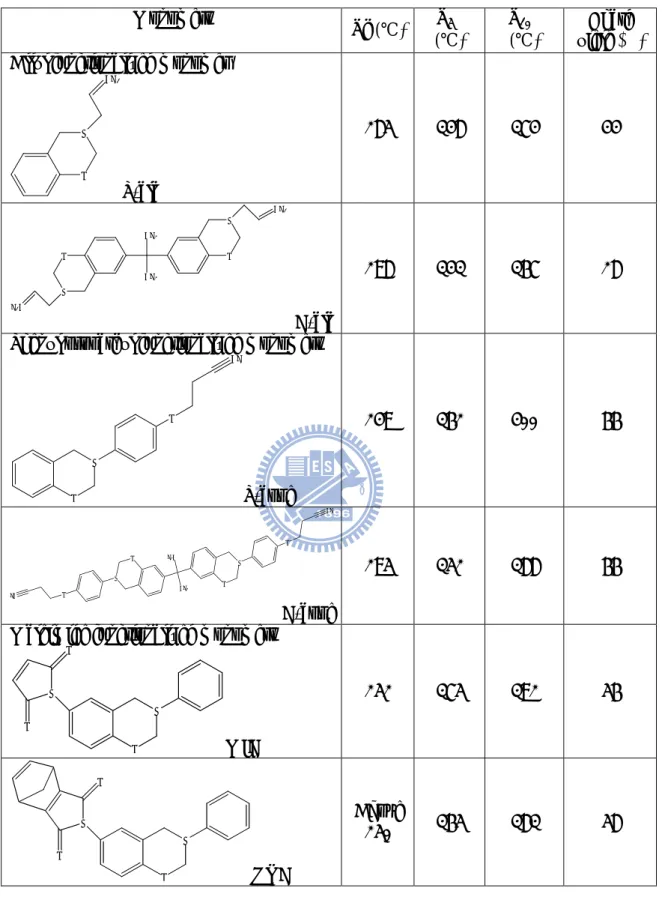
Table 1-2. Di-functional benzoxazine monomers. [8] CH3 H3C O N O N Ba CH3 H3C O N O N Ch3 H3C B-Pt CH3 H3C O N O N H4C CH3 B-mt CH3 H3C O N O N CH3 H3C B-ot CH3 H3C O N O N H4C CH3 H3C CH3 B-35m CH3 H3C O N O N CH3 H3C B-m O N O N 22P-a O O N N O 44O-a
1.2.3 Allyl-containing Benzoxazine Monomers
The main advantage of the allyl group [27,28] is not only that it provides additional crosslinkable sites, but that it can easily be cured at a temperature lower than that needed for acetylene groups. Allyl-containing monomers have attracted much attention because they are used as reactive diluentsof bismaleimides to improve the toughness of the cured resin [29,30]. The synthetic approaches adopted by Agag and Takeichi [31] for the preparation of two novel benzoxazine monomers modified with allyl groups which are shown in Scheme 1-4. It was reported that benzoxazines containing allyl group can polymerize at temperature below 150℃. However, the polymerization occurring at low temperature is from the allyl group, and a high temperature above 250℃ was needed to complete the polymerization of benzoxazine rings.
H2N CH2 CH2O CH3 CH3 OH HO N O CH2 OH CH3 CH3 O N O N CH2 H2C + B-ala P-ala
Scheme 1-4. Synthesis of allyl containing benzoxazine monomers.
1.2.4 Maleimide and Norbornane-containing Benzoxazine Monomers
A benzoxazine compound with a maleimide pendant (HPM-Ba) was prepared to achieve attractive processing and thermal properties. It was prepared from N-(4-hydroxyphenyl) maleimide (HPM), formaldehyde and aniline in dioxane medium at 30% yield. Another reported method uses 1,3,5-triphenylhexahydro- 1,3,5-triazine (TPTH). The reaction was performed through a solventless synthesis route where TPHT, aniline, and parafromaldehyde was mixed together and heated at 150℃ for 1.5 hrs. The yield of the final product, HPM-Ba, after washing and precipitation was 70%. Also, a nitrile group containing maleimide benzoxazine was synthesized to further improve thermal properties of polybenzoxazine resin. [32] The structures of benzoxazine monomers having maleimide and norborane functionality are shown in Table 1-3.
Table 1-3. Maleimidyl and Norbornyl Functional Benzoxazines. O N N R R: -H (HPM-Ba) -CN O N N O O NOB
1.3 Polymerization of Benzoxazines and Their Blends and Composites
The ring opening reaction of the benzoxazine was first reported by Burke et al. [26] In the reaction of 1,3-dihydrobenzoxazine with a phenol, having both ortho and
para positions free, it was found that aminoalkylation occurred preferentially at the
free ortho position to form a Mannich base bridge structure, along with small amount reaction at para position. To explain this ortho preference the formation of an intermolecular hydrogen-bonded intermediate species was proposed. The typical method of polymerization of benzoxazine monomers is thermal curing without any catalyst.
1.3.1 Photoinitiated Polymerization of Benzoxazines
The photoinitiated ring-opening cationic polymerization of a mono-functional benzoxazine, 3-phenyl-3,4-dihydro-2H-1,3-benzoxazine (Pa), with onium salts such as diphenyliodonium hexafluorophosphate and triphenylsulfonium hexafluoro- phosphate as initiators was investigated by Kasapoglu et al. [33] The phenolic mechanism also contributed, but its influence decreased with decreasing monomer concentration. Free radical promoted cationic polymerization of benzoxazine was also examined. The polymerization can be performed at much higher wavelengths and carbon-centered radicals formed from the photolysis of 2,2-diemthoxy-2- phenylacetophenone (DMPA),
were oxidized to produce carbocations. These carbocations are capable to initiate benzoxazine polymerizations. Scheme 1-5 describes that after addition of a proton (or carbocation) to the either heteroatom (oxygen or nitrogen) yields oxonium or ammonium cations, respectively.
N O O H N N O H+ B A B2B N O H N O H AB AA B1A OH OH N O O NH N O O N H B1B B2A N O N N O N N O O NH + + + + + + + + +
Scheme 1-5. Photoinitiated polymerization of N-phenyl-3,4-dihydro-2H-1,3-benzoxazine.
1.3.2 Thermal Polymerization of Benzoxazines
A cross-linked network structured polybenzoxazines, with higher Tg and degradation temperature, can be obtained when di-functional or multi-functional benzoxazines undergo polymerization. The polymeric structures form due to curing of mono-functional and di-functional benzoxazines are shown in Scheme 1-1. Di-functional benzoxazines derived from diamines are expected to undergo similar cross-linking. [34,35] It has been observed that during synthesis of a difunctional
benzoxazine (from bisphenol A, formaldehyde and methyl amine) not only bisphenol-A based benzoxazine (B-m) monomer forms as major product, but also dimmers and small oligomers form by the subsequent reactions between the rings and
ortho position of bisphenol A hydroxyl groups. These free phenolic hydroxyl structure
containing dimers and oligomers trigger the monomer to be self-initiated towards polymerization and cross-linking reactions. [36]
Curing reactions at two different temperatures below and above Tg temperature, demonstrate that the kinetics are significantly different for the two cure temperatures. Vitrification occurs sooner at higher cure temperature than the lower cure temperature, especially below the Tg. As vitrification causes a large increase in the viscosity of the system, at the reaction becomes largely diffusion controlled, and greatly affect the curing kinetics. [37]
The thermal properties of polybenzoxazines prepared from different benzoxazine monomers are list in Table 1-4. [8]
Table 1-4. Thermal properties of polybenzoxazines. Monomers Tg (℃) T 5%(℃) T10%(℃) Chard yield (%) O N Pa 146 342 369 44 CH3 CH3 O N O N Ba 150 310 327 32 CH3 CH3 O N O N CH3 H3C Bm 170 - - -CH3 CH3 O N O N CH3 CH3 B-ot 114 228 - 32 CH3 CH3 O N O N CH3 CH3 B-mt 209 350 - 31 CH3 CH3 O N O N CH3 H3C B-pt 158 305 - 32
Table 1-4 (continued) Monomers Tg (℃) T5% (℃) T10% (℃) yield (%)Chard Allyl functionalized monomer
O N CH2 P-ala 285 348 374 44 CH3 CH3 O N O N H2C CH2 B-ala 298 343 367 28
Phenyl propargyl functionalized monomers
O N O CH P-appe 249 362 400 66 O N O CH H3C CH3 O N O HC B-appe 295 352 388 66
Maleimide functionalized monomers
O N N O O MIB 252 375 392 56 O N N O O NOB Above 250 365 383 58
1.3.3 Properties of Epoxy- Polymbenzoxazine
For the improvement of the mechanical and water resistance properties of the cured resins from benzoxazine compounds and epoxy resins, terpendiphenol-based benzoxazines were synthesized and their curing with epoxy resins was investigated. [38] It has been observed that the curing reaction did not proceed below 150℃, but it proceeded quantitatively without curing accelerators above 180℃. The cured resins derived from terpendiphenol-based benzoxazines exhibited higher Tg, because of the hindrance of molecular chain mobility by the rigid and bulky cyclohexane ring from terpen backbone. The cured resins showed superior heat resistance, electrical insulation and specially water resistance properties compared with the epoxy resins cured by a bisphenol A novalac resin or Ba.
Agag et al. [39] described the curing behavior of an epoxy resin and benzoxaizne resin. The epoxy ring opened when they reacted with the hydroxyl groups that resulted from the ring opening of benzoxazines, and construct a network structure. For blends with equal functionality of oxirane to oxazine, the ring opening of benzoxazine and the partial curing of epoxy with hydroxyl functionality was indicated by a single exotherm at temperatures of about 240℃ in DSC thermograms. For the blends with higher molar ratio of epoxy, the homopolymerization of the residual epoxy resins with secondary hydroxyl groups, resulting from the ring opening of epoxide, [40] was observed by the second exotherm appears at 300℃ in the DSC plot.
In our previous study, a new class of PBZ was developed which exhibited extremely low surface free energies— even lower than that of pure Teflon (γs = 21
mJ/m2)— through strong intramolecular hydrogen bonding. [41-44] Furthermore, we applied the low surface free energy material polybenzoxazine as an efficient mold-release agent for silicon molds [45] and a stable superhydrophobic surface. [42] Typically, the surface free energy in PBZ system decreases initially and then increases steadily upon increasing the curing time, indicating that the surface free energy of PBZs is not stable during curing and annealing process. In order to overcome this problem, we designed the siloxane segment into benzoxazine to improve the stability of surface free energy during high temperature storage. [46] However, Liu [47] et al. found that the addition of soft segments, bis-propyl tetramethyl disiloxane, in benzoxazines usually results in lower Tg and poorer thermal properties. Ardhyananta et
al. developed a PBa-PDMS hybrids system by sol-gel process to improve the Tg above to 200℃. [48] Poly(imide-siloxane) was selected to blend into PBa to increase Tg was also discussed by Takeichi. [49] An imide-containing structure which was incorporated into benzoxazine could improve the thermal properties of PBZs.
In this study, we have discovered that the siloxane-imide–containing segment into benzoxazine. It possesses a relatively low surface free energy and better thermal and UV resistant properties than those polybenzoxazines lacking siloxane group after thermal crosslinking. Furthermore, the surface free energy of the polymerized polybenzoxazines is more stable during high temperature thermal curing process.
References
[1] Holly, F. W.; Cope, A. C. J. Am. Chem. Soc. 1944, 66, 1875. [2] Scheriber, H. Ger, Offen. 2225504, 1973; Offen. 2323936, 1973.
[3] Riess, G.; Schwob, J. M.; Guth, G.; Roche, M.; Lande, B. in “Advances in Polymer Science” (Eds B. M. Culbertson and J. E. Mcgrath), Plenum, New York, 1986. [4] Ning, X.; Ishida, H. J. Polym. Sci., Polym. Phys. Ed. 1994, 32, 921.
[5] Ishida, H. J. Appl. Polym. Sci. 1995, 58, 1751.
[6] Burke, W. J.; Murdoch, K. C.; Ec, G. J. Am. Chem. Soc. 1954, 76, 1677. [7] Burke, W. J.; Glennie, E. L. M.; Weatherbee, C. J. Org. Chem.1964, 24, 909. [8] Ghosh, N. N.; Kiskan, B.; Yagci, Y. Porg. Polym. Sci. 2007, 32, 1344. [9] Shen, S. B.; Ishida, H. J. Appl. Polym. Sci .1996, 61, 1595.
[10] Dunkers, J.; Ishida, H. J. Polym. Sci. Part A: Polym. Chem. 1999, 37, 1913. [11] Ning, X.; Ishida, H. J. Polym. Sci., Part A: Polym. Chem. 1994, 32, 1121.
[12] Takeichi, T.; Komiya, I.; Takayama, Y. Kyoka-Purasutikkus (in Japanese) 1997,
43, 109.
[13] Wang, Y. X.; Ishida, H. Polymer 1999, 40, 4563. [14] Macko, J. A.; Ishida, H. Polymer 2001, 42, 227.
[15] Furukawa,N. Benzoxazine-based thermosetting polymers and their manufacture,
compositions, and heat- and fire-resistant dielectric cured products with low water absorption. Jpn. Kokai Tokkyo Koho, 2004, p18.
[16] Wang,Y. X.; Ishida, H. Polym. mater. sci. eng. 1999, 80, 211.
[17] Ishida, H.; Allen, D. J. J. Polym. Sci., Part B: Polym. Phys. 1996, 34, 1019. [18] Kim,H. D.; Ishida, H. J. Appl. Polym. Sci. 2001, 79, 1207.
[19] Macko,J.; Ishida, H. J. Polym. Sci., Part B: Polym. Phys. 2000, 38, 2687. [20] Ishida,H.; Low, H. Y. Macromolecules 1997, 30, 1099.
[21] Ishida,H.; Rodriguez, Y. Polymer 1995, 36, 3151. [22] Nair, C. P. R. Prog. Polym. Sci. 2004, 29, 401.
[23] Agag,T.; Takeichi, T. Macromolecules 2001, 34, 7257. [24] Burke, W. J. J. Am. Chem. Soc.1949, 71, 609.
[25] Burke, W. J.; Bisshop, J. L.; Glennie, E. L. M.; Bauer, W. N. J. Org. Chem.1965,
30, 3423.
[26] Liu, J.; Ishida, H.; In: Salamone, J. C. A new class of phenolic resins with
ring-opening polymerization. The polymeric materials encyclopedia. Florida:
CRC Press 1996, 484.
[27] Andre, S.; Guida-Pietrasanta, F.; Rousseau, A.; Boutevin, B.; Caporiccio, G. J.
Polym. Sci., Part A: Polym. Chem. 2000, 38, 2993.
[28] Lin, K. F.; Lin, J. S.; Cheng, C. H. J. Polym. Sci., Part A: Polym. Chem. 1997, 35, 2469.
[29] Liang, G. Z.; Gu, A. J. Polym. J. 1997, 29, 553.
[30] Gouri, C.; Nair, C. P. R.; Ramaswamy, R. High Perform. Polym. 2000, 12, 497. [31] Agag, T.; Takeichi, T. Macromolecules 2003, 36, 6010.
[32] Thanyalak Chaisuwan H. I. J. Appl. Polym. Sci. 2006, 101, 548.
[33] Kasapoglu, F.; Cianga, I.; Yagci, Y.; Takeichi, T. J. Polym. Sci., Part A: Polym.
Chem. 2003, 41, 3320.
[34] Xiang, H.; ling, H.; Wang, J.; Song, L.; Gu, Y. Polym. Compos. 2005, 26, 563. [35] Lee, Y. H.; Allen, D. J.; Ishida, H. J. Appl. Polym. Sci. 2006, 100, 2443. [36] Ning, X; Ishida, H. J. Polym. Sci., Part A: Polym. Chem. 1994, 32, 1121.
[37] Russell, V. M.; Koening, J. L.; Low, H. Y.; Ishida, H. J. Appl. Polym. Sci. 1998,
70, 1413.
Appl. Polym. Sci. 1999, 74, 2266.
[39] Agag, T.; Takeichi, T. Perform. Polym. 2002, 14, 115. [40] Agag, T.; Takeichi, T. Polymer 1999, 40, 6557.
[41] Wang, Y. X.; Ishida, H. J. Appl. Polym. Sci. 2001, 79, 2331.
[42] Wang, C. F; Wang, Y. T; Tung, P. H.; Kuo, S. W.; Lin, C. H.; Sheen, Y. C. and Chang, F. C. Langmuir 2006, 22, 8289.
[43] Liao, C. S.; Wu, J. S.; Wang, C. F. and Chang, F. C. Macromol Rapid Commun
2008, 29, 56.
[44] Liao, C. S.; Wang, C. F.; Lin, H. C.; Chou, H. Y. and Chang, F. C., J Phys Chem C
2008, 112, 16189.
[45] Wang, C. F.; Chiou, S. F.; Ko, F. H; Chen, J. K.; Chou, C. T.; Huang, C. F.; Kuo, S. W. and Chang, F. C. Langmuir 2007, 23, 5868.
[46] Chen, K. C.; Li, H. T.; Chen, W. B. and Huang, S. C. 11th Pacific Polymer Conference 2009.
[47] Liu, Y. L.; Hsu, C. W. and Chou, C. I. J Polym Sci Part A: Polym Chem 2007, 45, 1007.
[48] Ardhyananta, H.; Wahid, M. H.; Sasaki, M.; Agag, T.; Kawauchi, T.; Ismail, H. and Takeichi, T. Polymer 2008, 49, 4585.
[49] Takeichi, T.; Agag, T. and Zeidam, R. J Polym Sci Part A: Polym Chem 2001, 39, 2633.
Chapter 2
Synthesis of Siloxane-Imide-Containing Benzoxazines
Holly and Cope [1] first reported the condensation reaction of primary amines with formaldehyde and substituted phenols for the synthesis of well defined benzoxazine monomers. Benzoxazine monomers are typically synthesized using phenol, formaldehyde and amine (aliphatic or aromatic) as starting materials either by employing solution or solventless methods. Various types of benzoxazine monomer can be synthesized using various phenols and amines with different substitution groups attached. These substitution groups can provide additional polymerizable sites and also affect the curing process. Consequently, polymeric materials with desired properties may be obtained by tailoring the benzoxazine monomer. Mono-functional, di-functional and multifunctional benzoxazine monomers could be obtained from different designed starting materials. [2]
In this section, we prepared different molecular weight of di-functional siloxane-imide-containing benzoxazine monomers from synthesized siloxane-containing dihydroxyl precursors and aniline and paraformaldehyde.
2.1 Synthesis of Siloxane-Imide-Containing Benzoxazine (BZ-A1)
2.1.1 Materials and Characterization
1, 4-Dioxane and paraformaldehyde (95%) were purchased from TEDIA (USA) and Showa Chemicals (Japan), respectively. Ethyl acetate (99.9%) was used as received from Mallinckrodt, Inc. (USA). Aniline (99%), ethylene glycol (≥99%), and diiodomethane (99%) were obtained from Aldrich (USA). The bifunctional bisphenol
A–type benzoxazine (Ba, Figure 2-1) was purchased from Shikoku Chemicals (Japan). CH3 CH3 N O N O
Figure 2-1. Structure of the bifunctional bisphenol A–type benzoxazine Ba.
FTIR spectra were recorded using a Nicolet Avatar 320 FTIR Spectrophotometer. The sample was prepared by casting the BZ-A1 monomer solution directly onto a potassium bromide plate and evaporated THF at 50℃ under vacuum. The spectrometer was operated in transmission mode utilizing the 32 scans at a resolution of 2 cm-1. 1H NMR spectra were recorded using a Varian UNITY Inova-400NMR Spectrometer operating at a proton frequency of 400 MHz and CDCl3 as the solvent. Molecular
weights were determined using a TRIO-2000 liquid chromatograph/mass spectrometer and a DB-5MS column.
2.1.2 Synthesis of the siloxane-containing dihydroxyl (A1-OH)
The siloxane-imide–containing dianhydride A1 and the siloxane-containing dihydroxyl compound A1-OH were synthesized according to the method reported by Li et al. [3] (Scheme 2-1). The siloxane— imide-containing dianhydride (A1) (30g, 0.065 mol) was dissolved in 90ml of dimethyl-formamide (DMF), and 4-aminophenol (14.9g, 0.136mol) in 40ml of DMF was gradually added. The solution was stirred for 6 hrs at ice-bath conditions, followed by imidization using a Dean-Stark instrument at 130℃ reflux for 4 hrs. A 1-OH in solid powder was obtained after vacuum drying, and
it was recrystallized from isopropanol (38g, yield = 91%, mp = 123℃). O O O Si O Si O O O Si Si CH3 CH3 CH3 CH3 H H O O O + 2 Pt Toluene, 80oC A1 CH3 CH3 O CH3 CH3 HO N O O Si O Si N O O OH O O O Si O Si O O CH3 CH3 O CH3 CH3 OH H2N + 2 -2H2O CH3 CH3 CH3 CH3 A1-OH DMF
Scheme 2-1. Preparation of the siloxane-imide–containing dianhydride (A1) and dihydroxyl compound (A1-OH)
The chemical structure of the light brown powder, A1-OH, was confirmed from
1H-NMR and FT-IR. 1H-NMR (CDCl
3, ppm) δ: 0.01-0.02 (m, 12H), 0.61 (m, 2H),
1.54-1.62 (m, 8H), 2.74 (m, 2H), 2.78 (m, 2H), 3.12-3.17 (m, 4H), 6.70-6.73 (d, 4H), 6.90-6.94 (d, 4H), 7.42 (s, 2H). FT-IR: imide 1789 and 1720 cm-1, OH 3100-3500 cm-1 (yield: 88%)
2.1.3 Synthesis of the siloxane-imide–containing benzoxazine
N,N´-bis(N-phenyl-3,4-dihydro-2H-benzo[1,3]oxazine)-5,5´-bis(1,1´,3,3´-tetrameth
yldisiloxane-1,3-diyl)-bis(norborane-2,3-dicarboximide) (BZ-A1)
Aniline (1.88 g, 0.02 mol) was added dropwise into a mixture of A1-OH (6.44 g, 0.01 mol), paraformaldehyde (1.26 g, 0.04 mol), and 1,4-dioxane (100 mL) in a 250-mL round-bottom flask equipped with a magnetic stirrer bar. (Scheme 2-2) The mixture was then heated under reflux at 115 °C for 20 hrs, and gradually became homogeneous and turning dark brown. The resulting mixture was filtered and the solvent was evaporated under vacuum. The residue was dissolved in ethyl acetate and
washed five times sequentially with 1 N aqueous NaOH and distilled water. Evaporation of the solvent and vacuum drying in an oven provided BZ-A1 as a brown powder (73.0%). A1-OH NH2 O N O O Si O Si N O O N O N CH 3 CH3 CH3 CH3 1 2 4 + + 1,4-dioxane reflux/ 20hrs BZ-A1 Si O Si CH3 CH3 CH3 CH3 N N O O O O O H OH Si O Si CH3 CH3 CH3 CH3 N N O O O O O H OH HCHO -2H2O
Scheme 2-2. Preparation of the siloxane-imide–containing benzoxazine monomer BZ-A1 from A1 and A1-OH
BZ-A1 was prepared according to Scheme 2 and its chemical structure was confirmed using FT-IR and 1H NMR spectroscopies and liquid chromatography/mass spectrometry (LC-MS). The IR spectrum of BZ-A1 (Figure 2-2) displays characteristic absorptions of a benzoxazine structure at 1498 cm–1and 1030 cm–1 (vibrations of the trisubstituted benzene ring), 1328 cm–1 (CH2 wagging of the oxazine unit) and 1230
cm–1 (asymmetric C–O–C stretching). The 1H NMR spectrum of BZ-A1 (Figure 2-3) displays aromatic protons at 6.60–7.40 ppm and characteristic peaks attributed to methylene units (oxazine Ar-CH2-N) at 5.30 and 4.60 ppm, respectively. LC-MS
(Figure 2-4) provided a molecular weight of 881.1 g/mol, consistent with the calculated formula weight.
4000 3500 3000 2500 2000 1500 1000 500 1498cm-1 1328cm-1 O N O O Si O Si N O O N O N CH3 CH3 CH3 CH3 v (cm-1) T ( % ) 1030cm-1 1230cm-1
Figure 2-2. IR spectrum of the siloxane-imide–containing benzoxazine BZ-A1.
Figure 2-3. 1H NMR spectrum of the siloxane-imide–containing benzoxazine BZ-A1.
8 6 4 2 0 ppm a b c f h de g m benzene i, j,k l O N O O Si O Si N O O N O N CH 3 CH3 CH3 CH3 a b c d e f m g h i j k l 8 6 4 2 0 ppm a b c f h de g m benzene i, j,k l O N O O Si O Si N O O N O N CH 3 CH3 CH3 CH3 a b c d e f m g h i j k l
m/z 100 200 300 400 500 600 700 800 900 1000 1100 1200 1300 1400 1500 1600 1700 1800 1900 % 0 100 x15 2.01e6 108.12 266.08 299.31 401.97 406.37 714.67 568.27 881.09
2.2 Synthesis of Siloxane-Imide-Containing Benzoxazine (BZ-A6)
2.2.1 Materials
5-Norbornene-2, 3-dicarboxylic anhydride (nadic anhydride) was purchased from Alfa Aesar (USA). Hydride-terminated polydimethylsiloxane, DMS-H03, was purchased from Gelest (USA) with molecular weight of ca. 400–500. Platinum divinyltetramethyldisiloxane complex was purchased from Gelest (USA). All chemicals were purified prior to use. 1,4-Dioxane and paraformaldehyde (95%) were purchased from TEDIA (USA) and Showa Chemicals (Japan), respectively. Ethyl acetate (EtOAc, 99.9%) was used as received from Mallinckrodt (USA). Aniline (99%), ethylene glycol (EG, ≥99%), and diiodomethane (DIM, 99%) were obtained from Aldrich (USA).
2.2.2 Synthesis of dinoborane anhydride terminated polydimethylsiloxane (A6)
The synthesis of the siloxane-imide–containing dianhydride A1 has been reported in the literature. [3, 4] The higher-molecular-weight siloxane-imide– containing dianhydride, which is called A6, was prepared with reference to these previous methods. Pt catalyst (0.8 mL) was added dropwisely into a solution of nadic anhydride (82.1 g) in toluene (400 mL) in a three-neck round-bottom flask while stirring with a magnetic stirrer bar. DMS-H03 (112.5 g) was gradually added into the solution and then heated react to 70 °C for 48 hrs. The resulting mixture was filtered and the solvent was evaporated under vacuum. After the removal of residue nadic anhydride, A6 was obtained as a transparent liquid (yield: 75.0%). The chemical structure of the transparent liquid product, A6, was confirmed with 1H-NMR (Varian UNITY Inova-400NMR spectrometer) and FT-IR (Perkin Elmer, Spectrum one). 1H-NMR
(CDCl3, 400 MHz) δ: 0.03~0.05 ppm (12H, CH3–Si–CH3), 0.65 ppm (2H, –CH–Si–),
1.55~1.66 ppm (8H, cyclopentane CH2), 3.39~3.43 ppm (4H, –C(=O)). FT-IR (KBr):
1859 cm-1, 1778 cm-1 (anhydride, C=O stretching), 1222 cm-1 (C–Si stretching), 1078 cm-1 (Si–O–Si stretching); no 1680 cm-1 (norborane, C=C stretching) or 2150 cm-1 (Si–H, stretching).
2.2.3 Imidization of siloxane-imide–containing dianhydride (A6-OH)
4-Aminophenol (5.3 g, 0.0484 mol) in DMF (30 mL) was added gradually to a stirred solution of the siloxane-imide–containing dianhydride A6 (16.5 g, 0.022 mol) in dimethylformamide (DMF, 30 mL) in a 250-mL round-bottom flask (Scheme 2-3). The solution was stirred for 6 hrs in an ice-bath and the imidization was performed using a Dean–Stark apparatus. A6-OH was obtained as a viscous dark brown liquid after vacuum drying (yield: 86.8%). 1H-NMR (CDCl3) δ: 0.03~0.08 ppm (12H,
CH3–Si–CH3), 0.65 ppm (2H, –CH–Si–), 1.55~1.66 ppm (8H, cyclopentane CH2), 6.23
ppm (2H, aromatic C–OH), 6.73~6.96 ppm (8H, benzene). FT-IR (KBr): 1720 cm-1 (imide), 3100~3500 cm-1 (OH, broad band).
2.2.4 Synthesis of siloxane-imide-containing benzoxazine (BZ-A6)
Aniline (3.8 g, 0.04 mol) was added dropwisely into a mixture of A6-OH (18.95 g, 0.02 mole), paraformaldehyde (2.4 g, 0.08 mole), and 1,4-dioxane (120 ml) in a 250 ml round-bottom flask equipped with a magnetic stirrer bar (Scheme 2-4). The mixture was then heated under reflux at 115 °C for 20 hrs, gradually becoming homogeneous and turning dark brown. The resulting mixture was filtered and the solvent was evaporated under vacuum. The residue was dissolved in ethyl acetate and washed five times sequentially with 0.5 N aqueous NaOH and distilled water. Evaporation of the
solvent and vacuum drying in an oven provided BZ-A6 as a viscous dark brown liquid product (yield: 87.7%). 1H-NMR (CDCl3) (Figure 2-5) δ: 6.70~7.30 ppm (aromatic
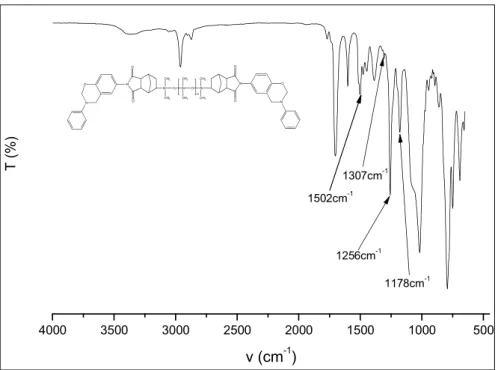
protons), 5.35 ppm (OCH2N), 4.65 ppm (Ar–CH2–N). FT-IR (KBr) (Figure 2-6): 1256
cm-1 (C–O–C, stretching), 1178 cm-1 (C–N–C, stretching), 1307 cm-1 (CH2, wagging of
oxazine), 1502 cm-1 (trisubstituted benzene ring).
8 7 6 5 4 3 2 1 0 e d e d c c Si CH3 CH3 O Si CH3 CH3 O Si CH3 CH3 N N O O O O O O N N n a ppm a a b b benzene b m m
4000 3500 3000 2500 2000 1500 1000 500 Si CH3 CH3 O Si CH3 CH3 O Si CH3 CH3 N N O O O O O O N N n 1178cm-1 1502cm-1 v (cm-1) T ( % ) 1256cm-1 1307cm-1
O O O 2 + Si CH3 CH3 O Si CH3 CH3 O Si CH3 CH3 O O O O O O n Si CH3 CH3 O Si CH3 CH3 O Si CH3 CH3 H n Pt complex toluene/ 70 deg.C A6 H Si CH3 CH3 O Si CH3 CH3 O Si CH3 CH3 O O O O O O OH NH2 -2H2O Si CH3 CH3 O Si CH3 CH3 O Si CH3 CH3 N N O O O O OH HO n + n 2 DMS-H03 A6 A6-OH DMF
Scheme 2-3. Syntheses of compounds A6 and A6-OH
Si CH3 CH3 O Si CH3 CH3 O Si CH3 CH3 N N O O O O OH HO NH2 Si CH3 CH3 O Si CH3 CH3 O Si CH3 CH3 N N O O O O O O N N n 2 + 4 1,4-dioxane/ reflux -2H2O 1 + n HCHO A6-OH BZ-A6
References
[1] Holly, F. W.; Cope, A. C. J. Am. Chem. Soc. 1944, 66, 1875.
[2] Ghosh, N. N.; Kiskan, B.; Yagci, Y. Porg. Polym. Sci. 2007, 32, 1344. [3] Li, H.T; Chang H.R.; Wang, M. W; and Lin, M. S. Polym Int 2005, 54, 1416.
[4] Eddy, V. J; Hallgren, J. E. and Robert, E. J Polym Sci Part A: Polym Chem 1990,
Chapter 3
Curing Behavior of Siloxane-Imide-Containing Benzoxazines
To understand the polymerization reaction of benzoxazines, an understanding of the chemical structure of its oxazine ring is very important. The ring opening of the benzoxazine was first discussed by Burke et al. [1] In the reaction of 1,3-dihydrobenzoxazine with a phenol, having both ortho and para position free, it was found that aminoalkylation occurred preferentially at the free ortho position to form a Mannich base bridge structure, along with small amount reaction at para position. A cross-linked network structured polybenzoxazines, with higher Tg and degradation temperature, can be obtained when benzoxazines undergo polymerization. It has been observed that during synthesis of a difunctional benzoxazine (from bisphenol A, formaldehyde and aniline) form by the subsequent reactions between the rings and ortho position of bisphenol A hydroxyl groups. These free phenolic hydroxyl structure containing dimmers and oligomers trigger the monomer to be self-initiated towards polymerization and crosslinking reactions. [2] The curing behavior of siloxane-imide-containing benzoxazines, BZ-A1 and BZ-A6, are discussed in this section.
3.1 Curing behavior of the siloxane-imide–containing benzoxazine BZ-A1
Typically, benzoxazines undergo exothermic ring opening reactions at ca. 200–250 °C, which can be monitored using DSC. DSC was performed using a TA Instrument DSC-Q10 apparatus operated at a heating rate of 10 °C/min under a N2
atmosphere. The gas flow rate was 40ml/ min. Benzoxazine samples of approximately 5 mg were scanned in hermetic aluminum sample pans. The reaction point of the bisphenol A–type benzoxazine Ba is 228.7 °C; the energy of the exothermic ring opening reaction is 296.0 J/g (Figure 3-1). The thermogram of BZ-A1 in Figure 3-1 reveals a ring opening exothermic reaction having an onset temperature at 194.9 °C and a peak point at 232.7 °C. The exothermic energy of BZ-A1 is 173.7 J/g; i.e., it is lower than that of Ba, presumably due to molecular weight effect, molecular weight of BZ-A1 (879 g/mol) is significantly higher than that of Ba (462 g/mol). The PBZs of Ba (PBa) and BZ-A1 (PBZ-A1) were then cured in an oven under the curing conditions listed in Table 3-1. 228.69°C 208.74°C 296.0J/g 173.68°C 282.45°C 232.73°C 194.91°C 173.7J/g 173.68°C 286.71°C -1.5 -1.0 -0.5 0.0 0.5 1.0 1.5 2.0 2.5 H ea t F lo w ( W /g ) 100 150 200 250 300 Temperature (°C) Ba ––––––– BZ-A1 – – – –
Exo Up Universal V4.4A TA Instruments
Figure 3-1. DSC thermograms of Ba and BZ-A1. Table 3-1. Curing conditions for PBZs
Benzoxazine Ba BZ-A1
200 °C/2 hrs + 230 °C/2 hrs 200 °C /2 hrs + 230 °C/4 hrs Curing conditions
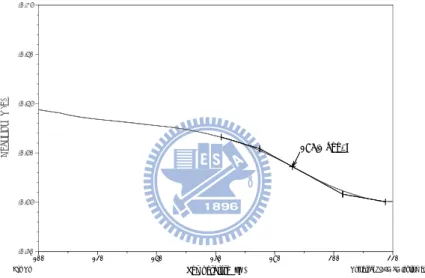
PBZs usually exhibit good thermal properties after polymerization. [3] The glass transition temperature of PBZ-A1 after cross-linking was 186.1 °C (Figure 3-2), which is substantially higher than that of typical PBZs (PBa: Tg= 150.0 ℃). [4] In general,
the longer and flexible of siloxane segments in the matrix structure results in lower of Tg(Tg from tan δ peak of CP-F-Bz/BATMS-Bz-100 is 116 ℃) as discussed by Liu et
al. [5] Our PBZ-A1 structure features both siloxane and imide segments in the benzoxazine monomer where the imide segment tends to raise the glass transition temperature. 186.1 deg. C -0.60 -0.55 -0.50 -0.45 -0.40 -0.35 H e a t F lo w ( W /g ) 100 120 140 160 180 200 220 Temperature (°C)
Exo Up Universal V4.4A TA Instruments
Figure 3-2. Glass transition temperature (Tg) of PBZ-A1, determined from the DSC
trace.
3.2 Curing behavior of the siloxane-imide–containing benzoxazine BZ-A6
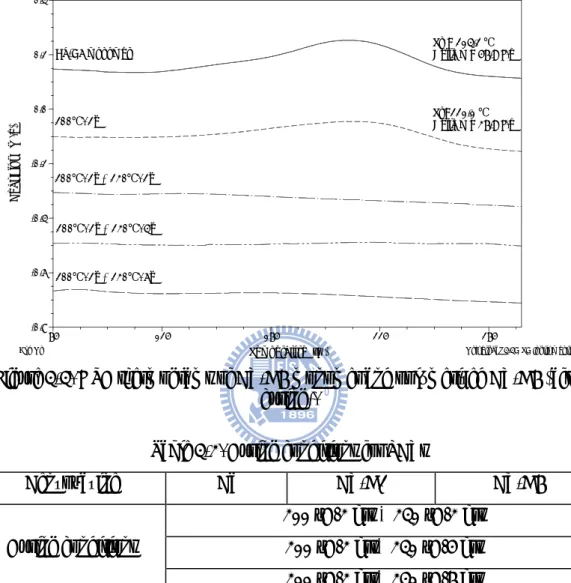
In general, benzoxazines undergo exothermic ring opening at temperatures of ca. 200–250 °C [6-9] which can be monitored using DSC. The thermogram of BZ-A6 in Figure 3-3 reveals a ring opening exothermic reaction having an onset temperature at 153.7 °C and a peak maximum at 214.2 °C with exothermic energy of 57.9 J/g. After curing at 200℃ for 2 hrs, the reaction heat is decreased to be 37.9 J/g from 57.9 J/g. We performed the polymerization of BZ-A6 using a two-step process; the first step
involved benzoxazine ring opening at 200 °C and the second involved post curing at a 230 °C. PBZs were cured in an oven under the curing conditions listed in Table 3-2.
BZ-A6 monomer 200℃/ 2h Tp = 214.2 ℃ Delta H = 57.9 J/g Tp=221.1 ℃ Delta H = 37.9 J/g 200℃/ 2h + 230℃/ 2h 200℃/ 2h + 230℃/ 4h 200℃/ 2h + 230℃/ 6h -0.8 -0.6 -0.4 -0.2 0.0 0.2 0.4 H e a t F lo w ( W /g ) 75 125 175 225 275 Temperature (°C)
Exo Up Universal V4.4A TA Instruments
Figure 3-3. DSC thermograms of BZ-A6 monomer and polymerized BZ-A6 (after curing).
Table 3-2. Curing conditions for PBZs
Benzoxazine Ba BZ-A1 BZ-A6
200 °C/2 hrs + 230 °C/2 hrs 200 °C/2 hrs+ 230 °C/4 hrs Curing conditions
References
[1] Burke, W. J.; Bishop, J. L.; Glennie, E. L. M.; Bauer, W. N. J. Org. Chem.1965, 30, 3423.
[2] Ning, X.; Ishida, H. J. Polym. Sci., Part A: Polym. Chem. 1994, 32, 1121. [3] Ghosh, N. N.; Kiskan, B. and Yagci, Y. Prog Polym Sci 2007, 32, 1344. [4] Ishida, H. and Allen, D. J. J Polym Sci Part B: Polym Phys 1996, 34, 1019.
[5] Liu, Y. L.; Hsu, C. W. and Chou, C. I. J Polym Sci Part A: Polym Chem 2007, 45, 1007.
[6] Chen, K. C.; Li, H. T.; Chen, W. B.; Liao, C. H.; Sun, K. W. and Chang, F. C.
Polym Int in press
[7] Takeichi, T.; Kano, T and Agag, T. Polymer 2005, 46, 12172. [8] Agag, T. and Takeichi, T. Macromolecules 2003, 36, 6010.
[9] Takeichi, T.; Agag, T. and Zeidam, R. J Polym Sci Part A: Polym Chem 2001, 39, 2633.
Chapter 4
Thermal/ Mechanical Properties of
Siloxane-Imide-Containing Polybenzoxazines
The physical, mechanical and thermal properties of polybenzoxazines are primarily decided by the nature of the diphenol and diamine. The properties of polybenzoxazines are shown to compare very favorably with those of conventional phenolic and epoxy resins. DMA reveals that these candidate resins for composite applications possess high modulus and glass transition temperatures. Long-term immersion studies indicate that they have low water absorption and loe saturation compact. Impact, tensile and flexural properties are also good. [1] BZs are cured usually in the temperature window of 160-220℃. The polymer exhibit Tg in the range 160-340℃ depending on the structure, and have higher stability. The high TGA decomposition onset temperature and char yield are attributed to the very strong intramolecular H-bonding between phenolic OH and the Mannich bridge. [2]
In this section, we discussed the thermal and mechanical properties of polymerized siloxane-imide-containing PBZ-A1 and PBZ-A6.
4.1 Thermal stability of the poly-siloxane-imide–containing benzoxazine PBZ-A1
4.1.1 Materials and Characterization
The bifunctional bisphenol A–type benzoxazine (Ba, Figure 4-1) was purchased from Shikoku Chemicals (Japan). The siloxane-imide-containing benzoxazine, BZ-A1, was synthesized from the according method in chapter 2, the structure is shown in
Figure 4-2. DSC was performed using a TA Instrument DSC-Q10 apparatus operated at a heating rate of 10 °C/min under a N2 atmosphere. The gas flow rate was 40ml/ min.
Benzoxazine samples of approximately 5 mg were scanned in hermetic aluminum sample pans. TGA was performed using a TA Instrument TGA-Q500 apparatus operated at a heating rate of 20 °C/min under an atmosphere of N2 or air, respectively.
An energy dispersive system (EDS) was used for element test, which was recorded using an LEO-1530 FE-SEM system.
CH3 CH3 N O N O
Figure 4-1. Structure of the bifunctional bisphenol A–type benzoxazine Ba.
O N O O Si O Si N O O N O N CH3 CH3 CH3 CH3 BZ-A1
Figure 4-2. Structure of the BZ-A1.
4.1.2 TGA of the poly-siloxane-imide–containing benzoxazine PBZ-A1
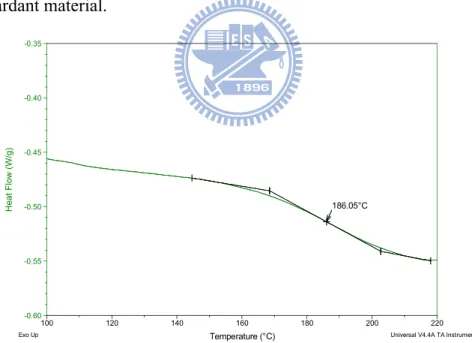
PBZs usually exhibit good thermal properties after polymerization. [3] The glass transition temperature of PBZ-A1 after cross-linking was 186.1 °C (Figure 4-3), which is substantially higher than that of typical PBZs (PBa: Tg= 150.0 ℃). [4] In general,
the longer and flexible of siloxane segments in the matrix structure results in lower of Tg(Tg from tan δ peak of CP-F-Bz/BATMS-Bz-100 is 116 ℃) as discussed by Liu et
benzoxazine monomer where the imide segment tends to raise the glass transition temperature.
Bisphenol-A is one of the phenolic compounds often used as the starting material for the synthesized of polybenzoxazines. PBa shows high decomposed temperature (T5% c.a. 300-330 ℃) and high char yield (c.a. 30-42 %) from TGA. [3, 6-9] Liu et al.
[5] investigated that siloxane-containg polybenzoxaizne, CP-F-Bz/BATMS-Bz-100, has Td at 369℃ in air. Figure 4-4 displays TGA thermograms recorded in air and
results are summarized in Table 4-1. The 5% and 10% weight loss temperatures (T5% loss and T10% loss, respectively) for PBZ-A1 cured at 200 °C/ 2hrs and 230 °C/ 2hrs were
380.1 °C and 441.1 °C, respectively, which are both higher than those of PBa or siloxane-containing polybenzoxazine. The PBZ-A1 shows higher thermal stability than PBa because of the presence of the siloxane-imide–containing segment. In Liu et al. siloxane-containing polybenzoxazine TGA study, they found high thermal stability silica layers formation during the thermal oxidation process and the layer structured protect the polybenzoxazine. [10] PBa-PDMS hybrids was investigated that introduced PDMS into PBa results in the improvement of thermal stability of the hybrid. [11] The better thermal stability of PBZ-A1 with higher decomposed temperature and high char amount is come from siloxane and imide group.
In contrast, the presence of siloxane-imide groups improved the thermo-oxidative stability of the benzoxazine by increasing the char yield to 10–12 wt% in air. This char yield is close to the content of inorganic content (Si–O–Si, 8.2%) in the BZ-A1 structure. EDS analysis was employed to analyze the elemental composition of the PBZ-A1 residue after TGA testing in air. Figure 4-5 displays an image of the residue from PBZ-A1 and its EDS data. The silicone content in the residue was significantly higher than those of C and O atom, the residue from PBZ-A1 after TGA testing in air
was primarily inorganic in nature. Thus, the siloxane units of BZ-A1 provide an inorganic content in its structure, therefore, improve its thermo-stability properties after cross-linking.
The same phenomena occurred in the TGA thermograms recorded under a N2
atmosphere (Figure 4-6, Table 4-2). The 5% weight loss temperature of PBa was ca. 328–337 °C under the N2 atmosphere, whereas that of PBZ-A1 was significantly
higher (ca. 355–362 °C). The temperatures for 5 and 10 wt% losses of PBZ-A1 were both higher than those for PBa. PBZ-A1 also featured a high weight residue after high temperature decomposition. The char yield of PBZ-A1 after curing at 200 °C for 2 hrs and then 230 °C for 2 hrs was high (48.0 %), i.e., it was improved by the presence of the siloxane-imide groups. It appears that the PBZ-A1 has the potential use as flame-retardant material. 186.05°C -0.60 -0.55 -0.50 -0.45 -0.40 -0.35 H ea t F lo w ( W /g ) 100 120 140 160 180 200 220 Temperature (°C)
Exo Up Universal V4.4A TA Instruments
Figure 4-3. Glass transition temperature (Tg) of PBZ-A1, determined from the DSC