On Nonblocking Multicast Three-Stage
Clos Networks
Frank K. Hwang and Sheng-Chyang Liaw
Abstract—We give necessary and sufficient conditions for
strictly nonblocking three-stage Clos networks with two types of multicast traffic. Then, we extend the results to other models where the routing is under certain restrictions. Finally, we com-pare our results with existing literature to mark the differences and similarities.
Index Terms—Multicast traffic, strictly nonblocking, switching
networks, wide-sense nonblocking.
I. INTRODUCTION
M
ASSON and Jordan [6] first considered nonblocking net-works for multicast, or -cast, traffic in which a re-quest consists of a simple idle inlet and idle outlets where and is a given upper bound. Actually there are two different types of multicast traffic. In the bundled type, all outlets of the request are specified simultaneously. A possible scenario is a conference call. In the incremental type, the out-lets can join the request one by one. A possible scenario is the video program ordering service. For the second type, we should redefine a multicast request as a pair of inlet, outlet such that the outlet must be idle while the inlet can be already connected to up to outlets. Although most of the literature do not mention this difference, one can usually detect which type they have in mind by inspecting the proofs. We highlight this differ-ence as we will show they can cause not only quantitative but also qualitative differences.In this paper we will only be concerned with the three-stage
Clos network (in Cantor’s notation [1])
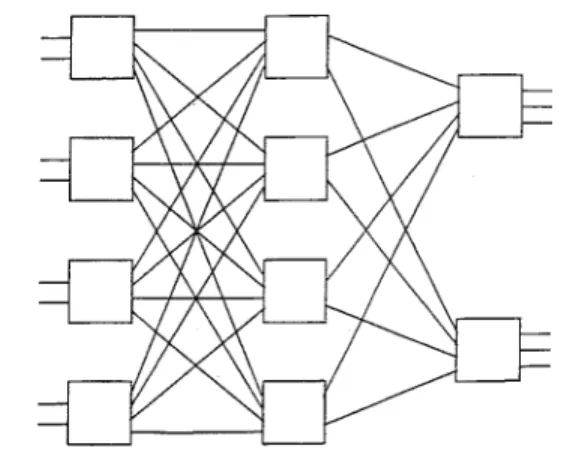
where the input stage consists of crossbars of size , the center stage crossbars of size , the output stage crossbars of size , and the connection of the crossbars between the input (output) stage and the center stage is a com-plete bipartite graph. Fig. 1 shows .
A state of a network is a routing of a set of requests. A state is a blocking state if there exists a new request which cannot be routed. A network is strictly nonblocking (SNB) if it has no blocking state; it is wide-sense nonblocking (WSNB) if it can avoid getting into a blocking state, usually by following a routing algorithm.
Manuscript received August 22, 1997, revised November 30, 1998; approved by IEEE/ACM TRANSACTIONS ONNETWORKINGEditor H. S. Kim. This work was supported in part by the National Science Council of the Republic of China under Grant NSC87-2119-M009-002.
F. K. Hwang is with the Department of Applied Mathematics, Na-tional Chiao Tung University, Hsinchu 30010, Taiwan, R.O.C. (e-mail: [email protected]).
S.-C. Liaw was with the Department of Applied Mathematics, National Sun Yat-Sen University, Kaohsiung 80424, Taiwan, R.O.C. He is now with the Department of Mathematics, National Central University, Chung-li, Taiwan, R.O.C.
Publisher Item Identifier S 1063-6692(00)06794-7.
Fig. 1. Three-stage Clos network.
Suppose a request contains two outlets of the same output switch. Under the no-split assumption, the two paths to these two outlets cannot split before the output stage. This is a very natural assumption and was widely adopted in early literature. Masson and Jordan [6] gave a sufficient condition on such that the network is SNB with incremental multicast traffic under the no-split assumption. As the no-split assumption can be considered as a rule of a routing algorithm, their result is now classified as WSNB instead of SNB. Recently, Giacomazzi and Trecordi [3] gave necessary and sufficient conditions for an SNB network with bundled multicast traffic. In this paper we give different necessary and sufficient conditions (under the same assumption) which are also more explicit and tighter than the conditions in [3]. We will compare these two sets of conditions in a later section. We also give analogous results for the incremental multicast traffic and under various assumptions on the fan-out capability of crossbars in a certain stage, as well as on no-split. In the following text we assume that the crossbar has fan-out capacity except otherwise specified.
II. MAINRESULTS
We first show a relation between bundled traffic and incre-mental traffic.
Lemma 1: Let be the number of center switches for a three-stage Clos network. If is not enough to guarantee SNB for bundled traffic, it is not enough for incremental traffic.
Proof: Assume that center switches are not enough to guarantee SNB for bundled traffic, but enough for incremental traffic. We can simulate a sequence of bundled traffic with a sequence of incremental traffic by turning an -request into 1-requests. Then the routing of the incremental sequence, which exists by our assumption, constitutes a routing of the bundled sequence. Hence the bundled sequence is not blocked, a contra-diction to our assumption.
An intuitive way suggested by a reviewer to interpret Lemma 1 is that the bundled traffic gets all information about a multicast request at one time, and hence should be easier to route.
Let and denote the number of
net-work inlets and outlets. An -request is a request from an inlet
to outlets, .
Theorem 2: A three-stage Clos network is SNB for bundled
-cast traffic if and only if the number of center switches is at
least .
Proof:
1) “if.” Since and are trivially sufficient for nonblocking, we show that is also enough. Consider an arbitrary -request, say, from an inlet lying on an input switch to outlets lying on output switches, say, . Call the other inlets lying on co-inlets, and the other outlets lying on co-outlets, . Clearly, the connec-tion from to (for a fixed ) can be blocked only by existing connections involving either the co-inlets, or the co-outlets on . The co-inlets can take at most
center switches. If we have
center switches, then the remaining center switches can be used to connect . For each , the co-outlets of can take at most center switches, thus can always find one center switch to connect with .
So, is enough.
2) “only if.” We construct a blocking state for
center switches with a new 1-request from an inlet lying on an input switch to an outlet lying on an output switch . Since SNB means nonblocking under ar-bitrary routing, we may assume that the inlets which have been routed do not share the center switches in the worst-case scenario. Let
. Then, the other multicasts originated from inlets on the other input switches and destined to can take as many as center switches. If in the meantime the
co-inlets take
center switches on way to some output switches other than , then no accessible center switch is left for the new request. The second term says that since there can be at most existing requests, the number of center switches taken by co-inlets is at most ( already taken by other input switches). For incremental multicast traffic, an -request is treated as 1-requests. So the current request is always a 1-request while the engaged inlet is already connected to distinct outlets in the network.
Corollary 3: Theorem 2 remains true if the -cast traffic is incremental.
Proof: By Lemma 1, it suffices to prove that is enough to guarantee SNB for incremental traffic. But the argument given in part 1) of the Proof of Theorem 2 is independent of the type of traffic, hence Corollary 3.
III. SOMEOTHERMODELS
In ref. [6] the case was considered that input switches have no fan-out capacity and argued that the nonblocking result obtained
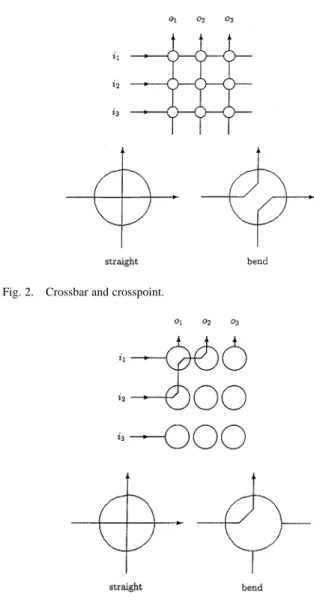
Fig. 2. Crossbar and crosspoint.
Fig. 3. New crosspoint guaranteeing SNB for crossbar.
under this assumption should be classified as WSNB rather than SNB. We think a difference should be made here whether the incapacity is due to hardware handicap or software (meaning a routing algorithm). If it is the former, then the result should still be classified as SNB because the blocking states do not exist in the first place. Even if we are not sure of the source of incapacity, or do not want to get into that level of details, we may still assume it is the hardware as long as we know the hardware can be so implemented. This view is consistent with the general acceptance of a crossbar switch as SNB. Typically, a crossbar is represented by a grid of input rows and output columns with a crosspoint at each intersection, and the crosspoint is assumed to have two states “straight” and “bend” (see Fig. 2).
However, such a crossbar is not SNB since the connection from to blocks the request from to , or to (as far as we know, this observation has not been made before). Note that this blocking can be removed either by wiring the crosspoint differently (see Fig. 3) or by the rule of a routing algorithm to disallow a path making a right turn, both having the effect of avoiding the path as shown in Fig. 3. (Sometimes the two states of a crossbar are called “open” and “closed,” and for each column only one crosspoint is allowed to be closed. Again, the latter statement represents an algorithm rule.)
Nevertheless, the literature continues to assume that cross-bars are SNB, since the implementation is there. Inheriting this philosophy, we will treat the nonblocking results obtained under the assumption of no fan-out capacity as SNB. The assumption of no-split is a different issue, since no-split is clearly an algo-rithm rule. Granted, it is conceptually possible that someone is ingenious enough, or stupid enough, to hardwire no-split. But the burden is on that person to specify the no-split as hardwired before claiming SNB.
Lemma 4: Assuming the input switch has no fan-out
ca-pacity, then an -request cannot be blocked in bundled -cast traffic if and only if the number of center switches is at least
for
for
Proof:
1) “if.” Since and are trivially sufficient for nonblocking, we show that is also enough. In any time, an -request is from an inlet lying on an input switch on way to outlets lying
on output switches, say, , .
Since the input switch has no fan-out capacity, every busy inlet must have one and only one center switch to route its request. The co-inlets can take at most
center switches. For each , the co-outlets of can take at most center switches and such output switches take at most center switches. So, there must be one center switch that is not taken by the co-inlets and co-outlets in center switches. Then the -request of can be routed. 2) “only if.” We construct a blocking state for
center switches with a new -request from an inlet lying on an input switch to outlets lying
on output switches, say, . Let
. Namely, the inlets lying on the other input switches can sup-port at least requests. The blocking state is that co-inlets take that many center switches on way to some outlets and the other inlets take another center switches on way to the co-outlets.
Theorem 5: Assuming the input switch has no fan-out
ca-pacity, then for an SNB three-stage Clos network with bundled -cast traffic
for
for
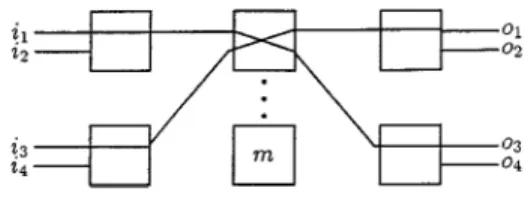
Fig. 4. Blocking network.
Proof: Let . Then
. Consider an -request which cannot be blocked in bundled -cast traffic. We claim that and there exists an -request such
that . Case 1. . Then and . If , then by Lemma 4 . If , then by Lemma 4 , that is . Case 2. . Then . By Lemma 4, . Moreover, where
We show that the bundled and incremental multicast traffic can have fundamental differences. Assuming the input switch has no fan-out capacity, then an SNB three-stage Clos network with incremental -cast traffic does not exist if , , all 1. Fig. 4 illustrates this fact by an example. Suppose the network has connected the two requests and . Then the new request is blocked since it has to be routed by the first center switch, which has already been taken by the connection.
Theorem 6: Assuming the center switch has no fan-out
ca-pacity, then for an SNB three-stage Clos network with bundled -cast traffic
Proof: In the Proof of Theorem 2, we obtained the
worst-case by not using the center switch fan-out, except the current -request was routed through one center switch. When the center switch has no fan-out capacity, then the -request will take center switches, since if , then center switches suffice by using the output switch fan-out. Therefore, the only adjustment needed from Theorem 2 is to replace 1 for the current request by . Moreover, since is increasing in , we can replace by .
Corollary 7: Theorem 6 remains true if the -cast traffic is incremental.
Proof: By Lemma 1 and the fact that the “sufficiency”
ar-gument does not depend on the traffic type.
Theorem 8: Assuming the output switch has no fan-out
ca-pacity, then for an SNB three-stage Clos network with bundled
Proof: The only difference from Theorem 2 is that the new
request will take more than one center switch if it goes to more than one outlet in an output switch.
1) “if.” Let be the maximum number of outlets on an , . Then the sufficiency condition
in Theorem 2 is replaced by .
2) “only if.” We construct a blocking state for center switches with a new -request, , from an inlet lying on an input switch to an outlet lying on an output switch . Let
(if ,
then ). Namely, the inlets lying on other input switches can take center switches. The blocking state is that the co-inlets take center switches on way to some output switches and the other inlets take another center switches on way to the output switch
. So,
center switches have been used. Then no accessible center switch is left for the new request and the new request needs fresh center switches.
Corollary 9: Theorem 8 remains true if the -cast traffic is incremental.
Proof: By Lemma 1 and the fact that the “sufficiency”
ar-gument does not depend on the traffic type.
Theorem 10: A three-stage Clos network with bundled
-cast traffic is WSNB under the no-split routing, if
Proof: Theorem 10 is obtained from Theorem 2 by
re-placing , the total number of
fan-outs from “other” inlets, with ,
since each inlet needs only one center switch to engage with any number of co-outlets from a fixed . Also replace
, the total number of fan-out from the co-inlets, with
. Note that each co-inlet can take at most center switches under the no-split routing and the worst-case scenario is the same as in Theorem 2, that is, . Let be the output switch of co-outlets. If , then the maximum connections from the co-inlets are supported by the co-outlets and output
switches. If , then co-inlets can
go to output switches, but the other can go to only , as has no more co-outlets available. Thus the co-inlets can take
center switches. If ,
the co-inlets can take center switches.
Corollary 11: Theorem 10 remains true if the -cast traffic is incremental.
Proof: By Lemma 1 and the fact that the “sufficiency”
ar-gument does not depend on the traffic type.
IV. COMPARISONS WITHEXISTINGRESULTS
Under the same assumption as Theorem 2, except that also has a lower bound, Giacomazzi and Trecordi [3] gave a different result. For comparison, we set that lower bound to 1. Then the formula given in [3] is
where is the total fan-out of the connections engaged by the co-inlets, and is the maximum number of connections engaged by the co-outlets. They also specified
First of all, since is a variable, should also maximize over . Thus is computed over the ranges of four variables, with three of them possibly substantial. The given in The-orem 2 is chosen from three values. But the differences between these two results are more than expressions. For example, when
, then is increasing in . Hence
which contains an term never appeared in Theorem 2. Hwang and Jajszczyk [5] considered a WSNB three-stage Clos network with bundled -cast traffic. (Actually, they al-lowed a request from inlets to outlets. We set
for comparison.) Their “strategy 2” forbids using input switch fan-out. Thus their result
is comparable to Theorem 5. In fact, Theorem 5 solves the maxi-mization problem in by showing that achieves maximum at
Thus can be computed by comparing two, instead of , values.
Their “strategy 3” forbids using center switch fan-out. Thus their result
is comparable to Theorem 6. We notice that their term
is quite different from our term .
The difference is because they define
. Note that by multiplying with , as we did in
Theorem 2, then , which is the
same as our term when .
Masson and Jordan [6] considered the model as assumed in Corollary 11 except they ignored the boundary effects of and and assumed . They obtained a sufficient con-dition , while Corollary 11 yields, under
the same premise as theirs, . Thus the two results differ by at least . Hwang [4] added in the boundary effects on and to obtain another sufficient
condition , which we
have also tightened.
Finally, for , in every theorem and corollary is
reduced to , the Clos SNB
theorem [2] for the point-to-point traffic. V. CONCLUSIONS
We gave necessary and sufficient conditions for strictly nonblocking three-stage Clos network under both bundled and incremental multicast traffic. We also extended these results to some other models studied in the literature, namely, when switches in a certain stage have no fan-out capacity, and when a no-split algorithm is used. It is interesting to note that while the network is definitely doing worse by losing the fan-out capacity of either the center stage or the output stage, it is not necessarily so with respect to the input stage.
Our results should be helpful in the design of three-stage mul-ticast networks. For example, all results except Theorem 5 tell us that for fixed , , and , we should keep and small, but more importantly, to keep small. On the other hand, The-orem 5 tells us that if the input switch has no fan-out capacity, or this capacity is banned by our routing algorithm, then it is more important to keep small. We also compared our results with existing results to unify the theory.
ACKNOWLEDGMENT
The authors wish to thank the referees for helpful suggestions which led to better readability of the paper.
REFERENCES
[1] D. Cantor, “On nonblocking switching networks,” Networks, vol. 2, pp. 367–377, 1972.
[2] C. Clos, “A study of nonblocking switching networks,” Bell Syst. Tech. J., vol. 32, pp. 406–424, 1953.
[3] P. Biacomazzi and V. Trecordi, “A study of nonblocking multicast switching networks,” IEEE Trans. Commun., vol. 43, no. 2,3,4, pp. 1163–1168, 1995.
[4] F. K. Hwang, “Rearrangeability of multiconnection three-stage Clos net-works,” Networks, vol. 2, pp. 301–306, 1972.
[5] F. K. Hwang and A. Jajszczyk, “On nonblocking multiconnection net-works,” IEEE Trans. Commun., vol. COM-34, no. 10, pp. 1038–1041, 1986.
[6] G. M. Masson and B. W. Jordan, “Generalized multistage connection networks,” Networks, vol. 2, pp. 191–209, 1972.
Frank K. Hwang received the B.A. degree from
Na-tional Taiwan University, Taipei, Taiwan, R.O.C., in 1960, and the Ph.D. degree from North Carolina State University, Raleigh, in 1968.
He worked at the Mathematics Center at Bell Labs from 1967-1996. He is now a Chair-Professor at Na-tional Chiao Tung University, Taiwan. He has pub-lished about 350 papers and written or coauthored the following books: The Steiner Tree Problem, North-Holland, 1992; Combinatorial Group Testing and Its Applications, Singapore: World Scientific, 1993, 2nd edition, 2000; The Mathematical Theory of Nonblocking Switching Networks, Singapore: World Scientific, 1998; and Reliabilities of Consecutive-k Systems, Norwell, MA: Kluwer, 2000.
Sheng-Chyang Liaw received the B.S., M.S., and
Ph.D. degrees in applied mathematics from National Chiao Tung University, Hsinchu, Taiwan, R.O.C., in 1989, 1991, and 1998 respectively.
He was a postdoctoral with the Department of Ap-plied Mathematics, National Sun Yat-Sen University, Kaohsiung, Taiwan. He is currently an Assistant Pro-fessor in the Department of Mathematics, National Central University, Chung-li, Taiwan. His research interests include network analysis, graph algorithm and combinatorial mathematics.