In most developing countries rural population is suffering from the burden of disease and disorders due to resource constrains and sever shortage of health care professionals and facilities. Use of information and communications technologies (ICT) in healthcare system can somehow eliminate the barriers of distance and topography and offer an opportunity to which they have limited or no access. Many developing countries have developed goals to adopt universal service (access) fund to provide affordable access to expand telecommunication and information services to rural and underserved areas to telephones, telecenters, distance learning and to support energy. Communication and information infrastructure offers an opportunity to rural, remote and underserved population to have access to wide range of educational and medical services. To mobilize investment in rural telehealth care systems, there is strong need to broaden the role of universal access funds to rural telemedicine systems. The impact on the education and health care would be dramatic and benefits to rural and underserved communities would be extensive. It is therefore necessary that these populations should have access to information and communication infrastructure. This will require new funding mechanisms and additional government subsidies and new taxes on communication providers.
Universal Access
Universal access means all the citizens of a country are able to use various services including communication, interaction and transaction services over the ICT infrastructure without too much inconvenience [1]. This does not require computer and internet at every home as it could be achieved through telecenters and through access through schools. Studies have shown that access to ICT can effectively enhance the effects
of other forms of private and public investments in the society.
Universal Service (Access) Fund
Universal Service Fund (USF) is a mechanism of providing affordable telecom facilities to rural and underserved areas. Rural areas are defined to include villages and communities of 10,000 persons or less. USF is a prominent mechanism of mobilizing investment into rural areas. These funds offer licenses and subsidies to private and public operators to serve designated areas and communities. The idea of creating universal access funds for rural communications has existed since 1994 when Chile in effort to bridge the access gap to rural and underserved areas, established Fondo de Desarrollo de las Telecommunicaciones [2]. Chile, Peru, Colombia, Guatemala and Dominican Republic issued license to rural operators through such funds. Following closely the success of Chile and Peru models other developing countries in Latin America, Asia and Africa are pioneering the implementation of telecommunications developments funds to provide communication and information serves to reach all segments of urban poor and rural communities.
Funds receive their resource from government contributions (Chile, Columbia), levy on telecommunication carries which are required to contribute small part of their revenues to such funds as in Peru (1%) and Dominican Republic (2%) or radio license fee (2%) as in Guatemala.
Services of Universal Service Fund
Access to information and communication technology has become important for economic development and poverty reduction yet the scope of universal access in most developing countries, except with few projects, remains concentrated to few regions and population groups and mostly for providing basic telephone
Expanding the role of Universal Service Fund to Rural Telemedicine
in Developing Countries
Muhammad Athar Sadiq
1, Isao Nakajima
1, Hiroshi Juzoji
1, Kiyoshi Igarashi
2,
Kenji Tanaka
21
Nakajima Laboratory, Department of Emergency and Critical Care Medicine,
Tokai University, 143 Shimokasuya, Isehara-shi, Japan 259-1193
2
National Institute of Information and Communication Technology, 4-2-1,
Nukui-Kitamachi, Koganei, Tokyo, Japan 184-8795
E-mail: [email protected]
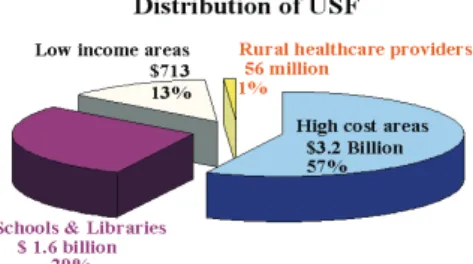
services and telecenters with internet access. Inclusion and expansion of services in universal access needs to be carefully assessed and needs to be adopted in accordance with country specific factors. Developing countries face plethora of problems of funds, expertise, shortage of health care and education facilities and personals. In United States the original purpose of the Universal Service Fund has been extended to support cost communications services for schools, libraries and rural health care providers [3]. Rural health care division of Universal Service Administrative Company (USAC) is responsible for ensuring for health care providers in rural areas obtain the benefits of the internet and current communications technology as provided for by the Unites States Congress and the Federal Communication Commission (FCC) through universal service support. The FCC established program funded $ 56 million in 2003 to rural health care providers so that they don’t need to pay more than their urban counterparts for the communication services Fig 1.
Fig 1. Distribution of Universal Service Fund in USA in 2003.
To expand the distribution of USF for health care provider, FCC in 2004 established a program that will fund up to $ 400 annually. These measures can be categorized into the subsidies in rural areas and to the people in the lower brackets of income. On the other hand in Japan only universal service carrier, Nippon Telegraph and Telephone Co. Ltd. (West & NTT-East), has the obligation to provide universal access. The USF was introduced in June 2002 to ensure provision of telecommunications that are essential for national life throughout Japan. Since then the number of mobile phone subscribers has exceeded the number of fixed line telephone subscribers. The use of IP based telephone is also widespread. The competition in telecommunication field has been further intensified due to increased growth of new fixed line telephone services called chokushu-type services in which the subscribers call without using NTT’s switching network. This has result in reduction in the basic monthly charges and installation fee of NTT. Currently Universal Service Fund services cover only local access and local telephone services in high cost areas (mostly rural and remote islands). Measures are being introduced to raise incentives in the development of communications infrastructure to high cost areas with tax exemption and low interest or free of interest loans.
However there is strong need to cover the high cost areas with communication services for rural healthcare.
High cost area Low cost area
Fig 2. Distribution of high and low cost areas for Universal access in Japan.
Assumptions have been made that narrowing the range of services covered by fund, magnitude of available discounts can be large and broader range of services will allow smaller discounts. Technology is changing very fast and limiting services we might limit our capabilities for integration. Telemedicine is usually considered social objective driven rather than business driven which is not true. The worldwide distribution of mobile phones and internet connectivity has dramatically increased the no of ways doctors and patients can interact. So telemedicine by directly increasing telecommunication traffic indirectly increases business activity. To understand the telemedicine market it is essential to identify its driving forces which are competition within the health care industry, advent of affordable IT solutions especially the internet, insensitivity to distance and increasing functionality and 21st century healthcare consumers [4]. Telemedicine market grows faster than our ability to measure it as business sector. In developed world funding in telemedicine market is being used to stimulate economic growth. Norway funds the largest telemedicine programs in the world. Consultations between remote hospitals and academic centers are being carried out on daily basis [5].
Why Universal Service Fund for Rural
Telemedicine?
The focus of most universal access funds in developing countries is primarily on basic telephony with few projects has focus of promoting access to internet services. A few other funds are planning to include support for points of presence or telecenters (e.g. Bolivia, Bangladesh, Morocco). Peru’s FITEL is financing pilot projects involving the internet [6]. In Kenya under InfoDev grant, field trials to improve access to telecommunication and information services for several rural a disadvantaged communities have been completed. InfoDev grants are utilized for
regulatory models for satellite services in Africa and for universal access regulatory harmonization across Africa. Only Dominican Republic has created by law “Fondo para el Desarrollo de las Telecommunicaciones (FDT)” to provide financial incentives to expand telecommunication services to rural and underserved areas that include telehealth along with telephones, telecenters and distance learning services. Recently Pakistan also has formulated a Universal Service Fund policy to maximize the commercial availability and coverage of ICT services and applications such as e-Health, e-Government, e-Commerce, e-Learning and other ICT services. This has been designed to ensure that un-served or relatively underserved areas gradually receive defined adequate services in a sustainable manner [7]. Telecommunication is a powerful tool in improving both the quality and access to education and healthcare in areas where the medical or educational infrastructure is inadequate or non-existent. In most developing countries the health care and school education system is underdeveloped and is able to provide services to population living in and around big cities. Rural population is suffering from the burden of disease and disorders due to resource constrain and sever shortage of health care facilities and professionals. Many poor patients in rural areas have to rely on basic Medicare services and for specialized care they have to travel to long distances to health care centers concentrated only in big cities. Rural schools lack the funds to attract specialized teachers necessary for courses to increase the competency of students to compete with students of big cities. Considering the rural education and health care status in most developing countries, it is important that the range of services covered by universal service fund in developing countries should expand to include rural schools and telemedicine centers.
The level of services must include bandwidth specification and needs to be adopted in accordance with country specific factors. In developed world where the aim is to have sophisticated health care delivery system, a key demand is to have second opinion and information for citizen to improve quality care and economic constrains. Many medical school and university hospitals provide patient information, course material, up to date medical literature and consultative services via national communication and infrastructure. As a result the two ways, real time video communication is the minimum level of services accepted. On the other hand in many developing countries health care at rural level is relatively simple and mostly consist of performing basic physical examination and dispensing common medicines, performing vaccinations, dressings of simple wounds, providing maternal/child care and family planning advices. These services don’t require high band width and use of sophisticated telemedicine equipments. A computer and modem would allow the exchange of electronic messages as e-mails and will also result in
continued medical education of doctors, nurses and other healthcare practitioners in rural areas.
Considerations
Many countries have adopted universal access to bridge the communication access gap only. Telecommunication in rural telemedicine can bridge the access health and education gap. Governments should expand the original purpose of universal service fund by adapting following measures:
1. Extend reasonably priced telephone services to rural, remote and underserved areas to support the cost communication for schools and rural health care providers.
2. The relatively low income of peoples of rural and underserved areas, it is difficult for the commercial providers of information and communication access to make profits. Therefore it is important to subsidize the provision of ICT services, at reasonably subsidized rates, to all public or nonprofit organizations that interested to provide healthcare and education to rural, remote and underserved areas. There is high potential for abuse of subsidies as have been shown recently in United Sates in e-Rate subsidy funds [1]. Even greater safeguards must be set in place to prevent abuse of subsidy funds in developing countries where government is seen as a way for politicians and officials to make money.
3. Developing new funding mechanisms that require additional government subsidies, new value added taxes on competitive access providers which are required to contribute a portion of their revenues to universal access fund. USF will make payments from these central funds to support communications services to school and health care programs. 4. Governments must adopt legislative changes
mandating the communication and information access providers to include e-health and e-education to rural and underserved areas as a condition of granting any license to provide services to reminder of the population.
5. USF policies should be reviewed regularly as today’s best solutions may be the best for tomorrow.
Conclusion
The governments are the most to gain from promoting the universal access services. In many developing countries education and health care is provided by governments. Telemedicine can reduce pressure on health budgets. It could be an economic means of achieving national health policy objectives. Promoting Universal Service (Access) Fund improve the quality
and efficiency of rural educational system, health care services by providing continued medical education and consultations to remote hospitals thereby reducing the unnecessary referrals, national heath structure and e-health administration.
References
[1] Samarajiva, Rohan. Universal Access Fund: How does it work? How to manage it? Presentation for International Seminar on ICT Policy Reform and Rural Communication Infrastructure 2004.
[2] ICT Policy Reform and Rural Communications Infrastructure. Institute of International Cooperation, Japan International Cooperation Agency, March 2005: pp. 99
[3] Heather E. Hudson. Rural Telemedicine: Lessons from Alaska for Developing Regions. J Telemedicine and e-Health, 2005; 11 (4), pp. 460-467
[4] Mittman R, Cain M. The future of the internet in health care. The internet and heath communication: Experience and Expectations. 2001: pp. 43-73
[5] Linder, A. "Global Telemedicine and the Future of Medical Science," Healthcare Informatics, November 1994: pp. 62-66.
[6] Dymond, Andrew & Sonja Oestmann. “Rural Telecommunication Development in a Liberalization Environment: An update on universal access funds”.
December 2003 http://info.worldbank.org/ict/WSIS/docs/comp_RuralT
elecom.pdf
[7] Universal Service Fund Policy, Ministry of Information Technology, Government of Pakistan. http://www.pakistan.gov.pk/ministries/moit/media/US FTask1Report23May06.pdf