國
立
交
通
大
學
企業管理碩士學程
碩
士
論
文
訂製化科技接受模式方法 :台灣電子書市場分析A Customized Technology Acceptance Model:
Don’t judge a Taiwanese E‐book Market by its Cover
研 究 生:迪納斯
指導教授:姜真秀 教授
中 華 民 國 九十 九 年 六 月
1
A Customized Technology Acceptance Model:
Don’t judge a Taiwanese E‐book Market by its Cover
Student: Johannes Martinus Potgieter
Advisor: Prof. Jin‐su Kang
A Thesis Submitted to the College of Management National Chiao Tung University in partial Fulfillment of the Requirements for the Degree of Global Master’s in Business Administration July 2010 Hsinchu, Taiwan, Republic of China
i
A Customized Technology Acceptance Model: Don’t Judge
a Taiwanese E‐book Market by its Cover.
Chinese abstract
訂製化科技接受模式方法 :台灣電子書市場分析 摘要 這十幾年來,電子書使用在教育方面的概念非常成功, 但是這個產品概念無法實現因為當 時的螢幕科技有限而不合。今日的電子書產品例如 Kindle,IPad,等等重新強調了這個技 術趨向的重要性。本研究是針對台灣市民對於電子書在娛樂市場使用情況和行為意圖是如 何被認知有用性,相對優勢,認知易用性和社會因素影響到。 本研究證明認知有用性對於年輕世代行為意圖的影響比較強烈。此外, 相對優勢對於行為 意圖的影響是及年齡和文化無關。區別男性及女性的接受度是不簡單,因為接受度是以年 齡有關而不是性別。在社會因素方面的研究,分區留在台灣的外國人及台灣人的使用影響 也是比較難. 市場還滿複雜的,並且人民無論是被哪一方面的文化影響都有相同的偏好。 這研究指出的結果將有助於電子書出版商以及對於電子書在娛樂使用之市場。性銷戰略是 會確定推出新技術產品之成功率。 這些信息使他們可以在採用電子書籍的戰略和管理方式做出決策。ii A Customized Technology Acceptance Model: Don’t Judge a Taiwanese E‐book Market by its Cover.
English abstract
The e‐book concept being used for academic purposes proved to be very successful during the last decade. However, the concept had trouble entering the market segment due to a lack of screen technology. Recent announcements of the launching of new e‐book reader devices (such as Kindle, Ipad, etc) have re‐emphasized the importance of this technological trend. Little research has been done as to how ‘ready’ the public is to accept this new trend. Therefore, this study is focused on the recreational market segment and it analyzes four constructs, namely perceived usefulness, relative advantage, ease of use and social factors influencing the usage and behavioral intention of people living and working in Taiwan, Republic of China.
The findings of this study indicate that the influence of perceived usefulness on behavioral intention is indeed stronger for the younger generation. Furthermore the effect of relative advantage on behavioral intention is not necessarily moderated by age, since the effect is the same for both groups and the effect of perceived ease of use on behavioral intention is more or less the same across cultures. Distinguishing between the ‘level of acceptance’ of males and females are not too easy, because it is most likely being moderated by age, and not gender. As for the influence of Social factors on usage, it is also not that easy to distinguish between the ‘level of acceptance’ of foreigners in Taiwan compared to Taiwanese citizens. The market is complex and people prove to have the same preferences, irrespective of culture. The findings give very specific indications to publishers and other market players interested in entering the e‐book market segment that is focusing on recreational purposes. Marketing strategies determine the success‐rate of the launch of any new technology.
These findings can help top managers to make better decisions regarding the recreational market segment of the e‐book marketplace.
iii
Dedication
This thesis is dedicated to my wife, Marguerite, who is my best friend and most loyal supporter. Marguerite’s never taking the easy way out and her continuous support accompanied me through the writing of my thesis and I am ever grateful.
iv
Acknowledgements
In the first place I would like to thank Prof. Jin‐su Kang for her support, guidance, patience and mentoring which kept me focused on my thesis and enabled me to complete it. The feedback and suggestions received from the members of my panel of internal reviewers as well as the members of my panel of external reviewer’s, which helped to refine this study is, much appreciated. I am grateful for my friends who helped me with the data collection. And lastly I would like to thank God for giving me the miracle opportunity to do a Global MBA in a foreign country.
v
Table of Contents
Chinese abstract
………
i
English abstract
………
ii
Dedication
………
iii
Acknowledgements ………
iv
Table of contents
………
v
List of tables
………
vi
List of figures
………
vii
Chapter I
Introduction………
1
1.1
Introduction to the problem………
1
1.2
Background of the study………
3
1.3
Statement of the problem………
5
1.6
Significance of the study………
5
1.7
Definition of the terms………
7
Chapter 2
Literature review………
8
2.1
Introduction………
8
2.2
E‐book definitions……… 11
2.3
E‐book usage………
13
2.4
Technology acceptance model………
16
Chapter 3
Methodology………
19
3.1
Research design………
19
3.2
Conceptual framework………
20
3.3
Research questions………
21
3.4
Sample & data collection………
22
3.5
Survey distribution………
24
3.6
Data analysis………
24
3.7
Validity & reliability………
28
Chapter 4
Results………
30
Assumptions and limitations………
42
Chapter 5
Conclusions & recommendations………
42
Bibliography
………
45
Appendix 1
………
49
Appendix 2
………. 53
vi
List of tables
Page
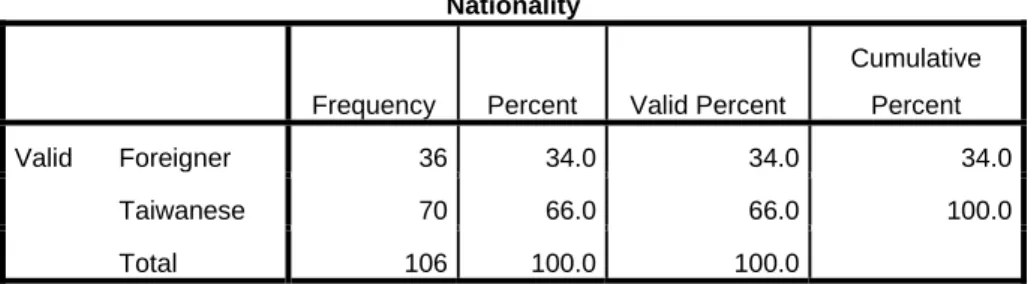
Table 1. Survey questions for the e‐book function: Constructs and Measurement 23 Table 2. Coding for survey responses 25 Table 3. Analysis of survey responses 27 Table 4. TAM reliability statistics 29 Table 5. Table concluding gender distribution 30 Table 6. Table concluding distribution according to nationality 31 Table 7. Table concluding distribution according to current and future e‐book users. 32 Table 8. Table distinguishing between the different age groups 32 Table 9. Factor Analysis 33 Table 10. Regression Analysis 35 Table 10.1 Influence of perceived usefulness on behavioral intention (moderated by age). 35 Table 10.2 Influence of relative advantage on behavioral intention (moderated by age). 36 Table 10.3 Influence of perceived ease of use on behavioral intention (moderated by gender). 38 Table 10.4 Influence of social factors on usage (moderated by nationality). 39 Table 10.5 Influence of behavioral intention on usage 40 Table 11. Correlation analysis 41
vii
List of figures
Page
Figure 1. Conceptual framework for exploring the public acceptance of e‐books for recreational purposes based on usage and behavioral intention. 20 Figure 2. Graph illustrating gender distribution 30 Figure 3. Graph illustrating distribution according to nationality as well as users 31 Figure 4. Graph distinguishing between the different age groups as well as users. 32
1
Chapter 1: Introduction
Introduction to the problem
The definition of an e‐book (being the electronic version of a printed book) goes as far back as 1971 when a project called ‘Project Gutenberg’ was started by Michael Hart at the University of Illinois in the USA. The aim of this project was to establish an electronic library of 10 000 books. The ethos of the project mirrored the not‐for‐profit idealism that spawned the internet itself: Hart saw publishing as a utopian, democratic tool for the education of the greatest number of people possible. The ethos could be summed up as: “If somebody wants to learn, it’s our responsibility to give them to opportunity to easily facilitate the process of learning. Why? Because not everybody wants to learn!” As a result, Project Gutenberg, made obtaining e‐books as ‘user‐friendly’ as possible (e.g. being able to download them in PDF format) and the most interesting is that Project Gutenberg still continues today (http://www.gutenberg.org/wiki/Main_Page ). However, since the beginning of project Gutenberg back in the early 70’s and the beginning of the Internet (which could be traced back to the late 1950’s), the main focus was on learning and having access to academic information. After the happening of the ‘Informational revolution’ and the Internet reaching a peak in the early 1990’s, a shift started happening. Information became easily accessible which meant that a market developed for information related to recreational purposes. This is the basis of this study: e‐books and all the research being done about e‐books was focused on the academic side of the ‘Informational revolution’ in the past, but being as far into the ‘Information age’ as we are at the moment, an emerging market is the ‘recreational segment’ of the e‐book market.
2 With advances in computer and Internet technology it is obvious that there is an opportunity for educational institutions, faculty members, and students to utilize the advantages associated with the growing presence of electronic textbooks.1 Countless research has been done on the future of the academic e‐book market segment. The publishing industry has been monitoring these developments for years and is constantly redefining its strategy as to which market segment would be the most profitable. It has been noted that “book‐like electronic reading in particular is a rapidly growing commercial phenomenon, with a wide variety of devices, software and distribution systems, and a wide range of content genres”.2 Even though this has been general knowledge for quite some time, the majority of researcher’s time and effort went into exploring the academic market segment of e‐books and the implications thereof. Only until recently the publishing industry became aware of the market potential of the recreational market segment of the e‐book market. The e‐book publishing industry should also focus on extra functionalities that e‐books can provide to the users in order to ‘exploit better potentiality of their electronic media’ and turn them into ‘enhanced versions of paper books not just empty book similes’. Recent research indicates that for too long the e‐book marketplace has been limited to the libraries of tertiary institutions. The exploitation of better potential of electronic media launches a brand new way of thinking. We find ourselves in 2010, a year in which e‐ink, e‐paper and e‐book readers have launched a whole new ‘informational revolution’ in itself. The recent launch of the Iliad, Ipad and Kindle devices is proof that a market with big potential is emerging. It is safe to note that the focus is now shifting to the recreational market segment of the e‐book marketplace. Therefore the focus of this study resulted in being on the public acceptance of the e‐book (with a focus on e‐books used for recreational purposes) 1 Sharp, J.M. (2005, November). High‐tech textbooks. ASEE (American Society for Engineering Education) Prism, 15(3), 42‐45. 2 Renear, A.; Salo, D. (2003). Electronic books and the open eBook publication structure. The Columbia Guide to Digital Publishing, Chapter 11, p. 455‐520
3
Background of the study
At the core of the success of any new technology lies the ‘acceptance’ of the market which results in adoption. Definition of ‘acceptance’: “the mental attitude that something is believable and should be accepted as true. Definition of ‘adoption’: “The act of accepting with approval” Definition of ‘usage’: “The act of using”; “accepted or habitual practice” Definition of ‘behavioral intention: “an indication of an individual's readiness to perform a given behavior. It is assumed to be immediate antecedent of behavior3” As the use of the internet became more widespread in the late 1980s, book vendors (publishers and aggregators) recognized the possibilities of providing content in digital form. The term e‐ book publisher refers to a business in which a provider enables authors to publish books through an online service. Aggregators in the e‐book market are ‘companies that bring together the e‐book content from different publishers and make it available, via specific hardware and software, to others, such as libraries.’ At present there are several e‐book formats available in the market and also devices specifically designed to read e‐books or designed for other uses as well. Some commonly used formats are MobiPocket, Adobe Acrobat Reader, Microsoft Reader, Palm Reader, VitalSource, Plain Text and HTML. Each format has its own features and specific reader software is needed to enable the e‐book to be read or viewed on a device. Some commonly used devices are PCs, PDAs, Blackberries, Pocket PCs, Tablets, Sony Readers, mobile phones, iPods and Kindle (the new e‐book reader from Amazon) as well as iPad (the new e‐
4 book reader from Apple). The focus on e‐book formats resulted in numerous studies being conducted. Almost all of this research was focused on students’ behavior and academic institutions. This study monitors the degree of readiness of the general public in Taiwan for the recreational market segment of e‐books. Therefore possibly future studies might be conducted as to which e‐book format is preferred in the recreational market segment. Given this background, a lot of research has been done on the acceptance, adoption and usage of e‐books by students. The acceptance and usage by students has the potential to increase textbook revenues for textbook publishers or to decrease textbook costs for the institution.4 Numerous authors presented findings that there is growing favorable acceptance of e‐books by students.5 Another group of authors presented findings that contradict the above statement (focusing on the deficiencies of e‐book devices and prices), stating that the acceptance and adoption of e‐books are not to be seen in the near future. Two very recent sources conclude the barriers preventing widespread adoption of e‐books are slowly coming down with the market for e‐book acceptance and usage growing slowly. This statement by those two sources produced a research trend focused on the e‐book format that would be preferred by students as well as the deficiencies that would inhibit e‐book acceptance and usage. The research that has been done regarding the academic e‐book marketplace served as motivation for this study. As been stated above, acceptance and adoption lie at the heart of the success of new technology. Therefore it is evident that a study focused on public acceptance of the leisure e‐book market place is needed.
4 Shiratuddin, N. (2005, April – June). E‐books in higher education: Technology, e‐marketing prospects, and pricing strategy. Journal of Electronic Commerce in Organizations, 3(2), 1‐16. 5 Abraham, 2004; Agee, 2003; Barlow, C.L. & Wetherill, K.S. (2005, October). Technology + imagination = results. T.H.E. Journal, 33(3), 21 – 26
5
Statement of the problem
The problem being addressed in this study is the lack of empirical knowledge related to the public acceptance of leisure e‐books that prevent the development of fact based strategies to implement methods for more cost‐effective and efficient marketing of leisure e‐books. Many publishers are reluctant to make their publications available in e‐book format and/ or to promote them too strenuously, because they are afraid of the effect on their revenues. In 2007 publisher’s behavior seemed that they were still dipping their toes in the water and waiting for someone else to take initiative despite the fact that a lot of progress had been made up till that point. It is interesting to note that the author of the ‘Harry Potter’ series, J.K. Rowling, refuses to have her books released in electronic format. This supports the above mentioned statement. The reason for this is the fact that publishers, with specific reference to geographic region, are reluctant to enter the recreational market segment of the e‐book market place. The behavior and preferences of Asian citizens as opposed to European or American citizens are totally different and exactly that fact makes this study of great value. Taking into consideration the pivotal role that Taiwan will play in the future of the e‐book market place, it is undeniable that the problem of the lack of empirical knowledge of the public acceptance of e‐books used for leisure purposes should be addressed. Taiwan has a rare combination of local Taiwanese people as well as a decent percentage of foreigners. This study will make use of a technology acceptance model (TAM) to retrieve the needed information.
Significance of this study
Research focusing on the recreational market segment of the e‐book market place is very scarce. This implies that information regarding the next generation’s perception of what the recreational e‐book market place entails, are lacking. New generations of users will play an important role in the development of e‐books with their information‐seeking behaviors and
6 technology preferences relating to e‐books and other electronic resources. However, the success of e‐books also relies on the publishing industry’s ability to develop new business models and comprehend that e‐books are not simply a substitute for paper books.6 To this end, vendors and librarians ‘need to work together on more mutually congenial business models’, keeping an open dialogue in order to reduce the barriers to the e‐book adoption. What makes this study significant is that it explores these barriers to e‐book adoption that should be bridged. The growing availability of e‐books and the improvement in e‐book reader technologies will increasingly bring e‐books to the attention of information users. All those parties involved (e‐paper manufacturers, the manufacturers of e‐book reader devices, etc.) will need to be proactive in their response to e‐book development. The information gathered in this study will help these parties to be proactive. The three major research areas in terms of the e‐book market are: 1. More comprehensive longitudinal monitoring to map the growth of the e‐book marketplace at this early stage in the development of e‐books. 2. Collection development in relation to e‐books generates a host of issues, the biggest of which is pricing models. More in‐depth research needs to be done in terms of pricing. 3. Monitoring the adoption of e‐books and the nature of e‐book use by users/ readers/ consumers is crucial, since this will have consequences for, among other things, pricing strategies. It is important that any work in this area takes into account existing models of adoption innovations and specifically technology adoption models. The significance of the study lies herein: that although the results of this study will mainly make a contribution to the third research area, it could also make a contribution to the other two 6 Rao, S.S. (2004, May 17). Electronic book technologies. Library Review, 53(7), 363 – 371.
7 future research areas as well.
Definition of terms
The following are the significant terms used in this research and the associated meaning within the context of this study: Ease of use. This variable describes the degree to which a person believes that using an e‐book would be free from effort.7 E‐book. For purposes of this study, this is an electronic software representation of a printed book used solely for non‐academic purposes, with other words for leisure (e.g. novels and fiction). E‐book reader device. A dedicated, specialized device used for the purpose of reading an e‐book. Technology acceptance model (TAM). A model developed to test end‐user acceptance of new information systems.8 The model uses the variables of perceived usefulness and perceived ease of use to predict the acceptance usage of a new technology. The model and extensions of this model have been used in numerous studies. Usage. The degree to which an end‐user will use an information system or particular technology.9 7 Davis, F.D. (1989, September). Perceived usefulness, perceived ease of use, and user acceptance of information technology. MIS Quarterly, 13(3), 318‐340. 8 Davis, F.D. (1989, September). Perceived usefulness, perceived ease of use, and user acceptance of information technology. MIS Quarterly, 13(3), 318‐340. 9 Davis, F.D. (1989, September). Perceived usefulness, perceived ease of use, and user acceptance of information technology. MIS Quarterly, 13(3), 318‐340.8 Usefulness. The degree to which a person will use an information system or particular technology to enhance their job performance.10
Chapter 2: Literature review
Introduction
As technology evolved, there are a number of instances where paper versions of novels have been replaced by electronic versions of the same book. There are different presentations of e‐ books currently being developed in formats from Web pages and each of the e‐book market segments are showing growth. The year 2009 was a breakout year for e‐readers and e‐books. The sales of e‐book reader devices have more than tripled by the end of 2009 and the content sales were up 176%11. A very brief industry overview is summarized in the following paragraph and states why research in Taiwan is valuable. Taiwan is known for being a leader in the technology field and is therefore reckoned as a strong force in the e‐book market. The Taiwanese government has recognized this potential and has invested a lot of money in the development thereof. It is forecasted that Taiwan will have the strongest supply chain for e‐book displays in the near future. Taiwan’s long history in manufacturing consumer electronics, its aggressive low cost strategy and closer ties with China gives the island’s companies an advantage over Japanese and South Korean peers. Growth in e‐book sales appear to be higher in Asian countries according to statistics. According to a market report released by China Book Business Report and www.du8.com (an online 10 Davis, F.D. (1989, September). Perceived usefulness, perceived ease of use, and user acceptance of information technology. MIS Quarterly, 13(3), 318‐340. 11 Rothman, D.H. (2006, August 28). Razing the tower of e‐Babel: The reason e‐books haven’t caught on is simple: They’re too complicated. Publishers Weekly, 253(34), 62.
9 reading web site), Chinese market capacity is estimated to be US $28.6 million for e‐books in 2008. The report also revealed that China had about 660,000 e‐books in 2007, with a 24.5 percent and a 14 percent rise over previous years respectively. Even though these figures are based on e‐book sales in general (no distinction being made between academic purposes or leisure purposes), it is a valid indication that an Asian Market like Taiwan is in desperate need of an analysis of the public acceptance of e‐books. A number of studies and dissertations have applied the technology acceptance model as a tool to determine usage of a particular technology based on the perceived usefulness and ease of use from a user perspective. The TAM was developed by Davis12 at the Massachusetts Institute of Technology. The use of the TAM in a 2‐year study by Gabbard13 found a relationship did exist between reader satisfaction and the attitude toward accepting technology used in an online community college environment. Numerous studies have made use of the basic TAM, but there have also been a number of studies that have extended the TAM. Boswell14 extended the TAM by including additional factors of perceived invasiveness and perceived objections to the acceptance of technology. This study did find that invasiveness in technology could be perceived as to have a negative impact toward the usage of technology. Table summarizing previous research done:
Number Researcher Topic
1. Smith, B.A.15 Student acceptance, usage and 12 Davis, F.D. (1989, September). Perceived usefulness, perceived ease of use, and user acceptance of information technology. MIS Quarterly, 13(3), 318‐340. 13 Gabbard, R.B. (2004). Applying the technology acceptance model to online education. Retrieved from Dissertations & Theses: Full Text database. (AAT3162232) 14 Boswell, K. (2004). The impact of perceived invasiveness and perceived objective on technology acceptance: An extension to the technology acceptance model. Retrieved from Dissertations & Theses: Full Text database. (AAT 3167439) 15 Smith, B.A. (2008, September). A quantitative analysis of the impact of e‐book format on student acceptance, usage and satisfaction. Published PhD Thesis. University of Capella.
10 satisfaction with regards to e‐books 2. Vasileiou, M.; Hartley, R.; Rowley, J.16 Overview of the e‐book market place 3. Davis, F.17 Applying the TAM to information technology 4. Gabbard, R.B.18 Applying the TAM to online education 5. Mercieca, P.19 E‐book acceptance Table summarizing individual acceptance models and their core constructs:
Number Name of model Core constructs
1. Theory of Reasoned Action (TRA) Attitude toward behavior, subjective norm 2. Technology Acceptance Model (TAM) Perceived Usefulness, Perceived ease of use, Subjective norm 3. Motivational Model (MM) Extrinsic and Intrinsic motivation 4. Theory of Planned Behavior (TPB) Attitude toward behavior, subjective norm, perceived behavioral control 5. Combined TAM & TPB Attitude toward behavior, subjective norm, perceived behavioral control, perceived usefulness 6. Model of PC Utilization (MPCU) Job‐fit, complexity, long‐term 16 Vasileiou, M., Hartley, R., & Rowley, J (2008, September). An overview of the e‐book marketplace. Online Information Review, 33(1), 173 – 192. 17 Davis, F.D. (1989, September). Perceived usefulness, perceived ease of use, and user acceptance of information technology. MIS Quarterly, 13(3), 318‐340. 18 Gabbard, R.B. (2004). Applying the technology acceptance model to online education. Retrieved from Dissertations & Theses: Full Text database. (AAT3162232) 19 Mercieca, P. (2003, April, 22). E‐book acceptance: What will make users read on screen? Retrieved December, 3, 2006, from http://www.iof.org
11 consequences, affect towards use, social factors, facilitating conditions 7. Innovation Diffusion Theory (IDT) Relative advantage, ease of use, image, visibility, compatibility, results demonstrability, voluntariness of use 8. Social Cognitive Theory (SCT) Outcome expectations – performance, outcome expectations – personal, self‐ efficacy, affect, anxiety The birthplace of the TAM, Massachusetts Institute of Technology’s quarterly journal, published an article in 2003 which commented on the interpretation of the TAM. They did research about the ‘extension’ of acceptance models and came up with the Unified Theory of Acceptance and Use of Technology (UTAUT)20. During the compilation of this article the publishers identified and discussed the eight specific models of the determinants of intention and usage of information technology. Second, these models were empirically compared to within‐subjects, longitudinal data from four organizations. Third, conceptual and empirical similarities across the eight models were used to formulate the UTAUT. Fourth, the UTAUT was empirically tested using the original data from the four organizations and then cross‐validated using new data from an additional two organizations. This study forms the basis of this thesis: having been able to identify specific constructs, dependent variables and independent variables to extend the TAM and make it market specific, knowing that the correlation between these chosen constructs and variables have been statistically validated by the original author of the TAM.
E‐book definitions
The initial idea of an e‐book was defined by Bush (1945) with the conceptualization of a hypertext engine he called the Memex. Bush envisioned this device as a mechanized library 20 Venkatesh, V., Morris, M.G., Davis, G.B., & Davis, F.D. (2003, September). User acceptance of information technology: toward a unified view. MIS Quarterly, 27(3), 425‐478.
12 where the individual could store all their books, records and communications to be later retrieved with speed and flexibility. He further envisioned a screen on which the content could be projected for reading21. Another early visionary idea was proposed by Alan Kay in 1968. Kay proposed the idea of the Dynabook as a device that very much fits the description of current laptop computers found in today’s environment. Kay’s concept of the Dynabook was defined as the device that will provide connections to online libraries and enable the searching and reading of books using a personal computer. As e‐books have evolved, a number of different formats and presentation methods have emerged. Some researchers asserted that e‐books are best suited for reference materials and educations materials rather than the public’s typical view of novels and popular literature. Although there have been a number of efforts to deliver electronic books via hardware devices that emulate the portability, readability and size of a traditional print book the conclusion by Abram was that a printed hardcopy is better for recreational reading. In terms of trends related to the format and usage of e‐books, a number of predictions have been made back in 200122. These predictions for the widespread use of e‐book devices did not come to pass within the time range it was forecasted for, but the author then updated his predictions to assert that four major trends would emerge in the e‐book market. E‐books that are used but not read are identified as primarily research or reference sources such as text books, manuals and reference books. E‐books in this category are those that the reader spends little time actually reading. The most successful example implementations of this trend are electronic libraries or e‐book collections such as Safari Tech Books Online, Oxford Reference and Netlibrary. 21 Bush, V. (1945, July). Where we may think. The Atlantic, 176(1), 101 – 108. 22 O’Leary, M. (2003, September/ October). E‐book scenarios updated. Retrieved August 8, 2006, from http://www.infotoday.com/online/sep03/oleary.shtml
13 The next trend identified by the author23 was the implementation of an aggregation reference collection rather than a library of single works that can be searched as a single database. Books related to information technology are the most frequently found example of aggregations for computer and information technology references. Institutional customers such as libraries and corporations make up the third trend as opposed to individual customers for e‐books. These types of customers are attractive to sellers as they get access to large purchasers, to the users who are provided access to large collections, and to libraries that can provide a service needed and desired by their customers. All of the foregoing definitions of e‐books have been oriented toward a format that presents the content of a hardcopy printed book in electronic form. There are several additional definitions often associated with e‐books that go beyond the simple creation of electronic version of a printed book. A number of authors have identified the use of Web‐based books as a format with search and linking capabilities24. Another format used by a number of publishers of e‐books is the use of CD‐Rom format where search and linking capabilities within the electronic text are often found25. There have also been a number of initiatives to deliver the accessibility of e‐books by means of dedicated electronic devices or readers. The market for these electronic devices boomed this year (2010) when big companies such as Amazon (Kindle) and Apple (Ipad) decided to add their latest gadgets to the market.
E‐book usage
The focus of this study is to examine the acceptance of e‐books focused on leisure by the 23 O’Leary, M. (2003, September/ October). E‐book scenarios updated. Retrieved August 8, 2006, from http://www.infotoday.com/online/sep03/oleary.shtml 24 Brisco, S. (2006, December). Ebooks are getting ready to go to school. School Library Journal, 52(12), 82 – 83.; Chen, Y. (2003). Application and development of electronic books in an e‐Gutenberg age. Online Information Review, 27(1), 8‐16 25 Clyde, L.A. (2005, June). Electronic books. Teacher Librarian, 32(5), 45 ‐47.
14 general public of Taiwan. The literature indicated there are a variety of audiences that have become the main users of e‐books. Taiwan is an extremely diverse and interesting market for the leisure market segment of e‐books. Even though the focus has been on the research and academic market of e‐books for a couple of years, it is interesting to note that big companies like Amazon.com and Apple, Inc. have broaden their product scope with a specific focus on the leisure market segment of e‐books. A number of positive aspects of technology as applied to electronic books have been examined in the past26. One of the aspects of this study concluded that younger people who are comfortable with technology are more likely to be receptive of e‐books than are older citizens who would be required to change their reading habits. The availability of e‐books continues to grow and become increasingly available for the public in general. Studies continue to emerge that indicate the usage of e‐books is expected to grow, not only amongst students, but amongst further generations. Although there are numerous articles and works of research that illustrated the potentially positive outlook for the growing usage and acceptance of e‐books, there have been a number of studies that identified remaining deficiencies with e‐books and instances of resistance to the widespread use of e‐books. Despite significant advances in e‐book devices and the software capabilities to allow readers to access electronic materials, the paper‐based publishing industry is concerned about piracy of their digital content. Furthermore, the technical advances and acceptance of e‐books by the reading public, the digital rights management restrictions established by publishers have adversely affected the availability of electronic content to consumers27. The issues related to the acceptance of electronic book materials (with a focus on academics 26 Agee, J. (2003, July/ August). Exciting e‐books: A new path to literature. Techtrends, 47(4), 5‐8. 27 Burke, R. (2001). E‐book devices and the marketplace: In search of customers. Library Hi Tech, 19(4), 325 – 331.
15 once again) has been done in the past28. A specific study by Mercieca compared a number of different digital formats to determine if there is a preferred format for reading textbook materials on a computer screen. The format of e‐books has always been a big issue and has been researched countless times, but given the technological age we find ourselves in, format is not the main issue anymore. The main issue is whether the public in general are ready for a technological reading revolution. This thesis examines just that. The capabilities available with e‐books that can meet the accommodation requirements of handicapped readers have also been explored29. There are available technologies in the form of variable print size, text‐to‐speech‐, and interactions that support a variety of student learning needs and can be a significant advantage over printed text. Even though this focus is yet again on the academic side of things, big companies have explored the same idea and came up with the concept of audio‐books. An ‘audio‐book’ is a recording that is primarily spoken word The advantages as well as disadvantages of the e‐book market place have been covered by this thesis. Furthermore the market potential has been analyzed. Moreover the perceived public acceptance of the leisure market segment of e‐books has always been the criteria throughout the analysis of this thesis. Although there are several resources reviewed that express some reservations regarding e‐ book acceptance30, there has been positive advances in the usage of e‐books in a number of 28 Mercieca, P. (2003, April, 22). E‐book acceptance: What will make users read on screen? Retrieved December, 3, 2006, from http://www.iof.org 29 Cavanaugh, T. (2002, November/ December). eBooks and accommodations. Teaching Exceptional Children, 35(2), 56 – 61. 30 Blumenstryk, G. (2001, May 18). Publishers promote e‐textbooks, but many students and professors are skeptical. Chronicle of Higher Education, 47(36), A35‐A38 Burk, R. (2001). E‐book devices and the marketplace: In search of customers. Library Hi Tech, 19(4), 325 – 331.
16 settings. Some of the resources that indicated there were growing usage and acceptance of e‐ books included a couple of studies by a couple of authors31.
Technology acceptance model (TAM)
The technology acceptance model was developed by Davis in 1989 at the Massachusetts Institute of Technology (MIT). The use of TAM in a 2‐year study found a relationship did exist between the attitude toward accepting technology and consumer satisfaction. In addition to numerous studies using the basic TAM, there have been a number of studies that have extended the TAM. In terms of TAM usage, the TAM has been used in a number of studies related to the acceptance of different technologies in a variety of settings. Some authors used the TAM to determine end user acceptance of new technology in a bank treasury. The findings of the study suggested that demographic variables such as age, position in the company, and the length of employment provided significant contributions to satisfaction leading to end‐user usage of new technology. This serves as a further basis of the extension of the TAM used in this specific study: the unique combination of perceived usefulness, relative advantage, perceived ease of use and social factors as independent variables together with the dependent variables usage and behavioral intention results in significant conclusions. The following moderators: age, gender and nationality also contribute to the validity of the study. Another application of the TAM examined individual differences consisting of self‐efficacy and knowledge of search domains as well as systems characteristics relative to the intention to use digital databases. The results of this study indicated that the TAM was successfully applied to determining the intention to use digital databases on usefulness and ease of use. Carlson, S. (2005, February 11). Online textbooks fail to make the grade. Chronicle of Higher Education, 51(23), A35‐A36. 31 Agee, J. (2003, July/ August). Exciting e‐books: A new path to literature. Techtrends, 47(4), 5‐8.
17 Additionally, this study found that individual differences and system characteristics were important factors in determining the perceived ease of use for digital databases32. This supports the dependent variables of this study namely usage and behavioral intention. Even though these variables have been studied in the past, it has never been applied to the ‘leisure’ context of e‐books. As been noted multiple times, previous research focused on the academic scope of the market and not the leisure market segment. The usage in numerous studies demonstrated the acceptance and applicability of the TAM where an analysis of a particular technology is needed. In studies relative to the academic scope of the market, numerous authors successfully utilized the TAM to conduct their studies and to achieve valid results using the TAM. The study of digital databases by some authors utilized the TAM to determine perceived ease of use by the users. The application of the TAM in these studies provided the motivation to utilize the variables of usefulness, ease of use and usage to be examined in this study of e‐book usage and behavioral intention. Some of the definitions worth mentioning are summed up by the following paragraphs. The analysis of this study is expected to reveal some differences in attitudes toward e‐books from a generational perspective. A number of authors have stated that there are four generations that are predominant on today’s college campuses. Authors have defined generations by birth years as well as by the traits and relationships between generations33. The Baby Boomers were born from 1943 to 1960, the Generation Xers were born from 1960 to 1981 and the latest generation, identified as Generation Y, also known as the Millennials, was born from 1982 to 2002. The importance of defining the generations is to understand the differences between the generations and their acceptance of technology and their expectations in a modern world. 32 Hong, W., Thong, J.Y., Wong, W., & Tam, K.Y. (2001 – 2002, Winter). Determinants of user acceptance of digital libraries: An empirical examination of individual differences and system characteristics. Journal of Management Information Systems, 18(3), 97 – 124. 33 Coomes, M.D., & DeBard, R. (2004), Summer). A generational approach to understanding students. New Directions for Student Services, 106, 5‐16.
18 The generations found in today’s workplace have been examined in the past34. The variables of usage, perceived usefulness and perceived ease of use associated with the TAM were used in this study to determine the preference of the general public in Taiwan in terms of e‐books or printed books. The TAM has been successfully used in a number of studies where perceived usefulness and perceived ease of use were key variables used to measure the usage of technology being examined in the study. The generations described in the literature were used as a part of the analysis of this study. The differences in attitudes between generations were expected to have an impact on their perspectives toward the perceived usefulness and perceived ease of use as related to their acceptance and usage of e‐books. These differences between generations were expected to have an impact on the expectations of how these different generations would see new e‐book reader devices and the whole concept of novels in e‐book format. The use of dedicated reader hardware for reading e‐books has become the most significant challenge facing the acceptance of e‐books. Several studies identified issues expressed with regard to e‐book reader hardware including the quality of displays, cost of devices, length of battery life, and availability of content. Despite numerous failures in this area to gain public acceptance, manufacturers continue to conduct research in this area with the possibility of developing an all purpose device that might include cell phone and multimedia capabilities35 Although the general public has provided some input on what features would be desirable to make e‐books more acceptable, a large focus is being placed on the cost of reliable and easy to use hardware devices. The reality found in this literature review is that the market for e‐books 34 Lancaster, L.C., & Stillman, D. (2002, November/ December). When generations collide: Who they are, why they clash, how to solve the generational puzzle at work. Women in Business, 55(6), 33 – 35. 35 “New chapter opens for ebook revolution. (2006, March 30). Computing, 77, 46. O’Leary, M. (2003, September/ October). E‐book scenarios updated. Retrieved August 8, 2006, from http://www.infotoday.com/online/sep03/oleary.shtml Vernon, R.F. (2006, Spring‐Summer). Paper or pixels? An inquiry into how students adapt to online textbooks. Journal of Social Work Education, 42(2), 417 – 427.
19 at this time is best suited for reference and research materials as well as academic textbooks that are not dependent on any particular hardware device to ensure acceptance36. For recreational reading such as novels, hard copy paper books will be difficult for any current e‐ book to surpass37. With regard to development efforts and future trends of e‐books, the literature suggests that the incorporation of multimedia and hyperlinked materials would likely increase the usefulness and usage of e‐books. In view of the technologies available and those being developed, the capability of e‐books to assist readers with reading and learning the materials is in the forecast. Other technological advancements such as electronic ink, electronic paper, and portable all purpose devices still hold the possibility for hardware acceptable for reading an e‐book.
Methodology
Research design
The design of this study used a cross‐sectional quantitative survey to examine the perceived usefulness, relative advantage, perceived ease of use and social factors influencing the usage and behavioral intention of e‐books by a sample of the general public of Taiwan, Republic of China. The recipients of the questionnaire were all currently based in Taiwan, whether they were foreigners, local Taiwanese or American‐born Chinese. The survey design is based on the original theory of the TAM developed by Davis38. This study used an enhanced version of the TAM with additional questions related to the dependent and independent variables while taking three moderators into consideration. The variables examined in this study are the perceived usefulness, relative advantage, perceived ease of use and social factors influencing the usage and behavioral intention of current and future e‐book users. 36 O’Leary, M. (2003, September/ October). E‐book scenarios updated. Retrieved August 8, 2006, from http://www.infotoday.com/online/sep03/oleary.shtml Rogers, M. (2004, April 15). Librarians, publishers, and vendors revisit e‐books. Library Journal, 129(7), 23‐24. 37 Burk, R. (2001). E‐book devices and the marketplace: In search of customers. Library Hi Tech, 19(4), 325 – 331. “New chapter opens for ebook revolution. (2006, March 30). Computing, 77, 46. 38 Davis, F.D. (1989, September). Perceived usefulness, perceived ease of use, and user acceptance of information technology. MIS Quarterly, 13(3), 318‐340.
20 The primary assumption underlying this study was that the recipients of the questionnaires will answer the survey honestly and based on their experience with e‐books for recreational purposes. Another assumption was that the recipients who stated that they were current users, made use of a diverse range of technological devices to read e‐books (e.g. personal computers, Personal Daily Planners, e‐book reader devices, etc.) in order to have developed some opinion on the perceived usefulness, relative advantage, ease of use and social factors influencing their usage and behavioral intention of e‐books.
Conceptual framework
Figure 1. Conceptual framework for exploring the public acceptance of e‐books for recreational purposes based on usage and behavioral intention Perceived usefulness Relative advantage Perceived ease of use Social Factors Behavioral Intention Usage
21
Research questions
The research questions to be addressed in this study are based on the technology acceptance model (TAM) methodology.39 The responses to the survey instrument will be used to identify the extent to which 4 different constructs (perceived usefulness, relative advantage, perceived ease of use, social factors) will influence the Taiwanese public to accept e‐books for leisure purposes based on behavioral intention and usage. 1. What is the influence of perceived usefulness on behavioral intention? 1.1 Is this influence moderated by age so that the effect is stronger for the younger generation? 2. What is the influence of relative advantage on behavioral intention? 2.1 Is this influence moderated by age so that the effect is stronger for the younger generation? 3. What is the effect of Perceived ease of use on behavioral intention? 3.1 Is this effect moderated by gender so that the effect is stronger for females? 4. What is the effect of social factors on usage? 4.1 Is this effect moderated by nationality so that the effect is stronger for Taiwanese citizens? 5. What is the effect of behavioral intention on usage? These questions have not been addressed in previous research and that is the motivation behind this study. 39 Davis, F.D. (1989, September). Perceived usefulness, perceived ease of use, and user acceptance of information technology. MIS Quarterly, 13(3), 318‐340.
22 Hypotheses
1. The influence of perceived usefulness on behavioral intention will be moderated by age such that the effect will be stronger for the younger generation. 2. The influence of relative advantage on behavioral intention will be moderated by age such that the effect will be stronger for the younger generation. 3. The influence of perceived ease of use on behavioral intention will be moderated by gender such that the effect will be stronger for females. 4. The influence of social factors on usage will be moderated by nationality such that the effect will be stronger for Taiwanese citizens. 5. There is a strong positive correlation between behavioral intention and usage.
Sample and data collection
The population surveyed in this study was people working and living in Taiwan, Republic of China. All of these participants had access to good quality internet connections as well as other technological devices (Personal computers, PDA’s, etc.) which enabled them to have instant access to e‐books would they want to. The selection criteria was subjects from both foreign countries and Taiwan, either male or female and covering a wide age‐range. These selection criteria enabled the researcher to conduct a census survey of 106 participants. The rationale for these particular criteria was that these participants as a sample represented the larger public of Taiwan (which is the focus of this thesis). Furthermore, all of these participants were well informed about the concept of an e‐book and even though some of them had limited experience with the e‐book, most of them had sufficient experience to give an informed opinion. All of this was taken into consideration when identifying the population, because it is necessary to have a sample that is representative of the population. More than 120 surveys were distributed to compensate for a possible low response rate and to ensure that more than 100 would be returned.23 Instrumentation The survey instrument developed and used for this study was based upon the application of the parameters associated with the TAM (perceived usefulness, relative advantage, perceived ease of use and social factors) as well as the additional variables of usage and behavioral intention. In a number of studies, the TAM served as the basis for the instrument to determine the perceived usefulness, relative advantage, perceived ease of use and social factors of a technology being studied40. Each participant indicated their response answering a couple of Yes/No questions, but mostly using a 3‐point Likert scale using ratings related to the e‐book variables being evaluated. The use of the Likert scale is the most used variation of the summated rating scale, which enables the recording of the participant’s attitude toward an item of interest. Table 1 illustrates the variables and measurements examined in this study. Table 1. Survey questions for the e‐book function: Constructs and Measurement TAM Construct Measurement Perceived usefulness Always, Often, Never Relative advantage Yes, No, The same Perceived ease of use Very easy, Not so easy, Very difficult Social Factors Always, Often, Never
40 Gabbard, R.B. (2004). Applying the technology acceptance model to online education. Retrieved from Dissertations & Theses: Full Text database. (AAT3162232) Landry, B.J. (2003). Student reactions to Web‐enhanced industrial elements. Retrieved from Dissertations & Theses: Full Text database. (AAT3134932) Tomita, M.T. (2000). Using the technology acceptance model to explain World Wide Web site use by health educators. Retrieved from Dissertations & Theses: Full Text database. (AAT9981440)
24 The questionnaire had 13 questions, the first 12 of which was directly related to the 4 constructs (3 questions per construct) and the 13th question was focused on behavioral intention.
Survey distribution
The data collection process for this study was conducted using the physical hand‐out of printed surveys which the participants had to fill in within the time span of 2 weeks. This approach was chosen above a Web‐based survey through which the participants will access the survey from a hyperlink embedded in an introductory e‐mail message, because this proves to have a much lower response rate. The survey data entered by the participants was captured into a database (after the researcher analyzed the findings). The database was used to analyze the data as described in the data analysis procedures in the next section. The introductory page of the survey contained the necessary informed consent language to inform the participants there was minimal potential risk to them by means of their identity and data as these would be kept confidential. No personal identifying information would be stored with the survey data for this study, nor would any personally identifying information be associated with the findings of the study. The participation in the survey was completely voluntary and the participants would be able to stop the survey at any time.Data analysis
The data analysis began with the coding of the participant responses associated with the variables related to each item on the survey instrument. The original survey designed for the study was modified by the researcher to reduce the number of questions and decreased the five‐point scale option to the three‐point Likert‐scale. The modifications reduced the amount of time the participants spent in answering the questions but decreased the depth of information obtained at the same time. The Likert data was converted into mean and percentage scores to
25 observe broad patterns of correlation. Each coding scale was coded using a 3‐point bipolar category41. The coding for each variable is illustrated in Table 2. Table 2. Coding for survey responses
TAM Construct Response Assigned code
Perceived usefulness Always 5 Often 3 Never 1 Relative advantage Yes 5 No 3 The same 1 Perceived ease of use Very easy 5 Not so easy 3 Very difficult 1 Social Factors Always 5 Often 3 Never 1 As initial step, the means, averages and standard deviations were calculated for each of the survey responses related to perceived usefulness, relative advantage, perceived ease of use and social factors. The analysis of the responses to the survey was conducted using the Statistical Package for Social Sciences (SPSS). SPSS was used to analyze the responses to the survey and 41 Scott, J., & Marshall, G (2005). A Dictionary of Sociology. New York: Oxford University Press.
26 the relationship among the variables. In view of the ordinal data captured by the survey instrument, Spearman’s rho was used to measure the degree to which the variables in this study are related. The application of Spearman’s rho indicates the degree to which there is a linear relationship between the variables. The analysis of the relationship yielded a range from ‐ 1.0 for a negative relationship to + 1.0 for a perfect positive relationship between variables42. SPSS was used to provide an analysis of the variables and the strength of the relationships under examination. Table 3 summarizes the analysis conducted on the results and responses to the survey of the study. 42 Lane, D. L. (2006, May 18). Evaluating e‐textbooks in a business curriculum. Retrieved from Dissertations & Theses: Full Text database (AAT3212017)
27
Table 3. Analysis of survey responses
Research question Research sub‐questions Survey instrument questions
1. What is the influence of perceived usefulness on behavioral intention? 2. What is the influence of relative advantage on behavioral intention? 3. What is the effect of Perceived ease of use on usage? 1.1 Is this influence moderated by age so that the effect is stronger for the younger generation? 2.1 Is this influence moderated by age so that the effect is stronger for the younger generation? 3.1 Is this influence moderated by gender so that the effect is stronger for females? 1,2,4 3,6,7 8,9
28 4. What is the effect of social factors on usage? 5. What is the effect of behavioral
intention on usage? 4.1 Is this influence moderated by nationality so that the effect is stronger for Taiwanese citizens? 11,12 13
Validity and reliability
A number of studies have successfully used the TAM to determine user acceptance of a technology being studied. The completed studies using the TAM have also addressed a variety of different technologies including Web‐enhanced instructional elements43, digital libraries44 43 Landry, B.J. (2003). Student reactions to Web‐enhanced industrial elements. Retrieved from Dissertations & Theses: Full Text database. (AAT3134932)
29 and so forth. These studies used the basic concepts of perceived usefulness and perceived ease of use to analyze the usage of the technology being studied. The use of the TAM in these studies has demonstrated the validity and reliability of this model to conduct the research proposed by this study. As with other studies using the TAM, the objective of this study was to evaluate the perceived usefulness and ease of use relative to usage and behavioral intention. The reliability of the modified TAM instrument used in this study was evaluated using Cronbach’s alpha. The result of the reliability statistics are shown in Table 4.
Table 4. TAM reliability statistics TAM Research Question Cronbach’s alpha Perceived Usefulness 0.722 Relative Advantage 0.803 Perceived Ease of Use 0.818 Social Factors 0.761 According to most researchers, it is recommended that instruments used in basic research have a reliability of 0.70 or better. The explanation for the reliability statstics indicated in Table 4 being above 0,70 is likely the result of the research questions analyzing what they were intended to analyze. There is strong internal consistency between the four different identifed constructs.
Results
44 Hong, W., Thong, J.Y., Wong, W., & Tam, K.Y. (2001 – 2002, Winter). Determinants of user acceptance of digital libraries: An empirical examination of individual differences and system characteristics. Journal of Management Information Systems, 18(3), 97 – 124.30 Descriptive Analysis
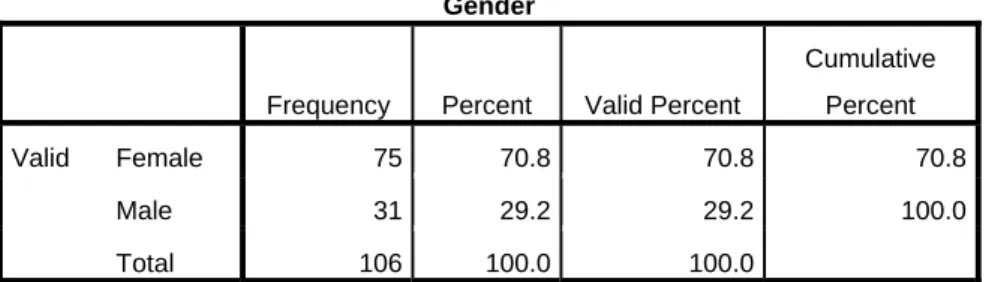
In the end, 106 questionnaires were collected. The following graphs sum up the situation: Table 5. Table concluding gender distribution
Gender
Frequency Percent Valid Percent
Cumulative Percent Valid Female 75 70.8 70.8 70.8 Male 31 29.2 29.2 100.0 Total 106 100.0 100.0 Figure 2. Graph illustrating gender distribution Of all the collected questionnaires, 29.2% (31) were completed by males and 70.8% (75) were completed by females