
由動詞及UP或DOWN組成之動詞片語與介系詞片語連用之分析 - 政大學術集成
137
0
0
全文
(2) Analysis of the co-occurrence of the VP-UP/DOWN construction and the P-NP construction. A Master Thesis Presented to Department of English,. 立. 政 治 大. National Chengchi University. ‧. ‧ 國. 學 er. io. sit. y. Nat. al. n. v i In Partial Fulfillment n Ch U Degree of of the Requirements e n g c hfori the Master of Arts. by Min-Chien Lee May, 2014.
(3) 立. 政 治 大. ‧. ‧ 國. 學. n. er. io. sit. y. Nat. al. Ch. engchi. i n U. v.
(4) Acknowledgements In the process of completing this thesis, I receive a lot of help and support from many people, to whom I would like to give my warmest thanks for assisting me accomplish this work. Firstly, I would like to express my greatest gratitude to my thesis advisor, Professor Siaw-Fong Chung. Professor Chung had been cultivating my ability to do. 政 治 大. the research from my 1 st year in the graduate school. She led me to find my direction. 立. of research, which was inspired by the NSC project professor chaired. And during my. ‧ 國. 學. graduate school years, professor supported me to many conferences, which gave me. ‧. the inspiration for my thesis. Through the longitudinal process of conducting my. Nat. io. sit. y. research, Professor Chung scaffolded me, encouraged me and guided me when I face. er. obstacles. With all her support and care, I could accomplish this thesis.. al. n. v i n Next, my gratitude goesCtohmy proposal committee, e n g c h i U Professor Kawai Chui and. Professor Chao-Lin Liu. They helped me inspect every aspect of my research, and gave me a great number of advices and suggestions which direct me to the right track to continue my research when I was in the proposal stage, and they also gave me confidence to carry on with my work. And I would like to express sincere gratitude to my oral defense committee, Professor Wen-hui Sah and Professor Michael Tanangkingsing. They gave me valuable feedback to improve and refine my thesis. I. iii.
(5) learned a lot from their comments and suggestions. And I would like to express many thanks to the teachers in the English Department for their instructions in class. Special thanks also go to the lab members in the corpus research group directed by Professor Siaw-Fong Chung: Rachel Tseng, Angel Lin, Lynn Chen, and August Chao. They gave me helpful feedback when I am struggling with my research. I would like to show my thanks to my classmates in the TESOL program – Tim Chang,. 政 治 大. Jill Juang, Sandy Kuo, and Ravi Chu. We have been supporting each other on the. 立. school works and developed close friendship since entered the department of English.. ‧ 國. 學. Thank you for accompanying me, caring for me and encouraging me through my. ‧. graduate student life, and thank you for helping me know that I am not alone on the. Nat. io. sit. y. road to an M.A. degree.. er. Finally, I would like to show my heart-felt thanks to my family and my close. al. n. v i n friend, Chin-Wen Yang. It would beC difficult to accomplish my study without h e nforgme chi U my family’s emotional and financial support, or without my close friend’s accompany. Thank you for your love and being there for me when I face difficulties that depressed me. It is you that provide me the shelter so that I could stand still and bravely to continue concentrating on my thesis. It is you that sustain me to accomplish this thesis.. iv.
(6) Table of Contents Acknowledgements………………………………………………………….. iii. Chinese Abstract…………………………………………………………….. vii. English Abstract……………………………………………………………... ix. Chapter 1 INTRODUCTION......................................................................................... 1. 1.1 Background and Motivation……………........................................... 1. 1.2 Significance of the Study………………………………………..….. 8. 政 治 大 2 LITERATURE REVIEW…......................................................................... 立. 10. 1.3 Organization....................................................................................... 2.1 Previous Research on Prepositions..................................................... 學. ‧ 國. 11 11 19. 2.3 Semantic Meanings of Patterns Containing Prepositions................... 21. 2.3.1 The Verb Preposition Sequence (VP P)…………….….......... 22. ‧. 2.2 Semantic Meanings of Prepositions…............................................... y. Nat. io. sit. 2.3.2 The Preposition Noun Sequence (P NP).................................. n. al. er. 2.4 Corpus-based Research on Prepositions…………………….…….... Ch. n U engchi. iv. 24 27. 2.5 Summary of the Chapter..................................................................... 30. 3 METHODOLOGY........................................................................................ 33. 3.1 Materials............................................................................................. 33. 3.2 Data Extraction................................................................................... 34. 3.3 Semantic Meaning Analysis…........................................................... 44. 3.3.1 Categorization of Literal Versus Metaphorical Meaning..…. 45. 3.3.2 Categorization of the First Pattern of [VP Pup/down]……….... 47. 3.3.3 Categorization of the Second Pattern of [Pin NP]..………….. 53. 3.4 Summary of the Chapter..................................................................... 58. v.
(7) 4 RESULTS...................................................................................................... 59. 4.1 Results of the Semantic Meaning Analysis……......……….…...….. 59. 4.1.1 The Literal Versus Metaphorical Meaning………………..... 63. 4.1.2 The First Pattern of [VP Pup/down] …….……………...….…. 72. 4.1.3 The Second Pattern of [Pin NP]…..………….....….…….…. 85. 4.2 Summary of the Chapter…..……..……..……..………..….……….. 99. 5 DISCUSSION............................................................................................... 101. 5.1 Major Findings and the Discussion of the Result....……………….. 101. 政 治 大 6.1 Overall Summary............................................................................... 立. 109. 6 CONCLUSION………….………………………........................................ 6.2 Implications........................................................................................ 學. ‧ 國. 109 110 114. Appendix………………………….……………………………………...….. 119. References……………………….……………………………..……………. 123. ‧. 6.3 Limitations and Suggestions for Future Studies…………................ n. er. io. sit. y. Nat. al. Ch. engchi. vi. i n U. v.
(8) 國立政治大學英國語文學系碩士班 碩士論文提要. 論文名稱:由動詞及 UP 或 DOWN 組成之動詞片語與介系詞片語連用之分析. 指導教授:鍾曉芳博士. 研究生:李旻倩. 論文提要內容:. 立. 政 治 大. 過去許多研究著眼於探討英文介系詞的語意,其中許多學者專注在單一介系. ‧ 國. 學. 詞的探討(e.g., Boers, 1996; Lindstromberg, 2010),其它學者則分析由動詞與介. ‧. 系 詞 組 成 之 動 詞 片 語 、 由 介 系 詞 與 名 詞 組 成 之 介 系 詞 片 語 的 語 意 ( e.g.. y. Nat. io. sit. Larsen-Freeman & Celce-Murcia, 1999; Lindner, 1983; Quirk, Greenbaum, Leech, &. er. Svartik, 1985) 。過去這些研究大多在單一介系詞的框架下進行,鮮少有包含雙介. al. n. v i n Ch 系詞的句構的研究。本論文所研究之句構為:一個由動詞及 UP/DOWN 組成之動 engchi U 詞片語加上一個由 IN 與名詞組成之介系詞片語,在本句構中包含兩個連用之介 系詞,本研究的分析包含雙介系詞的語意、動詞片語以及介系詞片語的語意,另 外還包含此句構中所有語意的語意關連。 本研究採納並調整前人對介系詞、動詞片語以及介系詞片語的語意類別,以 調整過的語意類別分析句構。研究結果發現在此句構中,雙介系詞大多含有隱喻 概念,而大多的動詞片語則用來表達完成的動作語意,介系詞片語則多描繪空間. vii.
(9) 概念或狀態。除此之外,我們發現此句構中的語意間有所關連,另外我們更發現 UP 和 DOWN 在本句構中並沒有完全對比的語意。 在本研究中,我們不同於以往研究只專注於一個介系詞或一個片語的分析, 而是由三個角度切入探討一個含有雙介系詞的句構,未來期望能將本研究的結果 運用在對比學習者對此句構的語言表現,並對介系詞的教學有更多貢獻。. 政 治 大. 關鍵字:BNC 英國國家語料庫、動詞片語、介系詞片語、雙介系詞連用、語意. 立. 分析. ‧. ‧ 國. 學. n. er. io. sit. y. Nat. al. Ch. engchi. viii. i n U. v.
(10) Abstract English prepositions have been extensively explored by researchers in previous studies. Many of them investigated the semantic meanings of prepositions (e.g., Boers, 1996; Lindstromberg, 2010) while others examined the semantic meanings of the patterns containing prepositions such as the verb-preposition sequence (VP P) and the prepositional phrase (P NP) (e.g., Larsen-Freeman & Celce-Murcia, 1999; Lidner,. 政 治 大. 1983; Quirk, Greenbaum, Leech, & Svartik, 1985). In these studies, the researchers. 立. focused on only one preposition in a particular construction (e.g., run away, at the. ‧ 國. 學. door); however, the pattern containing two co-occurring prepositions (e.g., lie down. ‧. in bed) was rarely explored. The thesis aims at the construction composed of the [VP. y. Nat. al. er. io. sit. P] pattern (the preposition is up or down) which follows a [P NP] pattern (the. v. n. preposition is in), and thus a {[VP Pup/down] [Pin NP]} construction in which the two. Ch. engchi. i n U. prepositions co-occur together. The semantic meanings of the two co-occurring prepositions and those of the two patterns are examined. The semantic meaning relationships between these four elements are explored as well. The data were extracted from the British National Corpus (BNC). The semantic meaning analysis was carried out by utilizing the modified semantic meaning categories proposed in the previous studies. The results show that the two co-occurring prepositions are extensively used to describe non-spatial concept. It is ix.
(11) also found that the [VP Pup/down] pattern frequently describes a continued or a completed action, while [Pin NP] pattern refers to a physical space or a state. Based upon the results of the semantic meanings of each element in the construction, we found that the elements are related in terms of their semantic meaning co-occurrence (e.g., when [Pin NP] refers to a physical space, the preposition in is used literally). In addition, we found that up is not the opposite of down.. 政 治 大. In this study, we examine the semantic meanings of the construction from. 立. multiple angles: the preposition, the patterns containing the preposition, and the. ‧ 國. 學. relationships between them. Based upon the results and findings in this thesis, we. ‧. suggest that language learners’ perception and production of this construction could. Nat. io. sit. y. be further explored. When comparing the results found in our study and those. n. al. er. produced by learners, if a difference is identified, a pedagogical profession should. Ch. raise the attention to the construction.. engchi. i n U. v. Keywords: BNC, two co-occurring prepositions, semantic meaning analysis, verb-preposition sequence, prepositional phase. x.
(12) CHAPTER 1. INTRODUCTION. 1.1 Background and Motivation English prepositions are frequently used in the English language (Daud & Abusa, 1999) and have been widely studied. Studies conducted by different researchers used. 政 治 大. different terminologies to refer to the preposition according to what lexical items the. 立. preposition co-occurs with. Some researchers used ‘particles’ to refer to the. ‧ 國. 學. prepositions co-appearing with phrasal verbs or particle verbs (Darwin & Gray, 1999;. ‧. Geld & Letica, 2011; Jon & Fletcher, 2004; Lindner, 1981), and others utilized. y. Nat. al. er. io. sit. ‘adverbial particles’ (Gardner & Davies, 2007), ‘spatial particles’ (Tyler & Evans,. n. 2003), and also ‘satellites’ (Talmy, 2003), and still the others referred to prepositions. Ch. engchi. i n U. v. as ‘spatial prepositions’ (Retz-Schmidt, 1988; Vorwerg & Weiß, 2010), ‘dimensional prepositions’ (Grabowski & Miller, 2000), and ‘projective’ (Herskovits, 1986)1. This study chooses the broad term ‘preposition’ to include the discussion of both prepositions occurring before the prepositional phrase and particles following the phrasal verb and the prepositional verb. In previous research, many studies explored sentences containing only one 1. However, the different terminologies are not the immediate focus of this thesis. 1.
(13) preposition in a sentence, and some examined the literal or metaphorical meaning of that preposition (Boers, 1996; Lindstromberg, 2010; Tyler & Evans, 2003). The literal prepositions describe the locative information between entities in space, while metaphorical prepositions express the non-spatial meanings (Tyler, Mueller and Vu, 2011). The differences between literal and metaphorical prepositions can be demonstrated by example (1.1a) and example (1.1b). In the example sentences of this. 政 治 大. thesis, the literal or metaphorical meaning of the prepositions are symbolized by the. 立. abbreviations in square brackets – [lit] or [met], and the preposition in discuss is in bold.. ‧ 國. 學. (1.1) a. The worker climbs up[lit] the stairs.. Nat. io. sit. y. ‧. b. The squirrels are stocking up[met] the seeds.. er. The preposition up in example (1.1a) is literal because it expresses the upward. al. n. v i n direction the workers are moving inC onhthe stairs in space,U e n g c h i while the preposition up in. example (1.1b) is metaphorical because it expresses the non-spatial idea about the increasing amount of the seeds. With the examination of the literal meaning of prepositions, Tyler and Evans (2003) mentioned that such two prepositions as up and down could be considered as a contrasting pair (Tyler & Evens, 2003:141). Examples (1.2a) and (1.2b) were drawn from their work.. 2.
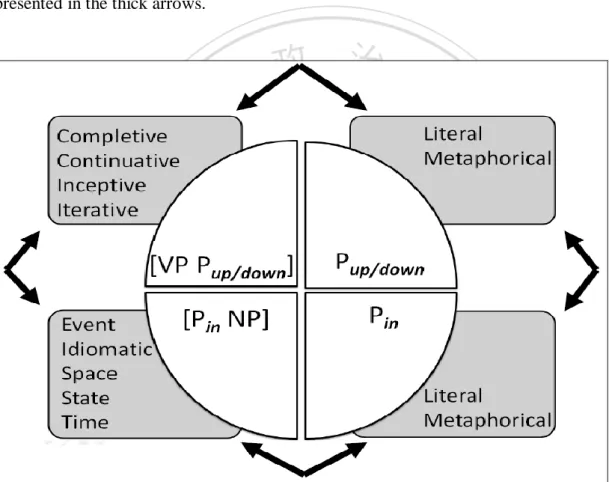
(14) (1.2) a. Jennifer climbed up[lit] the mountain. (Tyler & Evens, 2003: 137) b. The water went down[lit] the drain. (Tyler & Evens, 2003: 141). The preposition up in example (1.2a) conveys the spatial relationship toward an upward direction in which the agent moves, while the preposition down in example (1.2b) denotes the spatial relationship of a downward direction in which the water flows. Such a directional and literal semantic meaning is opposite for the prepositions. 治 政 up and down, and thus making the prepositions a contrasting 大 pair. 立 ‧ 國. 學. In addition to the studies which focused on semantic meanings of one single preposition in one sentence, there are other studies conducted to analyze the semantic. ‧. meanings of a certain pattern which contains a preposition. Since the preposition is. sit. y. Nat. io. n. al. er. very often used (a) after a verb (e.g., rely on), represented by [VP P] in this research,. i n U. v. or (b) before a noun or a noun phrase (e.g., in the box, over a period of time),. Ch. engchi. represented by [P NP] in this study, the [VP P] and the [P NP] pattern have become two of the most frequently studied patterns. For the [VP P] pattern, researchers found that it can denote a ‘Completive’ semantic meaning which shows the action completes, or a ‘Continuative’ meaning which refers to a continued action (Larsen-Freeman & Celce-Murcia, 1999; Quirk, Greenbaum, Leech, & Svartik, 1985; Strumpf & Douglas, 2004). Take (1.3a) and (1.3b) for example. When presenting the [VP P] pattern. 3.
(15) meaning in the example sentences of this thesis, the meaning of the pattern containing the preposition is in the parenthesis placed before the sentence, and the pattern in the sentence is underlined.. (1.3) a. (Completive) The kid drinks up the milk. b. (Continuative) They travel around the country.. 政 治 大. The [VP P] pattern, which has up as the preposition, in example (1.3.a) describes the. 立. completive state of the milk being consumed; the [VP P] pattern with a preposition. ‧ 國. 學. around in example (1.3.b) refers to the continued action of going on a trip or moving. ‧. from one place to another. For the [P NP] pattern, researchers found that the pattern. Nat. io. sit. y. containing the preposition denote distinct semantic meanings. The semantic meaning. er. that the [P NP] pattern expresses could be ‘Space’, which describes the entities in. al. n. v i n space, or ‘Time’, which refers to theCtemporal in time (Larsen-Freeman & h e n idea gchi U. Celce-Murcia, 1999; Quirk, Greenbaum, Leech, & Svartik, 1985; Strumpf & Douglas, 2004). See examples (1.4a) and (1.4b). The meaning of the [P NP] pattern is also in the parenthesis placed before the sentence in this thesis, and the pattern in the sentence is underlined. (1.4) a. (Space) The treasure is locked in the safe which is buried under the ground.. 4.
(16) b. (Time) The party is held on Saturday.. The [P NP] pattern in example (1.4a), in the safe, refers to the space hiding the valuable things, and the pattern in example (1.4b), on Saturday, orients a point in time. These examples show that when a preposition co-occurs with different lexical items such as a verb or a noun, the [VP P] or the [P NP] pattern containing the preposition projects a variety of semantic meanings.. 治 政 However, there are limited corpus-based studies 大investigating a sentence 立 ‧ 國. 學. containing two co-occurring prepositions: one belongs to [VP P] while the other exists in [P NP]. Two examples could be seen as below in examples (1.5a) and (1.5b).. io. sit. y. ‧. Nat. (1.5) a. We have to wake up on Sunday morning very early.. n. al. er. b. The heirloom has been passed down in Smith’s family.. Ch. engchi. i n U. v. Wake up in example (1.5a) and passed down in example (1.5b) refer to the [VP P] pattern while the preposition P in the former case is on and the latter is down. The [P NP] pattern for example (1.5a) is on Sunday morning, while that in example (1.5b) is in Smith’s family. And the preposition P in the former example is on and the preposition P in the latter case is in. These two examples illustrate this type of sentences, which is symbolized as {[VP P] [P NP]} in this study. VP stands for a verb. 5.
(17) or a verb phrase, P for a preposition, and NP for a noun or a noun phrase. Such sentences carrying two co-appearing prepositions in a {[VP P] [P NP]} construction have rarely been researched in the literature. Even though not much work on the {[VP P] [P NP]} construction has been found, some systematic observations of {[VP P] [P NP]} might be made, based upon the results from previous studies regarding the semantic meanings of the preposition P,. 政 治 大. the [VP P] pattern, and the [P NP] pattern. Based upon the results from the literature,. 立. this study specifically targets on the construction containing the [V Pup/down] pattern. ‧ 國. 學. plus the [Pin N] pattern in a single sentence. This targeted construction is symbolized. ‧. as {[V Pup/down] [Pin N]}, which has two co-occurring prepositions – up/down and in.. Nat. io. sit. y. The capitalized P followed by the italicized lowercase up/down or in is used from now. er. on in this thesis when referring to the preposition in the targeted construction (i.e.,. al. n. v i n C hfrom the literature,Uwe conducted our study in ). Building on the results engchi. Pup/down and Pin. a different way. Unlike previous studies focusing on only one aspect – either focusing on the semantic meanings of the preposition, or the semantic meanings of the [VP P] or [P NP] pattern – we examine the construction from more than one angle. Our analysis includes not only the semantic meanings of the preposition itself, but also the [VP Pup/down] pattern and the [Pin NP] pattern. In addition, the semantic meaning co-occurring relationships are also included. Based upon these analyses on the 6.
(18) targeted construction, we can also form our claim about whether it is as previous studies claimed that up and down form a contrasting pair (Tyler & Evans, 2003) or not (Lindstromberg, 2010: 193). Such an analysis as our study does is multi-leveled, which is addressed by three research questions listed below.. (1) What is the corpus distribution of the literal and metaphorical meanings of Pup/down in the [VP Pup/down] pattern and what is the distribution of the literal and metaphorical Pin in [Pin. 立. 治 政 NP]? 大. ‧ 國. 學. (2) How similar or different are the semantic meanings of [VP Pup/down] and [P NP] in the construction {[VP P] [P NP]}?. ‧. (3) What are the relationships between the meaning of Pup/down in [VP Pup/down] and the. sit. y. Nat. io. n. al. er. meaning of Pin in [Pin NP]; between the meaning of Pup/down in [VP Pup/down] and. i n U. v. the meaning of [VP Pup/down]; between the meaning of Pin and the meaning of [Pin. Ch. engchi. NP]; and those between the meaning of [VP Pup/down] and the meaning of [Pin NP]?. The first research question investigates how many preposition up and down in [VP Pup/down] and how many preposition in in [Pin NP] are used literally and metaphorically. The second research question reveals what semantic meanings the [VP Pup/down] pattern and the [Pin NP] pattern bear. Through the last research question, we will know (a) whether literal or metaphorical Pup/down correlates to the literal or 7.
(19) metaphorical meaning of Pin, (b) whether [VP Pup/down] tend to have a literal or metaphorical P up/down, (c) whether [Pin NP] tend to have a literal or metaphorical Pin, and (d) whether [VP Pup/down] tend to co-appear with certain [Pin NP].. 1.2 Significance of the Study There are a large number of studies investigating the semantic meanings of prepositions, the semantic meanings of the [VP P] pattern and also the [P NP] pattern. 治 政 (Dehé, 2002; Lindner, 1981; Lipka, 1972; Otani, 2006; Tyler 大& Evans, 2003; among 立 ‧ 國. 學. many). Some researchers found that among the uses of ‘prepositional phrase’ (Huang, 2011: 2), both of the [VP P] pattern and the [P NP] pattern cause great difficulties to. ‧. language learners. But not many have studied the combination of the two patterns. sit. y. Nat. io. n. al. er. which forms the {[VP P] [P NP]} construction. This study tries to fill the gap by. i n U. v. focusing on the {[VP Pup/down] [Pin NP]} construction where there are two. Ch. engchi. co-occurring prepositions – Pup/down and Pin. We try to reveal the semantic meanings of this construction, including the semantic meanings of the pattern containing a preposition (e.g., the [VP Pup/down] pattern in closed down in November, and the [Pin NP] pattern in dressed up in lifeboat gear). In addition, we also try to reveal the semantic meanings of the two co-occurring prepositions – Pup/down and Pin; it is the second valuable point of our study to contribute to the investigation of prepositions.. 8.
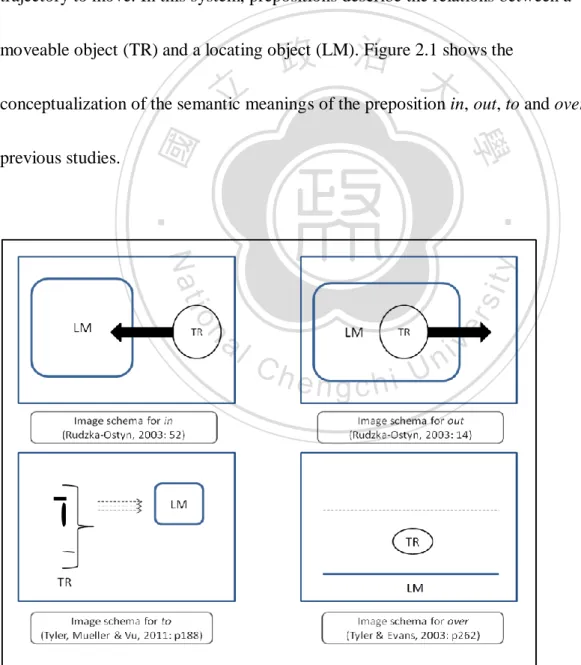
(20) The second importance for conducting this study is to see that in the targeted construction with two co-occurring prepositions, whether the two prepositions, when put together, have the semantic meanings proposed by previous studies. Among the few studies contributing to the construction of two co-occurring prepositions, Ayano (2004), who researched two co-occurring prepositions in a construction of {P P N} (i.e., two co-occurring prepositions following a noun such as back under the chair),. 政 治 大. found that based on the decomposition of the construction, the first preposition has [ +. 立. directional] feature, while the second one has a [ + locational] feature (e.g., Mary. ‧ 國. 學. moved a car right from[+dir] behind[+loc] the barn). However, comparing the results of. ‧. {P P N} in Ayano (2004) and our corpus data of {[VP Pup/down] [Pin NP]}, we found. Nat. io. sit. y. that two co-occurring prepositions perform differently in distinct constructions. For. er. example, started up in September last year has its second preposition in in the [Pin NP]. al. n. v i n C hreferring to a temporal pattern being [ - locational] and e n g c h i U idea. This type of example. motivates us to study of the semantics of two co-occurring prepositions in the {[VP P] [P NP]} construction and to investigate whether the prepositions have the semantic meanings as previous research proposed. The significance of this study lies in the way of data analysis, which is different from previous studies. We implement a multi-leveled investigation of the construction containing more than one preposition. We not only examine the semantic meanings of 9.
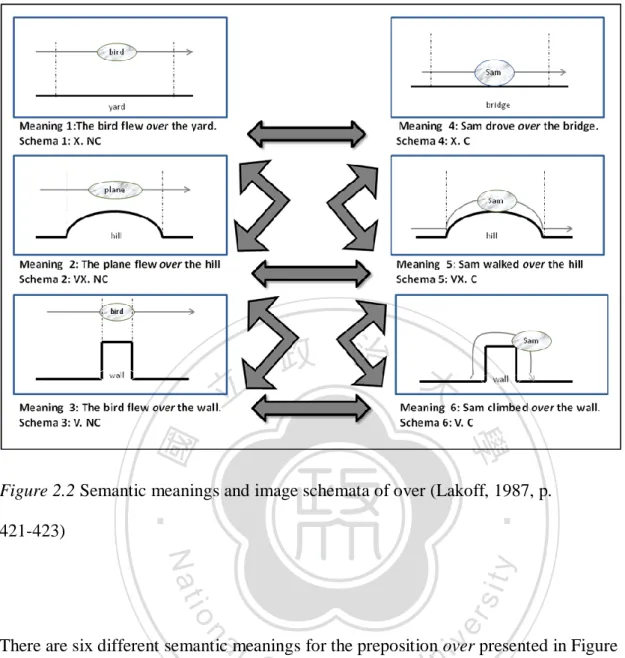
(21) the preposition, but also study the semantic meanings of the patterns containing prepositions (e.g., the semantic meaning of the [VP Pup/down] action in closed down in November, and the semantic meaning of [Pin NP] in dressed up in lifeboat gear). By revealing the semantics of the construction containing two prepositions in {[VP Pup/down] [Pin NP]}, we believe that the results could help English language learners understand and produce the preposition usages more accurately since this study. 政 治 大. reveals one of the greatest learning challenges – the semantic meanings – of the. 立. to propose pedagogical suggestions to the targeted construction.. 學. ‧ 國. prepositions (Larsen-Freeman & Celce-Murcia, 1999). At the end of the study, we try. ‧. 1.3 Organization. sit. y. Nat. io. n. al. er. This chapter presents the background and motivation of doing this study and also. i n U. v. the research questions to be explored in this research. Chapter 2 reviews the related. Ch. engchi. research regarding prepositions. Chapter 3 states the research methods including the source where the data were retrieved from, the steps of extracting the data, the semantic meaning categories and definitions for analyzing the data. The quantitative results of the data analysis are presented in Chapter 4. Chapter 5 further discusses the major findings regarding the three research questions. At the end, Chapter 6 presents the conclusion, implications, and limitations and suggestion of this study.. 10.
(22) CHAPTER 2. LITERATURE REVIEW. For the purpose of this thesis in exploring the semantic meanings of not only the prepositions but also the patterns containing prepositions, related studies are reviewed in this chapter. This chapter shows an overview of previous studies on prepositions. 政 治 大. (Section 2.1), and previous research on the semantic meanings of prepositions. 立. (Section 2.2), as well as the patterns containing prepositions (Section 2.3).. ‧ 國. 學. Corpus-based studies on prepositions are also reviewed (Section 2.4).. ‧ y. sit. Nat. 2.1 Previous Research on Prepositions. n. al. er. io. The semantic meaning of prepositions has been widely investigated, especially. Ch. i n U. v. through image schema. Image schema is the abstract image structure that organizes. engchi. how people perceive and interact with the spatial context in the physical world (e.g., UP-DOWN, IN-OUT, PART-WHOLE, PATH, CONTAINMENT, CONTACT, and VERTICALITY) (Johnson, 1987). Linguists believed that through image schema, the various meanings of prepositions could be characterized and understood in a systematic way (Brugman, 1988; Lakoff, 1987; Lindner, 1981; Tyler & Evans, 2001, 2003; Vandeloise & Bosch, 1991). 11.
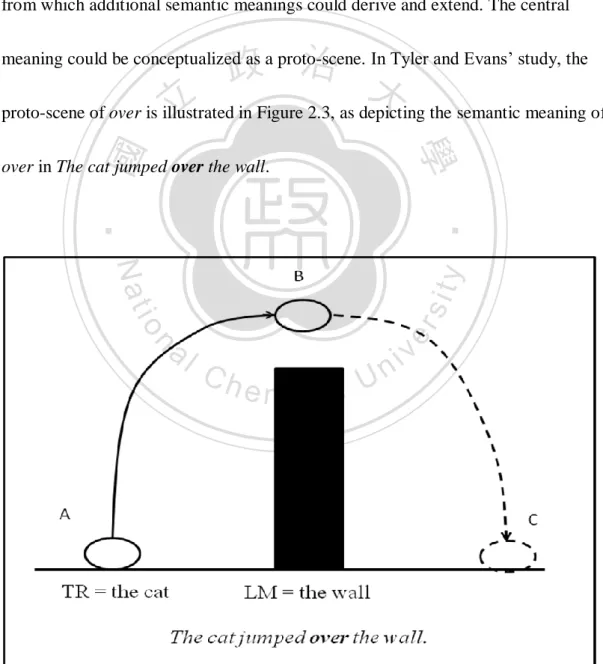
(23) In addition to image schema, Langacker (1987) and Lakoff (1987) had also explored the prepositions by examining how their senses are conceptualized in terms of foreground and background, or figure (F) and ground (G), or trajectory (TR) and landmark (LM). Trajector (TR) is a moving object while the landmark (LM) is another object which is less moveable. Landmark serves as a point of reference for the trajectory to move. In this system, prepositions describe the relations between a. 政 治 大. moveable object (TR) and a locating object (LM). Figure 2.1 shows the. 立. conceptualization of the semantic meanings of the preposition in, out, to and over in. ‧. ‧ 國. 學. previous studies.. n. er. io. sit. y. Nat. al. Ch. engchi. i n U. v. Figure 2.1 Image schemata with TR and LM for prepositions in, out, to and over 12.
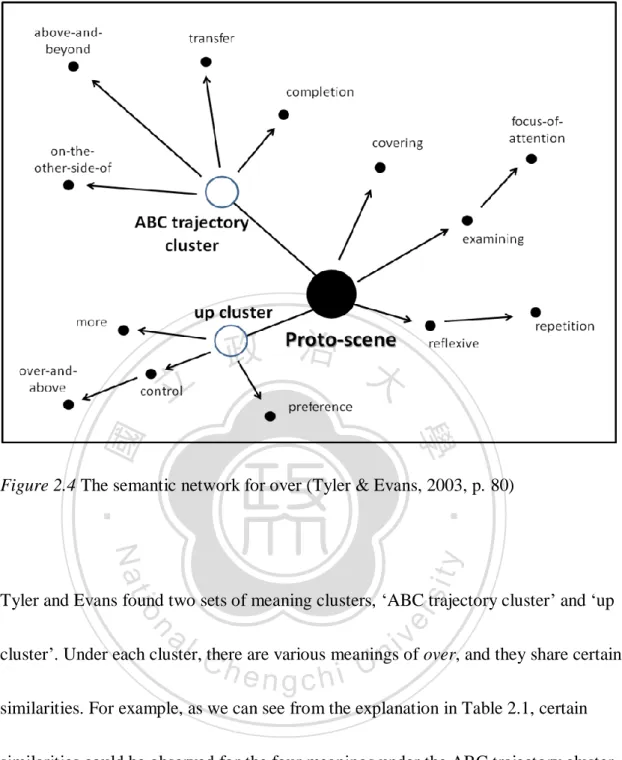
(24) For the preposition in, LM serves as a container for TR to be enclosed (Rudzka-Ostyn, 2003). In the same study, Rudzka-Ostyn stated that LM in the image schema for out acts as a container for TR to escape. For preposition to, Tyler, Mueller and Vu (2011) refer to the LM as a goal to which the TR faces forward. Tyler and Evans (2003) demonstrated the image schema for the preposition over. TR is conceptualized as. 政 治 大. being very close to LM and within the possible distance for it to reach the LM (the. 立. distance is illustrated by the dotted line).. ‧ 國. 學. Based upon the image schema device, each diagram can only represent one. ‧. semantic meaning for one preposition. However, as prepositions are polysemous. Nat. io. sit. y. (Taylor, 1993), the connections between senses of a preposition and how to represent. er. them are of great concern. Lakoff (1987) presented various image schemata to reflect. al. n. v i n C h over (see Figure different meanings of the preposition e n g c h i U 2.2 for a redrawn version by. the author of this study) 2. As shown in his study, various semantic meanings of one single preposition could be represented in various image schemata conceptualized in the relationship between TR and LM.. 2. Image schema: V=Vertical; X=EXTENDED; C=CONTACT; N=NO CONTACT. 13.
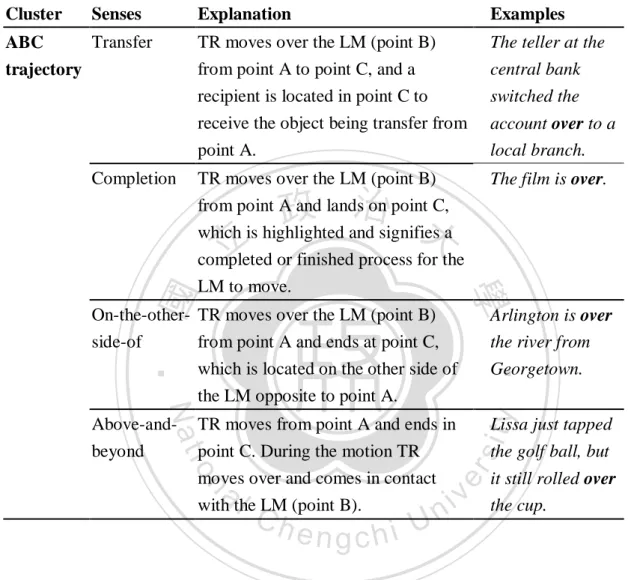
(25) 立. 政 治 大. ‧ 國. 學. Figure 2.2 Semantic meanings and image schemata of over (Lakoff, 1987, p.. ‧. 421-423). n. er. io. sit. y. Nat. al. i n U. v. There are six different semantic meanings for the preposition over presented in Figure. Ch. engchi. 2.2 (i.e., Meaning 1 to 6 are listed below each diagram). Different meanings of the preposition over arise when it appears in a different context, with distinct relationships between the TR and LM. Lakoff claimed that it is through the different image schemata with variant relationships between the TR and the LM, a chain for semantic meanings could be linked together in a principled way to illustrate the polysemous meanings of prepositions (see the thick arrows created by the author of. 14.
(26) this paper between diagrams demonstrating the chain). In addition to Lakoff’s claim that semantic meanings of a preposition could create a chain, the polysemous meanings could also be represented in a semantic network. For example, Tyler and Evans (2003) proposed such a semantic framework in their study of over as well, and claimed that prepositions have a central meaning from which additional semantic meanings could derive and extend. The central. 政 治 大. meaning could be conceptualized as a proto-scene. In Tyler and Evans’ study, the. 立. proto-scene of over is illustrated in Figure 2.3, as depicting the semantic meaning of. ‧ 國. 學. over in The cat jumped over the wall.. ‧. n. er. io. sit. y. Nat. al. Ch. engchi. i n U. v. Figure 2.3 Proto-scene for preposition over (Tyler & Evans, 2003, p. 71) 15.
(27) In Figure 2.3, the LM (the wall) is conceptualized as an obstruction for the TR (the cat) to overcome. In this proto-scene, the TR has to move across the LM to a point on the other side of the LM. Therefore, as shown in Figure 2.3, for the movement of the TR to complete, a point C is expected and inferred. Tyler and Evans believed that some senses could be extended from this proto-scene. Figure 2.4 shows the semantic. 政 治 大. network for over extended from the proto-scene of over. The big dark dot. 立. (proto-scene) represents the prototypical meaning of over, from which multiple. ‧ 國. 學. semantic meanings of over are extended. Each small dot is a semantic meaning of. ‧. io. sit. y. Nat. n. al. er. over.. Ch. engchi. 16. i n U. v.
(28) 立. 政 治 大. ‧ 國. 學. Figure 2.4 The semantic network for over (Tyler & Evans, 2003, p. 80). ‧ sit. y. Nat. n. al. er. io. Tyler and Evans found two sets of meaning clusters, ‘ABC trajectory cluster’ and ‘up. Ch. i n U. v. cluster’. Under each cluster, there are various meanings of over, and they share certain. engchi. similarities. For example, as we can see from the explanation in Table 2.1, certain similarities could be observed for the four meanings under the ABC trajectory cluster.. 17.
(29) Table 2.1 The Explanations of the Meanings in the ABC Trajectory Cluster of over in Tyler & Evans (2003) Cluster. Senses. Explanation. Examples. ABC. Transfer. TR moves over the LM (point B). The teller at the. from point A to point C, and a recipient is located in point C to receive the object being transfer from point A.. central bank switched the. TR moves over the LM (point B). The film is over.. 立. TR moves from point A and ends in. beyond. point C. During the motion TR moves over and comes in contact with the LM (point B).. n. al. Ch. Lissa just tapped the golf ball, but. er. io. Above-and-. Arlington is over the river from Georgetown.. ‧. Nat. On-the-other- TR moves over the LM (point B) side-of from point A and ends at point C, which is located on the other side of the LM opposite to point A.. 學. ‧ 國. 政 治 大. from point A and lands on point C, which is highlighted and signifies a completed or finished process for the LM to move.. y. Completion. account over to a local branch.. sit. trajectory. n U engchi. iv. it still rolled over the cup.. Table 2.1 lists the explanations of three extended senses of the ABC trajectory meaning cluster: ‘transfer’, ‘completion’, ‘on-the-other-side-of’, and ‘above-and-beyond’. All four senses falling in this cluster have the meaning in which the TR moved through point A to B and then to C. Tyler and Evans also posited that such a polysemy network could be constructed for each individual English. 18.
(30) preposition. From the above discussion, we could see that the polysemous meanings of an English preposition could be systematically extended from its proto-scene or its central meaning. The central meaning of a preposition, from Lindstromberg’s (2010) point of view, is the most prototypical meanings that many people think of when hearing that preposition. This type of meaning, in Lindstromberg’s study which is. 政 治 大. based upon the work by Brugman (1988) and Lakoff (1987), is referred to as the. 立. literal meaning of a preposition. And the literal meaning could be extended by. ‧ 國. 學. metaphors to give rise to additional related meanings. The idea is also mentioned in. ‧. Tyler and Evans’s (2001) work. They posited that the central meaning of a preposition. Nat. io. sit. y. motivates many of the metaphorical meanings. According to the researchers, it is. er. possible to see that there are two categories of semantic meanings for a preposition: (a). al. n. v i n Cmeanings, literal, central or prototypical (b) metaphorical or extended meanings. h e n gand chi U In the next section, previous studies investigating how two categories of semantic meanings – either literal or metaphorical – of prepositions differ will be reviewed.. 2.2 Semantic Meanings of Prepositions Many of the previous studies examining the prepositions mentioned that polysemous prepositions have central/literal meanings and extended/metaphorical. 19.
(31) meanings (Boers, 1996; Lindstromberg, 2010; Tyler & Evans, 2001; Tyler & Evans, 2003). Researchers also provided the definitions for discerning the literal meaning from the metaphorical meanings of a preposition. For example, Arnold (1986), while clarifying a variety of meanings types (e.g., literal meaning, figurative meaning, connotative meanings, etc.), described that if a lexicon has a literal meaning, the meaning refers to an entity which is obvious by itself without making reference to. 政 治 大. another entity. On the other hand, when a lexicon has a figurative or metaphorical. 立. meaning, the meaning could only be understood through the reference to another. ‧ 國. 學. similar entity. Tyler, Mueller, and Vu (2011) built on the definitions for literal and. ‧. metaphorical meanings in their study while investigating the semantics of English. Nat. io. sit. y. prepositions (e.g., to, for, and at), and they stated that metaphorical meanings are. n. al. er. extended from spatial to non-spatial. See two of the examples from their study. Ch. presented in examples (2.1a) and (2.1b).. engchi. i n U. v. (2.1) a. Nicole moved the chair from the living room to[lit] the dining room. (Tyler, Mueller, & Vu, 2011, p. 189). b. Kim is hard at[met] her studies. (Tyler, Mueller, & Vu, 2011, p. 196). The preposition to in example (2.1a) is literal because it refers to the spatial direction for the agent to move from one place to another location in the physical space, while 20.
(32) at in example (2.1b) has a non-spatial metaphorical meaning in describing the hard-working state of the agent. In sum, the criterion used to discern the literal meanings of a preposition from the metaphorical meanings is whether the meaning is spatial or non-spatial. If it is the former case, the semantic meaning of the preposition is literal; if the semantic meaning describes a non-spatial concept, the meaning is metaphorical. This criterion for distinguishing the literal meanings from the. 政 治 大. metaphorical meanings of prepositions is used in this study.. 立. ‧ 國. 學. 2.3 Semantic Meanings of Patterns Containing Prepositions. In addition to investigating the semantic meanings of a single preposition, many. ‧. have researched prepositions in the verb preposition sequence (i.e., the [VP P] pattern). sit. y. Nat. io. n. al. er. and also the pattern of a preposition with a noun phrase (i.e., [P NP] pattern) (Dehé,. i n U. v. 2002; Larsen-Freeman & Celce-Murcia, 1999; Lindner, 1983; Lipka, 1972; Otani,. Ch. engchi. 2006; Quirk, Greenbaum, Leech, & Svartik, 1985; Tyler & Evans, 2003). The researchers of these studies did not focus on the literal or metaphorical meanings of the patterns containing prepositions, but focused on and proposed other semantic meanings categories for the patterns. The studies concerning the semantic meanings of the [VP P] pattern is reviewed in Section 2.3.1, while the research regarding the semantic meanings of the [P NP] pattern is addressed in Section 2.3.2.. 21.
(33) 2.3.1 The verb preposition sequence ([VP P]) When referring to [VP P] pattern (e.g., stand up, throw away, keep on, mess around, think over, fade out), different terminologies have been used in the literature (e.g., Darwin & Gray’s (1999) phrasal verb, and Lindner’s (1983) verb particle construction, Quirk, Greenbaum, Leech, & Svartik’s (1985) multi-word verb). Regardless of different terminologies, researchers aimed at exploring the. 政 治 大. semantic meanings of the [VP P] pattern. The semantic meaning of the [VP P] pattern. 立. could be literal, aspectual or idiomatic according to Larsen-Freeman and. ‧ 國. 學. Celce-Murcia (1999). Among the semantic meanings of the [VP P] patterns,. ‧. Larsen-Freeman and Celce-Murcia categorized the aspectual patterns, which describe. Nat. io. sit. y. how the [VP P] action happens, based upon the preposition coming after VP in the. er. pattern (e.g., travel around uses around to show the action continues). The discussion. al. n. v i n CP]hpattern could alsoUbe seen in other of the aspectual meanings of the [VP engchi. researchers’ work such as Lindner (1983) and Otani (2006). Lindner and Otani proposed that this pattern has the ‘Completive’ meaning which describes a completed state of an action (see example (2.2)).. (2.2) (Completive) He ate up the sandwich. (Lindner, 1983, p.150). The [VP P] pattern in example (2.2), ate up, refers to the end of an eating action while 22.
(34) the sandwich was all taken into the agent’s mouth and swallowed. In addition to the ‘Completive’ meaning, Larsen-Freeman and Celce-Murcia (1999) posited that the [VP P] pattern has other three semantic meanings: ‘Continuative’, ‘Inceptive’, and ‘Iterative’. For the ‘Continuative’ meaning described by the [VP P] pattern, it refers to an action which continues for a period of time (see example (2.3)).. (2.3) (Continuative) She read through her lines in her play. (Larsen-Freeman &. 治 政 Celce-Murcia, 1999, p. 432) 大 立 ‧ 國. 學. In example (2.3), the [VP P] pattern describes the continued action of looking at the. ‧. lines in order to study and understand the content of it. As for the ‘Inceptive’ [VP P]. Nat. n. al. er. io. sit. y. pattern, it marks the beginning state of an action such as (2.4) exemplifies.. i n U. v. (2.4) (Inceptive) John took off. (Larsen-Freeman & Celce-Murcia, 1999, p. 432). Ch. engchi. The [VP P] pattern in example (2.4), took off, describes the beginning action of flying or the beginning state of becoming successful. Last but not least, for the ‘Iterative’ meaning of the [VP P] pattern, it refers to the repetition of an action. One typical example could be seen in example (2.5).. (2.5) (Iterative) He will think over her suggestions. (Larsen-Freeman & Celce-Murcia,. 23.
(35) 1999, p. 433). In example (2.5), the [VP P] pattern conveys the action of repetitively thinking about the suggestions given by the female person in order to make a decision about something or to understand something. In sum, there are four semantic meanings of the [VP P] pattern proposed in previous studies: (a) ‘Completive’ meaning describes a completed state of an action,. 治 政 (b)’Continuative’ meaning describes an action that continues 大for a period of time, 立 ‧ 國. 學. (c)’Inceptive’ meaning describes the beginning state of an action, and (d) ‘Iterative’ meaning describes the repetition of an action. When the previous studies discussed. ‧. these four semantic meanings, almost all the examples provided contain metaphorical. sit. y. Nat. io. n. al. er. prepositions (e.g., eat up and find out). The [VP P] pattern with a literal preposition is. i n U. v. rarely found in these studies (e.g., go down and jump up). Unlike these studies, we. Ch. engchi. examine the four semantic meanings of the [VP P] pattern containing both literal and metaphorical preposition.. 2.3.2 The preposition noun sequence ([P NP]) In addition to studying the [VP P] pattern, some of the previous studies such as the grammar book composed by Larsen-Freeman and Celce-Murcia (1999), and the book by Quirk, Greenbaum, Leech, and Svartik (1985) have also investigated the [P 24.
(36) NP] pattern, and proposed that [P NP] has several semantic meanings. These studies examined the semantic meanings of the pattern without considering the literal or metaphorical meaning of the preposition appearing before the NP. For example, the grammar books proposed that the [P NP] can denote a ‘Space’ meaning or a ‘Time’ meaning. For ‘Space’, [P NP] expresses a range of different relations between two entities in physical space (see from examples from (2.6a) to (2.6c)).. 治 政 (2.6) a. (Space) She fell on the floor. (Quirk et al., 1985, 大 p.675) 立 ‧ 國. 學. b. (Space) The ball rolled underneath the table. (Quirk et al., 1985, p.681) c. (Space) Meet me at the theater. (Quirk et al., 1985, p. 409). ‧. Nat. io. sit. y. Example (2.6a) expresses a point of position on the surface of the floor; underneath. er. the table in example (2.6b) expresses the passage for the ball to move alone; and at. al. n. v i n the theater in example (2.6c)Cconveys general dimension in space where plays h e nagmore chi U or shows are performed on the stage. These different types of spatial relations denoted by the [P NP] pattern are all marked as ‘Space’. For ‘Time’, two basic meanings – a point of time and a period of time – were proposed by researchers. Examples are illustrated in (2.7a) and (2.7b).. (2.7) a. (Time) We arrive at 10 o’clock. (Quirk et al., 1985, p. 688). 25.
(37) b. (Time) We camp there in the summer. (Quirk et al., 1985, p. 689). The [P NP] pattern in example (2.7a) refers to the specific time point in an hour while the pattern in example (2.7b) refers to the longer period of time regarding a season. Two types of temporal ideas are both categorized as ‘Time’. In addition to ‘Space’ and ‘Time’, the [P NP] pattern can refer to other semantic meanings – ‘Cause/Purpose, ‘Means/Agentive, ‘Degree’ and ‘Others’. For. 治 政 ‘Cause/Purpose’ and ‘Means/Agentive’, Quirk et al. (1985)大 proposed that both of 立 ‧ 國. 學. them include a continuum range of different meanings. ‘Cause/Purpose’ is very often associated with the preposition for. And the range of meanings include ‘cause’ (e.g.,. ‧. She lost her job for her age), ‘reason’ (e.g., He was fined for drunk driving),. sit. y. Nat. io. n. al. er. ‘purpose’ (e.g., Everyone ran for shelter) and so on. For ‘Means/Agentive’, it usually. i n U. v. has with as the preposition in the [P NP] pattern. The meanings include ‘manner’ (e.g.,. Ch. engchi. She performed the operation with great skill), ‘instrument’ (e.g., Someone had broken the window with a stone), and ‘agentive’ (e.g., The window had been broken with a stone by someone with a stone). As for ‘Degree’ and ‘Others’, Larsen-Freeman and Celce-Murcia (1999) gave some examples in their work. For example, the [P NP] pattern in Water freezes at 0°C expresses the exact unit or degree to measure the temperature. For ‘Others’, Larsen-Freeman and Celce-Murcia classified the idiomatic. 26.
(38) expressions such as the [P NP] pattern in He works at keeping in shape. All these four semantic meanings have been considered to be portrayed by the [P NP] pattern in the literature. In sum, there are six semantic meaning categories for the [P NP] pattern proposed in previous studies: (a) ‘Space’ meaning refers to a range of relations between entities in space, (b) ‘Time’ meaning refers to temporal ideas, (c). 政 治 大. ‘Cause/Purpose’ meaning refers to cause, motives or purposes, and it usually. 立. associates with a particular preposition for, (d) ‘Means/Agentive’ meaning refers to. ‧ 國. 學. the method or instrument, and it usually associates with particular a preposition with,. ‧. (e) ‘Degree’ meaning refers to the unit, amount or level of measuring things, and (f). Nat. io. sit. y. ‘Others’ refers to idiomatic expressions. All six semantic meanings are adopted but. er. adapted in our study (will be addressed in our methodology chapter) to analyze our [P. al. n. v i n C h a literal or metaphorical N] pattern, which contains either e n g c h i U preposition. 2.4 Corpus-based Research on Prepositions. Researchers specializing in different fields, including semantics, syntax, and contrastive analysis, found that corpus can be of use for their studies on prepositions. Many of them have incorporated the corpus as a tool from which concordance lines were retrieved as materials to explore prepositions. They adopted a corpus-based. 27.
(39) approach for three types of benefits corpus can provide: (a) rich and diversified data (Berez & Gries, 2008), (b) authentic linguistic examples presenting the true language usage (Wikberg, 2006), and (c) part-of-speech (POS) tagging for target linguistic items to be searched and sorted (Granger, 2002). In the semantics field, researchers analyzed the large quantity of data extracted from corpus. For example, Hying (2007) studied corpus data to evaluate spatial. 政 治 大. relation meanings in language uses; Alam (2004) and Srikumar and Roth (2013). 立. explored ways to determine meanings of prepositions. Chung and Lee (2013) studied. ‧ 國. 學. the literal and metaphorical meanings of the English prepositional phrase, [PREP the. ‧. NOUN of], and discussed its pedagogical implications. Lee and Chung (2013). Nat. io. sit. y. focused on the semantic meanings of the construction containing the [VP down]. er. pattern co-occurring the [in NP] pattern. Many others used corpus frequency and POS. al. n. v i n tags to investigate the semantics of C theh prepositions (Baldwin e n g c h i U & Villavicencio, 2002; Stetina & Nagao 1997; Yeh & Vilain 1998; Pantel & Lin 2000). Some linguists carried out corpus-based studies on the syntax of prepositions. They incorporated corpus to perform the task of researching prepositional phrase attachment ambiguity. In this field, prepositional phrase attachment has been investigated by utilizing distinct methods such as the decision tree (Merlo, Crocker, & Berthouzoz, 1997) or word proximity in corpus data (Pantel & Lin 2000; Stetina & Nagao 28.
(40) 1997; Yeh & Vilain 1998).. The above-mentioned corpus-based studies, in both the semantic and the syntax fields, examined one or more prepositions within one language. There are other linguists who did contrastive corpus-based analysis studies. For instance, Paulussen (1995) examined the polysemous meanings of Dutch prepositions with its counterparts in English and French. Both works by Baldwin, Beavers, Van Der Beek,. 政 治 大. Bond, Flickinger, and Sag (2006) and Girju (2009) analyzed the semantic meanings of. 立. prepositions together with the syntax performance of prepositional patterns. Baldwin. ‧ 國. 學. et al. (2006) investigated the English and Dutch prepositions while Girju (2009). ‧. focused on the semantic meanings and syntactic uses of prepositions in the English. Nat. io. sit. y. language and the Romance language. Klégr (2009) had the semantic and syntactic. n. al. er. analysis results of English and Czech prepositions applied to benefit and help. Ch. engchi. improving the descriptions in the dictionaries.. i n U. v. In addition, some researchers linked up their corpus-based studies of prepositions with pedagogically related issues. There are linguists discussing the language learning process or performance of learners at different ages. For example, Morgenstern and Sekali’s contrastive research (2009) focused on children’s acquisition and grammatical performance of French and English preposition, and they found that the frequency of input is essential. College students’ preposition collocation knowledge 29.
(41) and performance were analyzed and compared with that of the authentic examples in the corpus (Mueller, 2011). Koosha and Jafarpour (2006) examined whether adult learners’ performance on the preposition collocations differs with different teaching methods (i.e., traditional method versus data-driven approach). Different from the focus to exploring learning process and language performance, Mukundan and Roslim (2009) analyzed the language use in teaching materials and corpus. They found that. 政 治 大. there is a difference in the preposition usage frequency order between the material. 立. used in class and the authentic language in corpus, and they pointed out that teachers. ‧ 國. 學. need to be aware of this in their teaching.. ‧. Like these previous corpus-based studies, the current work utilize the rich corpus. Nat. io. sit. y. data, authentic linguistic examples and the POS tagging to investigate the semantic. er. meanings of English the prepositions and the patterns containing prepositions. The. al. n. v i n methodology we adopted to analyzeC the are presented in Chapter 3. hcorpus e n gdata chi U 2.5 Summary of the Chapter. In this chapter, we first reviewed previous studies regarding prepositions (see Section 2.1). Studies claimed that prepositions could bear a central/literal meaning and extended/metaphorical meanings. Section 2.2 addressed previous work on discussing how to determine whether the semantic meanings of a preposition are. 30.
(42) literal or metaphorical. In addition to analyzing the semantic meanings of the preposition alone, studies identifying the semantic meaning of the patterns containing prepositions were reviewed as well (see Section 2.3); previous work on the [VP P] pattern was examined in Section 2.3.1, and the studies on the [P NP] pattern were discussed in Section 2.3.2. Since many of the recent studies have incorporated the corpus as a tool to examine prepositions, related works in different linguist fields. 政 治 大. including semantics, syntax, and pedagogy were also reviewed (see Section 2.4). In. 立. Chapter 3, the methodology regarding the corpus data extraction, and the definitions. ‧ 國. 學. and categories of semantic meanings used in this thesis will be explained.. ‧. n. er. io. sit. y. Nat. al. Ch. engchi. 31. i n U. v.
(43) 立. 政 治 大. ‧. ‧ 國. 學. n. er. io. sit. y. Nat. al. Ch. engchi. 32. i n U. v.
(44) CHAPTER 3. METHODOLOGY. The methodology we adopt in this thesis is presented in Chapter 3. It contains three sections: the first introduces the online British National Corpus as the resource of the data (Section 3.1), and the second is the process of data extraction containing. 政 治 大. the {[VP Pup/down] [Pin NP]} construction (Section 3.2). The construction will be. 立. referred to as having the first pattern of [VP Pup/down] plus the second pattern of [Pin. ‧ 國. 學. NP] in this study from now on. Next in Section 3.3, we identify the semantic. ‧. meanings of Pup/down in the first pattern and Pin in the second pattern (Section 3.3.1), as. y. Nat. al. er. io. sit. well as [VP Pup/down] (Section 3.3.2), and [Pin NP] (Section 3.3.3).. v. n. Studying the {[VP Pup/down] [Pin NP]} construction, we hypothesize that there is. Ch. engchi. i n U. an expected relationship between the meanings of [VP Pup/down] and [Pin NP], and between the meanings of the elements in them.. 3.1 Materials In order to testify the research questions, this study includes the utilization of a corpus, British National Corpus (BNC) (Leech, Rayson, & Wilson, 2001). BNC is a corpus collecting 100 million words of written and spoken language from varied 33.
(45) sources. It was compiled to represent the current British English. It is chosen in this study not only because of its representativeness, but also because of its incorporation of part-of-speech (POS) tagging for words. The tagging makes possible the automatic retrieval of data, and serves as an important tool for such corpus-based research as this study. In this study, the materials were retrieved from the BNCweb (http://bncweb.lancs.ac.uk) (Hoffman, Evert, Smith, Lee, and Prytz, 2008), from. 政 治 大. which the data can be queried in an on-line platform with regular expressions.. 立. ‧ 國. 學. 3.2 Data Extraction. As this study explores the construction composed of a verb preposition sequence. ‧. (e.g., go up, laid down) followed by a preposition plus a noun or a noun phrase (e.g.,. sit. y. Nat. io. n. al. er. on stage, by law; thus, go up on stage and laid down by law), the first step was to find. i n U. v. out the corpus query syntax to extract data containing this construction from the BNC.. Ch. engchi. The BNC contains data texts which have been segmented into units, and the units have been processed through the CLAWS tagger (Marshall, 1983; Garside, Leech, & Sampson, 1987) which assigned and annotated the units with the POS tags. The tags can be matched with that in dictionaries. When referring to the grammatical POS of a verb, a preposition and a noun, the abbreviation V, P and N are used. These abbreviations are also used in the BNC tagset. So when corpus users key in the query. 34.
(46) syntax ’_V*’, the BNC will return the results for any word forms with the verb tag (e.g., went, picking, been); key in ‘_N*’, BNC will return the results for any word forms with the noun tag (e.g., deck, books). However, the BNC has some POS tags which are different from those in the dictionaries such as that of the preposition. Under the POS of prepositions, there are three distinct tags: PRP, PRF and AVP (Hoffmann et al., 2008). PRP stands for ‘prepositions (except of which is a PRF) such. 政 治 大. as about, at, in, on, with’; AVP represents the ‘adverbial particles’, which refer to. 立. ‘adverbs or prepositions when combined with verbs to create phrasal verbs’ (e.g.,. ‧ 國. 學. come back, break down, fall of). Using these POS tags to form the desired types of. ‧. query syntax, corpus users can search for texts with regular expressions. For example,. Nat. io. sit. y. by keying in the syntax of ‘_V* up_AVP _PRP _N*’, the query result will return as. n. al. er. demonstrated in Figure 3.1.. Ch. engchi. i n U. v. Figure 3.1. The Query Result Page for _V* up_AVP _PRP _N* 35.
(47) The BNC will automatically return the results of the syntax with the instances and corpus frequency. As shown in Figure 3.1, the query of ‘_V* up_AVP _PRP _N*’ returns 10,619 instances in 2,631 different texts, and there are 98,313,429 words in 4,048 texts, accounting for 108.01 instances per million words. The BNC will automatically thinned down with random selection to 5000 instances when the query. 政 治 大. results are more than 5000 instances, so there are only 5000 instances shown in the. 立. query result page. The thinned-down query results can be exported and downloaded. ‧ 國. 學. as text-files from the BNC by the corpus users.. ‧. Since this study aims at exploring the constructions with a preposition that. Nat. io. sit. y. follows a verb being up or down (e.g., grow up, came down) plus another preposition. n. al. er. that precedes a noun/noun phrase (e.g., in court, in June), eight types of query syntax. Ch. engchi. are included in this thesis (illustrated in Table 3.1).. 36. i n U. v.
(48) Table 3.1 Eight Types of Query Syntax on the BNCweb Symbols in This Study. {[V Pup] [P NP]}. {[V Pdown] [P NP]}. Query Syntax (a). _V* up_AVP _PRP _N*. (b). _V* up_AVP _PRF _ N*. (c). _V* up_PRP _PRP _N*. (d). _V* up_PRP _PRF _N*. (e). _V* down_AVP _PRP _N*. (f). _V* down_AVP _PRF _ N*. (g). _V* down_PRP _PRP _N*. 治 _PRF _N* 政_V* down_PRP 大. (h). 立. ‧ 國. 學. These eight types of query syntax match two different constructions, {[VP Pup] [P. ‧. NP]} and {[VP Pdown] [P NP]}, which are presented in the left column of Table 3.1.. y. Nat. er. io. sit. Square brackets [ ] are used to symbolize the first pattern constructed by the verb preposition sequence, and the second pattern containing a preposition plus a noun; the. al. n. v i n C whole constructionUcomposed by these two patterns. curly brackets { } illustrate the h engchi. Since the preposition in the first pattern is either up or down, the abbreviated P with the lower case up or down is used. It is to be noted that the queried ‘_N*’ from the BNC can only return single Nouns (e.g., curled up in bed, die down in autumn). However, the returned single Nouns in some of the query results did not complete the meaning of the {[VP Pup/down] [Pin NP]} construction. The interpretation of the sentence is complete only if the single Noun ‘Goroka’ plus ‘hospital’ is considered in the 37.
(49) sentence Even now there are a few people waking up in Goroka hospital with only one arm, wishing they hadn't got between Mr. Cassowary and his girl-friends. Therefore, we re-examined some of the returned ‘_N*’ and found the head nouns for this type of instances.. (3.1) a. Noun plus Noun: dressing up in Patrol uniform, and laid down in Government Accounting. 治 政 b. Noun plus a complement starting with Prep: set up 大 in partnership with FM 立 ‧ 國. 學. Recruitment, and pours down in rainbows of light. c. possessive form: lifted up in Alice’s arm, and sat down in Rachel’s office. ‧. d. Noun plus a conjunction phrase: end up in ponds and rivers, and came down. sit. y. Nat. io. n. al. er. in desert or Arctic condition. i n U. v. e. Noun plus a relative clause: grew up in Darlington where his parents…, and. Ch. engchi. laid down in legislation where they have found…. All the five types of data in the examples of (3.1) were included in this study and marked as having an NP tag (bolded) rather than an N after the preposition in the second pattern of {[VP Pup/down][Pin NP]}. The query results for all eight types of syntax (i.e., (a) to (h) in Table 3.1) are presented in Table 3.2. 38.
(50) Table 3.2 Query Results of Syntax Queries on the BNCweb Query syntax (a) _V* up_AVP _PRP _N* (b) _V* up_AVP _PRF _ N* (c) _V* up_PRP _PRP _N* (d) _V* up_PRP _PRF _N* (e) _V* down_AVP _PRP _N* (f) _V* down_AVP _PRF _ N* (g) _V* down_PRP _PRP _N*. Texts. Instances/ million words. 10619 534. 2631 430. 108.01 5.43. 11 4 3951 56 7. 11 2 1748 51 7. 0.11 0.04 40.19 0.57 0.07. 0 治 政 大. (h) _V* down_PRP _PRF _N*. 立. Instances. 0. 0. ‧ 國. 學. The number of instances shown in the query page for each type of the syntax was automatically thinned down by random selection from the BNC. It is presented in. ‧. io. sit. y. Nat. n. al. er. Table 3.3.. Ch. engchi. 39. i n U. v.
(51) Table 3.3 The Number of Instances Thinned Down by the BNC Construction. Query Syntax. {[VP Pup] [P NP]}. Number of Instances. (a). _V* up_AVP _PRP _N*. 5,000. (b). _V* up_AVP _PRF _N*. 534. (c). _V* up_PRP _PRP _N*. 11. (d). _V* up_PRP _PRF _N*. 4. Sub-total. {[VP Pdown] [P NP]}. 5,549 (e). _V* down_AVP _PRP _N*. 1,976. (f). _V* down_AVP _PRF _N*. 56. _V* down_PRP _PRP _N*. 7. (g) (h). Sub-total. 治 政 大 _V* down_PRP _PRF _N* 立. 4,014 9,563. ‧. ‧ 國. 學. Total. 0. The sum of the query results of the syntax (a) to (d) returned 5,549 hits for {[VP Pup]. sit. y. Nat. io. n. al. er. [P NP]}, and that of syntax (e) to (h) returned a total of 4,014 hits for {[VP Pdown] [P. i n U. v. NP]}. So there are a total of 9,563 instances which were directly downloaded from the. Ch. engchi. BNC in text files, and were then manually processed in Microsoft Excel (see Figure 3.2).. 40.
(52) 政 治 大 Figure 3.2. The Instances Downloaded From the BNC and Processed in MS Excel 立. ‧ 國. 學 ‧. In Figure 3.2, the file names of each instance are in columns A and B, while the. sit. y. Nat. instance sentences are in column C. The targeted construction {[VP Pup] [P NP]} or. n. al. er. io. {[VP Pdown] [P NP]} of the instances are automatically marked by the BNC with these. Ch. i n U. v. angle brackets (<<< >>>) in MS Excel, which makes easier to identify the verb,. engchi. preposition and the noun in the instances. An example of the queried instances is shown below in example (3.2).. (3.2) The nuts should first be <<< done up by hand >>>.. Example (3.2) is an instance composed of the {[VP Pup] [P NP]} construction extracted from the BNC presented in MS Excel, and VP matches for done and NP for 41.
(53) hand (underlines added); Pup for up and P for by (bold added by the researcher). The tagged VP, Pup/down, P and NP are put into columns H, I, J, and K in sequence in an MS Excel file. Since conducting a semantic analysis of all the 9,563 instances in a limited time is of some difficulties, the researcher of this present study narrowed down the number of instances to form a sample data for analysis. Of the 9,563 instances processed in. 政 治 大. the MS Excel file, when sorted by the different types of prepositions in the [P NP]. 立. pattern, the most frequent top ten [P NP] patterns which co-appear with [VP Pup] and. ‧ 國. 學. [VP Pdown] are listed in the left and right part of Table 3.4 respectively.. ‧. n. er. io. sit. y. Nat. al. Ch. engchi. 42. i n U. v.
(54) Table 3.4 Instances of the Top Ten Frequent [P NP] Patterns [P NP] Patterns [VP Pup]. [P NP] Patterns. [VP Pdown]. Pin NP. 1182 (21.30%). Pto NP. 1072 (26.71%). Pto NP. 1016 (18.31%). Pin NP. 664 (16.54%). Pof NP. 538 (9.70%). Pon NP. 475 (11.83%). Pby NP. 515 (9.28%). Pby NP. 403 (10.04%). Pfor NP. 411 (7.41%). Pat NP. 291 (7.25%). Pat NP. 329 (5.93%). Pfrom NP. 239 (5.95%). Pon NP. 257 (4.63%). Pwith NP. 220 (5.48%). Pfrom NP. 148 (2.67%). Pinto NP. P NP 政 治 61 (1.10%) P NP 大 立 56 (1.01%) P NP. …. …. …. 5549 (100.00%). Total. 134 (3.34%). into. 116 (2.89%). as. 72 (1.79%) …. 學. Total. 4014 (100.00%). ‧. ‧ 國. Pas NP. for. Nat. io. sit. y. The most frequently co-occurring preposition in the [P NP] pattern with [VP Pup] is in. er. which accounts for 1,182 instances out of the total 5,549 instances (e.g., struggling up. al. n. v i n C h (i.e., 26.71%)Uwith [VP P in bed); to co-occurs most frequently engchi. down]. such as drop. down to ground level. From Table 3.4, it is noticeable that both [Pin NP] and [Pto NP] are the top two frequent [P NP] patterns that follow the [VP Pup/down] pattern; however, they are in a different order. This study focuses on the analysis of the {[VP Pup/down] [Pin NP]} construction only since the {[VP Pup/down] [P NP]} and {[VP Pup/down] [P NP]} constructions have a comparatively close proportion of data when having [Pin NP] (i.e., 21.30% - 16.54%) than for [Pto NP] (i.e., 26.71 - 18.31%). Therefore, a total 43.
(55) of 1,846 instances were included for the analysis in this thesis (i.e., 1182 + 664).. 3.3 Semantic Meaning Analysis To analyze the extracted data and testify the research questions, the next step is to search for the categorization of the semantic meanings of the Pup/down and Pin, as well as [VP Pup/down] and [Pin NP]. This section begins with the presentation of semantic meaning categories of prepositions (Section 3.3.1), and followed by. 治 政 ] (Section 3.3.2) and categories of大 [P 立. categories of [VP Pup/down. in. NP] (Section 3.3.3).. ‧ 國. 學. It is to be noted that in the corpus, there are cases that some lexicons exist between [VP Pup/down] and [Pin NP] (e.g., The agency requires studies to show how. ‧. much spray residue is left on crops after harvesting and if the pesticide breaks down. sit. y. Nat. io. n. al. er. safely in water). Those cases have been examined by the researcher of this study, and. i n U. v. we found that the lexicons in between do not influence the semantic meanings of the. Ch. engchi. elements in the targeted construction. For example, safely in The agency requires studies to show how much spray residue is left on crops after harvesting and if the pesticide breaks down safely in water modifies [VP Pdown] and describe more detail about how the action of breaking down happens (i.e., in water); the lexicons of to quite a bit in On a purely practical note, all this added up to quite a bit in value and Ivy Cottage did not appear to have any extra locks or catches at the windows serve to. 44.
(56) elaborate more about how the [VP Pup] action happens in value). Therefore, we could make our claim that the all words existing between the [VP Pup/down] and [Pin NP] patterns do not influence the semantic meaning of the construction, and it is valuable to probe into the relationships between the elements in the construction, as what we hypothesized, mentioned in the beginning of the Chapter 3.. 3.3.1 Categorization of Literal Versus Metaphorical Meaning. 治 政 After reviewing the literature, the definitions and 大categories proposed by 立 ‧ 國. 學. previous studies are used in this study to discern literal meanings from metaphorical meanings of prepositions are presented in Table 3.5.. ‧. n. al. Ch. Semantic Meaning Categories Literal Metaphorical. Definitions. er. io. Literal Versus Metaphorical Meaning of Prepositions. sit. y. Nat. Table 3.5. i n U. v. eThen preposition g c h i describes the space and the relationships between objects within the space. The preposition express non-spatial ideas which is irrelevant to the space and the objects within in.. The definitions were utilized in studying both Pup/down and Pin. However, because Pup/down has its role in [VP Pup/down], and Pin has its role in [Pin NP], this study analyzed and discussed the meanings of Pup/down and Pin separately. For Pup/down in the first. 45.
(57) pattern of [VP Pup/down], its semantic meaning was firstly discussed as follows according to whether there is a spatial directional movement.. (3.3) a. To visit his people Ramsey had to go up[lit] in lifts. b. The stems die down[met] in autumn and the crown may need protection in hard winters.. 政 治 大. Because Pup in example (3.3a) expresses the upward directional movement for. 立. Ramsey to go up in space, it was categorized as a literal preposition; while Pdown in. ‧ 國. 學. example (3.3b) was marked as metaphorical since it does not refer to a downward. ‧. direction that the stems fall down in physical space, but to a non-spatial meaning. Nat. io. sit. y. describing the stems gradually being less strong. Secondly, for Pin in the second. er. pattern of [Pin NP], its semantic meaning was analyzed regarding where the NP is. al. n. v i n C h domains (see the located, either in space or other non-spatial e n g c h i U examples (3.4a) and (3.4b)).. (3.4) a. Philpott was sitting up in[lit] bed…. b. … a new committee would be set up in[met] June 1995 to ….. The preposition in in example (3.4a) describes the space where Philpott was located, so it was categorized as a literal preposition. In the example of (3.4b), in does not 46.
(58) express a spatial idea – the specific point in time – so we grouped it as a metaphorical preposition.. 3.3.2 Categorization of the First Pattern of [VP Pup/down] After reviewing previous research, this study used four semantic meaning categories proposed in previous studies to interpret [VP Pup/down] in terms of how an action happens, regardless of the literal or metaphorical preposition in it.. 治 政 Researchers in previous studies, such as Larsen-Freeman 大 and Celce-Murcia 立 ‧ 國. 學. (1999), categorized the meaning of [VP P] pattern into three categories: literal, aspectual and idiomatic. For the purpose of their work, they focused more on the [VP. ‧. P] pattern with the aspectual meaning. In their discussion of the aspectual [VP P]. sit. y. Nat. io. n. al. er. pattern, they had four types of the aspectual meaning – ‘Continuative’, ‘Completive’,. i n U. v. ‘Inceptive’, and ‘Iterative’ – which are composed of different types of VP and a. Ch. engchi. preposition (e.g., activity verbs or accomplishment verbs). These aspectual meanings of the patterns were discussed by considering the lexical semantic meaning P contributes (e.g., the ‘Completive’ pattern, burn down, uses down to indicate an action that is complete). However, for the purpose of our research, we think that it might not be an appropriate way to categorize [VP P] patterns by only considering the preposition’s meaning and neglecting the meaning of VP. The semantic meaning of. 47.
(59) the [VP P] pattern should be determined by all the components in the pattern rather than a single lexicon in this pattern. We think that it could be more appropriate and systematic to determine the aspectual meaning of the [VP P] pattern by taking both VP and P into account rather than simply considering the lexical semantics of P. In this thesis, we first decode what action meaning the whole [VP P] pattern refers to (e.g., stand up in you could stand up in court refers to the action of moving into an. 政 治 大. upright position), and determine how the action happens in terms of its aspect (e.g.,. 立. stand up in you could stand up in court refers to an completed action when the agent. ‧ 國. 學. reach the upward position so stand up has a ‘Completive’ aspectual meaning). The. ‧. aspectual semantic meaning categories and their definitions used in this study are. Nat. sit. n. al. er. io. Table 3.6. y. summarized in Table 3.6.. Ch. engchi. Semantic Meaning Categories and Definitions of [VP P]. i n U. v. Semantic Meaning Categories Definitions Continuative. It describes an action continuing for a period of time.. Completive. It refers to a completed state of an action.. Inceptive. It refers to the beginning state of an action.. Iterative. It refers to the repetition of an action.. All of the four categories were adopted in the thesis to analyze the case of [VP P] when the preposition is either up or down (i.e., [VP Pup/down]). 48.
數據
+7


![Figure 4.2. The Co-occurrence of P up and P in in {[VP P up ] [P in NP]}](https://thumb-ap.123doks.com/thumbv2/9libinfo/8059542.162896/79.892.108.734.143.857/figure-occurrence-p-p-vp-p-p-np.webp)
![Figure 4.3. The Co-occurrence of P down and P in Distribution in {[VP P down ] [P in NP]}](https://thumb-ap.123doks.com/thumbv2/9libinfo/8059542.162896/81.892.107.727.198.824/figure-occurrence-p-p-distribution-vp-p-np.webp)
相關文件
Al atoms are larger than N atoms because as you trace the path between N and Al on the periodic table, you move down a column (atomic size increases) and then to the left across
• helps teachers collect learning evidence to provide timely feedback & refine teaching strategies.. AaL • engages students in reflecting on & monitoring their progress
Robinson Crusoe is an Englishman from the 1) t_______ of York in the seventeenth century, the youngest son of a merchant of German origin. This trip is financially successful,
fostering independent application of reading strategies Strategy 7: Provide opportunities for students to track, reflect on, and share their learning progress (destination). •
Strategy 3: Offer descriptive feedback during the learning process (enabling strategy). Where the
Now, nearly all of the current flows through wire S since it has a much lower resistance than the light bulb. The light bulb does not glow because the current flowing through it
語文運用 留意錯別字 辨識近義詞及詞語 的感情色彩 認識成語
The existence of cosmic-ray particles having such a great energy is of importance to astrophys- ics because such particles (believed to be atomic nuclei) have very great
