E L S E V I E R
Colloids and Surfaces
A: Physicochemical and Engineering Aspects 122 (1997) 89-96
COLLOIDS
AND
A
SURFACES
Effects of polymer dosage on alum sludge dewatering
characteristics and physical properties
Chih Chao Wu a, Chihpin Huang a,,, D.J. Lee b
a Institute o f Environmental Engineering, National Chiao Tung University, Hsinchu 30039, Taiwan b Department of Chemical Engineering, National Taiwan University, Taipei 10617, Taiwan
Received 22 March 1996; accepted 10 December 1996
Abstract
The proper use of polymers as conditioners is a critical aspect of dewatering processes. In this study, we investigate their physical properties, i.e. size, density and fractal dimension and correlate them with their dewatering characteristics (bound water content, CST and SRF) on alum sludge with cationic polymer conditioning. Using CST measurement to determine the optimum polymer dose may lead to an over-dosing for polymer conditioned sludge. Bound water depletion and interstitial water formation significantly affect the moisture content during polymer conditioning. Moreover, the magnitude of bound water content reflects net change in moisture content, which is decreased by bound water depletion and increased by water formation. Floc size and density measurement suggest poor dewatering performance and increased bound water content are attributable to enlargements in floc size and decreases in floc density. Experimental results indicate that increases in bound water and decreases in floc density are caused by variations of both floc size and aggregation configuration type, not degree of floc compactness.
Keywords: Alum sludge; Bound water; Dewatering; Dilatometer; Fractal dimension; Polymer; Sludge conditioning
1. Introduction
Sludge dewatering aims to reduce the cost of sludge handling and transportation. Synthetic polymer conditioning is an efficient process most frequently used to improve sludge dewatering. Proper use o f polymers as conditioners is a critical aspect of sludge dewatering. Therefore, a more thorough understanding of the change in b o u n d water content and the physical properties o f sludge in a dewatering mechanism m a y provide valuable information regarding the optimal use of polymer conditioners in sludge dewatering treatment. The water in sludge plays an influential role in defining
* Corresponding author.
the dewatering characteristics, and is generally classified as bound water and free water. Vesilind [1] has suggested that the bound water content of sludge is a gross estimate of water bound in the sludge in different ways, including as interstitial water, vicinal water, and hydration water. Such a gross estimate can be regarded as the theoretical limit of mechanical dewatering. Several compre- hensive studies have measured bound water in sludge [2]. Previous methods, although widely employed in estimating the bound water content of sludge, are limited to operational definitions with respect to measurement methods [3,4]. A m o n g those methods, dilatometry consumes the least a m o u n t of time and is easy to operate. This method is based upon the assumption that the bound water remains unfrozen at temperatures 0927-7757/97/$17.00 Copyright © 1997 Elsevier Science B.V. All rights reserved
90 c Chao Wu et al. / Colloids Surfaces A: Physicochem. Eng. Aspects 122 (1997) 89 96 below free water's freezing point [5]. Moreover,
the amounts of total and free water can be deter- mined, thus allowing the sludge's bound water content to be calculated. Smith and Vesilind [6] have suggested that the freezing temperature, the solid concentration and air liberated from the sludge all affect frozen water measurement.
Floc size, density and fractal dimension charac- terize the sludge's physical properties. Fractal dimension analysis, which measures how particles fill spaces, is highly effective in investigating floc structure [7]. A previous study has surveyed avail- able techniques for analyzing the fractal aggregates [8]. Sato and co-workers [9] have demonstrated that a correlation can be found between bound water and cake solid concentrations in conditioned alum sludge. Smollen [10] has found a similar correlation in biological sludge. Katsiris [11] has reported that the bound water content of sludge decreased with an increase in polymer dosage and suggested that the decrease is due to polymer- water exchange at the binding sites of the sludge particles. Robinson et al. have proposed a similar hypothesis [3]. However, these investigations neglected the effects of variations in physical prop- erties of sludges as a function of polymer dosage.
Sludge microproperties such as floc size and density play influential roles in defining both the rate and extents of waste sludge dewatering mecha- nisms. Dulin et al. [12] have shown that incorpo- rating dissolved organic carbon into the floc structure may result in a significant decrease in floc density and a correspondingly marked decrease in dewatered solid concentrations. Moreover, Knocke et al. [13] have employed a water balance calculation to verify that the poly- mer conditioning enhanced the release of floc water, as evidenced by an increase in floc density. Despite the numerous studies dealing with bound water measurement, the relationship between the sludge's physical properties and dewa- tering characteristics remains unclear. In this study, we examine the effects of cationic polymer dosage on the physical properties of alum sludge and dewatering characteristics. Specific changes in floc density and floc size on bound water during polymer conditioning are also discussed.
2. Experimental methods and materials 2.1. Sludge sample and polymer
Sludge was obtained from the settling basin at the Chung-Hsien water treatment plant (Taipei, Taiwan). The suspended matter in the surface water was coagulated by adding aluminium sul- fate (alum). Table 1 presents the typical sludge characteristics.
Cationic polyelectrolyte (polymer PC-320) was obtained from the Taiwan Polymer Company. Polymer PC-320 is a copolymer of acrylamide and diallyldimethyl-amonium chloride, with an average molecular weight of 1.1-1.2 x 10 v, and a 20% charge density. Polymer solution (0.1% w/w) was prepared according to methods proposed by the polymer manufacturer.
2.2. Sludge conditioning and dewatering
The mixing apparatus used for sludge condition- ing consisted of a 1 1 mixing chamber, a stirrer, and a paddle impeller. 800 ml sludge sample was poured into the mixing chamber and mixed with polymer at a paddle rotation speed of 125 rpm for 60 s. After conditioning, 300 ml of the sludge was immediately withdrawn for measuring dewa- terability, floc density and further image analysis. The remaining sludge was settled for 2 h, after which the supernatant was discarded. Next, bound water content and dry solids content of the settled sludge were measured. A centrifugation process was also used for sludge dewatering. Settled sludge was centrifuged at 3000 rpm for 30 min. After centrifugation, the supernatant was decanted and the dry solids content of sludge cake was measured after drying at 105°C for 24 h. All experiments were conducted at 20°C.
2.3. Dewaterability measurement
Sludge dewaterability were evaluated by the capillary suction time (CST) and the specific resis- tance of filtration (SRF). Triton CST apparatus model 200 with a 1.8 cm diameter cylinder and Whatman No. 17 filter paper were used to measure CST value. A standard Buchner funnel apparatus
C. Chao Wu et al. /Colloids Surfaces A: Physicochem. Eng. Aspects 122 (1997)89 96 Table 1
Typical characteristics of alum sludge in the Chung-Hsien water treatment plant
91
pH Solid content (%) Dry density (kgm 3) CST" (s) Viscosity (cps) Zeta potential (mV)
7.3 3.82 2278 82 46.8 - 12.2
aCapillary suction time.
with a 9 cm funnel was used for the SRF determin- ations. A 100 ml sludge sample was filtered with 15 cm. Hg pressure. The filtrate quantity was col- lected as a function o f time.
2.4. Sludge floc density analysis
A free settling test was employed to measure the wet density o f sludge flocs. The settling travel of individual sludge aggregates in a quiescent column was recorded by a video camera equipped with a close-up lens. The column is an acrylic glass cylin- der (10 cm diameter and 60 cm high) with a glass plate facing the camera. Sludge supernatant was served as the settling medium. Sludge flocs were carefully collected by a pipette and then slowly released into the settling column. The floc diameter and terminal velocity in the column were deter- mined by replaying the tape. Using the measure- ment of floc terminal settling velocity and floc diameter, floc densities were calculated according to a modified Stoke's equation [ 14] and presented as wet density. Finally, the dry particle density was measured with a pycnometer.
2.5. Bound water content measurement
Dilatometer and an expression test were employed to measure the sludge's bound water content. The total volume o f the dilatometer was 65 ml. A 15 g sludge sample was introduced into the dilatometer and then the rest of the volume was filled with indicator fluid. A mineral oil (Shell D o n a x TG, USA) was selected as the indicator fluid according to the procedures described by Robinson and Knocke [3]. Dry ice in an ethanol bath was used to reduce the sample's temperature from 20 to - 2 0 ° C . The initial and final liquid levels on the dilatometer during cooling period were then recorded. The total water content of
sludge was determined by drying at 105°C for 24 h; the frozen water content were determined according to Eq. (1):
Frozen water content = (AL + W x A)/B ( 1 ) where AL is the level difference of 20 to - 2 0 ° C , W is the weight of oil used, A is the oil contraction coefficient for each dilatometer, and B the expan- sion coefficient o f sludge filtrate for each dilatome- ter. The a m o u n t o f bound water was calculated by subtracting the frozen water content from the total water and was defined as the dilatometric bound water (BWo) in this study.
A constant head piston press (Triton Electronics Ltd., type 147) was employed to find the bound water as defined by Lee [4]. About 350-400 ml samples of the original and the conditioned sludges were placed in the compression chamber. Hydraulic pressure of 1000 psi was then applied to the piston via the action o f a gear pump. Owing to compression by the piston, filtrate was squeezed out and its weight automatically recorded by an electronic balance connected to a personal com- puter. After all the removable moisture had been removed, the residual moisture in the sludge cake was measured and defined as the expressed bound water (B We).
2.6. Flocs size distribution and fractal dimension analysis
The sizes and distributions of sludge flocs were measured using an image-analysis system (Galai ScanArray-2, Israel). The images of flocs were transferred to the analyzer, in which software was loaded. More than 500 flocs were analyzed in this work.
Effective floc density ( ~ f - P 0 can be determined using Eq. (2), which relates a fractal radius func- tion R, derived from n primary particles of radius
92 C. Chao Wu et al. / Colloids' Surfaces A." Physicochem. Eng. Aspects 122 (1997) 89 96
Ro, to a proportionality (C) and the primary particle dry density (pp):
= c ( R ~ D-3
p f - - p , \ ~ o / I (pp - - p , ) ( 2 ) where pf is the wet floc density of particle and Pl is the density of liquid. The fractal dimension (D) can be determined according to the slope of loga- rithmic correlation between diameter and effective density of the floc [7]. Different fractal dimension values can accurately describe aggregation properties under various chemical dosages. More- over, their magnitude are related to aggregate morphologies.
3. R e s u l t s a n d d i s c u s s i o n
3.1. Polymer dosage and dewatering characteristics Fig. 1 displays performance curve describing the relationship between polymer dosage and dewaterability. As the polymer dose was increased from 0 to 15 mg 1-1, a decrease in CST readings occurred, and a particular reduction trend is evi- dent in the 5-15 mgl 1 range. The CST reading increased when the dose was increased from 30 to 60 mg 1-1. This performance curve indicates the optimal dose is 15 mg 1 - 1, and that doses exceed-
9O 80 7O 60 5O 40 30 20 I0 0 i [ ~ I i I ~ I i I i I I0 20 30 40 50 60 Dose (nag/L) 15 13 II 9 7 5 3 , I 7O
$
z
Fig. 1. Effects of cationic polymer (PC-320) dosage on CST and S R F o f alum sludge.
ing 15 m g l - 1 can be regarded as the overdose condition according to CST measurements alone. In addition to CST testing, SRF has been evaluated and depicted in Fig. 1 as well. On the basis of the location of minimum aav, the optimal dosage for dewaterability is 5 mgl 1. This is apparently not consistent with that from CST test. Furthermore, dry solids content after centrifugation (CDS%), and the gravity settling dry solids content (GDS%) were evaluated and are listed in Table 2. Notably, the dosage of 5 mg 1-1 corresponds to the maxi- mum values of GDS and CDS.
The data in Table 2 present the effects of cationic polymer dosage on the change of bound water content (BW d and BWe). Polymer conditioning significantly changes the bound water content of sludges. B Wd was reduced significantly when a polymer dosage of 5 mg I 1 was used. However, B Wo immediately increased substantially when the polymer dosage exceeded 15 mg 1 - 1. Later though, when the dosage reached 60mg1-1, BWa decreased slightly. In order to construct a concep- tual description for interpreting the moisture change within a sludge, the terms "free water", "interstitial water", "surface water" and "internal water" as postulated by Tasng and Vesilind [15] are used in the present study. For circumstances in which the bound water content initially drops, Robinson and Knocke [3] suggested that bound water releases appear to correlate with the coagula- tion of sludge particles. Katsiris and Kouzeli- Katsirit [ 1 1 ] have proposed a hypothesis suggesting that removal of bound water following polymer application results from polymer replac- ing absorbed water molecules on particle surfaces. The moisture replacement capacity by 5 mg 1-1 polymer is unlikely to account for the marked reduction in B Wo. We therefore speculated that the action of inter-particles squeezing so as to induce the possible pore space collapse may attri- bute greatly to the reduction in BWd. The increase in BWd as the polymer dosage exceeded
15 m g 1 - 1 may be attributed to the increase of the physically bound moisture fraction (such as inter- stitial water) as the polyelectrolyte agglomerates fine particles into larger flocs [10]. Visual observa- tion and dry solids content analysis of gravity settling (GDS) provide a clear support for this
C. Chao Wu et aL / Colloids Surfaces A: Physicochem. Eng. Aspects 122 (1997) 89-96 93 Table 2
Effect of cationic polymer (PC-320) on the characteristics of sludge sample
Dose CST 0~av GDS CDS BWa BWe
(mg I - 1) (s) ( x 1012 m kg- 1) (%) (%) (kg_H20/kg_ds) (kg.H20/kg_ds) 0 81 10.5 7.0 22.8 1.13 0.48 5 61 2.6 7.9 28.3 0.63 0.21 15 22 4.9 5.1 28.3 2.16 0.73 30 24 9.8 4.5 27.0 3.68 0.44 60 48 12.5 3.3 27.1 3.26 0.47
BWd: Bound water content measured by dilatometer.
BWe: Bound water content measured by expression test.
kg-ds: Weight of dry sludge.
GDS: Dry solids content after gravity settling. CDS: Dry solids content after centrifugation.
explanation. Also, Table 2 reveals that condition- ing at dosage under 30 and 60 mg1-1 formed a cloud-like sludge suspension, thereby causing a low GDS value. As a result, we contend that the bound water depletion and interstitial water for- mation mechanisms coexist in the sludge condi- tioning system. Bound water content after sludge conditioning is the net change in moisture content, decreased by bound water depletion and increased by interstitial water formation.
Table 2 also shows the bound water data mea- sured by expression test. Two things are noticeable. First, values of B We are smaller than B Wd, sup- porting the conclusion that bound water is an operationally defined value [4]. Second, there are similar patterns in the two tests for dependence of bound water content on polymer dose. This obser- vation correlates with previous findings in which a certain sequence was shown to exist between bound water contents measured by different meth- ods [16].
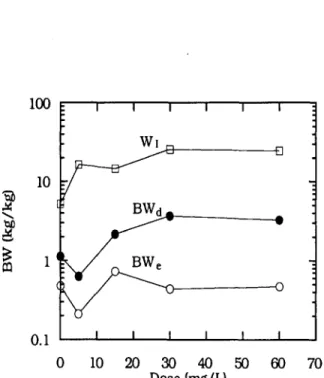
Fig. 2 presents a bound water sequence of polymer-conditioned sludge. The intrafloc water content (W0 is defined as the value obtained by using the mass balance consideration while com- paring the measured values of wet density and dry density of sludge. The three curves in Fig. 2 show that polymer conditioning significantly affects the water distribution in sludge. Theoretically, differ- ences between Wi and B Wd should be equal to the amount of free water (or frozen water) that can be removed by mechanical dewatering equipment [15]. Differences between
BWd
andBWe
are100 10 I I I I I I 0.1 I 0 60 70
w ~
[]
BWd A O I I I I I 10 20 30 40 50Dose (mg/L)
Fig. 2. Bound water sequence of original and conditioned sludge. Reported B W d are an average of triplicate measure-
ments. Reported BWe are average of duplicate measurements.
approximately equal to the part of interstitial water trapped tightly within floc structures and on floc surfaces. This water remained unfrozen as low as
- 20°C but could still be removed by high centrifu- gal strain [17] or compression to 1000 psi in this study. Furthermore, residual water remaining in the sludge cake after compression is intemal water, which can be regarded as the upper limit for the performance of any mechanical dewatering device [4].
Table 3 presents Wi and water removal ratios in response to the polymer dosage. With the water
94 C Chao Wu et al. / Colloids' Surfaces A: Physicochem. Eng. Aspects 122 (1997) 89-96
Table 3
Effect of polymer dose on the intrafloc moisture content, mois- ture removal efficiency and physical properties of alum sludge
Dose (mg I ') W i (kg kg- 1) Rf (%) R e (%) FD value 0 5.23 78.4 90.8 1.18 5 16.40 96.2 98.7 1.04 15 14.64 85.2 95.1 1.39 30 25.54 85.6 98.3 1.39 60 24.50 86.7 98.1 1.83
Rr=((VO- BW~)/W,) × lOO Ro=((V~- BWe)/~) × 100
sequence in Fig. 2, the ratio (Rf) of the differences between Wi and B W d divided by intrafloc water content can be calculated. Table 3 shows the ratio (Re) of the differences between W i and B We divided by Wi. The largest values of Rf and Re both occurred at a dosage of 5 mg 1 a. This occurrence strongly supports the contention that cationic polymer changes the water distribution within alum sludge, thereby easing the release of free water.
On the basis of the bound water content, dewa- tered dry solid content and moisture removal efficiency, the 5 mg 1 - ' polymer dosage is the most appropriate optimal dosage for dewatering sake. This is consistent with the optimal dosage deter- mined via SRF, but not via CST. Because of this consistency, Knocke et al. [18] suggested that a significant decrease in floc water content gives a corresponding decrease in filtration resistance and enhances the dewatering of sludge. Obviously, determining the polymer dosage on the basis of CST measurements may lead to overdosing. 3.2. Polymer dosage and sludge physical properties
The data in Fig. 3 illustrate the typical correla- tion between floc diameter and effective density obtained from analysis of free settling. These results clearly indicate that floc density increases with decreasing floc diameter.
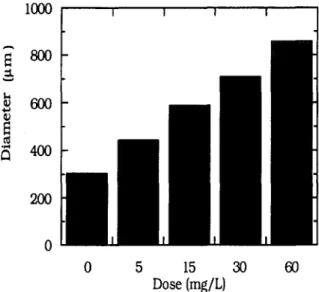
The effect of polymer dosage on the average particle diameter of a sludge sample measured by image analysis is shown in Fig. 4. The average diameter of the conditioned sludge floc signifi- cantly increases with the polymer dosage. Recall that, in Fig. 3, the floc density will decrease with
3.5 , . . . , . . . , . . . , . . . , . . . , . . . , . . 3 2.5 1.5 1 I , -4.2
i .
| • 0 -4 -3.8 -3.6 -3.4 -3.2 -3 -2.8 log D mFig. 3. Typical relationship between floc diameter (D) and
effective density (PrPl) at 30 mg 1 , polymer dose.
I000 800 4OO 200 I I I I 0 5 15 30 60 Dose {mg/L)
Fig. 4. Effects of polymer dosing on the average particle diameter of sludge measured by the image analysis.
increasing polymer dosage. Knocke and Kelley [19] have suggested that floc density significantly affects dewatering rates and high density sludge produces a better dewatering rate. Knocke et al. [15] have concluded that a significant decrease in floc water content would yield a corresponding improvement in specific filtration resistance. Therefore, based on our experimental results, we can infer that the poor dewatering performance (i.e. CST and SRF) and increased bound water
c Chao Wu et at / Colloids Surfaces A: Physicochem. Eng. Aspects 122 (1997) 89-96 95 content are attributable to enlargement in floc size,
and also to a decrease in floc density. However, when Knocke et al. [13] have used isopycnic centrifugation technology to measure the floc den- sity of sludge; the results indicated that water released via polymer addition caused an increase in floc density. The discrepancy remaining between their results and ours may be due to the possible osmosis depletion o f the intrafloc moisture.
Fractal dimension analysis is effective in investi- gating intrafloc structure. The theoretical values of fractal dimension vary from 1 to 3 and provide a useful index o f the degree of floc compactness [20]. In Table 3, the fractal dimension values ( F D value) o f alum sludge range from 1.04 to 1.83 and seem to increase with polymer dosage. These results indicate that the degree of sludge floc compactness increases with polymer dosage. Interestingly, sludge flocs with higher polymer dosage have lower densities but more compact structures. Apart from the compactness evaluation, the fractal dimension is a measure of how the particle fills the space it occupies. For F D values close to 1 (such as the low dose case in this study), the type of aggregation process produced by pri- mary particles forms lines similar to necklaces. In the high dose cases (in which F D is close to 2), the aggregation formation is similar to circular disks. Gill and Herrington [21] have provided a reasonable interpretation for the floc construction in the presence of polymer. At high polymer concentration, each floc is covered with several polymer molecules and, after the occurrence o f many interparticle collisions, large granular flocs are produced as each particle is bound to several others. However, at lower polymer dosage perhaps, only one polymer molecular may be attached to each particle; thus, the particles join together like necklaces forming small but open flocs.
Finally, it can be concluded that the increase in bound water and the decrease in floc density are caused by variations in floc size and aggregation configurations, not the degree o f floc compactness.
4. Conclusion
Results in this study indicate that using the CST measurement to determine the optimum polymer
dosage may lead to overdosing. This observation is confirmed by results obtained from vacuum filtration and bound water analysis of polymer- conditioned sludge. The magnitude of b o u n d water content reflects the net change in moisture content decreased by water depletion and increased by water formation. Analysis of intrafloc water content, dialtometric bound water content and expressed bound water content, reveals that poly- mer conditioning significantly affects water distri- bution in sludge. According to the measured results of floc size and density, the p o o r dewatering perfor- mance and increasing bound water content are attributable to an enlargement in floc size, and also to a decrease in floc density. Moreover, the increase in the bound water and the decrease in floc density are caused by variations in both floc size and aggregation type, not the degree of floc compactness.
Acknowledgment
This work was fully funded by the National Science Council, ROC (NSC84-2221-E-009-051). Sincere thanks are expressed to Dr. Jya-Jyun Yu for his linguistic help. Assistance from I.L. Chang and Y.C. Chuang with the experimental work is also acknowledged.
References
[1] P.A. Vesilind, Water Environ. Res., 66 (1994) 4. [2] D.J. Lee, J. Chem. Tech. Biotechnol., 61 (1994) 139. [3] J. Robinson and W.R. Knocke, Water Environ. Res., 64
(1992) 60.
[4] D.J. Lee and Y.H. Hsu, Water Environ. Res., 67 (1995) 310.
[5] I.V. Jones and R.A. Gortner, J. Phys. Chem., 36 (1932) 387.
[6] J.K. Smith and P.A. Vesilind, Water Res., 29 (1995) 2621. [7] D.J. Lee and Y.H. Hsu, Environ. Sci. Technol., 28
(1994) 1444.
[8] B.E. Logan and J.R. Kilps, Water Res., 29 (1995) 443. [9] H. Sato, S. Eto and H. Suzuki, Filtration Separation,
Nov./Dec. (1982) 492.
[10] M. Smollen, Water. Sci. Technol., 22 (1990) 153. [11] N. Katsiris and A. Kouzeli-Katsirit, Water Res., 21
96 C. Chao Wu et al. / Colloids SurJaces A: Physicochem. Eng. Aspects 122 (1997) 89 96 [12] E. Dulin and W.R. Knocke, J. AWWA, May (1989) 74.
[13] W.R. Knocke, C.M. Dishman and G.F. Miller, Water Environ. Res., 65 (1993) 735.
[14] N. Tambo and Y. Watanabe, Water Res., 13 (1979) 409. [15] K.R. Tsang and P.A. Vesilind, Water Sci. Technol., 22
(1990) 135.
[16] D.J. Lee, Water Sci. Technol., in press.
[17] F. Colin and S. Gazbaz, Water Res., 29 (1995) 2000. [18] W.R. Knocke, J.R. Hamon and B.E. Dulin, J. AWWA,
June (1987) 89.
[19] W.R. Knocke and R.T. Kelley, J. WPCF, 59 (1987) 86. [20] D.J. Lee, J. Chin. I. Ch.E., 25 (1994) 201.
[21] R.I.S. Gill and T.M. Herrington, Colloids Surfaces, 32 (1988) 331.