國立臺灣體育運動大學
National Taiwan University of Physical Education and Sport
體育研究所碩士學位論文
以單核球細胞免疫反應抑制人類 B 型肝炎病毒表
面抗原作用
探討太極拳運動對老年人免疫力提升之研究
Greater Response of Mononuclear Cells against Surface Antigen
Expression of Human Hepatitis B Virus from Middle-aged
People with Tai Chi Chuan Exercise
研 究 生:陳俊豪 撰
指導教授:陳裕鏞 博士
I 中文摘要
本研究在探討太極拳運動(Tai Chi Chuan ,TCC)對老年人在抑制 B 型肝炎病毒 免疫作用上是否較對照組(sedentary controls ,SC)有較強的免疫反應,太極拳運動 V ‧ O2 peak 最高峰可達到 45.83%,HR max 可達到 64.93%,因此認為太極拳對於老 年人是屬於一種有氧之中低強度運動。實驗方法採用植物血球凝集素(phytohaem- agglutinin , PHA)刺激作用後的人類週邊血液單核球細胞加入可表現 B 型肝炎毒 的 Hep3B 細胞培養基下,觀察其免疫抑制情形。經由實驗控制後的結果發現在相 同濃度的 PHA(5μg/ml)刺激之下,檢測兩者對於抑制 B 型肝炎病毒表面抗原作用 的表現,其中 TCC 組為 68.4%,而 SC 組為 84.3%,細胞激素(Cytokine) IFN-γ, TNF-α 和 IFN-α,在培養基的表現情形,具有運動習慣之 TCC 組較優於 SC 組。 結論:太極拳運動對老年人在抑制 B 型肝炎病毒免疫作用上較正常無運動習慣的 老年人有較強的免疫反應。 關鍵詞:太極拳、中等強度運動、B 型肝炎表面抗原
II
ABSTRACT
Whether middle-aged people with Tai Chi Chuan(TCC) exercise, at medium
intensity, have higher immunity against hepatitis B virus than sedentary controls(SC). We prepared conditioned media (MNC-CM) by stimulating the human peripheral blood mononuclear cells with phytohemagglutinin (PHA) for assessment of the inhibitory effects on hepatitis B surface antigen (HBsAg) expression in human hepatoma Hep3B cells. Results : The % HRmax at about 64.93 % and % V‧O2 peak at
about 45.83 % indicates that the TCC exercise might be defined as an aerobic and moderate exercise. The inhibitory effect of TCC group’ MNC-CM against the HBsAg expression was greater than that of SC group. Comparing with the same stimulating concentration of PHA (at 5 μg/ml), the relative HBsAg expression of TCC group MNC-CM was 68.4 % versus 84.3 % of SC group. The amounts of secreted cytokines such as TNF-α, IFN-γ and IFN-α, were greater in the MNC-CM from the TCC group than those in the SC group. Results of cytokine neutralization suggest that various cytokines may play a role for inhibitory effect of TCC-MNC-CM against HBsAg expression. Conclusion : The results indicate that the immune response of MNC, after being stimulated with PHA, to suppress HBsAg expression in middle-aged people with Tai Chi Chuan exercise is greater than that in sedentary controls.
III
IV CONTENTS 中文摘要 ··· I Abstract ··· II Contents ··· IV List of Table ··· V Chapter 1 Introduction ··· 1 1.1 Background ··· 1 Chapter 2 Methods ··· 3 2.1 Subjects ··· 3
2.2 Measurements of cardiopulmonary fitness ··· 4
2.3 Hepatoma cell cultures ··· 5
2.4 Preparation of mononuclear cell-conditioned media (MNC-CM) ··· 6
2.5 Assay for cytokines ··· 7
2.6 Assay for relative HBsAg expression ··· 8
2.7 Statistical analysis ··· 9
V
3.1 The anthropometric measurement and peak oxygen uptake (V‧O2peak)
of subjects ··· 10
3.2 Comparison of the reduction of relative HBsAg expression in Hep3B cells stimulated by PHA-MNC-CM between the SC group and TCC group ··· 11
3.3 Effects of cytokine against HBsAg Expression in Hep3B cells ··· 11
Chapter 4 Discussion ··· 14
VI
List of Table
Table 1. The anthropometric measurement of subjects ··· 24
Table 2. The blood lactate concentration and energy expenditure before and
after Tai Chi Chuan exercise ··· 25
Table 3. The cytokines secreted in PHA-MNC-CMs. ··· 26
Table 4. Effects of PHA-MNC-CMs, cytokine antibody neutralization on the
relative HBsAg expression. ··· 27
1
Chapter 1 Introduction
1.1 Background
Tai chi chuan (TCC) is a traditional Chinese martial art that has been practiced for many centuries. TCC has been progressively developed into a modern healthy exercise in accordance with its characteristics of relaxation and deep conditioned breathing. In fact, for its exercise intensity being less than about 50% of maximal oxygen intake (V‧O2max), TCC is generally acknowledged as a light or moderate aerobic
exercise.1 Over the years, the belief that TCC can improve the health of both immunity and mobility have rendered it a popular exercise for middle-agers to the elderly in the Asian world.
Many studies have verified the benefits of TCC, such as improving the physical and psychological health of the elderly2, the improvement of cardiovascular fitness3,4, the improved balance performance5, and the reduction of falls in elder cohorts6,7. The enhancement of immunity with TCC has also been reported8,9,10.
There are other evidences in the literature supporting the fact that moderate exercise indeed can improve our immune system. For example, it is reported that the elderly, who were administered with trivalent influenza vaccine, responded with a higher antibody titer to influenza in their blood after moderate exercise intervention
2
than those in controls.11 Moreover, greater infective resistance against herpes simplex virus type 1 by mice was also suggested to be associated with moderate exercise.12
Hepatitis B is a common disease that affects millions of people around the world. An enormous inhibitory effect on HBV expression by IFN-γ, secreted by human peripheral blood mononuclear cells (PBMNC), was reported.13 The TNF-α may also activate cell-mediated antiviral immune response to HBV. The increment of TNF-α production may contribute to cell-mediated antiviral immune response to HBV.14 Exercise has also been shown to be able to induce the secretion of TNF-α. The plasma concentrations of TNF-α in healthy men was also found to elevate after moderate exercise.15
The attempt of this study was to evaluate effects of Tai Chi Chuan exercise on the immune response against HBV expression of middle-aged people. We isolated PBMNC and incubated with various concentrations of PHA to simulate the immune reaction induced ex vivo. We hypothesized that middle-aged people with Tai Chi Chuan exercise may exert greater immunomodulatory responses to inhibit gene expression of HBV than the sedentary controls. Whether this response effect is caused by the secretion of cytokines from PBMNC was also evaluated.
3
Chapter 2 Methods
2.1 Subjects
In this study, twenty four middle aged people were recruited with their well informed consents after been examined by the Human Ethics Committee of National Taiwan College of Physical Education. 6 females and 6 males, who keep habitual TCC practicing at least 3 times a week for more than 3 years, were recruited to be as TCC group. Other twelve (6 males and 6 females) were recruited as sedentary control group (SC). All the SC subjects have no other habitual exercise types before the study. All of subjects have no clinical history of obvious cardiovascular, pulmonary, musculo- skeletal illness and any other surgical treatment, which were surveyed by clinic physician, during the 4 months prior to blood collection and the experimental period. Before blood collection, the subjects in the TCC group underwent a TCC exercise program for 3 months. 1 hour before the TCC exercise program, all subjects have breakfast consisting one egg and four slices of white toast and 220 ml both of milk and orange juice. Consumption of any drugs, caffeinated beverages, alcoholic drinks, smoking and vegetarian diet were refrained for 4 weeks prior to the study, as well as during the experimental period. To ensure the same time duration, all the subjects
4
performed each posture following a prerecorded video tape every day between 8 and 11 o’clock A.M. in an air conditioned room keep at about 24o
C. As the same time, the SC subjects been seated to watch the same video in the same place. Each process contained: warm up (low back and hamstrings stretching, gentle calisthenics and balance training) for 20 minutes, TCC practice for 24 minutes, and cool down for 10 minutes. Each set of TCC practice included 108 postures, with some repeated sequences. TCC subjects were guided by a Tai-Chi instructor to perform the similar motions and postures at the same speed during the TCC practice. Each fasting blood was taken between 8 and 9 o’clock A.M. after the subjects had rested quietly for at least 48 hours. All subjects including TCC and SC were mean age of 55.2 ± 4.8 years (range 48 to 66 years old), mean height of 162.5 ± 7.8 cm, and mean weight of about 60.6 ± 9.2 kg. These parameters between TCC and SC have showed no difference. After been examined by physician, neither HBV carriers nor hepatitis B surface antigen (HBsAg) positive were found in all of subjects.
2.2 Measurements of cardiopulmonary fitness
V ‧
O2max and ventilation were evaluated by (Q-Plex I, Quinton Instrument
5
braked cycle ergometer (Lode Excalibur, Quinton Instruments, Seattle, WA, USA). An incremental maximal exercise test was executed completely at 20 days before experimental period to test the maximal oxygen uptake (V‧O2max). After being warmed
up by loading set at 75 W for 2 min, they began to increase greater loading at 25 W every 2 min until volitional fatigue. The heart rate was monitored by polar pacer heart rate monitor during testing.
2.3 Hepatoma cell cultures
Hep3B/C16 (Hep3B), which the human hepatocellular carcinoma cell line integrated in the HBV genome in its chromosome with stably production of HBsAg, was taken as the cell model for studying HBV replication in previous study.16,17
In our preliminary work, we found that the addition of 30% CM is optimal for Hep3B cell. Therefore, the 30% volumes of MNC-CM and fresh Dulbecco's modified Eagle’s medium (DMEM) with 10% fetal calf serum were added, subsequently, incubated for 3 days in a humidified 5% CO2 incubator at 37oC. An initial concentration of 1 x 10⁶ cells/ml of the Hep3B cells were incubated in DMEM, which containing 10% fetal calf serum (Gibco/BRL), 1 X 10⁵ I.U./l penicillin, 1,000 micromole/l L-glutamine, and 100 mg/l streptomycin, in a humidified 5% CO2
6
incubator at 37oC. By the preliminary work about the directly effective concentrations of PHA on the relative HBsAg expression of Hep3B cells, the stimulating concentration of PHA was determined at 0 - 1.5 μg/ml in the MNC-CM, which had no direct effect on the relative HBsAg expression of Hep3B cells. The cell viability was measured by a tetrazolium dye colorimetric MTT test.18 The cell viability expressed as follows: MTT value of experimental group/MTT value of untreated control group.
2.4 Preparation of mononuclear cell-conditioned media (MNC-CM)
Human MNC from each subjects were isolated from the peripheral blood by density centrifugation (400 g, 30 min) in a Ficoll-Hypaque solution (1.077 g/ml) 19. After being washed by phosphate-buffered saline three times, MNC was suspended in RPMI-1640 medium (Gibco/BRL, Grand Island, NY, USA) containing 10% heat-inactivated autoserum, and incubated in autoserum-coated culture plates. Cells, at an initial concentration of 1 x 10⁶ cells/ml, were cultured in 10% heat-inactivated fetal calf serum (Hyclone, Logan, UT) with 1,000 micromole/l L-glutamine (Gibco/BRL), 100 mg/l streptomycin (Gibco/BRL), 50 mg/l penicillium (Gibco/BRL), and RPMI 1640 medium containing 5 μg/ml of phytohemagglutinin (PHA; Difco Lab., Detroit, MI, USA), respectively, at 37 oC in a fully humidified incubator with 5% CO2. The
7
collected aliquot was filtered through 0.45 μ membrane to remove MNC after cultivation for 24 hours. This collected aliquot, named as conditioned media (CM), was stored at -80 oC until use. 20 PHA-MNC-CM, prepared with 5 μg/ml PHA for 24 hours, were used to observe the relative HBsAg expression in Hep3B cells using the method described below. MNC-CM prepared with 5 μg/ml PHA was collected to assay the secretion of cytokine in CM. Hep3B cell medium, which a volume of only 30% .PBS contained with 5 μg/ml PHA replaced the MNC-CM, was named as the untreated control group. PHA, isolated from plants, is a natural mitogen of T lymphocytes. It has acted as an immuno-stimulant in many studies to simulate immune response and effect. PHA-MNC-CM from the sedentary control group was termed as SC-PHA-MNC-CM and the TCC group as TCC-PHA-MNC-CM. PBMNC stimulated with gradient concentrations of PHA was act as a model system to simulate immune reaction for evaluation of drug-induced,21,22 exercise-mediated immunomodulation in our previous studies. 19,23In this model system, various cytokines, including those relate to anti-viral and anti-tumor immunity such as γ, TNF-α and
8
2.5 Assay for cytokines
To detect the secreted cytokines in PHA-MNC-CM,commercial ELISA kits, including IL-1β, TNF-α, IFN-α, and IFN-γ (R&D Systems, Minneapolis, MN, USA), were used to determine at a wavelength of 450 nm by according to the method described by Wang et al.20 The correlation coefficients (γ) for the standard curves of three cytokines were between 0.998-0.999. Three separate experiments were each tested in duplicate. TCC-PHA-MNC-CM were pre-incubated at 37 °C for 90 min with various cytokine-neutralizing antibodies including anti-IFN-γ (30.0 μg/ml, is 10 folds more over than the concentration as near 100% of neutralization), anti-TNF-α (2.4 μg/ml), anti-IFN-α (1.0 μg/ml) and anti-IL-1β (5.1 μg/ml) in combination or alone. Viable cells were counted after 48 hours of incubation with added antibodies of the cytokines. Three separate experiments were each tested in duplicate.
2.6 Assay for relative HBsAg expression
The HBsAg is a useful index to evaluate the viral activity24 for the present of HBsAg in serum of patients indicated a current HBV infection and the risk for developing compensated cirrhosis and hepatocellular carcinoma. 25,26,27 After been cultured in DMEM with 10% fetal bovine serum for 24 hrs, Hep3B cells were
9
transferred to serum-free DMEM with or without 30% (v/v) MNC-CM and incubated for 48 hrs. We used commercial ELISA kits (General Biological, Taipei, Taiwan, Republic of China) to determine the secreted HBsAg in the culture medium. By pretest, PHA does not interfere with the HBsAg assay by ELISA kits. The determined optical density (O.D.) values of the Enzyme-Linked Immunosorbent Assay (ELISA) kits during measurement were normalized with cell numbers. The relative HBsAg expression was determined by following formula: (HBsAg/MTT) from PHA- MNC-CM / (HBsAg/MTT) from the untreated control group culture media. The (HBsAg/MTT) from the untreated control group culture media was treated as 100% expression.
2.7 Statistical analysis
Results are presented as mean ± standard error of the mean (SEM). Differences between the treatment groups, which consisted of matched samples, was assessed by Student’s t test. A confidence level of 5% (p < 0.05) was considered significant.
10
Chapter 3 Results
3.1 The anthropometric measurement and peak oxygen uptake (V‧O2peak) of subjects
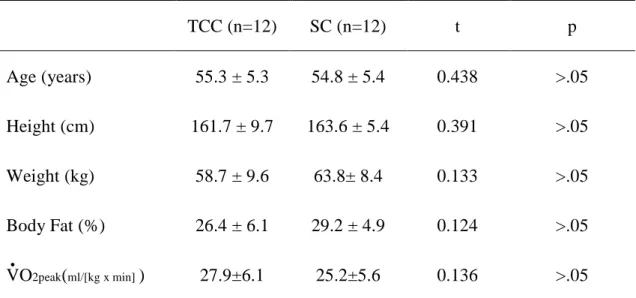
The basically anthropometric measurement of the two subjects groups were summarized in Table 1. The SC group was measured as mean age of 54.8 ± 5.4 years (range 50 to 63 years old). The TCC group was measured as mean body weight of 58.7 ± 9.6 kg (range 43 to 73 kg), mean age of 55.3 ± 5.3 years (range 48 to 66 years old), and mean body length of 161.7 ± 9.7 (range 140 to 175 cm). There was no difference in these anthropometric measurements between the SC group and TCC group (p>.05). The V‧O2peak observed in TCC group, as 27.9±6.1, were similar to in SC group, as
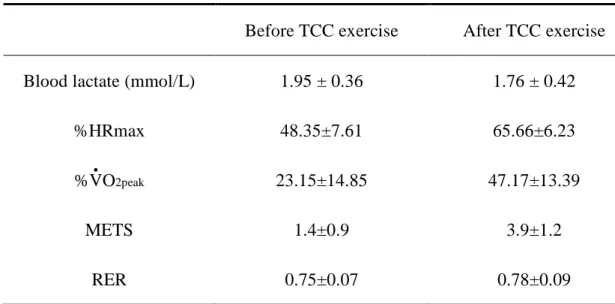
25.2±5.6. (p>.05) From Table 2, RER values exists no observable difference between before and after TCC exercise. During TCC exercise performance, the blood lactate concentration (from 1.95 to 1.76 mmol/L) seems exist no obvious change.
From the data of % HRmax (at 48.35±7.61 to 65.66±6.23 %) and of %V‧O2peak (at
23.15±14.85 to 47.17±13.39 %), the intensity of exercise increased during TCC exercise performance slightly higher.
11
3.2 Comparison of the reduction of relative HBsAg expression in Hep3B cells
stimulated by PHA-MNC-CM between the SC group and TCC group
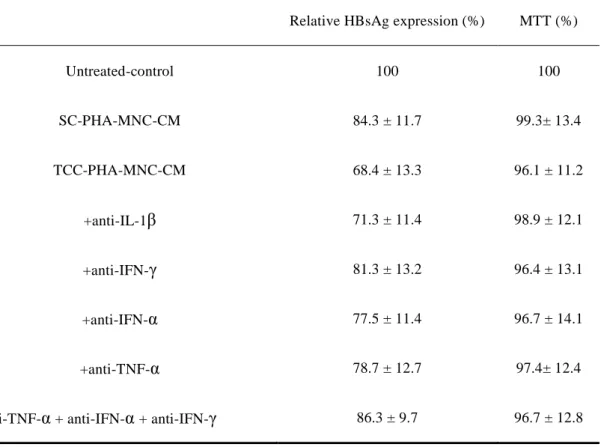
The response in TCC-PHA-MNC-CM was much more obvious than in SC-PHA-MNC-CM. For instance, a much lower relative HBsAg expression to the extent about 68.4% of HBV in Hep3B cells, incubated with TCC-PHA-MNC-CM prepared by stimulating with PHA at the same 5 μg/ml in comparison with the SC-PHA-MNC-CM, was observed (Table 4). No apparent death of Hep3B cells was examined in both groups when the PHA administered less than 5μg/ml. No obvious inhibition of relative HBsAg expression in Hep3B was observed in the SC group (Table 4).
3.3 Effects of cytokine against HBsAg Expression in Hep3B cells
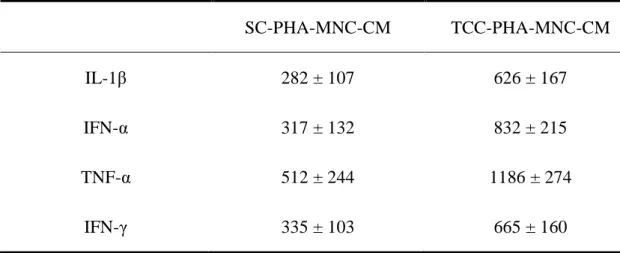
After being stimulated by PHA, the secretion of IFN-γ, IL-1β, TNF-α and IFN-α in TCC-PHA-MNC-CM all significantly raised up to (665 ± 160 pg/ml, 626 ± 167 pg/ml,1186 ± 274 pg/ml and 832 ± 215 pg/ml respectively), nevertheless, compared to those in SC-PHA-MNC-CM to (335 ± 103 pg/ml, 282 ± 107 pg/ml, 512 ± 244 pg/ml and 317 ± 132 pg/ml, respectively). (Table 3) It seemed exist no difference that the se- cretion of IL-2. Comparing to the same concentration of PHA (5 μg/ml) stimulation,
12
the secretion of TNF-α in TCC-PHA-MNC-CM was about 2 fold greater than that in the SC-PHA-MNC-CM.
When comparing the amount of PHA at 5 μg/ml in TCC-PHA-MNC-CM and SC-PHA-MNC-CM, the secretion of IFN-γ in TCC-PHA-MNC-CM was about 1 folds greater than that in SC-PHA-MNC-CM. The secretion IL-1β in TCC-PHA-MNC-CM, stimulating by the amount of PHA at 5 μg/ml, were at about 2 times greater than in SC-PHA-MNC-CM. The secretion of IFN-αin TCC-PHA-MNC-CM was also at about 2 times greater than in SC-PHA-MNC-CM (Table 3). The aliquots of CMT-PHA- MNC-CM were pre-incubated with one cytokine-neutralizing antibodies as anti-IL-1β, anti-IFN-γ, anti-IFN-α, and anti-TNF-α before cultivation of Hep3B cells to invest- igate the effects of cytokines on the reduction of relative HBsAg expression in Hep3B cells.
Results in Table 4 show that the relative HBsAg expression in Hep3B cells elevated to 81.3 ± 13.2% (from 68.4 ± 13.3%) in the presence of 500 N.U./ml anti-IFN-γ antibodies and to 77.5 ± 11.4% in the presence of 500 N.U./ml anti-TNF-α antibodies. The relative HBsAg expression in Hep3B cells elevated to the lower level at 64.7 ± 10.6% in the presence of anti-IL-1β antibody in CMT-PHA-MNC-CM. The relative HBsAg expression in Hep3B cells elevated to 77.5 ± 11.4% in the presence of anti-
13
IFN-α antibody. Although there was a statistically significant difference when comp- ared to CMT-PHA-MNC-CM alone, there was little elevation of relative HBsAg. The most reducing effect on the relative HBsAg expression in Hep3B cells was at about 86.3± 9.7% with a combination of all three cytokine antibodies.
14
Chapter 4 Discussion
The basic anthropometric measurements of TCC group were similar to SC group, for example, the two groups were similar in gender, height weight, age, body fat and V
‧
O2peak However, the slightly greater VO2peak of TCC group than of SC group has
been observed in our study. The similar phenomenon can also be indicated in other paper.28
The data of %HRmax after TCC exercise, at about 65.66 %, can be defined as moderate exercise. Hence, the TCC exercise, included 108 postures with some repeated sequences for 24 minutes, seems to be a moderate intensity exercise.
The similar results were also observed middle aged by Chen and in elderly by Lan.28 The factor that% V‧O2peak after TCC exercise at about 47.17 % can also support the
other strong evidence to define TCC as moderate intensity exercise. The MET after TCC practicing was about 3.9 METs in 24 min. It has shown that the exercise intensity is neither high nor low.
From the little to no change of blood lactate between exercise duration, the TCC practicing can be defined as aerobic exercise and low to moderate intensity exercise. The data present in our study have shown that greater immunomodulatory response of
15
PBMNC isolated from middle-aged people with Tai Chi Chuan exercise can significantly inhibit HBsAg expression of HBV in an ex vivo experimental model. The greater response by secretion of cytokines, mainly the TNF-α, IFN-α and IFN-γ, may cause the inhibitory effects. The basic anthropometric characteristics of TCC group exhibited no difference between SC group. Moreover, theV‧O2peak were also
similar. The TCC exercise with 108 postures and some repeated sequences, which performed by TCC group, seems to be exercise with moderate intensity. The TCC, a moderate intensity exercise, can avoid some risks of exercise damage. In our other data, the TCC as moderate exercise intensity was assumed by the measurement of MET after TCC practicing at about 3.5 METs in 24 min. There are little to no change of blood lactate during TCC exercise. It indicated that TCC practicing can be defined as aerobic exercise.
To enhance anti-viral immunity, moderate intensity exercise might be a suitable way. In vivo study by Lowder29, moderate exercise training inhibited activity of influenza virus. Due to the removal of MNC after stimulation by various concentrations of PHA, the soluble mediators produced by MNC in CM may be the factors about inhibiting HBsAg expression in Hep3B cells.
16
much greater than those in the SC-PHA-MNC-CM. It partially lost the inhibitory activity against relative HBsAg expression when the TCC-PHA-MNC-CM is neutralized by anti-IFN-γ, anti-TNF-α and/or anti-IFN-α antibodies (except anti-IL-1β). The results of our experiments of antibody neutralization showed that IFN-γ, IFN-α and TNF-α ,in soluble factors CM, might contribute to the greater inhibitory activity of TCC-MNC-CM. It must be pointed out that no cytotoxicity to MNC and Hep3B cells was observed (data not shown). The greater inhibitory activity of TCC-MNC-CM did not come from the cytotoxicity of Hep3B cells.
TNF-α was well documented to be and activator of antiviral effects in the immune system. For instance, noncytopathic suppression of hepatitis B virus DNA replication in hepatocytes was caused by the administration of TNF-α.30 A marked diminish of HBV replication occurred after administration of TNF-α to Hep3B cells.31
The prominent role played by TNF-α were assumed by our both data about the greater secretion of TNF-α and about the lower relative HBsAg expression with anti-TNF-α antibody neutralization in TCC-PHA-MNC-CM. The HBsAg inhibitory effects of IFN-γ has been presented in some clinical studies.31,32,33 Other study about active habitual older runners with moderate exercise showed that the greater blood IFN-γ concentration stimulated with PHA than that of sedentary older people was
17 observed.34
The much lower relative HBsAg expression with anti-IFN-γ antibody neutralization and higher IFN-γ in TCC-PHA-MNC-CM both provide evidences to assumed that the crucial inhibitory role played by IFN-γ. the similar phenomena have been presented in other study. The negative correlation of cell cytoplasmic HBV DNA and secreted level of IFN-γ in the supernatants of PBMNC medium was observed.35.36 Other evidence in similar experimental model about the anti-virus activity of immuno-cells activated by increased secretion of IFN-α has been demonstrated. For example, the neutralization by antibody of IFN-α in MNCs diminished the viral suppressing effects against Herpes simplex viruses.37
In addition, IFN-α has been used to inhibit the virus replication in clinical therapy. The administered IFN-α to HBeAg-positive patients led to loss of HBeAg from 25 to 40%.38,39 With both experimental data about much higher production of IFN-α and about lower relative HBsAg expression after the neutralization of anti-IFN-α antibody in TCC-PHA-MNC-CM, we can postulated that IFN-α exerts critical effects on suppression of hepatitis B virus.
In spite of the greater secretion of cytokines related closely to the reduction of HBsAg expression, the host HBV-harboring Hep3B cells did not killed by TCC-PHA-
18
MNC-CM in our study. It is logical to assume that the inhibitory activity of TCC- MNC-CM against HBsAg expression may not attribute to the cytotoxicity to Hep3B cells. It has been illustrated that both of the TNF-α and IFN-γ secreted fromHBV- specific cytotoxic T lymphocytes can inhibit HBV gene expression and replication without cytopathy.
After administration combined all of anti-TNF-α, anti-IFN-α and anti-IFN-γ antibodies together, the inhibitory effect against HBsAg expression in TCC-PHA- MNC-CM blocked the greatest. In other words, above three cytokines induced by TCC exercise played the mainly immunomodulatory anti-viral role. In summary, greater immunomodulatory response against HBsAg expression of HBV cells line exhibit in TCC group was illustrated by using an ex vivo antiviral immunity model. The much more secretion of cytokines, mainly IFN-γ, TNF-α and IFN-α from human peripheral blood MNC contributed to the greater immunomodulatory response against HBsAg expression of HBV cells line.
19
REFERENCES
1. Wang C, Collet JP and Lau J. The effect of TCC exercise on health outcomes in patients with chronic conditions: a systematic review. Arch Intern Med 2004; 164: 493–501.
2. Li JX, Hong and Y, Chan KM. Tai chi: physiological characteristics and beneficial effects on health. Br J Sports Med 2001; 35: 148–156.
3. Lan C, Lai JS, Chen SY and Wong MK. 12-month Tai Chi training in the elderly: its effect on health fitness. Med Sci Sports Exerc 1998; 30: 345–351.
4. Lan C, Chen SY, Lai JS and Wong MK. The effect of Tai Chi on cardiorespiratory function in patients with coronary artery bypass surgery. Med Sci Sports Exerc 1999; 31: 634–638.
5. Tsang WW and Hui-Chan CW. Effect of 4- and 8-wk intensive Tai Chi training on balance control in the elderly. Med Sci Sports Exerc 2004; 36: 648–657.
6. Wolf SL, Barnhart HX, Kutner NG, McNeely E, Coogler C and Xu T. Reducing frailty and falls in older persons: an investigation of Tai Chi and computerized balance training. Atlanta FICSIT Group. Frailty and Injuries: Cooperative Studies of Intervention Techniques J Am Geriatr Soc 1996; 44: 489–497.
20
7. Wolf SL, Sattin RW, O’Grady M, Freret N, Ricci L, Greenspan AI, Xu T and Kutner MA study design to investigate the effect of intense Tai Chi in reducing falls among older adults transitioning to frailty. Control Clin Trials 2001; 22: 689–704.
8. Irwin MR, Pike JL, Cole JC, and Oxman MN. Effects of a behabioral intervention, Tai Chi Chih, on varicella-zoster virus specific immunity and health functioning in older adults. Psychosom Med 2003; 65: 824-830.
9. Sun X, Xu Y, and Zhu R. Detection of ZC resette-forming lymphocytes in the healthy aged with TaiChiQuan (88 style) exercise. J Sports Med Phys Fitness 1990; 30: 401-405.
10. Yeh SH, Chuang H, Lin LW, Hsiao CY, and Eng HL. Regular tai chi chuan exercise enhances functional mobility and CD4CD25 regulatory T cells. Br J Sports Med 2006; 40: 239-243.
11. Kohut ML, Arntson BA, Lee W, Rozeboom K, Yoon KJ, Cunnick JE and McElhaney J. Moderate exercise improves antibody response to influenza immunization in older adults. Vaccine 2004; 22: 2298-2306.
12. Davis JM, Murphy EA, Brown AS, Carmichael MD, Ghaffa, A and Maye EP. Effects of moderate exercise and oa -glucan on innate immune function and
21
susceptibility to respiratory infection. Am. J. Physiol. Regul. Integr. Comp. Physiol. 2003: 286: R366–R372.
13. Suri D, Schilling R, Lopes AR, Mullerova I, Colucci G, Williams R and Naoumov NV. Non-cytolytic inhibition of hepatitis B virus replication in human hepatocytes. J Hepatol 2001; 35: 790-797.
14. Hsu HY, Chang MH, Ni YH and Lee PI. Cytokine release of peripheral blood mononuclear cells in children with chronic hepatitis B virus infection. J Pediatr Gastroenterol Nutr 1999; 29: 540-545.
15. Moldoveanu AI, Shephard RJ and Shek PN. Exercise elevates plasma levels but not gene expression of IL-1beta, IL-6, and TNF-alpha in blood mononuclear cells. J. Appl. Physiol. 2000; 89: 1499-1504.
16. Knowles BB, Howe CC and Aden DP. Human hepatocellular carcinomacell lines secrete the major plasma proteins and hepatitis B surface antigen. Science 1980; 209: 497-501.
17. Twist EM, Clark HF, Aden DP, Knowles BB and Plotkin SA. Integration pattern of hepatitis B virus DNA sequences in human hepatoma celllines. J. Virol. 1981; 37: 239-241.
22
Application to proliferation and cytotoxicity assays. J. Immunol. Methods 1983; 69: 55-63
19. Chiang J, Huang YW, Chen ML, Wang SY, Huang AC, Chen YJ. Comparison of anti-leukemic immunity against U937 cells in endurance athletes versus sedentary controls Int. J. Sports Med. 2000; 21: 602-607.
20. Wang, SY, Hsu, ML, Hsu, HC, Tzeng, CH, Lee, SS, Shiao, MS, et al. The anti-tumor effect of Ganoderma lucidum is mediated by cytokines released from activated macrophages Tlymphocytes. Int. J. Cancer 1997; 70: 699–705.
21. Chen YY and Chang HM. Antiproliferative and Differentiating Effects of polysaccharide Fraction from Fu-Ling (Poria cocos) on Human Leukemic U937 and HL-60 Cells source. Food Chem. Toxicol. 2004; 42(5):759-769.
22. Chen YJ, Shiao MS, Lee SS, Wang SY. Effect of Cordyceps Sinensis on the proliferation and differentiation of human leukemic U937 cells. Life Science 1997; 60(25): 2349-2359.
23. Liao HF, Chiang LM, Yen CC, Chen YY, Zhuang RR, Lai LY, et al. Effect of a periodized exercise training and active recovery program on antitumor activity and development of dendritic cells. J sporis med phys finess. 2006; 46:307-314. 24. Czaja AJ. Serologic markers of hepatitis A and B in acute and chronic liver
23
disease. Mayo Clin. Proc. 1979; 54: 721-732.
25. Chisari FV. Cytotoxic T cells and viral hepatitis. J. Clin. Invest. 1997; 99: 1472-1477.
26. Lee WM. Hepatitis B virus infection. N. Engl. J. Med. 1997; 337: 1733-1745 27 .Yang HI, Lu SN, Liaw YF, You SL, Sun CA, Wang LY, et al. Taiwan community-based cancer screening project group Hepatitis B e antigen and the risk of hepatocellular carcinoma. N. Engl. J. Med. 2002; 347: 168-174. 9(3): 804-810.
24
List of Figure and Table
Table 1. The anthropometric measurement of subjects
TCC (n=12) SC (n=12) t p Age (years) 55.3 ± 5.3 54.8 ± 5.4 0.438 >.05 Height (cm) 161.7 ± 9.7 163.6 ± 5.4 0.391 >.05 Weight (kg) 58.7 ± 9.6 63.8± 8.4 0.133 >.05 Body Fat (%) 26.4 ± 6.1 29.2 ± 4.9 0.124 >.05 V ‧ O2peak(ml/[kg x min] ) 27.9±6.1 25.2±5.6 0.136 >.05
The middle-aged people with Tai Chi Chuan were designated as (TCC) and the sedentary control group as (SC). V‧O2peak : peak oxygen uptake. Results are
25
Table 2. The blood lactate concentration and energy expenditure before and after Tai Chi Chuan exercise
Before TCC exercise After TCC exercise Blood lactate (mmol/L) 1.95 ± 0.36 1.76 ± 0.42
%HRmax 48.35±7.61 65.66±6.23
%V‧O2peak 23.15±14.85 47.17±13.39
METS 1.4±0.9 3.9±1.2
RER 0.75±0.07 0.78±0.09
The middle-aged people with Tai Chi Chuan were designated as (TCC). % HRmax: percentage of exercise intensity of maximal heart rate achieve during incremental exhaustive exercise;%V‧O2peak: percentage of exercise intensity of peak oxygen uptake;
26
Table 3. The cytokines secreted in PHA-MNC-CMs.
SC-PHA-MNC-CM TCC-PHA-MNC-CM
IL-1β 282 ± 107 626 ± 167
IFN-α 317 ± 132 832 ± 215
TNF-α 512 ± 244 1186 ± 274
IFN-γ 335 ± 103 665 ± 160
The middle-aged people with Tai Chi Chuan were designated as (TCC). TNF-α: tumor necrosis factor α; IFN-α: interferon-α, IL-1β: interleukin-1β and
anti-IFN-γ: interferon-γ. Triplicated data from separate experiments are expressed as mean ± SEM.
27
Table 4. Effects of PHA-MNC-CMs, cytokine antibody neutralization on the relative HBsAg expression.
Relative HBsAg expression (%) MTT (%)
Untreated-control 100 100 SC-PHA-MNC-CM 84.3 ± 11.7 99.3± 13.4 TCC-PHA-MNC-CM 68.4 ± 13.3 96.1 ± 11.2 +anti-IL-1β 71.3 ± 11.4 98.9 ± 12.1 +anti-IFN-γ 81.3 ± 13.2 96.4 ± 13.1 +anti-IFN-α 77.5 ± 11.4 96.7 ± 14.1 +anti-TNF-α 78.7 ± 12.7 97.4± 12.4
+anti-TNF-α + anti-IFN-α + anti-IFN-γ 86.3 ± 9.7 96.7 ± 12.8
Aliquots of TCC-PHA-MNC-CM were pre-incubated with or without two cytokine neutralizing antibodies anti-TNF-α (anti-tumor necrosis factor α, 2.4 μ g/ml), anti-IFN-α (anti-interferon-α, 1.0 μg/ml), anti-IL-1β (anti-interleukin-1β, 5.1 μg/ml) and anti-IFN-γ(anti-interferon-γ, 30.0 μg/ml) at 37 oC for 90 min before addition to
Hep3B cell culture. Triplicated data from separate experiments are expressed as mean ± SEM.