行政院國家科學委員會專題研究計畫 期中進度報告
台灣海峽之水團組成、流通量與聖嬰現象(Ⅲ)(2/3)
計畫類別: 個別型計畫 計畫編號: NSC94-2611-M-110-001- 執行期間: 94 年 08 月 01 日至 95 年 07 月 31 日 執行單位: 國立中山大學海洋地質及化學研究所 計畫主持人: 陳鎮東 計畫參與人員: 雷佳、王冰潔、謝睿麟、陳虹菱、王昱文、林毅杰、張裕彰、 陳亭伃;、蔡尚斌 報告類型: 精簡報告 報告附件: 出席國際會議研究心得報告及發表論文 處理方式: 本計畫可公開查詢 中 華 民 國 95 年 5 月 25 日Bjwang D:\24-3-NSC\94\sweet\SWEET-940801-950731.doc 1
行政院國家科學委員會補助專題研究計畫
□ 成 果 報 告
;
期中進度報告
台灣海峽之水團組成、流通量與聖嬰現象(III)(2/3)
計畫類別: ;個別型計畫□整合型計畫
計畫編號:NSC 94-2611-M-110-001 執行期間: 94 年 8 月 1 日至 95 年 7 月 31 日 計畫主持人:陳鎮東教授 計畫參與人員: 雷佳、王冰潔、謝睿麟、陳虹菱、王昱文、林毅杰、張裕彰、 陳亭伃、蔡尚斌 成果報告類型(依經費核定清單規定繳交): ;期中精簡報告 □完整報告 本成果報告包括以下應繳交之附件: ■赴國外出差或研習心得報告一份 □赴大陸地區出差或研習心得報告一份 □出席國際學術會議心得報告及發表之論文各一份 □國際合作研究計畫國外研究報告書一份 處理方式: 除產學合作研究計畫、提升產業技術及人才培育研究計畫、 列管計畫及下列情形者外,得立即公開查詢 □ 涉及專利或其他智慧財產權, □一年□ 二年後可公開查詢 執行單位: 中山大學海洋地質及化學研究所 中 華 民 國 95 年 5 月 24 日Bjwang D:\24-3-NSC\94\sweet\SWEET-940801-950731.doc
2
本計畫自 94 年 8 月至今,共發表 (一) 論文如下:
(SCI) 1. Selvaraj, K. and C.T.A. Chen, 2006. Moderate chemical weathering of subtropical Taiwan: Constraints from solid-phase geochemistry of sediments and sedimentary rocks, The Journal of Geology, volume 114, p. 101-116 (SCI: 2.097; this paper acknowledged NSC 93-2611-M-110-009, 93-2821-M-110-006 and 93-2621-Z-110-004).(附件 1)
(SCI) 2. Chen, C.T.A. and D.D. Sheu, 2006. Does the Taiwan Warm Current originate in the Taiwan Strait in winter-time? Journal of Geophysical Research, VOL. 111, C04005, doi:10.1029/2005JC003281. (SCI: 2.839; this paper acknowledged NSC 94-2611-M-110-001, NSC 94-2621-Z-110-001 and Aim for the top university plan 95C 030211). (附件2)
(SCI) 3. Chen, C.T.A. and S.L. Wang, 2006. A salinity front in the southern East China Sea separating the Chinese coastal and Taiwan Strait waters from Kuroshio waters, Continental Shelf Research, accepted (SCI: 1.431; this paper acknowledged NSC-94-2611-M-110-001, 94-2621-Z-110-001 and Aim for the top university plan 95C 030211). (附件 3) (二) 自94 年 8 月至今,共參加航次如下: 航次 日期 ORII-1312 94 年 10 月 6~7 日 ORIII-1105 94 年 10 月 26~27 日 ORIII-1126 95 年 1 月 3~5 日 ORIII-1146 95 年 4 月 20~21 日 ORII-1349 95 年 4 月 29~30 日 ORIII-1149 95 年 5 月 2~8 日
Bjwang D:\24-3-NSC\94\sweet\SWEET-940801-950731.doc
[The Journal of Geology, 2006, volume 114, p. 101–116]䉷 2006 by The University of Chicago. All rights reserved. 0022-1376/2006/11401-0006$15.00
101
Moderate Chemical Weathering of Subtropical Taiwan: Constraints from Solid-Phase Geochemistry
of Sediments and Sedimentary Rocks Kandasamy Selvaraj and Chen-Tung Arthur Chen
Institute of Marine Geology and Chemistry, National Sun Yat-Sen University, Kaohsiung 804, Taiwan (e-mail: [email protected])
A B S T R A C T
The well-known earthquake-and-storm-triggered extremely high physical weathering rate in Taiwan is consistent with present geochemical studies of sediments from different subenvironments (offshore, coastal, river, and lake) and sedimentary rocks of different geological ages, indicating a moderate chemical weathering condition. Major and trace element concentrations normalized to the average upper crust of Yangtze Craton show that the sediments and the average composition of sedimentary rocks of Taiwan are depleted in Ca, Mg, Na, and Sr, enriched in Rb and Zr, and unchanged with respect to K, indicating their moderately altered nature. The mean chemical index of alteration (CIA; 71–75) and plagioclase index of alteration (PIA; 81–86) values of coastal and offshore sediments reveal the sediments’ derivation from sedimentary rocks by moderate silicate chemical weathering processes. The mean CIA value (62) of sedimentary rocks of Taiwan is similar to that for Chinese sediment (61), further confirming the above inference.
A-CN-K, (A-K)-C-N, and A-CNK-FM plots (A p Al O C p CaO N p Na O K p K O F p FeO; ∗; ; ; ;M p MgO) also
2 3 2 2 T
confirm that the sediments and sedimentary rocks in Taiwan have undergone moderate silicate weathering, an interpretation consistent with CIA and PIA values. The plots also indicate the presence of illite, chlorite, and a subordinate amount of unaltered feldspars in sediments and sedimentary rocks, which are indicative of the physically weathered and/or moderately chemically altered nature of sediments. The dominance of illite, chlorite, and unaltered feldspars as inferred from geochemical data suggests that the immature nature of sediments and sedimentary rocks is probably a result of low residence times in the source region or river basin and quick removal of materials from the soil profile by steep, mountainous rivers (physical weathering dominates). Elemental ratios such as Rb/Sr, K/Rb, molar K/Na, and Al/Na are close to crustal values. Average shale and river particulates such as those from the Yellow River also indicate moderate chemical weathering conditions for sediments and sedimentary rocks, except for high alpine lake sediments, where the prevailing extreme chemical weathering condition over erosion is clearly differ-entiated by higher CIA (80–84) and PIA (92–96) values and by their positions on triangular plots. These inferences have also been illustratively corroborated by scatter plots of data such as Rb/Sr versus molar K/Na, and Al/Na versus CIA. Additional evidence from published sources noted here also favors moderate chemical weathering conditions for Taiwan. Geochemical variation of offshore, coastal, and river sediments is mainly controlled by non–steady state weathering dominated by erosion. Steady state weathering, however, seems to produce highly weathered sediments in the alpine region of Taiwan.
Online enhancement: appendix table.
Introduction
Disproportionately high physical and chemical de-nudation rates occur in the oceanic island of Tai-wan under the influence of copious orographic rain-fall associated with the Asian monsoon, frequent typhoon activities, and related storm-triggered landslides. The average erosion rate estimated for
Manuscript received October 4, 2004; accepted July 12, 2005.
the entire island is 5 mm/yr (WRPC 1973). The average physical denudation rate for Taiwan (1365
mg/cm2/yr) is probably the highest in the world, as
is the chemical denudation rate (50 mg/cm2/yr),
which is∼27% of the physical denudation rate (Li
1976). Recent estimates of maximum erosion rates (3–6 mm/yr) and the 30-yr average maximum sed-iment erosion rate (3.9 mm/yr; Dadson et al. 2003)
102 K . S E L V A R A J A N D C . - T . A . C H E N
have demonstrated that across Taiwan, cumulative seismic moment release (earthquakes of magnitude
greater thanM p 5.0w ) correlated linearly with
de-cadal erosion rates over a sixfold range during a period between 1900 and 1998. Dadson et al. (2003) concluded that storm runoff is a first-order control on erosion rates in Taiwan, and the modern erosion rates are not controlled by relief and precipitation. Other recent erosion rates estimated from river wa-ter and sediment discharges of the Easwa-tern Central Range of Taiwan show a wide range of values (2.2– 8.3 mm/yr) resulting from the influence of variable intensity of storms rather than from lithology, tec-tonic environment, or climate (Fuller et al. 2003). Li (1976), however, inferred that the great change in the physical denudation rate is related to relief and/or bedrock geology. Indeed, Milliman and Sy-vitski (1992) projected that mountainous rivers draining in South Asia and Oceania have much greater sediment yields (two- to threefold) than other mountainous rivers of the world, owing to the influence of human activity, climate, and ge-ology. Chen et al. (2004) listed 13 rivers in Taiwan among the top 20 worldwide in terms of sediment yield. Previous studies have documented highly variable physical and chemical denudation rates for this island, but no clear consistency between them has been established because relationships among climate, physical erosion, and chemical weathering remain poorly quantified since long-term weath-ering rates are difficult to measure (Riebe et al. 2001). The purpose of this article is to determine if the very high, widely variable physical and chem-ical denudation rates reported from this oceanic island show any covariance with the intensity
of chemical weathering, especially silicate
weathering.
Geochemical studies have contributed apprecia-bly to the understanding of the growth of the con-tinents through time (Taylor and McLennan 1985). Numerous factors including source area composi-tion, source area weathering conditions, hydraulic sorting, adsorption, diagenesis, and metamorphism affect the composition of siliclastic sediments and sedimentary rocks over a wide scale (Fedo et al. 1996). Silicate weathering strongly affects the major-element geochemistry and mineralogy of sil-iclastic sediments (e.g., Nesbitt and Young 1982; Johnsson et al. 1988; McLennan 1993), where larger
cations (Al2O3, Ba, Rb) remain fixed in the
weath-ering profile preferentially over smaller cations (Ca, Na, Sr), which are selectively leached (Nesbitt et al. 1980). These chemical signatures are ultimately transferred to the sedimentary record (e.g., Nesbitt and Young 1982; Wronkiewicz and Condie 1987),
thus providing a useful tool for monitoring source area weathering conditions. Silicate weathering in-dexes such as chemical index of alteration (CIA), plagioclase index of alteration (PIA), and chemical index of weathering (CIW) are therefore widely used to interpret the weathering history of modern and ancient sediments (Harnois 1988; Fedo et al. 1996; Colin et al. 1999; Tripathi and Rajamani 1999). For example, high CIA values reflect removal of labile
cations (Ca2⫹, Na⫹, K⫹) relative to stable residual
constituents (Al3⫹, Ti4⫹) during weathering (Nesbitt
and Young 1982). Conversely, low CIA values in-dicate the near absence of chemical alteration and might reflect cool and arid conditions (Fedo et al. 1995).
Chemical weathering rate (based on dissolved loads) includes dissolution of elements from both carbonate and aluminosilicate source rocks as well as atmospheric and modern anthropogenic inputs (Gaillardet et al. 1999; Sarin 2001; Han and Liu 2004). Though silicate weathering is Earth’s
long-term sink for atmospheric CO2(Berner et al. 1983),
in most natural environments, ionic contribution from carbonate rocks generally dominates the dis-solved phase (Han and Liu 2004), with silicate con-tributing smaller amounts of dissolved solids
(!15%; Sarin 2001). This is especially true where
Cenozoic rocks dominate, such as in Taiwan. Hence, the chemical weathering rate, especially sil-icate weathering, of this island may be lower than
previously projected (e.g.,97.09%Ⳳ 2.41%of total
chemical weathering; Lai 2003). Sediments pro-duced by landslides and typhoon activities from rough, mountainous terrain and rapidly transported to the continental margin by fluvial systems of Tai-wan would be expected to display minimal chem-ical weathering. That is, silt and mud would be expected to contain a comparatively low proportion of aluminous clay minerals and a commensurately higher proportion of primary minerals (feldspars).
In order to evaluate the chemical weathering in-tensity and provide accurate conditions of silicate weathering of Taiwan rocks, a wide representative range of geochemical data of offshore, coastal, river, and lake sediments of Taiwan (see table A1, avail-able in the online edition or from the Journal of
Geologyoffice), along with published geochemical results of sediments from Taiwan Strait (Chao and Chen 2003) and sedimentary rocks (Lan et al. 2002) of different geological ages of Taiwan, has been sub-jected to calculation of weathering indexes (CIA, PIA, and CIW). A variety of triangular and scatter plots have also been constructed from the geo-chemical data to accomplish our aim. To facilitate the interpretation of sediments and sedimentary
Journal of Geology S U B T R O P I C A L T A I W A N W E A T H E R I N G 103
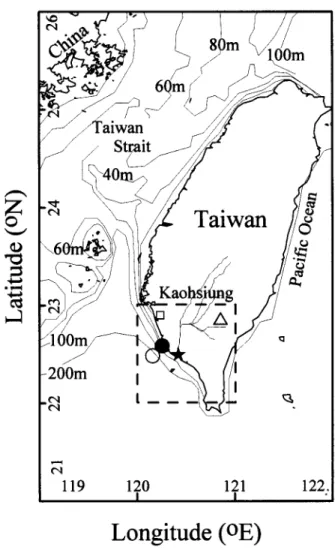
Figure 1. Map of Taiwan showing the study area (dashed line). Representative surface and core sediment samples collected from different subenvironments in southern Taiwan—offshore (open circle), coastal (filled
circle), river (star), and lake (open triangle)—have been used for this study. The open square represents Kao-hsiung City.
rocks, elemental values of representative river par-ticulates such as Kaoping (Lai 2003), Yellow and Yangtze (both from Li et al. 1984), and Amazon (Martin and Meybeck 1979), as well as loess (Li et al. 1984) and other important reference composi-tions such as upper continental crust (UCC), post-Archean Australian shale (both from Taylor and McLennan 1985), average shale (Turekian and Wedepohl 1961), and North American shale com-posite (Gromet et al. 1984), have also been included for comparison.
Methodology
A total of 106 sediment samples were collected from different subenvironments (12 offshore sur-face sediments, eight coastal sursur-face sediments, and core sediment consisting of 16 subsamples, all from off southwestern Taiwan; one bed sediment sample from Kaoping River; and core sediment con-sisting of 69 subsamples from high alpine, anoxic Great Ghost Lake) in southern Taiwan (fig. 1), with the help of appropriate sampling devices and tech-niques. Before chemical analysis, the samples were freeze-dried and homogenized, and the bulk
sedi-ment of each sample was finely ground (!200 mesh)
in an agate mortar. Major (Si, Ti, Al, Fe, Mn, Mg, Ca, Na, K, and P) and trace (Ba, Rb, Sr, and Zr) elements were determined using an x-ray fluo-rescence (XRF) spectrometer (Rigaku RIX 2000) equipped with an Rh tube at the Institute of Marine Geology and Chemistry, National Sun Yat-Sen Uni-versity, Taiwan. Details of the XRF method are de-scribed by Chen et al. (2001). The accuracy of the analytical method was established using six inter-nationally recognized standard reference materials: MAG-1, BCSS-1, PACS-1, MESS-1, NIES-2, and GBW 07314. Based on these standards, the accuracy
and precision of the analysis were withinⳲ1% for
major elements such as Al, Ca, Fe, K, Mg, Na, Si,
and Ti and withinⳲ5% for Mn, P, Rb, Sr, and Zr.
The precision and accuracy for Ba was within Ⳳ10%.
A LECO CHN-932 elemental analyzer was em-ployed to determine carbon content at 950⬚C. After the samples were repeatedly rinsed with 1 N HCl to remove inorganic carbon (IC), total organic car-bon was determined. The amount of IC was esti-mated by the difference between measured total carbon and organic carbon. The detection limit of IC is 0.01%. In the samples that were not measured for inorganic carbon, the mean value of each sam-ple’s particular subenvironment was used for the calculation of CaO in only the silicate fraction
(CaO∗). The CIA and PIA values of sedimentary and
metasedimentary rocks as well as reference com-positions such as UCC, average shale, post-Archean Australian shale, and North American shale com-posite were calculated without correcting CaO for carbonates and phosphates. In most of the sedi-mentary rocks of Taiwan, the CaO value is less than 2% (see table A1), with the exception of ar-gillite (2.53%); the calculated values are, therefore, slightly lower than actual CIA and PIA values. Loss on ignition (LOI) was calculated as a percentage of dry weight after the samples were ignited at 550⬚C for 1 h (Dean 1974).
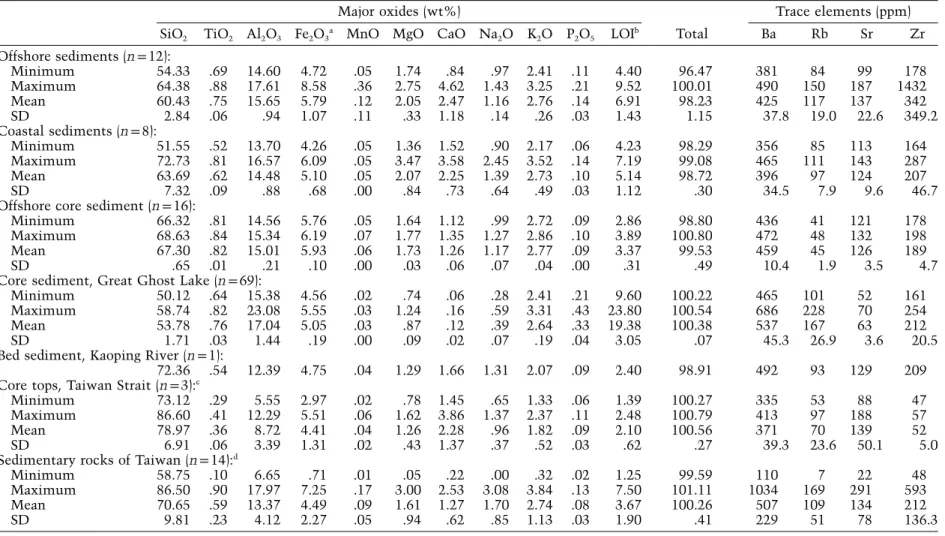
Table 1. Summary Statistics of Geochemical Compositions of Sediments and Sedimentary Rocks of Taiwan
Major oxides (wt%)
Total
Trace elements (ppm)
SiO2 TiO2 Al2O3 Fe2O3
a MnO MgO CaO Na
2O K2O P2O5 LOI b Ba Rb Sr Zr Offshore sediments (np12): Minimum 54.33 .69 14.60 4.72 .05 1.74 .84 .97 2.41 .11 4.40 96.47 381 84 99 178 Maximum 64.38 .88 17.61 8.58 .36 2.75 4.62 1.43 3.25 .21 9.52 100.01 490 150 187 1432 Mean 60.43 .75 15.65 5.79 .12 2.05 2.47 1.16 2.76 .14 6.91 98.23 425 117 137 342 SD 2.84 .06 .94 1.07 .11 .33 1.18 .14 .26 .03 1.43 1.15 37.8 19.0 22.6 349.2 Coastal sediments (np8): Minimum 51.55 .52 13.70 4.26 .05 1.36 1.52 .90 2.17 .06 4.23 98.29 356 85 113 164 Maximum 72.73 .81 16.57 6.09 .05 3.47 3.58 2.45 3.52 .14 7.19 99.08 465 111 143 287 Mean 63.69 .62 14.48 5.10 .05 2.07 2.25 1.39 2.73 .10 5.14 98.72 396 97 124 207 SD 7.32 .09 .88 .68 .00 .84 .73 .64 .49 .03 1.12 .30 34.5 7.9 9.6 46.7
Offshore core sediment (np16):
Minimum 66.32 .81 14.56 5.76 .05 1.64 1.12 .99 2.72 .09 2.86 98.80 436 41 121 178
Maximum 68.63 .84 15.34 6.19 .07 1.77 1.35 1.27 2.86 .10 3.89 100.80 472 48 132 198
Mean 67.30 .82 15.01 5.93 .06 1.73 1.26 1.17 2.77 .09 3.37 99.53 459 45 126 189
SD .65 .01 .21 .10 .00 .03 .06 .07 .04 .00 .31 .49 10.4 1.9 3.5 4.7
Core sediment, Great Ghost Lake (np69):
Minimum 50.12 .64 15.38 4.56 .02 .74 .06 .28 2.41 .21 9.60 100.22 465 101 52 161
Maximum 58.74 .82 23.08 5.55 .03 1.24 .16 .59 3.31 .43 23.80 100.54 686 228 70 254
Mean 53.78 .76 17.04 5.05 .03 .87 .12 .39 2.64 .33 19.38 100.38 537 167 63 212
SD 1.71 .03 1.44 .19 .00 .09 .02 .07 .19 .04 3.05 .07 45.3 26.9 3.6 20.5
Bed sediment, Kaoping River (np1):
72.36 .54 12.39 4.75 .04 1.29 1.66 1.31 2.07 .09 2.40 98.91 492 93 129 209
Core tops, Taiwan Strait (np3):c
Minimum 73.12 .29 5.55 2.97 .02 .78 1.45 .65 1.33 .06 1.39 100.27 335 53 88 47
Maximum 86.60 .41 12.29 5.51 .06 1.62 3.86 1.37 2.37 .11 2.48 100.79 413 97 188 57
Mean 78.97 .36 8.72 4.41 .04 1.26 2.28 .96 1.82 .09 2.10 100.56 371 70 139 52
SD 6.91 .06 3.39 1.31 .02 .43 1.37 .37 .52 .03 .62 .27 39.3 23.6 50.1 5.0
Sedimentary rocks of Taiwan (np14):d
Minimum 58.75 .10 6.65 .71 .01 .05 .22 .00 .32 .02 1.25 99.59 110 7 22 48 Maximum 86.50 .90 17.97 7.25 .17 3.00 2.53 3.08 3.84 .13 7.50 101.11 1034 169 291 593 Mean 70.65 .59 13.37 4.49 .09 1.61 1.27 1.70 2.74 .08 3.67 100.26 507 109 134 212 SD 9.81 .23 4.12 2.27 .05 .94 .62 .85 1.13 .03 1.90 .41 229 51 78 136.3 aTotal Fe expressed as Fe 2O3. bLOI p losson ignition.
cAnalysis from Chao and Chen 2003. dAnalysis from Lan et al. 2002.
Journal of Geology S U B T R O P I C A L T A I W A N W E A T H E R I N G 105
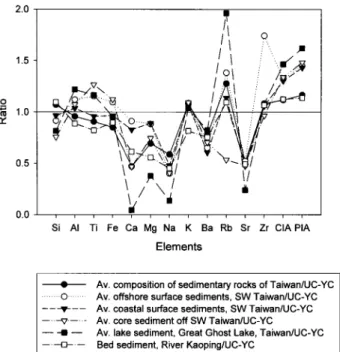
Figure 2. Spider plot showing comparison between av-erage compositions of sediments from different suben-vironments (offshore, coastal, river, and lake) and the av-erage composition of sedimentary rocks of Taiwan, both normalized to the average upper crustal (UC) values of Yangtze Craton (YC; Gao et al. 1998). Note the similarity in the behavior of most of the elements between sedi-ments and the average composition of sedimentary rocks. The similarity suggests that most of the recent sediments are physically eroded and/or moderately chemically al-tered products of sedimentary rocks. The depletion of Ca, Mg, Na, Ba, and Sr relative to the upper crust of Yangtze Craton could be attributed to their mobility during weathering.
Sediment Composition
The average composition of sedimentary rocks of Taiwan (table 1) has been calculated based on the data of Lan et al. (2002). The calculation involves 14 samples consisting of four widely varying sed-imentary and metasedsed-imentary rocks, such as phyl-lite (one sample), sandstones (three), argilphyl-lites (two), and metapelites (eight), with the assumption that these four rock types will represent approximately average values for sedimentary rocks in this small area (0.024%) of the earth’s surface. Based on Sr-Nd-O isotopic geochemistry of Taiwan granitoids and metapelites, Lan et al. (1995) suggested that cover sediments of Taiwan received recycled con-tinental crustal material from South China and the basement rocks of Taiwan. It has recently been shown, based on the Nd isotopic composition of sedimentary and metasedimentary rocks of Tai-wan, that these rocks are recycled materials of the UCC of the South China region (Lan et al. 2002). South China consists of the Yangtze Craton in the west and the Cathaysian fold in the east (Jahn et al. 1990; Lan et al. 1995). Because we are not aware of published results for the UCC of South China, in this study, sediment and sedimentary rock com-positions of Taiwan were compared with the upper crust of Yangtze Craton (Gao et al. 1998). The av-erage major (Si, Al, Ti, Fe, Ca, Mg, Na, and K) and trace (Ba, Rb, Sr, and Zr) element compositions of sediments from different subenvironments (off-shore, coastal, river, and lake) and the average com-position of sedimentary rocks (table 1) normalized with upper crustal values of Yangtze Craton (Gao et al. 1998) are shown in figure 2. The sediments and sedimentary rocks have remarkably similar patterns. The similarity suggests that most of the sediments are dominantly physically eroded and/ or moderately chemically modified. All the sedi-ments and average composition of sedimentary rocks are invariably depleted in Ca, Mg, Na, Ba, and Sr, enriched in Rb and Zr, and unchanged with respect to K. The degree of elemental variation is more prominent in lake sediments because of their highly altered nature. The slight depletion of Ti, Fe, and Mg shown by the average composition of sedimentary rocks of Taiwan is similar to UCC nor-malized values for these elements in the Huanghe sediments (Yang et al. 2004). Like sedimentary rocks, coastal and river sediments are depleted in Al, Ti, and Fe, whereas slight richness of these el-ements is evident in offshore and lake sediments.
Silicate Weathering: Geochemical Indicators and Triangular Plots
Geochemical processes such as weathering and soil formation are dominated by alteration of feldspars (and volcanic glass), which accounts for 70% of the upper crust if the relatively inert quartz is dis-counted (Nesbitt and Young 1982, 1984). Feldspars are by far the most abundant labile minerals, and consequently, the key process during silicate weathering of the earth’s upper crust is the deg-radation of feldspars by aggressive soil solutions so that the proportion of alumina to alkalis typically increases in the weathered product. A good mea-sure of the degree of weathering can be obtained by calculation of the CIA using molecular
propor-tions: CIA p 100(Al O /Al O ⫹ CaO ⫹ Na O ⫹∗
2 3 2 3 2
, where ∗is the amount of CaO
incorpo-K O)2 CaO
re-106 K . S E L V A R A J A N D C . - T . A . C H E N
sultant CIA gives a measure of the proportion of secondary aluminous clay minerals to primary sil-icate minerals such as feldspars (Nesbitt and Young 1982; Young et al. 1998).
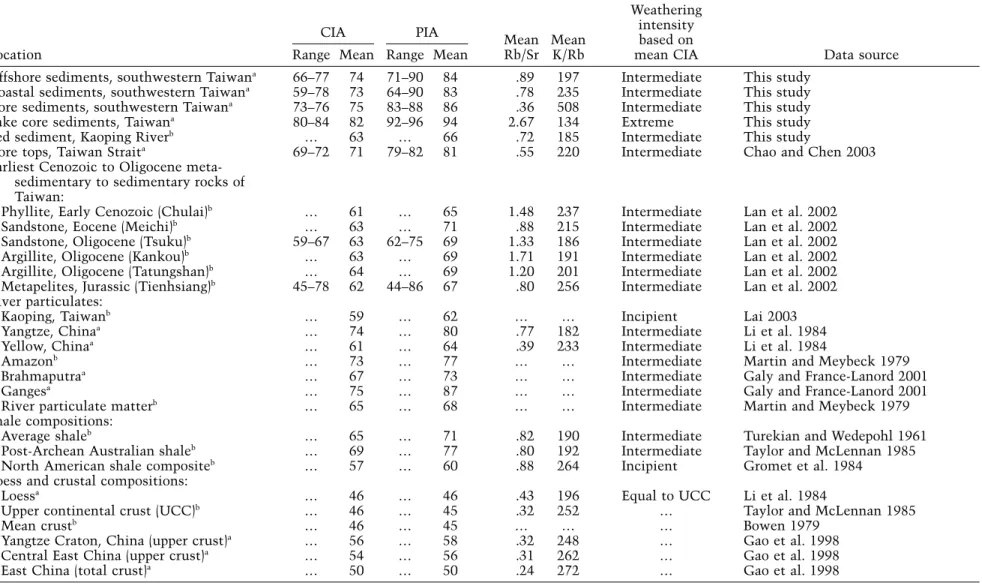
The calculated CIA values for sediments and sed-imentary rocks including river particulates, loess, and important reference compositions presented in table 2 demonstrate that the surface sediments off southwestern Taiwan (water depth 105–537 m) have moderate CIA values of 66–77, with an av-erage of 74. Values for the near coastal sediments
(water depth !100 m) from the same region are
slightly lower but comparable, with CIA ranging from 59 to 78 and a mean of 73. Sixteen subsamples of core sediment off southwestern Taiwan (water depth 294 m) exhibit a narrow range of CIA values (73–76) with a mean of 75. Three surface sediments (top 0–15 cm) of three cores from Taiwan Strait, off central Taiwan (data from Chao and Chen 2003), also show comparable CIA values (69–72). The CIA values of surface and core sediments have means ranging from 71 to 75 and fall within the range of values for average shale (70–75), indicating that the sediments are possibly the product of sedimentary and metasedimentary rocks that have undergone in-termediate chemical weathering. To deduce the sil-icate weathering trends, Nesbitt and Young (1982)
and Nesbitt et al. (1996) used A-CN-K (Al2O3
--K2O) and A-CNK-FM (Al2O3
-∗
CaO ⫹ Na O2
- ) ternary plots.
∗
CaO ⫹ Na O ⫹ K O FeO ⫹ MgO2 2 T
The data of sediments and sedimentary rocks of
Tai-wan plotted in Al2O3-CaO∗⫹ Na O2 -K2O
composi-tional space (fig. 3) fall on a trend parallel to the
A-join, and the trend approaches the Al2O3-K2O
C⫹ N
join at about CIA 80. The CIA values of many weath-ering profiles and sediments are linear, subparallel to the A-CN join in the A-CN-K plot (e.g., Nesbitt and Young 1984; Fedo et al. 1995; Selvaraj et al. 2004). All the samples that display moderate sili-cate weathering are thus plotted between CIA 60 and 80 (scale shown on the right side of the diagram for comparison), except for the sediments from high alpine Great Ghost Lake of southern Taiwan. The lake sediments that show a narrow range of higher
CIA values between 80 and 84 (mean p 82; table
2), therefore, fall very near to apex A (fig. 3) as ad-vanced weathering leads to an aluminum-rich com-position (e.g., Nesbitt and Young 1984; Nath et al. 2000). This indicates extreme chemical weathering in the high altitude region of this island. The lake is one of the wettest places in Taiwan (annual mm; Lou et al. 1997); the presence rainfall p 4200
of thick vegetation on the gently sloping shore (24⬚–
27⬚ inclination) surrounding the lake acts as an
ideal site for soil development, and the large
amount of humus material (mean total organic
; ) available in this region
carbon p 11.92% n p 69
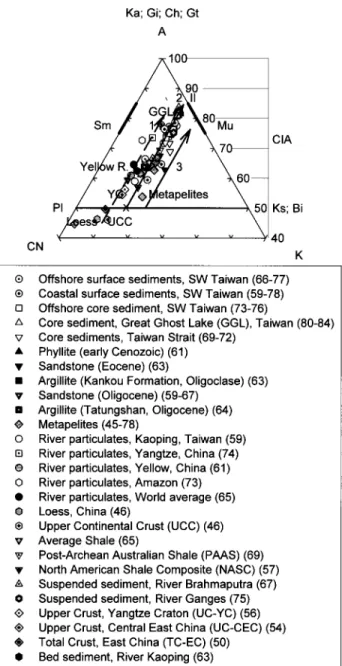
is probably responsible for the relatively low pH in soil solutions of lake catchments caused by pro-duction of organic acids. It has been shown by Colin et al. (1999) that increasing vegetation cover in the flood plains of the Irrawaddy River during the sum-mer monsoon reinforcement favors soil develop-ment. This inference indicates that acidic byprod-ucts of vegetation promote silicate weathering. The lowest CIA value of loess (46; table 2) indicates low-input acids to soils as a result of a cool, dry climate. Most of our sedimentary rocks plot between CIA 60 and 70 in figure 3, close to values for the ref-erence compositions such as the upper crusts of Yangtze Craton (56) and Central East China (54). The weathering trend (arrow 2 in fig. 3) connecting recent sediments and sedimentary rocks falls in a single line, suggesting that the sediments are the products of moderately weathered sedimentary rocks. The weathering trend of sediments and
sed-imentary rocks shows slight enrichment of K2O
compared with particulate matters of the major riv-ers Yellow, Yangtze, Brahmaputra, and Amazon and with upper crustal compositions, indicating the presence of considerable unaltered K-feldspar in the samples. In figure 3, arrow 2 intersects the feldspar join (Pl-Ks) at point x and may represent the original parent rock composition, which is also slightly rich in K-feldspar when compared with upper crustal compositions. Indeed, values for the bed sediment of the Kaoping River and its suspended particulate matter fall very close to those for river particulates of the Yellow River and average world values, which is evidence for the moderate silicate weath-ering in the river basin.
The CIA values of sediments from different sub-environments are higher than the calculated CIA values of sedimentary rocks (argillite, metapelite, phyllite, and sandstone) in Taiwan (Lan et al. 2002), which all have mean CIA in the narrow range be-tween 61 and 64 (table 2). These values are strikingly similar to the mean CIA (61) of Chinese sediment (Yang et al. 2004), suggesting that sedimentary rocks of Taiwan have experienced silicate weathering of intensity similar to that of Chinese sediments. This further substantiates that the sediments and sedi-mentary rocks are the product of rocks that expe-rienced moderate chemical weathering in the source regions. The calculated CIA values of sediments and sedimentary rocks have been classified according to the scheme suggested by Fedo et al. (1995) and shown in table 2. Nearly all the sediments and sed-imentary rocks, including metapelites, invariably show intermediate intensity of chemical
weather-Table 2. Chemical Index of Alteration (CIA), Plagioclase Index of Alteration (PIA), and the Mean Rb/Sr and K/Rb Ratios of Sediments, Sedimentary Rocks,
Riverine Particulates of Taiwan and China, and Important Reference Compositions
Location CIA PIA Mean Rb/Sr Mean K/Rb Weathering intensity based on
mean CIA Data source
Range Mean Range Mean
Offshore sediments, southwestern Taiwana
66–77 74 71–90 84 .89 197 Intermediate This study
Coastal sediments, southwestern Taiwana
59–78 73 64–90 83 .78 235 Intermediate This study
Core sediments, southwestern Taiwana
73–76 75 83–88 86 .36 508 Intermediate This study
Lake core sediments, Taiwana
80–84 82 92–96 94 2.67 134 Extreme This study
Bed sediment, Kaoping Riverb
… 63 … 66 .72 185 Intermediate This study
Core tops, Taiwan Straita
69–72 71 79–82 81 .55 220 Intermediate Chao and Chen 2003
Earliest Cenozoic to Oligocene meta-sedimentary to meta-sedimentary rocks of Taiwan:
Phyllite, Early Cenozoic (Chulai)b
… 61 … 65 1.48 237 Intermediate Lan et al. 2002
Sandstone, Eocene (Meichi)b … 63 … 71 .88 215 Intermediate Lan et al. 2002
Sandstone, Oligocene (Tsuku)b 59–67 63 62–75 69 1.33 186 Intermediate Lan et al. 2002
Argillite, Oligocene (Kankou)b … 63 … 69 1.71 191 Intermediate Lan et al. 2002
Argillite, Oligocene (Tatungshan)b … 64 … 69 1.20 201 Intermediate Lan et al. 2002
Metapelites, Jurassic (Tienhsiang)b 45–78 62 44–86 67 .80 256 Intermediate Lan et al. 2002
River particulates:
Kaoping, Taiwanb … 59 … 62 … … Incipient Lai 2003
Yangtze, Chinaa … 74 … 80 .77 182 Intermediate Li et al. 1984
Yellow, Chinaa
… 61 … 64 .39 233 Intermediate Li et al. 1984
Amazonb
… 73 … 77 … … Intermediate Martin and Meybeck 1979
Brahmaputraa
… 67 … 73 … … Intermediate Galy and France-Lanord 2001
Gangesa
… 75 … 87 … … Intermediate Galy and France-Lanord 2001
River particulate matterb
… 65 … 68 … … Intermediate Martin and Meybeck 1979
Shale compositions:
Average shaleb
… 65 … 71 .82 190 Intermediate Turekian and Wedepohl 1961
Post-Archean Australian shaleb
… 69 … 77 .80 192 Intermediate Taylor and McLennan 1985
North American shale compositeb
… 57 … 60 .88 264 Incipient Gromet et al. 1984
Loess and crustal compositions:
Loessa … 46 … 46 .43 196 Equal to UCC Li et al. 1984
Upper continental crust (UCC)b … 46 … 45 .32 252 … Taylor and McLennan 1985
Mean crustb … 46 … 45 … … … Bowen 1979
Yangtze Craton, China (upper crust)a … 56 … 58 .32 248 … Gao et al. 1998
Central East China (upper crust)a … 54 … 56 .31 262 … Gao et al. 1998
East China (total crust)a … 50 … 50 .24 272 … Gao et al. 1998
Note. Weathering intensity has been given based on the threefold classification of Fedo et al. (1995); weathering intensity for reference compositions such as UCC and mean crust are not given.
aIndicates the CaO values of only the silicate fraction. bRepresents the total CaO used for CIA and PIA calculations.
108 K . S E L V A R A J A N D C . - T . A . C H E N
Figure 3. Major element composition of sediments and sedimentary rocks, river particulates, loess, and other ref-erence compositions plotted as molar proportions on an
Al2O3-(CaO∗⫹ Na O2 )-K2O(A-CN-K) diagram. Arrow 1
represents the weathering trend of river particulates, arrow 2 indicates the weathering trend of sediments and sedimentary rocks of Taiwan, and arrow 3 marks the limit of weathering. The diagram also represents
the fields of idealized minerals: Pl pplagioclase;
; ; ;
Ks pK-feldspars Bi p biotite Sm psmectite Mu p
; ; ; ;
muscovite Il pillite Ka pkaolinite Gi pgibbsite
; . Arrow 2 through the
sedi-Ch pchlorite Gt p garnet
ments and sedimentary rocks intersects the feldspar join (Pl-Ks) at point x, which may give an indication of the original composition of the source material. The relation between chemical index of alteration (CIA) scale (Nesbitt
and Young 1982) and the triangle is shown at right. Most of the sediments and sedimentary rocks fall between CIA 60 and 80, indicating intermediate intensity of silicate weathering. Note that the lake sediments fall above CIA 80, suggesting their extremely altered nature. The reason for the parallelism between the weathering trends of ma-jor river particulates (arrow 1) and sediments and sedi-mentary rocks of Taiwan (arrow 2) could be explained as follows: most of the world’s major rivers are perhaps draining in the terrains consisting of significant amounts of granite, granodiorite, gneiss, and related geologically older rocks. In Taiwan island, however, the percentage of these rocks is very low, and most of the rocks are geologically younger sedimentary and metasedimentary clans. This probably causes the chemical variability ob-served between the two weathering trends, which in turn suggests the slight but significant differences between the composition of the original source rocks of sediments and sedimentary rocks of Taiwan and the composition of the UCC. The values of A coordinates are given in parentheses for comparison as well as to avoid confusion from overlapping points.
ing. CIW (100Al O / [Al O2 3 2 3⫹ CaO ⫹ Na O]2 ;
Har-nois 1988) ranges from 70 to 91, with a mean of 81, for coastal and offshore sediments. These values are close to those for post-Archean shales, with mod-erate losses of Ca, Na, and Sr from source area weath-ering (Condie 1993), and they correspond well with CIA values. The above interpretation is consistent with the mineralogy of coastal and offshore sedi-ments, which all show the dominance of quartz, feldspars, illite, and chlorite composition, with mi-nor amounts of calcite and kaolinite (Chen 1997). The CIA values are also consistent with sediment compositions obtained from ODP site 1144 of the northern South China Sea (Boulay et al. 2003). The site is believed to be partly sourced by Taiwan’s ter-restrial materials.
Monitoring plagioclase weathering alone also yields additional information for silicate weather-ing of sediments and sedimentary rocks, and the
PIA can be calculated as 100(Al2O3-K2O)/(Al O2 3⫹
-K2O) in molar proportions. It can
∗
CaO ⫹ Na O2
also be represented on a triangle showing molecular
proportions of Al2O3(minus Al associated with K),
CaO, and Na2O (see the PIA diagram of Fedo et al.
1995). The PIA values for coastal and offshore sed-iments, in general, fall between 80 and 90 (fig. 4), with a mean of 85, except for a few samples that show low PIA values (as low as 64; table 2) and indicate the presence of small amounts of plagio-clase feldspars in sediments. Sediments display low CaO values and seem to be totally depleted in the
Journal of Geology S U B T R O P I C A L T A I W A N W E A T H E R I N G 109
Figure 4. Triangular plot (after Fedo et al. 1995)
show-ing molar proportions of Al2O3 (minus that associated
with K), CaO, and Na2O. The diagram shows that the
plagioclase index of alteration (PIA) for most of the sed-iments falls between 80 and 90 (scale shown at right) because of the presence of small amounts of plagioclase feldspar resulting from moderate silicate weathering.
Lake sediments fall very close to the Al2O3-K2O apex,
which substantiates that they are the products of highly
weathered sedimentary rocks. An panorthite; Al p
. Symbols and other abbreviations are as in figure albite
3.
Figure 5. Mafics ternary plot of Nesbitt and Young
(1984). A is molar proportions of Al2O3, CNK represents
, and FM identifies .
∗
CaO ⫹ Na O ⫹ K O2 2 FeOT⫹ MgO
Symbols are as in figure 3. Also shown are the fields of
idealized minerals (see fig. 3 for details;Fs pfeldspars).
anorthite component (fig. 4). The sedimentary rocks, on the other hand, seem to contain a higher proportion of anorthite than sediments. Lake sed-iments show very high PIA values (92–96; table 2)
and plot near the Al2O3 apex on the triangle,
in-dicating their highly aluminous character. They are also virtually depleted in Ca, but all have small
amounts of Na2O (sodic feldspar), which is more
prominent in offshore and coastal sediments. These differences are well matched with a high degree of weathering for the lake sediments and moderate weathering for other sediments. Weathering has proceeded to a stage at which significant amounts of Ca and Na have been removed from the sedi-ments because of copious rainfall (source for or-ganic and inoror-ganic acids) in this island. Weather-ing studies show that Ca, Na, and Sr are rapidly lost during chemical weathering, and the amount of these elements lost is proportional to the degree of weathering (e.g., Wronkiewicz and Condie 1987). The consistency of CIA and PIA values among the sediments, sedimentary rocks, and metasedi-mentary rocks clearly suggests that, in general, the degree of silicate weathering in this island is a
pro-cess operating on a moderate scale over a long pe-riod (from Jurassic to recent, even though our study has some gaps in sampling representation for a few periods such as Miocene, Pliocene, and Pleisto-cene). The Pleistocene sediments (ODP site 1144) of the northern South China Sea have CIA values of 73–79 (Boulay et al. 2003). Among the sedimen-tary rocks, metapelites have a wide range of CIA values (45–78), the lowest value being equal to those of UCC and loess. The mean value (62; ), however, is consistent with those of the
n p8
other sedimentary rocks (61–64) but lower than those of the sediments discussed above. The CIA and PIA values of average composition of sedimen-tary rocks are about 20% higher than upper crust values of Yangtze Craton (fig. 2).
To illustrate the approximate mineralogical com-position of sediments and sedimentary rocks, major element data of all the samples have been plotted in the mafics triangle (fig. 5; Nesbitt and Young 1984; Nesbitt and Wilson 1992). It portrays
molec-ular proportions of Al2O3, CaO∗⫹ Na O ⫹ K O2 2 ,
and FeOT⫹ MgO (A-CNK-FM). Most of the
sedi-ments, sedimentary rocks, and river particulates (Kaoping, Yellow, and Yangtze) plot within the compositional triangle of feldspars, garnet, and chlorite. This implies the approximate mafic min-erals composition of samples; however, x-ray dif-fractogram (XRD) patterns of recent sediments
110 K . S E L V A R A J A N D C . - T . A . C H E N
have not shown any presence of garnet. Therefore, the coastal and offshore sediments plot away from the garnet join but close to the feldspar-chlorite join, suggesting that sediments are essen-tially composed of feldspars and chlorite, domi-nated by the latter. This inference is compatible with the XRD patterns of our coastal and offshore sediments, all showing prominent feldspar (d p
) and chlorite ( and 3.51) peaks (Chen
3.18 d p7.16
1997). The presence of illite and chlorite inferred from geochemical data is consistent with the ear-lier clay mineral investigation by Chen (1973), who found the illite-chlorite dominant suite over the continental shelf from the East China Sea to the southern part of Taiwan Strait. The close associa-tion of sediments with sedimentary rocks (fig. 5) indicates that the former is mostly the product of the latter. The lake sediments again plot toward higher Al than do other sediments and sedimentary rocks and well above the line of the feldspar-chlorite join, further confirming their higher sili-cate weathering. Bed sediment of the Kaoping River plots close to river particulates of the Yellow River and average world values, as in the A-CN-K plot; this denotes moderate silicate weathering in the river basin of the Kaoping and the similarity in the mineralogical composition of source rocks of the Kaoping and Yellow rivers. This finding, however, contradicts some previous reports (e.g., Yang 2001; Lai 2003) that suggested high chemical/silicate weathering rates based on dissolved river flux, prob-ably because the dissolved flux also includes the carbonate dissolved elements. The river particu-lates of the Amazon and Yangtze rivers, however, plot close to the sediments, with lower values re-sulting from the incorporation of total CaO instead of CaO in only the silicate fraction.
Large-Ion Lithophile Elements: Rb, Sr, K, and Na
The increase in chemical weathering intensity rap-idly leaches Sr compared to Rb (Nesbitt and Young 1982); therefore, the Rb/Sr ratio increases with in-creasing CIA (Ma et al. 2000). Likewise, with the increase in chemical weathering intensity, K will normally show depletion against Rb (Wronkiewicz and Condie 1989), thus leading to a lower K/Rb ratio. Rb has been considered to be primarily fixed in weathering residues and less reactive than Ca, Na, and Sr (Nesbitt et al. 1980). The Rb/Sr ratios of sediments and sedimentary rocks can thus be used to monitor the degree of source rock weath-ering (McLennan et al. 1993). The mean Rb/Sr ra-tios (0.89 and 0.78) of offshore and coastal surface sediments of southwestern Taiwan are consistent
with the Rb/Sr ratios of different shale composi-tions (0.80–0.88; table 2), corroborating that the de-gree of source rock weathering was moderate. The lower mean Rb/Sr ratios of core sediments off
southwestern Taiwan (0.36; n p16) and Taiwan
Strait (0.55;n p3) are closer to the Rb/Sr ratios of
different upper crustal and loess compositions (0.31–0.43). The mean Rb/Sr ratios of sandstones and metapelites are 0.88 and 0.80, respectively, in-dicating that the recent sediments from coastal and offshore regions are mainly derived from these sed-imentary rocks. This inference is supported by the similar Rb/Sr ratio (0.71) for bed sediment of the Kaoping River. High Rb/Sr ratios (1.74–3.77) of lake sediments and their higher mean value of 2.67
(n p69) further support their derivation from
in-tensively weathered rocks such as phyllite and ar-gillite (mean Rb/Sr ratios 1.48 and 1.71), which are
dominant in the entire drainage basin (90.3 km2) of
the lake. Rb/Sr ratios in the illite minerals are
usu-ally11, with a maximum value of 6.46 (Chaudhuri
and Brookings 1979), suggesting that the higher il-lite content in lake sediments might be responsible for higher Rb/Sr ratios. The moderate chemical weathering of sediments is also indicated by K/Rb ratios (table 2) of the investigated sediments that are not depleted in K (fig. 2), and mean K/Rb ratios of coastal (235), offshore (197), and river (185) sed-iments are consistent with K/Rb ratios of Taiwan’s sedimentary rocks (220), upper crusts of Yangtze Craton (248), and loess (196).
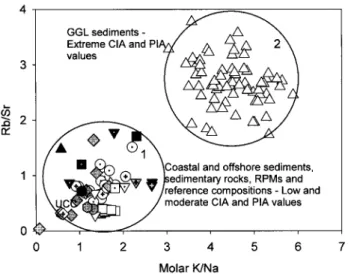
Molar ratios of K/Na of sediments and sedimen-tary rocks are correlated well with Rb/Sr ratios as well as CIA and PIA values (fig. 6). Both ratios are moderate and consistent with different shale com-positions and bed sediment of the Kaoping River, demonstrating moderate silicate weathering. The diagram shows the presence of minor plagioclase (Na and Sr) and K-feldspar (K and Rb) in recent sed-iments. The close association of sediments with loess and Yellow River particulates suggests com-positional similarity and also that the Taiwan Strait might have been sourced considerably from the loess plateau either by the Yellow River or from dust storm input. High K/Na and Rb/Sr ratios of lake sediments indicate stronger chemical weath-ering at higher altitudes as well as preferential dis-solution of plagioclase (Na and Sr) relative to K-feldspar during the silicate weathering process (Yang et al. 2004). The scatter plot of Al/Na ratio versus CIA (fig. 7) illustrates the interrelation be-tween both indexes, which reflects the silicate weathering intensity. The diagram shows that the degree of chemical weathering of sediments and sedimentary rocks of Taiwan is moderate, as
in-Journal of Geology S U B T R O P I C A L T A I W A N W E A T H E R I N G 111
Figure 6. Diagram showing variations in Rb/Sr versus molar K/Na in sediments and sedimentary rocks of Tai-wan and other reference compositions. Note the two sep-arate fields; low and intermediate values of chemical and plagioclase indexes of alteration (CIA and PIA) for sedi-ments and sedimentary rocks in field 1, having low Rb/ Sr and K/Na ratios compared to field 2, encircle the high CIA and PIA samples of Great Ghost Lake (GGL), which have higher Rb/Sr and K/Na ratios. See figure 3 for ex-planation of symbols and abbreviations.
Figure 7. Scatter plot of Al/Na ratio versus chemical index of alteration (CIA). Note the interrelation between both indexes, which reflects the silicate weathering in-tensity. Symbols and abbreviations are as in figure 3. dicated by their low Al/Na ratios (0–13.09), which
reveal the presence of small amounts of Na2O
(pla-gioclase) in the samples. The degree of chemical weathering of lake sediments is high, as shown by their very high Al/Na ratios (20.75–41.42) resulting from extreme dissolution of plagioclase. These in-ferences are consistent with their positions on the other triangular and scatter plots.
Several lines of evidence have been drawn as ad-ditional support for the conclusions arrived at in this study. The XRD patterns of our offshore and coastal surface sediments show quartz-feldspar-chlorite-illite-calcite-kaolinite association (Chen 1997). Consequently, illite and chlorite are the most abundant and ubiquitous clay minerals in the rock formations on the Hengchun Peninsula in southern Taiwan (Lin and Wang 2001). Both illite and chlorite may be derived either from the deg-radation of muscovite and biotite from metamor-phic formations or from the erosion of sedimentary rocks (Chamley 1989). Micas are essential minerals of rocks such as schist and phyllite. Chlorite is con-sidered a primary mineral of low-grade metamor-phic rocks. The basement complex of Taiwan, Tan-anao schist and the associated choritoid rocks, is considered the probable source of chlorite in these sediments. Accordingly, illite, chlorite, and quartz
are treated as products of physical erosion or mod-erate chemical weathering (Chamely 1989). Colin et al. (1999) identified from the core sediments of the Bay of Bengal and Andaman Sea that the sed-iments deposited during the last glacial maximum are characterized by a decrease in the smectite/
(illite⫹ chlorite) ratio resulting from increased
physical weathering. If the source rocks experi-enced intense chemical weathering, feldspars pres-ent in the source rock would be altered totally as aluminous clay (Fedo et al. 1996). Repeated cycles of weathering and abrasion during transport even-tually result in destruction of feldspars and for-mation of clay minerals (Nesbitt and Young 1996). As long as feldspars persist, the sediments will re-main compositionally immature (Nesbitt and Young 1996). It has also been mentioned that the absence of feldspar in sediments and sedimentary rocks is a characteristic feature of supermature sed-imentary rocks (Medaris et al. 2003). Maturity would have been further enhanced by additional weathering during fluvial transport in a warm, hu-mid climate (Johnsson et al. 1988) and by prefer-ential destruction of labile minerals and lithic frag-ments in the high-energy fluvial and shallow marine environments (Odom et al. 1976). The pres-ence of feldspars in sediments of this study, inferred from figures 4 and 6 and the illite-chlorite associ-ation shown in figure 5, suggests their derivassoci-ation by physical weathering (a key process in Taiwan) and/or moderate chemical weathering.
112 K . S E L V A R A J A N D C . - T . A . C H E N
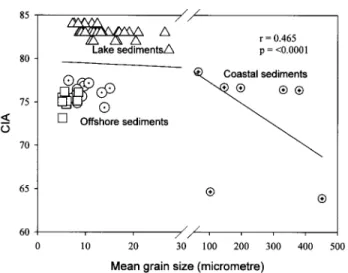
Figure 8. Bivariate plot of CIA and mean grain size (mm) for sediments of Taiwan. Symbols are as in figure 3. found in the record of clay minerals in sedimentary
basins by France-Lanord and Derry (1997). To
es-timate CO2consumption from silicate weathering,
they selected the Himalayan-derived sediments of the late Pleistocene–mid-Miocene age recovered from the distal Bengal Fan on ODP Leg 116. Before 7 Ma and after 1 Ma, the clay mineral assemblage in the Bengal Fan was dominantly illite and chlorite (I-C assemblage), reflecting moderate weathering in the Ganges-Brahmaputra system. Between 7 and 1 Ma, clays in the Fan were dominantly pedogenic smectite and kaolinite (S-K assemblage), reflecting more intense weathering. The I-C sediments have
lost little or no K2O or MgO relative to the source
rocks but have lost about half of their Na2O and
CaO, while the S-K sediments have lost some MgO,
about half of their K2O and CaO, and much of their
Na2O. Therefore, the secondary mineral
assem-blage of I-C in the sediments of southwestern Tai-wan inferred from figures 5 and 6 and their un-changed K and slightly depleted Mg contents (fig. 2) corroborate that these sediments are the products of physically weathered rocks and/or intermediate chemical weathering. The clay mineral composi-tion of present-day Ganges River sediment is es-sentially illite and chlorite, however, indicating rapid mechanical weathering in the source area (Singh et al. 2003).
Mean grain sizes (determined with a Coulter LS particle size analyzer) of offshore surface (6.47–15.08
mm; n p12) and core (5.13–8.55 mm;n p13)
sedi-ments fall within fine and very fine silt classes of siliclastic sediments. Coarser coastal sediments have a wide range of mean sizes, from 65 to 452 mm, and fall in very fine to medium sand classes. Fine
and medium silt sizes (7.30–27.4 mm; n p37) are
the characteristics of highly weathered lake sedi-ments. Silt and sand dominance suggests the pres-ence of a relatively higher amount of feldspars than secondary clay minerals. The insignificant
correla-tion (r p0.465 P p 0.0001 n p 69; ; ) between mean
grain size and CIA of studied sediments (fig. 8) sup-ports the above inference and indicates that the chemical variability seems to be less likely to be grain-size controlled because of non–steady state weathering.
Consequences of Erosion and Chemical Weathering
Tectonism and climate generally determine the rel-ative rates of erosion and chemical weathering (McLennan and Taylor 1991). Likewise, the relative rates of chemical weathering and erosion chiefly control the composition of siliclastic sediments
(Nesbitt et al. 1997). Balanced rates of chemical weathering and erosion result in steady state weathering, which produces compositionally sim-ilar sediments over a long period. Non–steady state weathering, however, occurs where climate and tectonism vary greatly, altering the rates of chem-ical weathering and erosion and resulting in pro-duction of chemically diverse sediments. The ex-treme height of Taiwan’s mountains (4 km) and the monsoon climate (average precipitation is 2500 mm/yr with an average of four typhoons per year) result in very rapid physical denudation and fast transport of sediments to the ocean. In such a weathering-limited regime, soils are thin because of a high rate of mechanical denudation (physical formation). The residence time of
weathering1soil
secondary products of weathering is much lower because storage within the high-standing island’s riverine systems is thought to be minimal (Lyons et al. 2002); rates of chemical weathering are low, similar to those of the Himalayas (France-Lanord and Derry 1997), but high physical weathering rates continuously create new mineral surfaces that are responsible for enhanced river chemical fluxes (Gaillardet et al. 1999). Rivers of Taiwan, therefore, show high elemental fluxes that are highly related to huge storm-induced, physically eroded sedi-ments transported in short mountainous rivers (erosion effect) rather than true alteration of feld-spars to clay minerals, i.e., silicate weathering.
Rivers draining in low-altitude areas may have a better chance of segregation of elements in weath-ering relative to high-altitude systems, as con-cluded by Zhang and Liu (2002). They observed that
Journal of Geology S U B T R O P I C A L T A I W A N W E A T H E R I N G 113
the segregation factor ([Ca⫹ K ⫹ Na ⫹ Mg]/[Fe ⫹
) in suspended matter of Chinese rivers increases Al]
with sediment yields in regions dominated by phys-ical weathering. In contrast, the segregation factor decreases with sediment yield in regions dominated by chemical and biological weathering because the reduced water column turbidity allows chemical and biological reactions to process into depth over the drainage basin. In addition, an increase in the height/length (H/L) ratio of the river course cor-responds to a reduced segregation of elements in weathering. Therefore, the very high H/L ratios of Taiwan rivers and their huge suspended load (∼400 t/yr; Dadson et al. 2003) are also probably not con-ducive to chemical weathering. Further, extensive erosion results in reduction of soil particle reten-tion in the weathering crust, coupled with incom-plete chemical reaction caused by reduction of water-particle contact and segregation of elements (e.g., Al and Si; Zhang et al. 2003).
The ratio between the rates of physical and chemical denudation in Taiwan ranges from 10 to
40 mg/cm2/yr, approximately. In general, the areas
of lower physical denudation rate show higher chemical denudation rates and vice versa (see fig. 1 of Li 1976). Similarly, the ratios of physical and chemical denudation rates of Chinese rivers lie
mostly between 2 and 10 mg/cm2/yr, excluding
loess areas, where the ratio is high, at 90 mg/cm2/
yr. The average physical erosion rate in the Yellow
Basin was about1.4 # 106kg/km2/yr, while the
av-erage chemical erosion rate was25 # 103kg/km2/
yr. In comparison, the average physical and chem-ical erosion rates in the Yangtze Basin were
and kg/km2/yr, respectively
6 3
0.29 # 10 104 # 10
(Li et al. 1984). This implies that intense physical weathering cannot naturally result in a high silicate weathering rate, mainly because the strong erosion prevents the newly formed sediment from accu-mulating in the catchments area or in the soil pro-file. As a consequence, the source rocks and sedi-ments have less time to react with the weathering agents, leading to moderately weathered material. Hence, because of the combination of active tec-tonic and climatic regimes (high relief, high rain-fall, and storm-induced landslides), the continental rocks of Taiwan are eroding rapidly at 3–7 mm/yr (Dadson et al. 2004) through processes of fluvial bedrock incision (Hartshorn et al. 2002), landslid-ing (Hovius et al. 2000), and debris flows (Lin et al. 2004). Large volumes of such physically eroded de-tritus are responsible for high dissolved elemental fluxes (mass/volume ratio) in the fluvial system. Chemical weathering has a smaller effect, and physical denudation and subsequent erosion are
more important in controlling sediment composi-tions of the coastal and offshore sediments studied. These sediments are produced through non–steady state weathering dominated by hill-slope mechan-ical erosion. The possibilities of highly weathered zones of soil profile are expected to be slight on the slopes of steep mountains, since the profile mate-rials are eroded before chemical weathering can produce the appropriate mineralogy or soil zona-tion (Nesbitt et al. 1997). This non–steady state weathering is likely to be a characteristic feature of tectonically active high-standing islands of Asia and Oceania, such as Taiwan, the Philippines, In-donesia, New Zealand, and Papua New Guinea, where the entire spectrum of weathering zones de-veloped on bedrock is susceptible to rapid erosion. Tectonism, moderate relief of lake catchments, and very high rainfall in the alpine region of Taiwan result in more vegetation, which stabilizes soils and aids in the production of organic acids that decompose most of the feldspars. Deep weathering profiles are therefore possible in high-altitude areas of Taiwan where the dominance of chemical weath-ering rates resulting from high annual acid input to mineral zones of soils over erosion produces highly weathered sediments.
Conclusions
In spite of huge orographic rainfall in this moun-tainous island, chemical weathering is not an in-tense process, except in the sediments of alpine Great Ghost Lake, where the CIA and PIA values show extreme weathering conditions. The CIA and PIA values between the upper crust of Yangtze Craton and the sedimentary rocks of Taiwan and sedimentary rocks and recent sediments increase by just 20% in each stage. Moreover, sedimentary rocks are recycled continental crustal materials, their derivatives are recent sediments, and the chemical weathering intensity of sediments is more or less equal to the weathering conditions of rivers such as Changjiang and Brahmaputra. Our conclusions in this study emphasize the need for additional data in this area and the need to recheck the chemical weathering rates of this oro-gen with more precise and appropriate techniques. The dissolved flux data of almost all the rivers in Taiwan show a very high concentration of nitrate, clearly indicating the influence of anthropogenic input in the dissolved loads rather than true weathering fluxes from dissolution of rock-forming minerals. Anthropogenic input appears to be the major source of riverine nutrients in the Kaoping River (Yang 2001). For example,
anthro-114 K . S E L V A R A J A N D C . - T . A . C H E N
pogenic inputs of total dissolved nitrogen and
phosphate are about5–6 # 104and4–8 # 103kg/
d, respectively. This condition may hold for most of the west-flowing rivers of Taiwan, where the total population of the country is residing. Mod-erate silicate weathering is further supported by the fact that the concentrations of dissolved silica in all but six rivers of Taiwan (C.-T. A. Chen, un-pub. data) are lower than the reported values of this parameter in 60 large rivers in the world (Gail-lardet et al. 1999). Clearly there is still a need for additional information and long-term geochemi-cal evidence about chemigeochemi-cal weathering of this orogen. Therefore, our future investigation will focus on long core sediments of the northwest Pacific eastern side of the island, where huge amounts of weathered materials are directly
trans-ported by 11 fast-flowing rivers from the steep slopes of the Eastern Range of Taiwan (Fuller et al. 2003), with an aim to reconstruct the long-term weathering history of Taiwan.
A C K N O W L E D G M E N T S
Financial support from the Republic of China Na-tional Science Council (NSC 93-2611-M-110-009, 93-2811-M-110-006, and 93-2621-Z-110-004) is greatly appreciated. We thank B. N. Nath for help-ful comments and N. R. Rao for fine-tuning the revised manuscript. We gratefully acknowledge W. Nesbitt and an anonymous reviewer for their help-ful comments and critiques of the original manu-script.
R E F E R E N C E S C I T E D
Berner, R. A.; Lasaga, A. C.; and Garrels, R. M. 1983. The carbonate-silicate geochemical cycle and its effect on atmospheric carbon dioxide over the last 100 million years. Am. J. Sci. 205:641–683.
Boulay, S.; Colin, C.; Trentesaux, A.; Pluquet, F.; Bertaux, J.; Blamart, D.; Buehring, C.; and Wang, P. 2003. Min-eralogy and sedimentology of Pleistocene sediment in the South China Sea (ODP Site 1144). In Prell, W. L.; Wang, P.; Blum, P.; Rea, D. K.; and Clemens, S. C., eds. Proc. ODP, Sci. Results 184:1–21.
Bowen, H. T. M. 1979. Environmental chemistry of the elements. London, Academic Press, 333 p.
Chamley, H. 1989. Clay sedimentology. Berlin, Springer, 623 p.
Chao, H.-J., and Chen, J.-C. 2003. Grain size, mineralog-ical and chemmineralog-ical characteristics of cored sediments from offshore Hsinchu and their geological implica-tions. Acta Oceanogr. Taiwan. 41:61–96 (in Chinese with English abstract).
Chaudhuri, S., and Brookings, D. G. 1979. The Rb-Sr sys-tematics in acid-leached clay minerals. Chem. Geol. 24:231–242.
Chen, C.-T. A. 1997. Research report on phytoplankton, benthos, fishery resources and sediment quality in and around the slag disposal area of the China Steel Com-pany, off southwest Taiwan. No. 31. Institute of Ma-rine Geology and Chemistry, National Sun Yat-Sen University, Taiwan, 322 p. (in Chinese).
Chen, C.-T. A.; Liu, J. T.; and Tsuang, B.-J. 2004. Island-based catchment: the Taiwan example. Reg. Environ. Change 4:39–48.
Chen, C.-T. A.; Wann, J.-K.; and Lou, J.-Y. 2001. Aeolian flux of metals in Taiwan in the past 2600 years. Che-mosphere 43:287–294.
Chen, P.-Y. 1973. Clay minerals distribution in the sea-bottom sediments neighbouring Taiwan island and northern South China Sea. Acta Oceanogr. Taiwan. 3: 25–64.
Colin, C.; Turpin, L.; Bertaux, J.; Desprairies, A.; and Kis-sel, C. 1999. Erosional history of the Himalayan and Burman ranges during the last two glacial-interglacial cycles. Earth Planet. Sci. Lett. 171:647–660.
Condie, K. C. 1993. Chemical composition and evolution of the upper continental crust: contrasting results from surface samples and shales. Chem. Geol. 104:1– 37.
Dadson, S. J.; Hovius, N.; Chen, H.; Dade, W. B.; Heish, M.-L.; Willett, S. D.; Hu, J.-C.; et al. 2003. Links be-tween erosion, runoff variability and seismicity in the Taiwan orogen. Nature 426:648–651.
Dadson, S. J.; Hovius, N.; Chen, H.; Dade, W. B.; Lin, J.-C.; Hsu, M.-L.; Lin, C.-W.; et al. 2004. Earthquake-triggered increase in sediment delivery from an active mountain belt. Geology 32:733–736.
Dean, W. E., Jr. 1974. Determination of carbonate and organic matter in calcareous sediments and sedimen-tary rocks by loss on ignition: comparison with other methods. J. Sediment. Petrol. 44:242–248.
Fedo, C. M.; Eriksson, K. A.; and Krogstad, E. J. 1996. Geochemistry of shales from the Archean (∼3.0 Ga) Buhwa Greenstone Belt, Zimbabwe: implications for provenance and source-area weathering. Geochim. Cosmochim. Acta 60:1751–1763.
Fedo, C. M.; Nesbitt, H. W.; and Young, G. M. 1995. Unraveling the effects of potassium metasomatism in sedimentary rocks and paleosols, with implications for paleoweathering conditions and provenance. Ge-ology 23:921–924.
France-Lanord, C., and Derry, L. A. 1997. Organic carbon burial forcing of the carbon cycle from Himalayan ero-sion. Nature 390:65–67.
Fuller, C. W.; Willett, S. D.; Hovius, N.; and Slingerland, R. 2003. Erosion rates for Taiwan mountain basins: new determinations from suspended sediment records and a stochastic model of their temporal variation. J. Geol. 111:71–87.
Journal of Geology S U B T R O P I C A L T A I W A N W E A T H E R I N G 115
Gaillardet, J.; Dupre, B.; Louvat, P.; and Alle`gre, C. J.
1999. Global silicate weathering and CO2
consump-tion rates deduced from the chemistry of large rivers. Chem. Geol. 159:3–30.
Galy, A., and France-Lanord, C. 2001. Higher erosion rates in the Himalaya: geochemical constraints on riv-erine fluxes. Geology 29:23–26.
Gao, S.; Luo, T.-C.; Zhang, B.-R.; Zhang, H.-F.; Han, Y.-W.; Zhao, Z.-D.; and Hu, Y.-K. 1998. Chemical com-position of the continental crust as revealed by studies in East China. Geochim. Cosmochim. Acta 62:1959– 1975.
Gromet, L. P.; Dymek, R. F.; Haskin, L. A.; and Korotev, R. L. 1984. The “North American Shale Composite”: its compilation, major and trace element character-istics. Geochim. Cosmochim. Acta 48:2469–2482. Han, G., and Liu, C.-Q. 2004. Water geochemistry
con-trolled by carbonate dissolution: a study of the river waters draining karst-dominated terrain, Guizhou Province, China. Chem. Geol. 204:1–21.
Harnois, L. 1988. The CIW index: a new chemical index of weathering. Sed. Geol. 55:319–322.
Hartshorn, K.; Hovius, N.; Dade, W. B.; and Slingerland, R. L. 2002. Climate-driven bedrock incision in an ac-tive mountain belt. Science 300:2036–2038.
Hovius, N.; Stark, C. P.; Chu, H.-T.; and Lin, J.-C. 2000. Supply and removal of sediment in a landslide-dominated mountain belt: Central Range, Taiwan. J. Geol. 108:73–89.
Jahn, B.-M.; Zhou, X. H.; and Li, J. L. 1990. Formation and tectonic evolution of southeastern China and Tai-wan: isotopic and geochemical constraints. Tectono-physics 183:145–160.
Johnsson, M. J.; Stallard, R. F.; and Meade, R. H. 1988. First-cycle quartz arenites in the Orinoco River Basin, Venezuela and Colombia. J. Geol. 96:263–277. Lai, Y. C. 2003. Geochemistry of major and trace
ele-ments in the Kaoping River: weathering and human influences. M.S. thesis, Institute of Marine Geology and Chemistry, National Sun Yat-Sen University, Tai-wan, 104 p. (in Chinese with English abstract). Lan, C.-Y.; Lee, C.-S.; Shen, J. J.-S.; Lu, C.-Y.; Mertzman,
S. A.; and Wu, T.-W. 2002. Nd-Sr isotopic composition and geochemistry of sediments from Taiwan and their implications. West. Pac. Earth Sci. 2:205–222. Lan, C.-Y.; Lee, T.; Jahn, B.-M.; and Yui, T.-F. 1995.
Tai-wan as a witness of repeated mantle inputs: Sr-Nd-O isotopic geochemistry of Taiwan granitoids and me-tapelites. Chem. Geol. 124:287–303.
Li, Y.-H. 1976. Denudation of Taiwan island since the Pliocene epoch. Geology 4:105–107.
Li, Y.-H.; Teraoka, H.; Yang, T.-S.; and Chen, J.-S. 1984. The elemental composition of suspended particles from the Yellow and Yangtze rivers. Geochim. Cos-mochim. Acta 48:1561–1564.
Lin, C. W.; Shieh, C. L.; Yuan, B. D.; Shieh, Y. C.; Liu, S. H.; and Lee, S. Y. 2004. Impact of the Chi-Chi earth-quake on the occurrence of landslides and debris flows: example from the Chenyulan River watershed. Eng. Geol. 71:49–61.
Lin, S. B., and Wang, Y. R. 2001. Clay minerals in the rock formations on the Hengchun Peninsula, southern Taiwan, and their tectonic implications. West. Pac. Earth Sci. 1:157–174.
Lou, Y.-J.; Chen, C.-T. A.; and Wann, J.-K. 1997. Paleo-climatological records of the Great Ghost Lake in Tai-wan. Sci. China Ser. D 40:284–292.
Lyons, W. B.; Nezat, C. A.; Carey, A. E.; and Hicks, D. M. 2002. Organic carbon fluxes to the ocean from high-standing islands. Geology 30:443–446.
Ma, Y.; Liu, C.; and Huo, R. 2000. Strontium isotope systematics during chemical weathering of granitoids: importance of relative mineral weathering rates. J. Goldschmidt Conf. Abstr. 5:657.
Martin, J.-M., and Meybeck, M. 1979. Elemental mass-balance of material carried by major world rivers. Mar. Chem. 7:173–206.
McLennan, S. M. 1993. Weathering and global denuda-tion. J. Geol. 101:295–303.
McLennan, S. M.; Hemming, S.; McDaniel, D. K.; and Hanson, G. N. 1993. Geochemical approaches to sed-imentation, provenance, and tectonics. In Johnsson, M. J., and Basu, A., eds. Processes controlling the com-position of clastic sediments. Geol. Soc. Am. Spec. Pap. 284:21–40.
McLennan, S. M., and Taylor, S. R. 1991. Sedimentary rocks and crustal evolution: tectonic setting and sec-ular trends. J. Geol. 91:1–22.
Medaris, L. G., Jr.; Singer, B. S.; Dott, R. H., Jr.; Naymark, A.; Johnson, C. M.; and Schott, R. C. 2003. Late Pa-leoproterozoic climate, tectonics, and metamorphism in the southern Lake Superior region and Proto–North America: evidence from Baraboo interval quartzites. J. Geol. 111:243–257.
Milliman, J. D., and Syvitski, J. P. M. 1992. Geomorphic/ tectonic control of sediment discharge to the ocean: the importance of small mountainous rivers. J. Geol. 100:525–544.
Nath, B. N; Kunzendorf, H.; and Plu¨ger, W. L. 2000. In-fluence of provenance, weathering, and sedimentary processes on the elemental ratios of the fine-grained fraction of the bedload sediments from the Vembanad Lake and the adjoining continental shelf, southwest coast of India. J. Sed. Res. 70:1081–1094.
Nesbitt, H. W.; Fedo, C. M.; and Young, G. M. 1997. Quartz and feldspar stability, steady and non-steady-state weathering, and petrogenesis of siliclastic sands and muds. J. Geol. 105:173–191.
Nesbitt, H. W.; Markovics, G.; and Price, R. C. 1980. Chemical processes affecting alkalis and alkaline earths during continental weathering. Geochim. Cos-mochim. Acta 44:1659–1666.
Nesbitt, H. W., and Wilson, R. E. 1992. Recent chemical weathering of basalts. Am. J. Sci. 292:740–777. Nesbitt, H. W., and Young, G. M. 1982. Early Proterozoic
climates and plate motions inferred from major ele-ment chemistry of lutites. Nature 299:715–717. ———. 1984. Prediction of some weathering trends of
116 K . S E L V A R A J A N D C . - T . A . C H E N
and kinetic considerations. Geochim. Cosmochim. Acta 48:1523–1534.
———. 1996. Petrogenesis of sediments in the absence of chemical weathering: effects of abrasion and sorting on bulk composition and mineralogy. Sedimentology 43:341–358.
Nesbitt, H. W.; Young, G. M.; McLennan, S. M.; and Keays, R. R. 1996. Effects of chemical weathering and sorting on the petrogenesis of siliclastic sediments, with implications for provenance studies. J. Geol. 104: 525–542.
Odom, I. E.; Doe, T. W.; and Dott, R. H., Jr. 1976. Nature of feldspar-grain size relations in some quartz-rich sandstones. J. Sediment. Petrol. 46:862–870.
Riebe, C. S.; Kirchner, J. W.; Granger, D. E.; and Finkel, R. C. 2001. Strong tectonic and weak climatic control of long-term weathering rates. Geology 29:511–514. Sarin, M. M. 2001. Biogeochemistry of Himalayan rivers
as an agent of climate change. Curr. Sci. 81:1446– 1450.
Selvaraj, K.; Ram Mohan, V.; and Szefer, P. 2004. Eval-uation of metal contamination in coastal sediments of the Bay of Bengal, India: geochemical and statistical approaches. Mar. Pollut. Bull. 49:174–185.
Singh, I. B.; Jaiswal, M.; Singhvi, A. K.; and Singh, B. K. 2003. Rapid subsidence of western Ganga plain during late Pleistocene: evidence from optical dating of sub-surface samples. Curr. Sci. 84:451–454.
Taylor, S. R., and McLennan, S. M. 1985. The continental crust: its composition and evolution. London, Black-well, 312 p.
Tripathi, J. K., and Rajamani, V. 1999. Geochemistry of the loessic sediments on Delhi Ridge, eastern Thar Desert, Rajasthan: implications for exogenic pro-cesses. Chem. Geol. 155:265–278.
Turekian, K. K., and Wedepohl, K. H. 1961. Distribution
of the elements in some major units of the earth’s crust. Geol. Soc. Am. Bull. 72:175–192.
Water Resources Planning Commission. 1973. Prelimi-nary estimation of river sedimentation in Taiwan. Tai-pei, Ministry of Economic Affairs.
Wronkiewicz, D. J., and Condie, K. C. 1987. Geochem-istry of Archean shales from the Witwatersrand Su-pergroup, South Africa: source-area weathering and provenance. Geochim. Cosmochim. Acta 51:2401– 2416.
———. 1989. Geochemistry and provenance of sedi-ments from the Pongola Supergroup, South Africa: evi-dence for a 3.0-Ga-old continental craton. Geochim. Cosmochim. Acta 53:1537–1549.
Yang, G. I. 2001. Denudation and transport of terrestrial materials from the Kaoping River watershed. M.S. the-sis, Institute of Marine Geology and Chemistry, Na-tional Sun Yat-Sen University, Taiwan, 128 p. (in Chi-nese with English abstract).
Yang, S. Y.; Jung, H.-S.; and Li, C. X. 2004. Two unique weathering regimes in the Changjiang and Huanghe drainage basins: geochemical evidence from river sed-iments. Sediment. Geol. 164:19–34.
Young, G. M.; von Brunn, V.; Gold, D. J. C.; and Minter, W. E. L. 1998. Earth’s oldest reported glaciation: phys-ical and chemphys-ical evidence from the Archean Mozaan Group (∼2.9 Ga) of South Africa. J. Geol. 106:523–538. Zhang, J., and Liu, C. L. 2002. Riverine composition and estuarine geochemistry of particulate metals in China: weathering features, anthropogenic impact and chem-ical fluxes. Estuarine Coastal Shelf Sci. 54:1051–1070. Zhang, J.; Ren, J. L.; Liu, S. M.; Zhang, Z. F.; Wu, Y.; Xiong, H.; and Chen, H. T. 2003. Dissolved aluminum and silica in the Changjiang (Yangtze River): impact of weathering in subcontinental scale. Global Biogeo-chem. Cycles 17:1077–1087.