Solid State Communications 147 (2008) 234–237
Contents lists available atScienceDirect
Solid State Communications
journal homepage:www.elsevier.com/locate/sscMagnetic order of LiCu
2
O
2
studied by resonant soft x-ray magnetic scattering
IS.W. Huang
a,b, D.J. Huang
a,b,∗, J. Okamoto
a, W.B. Wu
a, C.T. Chen
a, K.W. Yeh
c, C.L. Chen
c, M.K. Wu
c,
H.C. Hsu
d,e, F.C. Chou
d,aaNational Synchrotron Radiation Research Center, Hsinchu 30076, Taiwan
bDepartment of Electrophysics, National Chiao Tung University, Hsinchu 30010, Taiwan cInstitute of Physics, Academia Sinica, Taipei 11529, Taiwan
dCenter of Condensed Matter Sciences, National Taiwan University, Taipei 10617, Taiwan eDepartment of Physics, National Taiwan Normal University, Taipei 11677, Taiwan
a r t i c l e i n f o Article history:
Received 25 February 2008 Received in revised form 23 April 2008
Accepted 28 April 2008 by E.V. Sampathkumaran Available online 7 May 2008
PACS: 31.15.Ar 71.20.-b 32.10.Dk Keywords:
A. Magnetically ordered materials C. X-scattering
D. Phase transitions E. Synchrotron Radiation
a b s t r a c t
We present results of resonant soft x-ray magnetic scattering measurements on single crystals of LiCu2O2
to address the magnetic order. LiCu2O2exhibits a long-range magnetic order incommensurate with the
lattice, and the modulation vector is (0.5,ζ, 0) in reciprocal lattice units withζ ∼ 0.174, depending upon the temperature. The spin–spin correlation length along the spin chain deduced from the width of momentum scan is larger than 2100 Å. The inter-chain correlation length that lies within theabplane was discovered to be substantial,∼690 Å.
© 2008 Elsevier Ltd. All rights reserved.
Magnetic properties of low-dimensional frustrated spin sys-tems have attracted much interest for many years. A quasi-one-dimensional system of spin 1
/
2 chain with intensive interplay of geometric frustration and quantum fluctuation is interesting and important because of the competition between the nearest- and next-nearest-neighbor interactions, i.e.,J1andJ2, respectively. Inthe classical regime, such a competition results in magnetic ground states of long-range incommensurate spiral spins with a propaga-tion vector cos−1
(
J1
/
4J2)
, if|J2/
J1|>
1/
4 [1]. For quantum systems,quantum fluctuations can destroy the long-range order and give rise to gapped spin-liquid phases with commensurate spin corre-lations [2–6], and other exotic states depending upon|J2
/
J1|[7].In addition, 3D interactions in real quasi-1D materials tend to
I We thanks the technical staff of NSRRC, particularly Longlife Lee and H.W. Fu,
for their help. This work was supported in part by the National Science Council of Taiwan.
∗Corresponding address: National Synchrotron Radiation Research Center, 101
Hsin Ann Rd., 30076 Hsinchu, Taiwan. Tel.: +886 3 5780281; fax: +886 3 5783892. E-mail address:[email protected](D.J. Huang).
suppress quantum spin fluctuations and restore semiclassical behavior.
LiCu2O2 is a mixed-valent magnet which is highly frustrated
and with an equal number of Cu2+and Cu+oxidation states. The
magnetic Cu2+ is located at the center of the square base of a
fivefold-oxygen pyramid and form edge-shared chains running along thebaxis with the Cu–O–Cu bond angle of 94◦; adjacent
CuO2 chains are connected by Li+, forming 2D layers of Cu2+ in
theab plane. Double layers of Cu2+
stack along thecdirection with intervened layers of non-magnetic Cu+ions, as illustrated in
Fig. 1.
Several experiments evidenced that LiCu2O2exhibits a strong
competition between classical and quantum spin correlations. Measurements of electron spin resonance (ESR) suggested that LiCu2O2 possesses characteristics of a spin-liquid state with an
energy gap of 6 meV in the magnetic excitation spectrum [7]. In contrast, measurements of Li nuclear magnetic resonance (NMR) revealed a clear signature of incommensurate static modulation of magnetic order below 24 K [8]. Neutron results also found that the spin structure of LiCu2O2 is spiral with an incommensurate
propagation vectorEq =
(
1/
2, ζ,
0)
,ζ
∼ 0.
174, and the magnetic0038-1098/$ – see front matter©2008 Elsevier Ltd. All rights reserved. doi:10.1016/j.ssc.2008.04.040
S.W. Huang et al. / Solid State Communications 147 (2008) 234–237 235
Fig. 1. Illustration of the crystal structure of LiCu2O2. The green, blue, cyan, and red
spheres denote Li, Cu2+ , Cu+, and O ions,respectively. The black chemical bonds highlight the zigzag spin chains.
moments of Cu2+
were found to lie in theabplane [9]. Recent ESR results [10] also concluded that the spin wave spectrum of LiCu2O2 with spiral order has a gap of 1.4 meV and supported spin moments being in theabplane.
In addition to its novel magnetic properties, LiCu2O2 was
discovered to be one member of multiferroics in which magnetism and ferroelectricity coexist and ferroelectric polarization can be reversibly flipped by applied magnetic fields [11,12]. However, the direction of electric polarization deduced from the antisymmetric exchange interaction such as the spin-current model [13] suggests the spin spirals to be in the bc plane, rather than the ab plane [11]. Very recent measurements of polarized neutron scattering confirmed the existence of transverse spiral spin components in thebcplane and also implied the existence of large quantum fluctuation [12].
In this work, complementary to neutron scattering, we present results of resonant soft x-ray scattering to study the magnetic order of LiCu2O2. With photon energy tuned around the L-edge
(2p → 3d) absorption of transition metal, resonant soft x-ray scattering takes place through a dipole allowed transition, and a core-level electronΨ2p is virtually promoted to an intermediate
stateΨ3dabove the Fermi level. The resonance effect enhances the
scattering cross section dramatically and gives rise to a direct probe of the ordering of 3d states in transition metals. For the polarization vectors of incident and scattered x-rays beingEeiandEes, the resonant scattering amplitude of x-ray with wavelength
λ
isfmagres = −i3
λ
8π
(
Ee∗
s × Eei
)
· ˆz(
F1,1−F1,−1),
(1)whereF1,±1are scattering amplitudes associated with the change
of magnetic quantum number∆mbeing±1;zˆis the quantization axis of magnetization [14]. Resonant soft x-ray magnetic scattering thus provides us an effective experimental method to probe magnetic order with a good momentum resolution [15–19].
We measured resonant soft-x-ray magnetic scattering on LiCu2O2 with the elliptically-polarized-undulator beamline of
the National Synchrotron Radiation Research Center (NSRRC), Taiwan. Single crystals of LiCu2O2 were grown with the floating
zone method, and characterized with x-ray diffraction at room temperature. LiCu2O2has a layered orthorhombic crystal structure
with the space groupPnma, and the lattice constantsa = 5
.
73 Å, b=2.
86 Å, andc=12.
417 Å. Our crystals were found to be twined with mixing of thea- andb-axis domains as observed previously in the literature [9,11,12]. LiCu2O2crystals were cut to have a twined(100)/(010) surface for scattering measurements. The scattering
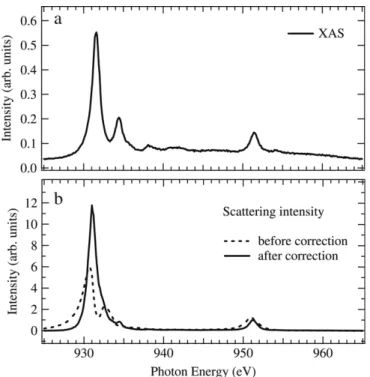
Fig. 2. Photon-energy-dependent spectra of (a) x-ray absorption and (b) scattering of LiCu2O2around the Cu L2,3edges. The absorption spectrum was obtained from
the fluorescence-yield method; the scattering spectra were recorded by fixing the momentum transfer to be (1/2, 0.174,0). Dashed and solid lines in (b) are scattering spectra before and after correction for self-absorption, respectively. The correction method is described in the text. All spectra were measured at 10 K.
plane defined by the directions of the incident and scattered x-rays is in theabplane of the lattice.
Fig. 2shows the x-ray absorption spectrum (XAS) of LiCu2O2
around the Cu L2,3 edges obtained from the fluorescence-yield
method in which the fluorescence was collected by a detector composed of an electron multiplier and a CsI thin film for converting photons into electrons. In our fluorescence-yield measurement, the angle between the incident beam and the surface normal was 30◦. As plotted in Fig. 2, theL
3 manifold of
XAS which originates from the 2p3/2 → 3d transition consists of one main peak and one small peak, corresponding to the divalent and monovalent copper ions in the ground state, respectively. In other words, the XAS peak centered at 931.4 eV corresponds to the transition from the electronic configuration 3d9in the ground state
of Cu2+to 2p
3/23d
10in the final state of the absorption process,
where 2p
3/2denotes the core hole created in the 2p3/2level. Like
the XAS of Cu2O, the small XAS peak of 934.4 eV originates from
the absorption of Cu+ in which the electronic configuration for
the ground state and the XAS final state are, respectively, 3d10and
2p
3/23d
104s1[20–22].
To understand the magnetic order of LiCu2O2, we first set the
photon energyh¯
ω
corresponding to the 2p3/2 →3d transition ofCu2+
and measured the scattering intensity through momentum scans, i.e., theqscans, along the [100] and [010] directions. The data were recorded at the sample temperature of 10 K with the polarization vector Eein the scattering plane. The scattering intensity maximizes atEq =
(
1/
2,
0.
174,
0)
in reciprocal lattice units. Note that only domains with the a axis normal to the crystal surface contribute to the x-ray magnetic scattering of such Eq; our scattering measurements thus probe LiCu2O2 of awell defined crystallographic orientation, although the crystal is twined. The data indicate that the magnetic order of LiCu2O2 is
incommensurate with its lattice and the modulation vector is (1
/
2, 0.174, 0) at 10 K. In addition to XAS,Fig. 2plots the measured photon-energy dependence of scattering intensityI(
q,
h¯ω)
with236 S.W. Huang et al. / Solid State Communications 147 (2008) 234–237
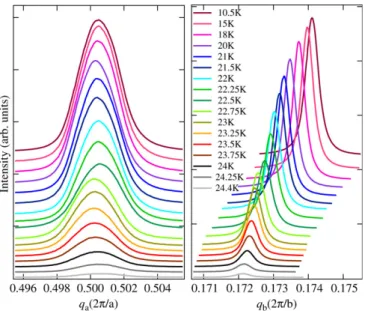
Fig. 3. Momentum scans of resonant soft x-ray scattering of LiCu2O2along the [100] and [010] directions at various temperatures below 25 K. The incident photon energy was set at 930 eV. qaand qbare the components of momentum transfer in the ab plane, i.e.,Eq=(qa,qb,0). All qascans were recorded with qbfixed at the maximum of scattering intensity, and vice versa.
the momentum transfer fixed atqE =
(
1/
2,
0.
174,
0)
. Peaks of I(
q,
h¯ω)
appear to be shifted from those of XAS by an energy between 0.5 and 1.9 eV. In fact, there exists a self-absorption effect. One needs to correct the measured scattering intensity I(
q,
h¯ω)
for self absorption; the scattering intensity is proportional to the scattering cross section multiplied by an x-ray absorption correctionA(
q,
h¯ω)
, i.e.,I(
q,
h¯ω)
∝ |fresmag|2A
(
q,
h¯ω)
. For a singlecrystal, A
(
q,
h¯ω)
is proportional to the inverse of absorption coefficientµ
[23]. The energy scan of magnetic scattering after such correction is also depicted inFig. 2. Clearly, the scattering intensity of the energy corresponding to XAS peaks of Cu+is muchweaker than that corresponding to those of Cu2+, consistent with
the expectation that the magnetic moment of Cu+ is negligible
because of the 3d10configuration.
NMR and neutron measurements indicate that the Néel temperatureTNof the spiral magnetic order in LiCu2O2is between
22 and 24 K. Fig. 3 shows q scans along the [100] and [010] directions at various temperatures below 25 K. To reduce the self-absorption effect, the incident photon energy was set at 930 eV. The q scans were fitted to a Lorentzian function with a linear background to determine the peak position and the half-width at half maxima (HWHM). We define the spin–spin correlation length as the inverse of HWHM, i.e.,
ξ
≡ 1/
HWHM. The correlation lengths along the [100] and [010] directions were found to be 690 Å and 2110 Å, respectively, at 10 K. The observed correlation length along the spin chain is substantially larger than the inverse of HWHM in neutron measurements, because the width ofqscan in neutron scattering is often limited by instrumental resolution. This result indicates the existence of long-range incommensurate magnetic order in LiCu2O2, although the spin-1/
2 chains havea strong quantum character. In addition, measurements of soft x-ray magnetic scattering surprisingly reveal that there exists substantial in-plane interaction perpendicular to the spin chain.
We plot the temperature-dependent scattering intensity and the components of the modulation vector along [100] and [010], i.e.,qaandqb, inFig. 4. The decrease of scattering intensity with the increase of temperature suggests that the onset temperature of magnetic order is about 24.5 K. Above this temperature, the long-range magnetic order collapses because thermal fluctuation overcomes the interlayer coupling. In addition, as the temperature
Fig. 4. Temperature-dependent scattering intensity and components of momen-tum transfer deduced of data shown inFig. 3. The scattering intensity plotted in (a) is the peak area momentum scans; the components of momentum transfer qaand qbplotted in (b) and (c) are obtained from fitting momentum scans to a Lorentzian function with a linear background.
increases, the peak position in theqscan along the [100] direction remains unchanged, while that along [010] moves toward a smaller value. That is, the modulation vector is (1
/
2,ζ,
0) withζ
being 0.174 at 10 K, andζ
starts to decrease and depart away from 0.174 when the temperature goes above 17 K. These results are consistent with that observed by neutron scattering [9]. In the classical regime, if|J2/
J1|is greater than 14, the propagationvector is cos−1
(
J1
/
4J2)
in units of the reciprocal lattice constantand the pitch angle of spin spirals is 2
πζ
. The measurement ofζ
= 0.
174 indicates that the pitch angle is 62.
6◦ andJ1
/
J2 = 0.
184 at 10 K. The measured ratio J1/
J2 is consistentwith the results of inelastic neutron scattering [24] and LSDA+U calculations [25]. The temperature dependence of
ζ
suggests that there is a competition between the nearest- and next-nearest-neighbor exchange interactionsJ1andJ2. The change in modulation vector implies that such competition leads to an increase ofJ1/
J2 as the temperature approaches to the transition temperature, resulting in a decrease in the pitch angle of spin spirals.In summary, measurements of soft x-ray magnetic scattering indicate that LiCu2O2 exhibits a long-range magnetic order
incommensurate with the lattice, and the modulation vector is
(
0.
5, ζ,
0)
,ζ
∼ 0.
174. Such a magnetic structure is derived from the ordering of divalent Cu2+ions rather than monovalent Cu+. Inaddition, there is a temperature-dependent competition between the nearest- and next-nearest-neighbor exchange interactions, and the ground state is of a renormalized classical character although the system has the quantum nature of spin 1
/
2.References
[1] R. Bursill, et al., J. Phys. Condens. Matter 7 (1995) 8605. [2] B.S. Shastry, B. Sutherland, Phys. Rev. Lett. 47 (1981) 964. [3] F.D.M. Haldane, Phys. Rev. B 25 (1982) 4925.
[4] K. Okamoto, K. Nomura, Phys. Lett. A 169 (1992) 433. [5] S.R. White, I. Affleck, Phys. Rev. B 54 (1996) 9862.
S.W. Huang et al. / Solid State Communications 147 (2008) 234–237 237
[7] S. Zvyagin, G. Cao, Y. Xin, S. McCall, T. Caldwell, W. Moulton, L.-C. Brunel, A. Angerhofer, J.E. Crow, Phys. Rev. B 66 (2002) 064424.
[8] A.A. Gippius, E.N. Morozova, A.S. Moskvin, A.V. Zalessky, A.A. Bush, M. Baenitz, H. Rosner, S.-L. Drechsler, Phys. Rev. B 70 (2004) 020406.
[9] T. Masuda, A. Zheludev, A. Bush, M. Markina, A. Vasiliev, Phys. Rev. Lett. 92 (2004) 177201.
[10] L. Mihaly, B. Dora, A. Vanyolos, H. Berger, L. Forro, Phys. Rev. Lett. 97 (2006) 067206.
[11] S. Park, Y.J. Choi, C.L. Zhang, S.-W. Cheong, Phys. Rev. Lett. 98 (2007) 057601. [12] S. Seki, Y. Yamasaki, M. Soda, M. Matsuura, K. Hirota, Y. Tokura, Phys. Rev. Lett.
100 (2008) 127201.
[13] H. Katsura, N. Nagaosa, A.V. Balatsky, Phys. Rev. Lett. 95 (2005) 57205. [14] J.P. Hannon, G.T. Trammell, M. Blume, D. Gibbs, Phys. Rev. Lett. 61 (1988) 1245. [15] S.B. Wilkins, P.D. Hatton, M.D. Roper, D. Prabhakaran, A.T. Boothroyd, Phys.
Rev. Lett. 90 (2003) 187201.
[16] N. Stojić, N. Binggeli, M. Altarelli, Phys. Rev. B 72 (2005) 104108.
[17] S.B. Wilkins, N. Stojic, T.A.W. Beale, N. Binggeli, C.W.M. Castleton, P. Bencok,
D. Prabhakaran, A.T. Boothroyd, P.D. Hatton, M. Altarelli, Phys. Rev. B 71 (2005) 245102.
[18] U. Staub, V. Scagnoli, A.M. Mulders, K. Katsumata, Z. Honda, H. Grimmer, M. Horisberger, J.M. Tonnerre, Phys. Rev. B 71 (2005) 214421.
[19] J. Okamoto, D.J. Huang, C.-Y. Mou, K.S. Chao, H.-J. Lin, S. Park, S.-W. Cheong, C.T. Chen, Phys. Rev. Lett. 98 (2007) 157202.
[20] J. Ghijsen, L.H. Tjeng, J. van Elp, H. Eskes, J. Westerink, G.A. Sawatzky, M.T. Czyzyk, Phys. Rev. B 38 (1988) 11322.
[21] J. Ghijsen, L.H. Tjeng, H. Eskes, G.A. Sawatzky, R.L. Johnson, Phys. Rev. B. 42 (1990) 2268.
[22] L.H. Tjeng, C.T. Chen, S.-W. Cheong, Phys. Rev. B 45 (1992) 8205.
[23] H. Stragier, J.O. Cross, J.J. Rehr, L.B. Sorensen, C.E. Bouldin, J.C. Woicik, Phys. Rev. Lett. 69 (1992) 3064.
[24] T. Masuda, A. Zheludev, B. Roessli, A. Bush, M. Markina, A. Vasiliev, Phys. Rev. B 72 (2005) 014405.
[25] V.V. Mazurenko, S.L. Skornyakov, A.V. Kozhevnikov, F. Mila, V.I. Anisimov, Phys. Rev. B 75 (2007) 224408.