
中國幹部考核與幹部教育培訓: 以科學發展觀為例子 - 政大學術集成
132
0
0
全文
(2) 1 Changes in Cadre Evaluation and Training in China. 立. 政 治 大. ‧. ‧ 國. 學. n. er. io. sit. y. Nat. al. Ch. engchi. i n U. v.
(3) 2 Changes in Cadre Evaluation and Training in China. 立. 政 治 大. ‧. ‧ 國. 學. n. er. io. sit. y. Nat. al. Ch. engchi. i n U. v.
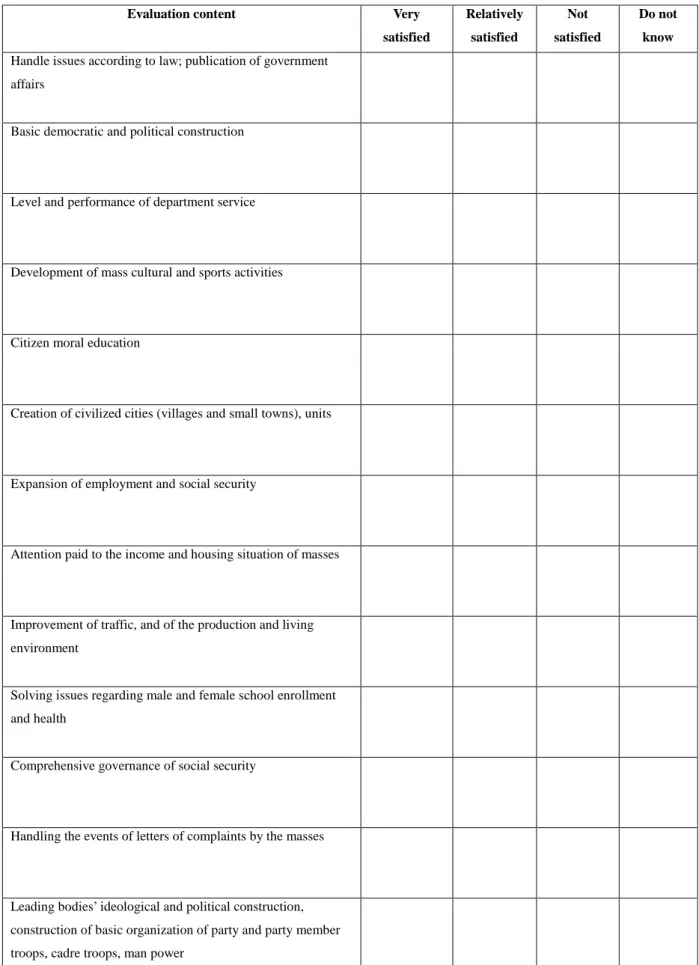
(4) 3 Changes in Cadre Evaluation and Training in China. TABLE OF CONTENTS List of pictures and figures .................................................................................................................. 5 List of tables ........................................................................................................................................ 6 Executive Summary............................................................................................................................. 7 Foreword .............................................................................................................................................11 Preface ............................................................................................................................................... 13 Chapter 1—Introduction .................................................................................................................... 17. 政 治 大. Chapter 2—Strategic Initiatives and the Administrative System ...................................................... 23. 立. Tensions in central-periphery relations ................................................................................ 23. ‧ 國. 學. Conflicts between economy and ecology ............................................................................. 28 Cadre accountability ............................................................................................................. 29 Organizational Change and Guided Evolution ..................................................................... 31. ‧. Theoretical considerations .................................................................................................... 33. sit. y. Nat. Methodology......................................................................................................................... 34 Operationalization ............................................................................................................ 34. io. al. er. Remarks on experiences in field work .............................................................................. 36. n. v i n Ch General historical overview .................................................................................................. 40 engchi U. Chapter 3—The Evolution of the Cadre Management System ......................................................... 39. The grip of the Party ............................................................................................................. 41 Cadre selection and promotion ............................................................................................. 44 Cadre training and education ................................................................................................ 47 Promoting policies through the CMS ................................................................................... 50 Conclusion ............................................................................................................................ 52 Chapter 4—Responding to New Challenges in the 21st Century ...................................................... 55 Political, economic, social and environmental background ................................................. 55 A new ideology is born ......................................................................................................... 58 What is the Scientific Development View? ....................................................................... 58 What does “scientific” mean? .......................................................................................... 61 What is the role of the government in the task of transformation? .................................. 61 How is the conflict between environment and socio-economic development addressed in.
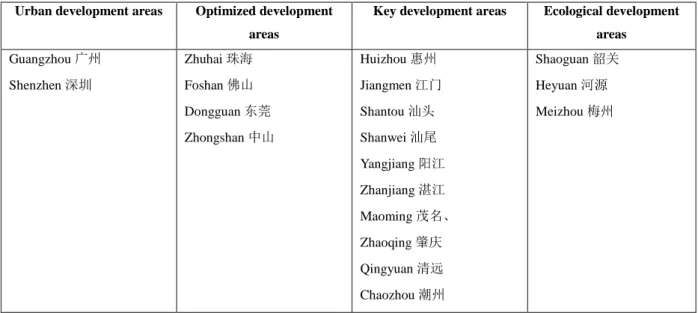
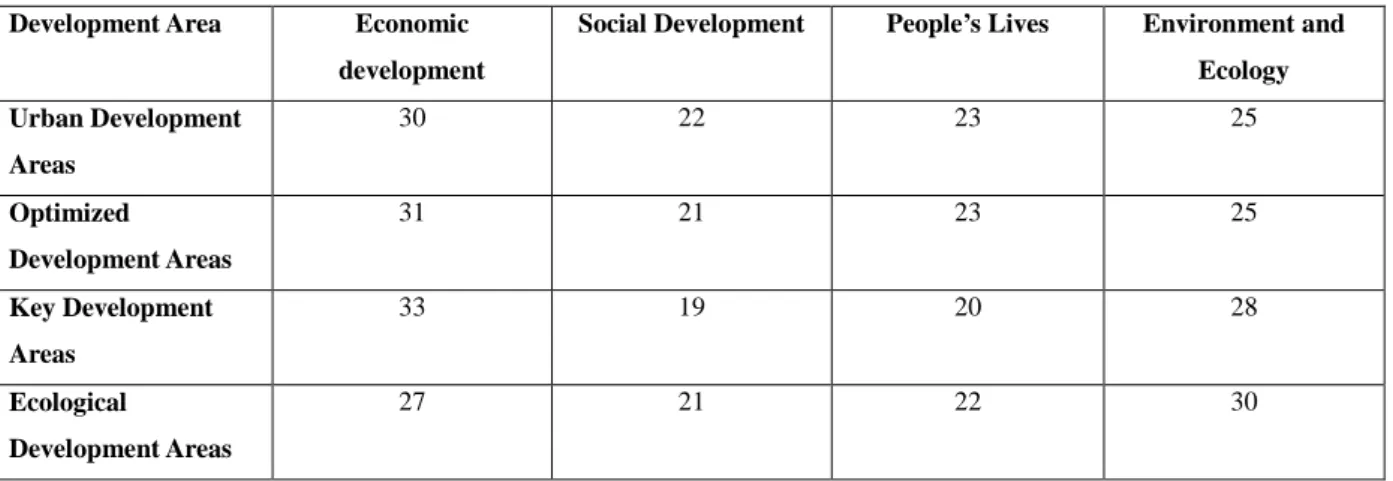
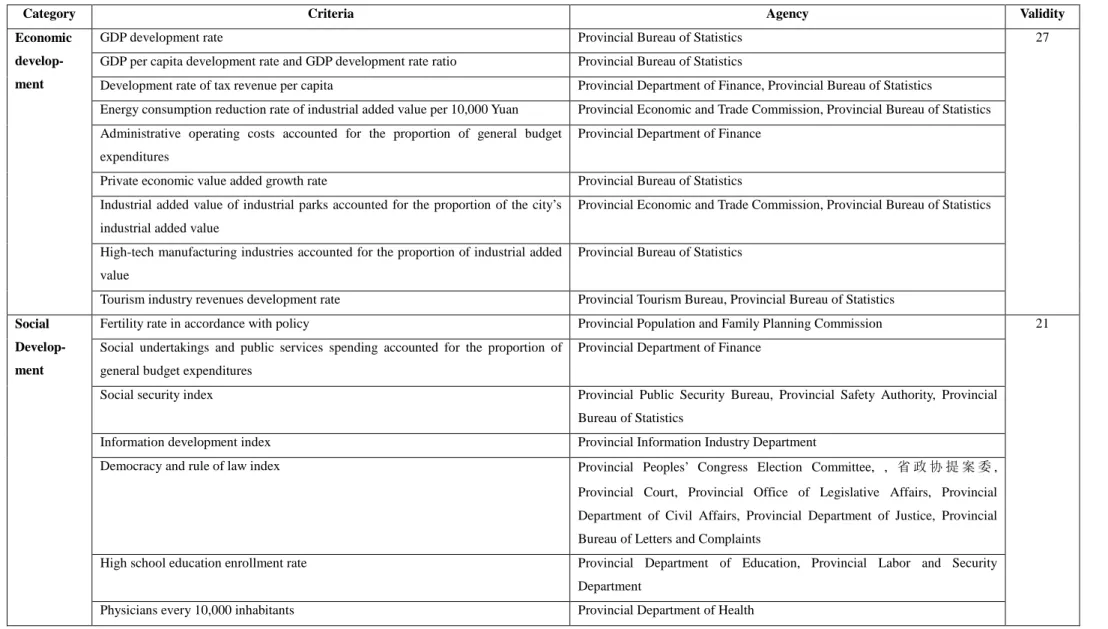
(5) 4 Changes in Cadre Evaluation and Training in China the ideological realm? ...................................................................................................... 62 How is the conflict between environment and socio-economic development addressed in the practical realm? ......................................................................................................... 64 Conclusion ............................................................................................................................ 66 Chapter 5—The Incorporation Scientific Development into the CMS ............................................. 69 Setting up evaluating systems under the Scientific Development View scheme ................. 69 Launch of trial projects .................................................................................................... 69 The Guangdong Cadre Evaluation System....................................................................... 73 Conclusion ........................................................................................................................ 81 Scientific Development in cadre education and training ...................................................... 83 Adoption and experimentation ......................................................................................... 83. 政 治 大. Party school curricula ...................................................................................................... 84. 立. Conclusion ........................................................................................................................ 91. ‧ 國. 學. Chapter 6—Critical Assessment ........................................................................................................ 92 Failed system in environmental politics ............................................................................... 92 Motivational factors and different outcomes ........................................................................ 95. ‧. Scientific Development and the claim of objectivity in cadre evaluation ............................ 96. sit. y. Nat. Lack of political reform ........................................................................................................ 98 Use and effectiveness of cadre education ........................................................................... 100. io. n. al. er. Chapter 7—Conclusion and Further Considerations ....................................................................... 104. i n U. v. Appendix ..........................................................................................................................................112. Ch. engchi. References ....................................................................................................................................... 123.
(6) 5 Changes in Cadre Evaluation and Training in China. LIST OF PICTURES AND FIGURES. Figure 1: The guided evolution model ..................................................................................... 33 Figure 2: Example of Management cadre................................................................................. 46 Figure 3: Example of party and government cadres ................................................................. 46. 政 治 大. Figure 4: The process of incorporation of the Scientific Development View .......................... 69. 立. Picture 1: Cadre training session .............................................................................................. 35. ‧ 國. 學. Picture 2: Commemorative stamp of CPS ................................................................................ 48 Picture 3: How to achieve Scientific Development and construct an Ecological Civilization. 66. ‧. n. er. io. sit. y. Nat. al. Ch. engchi. i n U. v.
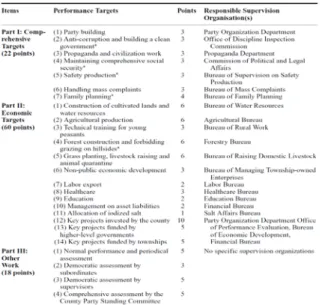
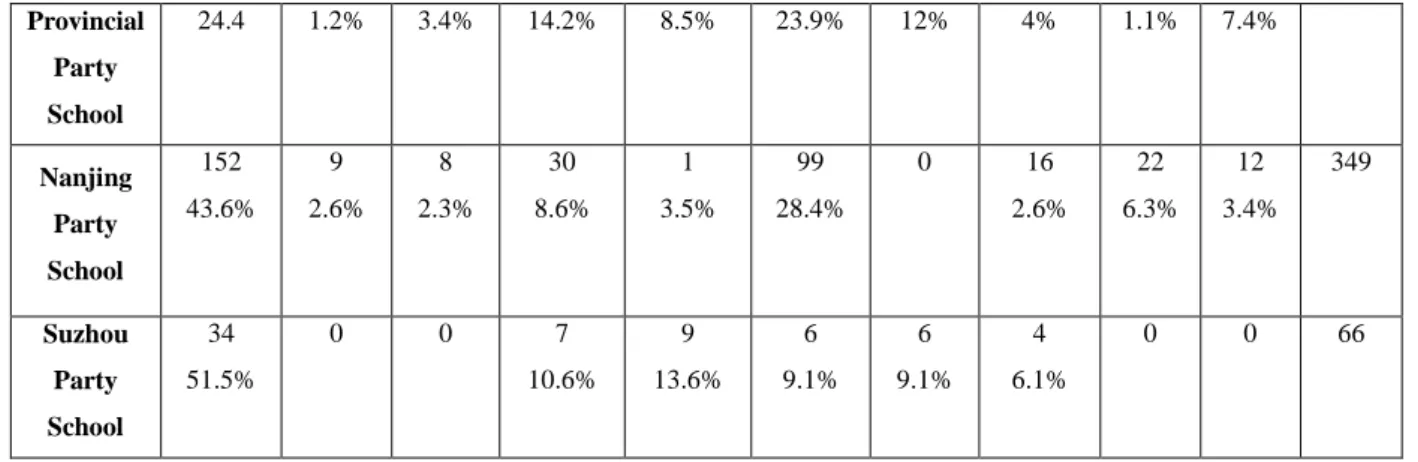
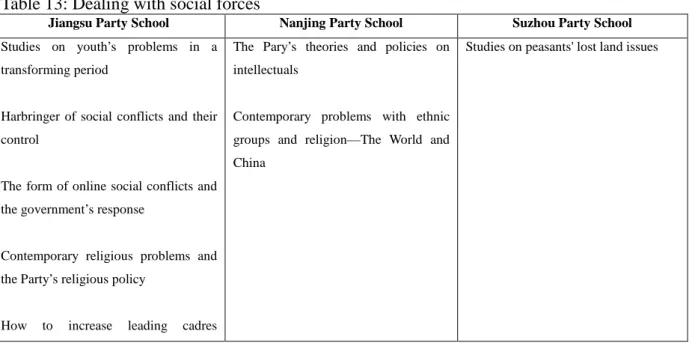
(7) 6 Changes in Cadre Evaluation and Training in ChinaList of tables. LIST OF TABLES. Table 1: Evaluation criteria under the Scientific Development View scheme ......................... 71 Table 2: Guangdong's development areas ................................................................................ 74 Table 3: Target category weight according to development areas in Guangdong .................... 75 Table 4: Evaluation system according to categories, criteria, validity and data providing. 政 治 大. agency for ecological development areas in Guangdong ......................................................... 78. 立. Table 5: Assessment of satisfaction level of the masses for leading bodies ............................. 80. ‧ 國. 學. Table 6: Performance targets in Jingbian County ..................................................................... 82 Table 7: Analysis of proportionality of cadre training contents in Jiangsu Province ............... 85 Table 8: Global, national and local topics ................................................................................ 86. ‧. Table 9: Coordinated development, innovation, and upgrading ............................................... 86. sit. y. Nat. Table 10: The Scientific Development View ............................................................................ 87 Table 11: Capacity building ...................................................................................................... 88. io. al. er. Table 12: Green development ................................................................................................... 90. n. v i n C h Development U Table 14: Seminar program of Chuxiong e n g c h i and Reform Commission at Renmin. Table 13: Dealing with social forces ........................................................................................ 90. University, 23-31 July 2013.................................................................................................... 112 Table 15: Professional training for MEP ................................................................................ 113 Table 16: Jiangsu Province development targets 2010-2015 ................................................. 114 Table 17: Evaluation system according to category, criteria, validity, and data providing agency for key development areas in Guangdong .................................................................. 116 Table 18: Evaluation system according to categories, criteria, validity, and data providing agency for optimized development areas in Guangdong........................................................ 118 Table 19: Evaluation system according to categories, criteria, validity, and data providing agency for urban development areas in Guangdong .............................................................. 120.
(8) 7 Changes in Cadre Evaluation and Training in China. EXECUTIVE SUMMARY During the Reform Era, China's impressive development was based on a strategy that favored economic development in terms of GDP growth. The disastrous consequences upon the rural and urban environment are also affecting its economy. Having become aware of its vulnerability, China has been trying new ideas and concepts to overcome “GDPism” and turn towards a more socially equitable and environmentally sound development model. At the 16th. 政 治 大 Scientific Development View 科学发展观 and Harmonious Society 社会和谐. Scientific 立. Party Congress, the leadership generation under Hu Jintao adopted two new party guidelines,. ‧ 國. 學. Development is a home-grown concept and reflects China’s ideas of a comprehensive and balanced development that is subject of this thesis.. Drawing on recent literature that highlights the role of the CCP’s organizational apparatus in. ‧. Chinese politics, I argue that the cadre management system (CMS) is important in organizing. y. Nat. and sustaining the relationship between central and local governments, and in the party-state’s. sit. efforts to govern the country, its agents and society. It serves the transformation efforts as it. n. al. er. io. transports the center’s ideas to the different levels of the party-state administration in order to. i n U. v. make local cadres cooperate with central party lines and change their mindsets and political attitudes.. Ch. engchi. The CMS has a history of continuous evolution guided by leading figures in Chinese politics. Ever since its re-establishment in the 1980s, the system has changed and thus responded to external and internal challenges in economy, politics, society, and the environment. Due to the success of the incentive and constraint system upon cadre behavior, policy decision-making and implementation of economic policies during the Reform Era, the Chinese leadership has good reason to carry on with its efforts in this administrative area. In environmental politics however the proven system appears not to bring the promised success. The reasons therefore are manifold. First, structural and political constraints hinder effective environmental policy implementation. Second, uneven development makes it impossible to apply a top-down strategy that demands the same standards and results from every region. China has to comply with the logic of economic growth in order to develop the whole country. Third, harmonizing the environment with economic development is a problem related to the development view 发.
(9) 8 Changes in Cadre Evaluation and Training in ChinaExecutive Summary 展观 of cadres and governments that is very much shaped by the development concept of the Reform Era. Since 2009, provincial governments have translated Scientific Development into their cadre evaluation systems. Instead of merely re-arranging the validity of criteria and placing more emphasis on social and environmental issues, they differentiated their jurisdictions into four development areas 发展区 and adapted the evaluation criteria sets accordingly. Hereby a greater weight is placed on environmental targets in all development areas. The idea of differentiation––also formulated in the theory of Scientific Development––is to pin on local strengths and to increase the latitude for environmental or social goals. Local disparities should so be overcome, and incentives and constraints distributed more evenly among. 治 政 During the last decade, China has put much effort into the 大modernization of cadre schools and cadre instruction. Cadre 立 training has taken a high degree of decentralization and provinces, districts etc.. ‧ 國. 學. fragmentation. Training contents are very diverse and cover issues of economic and social management, environmental science, administrative and leadership capacities. The goal is to. ‧. improve management capacities, diffuse knowledge, change the mind-sets of cadres and foster loyalty to the Party.. Nat. sit. y. My thesis unfolds as follows: In Chapter one I introduce the topic under investigation and. io. er. pose my research questions. Chapter two focuses on the existing literature on issues that concern central-periphery relations, explains the prevailing theories in the study of. n. al. Ch. i n U. v. bureaucracy and the decision-making process, introduces the findings of main studies on. engchi. cadre accountability and education, and gives an overview on approaches of environmental governance. Furthermore, treating the CMS as an adaptive system, I discuss theoretical approaches of organizational studies that explain organizational change. They helped me to define the variables and narrow my focus. I then present the methodology applied in this research that I wind up with an account of my experiences in the process of this research and in particular in my field work trip to Suzhou and Beijing in July 2013. In chapter three, I revisit the history of cadre management and its functional role in Chinese reform politics. The main proposition is that the system responds to external and internal challenges and develops in congruence with its transforming environment. At the beginning of the 21st century, China has been faced with a myriad of economic, social and environmental challenges. It has thus commenced to turn towards a new development mode. The need for transformation of development and the various challenges faced are formulated in Hu Jintao’s proposed.
(10) 9 Changes in Cadre Evaluation and Training in China ideology, the Scientific Development View. Hence, in Chapter four I relate to the theory’s contents, and the economic, social and environmental background against which it was formulated and adopted. Finally I conduct an empirical research on cadre education in Jiangsu Province, and formal regulations of the new cadre evaluation system under the Scientific Development View scheme in Guangdong Province in Chapter five. Chapter six is a critical analysis of the findings in cadre evaluation and education. I conclude with a short summary of the main findings developed in the thesis and some further considerations.. 立. 政 治 大. ‧. ‧ 國. 學. n. er. io. sit. y. Nat. al. Ch. engchi. i n U. v.
(11) 10 Changes in Cadre Evaluation and Training in China. 立. 政 治 大. ‧. ‧ 國. 學. n. er. io. sit. y. Nat. al. Ch. engchi. i n U. v.
(12) 11 Changes in Cadre Evaluation and Training in China. FOREWORD This research grounds in research activities and extensive studies over a period of four years on sustainable development and how China is trying to come to terms with the conflicting interests of economy and ecology. The outcomes of this thesis base on knowledge that I have acquired through my participation in two joint-research projects on measurement of sustainable development and circular economy with China Renmin University and the. 政 治 大 Nations Environmental Program, and the successful completion of the Master program in 立. Department for East Asian Studies/Sinology, University of Vienna, an internship at the United. Political Science at National Chengchi University (NCCU), Taipei, Taiwan.. ‧ 國. 學. In the past two years during my studies at NCCU I attended seminars on methodology and comparative politics that helped me to further develop my research and writing skill, and. ‧. deepen my theoretical understanding. The syllabi of the courses on environmental governance. y. Nat. contained important studies and works with which I acquired consolidated knowledge of the. sit. dynamics in environmental policy decision-making and implementation in China. Seminars in. al. er. io. comparative politics broadened my perspective on the issue of development and. n. v i n C h political thoughtUdeepened my understanding of China, my thinking. The classes on Chinese engchi its history, politics and society in general. The professors at NCCU and Prof. Susanne. transformation in China, and helped me to adopt a more systematic and structural approach in. Weigelin–Schwiedrzik at University of Vienna provided me with valuable advice and pushed me to cross academic and intellectual borders. They urged me not to take everything for granted and instead ask more intriguing questions. I want to express my thanks to all of them! I am very grateful for having Prof. Wang Jenn-hwan at National Chengchi University as my Master thesis advisor, as he guided me very smoothly through the process of finalizing my studies at NCCU. He is very able in imparting his expertise and familiarity with Chinese environmental governance to his students, and always provides quick and valuable advice. Even though he challenged me quite often in the choice of my research topic, he fully supported me and my research goals. I am much obliged to my PhD advisor Prof. Susanne Weigelin-Schwiedrzik, University of Vienna. Ever since my first Master thesis at the Department of East Asian Studies/Sinology,.
(13) 12 Changes in Cadre Evaluation and Training in China she has never refused advice. Even at such a great geographical distance she continued to support me during the three years that I spent in Taiwan. In spite of her various appointments and her family life she always found the time to respond to my e-mails, gave me an appointment when I quickly rushed through Vienna and proposed ways to solve the problems I encountered in my research. I am very grateful that she has never let me down and refrained from believing in me. Besides being a very insightful and brilliant scholar, she has a great heart for young people, especially her students whom she motivates to higher accomplishments and fosters their development on academic and personal level. I thank Prof. Yang Zhi of China Renmin University for helping me and making me feel welcome in Suzhou and Beijing. She opened up many channels and possibilities, and introduced me to people that were important for this research. Even though she works as. 政 治 大. busily as a bee, she has spared a great deal of her time and exerted patience in answering my. 立. questions.. ‧ 國. 學. Furthermore I want to express my gratitude to the members of the graduation commission, Prof. Guo Chengtian and Prof. Chien Shiuh-Shen.. Finally, I wholeheartedly thank my family who has always supported me in my ambitions and. ‧. projects, although I might have given them a lot to worry about. My fiancé Roberto. sit. y. Nat. Marinaccio and my friend Elisabeth Heigl, with whom I share a very deep friendship, were always there for me during the last two years and supported me unconditionally. Both. io. n. al. er. challenged me in my thinking and incited me to reflect my approaches. It is especially due to. i n U. v. the emotional support of these people that I have come so far, achieved what I have achieved, and finished what I have started.. Ch. engchi.
(14) 13 Changes in Cadre Evaluation and Training in China. PREFACE. At the beginning of the 21st century, sustainable development has become the new paradigm adopted by governments in developing and developed countries alike. They are trying to find adequate strategies and methods to cope with the consequences of industrialization and urbanization. The core problem of sustainable development is however how to harmonize or coor-. 政 治 大. dinate development that allows for social equity and a sound environment, but does not compromise economic growth.. 立. China’s impressive economic development during the Reform Era grounded in a strategy that. ‧ 國. 學. favored economic development in terms of GDP growth rates, but neglected social inequalities and environmental degradation. The disastrous consequences upon rural and urban envi-. ‧. ronment are significantly affecting China’s economy today. Having become aware of its vul-. y. Nat. nerability, China has been experimenting with new ideas and concepts to overcome this. al. er. io. tally sound direction.. sit. “GDPism”, and tries to turn development towards a more socially equitable and environmen-. n. v i n C h and social structures. state makes use of its specific political e n g c h i U Transformation is promoted on In its push for transformation of its hitherto one-sided development model, the Chinese party-. the different levels of society and its subsystems. From a political vantage point, five spheres. can be discerned that describe the mechanism of transformation: ideology (Scientific Development View), party (cadre management), management (institutions of environmental governance), dissemination (media, workshops and research), and experimentation (local policy projects). First, the proclamation of an ideological doctrine by the CCP and its successive further development: Until recently, official documents treated the concept of Scientific Development as an important guiding and major strategic thought. At the 18th Party Congress in November 2012, the Scientific Development View was elevated to the same level of the other four partyideologies, and the Party Regulations were revised accordingly. Second, the incorporation of the ideology into the CCP’s organizational apparatus: China's huge territory is administered by a vast number of party and government cadres who are em-.
(15) 14 Changes in Cadre Evaluation and Training in ChinaPreface bedded in an institutional context of incentives and constraints: Appointment and promotion give incentives; monitoring and evaluation provide constraints for local cadres to implement national policies (Edin 1998: 100). In addition to that, cadres have to pass training circles in party schools and cadre academies. After the adoption of the Scientific Development View at central level in 2003, the Central Organization Department (COD) started to experiment with new evaluation systems that incorporate the new idea a more balanced and reasonable development. Party committees at local level were given order to translate the theory into their cadre evaluation systems and the training curricula of party schools and cadre academies. Third, the establishment and upgrading of institutions of environmental protection: Institutions of environmental protection were already established after the launch of Reform and Open Policy, however they were not being considered significant for China’s. 政 治 大. development, as priority was given to economic growth for achieving modernization. During. 立. the 1990s, a slight change was noticed as the government slowly began to acknowledge the. ‧ 國. 學. adverse effects of economic growth and industrialization. However, it was not until the beginning of the 21st century that environment protection gained momentum in the political agenda, in particular under the 11th Five-Year Plan. China planned to reduce 20 per cent of its. ‧. energy consumption per unit of GDP, 30 per cent of water consumption per unit of industrial. sit. y. Nat. added value, 10 per cent of the total discharge of major pollutants, and increase forest coverage from 18.2 to 20 per cent (Wu nian guihua 2006). Measurement methods, frequency. io. n. al. er. of monitoring and evaluation methods of the urban environment were standardized (Huanjing. i n U. v. baohuju 2006). The body of environmental laws and policies grew. Finally, during the 11th. Ch. engchi. National Congress, the environmental protection administration gained more clout when the State Environmental Protection Administration was replaced with the Ministry of Environmental Protection. Fourth, the CCP party-state controls external institutions such as universities and other research institutions; in order to disseminate the idea of the Scientific Development View among cadres and the society, media also plays an important role. Above all, in its claim that development has to be framed in accordance with reasonable principles, universities and research institutions have a pivotal function. They develop models that applied in praxis can help to attenuate the conflicts, such as those between economy and ecology. In doing research, they support the development of Scientific Development 1 and its adoption. Furthermore they provide training seminars for cadres to deepen their human intellectual knowledge. In general,. 1. I use Scientific Development View and scientific development interchangeably..
(16) 15 Changes in Cadre Evaluation and Training in ChinaPreface the Scientific Development View has become an extensively researched topic by various scholars in Chinese universities, academic institutions and the Central Party School, not only on theoretical grounds but also in the search for practical solutions. International cooperation and academic exchange plays hereby an important role. Since 1978 and the Opening and Reform Policy, China has not only opened up economically, but also absorbed technical knowledge for its development and economic growth. Western approaches have been studied, analyzed and adopted; academic exchange has vigorously been promoted. Against the background of changing socio-economic, environmental and political challenges, a more systematic approach is adopted to respond to them more appropriately. In The Great Urban Transformation, Hsing You-tien (2010) hints that. 政 治 大. [s]ince the late 1980s, Chinese urban planners have been trained in schools using. 立. American city planning textbooks. Because the principle of efficiency in urban land. ‧ 國. 學. use dovetails with the development discourse in contemporary urban China, the new generations of city planners have enjoyed the political support of municipal government leaders. (39). ‧ sit. y. Nat. The Urban Rural Planning Law stipulates that every scale of administrative territory has to be. io. n. al. er. planned according to a “Master plan.” David Bray (2010) points out that. i n U. v. [t]he significance of contemporary 'master planning' lies less in discourses of national. Ch. engchi. resurgence, than in a new manifestation of utopian modernism launched by Hu Jintao through this 'theory of scientific development': within this paradigm, the key objective of government planners is to re-order and standardize the built environment so as to render communities and economies more transparent and governable. (2). Drawing on international experience however does not mean that China is blindly emulating models. In the case of promoting low carbon economy, Hofem and Heilmann (2013) explain that. [e]ven though foreign actors played a crucial role in initiating exchanges, LCE [low carbon economy, note from the author] policy diffusion must not be seen as emulating Western models but rather as an open-ended process: A transferable “international best practice” of building an LCE has not yet been established, and the Chinese policy.
(17) 16 Changes in Cadre Evaluation and Training in China and research communities are determined to explore and generate novel LCE approaches that are compatible with local circumstances and needs. Learning from abroad does not mean imitating foreign practice, but rather adapting and transforming it. (201). Fifth, policy experimentation: Since the adoption of Scientific Development has become an strong factor in the competition between provinces and cadres for political authority and promotion, experimental policy projects have been launched that aim at the coordination of conflicting policy goals (for example between economic development and environmental protection). These policy projects are not necessarily successful in the first place as can be observed in the case of Green GDP. 2 However they serve as important inputs in the circle of dissemi-. 政 治 大. nation, organization and implementation, as the experiences evolve and create the narratives. 立. of the national discourse of Scientific Development and have consequences upon the organi-. ‧ 國. 學. zation of transformation.. The focus of the presented research is placed on the transformation efforts in the CCP’s. ‧. organizational apparatus. I investigate how the ideological foundation of the Scientific. sit. y. Nat. Development View—in which the parameters of transformation are formulated—has been translated into cadre evaluation and party school training contents. The goal is to reveal the. io. n. al. er. organization of ideology in today’s China. In contrast to other researcher who chose a specific. i n U. v. policy (field) or a law and investigate its implementation or enforcement, I look into the. Ch. engchi. organization of ideology. The main contribution of this study is a systematic analysis how the Scientific Development View has been incorporated into one part of the administrative system, namely the cadre management system. By doing so, I reveal the interaction of the national and local level and give examples of interpretation of the ideology in the local context.. 2. Green GDP was an ambitious project launched by the State Environmental Protection Administration and the National Bureau of Statistics in 2004 that aimed at the reflection of resource and environmental costs in national GDP accounting. It eventually came to a halt in 2007. However, recent publications in the Chinese press support the assumption that Green GDP accounting continues to be developed on local level..
(18) 17 Changes in Cadre Evaluation and Training in China. CHAPTER 1—INTRODUCTION At the turn of the new century, the Chinese party-state’s rhetorically shifted its focus on a concept of sustainability by denying the previous development concept which had been based on high quantitative economic growth. The push for transformation aimed at the promotion of a more balanced and reasonable development model that takes into account social and. 政 治 大 environment and ecology protected. 立 At the 16th Central Party Congress, the Chinese Communist Party (CCP) adopted two new ecological factors. By doing so socio-economic disparities should be reduced, and the. ‧ 國. 學. party guidelines: Scientific Development View 科学发展观 3 and Harmonious Society和谐 社会. According to the official wording, the Scientific Development View aims at “a compre-. ‧. hensive, coordinated, sustainable development holding on to the principle of putting the peo-. y. Nat. ple first” (Xinhua News, 4 April 2004). 45 The theory, assigned to Hu Jintao, serves as an im-. io. sit. portant guiding and major strategic thought 重要指导重大战略思想driving development. n. al. er. forward. It pursues a comprehensive, coordinated and sustainable development of economy, politics, culture, society and environment.. Ch. engchi. i n U. v. Its key theory is development, its core concern is to put the people first, its basic demand is comprehensive and coordinated sustainability, its fundamental method is to take into consideration every aspect through planning and preparation. (Hu, 24 November 2007) 6. Modernization is considered a multi-facetted process, the theory is supposed to help China to 3. 4 5. 6. The official English translation on Chinese webpages is the Scientific Development Outlook, in various discussions with my Chinese professors at NCCU, I came to the conclusion that the transation view comes nearer its original meaning. The Chinese original is as followed: 坚持以人为本、全面、协调、可持续的发展 Short translations of terms are followed by the original Chinese working in the running text. The Chinese originals of longer quotations are added in footnotes. The Chinese original as followed: 科学发展观,第一要义是发展,核心是以人为本,基本要求是全面协 调可持续,根本方法是统筹兼顾。.
(19) 18 Changes in Cadre Evaluation and Training in ChinaChapter 1—Introduction cope with the various emerging challenges such as resource depletion, economic vulnerability, transformation of production structures, social discontent, low level of education, and uncoordinated policies that cause harm to the different subsystems of its social system.. Scientific Development is the solution for the newly emerged issues; it tackles the problems of insufficient balanced development in some places and aspects that have come with our country’s development process. It draws on the laws of development; it is an innovative developmental idea and mode to transform development; it solves the problems of development, and gradually offers solution for the unbalanced development of countryside and city, regions, economic and social, people and nature, and uncoordinated reasoning; it deeply reflects the new needs of China’s economic and social. 政 治 大. development that came with entering a critical stage of development. (Hu, 24 Novem-. 立. ber 2007) 7. ‧ 國. 學. Since its adoption in 2003, local governments underlie more constraints. They are required to pay more attention to social and environmental factors, and to search innovative solutions to. ‧. enhance the coordination and harmonization of development. A growing body of environmen-. sit. y. Nat. tal laws and the upgrading of the State Environmental Protection Administration to ministerial rank in 2008 improved the political leverage of environmental agendas. Moreover, since 2009,. io. n. al. er. local party committees have to incorporate the idea of the Scientific Development View into. i n U. v. their cadre evaluation systems, and train cadres in party schools and cadre training institutions. Ch. engchi. accordingly. Changes in policy-making occurred and some new innovative projects were launched that aim at solving the conflicting interests between economic and environmental policy goals. Yet, problems in policy implementation and law enforcement have remained, and the environmental situation in China is severer than ever before. The pool of research on institutional aspects of environmental protection, sustainable development, and their implications on local policy implementation is vast. The idea of the Scientific Development View however has widely been neglected and dismissed by international scholars as hollow and flowery phases. In China, on the other hand, Scientific Development is widely seen as something very unique that helps to improve the country’s. 7. The Chinese original is as followed: 科学发展观正是为了解决新问题提出来的,它针对我国发展过程中 一些领域和方面出现的发展不 够平衡问题,着眼于把握发展规律、创新发展理念、转变发展方式、 破解发展难题,进一步提出了解决城乡、区域、经济社会、人与自然发展不平衡、不协调的思路, 深刻反映了我国经济社会发展进入关键时期的新要求。.
(20) 19 Changes in Cadre Evaluation and Training in ChinaChapter 1—Introduction development as it is compatible with the specific circumstances and tackles the variety of issues and challenges China is facing. By the same token, while environmental standards and environmental accountability are focus of several case studies, so is not the incorporation of the ideology’s demands in the incentive and constraint system. In its efforts to push for a new development mode, the Chinese leadership makes use of the party-state’s specific organizational structures. Drawing on recent literature that highlights the importance of CCP’s organizational apparatus in Chinese politics, I argue that the cadre management system (CMS) is important for organizing and sustaining the relationship between the central and local governments. It thus plays a functional role for the CCP to govern the country, its agents and society. Through incentives and monitoring development should turn into a new direction. This assumption is based on past experiences when, after the. 政 治 大. Reform and Open Policy had been launched, cadres were incentivized to promote economic. 立. development. Success was evaluated and measured in growth rate numbers which were,. ‧ 國. 學. henceforth, decisive for cadre promotion. This legacy of the GDP growth oriented evaluation system however is now the root of many of China’s problems and poses obstacles to sustainable policy implementation and law enforcement, in particular in the environmental. ‧. realm.. sit. y. Nat. Cadre education and training 干部教育培训 on the other hand was modernized in order to. io. er. prepare cadres with new skills needed in the administration of a transforming country. In its function of forma mentis, cadre education is intended to change the mind-sets of cadres. With. n. al. i n U. v. the beginning of the 21st century, cadre training and evaluation have become vital in the CCP. Ch. engchi. efforts to strengthen and improve state capacity 执政能力 and change China’s mode of development 发展方式. Instead of analyzing the institutionalization or organization of the sustainability paradigm, I decided to focus on China’s home-grown idea of comprehensive, coordinated and sustainable development, namely the Scientific Development View. The Chinese Party-state was initially established and built on an ideology that penetrated its state-administration and society. Despite the pragmatic change through the Reform and Opening Policy, the CCP and its central leadership have not totally replaced ideology and refrained from formulating ideas via a very complex and subtle rhetoric. Grounded in traditional Marxism, the CCP ideologies are based on an understanding of socio-economic development. Even though the gap between traditional Marxism and China’s contemporary interpretation of it is quite large, ideologies formulated in China nevertheless represent a Marxist-Leninist kind of logic, and reflect the.
(21) 20 Changes in Cadre Evaluation and Training in ChinaChapter 1—Introduction Party’s idea of socio-economic development. The spread of ideology serves the construction of unification and instilment of loyalty among its members. The transportation of the leadership’s ideas of development contain political guidelines, modes of conducts, and moreover priorities which the lower levels should adhere to. Policy targets are always rhetorically embedded in party ideologies. Even though the processes of policy decision-making and implementation are hindered by various political, structural factors and behavioral patterns, ideology in China still reflects a concept of development and the path on which China’s leadership is trying to direct the country. It is thus important to decipher the contents of the rhetoric and analyze the background on which ideologies are formulated, the discrepancy between ideology and praxis, and the underlying factors that hinder their realization.. 政 治 大. The following chapters explore how China has responded to new challenges in the CMS, how. 立. its idea of a balanced and sustainable development has been transported from the center to the. ‧ 國. 學. lower levels in administration and incorporated into cadre evaluation and education systems. I hereby take particular interest in the ideological foundation of China’s new development model. Scientific Development View is a home-grown ideational strategy of development by. ‧. means of which China has been trying to turn development towards a more socially equitable. sit. y. Nat. and environmentally sound direction. It thus deserves more of our attention. The inquiry on Scientific Development will help us to deepen our understanding of how China sees its future.. io. n. al. er. The focus on the process of organizing ideology is an important work that reveals the. i n U. v. relationships between center and periphery, the flow of ideas within the state bureaucracy, and. Ch. engchi. the tensions between unification and diversity. In my thesis I raise two research questions:. 1) How does the CMS respond to external and internal changes? 2) How is the idea of a balanced, comprehensive and all-encompassing development translated into cadre evaluation and training on local level?. My thesis unfolds as follows: Chapter two focuses on the existing literature on issues that concern central-periphery relations, it explains the prevailing theories in the study of bureaucracy and the decision-making process, introduces the findings of main studies on cadre accountability and education, and gives an overview on approaches of environmental governance. Furthermore, treating the CMS as an adaptive system, I discuss theoretical approaches of organizational studies that explain organizational change. I then present the.
(22) 21 Changes in Cadre Evaluation and Training in ChinaChapter 1—Introduction methodology applied in this research that I wind up with an account of my experiences in the process of my research activities, in particular during my field work trip to Suzhou and Beijing in July 2013. In chapter three, I revisit the history of cadre management and its functional role in China’s reform politics. The main proposition is that the system responds to external and internal challenges and develops in congruence with its transforming environment. At the beginning of the 21st century, China has been faced with a myriad of economic, social and environmental challenges. It has thus commenced to turn towards a new development mode. The need for transformation of development and the various challenges faced are formulated in Hu Jintao’s proposed ideology, the Scientific Development View. Hence, I relate to the theory’s contents, and the economic, social and environmental background against which it was formulated and adopted. Finally, I conduct an empirical. 政 治 大. research on the formal regulations of the new cadre evaluation system under the Scientific. 立. Development View scheme in Guangdong Province, and cadre education in Jiangsu Province. ‧ 國. 學. in chapter five. Chapter six is a critical analysis of the findings in cadre evaluation and education. I conclude with a short summary of the main findings developed in the thesis and some further considerations.. ‧. n. er. io. sit. y. Nat. al. Ch. engchi. i n U. v.
(23) 22 Changes in Cadre Evaluation and Training in ChinaChapter 1—Introduction. 立. 政 治 大. ‧. ‧ 國. 學. n. er. io. sit. y. Nat. al. Ch. engchi. i n U. v.
(24) 23 Changes in Cadre Evaluation and Training in China. CHAPTER 2—STRATEGIC INITIATIVES AND THE ADMINISTRATIVE SYSTEM. This chapter comprises a review on the relevant literature and the theoretical approaches. It. 政 治 大 of bureaucracy and the decision-making process, introduces the findings of main studies on 立 cadre accountability and education, and gives an overview on approaches of environmental. discusses the issue of central-periphery relations, explains the prevailing theories in the study. ‧ 國. 學. governance, and present theoretical frameworks on organizational change. Finally, I introduce the methodology I applied that I wind up with an account of my experiences in the process. ‧. of this research and in particular during my field work trip to Suzhou and Beijing in July 2013.. n. Ch. engchi. er. io. al. sit. y. Nat TENSIONS IN CENTRAL-PERIPHERY RELATIONS. i n U. v. Before looking at institutions, strategies and mechanisms applied by contemporary rulers, we have to take a step back and explain the tensions in which political regimes in China have been embedded over the last two centuries. Susanne Weigelin-Schwiedrzik (2004) describes the historical roots of the tensions between center and periphery in China, their importance for political transformation and validity in contemporary politics in China as a mechanism of modernization: “Transformation in tradition” is a typical form of China’s path-consistent modernization that requires perpetual bargaining between the center and the periphery. The continued existence of the Chinese empire cannot be explained without the influence and intentional use of this mechanism. (81) 8 8. The original German version is as followed: Das für China typische “Wandel in der Tradition” ist eine From.
(25) 24 Changes in Cadre Evaluation and Training in China. The assumption that this mechanism is also valid for and used by the incumbent leadership is reasonable. Tensions between the central and local governments have not only resulted in stalemates but also in changes. Up until today, the inconclusive discussions on state control, atrophy or adaption are inapt to give an answer why the CCP continues to rule in spite of socio-economic transformations and the change of the international environment during the last 30 years. As a consequence, some China experts have brought the Party and its efforts to strengthen the organizational apparatus back into the focus of studies on political development. In contrast to the 1980s and 1990s, recent literature has asserted a continued dominance of the CCP in state management. The most insightful works are China's Communist Party: Atrophy and Adaptation by David. 政 治 大. Shambaugh (2008a), Frank Pieke’s (2009) The Good Communist: Elite training and State. 立. Building in Today's China, and The Chinese Communist Party as Organizational Emperor:. ‧ 國. 學. Culture, Reproduction and Transformation by Zheng Yongnian (2010). The questions tackled in the three monographs all boil down to the very essence of center-periphery relations. They investigate the institutions and mechanisms by means of which the CCP is trying to sustain a. ‧. balanced relationship in order to maintain power and govern the country, its agents and. sit. y. Nat. society.. Pieke (2009: 26) argues that the CCP tightens the grip on its agents through personnel. io. n. al. er. management, in particular by appointing leading positions, and preparing cadres for the. i n U. v. exercise of leadership on behalf of the Party through training. David Shambaugh (2008a: 111). Ch. engchi. holds that four recent political campaigns––Jiang Zemin's Three Represents, Hu Jintao's Scientific Development View and Harmonious Society, and the campaign on the party's Governing Capacity––have served to “win the minds of its members and the public” (111), and underlie the efforts to strengthen the organizational apparatus from the top to the bottom. In the viewpoint of Zheng Yongnian (2010: 150) the technologies and mechanisms of power ground in the creation of the Party’s own “organic intellectuals” (150). By means of organization and ideology the former exercises domination over the government. While Shambaugh and Pieke argue that organizational strategies are based on Communist ideology and a Leninist party model, Zheng (2010: xv) sees the nature of the CCP expressed in a continuous struggle for hegemony and domination that crosses the borders of its historical der pfadtreuen Erneuerung, die immer wieder zwischen Zentrum und Periphery ausgehandelt werden muss. Ohne die Wirkung und bewusste Nutzung dieses Mechanismus ist die Kontinuität der Existenz des chinesischen Reiches nicht erklärbar..
(26) 25 Changes in Cadre Evaluation and Training in China setting. Cultural connotations, historical continuity and discontinuity are embedded in the CCP as political facts. The “organizational emperorship” (xivf) is a reproduction of China's traditional imperial political culture in modern times. Shambaugh, Pieke, and Zheng revived a debate over which the rise of pragmatic politics had drawn a thick curtain: The question of ideology and organization. In his seminal work, Ideology and Organization in Communist China, Franz Schurmann (1968) stated that the CCP created an all-encompassing web of organizations that covered and penetrated the Chinese society and its fabric.. Pure and practical ideology together constitute the ideology of organization. They should be tools for the creation and use of organization. […] The ideas of pure. 政 治 大. ideology state values: moral and ethical conceptions about right and wrong. The ideas. 立. of practical ideology state norms: rules which prescribe behavior and thus are expected. ‧ 國. 學. to have direct action consequences. Values and norms are tools through which two important organizational functions are accomplished. First, they serve to motivate individuals to give full commitment to the organization. Second, they give individuals. ‧. a set of rational ideas with which to carry out the actions demanded by the. io. sit. y. Nat. organization. (38-39). n. al. er. During Mao Era, the central value of pure ideology was struggle (39). With the launch of the. i n U. v. Reform and Opening Policy in 1978 however the central value in ideology became. Ch. engchi. development. During the 1980s, scholars asserted the rising importance of the government as the manager of economic affairs. They heralded the demise of ideology and the retreat of the CCP as reformers pushed for more efficiency and effectiveness (Dittmer 1984; Burns 1989). What they did leave behind though was the question of organization. Thirty years after the pragmatic change, Shambaugh, Pieke and Zheng revived the old debate by putting the cart before the horse: 9 the cadre management system. Their research foci stand in contrast with local government studies that emphasize the power structures in Chinese bureaucracy and the influence of media and society in the policy decision-making and implementation process. While they do not negate the existence or the severity of conflicts along vertical and horizontal power lines, and between central policy goals and local interests, they highlight the role of party organization that eventually allows the center to 9. I borrowed this expression from Hon S. Chan et al. (2009) who used it in one of their articles on cadre accountability..
(27) 26 Changes in Cadre Evaluation and Training in China reach its agents at the different levels of administration. Cadre management is important in the CCP's efforts to instill and insure loyalty and commitment among its cadres, and aims at the maintenance and legitimization of the Party’s power position. I argue that the CMS also serves the function to transport ideas of development. The interpretation of development and, finally, the implementation of policies rest on the local governments that deal with conflicting interests between the central party guidelines and local circumstances and needs. Analysts of Chinese politics experienced an overwhelming influence by the theory of “fragmented authoritarianism” proposed by Kenneth Lieberthal (1992). The theory is generally considered a great contribution to fathom processes within China’s bureaucracies. Andrew Mertha (2009) called it the “most durable heuristic” (996) with which to analyze the complex relationship between the different horizontal and vertical authority lines in Chinese. 政 治 大. bureaucracy. However, the theory and its generalizability have been criticized. Even. 立. Lieberthal (1992: 5) himself acknowledges in the introducing chapter of Bureaucracy,. ‧ 國. 學. Politics, and Decision Making in Post-Mao China the lack of empirical data over a wide range of bureaucracy clusters, as the theory mainly grounds in empirical evidence drawn from one of the six bureaucracy clusters under investigation, namely the economic bureaucracies. 10. ‧. Yet, the main argument of the fragmented authoritarian theory still stands its grounds:. sit. y. Nat. The fragmented authoritarianism model argues that authority below the very peak of. io. n. al. er. the Chinese political system is fragmented and disjointed. The fragmentation is. i n U. v. structurally based and has been enhanced by reform policies regarding procedures.. Ch. engchi. [....] Structurally, China's bureaucratic ranking system combines with the functional division of authority among various bureaucracies to produce a situation in which it is often necessary to achieve agreement among an array of bodies, where no single body has authority over the others. (8). Policy making comprises extensive bargaining between the involved actors and authorities. This often leads to delays or stalemates of policy initiatives when the bargaining actors do not come to an agreement. The theoretical framework emphasizes on policy-making as a very controversial subject that generates struggles within the bureaucracy, and between party officials and the society. It 10. The book was written at a time when access to information and informants were still very limited. The situation changed considerably, however, information one acquires has to be carefully interpreted, evaluated and cross-checked with other research..
(28) 27 Changes in Cadre Evaluation and Training in China however cannot explain the reasons for the CCP’s survival and why the party-state has changed as it has. It lacks the perspective that the party-state is a learning system. In 2011, two well-respected scholars—Sebastian Heilmann and Elizabeth Perry—published “an insightful and thought-provoking” (Chen, 27 September 2011) book that critically questions existing models in explaining China’s developmental path and provides a new theoretical framework. The claim is that guerilla war and resistance strategies in the pre-1949 era have shaped and influenced policy-making and have so equipped the CCP with high resilience and adaptability. In a previous publication, Sebastian Heilmann (2008) describes the Chinese policy process as a “point-to-surface” (2) approach in which local governments initiate policy experiments and try to get formal and informal backing of higher-level policy-makers.. 立. 政 治 大. The “model experiences” (dianxing jingyan) extracted from the initial experiments are. ‧ 國. through. extensive. media. coverage,. 學. disseminated. high-profile. conferences,. intervisitation programs and appeals for emulation to more and more regions. This expansion process requires progressive policy refinement and affects a search for. ‧. generalizable policy solutions. (2). sit. y. Nat. io. promote them rests on the central government.. n. al. er. Local governments are allowed to experiment with their own models, whereas the decision to. i n U. v. The approach comes near to David Goodman’s (1985) central control and local flexibility.. Ch. engchi. Goodman argues: “A province might claim to be adapting a central policy to local conditions when in fact its provincial implementation is intended to achieve some other goal” (Goodman 1985: 7), and further infers that “the problem of reconciling competing national and local interests […] overlays the need for both central control and local flexibility” (8). To carry out policies is thus to cooperate with the central government. Yet, the interpretations of development vary between central and local governments. In the context of sustainable development, these competing models of development are expressed in the interpretation of what is to be “developed” and what is to be “sustained”. In addition, as suggested in the doctoral thesis by Sabrina Harbich (forthcoming) on resettlement policies in Yunnan, the pace of setting new standards and adopting policies at central level does not correspond to the pace and possibilities (or capacities) of implementation at local level..
(29) 28 Changes in Cadre Evaluation and Training in China. CONFLICTS BETWEEN ECONOMY AND ECOLOGY The field of environmental governance and sustainable development has harvested an abundance of studies during the last decade. Literature covers a wide range of topics, such as the issue of competing interests between governmental agencies, and the influence of media, NGOs and society on the implementation process. Challenging the institutional and administrative approach, and in particular the fragmented authoritarianism by Lieberthal (1992), various studies consider internal forces, i.e. NGOs and media (Economy 2005), and external forces, i.e. INGOs (Zusman et al. 2005) and international politics (Yu 2008) as driving forces in China's environmental sustainable development. Lo-. 治 政 and constitute a study field on its own. Unfortunately, these 大 studies often pay too little atten立or even misjudge its impact. Elizabeth Economy (2005: 104) tion to the central government. cal governments have become a strong focus of the study field of environmental governance. ‧ 國. 學. ascribes the center the role of an inspector who sends inspection teams to localities to investigate whether local governments and local branches of the Environmental Protection Bureaus. ‧. enforce the center's policies. Despite the growing prominence of NGOs, and influence of society and media in politics, the central government is more than just an “inspector” (104) as. Nat. sit. y. stated by Economy. Qi Ye et al. (2008) point to the strategic decisions on central level and. io. er. how they influence local governments' behavior and the mindset of cadres. Environmental governance is, in its nature, an interdisciplinary field, and has thus been. n. al. Ch. i n U. v. strongly influenced by theories of biology, physics, geography and the like. In recent years,. engchi. advocates of political geography and environmental geography have introduced new theoretical approaches. 11 Since environmental issues are trans-boundary phenomenon, politics of scale has become a popular approach. Scaling serves as an analytical framework to capture the dynamics of inter-regional and inter-state environmental governance (Bulkeley 2005; Magee 2006; Bai 2007; Reed et al. 2010). Still, inter-regional and intra-regional approaches are still under-represented in the field of environmental governance. Environmental policy and its implementation on local level are inherent to the issue of state capacity 执行能力, which has become a major concern for the Chinese leadership. Policy implementation has always been a serious issue in contemporary China. China’s vast territory comprises provinces that vary in their developmental states, social and environmental issues.. 11. See for example Geographies of Governance, Bulkeley 2005..
(30) 29 Changes in Cadre Evaluation and Training in China The central government acknowledges these variations and is also aware of the different actors that come into play in the decision-making and implementation processes. In formulating policies and guidelines the center takes these provincial variations into account, and leaves enough leeway for local governments to adopt measures that are in accordance with local particularities. On the other hand, the challenging task of local governments is to find a way how to carry out their enforcement duties and convince the center that is doing so. At the same time they have to weigh their decisions in order not to harm local interests that could scare off investors and destabilize society. An illustrative example is hereby the enforcement of pollution standards. Various studies show that the results are rather disappointing, especially because these threaten local economic interests. Either polluting factories are spared from being shut down because of their pivotal. 政 治 大. role in contributing to government revenues, or the local EPBs lack personnel and financial. 立. resources to efficiently monitor pollution activities in their jurisdictions. If pollution standards. ‧ 國. 學. were still enforced, and factories shut down, significant economic and social harm was the result (tax revenues, job opportunities, etc.). Hence, the expectations that economic, social, and environmental interests would be better coordinated were not fulfilled. The socio-. ‧. economic consequences of the competing interests of different State levels in sustainable de-. sit. y. Nat. velopment is very well displayed in Bryan Tilt's (2009) anthropological study on sustainable. io. ests, and its impacts on the local population.. n. al. Ch. CADRE ACCOUNTABILITY. engchi. er. policy in rural China. It shows quite plainly the conflict of economic and environmental inter-. i n U. v. Studies on cadre accountability have revealed the ambiguous and adverse effects of evaluation on policy implementation, and the implications on China’s state capacity (Edin 1998; Chan et al. 1996; Guo 2007; Chan et al. 2009). While earlier research on accountability mostly applied a neo-classical theoretical framework to explain principal-agent relations (Shih et al. 2004; Zhang et al. 2004), recent works draw on more diversified approaches of public administration (Chan et al. 2009). The adverse and ambiguous effects, and behavioral patterns of officials can be explained by the interaction of formal institutions of cadre accountability and informal factors such as political coalition building or social capital (Tsai 2007), strategic behavior of cadres to obtain tax alleviation, funding, and rent seeking activities for the purpose of supplementing one’s.
(31) 30 Changes in Cadre Evaluation and Training in China income (Whiting 2004; Zhang et al. 2004; Kung 2009). The system of accountability—as it is arranged now—is geared toward the fulfillment of higher level policy goals, namely the compliance of lower-level organization to the requirements of their supervisory bodies. By doing so it tightens control over officials and enhances accountability. However, enhanced accountability does not necessarily produce better performance, as cadres have to make tradeoffs between the conflicting goals of different policies (Chan et al. 2009: S58). The weakness of the accountability system lies in its conjunction with the evaluation system. In contrast to the clear work targets that local cadres have to fulfill, evaluation lacks a clear basis (Edin 1998: 119). Another explanatory framework proposed by Steven Oliver (2013), a doctoral candidate of University of California at San Diego, reveals the proneness of the system to manipulation in terms of false reporting.. 政 治 大. Summarizing, the question of effectiveness of accountability is a matter of perspective and. 立. interests. Cadres are on the interface between state and society. Pressure is exerted by higher-. ‧ 國. 學. level supervisory bodies that require local cadres to fulfill policy requirements, at the same time pressure comes from society and the perceived interests of the local population. By the same token personal vested interests play into the trade-off choices of local cadres when. ‧. policy goals are conflicting.. sit. y. Nat. While research on cadre accountability has already started in the 1980s and harvested valuable results, the field on party schools and cadre training is still in its fledgling stages. Scholars. io. n. al. er. have commenced to shed more light on the history of party schools, their role in party build-. i n U. v. ing and in the professionalization of the cadre corps (Shambaugh 2008b; Chin 2011), and on. Ch. engchi. the design of curricula (Guo 2009). Frank Pieke (2009) scrutinized the structures of contemporary party schools in their function for socialist governance. However, we still know little about their implications on cadre behavior and policy implementation as there are no longitudinal surveys and studies on how cadre training affects the political attitudes and behavior of cadres. Generally speaking, literature on the CMS analyzes its components separately (training, evaluation, promotion), and thus does not sufficiently explain how the different elements operate in their complexity, and how this complexity serves the center in its efforts to make local agents cooperate. I (Ritirc forthcoming) 12 recently completed an article in which I show how the CCP is trying 12. By the time writing this thesis, the article “Between Pragmatism and Ideology: The Chinese Cadre Management System and its Responses to Internal and External Challenges” was still in preparation for submission..
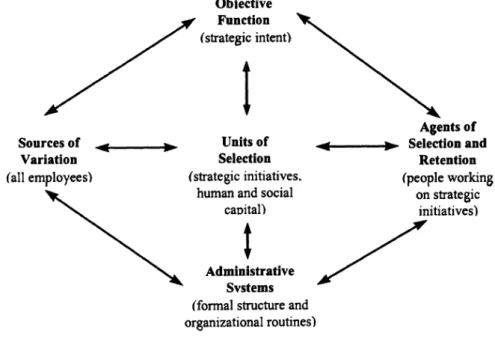
(32) 31 Changes in Cadre Evaluation and Training in China to tackle the issue of moral degradation in its CMS by incorporating cadre morality 官德 (literally, official morality) as a compulsory training session in party schools and adding this criterion in cadre evaluation. The thrust for moral education and evaluation raises questions on technical, political, legislative and philosophical problems. Furthermore, without an appropriate legislative foundation, an independent judiciary and media, transparency and democratic control the pure administrative approach is bound to be futile in the long run. Still, even though the analysis does not investigate the impact or outcomes of moral training and evaluation, it however shows how China is trying to come to terms with challenges by means of managing its cadres. It also reveals that the two elements, training and evaluation, are complementary, and they systematically react to changing policy guidelines.. 政 治 大 ORGANIZATIONAL CHANGE AND GUIDED EVOLUTION 立. ‧ 國. 學. The CMS and its transformation efforts are best approached by theories of adaptive systems. Organizations are adaptive and their survival depends on their ability to change with the. ‧. transforming environment. I have thus delved deeper into theories of organizational studies. evolutions of big organizations.. io. sit. y. Nat. and found interesting approaches that tackle the issue of structural inertia and guided. al. er. Studies on the phenomenon of “structural inertia” (Hannan et al. 1977) address big organiza-. n. v i n C h among the firstUwho applied evolutionary and ecologistructures. Hannan and Freedman were engchi tions and their difficulties in responding to environmental changes by changing strategies and. cal perspectives to theorize on these difficulties. They assumed that “organizations seldom succeeded in making radical changes in strategy and structure in the face of environmental threats” (Hannan et al. 1984: 149). However, in a paper published seven after their first article in 1970, their general assumption experienced a substantial change. The authors acknowledged that organizational change occurs frequently, and sometimes even in a radical form. Above all, those organizations which structures are difficult to alternate tend to be favored by the selection process. Hence, they survive environmental threats and transformations better than smaller ones (149). This proposition derives from a set of theorems they develop in their paper. The key argument in their revised theory is timing. It is not the existence of inertial forces itself that threatens an.
(33) 32 Changes in Cadre Evaluation and Training in China organization’s survival, what is crucial is the speed of response when environmental threats and opportunities emerge. Hence, the important question is whether organizations are able to learn about their environment, and change strategies and structures as quickly as the environment changes (151). Time is not the only component that is crucial in intra-organizational evolution. Another factor determining the future of an organization is managers who are aware of the need to change and their applied strategies. In their paper Strategy as Guided Evolution, Bjorn Lovas and Sumantra Ghoshal (2000) “conceptualize an organization as an ecological system purposefully designed to guide the evolution of strategy” (876). The theory of guided evolution consists of five main elements: (1) The units of selection: strategic initiatives, and human and social capital (units of selection); (2) objective function: strategic intent; (3) administrative system;. 政 治 大. (4) sources of variation (everyone who has relevant knowledge); (5) agents of selection and. 立. retention (also including every employee) (875-876).. ‧ 國. 學. The model proposed by Lovas et al. (see figure below) treats the top management as an active and important factor in organizational ecology as it creates and guides evolutionary and ecological processes that in turn enhance adaption to or the enactment of changes in the external. ‧. environment. Still, organizations do not change at will as they are subjected to inertial forces. sit. y. Nat. and evolutionary and ecological processes that shape the strategy and performance of organizations (876). Evolutionary and ecological forces do not operate outside the system, but they. io. n. al. er. are integral to and part of formal strategies, structures and systems of the organization (876).. i n U. v. The top management intervenes in these processes, and, by doing so, shapes the strategy and. Ch. performance of the organization.. engchi. Approaches of organizational communication focus on the messages that are transported via channels through interactants. Organizational communication crosses the boundaries of organizations and is influenced by the wider cultural, political, technological, and institutional environment (McPhee et al. 2000; Lammers et al. 2006; Monge et al. 2008)..
(34) 33 Changes in Cadre Evaluation and Training in China Figure 1: The guided evolution model. 學. ‧ 國. 立. 政 治 大. Source: Lovas et al. 2000: 876. ‧. THEORETICAL CONSIDERATIONS. sit. y. Nat. io. er. The Chinese leadership has a clear intention which it has repeatedly reiterated: transformation of development. By doing so, it formulates an ideological framework that contains the param-. n. al. Ch. i n U. v. eters of change and transformation (unit of selection or strategic initiative). Guidelines are. engchi. adopted that should be adopted at lower levels. The sources of variations in the Chinese political system are cadres; they are supposed to implement policies according to the guidelines set at central level. Some of these cadre become agents of selection and retention as they come up with new ideas (i.e. policy projects) that they feed into the input-output circle and which consequently become part of the strategic intent. If successful, these ideas are promoted and even emulated by other cadres in other jurisdictions. All of them are embedded in a system of formal structures and organizational routines (i.e. CMS) that gives incentives, sets constraints and thus exerts a certain degree of control over their actions. The focus of my research lies on the changes which the unit of selection brings on the administrative system or the changes that have resulted in the CMS after the adoption of the Scientific Development View..
(35) 34 Changes in Cadre Evaluation and Training in China I treat evaluation and education as complementary elements of the CMS that equally reflect the ideas of development and transformation. They respond to external and internal challenges in China and translate them into their systems. The CMS—besides instilling loyalty among cadres—serves the function to transport ideas of development and thus organizes ideology. By doing so, the leadership hopes to push China down the path of transformation. The interpretation and implementation rest on the local governments that tailor evaluation targets and cadre education according to the strategic initiative decided on central level, at the same time they make them compatible with local circumstances and needs. Faced with the problem of policy implementation at local level, and rampant corruption within the Chinese bureaucracy, the quest for standardization and objectivity to make cadres more accountable for their actions is important. In contrast to most of the studies on cadre account-. 政 治 大. ability, I hold that the incentive and constraint system tackles the principle-agent and the so. 立. called dictator’s commitment problem. 13. ‧ 國. 學. Finally, the channels that transport ideas and concepts are not entirely institutional (or administrative); personnel relations, technologies, and external institutions—such as media and academia—serve as developer and promoter of the ideas of development.. ‧ sit. al. er. io. OPERATIONALIZATION. y. Nat. METHODOLOGY. n. v i n My thesis draws on an extensiveC research sources of CCP and Chinese government U h e nofgtextual i h c releases, publications and reports in the Chinese press. Between July 18 and August 2, 2013 I went on a field work trip to Jiangsu Province (I was based in Suzhou) and Beijing where I conducted semi-structured one-hour (and more) open-end interviews with Chinese scholars of different academic disciplines, one leading cadre of a private Chinese enterprise 民营, and representatives of NGOs. I also participated in a cadre training session on Questions and study on Ecological Civilization and circular economy 生态文明与循环经济研究问题 at China Renmin University, Beijing. Participants were cadres of different age and rank of the Chuxiong 楚 雄 州 Development and Reform Commission 发 展 改 革 委 员 会 that had commuted to the capital for a one-week long training program at China Renmin University. At 13. The dictator’s commitment problem theorizes on power-sharing in dictatorial regimes. Boix et al (2013) state: “Power-sharing in dictatorships is complicated by a fundamental commitment problem: no independent authority can guarantee that the spoils of joint rule will be divided as the dictator and his and her allies agreed.” (300)..
數據
+7


Outline
T HEORETICAL CONSIDERATIONS
R EMARKS ON EXPERIENCES IN FIELD WORK
C ADRE SELECTION AND PROMOTION
C ADRE TRAINING AND EDUCATION
H OW IS THE CONFLICT BETWEEN ENVIRONMENT AND SOCIO - ECONOMIC DEVELOPMENT ADDRESSED IN THE PRACTICAL REALM ?
L AUNCH OF TRIAL PROJECTS
P ARTY SCHOOL CURRICULA
Seminar on Topics of Suzhou’s Ecological Civilization and Sustainable Development 苏州市 生态文明与可持续发展专题研修班. Prominent figures such as State Councilor Niu
F AILED SYSTEM IN ENVIRONMENTAL POLITICS
C HAPTER 7—C ONCLUSION AND F URTHER
相關文件
社團參與證明 學生幹部證明
張意欣 女 財政部 國庫署副組長 輔仁大學統計學系
教師專業發展評鑑 初階暨進階培訓中心 資料來源
03 集體創作 洪慶桐 建國科技大學 / 勞動部勞動力發展署中彰投分署, 彰化縣私立達德高級商工職業學校.. 03 集體創作 張建雄
高中部國文科 1 實缺 以臺中市政府教育局規定為準 備取 若干 高中部英文科 1 實缺 以臺中市政府教育局規定為準 備取 若干 高中部數學科 1 實缺 以臺中市政府教育局規定為準
勞動部勞動力發展署桃竹苗分署-幼 獅職業訓練場(前行政院勞工委員會 職業訓練局青年職業訓練中心)、臺 北市立南港高級工業職業學校 39 資訊與網路技術 1 林家諄
The booklet is divided into four chapters, which cover the spirit and governance framework of school-based management, scope of school- based management, roles
賽決賽 前三名 採認 指導:教育部 承辦:國立臺灣大學 國際. 科展
