行政院國家科學委員會專題研究計畫 成果報告
科技、媒體與社會:媒體再現與文化價值觀對新科技接受
程度之影響
研究成果報告(精簡版)
計 畫 類 別 : 個別型 計 畫 編 號 : NSC 99-2511-S-004-004- 執 行 期 間 : 99 年 11 月 01 日至 100 年 10 月 31 日 執 行 單 位 : 國立政治大學傳播學院傳播研究暨發展中心 計 畫 主 持 人 : 施琮仁 計畫參與人員: 碩士班研究生-兼任助理人員:張瑜倩 碩士班研究生-兼任助理人員:蘇民欣 碩士班研究生-兼任助理人員:鄭欣怡 報 告 附 件 : 出席國際會議研究心得報告及發表論文 公 開 資 訊 : 本計畫可公開查詢中 華 民 國 101 年 01 月 21 日
中 文 摘 要 : 本研究檢視了台灣兩家平面媒體對奈米科技的報導—聯合報 與自由時報。選擇這兩家報紙的原因是因為它們是國內兩家 發行量最大的平面媒體。研究結果顯示,這兩家報紙對奈米 科技的報導都相當正面,不僅採用正面的框架,對於奈米科 技優點的報導,也大大地多過對於風險的報導。詳細地說, 兩報對於優點的報導主要集中在奈米科技所帶來在「消費者 產品」與「醫療」方面的進步。雖然與風險相關的報導很 少,兩報中報導最多的風險是奈米科技對「健康」與「環 境」的負面影響。關於消息來源,本研究發現,記者在報導 奈米科技時最常引用在大學教授與科學家。目前台灣媒體對 於奈米科技的正面型塑,或許也和記者倚重這些消息來源有 關。 中文關鍵詞: 奈米科技、媒體報導、框架、科技風險
英 文 摘 要 : This study examined news coverage of nanotechnology in two Taiwanese newspapers—the United Daily and the Liberty Times. These two newspapers were chosen
because they are the two newspapers with the highest circulation rate in Taiwan. The results indicated that both newspapers, in general, gave nanotechnology a positive light. Specifically, they both emphasized the ’progress’ frame and the ’benefit’ frame. In addition, both newspapers also covered more benefits than risks. The benefits emphasized were related to consumer products and medical advancement. On the other hand, although rarely mentioned, the risks that appeared most often were about the negative impact on health and the environment. In terms of source used, the two newspapers consulted professors or scientists working in universities most often for information about nanotechnology, which, in part, explains the positive coverage offered by the newspapers.
英文關鍵詞: Nanotechnology, Media coverage, Framing theory, Technological risk
1
行政院國家科學委員會補助專題研究計畫
□成果報告
□期中進度報告
科技、媒體與社會:媒體再現與文化價值觀對新科技接受程
度之影響
計畫類別:□個別型計畫 □整合型計畫
計畫編號:NSC 99-2511-S-004-004
-
執行期間: 99 年 11 月 01 日至 100 年 10 月 31 日
執行機構及系所:政治大學-傳播學院傳播研究暨發展中心
計畫主持人:施琮仁
共同主持人:
計畫參與人員:張瑜倩、蘇民欣、鄭心怡
成果報告類型(依經費核定清單規定繳交):□精簡報告 □完整報告
本計畫除繳交成果報告外,另須繳交以下出國心得報告:
□赴國外出差或研習心得報告
□赴大陸地區出差或研習心得報告
□出席國際學術會議心得報告
□國際合作研究計畫國外研究報告
處理方式:
除列管計畫及下列情形者外,得立即公開查詢
□涉及專利或其他智慧財產權,□一年□二年後可公開查詢
中 華 民 國 101 年 01 月 20 日
附件一2 研究內容
一、 前言
在日常生活中,並不是每個人都能跟新科技有直接的接觸,如此一來,大眾媒體就成為了普羅大 眾瞭解科技議題最重要的管道,尤其是媒體對某議題報導的量與角度,都會塑造民眾的看法與意見 (e.g., Scheufele & Lewenstein, 2005)。然而,有鑑於新科學技術與新科技的發展常常會引發一些 關於其社會衝擊的討論,媒體的角色於是從中立的訊息傳遞者,逐漸轉變成各方勢力(包括政策決策 者、利益團體等)的競爭場域,這些勢力在媒體上爭奪議題的定義權,以讓議題朝向對己方有利的方 向發展。正因如此,探討媒體內容就變得至關重要,因為媒體藉由不同的再現手法,提供了大眾不同 的「真實」,進而影響人們對新科技的態度與想法。 本研究以奈米科技為例,試圖檢視台灣媒體如何報導科學議題。奈米科技在台灣受到很高的重視, 政府在 2004 年投入超過兩百億台幣的資金,推動為期五年的奈米國家型科技計畫,使台灣成為世界前 十大的奈米科技發展國家。台灣在奈米相關研究的發表數量上,也排名世界前二十,專利的數量則是 世界第六 (Hullmann, 2006; 經濟部投資業務處,民 96)。這樣的特色與政策,究竟對媒體的報導有 何影響,是個很值得探討的議題。 二、 研究目的 本計畫的研究目的,在於瞭解台灣平面媒體如何報導奈米科技。本計畫將以「框架分析」為理論 基礎,分析台灣兩大報(聯合報與自由時報)對奈米科技的包裝與再現。此外,本研究也將分析報紙 中對特定優點與風險的刻畫,作為推估民眾感知的基礎。由於框架的使用與風險的描繪和記者所採訪 的消息來源息息相關,因此,本計畫也將深入剖析各種不同消息來源在奈米相關新聞中的角色。 透過上述分析,本研究期待能夠為奈米科技在媒體中的再現方式,勾勒出一幅基本的圖像,並據 以討論造成此再現方式的背後原因,包括文化價值觀、政策、產業發展等等,希望能發現台灣傳播與 報導新興科技的獨特性。 三、 文獻探討 除了少數科學家有切身的經驗之外,一般人對新科技的認識與瞭解大都不是直接的,而是間接 地從新聞媒體獲得消息,因此媒體對於科學議題報導的角度就格外重要,因為不論是報導的數量或 是框架都會影響民眾的態度(Conrad, 1999; Severin & Tankard, 1988)。以奈米科技為例,學者 們已經發現,目前美國民眾對奈米科技 尙能接受,原因是相關新聞現階段還相當地正面(Scheufele & Lewenstein, 2005)。因此,研究媒體內容,不僅能瞭解科學議題如何被報導,也能對民眾所接 觸到的資訊,以及可能形成的態度,有深入的瞭解。有鑑於媒體框架對民眾認知的影響力,本計畫 將著重於分析媒體框架(Chong & Druckman, 2007; Entman, 1993; Pan & Kosicki, 1993; Scheufele, 1999)。
3
在研究媒體對科學議題的報導上,Gamson and Modiglinan (1989)的著作可說是提供了絕佳的
典範。以核能發電為例,這兩位研究者找出了七種最常為媒體使用的框架--(1)進步;(2)能源
獨立 ;(3)惡魔交易;(4)失控 ;(5)公眾監督責任;(6)成本效益;(7)柔性訴求。 他們發現,
在 1970 年代以前,整個社會對於新科技瀰漫著正面的氛圍,因此媒體報導也大都是正面的,視核
能發電為一種時代的「進步」。然而,在 1970 年代之後,由於三哩島核電廠事件(Three Mile Island)
和中東地區停止輸出石油事件,導致了社會及媒體對核能發電觀感的改變,此一時期,「進步」雖 然仍為媒體主要使用的框架,但「能源獨立」、「公眾監督」以及「軟性訴求」都已逐漸浮出檯面。 也就是說,社會上不只有支持核能發電的聲音,反對者的觀點也漸漸地普及。之後,也有相關團體 以經濟的角度來討論核能發電是否符合成本效益,這派支持者認為核能發電其實比其他發電的方法 更不實際。 雖然上述文章提供了日後學者研究媒體對科學議題報導的基石,但由於這些研究大多源自於美 國本土,他們的發現能否適用於其他的科學議題,甚至其他的文化背景,就非常值得探討了。因此, 有一些學者們開始了比較性的研究,舉例來說,Stephens (2005)比較了美國與其他國家媒體對於 奈米科技的報導,發現了美國的媒體傾向把奈米科技形容為「新發現」以及「商業上的突破」;相 對地,非美國媒體則是著重於奈米科技對社會的影響。此外,Marks 等學者(2007)也比較了美國與 英國媒體對生物科技的報導,研究結果顯示,英美的媒體對於食品生物科技皆給予較為負面的報 導,而對醫療生物科技給予叫正面的報導。
然而,美國的華盛頓郵報(The Washington Post)要比英國的泰晤士報(The London Times) 更強調風險與負面報導。之後,漸漸有一些學者投入了「文化與媒體報導」這塊研究領域。例如 Te Kulve (2006)研究了九0年代之後荷蘭媒體對奈米科技的報導,發現了媒體以「新科技」這個 角度來呈現奈米科技的頻率愈來愈低,從九0年代的 65%到 2003 年之後只剩下 32%;相反地,奈 米科技對「社會的衝擊」則是從完全沒有受到注意,到 2003 年之後佔據了 9%的媒體版面。由此 可見,研究媒體內容是瞭解民意形成的重要途徑,而瞭解媒如何體塑造新科技形象更可以顯示出一 個文化或社會背景對於科技的基本觀感(Swidler, 1986),因此瞭解不同國家的媒體對科技議題的 報導,尤其是在東方文化中的媒體如何呈現更是值得討論的議題。 四、 研究方法 本研究採用內容分析法,分析從 2001 年 1 月 1 日至 2010 年 12 月 31 間聯合報與自由時報所 刊登之奈米科技相關新聞。研究者在聯合知識庫(聯合報)與慧科大中華新聞網(自由時報)中, 以「奈米」為關鍵字進行搜尋。在刪除無關之新聞後,聯合報有 258 篇,而自由時報僅有 117 篇, 總計 375 篇。詳細來說,若搜尋而得的新聞符合下列三個條件之一,本研究即不採用:第一,在 內文中留有產品製造商聯絡方式之疑似廣告文章;第二,內文中提到多種新科技,而奈米科技僅 為其中一例;第三,「奈米」這個詞在新聞中主要被當作單位使用,而沒有更進一步的訊息。 三位傳播科系的研究生在接受嚴格個訓練後,開始負責相互同意度測驗檢定與編碼。相互同 意度以 Krippendorf’s Alpha 來計算,這項數值納入了機率因素的考量,因此會比百分比同意度
4 0 5 10 15 20 25 30 35 40 45
Economic Computer Environment Medical Capacity Military Energy Consumber Other
% of st or ie s UDN LT Total 更為準確,但也更為保守。本研究之相互同意度皆在可接受之範圍。 五、 結果與討論 (一)新聞框架 以使用的新聞框架而言,聯合報與自由時報非常類似。兩報最常用「進步」的框架來包裝奈米科技(聯 合報 40.3%;自由時報 47.9%),其次是「利益」框架(聯合報 26.0%;自由時報 22.2%),再來則是「公 眾課責性」框架(聯合報 20.5%;自由時報 16.2%)。詳細的框架使用分佈,請見圖一。 圖一、聯合報與自由時報新聞框架使用情形 (二)優點呈現 兩報在呈現奈米科技的優點方面,也大致相似。詳細來說,兩報都最強調奈米「消費者產品」的好處, 雖然聯合報(40.3%)報導的比率高於自由時報(31.6%)。兩報其次強調的是「醫療上」的好處,不同 的是,在這方面自由時報(29.1%)的報導反比聯合報(25.6%)稍多。值得一提的是,聯合報在各項 優點的報導數量都多過自由時報,除了「軍事」優點之外(聯合報 2.7%;自由時報 5.1%)。 圖二、聯合報與自由時報對於奈米科技優點之報導
5 (三)風險呈現 有別於優點,與奈米科技相關的風險則很少在台灣的報紙中被報導,而聯合報所報導的風險又少於自 由時報。舉例來說,即便自由時報比聯合報刊登了更多關於「健康」的風險,其比率仍甚低(聯合報 3.5%;自由時報 12.0%)。而在兩報中出現次為頻繁的是「環境」風險(聯合報 1.2%;自由時報 4.3%); 此外,兩報也偶而提及了奈米科技所可能帶來的「機器人失控」以及「失業」的風險。詳細的風險呈 現狀況,請見圖三。 圖三、聯合報與自由時報對於奈米科技風險之報導 (四)消息來源 本研究分析了每篇新聞中最先出現的三個消息來源,在兩報中最常成為第一個消息來源的,是大學中 研究奈米科技的教授與科學家(聯合報 16.7%;自由時報 21.4%),其次是在公家單位或由政府所資助 之研究單位工作之科學家(聯合報 12.4%;自由時報 15.4%)。而最常成為兩報新聞中第二個消息來源 的還是大學中的教授與科學家,然而,其他消息來源也佔有極重的比例。「其他」來源的頻繁出現,大 多是因為記者常使用「專家」等非指涉特定對象的詞彙。至於第三個消息來源,大學中的教授與科學 家仍扮演主要角色,但值得注意的是,兩報皆有 4%左右的新聞採用了「產業界」的消息來源。 (五)討論 本研究分析了台灣聯合報與自由時報從 2000 年至 2010 年對於奈米科技的報導,研究發現,兩報 的報導大多相當正面,不僅採用正面的框架(強調奈米科技帶來進步、好處),對於奈米科技優點的報 導,也大大地多過對於風險的報導。這樣的報導型態或許和記者訪問的消息來源有關,如前所述,本 研究中最重要的消息來源為大學中研究奈米科技的教授與科學家,而科學家對新科技通常都持有較正 面的態度。當然,也有可能記者本身就對奈米科技有正面的看法,因此刻意找尋相關科學家進行訪問, 只是這個假設在本研究中無法驗證。 值得一提的是,在「進步」與「利益」兩大框架之外,記者也很常用「公眾課責性」的角度來型 塑奈米科技,這一點可能和許多新聞報導奈米科技相關的科學活動訊息有關。在台灣,奈米科技的訊 息常常是透過活動事件呈現,這些活動強調科學教育的成果與學生研發的成就,將奈米科技與公眾緊 密地拉上關係。
6 而關於奈米科技可能帶來的風險,則有兩點值得解釋。首先,雖然兩報對於風險的報導都甚為稀 少,但聯合報報導風險的次數更遠低於自由時報,這或許和聯合報「新聞中的科學」專頁有關。其次, 兩報對於「健康」與「環境」風險的關注,也和國外的民意調查資料相符。根據美國的研究,這兩項 風險是公眾最擔心的風險,科學家甚至比一般民眾更為擔憂。 簡言之,台灣的平面媒體對於奈米科技的報導和美國較為相似,皆較強調此科技的正面影響,此 發現和 Stephen(2005)及Te Kulve (2006)的發現有所差異。而台灣媒體的報導會不會和荷蘭媒體一 樣,在未來逐漸轉向關注奈米科技對社會的衝擊,則是日後需要持續追蹤注意的問題。 參考文獻
Chong, D., & Druckman, j. N. (2007). Framing theory. Annual Review of Political Science, 10, 103-126. Conrad, P. (1999). Uses of expertise: Sources, quotes, and voice in the reporting of genetics in the news.
Public Understanding of Science, 8(4), 285-302.
Entman, R. M. (1993). Framing: Toward clarification of a fractured paradigm. Journal of Communication, 43, 51-58.
Gamson, W. A., & Modigliani, A. (1989). Media Discourse and Public Opinion on Nuclear Power: A constructionist Approach. The American Journal of Sociology, 95(1), 1-37.
Hullmann, A. (2006). Who is winning the global nanorace? Nat Nano, 1(2), 81-83.
Marks, L. A., Kalaitzandonakes, N., Wilkins, L., & Zakharova, L. (2007). Mass media framing of biotechnology news. [Article]. Public Understanding of Science, 16(2), 183-203.
Pan, Z., & Kosicki, G. M. (1993). Framing Analysis: An Approach to News Discourse. Political
Communication, 10(1), 55-75.
Scheufele, D. A. (1999). Framing as a theory of media effects. Journal of Communication, 49, 103-122. Scheufele, D. A., & Lewenstein, B. (2005). The public and nanotechnology: How citizens make sense of
emerging technologies. Journal of Nanoparticle Research, 7(6), 659-667.
Severin, W. J., & Tankard, J. W. (1988). Communication theories : origins, methods, uses (2nd ed.). White Plains, N.Y.: Longman.
Stephens, L. F. (2005). News narratives about nano S&T in najor U.S. and non-U.S. newspapers. Science
Communication, 27(2), 175-199.
Swidler, A. (1986). Culture in Action: Symbols and Strategies. American Sociological Review, 51(2), 273-286. Te Kulve, H. (2006). Evolving Repertoires: Nanotechnology in Daily Newspapers in the Netherlands. Science
as Culture, 15, 367-382.
經濟部投資業務處(民96)。台灣奈米科技產業發展現況。
1
國科會補助專題研究計畫項下出席國際學術會議心得報告
日期:101 年 1 月 20 日
一、參加會議經過
IAMCR 年會為傳播領域數個重要研討會之一,2011 年的年會於七月在土
耳其的伊斯坦堡舉辦,以「Cities, Creativities, Connectivity」3C 為會
議主軸。本次年會為期五天,共有 340 個場次,超過一千篇的論文在此發表。
本人的論文在最後一天發表,題為「News coverage of nanotechnology in Taiwan」,
主持人為英國李斯特大學(Leicester University)媒體與傳播學系的 Anders
計畫編號
NSC 99-2511-S-004-004-
計畫名稱
科技、媒體與社會:媒體再現與文化價值觀對新科技接受程度
之影響
出國人員
姓名
施琮仁
服務機
構及職
稱
政治大學-國際傳播英語碩士學
位學程
會議時間
100 年 7 月 13
日至
100 年 7 月 17
日
會議地
點
伊斯坦堡,土耳其
會議名稱
(中文) 國際媒體與傳播研究學會
(英文)
The International Association for Media and Communication Research發表論文
題目
(中文)台灣媒體對奈米科技的報導
(英文)
News coverage of nanotechnology in Taiwan2
Hansen,亦為知名的科學、環境傳播學者。
二、與會心得
IAMCR 比其他重要的傳播年會(例如 ICA 與 AEJMC)更重視「科學與健
康傳播」這個領域,我們可以看到此學會中有數個相關的小組,例如健康傳
播小組,以及環境、科學與風險傳播小組,甚至有專門探討傳播與愛滋病的
division。因此,本會議中聚集了許多來自不同國家、對科學與健康傳播有
興趣的研究者。值得一提的是,以研究人數來說,台灣和歐美國家相比少了
許多,而且大多是基於個人研究計畫。在本人宣讀論文的時段裡,絕大部分
的研究來自歐洲,其中約有一半的論文是由專門的研究機構,集結數名研究
者之力所完成,在這個領域的研究風氣似乎較為興盛。
參與這次年會一個很大的收穫,是能將台灣在地的研究成果讓世界各地
的人知曉,外國的研究者也對台灣的情況非常感興趣,並根據自身的經驗問
了許多有趣的問題。此外,研討會的地點位於風景秀麗、深具歷史與文化傳
統的伊斯坦堡,因此吸引了許多知名華人傳播學者與會,身為傳播領域新進
學者,這次的交流讓我受益匪淺。
規模龐大雖然能夠增加與會者交流機會、融入各地不同觀點,但另一方
面也容易使會場變得紛雜,溝通與交流難以深入。
三、建議
在紀錄此趟旅行的豐收之外,我也不禁想起在會議中遇見的國外傳播領
域研究生,他們積極的參與讓我反思起國內的狀況,也就是說,這次的會議
3
當中雖然有不少與會者來自台灣,但大多為知名專家學者,研究生的參與程
度似乎較低,跟不上國外的速度,我想或許能夠透過增加研究生出國發表論
文的補助,以及教師的鼓勵,能夠讓台灣這在方面迎頭趕上。
1
Running head: NANO NEWS IN TAIWAN
News Coverage of Nanotechnology in Taiwan Tsungjen Shih
2 NANO NEWS IN TAIWAN
Abstract
Taiwan is among the top 10 countries with the largest amount of governmental investment in nanotechnology, and nano-related products are ubiquitous in Taiwan. Based on these facts, it will be interesting to examine media coverage of
nanotechnology to see if it reflects the special economic and cultural context in
Taiwan. Analyzing 158 news stories from 2008 to 2010, I found that Taiwanese media were extremely positive about nanotechnology in terms of overall story tone. In addition, not only did they portray the technology as having the potential to bring about progress (the progress frame), the media also emphasized a lot more benefits than risks, with a focus on consumer goods and media advancement. As far as news sources are concerned, university scientists were the group consulted most frequently by the journalists in Taiwan when covering nanotechnology. Theoretical and practical implications are discussed.
3 NANO NEWS IN TAIWAN
News Coverage of Nanotechnology in Taiwan
A long-standing paradigm in communication research has focused on the way media shape the images in people’s head. Over the past few decades, media have been found to at least affect people’s judgment of issue importance, perception of social reality, and attitudes toward controversial issues. The effect of the media is even more pronounced when the issues covered are unobstrusive; that is, issues with which people do not have direct experience.
Science and technology is one of these issues because the general public usually does not witness the process through which scientific breakthroughs take place. People’s awareness or understanding of scientific innovations is, therefore, mostly cultivated by the mediated channels, such as the mass media.
However, since many of the new developments in science and technology often spark public debates regarding their social and personal impact (e.g., stem cell research, genetically engineering, nuclear power), the media do not serve as much a role of a transmitter of neutral information as an arena where different forces or stakeholders vie for the definition of issues. To the extent that each of these stakeholders may strive to provide its own version of the reality in the media, it is, therefore, important to examine media content to obtain a better grasp on the bases on which people make their judgment.
This study uses nanotechnology as a case study and investigates how the technology is covered in Taiwan. Specifically, this study will look at news frames, accounts of benefits and risks, and the sourcing pattern in two Taiwanese newspapers from 2008 to 2010. Nanotechnology serves as an ideal research topic both because of its revolutionary impact and the low level of knowledge among the general public. On one hand, scientists and the industries are very excited about the technology’s
4 NANO NEWS IN TAIWAN
economic potential, expecting its market value to reach 1.5 trillion by 2015. On the other hand, public opinion polls conducted in the US have consistently showed that people know very little about the new technology and the level of knowledge does not seem to increase over time, which gives the media much leverage in shaping people’s perception about nanotechnology.
The fact that the development of nanotechnology has become a global phenomenon with many governments competing with each other relative to the amount of money invested also makes the issue worth studying. As many framing theorists suggest, frames work the best when it resonates with embedded cultural values (Van Gorp, 2007). Given the cultural contexts in each country of the world are different, it will be interesting to see how nanotechnology is covered in media outside the US and Europe, where most of relevant research is derived (Kjærgaard, 2010).
Before I lay out the theoretical framework for this study, it is necessary to provide some basic information about the development of nanotechnology in Taiwan, such as how much financial support the government has given to the R&D of this
technology and how many patent registries have been originated from Taiwan. Nanotechnology in Taiwan
Seeing nanotechnology as a revolutionizing and driving force for future industry, the Taiwanese government has invested a great deal of money in the research and development of the technology. In 2004, the government put in about 76 million Euros, making it among the top ten countries in the world with the most public funding (Hullmann, 2006).
Later the government provided $23.2 billion NTD to initiate the National Program on Nano Technology (NPNT) in 2004 aiming to integrate human and technical resources in a centralized way and to build a connection between the
5 NANO NEWS IN TAIWAN
academics and the industry. With the level of financial support and the nano centers, the government expected to have more than 1,500 nano-companies in Taiwan.
By 2008, researchers and scientists in Taiwan have published 3,745 studies in international journals. Moreover, although the US is still dominant in terms of the number of patents, the nanotechnology industry in Taiwan registered 382 patents, ranking number six worldwide according to NNI.
Framing science
Framing is recognized as an integral part in the popularization of science and technology. Research has shown that merely providing information to the general public does not guarantee more support. Scientists and policy makers need to frame issues in ways that address people’s beliefs and values (Nisbet & Scheufele, 2009; Scheufele, 2006).
Definitions of frames and framing are abundant. Most researchers, however, seem to agree upon the distinction between an “audience frame,” or frame in thought, and a “media frame,” or frame in communication (Chong & Druckman, 2007;
Scheufele, 1999). Whereas the audience frame refers to the set of dimensions shaping people’s evaluations, the media frame refers to “a central organizing idea for making sense of relevant events, suggesting what is at issue” (Gamson & Modigliani, 1989, p. 5). To frame is, therefore, “to select some aspects of a perceived reality and make them more salient in a communicating text, in such a way as to promote a particular problem definition, causal interpretation, moral evaluation, and/or treatment
recommendation” (Entman, 1993, p. 52).
Gamson and Modigliani’s (1989) classical study on news coverage of nuclear power provided a decent framework for examining media representation of other emerging technologies, such as nanotechnology. In the study, they identified seven
6 NANO NEWS IN TAIWAN
major “media packages,” or frames, including progress, energy independence, devil’s bargain, runaway, public accountability, not cost effective, and soft paths.
A recent research adapted these framing devices to entail some features of nanotechnology and found “progress” as the most prominent frame across four US media outlets, outnumbering other frames, such as “futuristic,” “economic,” “confluence,” “Pandora’s Box,” “public accountability,” “runaway,” and “ethics” (Lewenstein, Radin, & Diels, 2007).
This study drew on the framing typology developed by Lewenstein et al. (2007). However, the “Pandora’s Box” was subsumed under a larger frame called
“uncertainty” to better capture the indefinite nature of nanotechnology. Two other frames—“benefits” and “risks”—were added because they were important frames identified by other research (e.g., Listerman, 2010). Table 1 below presents the frames examined in this study and their descriptions.
[Insert Table 1 about here] News coverage of nanotechnology around the world
There is a growing body of literature on how media frame nanotechnology in the past few years. International scholars were especially interested in whether the framing pattern is different between the United States and other countries. This endeavor is, on one hand, based on an empirical reality that most of current research on media coverage of emerging technologies originated from the US and, on the other hand, based on a critical refection on the lack of cultural elements in extant framing research (Carragee & Roefs, 2004; Van Gorp, 2007).
Research indicated differences between US and other countries with respect to the way media framed nanotechnology. In US, “scientific discovery” was the most prominent frame, appearing in about one third of the news articles, followed by the
7 NANO NEWS IN TAIWAN
“business” frame and the “social implications and risks” frame. On the contrary, non-US media emphasized “social implications and risks” frame about three times more often than the “scientific discovery” frame (Stephens, 2005).
This finding was replicated in the Danish context, where media also framed nanotechnology as “scientific discovery” quite frequently, only slightly less prominent than the “science and technology policy” frame (Kjærgaard, 2010). However, the “social implications and risks” frame appeared in only six percent of the total article investigated, receiving less attention than other frames, such as “education,”
“personal,” and “science fiction and popular culture.”
In the Netherlands, researchers also found significant differences across
countries. Whereas US newspapers tend to give nanotechnology a more positive light and emphasize its benefits, Dutch newspapers were characterized by a shift from a “dual pattern,” with the co-existence of high and modest expectation toward nanotechnology, to an “antagonistic pattern” filled with contrasted views (Kulve, 2006). In UK, the media had an inclination to feature on the “science research” frame, the “science fiction and popular culture” frame, and the “business” frame. The “social implications and risks” frame only appeared in less than 10 percent of the stories analyzed (Anderson, Allan, Petersen, & Wilkinson, 2005).
In sum, these studies altogether suggested a lack of overall frames across
borderlines for people to make sense of nanotechnology. Even though nanotechnology is a global issue, media coverage was likely to be influenced by local factors, such as the position of prominent figures (Anderson, et al., 2005), government policy
(Kjærgaard, 2010), and values toward science and technology (Gaskell, Ten Eyck, Jackson, & Veltri, 2005).
8 NANO NEWS IN TAIWAN
In addition to frames, whether the media emphasize the contributions or dangers of nanotechnology has significant implications on public perception of the technology. Research suggested that the favorable attitudes of the American public toward
nanotechnology in the early stage were attributable to the prominence of benefits in the media (Scheufele & Lewenstein, 2005).
Although not looking at specific benefits and risks associated with
nanotechnology, Stephens (2005) examined the relative weights of the two concepts implied in news stories. He found that whereas about a third of news stories portrayed nanotechnology as having more benefits than risks, only about 10 percent of the articles suggested otherwise (i.e., risks outweighed benefits). It is noteworthy, however, that the majority of stories did not exhibit discernible tones regarding benefits or risks of nanotechnology (47.3%).
Media representation of benefits and risks also varied with countries. A study examining the content of the New York Times in the US and the Independent in the UK from 1990 to 2003 showed that benefits received more attention in the US newspaper than its UK counterpart, although the amount of coverage dedicated to risks was equivalent in two countries (Gaskell, et al., 2005).
News sources
News sources have been recognized as an integral element in the news-making process insofar as they provide the information journalists need. Gans (1979)
analogize the relationship between journalists and sources as dancing, with sources often taking the lead. This is especially the case when it comes to covering science and technology where journalists have to rely on experts or scientists for background information, clarification, and their comments on scientific findings (Conrad, 1999; Dunwoody & Peters, 1992).
9 NANO NEWS IN TAIWAN
A great deal of research has pointed out that journalists have a tendency to approach the authority from established organizations for information. This act can be attributed, in part, to the need to secure credibility and, in part, to the convenience provided by routine information channels. (Berkowitz, 1987; Hansen, 1994; Sigal, 1973). Among various authorizes, government officials were the one sought after the most. This was evidenced by a study on news coverage of marijuana where the
researcher found that officials appeared in 70 percent of the stories. (Shepherd, 1981). Other studies about news coverage of public health diseases also found that
government officials and scientists were the two sources consulted most frequently by journalists (Berry, Wharf-Higgins, & Naylor, 2007; Shih, Brossard, & Wijaya,
Forthcoming).
The reliance on officials and routine news channels as news sources was even stronger for TV because of the equipment and timing constraints TV journalists encountered (Berkowitz, 1987). In light of the salient role played by officials and scientists, Hansen (1994) considered government and scientific institutions as two important “forums” where journalists can visit on a regular basis for science news. Consequently, this study will examine how these two sources may appear in news coverage of nanotechnology.
However, some scholars have noted the importance of accounting for the
“context in which science is produced, and whom it is produced for” (Hansen, 1994, p. 119; Hilgartner, 1990). That is, it is likely that claims made by scientists working for the government may be different from those made by their counterparts in private corporations. This study, therefore, did not treat scientists as a homogeneous group, but instead distinguished different types of scientists based on their affiliations; i.e., whether they were from governmental branches, universities, private companies, or
10 NANO NEWS IN TAIWAN
non-governmental organizations.
It should be noted that in these institutions, this study further took into account other non-scientists staff in light of their possibility of becoming news sources. For instance, a professor in sociology can be asked by the journalists to comment on the social and ethical impact of nanotechnology and an executive manager of an IT company may appear in the media to explicate the economic potential of the technology.
Furthermore, as journalists have the needs to “balance” a news story, they are likely to interview some sources who are traditionally not prominent in the media and would often provide perspectives different from those of government officials. These actors include consumer groups, environmental groups, religious organizations, health practitioners, and so on. A complete list of sources this study examined is presented in Table 2.
[Insert Table 2 about Here]
Based on the literature, the following research question was developed. Research questions
RQ1: How is nanotechnology framed in Taiwanese newspapers?
RQ2: How are benefits and risks represented in Taiwanese newspapers?
RQ3: What type of sources do journalists use to cover nanotechnology in Taiwanese newspapers?
RQ4: What is the overall tone of newspaper coverage of nanotechnology in Taiwan? Methods
This study employs quantitative content analysis. News stories published during the three-year time frame between 2008 and 2010 were collected by entering the term “nanotechnology” as the keyword in the search box of two databases—the United
11 NANO NEWS IN TAIWAN
Knowledge database and the Liberty Times online. Three coders were trained to go through all the searched articles and remove irrelevant ones. The news articles were dropped from the pool if they (1) used the term “nano” only as a unit of measurement, (2) mentioned “nanotechnology” in the passing or only as one example of a variety of scientific innovations, and (3) were explicit advertisements. A story was considered as irrelevant and removed only when all three of the coders agreed with the decision. After the process, the number of stories was 97 for UDN and 61 for LT.
Intercoder reliability was assessed for each newspaper using Krippendorff’s
Alpha (α) by randomly choosing 10 percent of the total population. Krippendorff’s Alpha is appropriate and attractive because it adjusts for chance agreement and is
suitable for all levels of measurement (Krippendorff, 1980; Neuendorf, 2002). All the reliability coefficients were at the satisfactory level, ranging from .65 to 1 for UDN and .70 to 1 for LT.
Results
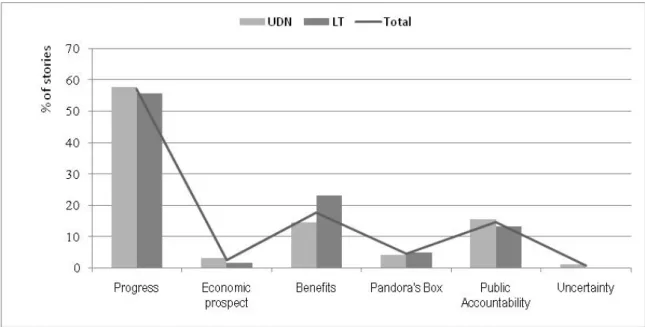
RQ1 examined the frames used by the journalists in Taiwan to represent nanotechnology. As Figure 1 shows, Taiwanese newspapers tended to characterize nanotechnology as the technology of future and as having the potential to bring human life to a different level (57%). The newspapers also emphasized the contribution of the technology (17.7%) and the need for the general public to be involved in the development process (14.6%). The media were less likely to portray nanotechnology in terms of its potential negative impact (4.4%), its economic prospect (2.5%), and the uncertain nature (0.6%).
[Insert Figure 1 about Here]
RQ2 explored how the two newspapers portray risks and benefits associated with nanotechnology. The results showed that the benefits greatly outweighed the
12 NANO NEWS IN TAIWAN
risks. Only 10 out of the total 158 stories talked about risks, with 9 of them about the negative impact on human health. In contrast, the benefits were frequently mentioned in news coverage of nanotechnology. Specifically, the media highly emphasized consumer benefits (41.1%) and medical benefits (32.9%), as Figure 2 shows. Benefits in relation to energy (11.4%), the environment (7.6%), and computer (7%) received a moderate level of media attention. In addition, economic (2.5%), human capacity (1.9%) and military (1.9%) benefits appeared only sporadically in the news.
[Insert Figure 2 about Here]
RQ3 asked the type of sources used in news stories about nanotechnology. On average, the number of sources used by the two newspapers was similar, with 1.90 sources appearing in UDN and 1.93 sources appearing in LT. Thirteen out of the total 158 stories were unattributed, with 11 from UDN and 2 from LT.
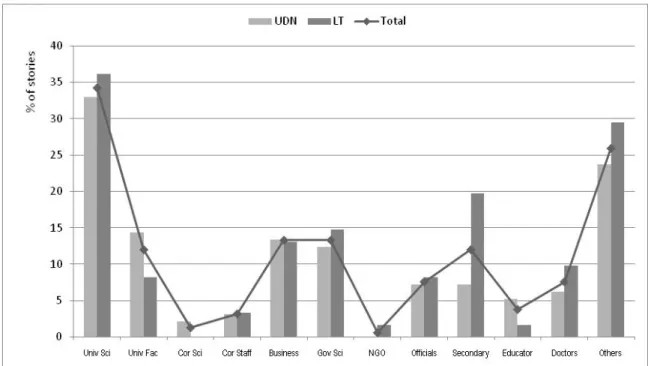
As Figure 3 indicates, the sources cited most often were university scientists, appearing in 34.2% of the stories, followed by people from the industry and scientists working in public sectors (13.3% each). Journalists also cited findings from scientific journals or information from other media quite often, with this type of source
accounting for 12% of the total stories. Government officials and doctors were only consulted by the journalists for information occasionally, with each source category appearing in only 7.6% of the stories. Although this study did not intend to compare the two newspapers under examination, the results showed that they were fairly similar in regards to the sourcing pattern.
[Insert Figure 3 about Here]
RQ4 explored the tone of the stories about nanotechnology. The results
suggested that more than three-quarters of the stories were favorable to the technology (77.2%). Fewer than one in five stories were neutral (17.7%) and only one in twenty
13 NANO NEWS IN TAIWAN
stories were negative (5.1%). This pattern was also similar across media. Conclusion
Analyzing 158 news stories from 2008 to 2010, this study provided a clear picture about how media portrayed nanotechnology in Taiwan. Specifically, I examined frames, representation of benefits and risks, and sourcing patterns in two newspapers. The results suggested that Taiwanese media were extremely positive about nanotechnology. Not only did they portrayed the technology as having the potential to bring about progress, the media also emphasized a lot more benefits than risks. Furthermore, evaluated by the overall tone, the lion’s share of the stories were favorable.
The results seem to come closer to those obtained in the United States where news coverage of nanotechnology was mostly positive, than findings obtained in some European countries where a more reserved tone was identified. It is noteworthy that Taiwanese media emphasized even fewer risks than the US media. Two
explanations are possible. First, the dominance of positive frames and benefits in the media may be attributable to the “pro-science” culture prevailing in Taiwanese society, which often leads people to pay less attention to the negative impact of technologies. As Van Gorp (2007) suggested, such a culture “provides the linkage between news production and news consumption” (p. 61).
Second, the “players” who were supposed to remind people of its potential ethical, legal, and social implications were basically absent in Taiwan. As the findings about news sources suggested, the organizations which usually “monitor” the
development of nanotechnology for the general public, such as consumer groups or environmental groups, either did not exist or did not successfully make themselves to the media. As a consequence, sources who were pro-science not only had more
14 NANO NEWS IN TAIWAN
chance to voice their opinions in the media, but also had greater power to frame the issue in their preferred direction.
This study also found that newspapers in Taiwan played up the potential of nanotechnology to help produce better quality consumer goods and to contribute to medical advancement. One the one hand, this may be the result of governmental policies which stress the development in the two areas. On the other hand, this also suggests that the media considered the two aspects as more relevant to people’s understanding of nanotechnology; that is, the public would make more sense if the technology was associated with concrete products or medical treatment. The findings, however, cannot be compared with other study because nearly all existent research examined only the relative weight of positive and negative impacts in news stories, rather than the portrayal of specific risks and benefits.
15 NANO NEWS IN TAIWAN
Reference
Anderson, A., Allan, S., Petersen, A., & Wilkinson, C. (2005). The framing of nanotechnologies in the British newspaper press. Science Communication,
27(2), 200-220.
Berkowitz, D. (1987). TV News Sources and News Channels: A Study in Agenda-Building. Journalism Quarterly, 64(2), 508-513.
Berry, T. R., Wharf-Higgins, J., & Naylor, P. J. (2007). SARS wars: An examination of the quantity and construction of health information in the news media.
Health Communication, 21(1), 35-44.
Carragee, K. M., & Roefs, W. (2004). The neglect of power in recent framing research.
Journal of Communication, 54(2), 214-233.
Chong, D., & Druckman, j. N. (2007). Framing theory. Annual Review of Political
Science, 10, 103-126.
Conrad, P. (1999). Uses of expertise: Sources, quotes, and voice in the reporting of genetics in the news. Public Understanding of Science, 8(4), 285-302. Dunwoody, S., & Peters, H. P. (1992). Mass media coverage of technological and
environmental risks: A survey of research in the United States and Germany.
Public Understanding of Science, 1(2), 199-230.
Entman, R. M. (1993). Framing: Toward clarification of a fractured paradigm.
Journal of Communication, 43, 51-58.
Gamson, W. A., & Modigliani, A. (1989). Media Discourse and Public Opinion on Nuclear Power: A constructionist Approach. The American Journal of
Sociology, 95(1), 1-37.
Gans, H. (1979). Deciding What's News: A Study of CBS Evening News, NBC NIghtly
News, Newsweek and Time. New York and Oxford: Oxford University Press.
16 NANO NEWS IN TAIWAN
Cultural support for technological innovation in Europe and the United States. [Article]. Public Understanding of Science, 14(1), 81-90.
Hansen, A. (1994). Journalistic practices and science reporting in the British press.
Public Understanding of Science, 3(2), 111-134.
Hilgartner, S. (1990). The dominant view of popularization: conceptual problems, political uses. Social Studies of Science, 20(3), 519.
Hullmann, A. (2006). Who is winning the global nanorace? Nat Nano, 1(2), 81-83. Kjærgaard, R. S. (2010). Making a small country count: nanotechnology in Danish
newspapers from 1996 to 2006. Public Understanding of Science, 19(1), 80-97.
Krippendorff, K. (1980). Content analysis: An introduction to its methodology. Beverly Hills, CA: Sage.
Kulve, H. T. (2006). Evolving Repertoires: Nanotechnology in Daily Newspapers in the Netherlands. Science as Culture, 15(4), 367 - 382.
Lewenstein, B. V., Radin, J., & Diels, J. (2007). Nanotechnology in the media: A preliminary analysis. Nanotechnology: Societal Implications, 258.
Listerman, T. (2010). Framing of science issues in opinion-leading news: international comparison of biotechnology issue coverage. Public Understanding of Science,
19(1), 5-15.
Neuendorf, K. (2002). The content analysis guidebook: Sage Publications, Inc. Nisbet, M. C., & Scheufele, D. A. (2009). What's next for science communication?
Promising directions and lingering distractions. Am. J. Bot., 96(10), 1767-1778.
Scheufele, D. A. (1999). Framing as a theory of media effects. Journal of
Communication, 49, 103-122.
17 NANO NEWS IN TAIWAN
Scheufele, D. A., & Lewenstein, B. (2005). The public and nanotechnology: How citizens make sense of emerging technologies. Journal of Nanoparticle
Research, 7(6), 659-667.
Shepherd, R. G. (1981). Selectivity of Sources: Reporting the Marijuana Controversy.
Journal of Communication, 31(2), 129-137.
Shih, T., Brossard, D., & Wijaya, R. (Forthcoming). News coverage of public health issues: The role of news sources and the processes of news construction.
International Public Health Journal, 3(1).
Sigal, L. V. (1973). Reporters and officials: the organization and politics of
newsmaking. Lexington, Mass: DC Health.
Stephens, L. F. (2005). News narratives about nano S&T in najor U.S. and non-U.S. newspapers. Science Communication, 27(2), 175-199.
Van Gorp, B. (2007). The constructionist approach to framing: Bringing culture back in. Journal of Communication, 57(1), 60-78.
18 NANO NEWS IN TAIWAN
Table 1
Frames in news coverage of nanotechnology
Frame Description
Progress Does the article portray nanotechnology as progress, as a trend of the future or a big leap from the past? Or does it portray nano as something that will bring about revolutionary effect on society. (e.g., when the nano-related invention is explicitly mentioned to be superior; that is, explicit
comparison is made between nano and other manufacturing approaches/ techniques.)
Economic Does the article emphasize economic impact
of
nanotechnology, including the revenue of a company, job opportunity/ loss, increased stock price, increased energy efficiency, food production, or other influences on the market/ business sectors?
Ethics Does the article portray nanotechnology as interference of nature, an act of playing god, or a morally problematic issue? Runaway Does the article portray nanotechnology as having the
potential to spiral out of human control?
Public accountability Are social concerns a salient aspect of nanotechnology? Coverage about ethical, legal, and social implications of nanotechnology, as well as public outreach efforts and science education, should be included in this category. Futuristic Does the article portray nanotechnology (or applications of
nanotechnology) as something far away in the distant future? Benefit Does the article emphasize the positive impact of
nanotechnology, such as increased ability in treating disease, improved health condition , better consumer goods, and so on?
Risk Does the article portray nanotechnology as something that creates negative (non-economic) impacts on the society or an individual?
Uncertainty Does the article portray nanotechnology as something that we don’t know much about? We lack information about the benefits, risks (unforeseen ills), and applications of
19 NANO NEWS IN TAIWAN
Table 2
Frames in news coverage of nanotechnology
University Scientists doing research mainly in nanotechnology, including areas such as fundamental sciences (e.g., physics, chemistry), material sciences, or any engineering programs.
University administrative employees or faculty members whose areas of study/ profession are not directly related to the advancement and development of nanotechnology. (E.g., professors in Sociology/ Business, administrators, etc.) Scientists working for private nano-companies, industry, or businesses who is responsible for doing research about nanotechnology or for developing nano products. For example: an IBM engineer.
Employees, executives, administrative staff, or spokesperson in private nano-companies, industry, or business whose job is NOT on research and development of nanotechnology. For example: an IBM executive manager. Other business sources or corporations whose main job is NOT research and development of nanotechnology – includes industry analysts, financial
institutions, retailers, administrative or executive staff (CEO, managers), etc. Scientists working for governmental agencies or institute funded by
government, whose research/ work is related to nanotechnology or nano products.
Government officials, including political leaders, officials from the regulatory agencies, such as the EPA, the FDA, the Department of Public Health, and state or local government officials, spokesperson, city council members.
Non-governmental groups, including non-profit organizations, consumer organizations, such as the Green Consumer’s Foundation and the Homemaker’s Union and Foundation, environmental organizations such as Greenpeace, “ETC”, and religious organizations.
International institutions (such as the United Nations, etc. Not companies). Secondary sources, including other news media, magazines, scientific periodicals, public opinion polls, or survey results.
School teachers (from K-12) who teach science or technology. Doctors, health practitioners, or hospital staff.
Others.
20 NANO NEWS IN TAIWAN
21 NANO NEWS IN TAIWAN
22 NANO NEWS IN TAIWAN
國科會補助計畫衍生研發成果推廣資料表
日期:2012/01/18國科會補助計畫
計畫名稱: 科技、媒體與社會:媒體再現與文化價值觀對新科技接受程度之影響 計畫主持人: 施琮仁 計畫編號: 99-2511-S-004-004- 學門領域: 科學教育與傳播-公眾對科技的理 解與參與無研發成果推廣資料
99 年度專題研究計畫研究成果彙整表
計畫主持人:施琮仁 計畫編號: 99-2511-S-004-004-計畫名稱:科技、媒體與社會:媒體再現與文化價值觀對新科技接受程度之影響 量化 成果項目 實際已達成 數(被接受 或已發表) 預期總達成 數(含實際已 達成數) 本計畫實 際貢獻百 分比 單位 備 註 ( 質 化 說 明:如 數 個 計 畫 共 同 成 果、成 果 列 為 該 期 刊 之 封 面 故 事 ... 等) 期刊論文 0 1 100% 研究報告/技術報告 0 0 100% 研討會論文 0 0 100% 篇 論文著作 專書 0 0 100% 申請中件數 0 0 100% 專利 已獲得件數 0 0 100% 件 件數 0 0 100% 件 技術移轉 權利金 0 0 100% 千元 碩士生 3 3 100% 博士生 0 0 100% 博士後研究員 0 0 100% 國內 參與計畫人力 (本國籍) 專任助理 0 0 100% 人次 期刊論文 0 1 100% 研究報告/技術報告 0 0 100% 研討會論文 1 1 100% 篇 論文著作 專書 0 0 100% 章/本 申請中件數 0 0 100% 專利 已獲得件數 0 0 100% 件 件數 0 0 100% 件 技術移轉 權利金 0 0 100% 千元 碩士生 0 0 100% 博士生 0 0 100% 博士後研究員 0 0 100% 國外 參與計畫人力 (外國籍) 專任助理 0 0 100% 人次其他成果
(
無法以量化表達之成 果如辦理學術活動、獲 得獎項、重要國際合 作、研究成果國際影響 力及其他協助產業技 術發展之具體效益事 項等,請以文字敘述填 列。) 無 成果項目 量化 名稱或內容性質簡述 測驗工具(含質性與量性) 1 課程/模組 1 電腦及網路系統或工具 0 教材 1 舉辦之活動/競賽 0 研討會/工作坊 0 電子報、網站 0 科 教 處 計 畫 加 填 項 目 計畫成果推廣之參與(閱聽)人數 0國科會補助專題研究計畫成果報告自評表
請就研究內容與原計畫相符程度、達成預期目標情況、研究成果之學術或應用價
值(簡要敘述成果所代表之意義、價值、影響或進一步發展之可能性)
、是否適
合在學術期刊發表或申請專利、主要發現或其他有關價值等,作一綜合評估。
1. 請就研究內容與原計畫相符程度、達成預期目標情況作一綜合評估
■達成目標
□未達成目標(請說明,以 100 字為限)
□實驗失敗
□因故實驗中斷
□其他原因
說明:
2. 研究成果在學術期刊發表或申請專利等情形:
論文:□已發表 □未發表之文稿 ■撰寫中 □無
專利:□已獲得 □申請中 ■無
技轉:□已技轉 □洽談中 ■無
其他:(以 100 字為限)
已於研討會發表:Shih, T. (2011, July 13-17). News coverage of nanotechnology in Taiwan. Paper presented at the International Association for Media and Communication Research, Istanbul, Turkey.