
打破第四道牆: 以敘事理論為基礎之個人化3D互動敘事創作系統 - 政大學術集成
95
0
0
全文
(2) Acknowledgements. “We differ, blind and seeing, not in our senses, but in the imagination and courage with which we seek wisdom beyond the senses.” –Helen Keller In the introduction to western literature course as a freshman, we were introduced to the core theme of sight and blindness in Sophocles’ Oedipus the King, where knowledge can make a blind man “see” that which other men with sight may. 政 治 大 be ignorant to. Similar is the wisdom in Helen Keller’s quote above, and it is with 立 these words I hope to express sincere gratitude to those who have opened my eyes, to ‧. ‧ 國. 學. catch a fleeting glimpse of their wisdom, and guided me in the two years of master’s studies.. sit. y. Nat. I owe deepest thanks to my thesis advisors Professors Tsai-Yen Li and Ru-Shou Chen, and internship advisor Marc Christie. Throughout these two years, they have lead me with much patience and insight to find a topic that closely fits my ability and. n. al. er. io. interests, tutored me on the necessary skills, and constantly challenged me to do better, to reach higher. Even more valuable was their emphasis on the importance of perseverance, resilience, and most of all, enjoying the process.. Ch. engchi. i Un. v. I would like to thank Professor Hao-Chuan Wang from National Tsinghua University and Professor Shih-Kai Chung from National Taiwan University of Arts for being on my oral exam committee, providing insightful feedback on the work. I am especially grateful for the advice and encouragement from Professor Wang throughout master’s studies, motivating me to pursue the delights of research. In relation to this thesis, I am also sincerely grateful for the assistance of Julian Joseph at IRISA/INRIA on developing the Theater platform, and preparation of the beautiful 3D scenarios. I also thank the teachers and faculty of the Digital Contents and Technologies Program, Department of Computer Science, and Department of English, who are too numerous to name within such limited space, but made no less impression on my learning and attitude towards life. i.
(3) I am extremely lucky to have the opportunity to work alongside classmates, colleagues, and friends who never cease to enlighten me. To classmates of DCT 3: Yaochi, 棒棒, Wei-Chiang, Dora, Dada, Shuyun, 耀穗, Chang-Yuan, Rx, Ray, and Bryan: I wish you the very best in pursuit of life’s goals and dreams. Thanks to teachers and colleagues in the Mimetic Team at IRISA/INRIA, in particular Prof. Franck Multon and Prof. Fabrice Lamarche for the insightful discussions, and Carl and Thomas. Thanks to members of IMLab, for sharing laughter and tears, for being the base to which I can return to recharge. You are great lab mates, and special thanks to Jeffy, Sid, Roxanne, Zen, Veronica, Achung, Pandia, Kai, Morgan, Aiko, Wei-Chen, MOK, Cyril, Mini, Pei-Shan, Gloria, Orange, Iris, 小夫, Pinke and everyone else not mentioned, for always being there.. 政 治 大 Institute of Information Science at Academia Sinica, who gave me my first research 立 internship and many following opportunities.. I would also like to express my thanks to Professor Tyng-Ruey Chuang in the. ‧ 國. 學. ‧. Finally, to my dearest parents, brother, grandparents, and family: thank you for your unwavering patience, support, and forgiveness for the decisions and mistakes I make, for your love and care, and for bringing me up to be who I am. I love you so much.. n. er. io. sit. y. Nat. al. Ch. engchi. ii. i Un. v. Hui-Yin Wu July 20, 2013.
(4) 打破第四道牆:以敘事理論為基礎之個人化 3D 互動敘事創作系統. 摘要. 互動敘事為敘事創作開啟了許多新的可能性,不論是在各種多媒體敘事創作平台. 政 治 大 月異的傳播工具,要在各種平台上創作出這類多媒體互動敘事,對於各種敘事創 立 上或是提供更擬真、更深刻的說故事體驗,是傳統敘事所無法提供的。透過日新. ‧ 國. 學. 作者來說是一項相當大的挑戰,也引發了許多相關議題的探討:要如何開發出好 用的創作工具,不但是可以降低創作技術門檻,同時也提升創造力。如何設計出. ‧. 一個創作模型是能夠讓故事建構者(包含原創作者、中介創作者、體驗者等本系. sit. y. Nat. 統目標使用者)對於故事內容、結構以及像長度、複雜度、主軸、文類等故事特. n. al. er. io. 性有更多的控制權。. Ch. engchi. i Un. v. 為了探討這議題,本研究提出一個多媒體敘事創作以及互動敘事腳本產生的 框架,結合 3D 戲劇平台建立一個具有創作環境,以故事建構者設定的條件與 敘事理論為基礎的故事篩選與腳本產生機制,及3D虛擬模擬環境的互動敘事系 統。在創作與故事產生方面,故事建構者可以針對各種條件的篩選(像是故事主 軸、長度、敘事架構、時間順序等等)由同一組故事片段產生各種敘事上的可能 性。本研究設計一個演算法,有效重組既有的故事片段以產生符合作者所有條件 設定的互動敘事腳本。. iii.
(5) 這種機制的另一個特色就是所產生的互動敘事腳本與敘事平台是獨立的,不 受到特定平台的技術門檻、創作格式所侷限。為展現此腳本產生系統在各種敘事 表現形式上的彈性,在本研究的系統實作中,可以同時產生故事的文字形式並在 3D敘事系統 The Theater 上以即時的動畫、攝影機規劃與簡易互動呈現結果。最 後,此研究設計一個質化前導實驗,以了解使用者面對具互動、動畫與個人化的 敘事內容時,會有甚麼看法與反應。. 此次研究的貢獻為設計一個建構在3D虛擬環境上的互動敘事創作的架構, 並提供適當的故事腳本產生機制,讓創作者的故事片段擁有重複利用價值。此外,. 治 政 透過故事內容的篩選過程,我們能提供故事建構者在故事結構與內容上有高度的 大 立 控制,讓產生出來的敘事腳本符合故事建構者所設定的條件、具有良好的敘事理 ‧ 國. 學. 論基礎,並即時在3D虛擬環境中以角色動畫演出。以這次建立互動敘事平台的. ‧. 經驗以及於使用者測試中所得到的回饋,本研究也對於敘事創作介面與輔助工具. 關鍵字:互動敘事、故事產生、虛擬環境、3D 動畫. n. al. Ch. engchi. iv. er. io. sit. y. Nat. 提供一些設計原則,並提出一些互動敘事系統未來可再延展的議題。. i Un. v.
(6) Breaking Into the Fourth Wall: Generating Personalized Interactive Narratives for 3D Drama Environments. Abstract Interactive storytelling opens a world of possibilities for narrative creation on multimedia platforms, allowing a more compelling and immersive experience compared to traditional narratives.. With the emergence of new storytelling. 治 政 technologies, the authoring of such narratives in 大 complex virtual environments 立 becomes an issue critical in the domain of multimedia storytelling platforms: How can ‧ 國. 學. we reduce the authoring effort as well as enhance creativity for interactive narratives?. ‧. How can we design a flexible framework to allow creators of the story (including. sit. y. Nat. authors and experiencers at various stages of the interactive story) to have control. io. al. er. over the story content and structure based on characteristics such as length,. n. complexity, plot line, and genre?. Ch. engchi. i Un. v. In order to address these issues, we propose the design of an interactive storytelling platform with models for authoring, story generating based on narrative theory and constraints set by story creators, and simulation in virtual environments. In the platform the creators of the story can specify characteristics (such as plot, length, narrative structure, time sequence, and etc.) on story fragments in order to generate variations of interactive stories.. An algorithm we devise will filter and. recombine story fragments from these characteristics, generating a high-level interactive script that satisfies all authorial and structural constraints.. v.
(7) This. mechanism. provides. sufficient. abstraction. from. the. technical. implementation in that it is platform independent, and can be highly expressive in various forms of discourse.. To implement the results of the story generation and. demonstrate the abstraction from the virtual environment, we simulate the generated interactive narrative both in text form and in the 3D animation environment of The Theater.. The Theater platform is complete with autonomous character animation,. simple interaction methods, and automatic camera planning.. Finally, we carry out a. qualitative pilot study to understand how users would perceive and react to the animated, interactive, and personalized narrative content.. 立. 政 治 大. Through this implementation, our contributions are to design a flexible. ‧ 國. 學. framework for authoring interactive narratives for 3D environments, and also provide. ‧. story generating tools that allow easy reuse and recombining of existing story. sit. y. Nat. fragments. Moreover, the filtering and selection process provides high-level control. io. al. er. over the story content and structure, thus enforcing the authorial control as well as. n. ensuring the generated stories have a basis in narrative theory.. Ch. n engchi U. iv. From the experience. of implementing this platform and feedback obtained from the user experiment, we hope to suggest design principles for authoring tools and interfaces of interactive narratives.. Keywords: interactive narrative, story generation, virtual environments, 3D animations. vi.
(8) CONTENTS. CHAPTER 1 Introduction .......................................................................................................... 1 1.1 Motivation .................................................................................................................... 1 1.2 Purpose ......................................................................................................................... 3 1.3 Research Questions ...................................................................................................... 4. 政 治 大. CHAPTER 2 Related Work ........................................................................................................ 5. 立. 2.1 Interactive Narrative Theories and Structure ................................................................ 5. ‧ 國. 學. 2.2 Applications for Interactive Narrative Creation ........................................................... 9. ‧. 2.3 Story Generating and Content Filtering Techniques .................................................. 11 2.4 Virtual Environments for Interactive Storytelling ...................................................... 13. sit. y. Nat. io. al. er. CHAPTER 3 System Design .................................................................................................... 15. n. iv n C hengchi U 3.2 Linking Process .......................................................................................................... 18 3.1 Authoring Process ....................................................................................................... 16. 3.3 Story Generating and Filtering ................................................................................... 20 3.4 Time and Perspective .................................................................................................. 27 3.5 Discourse Representation ........................................................................................... 30 3.6 The Theater Platform Implementation ....................................................................... 35 CHAPTER 4 Examples & Demonstration ............................................................................... 37 4.1 Godfather X ................................................................................................................ 37 4.2 Bedtime Story ............................................................................................................. 41 4.3 Whodunit vs. Howcatchem (Demonstration and User Evaluation) ........................... 42.
(9) CHAPTER 5 User Experiment ................................................................................................. 46 5.1 Purpose of User Evaluation ........................................................................................ 46 5.2 User Evaluation Design .............................................................................................. 46 5.3 User Group ................................................................................................................. 50 5.4 Results ........................................................................................................................ 51 CHAPTER 6 Conclusion and Future Work .............................................................................. 64. 政 治 大 6.2 Applications for Future Work ..................................................................................... 65 立 6.1 Conclusion .................................................................................................................. 64. ‧ 國. 學. References ................................................................................................................................ 67 Appendix A: User Evaluation Survey ...................................................................................... 72. ‧. n. al. er. io. sit. y. Nat. Appendix B: User Survey Transcript ....................................................................................... 75. Ch. engchi. i Un. v.
(10) List of Figures. Figure 1. Plot architectures of interactive narratives proposed by Marie-Laure Ryan ........... 7 Figure 2. Chatman’s formalization of elements in narrative .................................................. 8 Figure 3. Façade (2005) is a well-recognized example of interactive storytelling............... 10. 政 治 大 Figure 5. System Workflow 立.................................................................................................. 15 Figure 4. EmoEmma uses a voice-emotion interface for user interaction............................ 14. ‧ 國. 學. Figure 6. Authoring process and the story pool .................................................................... 17. ‧. Figure 7. A sample move with conditions on transitions...................................................... 19. Nat. io. sit. y. Figure 8. Algorithm for story generating .............................................................................. 21. al. er. Figure 9. Example initial story graph ................................................................................... 22. n. iv n C Figure 10. First step: removing contradicting ........................................................... 23 h e n g cnodes. hi U Figure 11. Pasting, reversing, and propagating end conditions ............................................ 24 Figure 12. Removing dead ends ........................................................................................... 25 Figure 13. Sample story graph on the constraints complexity>=4; ‘T+’=true........... 27 Figure 14. Algorithm for real-time decision ......................................................................... 29 Figure 15. Workflow of the interactive narrative simulation ............................................... 33 Figure 16. Fragment and corresponding XML scenario ....................................................... 34.
(11) Figure 17. Sample output of the animation engine with scenario generation, camera and character behavior specification, and simple interaction mechanism .......................... 36 Figure 18. Mini detective story using embedding ................................................................ 44 Figure 19. Screenshots of final detective story..................................................................... 45 Figure 20. The Interactive Menu .......................................................................................... 48. 立. 政 治 大. ‧. ‧ 國. 學. n. er. io. sit. y. Nat. al. Ch. engchi. i Un. v.
(12) List of Tables. Table 1. Comparison of four modes based on the presentation, number of fragments in the story, possible variations, and whether they have interaction and conditions. ............. 48 Table 2. User background information ................................................................................. 50 Table 3. Narrative experience of users ................................................................................. 51. 治 政 大 Table 4. Perception of interactive narratives ........................................................................ 52 立 ‧ 國. 學. Table 5. Activities that the users associate with interactive narrative .................................. 53 Table 6. Comparison of high and low voted activities in relation to interactive narratives . 54. ‧. sit. y. Nat. Table 7. Number of cumulative fragments experienced by the user for each round ............ 55. n. al. er. io. Table 8. User 1’s ranking of the four modes on 7 indicators ................................................ 56. Ch. i Un. v. Table 9. User 2’s ranking of the four modes on 7 indicators ................................................ 58. engchi. Table 10. User 3’s ranking of the four modes on 7 indicators .............................................. 59 Table 11. User 4’s ranking of the four modes on 7 indicators .............................................. 60 Table 12. User 5’s ranking of the four modes on 7 indicators .............................................. 61.
(13) CHAPTER 1 Introduction. 立. 1.1 Motivation. 政 治 大. ‧ 國. 學. The way we tell stories has continuously been altered by the ever evolving technologies of the. ‧. present day, opening us to a new page in the era of “artwork of the future” that was proposed. sit. y. Nat. by Richard Wagner (1849), where “the spectator transplants himself upon the stage…and. al. n. which seems the wide expanse of the whole World.”. Ch. engchi. er. io. lives and breathes now only in the artwork which seems to it as Life itself, and on the stage. i Un. v. The development of multimedia platforms, realistic virtual environments, smart agents and planning techniques combine to create the emerging technologies of interactive virtual storytelling.. Driven by research in computational narratives, virtual storytelling. environments, smart authoring interfaces, and autonomous character animations, issues in interactive storytelling are gaining increasing attention in fields of literature, computer science, and communications.. One issue central to interactive storytelling but insufficiently explored in the past is the 1.
(14) the authoring of 3D interactive narratives and realization on a virtual drama platform. Though there are currently a wide variety of drama platforms that can provide immersive story experiences, yet their expressiveness is limited to each drama platform’s functionality and rules of the drama manager. Moreover, authors are often required to design a script that is specific to that system’s architecture.. Closely related topics in story generation, graphical. authoring interfaces, and story structure visualization tools begin to address the issue of dynamic story content creation and ease of authoring.. However, the content creation for an. 政 治 大. author to realize a story idea on a specific system is still laborious and often requires technical. 立. knowledge as well as good understanding of the system.. The reusability of previously. ‧ 國. 學. authored content is also limited due to the rigidity of the structure of the script.. ‧. 3D virtual environments allow for a much more realistic and immersive storytelling. y. Nat. sit. experience, combined with virtual characters, scenes, and cinematography.. Realizing a story. n. al. er. io. in 3D poses challenges in animation technology, namely the automatic generation of character. iv Low-level n U. animation sequences as well as camera planning.. Ch. engchi. specifications for such. character animations and camera are a high barrier for authors with little or no background in computer animations and graphics, and thus limit the extent of expressiveness of the interactive narrative.. Moreover, the integration of a flexible authoring mechanism while. providing sufficient abstraction from the 3D virtual environment is a big challenge to current 3D interactive storytelling platforms.. Motivated by this need for more sophisticated interactive narrative authoring tools and 3D simulation platforms, this work hopes to address the issue of authoring complex narratives for 3D virtual storytelling environments. 2.
(15) 1.2 Purpose In this work we propose an authoring framework for flexible creation of personalized interactive narratives that allows dynamic adding, editing, reuse, rearrangement, and customization of story fragments for interactive scenario generation.. The aim of the. authoring framework is not only to provide flexibility for designing high-level content across multimedia storytelling platforms. User models also provide room for customization to. 政 治 大. ensure that the resulting plotline conforms to structural narrative theory and allows. 立. personalized content selection through filtering of high-level characteristics.. ‧ 國. 學. The resulting script can then be mapped to a system specific scenario that can be realized. ‧. in both text and a 3D interactive drama management platform with an animation engine, The. y. Nat. sit. Theater, which is comprised of autonomous characters, scene engines, and camera modules.. n. al. er. io. Various interaction mechanisms can also be added to allow more immersive interactive. i Un. storytelling experience according to each author’s design.. Ch. engchi. v. Finally, the system is evaluated through a user experiment for three main purposes: 1) record the emotional response from users on the mechanism from the personalized story filtering, 2) understand the effect of personalized 3D interactive narratives as compared to traditional linear narratives, and 3) receive qualitative feedback on the framework design as a whole.. 3.
(16) 1.3 Research Questions Through the development of this framework and exploration of related issues, we address the following challenges:. 1) Designing a flexible framework for generic story content, structure,. and discourse in 3D interactive story creation 2) Developing story generating mechanisms that addresses personalization and theory conformity 3) Collect user feedback through a pilot study to gain preliminary observations of how users from various backgrounds would react to and use such a framework.. 立. 政 治 大. ‧ 國. 學. The ultimate goal is to provide design principles for future development of authoring and visualization tools and drama management techniques based on this framework.. By. ‧. providing design concepts and frameworks for authoring in interactive narrative platforms,. y. Nat. n. al. Ch. engchi. 4. er. io. response to the rise of digital interactive storytelling.. sit. authoring tools and simulation can be better designed to fit users’ creative processes, in. i Un. v.
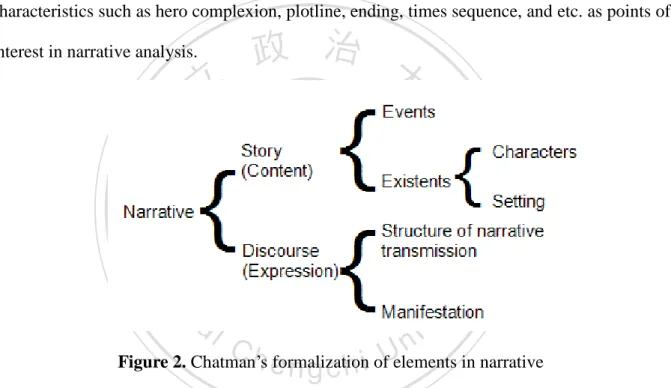
(17) CHAPTER 2 Related Work. 政 治 大 Narratives, interactive or not, have been a constant topic of interest in the fields of literature 立. ‧ 國. How to tell a compelling story by combining discourse (the. 學. and communications.. expression), story (the action and plotline), and narration (the organization of the events). ‧. (Lothe 2000) is crucial to literary as well as communication design.. Moreover, with. sit. y. Nat. interactive technologies in the picture, multimedia storytelling further explores the many. er. io. aspects of automation, personalization, and replay-value in storytelling.. al. n. iv n C U h e n gtopics In this chapter we attempt to approach storytelling from its roots in c h iin interactive narrative theory, the role of the author and computer technology in narrative creation, and current implementations of virtual storytelling environments that have influenced the design of our system.. 2.1 Interactive Narrative Theories and Structure Since Roland Barthes’s statement in his “The Death of the Author” (1967) that releases part of the authorial control to the reader, the role of the reader in the creative text has gone from singly receptive to participative in the work and its societal impact: “a text is not a line of 5.
(18) words releasing a single 'theological' meaning (the 'message' of the Author-God) but a multi-dimensional space in which a variety of writings, none of them original, blend and clash.”. Recent attempts to understand collaborative storytelling include the Story Circle experiment carried out by a cross-national research group to encourage the mass public to film parts of their lives and stories to share with the world (Hartley & McWilliam 2009).. 政 治 大. Though the stories created are not interactive, the project was pioneering in leading the world. 立. into the era of digital storytelling in which every reader is also a creator, challenging the. ‧ 國. 學. forms of storytelling to change with the advancement in technologies and communications. Murray’s Hamlet on the Holodeck also provides an optimistic viewpoint for the development. ‧. of computer assisted films and novels, believing that computer technologies can transform. y. Nat. io. and recombination of new mediums (Murray 1997).. n. al. Ch. engchi. er. sit. narratives into a more immersive and expressive form through computational technologies. i Un. v. With the rise of multimedia technologies, the emergence of non-linear storytelling has been explored by researchers in the field.. In her book Avatars of Story, Marie-Laure Ryan. examines issues in electronic and transmedia storytelling (2008).. She proposes that there are. certain textual architectures that are typical of interactive narratives, which affect the plotline, discourse, and story as demonstrated in Figure 1.. Ryan also identifies the types of. interactivity commonly seen, and how they relate to characteristics such as perspective, time, and dramatization discussed in narrative theory.. 6.
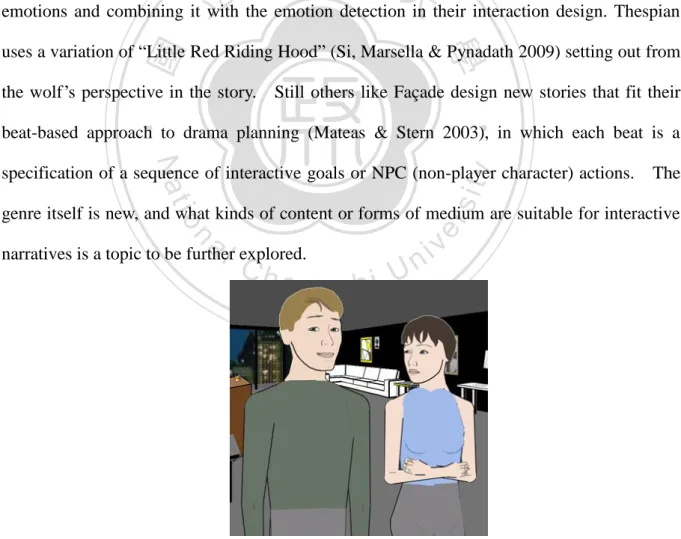
(19) 立. 政 治 大. ‧. ‧ 國. 學. Figure 1. Plot architectures of interactive narratives proposed by Marie-Laure Ryan. sit. y. Nat. er. io. Bryan Alexander (2011) also points out how the internet, multimedia, and computer games. al. n. iv n C perspectives to the story, and blendhthe e nlinegbetween c h i Ufiction and reality to establish a more exploit the benefits of digital storytelling to create collaborative narratives, bring together new. immersive experience.. In order to break down a narrative to fine-grained fragments for story generating, we survey literary theories on narrative structure.. Existing structuralist theories provide an. excellent basis in designing a story structure comprised of fragments, or analyzable units of story, and these theories also serve as an important source to designing temporal and character arrangements such as flashback, chronology, or ellipses.. Vladimir Propp had provided a. theorem for the breaking down of folktales into 31 functions (Propp 1928), and the functions 7.
(20) are connected into sequences of plot units called “moves.” However, Propp’s formalism has been found to be too rigid and is considered linear to be modeled for interactive narratives due to its restrictions on the order and content of story events (Tomaszewski & Binsted 2007). Chatman proposes models in which there is a separation between form and content, narrative and discourse to break down the story content into elements that can be manipulated and recombined individually, as shown in Figure 2 (Chatman 1980).. He also provides story. characteristics such as hero complexion, plotline, ending, times sequence, and etc. as points of interest in narrative analysis.. 立. 政 治 大. ‧. ‧ 國. 學 er. io. sit. y. Nat. al. n. iv n C h eformalization Figure 2. Chatman’s n g c h i ofUelements in narrative In the areas of generative narrative creativity and literature of drama managements systems, the concept of story fragments has also been greatly discussed.. Mateas and Stern. (2002) introduced the concept of beats, which are a collection of goals and actions for each story fragment.. The structure allows the user to specify what happens in each beat, and. whether there are goals or preconditions, but does not address the question of reusability or time sequences, and they are also platform specific. Case-Based Reasoning methods were proposed for plot generation of specific structured stories (Turner 1992; Gervás et al. 2005). Riedl and León (2008) proposed the concept of a “vignette” which is comprised of an action, 8.
(21) the character, and its current states. Preconditions for each vignette are checked to be fulfilled before the story progresses. This brings the story down to very concise character-action-state statements, but may result in a more loosely structured story in terms of story themes or overall plotlines. Moreover, though the concept of beats and vignettes have a basis in planning algorithms for story generation, the preconditions in the vignettes and beats is sometimes just as or even more rigid and complicated than branching formalisms. The planning formalism also requires much more effort on the authoring side to maintain the logic of the overall. 政 治 大. storyline. To deal with complicated storytelling scenarios, branching algorithms are much. 立. more intuitive for current storytelling applications.. ‧ 國. 學. 2.2 Applications for Interactive Narrative Creation. ‧. The collaborative nature of digital narratives calls for the development of more sophisticated. y. Nat. With the diversity of multimedia. sit. authoring tools that are widely accessible to the public.. n. al. er. io. platforms, it is difficult for any person to realize their creations without having prior knowledge of the specific platform.. Ch. i Un. v. Thus the issue of script generation is closely tied to. e nPast h i use graph visualization techniques and g cprojects. tools and interfaces to author the script.. pre-designed slots for authors to fill in (Spierling, Weiß & Müller 2006).. Some. implementations allow users to recombine existing multimedia content to author non-linear narratives (Schneider et al. 2003). Another interesting issue on authoring tools is not only how the tool can ease the creation process, but even further enhance the creative process by providing content or structural suggestions on the narrative.. Chang et al. (2011) designed a computer-aided. system that assists authors to create fairytales through image and text libraries that are 9.
(22) organized based on Propp’s formalisms.. The designed interface allows users to browse and. borrow existing content in their own stories.. The adaptation of famous literary works into interactive narratives (Spierling & Homann 2010) brings to light the question of the suitability of various genres of fiction to be adapted into an interactive narrative.. In literary theory, there is no standard to what kind of story. makes a good interactive narrative. The system EmoEmma adapts Madame Bovary (Cavazza. 政 治 大. et al. 2009) taking advantage of Gustave Flaubert’s detailed notes on character thoughts and. 立. emotions and combining it with the emotion detection in their interaction design. Thespian. ‧ 國. 學. uses a variation of “Little Red Riding Hood” (Si, Marsella & Pynadath 2009) setting out from the wolf’s perspective in the story.. Still others like Façade design new stories that fit their. ‧. beat-based approach to drama planning (Mateas & Stern 2003), in which each beat is a. y. Nat. sit. specification of a sequence of interactive goals or NPC (non-player character) actions.. The. n. al. er. io. genre itself is new, and what kinds of content or forms of medium are suitable for interactive narratives is a topic to be further explored.. Ch. engchi. i Un. v. Figure 3. Façade (2005) is a well-recognized example of interactive storytelling. 10.
(23) Finally, in narrative generation, it is also relevant to mention the applications to NLP in interactive storytelling.. Especially in text-based narratives, time and consistency is a topic. of constant discussion when considering the textual presentation of events. Montfort (2007) specifically discusses the issue of grammatical tense in interactive narratives using an ordered tree representation of time. Lönneker (2005) introduces architecture for “levels” of narrative in story generation technologies to deal with natural language issues such as tense and perspective, which provides a basis for designing embedded story structures.. 治 政 大 2.3 Story Generating and Content Filtering Techniques 立 ‧ 國. 學. Story generation techniques can assist the creative process by recombining story elements into various possibilities.. Si et al. (2009) also proposed a planning technique by deciding. ‧. character actions at runtime.. However, they approach story generation by evaluating. y. Nat. n. al. Porteous et al. have used character perspectives to. er. io. narratives with loose plot structures.. sit. character-based goals and not plot-based, which may sometimes result in incoherent. i Un. v. generate various storylines that fit the specified point-of-view (2010).. Ch. engchi. They apply a. planning technique that searches and chooses story segments that serve as a suitable next-step at runtime.. In a later work by Porteous et al. (2011), they also employ temporal management. to ensure feasible plotlines by pre-planning character-agent actions to fulfill plot goals. Their research demonstrates how story characteristics such as perspective and time sequences can be modeled and incorporated into virtual narratives, but we further extend the characteristic filtering mechanism in this research to incorporate real-time user interaction.. By generating and filtering story fragments to produce new narratives, we not only enhance creativity, but also allow for more personal and user-conforming storytelling 11.
(24) experiences.. The issue has been addressed by Riedl (2009), who first proposed a model to. set authorial goals at which story should aim.. The branching structure allows easy pruning. of the story graph to find paths that generate a conforming narrative. Yu and Riedl (2012) further explored the topic, using learning techniques to simulate user preferences and score certain stories.. From the previous work on generative and interactive narratives we draw a few observations.. 政 治 大. First of all, both branching and planning formalisms adopt precedence and. 立. conditional logic to preserve the temporal structure of the narrative.. Branching is often. ‧ 國. 學. considered more restrictive in generative power than planning, but has greater control over the coherent and logical expression of the narrative at runtime, as well as efficient management of. ‧. user decisions (Ryan 2006).. While planning algorithms provide the capacity for dynamicity. y. Nat. sit. in storytelling, their benefits are often insufficiently explored due to the limitations on the. n. al. er. io. scalability of existing stories, while our proposed branching formalism, combined with an. i Un. v. intelligent filtering mechanism, provides more room to explore storylines that demand strong. Ch. engchi. control of plot logic while using filtering algorithms to achieve personalization.. Second, and. most importantly, though a few generative architectures enforce some form of temporal logic by using precedence conditions, in most cases they only work linearly (without real-time user interaction) and cannot present temporal variations.. The issue of generating large-scale. dynamic stories by altering perspective or temporal sequences is still an ongoing difficulty (Gervás et al. 2006).. Though past work (Porteous et al. 2010; 2011) has addressed issues. concerning perspectives and timing in virtual narratives, the addition of user interactivity and real-time dynamicity is a central contribution in this work.. 12.
(25) Finally, current research on generative interactive simulation with considerations to time and perspective often focuses on a limited aspect of presentation.. Text-based systems. address the grammatical accuracy in tense and focus, while 3D virtual drama platforms use temporal planning for agent and animation planning.. Thus, we present a system that. observes temporal issues in the plotline, with sufficient abstraction from the presentation.. 2.4 Virtual Environments for Interactive Storytelling. 立. 政 治 大. Recent progression in development of virtual environments with autonomous character. ‧ 國. 學. animation engines, novel interaction methods, automatic camera and lighting techniques, and intelligent drama management have brought interactive storytelling a step forward to take on a. ‧. more immersive, expressive, and realistic form of presentation.. Nat. y. In a qualitative survey of. sit. recent drama management platforms (Roberts & Isbell 2008), we note a few arising. n. al. er. io. characteristics to observe and analyze interactive narratives, including replay value, the. i Un. v. dilemma between authorial control and user autonomy, and other aspects of authoring and immersiveness.. Ch. engchi. A basic implementation of interactive narratives is in a text-based system, as demonstrated by the marlinspike interactive drama system (Tomaszewski & Binsted 2009), which can take in a specific set of typed user actions and returns pre-authored story segments. The drama manager designed in the system records parameters in past story segments into its decision-making, in order to make decisions that maintain the logic and coherence of the overall narrative.. 13.
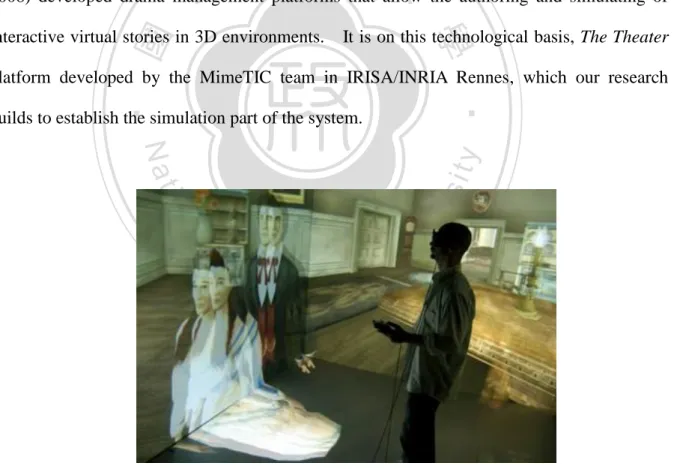
(26) Swartout et al. (2001) first recognized interactive narratives as a vessel for integrating storytelling with multimedia environments that contain visual-audio content.. From hence on,. a wealth of research saw bloom for virtual storytelling environments with autonomous character, lighting, and camera models that adapt real-time to various scenarios (Lino et al. 2010; Chen & Li 2012).. New ways of interaction such as voice and emotion detection used. by Cavazza et al. (2009) and multiplayer models (Fairclough & Cunningham 2003) were built to provide even more interactive and immersive experiences.. The former European project. 政 治 大. IRIS Network of Excellence—Integrating Research in Interactive Storytelling (Cavazza et al.. 立. interactive virtual stories in 3D environments.. 學. ‧ 國. 2008) developed drama management platforms that allow the authoring and simulating of It is on this technological basis, The Theater. platform developed by the MimeTIC team in IRISA/INRIA Rennes, which our research. ‧. builds to establish the simulation part of the system.. n. er. io. sit. y. Nat. al. Ch. engchi. i Un. v. Figure 4. EmoEmma uses a voice-emotion interface for user interaction. 14.
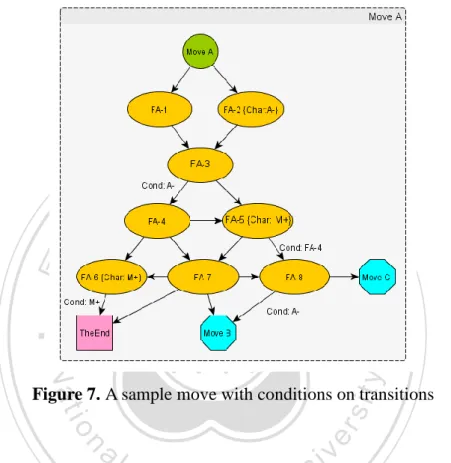
(27) CHAPTER 3 System Design. 政 治 大 The design of the interactive narrative scenario generation and simulation involves five main 立. ‧ 國. 學. parts: the Authoring Process, Linking Process, Interactive Story Generation, Discourse Representation, and the final Interactive Story Simulation.. The relation between each step is. ‧. demonstrated in Figure 5.. n. er. io. sit. y. Nat. al. Ch. engchi. i Un. v. Figure 5. System Workflow. 15.
(28) The details of each stage are explained in the following sections.. In the first section we. describe the authoring process, where the author may create and edit any number of story fragments according to their own creative process, creating a story pool which is the basis to all the following stories.. The fragments are then tagged and linked together into a story. graph, and through conditions and user-defined preferences, the fragments are filtered to generate a subgraph that fits all these constraints.. Based on the implementation platform, the. 政 治 大. discourse of the narrative can be designed according to the content and then simulated.. 立. In. this implementation, we demonstrate the abstraction of the authoring from the implementation. ‧ 國. 學. by simulating the story both in text and in the 3D environment of The Theater.. ‧. 3.1 Authoring Process. y. Nat. n. al. For example: even if the events in your story. er. io. not always come at any particular sequence.. sit. If you have had experience of writing a story, you may realize that the creative process does. i Un. v. are narrated in chronological order, your writing and thinking process is not necessarily so.. Ch. engchi. The authoring process of the interactive narrative could be seen as similarly spontaneous and unpredictable.. Thus we hope to design an XML format to allow most flexibility and. expressiveness in the interactive script. The most basic unit of the story script is what we call a “fragment” which ideally includes a small unit of action, description, or thought stream of one or a group of characters.. For example, taking Gerald Prince’s example of a minimal. story, “John was happy,” “John met a woman,” and “John was unhappy” could be fragments that could be arranged to create story variations (1974).. The author does not need to assume. any specific order or relationship between the fragments in this stage. 16. It is similar to the.
(29) brainstorming stage of the creative process. The authoring process is depicted in Figure 6 where the user can add and remove story fragments according to their own preferences.. Descriptive characteristic tags can be added. to the fragments for personalized filtering described in Section 3.3. The authoring fragments can be reused in various stories the author wishes to create.. 立. 政 治 大. ‧. ‧ 國. 學 er. io. sit. y. Nat. Figure 6. Authoring process and the story pool. n. al. v. The information contained in the story fragment includes: 1. ID:. i n C U hengchi A unique id for the fragment. 2. Characteristics: Tags that the author can give each fragment.. They may be. keywords or other characteristics that help the author categorize the fragment or personalized filtering. 3. Parameters:. Integer parameters that be given a value, incremented, or. decremented. 4. Description: 5. Decisions:. A short summary of what happens in the fragment. The fragment can embed other sub-fragments that allow decisions—a. dividing of the story path or changing of story characteristics/parameters—based on 17.
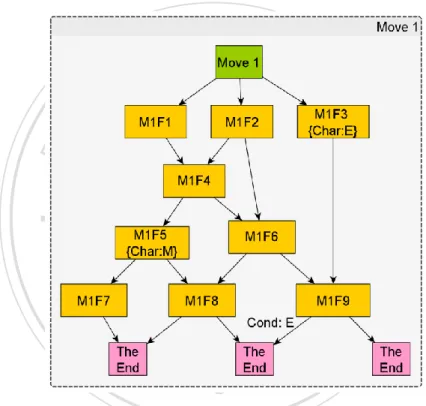
(30) the user’s decisions to affect the outcome of the story. 6. Embedding Points:. Certain points where the story can optionally branch out and. play a specific fragment before continuing the fragment.. This is a design to. generate stories with varying point-of views and time sequences.. The result of the authoring process would be a pool of fragments that can be connected logically in the linking process (described in the next section) to produce a story graph for the interactive script.. 立. 3.2 Linking Process. 政 治 大. ‧ 國. 學 ‧. 3.2.1 Conditions. y. Nat. sit. The second aspect of the linking process is setting conditions to the transitions.. In a. n. al. er. io. complicated branching story, there are so many paths to recombine story fragments that the. i Un. v. author cannot keep track of which path is logical while others may be not.. Ch. engchi. In this case, by. evaluating the characteristics previously set in the authoring process, authors can now restrict the combinations of stories by evaluating the characteristics.. Suppose after linking the fragments, we have a collection of fragments that form a “move” or what is similar to a chapter in a text story.. Each move has entering points (initial. states) and exiting points (transition states or end states).. A sample move is depicted in. Figure 7 below, where each node is a fragment, and the string sequence on the node is the identifying ID of each node, followed by characteristic tags, which are embraced in the curly brackets.. The green node signifies an entering point into the move. 18. The yellow nodes are.
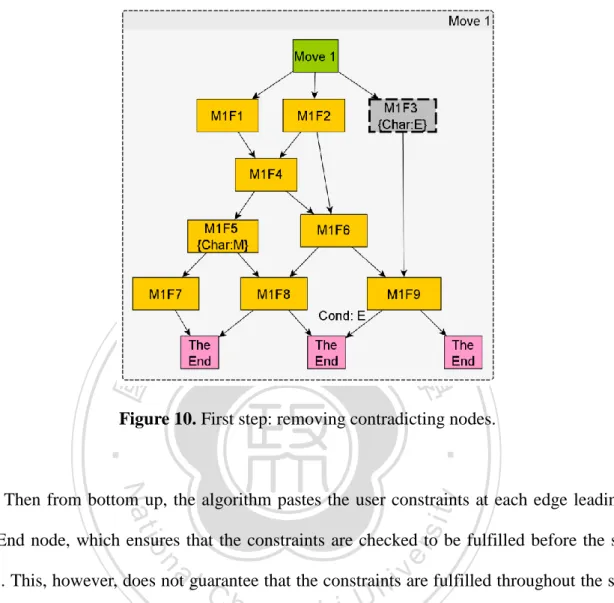
(31) normal story fragments.. Blue nodes indicate a transition from one move to another, while. the pink “TheEnd” node ends the story.. 立. 政 治 大. ‧. ‧ 國. 學 y. Nat. n. al. er. io. sit. Figure 7. A sample move with conditions on transitions. Ch. i Un. v. Using an example to explain conditions, in Figure 7 we see the edge between fragment. engchi. FA-8 and Move B has a condition A-, which means that a path that does not go through FA-2 (which is the only fragment with the characteristic A-) would be illegal to go through that edge. For example, the path "Move A" → "FA-1" → "FA-3" → "FA-5" → "FA-7" → "F-A-8" → "Move B" would be illegal.. Thus conditions enforce logical precedence. between story fragments.. With the use of conditions, we can allow the author more control over the story during the linking process and thus creating more believable and logical transitions.. 19.
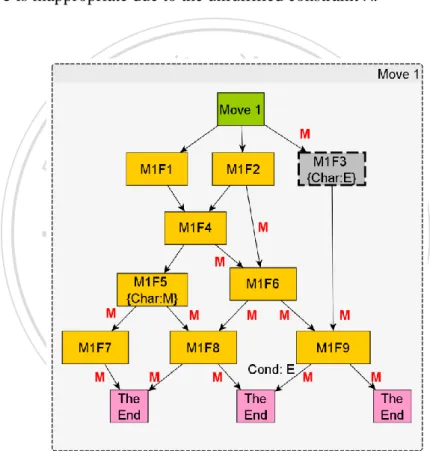
(32) 3.2.1 Moves and the Story Graph Once we have conditions and edges to link the fragments into moves, moves can then in turn be linked together to generate complicated plotlines that involve multiple sequences of plot. Moves can also branch to various other moves through the transitional nodes, thus creating a complicated story graph.. 治 政 大 3.3 Story Generating and Filtering 立 ‧ 國. 學. Conditions and characteristics provide ways for the user to restrict the interactive script generation output to stories that conform to certain constraints.. To do this, we use a filtering. ‧. algorithm that evaluates the characteristic tags on story fragments and the conditions on the. y. Nat. n. al. er. io. sit. edges in order to determine if there are any constraints that are violated.. i Un. v. The proposed algorithm is described in Figure 8. A node means a fragment in the story. Ch. engchi. graph. We first assume that the author is very thorough and subjective in adding characteristics to each fragment, tagging all sad story endings with a characteristic called tragedy T.. In this case, the user of the system could set a constraint T = false, and the. algorithm would perform a traversal through all the possible story paths, removing all the fragments that have the characteristic T+, ensuring that the resulting story is not sad.. Another way to set constraints is by giving values to parameters. Suppose a user would like to experience a story of limited complexity, defined by Propp (1928) as the number of moves (progression from recognition of a lack to its liquidation), with an increasing degree 20.
(33) from 1 to 4.. Then the user could set a constraint complexity<=2 to the story to indicate. that they would like to have a simple story with 2 or less moves.. Again, an algorithm is. applied to filter paths that are too long. Algorithm 1 Traverse (node N, constraints C) 1:. if C violates descriptors of node N then remove node N, and node’s incoming and outgoing edges. 2: 3:. end if. 4:. for all sons s of node N do. 5:. if s has not been traversed then. 政 治 大 Traverse(s, C). 6:. tag s as traversed. 立 end if. 7: 9:. 學. ‧ 國. 8:. end for. 10: if all outgoing edges of N have conditions then for all outgoing edges e of node N do. cond cond ∨ conditions on edge e. 14:. for all descriptors d of node N do. cond = negateCondition(d, cond). er. io. al. y. end for. Nat. 13:. sit. 12:. 15:. 19:. end for. 17:. n. 18:. iv n C for all incoming edges e of node heng i U N do h c add conditions cond to edge e. 16:. ‧. 11:. end for. 20: end if. Figure 8. Algorithm for story generating. In detail, there are five main steps to the algorithm: (1) Setting user constraints (2) Removing contradicting nodes (3) Pasting user constraints (4) Propagating and reversing user constraints (5) Removal of dead ends.. 21.
(34) In the first step the user defines a set of constraints that they would like to see fulfilled in Suppose the user would like a story where E = false (no evil. the ultimate outcome.. character), M = true (with magical elements), we have an initial story graph as depicted in Figure 9 with the fragments M1F3 tagged with characteristic E, and fragment M1F5 tagged with characteristic M.. 立. 政 治 大. ‧. ‧ 國. 學. n. er. io. sit. y. Nat. al. Ch. engchi. i Un. v. Figure 9. Example initial story graph. Once the constraints are set, the algorithm first carries out a depth-first search through the story graph to remove any contradicting nodes, i.e. any nodes tagged with the characteristic ‘E’ in this example, which represents Evil. We do not do anything with the M characteristic. We cannot determine whether a fragment is a desirable one simply by checking for the presence of M, since it may be fulfilled in other fragments of the storyline. The resulting story graph from the first step can be seen in Figure 10, where M1F3 is removed. 22.
(35) 立. 政 治 大. ‧ 國. 學. Figure 10. First step: removing contradicting nodes.. ‧ y. Nat. sit. Then from bottom up, the algorithm pastes the user constraints at each edge leading to. n. al. er. io. TheEnd node, which ensures that the constraints are checked to be fulfilled before the story. i Un. v. ends. This, however, does not guarantee that the constraints are fulfilled throughout the story,. Ch. engchi. and can easily lead to an illogical story or dead end, since there are no constraints to limit where the story can lead throughout the story graph.. Thus we need the third step: to. propagate and reverse the constraints throughout the story graph. The act of propagating and reversing is done intermittently: given our current node position P, we take all the constraints on the outgoing edges of P and “reverse” them according to any changes within P. For example, if P is tagged with the characteristic ‘Magic’ and has the parameter change of ‘complexity+=1’ then the user constraints originally ‘Magic=true’ and ‘complexity>=2’ is reversed into only ‘complexity>=1’ indicating that condition of ‘Magic’ is fulfilled, and the complexity was incremented in this node. The union of all the reversed constraints for each 23.
(36) edge are propagated and pasted to the incoming edges of P to indicate that at least one of the reversed outgoing edges of P must be satisfied prior to entering P. This process of reversing and propagating ensures that all end constraints (as well as other edge constraints that are reversed along the way) are checked and validated at the beginning of the story. As demonstrated in Figure 11, we can immediately determine that the edge between fragment M1F2 and M1F6 is inappropriate due to the unfulfilled constraint M.. 立. 政 治 大. ‧. ‧ 國. 學. n. er. io. sit. y. Nat. al. Ch. engchi. i Un. v. Figure 11. Pasting, reversing, and propagating end conditions. Though propagation and reversing already ensures that no dead ends will occur in the story, for the last step we still remove unfeasible dead ends to generate a complete subgraph (as shown in Figure 12) of the original story of all feasible story paths.. 24.
(37) 立. 政 治 大. ‧ 國. 學. Figure 12. Removing dead ends obtaining the final subgraph. ‧ y. Nat. sit. Filtering of parameters and characteristics alone do not contribute to a suitable story.. n. al. er. io. Suppose the algorithm generates a story: Once upon a time there was a man called. i Un. v. John. He did many evil things. Then he went to Heaven after he died.. Ch. engchi. Assuming there no unknown events in the story, even though the story is indeed simple and not of a sad ending, the reader can reasonably doubt the logic of the author.. In order to. preserve the logic of the story, the conditions that were set in the linking process must be strictly upheld, while ensuring that there are no dead ends.. The filtering and story generation mechanism not only provides personalization on the level of characteristics, but is also applied in our system to maintain story structure using an example of the six modes of plot proposed by Chatman (1980).. 25.
(38) Chatman’s six modes of plot: a. An unqualifiedly good hero fails b. A villainous protagonist fails c. A noble hero fails through miscalculation d. A villainous protagonist succeeds e. An unqualifiedly good hero succeeds f. A noble hero miscalculates, but then is redeemed. We are able to tag the fragments with customized characteristics as indicated below:. 治 政 Tragedy (T)—Bad ending (combined with大 Genre) 立 hero Hero (H)—A good ‧. ‧ 國. 學. Miscalculation (M)—Hero makes a mistake. Then Chatman’s six modes of plot can be interpreted as the following logical expression. sit. al. er. io. An unqualifiedly good hero fails: H ∧ T A villainous protagonist fails: ¬ H ∧ T A noble hero fails through miscalculation: H∧M∧T A villainous protagonist succeeds: ¬ H ∧ ¬ T An unqualifiedly good hero succeeds: H ∧ ¬ T A noble hero miscalculates, but then is redeemed: H ∧ M ∧ ¬ T. n. a. b. c. d. e. f.. y. Nat. of conditions:. Ch. engchi. i Un. v. The resulting output is a story graph that is both comprehensive (includes all possible paths that fit the constraints) and restricting (only those paths that fit the constraints). story can then be run in real-time.. The. A sample run of the story graph on the constraints. complexity>=4;‘T’=true; ‘H’=false is shown below in Figure 13.. 26.
(39) 立. 政 治 大. ‧. ‧ 國. 學 er. io. sit. y. Nat. al. n. iv n C Figure 13. Sample story graphhonethe n gconstraints c h i Ucomplexity>=4;. ‘T+’=true. 3.4 Time and Perspective The addressing of time sequences and perspectives in narratives is extremely challenging when it comes to narrative generation due to three main issues: logicality, interactivity, and presentation.. First of all, if the story would require flashbacks or jumps in the sequence of. events, how to preserve the logicality of the generated events is extremely important.. For. example: What happens in the present (such as opening a treasure chest) must be causally. 27.
(40) logical with something that happened in the temporal past (found a key corresponding to the chest somewhere).. Similarly interaction both in the present and flashback past most be. coherent on the temporal timeline, for example, if a character chooses to open a chest in the present, in a flashback he or she must choose a path that leads them to the key (and the chest). Finally, given that the logic of sequenced events is believable, how to present them such that the perceiver understands that there is a change in the sequence of events or show specific character perspectives (such camera movement) also requires knowledge in cinematography In this thesis we only address the first 政 治 大. that cannot be addressed by the story structure alone.. 立. two issues and leave the last one for further investigation.. ‧ 國. 學. We address the issue of time sequence with the concept of “embedding,” the situation. ‧. where one story event happens within the presence of another event.. Nat. y. When embedding. n. al. In the revalidation process, for every fragment. er. io. within and outside the embedded fragment.. sit. occurs within the story graph, we use revalidation to ensure the logicality and interactivity. i Un. v. the user chooses, removing any illogical branches following or preceding, while preserving all. Ch. engchi. that are validated, thus preserving the interactivity.. The algorithm for the revalidation. process is as indicated in Figure 14.. There are three main steps to the algorithm: first, it checks the time frame of the fragment (whether it is currently an embedded node that is out of chronological order) and uses a flag to record the levels of embedding. Next, it revalidates the story graph based on the current node to ensure that the whole narrative sequence maintains its logicality, using the validation algorithm in Figure 8. Finally, it returns the next valid node calculated.. 28.
(41) Algorithm 2 Real-Time Decision (Decision D) 1: 2: 3: 4: 5:. if current node has embedding then embedLevel+=1 push node N into levels stack L next node N’ = embedding entrance point Ne embedFlag = true. 6:. end if. 7: 8:. if embedFlag is false and embedLevel>0 then current node N = pop L. 政 治 大. 9: end if 10: get next adjacent node N’ from current node N and decision D. 立. 11: for all incoming edges e of node N’ do. ‧. ‧ 國. 學. 12: C C∨conditions on e 13: end for 14: Traverse(s, C) 15: return next node N’. sit. y. Nat. er. io. Figure 14. Algorithm for real-time decision. al. n. iv n C he However, due to the complexity of n the revalidation g c h i U process, the embedding is currently only proven on a minimal example with limited conditions (boolean conditions only) in order to demonstrate its capacity, but not included in the full demonstration or user evaluation.. The implementation of perspective filtering is much more straightforward, where we set a condition that has to be fulfilled throughout the story: the presence of a certain character from whom our perspective sets out.. When the character is not present in a fragment, that. fragment is still evaluated in order to preserve the logic of the events, but the presentation is repressed and hidden from the audience. 29.
(42) An example of perspectives and time sequences can be seen in the second demonstration in chapter 4.. 3.5 Discourse Representation After generating a story, it has to be presented in some form of narrative discourse—whether in text, film, animation, or sound—to be experienced.. In the system design, this research. 政 治 大. does not assume that the narrative is for any specific platform, and instead tries to model the. 立. high-level elements that apply to all forms of discourse.. ‧ 國. 學 ‧. 3.5.1 System Representation. y. Nat. n. al. previous section is based on this XML script. shown below:. Ch. The story generation mentioned in the. er. io. story tags, characteristics, fragments, and conditions.. sit. An XML high level story script is used to represent the story graph and its corresponding. i Un. v. The basic design of the XML script is as. engchi. <Story title="Whodunit vs. Howdhecatchem" author="Helen"/> <move id="Investigation"> <transition num="Deny"> <descend desc="Convicted_Wrong"> <and> <testCharacteristic variable="Murder" value="false"/> </and> </descend>. 30.
(43) <descend desc="Convicted_Right"> <and> <testCharacteristic variable="Elope" value="false"/> </and> </descend> </transition> <transition num="Convicted_Wrong"> … </move> <function id="Deny" description="The wife denies any knowledge of the. 政 治 大. murder." propp="" characteristic="Deny:wife:inspector:lie"> <embed id="Murder">. 立. </function>. ‧. ‧ 國. 學. The story script includes the story title, its author, and specification on the moves and Conditional statements may be added on edges between transitions in. sit. y. Nat. functions of the story.. n. al. er. io. the moves, while characteristic tags and parameters can be added on the fragments. In order to. i Un. v. address time sequences, other moves and fragments may be embedded in fragments to create varied time sequences.. Ch. engchi. The XML script can be flexibly edited, extended, and reorganized as. fitting to the author’s creative process.. This XML script is the high level concise representation of the story, and its purpose is meant for system interpretation. Though it also represents the main concept of the story, it is not a suitable form of representation for most people. Therefore, in order to demonstrate the abstraction between content and discourse, story and form of presentation, we propose to simulate the story in two modes: first in the simple text-based narrative, and later in the 3D environment. 31.
(44) 3.5.2 Text Representation The simplest form to present the interactive narrative is in text form, where each fragment has a corresponding piece of text. A sample output in text form is as follows with the conditions complexity<=1 and tragedy=true, and it simulates the user choice with a random seed every time there is a branch (such as in M1F2A there is a decision).. 政 治 大. M1F1 There was once a poor father of twelve, just given birth to his 13th son.. 立. M1F2 The poor father does not have enough money to feed his smallest son.. ‧ 國. 學. M1F2A The father decides to find a godfather for his son. .... ‧. M1F9 The boy lives a difficult life, but in afterlife he has eternal joy.. y. Nat. io. sit. The End. n. al. er. TheEnd. iIfv we output the whole story in a n U. Each fragment has a description preceded by its ID.. Ch. engchi. single paragraph, we would have something that looks like:. There was once a poor father of twelve, just given birth to his 13th son. The poor father does not have enough money to feed his smallest son. The father decides to find a godfather for his son.... 32.
(45) 3.5.3 3D Representation. 立. 政 治 大. ‧. ‧ 國. 學 sit. y. Nat. er. io. Figure 15. Workflow of the interactive narrative simulation. n. al. Just as each narrative. iv n C hen fragment has ac corresponding g hi U. text description, in the 3D. representation, instead of a text description, each fragment has a corresponding 3D counterpart that specifies the theatrical aspects of the fragment.. The corresponding fragment. is mapped to an XML scenario, the interactive script that specifies the character animations, user interaction options, scene locations, and camera movement.. The process in which the. script generation works with the 3D animation engine is as illustrated in Figure 15, and the mapping of the fragment to XML scenario can be seen in Figure 16.. 33.
(46) 立. 政 治 大. ‧. ‧ 國. 學 sit. y. Nat. er. io. Figure 16. Fragment and corresponding XML scenario. al. n. iv n C hstory After the author has created the graph, i Ucan further specify the corresponding eng c hthey 3D scenarios, character, text, and camera.. The script engine works independently of the. animation engine, generating an interactive script that tells the animation engine the sequence of events to play.. The animation engine then requests and directs the 3D content and. displays the result to the audience.. Since it is an interactive narrative, the audience can then. provide feedback, which is returned either to the animation engine to produce character behaviors unrelated to the story, or returned to the script engine to plan the next step in the story.. The details of the implementation on The Theater are outlined in the next section.. 34.
(47) 3.6 The Theater Platform Implementation The simulation of the generated narratives is performed by The Theater 3D animation engine with smart characters and an automated cinematography system.. The Theater is currently. developed and maintained by the MimeTIC team at IRISA/INRIA, France.. One main purposes of using The Theater as a simulation platform is to demonstrate the. 政 治 大. separation of the semantic description of scene and character behaviors from the visual. 立. implementation in the virtual environment.. As described in the previous section, each story. ‧ 國. 學. fragment has a corresponding XML script composed of high-level actions, character behaviors, and specification of the scenario. The author can assign a selected set of behaviors. ‧. (e.g. character dialogues and basic movements, interacting with objects, travelling to certain. y. Nat. sit. locations). The animation engine then translates these commands into exact coordinates and. n. al. er. io. plans paths accordingly for characters and camera to simulate.. i Un. The cinematography engine. v. is based on an implementation of Director Volumes (Lino et al. 2010) which selects best. Ch. engchi. viewpoints and cuts from classical filmmaking theories.. The Theater platform is composed of three main parts: 1. Simulation engine: The input of the simulation engine is an XML-based interactive scenario generated by the graph traversal algorithm Figure 8.. The simulation. engine analyzes the script, evaluates the conditions and interaction, and directs the character and cinematography engine to execute each fragment. 2. Character behavioral engine: Allows authoring of complex behaviors, path planning, basic interaction, and modeling and assigning of high-level behaviors to characters. 35.
(48) 3. Cinematography engine: A real-time cinematography engine that presents the narrative through decisions on the viewpoint, camera movement, and transitions between cuts and scenarios.. 立. 政 治 大. ‧. ‧ 國. 學. n. er. io. sit. y. Nat. al. Ch. engchi. i Un. v. Figure 17. Sample output of the animation engine with scenario generation, camera and character behavior specification, and simple interaction mechanism. 36.
(49) CHAPTER 4 Examples & Demonstration. 政 治 大. 立. ‧ 國. 學. 4.1 Godfather X. ‧. The first story authored is based on the Brothers Grimm story “Godfather Death” which has been enriched by various variations throughout its development, with both tragic and happy. y. Nat. We exploit this. er. io. sit. endings, different character genders, and even completely different plotlines. benefit to create an interactive story based on these variations.. n. al. Ch. engchi. i Un. v. The basic storyline is about the outcome of a son of a poor father who has no money to raise him.. As a solution, the father decides to go into the streets to search for a suitable. godfather for his son (or he simply throws the son out to be picked up), and he is approached by the Angel, the Devil, and Death.. In the Grimm version, the father rejects the Angel and. Devil, believing them to be unfair and treacherous respectively, and turns his son over to Death, who equally takes everyone. becomes a famous physician.. The son then grows up and under the guidance of Death,. However, in pursuing his personal wealth and happiness, he. defies his Godfather’s orders, and is in the end punished and killed.. 37.
(50) In deciding the appropriate branching points of the story (since the original Brother’s Grimm version is a linear narrative), we refer to the Irish, Mexican, and Lithuania versions of the fairytale. The plotline deviates depending on the gender of the protagonist, which godfather is chosen, the character alignment of the Godfather Death (in some version, he is depicted with a more villainous character). Also, the protagonist, through a series of tests and incidents, makes choices on his future path, which can lead to either happiness or tragedy.. 政 治 大. We take the variations of the fairytale in various cultures into consideration when rewriting an. 立. interactive version of the Godfather Death story, renaming it as “Godfather X” to indicate the. ‧ 國. 學. open-ended nature of the story and independence from the original plotline.. ‧. The fully authored story graph of this story contains 79 story fragments, grouped into. y. Nat. n. al. er. io. sit. sequences of seven moves, and can produce over a thousand story variations.. i Un. v. Two example text-based representations of the story are as follows.. Ch. engchi. The first one is. generated with end conditions of a low complexity story (number of moves less or equal to one) and happy ending.. Once Upon a Time... M1. -Move 1-. M1F1. There was once a poor father of twelve. He has just given birth to his thirteenth son.. M1F2. The poor father does not have enough money to feed his smallest son.. M1F2A. The father decides to find a godfather for his son. 38.
(51) M1F3. The poor father decides to find a godfather for his son in the streets.. M1F5. The poor father takes his son with him into the street.. M1F6. He meets the Angel. The Angel offers to give the son health and happiness.. M1F6B. Accept the Angel's offer: the angel will bring the child the best future.. M1F9. The boy lives a difficult life, but in afterlife he has eternal joy and happiness.. TheEnd. The End. 政 治 大. 立. ‧ 國. moves greater or equal to 2) and tragic ending.. 學. The second story is generated on the conditions of a high-complexity story (number of An interesting thing to note is that this. ‧. generated sequence is very similar to the original Godfather Death story.. er. io. sit. y. Nat. al. n. Once Upon a Time.... Ch. i Un. v. M1. -Move 1-. M1F1. There was once a poor father of twelve. He has just given. engchi. birth to his thirteenth son. M1F2. The poor father does not have enough money to feed his smallest son.. M1F2B. The father decides to throw his son out into the streets.. M1F4. The poor father throws the son out of the house. The son is thrown on the sidewalk.. M1F8. He meets Death. Death offers that he is equal to all people.. M1F10. Death gives the 13th son a magical herb and tells him he will become a famous physician. If he stands at a sick person's head, the son can use the herb to cure the person. However, if death is standing at the foot, 39.
(52) nothing will save the person. M1F11. The son becomes a famous physician and makes a lot of money. M2. -Move 2-. M2F1. The king is ill. M2F2. The boy sees death at the foot of the king's bed. M2F2B. The boy decides to turn the king around so his head is in the direction of death and give him the medicine.. M2F4. The king eats the medicine.. M2F7. The king is healed.. M3. -Move 3-. M3F1. Death warns the boy never to defy his orders.. 政 治 大 The princess is ill 立. M3F2. 學. M3F3A. The boy sees death at the foot of the princess's bed. ‧ 國. M3F3. The boy decides to turn the princess around so her head is in the direction of death and give her the medicine.. M3F6. The princess eats the medicine. The princess gets well soon.. ‧. M3F4. Nat. M4. -Move 4-. M4F1. The boy is taken to his Godfather, Death's, cave, which. er. sit. y. The king marries the princess to the boy in gratitude.. io. M3F8. al. M4F5. The boy requests his godfather to have mercy and give. n. M4F3. iv n C represent theh length of their e n g c h i U life. The boy realizes his candle is about. is lit with candles. Death tells the boy that the candles to go out.. him a new candle. M4F9. Death pretends to help the boy but slips on purpose, and the boy dies as his candle goes out.. TheEnd. The End. The two examples demonstrate how our story structure can produce personalized stories that fulfill a certain set of story characteristics, and the produced story conforms to an. 40.
(53) extended Propp’s formation for fairytales.. The example also serves as a preliminary. demonstration of the capacity of creating an interactive story from a previous linear narrative on. our. platform.. A. video. of. this. demonstration. can. be. found. at. https://vimeo.com/63299165.. 4.2 Bedtime Story To address the issue of time sequences, we created a minimal example of an embedded story,. 政 治 大. inspired by the story structure of Arabian Nights where the bride of a Persian king tells stories. 立. that include other stories.. In the minimal example, a dog tells the puppy a bedtime story, and. ‧ 國. 學. based on the story the dog chooses to tell (a story about dog food or Cleopetra), the puppy either falls asleep due to boredom or content. The two generated variations are as below:. ‧. n. al. er. io. Embedding…. sit. The puppy wanted to hear a bedtime story.. y. Nat. *********************Example 1*********************. Once upon a time.. Ch. engchi. i Un. v. A story about Dog Food. TheEnd Returning… The story was so boring. The puppy fell asleep. The End. *********************Example 2********************* The puppy wanted to hear a bedtime story.. 41.
(54) Embedding… Once upon a time. A story about Cleopatra. The End. Returning… The story was so exciting. The puppy fell asleep. The End.. 政 治 大. 立. 4.3 Whodunit vs. Howcatchem (Demonstration and User Evaluation). ‧ 國. 學. The structure of the bedtime story is revised as a more complicated detective story used. ‧. in our evaluation, represented in Figure 18. The story graph uses the same notation as before. y. Nat. There is actually no direct edge. sit. except for the dotted lines, which denote an embedding.. n. al. er. io. connecting the entrance and exit point of the embedding. When the embedding takes place,. i Un. v. the algorithm detects a suitable entrance point in the move, and when finishing the embedding,. Ch. engchi. returns to the original embedding point.. Two sample stories generated using the embedding on the detective story is as below with the screenshots in Figure 19.. *********************Example 1********************* Entrance point for Investigation The inspector questions the wife who recollects the murder. Embedding…. 42.
(55) Entrance point for Murder The wife has long been dissatisfied with her husband Wife accidentally kills husband during heated discussion Returning… Wife makes a decision either to acknowledge the murder or not. The wife denies any knowledge of the murder. The wife was convicted and placed in the jail for her crimes. In jail, the wife regrets the lost chances and lost love of her. 政 治 大. lifetime. The End.. 立. *********************Example 2*********************. ‧ 國. 學. Entrance point for Investigation. The inspector questions the wife who recollects the murder.. ‧. Embedding…. sit. y. Nat. Entrance point for Murder. io. n. al. er. The wife has long been dissatisfied with her husband. i Un. v. Wife tries to escape the house to meet her lover to elope. Returning…. Ch. engchi. Wife makes a decision either to acknowledge the murder or not. The wife denies any knowledge of the murder. The wife is released due to insufficient evidence of her involvement, and leaves with a sense of guilt and loss. The End.. 43.
(56) 立. 政 治 大. ‧. ‧ 國. 學. n. er. io. sit. y. Nat. al. Ch. engchi. i Un. v. Figure 18. Mini detective story using embedding. 44.
(57) 立. 政 治 大. ‧. ‧ 國. 學 sit. y. Nat. n. al. er. io. Figure 19. Screenshots of final detective story. Ch. engchi. 45. i Un. v.
數據

+7


相關文件
張清榮 兒童文學創作論 新店:富春文化事業股份有限公 理論和.. 陳千武等 第四屆「兒童文學與兒童
In Section 4, we give an overview on how to express task-based specifications in conceptual graphs, and how to model the university timetabling by using TBCG.. We also discuss
Ramesh: An algorithm for generating all spann ing trees of directed graphs, Proceedings of the Workshop on Algorithms an d Data Structures, LNCS, Vol.. Ramesh: Algorithms for
Based on Cabri 3D and physical manipulatives to study the effect of learning on the spatial rotation concept for second graders..
In this paper, we have studied a neural network approach for solving general nonlinear convex programs with second-order cone constraints.. The proposed neural network is based on
The solvabilities of eigenvalue optimization problems associated with p-order cone and circular cone
In section 4, based on the cases of circular cone eigenvalue optimization problems, we study the corresponding properties of the solutions for p-order cone eigenvalue
Matrix model recursive formulation of 1/N expansion: all information encoded in spectral curve ⇒ generates topological string amplitudes... This is what we
We propose a primal-dual continuation approach for the capacitated multi- facility Weber problem (CMFWP) based on its nonlinear second-order cone program (SOCP) reformulation.. The
