國立交通大學
國立交通大學
國立交通大學
國立交通大學
英語教學研究所碩士論文
英語教學研究所碩士論文
英語教學研究所碩士論文
英語教學研究所碩士論文
A Master Thesis
Presented to
Institute of TESOL,
National Chiao Tung University
In Partial Fulfillment of the Requirements
for the Degree of
Master of Arts
強制性標準化測驗對大學生外語學習動機之影響
Impacts of Compulsory Standardized Exams on College Students’
L2 Learning Motivation
研究生:陳姿惠
Graduate: Tzu-Hui Chen
指導教授:黃淑真
Advisor: Shu-Chen Huang
中華民國 九十七 年 五 月
May, 2008
i
論文名稱:強制性標準化測驗對大學生外語學習動機之影響
校所組別:國立交通大學英語教學研究所
畢業時間:九十六學年度第二學期
指導教授:黃淑真教授
研究生:陳姿惠
中文摘要
中文摘要
中文摘要
中文摘要
近年來許多大學制定英語能力畢業門檻,規定大學生必須在畢業前通過英語
能力檢定考試,這項政策的目的似乎在於激勵學生學習英語,然而,施行效果有
待研究進一步釐清。本研究旨在探討台灣大學生如何看待英語能力畢業門檻,以
及他們對強制性英語測驗的重視程度如何影響其外語學習動機和考試表現。另
外,我們亦探討三項重要的外語學習動機概念之間的關係。
實驗參與者來自國立交通大學共三百一十九位大一學生。實驗進行前、後測,
共收集了四項資料:考試動機 (對英語能力檢定考試重視程度)、英語學習自我
效能、英語學習內在動機、及英語學習動機強度 (學英語所付出的時間與精力)。
此外,學生亦分享對英語能力畢業門檻的看法,及準備英語能力檢定考試的態度
與方法。
研究發現:(一) 本研究參與者的考試動機不強,亦即學生對校方要求的英
文能力檢定考試重視程度不高。即便如此,我們發現考試動機仍與英語學習自我
效能、英語學習內在動機、及英語學習動機強度呈現低度的相關性。(二) 學生
的英語學習自我效能、英語學習內在動機及英語學習動機強度與他們的考試表現
呈正相關,由此可推論,英語學習自我效能與內在動機較高的學生,通常會花較
多時間及精力學習英文,呈現在此次強制性標準化測驗結果的學業表現通常也較
優秀。(三) 無論考前考後,學生的英語學習自我效能、英語學習內在動機、及
英語學習動機強度皆具正向相關性,這代表三者相互影響,自我效能越高,內在
ii
動機越強、付出的努力越多。(四) 考試前後,不同組別的大學生在外語學習動
機的變化上呈現不同結果。考試動機較強的學生考試過後付出的努力明顯減少;
考試動機較弱的學生考試過後自我效能反而較高。(五) 雖然半數以上的學生認
為英語能力畢業門檻有助於英語能力的提升,然而只有三分之一的學生在考前有
準備考試。綜合上述五點,本研究提出結論與建議,以作為教師改善教學及提升
學生外語學習動機之參考。
iii
ABSTRACT
Over recent years, more and more universities in Taiwan set graduation
thresholds, regulating that college students pass certain levels of standardized English
proficiency tests before graduation. Students are expected to be motivated to maintain
or enhance their English ability through such policies. However, the real effects
remain unclear. The present study, based on expectancy-value theory, aimed to
investigate how college students perceived English proficiency tests they were
required to take, how perceived levels of importance of examinations exerted
influences on students’ L2 learning motivation and academic performance as
operationalized in GEPT scores, and the reciprocal relationships among three facets of
L2 learning motivation.
A total of 319 first-year college students in National Chiao Tung University was
recruited in this study. They were given two sets of questionnaires, which measured
their perceptions towards the compulsory standardized examination (test motivation)
and L2 learning motivation, including self-efficacy beliefs, intrinsic value and
motivational intensity. Besides, students were encouraged to express their opinions
towards graduation thresholds and share their experiences about ways to prepare for
and attitudes to deal with a compulsory standardized examination. The statistical
methods of correlation and within-subject t-tests were applied to analyze the collected
data.
The following results were found. First, our participants were not very motivated
towards the compulsory standardized examination undertaken. However, their test
motivation was still slightly correlated with self-efficacy beliefs, intrinsic value and
motivational intensity. Second, students who had higher self-efficacy beliefs and
intrinsic value were usually those who spent more effort in the subject of English and
iv
those who performed better academically. Third, self-efficacy beliefs, intrinsic value
and motivational intensity were positively correlated with one another both before and
after the examination, suggesting that the higher self-efficacy beliefs one has in
learning English, the higher intrinsic motivation one owns and the more effort he or
she puts forth. Fourth, the two groups of students with higher and lower test
motivation differed in the changes of their L2 learning motivation. Students with
higher test motivation obviously spent less effort after the examination; those who had
lower test motivation had higher self-efficacy beliefs after the examination. Fifth,
only one-third of our participants prepared for this required examination even though
most of them thought the compulsory standardized examination was beneficial to
enhancing their English proficiency. Finally, implications are drawn to provide
suggestions to policy makers and classroom teachers on how students’ motivation
could be maintained while the graduation threshold policy is enforced.
v
ACKNOWLEDGEMENTS
In retrospection of the precious three years during my graduate studies, I
accumulated professional knowledge both in teaching theories and research surveys,
which serve as a base for the completion of my thesis. Here, I would like to express
my deepest gratitude and appreciation to the teachers and friends.
First and foremost, I would like to thank my advisor, Professor Shu-Chen Huang.
I still remember that she was the teacher in my first class at NCTU. With excellent
research ability, she inspired me a lot and gradually expanded my limited intellectual
capabilities. She was always helpful, giving me thoughtful suggestions and comments
when I was writing my thesis. I really appreciate her patient guidance, which
broadens my horizons and makes me unearth my own potential. Besides, my gratitude
is devoted to Professor Chih-Hua Kuo and Professor Tsai-Yu Chen, the committee
members during my oral defense. I would like to thank them for their insightful
feedback on my thesis. Furthermore, I am grateful to all the other professors in the
Institute of TESOL at NCTU, including Professor Yu-Chih Sun, Professor Ching-Fen
Chang, Professor Stephanie Weijung Cheng, Professor Lu-Chun Lin, Professor
Po-Sen Liao, and Professor Yi-Chun Liu. Their instruction had great impact on my
thinking.
I would like to thank my friends – Hsiun, Igent, Kelly, Jill, Wendy, and
Mei-Hung – for their constant support and encouragement. Especially for Igent and
Hsiun, I would never forget your company throughout my stay in the dorm at NCTU.
I was so blessed to have all of you to help me go through all the ups and downs during
the process.
Lastly and most importantly, my sincere appreciation goes to my family and my
boyfriend. With their love, support, understanding, and encouragement, I overcame
the frustrations and depression in the process of thesis writing and achieved this
accomplishment.
vi
TABLE OF CONTENTS
中文摘要
中文摘要
中文摘要
中文摘要
...ⅰ
ⅰ
ⅰ
ⅰ
ABSTRACT...ⅲ
ⅲ
ⅲ
ⅲ
ACKNOWLEDGEMENTS ...ⅴ
ⅴ
ⅴ
ⅴ
TABLE OF CONTENTS ...ⅵ
ⅵ
ⅵ
ⅵ
List of Tables...ⅷ
ⅷ
ⅷ
ⅷ
List of Figures ...ⅸ
ⅸ
ⅸ
ⅸ
CHAPTER ONE INTRODUCTION...1
General English Proficiency Test ...2
The Impacts of Exams ...4
The Research Framework...5
Purpose of this Study...7
Significance of this Study ...8
CHAPTER TWO LITERATURE REVIEW ...10
L2 Learning Motivation Theories and Learning Motivation Theories in
General...11
Gardner’s motivation theory ...
11
Self-determination theory ...
14
Social motivation...
15
Dörnyei and Ottó’s process model of L2 motivation ...
16
Expectancy-value Theories...18
Expectancy of success ...
18
Value...
20
Self-efficacy Theory ...21
Origin and definition of self-efficacy beliefs ...
21
Self-efficacy beliefs and academic achievement ...
22
The fluctuating nature of self-efficacy beliefs...
23
Self-efficacy beliefs and effort...
25
Intrinsic Value...26
Examinations and Motivation ...27
Examinations and intrinsic motivation ...
27
Examinations and effort and self-efficacy beliefs ...
29
CHAPTER THREE METHOD...31
vii
Instruments ...32
Self-efficacy beliefs...
32
Motivational intensity...
33
Intrinsic value ...
33
Test motivation...
34
Students’ attitudes toward GEPT as a threshold for graduation ...
34
Procedures...35
Translation and back translation of the questionnaire items ...
36
Pilot study and its results ...
37
Two-stage data collection...
38
Data Analysis ...40
CHAPTER FOUR RESULTS...41
Descriptive Statistics...41
Investigation of Research Questions ...43
CHAPTER FIVE DISCUSSIONS AND CONCLUSIONS...55
Summary of the Findings ...55
Discussions ...58
Theoretical and Pedagogical Implications ...62
Conclusions ...64
REFERENCES...66
APPENDICES ...75
Appendix A Regulations on Graduation Requirements among National
Universities in Taiwan ...75
Appendix B An Introduction to GEPT ...76
Appendix C 研究徵求大一班級參與
研究徵求大一班級參與
研究徵求大一班級參與
研究徵求大一班級參與
...80
Appendix D 大一學生英語學習動機調查問卷
大一學生英語學習動機調查問卷
大一學生英語學習動機調查問卷
大一學生英語學習動機調查問卷
(前測
前測
前測
前測
) ...81
viii
List of Tables
Table 2.1 The Two-dimensional Attributional Model ...19
Table 2.2 The Three-dimensional Attributional Model ...19
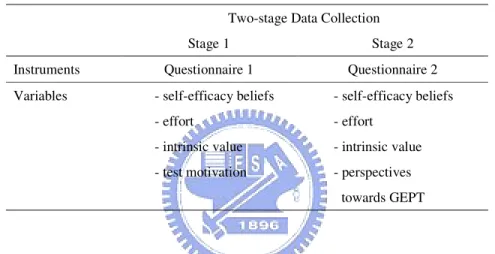
Table 3.1 Instruments and Variables in the Two Stages of Data Collection...36
Table 3.2 The Cronbach Alpha Values for Subscales...38
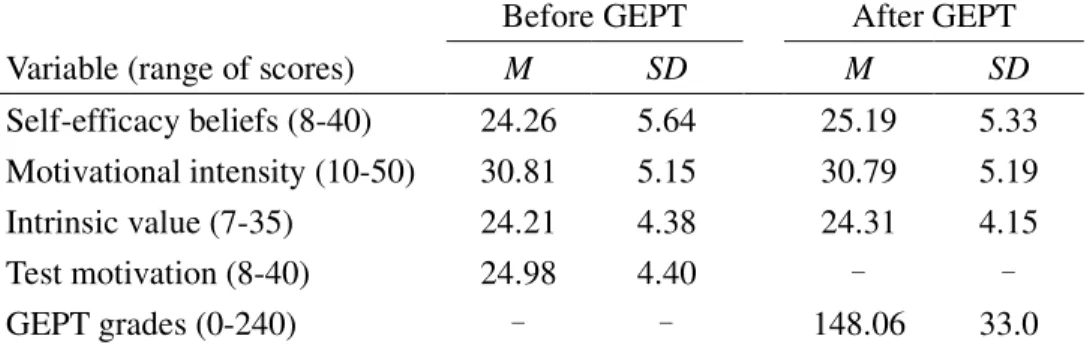
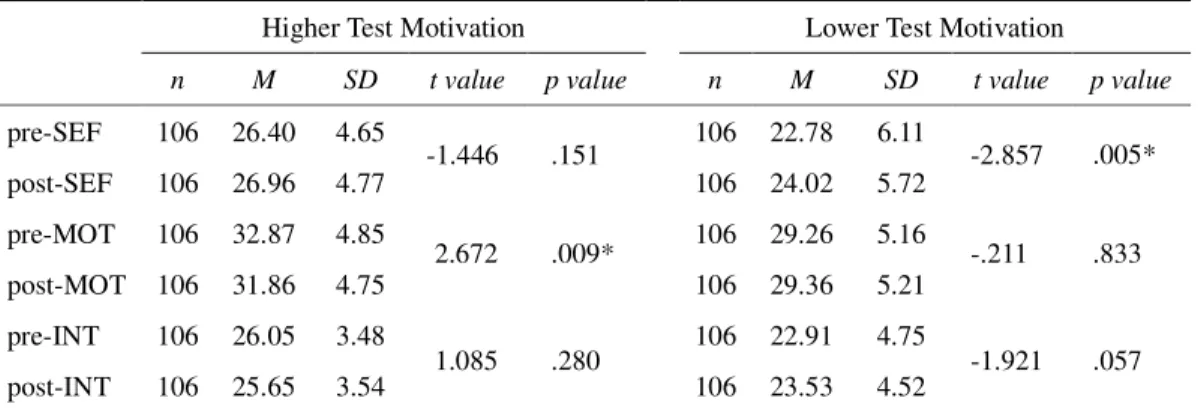
Table 4.1 Means and Standard Deviations of Self-efficacy Beliefs, Motivational
Intensity, Intrinsic Value, Test Motivation and GEPT Grades ...42
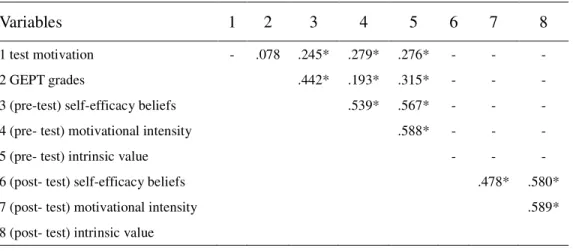
Table 4.2 Correlations among Test Motivation, GEPT Grades and the Motivational
Variables...44
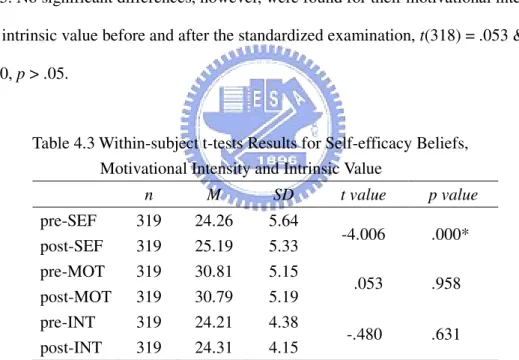
Table 4.3 Within-subject t-test Results for Self-efficacy Beliefs, Motivational
Intensity and Intrinsic Value ...46
Table 4.4 Within-subject t-tests Results for Self-efficacy Beliefs, Motivational
Intensity and Intrinsic Value between the Groups of Higher and Lower
Test Motivation...47
Table 4.5 Within-subject t-tests Results for Self-efficacy Beliefs ...49
Table 4.6 Undergraduates’ Responses to the Usefulness of the
Graduation Threshold ...50
Table 4.7 Reasons for Effectiveness and Ineffectiveness of the Compulsory
Standardized Examination...51
Table 4.8 Numbers and Percentage for Preparation for GEPT among the
Undergraduates ...53
Table 4.9 The Attitudes for Taking GEPT among the Undergraduates Not Preparing
for the Examination...54
ix
List of Figures
Figure 1.1 Framework of This Study ...6
Figure 2.1 Gardner’s Socio-educational Model of Second Language Acquisition ...13
Figure 2.2 Fluctuations of Self-efficacy Beliefs ...24
1
CHAPTER ONE
INTRODUCTION
In recent years, more and more college students are encouraged to take standardized examinations such as TOEFL, TOEIC, or IELTS to demonstrate their English proficiency. Of the standardized examinations, General English Proficiency Test (GEPT) has been extensively adopted among universities in Taiwan. For example, National Taiwan University uses the first stage of the High-intermediate level of GEPT as a placement test, placing their sophomores in different levels of Online English programs. Those who have passed this examination can waive the credits.1
On the other hand, some national universities set regulations, requesting their undergraduates to pass a certain level of GEPT or take remedial English courses as a prerequisite of graduation. Undergraduates in National Cheng Kung University, National Sun Yat-sen University and National Chung Cheng University are asked to succeed in the Intermediate or the first stage of the High-intermediate levels of GEPT. Starting from 2003, the freshmen in National Chiao Tung University are also required to pass the first stage of the High-intermediate level of GEPT. If they fail the
examination, they have to take remedial English courses. During the course-taking period, course waivers are warranted once students succeed in this examination. It seems that GEPT gradually serves as a threshold for graduation amid the universities in Taiwan.
In Taiwan, many people consider that students’ English proficiency starts to decrease once they attend universities. The reason may be that students no longer 1 國立臺灣大學為提升學生之英語能力,特訂定進階英語課程施行辦法。進階英語課程總計施行 二個學期,凡修習學士學位者,於二年級起修習進階英語(一)及(二),每星期各二小時。 進階英語課程按學生英語能力分班。分班前,統一施測全民英語能力分級檢定中高級初試,以 該成績為分班依據。通過全民英語能力分級檢定中高級初試者得免修全部課程。
2
have to worry about entrance examinations. Compared with high school students, college students spend obviously less time studying English every week. High school students learn English almost every day since the grades in the school subject of English have great influences on their choices of future universities. However, most college students only need to take four to six credits on English courses in the first to second academic years. In other words, they merely attend two to three English classes every week. For non-English majors, they have few chances to register in English classes afterwards. To facilitate college students’ English learning, many universities set regulations that their students have to pass a standardized examination before graduation. It seems that this kind of policy intends to enhance students’ motivation to learn English. However, its real effects remain unclear. Thus, it is worth probing any positive or negative impacts this policy may bring on college students’ motivation to learn English.
We complied a table (Appendix A), summarizing the graduation requirements, required English credits and measures for not reaching the graduation threshold amid twelve national universities in Taiwan. It appears that most national universities make use of GEPT as the graduation standard. Below, the standardized examination of GEPT is briefly introduced as part of the background, followed by a brief review concerning the impacts of standardized examinations on students’ learning motivation. Then, the researcher indicates the niche and purpose of this study. Significance of this study is finally addressed.
General English Proficiency Test
GEPT is sponsored by the Ministry of Education in Taiwan and developed by the Language Training and Testing Center (LTTC). This standardized examination has been administered in Taiwan since 2000. Different from other English proficiency
3
tests developed by foreign institutions, as LTTC claims, GEPT aims to test candidates’ general English ability.2
GEPT is divided into five levels with each level standing for varying English proficiency. Each level of GEPT contains two stages of testing. The first stage is inclusive of listening and reading tests and the second one writing and speaking tests. According to LTTC, non-English major undergraduates are capable of understanding English in social or working occasions (listening ability) and reading all kinds of articles and documents (reading ability), which are assessed in the first stage of the High-intermediate level of GEPT. This is why the first-year students in National Chiao Tung University are required to pass the listening and reading sections of the High-intermediate level of GEPT. They have to complete ninety-five multiple-choice items in eighty-five minutes, with forty-five items for the listening section and fifty items for the reading section.
GEPT is a criterion-referenced test. Test-takers’ scores in the listening and reading sections hinge on the number of correct answers they gain. Testees have to achieve the criterion of the standardized passing grade, i.e., 80 out of 120 points, in listening and reading tests so that they can further take the following stage of writing and speaking tests.3
More detailed information regarding GEPT, including its features, assessed contents, format, testing time, grading criteria, and comparisons with other
standardized examinations is offered in Appendix B. In the next section, we would like to direct our readers’ attention to the influences standardized examinations may
2
TOEFL and IELTS are designed for international students who would like to apply for schools in English-speaking nations. These standardized exams are to test their English ability in academic settings. TOEIC is mainly designed to evaluate test-takers’ English skills in workplaces.
3
Starting from 2008, testees can also pass the first stage of the High-intermediate level of
GEPT once they get a total score of 160 in listening and reading sections, with each section reaching at least 72 points (http://www.lttc.ntu.edu.tw/gepthifmain.htm). This research was conducted before this regulation was enforced. As a result, this new rule did not fit for this study.
4
have on learners’ motivation in learning English.
The Impacts of Exams
Some researchers state that examinations could be a motivator (Linn, 1993), driving learners to study harder. From another perspective, nevertheless, examinations may damage learners’ motivation (Grolnick & Ryan, 1987), making them lose
interests in L2 learning. The pros and cons of examinations have been debated for a long time. Over recent years, some researchers mentioned that the level of importance of an examination as perceived by students affects their performance on that
examination by influencing their motivation (Wolf & Smith, 1995). In Wolf and Smith’s research (1995), they developed a questionnaire to examine “how motivated the student was to perform on the test in question” (p. 231). It was found that students’ test scores were correlated with testing conditions. In their study, Wolf and Smith (1995) focused on how levels of importance of an examination affect students’ motivation and how motivation, in turn, influences test performance. However, it seems that the construct of motivation has not been explored more deeply in Wolf and Smith’s study (1995). As a result, we think it necessary to make deeper investigations into this area.
According to expectancy-value theories, expectancy of success on a given task and the value attached to that task are two key factors to motivate individuals to perform assigned tasks. Of task values, intrinsic value is of great importance, defined as one’s behavior in performing a task being out of his or her inner interests without the stimuli of external rewards. It has been reported that intrinsic motivation can make learning more lasting (Lepper, Greene, & Nisbett, 1973).
Aside from task values, the other facet of expectancy-value theories, expectancy of success, is worth noticing. Self-efficacy beliefs are one of the motivational
5
constructs that are related to the notion of expectancy of success, representing that people believe they are capable of executing actions.
When it comes to self-efficacy beliefs, the concept of motivational intensity is often discussed as well, which means the amount of effort one intends to expend when performing a task. Research has suggested that one’s effort spent on a task is related to his or her level of self-efficacy beliefs (Bandura, 1986, 1997; Pajares, 1996; Stajkovic & Luthans, 1998). The higher level of self-efficacy beliefs, the more effort one is willing to spend.
The relationships between self-efficacy beliefs and motivational intensity have been extensively discussed. Based on expectancy-value theories, self-efficacy beliefs and intrinsic motivation are two crucial notions. However, little research probes how the two variables may interact mutually. Also, it is of interest to know whether individuals with higher levels of intrinsic motivation expend more effort on a given task. Accordingly, the correlation among the three variables is another aspect that deserves to be inspected.
In addition to the reciprocal interaction of the motivational variables, the changes of individual variable before and after the compulsory standardized examination are worth investigating. It is possible that the compulsory standardized examination and the test results exert influences on students’ intrinsic motivation, effort intended to put forth and self-efficacy beliefs in learning English.
On the basis of the above rationale, we proposed a research framework to describe possible relationships among the variables.
The Research Framework
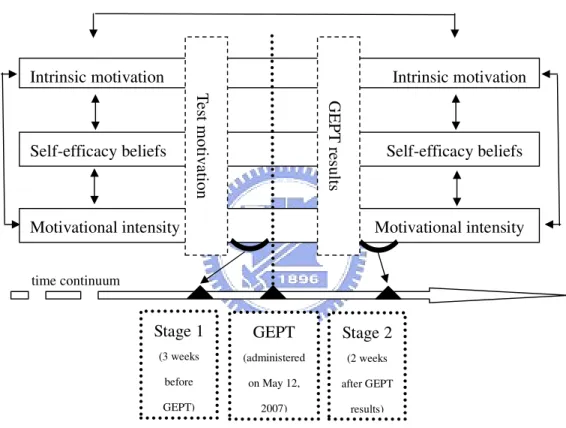
Figure 1.1 displayed the order of these variables along a time continuum. The three motivational variables on the left represented our participants’ existing L2
6
learning motivation before they took GEPT while the same three variables on the right meant their motivation to learn English after they finished the test and were informed of the grades. As shown in this figure, the standardized examination was administered on May 12, 2007. Stage 1 and Stage 2 were the schedule of data collection.
Figure 1.1 Framework of This Study
Since motivational orientations of individuals may not remain consistent over time and they are shaped by experiences (Dörnyei, 2000; Wolf & Smith, 1995), we hypothesized the three variables of intrinsic value, self-efficacy beliefs and
motivational intensity may be influenced by external events or one’s mental state. Before our participants took the compulsory standardized examination, they had already had their own interest, levels of self-efficacy beliefs, and efforts intended to
time continuum
Intrinsic motivation Intrinsic motivation
Self-efficacy beliefs Self-efficacy beliefs
Motivational intensity Motivational intensity
T e st m ot iv a tion G E P T r es ul ts GEPT (administered on May 12, 2007) Stage 1 (3 weeks before GEPT) Stage 2 (2 weeks after GEPT results)
7
make about learning English. In the context of our study, two factors may affect these motivation. One is how our participants were motivated to perform well on the compulsory standardized examination (test motivation) and the other is GEPT results. Our participants’ test motivation may pose impact on their original self-efficacy beliefs, motivational intensity and intrinsic value, which may in turn exert influences on their test performance. After our participants obtained their GEPT grades, their subsequent motivation may be affected. Accordingly, we would make an investigation into the possible changes of the three motivational variables before the compulsory standard examination was held and after our participants were notified of their test results. Furthermore, we thought that the three variables of intrinsic value,
motivational intensity and self-efficacy beliefs may be correlated with one another in some degree before and after this examination. Hence, we intended to examine the interrelationships among the three motivational variables.
Purpose of this Study
The present study aims to investigate the influences the compulsory standardized examination may exert on first-year college students’ motivation to learn English. Three motivational factors were scrutinized, including self-efficacy beliefs, motivational intensity, and intrinsic motivation. In addition, we explored our participants’ attitudes and motivation to prepare for and pass this examination, i.e., their test motivation. Moreover, their perspectives toward learning English as a requirement and GEPT as a threshold for graduation was another major facet that we zeroed in on. In this study, five questions were probed:
1. Are college students’ pre-test self-efficacy beliefs, motivational intensity and intrinsic value in learning English correlated with their motivation towards this compulsory standardized examination defined as test
8
motivation?
2. Are college students’ pre-test self-efficacy beliefs, motivational intensity and intrinsic value in learning English correlated with their GEPT grades? 3. Are college students’ self-efficacy beliefs, motivational intensity and
intrinsic value correlated with one another before they took the compulsory standardized examination and after they gained GEPT grades?
4. Do college students’ self-efficacy beliefs, motivational intensity and intrinsic value in learning English change significantly before and after the compulsory standardized examination?
5. What are college students’ perspectives towards learning English as a requirement and the compulsory standardized examination as a graduation threshold?
The first-year college students in National Chiao Tung University were recruited as our participants. Questionnaires, including Likert-type scales and open-ended questions, were administered to elicit students’ responses to the above five research questions.
Significance of this Study
Through the canvass, this research can add one piece of information to the current literature regarding the effects of examinations on students’ L2 learning motivation. Since the nature of GEPT is different from that of other compulsory examinations mentioned in past research, it is hoped that the present study can clarify how compulsory standardized examinations exert influences on language learners’ motivation in L2 learning. In addition, this study can provide useful information for the authority to reflect upon this policy executed at quite a few universities, and help clarify whether this policy motivates or demotivates college students in English
9
learning. Implications will then be drawn to provide suggestions to policy makers and classroom teachers on how students’ motivation could be maintained while the graduation threshold policy is enforced.
10
CHAPTER TWO
LITERATURE REVIEW
Influenced by the Confucianism, collectivism and social expectations, Chinese learners are motivated to show excellence in examinations so as to glorify their clans (Chen, Warden, & Chang, 2005). Some researchers argue that examinations could be demotivating during the learning process (Grolnick & Ryan, 1987). Others advocate “test as the motivator,” making students spend more time studying (Linn, 1993). Still others challenge this assumption, pointing out that the amount of effort an individual spends relies on the importance of examinations (Wainer, 1993; Wolf & Smith, 1995). Warden and Lin (2000) found that Taiwanese students seem to be motivated to learn because they have to pass examinations or requirements. For example, junior and senior high school students in Taiwan have to pass entrance examinations to enter their ideal schools. A recent example is that university students have to pass English proficiency tests so that they can graduate. As noted above, examinations serve as a motivator to encourage, or even force students to study in Asian society. However, further studies are necessary to investigate the impact of examinations on students’ L2 learning motivation.
In this chapter, we review theories and empirical studies regarding effects of examinations on learners’ motivation to learn a second language. First of all, we provide our readers with a sketch of L2 learning motivation theories and learning motivation theories in general, narrowing down to expectancy-value theories. On the basis of the expectancy-value frameworks, two motivational variables, self-efficacy beliefs and intrinsic motivation, are addressed. Finally, we explore the relationships between examinations and motivation.
11
L2 Learning Motivation Theories and Learning Motivation Theories in General A second language is a school subject which can be divided into different skills with explicit instruction from the perspective of education (Dörnyei, 2000). Different from other school subjects, learning a second language involves learning social and cultural aspects this second language embodies. As can be understood, L2 learning is multifaceted and as a result, a wide range of theories regarding L2 learning motivation have surged from the 1970s on, such as Gardner’s motivation theory,
self-determination theory, social motivation, Dörnyei and Ottó’s process model of L2 motivation, and expectancy-value theory.
Gardner’s motivation theory
Gardner’s motivation theory subsumes three distinct areas, including integrative motivation, the socio-educational model and the Attitude/Motivation Test Battery (AMTB).
Gardner and his colleague, Lambert, conducted research in Canada, where Anglophone and Francophone communities co-exist. Since English and French played the role of mediating factors that may enhance or hinder intercultural communication and affiliation between these two communities, Gardner and Lambert (1972) explored the reasons that encourage or discourage Canadian people to learn French or English as their second language. It was found that whether an individual can learn a second language successfully hinges on his or her attitudes towards the L2 and the L2 community and his or her ethnocentric orientation in general. Gardner and Lambert discovered that Canadian people learned English or French as a second language with differing purposes. Some of the people learned the L2 because they wanted to be connected to the other community, to realize its culture and to interact with its people whereas some learned the L2 for the purpose of getting a better job or earning more
12
money. The former is defined as integrative motivation while the latter instrumental motivation.
Previous research (Gardner & Lambert, 1972; Gardner, 2001; Hernandez, 2006) has revealed that integrative motivation was a predictor of successful second language acquisition for language learners with integrative motivation learn for the sake of learning. They demonstrate interest in a second language and desire to interact with its native speakers and culture. On the other hand, individuals with instrumental
motivation learn a second language mainly for pragmatic purposes, such as the pursuit of better employment. They easily give up learning a second language once they achieve their goals. As a consequence, it is often recommended that L2 learners develop integrative motivation in a foreign language classroom.
Besides these two important concepts, motivational intensity and desire to learn the language are another two components in Gardner’s motivation theory.
“Motivational intensity” means effort an individual spends learning a second language. “Desire to learn the language” represents an individual’s will or want in learning a second language. Theoretically, the two components are positively correlated. The more one wants to learn a language, the more effort he or she expends. These two components and attitudes towards learning a language, as stated above, constitute an individual’s motivation in L2 learning (Gardner, 1985).
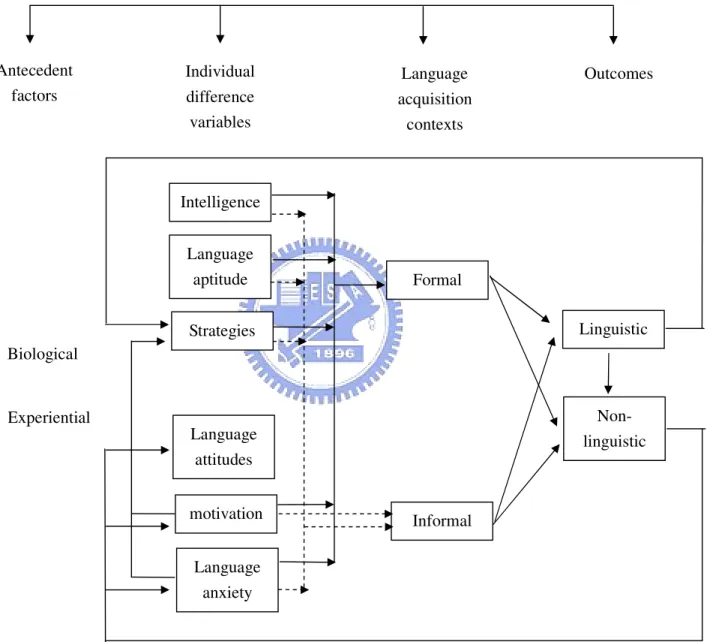
The socio-educational model is concerned with the influences individual difference characteristics bring during a L2 learning process. This model was proposed by Gardner and MacIntyre (1993), focusing on four aspects of the second language acquisition process, including antecedent factors, individual difference variables, language acquisition contexts and outcomes.
As can be seen in Figure 2.1, in formal and informal learning contexts, an individual’s biological and experiential factors such as age, gender, or learning history
13
as well as individual difference variables including intelligence, language aptitude, learning strategies, language attitudes, learning motivation and language anxiety interact altogether and finally lead to linguistic and non-linguistic L2 attainments.
Figure 2.1 Gardner’s Socio-educational Model of Second Language Acquisition (Gardner & MacIntyre, 1993; p. 8)
Antecedent factors Individual difference variables Language acquisition contexts Outcomes Intelligence Language aptitude Strategies motivation Language anxiety Language attitudes Formal Informal Linguistic Non- linguistic Biological Experiential
14
From Gardner and MacIntyre’s (1993) socio-educational model, we can unearth that learning a second language is a sophisticated process with many aspects being involved. To measure the complicated concept of L2 motivation, Gardner developed the Attitude/Motivation Test Battery with a total of 134 items. The constituent constructs measured in the AMTB are inclusive of attitudes towards French Canadians, interest in foreign languages, attitudes towards learning French, integrative orientation, instrumental orientation, French class anxiety, French use anxiety, motivational intensity, desire to learn French, evaluation of the French teacher and evaluation of the French course (Gardner, 2001). The AMTB has been widely used in empirical studies regarding L2 motivation (Clément, Dörnyei, & Noels, 1994; Kraemer, 1993; Muchnick & Wolfe, 1982).
Self-determination theory
Similar to the constructs of Gardner’s integrative and instrumental motivation, intrinsic and extrinsic motivation are extensively investigated in the field of L2 learning motivation (Noels, 2003; Noels et al., 2003; Shaikholeslami & Khayyer, 2006). Intrinsic motivation refers to one’s performing behavior out of his or her interest or enjoyment of the targeted task. As for extrinsic motivation, one may demonstrate his or her behavior due to rewards or punishment avoidance. From an educational point of view, people may be intrinsically motivated to learn a second language if their behavior is triggered by maintaining consequences that are inherent in tasks, such as the pleasures. On the other hand, people may be extrinsically
motivated to learn a second language that helps them get better jobs or higher salaries in the future.
Originally, intrinsic and extrinsic motivations are viewed as a dichotomy. Quite a few researchers indicated that extrinsic motivation may undermine students’ intrinsic
15
motivation, making them lose interest in L2 learning once external rewards are removed (Deci, 1971, 1972; Lepper et al., 1973). However, other researchers did not find such a relationship between intrinsic and extrinsic motivation; in fact, they found that other forms of external rewards could be conducive to intrinsic motivation (Lepper & Henderlong, 2000; Ryan, Mims, & Koestner, 1983). Afterwards, Deci and Ryan (1985) reported that intrinsic and extrinsic motivations are like the two ends of a continuum, being called self-determined and controlled forms of motivation. This is known as self-determination theory. From their perspectives, everyone has these two sorts of motivation. One’s initial action can be aroused by extrinsic rewards. Once she or he is more self-determined and self-regulated, extrinsic motivation can combine with or even lead to intrinsic motivation. Besides the intrinsic/extrinsic continuum, Deci and Ryan (1985) also discovered that autonomy, competence and relatedness are three components that affect an individual’s levels of self-determination in performing a particular task. When individuals are capable of deciding their own behavior, they have faith in their own ability and they feel connected to other people, they would show more intrinsic motivation.
Social motivation
Intrinsic/extrinsic motivation and integrative/instrumental motivation mentioned above are subsumed to personal motivation, which is contrasted to social motivation put forth by Weiner (1994). Social motivation means that an individual’s behavior is influenced by the environment he or she stays. Parents, teachers, peers, and schools are all factors that impact on an individual’s motivation. When it comes to L2 learning, the social context often plays a crucial role in shaping humans’ motivation (Dörnyei, 2000).
16
However, Dörnyei (2000) stated that motivation does not necessarily remain constant all the time when it refers to the mastering of a L2. Instead, motivation may fluctuate with the influences of internal and external events. Thus, he and his colleague took “time” into consideration and proposed a model, which would be introduced in the following section.
Dörnyei and Ottó’s process model of L2 motivation
The field of motivation is comprised of abundant theories and models with respect to L2 learning. To synthesize a variety of motivation theories and tackle the challenge of time during motivational processes, Dörnyei and Ottó (1998) proposed a process model of L2 motivation. This model is inclusive of two dimensions: action sequence and motivational influences. The dimension of action sequence describes how one’s wishes, hopes and desires are transformed into goals, then into intentions, finally leading to action launch, completion and evaluation. The other dimension of motivational influences explains energy sources and motivational forces that help fuel the action sequence.
The dimension of action sequence is divided into preactional, actional and postactional phases. The preactional phase corresponds to “choice motivation,” meaning that one has to turn abstract wishes, hopes, and desires into concrete goals. With commitment and tangible steps needed to carry out the goals set, one’s
intentions are formed. However, they are not sufficient for an action to be launched. Only with the adequate starting time and appropriate means and resources can one begin to implement subtasks planned in the process of intention formation.
The actional phase corresponds to “executive motivation.” During the process of action implementation, one keeps appraising the progress and tries to utilize strategies to control the progress. Following that, an actional outcome is ultimately reached. The
17
optimal situation is that an individual’s goal is achieved whereas it is possible for he or she to terminate the action. Action termination, nevertheless, is not equal to action abandonment. The actor can fine-tune the subtasks and continue the action or the original goal can be modified and the sequential process can be re-started.
When the actor acquires an actional outcome, she or he enters the postactional phase in the process model. Here, the actor explores the causal attributions of success or failure of the action. The critical retrospection facilitates the actor to examine the internal standards and action-specific strategies employed in the previous phase.
Next, we move to the other dimension in the process model – motivational influences. Five clusters correspond to the five processes in the dimension of action sequence. They are motivational influences on goal setting, on intention formation, on the initiation of intention enactment, executive motivational influences and
motivational influences on postactional evaluation. Each cluster contains various motivational factors that may contribute to or fail the implementation of action.
To sum up, the process model tells us that L2 learning motivation is sophisticated in essence and involves ample motivational factors, which render motivation research more challenging.
Of all the theories concerning L2 learning motivation, we base our research on expectancy-value theories. In ESL learning milieu, language learners can demonstrate their ability by interacting with native speakers. However, the English-learning environments for most Asian students are not sufficient once they step out of their language classrooms. Accordingly, it is possible for students in an EFL context to look forward to success in L2 learning by means of performing well on examinations. Besides, they may add value judgments to their own success gained from the
examination results. “Expectancy of success” and “value” are thus crucial during L2 learning process in that they probably explain students’ motivation to learn a L2.
18
In the following section, we would like to direct our readers’ attention to several theories under the expectancy-value frameworks and then narrow our focus to two motivational components, i.e., self-efficacy beliefs and intrinsic value.
Expectancy-value Theories
Beginning with Atkinson’s achievement motivation theory, expectancy-value theories emphasize that humans are born with curiosities and they are actively motivated to explore the environment and receive challenges (Dörnyei, 2000). In the expectancy-value frameworks, an individual’s expectancy of success and the value attached to success are two key factors that influence the individual’s motivation to perform a given task.
Expectancy of success
Expectancy of success is linked to the question “Can I do this task?” Many theories are relevant to this concept. From an educational viewpoint, attribution theory, self-worth theory, and self-efficacy theory are the three most important constructs that are used to explain whether an individual expects attainments in a task. Weiner is the representative of attribution theory, which deals with one’s past performance with two-dimensional, and more recently, three-dimensional models of causal attributions (Weiner, 1979; Williams, Burden, & Al-Baharna, 2001). We will explain attribution theory in more detail with two tables that are complied on the basis of causal elements.
As shown in Table 2.1, this initial model involves two dimensions: locus of causality and stability. A learner may attribute success or failure to internal factors, such as ability and effort, or to external factors, such as task difficulty and luck.
19
Table 2.1 The Two-dimensional Attributional Model
Locus of causality
Internal External Stable
Unstable
Ability Task difficulty
Effort Luck
(Modified from Williams et al., 2001; p. 173)
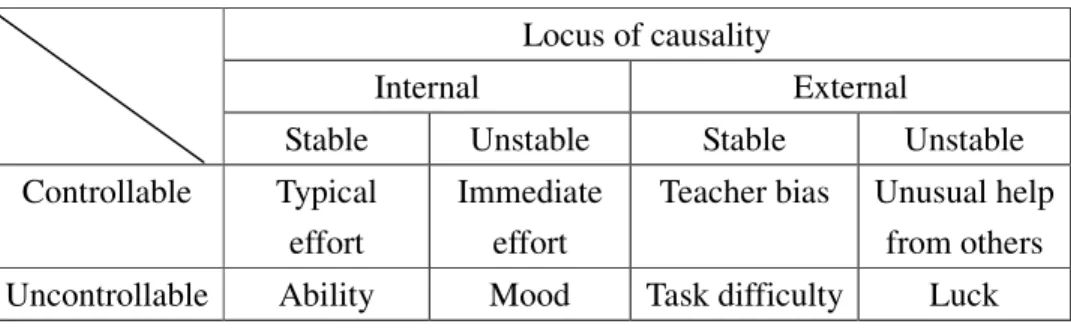
Of the four causes, ability and task difficulty are stable, which represents that they do not usually change over time. By contrast, effort and luck are unstable and easy to change over time. Following Weiner’s perspective, a number of researchers conducted research to explore to what factors language learners ascribe their success or failure (Brown, 2004; Graham, 2004). Later researchers, nevertheless, found that Weiner’s model could not fully explicate their participants’ causes of success or failure. As a result, the facet of controllability was added to this original model, which concerns the extent to which one can control an event or outcome. A more
complicated three-dimensional attributional model showed up as follows:
Table 2.2 The Three-dimensional Attributional Model Locus of causality
Internal External
Stable Unstable Stable Unstable
Controllable Typical effort
Immediate effort
Teacher bias Unusual help from others
Uncontrollable Ability Mood Task difficulty Luck
(Adopted from Williams et al., 2001; p. 173)
As demonstrated in Table 2.2, we can see four more attributional causes: immediate effort, mood, teacher bias and unusual help from others. Because of the latest dimension for causal attributions, more research was extended beyond Weiner’s
20
perspective, trying to investigate possible causal factors for success and failure (Little, 1985; Weiner, 1992).
Covington’s (1992) self-worth theory is related to maintaining one’s self-esteem. It is natural for people to try to protect their personal value and worth, especially when they encounter competition, failure or negative feedback. Self-efficacy theory is what we are concerned with among the three constructs. Additional discussions on this theory are separated from this section and will be introduced later on.
Value
The other facet in the expectancy-value frameworks is value, which is also labeled as ‘valence’, ‘incentive value’, ‘attainment value’, ‘task value’ and
‘achievement task value’ by various researchers. According to Dörnyei (2000), value is linked to the question “Do I want to do the task?” Eccles and Wigfield (1995) considered that task values are composed of four components: attainment value, intrinsic value, extrinsic value and cost. Individuals may want to do a given task for the purpose of mastery goal or performance goal (attainment value). Factors such as effort, time, anxiety and fear of failure are all costs that individuals have to pay during the process of task completion. Intrinsic and extrinsic values are of extreme
importance in the field of education. As already explained in self-determination theory, individuals may be motivated to execute an action because of inner interest and
enjoyment (intrinsic value) or external rewards and tangible goals (extrinsic value). The four components interplay reciprocally to determine one’s strength or intensity when performing a task. Amid the four values, we aim to explore the component of intrinsic value. Again, relevant discussions will be given in subsequent sections.
21
Self-efficacy Theory
An array of factors can determine whether an individual trusts he or she has the capacity to do a task. From an educational viewpoint, attribution, self-worth, and self-efficacy theories have prominent effects on learners’ expectancy of success. The reason why we zero in on self-efficacy beliefs is that it is a main construct discussed in educational psychological literature (Dörnyei, 2000). In the past, researchers concentrated on two issues. One is the link between self-efficacy beliefs and college major and career choices and the other is the relationships among self-efficacy beliefs, related psychological constructs, and academic motivation and achievement (Pajares, 1996). At school, students’ self-efficacy beliefs towards mathematics are frequently investigated (Keramati, Shahraray, & Farahani, 2004; Metallidou & Vlachou, 2007). However, little research refers to students’ self-efficacy beliefs regarding L2 learning. Therefore, it is worth probing students’ self-efficacy beliefs if we treat L2 as a school subject.
At this section, we are going to depict self-efficacy beliefs, which are related to expectancy of success under the expectancy-value frameworks. The origin and definition of self-efficacy beliefs are first presented, followed by exploring the relationships between self-efficacy beliefs and academic achievement. Next, we discuss the fluctuating nature of self-efficacy beliefs. Eventually, how self-efficacy beliefs interact with other motivational variables is investigated.
Origin and definition of self-efficacy beliefs
Bandura (1977) at first presented the concept of self-efficacy beliefs in his book “Self-efficacy: Toward a unifying theory of behavioral change,” defining it as “beliefs in one’s capabilities to organize and execute the course of action required to manage prospective situations (Bandura, 1995; p. 2).” People with different levels of
22
self-efficacy beliefs may view difficult tasks in varied ways. Self-diagnostic
orientation is a key feature among people with low self-efficacy beliefs. They tend to perceive difficult tasks as personal threats and think of personal deficiencies and the obstacles that impede their performance. Therefore, they easily give up in the face of failure. By contrast, people with high self-efficacy beliefs are characterized by task-diagnostic orientation. Such people view difficult tasks as challenges and handle threatening situations with confidence. Hence, they heighten and sustain effort even in the face of failure.
Self-efficacy beliefs and academic achievement
Compared to other constructs, some researchers thought that self-efficacy beliefs are more precise to predict students’ achievement or performance (Pajares, 1996; Zajacova, Lynch, & Espenshade, 2005). Many studies have revealed that self-efficacy beliefs are positively related to academic performance (Bong, 2001; D’amico & Cardaci, 2003; Elias & Loomis, 2002).
Bong (2001)reported on an investigation into the role of self-efficacy beliefs and task-value in predicting college students’ academic achievement and future course enrollment intentions. One hundred and sixty-eight female undergraduate students in Seoul were administered scales of various self-efficacy beliefs and task-value beliefs at two different time points. Partial findings showed that self-efficacy beliefs are positive predictors of students’ academic performance.
D’amico and Cardaci (2003) conducted a study on one hundred and fifty-one students in India with an average age of 13.4 years. All of them completed a 24-item questionnaire including self-efficacy beliefs and self-esteem for three school subjects: linguistic-literary, logical-mathematical, and technical-practical. The measure of the participants’ scholastic achievement depended on their teachers’ ratings of one to five
23
points. One of the findings revealed that students’ self-efficacy beliefs are
significantly correlated with their academic achievement, which represented that the students with higher self-efficacy beliefs performed better in school subjects than those with lower self-efficacy beliefs.
In their research, Elias and Loomis (2002) found the same results as well. This study examined whether need for cognition (NFC) and academic self-efficacy are predictors of academic performance. Besides, the authors investigated the causal direction of NFC and self-efficacy beliefs by executing path analysis. One hundred and thirty-eight undergraduate students in the United States were recruited for this study. They were administered questionnaires including NFC scale, academic self-efficacy scale and demographic information. The findings showed that NFC and self-efficacy beliefs can be used to predict one’s academic performance measured by Grade Point Average. People with higher NFC and self-efficacy beliefs like to partake in enjoyable and challenging tasks and obtain greater performance in academics.
The fluctuating nature of self-efficacy beliefs
What we have discussed so far is the interrelatedness of self-efficacy beliefs and academic achievement. Actually, self-efficacy itself is an interesting construct worth probing. Stajkovic and Sommer (2000) reported on an investigation into the direct and reciprocal links among self-efficacy beliefs, performance feedback and causal
attributions. First of all, the authors proposed a conceptual rationale with two sets of hypotheses, with the first four hypotheses stating how individuals with differing levels of self-efficacy beliefs attribute their success or failure and the remaining four
hypotheses stating the effects of causal attributions on formation of subsequent self-efficacy beliefs and performance outcome. Ninety-three undergraduate and graduate students at a Midwestern university participated in this study. They were
24
asked to give as many uses of an object as possible in one minute, which was measured as their performance attainments. After the practice trial, all the students were administered the scale of self-efficacy beliefs, which served as their initial self-efficacy beliefs. Next, they were given the experimental trial and told whether they succeeded or failed the task. Following that, they were administered two scales regarding self-efficacy beliefs, as subsequent self-efficacy beliefs, and causal
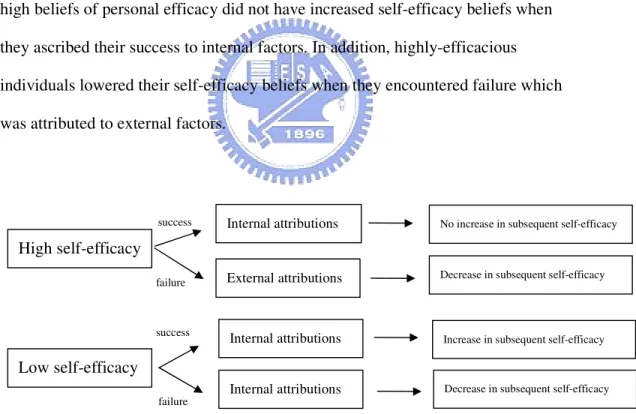
attributions of their success or failure. As can be seen in Figure 2.2, it was discovered that low-efficacious individuals increased their self-efficacy beliefs when success was attributed to internal factors whereas decreased their self-efficacy beliefs when attributing failure to internal factors. However, the authors found that individuals with high beliefs of personal efficacy did not have increased self-efficacy beliefs when they ascribed their success to internal factors. In addition, highly-efficacious individuals lowered their self-efficacy beliefs when they encountered failure which was attributed to external factors.
Figure 2.2 Fluctuations of Self-efficacy Beliefs
(Modified from Model of Hypothesized Relationships Proposed by Stajkovic and Sommer, 2000; p. 10)
failure success failure success High self-efficacy Low self-efficacy Internal attributions External attributions
No increase in subsequent self-efficacy
Decrease in subsequent self-efficacy
Internal attributions
Internal attributions
Increase in subsequent self-efficacy
25
This empirical study tells us that self-efficacy beliefs are dynamic and may change due to a single event during a short period of time. In Stajkovic and Sommer’s (2000) research, the single event is one-minute brainstorming during which the participants had to think as many uses of an object as possible. The two authors examined the causes that resulted in the changes of individual self-efficacy beliefs. Their investigation gives us insightful explanations about the fluctuating nature of self-efficacy beliefs. Nevertheless, it is a pity that all the incidents occurred in the lab setting rather than in real learning situations. Accordingly, it remains doubtful whether we can generalize its findings to the real world.
Self-efficacy beliefs and effort
The previous literature manifested that levels of self-efficacy beliefs are a vital indicator of an individual’s success. Moreover, they determine the amount of effort one is going to expend for the task undertaken (Eccles & Wigfield, 2002). Many researchers have expressed that one’s effort spent on a task is related to his or her level of self-efficacy beliefs (Bandura, 1986, 1997; Pajares, 1996; Stajkovic & Luthans, 1998). Low-efficacious people tend to consider that tasks are more difficult than they really are and do not believe they have sufficient ability to accomplish the tasks. Hence, such people may pay less effort in completing tasks than those with high self-efficacy beliefs. However, we found that the remarks these researchers put forth are mostly theoretically-based. In other words, more empirical studies need to be done to prove the relationships between efficacy beliefs and effort.
After the construct of self-efficacy beliefs is introduced, the ensuing passages channel our readers’ attention to the other facet of the expectancy-value frameworks, describing the concept of value in task performance. Here, we pay more attention to the motivational variable of intrinsic value. Following that, we explore the
26
relationships between examinations and motivation.
Intrinsic Value
Eccles and Wigfield (2002) said that intrinsic motivation belongs to one of the theories relating to the domain of task value. It has been noted that whether an
individual has the desire to do a certain task depends on the value he or she attaches to success of completing that task. The values consist of attainment value, intrinsic value, extrinsic value and costs (Eccles and Wigfield, 1995). Hence, when an individual is intrinsically motivated to do an activity, he or she experiences enjoyment or
satisfaction during the process, which can be dubbed intrinsic value this individual connects to that activity.
When we mention intrinsic motivation, extrinsic motivation is its counterpart that immediately emerges in our mind. Many psychologists have claimed that extrinsic rewards decrease intrinsic motivation (Atkinson, 1964; deCharms, 1968; Murray, 1964). Early studies concentrated on the effects of externally mediated rewards on intrinsic motivation. Deci (1971) conducted two laboratory experiments and one field experiment to test this hypothesis. He discovered that participants who received money as external rewards when solving puzzles did decrease their intrinsic motivation once external rewards vanished. However, those who took verbal
reinforcement and positive feedback as external rewards when doing a good job actually had increased intrinsic motivation when they proceeded to undertake the task.
Aside from tangible and intangible rewards, it is also found that threats of punishment and negative feedback would reduce one’s intrinsic motivation (Deci, 1972). Threats of punishment and negative feedback can be realized as external pressure, which might undermine an individual’s interest of doing any activities. Actually, as long as individuals perceive any form of intervention as external pressure,
27
they may think they are compelled to get involved in tasks, which make it possible to destroy their intrinsic motivation. In Lepper et al.’s (1973) study, for example, two groups of children drew pictures with one group being given rewards for participating in this study and the other one being told that they were monitored during their drawing. The researchers discovered that the so-called “observed” group stopped painting the next time they were asked to do the same activity without being monitored.
Examinations and Motivation
Examinations and intrinsic motivation
Applying the preceding concept to the context of education, examinations are usually carried out as a means to evaluate students’ learning. At schools, students may be forced to study to avoid being scolded or receiving poor outcomes other than doing it out of their own interest. Examinations may be viewed as external pressure that would be likely to undermine students’ learning interest. On the contrary, some researchers argue that examinations may serve as a powerful inducement for students to study (Linn, 1993). To perform well on examinations, students may study hard and consequently experience the pleasure of learning (Remedios, Ritchie, & Lieberman, 2005).
To assess the effects of examinations on students’ intrinsic motivation, relevant studies in laboratory and real-life settings were conducted (Gallagher & McClune, 2000; Grolnick & Ryan, 1987; Remedios et al., 2005). Grolnick and Ryan (1987) separated their participating students into two groups. Both groups were designated to learn material. The only difference was that one group learned the material for the purpose of testing whereas the other group was simply for the sake of learning. The students who had to take the tests reported that they felt much pressure but showed
28
great enthusiasm and interest in pursuit of good performance. However, they immediately lost their motivation in learning after the tests were finished.
Remedios et al. (2005) did a study in Northern Ireland where some 10 and 11-year-old children have to join a Transfer Test for the purpose of being selected to a grammar school whereas other children do not have to take the examination until they are fourteen. A total of one hundred and eight primary school students took part in this study, with forty-two students being the members of the non-test group and sixty-six students belonging to the test group. Both groups were administered 7-point Likert type items of intrinsic motivation two weeks before and after the Transfer Test was held. The findings showed that the intrinsic motivation of the students in the test group was lowered even though they passed the Transfer Test and obtained expected grades. The other group did not display such a phenomenon. Thus, Remedios et al. concluded that examinations indeed decrease students’ intrinsic motivation under some circumstances.
Both Grolnick and Ryan (1987) and Remedios et al. (2005) reported that students’ intrinsic motivation was diminished after they underwent tests. Gallagher and McClune (2000), however, did a similar study as Remedios et al.’s (2005) research but gained a conflicting result. They found that the primary school students in Northern Ireland were highly motivated when they obtained a place at the grammar school since they deemed passing the Transfer Test and getting good grades as
positive feedback, which enhanced their intrinsic motivation.
All the above three studies intended to investigate students’ intrinsic interest towards school subjects learning. However, we can witness completely different results. The reason lies in the varying nature of examinations. The Transfer Test in Northern Ireland is declared by the government and pupils in some regions definitely have to take this examination in order to obtain a place in the grammar school. As a
29
consequence, the students will take it seriously. What would happen to our
participants in this study if examinations do not have a direct influence on students? Much research needs to be conducted to clarify this point.
Examinations and effort and self-efficacy beliefs
The foregoing passages discuss the effects examinations may have on learners’ intrinsic motivation. The relationship among examinations, effort and self-efficacy beliefs will be explored as follows.
Whether students are motivated to prepare for examinations depends on the importance of examinations (Wolf & Smith, 1995). If students consider that examinations they are undertaking are crucial, they own higher motivation in expending effort on examinations. Contrarily, they will not be motivated to prepare for examinations and pay considerable effort if the examinations are not so important for them.
Wolf and Smith (1995) designed two sets of classroom-based examinations and one hundred and fifty-eight college students took part in their study. Each participant had to take two sets of examinations, with one being counted as part of their grades while the other being not. When the examinations were over, they were administered a questionnaire with the purpose of understanding their motivation and perceptions towards the two examinations. The findings demonstrated that students were highly motivated and spent more effort preparing for examinations when they were notified that the examination results would be counted as their grades.
The above study tells us that significance of examinations determines the amount of effort one is going to pay. The more consequential an examination is, the more effort one expends. Since effort is closely related with self-efficacy beliefs, it is necessary to investigate the interrelationship between self-efficacy beliefs and
30
examinations. Put it more specifically, do students’ initial self-efficacy beliefs influence their test performance? In other words, we can scrutinize whether highly efficacious students perform better than those with lower self-efficacy beliefs. In addition, are students’ subsequent self-efficacy beliefs different from their initial ones after they get their test results? More importantly, is it possible that students’
perceptions towards examinations undertaken exert influences on their self-efficacy beliefs, and further, their attainments on examinations. Those are the concerns that need to be inspected.
31
CHAPTER THREE
METHOD
This study aims to investigate the effects the compulsory standardized examination may have on first-year college students’ motivation to learn English before and after they took the required GEPT. First-year students in National Chiao Tung University were recruited for this study. They completed two sets of
questionnaires before and after partaking in GEPT. Besides, they were asked to give their opinions on two open-ended questions for the purpose of understanding how they prepared for this compulsory standardized examination and how they viewed this policy of GEPT as a threshold for graduation.
In the following sections, we described our participants, instruments, procedures of data collection, and the statistical methods for data analysis.
Participants
Our sample comprised of five hundred and ninety first-year college students in National Chiao Tung University who took GEPT on May 12th 2007. These
participants came from thirteen Freshman English courses, with two hundred and sixty-ninecoming from five reading courses, one hundred and nine from four
conversation courses, and another two hundred and twelve from four listening courses. Students in each class came from diverse colleges, including colleges of electrical and computer engineering, computer science, engineering, science, biological science and technology, management, humanities and social science, and Hakka studies.
For the college students in National Chiao Tung University, English is a required course in the first academic year. They are required to register in two of three
32
inclusive of reading, conversation and listening courses. Regulated by the school policy, it is stipulated that the first-year students have to take the first stage of the High-intermediate level of GEPT at the end of the first academic year. Additionally, GEPT is incorporated into the requirements of the English courses the students take. It is a must for the students to take the listening and reading sections of the same level of GEPT as a mock, whose grades they obtain will be counted as 15-20% of their total scores of the courses they take.
Students who successfully pass the first stage (listening and reading sections) of GEPT can go on taking advanced English courses or second language courses of Japanese, French, and German, with a maximum of 4 credits. As for those who do not pass the examination, they can still take these courses but at the same time, they have to take another year’s study of remedial English before they graduate from the
university. The remedial English courses aim at improving listening and reading skills. Students meet for an hour every week. The textbook “Read and Think” is the essential reading. Some teachers may add other supplemental materials such as Advanced magazines to their course reading. If students do not plan to take remedial English, they can choose to take GEPT again. Once they pass, it is not necessary for them to take remedial English courses.
Instruments
Questionnaires, including Likert-type statements and open-ended questions (Appendices D and E) were employed in the present study. Below, the instruments used for measuring variables were elaborated.
Self-efficacy beliefs