
兩岸經濟協議和哥美自由貿易協定的比較分析:政治貿易 - 政大學術集成
158
0
0
全文
(2) 立. 政 治 大. ‧. ‧ 國. 學. n. er. io. sit. y. Nat. al. Ch. engchi. i n U. v.
(3) ABSTRACT As part of the globalization of world economy and the growing regionalization trend, Colombia and Taiwan started the negotiation of Preferential Trade Agreements with their respective neighboring powers -the United States and China-, in a process in which individual and regional interests are at stake. This work argues that the will of creating a PTA is motivated by strategic interaction and strong political consideration under the logic of “politicized trade” from the US and China's side; while for Taiwan and Colombia it is the need of improving their economic ties with the rest of the world as well as their positions in the international order.. 立. 政 治 大. ‧. ‧ 國. 學. n. er. io. sit. y. Nat. al. Ch. engchi. i n U. v. 1 .
(4) TABLE OF CONTENTS Page ABSTRACT………………………………………………………………………………………….1 TABLE OF CONTENTS……………………………………………………………………………2 I INTRODUCTION…………………………………………………………………………………..5 Defining a Preferential Trade Agreement (PTA)………………………………………..8 Table 1 Balassa’s Stages of Economic Integration…………………………...............10. II. TAIWAN’S. AND. 治 ECONOMY 政 POLITICAL 大. COLOMBIA´S. 立. AND. FOREIGN. POLICY……………………………………………………………………….................................16 Table 2 Taiwan’s and Colombia’s Political Economy……………………………….16. ‧ 國. 學. Taiwan’s Political System………………………………………………………...........................16 The Developmental State in Taiwan……………………………………..........................18. ‧. Colombia’s Political System...…………………………………………………………...............21 Economic structures: Export-oriented model vs. ISI…………………………………………..23. y. Nat. sit. Taiwan’s Economic Structure……………………………………………………………...24. al. er. io. Colombia’s Economic Structure …………………………………………….....................28. v. n. WTO and Economic Policy for Taiwan and Colombia………………….........................33. Ch. i n U. Taiwan’s and Colombia’s Foreign policy……………………………………………………….37. engchi. Table 3 Taiwan’s and Colombia’s Foreign Policy…………………………………38 Foreign Policy Protagonists in Taiwan…………………………………………………....38 Foreign Policy Protagonists in Colombia…………………………………........................40 Foreign Policy Powers in Taiwan……………………………………………………….....42 Foreign Policy Powers in Colombia…………………………………………………….....46 Foreign Policy Stakeholding Constituencies and Formation in Taiwan…....................51 Foreign Policy Stakeholding Constituencies and Formation in Colombia…………………………………………………………………………………….56 Taiwan’s Participation in International Organizations..................................................60 Colombia’s Participation in International Organizations...............................................64 Taiwan’s Diplomatic Allies............................................................................................67. 2 .
(5) Colombia’s Diplomatic Allies…….................................................................................70. III COLOMBIA’S AND TAIWAN’S BILATERAL RELATION WITH NEIGHBORING POWERS AND THEIR PREFERENTIAL TRADE AGREEMENTS………………...............73 Table 4 Taiwan-China ECFA and Colombia-US FTA compared…………………………....74 Colombia, the United States and the Free Trade Agreement………………………………..75 Colombia-United States Bilateral Relation……………………………………………....75 Free Trade Agreement’s Scope and Approach………………………………………....76 Non-economic Factors in the Free Trade Agreement……………………………….....78 Taiwan, China and the Economic Cooperation Framework Agreement (ECFA)…………..89. 政 治 大 The Economic Cooperation Framework Agreement (ECFA)...………………………..91 立 ECFA’s Scope and Approach……………………………………………………………..93 Taiwan-China Bilateral Relation…………………………………………………………..89. ‧ 國. 學. The Controversy around ECFA…………………………………………………………...96 Non-economic factors in ECFA…………………………………………………………...98. ‧. Chapter Remarks………………………………………………………………………………..102. y. Nat. sit. IV THE EFFECT OF PREFERENTIAL TRADE AGREEMENTS ON COLOMBIA’S AND. al. er. io. TAIWAN’S REGIONAL RELATIONS………………………………………………………...105. v i n Table 5 Taiwan’s and Colombia’s Regional C h Relations andUthe PTAs…………………….106 e n Regional c h i Relations………………………107 Regionalism in South America and Colombia’sg n. The Regionalization of World economy………………………………………………….......105. US-Colombia FTA’s Effect on Colombia’s Regional Relations………………………….109 Regionalism in East Asia and Taiwan’s Regional Relations………………………............112 Taiwan-China ECFA’s Effect on Taiwan’s Regional Relations……………………..113 Table 6 East Asian Economic Integration…………………………………………………...116 Chapter Remarks………………………………………………………………………………117. V CONCLUSIONS AND POTENTIAL CONTRIBUTIONS……….…………………..…..119 Potential Contributions…………………………………………………………………..........124. BIBLIOGRAPHY………………………………………………………………………...........128. 3 .
(6) APPENDIX A Map of the Americas...................................................................…...........143 APPENDIX B Map of East Asia.......................................................................................144 APPENDIX C Text of the Economic Cooperation Framework Agreement (ECFA)……………………………….……………………………………...........145 APPENDIX D Summary of the Text of the Colombia-US Free Trade Agreement…………………………………………………………………..........152. 立. 政 治 大. ‧. ‧ 國. 學. n. er. io. sit. y. Nat. al. Ch. engchi. i n U. v. 4 .
(7) INTRODUCTION As part of the globalization of world economy and the growing regionalization trend, Colombia and Taiwan started the negotiation of trade agreements with their respective neighboring powers -the United States and China-, in a process in which individual and regional interests are at stake. Owed to increasing globalization, Preferential Trade Agreements (PTAs) have permeated the discourse on international politics. Nowadays one cannot think of a country as an isolated actor from which policy decisions remain separated from the rest of the world. This is most. 政 治 大 there is a thin line separating 立national politics from global dynamics, which certainly. clearly demonstrated by the expansion of the trade-related policy agenda. Therefore. ‧ 國. 學. makes of PTAs a major component in a country’s foreign economic policy. One argument is that the unsuccessful Doha Round of World Trade. ‧. Organization (WTO) negotiations is the main reason for the increase in the. sit. y. Nat. negotiations of PTAs, while others explain such agreements as the result of the. n. al. er. io. NAFTA in North America or the European Union. We might say that some of those. v. processes are in fact the competitive result of the North American and European. Ch. engchi. i n U. integration, while others reflect the aspiration for economic gains and international bargaining power that such economic links can bring. This point is particularly true for both Taiwan-China and Colombia-United States cases as they are economies of different sizes and levels of development, brought together by PTAs. This work will argue that in spite of their different strategies towards development and decision making arrangements, both Taiwan and Colombia share the interest in improving their economic ties with the rest of the world as well as their positions in the international order. These are the major reasons for why they are. 5 .
(8) committing to PTAs with their respective surrounding powers: The United States and China1. In these terms, the main objective of this research is to establish and compare the bilateral strategies to the PTAs Colombia and Taiwan have signed with the United States and China respectively, and to establish the effects of such agreements in both Taiwan’s and Colombia’s regional relations. The prime motivation for this research stems from the fact that Colombia and Taiwan have different economic trajectories but similar issues with regards to their. 政 治 大 differences. Taiwan, - one of the Asian Tigers - is considered by many as a success 立. position in the global system. This work will highlight both the similarities and. thanks to its outward-looking policy, while the bilateral relationship with mainland. ‧ 國. 學. China represents the biggest constrain for the island’s role in the international arena.. ‧. In contrast, Colombia, the fourth largest and second most populated South American. sit. y. Nat. country, still faces economic and social issues attributed by many to the inward-. io. er. looking policy, reliance on primary products exports, and internal armed conflict. These factors along with the close relationship with the United States have. al. n. v i n Cthe determined Colombia’s status at level as well as its foreign policy U h einternational i h ngc preferences.. Furthermore, Colombia and Taiwan are salient countries for comparison for a number of reasons. First they occupy broadly similar positions in the global political economy as peripheral and semi-peripheral economies. Second, both countries had similar economic structures under the Import Substitution Industrialization (ISI) 1 The tentative name for the economic agreement between Taiwan and China is Cross‐strait Economic Cooperation Framework Agreement –ECFA‐. . 6 .
(9) model but Taiwan changed its orientations in the 1960’s while Colombia remains a primary product exporter. However, both of them seek to expand their export markets and manage the vulnerability that results from the overexposure to such markets. Third, both countries adopted reforms towards liberalization as result of their economic structure and international pressures. Fourth, Colombia and Taiwan have expressed their interest in the process of economic integration brought by the courses of globalization but have not made further progress on that issue. Finally, their economic and political relations are highly influenced by the neighboring powers:. 政 治 大 This research is also motivated by the lack of cross-regional studies covering 立. The United States and China2.. Colombia and Taiwan’s experiences and comparative works that analyze their. ‧ 國. 學. particular approaches to bilateral trade agreements. One reason has to do with the. ‧. attention given to the effects of such agreements on each individual country, but. sit. y. Nat. these studies often ignore the determinants of particular policy choices. Certainly,. io. er. external constrains determine to some extent national policies, minor and medium powers in particular, but also there are domestic forces that either favor or weaken. al. n. v i n C h in the followingUchapters. such policies as will be demonstrated engchi. An additional reason for the lack of this kind of comparative work could be the. limitations posed by methodological problems, language and the difficulty to access the ideas of policy makers behind the official discourse. Then, besides personal interviews, I rely on the existing literature on the bilateral economic strategy and participation of both countries in PTAs, as well as regarding their relations at a regional level. This way I want to delineate three parts of the economic bilateral strategies: the approaches of such strategies to achieve national objectives; the 2 For Colombia’s and Taiwan’s geographical location please refer to appendix A and B. . 7 .
(10) balance between the strategy and their regional relations, and the coherence between policy and bilateral and regional relations.. Defining a Preferential Trade Agreement. There are three theoretical approaches to trade agreements as explained by Bagwell and Staiger (2002). The traditional approach states that governments create tariffs to manipulate their terms of trade with the objective of maximizing national. 政 治 大. welfare. However, this approach ignores the political constraints under which real governments operate.. 立. The political economy approach posits that governments place emphasis on the. ‧ 國. 學. distributional consequences of their tariff choices. This approach emphasizes the. ‧. political motivations that influence government preferences. Under those two. io. er. from a trade driven prisoner’s dilemma.. sit. y. Nat. approaches the purpose of trade agreements is to provide governments an escape. The commitment approach in turn, highlights the difficulty for governments in. n. al. making policy commitments. v i n toCthe private sector,Uso a free hengchi. trade agreement is. considered as a helpful way for a government to make political commitments to the private sector. Baldwin argued that governments are motivated by autonomous ideological concerns that shape their general goals, but face a political support constraint when setting trade policy to pursue these goals. Concluding that “models focusing exclusively on short-run and direct self-interest are insufficient for explaining the wide range of behavior patterns observable in the trade policy arena [while] … long-run. 8 .
(11) self-interest [and] concern for welfare of other groups and the state” are also necessary to account for trade policy outcomes (1985, 174). Traditionally, PTAs appear when two or more countries decide to concede each other a given set of preferences and customs advantages –no extensible to othersfor the purpose of boosting trade. Therefore they are mainly distinguished by the special market access granted between members. The trade barriers established by members over goods produced within the preferential group are lower than those set on goods produced elsewhere.. 政 治 大 unions and common markets. Owed to the increase of such agreements and the rise 立. PTAs include free trade areas, commerce liberalization agreements, customs. international political economy.. 學. ‧ 國. of trade flows within them, PTAs are considered nowadays major elements of the. ‧. Since PTAs are generally subscribed by countries located in the same. sit. y. Nat. geographical region, the spread of the arrangements has stimulated the rise of. io. er. regionalism. Under this logic, as more economies are covered by such agreements, more economies that do not belong to the same preferences will establish one in. al. n. v i n response as it is safer to be inCthan to be out of U h e n g c h i the group of the “preferred”. In. particular, “according to the WTO report, countries in the Asia-Pacific region are consolidating their drive towards regionalism at an accelerated pace [through such agreements]” (Junfang Xi, 2010: 37). Although there is a wide range of options to be considered when nations. contemplate economic integration, most of the countries are either committed or negotiating a PTA to take advantage of this trend. As explained by Folsom, Gordon & Spanogle (2009) while trying to maintain imports to reasonable levels, all nations want to be major exporters, as exports provide the means to pay the imports. This 9 .
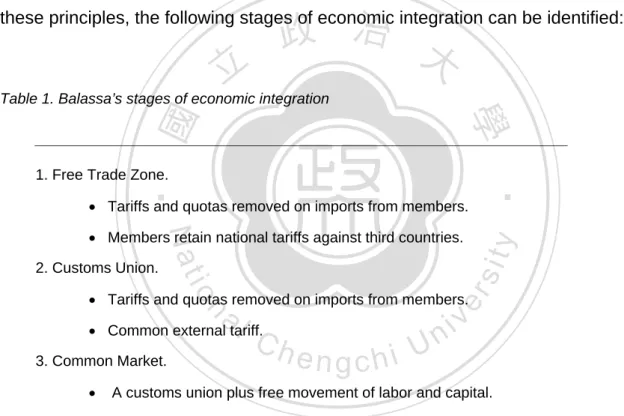
(12) need to export leads to the creation of laws of encouragement as tax benefits or exports financing; in contrast to the laws of discouragement or import rules, which include import duties, nontariff trade barriers such as import quotas, import licensing procedures, certain standards, testing requirements, subsidies, and so on. Balassa (1964) defined economic integration as a process of economic activities accompanied by measures to abolish discrimination between economic units belonging to different nations. In business terms, integration is to be characterized by the absence of various forms of discrimination between national economies. Under. 政 治 大. these principles, the following stages of economic integration can be identified:. 立. Table 1. Balassa’s stages of economic integration. ‧ 國. 學. ________________________________________________________________. Members retain national tariffs against third countries.. y. sit. io. er. 2. Customs Union.. Nat. Tariffs and quotas removed on imports from members.. ‧. 1. Free Trade Zone.. Tariffs and quotas removed on imports from members.. n. al. Common external tariff. 3. Common Market. . Ch. engchi. i n U. v. A customs union plus free movement of labor and capital.. 4. Economic Union. A common market with some harmonization of national economic policies. 5. Total Economic Integration. Unification of monetary, fiscal, social and macroeconomic policy. Establishment of a supranational authority whose decisions are binding for member states. ______________________________________________________________ Source: Laffan, O'Donnell & Smith 1999: 102.. 10 .
(13) Although Balassa’s five stages are still used for the study of economic integration, they underestimated the degree to which national policies and regulations need to be harmonized, and institutions to be created for a Free Trade Zone, a Customs Union and a Common Market. Therefore, more recent studies include the political and institutional requirements to achieve a genuine economic integration and identify extended mechanisms that shape new agreements as: - Single Market: Besides the characteristics of the Common Market, it includes elimination of technical and fiscal barriers, removal of physical borders, and. 政 治 大 at least indirectly, for countries seeking to become part of it. 立. harmonization of norms on product standards and some of the taxes,. -Monetary Union: Along with the coordination of economic policies required by. ‧ 國. 學. the economic union, it fixes exchange rates between currencies of member countries. ‧. in order to bring stability to the system. However, since these measures are. y. sit. io. er. common currency.. Nat. insufficient, the Union is strengthened by replacing multiple currencies with a. In sum, under free trade areas the parties reduce or remove trade barriers as. al. n. v i n C h towards third parties. tariffs and quotas, while retain them In customs unions, trade engchi U barriers are removed among the parties, but also common trade barriers are created. for all participating states as regards third-party states. Common markets in turn provide free movement of factors of production among the parties, while economic communities and economic unions embrace the harmonization of national policies at different levels (Folsom et al 2009). On the other hand, to examine the Economic Cooperation Framework Agreement ECFA one needs first to mind the sensitive issue of cross-strait relations between China and Taiwan. ECFA is in fact a comprehensive economic framework 11 .
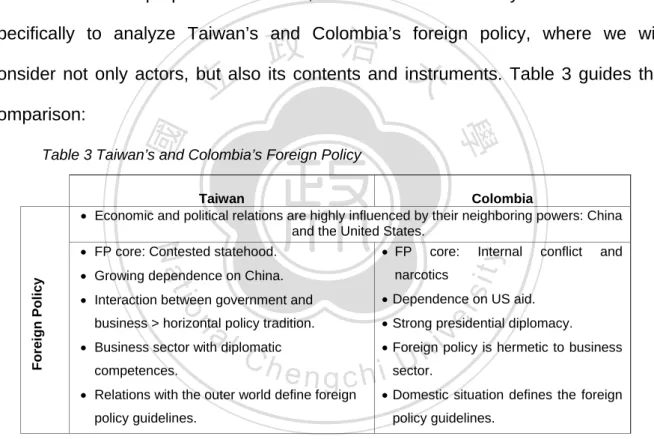
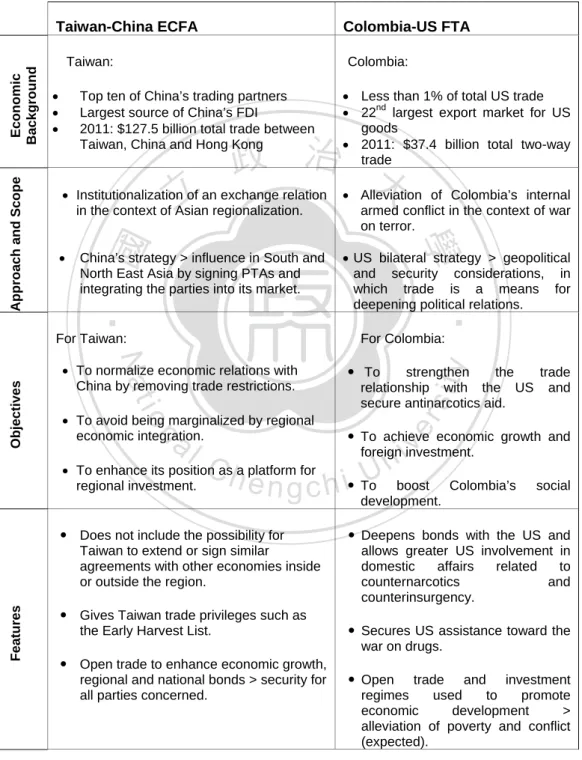
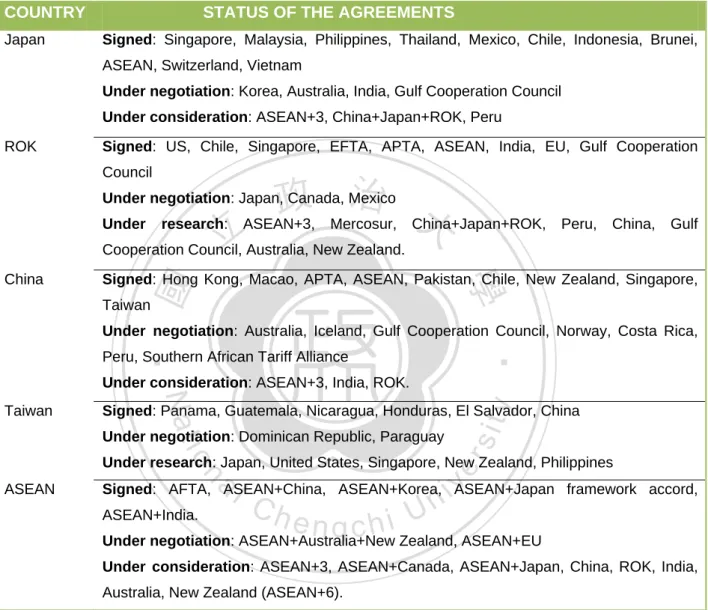
(14) agreement that will automatically lower import tariffs and give the parties preferential access to some sectors, so that the commerce between Taiwan and the mainland is expected to become more integrated. Taiwan’s officials have emphasized that ECFA is a framework, “no more than a preliminary framework…similar to a contents page of a book” (Hong, 2010: 8) but at the same time they have said the agreement is signed according to the Article XXIV of the GATT, with the free trade area to be implemented gradually and not immediately, which would make of ECFA an agreement of phased liberalization.. 政 治 大 contracting parties must decide the full set of regulations and establish a time table 立. Nevertheless GATT’s Article XXIV states that when signing the agreement the. for the creation of the free trade area, and that there should be something in place. ‧ 國. 學. when the negotiations are completed or the terms of the agreement are presented to. ‧. the WTO. In this sense, the distance between the government references to the. sit. y. Nat. ECFA and the actual GATT’s clause, undermine or at least question the coherence. io. er. that is expected when presenting the agreement to the public. Consequently, the definition of ECFA must be constructed based on what has actually been negotiated. n. al. and the events that will follow.. Ch. engchi. i n U. v. The formation of Preferential Trade Agreements is not new. According to Mansfield and Reinhardt (2003: 833) in 1947 GATT stipulated that member-states are permitted to form a PTA only if it eliminates barriers to “substantially all the trade” among its members and does not “on the whole” increase protectionism against nonmembers. Trade integration then seeks to create mechanisms that eliminate discriminatory measures among the parties. However, the authors consider that in fact, trade barriers within preferential arrangements are almost never completely eliminated and members frequently raise trade barriers on nonmembers’ products. 12 .
(15) In this perspective the formation of PTAs is not limited or conditioned by the developments within the WTO, yet the massive trend to these agreements creates systemic risks for the multilateral Organization. Nearly all of WTO members are partners in one or more regional or bilateral trade agreements which are inherently discriminatory as they don’t embrace universalized trade preferences. With every PTA –which liberalizes trade between member states only- the principles of multilateralism and non-discrimination in international trade as embodied by the WTO lose more relevance (Manger, 2009).. 政 治 大 possibilities: trade creation among participants and trade diversion between those 立 Viner (as cited by Folsom et al 2009) explains how PTAs embody two. states and the rest of the world. Folsom et al (2009) consider that trade diversion. ‧ 國. 學. makes difficult to effectively allocate scarce resources, even with the existence of. ‧. trade agreements, due to the absence of a common trade wall against outsiders.. sit. y. Nat. The “Rules of origin” serve as a barrier against third-party imports as under their. io. therein.. al. er. regulations free trade areas are completely “free” only for the goods originated. n. v i n C hindividual PTAsUwith developing economies offer In turn, for developed countries engchi. limited export prospects as many of these accords exclude the goods in which. developing countries have comparative advantages. This is due to the lax discipline of the WTO’s rules that allow excluding sensitive domestic sectors from the PTA’s liberalization process. Additionally, the huge amount of existing PTAs creates a puzzle of different rules that are costly for developing countries and hard to follow for firms. For example, only half of the imports into the European Union from leastdeveloped nations make use of the full tariff preferences available. The other half is covered by Most Favored Nation tariffs since “exporters would rather pay the higher 13 .
(16) duty than deal with the documentation requirements” (Breton quoted in Manger, 2009: 2). Furthermore, it has been argued that compared with even minor tariff reductions on a multilateral basis, PTAs do not create much trade (Kruger 1999, Manger 2009). The commitment to lower barriers they suppose is surpassed by the unilateral measures applied by many countries, which reinforces the argument that PTAs are a second-best solution to multilateral and unilateral liberalization. Countries then sign PTAs mainly because these agreements are discriminatory, therefore only countries. 政 治 大 Then why are Colombia and Taiwan pursuing PTAs with the United States and 立. who sign them can obtain benefits, while the non-members remain marginalized.. China? And why are the United States and China signing agreements with partners. ‧ 國. 學. that in theory would bring little benefits in terms of market? Do the PTAs that. ‧. Colombia and Taiwan pursue with the United States and China help them to achieve. sit. y. Nat. their individual goals and benefit their regional relations? This work argues that the. io. consideration under the logic of “politicized trade”.. al. er. will of creating a PTA is motivated by strategic interaction and strong political. n. v i n To answer those questions C and explain the main h e n g c h i Uargument of this research, the. analysis will be divided in five chapters. Although the cases are considered. separately in much of this work, each chapter will present a comparative table to illustrate the analysis, and the end of chapters III and IV will include comparative remarks to establish major similarities and differences between the cases. This introduction is the first chapter. Chapter II presents a review on Colombia’s and Taiwan´s political economy in order to delineate a comparative approach for the study of both cases. In this regard, special attention will be given to their political system, inward/outward-looking economic models and how these variables influence 14 .
(17) the foreign policy decision making. Chapter III examines separately Colombia and Taiwan’s relations with their neighboring powers by assessing the bilateral trade agreements FTA’s and ECFA’s major topics and scope, in order to establish the approaches and motivations behind the negotiated bilateral Preferential Trade Agreements. Chapter IV addresses Colombia and Taiwan’s regional relations, and the effects of the FTA and the ECFA upon both countries’ regional links. Chapter V offers some conclusions on the distinctive features of Colombia and Taiwan’s bilateral trade strategies embodied in the FTA and ECFA, as well as the effect of. 政 治 大 contributions will be presented for Colombia and Taiwan to advance in the relations 立. such agreements on both countries’ regional relations. Furthermore, some potential. with their neighboring powers and within their regions.. ‧. ‧ 國. 學. n. er. io. sit. y. Nat. al. Ch. engchi. i n U. v. 15 .
(18) II TAIWAN’S AND COLOMBIA´S POLITICAL ECONOMY AND FOREIGN POLICY This chapter presents a review on Taiwan´s and Colombia’s political economy in order to formulate a comparative approach for the study of both cases. In this regard, special attention will be given to their political system, inward/outward-looking economic models and how these variables influence foreign policy decision making. Table 2 illustrates the similarities and differences to be explained below:. . 立. Colombia. President: highest authority. Holds specific powers to conduct national affairs. Developmental state tradition.. . . Autonomous State Japanese colonial rule established the first industrial base.. Clientelistic State Spanish colony based extraction of resources.. . Primary ISI + new institutions and arrangements.. Primary ISI with persistence of rent seeking and influence of political elites.. . Secondary ISI based on infrastructure and industrial development > Technology intensive strategy in the 80’s.. Return to the export of agricultural products > Abandonment of the ISI before its completion > Reliance on primary products.. the. y. sit. v i n C + protection Economic liberalization at the expense Economic liberalization h e n g c hofi theUdomestic market. n. . on. er. io. al. Lack of a defined State project.. ‧. ‧ 國. . Nat. Economic Structure. . 政 治 大. Taiwan Democratic multiparty system.. 學. Political System. Table 2 Taiwan’s and Colombia’s Political Economy. of domestic market and key sectors > strengthening of competitiveness.. Taiwan’s Political System. The Republic of China (ROC) was founded in 1912 as the first Asian republic. After the Chinese Civil War, the People’s Republic of China (PRC) was established on the mainland China in 1949 and the defeated nationalist government of the ROC. 16 .
(19) moved to Taiwan and since then has exercised full authority over Taiwan, Penghu, Kinmen and Matsu. The ROC (hereafter Taiwan) thus rules a defined territory, has its own constitution, national flag and anthem, legal system, currency and armed forces. It conducts its own foreign relations with more than twenty countries, and its government represents the 23 million Taiwanese living under its jurisdiction. Consequently “despite PRC protestations to the contrary, it is obvious that the ROC does exist and meets all the requirements of statehood” (Hickey, 2007: 3).. 政 治 大 provincial, municipal and county/city, each of which has defined powers. The central 立 The government of the ROC is divided into three main levels: central,. government consists of the Office of the President, the National Assembly, and five. ‧ 國. 學. branches of government or Yuan: the Executive Yuan, the Legislative Yuan, the. ‧. Judicial Yuan, the Examination Yuan, and the Control Yuan.. sit. y. Nat. The thirteenth term presidential election was held on 14 January 2012.. io. er. President Ma Ying-jeou was re-elected with 51.6% of the votes, followed by the DPP candidate Tsai Ing-wen with 45.63%. Reuters (2012, January 14).. n. al. The president is the. v i n C h authority of Uthe nation highest engchi. and holds specific. constitutional powers to conduct national affairs. He is assisted in making decisions on state affairs by advisors and agencies such as the National Security Council and the National Unification Council. As chief of state, the president represents the nation in its foreign relations and at all state functions. He’s responsible for developing Taiwan’s foreign policy goals, objectives and strategies, “outlining the basic principles of national security and setting the direction and tone of cross-strait relations with the PRC. The president also exercises the powers of concluding treaties, declaring war and making 17 .
(20) peace… [and] is responsible for appointing officials including the premier 3 , the minister of foreign affairs and high-ranking military officers and defining the foreign policy responsibilities, if any, of the vice president” (Hickey, 2007: 45). All acts of state are conducted in his name and all his powers are exercised in accordance with the Constitution and the law (International Business Publications, 2009). The Ministry of Foreign Affairs (MOFA) belongs to the Executive Yuan and “is responsible for conducting the nation’s foreign affairs and related matters with its main purpose being to preserve and protect the nation’s interest” (Ministry of Foreign. 政 治 大 After the lifting of martial law in 1987 the Constitution amendment modified 立. Affairs Republic of China (Taiwan) [MOFA], 2011).. the presidential powers. For instance, unlike the almost unlimited power that the. ‧ 國. 學. president used to exercise over both domestic and foreign policy, the president now. Nat. io. al. er. The Developmental State in Taiwan. sit. y. ‧. shares power with an appointed premier and cabinet.. n. v i n Ch Taiwan as all the Newly Industrialized Countries (NICs) has a developmental engchi U. state tradition, in which the relation between the state and the capital is key to understand the foreign policy formation. Under the developmental state paradigm, state and capital work together aiming to achieve growth, productivity and competitiveness with a commitment to economic growth and technological advancement. In East Asia, authoritarian mono-regime politics were a central part in the implementation of the model as they provided the continuity and the strong state powers necessary to sustain the project. 3 After presidential approval, the premier may serve as a chief foreign policy spokesperson. . 18 .
(21) In order to realize such ends, the state strategically allocates resources, guides and coordinates markets and the private sector; uses a raft of policy instruments and fosters the state’s relations with society. Here, as the state’s industrial and mercantile policies have a core role as they gradually strengthen the domestic business sector in the pursuit of techno-industrial catch up (Gerschenkron, 1962 as cited in Hobday, 2009). Such arrangements introduce another relational concept of the developmental state, which is embedded autonomy. Evans (1995: 59) defines it as “the concrete set. 政 治 大 the continual negotiation and renegotiation of the state’s goals and policies”. Under 立 of social ties that bind state and society […] and provide institutionalized channels for. this category, in Taiwan the state apparatus remains connected to key economic. ‧ 國. 學. groups, and “its embeddedness provides sources of intelligence and channels of. sit. y. Nat. effectiveness of its infrastructural power” (Dent 2002: 40).. ‧. implementation that improve the state’s policy competence, thus enhancing the. io. er. Therefore, the state instead of an antagonistic relationship collaborates with the domestic economic class towards a well defined project. For instance, under the. al. n. v i n C h policies initiated liberalization and internationalization in the 1980’s, the Taiwanese engchi U government opened the economy to foreign competition but at the same time. implemented measures to strengthen its export competitiveness. The small and medium-size enterprise based nature of Taiwan’s economy is therefore a consequence of the evolution of Taiwan’s developmental state and its strategic trade policies. From a single-party power structure, often labeled as a kind of developmental authoritarian dictatorship, Taiwan has become a democracy where the dynamics of. 19 .
(22) the struggle over power and policy have produced a competitive multiparty system4. Within this system there are internal party groupings which represent contending personalities and approaches to issues such as Taiwan’s identity, relations with Mainland China, and domestic and foreign policies. However, the competition is framed by a lack of trust in which the political players work to undermine their opponents, therefore political cooperation is absent. Additionally, Swaine and Mulvenon (2001) identify a lack of maturity on Taiwan’s political system characterized by the KMT’s partisan political advantage. 政 治 大 of the state machinery, the bias of the state-owned media, and the lack of autonomy 立 combined with the persistence of its influence over the state; the administrative bias. in the private sector. Likewise, Hickey (2007: 60, 61) argues that at least in regards. ‧ 國. 學. to foreign policy bureaucracy, Taiwan hasn’t been able to fill the void left by the. ‧. downfall of the KMT decision making structure, and as a consequence has a weak. sit. y. Nat. state bureaucracy and there is no culture for inter-agency consultation. Therefore,. io. er. the role played by the MOFA and other foreign policy actors remains very limited in the policy-making processes, according to the above quoted authors.. al. n. v i n C h when analyzing Different viewpoints are evident Taiwan’s policy making. Dent engchi U. instead, recognizes a rational and specialized functionality established among the state’s agencies that manage foreign policy issues, which creates in its words “harmonious inter-ministry relations” and avoids overlapping (2002: 268). In this regard, he follows “the introduction in the 1980’s of mechanisms for intra-ministerial coordination, located various ministries into the economic policy scope and fostered a broader consensus in foreign policy making” (Dent, 2002: 270). 4 The current Legislative Yuan representing parties are in their order of importance: the Kuomintang (KMT), the Democratic Progressive Party (DPP), the People First Party (PFP), the New Party, and the Non‐Partisan Solidarity Union (NPSU). . 20 .
(23) Colombia’s Political System Colombia is a presidential representative democratic republic with a strong executive. The President is both head of state and head of government and is elected for a four-year term. From 2005 a consecutive re-election is possible for a second term. The central government consists of three separate branches: The executive, legislative, and judicial branches. The executive power is exercised by the government; the legislative power is vested in the Bicameral Congress which. 政 治 大. consists of the Senate and the Chamber of Representatives, both directly elected for. 立. four-year terms; and the Judiciary is independent of the executive and the legislature. ‧ 國. 學. and consists of the Supreme Court, the Council of State, the Constitutional Court, and the Superior Judicial Council.. ‧. Colombia has a multi-party system with three major political parties: The. Nat. sit. y. Social Party of National Unity (liberal conservatism); the Conservative Party. n. al. er. io. (conservatism); the Liberal Party (social liberalism), and the Radical Change Party. i n U. v. (conservative liberalism); although other parties such as the Green Party (centrism,. Ch. engchi. green politics), and the alternative Democratic Pole (democratic socialism) have achieved significant electoral success as alternatives to the country’s traditional political background, the latter being the only center-left party. The 2010 presidential election was held on 30 May 2010 and former Defense Minister Juan Manuel Santos (Social Party of National Unity) was elected with 69.13% of the votes in the second round, followed by the Green Party candidate Antanas Mockus with 27.47%. Likewise Taiwan, in Colombia the President symbolizes the national unit and holds constitutional powers to direct the nation’s international relations. In this regard, 21 .
(24) also included in the presidential functions are the ability to also to appoint diplomatic and consular agents, to receive official agents and to subscribe international treaties or agreements with other States and entities, which shall be the subject of congressional approval (Constitución Política de Colombia, 1991). The Ministry of Foreign Affairs (in Spanish: Ministerio de Relaciones Exteriores) also known as the Chancellery, belongs to the executive branch and is responsible for “conducting foreign relations through diplomatic missions and formulating foreign policies towards democratic prosperity” (Ministerio de Relaciones. 政 治 大 Colombia has a historical presidential tradition but unlike Taiwan, there is not 立. Exteriores. República de Colombia [Minexteriores], 2010).. a defined state project as we can find under the developmental state paradigm. We. ‧ 國. 學. can interpret this as a result of inherited institutions from the Spanish colony, as were. ‧. the local elites who imported the European Nation-State model and established it for. sit. y. Nat. their future benefit. In this way the elites could rule over politics, laws, institutions and. io. er. the military, thus a wider participation in the construction of the national project was only achieved after a long process of armed struggles and social discontent that. al. n. v i n established violence as the onlyC means for the recognition h e n g c h i U of rights.. The persistence of such dislocation can be explained through the fact that. Colombia is still in the process of state-making (Ayoob, 1997). This process basically involves the strengthening of state control over territory and population, the consolidation of political authority, the maintenance of order, and natural resources extraction. According to Tickner (2004, this phenomenon is reflected in the weakness of the institutional apparatus and its control over national territory, which is more than evident in the case of Colombia: precarious state presence, low levels of integration with national centers, and high rates of poverty and underdevelopment. 22 .
(25) At an institutional level, such conditions are worsened by a strong executive, one of the main features of Colombian politics. The interactions, divisions and tensions between the agencies responsible for policy design and implementation, negatively affect policy coordination and thus, the process of achieving consensus over domestic and foreign affairs. Martha Ardila quotes as an example “the tensions between the Ministries of Foreign Affairs and Foreign Trade; Foreign Affairs and National Defense; and Foreign Affairs and the Vice Presidency on issues such as security, human rights and cooperation, among others” (2011:94).. 政 治 大 important when defining the state’s priorities, yet internal conflict and the search for 立 In Colombia both the domestic natural resources and geopolitics are. international cooperation is what predominate in foreign policy making. Certainly. ‧ 國. 學. there is an overlapping of subjects within these topics since security and drug. ‧. trafficking are global issues that also influence the domestic agenda. Therefore, one. sit. y. Nat. of the major weaknesses of the Colombian political system is the lack of a. io. er. comprehensive vision to define a coordinated state policy that could be extended to the international field to cope with the country’s permanent demand for international. n. al. cooperation.. Ch. engchi. i n U. v. Economic structures: Export-oriented model vs. ISI There are two main development strategies available for less developed countries: Import Substitution Industrialization (ISI) or Export-led growth. ISI is based on the idea of economic nationalism to achieve self-sufficiency through the encouragement of local industry seeking to produce goods for the domestic market and export primary products.. 23 .
(26) Haggard asserts that “virtually all developing countries began their contact with the world economy as exporters of primary products, and many remain depending on commodity exports” (1990: 24). The choice of the strategy that should follow this initial period is affected by economic factors, government policies, and agents involved in the trajectory. Then, such a first stage is usually followed by primary Import Substitution that stresses the domestic production of goods while exporting primary products. The choice to take ISI to a deeper stage would depend on the size of the market, the. 政 治 大 growth of manufactures,. availability of natural resources, the earnings from exports used to support local manufacturing, the consequent. 立. and the continuity of. supportive industrial policies (Haggard, 1990).. Nat. sit. y. ‧. ‧ 國. 學. Taiwan’s Economic Structure. io. er. The beginning of Taiwan’s heavy industry development took place during the last decade of Japanese colonial rule (1935-1945) which made Taiwan a strategic. al. n. v i n actor in Japan’s war effort as a C manufacturing center. h e n g c h i U Japan started to progressively invest in the island’s economic development, thus establishing the first industrial base that remained after the end of the war that ended Japanese rule.. Like most developing countries Taiwan started the primary import substitution in the fifties, under Chiang Kai-shek’s administration after his forces moved to Taiwan in 1949. In this context, American financial assistance and technical support were a major contribution for the upgrade of Taiwan’s industrial capital and economic efficiency (Dent, 2002). Nevertheless, the emergence of the developmental state. 24 .
(27) during the 1950’s was the most important determining factor in Taiwan’s modern economic development. From a statist perspective, the extensive role of the State is one of the core reasons for Taiwan’s success. The high levels of protection granted to industries, the incentives given to specific sectors, and the general State control over market mechanisms made it possible to achieve high rates of growth. In general, as Gilpin puts it, “in their path to economic success East Asian governments pursued protectionist policies to favor their industrial development, associated with economic. 政 治 大 According to Dent, “the export imperative was heightened by the island’s lack 立. self-sufficiency and political autonomy” (1987: 33).. of natural resources and relatively small domestic market” (2002: 215), which by the. ‧ 國. 學. late fifties proved to be too small to absorb domestic production. Along the same line. ‧. Haggard (1990) states that the shift from ISI to an Export-led strategy is more likely. sit. y. Nat. to occur when countries lack the necessary resources to continue with import. io. er. substitution and then face the need to generate non-traditional exports, which will give them a comparative advantage. The shift is pulled by the State through. al. n. v i n C hof labor intensiveU manufactures and encourage incentives that favor the exporting engchi export oriented investment.. Tsai explains that shift arguing that “Primary Import substitution lost momentum” (1999: 72) by 1957 owed to the saturation of the protected Taiwanese market and the failure in saving foreign exchange, which together with pressure from the United States accelerated the reorientation of the development strategy and led the government to implement a reform package from the end of 1957 to 1972. The new policies included the Foreign Exchange Reform, The Nineteen Point Economic and Fiscal Reform Programme and The Statute for The Encouragement of 25 .
(28) Investment 5 . Under these measures “many goods were decontrolled, licenses for many others were eliminated and tariff reform was promulgated to make possible the transition to export-led growth” (Haggard, 1990: 138). These early liberal trade policies were “generally limited to the export sector, with the domestic market remaining heavily protected” (Tsai, 1999: 73). The secondary import substitution that took place between 1973 and 1980 focused on infrastructure and the role of the state in industrial development. The Ten Major Construction Projects of 1974-1978 involved the establishment of Taiwan’s. 政 治 大 Technology Research Institute (ITRI) and the Institute for Information Industry (III) 立 heavy and chemical industries, which along with the creation of the Industrial. paved the way for the promotion of high-tech industries after 1980.. ‧ 國. 學. Wang (1995) explains that second shift on the development strategy as a. ‧. result of the loss of the competitive advantage of the Newly Industrialized Countries. sit. y. Nat. and the consequent need to discover new sources of growth in the early eighties. In. io. er. this scenario the economic structure had to be upgraded by making it more technology and labor intensive, so the development of the high-tech industry begun.. al. n. v i n C h the center U The Information Technologies became of the new strategy, which was engchi focused on promoting strategic industries and national key technologies6.. Therefore, in addition to the role of the state, the geographic location, the distribution of economic activities and the development of new technologies also contributed to progressive economic development in Taiwan. Under this perspective 5 Other measures to promote exports included the liberalization of the foreign exchange allocation system, a special export loan programme, import liberalization and the establishment of exports processing zones. 6. The two key policies on Taiwan’s IT development were the Ten‐Year Plan 1980‐1990 that . emphasized on IT production for export, and the Ten‐Year Plan 1990‐2000 that emphasized on IT applications. . 26 .
(29) the island not only had the material capabilities required to develop its own industries, but also the necessary policies and institutions to foster and protect economic activities favorable to the interests of domestic industry. Although developmental statism remains evident in Taiwan’s political economy, it has partially given in to neoliberalism. As mentioned, the process progressively started in the seventies and continued through the eighties with the deregulation and liberalization of the economy, driven by domestic and external pressures. During its path to economic development, the final decision-making. 政 治 大 economic bureaucracy, for Haggard “A sharp division of labor existed in Taiwan 立 authority rested with the KMT Party but economic affairs relied mainly on the. between the political and economic sides of government” (1990: 140).. ‧ 國. 學. At the domestic level, the increasing democratization initiated in the late. ‧. eighties brought pressures for the government to move towards a market democracy;. sit. y. Nat. while, at the international level, as Dent (2002) points out, the United States. io. er. pressured Taiwan to adopt less state-active policies in exchange for liberal measures, an idea reinforced by negotiations for Taiwan’s accession to the WTO.. al. n. st. By the 21. Ch. century Taiwan had become. engchi. v i n aUmajor world. manufacturer and. exporter in technology-intensive industry sectors, and had passed many developing countries in terms of income per capita. Additionally, Taiwan’s relative lack of natural resources and the need for supplies of strategic industrial materials have led the governments to give particular priority to outward foreign direct investment projects in raw material based sectors.. 27 .
(30) Colombia’s Economic Structure In early years during the ISI, the governments in Taiwan and Colombia refused an absolute free market approach and intervened in economic activity in an attempt to guide it towards development. In both cases, governments sought to encourage productive diversification, which was accompanied by the creation of state organizations to promote investment in infrastructure and industry. Both economies then were more inward oriented and manufacturing played an important role in terms of primary production.. 政 治 大. However, the means and details of their inward-looking policy were different.. 立. In Colombia the adoption of the ISI was encouraged in the 1940s and 1950s by the. ‧ 國. 學. United Nations Economic Commission for Latin America (ECLA) and its director, Raúl Prebisch. “This model aimed to achieve self-sufficiency and a certain degree of. ‧. withdrawal from and reinsertion into the capitalist trading system” (Haggard, 1990:. Nat. sit. y. 26). Furthermore, as García (1974) argues, one of the propositions linked to this. n. al. er. io. approach was the regional integration in Latin America to achieve trade gains. i n U. v. through economies of scale, although this point remained secondary to Import Substitution Industrialization.. Ch. engchi. The effects of the great depression and the characteristics of Latin American economies in the post-World War II period made the ISI appear as the most suitable strategy for economic development in terms of lessening dependence on foreign markets. However, unlike Taiwan, the ISI in Colombia was not accompanied by changes in the institutional arrangements, so the rent seeking as well as the privileges conceded to the industries linked to land owners and political elites remained high.. 28 .
(31) The ISI in Colombia was initially meant to satisfy domestic demand, while expanding the domestic market. The Instituto de Fomento Industrial (in English, Institute for Industrial Promotion) was created in the late forties; local production was protected under new policies, while new credits were introduced seeking to finance the accumulation of capital (Sanabria, 2007.) Between 1945 and 1953 there was a significant increase in the production of raw materials that caused a division between commercial-technical agriculture and traditional agriculture. Industrial production continued to be prioritized throughout the. 政 治 大 the farmers made efforts to improve productivity through investment or innovation, 立 fifties, while agricultural production was marginalized. Neither the government nor. instead all the resources were oriented to industry; as a result the land ownership. ‧ 國. 學. arrangements and the local powers remained the same, while agricultural. ‧. productivity stagnated.. sit. y. Nat. As a consequence, the social sectors that were not involved in “modern”. io. er. technical agriculture were left behind by the State incentives, an unequal situation worsened by the absence of land reform. Misas (2002) states that owed to the. al. n. v i n Ccoffee liberalization of coffee prices the and the new industrial bourgeoisie U h e ngrowers i h gc. became the new protagonists of the development model and the State acted to favor the interests of these powerful economic elites. In Taiwan instead, the extensive land reforms of 1949-1953 proceeded first with the rent reduction program; the sale of public land acquired from the Japanese, and the “advance” against the rural power of landlords backed by a newy developed rural administration. To contrast this with what occurred in Colombia we can quote the Korean groups that opposed export-led growth in the sixties “attention to the. 29 .
(32) exports at the expense of the domestic market, to industry at the expense of agriculture, and to accumulation at the expense of equity” (Haggard 1990: 73). As a result of the social fragmentation during the sixties, liberal guerrillas were formed in the south of the country, while in the coffee-growing regions the political differences between conservative and liberal farmers set them at odds. The country therefore started to suffer a generalized violence which had its roots in the countryside and “Terror became the normal way of life for millions of Colombians, in the countryside as in the cities, and such an atmosphere necessarily influenced the. 政 治 大. weakening of the agricultural, industrial and coffee production” (Kalmanovitz, 1988: 379).. 立. After the end of the first stage of the ISI in the sixties, “the Colombian. ‧ 國. 學. government went back to the export of agricultural products as the main income. ‧. source to support the industry” (Bethell, 2000:289), coffee thus became the major. sit. y. Nat. export sector at the expense of the exports which had led to growth in previous years.. io. er. However, coffee failed to make an impact on accumulation as the previous new exports had done, causing economic stagnation and an overall decrease in exports.. al. n. v i n The problem in ColombiaC was not the abandonment of the ISI model, but the hengchi U. abandonment of the industrialization process itself before its completion and without being replaced by any other strategy. Many authors have argued that the Colombian industrialization process stopped in 19707, and from that year a deindustrialization process started. In this regard Misas states that the policies implemented under the ISI strategy were simultaneously “industrializing and deindustrializing” for the economy (2002: 59) since the protective measures prevented the domestic industry form upgrading its technology capabilities and skills so that they could adapt to the 7 Echeverría y Villar, 2005; Sanabria, 2007; Misas, 2002. . 30 .
(33) levels of international production. What we find here is that in Colombia the ISI was implemented as a complementary model for the agricultural economy but not as an autonomous project that might have created a real industrial-based economy in the long term. The eighties are usually referred to as the “Lost decade” in Latin America owed to the foreign debt crisis and the economic stagnation of its economies. The widespread adoption of the principles of the Washington Consensus was to a large degree a reaction to the economic crisis and the inability to succeed with the ISI. The. 政 治 大 technocrats, public opinion and politicians around the feasibility of industrialization, 立. protectionist project then was followed by a change of perceptions among national. its objectives, the economic policies, as well as the definition of the role of the state. ‧ 國. 學. regarding the nation’s economic orientation. In this context, Colombia seemed to. ‧. have faced no other alternatives and relinquished the ISI before its completion. The. sit. y. Nat. liberalization policies then started to rule the economy and the regulatory measures. io. er. built under the ISI were dramatically changed without knowing which should have been the new strategy or the new institutional arrangements.. al. n. v i n Cinternational Due to the liberalization of and the subsequent increase in h e n g c htrade i U. imports, domestic firms lost a great portion of the market. As Kalmanovitz (1988) points out, the financial and monetary policies designed in the early eighties were enshrined in the prosperity of the U.S. economy, which gradually strengthened the Pacific area and the participating regions of California and Texas in addition to Japan and its areas of influence - South Korea, Taiwan, Hong Kong, Singapore and Malaysia -. One more difference between Taiwanese and Colombian paths to development thus comes to the surface: Despite having both the Pacific and the 31 .
(34) Atlantic coasts, Colombia was not part of the prosperous Pacific economies of the eighties, as that of Taiwan. On the contrary, its economy was characterized by a decrease in domestic production and exports, and an increasing unemployment rate between 13% and 14,5% (Arango & Posada, 2001). The two economies then ran parallel: the Taiwanese as part of the new scenario of industrialization and technology upgrading, and the Colombian as an example of a failed model replaced by a liberal project for which the economy was unprepared. Gabriel Misas asserts that economic liberalization couldn’t transform the. 政 治 大 linking the economy to international dynamics. On the contrary, “the new measures 立. existent relation between economic actors by changing the norms of production or. caused a decrease in the accumulation of capital, the domestic market was lost to a. ‧ 國. 學. massive wave of imports, and the trade balance was negative” (2002: 195).. ‧. In sum, the negative consequences of the economic liberalization were owed. sit. y. Nat. to the State’s failure in achieving competitiveness by adapting the domestic economy. io. er. to international norms. The State failed to promote and protect economic activities favorable to the interests of the domestic industry and lost control over the domestic. n. al. market.. Ch. engchi. i n U. v. By contrast, the Taiwanese approach fostered domestic manufacturing from the mid-1930s, and shifted to more outward-looking economic policies in the 60’s in a process accompanied by market interventionism and institutional arrangements. This "mixed" approach gave a more explicit role to exports, and although agriculture had a decline relative to manufacturing, agricultural products maintained an important position in the economy. In both countries, the inward orientation under the ISI model was the result of particular policy choices towards industrialization through protection (tariff protection, 32 .
(35) price controls), which helped to achieve a significant diversification and expansion of the domestic industrial base. These measures were followed in Taiwan by a shift in incentives to favor the production of high-technology; unlike Colombia which moved to the expansion of manufactured exports (basically clothing and textiles), yet today the main exports still consist of commodities and agricultural products. Taiwan instead has undergone an amazing transformation from a one-party state under martial law to a prosperous democracy and an economic reference point for the region, first as a center for manufacturing and now as a center for hi-technology innovation.. 立. 政 治 大. WTO and Economic Policy for Taiwan and Colombia. ‧ 國. 學. The WTO membership represents a major external pressure for Taiwan and. ‧. Colombia´s trade policy liberalization. Like Lam points out “In order to make its. Nat. sit. y. application more attractive, Taiwan agreed in 1995 to assume all the responsibility of. n. al. er. io. a developed country member [if accepted], which involved wider market opening”. i n U. v. (2002: 285). Certainly, after its accession in 2001 Taiwan has to act according to its. Ch. engchi. WTO obligations, which means it must implement liberalization measures mainly related to the reduction of tariff rates and import licenses. Nevertheless, in Taiwan neoliberal reforms have not necessarily lead to the deconstruction of the developmental state. Rather, according to Dent “the way in which economic liberalization is implemented is more important …in particular regarding the regulatory measures that accompany neo-liberal reform”. (2002: 217, 218). This is to say ‘liberalization with re-regulation’ would be the approach that exemplifies the adaptability of Taiwan’s developmental state to meet the challenges of globalization. For instance, in its international financial policy the Taiwanese State 33 .
(36) has implemented neo-liberal policies only in certain aspects, while others such as the currency market, remain state regulated. In this regard, Taiwan’s Foreign Trade Act embodies the “liberalization plus” approach to Taiwan’s foreign economic policy formation by stressing the need for economic openness in the global era but also state activism in promoting industrial competitiveness(Bureau of Foreign Trade, [BOFT] 1993). As an example, the Bureau of Foreign Trade (BOFT) helps companies in increasing their international competitiveness through various plans, measures and schemes, insurances and so. 政 治 大 Colombia in turn, has been a member of WTO since 30 April 1995. The 立. on (Dent 2002: 236).. approval by the Colombian congress in 1994 of the law that accepts the agreement. ‧ 國. 學. which establishes the World Trade Organization and the multilateral agreements. ‧. annexed was a major step in the process of Colombia’s economic liberalization. At. sit. y. Nat. the same time, the new law set the framework from which to develop future. io. er. programs of economic integration within Latin America and the Caribbean. Since economic liberalization policies had started earlier, the country was. al. n. v i n ahead of the conclusions of theC Uruguay Round (1994), h e n g c h i U this lead many to think that Colombia could easily embrace the obligations required by participation in the WTO.. Certainly, to be a WTO member entails policies and procedural adjustments according. to. broad. international. commitments.. Consequently,. Colombia's. participation in the global trading system became more demanding and required greater specialization of the government. Colombia’s membership in the WTO was meant to open new trade opportunities for private business, which as stated by (Acuña, 1994), could in turn take advantage of regional agreements and preferential treatment from developed 34 .
(37) countries like the United States and the European Union, with the ATPA and the Andean GSP, respectively. Also, a deeper relation between private capital and national government was expected as a result of the role of the dispute settlement system of the WTO, which is the scenario for governments to safeguard the interest of national businesses. But most importantly, according to (Ardila, 2005) the WTO would allow the nation to defend its interests as a developing country regarding the “new” issues used by industrialized countries to justify protectionist practices, especially those. 政 治 大 For instance, in both the Uruguay and the Doha rounds Colombia centered the 立. related to environmental protection, restrictive business practices and labor rights.. discussions on agriculture and the elimination of trade barriers for tropical products. ‧ 國. 學. such as flowers, coffee and fruits, as well as on the textiles industry.. ‧. While Colombia had started the liberalization process as the only option after. sit. y. Nat. the failure of the ISI model in the eighties, Taiwan maintained a strong institutional. io. er. and regulatory framework parallel to its liberalization policies. Such liberalization process saw its definite institutionalization in 2001 with the WTO membership. For. al. n. v i n C h to global dynamics; adaptability engchi U. Taiwan, apart from its. security and economic. reasons are certainly a huge motivation to keep the state-centric approach. By contrast, Colombian elites embraced liberalization as the path that had to be followed to integrate their economy with the world no matter the disadvantages faced by developing countries in placing their goods on the markets of industrialized countries. As Rocha puts it “Since 1998, the trade strategy in Colombia has focused exclusively on the preparation of the FTA negotiations, in order to repeat the Mexican experience after its entry into NAFTA, but emphasizing in the consolidation. 35 .
數據

+3

相關文件
近年來,隨著全球政經環境快速改變,尤以東協經濟整 合在 1999 年形成自由貿易區後,更積極以東協+N 模式進 行整合,東協加中國大陸、東協加日本與東協加韓國等東協
經濟部國際貿易局 貿易服務組
局部性協定:在拉丁美洲整合協會(ALADI)架構下與 7 個國家簽 署 9
美國貿易調整協助方案(Trade Adjustment Assistance,
為協助廠商因應全球區域經濟整合及自由貿易協定 之衝擊,提升產品出口競爭力,經濟部已協調財政 部針對進口關稅 4.3 %以上之產品,恢復外銷品出
You are given the wavelength and total energy of a light pulse and asked to find the number of photons it
Wang, Solving pseudomonotone variational inequalities and pseudocon- vex optimization problems using the projection neural network, IEEE Transactions on Neural Networks 17
volume suppressed mass: (TeV) 2 /M P ∼ 10 −4 eV → mm range can be experimentally tested for any number of extra dimensions - Light U(1) gauge bosons: no derivative couplings. =>
