國
立
交
通
大
學
資訊學院 資訊學程
碩
士
論
文
半導體在製品晶舟置換之設計與實作
Design and Implementation of In-Process FOUP Exchange in
Semiconductor Manufacturing
研 究 生:楊申甲
指導教授:李素瑛 教授
半導體在製品晶舟置換之設計與實作
Design and Implementation of In-Process FOUP Exchange in
Semiconductor Manufacturing
研 究 生:楊申甲 Student:Shen-Chia (Jack) Yang
指導教授:李素瑛 Advisor:Suh-Yin Lee
國 立 交 通 大 學
資訊學院 資訊學程
碩 士 論 文
A Thesis
Submitted to College of Computer Science National Chiao Tung University in partial Fulfillment of the Requirements
for the Degree of Master of Science
in
Computer Science June 2010
Hsinchu, Taiwan, Republic of China
i
半導體在製品晶舟置換之設計與實作
學生:楊申甲
指導教授:李素瑛教授
國立交通大學 資訊學院 資訊學程碩士班
摘 要
隨著科技日益月新,電晶體設計與生產亦須隨著進步的腳步邁進。這
些電晶體的生產週期在半導體製程中扮演著重要的角色。隨著產品的多元
化,半導體廠內的產品不再是以往大量的單一產品,而這些多元化生產往
往會相互影響各種產品的生產週期。昂貴的投資伴隨著製造機台折舊的財
務壓力,儘管這些廠商已經盡力將產能調配到滿載水位,半導體公司仍然
期望各種產品的生產週期能夠有進步的空間。
在 12 吋半導體晶圓生產過程中,搭載這些晶圓運輸的載具我們稱為
晶舟。在繁雜的生產過程裏,晶圓會因製程上的需求,必須做晶舟的置換。
這些置換晶舟的過程在目前生產架構下,必須花冗長的時間等待置換機
台。此篇論文借由國際半導體協會(SEMI)新定義的機台規格,配合生產執
行系統(MES)軟體及相關系統的修改,設計與實作了在製晶圓的晶舟置
換。此設計不但節省了晶圓等待置換機台的時間,縮短了製造週期,也騰
出了更多置換機台的產能供其他產品使用。
ii
Design and Implementation of In-Process FOUP Exchange in
Semiconductor Manufacturing
Student: YANG, SHEN-CHIA
Advisor: Dr. LEE, SUH-YIN
Degree Program of Computer Science
National Chiao Tung University
ABSTRACT
Semiconductor manufacturing is an expensive investment. Depreciations of the equipments need years to cover while the growth of information technology accelerates year by year. Although the factories maximize the throughput and their capacity of manufacturing these integrated circuits (IC), cycle time (CT) of producing these ICs has always been a key factor and reduction of CT is always welcome. On the other hand, a semiconductor factory may come up with more and more demands on manufacturing new products and these various combinations of products may affect the CT of a single volume product.
Front opening unified pod (FOUP) is the carrier of the 300mm wafers. During the process of manufacturing, the wafers are being exchanged from one FOUP to the other according to the information defined in a process flow. This thesis designs and implements a new strategy called In-Process FOUP Exchange (IPFE) via the concept of a new standard introduced in SEMI organization that would eventually assist to reduce the time of the wafers waiting to be executed by the FOUP exchange equipments and hence reduce the cycle time.
iii
Acknowledgements
The Degree Program of NCTU has to be done while studying and working collides at the same time. I would like to thank my advisor, Dr. Suh-Yin Lee, for her full support of the entire thesis as well as my colleagues and leaders in Computer Integrated Manufacturing Division of Powerchip Semiconductor Corporation, for sharing me the time, machines and data for simulation.
I would like to thank my thesis readers and advisors, Dr. Sheng-Ren Wang and Dr. Muh-Cherng Wu, for their patience and guidance for this thesis to be done.
Finally, I would like to thank my family and friends for their spiritual support with love.
iv
Table of Contents
摘要………i Abstract………...……….ii Acknowledgments…...………iii Table of Contents.……...……… iv List of Figures…….…..………v List of Tables……….………..vi Chapter 1 Introduction ………...………..1 1-1 Problems Encountered ………..……….2 1-2 Aim ………....2 1-3 Methods ………...3 1-4 Thesis Layouts ………...4Chapter 2 Background of Automation in Semiconductor Manufacturing………...…5
2-1 Automation in Semiconductor Manufacturing ………..5
2-2 Operations in semiconductor manufacturing ………...……….8
2-3 Implementations on In-Process-FOUP-Exchange………...13
Chapter 3 The Experiment ……….23
3-1 Modifications………24
3-2 Error handling………...30
3-3 Test Result………31
Chapter 4 Data Analysis and Comparison………..37
4-1 Collected Data Interpretation……….…..37
4-2 Decision Model in MES……….…..40
4-3 Benefits ………...……….43
Chapter 5 Conclusion……….…47
References………..……….49
Appendix A: List of acronyms………50
v
List of Figures
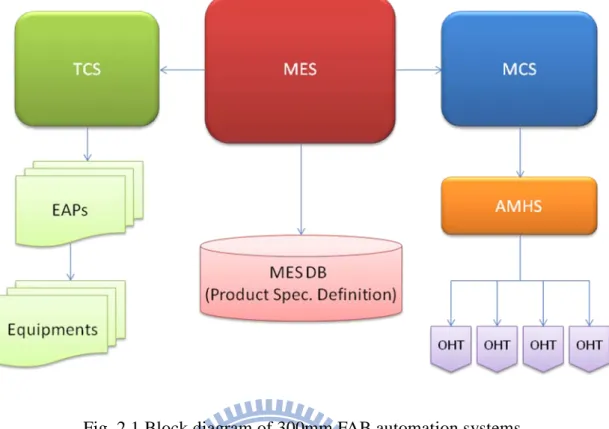
Fig. 2.1 Block diagram of 300mm FAB automation systems. ………....7
Fig. 2.2 Controls of the four systems inside the FAB. ………....7
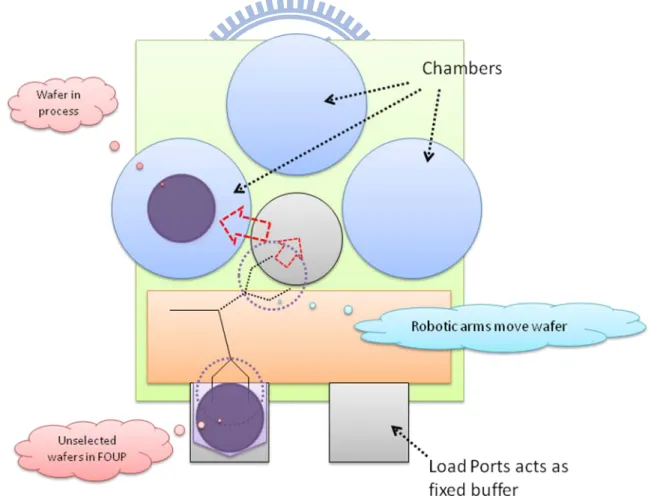
Fig. 2.3 Concept of a fixed-buffered equipment ……….9
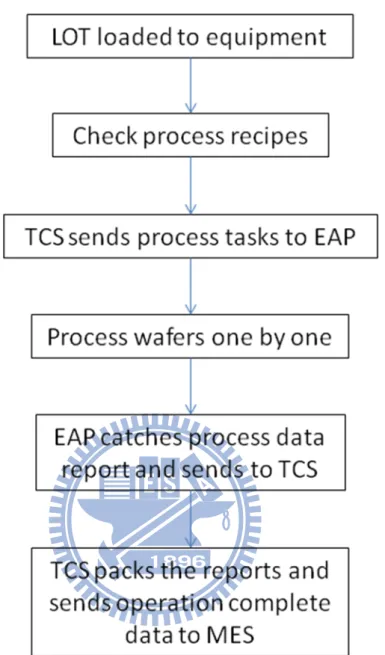
Fig. 2.4 Conceptual flow diagram of processing a LOT for fixed-buffered equipment……10
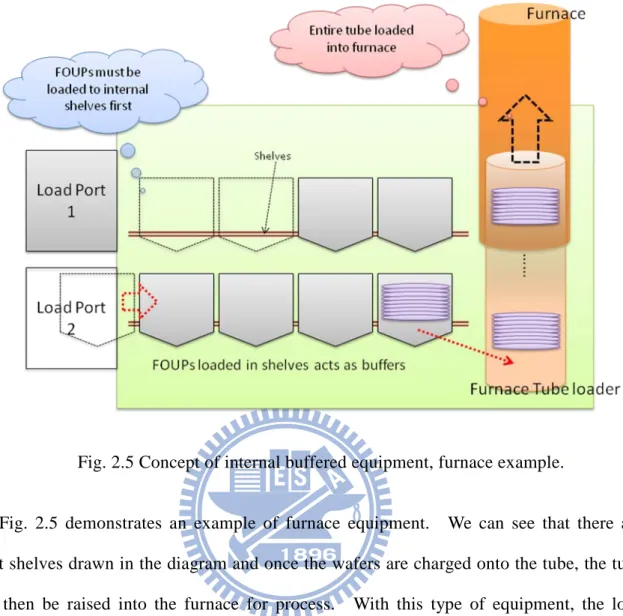
Fig. 2.5 Concept of internal buffered equipment, furnace example………..…….11
Fig. 2.6 Conceptual flow diagram of processing a LOT for internal-buffered equipment…12 Fig. 2.7 The MES – Equipment hierarchy………..14
Fig. 2.8 Sequence flow diagram of events to be handled by EAP for TCS and the equipment……….16
Fig. 2.9(a) Sorter example – when equipment is empty and ready for operation…………..17
Fig. 2.9(b) Sorter example – Lot A and empty FOUP reaches equipment……….17
Fig. 2.9(c) Sorter example – Wafers are being transferred to new empty FOUP…………..18
Fig. 2.9(d) Sorter example – Operation completed and ready to be carried away…………18
Fig. 2.9(e) Sorter example – FOUPs being carried away from equipment………19
Fig. 3.1 Part of the operations in a product flow………....23
Fig. 3.2 Additional modifications in EAP event handling elaborated form Fig. 2.8……...25
Fig. 3.3 Time required for operation in original scheme………27
Fig. 3.4 IPFE function acts as an arc over W1 and X1 operations………....28
Fig. 3.5(a) Flow chart for an ideal furnace and sorter operations………...32
Fig. 3.5(b) Flow chart for furnace and sorter operations with various waiting time……….33
Fig. 3.5(c) Flow chart for furnace operation with IPFE function applied……….33
Fig. 3.6 Experiment result of Fig. 3.5(a) ~ Fig. 3.5(c)………..34
Fig. 3.7 Flow chart of IPFE function applied but failed to take place………...35
Fig. 3.8 IPFE function failed to operate compared with original case of Fig. 3.5(a)………36
Fig. 4.1 Wet equipment………...40
Fig. 4.2 MES request empty FOUP transaction logic………41
Fig. 4.3 Re-wrapped “Operation Complete” transaction of MES………..42
Fig. 4.4 Effect of WIP idle (waiting) for sorter operation………..44
Fig. 4.5(a) WIP status for products before IPFE………45
vi
List of Tables
Table 4.1 Time waited in minutes from end of an internal buffered equipment to
start of a sorter process……….…38 Table 4.2 Hit rate of IPFE function with FOUP transfer time considered……….39
1
Chapter 1 Introduction
In the rapid changing semiconductor industry, volume production of compulsory memory integrated circuits such as DRAM and FLASH has yet reached a critical point of supply over demand. However, these memory solution companies cannot just stop making products to reduce the supply because these factories, usually called FABs, need to produce some goods to balance the tool depreciations to the company. Some enterprises come up with a solution of manufacturing foundry goods such as CMOS image sensors or other profit worth foundry products to keep the factory running. This change of manufacturing in the FAB results in various combinations of products to be manufactured in the same FAB, and thus change would not only affect the cycle time (CT) of the original massive single products but also the cycle time of the new products.
In the process of semiconductor manufacturing, a sequence of operations such as photolithography, etching, diffusion, and thin film deposition is run over and over to make an integrated circuit (IC) on a silicon wafer. This may sum up to hundreds of operations in combinations with sample testing operations to complete. These wafers are carried in a container known as front opening unified pod (FOUP) in a 300 mm FAB. Among these operations, not only one FOUP is used throughout the entire production; these FOUPs need to be exchanged due to materials or particles contaminated throughout the process or, to be exchanged to FOUPs that fit to new hardware docks. Although these FOUP exchange operations may not occupy much of the entire production but they are essential to the production process and most important of all, they will occupy traffic in the FAB and affect the cycle time of all the products to be delivered on-time, especially when the amount of these FOUPs are short or one of these FOUP exchange equipments failed to function
2
properly.
In this chapter, we will describe the problems we have encountered first, then the aim of this thesis. After that, we will introduce the method to be used and the thesis layout at end of this chapter.
1-1 Problems Encountered
As we have mentioned above, the FOUP exchange operation consumes time for a product to complete as well as it may cause traffic in the FAB due to FOUP transportations. In addition, these empty FOUPs are kept in FOUP exchange tools called sorters[1] and are
distributed in certain places in the FAB. This indicates that all these product-contained FOUPs and empty FOUPs would have to be delivered to this location of the FAB that could possibly and potentially provide another bottleneck of traffic in the FAB if the routes of overhead hoist transports (OHT) to the sorters are blocked. To conclude these problems, we may summarize three main issues: 1. Time wasted for empty FOUP and FOUP with products to be delivered to FOUP exchange tools, 2; the traffic caused by these operations and 3; the distribution of empty FOUPs would not be uniformed or balanced in the FAB.
1-2 Aim
With the new version of SEMI standard SEMI E94.1-1107[2], FOUPs containing
products to be processed are delivered to the tools and then unloaded from the equipments’ load ports after the control process has started. By using the concept of “Manufacturing Optimization Improvements Leveraging SEMI E94-1107”[3] and “Enabling Material
Redirection in the Next-Generation Factory”[4], the aim of this thesis is to introduce a
3
FOUP after all the wafers needed to be processed had successfully loaded to its’ process equipments and deliver the required empty FOUP to carry the finished lots after processing, i.e., to reduce the time taken for these FOUP exchange operations in order to save products’ cycle time as well as ease up the traffic in the FAB. This would eliminate the FOUP exchange operations and could solve the three problems mentioned above at a time after the methodology of this thesis is introduced. The potential risk of this mechanism would be the additional computing consumptions required for the calculations redirecting the FOUPs but as to the result, which will be discussed in chapter 3, the additional logic added would not make the computers to suffer.
1-3 Methods
As far as mentioned, the aim of the thesis is to reduce the cycle time for manufacturing a semiconductor product. Before the experiment started, some data such as average cycle time of products, the average FOUP exchange rate and related transfer time from a memory production FAB was collected. These data were then transferred to a simulation environment. After that, some modification of the manufacturing execution system (MES) program was made on the testing environment to simulate the action of dispatching away the FOUP of loaded lot and deliver the desired FOUP following the concept of SEMI E94-1107. The modification of the program was not applied to all the equipments in the FAB because. Not all the operations in the manufacturing process would need the new function due to actual equipment constraints as well as the operation itself, i.e., the next manufacturing operation may not need to have the FOUP exchanged. The program contained logic to judge the operations that are required for this unloading FOUP process together with the empty FOUP selection logic to optimize the entire dispatching process.
4
1-4 Thesis Layouts
Chapter 2 describes how the computer integrated manufacturing (CIM) FAB operates by introducing the MES and how it is associated with other systems such as tool control systems (TCS) and Automated Material Handling Systems (AHMS) to control the full automated FAB. Chapter 3 shows the parts of the objects in chapter 2 are modified to establish the scenario of this thesis and display the experiment result. Data analysis and comparison is in Chapter 4. Some benefits and further implementation discussion are in the conclusion chapter, Chapter 5.
5
Chapter 2 Background of Automation in Semiconductor
Manufacturing
As we have mentioned in Chapter 1, there are some problems regarding to the cycle time of semiconductor manufacturing that we may work on to improve. Before we head to the experiment thoroughly, let us take a glimpse on the evolution of automation in semiconductor manufacturing when it comes to a new era of 300 mm FABs. We will discuss the systems used for an automated 300 mm FAB in section 2-1, followed by the processes regarding to FOUP exchanges and its purpose in 2-2. Section 2-3 describes how the method in this thesis is applied with the systems mentioned.
2-1 Automation in Semiconductor Manufacturing
We know that semiconductor manufacturing is a combination of four main processes that runs over and over depending on the product complexity. These processes are photolithography, etching, thin film decomposition, and diffusion. In addition to these repeated processes, we usually apply some quality check operations in between to ensure that the process we just applied on the wafer is made to standard. For example, some alignment checks are required for photography process so that all the lines or circuits to be produced later shall all lie in their perfect positions. The repeated steps are run over and over with different recipes and various data are collected to form a single chip. However, since we cannot remember all the operations to be handled and all the values to be tuned and applied throughout the process, the manufacturing execution system (MES) is introduced.
6
for a product to be run in its database. The MES can judge what operations for a lot to be run next as well as what recipes defined to be executed. These packages of data are transferred to the equipments through tool control system (TCS). The TCS will arrange a sequence of jobs called control jobs for the equipment automation program (EAP) to provide equipments detailed data. The EAPs have codes standardized by SEMI or commands defined by the equipment manufacturer to communicate with the equipment, e.g., commands to load or unload the FOUP.
The final systems that chained up the entire automation of a FAB to make a full automated FAB possible are the material control system (MCS) and the automated material handling system (AMHS). With the communication of MES and MCS, MES requests transfer commands to MCS and MCS then calculates the best route for a FOUP to be carried from one place to another. These transfer commands created will then be executed by AMHS for the overhead hoist transports (OHT) or other transportation devices to deliver the goods. While transferring, the MCS reports the transfer status such as the location of the FOUPs to MES so that the products could easily be found in the entire FAB.
With the assistance of the four systems, a 300 mm semiconductor FAB can be operated automatically1
1. The automation mentioned here is the basic abstract of automation. More judgments are required depending on the needs of a FAB. These other decisions are assisted by real time dispatcher (RTD) systems[5], advance process control
(APC) systems, and statistical process control (SPC) systems. These systems are hooked up to the CIM framework by connections with MES.
as block diagram shown in Fig. 2.1. Elaborated from Fig. 2.1, Fig 2.2 shows what it may look like in the FAB with the control of the four systems.
7
Fig. 2.1 Block diagram of 300mm FAB automation systems.
8
2-2 Operations in semiconductor manufacturing
We have now acknowledged the concept of automation in a semiconductor FAB. We will now discus the operations in detail on why the FOUP exchange operations are needed in a manufacturing process as well as the types of FOUP exchange operation in an automated FAB. Before we start, let us acquire the knowledge of the types of the equipments in the FAB.
There are two main types of equipments in the FAB, one is fixed buffered equipment and the other is internal buffered equipment. The fixed buffered equipments do not have internal shelves to have the lots loaded inside the equipment as diagramed in Fig. 2.3.
Fig. 2.3 Concept of a fixed-buffered equipment.
9
wafers to be stored temporarily, and both the FOUPs and wafers are kept in one place on the load port of the equipment as a buffer. The loaded FOUP do not have further transpor- tations into these equipments, therefore we call these equipments a fixed buffered type. These types of equipments consist of processing equipments and quality check equipments. Sorters are also classified as fixed buffered equipments. These equipments usually process wafers in a sequential manner.
Please note from Fig. 2.3, we can see that once the FOUP is loaded (or docked) to the equipment, it stays on the load port and the robotic arms will move the wafers to their respective chambers to process depending on the process recipe defined while the wafers waiting for process stays in the FOUP. When the wafers are done, they are transferred back to the FOUP on the load port of the equipment and the next wafer is loaded to the chamber.
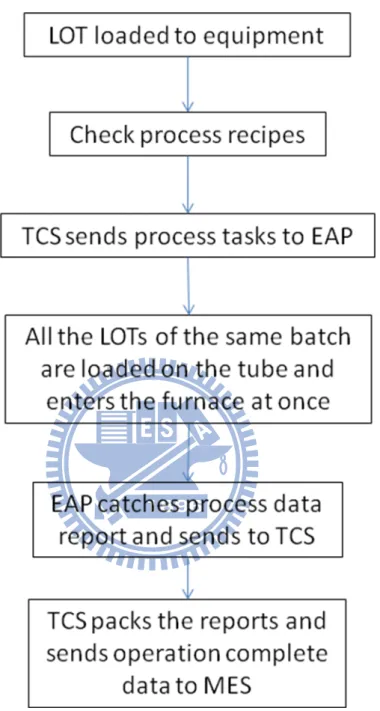
Fig. 2.4 depicts a conceptual flow diagram of what happens when the reserved lot is loaded to the equipment and being processed. When the FOUP is being loaded onto the equipment, the TCS sends a process transaction to MES to check if the loading FOUP is able for process for the equipments. These checks include information defined in MES as well as the recipes logically defined2
2. We use the term logically defined here for recipes is because the actual recipe that should be executed is predefined in the equipment configuration itself, called physical recipe. MES cannot control the physical recipe configurations in detail such as which chambers of the equipment should be run for the product.
in TCS. The wafers are then processed one after the other after the control job is sent from TCS to the EAP. All the communication codes and data from the equipments are parsed in the EAP before sending back to MES from TCS. There are some more detailed interactions and communications for wafer processing which will not be discussed in this thesis.
10
Fig. 2.4 Conceptual flow diagram of processing a lot for fixed-buffered equipment. As to internal buffered equipments, the FOUPs are loaded from exterior load ports and are moved to shelves embedded inside the equipment. This is mainly because within internal buffered equipments, the lots can be processed in forms of batches. In other words, all wafers of lots are firstly removed from FOUPs on the shelf to a furnace tube or tank to be processed at a time so that more than one lot can be run within one operation to maximize the throughput of the equipment as shown in Fig 2.5.
11
Fig. 2.5 Concept of internal buffered equipment, furnace example.
Fig. 2.5 demonstrates an example of furnace equipment. We can see that there are eight shelves drawn in the diagram and once the wafers are charged onto the tube, the tube will then be raised into the furnace for process. With this type of equipment, the load ports are usually emptied since the FOUPs are on the shelves inside the equipment. The empty FOUPs will wait for the entire process to be finished and then discharged from the tube back to their original FOUPs. For where the wafers to be returned to, the FOUPs are pre-defined in the control job while operation starts for the process.
The main difference between fixed buffered equipment and internal buffered equipment is that all the wafers are pulled out from the FOUP in the internal buffered equipment whereas the wafers stays in the FOUP until it is their term to be processed in the fixed buffered equipments. In addition, from the flow diagram of Fig. 2.6, we can compare with Fig. 2.4, the procedures of the internal-buffered equipment is different than that of
12
fixed-buffered equipment.
Fig. 2.6 Conceptual flow diagram of processing a lot for internal-buffered equipment. Having understood the types of equipments, we can now move our pace to the types of processes in semiconductor manufacturing that would differentiate the various types of needs of FOUPs. Some manufacturing processes contain high quantity of metallic vapor or particles that will be contaminated along the wafers as well as its carriers, FOUPs.
13
After these kinds of operations, the wafers must be transferred to FOUPs categorized as “After-Metal” FOUPs. And before those operations, the wafers are carried in “Before-Metal” FOUPs. When the lots are being cleaned, they have to be moved back to “Before-Metal” type FOUPs again for yield control. The number of changes of these FOUP exchanging operations may differ according to different types of products. In a fully automated FAB, these operations are done by sorter equipments where empty clean FOUPs are located in sorter shelves as well as the lots required for FOUP exchange. Since sorters are not key equipments and may occupy a big portion of space in the FAB, the automated sorters do not come up with numbers. However, the contaminated products cannot be dispatched to their next operations if the FOUPs have not been changed to the desired ones. These lots may sit in stockers for periods of time from minutes to hours depending on the dispatching system. More detailed numbers of the collected data will be discussed in Chapter 4 for these FOUP exchange operations.
Furthermore, discussions of FOUP exchange operations may include some equipments’ load ports are not capable of new type of FOUPs, i.e., the docking of the equipment cannot comply with some new types of FOUPs. The lots in these FOUPs may have to wait to be exchanged as well and this may consume cycle time. Finally, some products with high yield concern may have to be processed in dedicated FOUPs and these lots will also require FOUP exchange operations. In the next section, we will discuss how the new metho- dology is applied in this thesis to shorten the cycle time by “In-Process-FOUP-Exchange” (IPFE) function.
2-3 Implementations on In-Process-FOUP-Exchange
Before we start on discussing the implementations of the In-Process-FOUP- Exchange (IPFE) function, we have to narrow down the jobs to be done by looking through what tasks
14
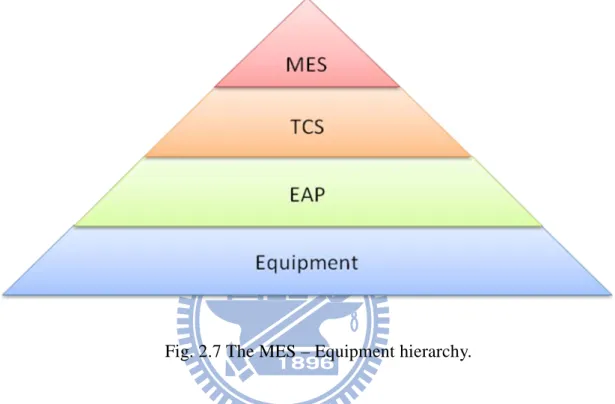
or procedures there are from MES to equipments. We will go through the automation system hierarchy as shown in Fig. 2.7 from bottom up. As we have mentioned in Fig. 2.4 and Fig. 2.6 the sequence of manufacturing in section 2-2, the equipments are controlled by EAP through TCS in FAB automation. The EAP performs only the Control Job (CJ) [6]
Fig. 2.7 The MES – Equipment hierarchy.
When the equipment’s load port is empty and ready to process lots, it will signal a load request from EAP to TCS and then to MES, the MES will return some lots available for processing. In FOUP exchange operations, MES will then return the lots as well as empty FOUP for this operation. Once TCS obtained the lots from MES, it will reserve the FOUP for transport and signal this event to AMHS through MES. After the FOUP has been transported and loaded to the equipment, TCS will handle a sequence of operations as Fig. 2.4 or Fig. 2.6 depending on the type of the equipment (fixed buffered or internal buffered). TCS checks again with MES the lot loaded to be sure whether if this lot can be processed
15
by the equipment and is ready to prepare the Control Job (CJ), which is the actual job the equipment will execute to process the lot, for the EAP to be sent to the equipment. The EAP performs only the Control Job assigned by TCS and most of the information such as attributes or recipes for the equipment to be processed to the lot is defined in the Control Job. After the equipments are done with the lots, the CJ end signal is sent to TCS and TCS will ask MES for where the finished lots to be transferred and the cycle repeats from an empty load port. There are much more jobs to be done by TCS in the lot processing sequence but will not be mentioned in this thesis. However, the sequence of jobs would of course follow the specification defined by SEMI standard with minor changes depending on the need of each FAB. Any exceptions in between the sequence of jobs would terminate the job to proceed and the equipment will send alarm signal on site as well as to TCS.
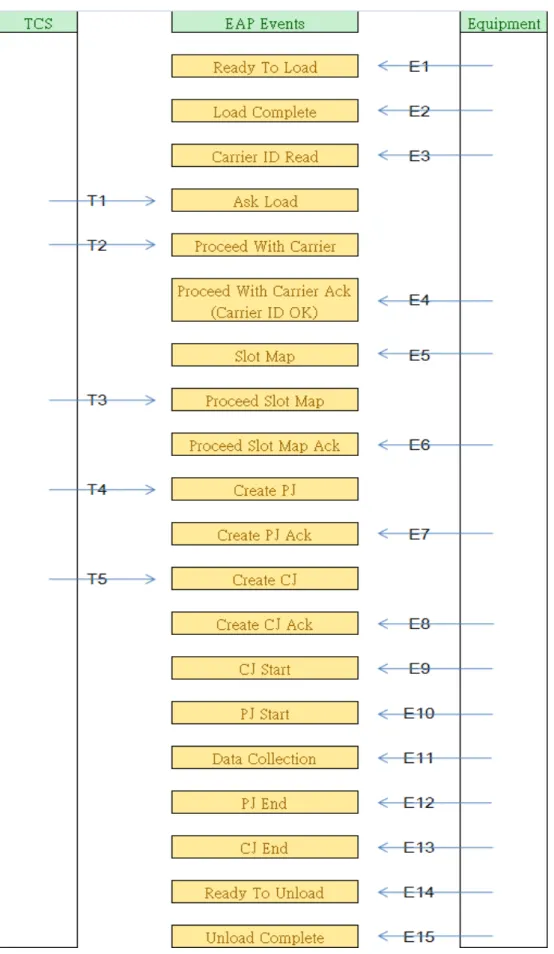
Fig. 2.8 is the actual sequence flow diagram of the jobs and events between TCS and the equipment while processing a product. We use labels T1 to T5 to illustrate signals send by TCS and E1 to E15 to represent the signals send from the equipment. The EAP, in this circumstance, acts as an interface between TCS and the equipment, i.e. the EAP handles the signals from both sides and translates what to be done or what to be reported for TCS and the equipment. This diagram is important because the diagram will help us to explain the changes we made to make the In-Process FOUP Exchange function to work, which will be described in Chapter 3.
16
Fig. 2.8 Sequence flow diagram of events to be handled by EAP for TCS and the equipment.
17
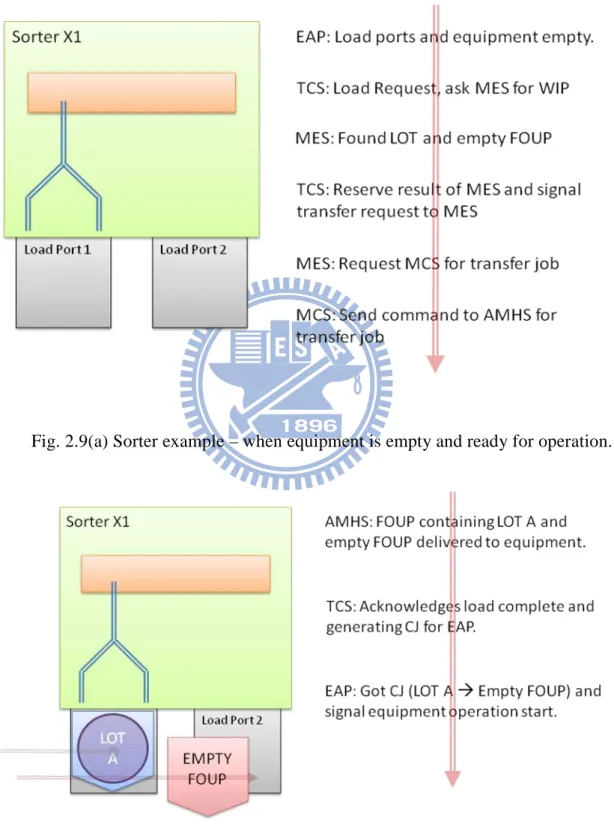
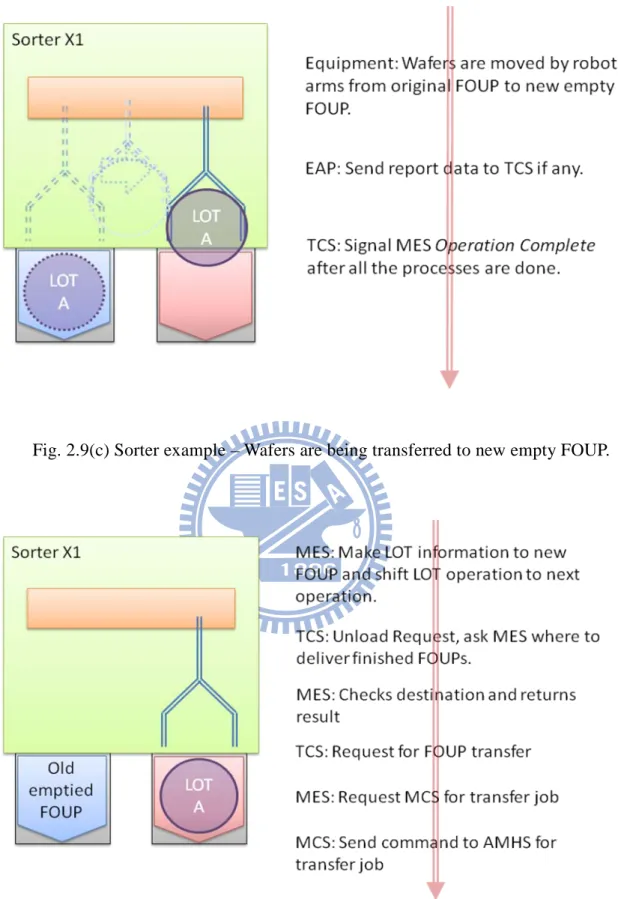
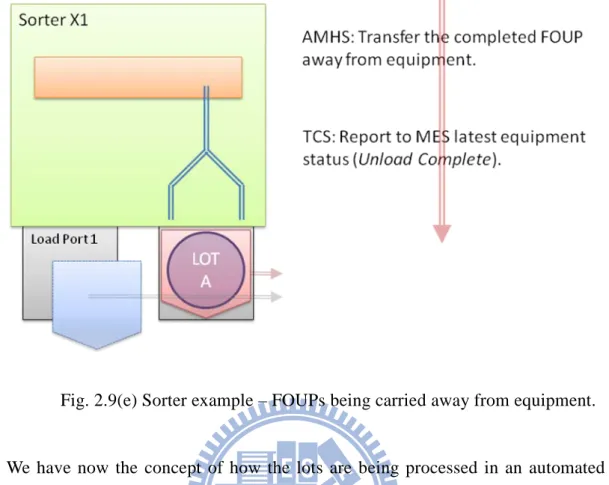
To make Fig. 2.8 a more readable example, we use the example of a sorter to demons- trate a cycle of an equipment operation. This is shown from Fig. 2.9(a) to Fig. 2.9(e).
Fig. 2.9(a) Sorter example – when equipment is empty and ready for operation.
18
Fig. 2.9(c) Sorter example – Wafers are being transferred to new empty FOUP.
19
Fig. 2.9(e) Sorter example – FOUPs being carried away from equipment.
We have now the concept of how the lots are being processed in an automated FAB. The next thing we would discuss is how we could use the concept of SEMI standard document E94.1-1107 to accomplish our needs. In FOUP exchange operations, the original Control Job assigned by TCS would require a source FOUP and a destination FOUP after MES returned what to be processed on a sorter. For the IPFE operation, the lots are processed in either fixed or internal buffered equipments. However, most of the fixed buffered equipments do not process the entire lot at a time whereas taking the wafers one by one into the equipment chambers sequentially (Fig. 2.3). In addition, as we look into the operations of an IC fabrication, the FOUP exchange operations are mostly performed after internal buffered equipments due to before metal or after metal gas contamination concerns as we have mentioned earlier. Therefore, we will only discuss the
20
IPFE function operation cases on lots that has to be processed in the internal buffered equipments in this circumstance.
According the SEMI standard E94.1-1107, the attribute named “MtrlOutSpec” has two main data fields, the “SourceMap” (source FOUP) and the “DestinationMap” (destination FOUP). These fields are not filled in either fixed or internal buffered operations since the source and the destination is the same and the lots will return to the original FOUP after process completion. In the IPFE operation, we will make use of this attribute by inserting the “SourceMap” when control job starts while leave “DestinationMap” the same as “SourceMap” at the beginning3
3 According to the SEMI E94-0309 specification, once the MtrlOutSpec attribute is set to Material Redirection Mode, the destination attribute could be set by the
SetAttr option described in SEMI E39.1-1103[7] document. We can assign a new
destination FOUP ID for the required process.
. After we have successfully loaded the lots into the equipment for processing, the EAP would sense the event of wafers in the tube being loaded or pushed into the furnace and notify TCS as in Fig. 2.5. This notification would trigger TCS to send a new inquiry transaction for MES to ask for an empty available FOUP that would suit the processing lot for the next operation according to the flow definition defined in advance. In this new inquiry transaction, MES calculates and determines which empty FOUP to be assigned. The dispatching logic of the empty FOUP in MES will be discussed in detail in Chapter 4, the discussion chapter. Once the empty FOUP is decided and sent
21
to the equipment, TCS would ask EAP to unload the original FOUP that carried the lot from the load port of the equipment. As soon as the old empty FOUP has been unloaded from the equipment load port, EAP will capture this signal ask transportation of the new empty FOUP to the equipment. The detailed description of the procedure will be described in chapter 3. TCS, at this moment, would ask MES where to deliver the original empty FOUP; either this FOUP could be used again and sent back to a nearby stocker or, to some other locations such as FOUP cleaning locations. This is similar to end of process in figure 2.8(d) where the FOUPs are to be carried away. Then, TCS will use the attribute “SetAttr” defined in SEMI E39-0703[7] and SEMI E39.1-0703[8] to update the CJ attribute
“DestinationMap” previously mentioned to provide the new empty FOUP information while arrival of the new FOUP. After the lot has finished the processing, EAP would return the lot into the updated “DestinationMap” FOUP. TCS, by acknowledging unload request by the EAP, would check with MES again where to deliver this finished lot and the IPFE operation is complete with the original operation complete function.
We have now finished the basic concept of a 300 mm FAB automation framework and the new IPFE operation. By using this new IPFE operation, we would expect the average cycle time of a product to be reduced by the average waiting time plus the original FOUP exchange time as my hypothesis. This cycle time reduction will not only benefit the product applied but also the other products due to the relaxation of the sorter throughput.
22
In the next chapter, we will make the previously mentioned procedures into practice in a simulated environment as well as presenting the results.
23
Chapter 3 The Experiment
In this chapter, we will discuss the experiment. We have described the concept of TCS, EAP, and equipment sequence process in Fig 2.8. Fig 3.1 shows the flow of the two main operations of a semiconductor production flow by which the circles represents the operation.
Fig. 3.1 Part of the operations in a product flow.
The first circle in Fig. 3.1 on the left hand side is an internal buffered operation, labeled
I1. In this operation, all the lots to be processed are run in a batch, or group. The
batched lots are removed from their FOUPs and the FOUPs are kept in the shelves inside the equipment as in Fig. 2.5 and the wafers are loaded into a furnace. In the original process flow, the wafers are moved back to their original FOUPs from the furnace tube after step E13 of Fig. 2.8. These FOUPs are then unloaded from the equipment to the stocker and wait for the next operation. We assign a smaller circle labeled W in Fig. 3.1 to
24
represent the “idle” or “waiting” status of these lots. The next operation on the right hand side indicates a FOUP exchange operation, labeled X1. In this operation, the wafers are required to be transferred from a certain type of FOUP, say Before Metal FOUP, to an After Metal FOUP due to metal contamination constraints. We simply call the types of the FOUPs B-type and A-type respectively. After the X1 operation, the B-type FOUP is emptied, it is then transferred to a FOUP cleaning equipment for further use; the A-type FOUP will then contain the wafers of the lot.
In section 3-1, we will describe what modifications of software we have done to make it work using the SEMI E94-1107 standard as well as the problems that may encounter. In section 3-2, we will discuss the solutions to 3-1 and their trade-offs. Finally, the results of the experiment in section 3-3.
3-1 Modifications
Elaborated from figure 3.1, node I1, we will look closer inside the TCS-equipment sequence and discuss some more detailed events from the equipment that we may capture to make IPFE function possible.
In current TCS control job creation, the content of attribute “MtrlOutSpec” is left blank and the EAP software takes the content “SourceMap” and “DestinationMap” as the same value. These two contents provide the FOUP ID to let the equipment know where to take the wafers from and where to place the finished wafers back after process. The first modification takes place while TCS creates the control job. We provided the whole content of the “MtrlOutSpec” according to the SEMI specification with both “SourceMap” and “DestinationMap” the same data since we have not decided the new empty FOUP yet. This modification is in step T4 of Fig. 2.8. After all the wafers of the same batch lots are
25
loaded into the furnace tube and the process started as step E10 of Fig. 2.8, EAP will catch this event and signal TCS. This event gives us a new T6 transaction from EAP to TCS as shown in Fig. 3.2. We label the transaction such as M1 in the figure to indicate the transaction being sent from MES.
Fig. 3.2 Additional modifications in EAP event handling elaborated form Fig. 2.8. Continue with Fig. 3.2, TCS will send a new transaction, T7, to MES to inquire a new empty FOUP when the furnace is loaded if the process time of the batch has more than an hour left. The inquiry input would be some basic information of the first lot in the batch such as type of FOUP required, lot’s product name, lot’s flow name, and lot’s operation number…etc. The one-hour-buffer is to be kept for any exceptions that would require human resources to take over. For example, we may expect some transportation issue due
26
to hardware failure and this buffer could be used for operators or engineers to recover the chance of the finished wafers having no FOUP to return after process since the original FOUP may not be on site. This problem will be discussed in section 3-2. MES, on the left side of Fig. 3.2, would calculate whether to return a new empty FOUP or the ID of the original FOUP and return the result in M1 as well as mark an transfer reserve record on the new FOUP in case of this new FOUP being selected by other operations in the FAB. TCS then examines if the returned FOUP ID is the same as what had provided in the inquiry transaction. If the FOUP ID remains the same, TCS will use the next lot in the batch for next inquiry. Otherwise, TCS will use “SetAttr” to modify the control job’s “DestinationMap” content, T8. By receiving an update success, TCS will tell EAP to unload the old FOUP, T9, inside the equipment and ask MCS to make a transfer command, T9’, to carry this old FOUP away by means of MES; if “SetAttr” had failed, the “DestinationMap” would remain the same and TCS cancels the transfer reservation made in M1 earlier and move to next lot in batch. When the old FOUP leaves the load port of the equipment, T10, EAP could sense this signal and notify TCS such that TCS can then ask MES to establish another transfer command to MCS for the new FOUP to be transferred, T10’. The reason of the asynchronous transfer rather than transferring both the old and the new FOUP at the same time will be discussed later in this thesis. When the new FOUP has successfully arrived and docked to the equipment load port and moved to shelf inside the equipment, the new FOUP is ready to be filled with finished wafers. The same cycle will be repeated for the same batch of products until no changes are required. This is the first portion of IPFE.
The second portion of IPFE is when the wafers have finished process. After the products have finished their process in the furnace, the wafers are transferred to the new FOUP while reporting an operation complete to MES. A new operation complete
27
transaction is introduced here because in this transaction, we need to call a FOUP exchange operation as well as a skip operation since the original operation X1 is no longer needed and the information of the lot should be at W2 of Fig. 3.1 instead of W1. In other words, the next operation of the LOT will be the one after the original FOUP exchange operation, status “waiting” at W2 of Fig. 3.1.
As we can see from Fig. 3.3, we have bisected the times needed for the original flow process.
Fig. 3.3 Time required for operation in original scheme.
In Fig. 3.3, the total time used in the original scheme from point S to point E would be TF (time for furnace operation) plus Ti (time wait for sorter operation, idle time) plus TX
(time for sorter operation to complete). Tm in the figure is calculated in Ti because the
28
TSE , therefore, is the total time required in the original product scheme, which will be
denoted as function:
TSE = TF + Ti + TX (Eq1)
On the other hand, Fig. 3.4 gives us what we did for the IPFE function. The shaded part W1 and X1 with the respective times required Ti and TX is eliminated and a new arc is
drawn from the end point of operation I1 to the start point of W2.
Fig. 3.4 IPFE function acts as an arc over W1 and X1 operations.
We can tell from Fig. 3.4, since we have done all the work for X1 while the lots are in the process of I1. When the lot is completed with process I1, the lot status would be “waiting” at beginning of W2. Therefore, by using the IPFE function, the new total time elapsed for I1 to end of X1 would be calculated as from point S to point E’ in Fig. 3.4. This gives us a new time line, TSE’, in Fig. 3.4. This new time line is equal to that of the
29
lot being processed in operation I1 and would be:
TSE’ = TF (Eq2)
or
Tdiff = TSE - TSE’ (Eq3)
And as to the ratio of time reduction R using IPFE function, compared with the original scheme, we may obtain:
R% = (Tdiff) / (TSE) (Eq4)
The value of Tdiff may be different in the above formula since Ti may vary in the
original scheme, which depends on the work in process (WIP) of the sorters. We will discuss more about the benefit obtained from IPFE function with statics in chapter 4.
Before we end this section, there is a main problem that we might encounter using the IPFE function. That is, while the old FOUP has been removed or unclamped from the equipment, we cannot definitely be sure if the new FOUP could be delivered. This may be caused by some unpredictable issues by exceptions that may occur at AMHS. In addition, this would extract a minor problem of what if the new FOUP to be delivered arrived later than the furnace process have finished. However, these problems did not occur during the experiment since we modified the software and assumed that the mechanical site of AMHS worked perfectly in simulation as well. We will discuss the solution to these problems in the next section.
30
3-2 Error handling
From section 3-1 we know that MES will provide a new FOUP if available in a nearby stocker for IPFE. However, if the nearby stocker is disabled due to power failure or any possible issues, the reserved new FOUP for transfer would be stuck inside the stocker and this new FOUP cannot be delivered. To solve this problem, the MES will have to check once more which new FOUP to be delivered while the old FOUP disconnects from the equipment. As long as the stocker of the new FOUP is available, no changes are required. In contrast, if the stocker is unfortunately unavailable, the MES will have to shift the reserved new FOUP information to a new one from the other stocker and hence a new transfer job should be created. In the worst case scenario, if no more empty FOUPs are available, the reservation will be marked to the old FOUP that had just been carried away. This is a big trade-off however, the time for the old FOUP to be carried to-and-fro from the equipment. This trade-off may be minor since the furnace operation usually last for hours and there would be enough time for engineers to recover the fault stocker as well as the to-and-fro transfers.
The second problem we have mentioned at the end of section 3-1 could be solved by adding timer logic in the TCS since TCS has the start time of the process mentioned earlier at beginning the of section 3-1. The TCS may decide whether to request MES for a new FOUP depending on the time the furnace process has elapsed. For example, if a furnace operation takes an average of four hours, the TCS may judge whether the IPFE function is required if the running batch process has already been run more than three hours. That is why we have said earlier if the IPFE function would take place if there is more than one hour left of the furnace operation. The trade-off of this solution would be that some lots may not apply the IPFE function since there are four LOTs in a batch. And for each lot to
31
apply the IPFE function, the time required for both old and new empty FOUPs to be carried in an asynchronous method would require more time for a complete cycle of the IPFE function. However, the cycle time of the lots that had applied the IPFE function before the three-hour limitation mentioned above may still be benefited.
To conclude this section, the key point of the errors and its handling depend on AMHS. In chapter 4, we will study a few statistics from the concept of AMHS with the original flow process and then discuss whether the additional exception handling work is worthwhile using the IPFE function in chapter 5.
3-3 Test Result
In the simulation, we established a small process flow containing 5 operations by which the second operation is the furnace operation and the third operation is the sorter FOUP exchange operation. This is to simulate what we have described in section 3-1. The experiment is to test if the ideal case of the IPFE function can be applied to the automated systems in a 300mm FAB. For the simulation environment, we used a licensed IBM SiView4 on a IBM AIX5
4
SiView is a product registered to International Business Machines (IBM) Corporation. The term of use may be requested to follow the agreements within the software.
operating system for the MES site. Since the software and the hardware of MES are considered as company privacy, we may not describe the versions of the software in detail. We used the SiView solution to establish 100 lots in the simulation environment and made 25 batches of four lots at a time to execute the simulated furnace operation. On the TCS and EAP site, we used the software developed by Powerchip Semiconductors Corporation and made the modifications. Fig. 3.5(a) to Fig. 3.6(c) shows the flow diagram of the experiment.
5
AIX is an operating system registered to International Business Machines (IBM) Corporation. The term of use may be requested to follow the agreements within the software.
32
Fig. 3.5(a) shows the flow for the normal condition case. The batches go through from point S to point E with only five minutes of waiting time for the next operation, sorter operation to start. The three minutes waiting time is the ideal and average time in the actual production FAB for a FOUP to be delivered to the sorter. This experiment is similar to what we have described in Fig. 3.3. The time measured in this case is TSE.
Fig. 3.5(a) Flow chart for an ideal furnace and sorter operations.
The next figure, Fig. 3.5(b), is the flow diagram when we added the variable of various waiting time for “Wait for sorter operation” case. In Fig. 3.5(b), we can see that we used the word “vary” because the time waited for sorter operation is the randomized time taken from actual production FAB of 3000 lots in the similar furnace to sorter operation. The time measured in this simulation is TSEi. The “i" represents “idle” in this circumstance.
This experiment is also equivalent to the diagram described in Fig. 3.3 with only the difference of various waiting time added for the lots.
33
Fig. 3.5(b) Flow chart for furnace and sorter operations with various waiting time. Finally, we applied the IPFE function to the simulation and the flow chart would be shown in Fig. 3.5(c). Please note that this experiment is the concept of Fig. 3.4, the time
waiting for sorter operation and the time for the sorter operation is by-passed, or neglect. Therefore, the terminal node is denoted as “E’ ” in this case and the time measured is TSE’.
34
After knowing the three major cases of the experiment and applying the modifications mentioned to the related systems, we simulated one hundred lots on the short process flow. The IPFE function worked properly and was as expected. In this experiment, we have not applied the actual transfer of the FOUPs but have controlled the delays of the time that for both old and new FOUP being transported to the equipment. We summarized the results of the three experiments mentioned above and plot the graph for TSE, TSEi, and TSE’ into a
graph to see the difference in Fig. 3.6.
Fig. 3.6 Experiment result of Fig. 3.5(a) ~ Fig. 3.5(c).
We tested the experiments again with the IPFE function to the flow of Fig. 3.5(a) but set the condition that failed to apply the IPFE function, i.e., all the wafers still stayed in the same FOUP. The flow chart of this case is diagrammed in Fig. 3.7.
35
Fig. 3.7 Flow chart of IPFE function applied but failed to take place.
We can see that because the IPFE function failed to take place inside the furnace operation, the original operation, the sorter operation, must be performed. This is the worst case of what would happen even if the IPFE function is applied but failed to operate in the simulation. The time measured in this experiment would also be TSE’, and it is
compared with the original experiment, case of Fig. 3.5(a), again. The comparison graph is in Fig. 3.8.
The purpose of doing the experiment of Fig. 3.7 is because we have to make sure that even with the new IPFE function applied to the FAB, the original scheme of the process must still work properly. As the result of Fig. 3.8 shows, the new IPFE function will not make a difference if it had failed to operate.
36
Fig. 3.8 IPFE function failed to operate compared with original case of Fig. 3.5(a). Furthermore, since the function worked properly, we have added a few more checks and algorithms in the MES program such that the decision of whether IPFE is necessary. This decision making function will be discussed more in detail in the next chapter. We can see that the improvement does not seem to be so effective when the stocker failure rate is high even with the IPFE function had implied but it does not affect the original process scheme.
In the next chapter, we will not only discuss the new MES algorithm but also how the IPFE function may benefit the traffic of the semiconductor manufacturing.
37
Chapter 4 Data Analysis and Comparison
We have introduced the IPFE function and successfully implemented it in a semiconductor manufacturing automation simulation and the result was as expected. In this chapter, we will discuss in detail the results obtained from the previous chapter. In section 4-1, we will begin with the data collected as a baseline for comparison and discuss what would the IPFE function affect on the collected data. Section 4-2 describes the decision methodology of MES. After that, section 4-3 discusses how the IPFE function has relaxed the WIP of the original sorter operations.
4-1 Collected Data Interpretation
Let us take a look at the data we have monitored in a DRAM manufacturing company. The sample product we looked for is a main product that consumes 30% of the company’s production line. There are more than 800 operations in manufacturing this DRAM product. Within these 800 operations, we have found five pairs of the operations that may be similar to Fig. 3.1 and these ten operations may be the candidate for the IPFE function to take place. We will label these five pairs of operations AI1, AX1, BI1, BX1, CI1, CX1, DI1, DX1, EI1, and EX1 by which the “I” operations stand for lots to be processed in internal buffered equipment and the “X” operations are those for lots to be processed in a sorter equipment. In other words, the AI1 ~ EI1 operations requires sorter operations, AX1 ~ EX1, after the lots have completed their process in their respective internal buffered equipments. Among the five pairs of the internal buffered operations mentioned above, some of the operations are Wet operations. Wet operations are operations that consist of sinking the entire lot into a tank full of liquid. Most of these operations are for cleaning purposes and FOUP exchange operations are usually required after the lots being cleaned. In this operation,
38
the equipment used are categorized as internal buffered equipments as well because these equipments have also the internal shelves to place the FOUPs and can process 2 lots at a time with all the wafers of these 2 lots unloaded from the FOUPs into a tank. The entire process elapses for approximately 2 hours. The five pairs of operations we have selected here in this thesis contain two Wet operations. Further down in the thesis, we will briefly discuss about the Wet equipment. Table 4.1 shows the average time measured in minutes a lot needed to wait from finished process of nI1 to start of nX1 for 3000 lots of the same DRAM product where “n” stands for A ~ E from the previous descriptions.
Table 4.1 Time waited in minutes from end of an internal buffered equipment to start of a sorter process. A B C D E nI1 ~ nX1 69.37 105.8 45.56 96.1 143.23 nX1 3.18 2.98 3.52 3.18 3.61 Total 72.55 108.78 49.08 99.28 146.84 Flow Total 476.53
The total time for the entire process flow to finish from the Table 4.1 would require 476.53 minutes in average and that is 0.33 day.
From the experiment we did in chapter 3, we have successfully by-passed all the five pairs of the operations AX1 ~ EX1 in a simulated environment. Therefore, the idle time the LOTs waited to be processed in FOUP exchange operations after finishing the I-operations were saved as well as the time that may be needed for the actual FOUP exchange operations.
As we have mentioned in chapter 3, we simulated the cases to make the IPFE function to work. We then tested the IPFE function again with different cases of FOUP transfer
39
delays. This is because in the actual semiconductor manufacturing process, FOUP transportation is a critical issue. We can see from Table 4.2, we tested four major delay cases. The first delay group is randomized from 5 to 10 minutes. The second group is from 10 to 15 minutes. The third group is from 15 to 20 minutes. And the last group is the randomized time beyond 20 minutes of transfer delay. As from the third group, the hit rate of the IPFE function was 97%. This means that in 25 batches of 100 lots, 3 lots will fail to perform the IPFE function. If set the delay to 20 minutes and beyond as the lst group, the hit rate of the IPFE function would drop to 86%. This means that 16 lots failed to perform the IPFE function.
Table 4.2 Hit rate of IPFE function with FOUP transfer time considered. FOUP transfer time (min) 5~10 10~15 15~20 20~beyond IPFE Success rate 100% 100% 97% 84%
We have mentioned earlier in chapter 2 how internal buffered processes take place for furnace equipments (Fig 2.5). We would briefly describe how the process takes place for
Wet equipments. This operation requires a batch of 2 lots takes approximately 2 hours to
40
Fig. 4.1 Wet equipment.
Before we move on to the next section, we can summarize what we have done so far. We have tested all the cases with the application of IPFE function and discovered that some cycle time of a certain product may be reduced. We have tried the IPFE function with its best cases as well as worst cases and in addition with some delays of FOUP transportations to make it similar to that of the FAB scenario. As we have noticed that the changes for the software above to fit the IPFE function is based on TCS and EAP. In the next section, we will discuss some detailed changes in the MES of how we make the decision of which empty FOUP to be assigned.
4-2 Decision Model in MES
In the inquiry transaction “T7” of Fig. 3.2, TCS demands a new empty FOUP from MES, the check diagram is as shown in Fig. 4.2.
41
Fig. 4.2 MES request empty FOUP transaction logic.
From the diagram, the first part is to find the available stockers and then calculate the transport time required. The transportation time is calculated by a new table in the database to judge whether to transport a new FOUP or not, i.e. by checking the transfer command queue of the stocker as well as the FOUPs being transferred occupies the route from stocker to the desired internal buffered equipment. This could be done by a reply of “traffic report”5
5 The traffic report of MCS is a transaction that MES request to MCS, if this transaction is not available or has timed-out, MES will simply assume that the route from stocker to equipment is free of traffic.
from MCS. After checking the requirements, MES would return an appropriate FOUP for TCS to reserve. In this case, if the result of MES is to transfer the new FOUP and an additional “transfer reserve” action takes place to prevent any other systems or users may take the reserved FOUP. This newly reserved FOUP would only begin its transfer when the old FOUP on the equipment starts to leave. This asynchronous transfer has two main reasons: 1. to make sure that there are enough and available empty
42
shelf inside the equipment; 2. the load port of the equipment is not occupied. On the other hand, if no appropriate FOUP was found and old FOUP ID was returned from MES, TCS will skip this LOT and check again for the next LOT in the batch.
It is quite different though, from the dispatching logic view of neither by LOT nor by equipment since what we tried to do was to “steal” the time while the wafers are being processed and the dispatching logic is based on empty FOUPs and stockers. Therefore, all the jobs in the IPFE function must act in an asynchronous behavior depending on whether the wafers have been started to process.
The final change to MES was when all the LOTs in the batch have completed their process. The transaction that handles this action is called “Operation Complete”. Since the control job of a batch is the same, MES has to judge which of the lots have used IPFE function and which lots have not. In the original computer integrated manufacturing (CIM) framework, the control job information was kept only in between TCS and EAP. But when it comes to the IPFE case, MES must need to know whether the attributes of the control job have been changed.
43
Therefore, we have re-wrapped the “Operation Complete” transaction as in Fig. 4.3 such that MES must judge with the additional information, that whether further operations for the LOT in the batch are required. These operations include “FOUP exchange
operation” and “Operation Locate” operation. “Operation Locate” is a transaction that
sets a lot to a desired operation of a product flow directly.
Having discussed the changes and decision logic in MES, we will move on to the next section of how the IPFE function would affect the traffic of the FAB.
4-3 Benefits
After we have successfully implemented the IPFE function in the test environment, we extended more simulation models to observe what would this function may benefit the entire FAB. The model was to adapt one major product, named product B, and the rest of the products categorized as others, named product C, into the simulation and tested for 24 hours. We observed the amount of wafers work in process (WIP) that are idle (wait for sorter operation) in the first day and re-run the same scenario with IPFE function applied for another 24 hours. The IPFE function was only applied for the product we have mentioned, named product A, which occupies 30% of the DRAM company’s production line. Within product A, the entire process consists of 11 FOUP exchange operations and only 5 of them could apply the IPFE function. We can see from Fig. 4.4 that the WIP idle was decreased because 5 of the sorter operations were no longer needed. The improvement of wafers being idle was by 7.84% in average.
44
Fig. 4.4 Effect of WIP idle (waiting) for sorter operation.
Furthermore, Fig. 4.5(a) shows the WIP status before IPFE applied to product A and Fig. 4.5(b) shows the WIP after IPFE applied to product A. We can see that the WIP of product A had decreased and there was an increase of WIP for both product B and product C. This indicates that with the same amount of time provided for the same amount of wafers to process, the IPFE function would enhance the sorter to operate more jobs for other products. This would result in a shortening of cycle time for not only product A but also the cycle time of other products.
45
Fig. 4.5(a) WIP status for products before IPFE.
46
The last topic we would like to discuss before we finish is the occupation rate of the stockers. In the automation process, the equipments would assign one or more of their nearby stockers such that the transfer time of the FOUPs could be reduced to minimum. Since sorters are busy around the clock, their nearby stockers’ occupation rates are usually high, more than 90%. One main reason is because these stockers may have to store empty FOUPs as well as FOUPs containing products for exchange operations. On the other hand, the nearby stockers of the internal buffered equipments do not have a high occupation rate, 50% ~70%. With the IPFE function applied, we can store some of the empty FOUPs in these stockers and hence balance the stocker occupation rate. This is significant because if the FOUPs are well balanced in the FAB, the traffic of the FAB would be balanced as well. However, we have not actually tested and monitored the traffic control of the FAB since we cannot apply the function onto the production environment to see the transportation status because a minor bug in the program may cause the entire FAB to halt.
To conclude this chapter, we have explained the model being used in MES and monitored the benefits to the WIP for the FAB which may maximize the throughput of the semiconductor manufacturing.
47
Chapter 5 Conclusion
In semiconductor manufacturing, cycle time (CT) has always been a competitive challenge. With the assistance of the new SEMI standard, we introduced a new function called In-Process FOUP Exchange (IPFE) that would “steal” some of the processing time in semiconductor manufacturing. We have assumed that with the IPFE function introduced, we could by-pass some of the operations in manufacturing an integrated circuit (IC). In this thesis, we have applied the changes in the related systems in an automated 300mm FAB and simulated the experiment. The results of the experiments proved that the IPFE function may benefit the cycle time of semiconductor manufacturing.
However, there would be a lot more challenges if we would actually apply the IPFE function onto production. The main reason is that not all the equipments in the company could support the specification standard that has been decided in SEMI E94-1107. This is because the functions in a semiconductor factory must be decided before building the actual factory. With each function added or requested, the equipment vendors and factory engineers must apply a full function test to the equipments before deploying to the factory production line. This is critical because the cost of manufacturing these integrated circuits are high and the delivery time for customers is important.
The other potential issue we cannot test in the experiment is that there may be some materials or metallic vapor contaminated inside the internal buffered equipments that would actually pollute the new FOUPs transferred for the IPFE function. On the other hand, there are some other operations that require FOUP exchange operations but were not defined in the process flow. These operations do not have contamination concerns but may require additional calculations on site by which other software applications, such as
48
watchdog servers, may have to be created.
As conclusion, the experiment supports that IPFE function would be worth being implemented in a modern FAB since it not only could reduce the cycle time of a single product, but also help to shorten the cycle time of the other products. In addition, the transportation traffic can also be integrated. However, with all the changes we may think of to enhance semiconductor manufacturing, we still have to monitor the behavior of infrastructure because trillions of transactions take place in a 120K FAB. Once the CPU loading or software threads start to suffer in the FAB, the entire production line may result a hang and deadlocks may occur. These concerns could be the considerations while a company tries to expand and we hope that this thesis may be a good reference for automation design in semiconductor manufacturing in the coming future.
49
References
[1] Y.C. Wang, D. Ho, C.S. Wu, L. jann, “Sorter Automatic Operations in A 300 mm FAB”, Semiconductor Manufacturing Technology Workshop 2002
[2] SEMI E94.1-1107 Specification for SECS-II Protocol for Control Job Management (CJM), http://www.semi.org.
[3] C. Maxim, R. Goss, D. Adhikari, J. Rothe, M. Drozda, “Manufacturing Optimization Improvements Leveraging SEMI E94-1107”, Advanced Semiconductor Manufacturing Conference, 2009. ASMC '09. IEEE/SEMI. [4] C. Maxim, R. Goss, D. Adhikari, J. Rothe, M. Drozda, “Enablin Material
Redirection in the Next-Generation Factory”, Future Fab International, July 2009, pp48 – 53.
[5] D.L. Wu, H.L. Lo, C.C. Pan, Y.T. Chang, C.L. Peng, “Automatically Form Batch via Real Time Dispatch for Furnace Operation in 300 mm FAB”, Semiconductor Manufacturing Technology Workshop Proceedings, 2004, pp29 – 32.
[6] SEMI E94-0309 Specification for Control Job Management (CJM), http://www.semi.org.
[7] SEMI E39-0703 Specification for Object Services Standard: Concepts, Behavior, and Services, http://www.semi.org.
[8] SEMI E39.1-0703 Specification for Object Services Standard, http://www.semi.org.
50
Appendix A: List of acronyms
AMHS Automated Material Handling System APC Advance Process Control
CIM Computer Integrated Manufacturing CJ Control Job
CMOS Complementary Metal-Oxide-Semiconductor CT Cycle Time
DRAM Dynamic Random Access Memory EAP Equipment Automation Program FOUP Front Opening Unified Pod IC Integrated Circuit
IPFE In-Process FOUP Exchange MCS Material Control System
MES Manufacturing Execution System OHT Overhead Hoist Transport
PJ Process Job
RTD Real-Time Dispatch
SPC Statistical Process Control TCS Tool Control System WIP Work-In-Process
51
Biography
Shen-Chia (Jack) Yang graduated from National Chiao Tung University, Hsin-Chu, Taiwan in the year of 2003 majored in Computer Science and Information Technology. Jack served the compulsory military service in Taiwan and assisted to translate a text book while served in the Army. He finished the service and started to work for Powerchip Semiconductors Corporation in May 2005. Jack works as a senior engineer in the