DOI: 10.6244/JOMR.2015.23.03
Ear-Pleasing or Not:
Listening to Qin Music in Shanghai
during the Interwar Period
Joys H. Y. Cheung
Abstract
The qin, or guqin, a Chinese zither known for its long history since antiquity, was part of the modern field of “music” emerging in Shanghai during the interwar period (1918-1937). Shanghai was a cosmopolitan of both strong colonial presence and vibrant Chinese adaptations. Whereas the first national conservatory of music specializing in the training of Western classical music was established there in 1927, numerous private musical societies specializing in the performance of different kinds of Chinese music were also founded and leading members actively published journals and magazines. Being proactive in defending native music in the colonial and cosmopolitan contexts, they often addressed musical and national values through comparisons of Chinese and Western music.
Jinyu Qin Society (Shanghai branch est. 1936) was an active defender of Chinese music and one of the most visionary organizations amongst modern qin societies. Its publication, Jinyu qinkan, recorded how its members asserted the modern values as well as the traditional heritage of qin music. Among them, three essayists responded to critics of qin music by subtly engaging the ear. In a proactive fashion, they denied the pleasure of the ear in claiming the modern value of qin listening.
This article examines how the Jinyu essayists engaged with the aural negation. Compared with pre-modern negation on ear-pleasing music recorded in classics and the qin lore, Jinyu essayists’ can be interpreted as a modern expansion of aurality. It comes as a result of competition among different musical styles and is related to unprecedented stimulation in music listening. In the new concert setting, qin music was performed with no or with low-quality sound amplification systems and was juxtaposed to other types of music performance. The aural experience at these modern events reinforced the ear-displeasing impression of the qin for listeners who had not acquired appreciation of the instrument; and they in turn influenced the supporters of qin music to concede its sonic inferiority. Paradoxically, it is through the sensual negation that the qin defenders reaffirmed the classical value and artistic heritage of the qin.
Keywords: Aurality, Chinese modernity, qin listening, qin and interwar audio technology, interwar Shanghai, Jinyu Qin Society
琴音不媚耳:
兩戰期間上海的音樂和聽琴
張海欣
摘 要
歷史悠長的琴,是兩戰時期(1918-1937)在上海所興起的現代「音樂」 場域的一部份。強盛的殖民力量和蓬勃的中國適應創造力同時在此存在。第 一所專門教育西洋古典音樂的國立音樂學院於 1927 年成立,而很多以演奏本 土音樂為宗旨的私辦音樂會也在此活動。後者的領袖們也活躍出版刊物,積 極地為本土音樂生存而辯護立論。 今虞琴社的上海部於 1936 年成立,為一「捍衛者」組織,在現代琴社中 最具前瞻性。其刊物《今虞琴刊》重要地記錄了成員如何論辯琴的現代價 值,同時又維持承傳下來的固有實踐。其中三位撰文者幽微地表現了一種嶄 新的聆聽投注,有以近乎挑釁的看法,以否定耳朵的樂趣來定義琴。 此文審視此種聽覺否定。與從前琴人對悅耳的否定以實踐古雅理念作比 較,《今虞》把否定成為琴知識的結構部份,展示一種聽覺的現代擴展。此固 然與「音樂」場域的競爭關係有關,但也受到前所未有的聆聽環境刺激。在 新興的音樂會場合中,琴在沒有或粗糙的擴音支援下,與其他種類的樂聲以 比鄰式被緊接聆聽。這種聆聽經驗為反對琴的主張提供了感官的基礎,直接 或間接的影響琴的捍衛者,承認琴聲的遜弱不悅耳。弔詭的是,琴者正是通 過否定悅耳,誘發自古以來深度聽琴的論述:否定自己,以肯定固有的自 己。 關鍵詞:聽覺與中國現代性、聽琴、古琴與兩戰期間音響、古琴與兩戰期間 上海、今虞琴社DOI: 10.6244/JOMR.2015.23.03 “Moreover, the tone qualities of the [Chinese] musical instruments are none too pleasing. The 7-chord Ch’in [qin] (七絃琴) has hardly any sound at all.”
-Benjamin Z. N. Ing (應尚能), “Music Chronicle.” T’ien Hsia Monthly 4/1 (1937): 54.
“If the [qin] music does not give profound expressions, but excels only in the rise and fall of the tones and in rhythmic vigor which please the ear of the listeners, then for qin players-aficionados it is merely popular tunes and vulgar sounds.” -Peng Qingshou (彭慶壽), “Cong xiandai yinyue shang lun qin” [Discussion of the qin from the perspective of modern music]. Jinyu qinkan (1937), 62.
The tension between constraining and yielding to the pleasure of the ear underpinned the emerging field of music in early-twentieth-century China.1 At a time when culturally conscious Chinese were competing to define the proper practice of music for the modern nation, controversy over the softly sounded seven-stringed zither qin (琴; also known as guqin 古琴)2 best revealed the clash
1
This article is part of a pilot project on qin listening and sounds, funded by Direct Grant, Chinese University of Hong Kong (2014-15). Early ideas of the article were presented at the Hong Kong Youth Symposium of Qin Studies (香港青年琴學論壇) organized by the Research Centre for Chinese Cultural Heritage (中國傳統文化研究中心) at Baptist University of Hong Kong (香港浸會大學), June 5-6, 2015. I thank Lau Chor-wah (劉楚 華), the Centre director, for inviting my participation. My gratitude is also extended to the two anonymous reviewers, and to Lee Heung Sing (李向昇) and Ray Pok Tung Wong (黃博棟), who assisted the research process both professionally and gracefully.
2
This article uses the term qin instead of guqin to facilitate a discussion on listening. In Chinese, the term “tingqin” (聽琴), literally means “listen to the qin,” articulates the subject matter in both pre-modern and modern usages. While the term guqin was a
between conflicted expectations of music and its listening. As shown in the opening quotes, while aural difficulty of the qin elicited rejection from Westernized reformers such as Benjamin Z. N. Ing (a.k.a. Ying Shangneng, 1902-1973), an America-trained baritone and influential educator of Western classical vocal music, the same difficulty was received favorably by qin defenders such as Peng Qingshou (style name Peng Zhiqing 彭祉卿, 1891-1944), one of the leading members of Jinyu Qin Society (Jinyu qinshe 今 虞 琴 社 ). Indeed, the presence of the Westernized and skeptical voices urged proactive qin defenders to reflect on their practice and address challenges being posted. Their proactive qin listening was crucial to their assertion of the qin in the modern field of music, which emerged from a fraught colonial context. This article examines the historical context with a focus on the ear, situating qin defenders’ musical advocacy and proactive listening in the new sonic environment through which the general audience came to have aural contact with the qin.
The ideal notion of music as shaping component of the cultural-political conditions of a society has been crucial to the Confucian knowledge and ritual system since ancient time. But it was only after China’s colonial encounter with the modern West that music became—through a period of drastic socio-political changes—an independent field of practice. Fundamental to the modern field was a series of new institutional and educational constructions sponsored by the government and local authorities, who in their reform programs gradually accommodated musical elements borrowed from modern Japan and the West. Many new forms of musical imaginations and organizations that would have lasting impact emerged from Shanghai, a treaty port turned cosmopolitan, especially during the interwar period (1918-1937). For example, the first national conservatory of music specializing in the training of Western classical music was established there in 1927. Meanwhile, several privately run musical societies specializing in the performance of different kinds of Chinese music were founded since earlier in the interwar period, publishing thoughts and notations in print, and giving regular music performances.3 Indeed, their vibrant activities show that
common usage in the modern time, many continued to keep the term qin depending on the usage context. With a need to maintain consistency in the article, qin is the preferred term here.
3
The year of 1927 marked the beginning of the “Nanjing decade,” also known as the “golden decade,” when the Kuomintang, having secured its governance over the divided
DOI: 10.6244/JOMR.2015.23.03 Chinese adoption of Western music and the colonial-cosmopolitan presence of Western performance groups did not wipe out Chinese continuation of their musical practices rooted from the pre-modern past. Western music and performing groups did, however, occupy a privileged position in Chinese reform discourse of music.
While proactive supporters of native music firmly challenged the view that Western music should be the new Chinese musical foundation, they never rejected the scientific and modern values embodied by Western music. As important as those values were, the privileged position of Western music was a source of anxiety for native music supporters. Fellow Westernized reformers’ rejections of native musical instruments and their pre-modern establishments, deemed outdated by Western-based measurements, posted constant challenges to practitioners of native music.
The qin was one of the most rejected musical instruments. Its long and distinguished history in pre-modern literati culture made it especially vulnerable for criticism at a time when iconoclasm prevailed. But committed qin practitioners continued their music making despite the rejections, and leading defenders even attempted to confront underlying assumptions of the rejections. While Shanghai was home to the largest Western symphony orchestra of Asia erstwhile, the same colonial site also hosted Jinyu Qin Society, the modern qin organization with the best organized and most progressive outlook. Its publication, Magazine of Jinyu Qin Society, or Jinyu qinkan (今虞琴刊), importantly presented how proactive qin defenders embraced modern values of music while continuing the tradition.
Asserting the modern relevance of the qin, proactive Jinyu members were sensitive listeners to the changing soundscape of Shanghai or any parts of the country where they grew up. In their responses to modern challenges against the qin, a few contributing writers of Jinyu qinkan provocatively denied the pleasure of the ear in defining the instrument. While restraint from sensual pleasure, including that of the ear, had been a common teaching in Confucianism and had shaped the
warlords and settled in Nanjing, exercised leadership in building the state and society. The decade ended in 1937 when Japan invaded in full scale. While many musical activities and establishments of distinctive modern significance took place within the decade, this article extends to cover the previous decade immediately following WWI in order to show the continuity between earlier musical endeavors and their more elaborate developments after 1927.
pre-modern qin lore, modern qin defenders were more assertive with the negation. In what way did qin defenders engage the negation of the ear? What were the modern aural conditions that likely have contributed to their assertive negation?
Inspired by recent studies in sound and listening,4 this article examines the issue of modern aurality in Chinese qin practice. The arguments of three Jinyu essayists are the primary focus. A contextualization of their thoughts and aural sensitivity in interwar Shanghai provides the basis of my interpretation, and a comparison with selected pre-modern materials serves to substantiate the newness of the interwar practice. In the following, I will first outline the complex social relations in the emerging field of music in interwar Shanghai, presenting Jinyu defenders as concerned participants in the rivalry of defining the emerging field. Built from such a social basis, I will re-construct the listening environment of Shanghai, attempting to “hear qin” performance activities in the city before the founding of Jinyu. Analysis of the three Jinyu essayists’ negation of the ear and the subtly modern nature of their negation and will then be presented, supported with comparisons with pre-modern practices. The issue on how the changing aural conditions gave rise to modern qin listening will be explored toward the end .
QIN IN THE FIELD OF MUSIC
The modern Chinese notion of music came from an adoption of the Western practice that treats music as an individual art form. As an umbrella term encompassing cross-genre practices, the concept was foreign to pre-modern China.5 While the Confucian notion of music that stresses the correlation between musical and socio-cosmological orders was essential to political governance, the notion did not conceptualize the myriad musical activities practiced beyond the
4
Among recent important works, Veit Erlmann’s edited volume shows how the ear has been crucial to modernity in different cultural moments and places, with methodological implications in ethnography. The edited volume of David Novak and Matt Sakakeeny ambitiously defines the philosophical, theoretical, and epistemological foundation of the rising field. See Veit Erlmann, ed., Hearing Cultures: Essays on Sound, Listening and
Modernity (New York: Berg, 2004). David Novak and Matt Sakakeeny, eds., Keywords in Sound (Durham: Duke University Press, 2015).
5
Although the Chinese compound word yinyue (音樂) existed in classical Chinese, the usage did not carry the imported connotation of autonomous art originated in modern Europe.
DOI: 10.6244/JOMR.2015.23.03 official ritual system as a single discipline.6 In the early twentieth century, it was through the social reform program, especially that of education, that “music” became recognized as an independent discipline in the official discourse. A host of new musical sounds and practices, brought from the West into China initially through colonial or colonial-derived contacts, became the foundation of the emerging field. From military band music, church hymns, to school songs (primarily via modern Japan), music engaging Western forms and elements were heard as being beneficial to strengthening Chinese society and culture. With the first national conservatory of music being established in Shanghai in 1927, this line of argument received more fully institutionalized support in the educational infrastructure, placing Western classical music as the supreme model for modern China’s musical development.
The practice of Western music and its nation-building discourse, however, constituted only part of the emerging field of music. There existed reform-minded visionaries who insisted on the modern relevance of native music. Like their Western-oriented counterparts, proactive supporters of native music enthusiastically responded to modern socio-cultural issues and recognized the value of Western music. While selectively continuing the use of Chinese musical instruments and established musical practices, native music supporters indeed engaged the same nation-building discourse with Westernized music reformers. But the divergent approaches of the two sides generated clashing visions in defining and realizing the modern notion of music. Great Unity Music Society (大同樂會),7 founded by Zheng Jinwen (鄭覲文, 1872-1935) in 1919, was the most organized modern music society in Shanghai that maintained and reformed the use of native music. With its wide social recognition and influences, Great Unity can be regarded as the representative of modern native music forces in the city, one that rivaled the Western-oriented National Conservatory School of Music (Guoli yinyue yuan 國立
6
Also, musicians beyond the official ritual system did not necessarily embrace the Confucian notion as integral to their music making in practice.
7
For a discussion of the Great Unity Music Orchestra, see Frederick Lau, “Nationalizing Sound on the Verge of Chinese Modernity,” in Kai-Wing Chow et al., eds., Beyond the
May Fourth Paradigm: In Search of Chinese Modernity (Lanham, MD: Lexington
Books, 2008), 214-15. For a documentary of Great Unity’s activities, see Chen Zhengsheng, “Datong yuehui huodong jishi” [A documentation of Great Unity Music Society’s activities]. Jiaoxiang—Xi’an yinyue xueyuan xuebao / JiaoXiang—Journal of
音樂院).8
Tensions between the Conservatory and Great Unity generated the complex social relations that underlay the emerging field of music. The two organizations represented two clashing forces, which can be heuristically referred to as the “reformers” and “defenders.” Each was connected to a group of supporting or sympathetic musical communities. Beyond the two, there existed a third musical force, one that was run by colonial administrations in the city, and was best represented by the Shanghai Municipal Orchestra (Shanghai gongbuju yuedui 上海
工部局樂隊).9
A musical group that was administered by the colonial office of the British-led International Settlement, the Orchestra had the largest organizational capacity among Westerners’ musical groups.10
Among the three kinds of musical forces, Jinyu Qin Society was the most significant defender organization of qin music. Focusing exclusively on the qin, Jinyu operated independently from Great Unity. Nonetheless, the two organizations shared the same defender visions, and were acquainted on good terms. The name of late Zheng and his successor Wei Zhongle (衛仲樂, 1909-1997) were listed in the “Qin Players Register” of Jinyu qinkan, for example.11
Seeing Jinyu as a defender group here allows us to analytically locate the qin society in the web of complex social relations that constituted the field of music in Shanghai.
In Jinyu qinkan, defensive voices are indeed prominent. In the Preface, Zha Fuxi (查阜西, 1895-1976), an important Jinyu co-founder, presents a strong
8
Since 1956, the Conservatory has been known as the Shanghai Conservatory of Music. For a discussion of the Conservatory, see Maria M. Chow, “Representing China Musically: A Chinese Conservatory and China’s Musical Modernity 1900-1937” (PhD diss., University of Chicago, 2005).
9
The Shanghai Municipal Orchestra was first established as a “public band,” which expanded to include an orchestra in 1907. See Han Kuo-huang [Han Guohuang], 〈上海 公部局樂隊研究〉[A study of the Shanghai Municipal Orchestra], in《韓國鐄音樂文 集 ( 四 )》 [Collected writings on music by Han Guohuang (4)] (Taipei: Yueyun chubanshe, 1999), 145-50, 158.
10
For a relational analysis of the three forces (reformers, defenders, and colonial), using concepts of social network theory, see Joys H. Y. Cheung, “Divide and Connections in Chinese Musical Modernity: Cases of Musical Networks Emerging in Colonial Shanghai, 1919-1937.” Twentieth Century China 37/1 (2012): 30-49.
11
Zheng had already passed away by the time Jinyu made the registry. He was listed with the name Zheng Guangyu (鄭光裕) right next to Wei Zhongle. “Qinren timing lu” [Qin players register]. Jinyu qinkan (1937), 243.
DOI: 10.6244/JOMR.2015.23.03 position of qin music against Western and contemporary Chinese criticisms. Agreeing with reformers, Zha acknowledges the importance to embrace “progressive methods” (qianjing fangfa 前進方法) and responds to “needs of the time” (shidai zhi xuyao 時 代 之 需 要 ).12
But abandoning valuable native establishements is not the way, and he calls for “refining and studying the long tradition of qin musical art in order to fully manifest its advanced achievements.”13 Zha regards qin as more distinctively developed than other Chinese musical instruments with its continued transmission over “several thousands of years’ time.” However, he did not call for discontinuing the other native musical instruments. With knowledge and confidence, Zha discusses the advanced achievements of the qin, refuting criticisms that simplistically denied the musical value of all Chinese music. Five areas are celebrated: (1) complexity of scale and use of intervals, (2) sophisticated variety of rhythmic patterns, (3) independence from reliance on literary components, (4) developed use of modulations, and (5) refined making of the instrument.
For each argument, Zha refutes a specific remark made by either “Westerners” or a specific Chinese critique (Huang Jinkuai [黃金槐] for [3], Wang Guangqi [王 光祈] for [4]). Invoking Western musical terms such as thirty-second note, major third interval, and contrapuntal music, Zha presents qin music as not being inferior than Western music in terms of organizational sophistication. A similar stance was more fully articulated by Peng, another co-founder of Jinyu. Peng’s essay, titled “Discussion of the Qin from the Perspective of Modern Music,” addressed the sophistication of qin music drawing from modern musical concepts adopted from the West.14 Both Zha and Peng were proactive defenders who asserted Chinese musical values through comparing qin music to Western music, with terms at times more articulately than those presented by Great Unity leading members. While Great Unity received greater social recognition in Shanghai with its high-profile collaboration with cultural groups and Western musicians, Jinyu was no less
12
Zha Fuxi, “Fakan ci” [Preface]. Jinyu qinkan (1937), 4.
13
Ibid.
14
Peng, “Cong xiandai yinyue shang lun qin.” Echoing Zha, Peng presents arguments in four areas: (1) timbre richness, (2) complex pitch and modal systems and their sophisticated rhythmic design, (3) subtle melodic design, and (4) efficacy of moral cultivation. But beyond the four affirming arguments, Peng also acknowledged weakness of qin, namely its difficulty to reach the populace and its soft volume.
sensitive to the changing musical world. As Zha concluded the Preface, Jinyu— with supports of qin players from all over the country—was organized for the goal of “claiming a well-deserved seat in today’s field of music.”15
A defender’s outcry, Jinyu leaders’ connection with other musical builders in Shanghai could not be stated more clearly.
QIN ACTIVITIES IN THE COSMOPOLITAN
When Jinyu published their magazine in 1937, a year after the society was founded, the interwar period was coming to its end with Japan’s intensifying attacks. The interwar period was critical to the formation of proactive musical visions and actions. In the formation process of their defensive response, Jinyu members’ music listening experience was a crucial factor. The regional origin of Jinyu members was so diverse that it deserves a full discussion beyond this article. But it suffices to mention that many had direct or indirect connections to Suzhou— a suburban town in close vicinity of Shanghai where Jinyu was founded. The branch in Shanghai was founded several months afterward to facilitate the influential group of members who lived or worked in the city. Given the significance of the musical and cosmopolitan establishments in Shanghai, which mirrored or even shaped other places, an analytic focus on Shanghai is taken here to illuminate some of the main sonic features of the modern Chinese conditions of music. The city’s soundscape was rich and diverse. Along with the rise of gramophone and radio broadcast technologies in the 1920s, numerous small-sized music societies, newly formed by the young Chinese working population or student body, contributed to the city’s soundscape with their frequent performance activities.
Little was known about qin performance activities held at different social spaces of the city, however. Print records were scattered. The records of qin performance events published in Jinyu qinkan, both inside and outside Shanghai, were mostly limited to newly founded qin societies or private yaji ( 雅集 ) performance gatherings. Inside the city, for example, two remarkable qin gatherings were held at the Morning Breeze Cottage (晨風廬) of Zhou Qingyun
15
DOI: 10.6244/JOMR.2015.23.03 (周慶雲, 1864-1933), initiator of the events, early at the beginning of the interwar period between 1919 and 1920.16 Thanks to the recently enhanced accessibility of Shenbao (申報), the major Chinese newspaper in Shanghai, we can trace a group of musical activities at which qin sounds were played and heard during the interwar period, especially in the 1920s. Taking place prior to the founding of Jinyu, these activities reveal to us notable presence of qin sounds in Shanghai. Different from qin-focused gatherings, these earlier performance events were participated by musicians of different types of music, even Western music. These details reveal contacts between qin and other native music players in unprecedented contexts,17 providing new clues for re-constructing the modern listening environment of the interwar period.
From Shenbao, at least three types of qin-related musical activities held in the 1920s are identified: (1) concerts held by musical or non-musical societies, (2) concerts of music clubs in schools, and (3) music programs or concerts broadcasted from radio stations.
Qin music could be performed at events organized by musical members of non-musical societies. These include a performance occasion held at the annual meeting of a travel interest group known as Yousheng Travel Troupe (Yousheng lüxingtuan 友聲旅行團, est. 1920). Held at a conference room at a public gymnasium of the Chinese City area in August 1923, a musical performance was organized at the end of the meeting. Four musical pieces of different genres were performed, beginning with Ye Yicheng (葉亦成)’s qin solo Lyric on the Return
16
The gathering held at the Morning Breeze Cottage in 1920, which lasted for three days, had a hundred and six registered attendees, among whom thirty-three players performed. See Zhou Qingyun, “Chenfenglu qinhui jilu: Erjuan” [Records of the Morning Breeze Cottage qin meeting: Two chapters] (Shanghai: Chengfenglu, 1922). The Records also contains discussions on pitch positioning, modes, tunings, and intonations of the qin.
17
Zha’s reflection on his musical upbringing and experiences, from different places of Hunan, Nanchang of Jiangxi, to Nanjing and Shanghai during the interwar period, also shows how a modern intellectual raised with both classical Chinese and modern schooling had diverse musical encounters. While his autobiographical record does not cover performance events beyond his personal experience, his interaction with native music societies in Shanghai beyond the qin circles, including Great Unity, reinforces the fact that qin players had maintained contacts with other defenders in the musical network of Shanghai. Huang Xudong et al., eds., Zha Fuxi qinxue wencui [Essay collections of Zha Fuxi’s qin scholarship] (Beijing: Zhongguo meishu xueyuan chubanshe, 1995), 14.
(Guiqu laici 歸去來辭), which was followed by a Zhuqin (祝琴, small-sized yangqin 揚琴 dulcimer in the style of Zhu Xiangshi 祝湘石) solo piece, an instrumental performance on a bowed sanxian (三弦, three-stringed plucked lute) in a style that imitates different operatic oral delivery types (known as sanxian laxi 三弦拉戲), and a sizhu (絲竹) ensemble performance by Guoyue Music Study Club (Guoyue yanjiushe 國樂研究社, est. 1919).18
Guoyue, founded in the same year as Great Unity (1919) but had a less ambitious vision, held a special concert in June 1924. The concert featured the pipa (琵琶) solo performance of guest performer Wang Yuting (汪昱庭, 1872-1951), a pipa solo master and a Great Unity member in Shanghai. Following his performance of The Hegemon King Taking off His Armor (Bawang xiejia 霸王卸 甲) and Sunset with the Flute and Drum (Xiyang xiaogu 夕陽簫鼓), Guoyue member Tao Dezi (陶德滋) performed two pieces on the qin: Pu’an Incantation (Pu’an zhou 普安咒) and Seagulls, Egrets, and the Free Mind (Oulu wangji 鷗鷺 忘機). Different from the Yousheng program in the previous year, in which qin was performed with music of more vernacular origins, all four pieces at this Guoyue concert came from a solo tradition of longer history. As the Shenbao reporter commended, “Listening to the ancient rhythms and ancient melodies, the concert audience all praised the music.”19
Two years later in October 1926, a music and dance performance event organized by the Chinese Music Correspondence Education Institute (Zhongguo yinyue hanshou xueshe 中國音樂函授學社) featured a program mixed with different genres. The core musical repertoire included:
Marquis Shouting (Shouting hou 壽亭侯), a sizhu ensemble piece in the drum-and-gong (luogu 鑼鼓) style; Geese Descending on Smooth Sands (Pingsha luoyan 平沙落雁), a qin solo piece; Night Moon at Xunyang (Xunyang yeyue 潯陽夜月), a solo piece of the guse (古瑟), a zither of ancient origin larger than the qin; Dragonboat (Nao longzhou 鬧龍舟) and Ambushed from All Sides (Shimian maifu 十面埋伏), pipa solo
18
“Yousheng luxingtuan jiaoyi hui ji” 友聲旅行團交誼會紀 [On Yousheng Travel Troupe’s members meeting], Shenbao, August 1, 1923, [194], 18.
19
“Zuori juxing zhi er yinyuehui: Guoyue she qing mingjia zou guqu” 昨日舉行之二音 樂會: 國樂社請名家奏古曲 [Two music concerts held yesterday: Guoyue Music Group invited masters performing ancient music], Shenbao, June 16, 1924, [203], 354.
DOI: 10.6244/JOMR.2015.23.03 pieces…20
Other pieces of the program were loosely described as “ancient pieces” (guqu 古 曲), which included music of zheng (箏) solo and ensembles in different styles, such as sizhu and wind-and-percussion (chuida 吹打) of Sunan style. Most interestingly, among invited guest performer groups, the Shanghai Music Research Society (Shanghai yinyue yanjiuhui 上海音樂研究會) gave performance on the “Western music” (xiyue 西樂).21
Unfortunately, no specific pieces were reported in the announcement.
Mirroring the vibrant club culture in the society, students from high schools and colleges organized themselves into different music clubs. A few of their special music concerts captured interests of Shenbao reporters. In 1923, for example, the Music Society of the High School Affiliated to Fudan University (復旦大學中學部 音樂會) held a grand variety music show at the assembly hall of the school in a January evening. Opening the event to guests from outside, the program included:
qin, pipa, xiao (簫) solo, sizhu ensemble, Cantonese music, Cantonese operatic singing, Minnan (閩南) operatic singing, Peking Opera singing, shuanghuang (雙簧)-styled comedy duo, standup comedic talk, Western music etc.22
While qin music began the program, “Western music” concluded it. As a entertainment and music fair, or tonglehui (同樂會), comedic performances were featured, interestingly right before “Western music.” The tranquil qin was followed by other solo Chinese musical instruments, before ensemble music and operatic music of native genres were performed.
Two years later in December 1925, a ticketed singing and dance performance event organized by the Chinese Music Club of Pudong High School (浦東中學國 樂會) featured native musical genres only. The qin solo performance of Pounding Clothes (Daoyi 搗衣) by Tong Zhixian (童致咸) and his duet performance of
20
“Youyi xiaoxi” 遊 藝 消 息 [Events News of the Chinese Music Correspondence Education Institute], Shenbao, October 7, 1926, [228], 157.
21
Ibid.
22
“Fudan zhongxue bu tong le dahui zhi” 復旦中學部同樂大會誌 [The variety music show held by the Music Society, high school affiliated to Fudan University], Shenbao, January 7, 1923, [188], 139.
Night Mooring at Autumn River (Qiujiang yebo 秋江夜泊) with Ling Shun-sheng (Ling Chunsheng; 凌純聲, 1902-1978) on the xiao were preceded by guest solo performances on the Great Unity’s reconstructed se (by Zheng), pipa (by Wang [Yuting]), sheng (笙; by Ling), and erhu (二胡; by Ling). Then, sizhu ensemble, Kunqu singing, dance, and musical drama were performed.23 Tong’s life background is difficult to locate. Perhaps he was also a guest performer like many other reported names, such as his duet partner Ling (who was about to leave for the University of Paris, Sorbonne to receive his doctoral training in Anthropology).
Beyond Shenbao, I have also located a photographic image that shows the presence of the qin at the Chinese Music Club of the elitist Saint Maria Girls’ School. Published in the China Photographic Society Pictorials, the image shows that among native musical instruments played by club members, the qin has its place (Figure 1; the second in the front row from the right).
Figure 1. “A Recent Picture of the Chinese Music Club, Saint Maria Girls’ School” (1926).24
23
“Pudong zhongxue guoyue gewu hui yuzhi” 浦東中學國樂歌舞會預誌 [Music and dance program of the Chinese Music Club, Pudong High School], Shenbao, December 28, 1925, [219], 567.
24
Huang Meisheng, “Sheng maliya nu jiao guoyue hui zhi jin ying” [A recent picture of the Chinese Music Club, Saint Maria Girls’ School]. China Photographic Society
DOI: 10.6244/JOMR.2015.23.03 The third type of qin performance activities took place at radio broadcast stations. For example, in the evening of October 8, 1927, Zhang Jingzhai (張景齋; given name Zhang Zhaosong 張肇崧, 1867-1950), a travel writer and educator— for a while also the family teacher of Yuan Shikai (袁世凱, 1859-1916)’s sons,25 performed Calls of the Deer (Luming 鹿鳴) at Carol Broadcasting Station, a radio station jointly run by an American corporation and Shenbao. Zhang was commended in the announcement as having studied the art of qin of the Ming dynasty for more than four years, being “reputed as a superbly capable player.” 26 In the same program, Zheng also performed on the qin, though the repertoire was not announced in advance in Shenbao.
The above are examples of the 1920s. In the 1930s, while music societies and clubs continued their performance activities, the society experienced a different set of political dynamics. The Nationalist government, having settled its administration in Nanjing since 1927, asserted more centralized leadership and control. Receiving both new infrastructure opportunities and censorship constraints, the society was also challenged with increasing military threat approached from Japan. With these new happenings, defenders carrying social connections and musical experience made in the previous decade conducted new initiatives of national or unifying orientation. For example, Great Unity attempted to unite Chinese musical groups in Shanghai into a single organization in 1929. The unification project went abortive, however, due to disagreement over the use of notation. Yet, a series of flood relief charity events, initiated by another defender group (Zhonghua Jiande Chinese Music Society 中 華 儉 德 國 樂 團 ) in September 1931, successfully brought different native music performers together at two concerts held on the same day. At the concert, Zheng, representing Great Unity, performed Autumn Geese (Qiuhong 秋鴻) on the qin.27
25
See Zhang Zhentian 張振鈿, “Guoxue mingshi Zhang Zhaosong” 國學名師張肇崧 [Renowned national classical studies scholar Zhang Zhaosong], Guangzhou Hepu Association / 廣州合浦學會, http://www.gzhpxh.com/_d270760845.htm (accessed July
14, 2015).
26
“Kailuo boyintai boyin” 開洛播音台 播音 [Carol Broadcasting Station program],
Shenbao, October 8, 1927, [239], 165.
27
“Zhonghua jiandehui chou zhen quanguo shuizai youyi dahui” 中華儉德會籌賑全國水 災遊藝大會 [Variety art shows fund-raising for flood relief, by Zhonghua Jiande Chinese Music Society], Shenbao, September 5, 1931, [286], 146.
Meanwhile, Zha presented a qin program initiative to the National Conservatory of Music in 1932.28 When the initiative was rejected, Zha turned to concentrate on forming a qin society of a distinct national scope. Four years later, Jinyu was founded with support of twenty-eight qin defenders. During that year, Jinyu members broadcasted a concert of fourteen pieces at the radio station The Buddha’s Voice (Foyin diantai 佛音電台), filling an unprecedentedly extended broadcast time in Shanghai with sounds of the qin.29
JINYU QIN LISTENING
Jinyu sought to revive the qin tradition in the spirit of Yan Cheng (嚴瀓, 1547-1625), a Ming-dynasty scholar-official who organized the Qinchuan Society (琴川 社) during retirement in the area of Mount Yu, or Yushan (虞山), located in the suburban vicinity of greater Shanghai. Jinyu, literally “modern Yu” in the name, on the one hand modeled itself on the refined Yushan style of the Ming dynasty in hosting qin gatherings and making compilations of qin notations and discussions, while on the other, orienting those activities as proactive responses to modern challenges. As Zha stated in the Preface of Jinyu qinkan, Jinyu sought to enable exchanges among qin players of different regions of the country. “Seeking to unify different visions gradually, [the print platform of Jinyu] hopes to better communicate the qin to the music field in the modern nation.”30
Jinyu qinkan thus had an ambitious goal. Call for contributions was announced to over a hundred members after Jinyu was founded in March 1936, and submissions were all received by January 1937. (The print process was delayed till October due to the interruption of Japanese bombs.31) The magazine features a
of a solo musician, continuing Zheng’s role of performing on the qin, besides the pipa, at events where Great Unity members conducted musical exchanges with Western musical guests in Shanghai. See “Wei Zhongle geren yinyuehui” 衛仲樂個人音樂會 [Wei Zhongle solo recital], Shenbao, March 14, 1935, [326], 397.
28
See Huang Xudong et al., Zha Fuxi qinxue wencui, 14; Also, Fu Murong, Jiandan
qinxin: Zha qinxue yanjiu [The sword and the qin, the gall and the heart: A study of
Zha’s qin scholarship] (Beijing: Wenhua yishu chubanshe, 2011), 403.
29
See Jinyu qinkan (1937), 294.
30
See Note 13.
31
DOI: 10.6244/JOMR.2015.23.03 variety of sections: Pictures, Reminiscences and Memories, Argumentative Essays, Scholarly Study, Evidential Study, Notations and Performance, Records, Editors’ Picks, Literary Arts, and Miscellany.
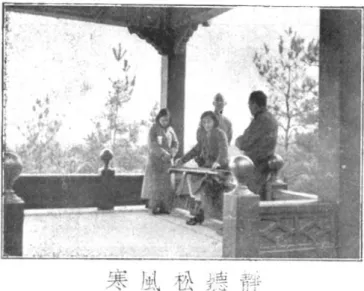
In Pictures, photos of qin players showcase either members of a specific qin society in the country, or an individual performing on the qin in action. There is one that presents a qin listening occasion, captioned by a verse selected from the Tang-dynasty poem “Listening to the Qin Playing” (Ting tanqin 聽彈琴) written by Liu Changqing (劉長卿, ca. 710-790). The sound of the qin is compared to the “frosty wind in the pines,” being encountered by a quiet listening subject. In the photo (Figure 2), three individuals attentively listen to an acquaintance playing on the qin in a tranquil wintry occasion, inside a pavilion that is sparsely surrounded by trees. In classical poetry similar imageries and sentiments are commonly used to characterize qin listening: with only one or few appreciative friends, at a secluded venue surrounded by nature. Settings of secluded features were found in private gardens inside and outside Shanghai, where Jinyu members continued to practice listening in the classical style. However, being aware of modern criticisms against the qin, at least three Jinyu members also engaged with unappreciated listening experience with the instrument.
Figure 2. “Quietly Listening to the Frosty Wind in the Pines”32
32
Li Dihu (李迪瑚, art name Li Baoshan 李葆珊, 1874-1952), a retired politician from Fujian then living in Shanghai, de-emphasized the ear in qin practice. In the essay “Three Essentials of Qin Learning,” Li presents three emphases as the essentials of profound qin playing: (1) manifestation of the player’s disposition (zhong xingqin 重性情) , (2) concentration on the player’s own spiritual cultivation and enjoyment (zhong jiling 重己靈), and (3) careful mastership and understanding of profound pieces (zhong zhuanjing 重專精). The second emphasis puts one’s own self as the most important experiential subject in qin practice. The reason why the qin can best cultivate one’s spirit and disposition is because the purpose of playing the instrument is for pleasing one’s own self, not pleasing other people. Connecting this emphasis to listening, Li describes that “If one cares whether the music pleases the ear or not, then the focus is on pleasing other people, not on pleasing one’s own self.”33
Elaborating on this listening emphasis, Li’s third essential values profound pieces such as Water Immortals (Shuixian cao 水仙操) and Mists and Clouds over Xiaoxiang Rivers (Xiaoxiang shuiyun 瀟湘水雲) over others that can easily “please others’ ear.”
Peng had a similar doubt on the ear-pleasing property of qin music. His essay “Discussion of the Qin from the Perspective of Modern Music” shows how qin music can be understood with analytical terms imported from Western music theory.34 Rather than rigidly imposing such translated concepts as “melody,” “rhythm,” and “minor scale,” however, Peng discreetly highlights the unique organizational features and performance practice of qin music. His discussion is divided into four areas—(1) timbre, (2) pitch system and modes, (3) musical design of the pieces, and (4) music-transcending character. The unique timbral variety of the qin is elaborately discussed, not only in the first section dedicated to timbre but also in the third section which discusses the way melodic materials are constituted. When the Western pitch and scale systems are invoked, they serve the purpose of either asserting compatibility between the Chinese and Western systems, or showcasing the extraordinarily sophisticated organization of qin music.
But sophisticated organization alone does not fully address the accomplishment of qin music. Peng’s fourth area transcends all the structural
33
In Chinese: 倘津津於好聽不好聽, 是意在悅人, 而非悅己. See Li Dihu, “Xue qin san yao” [Three essentials of qin learning]. Jinyu qinkan (1937), 48-49.
34
DOI: 10.6244/JOMR.2015.23.03 properties systematically identified in Western music theory. It even transcends the disciplinary boundary of music, as the qin goes beyond aesthetic expression of sonic phenomena, enabling cultivation of one’s mind and longevity. With sounds that can harmoniously “connect with one’s heart and spirit directly,”35
qin music has an incomparable power in depicting the emotional states of people, and the situated appearances of external objects or environment. Here, Peng offers perspectives on qin listening. Characterizing the ideal qin listener as being in a “calm and still” state, he rejects the ear-pleasing experience. Music that “excels only in the rise and fall of the tones and in rhythmic vigor” easily charms the ear. But without profound expressions, such music—even if played on the qin—is “merely popular tunes and vulgar sounds.”36
The negation of the pleased ear is here presented as a defining characteristic of preferred qin music, echoing Li’s idea that “The lofty repertoire of qin music does not please the ear at initial listening.”37
For both Peng and Li, understanding profound expressions of the preferred qin repertoire does not come easily. For Peng, it is only when the listener’s aural ability has reached an enhanced level that profound meanings can be grasped and felt. Similarly, Li thought that it is only after a period of deep concentration that one can increasingly experience the profound emotions being expressed in pieces that have displeased the ear.
More bluntly than Peng and Li, Wu Zhaoyu ( 吳兆瑜, style name Wu Xiangcen 吳湘岑 1905-)—the youngest among the three and a woman—directly declared that “qin music does not please the ear.”38
Her short essay “Qin Promotion as Shaping the Nation’s Future” argues that the moral edification power of the qin is essential to strengthening the whole nation. Upholding the Confucian belief that a strong nation is constituted by people with upright thinking and honest integrity, Wu commends the qin as the native Chinese music that can effectively enhance anyone’s moral realization. “Although the music of the qin does not please the ear,” it has the rare qualities of being “lofty (gao 高) and unworldly (kuang
35 Ibid., 62. 36 Ibid. 37 Ibid. 38
Wu Zhaoyu [Wu Xiangcen], “Tichang guqin wu yingxiang minzu qiantu” [Qin promotion as shaping the nation’s future. Jinyu qinkan (1937), 57.
曠),” which can “cleanse human being’s wicked mind, restoring purity.”39
Unlike Peng and Li, Wu does not differentiate between the greater and lesser repertoire of qin music. Rather, she contrasts (ear-displeasing) qin music with widely received Western music, especially the “licentious” (mimi zhiyin 靡靡之 音) type of Western music which is primarily referred to jazz or popular love songs commercialized in the dance hall culture and gramophone industry.40 The latter is, for Wu, the inferior musical sounds that are ear pleasing, but deplete of moral value.
All three Jinyu essayists were giving a modern identity to the qin. Their characterizations, ranging from stipulating the essentials, the theoretical make-ups, to the ethical power, defined the qin with terms that served a larger defensive agenda vis-à-vis increasing calls for its abandonment. While their negation of the aural pleasure commonly elicited a kind of profound listening, the negation was integral to their characterizations of the instrument. Among the three essayists, Wu’s voice was the most radical, claiming the ear displeasing quality as a fact of qin music obvious to all. I see her characterization as epitomizing a crucial aspect of qin aurality that underlay the thoughts of proactive qin defenders of her time, fitting the trajectories of the arguments of Li and Peng. All their articulations asserted a denied presence of the ear as being constitutive to the modern knowledge of the qin. The emerging modern identity of the qin thus engages a proactive but paradoxical relation with the ear: one has to listen with the ear in order to deny it. Through such an aurality paradox, profound qin listening is elicited, one that transcends sensual pleasure obtained from charming but somewhat depraved musical expressions. Profound qin listening communicates with one’s inner being while restraining from self indulgence; it realizes sympathetic understanding and feeling of situated life conditions while orienting all musical experiences toward edifying one’s moral character.
However, given the fact that associating self-cultivation with non-indulgent music has been an ideal in Confucianism since antiquity, how did Jinyu essayists’ negation of the ear present an aural consciousness different from their pre-modern
39
In Chinese: 古琴的音調雖不悅耳, 其一派高曠之氣, 能[洗]滌人類卑劣思想, 使之 純潔. Ibid.
40
See Andrew F. Jones, Yellow Music: Media Culture and Colonial Modernity in the
DOI: 10.6244/JOMR.2015.23.03 predecessors?
PRE-JINYU QIN LISTENING
Pitting moral edification against sensual pleasure is a fundamental Confucian ideology of music. Since pleasing the ear as a prominent type of sensual pleasure is censored in the ideology, Jinyu essayists’ negation of the ear is an obvious continuation of Confucianism. Not only so, as Peng described, there existed an evaluation practice among qin players-aficionados that banished ear pleasing qin pieces as “merely popular tunes and vulgar sounds.”41
The pleasure of the ear had been distrusted in the qin tradition that upheld ideals and values rooted in established ideologies.42 However, while Jinyu essayists’ thoughts stayed within the established bounds, they presented an expanded aurality in characterizing the qin. Rather than simply ignoring or rejecting the censorable pleasure of the ear when commending profound listening, in a trajectory common in pre-modern time, Jinyu essayists went farther to embrace the displeasing effect as an integral characteristic of qin music. The negation in their aurality thus subtly shifted from the despicable, banished ear to the ascetic, displeased ear.
Comparative visits to selected pre-modern cases could illuminate the shift. For example, in classical Confucianism, tension between profound and pleasurable listening is addressed in the well-known musical conversation between Marquis Wen of Wei (魏文侯, ca. 472-396 BCE) and Confucius’s disciple Zi Xia (子夏, fl. 5th century BCE).43 Confronted with a listening predicament, Marquis Wen asks Zi Xia why that when he puts on his official robe and black hat and listens to “ancient
41
Peng, “Cong xiandai yinyue shang lun qin,” 62.
42
Besides Confucianism, established ideologies that have shaped the qin tradition include Daoism and Buddhism. The three schools of thoughts underwent various processes of integration in history. Confucianism has the strongest and most direct views on music in relation to morality, and Confucian classics were fundamental to the pre-modern education system. For a discussion of qin ideology in relation to the three schools of thoughts, see Robert H. van Gulik, The Lore of the Chinese Lute: An Essay in the
Ideology of the Ch’in (Tokyo and Vermont: Sophia University and Charles E. Tuttle
Company, [1940] 1969).
43
The conversation is recorded in more than one classics, including “Yueji”樂記 (Record of Music), a chapter in the Liji 禮記 (Book of Rites, ca. 2nd and 1st centuries BCE).
music” (guyue 古樂), he only feels he will keel over from boredom. But when he listens to the music of Zheng and Wei (Zheng Wei zhi yin 鄭衛之音), he forgets what it means to be tired.44 Zi Xia then explains the difference between the two kinds of music. The former could elicit thoughts of and discussion on the ancient sages, while the latter with its frantic and hurried sounds would inspire an indulgent volition.45 With a Confucian-styled associative thinking, Zi Xia concludes that the superior man listens to not only the sounds and their effects in music, but also what those sounds and effects mirror in social relations.
Different from Jinyu essayists, Zi Xia did not address the issue of sensual boredom. He only affirmed the harmonious and virtuous efficacies of ancient music, detailing how it is orderly performed in proper ritual context, and citing from two poems in the Book of Songs (Shijing 詩經) to remind how virtuous music was properly practiced by an ancestor of the Zhou dynasty. The displeasing effect of ancient music was not directly addressed.
Another difference between Jinyu essayists and Zi Xia lies in the aural engagement of the listening subject being projected. “Ancient music,” an ideal form of music practiced by benevolent sages and kings in antiquity, is the utopian source for the preferred music in the Confucian tradition, including qin music. While Jinyu essayists subscribed to the tradition and regarded the qin as the instrument that best manifests ancient music, the listening subject in their discussion simultaneously negates the pleasure of the ear while obtaining profound meanings of qin music. In other words, the same listening subject engages both negative and affirming modes of relations with qin music, and both modes are equally important. In contrast, the listening subject in the Zi Xia-Marquis Wen conversation engages only one of the two modes. The listener who finds ancient music aurally displeasing (Marquis Wen) stands apart from the listener who can appreciate its profound meanings (Zi Xia). While Jinyu essayists embraced aural insignificance or displeasure as an equally important dimension of profound listening, Zi Xia engaged the latter only.
In classical poetry, especially since the Tang period, qin listening is a recognized theme. A good number of works laments people’s abandonment of the
44
My translation has consulted Scott Cook, “‘Yue Ji’ 樂 記 —Record of Music: Introduction, Translation, Notes, and Commentary,” Asian Music 26/2 (1995): 61-64.
45
DOI: 10.6244/JOMR.2015.23.03
qin for instrumental music in vogue, echoing Marquis Wen’s preference. The poets, however, rarely assume the didactic role of Zi Xia in making ideological arguments. Many engage the image, sound, and listening experience of the qin primarily for creating their poetic persona. Nonetheless, the ancient music ideal embraced by these poets and their concern of people turning away their ear away from the qin indicate a continuity of the aurality tradition represented by the Zi Xia-Marquis Wen conversation.
For example, the aforementioned Tang poem written by Liu (“Listening”) ends with “Although ancient pieces are held high in regard, most today do not play them.”46
Several decades later, Bo Juyi (白居易, 772-846) lamented the declined interest of the qin in “An Abandoned Qin” (Feiqin 廢琴), and gave a reason: “What has caused it to be so? The Jiang’s flute (姜笛) and Qin’s zheng (秦箏).”47 Both poems characterize the qin as sounds of antiquity, which was not the preferred music of the day despite its consented prestige and long history. Such a classicist conception of the qin retrospectively values the instrument as manifesting attributes of utopian ancient music, thus continuing the Confucian ideal that underlay the Zi Xia-Marquis Wen conversation.
The aurality focus of these poems and its corresponding listening subject involve a play of ambiguity. In Liu’s “Listening,” the aural experience of a profound listener (presumably the poet) is described as “quietly listening to the frosty wind in the pines.” Those who have turned away from the qin, whether because of the displeased experience of the ear or else, are not given real aural attention. In Bo’s “An Abandoned Qin,” the profound listener somewhat retreats to the background as the focus is placed on the physical appearance and sonic residue of the qin rather than on an engaged experience of profound listening. Nevertheless, aural allusions are prominent. The refined “sounds of antiquity” (taigu sheng 太古聲) are described as “mild and flavorless,” with “lingering notes [being] clear and bright.” But different from Liu and Zi Xia, who focus on the
46
In Chinese, 古調雖自愛, 今人多不彈. My translation has consulted John Thompson’s rendition. Silk Qin, http://www.silkqin.com/09hist/qscb/qscb05d.htm (accessed August 2, 2015).
47
In Chinese, 何物使之然, 姜笛與秦爭. My translation has incorporated elements of Ronald Egan’s rendition. Ronald Egan, “The Controversy Over Music and ‘Sadness’ and Changing Conceptions of the Qin in Middle Period China.” Harvard Journal of
experience of profound listening exclusively, Bo also alludes to the aural dimension of listeners who have turned away from the qin. The kinds of music that appeal to their ear—“the Jiang’s flute and the Qin’s zheng”—are discreetly specified. Bo’s inclusion of the antithetical listening does not align with Jinyu essayists’ inclusion of the displeased ear either, however. Whereas the displeased experience of listening to the qin constitutes Jinyu essayists’ ideal of profound listening, it is only ambiguously implied in Bo’s poem. Also, although Bo points out the “mild and flavorless” sounds of the qin does not “[match] the preferences of men today,” he does not ruminate on the wonder of qin listening. His aural attention soon shifts to the vulgar sounds to which antithetical listeners have turned. But instead of scathing the despicable nature of the vulgar sounds, which would have banished the ear of the antithetical listener, Bo anchors his poetic persona in lament. He does not engage profound listening, nor displeased listening.
Notwithstanding these differences, classical poems continued the Confucian ideological tradition. They subscribed to the antiquity ideal, and distrusted vogues of the present.48 Such a subscription more or less sustained its prominence in the subsequent long period since the mid-Tang, from the Song to the Qing.
For proactive qin players-aficionados of the period, practices deemed impeding the realization of the antiquity ideal provoked reactions beyond merely making poetic laments. Many compiled anthologies of qin notated score as an effort to restore the ideal practice. For example, Zhu Quan (朱權, 1378-1448)’s Wondrous and Secret Notation (1425) (Shenqi mipu 神奇秘譜)—the earliest qin music anthology in extant—demonstrates such proactive attitude, reiterating the antiquity ideal and rejecting the vogue of the present. Zhu in the anthology classifies a group of repertoire of older origins into a section deferentially titled “Celestial Airs of Antiquity” (Taigu shenpin 太 古 神 品 ),49
suggesting that
48
As Egan has shown, prior to mid-Tang, subscription to classicism in the qin lore underwent changing degrees of emphasis, having subsided by the Han vogue of expressing sadness, followed by neo-Daoist reactions best represented by Xi Kang (嵇 康, 223-262). Bo marked a noticeable turning point, which was firmly established in Ouyang Xiu (歐陽修, 1007-1072) in the Song dynasty. See Egan, “The Controversy Over Music and ‘Sadness’ and Changing Conceptions of the Qin in Middle Period China.”
49
A study of the repertoire can be found in Bell Yung, ed., Celestial Airs of Antiquity:
DOI: 10.6244/JOMR.2015.23.03 compositions of ancient origins could continue to be played. Zhu also confronts the problems of the present, which lie in the performance practice and manner of qin players. Having introduced the qin as “a sacred object from antiquity” in the Preface,50 Zhu complains about how contemporary vulgar uses of the instrument “by illiterates and the merchants, the lowly prostitutes and actors, and vulgar foreigners, the sick and the like” has corrupted the Way (Dao) of the instrument.51 His purpose of compiling the notations of selected sixty-four pieces was to “reverse the trend of decadence that has come to pass, and to restore the ancient purity that is to be.”52
No sonic or aural references of vulgar musical practices, however, are provided.
An aurally focused remark is found in the Preface of Yan’s Notations of the Pine and Strings Studio (松絃館琴譜, 1614), an important work for the Yushan School which would inspire the founding of Jinyu during the interwar period. Thinking with terms that echoed the Zi Xia-Marquis Wen musical conversation, Yan mocks the poor qin listening ability of Emperor Xuanzong of Tang (唐玄宗, r. 712-755).53 According to an anecdote,54 the emperor once listened to the qin but could hardly bear it. Having been fond of playing the Jiegu (羯鼓), a bucket-shaped drum played with sticks on both sides, the emperor immediately ordered his
50
In Chinese, “上古之神物.” Zhu Quan, “Quxian Shenqi mipu xu” [Preface of Shenqi
mipu by Quxian], in Shenqi mipu [Wondrous and secret notation]. In Zhongguo yishu
yanjiuyuan yinyue yanjiusuo et al., eds., Qinshu jicheng [Compendium of qin publications] vol.1 (Beijing: Zhonghua shuju, 2010), 107. Translation from Georges Goormaghtigh and Bell Yung, trans., “Preface of Shenqi mipu: Translation with Commentary.” ACMR Reports: Journal of the Association for Chinese Music Research 10/1: 4.
51
Ibid.
52
Ibid. Departed from the mid-Tang poets’ laments, the Confucian classicism for Zhu integrated Daoist ideals and stressed individual aspirations that were exemplified in Xi. Achieving union with the “Great Void” (taixu 太虛) was for Zhu a realization of ancient music. Zhu, “Preface of Shenqi mipu by Quxian,” 107. Goormaghtigh and Yung, trans., “Preface of Shenqi mipu: Translation with Commentary,” 5-6.
53
Yan Cheng, “Xu” [Preface], Songxian guan qinpu [Notations of Pine and Strings Studio], 1614. In Zhongguo yishu yanjiuyuan yinyue yanjiusuo et al., eds., Qinshu
jicheng [Compendium of qin publications] vol.8, 74.
54
The anecdote is recorded in Wang Dang (王讜, fl. 11th century), Tang yulin [Forrest of words from the Tang dynasty]. See Liu Yuezhu, Tangren yinyue shi yanjiu: yi konghou
pipa dijia wei zhu [A study of Tang music history: Focusing on Konghou, pipa, and dijia] (Taipei shi: Xiuwei zixun keji gufen youxian gongsi, 2007), 31.
favorite drum be taken out and played in order to rinse the boredom. Pitting Jiegu listening against qin listening, Yan uses Emperor Xuanzong’s pick to allude to the popular musical taste of his time. However, since no further remarks on the ear are followed, it is difficult to characterize the aurality of Yan further. Similar to Zhu, what bothered Yan and impelled the compilation came from those who played the qin, specifically those who set texts to qin music, and vice versa, in a stylistically "dull" fashion.55 His notation anthology of thirty-one pieces meant to show how the refined style could be applied with subtle and varying treatments of the timbre.56
Direct attentions given to the ear are found in Notations of the Dahuan Pavilion (大還閣琴譜, 1673), another crucial work for the Yushan School but compiled by Xu Shangying (徐上瀛, style name Xu Qingshan 徐青山, later named Xu Hong 徐谼, ca. 1582-1662). The anthology was widely circulated with numerous reprints during the Qing, having an influence that exceeded the above two anthologies in the period. Making aesthetic commentaries on an array of twenty-four touches in qin playing, Xu elaborates on the Confucian duality between the refined, or ya (雅), and vulgar, or su (俗), and banished ear pleasing qualities as characteristics of vulgar touches. In his “Xishan Treatise on the Aesthetics of Qin Music” (Xishan qinkuang 谿山琴況, 1641), which was included in the anthology, ear pleasing properties are cautioned in the discussions of four particular touches: “clarity” (qing 清), “antiquity” (gu 古), “unadornedness” (dan 澹), and “beauty” (li 麗).57
Underlining these four touches is the overarching ya ideal,58 the corrupted expressions of which manifest different undesirable qualities
55
Yan, “Fu Qinchuan quipu xu” [Attached preface to Notations of Qinchuan], Songxian
guan qinpu, 162.
56
For a study of the masculinity and friendship of Yan Cheng’s circle, see Joseph S. C. Lam, “Music and Male Bonding in Ming China.” Nan Nü 9 (2007): 92-101.
57
Xu Shangying, “Xishan qinkuang” [Xishan Treatise on the aesthetics of qin music], in
Dahuan’ge qinpu [Notations to Dahuan Pavilion]. In Zhongguo yishu yanjiuyuan
yinyue yanjiusuo et al., eds., Qinshu jicheng vol.10, 297-470. Translation from Chun Yan Tse and Shui Fong Lam, trans., “The Xishan Treatise on the Aesthetics of Qin Music.” Renditions 83 (2015): 89-111.
58
Drawing from linguistic perspectives, Xu Liang identifies the bi-character compound words of the twenty-four touches as the foundation for meanings classification and interpretation, and has found that the touch of ya “can be regarded as the overarching principle of the first eight touches,” which include the four touches being discussed here. Xu Liang, “Wenzi yu wenzi beihou—lun “Xishan qinkuang” zhi wenben