Prevalence of malformed frogs in Kaoping and Tungkang
river basins of southern Taiwan
Da-Ji Huang1, Yuh-Wen Chiu2, Chien-Min Chen1, Kai-Hsiang Huang3 and Shu-Yin Wang*4
1Department of Environmental Resources Management, Chia Nan University of
Pharmacy and Science, Tainan - 71710, Taiwan, Republic of China
2Faculty of Biomedical Science and Environmental Biology, Kaohsiung Medical University, Kaohsiung 807, Taiwan 3Institute of Fisheries Science, National Taiwan University, Taipei 106, Taiwan, Republic of China
4Graduate Institute of Biotechnology, Chinese Culture University, Yang Ming Shan, Taipei 111, Taiwan, Republic of China
(Received: January 29, 2009; Revised received: May 20, 2009; Accepted: June 26, 2009)
Abstract: In this study, we found many amphibians with bizarre appearances, known as malformations in Pingtung County, southern Taiwan. For this investigation we collected frogs inhabiting the Kaoping and Tungkang river watersheds between February 2006 and June 2007. Among the total number of 10,909 normal frogs (i.e., anurans) collected during the investigation period, the Indian rice frogs (Rana limnocharis) account for the greatest number; next is the Chinese bullfrog (Rana rugulosa). Of all the 244 captured malformed frogs, the Indian rice frog account for the greatest proportion. These malformed frogs have their main distribution in upstream areas of these two rivers. Our result indicates that the appearance rate of malformed frogs is 1.8% in the upstream reaches of the Kaoping River and 2.6%, and 0.8%, respectively in the upstream and midstream reaches of the Tungkang river. The most-commonly-found malformation is the lack of palms, followed by the lack of appendages, exostosis, and a malformed appendicular. It is, therefore, reasonable to speculate that the causes for the malformation may be related to the increased organic pollutants and agricultural chemicals used in the upstream reaches of these two rivers.
Key words: Anurans, Malformed frog, Southern Taiwan, Indian rice frog (Rana limnocharis)
PDF of full length paper is available online
* Corresponding author: [email protected]
Introduction
Anurans reproduce and lay eggs mostly in water, and the tadpoles grow up in the water and become amphibious in their adulthood (McDiarmid and Altig, 1999). Their complicated life cycle and extreme sensitivity to environmental changes make amphibians a good index for environment monitoring (Venturino et al., 2003). In the past two decades, frog populations have rapidly declined worldwide due to global climate changes, increased pollutants, and decreases and degradation of habitats (Rodriguez-Prieto and Fernandez-Juricic, 2005). In addition to rapid declines in frog populations, malformed frogs are also an important issue. Mass population decreases and strange phenomena like malformations indicate that potential crises exist in our environment (Loman and Andersson, 2007).
Currently, there are three hypotheses proposed about frog malformation: ultraviolet radiation, water pollution and parasites. The ozonosphere is becoming thinner, allowing stronger ultraviolet radiation to reach the surface of the earth; thus, the radiant energy destroys genes that control growth and results in frog malformation (Ankley et al., 2002; 2004; Bruner et al., 2002). Moreover, the various pollutants, such as pesticides-methoxychlor, xenoestrogen-diethylene glycol, and heavy
metal- copper etc. in water may cause the formation of malformed frogs. (Fort et al., 2004a; Fort and Paul, 2002; Fort et al., 2004b). In addition to the influence of increased ultraviolet radiation and water pollution, frog malformation may also result from parasitic (Ribeiroia ondatrae) infection (Johnson et al., 2001). However, none of the above three hypotheses can be conclusively verified with existing evidence (Burkhart et al., 2000; Cohen Jr, 2001). Reports have it that many malformed frogs have been discovered in the US and Europe in recent years (Geer and Krest, 2000; Met eyer, 2000; Vandenlangenberg et al., 2003). So far, no reports have documented the appearance of malformed frogs in Taiwan. In this study, we have collected anurans in the drainage basins of the Kaoping and Tungkang rivers, located in Pingtung County, southern Taiwan, to analyze the possible causes, to explore the present existence and prevalence of malformed frogs.
Materials and Methods
This study mainly investigated the quantity and distribution of malformed anurans in the drainage basins of the Kaoping and Tungkang rivers, Taiwan. Each river was divided into upstream (Kaoping upstream, KPU and Tungkang upstream, TU), midstream (Kaoping midstream, KPM and Tungkang midstream, TM), and downstream (Kaoping downstream, KPD and Tungkang downstream, TD) sites (Fig. 1).
©Triveni Enterprises, Lucknow (India) For personal use only
A visual encounter method was used for amphibian collection (Lin and Lue, 2004). On each sampling day, 2 hr of sampling was conducted from 19:00 to 21:00 using a strong light and collecting net around anuran habitats, such as rice fields, drainage areas, and banana farms in the study area. The amphibian densities were calculated as numbers per 100 m2.
Amphibians were collected from study sites and identified to species level (Yang, 1998). The sex was determined and recorded, and the snout-vent length (SVL) was also measured. In addition, any abnormal morphology was identified in the frogs. Abnormal frogs were brought back to the laboratory for further examination (Meteyer, 2000).
SPSS vers. 12.0 (SPSS, 2003) was used for the statistical analysis. The snout-vent lengths between normal and abnormal frogs were compared, using Student’s t-test (paired assay, p<0.05). Comparisons of malformation frequencies between males and females were examined by Chi-squared analysis in this study.
Results and Discussion
In this study, 10,909 frogs were collected from six study sites of KPU, KPM, KPD, TU, TM, and TD during February 2006 to June 2007. The Indian rice frog (Rana limnocharis) was the most dominant (accounting for a capture rate of over 95%), followed by the Chinese bullfrog (R. rugulosa) and Asiatic painted frog (Kaloula pulchra pulchra). The average densities (D) were 9.4 (KPU), 0.1 (KPM), 4.8 (TU) and 0.8 (TM) individuals (ind.) m-2 respectively
(Table 1). In the six survey sites, the greatest numbers of individuals were in the KPU and TU in order; in both the KPM and TM sites the numbers were on the low end; and no individuals were captured in the KPD or TD sites (Table 1). These data reveal an obvious fact that in the downstream of both rivers the habitat alterations and pollutants had greatly affected both local amphibian populations (Green, 2003). Much environmental monitoring research has evaluated environmental conditions mainly based on changes in amphibian populations (Ankley et al., 2004; Burkhart et al., 2000; Klaassen, 2001; Liao et al., 2006; Ouellet et al., 1997; Venturino et al., 2003). A report issued by the Pingtung County Environmental Protection Bureau confirms that the water quality of the Kaoping and Tungkang Rivers has been deteriorating from upstream to downstream (EPB/Pingtung-County, 2006). The worsening situation may be most likely caused by the following reasons. At the KPU and TU sites, livestock wastewater and agricultural chemicals are mostly responsible for the severe pollution. At the KPM and TM sites, aside from livestock wastewater and agricultural chemicals, the gradually growing human population, plus the increasing amounts of discharged domestic wastewater have further worsened the quality of both rivers. And at the KPD site, more wastewater from factories on both banks flows into the river while at the TD site, agricultural and livestock wastewater is gradually increased (Jen et al., 2004). Our results indicate that the KPU and TU sites are better habitats for amphibians, followed by the KPM and TM sites, while the KPD and TD sites are the worst.
Kaoping River Tungkang River KPU TU KPM TM TD KPD 10 Km 50 Km
N
E120 E121 E122
N23 N25
N24
Taipei
N22
Fig. 1: Location of study sites in the Kaoping and Tungkang river basins. Kaoping upstream (KPU), Kaoping midstream (KPM) and Kaoping downstream (KPD); Tungkang upstream (TU), Tungkang midstream (TM) and Tungkang downstream (TD)
This investigation revealed that most frogs were found in the reaches of the KPU and TU. In the Kaoping River, the frog population was higher in summer (May to July) 2006 and 2007, and lower in autumn (August to October) and spring (February to April). In the Tungkang River, frog population numbers, from high to low, were in the order of spring 2006, summer 2007 and autumn 2006 (Table 1). Wu et al. (2006) reported that the population of Indian rice frog increased after the breeding season (March to October). The same pattern was found in our observations at the KPU site but not at the TU site. It is probably a key factor that the higher level of human activities in the upstream areas of the Tungkang River has interfered with the growth of frog populations. In
comparison with the density data of the Lanyang River of northeastern Taiwan (3-13 ind. 100 m-2), the central mountainous
area of Taiwan, southern Taiwan (2.5-18.0 ind. 100 m-2), and the
Zhoushan Archipelago of China (Huang and Hou, 2004; Lin and Lue, 2004; Wu and Liu, 2004; Wu et al., 2006), we have found out that the amphibian populations at the KUP and TU sites are slightly lower than those of the Zhoushan Archipelago, and are comparatively higher than Lanyang River of northeastern Taiwan. In this study, 244 (2%) malformed frogs in total were collected (malformed/normal, 244/10,909), among which 161 were collected at the KPU site, 59 at the TU site, and 24 at the TM site
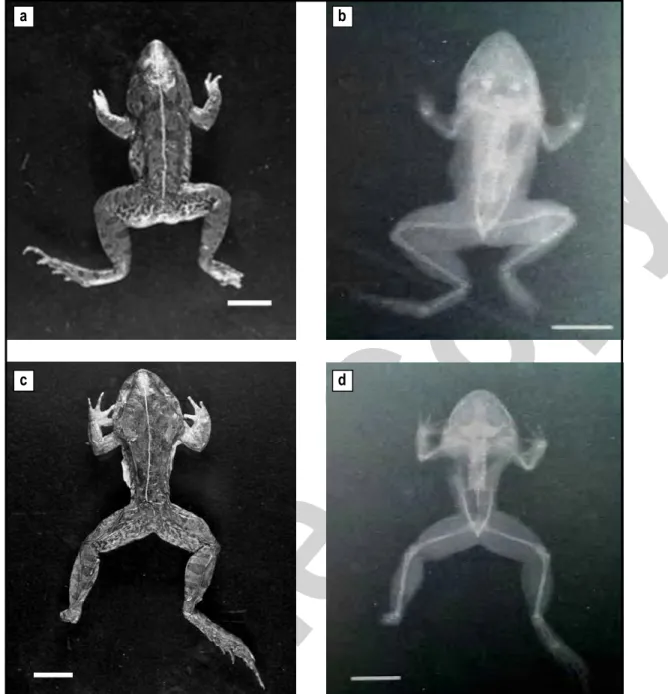
Fig. 2: No foot/partial foot. The tibiofibular bone was present but the tibiale and fibulare were shorter than normal bones in the right limb (a). The absence of the tibiale and fibulare in the left limb (c). b and d are x-ray pictures corresponding to a and c, respectively. (Bar = 1 cm)
a b
(Table 2). In species, of all the malformed frogs, 240 were Indian rice frogs, and only 4 were Chinese bullfrogs. The fact that more numbers of malformed frogs were found at the KPU and TU sites may be associated with the higher populations of amphibians. However, very few numbers of malformed frogs were found in the midstream and downstream reaches, the environment of which is thought to be more appropriate for amphibians to live in (Feidieker et al., 1995; Loeffler et al., 2001; Rodriguez-Prieto and Fernandez-Juricic, 2005). The malformation rate of frogs generally falls between 2 and 3% (Stocum, 2000). Our results indicated the frog malformation percentages in all seasons at the KPU and TU sites
during 2006 to 2007 were around 0.67-3.15% and 0-7.5%, respectively. Comparatively, though these data were lower than those reported in northern California (0.6-9%; Bettaso, 2004) and Minnesota (0.3-22.8%; Canfield et al., 2000), still the percentages at the KPU and TU sites are quite high, which implies there must be some potential factors causing these abnormalities in amphibians.
Among the 244 frogs with a peculiar appearance, there are 171 with one malformation symptom, 64 with two, 7 with three, and 2 with four. For the malformation symptoms, foot/partial foot
Table - 1: Seasonal variation in density and percentage of malformed frogs
Kaoping river Tungkang river
Season Upstream Midstream Downstream Upstream Midstream Downstream
D m% D m% D m% D m% D m% D m% Spring/2006 8.0 1.87 0.3 0 0 0 9.1 1.56 — — — — Summer/2006 13.9 3.15 0 0 0 0 0.9 7.50 2.9 4 0 0 Autumn/2006 8.7 0.97 0.1 0 — — 5.9 2.67 1.3 0 — — Winter/2006 0.9 1.27 0 0 — — 4.2 0.77 0 0 — — Spring/2007 6.1 2.93 0 0 0 0 2.2 0 0 0 0 0 Summer/2007 18.7 0.67 0 0 0 0 6.6 2.93 0 0 0 0 Mean 9.4 1.8 0.1 0 0 0 4.8 2.6 0.8 0.8 0 0 SD 5.7 0.9 0.1 0 0 0 2.7 2.4 1.1 1.6 0 0
— = Not sampled, SD = Standard deviation, D = Individuals 100 m-2, m% = Percentage of malformed frogs Table- 2: Frequency of symptoms in abnormal frogs
Kaoping river Tungkang river
Total
Upstream Midstream Upstream Midstream
Amelia 12 0 7 2 21
Ectromeila 39 0 14 4 57
No foot/ Partial foot 67 0 22 12 101
Entire toe missing 11 0 0 0 11
Exostosis 15 0 6 0 21
Multiple toes 10 0 5 3 18
Short toes 1 0 2 0 3
Bone bridge/ Bone Rotation 3 0 2 1 6
/ Proportionately short limb
Other 3 0 1 2 65
Table - 3: Frequency of symptoms in abnormal male and female frogs
Kaoping river Tungkang river Total
Male Female Male Female Male Female
Amelia 8 4 4 5 12 9
Ectromeila 22 18 10 7 32 25
No foot/ Partial foot 45 22 18 16 63 38
Entire toe missing 8 3 0 0 8 3
Exostosis 7 7 4 3 11 10
Multiple toes 5 4 6 3 11 7
Short toes Bone bridge/ 0 1 1 1 1 2
Bone Rotation / Proportionately 2 1 0 2 2 3
short limb
Fig. 3: Ectromeila. The stifle (knee) is present, and a portion of the tibiofibular bone is also present (a). The absence of the stifle (knee) and femur also occurred as exostosis in the femur bone (c). b and d are x-ray pictures corresponding to a and c, respectively. (Bar = 1 cm)
a b
c d
(Fig. 2) is the most prevalent; ectromeila (Fig. 3) the second, and amelia the third respectively. Except for the no foot/partial foot symptoms, other symptoms do not significantly differ between the KPU and TU sites (Table 2). In our investigation, the number of those malformed frogs that have more than one malformation symptom is 64, among which exostosis most often occurs, accompanied by other symptoms. Exostosis in malformed frogs was mostly accompanied by ectromeila and no foot/partial foot. This phenomenon may be caused by trying to act with incomplete limbs which might result in limb wearing or injury, causing a chronic inflammatory reaction and bone tissue proliferation (Smithuis, 1964).
There were more males than females in number in the collected malformed frogs. A Chi-squared analysis of the frequencies of symptoms in abnormal frogs shows no significant difference between males and females in either the Kaoping or Tungkang Rivers (Table 3).
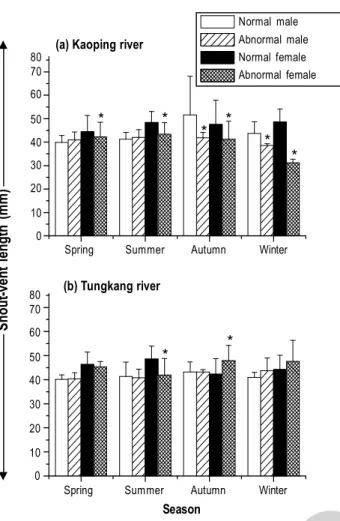
The average snout-vent length (SVL, 42.62 mm) of abnormal individuals is shorter than that of normal frogs (45.16 mm, p<0.01). In the Kaoping River basin, the same pattern is observed in female frogs; the average SVL shows no difference between normal and abnormal males in spring and summer; however, it is shorter for abnormal individuals than for normal frogs (Fig. 4a).
Spring Summer Autumn Winter 0 10 20 30 40 50 60 70 80 * *
b. Tungkang river
normal male abnormal male normal female abnormal femaleSpring Summer Autumn Winter
0 10 20 30 40 50 60 70 80 * * * * * *
a. Kaoping river
(a) Kaoping river(b) Tungkang river S n o u t-ve n t le n g th ( m m )
Fig. 4: Snout-vent length of normal and abnormal frogs sampled during February 2006 to June 2007. Asterisk (*) indicates significant at p<0.05
Season
Abnormal frogs with a shorter SVL are thought to be less active, resulting in malnutrition due to the difficulty in capturing prey (Ouellet et al., 1997). However, a shorter SVL in abnormal frogs was not observed in the Tungkang River basin (Fig. 4b).
Ouellet et al. (1997) found higher malformation rates in agricultural fields. Agricultural chemicals such as pesticides and herbicides are the most often mentioned materials among various contaminants that can lead to creature malformation (Clements et al., 1997; El-Merhibi et al., 2004; Gillilland et al., 2001; Lu, 2001). Furthermore, some agricultural chemicals such as pesticides are found to posses estrogen-like activity that can affect the normal development of bones (Pickford and Morris, 2003). In addition, our results reveal that numerous malformed frogs were found during the 1-2 months after high agricultural activities in summer. Therefore, agricultural chemicals are very likely the factor that affects frog malformation in the Kaoping and Tungkang River basins. Kiesecker (2002) indicated that, when parasites exist, the amphibian malformation rates that occurred in water bodies containing pesticides are higher than those without pesticides. As a result, a combination of parasites and pesticides (Johnson et al., 2001) may contribute to the appearance of malformed frogs at the KPU and TU sites.
In addition to ultraviolet radiation, parasites and pollutants,, rising temperatures can also cause malformations in amphibians (Lu, 2001). The Central Weather Bureau/ROC (2006) showed that the temperature in Pingtung went up from 25.1 to 25.9oC during
2001 to 2006. Rising temperatures and organic material contamination can expand the microbiological populations such as of R. ondatrae and cyanobacteria (Hynes, 1974).
This study suggest that, as the result of human activities, the pollution from upstream to downstream has been increasingly worsening and thus causes the decreasing number of frog populations. Potential sources that possibly lead to the malformation are in the upstream areas, where frog malformation may be closely related to organic wastewater and chemicals released through agricultural activities.
Acknowledgments
We thank Mr. Wan-Chang Lin for field sampling assistance and providing useful information for our study. We are also grateful to the National Science Council of Taiwan for its financial support of this study (NSC95-2621-B-041-001).
References
Ankley, G.T., S.T. Degitz, S.A. Diamond and J.E. Tietge: Assessment of environmental stressors potentially responsible for malformations in North American anuran amphibians. Ecotoxicol. Environ. Saf., 58, 7-16 (2004).
Ankley, G.T., S.A. Diamond, J.E. Tietge, G.W. Holcombe, K.M. Jensen, D.L. DeFoe and R. Peterson: Assessment of the risk of solar ultraviolet radiation to amphibians. I. Dose-dependent induction of hindlimb malformations in the Northern leopard frog (Rana pipiens). Environ. Sci. Technol., 36, 2853-2858 (2002).
Bettaso, J.B.: Humboldt bay national wildlife refuge 2004 Northern red-legged frog malformation report: U.S. Fish and Wildlife Service, Arcata Fish and Wildlife Office, Arcata Fisheries Technical Report Number AFWO-TR08-07, Arcata, California (2004).
Bruner, M.A., P.A. Shipman, M. Rao and J.A. Bantle: Developmental effects of ambient UV-B light and landfill leachate in Rana blairi and Hyla chrysoscelis. Ecotoxicol. Environ. Saf., 53, 73-80 (2002). Burkhart, J.G., G. Ankley, H. Bell, H. Carpenter, D. Fort, D. Gardiner, H.
Gardner, R. Hale, J.C. Helgen, P. Jepson, D. Johnson, M. Lannoo, D. Lee, J. Lary, R. Levey, J. Magner, C. Meteyer, M.D. Shelby and G. Lucier: Strategies for Assessing the Implications of Malformed Frogs for Environmental Health. Environ. Hlth. Perspect., 108, 83-90 (2000). Canfield, J.T., S.M. Kersten and P. Vanselow. 1997-1999 field season report - Minnesota malformed frog investigation. In MPCA (Ed.). Minnesota: Minnesota Pollution Control Agency, Paul, MN. pp. 72 (2000). Clements, C., S. Ralph and M. Petras: Genotoxicity of select herbicides in
Rana catesbeiana Tadpoes using the alkaline single-cell gel DNA electrophoresis (Comet) assay. Environ. Mol. Mutagen, 29, 277-288 (1997).
Cohen Jr, M.M.: Frog decline, frog malformations, and a comparison of frog and human health. Am. J. Med. Genet., A, 104, 101-109 (2001). El-Merhibi, A. Kumar and T. Smeaton: Role of piperonyl butoxide in the toxicity of chlorpyrifos to Ceriodaphnia dubia and Xenopus laevis. Ecotoxicol. Environ. Saf., 57, 202-212 (2004).
EPB/Pingtung-County: The plan of water quality improvement and pollution decrease in Kaoping river Pingtung County Environmental Protection Bureau, Taiwan. (2006)
Feidieker, D., P. Kampfer and W. Dott: Field-scale investigations on the biodegration of chlorinated armoatic compounds and HCH in the subsurface environment. J. Contam. Hydrol, 19, 145-169 (1995). Normal male
Abnormal male Normal female Abnormal female
Spring Summer Autumn Winter
Spring Summer Autumn Winter 80 70 60 50 40 30 20 10 0 80 70 60 50 40 30 20 10 0
Fort, D.J., P.D. Guiney, J.A. Weeks, J.H. Thomas, R.L. Rogers, A.M. Noll and C.D. Spaulding: Effect of methoxychlor on various life stages of Xenopus laevis. Toxicol. Sci., 81, 454-466 (2004a).
Fort, D.J. and R.R. Paul: Enhancing the predictive validity of frog embryo teratogenesis assay - Xenopus (FETAX). J. Appl. Toxicol., 22, 185-191 (2002).
Fort, D.J., J.H. Thomas, R.L. Rogers, A. Noll, C.D. Spaulding, P.D. Guiney and J.A. Weeks: Evaluation of the developmental and reproductive toxicity of methoxychlor using an anuran (Xenopus tropicalis) chronic exposure model. Toxicol. Sci., 81, 443-453 (2004b).
Geer, K. and S. Krest: A new threat to frogs. Endangered Species Bulletin, 25, 12-13 (2000).
Gillilland, C.D., C.L. Summer, M. Gillilland, K. Kannan, D.L. Villeneuve, K.K. Coady, P. Muzzall, C. Mehne and J.P. Giesy: Organochlorine insecticides, polychlorinated biphenyls, and m etals in wat er, sedim ent , and green frogs f rom southwes tern M ichigan. Chemosphere, 44, 327-339 (2001).
Green, D.M.: The ecology of extinction: population fluctuation and decline in amphibians. Biol. conserv, 111, 331-343 (2003).
Huang, C.Y. and P.C.L. Hou: Density and diversity of Litter amphibians in a Monsoon forest of southern Taiwan. Zool. Stud., 43, 795-802 (2004).
Hynes, H.B.N.: The Biology of Polluted Water. London: Liverpoll University Press (1974).
Jen, C.-H., J.-C. Lin, W.-K. Chao and M.-L. Hsu: Changing water resources, quality and pollution in Kao-Ping watershed. J. Geogr. Sci, 37, 139-160 (2004).
Johnson, P.T.J., K.B. Lunde, E.G. Ritchie, J.K. Reaser and A.E. Launer: Morphological abnormality patt erns in a California amphibian community. Herpetologica, 57, 336-352 (2001).
Kiesecker, J.M.: Synergism between trematode infection and pesticide exposure: A link to amphibian limb deformities in nature? Proc. Natl. Acad. Sci. U.S.A, 99, 9900-9904 (2002).
Klaassen, C.D.: Casarett and Doull’s Toxicology (6 Edn.). New York: McGraw-Hill (2001).
Liao, S.-W., W.-L. Lai, J.-J. Chen, J.-Y. Sheu and C.-G. Lee: Water quality during development and apportionment of oollution from rivers in Tapeng Lagoon, Taiwan Environ. Monit. Assess., 122, 81-100 (2006). Lin, C.-F. and K.-Y. Lue: Altitudinal differences in temporal distribution, spatial preference and timing of breeding climax of frogs and toads in the c entral Taiw an. Endem ic Species Res earch, 6, 39-50 (2004).
Loeffler, I.K., D.L. Stocum, J.F. Fallon and C.U. Meteyer: Leaping lopsided: a review of the current hypotheses regarding etiologies of limb malformations in frogs. Anat. Rec., 265, 228-245 (2001). Loman, J. and G. Andersson: Monitoring brown frogs Rana arvalis and
Rana temporaria in 120 south Swedish ponds 1989–2005. Mixed trends in different habitats. Biol. Conserv., 135, 46-56 (2007). Lu, Y.-P.: Effects of water temperature for the Rana Spinosa Hatching.
Journal of Ningbo Unversity, 14, 71-73 (2001).
McDiarmid, R.W. and R. Altig: Tadpoles- The biology of anuran larvae: The University of Chicago Press (1999).
Meteyer, C.U.: Field guide to malformations of frogs and toads. In USGS (Ed.). National Wildlife Health Center. pp. 16 (2000)
Ouellet, M., J. Bonin, J. Rodrigue, J.-L. DesGranges and S. Lair: Hindlimb deformities (Ectromelia, Ectrodactyly) in free-living anurans from agricultural habitats. J. Wildl. Dis., 33, 95-104 (1997).
Pickford, D.B. and I.D. Morris: Inhibition of gonadotropin-induced oviposition and ovarian steroidogenesis in the African clawed frog (Xenopus laevis) by the pesticide methoxychlor. Aquat. Toxicol., 62, 179-194 (2003).
Rodriguez-Prieto, I. and E. Fernandez-Juricic: Effects of direct human disturbance on the endemic Iberian frog Rana iberica at individual and population levels. Biol. Conserv., 123, 1-9 (2005).
Smithuis, T.: Exostosis bursata. J. Bone and Join Surg., 46, 544-545 (1964).
SPSS: SPSS Base 12.0 User’s Guide. SPSS Institute, Chicago, I.L. (2003).
Stocum, D.L.: Frog limb deformities: An “Eco-Devo” riddle wrapped in multiple hypotheses surrounded by insufficient data. Teratology, 62, 147-150 (2000).
Vandenlangenberg, S.M., J.T. Canfield and J.A. Magner: A regional survey of malformed frogs in Minnesota (USA) (Minnesota malformed frogs). Environ. Monit. Assess., 82, 45-61 (2003).
Venturino, A., E. Rosenbaum, A.C. De Castro, O.L. Anguiano, L. Gauna, T.F. De Schroeder and A.M.P. De D’Angelo: Biomarkers of effect in toads and frogs. Biomarkers, 8, 167-186 (2003).
Wu, S.-H. and Y.-C. Liu: Anuran apecies. In H.-C. Lin and K.-C. Shao (Eds.), Catchment-estuary linkages of food web dynamics in the Lanyang river. pp. 236-255 (2004).
Wu, Z., Y. Li and B.R. Murray: Insular shifts in body size of rice frogs in the Zhoushan Archipelago, China. J. Anim. Ecol., 75, 1071-1080 (2006).
Yang, Y.J.: A field guide to the frogs and toads of Taiwan. Taipei (in Chinese): Chinese Society and Nature Photography (1998).