行政院國家科學委員會專題研究計畫 成果報告
以最後通牒賽局檢驗二系統理論(第 2 年)
研究成果報告(完整版)
計 畫 類 別 : 個別型 計 畫 編 號 : NSC 98-2410-H-004-046-MY2 執 行 期 間 : 99 年 08 月 01 日至 101 年 01 月 31 日 執 行 單 位 : 國立政治大學心理學系 計 畫 主 持 人 : 顏乃欣 共 同 主 持 人 : 林慶波 計畫參與人員: 碩士級-專任助理人員:陳佩鈴 碩士班研究生-兼任助理人員:張瀠方 碩士班研究生-兼任助理人員:仲慧瓘 大專生-兼任助理人員:高常豪 博士班研究生-兼任助理人員:王智賢 博士班研究生-兼任助理人員:周怡岑 報 告 附 件 : 出席國際會議研究心得報告及發表論文 公 開 資 訊 : 本計畫涉及專利或其他智慧財產權,2 年後可公開查詢中 華 民 國 101 年 04 月 30 日
中 文 摘 要 : 在最後通牒賽局中,回應者可以接受或者是拒絕提議者所提 出的提議。在以往的研究中,皆可以發現通常回應者會拒絕 不公平提議,並且接受公平的提議。在本計畫中,總共完成 了五個實驗。在五個實驗中,我們利用最後通牒賽局檢驗分 別探討了文化、性別、吸引力、人格特性、同情心與社會焦 慮在這個賽局決策中所扮演的角色。所有實驗皆有紀錄反應 時間、接受率與腦電波,腦波分析主要以回饋關連負波 (Feedback-Related Negativity, FRN)為主。 中文關鍵詞: 最後通牒賽局、腦電波、回饋關連負波
英 文 摘 要 : In the Ultimatum Game, participants (responders) can either accept or reject the offer that is proposed by another person (proposer). It is typically found that participants reject offers that are more unfair and accept offers that are fairer. According to the literature, there are many factors could influence people to make their decision when they play the ultimatum game, including the emotional and cognitive factors. Also the personality might take a part of it. In the present project, five experiments were done to investigate different issues on the Ultimatum Game. Three external factors such as culture,
gender, and attractiveness were investigated first. And the internal factors such as personality, empathy and anxiety were then also investigated. In those experiments, the acceptance rate, reaction time and EEG data were all recorded in order to reveal the detail of how those factors influence the
participants to play the ultimatum game. 英文關鍵詞: Ultimatum Game, ERP, FRN
行政院國家科學委員會補助專題研究計畫 □ˇ成果報告 □期中進度報告
以最後通牒賽局檢驗二系統理論
Examining Two-system Model of Decision Making in the Ultimatum Game
計畫類別:□ˇ 個別型計畫 □ 整合型計畫 計畫編號:NSC 98-2410-H-004-046-MY2 執行期間: 98 年 08 月 01 日至 101 年 01 月 31 日 計畫主持人:顏乃欣 教授 共同主持人:林慶波 副教授(陽明大學神經科學研究所) 計畫參與人員: 成果報告類型(依經費核定清單規定繳交): □精簡報告 □ˇ完整報告 本成果報告包括以下應繳交之附件: □赴國外出差或研習心得報告一份 □赴大陸地區出差或研習心得報告一份 □出席國際學術會議心得報告及發表之論文各一份 □國際合作研究計畫國外研究報告書一份 處理方式:除產學合作研究計畫、提升產業技術及人才培育研究計畫、列管計畫 及下列情形者外,得立即公開查詢 □涉及專利或其他智慧財產權,□一年□二年後可公開查詢 執行單位: 中 華 民 國 101 年 04 月 30 日
摘要 在最後通牒賽局中,回應者可以接受或者是拒絕提議者所提出的提議。在以 往的研究中,皆可以發現通常回應者會拒絕不公平提議,並且接受公平的提議。 在本計畫中,總共完成了五個實驗。在五個實驗中,我們利用最後通牒賽局檢驗 分別探討了文化、性別、吸引力、人格特性、同情心與社會焦慮在這個賽局決策 中所扮演的角色。所有實驗皆有紀錄反應時間、接受率與腦電波,腦波分析主要 以回饋關連負波(Feedback-Related Negativity, FRN)為主。 關鍵字:最後通牒賽局、腦電波、回饋關連負波
Examining Two-system Model of Decision Making in the Ultimatum Game
Abstract
In the Ultimatum Game, participants (responders) can either accept or reject the offer that is proposed by another person (proposer). It is typically found that
participants reject offers that are more unfair and accept offers that are fairer. According to the literature, there are many factors could influence people to make their decision when they play the ultimatum game, including the emotional and cognitive factors. Also the personality might take a part of it. In the present project, five experiments were done to investigate different issues on the Ultimatum Game. Three external factors such as culture, gender, and attractiveness were investigated first. And the internal factors such as personality, empathy and anxiety were then also investigated. In those experiments, the acceptance rate, reaction time and EEG data were all recorded in order to reveal the detail of how those factors influence the participants to play the ultimatum game.
Examining Two-system Model of Decision Making in the
Ultimatum Game
Neuroeconomics, a very recent approach, try to integrate ideas from the fields of psychology, neuroscience and economics in investigating decision making (Camerer, Loewenstein, & Prelec, 2005; Sanfey, Loewenstein, McClure, & Cohen, 2006). Neuroeconomics has inspired some changes in economics. For example, research in psychology and neuroeconomics challenges the assumption within economics that decision making is a unitary process, that is, an integrated and coherent utility maximization.
In the present project, the Ultimatum game was used as the main economic task to investigate neuroscience and psychological phenomena. The essential idea of Ultimatum game is using it to understand how the decisions have been made under different social circumstances. The present project used it to investigate how the decision process is influenced by different potential social factors. Combining with the Neuroeconomic view, by collecting behavior, electrophysiological, and
neuroimaging data on human beings, the underlying process of Ultimatum game is revealed into more details. The following is the review of the Ultimatum game and how the social factors influences the decision making process.
1. Introduction
1.1 The Ultimatum Game
Ultimatum Game is a social game plays by two players, during the game two players are asked to split a sum of money. One player (the proposer) makes an offer of how to allocate a sum of money, the other player (the responder) can decide either to accept or reject this offer. If the offer is accepted, the money is split as proposed; if the offer is rejected, neither player receives any money. From classical economical view, responders should maximize material utility by accepting every offer. However, in the Ultimatum Game, it is found that this rational assumption was violated (Güth, Schmittberger, & Schwarze, 1982). Rejection rates up to 80% were observed for offers below 25% of the available money (Camerer, 2003). Why people reject the offer? It is clear that individuals are not solely motivated by material utility. There is increasing evidence indicating that fairness and the social interaction between the proposer and the responder plays an important role in the Ultimatum Game (Fehr &
Schmidt, 1999; Guro lu, van den Bos, Rombouts, & Crone, 2010; Hari & Kujala, 2009; Rabin, 1993).
Therefore, the Ultimatum game provides a useful tool to study the social
interaction between people. The present project used it to exam many different social effects on decision making, for example, culture, attractiveness, empathy, and social anxiety. Different effects will be reviewed in the following sections. (Cappelletti, Guth, & Ploner, 2008).
1.2 The Biological Evidence from the Ultimatum Game
1.2.1 Neuroimaging Evidence Supporting the Two-system Model of Decision Making
According to Sanfey and his colleague, when the proposer was instructed as a computer or human, participants (the responder) took different strategy and involved different biological base (Sanfey, Rilling, Aronson, Nystrom, & Cohen, 2003). In their study, the acceptance rate was higher when the proposer was computer rather than human. Besides, neuroimage showed that when the participant was confronted with an unfair offer, the anterior insula and the DLPFC were activated. Moreover, when participants rejected the offer, the activation of anterior insula and ACC were greater than the DLPFC activation. On the other hand, when participants accepted the offer, the activation of DLPFC is greater than the insula activation. It is known that anterior insula and ACC are brain areas involving negative emotion response and conflict monitoring system, respectively. In contrast to anterior insula and ACC, DLPFC usually is linked to cognitive processes such as goal maintenance, executive control, and the inhibition of prepotent responses. Results of Sanfey’s study support the two-system model of decision-making, that is, the emotional and deliberative systems are involved in the Ultimatum Game. Furthermore, it is suggested that the activations of these two systems interacted to influence participant’s responses. Similar results were also found in Tabibnia, Satpute, and Lieberman (2008). Knoch, Pascual-Leone, Meyer, Treyer, and Fehr (2006) further tested two possible
interactions between the emotional and deliberative systems. One is that unfair offers generate an impulse to reject, and that DLPFC activity is involved in controlling the impulse. The other hypothesis is that fundamental impulses associated with
self-interest need to be controlled to maintain the fairness goal. Knoch et al. disrupted DLPFC activity with low-frequency TMS. It is predicted that disrupting DLPFC should increase the acceptance rate for unfair offers if the first hypothesis is correct, and reduce the acceptance rate for unfair offers if the second hypothesis is correct. It was found that disruption of the right, but not the left, DLPFC increased participants’ acceptance rate for unfair offers. That is, right DLPFC is involved in controlling the
impulse that pushes participants towards accepting unfair offers. However, participants with right DLPFC disruption still judged unfair offers as very unfair.
Without using the fMRI and TMS, the dual-process model can be tested behaviorally. One way to study the mechanism is to decrease individual’s cognitive resources in order to lessen the cognitive control in the Ultimatum Game. Cappelletti, Guth, and Ploner (2008) investigated the interaction between the emotional and deliberative systems by occupying participants’ cognitive resources through time pressure and cognitive loading in the Ultimatum Game. In dual systems, it is assumed that when one of the systems is overloaded, the other system will be more dominated. It is found that the responders were more likely to reject offers when they were under time pressure, but they were not affected by the cognitive loading manipulation.
However, the cognitive loading manipulation in this study may not be able to successfully occupy the cognitive resource of the executive control in working memory. Participants were asked to mentally solve five multiplication problems which involved two 2-digit numbers such that they resulted in a 3-digit number (e.g., 14 x 16 = 224). They were asked to memorize the results of the problems and to keep them in mind until later stage. With this manipulation, participants might just keep the five 3-digit numbers in long-term memory without reducing cognitive resources in working memory. In the present project, the effect of cognitive loading will be studied with a manipulation to ensure the cognitive resource in working memory is taxed. Furthermore, the finding that rejection rate increased under time pressure in Cappelletti et al. is not consistent with the increasing acceptance rate with right DLPFC disruption found in Knoch et al. (2006). More studies are needed to clarify the effects.
Another way to study how affective processes influence responders’ behaviour in the Ultimatum Game is to manipulate the affective states. Harle´ and Sanfey (2007) induced different affective state (amusement or sad) with short movie clips. It is found that high level of sadness resulted in lower acceptance rates of unfair offers. In the present project, different emotional states (such as contempt, disgust and angry) elicited with different methods (such as emotional pictures) will be further investigated.
1.2.2 Patients with Ventromedial Prefrontal Damage
Ventromedial Prefrontal cortex (VMPFC) damage is reliably associated with defective decision making and poorly controlled emotional responses (Anderson, Barrash, Bechara, & Tranel, 2006; Damasio, 1994). Such patients may be
short-tempered, irritable, angry, argumentative, and abusive. Koenigs and Tranel (2007) found that patients with VMPFC damage showed low acceptance rate of unfair offers in the Ultimatum Game. It is suggested that damage to VMPFC, which is
critical for the modulation of emotional reactions, will result in exaggerated irrational economic decisions.
1.2.3 The Feedback-Related Negativity
Previous studies have identified a negative deflection at fronto-central recording sites that peaks approximately 250 ms following feedback presentation and appears larger after the negative feedback (Gehring & Willoughby, 2002; Hajcak, Moser, Holroyd, & Simons, 2006), which therefore is named the Feedback-Related
Negativity (FRN). This component appears to play a role in performance monitoring and is generated in anterior cingulate cortex (ACC; Gehring & Willoughby, 2002; Miltner et al., 1997).
It was suggested that FRN is elicited when subjects received feedback indicating inaccurate performance (Miltner, Braun, & Coles, 1997). Furthermore, recent studies have demonstrated that FRN is sensitive to relative consequences rather than actual outcomes (e.g., Holroyd, Larsen, & Cohen, 2004, Yen et al., 2007, 2008). That is, a positive feedback worse than expected could elicit FRN (i.e. +5 compared to +15), but a negative feedback better than expected might not elicit FRN (i.e. -5 compared to -15).
According to Sanfey, the activation of ACC is greater when the offer is unfair (Sanfey et al., 2003). This result provides an assumption basis that the FRN might have some correlation with the Ultimatum Game. This assumption is supported by Polezzi and his colleague, in their study, they observed greater FRN when those offers are unfair (Polezzi, Lotto, Daum, Sartori, & Rumiati, 2008).
In summary, both the emotional and deliberative systems are involved in the Ultimatum Game, and the activations of these two systems interact to influence responder’s responses. Specifically, the unfair offers eliciting negative emotion and generate an impulse to reject, and that DLPFC activity is involved in controlling the impulse.
1.2 Culture and the Ultimatum Game
Do cultures have the effects on economic games? These types of effect are increasingly explored through laboratory experimentation with games and economic decision problems. There are several studies have been examined the culture effects in the Ultimatum Game (Chuah, Hoffmann, Jones, & Williams, 2007; Henrich et al., 2001; Roth, Prasnikar, Okuno-Fujiwara, & Zamir, 1991). In general, the player’s behaviors in the Ultimatume Game are quite similar for participants from different regions of the world (Europe, Asia, and North America). That is, proposers make similar offers (40 to 50 percent of the total), and responders usually reject low, inequitable offers. However, culture difference does exist.
Roth et al. (1991) found small but significant difference between Tokyo, Pittsburgh, and Jerusalem after carefully controlled for stake size, procedural
variations, translation differences, and currency scales. Henrich (2000) also yielded a similar conclusion when compared Machiguenga and Los Angeles participants. In Chuah et al. (2007), Malaysian Chinese and UK participants played with opponent of their own as well as of the other culture in different location. It was found that
participants proposed significantly higher offers in condition MMM (proposer: Malaysia, responder: Malaysia, Location: Malaysia) compared with condition UUU (proposer: United Kingdom, responder: United Kingdom, Location: United Kingdom). Roth (1995). These results indicate a difference in what is perceived as fair, or what is expected under the circumstance.
However, Chuah et al. (2009) indicated that the inter-national and intra-national concepts might also play an important role of the culture difference. They recruited Malaysian and UK participants to play the Ultimatum game to international
proposers/responders or intra-national proposers/responders. On the proposers’ side the results showed Malaysian proposer provided higher offer to the compatriots but no difference was found in UK proposer. On the responders’ side, no difference was found under any nationality. They suggested inter-national and intra-national concepts did influence the Ultimatum game, but in different nationality might have different effects. In the present project of the first year, we explored the inter- and
intra-national concept in Taiwanese participants in the Ultimatum game. Moreover, we are also trying to find more factors that might influence the behaviors and ERP components in the Ultimatum Game.
1.3 Attractiveness and the Ultimatum Game
Many studies had shown the evidence of how negotiating, social interaction and bargaining were influenced by attractiveness (Kahn, Hottes, & Davis, 1971; Mulford, Orbell, Shatto, & Stockard, 1998; Wilson & Eckel, 2006). The evidence from those studies revealed by some means that attractive people received more positive attention and outcome. According to the evidence, it was assumed in the ultimatuma game that the attractive proposers might get higher acceptance rate cause people are willing to give them more, but why?
One possible explanation was from Solnick and Schweitzer (1999): Attractive people might be expected to be more demanding. They did a three-stages experiment. First, they asked 70 participants to play the ultimatum game, and took a picture of every participant. Second, they asked other 20 subjects to rate the all 70 participants’ pictures with an 11-point scale ranging from -5 (Very Unattractive) to +5 (Very Attractive). Twenty-four pictures (6 very attractive male/ female ; 6 very unattractive
male/female) were selected for the third experiment stage. During the third stage, they recruited another 108 participants to play the ultimatum game. Seventy-eight
participants played the game by taking the people in the 24 pictures as responders and 30 participants played the game by taking the people in the 24 pictures as proposers. The results showed participants played as a proposer were willing to offer more money to attractive people than non-attractive people. Moreover, participants played as responders had higher average minimum acceptance offer to attractive proposers than unattractive proposers. In other words, they were willing to accept the lower offer from attractive proposers but not unattractive proposers. The results showed that physical attractiveness did influence other’s decision making process, but their work can’t explain why attractive people are offered more. However, they still suggested that attractive people might be expected to be more demanding. They implied because attractive people enjoy more advantages(Eagly, Ashmore, Makhijani, & Longo, 1991), and often being offered more than others. Eventually, they may demand more and be expected to be more demanding.
Another possible explanation is attractive people are expected to be more cooperative. Andreoni and Petrie(2008) did a linear public goods game. The rule of the game is that in each trial the subject had to decide how much to invest in a private good or a public good. They all played with five partners. Each subject is paid based on their investment in the private good and the total group investment in the public good. Based on the rules, not only how much the subject invested influence their own payment, but also how much the partners invested. They did this game under the manipulation of whether to provide the subject about the information of how much money their partners invest in the public goods or not. The results showed under no information condition and when the partners were attractive people, participants invested more money in the public goods than the partners who were unattractive people. But the effect only happened when participants didn’t really know how much their partner invest. Andreoni and Petrie(2008) suggested because people expected attractive people to be more cooperative and they were willing to invest more money. Once participants knew how much their partners invested, the effect disappeared. Langlois et al. (2000) proposed cause attractive people were judged positive and helpful-looking, they might be expected to be more cooperative and people are willing to cooperate with them. Mulford, et al., (1998) also showed the similar effect. They did a prisoner’s dilemma games and the results showed participants were more willing to cooperate with attractive people.
With the two possible explanations, attractive people might be offered more, either because the participants expect the attractive people are more demanding or more cooperative. However, these two psychological mechanisms are totally different.
Obviously, the behavior results can’t totally disentangle the two possible
psychological mechanisms. In the present study, the ERP technique was used to get more detail about the different psychological mechanisms.
1.4 Personality and the Ultimatum Game
It has been suggested that different personality would lead different strategy of decision-making (Ben-Ner, Kong, & Putterman, 2004; Boone, De Branbander, & van Witteloostuijn, 1999; Brandstatter & Guth, 2002; Brandstatter & Konigstein, 2001; Burks,Carpenter, & Verhoogen, 2003; Scheres & Sanfey, 2006). Several personality traits are considered to be involved in the Ultimatum Game, such as attitude toward reward (Scheres & Sanfey, 2006), extraversion vs. introversion and thinking vs. feeling (Schmitt, Shupp, Swope, & Mayer, 2008; Swope, Cadigan, Schmitt, & Shupp, 2008).
1.4.1 The Myers-Briggs Type Indicator (MBTI)
The Myers-Briggs Type Indicator (MBTI) (Myers, McCaulley, Quenk, & Hammer, 1998), a popular self-report questionnaire, was designed to measure
psychological preferences in how people perceive the world and make decisions. Four psychological perferences of individuals are: (1) perception: how a person acquires information, which can be differentiated as preference for sensing or intuition; (2)
judgment: how a person makes decisions, which can be differentiated as preference
for thinking or feeling; (3) orientation: the degree to which a person’s attention is directed outward or inward, that is, extraversion or introversion; and (4) attitude toward outer world: the degree to which a person prefers perceiving to judging. Swope et al. (2008) found that individuals with preferences for extraversion in orientation and feeling in judgment showed more cooperative behavior.
Swope et al. (2008) were interested in the offering behavior in different games. However, in the present project, I am interested in how the responder responds in the Ultimatum Game, especially when one faces with unfair offer. As mentioned above, the interaction between emotional and deliberative systems can guide one’s decision. It is interesting to see whether the preference for thinking or feeling in judgment will make a difference in rejection rate for unfair offers. It is expected that individuals who prefer to use feeling in judgment will show higher rejection rate for unfair offers than those prefer to use thinking in judgment.
1.4.2 Social Value Orientation
In the Ultimatum Game, the feeling of fairness plays an important role in determining whether the reponder will accept or reject the unfair offers. Fairness in economic-exchange tasks is typically defined as the equitable distribution of an initial stake of money between two people. The prosocial vs. proself attitudes in social value
orientation may influence individual’s behavior in the Ultimatum Game. Preferences for various own-other outcome distributions have been called value orientations (Liebrand, 1983). In general, there are two prosocial orientations, cooperation (maximization of own and others’ outcomes) and equality (minimization of absolute differences between own and others’ outcomes), and two proself orientations, individualism (maximization of own outcomes with little or no regard for others’ outcome) and competition (maximization of own outcomes relative to others’
outcomes). Previous studies have shown that prosocials sometimes behave even more noncooperatively than others (e.g., Kelly & Stahelski, 1970). They trun to
noncooperation when other individuals fail to cooperate. It is interpreted that
prosocials have strong desire to restore equality in outcome. When feelings of fairness are seriously violated, prosocials may behave more noncooperatively. Liebrand, Jansen, Rijken, and Suhre (1986) suggests that prococials tend to evaluate cooperative and noncooperative others in terms of morality, percieving cooperation as good and noncooperation as bad. In contrast, proselfs tend to evaluate cooperative and
noncoorperative others in terms of might, perceiving cooperation as weak and noncooperation as strong and intelligent. Since the feeling of fairness may influence the rejection rate of unfair offers in the Ultimatum Game, it is expected that prosocials will reject more unfair offers than proselfs. This hypothesis will be tested in this project. It is interesting to observe different personalities toward the Ultimatum game. This may lead us to the next section to discuss whether some other factors related to different personalities will affect player’s behavior in the Ultimatum Game.
1.5 Empathy and the Ultimatum Game
Along with last section, we expected that different personality will have different influence on the response of playing the Ultimatum Game, especially the behavior of prosocials and proselfs (Rijken & Suhre, 1986). In this section, we will follow the personality issue and take it into a deeper discussion of a special psychological phenomenon: Empathy and the role of empathy in the Ultimatum game. Empathy is related to a variety of prosocial behavior, it makes us can receive others’ situations and states. Barraza, and Zak, (2009) mentioned the motivation of prosocial behaviors, such as volunteering and donations to charities, might be elicited by the experience of empathy.
Although the phenomenon of empathy has been known for a long time, the knowledge of underlying neuro mechanism about it is limited. In Barraza, and Zak, (2009) they investigated the OT (oxytocin) level and the relationship with empathy and Ultimatum game. They used the emotional video to elicit participant’s empathy. The results showed the participants who watched the emotional video rather than
unemotional one gave more money to the player. Also they found the OT level of those participants had increased. Even in their study, it has showed that the empathy has some influence on the Ultimatum game but still didn’t show clearly of the
interaction effect on fairness and empathy. Ultimatum game has been characterized as a social game. The main component of this game is the interaction of two players and the fairness. In Barraza, and Zak, (2009) they didn’t investigated the effect of
empathy toward the other player in the game and how empathy and fairness will interact. Some of the studies had shown that fairness and empathy shares some part of neuronal basis (Page, K. M., & Nowak, M. A., 2002; Singer, T., 2008), however none of the study used the ultimatum game to investigated it. More importantly, in the present project, we wanted to know will the empathy toward the other player
influence the participants’ playing strategies and used it to know the interaction effect of fairness and empathy.
1.6 Social Anxiety and the Ultimatum Game
Still following the issue of how personality will influence the ultimatum game, in this section we will discuss about how a special personality: social anxiety. The anxiety has been a well-studied psychological state, however, it is little known of how it will interact with fairness and negotiate behavior.
Brooks, and Schweitzer, (2011) has suggested that the anxiety might have influence on the negotiation performance. In their studies, the participants were induced with different psychological states, either anxiety or neutral at first and then were asked to play shrinking pie game. The results showed compared to negotiators experiencing neutral feelings, negotiators who feel anxious expect lower outcomes, make lower first offers, respond more quickly to offers, exit bargaining situations earlier, and ultimately obtain worse outcomes. In their study, it showed that anxiety does affect the negotiation behavior. In the present project, we wanted to take it into a further investigation of how different types of anxiety influence the negotiation behavior. Anxiety can be presented into different types. Here, we wanted to know if the social anxiety and non-social anxiety will have different influences on the behavior of playing Ultimatum game.
Since Ultimatum game is a social negotiation game, we are interested if the different types of anxiety will gave different effects when the participants playing the Ultimatum game. Gu, , Ge, Jiang, and Luo, (2010) suggested that the anxiety was induced due to the uncertainty of the outcome. People who are more anxious usually have lower expectation of the outcomes. Correspond to the results of Brooks, and Schweitzer, (2011), the nervous participants were really have lower expectation of the offer. However, what if the participants were experiencing social anxiety? Social
anxiety usually were elicited in social situation with who is afraid of be evaluated by others (Harold Leitenberg, 1990). How is the social anxiety going to affect the social game such as Ultimatum game will be investigate in the present project.
2. Question and aim
In the present project, we were aimed to clarify how the multiple factors influence the response of the responder in the Ultimatum Game.
2.1
Culture
The question is straight forward that whether the participant behave
differently in the Ultimatum Game when they face the responders from different regions of the world (Taiwan and Western contries), and especially when they are in face of unfair offers. The ERP and behavior data will be both collected in order to explain the neuronal basis of the effect of culture in the Ultimatum game.
2.2
Attractiveness
In this section, the question is to clarify the underlying mechanism of how attractiveness influences the negotiation process. Two hypothesis from Solnick and Schweitzer (1999) and Andreoni and Petrie(2008) were tested. The ERP and behavior data will be both collected in order to explain the neuronal basis of the effect of attractiveness in the Ultimatum game.
2.3
Personality
The MBTI and social orientation questionnaire were used in order to answer
the correlation of different personalities with the components of the Ultimatum game, such as fairness. Only behavior data were collected in this section, however, the complex relations of different personality and the components of Ultimatum were examined by more statistical tests.
2.4
Empathy
The main question in this issue will be how the empathy toward the other players influences participants’ behavior in Ultimatum game. Moreover the interaction of how empathy interacts with fairness will be investigated. The ERP and behavior data will be both collected in order to explain the neuronal basis of the effect of empathy in the Ultimatum game.
2.5
Social anxiety
Further question after Brooks, and Schweitzer, (2011) needs to be asked, in this section the effects of different types of anxiety were emphasized. Especially the effect of social anxiety in the Ultimatum game was investigated. Same as the
sections before not only the behavior data were collected but also the ERP data were recorded in order to further understand the effects of different anxieties in Ultimatum game.
3. Methods and Results
3.1 Experiment I: Culture Factor in the Ultimatum Game
Method
Participants
Nineteen undergraduates from National Cheng-chi University participated in experiment 1. Four subjects were excluded because the rejection rate of ERP trials was higher than 20%. All participants were right-handed and had normal or corrected to normal vision. They were recruited by advertisements, signed an informed consent form and were debriefed at the end of the experiment.
Experimental Design
In the present experiment, participants play an ultimatum game as a responder to decide whether to accept or reject how the proposer proposes to allocate NT$100. The gender, nationality, and offer of the proposer were manipulated. In nationality, the proposer could be either a Taiwanese (the same nation with the responder) or a Foreigner (different nation with the responder). Propositions of how to allocate the NT$100 were 10/90, 20/80, 30/70, 40/60 (unfair offer to responder) and 50/50 (fair offer to responder). There were 240 trials in total. All these trials were divided into four blocks.
Task Procedure
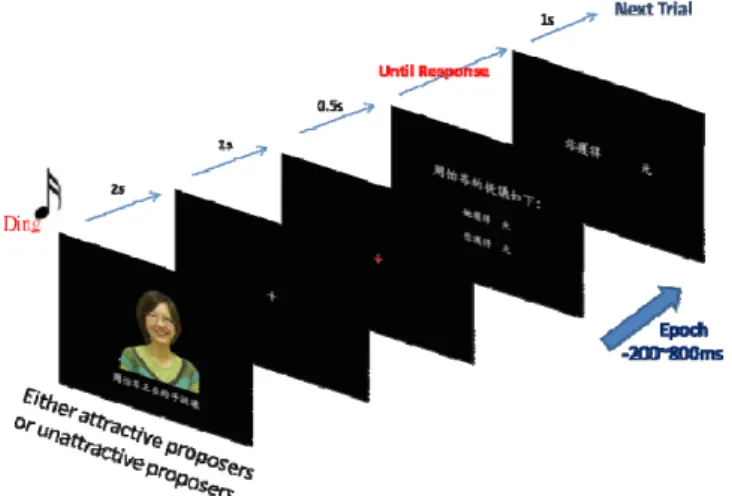
Figure 1. At the beginning, the picture of the proposer appears with the accompany of the sound ”Ding”. The
picture of proposer lasts for 1500ms then fixation appears, lasting for 1000s. After a fixation, a red blink star appears on the fixation (Participants are instructed to blink their eyes when blink star appears. This procedure is to ensure that the target period of brainwave won’t be contaminated by the blink), lasting for 500ms. After the blink star disappears, a fixation appears again and lasts for 1000ms. After that, the proposition is shown and lasting until participant response. After response, the result of participant’s response appears for 2000ms.
ERP recording and data analysis
Continuous EEG was recorded during the experiment with a sintered Ag/AgCl 64-electrode Quick-Cap and amplified using Neuroscan Synamps 2 with an A/D conversion rate of 500 Hz. A 0.1-30 Hz band-pass filter was also using during the recording and impedance was kept below 10 kΩ. Moreover, the EEG was initially referenced to reference point in between CZ and CPZ but converted to an average reference off-line. In the Off-line analysis, the EEG was first filtered with high-pass filter 0.01HZ and then low-pass filter 30HZ. After filtering, the EEG was cut into epochs time-locked to offer presentation (-200 pre-stimulus and 1000ms post-stimulus). Following baseline correction to the 200 ms interval preceding the stimulus, epochs containing excessive noise (60μ V) were rejected and the remaining epochs were averaged to create the
event-related potentials (ERPs). Subjects with fewer than 80% artifact free trials in total were eliminated from ERP analyses in the study. In the average ERP data, FRN amplitude was defined as the difference between the most positive peak within 160–240 ms time window and the most negative potential within 240–320 ms time window.
In both behavior and ERP data analysis, because of the effects of offer were not significant between offer 20, 30 and 40. We combined those three offers into one level in order to increase the statistic power and tested the effects between offer 10, 20-40 and 50.
Results
Behavior results
Acceptance rate and reaction time
The ANOVA of 2(culture)×2(gender)×3(offer) were performed on both acceptance rate and reaction time. The significant main effect of offer was found both in acceptance rate F(2,28) = 51.507, P <.000 and reaction time F(2,28) = 8.945, P <.001. It showed generally participants accepted offer 50 more than offer
20-40 and offer 10, also to accepted offer 30 more than offer 10, but it took them longer to decide whether to accept or reject offer 20-40. Furthermore, one marginal effect was found in acceptance rate of the interaction of culture and gender (F(1,14) = 3.830, P =.071) and one marginal effect was found in reaction
time of the interaction of gender and offer (F(2,28) = 3.046, P =.064).
Reaction Time Acceptance Rate
culture gender offer Means SD Means SD
Foreign Male 10 827.817 57.467 0.133 0.07 30 851.546 65.318 0.598 0.062 50 731.927 42.345 0.939 0.034 Female 10 829.95 58.421 0.173 0.078 30 839.528 58.169 0.604 0.064 50 714.405 31.019 0.95 0.028 Local Male 10 794.228 71.042 0.133 0.074 30 873.438 78.414 0.598 0.063 50 772.411 59.366 0.927 0.04 Female 10 867.611 71.4 0.139 0.069 30 863.228 58.693 0.579 0.064 50 688.046 51.138 0.928 0.036 Electrophysiological results
Feedback Related Negativity
In the ERP results, the ANOVE of 2(culture)×2(gender)×3(offer) were performed on the amplitude of FRN. Because that the maximum FRN amplitudes are observed at frontal sites(Gehring & Willoughby, 2002; Hajcak, Moser, Holroyd, & Simons, 2006), data from electrode sites Fz, FCz and Cz were
combined to test. Only the three way interaction of culture, gender and offer was found significant (F(2,28)=4.907, p<0.05). The interaction showed under offer 10,
the interaction of culture and gender was significant and the FRN was larger when the proposers is local Female than Foreigner Female, however no difference was found in Male. (see Fig 2).
DISCUSSION
In sum, the culture and gender did have some effects on the Ultimatum game, especially on the FRN. The reaction time and acceptance rate had showed the participants did accepted more offer 50 than other offers, but it took longer for them to decide whether to accept offer 20-40. Although, the interaction effect was not significant, it still showed the trend that in general, when the proposers are female, the difference of acceptance rate between culture were larger than the male proposers. It showed when the participants faced the foreign female they were willing to accept more offers than local female. But no difference was found in male proposers. The FRN showed the similar pattern but only under offer 10. It showed the FRN was larger when the proposers are local Female than Foreigner Female, however no difference was found in Male. Obviously, the female proposers were more influential than male proposers and the culture effect was only happened in female but not for male.
It is interesting to find out the female proposers were more influential than male proposers. During the experiment, we also got the feedback from the
participants. They said that not only the culture influences their decision, but also the attractiveness might have some influences too. In order to investigate the effect of the attractiveness, the next experiment will aim to find out the effect of attractiveness on the ultimatum game.
3.2 Experiment II: Attractiveness in the Ultimatum Game
METHODS
Participants
Thirty undergraduates from National Cheng-chi University participated, fifteen males and fifteen females. But four participants (two males; two females) were excluded from ERP analysis due to the insufficient trials after artifact rejection procedure. Additionally, one participant’s reaction time data was eliminated because extreme long reaction time. All participants were
right-handed and had normal or corrected to normal vision. They were recruited by advertisements, signed an informed consent form and were debriefed at the end of the experiment. Beyond that, in order to ensure that participants were sufficiently motivated to make real decisions, they were told they will also receive some bonus at the end of experiment based on one of their decision which is randomly chose in the Ultimatum Game task.
Material
The ultimatum task
In the ultimatum game, two players are going to make a deal with how to split 100NT in each round. One player will be the proposer who will propose how to split the money, the other will be the responder with accept or reject the offer to finish the deal. In the present study, all the participants played the role of responders, they were asked to accept or reject the money the proposer offered by press either 7 or 9 in the keyboard. The proposer will only give three different kinds of proposes (responders can either get 10 or get 30 or get 50). The task was presented as figure 1.
Proposer’s pictures
In the present study, the proposers were all girls. The proposers were categorized into two groups, attractive girls vs. unattractive girls by the rating
results which were rated by sixteen people. Twenty six out of forty five pictures were selected thirteen pictures were rated more attractive (Mattractive = 93.69) than
another thirteen pictures (Munattractive = 80.92) significantly (F(1,25) = 47.840,
P<.000).
Subjective Rating Question
After the ultimatum task, the subject was asked to do some subjective rating. The questions were followed by the proposer’s pictures which were showed in the ultimatum game before. Subjects were asked to rate: 1.Do you
think the person in the picture is attractive (1:very unattractive;9:very attractive); 2. When to allocate 100NT, how much do you think the person in the picture will expect to get? (1:90NT, 2:80NT, 3:70NT, 4:60NT, 5:50NT); 3.When to allocate 100NT, how much are you willing to give to the person in the picture?(1:10NT,
2:20NT,3.30NT,4:40NT,5:50NT).
Procedure
The participants were first told to read the confirm consent and sign for it if they all agree with the experiment detail. For the reason to make participants to believe that they are going to play the game with real persons. The researcher told them the proposers in the experiment were all the formal participants and the experiment will keep running, so the researcher will take picture of her/him for the future experiment. After then, they were led to the experiment room and seated in a comfortable chair. The researcher explained about how the brain activity will be recorded and the general purpose of this study then attached the electrodes. Next, participants began to play the ultimatum game, the game was began with one practice block in six practice trials and then two experimental blocks in 78 trials of each. They were allowed to make the decision based on their own pace but were told to try not blink their eyes while the stimuli of offer shows. After the ultimatum game session, the participants were then asked to rating the attractiveness of each proposer.
ERP recording and data analysis
Continuous EEG was recorded during the experiment with a sintered Ag/AgCl 64-electrode Quick-Cap and amplified using Neuroscan Synamps 2 with an A/D conversion rate of 500 Hz. A 0.1-30 Hz band-pass filter was also using during the recording and impedance was kept below 10 kΩ. Moreover, the EEG was initially referenced to reference point in between CZ and CPZ but converted to an average reference off-line. In the Off-line analysis, the EEG was first filtered with high-pass filter 0.01HZ and then low-pass filter 30HZ. After filtering, the EEG was cut into epochs time-locked to offer presentation (-200 pre-stimulus and 1000ms post-stimulus). Following baseline correction to the
200 ms interval preceding the stimulus, epochs containing excessive noise (60μ V) were rejected and the remaining epochs were averaged to create the
event-related potentials (ERPs). Subjects with fewer than 16 artifact free trials in any conditions were eliminated from ERP analyses in the study. In the average ERP data, FRN amplitude was defined as the difference between the most positive peak within 160–240 ms time window and the most negative potential within 240–320 ms time window.
RESULTS
Subjective rating
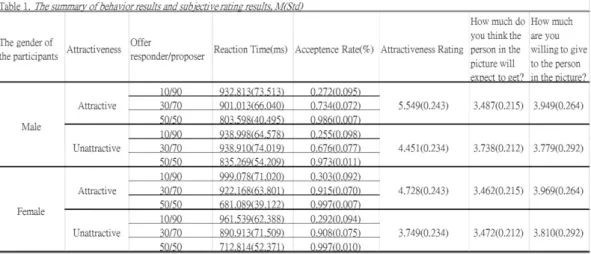
In the subjective rating, the ANOVA of 2(gender)×2(attractiveness) were performed. The results of attractiveness rating showed two significant effects. First, The main effect of attractiveness was found (F(1,28) = 88.091, P <.000).It
revealed the attractive proposers (Mattractive = 5.138) actually were more attractive
than the unattractive proposers (Munattractive = 4.100). Moreover, the other main
effect was found in gender. It indicated generally male (Mmale = 5.000) rated
higher score than female (Mfemale = 4.238). With question of “When to allocate 100NT, how much do you think the person in the picture will expect to get?”, one
marginal main effect of attractiveness was found (F(1,28) = 3.350, P =.078). It
showed that participants thought the attractive person expect to get more
( Mattractive = 3.613; Munattractive = 3.467; the higher rating, the higher they thought the person in the picture expect to get.). Furthermore, the results of the question “when to allocate 100NT, how much are you willing to give to the person in the
picture?” revealed one significant main effect of attractiveness (F(1,28) = 5.661, P <.05). It indicated participants were willing to give the attractive people more money than unattractive people (Mattractive = 3.959; Munattractive = 3.795; the higher rating, the higher they are willing to give more money to the person in the picture.).
Behavior results
Acceptance rate and reaction time
The ANOVA of 2(gender)×2(attractiveness)×3(offer) were performed on both acceptance rate and reaction time. Moreover, trials which contained reaction time longer or shorter than 2.58 SD will be replaced by mean. One subject’s behavior data was excluded because of the excessive long reaction time. The significant main effect of offer was found both in acceptance rate F(2,54) = 72.823, P <.000 and reaction time F(2,54) = 18.088, P <.000. It showed generally
participants accepted offer 50 more than offer 30 and offer 10, also to accepted offer 30 more than offer 10, but it took them longer to decide whether to accept
or reject offer 30 or offer 10 (Fig. 2 and 3). Furthermore, one marginal effect was found in acceptance rate of attractiveness (F(1,27) = 3.488, P =.073). It showed the
acceptance rate in overall was slightly higher in attractive condition than unattractive condition (Mattractive = 0.701; Munattractive = 0.684). No more significant effect was found. Table 1 showed the summary of subject rating results and behavior results in each conditions.
Electrophysiological results
Feedback Related Negativity
In the ERP results, the ANOVE of 2(gender)×2(attractiveness)×
3(offer)x3(position) were performed on the amplitude of FRN. Because that the maximum FRN amplitudes are observed at frontal sites(Gehring & Willoughby,
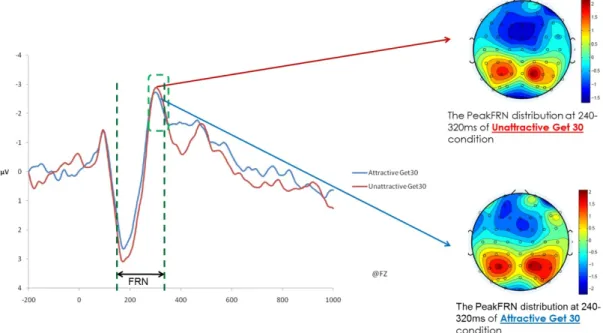
2002; Hajcak, et al., 2006), data from electrode sites Fz, FCz and Cz were tested. The main effect of attractive and offer were not significant, but the three way interaction of attractiveness, offer and position was found significant
(F(4,96)=3.491, p=0.01). The interaction revealed at Fz and under offer 30, the
FRN was larger when participants faced the unattractive proposers than attractive proposers (Fig. 4). Moreover, the two way interaction of gender and
attractiveness was also found significant (F(1,24)=4.590, p<0.05). It showed when
female participants faced the unattractive proposers the FRN was larger than attractive proposers. But no difference was found in male participants (Fig. 5)
DISSCUSION
Figure 4. The FRN amplitude difference of Attractiveness at FZ, offer get 30 and scalpel distribution
From the results, the participants actually rated the attractive proposers are more attractive and thought they will expect to get more money. Even more, participants also willing to give attractive people more money. But the effect only happened in subject rating. Attractiveness didn’t cause any significant differences in acceptance rate or reaction time. However, the FRN revealed some difference on the interaction of attractiveness and offer, also the interaction of gender and attractiveness.
The results of subject rating and behavior results showed although participants said they are willing to give the attractive people more money,
actually in the acceptance rate, there was only a small difference of attractiveness. One possible explanation is because while playing the ultimatum game, the participant was playing as responder which was a passive side. But the rating question was how much you are willing to give to people, it is an active side. Passive accept others’ offer and active give money might have different mechanisms and attractiveness could have different influence on different perspective. Another possible explanation might be that in the present study, the proposers were only provided three different offers (responder gets 10 or gets 30 or gets 50). In subject rating results, it indicated that participants were willing to give above NT30 but under NT40 to both attractive and unattractive people. The main difference money amount might be NT40, but no such offer in the present study. In other words, if participants were given the offer of NT40, it might show some difference in attractiveness. The second reason actually was more
reasonable in the present study, since actually there was a pattern in the
acceptance rate of attractiveness. It showed people actually accepted more offer from attractive proposers than unattractive proposers.
Even though no significant difference of attractiveness was found in acceptance rate, the FRN actually showed some difference of attractiveness. It was found in the frontal site (FZ), under the offer of NT30, the attractiveness reached the significant difference. It showed the FRN amplitude was larger when participants faced the unattractive proposers proposed the offer of NT30 than attractive proposers proposed the offer of NT30. This result actually supported the hypothesis of Solnick & Schweitzer (1999). Participants actually showed higher unexpected feeling to unattractive proposers when they propose a lower offer. Compare to unattractive proposers, when attractive proposers propose a lower offer was less surprised. But the effect only was found in offer of NT30. Combine the results with subject rating, it showed participants actually thought both attractive and unattractive people expected to get around NT70 and they thought attractive people expected to get more than unattractive people. It might
explain the FRN difference only happened when they proposed 70/30 offer. Once the offers were lower than NT30 or higher than NT30, the influence of
attractiveness might decrease. Moreover, another significant effect showed females were more sensitive to the attractiveness. This is corresponded to the results of Kahn, et al (1971), it indicated when playing the prisoner's dilemma games, females were more likely to change their choice based on the
attractiveness of their partner. It showed females actually have higher sensitivity to attractiveness than males and it reflected on the FRN too.
In sum, the present study furthers the understanding of the processes behind how attractiveness works in the social negotiation process. On the other hand, more questions are raised. First, in the present study, participants only played as responders, but not as proposers. As mentioned before, these two different perspectives might have different underlying mechanism which should be investigated in the future. Second, the offer options were limited in the present study, it might result in loss some significant difference between more subtle offers. The future study might find this as an important factor. Third, since the ultimatum game is a game with the feature of fairness, but the complicate relationship fairness and attractiveness can’t be examine in the study, which should work on it and toward to a more systematic understanding of
attractiveness in the social context.
3.3 Experiment III: Personality and the ultimatum game
METHOD
Participants
One hundred and eighty undergraduates from National Cheng-chi University participated in experiment IV. They were recruited by after class break, signed an informed consent form and finished the questionnaire. One of the participants was excluded from the analysis because of the unfinished questionnaire.
Material
A six pages questionnaire was used to investigate the relationship between personality, social orientation and ultimatum game. The questionnaire can be divided into four sections. The first and second sections were the questions from the MBTI tests (Furnham, A. ,1996). For the research goal, we only extracted questions which were related to personality of sensing/intuition (S/N) and thinking/feeling (T/F). The first section of the questionnaire includes fifteen
questions asking participants to choose which one of the following answers describes the best of their feeling. The second section of the questionnaire includes 35 pairs of
words, and the participants were asked to select one of the words of each pair which they prefer the most. In the third section, the social value orientations were examined. The social value orientations were measured by the questionnaire developed by Murphy, R., Ackermann, K., and Handgraaf, M. (2011). It includes fifteen questions which the participants were asked if they need to allocate 100 NT, how they will allocate the money between themselves and the others. The fourth section of the questionnaire, the participants were
asked to read a story of ultimatum game and rated they feeling. (Please refer the questionnaire to the appendix 1)
Data analysis
All the scores were computed by the methods that were provided by Furnham, A. ,1996 and Murphy, R., Ackermann, K., and Handgraaf, M. (2011).
RESULTS
Behavior results
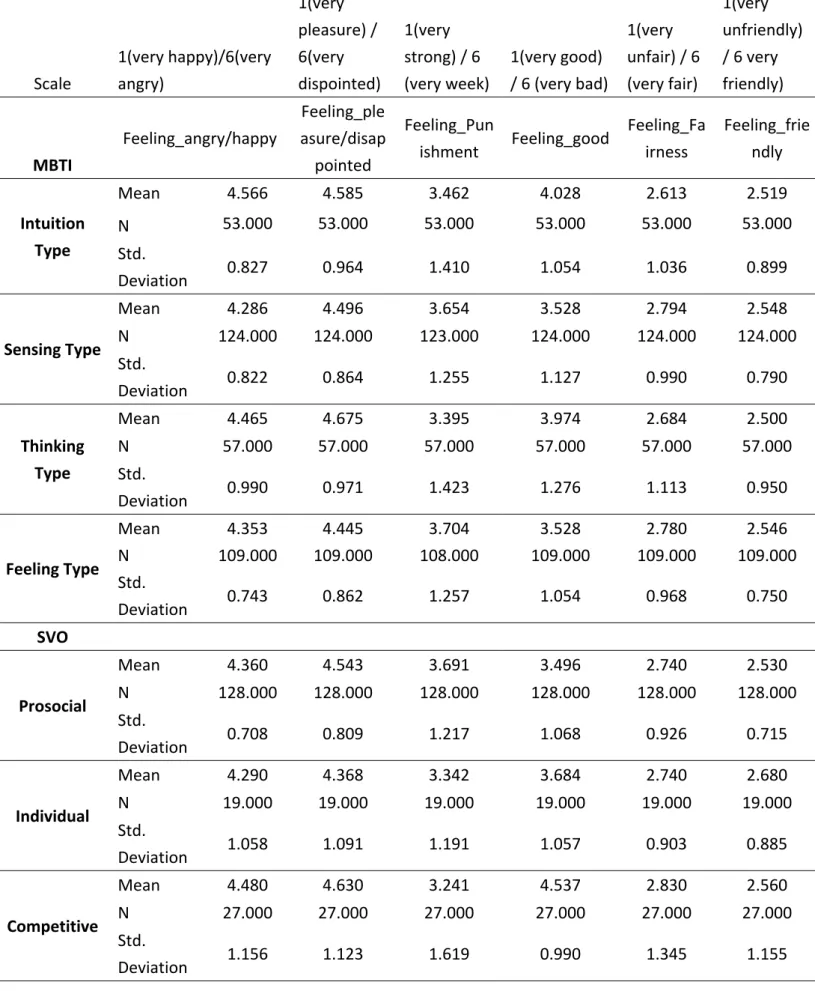
The MBTI scores were computed and participants were categorized into different categories. Since sensing/intuition (S/N) are on the same axis and thinking/feeling (T/F) are on the same axis. Participants who scores higher on sensing or thinking will be categorized into sensing group or thinking group rather than intuition group or feeling group and vice versa. The mean scores of the response of the ultimatum game story were compared between groups. Three main effects were found. It showed participants who are sensing type rated higher score on feeling angrier than participants who are intuition type (F(1,176) =
4.287, P <.05). Also, it showed sensing participants rated higher score on not feeling good than participants who are intuition type (F(1,176) = 7.598, P <.01).
On the other hand thinking type of participants also rated higher score on not feeling good than participants who are feeling type (F(1,165) = 5.787, P <.05). On
the results of SVO, three categorizes were created base on the method provided by Murphy, R., Ackermann, K., and Handgraaf, M. (2011), prosocial, individual and competitive. Only one significant effect was found on feeling good (F(2,173) = 10.854, P <.000). It showed the competitive type rated higher on feeling bad than the
Table 1 The statistical table for MBTI and SVO Scale 1(very happy)/6(very angry) 1(very pleasure) / 6(very dispointed) 1(very strong) / 6 (very week) 1(very good) / 6 (very bad) 1(very unfair) / 6 (very fair) 1(very unfriendly) / 6 very friendly) MBTI Feeling_angry/happy Feeling_ple asure/disap pointed Feeling_Pun ishment Feeling_good Feeling_Fa irness Feeling_frie ndly Intuition Type Mean 4.566 4.585 3.462 4.028 2.613 2.519 N 53.000 53.000 53.000 53.000 53.000 53.000 Std. Deviation 0.827 0.964 1.410 1.054 1.036 0.899 Sensing Type Mean 4.286 4.496 3.654 3.528 2.794 2.548 N 124.000 124.000 123.000 124.000 124.000 124.000 Std. Deviation 0.822 0.864 1.255 1.127 0.990 0.790 Thinking Type Mean 4.465 4.675 3.395 3.974 2.684 2.500 N 57.000 57.000 57.000 57.000 57.000 57.000 Std. Deviation 0.990 0.971 1.423 1.276 1.113 0.950 Feeling Type Mean 4.353 4.445 3.704 3.528 2.780 2.546 N 109.000 109.000 108.000 109.000 109.000 109.000 Std. Deviation 0.743 0.862 1.257 1.054 0.968 0.750 SVO Prosocial Mean 4.360 4.543 3.691 3.496 2.740 2.530 N 128.000 128.000 128.000 128.000 128.000 128.000 Std. Deviation 0.708 0.809 1.217 1.068 0.926 0.715 Individual Mean 4.290 4.368 3.342 3.684 2.740 2.680 N 19.000 19.000 19.000 19.000 19.000 19.000 Std. Deviation 1.058 1.091 1.191 1.057 0.903 0.885 Competitive Mean 4.480 4.630 3.241 4.537 2.830 2.560 N 27.000 27.000 27.000 27.000 27.000 27.000 Std. Deviation 1.156 1.123 1.619 0.990 1.345 1.155
3.4 Experiment IV: Empathy and the ultimatum game
METHOD Participants
Twelve undergraduates from National Cheng-chi University participated in experiment IV. All participants were right-handed and had normal or corrected to normal vision. They were recruited by advertisements, signed an informed
consent form and were debriefed at the end of the experiment.
Material
The observation ultimatum task
In the observation ultimatum task the participants did not need to actual play the game but only observe the others play. During the game, the participants were told some of the responders were from poor family and the rest of the players were from normal family. The responders’ pictures that were from poor family were marked by red frame and the rest were marked by yellow frame (see Fig. 1). No information of proposers was provided. However, there are two kinds of proposers, fair vs. unfair. The fair proposers will only propose offer 30 and offer 50, in the other hand the unfair proposer will only propose offer 30 and offer 10.
The real play ultimatum task
The real ultimatum task was as same as Experiment I and II. However, during this task, the participants were playing the game with the people who were playing in the observation ultimatum task. Participants were told that they will be randomly choose to be a responder or a proposer, but the default setting of the experiment were the participants will be a responder.
Procedure
In this experiment, there were two steps in order to induce empathy (step 1, observation) and to see how the empathy interacts with fairness (step 2, real play). Participants were told that they are going to participate a two days experiment. In the first day, their task is to observe others play the ultimatum game, and the next day they will play the ultimatum game with those people who they observe.
During the first day, the participants were first told to read the confirm consent and sign for it if they all agree with the experiment detail. For the reason to make participants to believe that they are going to play the game with real persons, the researcher told them they were observing one of our formal experiments. Then they were told they will be our next experiment’s responder
or proposer so the researcher will take picture of her/him. After then, they were led to the experiment room and seated in a comfortable chair. The researcher explained about how the brain activity will be recorded and the general purpose of this study then attached the electrodes. Next, participants began to observe the ultimatum game, the game was began with one practice block in three practice trials and then three experimental blocks in 80 trials of each. After each trail, the participants were asked to rated the fairness of the offer (1: very unfair, 7 :very fair).
At the second day, the participants were directly led to the experiment room and seated in a comfortable chair and then attached the electrodes. Next,
participants began to play the ultimatum game, the game was began with one practice block in six practice trials and then three experimental blocks in 80 trials of each. They were allowed to make the decision based on their own pace but were told to try not blink their eyes while the stimuli of offer shows.
ERP recording and data analysis
Continuous EEG was recorded during the experiment with a sintered Ag/AgCl 64-electrode Quick-Cap and amplified using Neuroscan Synamps 2 with an A/D conversion rate of 500 Hz. A 0.1-30 Hz band-pass filter was also using during the recording and impedance was kept below 10 kΩ. Moreover, the EEG was initially referenced to reference point in between CZ and CPZ but converted to an average reference off-line. In the Off-line analysis, the EEG was first filtered with high-pass filter 0.01HZ and then low-pass filter 30HZ. After filtering, the EEG was cut into epochs time-locked to offer presentation (-200 pre-stimulus and 1000ms post-stimulus). Following baseline correction to the 200 ms interval preceding the stimulus, epochs containing excessive noise (60μ V) were rejected and the remaining epochs were averaged to create the
event-related potentials (ERPs). Subjects with fewer than 16 artifact free trials in any conditions were eliminated from ERP analyses in the study. In the average ERP data, FRN amplitude was defined as the difference between the most positive peak within 160–240 ms time window and the most negative potential within 240–320 ms time window.
RESULTS Subjective rating
A 2(proposer) X 2(responder) ANOVA was tested for the observation ultimatum game. Only offer 30 is comparable between fair and unfair proposers, so the trails of offer 10 and offer 50 were excluded. The results showed that only one significant
main effect for responder was found (F(1,11)=10.577, p<.01). It showed that participants felt that when the responders were from poor family it is less fair to propose 30 to them (Mempathy = 3.485, Mnormal = 3.994). No other significant effect was found.
Behavior results
Acceptance rate and reaction time
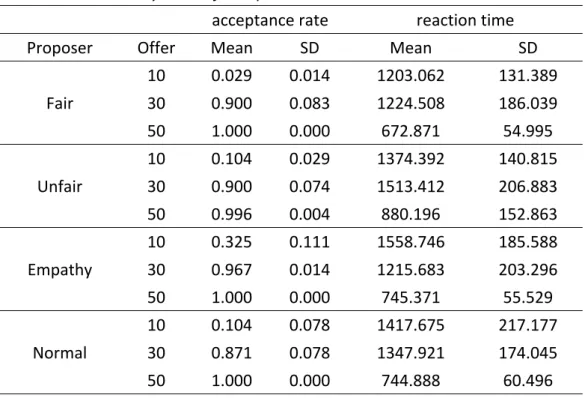
The acceptance rate and reaction time for the real play ultimatum game was tested by a 4(proposers’ type) X 3(offers) ANOVA. In the results of reaction time, only the main effect of offers was significant (F(2,22)=19.616, p<0.001). It showed that it took longer for participants to decide to accept offer 10 than offer 50 and offer 30 than offer 50(Moffer10 = 1388.649, Moffer30 = 1325.381, Moffer50 = 760.831). In the results of acceptance rate, the main effects of offers and proposers’ type were significant (F(2,22)=124.780, p<0.001; F(2,22)=7.543, p=0.001). Moreover, the interaction effect of proposers’ type and offers was also found significant too (F(2,22)=2.816, p<0.05). It showed that under the offer 10 and 30, the participants will accept more from the proposers who were from poor family than the other types’ proposers (see table 1). No other effects was found.
Table 1 the summary table of acceptance rate and reaction time
acceptance rate reaction time
Proposer Offer Mean SD Mean SD
Fair 10 0.029 0.014 1203.062 131.389 30 0.900 0.083 1224.508 186.039 50 1.000 0.000 672.871 54.995 Unfair 10 0.104 0.029 1374.392 140.815 30 0.900 0.074 1513.412 206.883 50 0.996 0.004 880.196 152.863 Empathy 10 0.325 0.111 1558.746 185.588 30 0.967 0.014 1215.683 203.296 50 1.000 0.000 745.371 55.529 Normal 10 0.104 0.078 1417.675 217.177 30 0.871 0.078 1347.921 174.045 50 1.000 0.000 744.888 60.496
Electrophysiological results
Feedback Related Negativity
In the ERP results of observation ultimatum game, the ANOVA of
2(proposer)×2(responder)x3(position) were performed on the amplitude of FRN. Because that the maximum FRN amplitudes are observed at frontal sites(Gehring & Willoughby, 2002; Hajcak, et al., 2006), data from electrode sites Fz, FCz and Cz were tested. However, no effects were found. In the ERP results of real play ultimatum game, the ANOVA of 4(proposer)×3(offer)x3(position) were
performed on the amplitude of FRN. Only the main effect of offer was found significant (F(2,22)=4.521, p<0.05). It showed the FRN was higher for offer 30
than offer 10 and offer 50 than offer 10 (Moffer10 = 4.203; Moffer30 = 5.398;
Moffer50 = 5.230). No other effects were found.
DISCUSSION
Unfortunately, we did not find any empathy effect showed on the FRN in the ultimatum game. It might due to the too complicated design of the
experiment. However, the main effect of the offer was still found in reaction time, acceptance rate and FRN. Moreover, it showed that empathy did show some effect when the participants were watching others play, and also it influences on how they played the game, but no effects on the FRN was found.
3.5 Experiment V: Social anxiety and the ultimatum game
METHOD
Participants
Twenty-five undergraduates from National Cheng-chi University participated in experiment V. All participants were right-handed and had normal or corrected to normal vision. They were recruited by advertisements, signed an informed consent form and were debriefed at the end of the experiment. Eight participants’ data were excluded for both behavior and ERP data analysis.
Material
The ultimatum task
In the ultimatum game, two players are going to make a deal with how to split 100NT in each round. One player will be the proposer who will propose how to split the money, the other will be the responder with accept or reject the offer to finish the deal. In the present study, all the participants played the role of responders. They were asked to accept or reject the money the proposer offered by press either 7 or 9 in the keyboard. The proposer will only give three different kinds of proposes (responders can either get 10 or get 30 or get 50).
Two anxieties were manipulated, social vs. non-social. The social anxiety was manipulated by telling the participants while they play the game, the researcher will watch their action through the video camera in the other room. The non-social anxiety was manipulated by playing the white noise while the participants playing the game.
Subjective Rating Question
After the ultimatum task, the subjects were asked to do some subjective ratings of their anxiety states. The questions were from state-trait anxiety inventory (SATI)(Spielberger, C. D.,2005).
Procedure
The participants were first told to read the confirm consent and sign for it if they all agree with the experiment detail. For the reason to make participants to believe that they are going to play the game with real persons. The researcher told them the proposers in the experiment were all the formal participants and the experiment will keep running, so the researcher will take picture of her/him for the future experiment. After then, they were led to the experiment room and seated in a comfortable chair. The researcher explained about how the brain activity will be recorded and the general purpose of this study then attached the electrodes. Next, participants began to play the ultimatum game, the game was began with one practice block in six practice trials and then three experimental blocks in 60 trials of each. They were allowed to make the decision based on their own pace but were told to try not blink their eyes while the stimuli of offer shows.
In the current experiment, the participants were told they would play the ultimatum game under three different conditions, control, white noise and social anxiety. After the ultimatum game session, the participants were then asked to rating their anxiety state by the questions in SATI. In the end of the experiment they participants were again asked to filled some questions about if they feel any difference under three different conditions. Also their were asked if the
manipulations (ex. White noise and someone is watching them play) have some effects on them.
ERP recording and data analysis
Continuous EEG was recorded during the experiment with a sintered Ag/AgCl 64-electrode Quick-Cap and amplified using Neuroscan Synamps 2 with an A/D conversion rate of 500 Hz. A 0.1-30 Hz band-pass filter was also using during the recording and impedance was kept below 10 kΩ. Moreover, the
EEG was initially referenced to reference point in between CZ and CPZ but converted to an average reference off-line. In the Off-line analysis, the EEG was first filtered with high-pass filter 0.01HZ and then low-pass filter 30HZ. After filtering, the EEG was cut into epochs time-locked to offer presentation (-200 pre-stimulus and 1000ms post-stimulus). Following baseline correction to the 200 ms interval preceding the stimulus, epochs containing excessive noise (60μ V) were rejected and the remaining epochs were averaged to create the
event-related potentials (ERPs). Subjects with fewer than 16 artifact free trials in any conditions were eliminated from ERP analyses in the study. In the average ERP data, FRN amplitude was defined as the difference between the most positive peak within 160–240 ms time window and the most negative potential within 240–320 ms time window.
RESULTS
Subjective rating
The SATI scores were test a 3(Anxiety states) ANOVA. However, none of the effect was found significant. It showed participants did not reveal any difference on SATI scores.
Behavior results
Acceptance rate and reaction time
Form the response of the questionnaire at the end of experiment, we found that some of the participants had said that they did not really influence by the
manipulations. In order to decrease the influence of individual difference on the manipulation effect, the acceptance rate and reaction time were both tested by adding the responses of the questionnaire as co-variables. A 3(Anxiety states) x 3(offer) ANOVA was tested. No effect was found significant in reaction time. But the main effect of offer was found significant (F(2,24)=11.089, p<0.00). It showed that the participants accepted offer 50 higher than offer 30 and offer 10.
Electrophysiological results
Feedback Related Negativity
In the ERP results of observation ultimatum game, the ANOVA of 3(Anxiety states)×3(offer)x5(position) were performed on the amplitude of FRN. Because
that the maximum FRN amplitudes are observed at frontal sites(Gehring & Willoughby, 2002; Hajcak, et al., 2006), data from electrode sites Fz, F1, F2, F3 and F4 were tested. The interaction effect of anxiety state and offer was found significant (F(4,48)=3.305, p<0.05). It showed that under offer 30, the FRN was smaller in white noise condition than social anxiety and control conditions (see Fig 1).