國
立
交
通
大
學
網路工程研究所
碩
士
論
文
雲 端 大 型 多 人 線 上 遊 戲 下 考 量 暫 離 玩 家 之
資源配置方法
Resource provisioning for MMOG clouds considering
AFK players
研 究 生:陳治豪
指導教授:王國禎 教授
雲端大型多人線上遊戲下考量暫離玩家之資源配置方法
Resource provisioning for MMOG clouds considering AFK players
研 究 生:陳治豪 Student:Chihhao Chen
指導教授:王國禎 Advisor:Kuochen Wang
國 立 交 通 大 學
網 路 工 程 研 究 所
碩 士 論 文
A ThesisSubmitted to Institute of Network Engineering College of Computer Science
National Chiao Tung University in Partial Fulfillment of the Requirements
for the Degree of Master
in
Computer Science June 2012
Hsinchu, Taiwan, Republic of China
i
雲端大型多人線上遊戲下考量暫離玩家之
資源配置方法
學生:陳治豪 指導教授:王國禎 博士
國立交通大學網路工程研究所
摘 要
近年來大型多人線上遊戲(MMOGs)吸引全世界成千上萬的玩家
上線,且成為個人娛樂中非常重要的一部份。為了能夠支援更多的線
上玩家,許多遊戲提供商(如OnLive)利用雲端計算的優點發展雲端遊
戲。雖然雲端遊戲提供商從雲端計算上獲得強大的計算能力,如何有
效的分配雲端資源(如虛擬機器)來滿足玩家的需求和有效的雲端資
源利用是一項重要的研究議題。在此篇論文中,我們對大型多人線上
遊戲提出一個考量暫離玩家(AFK players)的有效資源配置方法,利用
暫離玩家僅需較低服務品質(QoS)的特性,降低配置給予他們的資源
(如幀率),從而支援更多的線上玩家。我們以魔獸世界做為個案研究,
調查實際線上玩家的人數和暫離玩家的人數。我們利用類神經網路來
預測玩家和暫離玩家的人數,並評估可額外支援的線上玩家的人數。
然後,我們預測需使用的虛擬機器數量。依據真實遊戲數據之評估結
果顯示,我們的資源配置方法能夠額外支援11.04%的線上玩家,且在
46.05%的觀察時間內能在每一個魔獸世界的王國的一個遊戲區減少
一台虛擬機器的使用,以支援更多玩家。因此,我們的方法能有效降
低雲端資源的浪費,並提高資源的使用率。
關鍵詞:暫離玩家、雲端計算、大型多人線上遊戲、資源分配。
iii
Resource provisioning for MMOG clouds
considering AFK players
Student: Chihhao Chen Advisor: Dr. Kuochen Wang
Department of Computer Science National Chiao Tung University
Abstract
Massively Multiplayer Online Games (MMOGs) are attracting millions of players from all over the world and become an important part of personal entertainments. To support more online players, many game providers (such as OnLive) take advantage of cloud computing to develop cloud gaming services. Although cloud gaming providers obtain powerful computing power from clouds, how to allocate cloud resources (e.g., virtual machines, VM) so as to meet player requirements and to efficiently utilize cloud resources is a key issue. In this paper, we propose an efficient resource provisioning scheme for MMOGs considering AFK (away from keyboard) players, RP-AFK, in game clouds. We leverage the characteristic of AFK players, which only need low QoS for gaming, to decrease the provision of resources (e.g., frame rates) to them and to support active online players. We used World of Warcraft (WoW), which is currently the world's most-subscribed MMORPG (Massively Multiplayer Online Role Player Game), as a case study to measure the total numbers of players and AFK players. We predicted the total numbers of players and AFK players by using neural networks, which can provide high prediction accuracy, and evaluated the number of extra online players supported. Then we predicted the number of VMs required. Evaluation results based on real
game data show that the proposed RP-AFK can support 11.04% extra online players. One less VM can be used in a game zone of a WoW realm for 46.05% of the observed time. Therefore, the proposed scheme can reduce the waste of cloud resources and increase the resource utilization to support more players.
v
Acknowledgements
Many people have helped me with this thesis. I deeply appreciate my thesis advisor, Dr. Kuochen Wang, for his intensive advice and guidance. I would also like to show my appreciation for all the classmates in the Mobile Computing and
Broadband Networking Laboratory for their invaluable assistance and suggestions.
The support by the National Science Council under Grants NSC99-2221-E-009-081-MY3 and NSC101-2219-E-009-001 is also gratefully acknowledged. Finally, I thank my father, my mother and my friends for their endless love and support.
Contents
Abstract (Chinese) ... i
Abstract ... iii
Contents ... vi
List of Figures ... viii
List of Tables ... ix Chapter 1 Introduction... 1 Chapter 2 Background ... 3 2.1 WoW ... 3 2.2 Frame rate ... 3 2.3 AFK ... 4 2.4 OnLive ... 5
2.5 Game Data collection ... 5
2.6 Resource provisioning ... 6
2.7 Comparison of different approaches qualitatively ... 6
Chapter 3 Proposed Resource Provisioning Considering AFK Players ... 8
3.1 Resource provisioning considering AFK players... 8
3.2 Game data collection ... 9
3.3 Neural network-based predictor ... 11
Chapter 4 Evaluation Results ... 14
4.1 Experimental setup ... 14
4.2 Comparison of three prediction methods ... 15
vii
4.4 The average usage of VMs in one zone of a WoW realm ... 17
4.5 Under-allocation and over-allocation ... 17
Chapter 5 Conclusions ... 19
5.1 Concluding remarks ... 19
5.2 Future work ... 19
List of Figures
Figure 1: (a) An active player and (b) an AFK player in the WoW [6]. ... 4
Figure 2: A player is AFK for (a) 30 minutes and (b) 60 minutes in the WoW [6]. ... 5
Figure 3: The flowchart of the proposed RP-AFK. ... 9
Figure 4: The total numbers of players and AFK players in six cities of a WoW realm in Taiwan. ... 10
Figure 5: The total numbers of players and AFK players in a city, Orgrimmar, of a WoW realm in Taiwan. ... 11
Figure 6: A neural networks-based predictor for numbers of total players and AFK players. ... 13
Figure 7: Prediction errors (PEs) of the three prediction methods. ... 15
Figure 8: The number of extra players supported considering AFK players. ... 16
Figure 9: The average usage of VMs in one zone of a WoW realm. ... 17
ix
List of Tables
Table I: Comparison of different approaches qualitatively. ... 7 Table II: Experimental parameters... 14
Chapter 1
Introduction
Over the past decade, Massively Multiplayer Online Games (MMOGs) have become popular and attract millions of players worldwide. Nowadays, more than half of Internet users also are MMOGs players [1]. To support more players, game providers rack their brains trying to think of new architectures for MMOGs. Today, many game providers take advantage of cloud computing to develop cloud gaming services. Onlive [2], Ubitus [3] and Gaikai [4] launched cloud gaming services during 2010 to 2011.
Cloud gaming is a type of online gaming that directly transmits on-demand streaming of game screens to players’ devices [5]. In other words, players can play games without storing all game contents on their own devices. Game screens are streamed directly to players’ devices after being processed by cloud gaming providers’ servers. Although cloud gaming providers have powerful capability of computing, they may waste cloud resources without utilizing resources efficiently. Therefore, how to efficiently utilize cloud resources is an important issue.
An MMOG is a multiplayer video game which many players participate at the same time over the Internet. There are many different types of MMOGs in the market, including MMORPG (Massively Multiplayer Online Role Player Game, e.g., World of Warcraft (WoW) [6]), MMOFPS (Massively Multiplayer Online First Person Shooter, e.g., Counter Strike [7]), MMORTS (Massively Multiplayer Online Real Time Strategy, e.g., StarCraft II [8]) and so on. However, MMORPGs are the most popular games. Hundreds or thousands of players interact with other players
2
worldwide via avatars, which are virtual roles, in a persistent virtual world. According to the number of players, MMORPGs share up to 95% in the MMOG market [1].
Although there are a large number of online players in MMOGs concurrently, we observed that some players didn’t play games all the time and they are sometimes away from their computers (or away from keyboard, AFK) temporarily. Some of the online players even leave their computers doing something else for a long time, such as eating dinner, watching TV, taking a bath, going to sleep and so on. In this paper, we propose an efficient resource provisioning scheme considering AFK players. The proposed resource provisioning scheme can reduce the waste of cloud resources and increase the resource utilization by supporting more players.
The remainder of this paper is organized as follows. We introduce the background and related work in Chapter 2. Chapter 3 presents the proposed resource provisioning scheme considering AFK players and depict our game data collection method. Chapter 4 shows evaluation results. Finally, concluding remarks and future work are given in Chapter 5.
Chapter 2
Background
2.1 WoW
World of Warcraft (WoW) [6] is currently the world's most-subscribed MMORPG with 10.2 million subscribers as of February 2012 [9]. WoW is a multi-server architecture to support a lot of realms, which are instances of the game world [10], to support millions of players. There are 763 realms worldwide and 39 realms in Taiwan [11]. Players can only interact with other players in the same realm.
Who List is a component of the default WoW User Interface for searching online
players [12]. We can search online players by name, guild, zone, class (e.g., hunter, priest, rogue, warlock, warrior), race (e.g., human, dwarf, gnome) or level (1 - 85). Note that Who List only returns 50 players in one request. Besides, WoW also provides many APIs which is a set of functions for players. The list of API is updated and announced at [13].
2.2 Frame rate
Frame rate in MMOGs is the frequency of consecutive images, frames, refreshed on a monitor and expressed in frames per second (FPS) [14]. In multi-server MMOG architecture, frames are produced by players’ computers. In cloud gaming, frames are produced and delivered to players’ devices by servers. Frame rate involves players’ experiences because low FPS causes avatar movement discontinuously and decreases players’ experiences of games. The acceptable frame rate is between 30 to 60 FPS in modern MMOGs [14].
4
2.3 AFK
AFK is commonly used in the internet, not just in MMOGs, to denote that an online user is temporarily away from the computer, or is not actually paying attention to the computer [15]. For example, in the WOW, players are marked AFK automatically after 5 minutes without any interaction [16] and players’ avatars could sit on the ground, as shown in Figure 1. In Figure 2, if WoW players are AFK for 30 minutes, they will be logged off and the game screen is switched to the character selection screen. And WoW disconnects players from servers if players are AFK for 60 minutes [16].
Because AFK players are not at their computers or are not playing games at that time, they only need low QoS for gaming. For example, AFK players don’t care about game experience, such as frame rates and avatars’ movements. If cloud gaming providers decrease the provision of resources to AFK players, they can save cloud resources and support more active players.
2.4 OnLive
OnLive [1] is one of the famous cloud gaming providers that provides the world’s highest performance cloud gaming service [17]. OnLive stores the games on remote servers and delivers on-demand streaming of game screens (frames) via the Internet. OnLive has partnered with over 50 well-known games companies in the business and has provided nearly 300 games on the service [18] [19].
2.5 Game Data collection
For gaming designers, it is one of the most significant things that they take account of players’ behavior when designing games. Lee et al. [1] provided a good starting point to exploring users’ game play time and presented a WoW history dataset that includes players’ game play time and a number of attributes, such as their races, current levels, and in-game locations, etc. They used the who command
6
provided by WoW to collect the dataset between Jan. 2006 and Jan. 2009 in Taiwan. They investigated players’ behavior, including the play time, session count, and session play time. Finally, they gave a sample use of the dataset to model and predict the subscription time of players and the usage time of avatars [1].
2.6 Resource provisioning
To have an efficient resource provisioning scheme for MMOGs, it needs a prediction algorithm with high accuracy to predict workloads. Nae et al. [20] proposed a dynamic resource provisioning method that can efficiently allocate resources in MMOG. They predicted MMOG workloads by using a neural network-based predictor which can provide high prediction accuracy. Their simulation results showed that the neural network-based predictor has lower prediction error than other prediction methods, such as last value and moving average.
2.7 Comparison of different approaches qualitatively
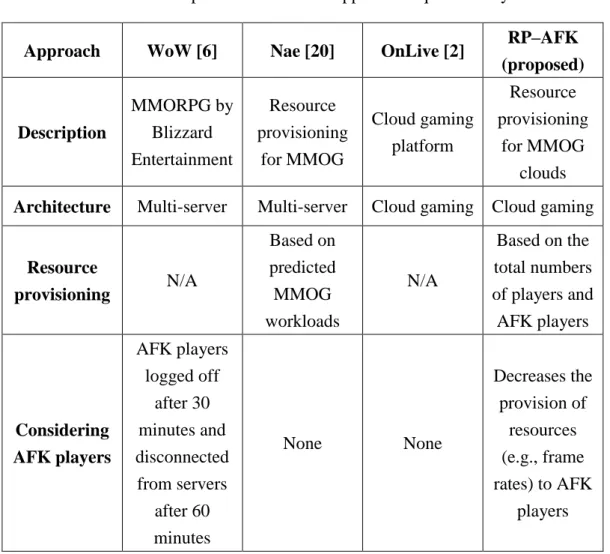
In Table I, we compare the proposed RP-AFK with other approaches. Although WoW logs off and disconnects players when players are AFK for 30 minutes and 60 minutes, respectively, it causes AFK players to re-login and still wastes resources for the first 30 minutes. Remind that related work did not take AFK players into consideration when allocating resources.
Table I: Comparison of different approaches qualitatively.
Approach WoW [6] Nae [20] OnLive [2] RP–AFK (proposed) Description MMORPG by Blizzard Entertainment Resource provisioning for MMOG Cloud gaming platform Resource provisioning for MMOG clouds
Architecture Multi-server Multi-server Cloud gaming Cloud gaming
Resource provisioning N/A Based on predicted MMOG workloads N/A Based on the total numbers of players and AFK players Considering AFK players AFK players logged off after 30 minutes and disconnected from servers after 60 minutes None None Decreases the provision of resources (e.g., frame rates) to AFK players
8
Chapter 3
Proposed Resource Provisioning
Considering AFK Players
3.1 Resource provisioning considering AFK players
We propose an efficient resource provisioning scheme for MMOGs considering AFK players (RP-AFK) in cloud gaming. We leverage the characteristic of AFK players, which only need low QoS for gaming, to decrease the provision of resources (e.g., frame rates) to them and to support more players. The flowchart of the proposed RP-AFK is showed in Figure 3 and the details of the RP-AFK are described in the following.
1) Read historical game data that include total numbers of players and AFK players of a WoW realm in Taiwan.
2) Predict the total numbers of players and AFK players using a neural networks predictor based on historical game data.
3) Predict the number of VMs required at each time step during time to time (time period).
4) Find the maximum number of VMs required ( at the next time period. Note that we need to create new VMs in advance to prevent the existing VMs from overloading.
5) Compare with the number of VMs used currently. If is equal to the number of VMs used currently, go to step 8. If is less than the
number of VMs used currently, go to step 6. Otherwise, go to step 7. 6) Close the VMs that aren’t required. Then go to step 8.
7) Create extra VMs required. Then go to step 8.
8) Collect current game data and store in historical game database.
3.2 Game data collection
We use WoW as a case study and describe how we collected game data that include the number of AFK players. The details of our game data collection method are described in the following.
1) Create an AddOn for WoW.
2) Use Who List to search online players by class and zone because Who List only Figure 3: The flowchart of the proposed RP-AFK.
10
returns 50 avatars in one request.
3) Add the online players searched to our friend list because API UnitIsAFK only works for friends.
4) Use API UnitIsAFK to verify whether the online players are AFK.
5) Output the total numbers of players and AFK players to the chat window. 6) Use API LoggingChat to log chat data to a file (historical game database).
In MMOGs, players are usually AFK in towns or cities because they will not be attacked by oppositional players or monsters. We collected the total numbers of players and AFK players in six cities of a WoW realm in Taiwan, as shown in Figure 4. We found that most of players are staying and AFK in a city, called Orgrimmar. Therefore, we just collected game data in this city.
Figure 5 shows the total numbers of players and AFK players in Orgrimmar. The number of AFK players is showed daily with variations and is about 25% of the total
Figure 4: The total numbers of players and AFK players in six cities of a WoW realm in Taiwan. 0 50 100 150 200 250 300 350 400 11:05 19:42 04:19 12:57 21:34 06:11 Num b er of p layer s Time (03/10 11:05~03/12 11:15)
Total players in city A AFK players in city A Total players in city B AFK players in city B Total players in city C AFK players in city C Total players in city D AFK players in city D Total players in city E AFK players in city E Total players in city F AFK players in city F
number of players. That is, if there is more number of total players, there will have more number of AFK players so as to save more cloud resources. We collected game data from 2012/03/10 to 2012/5/20 and predicted the total numbers of players and AFK players in the near future by using a neural network-based predictor.
3.3 Neural network-based predictor
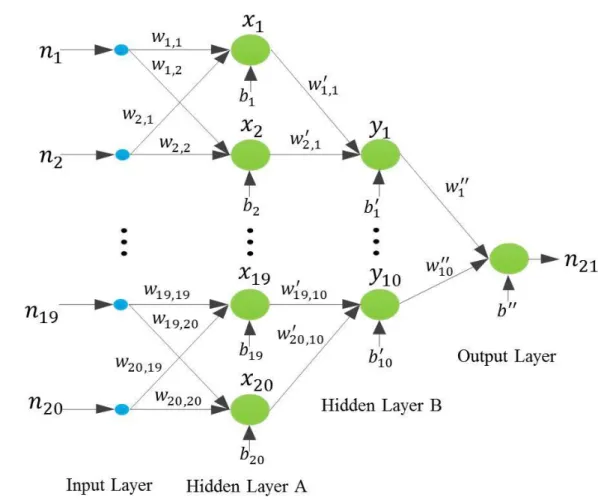
The neural network-based predictor provides a robust and highly accurate approach to approximating a real target function [20]. A neural network-based predictor with a time series input is showed in Figure 6 [21]. The network has 20 network inputs and one network output. We input the number of players from time step 1 to time step 20 and predict the number of players at time step 21. The neural network has two hidden layers. Hidden layer A and hidden layer B have 20 neurons Figure 5: The total numbers of players and AFK players in a city, Orgrimmar, of a
WoW realm in Taiwan.
0 50 100 150 200 250 300 350 400 11:05 04:19 21:34 14:49 08:03 01:18 Num b er of p layer s Time (03/10 11:05~03/14 07:12)
12
and 10 neurons, respectively. Each layer’s neuron performs calculations based on the following equations: (∑ ) (∑ ) (∑ )
Note that is the output, is an input, is a weight modifying , and is the bias of the hidden layer A. is the output, is an input, is a weight modifying , and is the bias of the hidden layer B. is the output, is an input, is a weight modifying , and is the bias of the output layer [21]. In addition, is a log sigmoid transfer function for two hidden layers neurons and is a linear transfer function for the output layer neuron. We used this neural network-based predictor to predict the total numbers players and AFK players.
Then, we predict the number of VMs required by the following equation:
(
)
where is the predicted number of VMs required at time step , is the predicted total number of players at time step , is the predicted number of AFK players at time step , is average resources used (CPU utilization) by an active player, is average resources used (CPU utilization) by an AFK player, and is number of players supported in a VM.
Figure 6: A neural networks-based predictor for numbers of total players and AFK players.
14
Chapter 4
Evaluation Results
4.1 Experimental setup
For evaluation, game data including the total numbers of players and AFK players were collected by using our game data collection method, as described in Chapter 4. We used MATLAB [22] as a prediction tool to predict the total numbers of players and AFK players in the near future. The evaluation period was from 2012/03/10 to 2012/5/20. To evaluate the number of VMs used, we assumed one VM can support 31 avatars [23] and VM startup time is 10 minutes [24]. If players are AFK, we reduced their frame rates to 8 FPS, which is the lowest rate supported in WoW. Experimental parameters are summarized in Table II.
Table II: Experimental parameters. Game data From WoW
Prediction technique Neural network
Prediction tool MATLAB API (nntool)
Evaluation period 2012/03/10 11:05 ~ 2012/5/20 18:30 VM capacity 31 avatars [23]
VM startup time 10 minutes [24]
4.2 Comparison of three prediction methods
We compared the neural network-based prediction method with the last value and moving average prediction methods. We aimed to minimize the prediction error (PE) which was calculated by the following equation [20]:
∑ |
|
∑
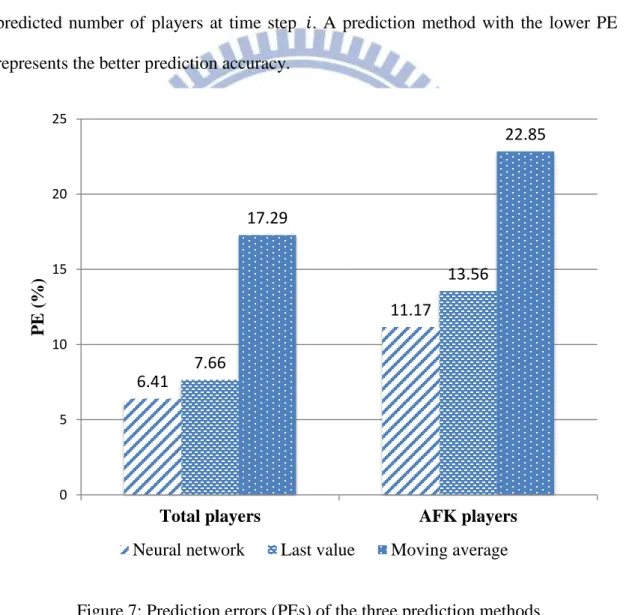
where is the actual number of players at time step and is the predicted number of players at time step . A prediction method with the lower PE represents the better prediction accuracy.
The PEs of the above three prediction methods are showed in Figure 7. Since the neural network-based predictor has high prediction accuracy, the PE of the neural
Figure 7: Prediction errors (PEs) of the three prediction methods. 6.41 11.17 7.66 13.56 17.29 22.85 0 5 10 15 20 25
Total players AFK players
P
E
(%
)
16
network-based prediction method is much lower than that of moving average prediction and that of last value prediction.
4.3 The percentage of extra players supported
considering AFK players
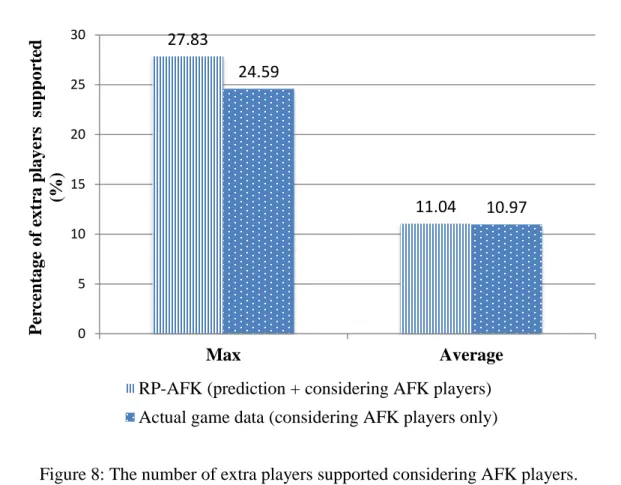
We evaluated the percentage of extra players supported considering AFK players. Experimental results show that the average percentage of extra players supported for RP-AFK is 11.04%, and it is almost equal to the average percentage of extra players supported based on the actual game data,, as shown in Figure 8.
Figure 8: The number of extra players supported considering AFK players. 27.83 11.04 24.59 10.97 0 5 10 15 20 25 30 Max Average P er ce n tage of e xtr a p layer s su p p or te d (% )
RP-AFK (prediction + considering AFK players) Actual game data (considering AFK players only)
4.4 The average usage of VMs in one zone of a WoW
realm
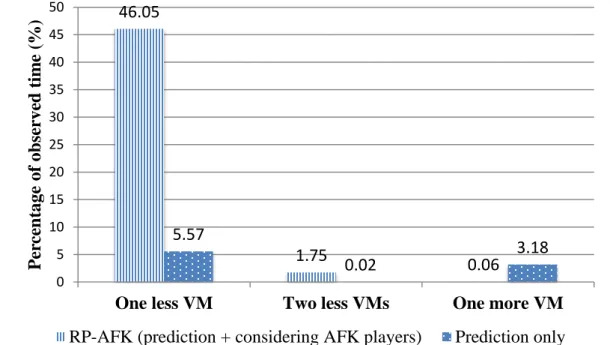
We also evaluated the usage of VMs in one zone of a WoW realm. Figure 9 shows RP-AFK used one less VM for 46.05% of the observed time period and used two less VMs for 1.75% of the observed time period. It supports that our scheme can save cloud resources by decreasing the provision of resources to AFK players.
4.5 Under-allocation and over-allocation
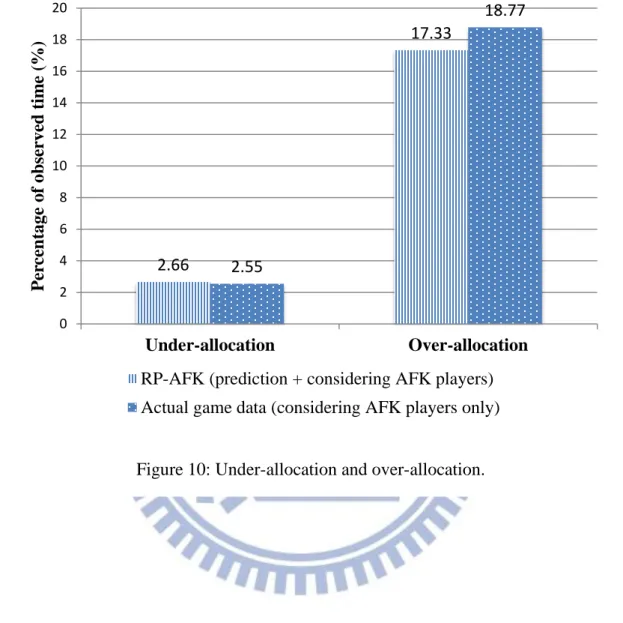
Finally, we evaluate the under-allocation and over-allocation of RP-AFK. Under-allocation means that the assignment of the number of players is more than the number of players that VMs can handle [20] and over-allocation means that the number of VMs allocated is higher than the number of VMs needed [25]. Figure 10 shows the under-allocation of RP-AFK is slightly higher than the under-allocation of resource allocation based on actual game data. However, the over-allocation of
Figure 9: The average usage of VMs in one zone of a WoW realm. 46.05 1.75 0.06 5.57 0.02 3.18 0 5 10 15 20 25 30 35 40 45 50
One less VM Two less VMs One more VM
P er ce n tage of ob se rve d tim e (% )
18
RP-AFK is smaller than the over-allocation of resource allocation based on actual game data.
Figure 10: Under-allocation and over-allocation. 2.66 17.33 2.55 18.77 0 2 4 6 8 10 12 14 16 18 20 Under-allocation Over-allocation P er ce n tage of ob se rve d tim e (% )
RP-AFK (prediction + considering AFK players) Actual game data (considering AFK players only)
Chapter 5
Conclusions
5.1 Concluding remarks
We have presented an efficient resource provisioning scheme considering AFK players (RP-AFK) for MMOG clouds. We leverage the characteristic of AFK players, which only need low QoS for gaming, to decrease the provision of resources to them and to support more online players. We used WoW as a case study to illustrate the proposed resource provisioning scheme that is valuable to MMOG cloud providers. The proposed RP-AFK scheme can support 11.04% extra players and use one less VM for 46.05% of the observed time in a game zone of a WoW realm. Therefore, our scheme can reduce the waste of cloud resources and increase resource utilization by supporting more online players.
5.2 Future work
In our current resource provisioning scheme, we focused only on number of players. In the future, we will consider players’ interaction in our resource provisioning scheme. In addition, we will implement our proposed resource provisioning scheme considering AFK players in an experimental MMOG cloud.
20
Bibliography
[1] Y. Lee, K. Chen, Y. Cheng and C. Lei, “World of Warcraft avatar history dataset,” in Proc. the Second Annual ACM Conference on Multimedia Systems, pp. 123-128, Feb. 2011.
[2] “Onlive,” [Online.] Available: http://www.onlive.com/.
[3] “Ubitus,” [Online.] Available: http://www.ubitus.net/index.html. [4] “Gailai,” [Online.] Available: http://www.gaikai.com/.
[5] “Cloud gaming,” [Online.] Available: http://en.wikipedia.org/wiki/Cloud_gaming. [6] “World of Warcraft,” [Online.] Available: http://us.battle.net/wow/en/.
[7] “Counter Strike,” [Online.] Available: http://www.counter-strike.net/. [8] “StarCraft II,” [Online.] Available: http://us.battle.net/sc2/en/.
[9] “World of Warcraft subscriber numbers dip 100,000 to 10.2 million,” [Online.] Available:
http://wow.joystiq.com/2012/02/09/world-of-warcraft-subscriber-numbers/.
[10] “Realms list,” [Online.] Available: http://www.wowwiki.com/Realms_list. [11] “Realms,” [Online.] Available: http://www.wowwiki.com/Realm.
[12] “Who,” [Online.] Available: http://www.wowwiki.com/Who_List.
[13] “World of Warcraft API,” [Online.] Available:
http://www.wowwiki.com/World_of_Warcraft_API.
[14] “Frame rate,” [Online.] Available: http://en.wikipedia.org/wiki/Frame_rate. [15] “AFK - away from keyboard,” [Online.] Available:
http://internetgames.about.com/od/glossary/g/afk.htm.
[16] “Away,” [Online.] Available: http://www.wowwiki.com/Away.
http://www.cloudtweaks.com/2011/03/top-cloud-computing-gaming-providers/.
[18] “OnLive: partners,” [Online.] Available: http://www.onlive.com/corporate/partners.
[19] “OnLive: all game,” [Online.] Available: http://www.onlive.com/games/featuredgames#&tab=all_games.
[20] V. Nae, A. Iosup and R. Prodan, "Dynamic resource provisioning in massively multiplayer online games," IEEE Transactions on Parallel and Distributed Systems, pp. 380-395, March 2011.
[21] Truong Vinh Truong Duy, Y. Sato and Y. Inoguchi, "Performance evaluation of a green scheduling algorithm for energy savings in cloud computing," in Proc.
IEEE International Symposium on Parallel & Distributed Processing, Workshops and Ph.D Forum (IPDPSW), pp. 1-8, April 2010.
[22] “Matlab,” [Online.] Available: http://www.mathworks.com/products/matlab/. [23] Y. Lee and K. Chen, "Is server consolidation beneficial to MMORPG? a case
study of World of Warcraft," in Proc. IEEE 3rd International Conference on Cloud
Computing (CLOUD), pp. 435-442, July 2010.
[24] “How quickly will systems be running,” [Online.] Available:
http://aws.amazon.com/ec2/faqs/#How_quickly_will_systems_be_running.
[25] “Do you overwork your resources,” [Online.] Available:

![Figure 2: A player is AFK for (a) 30 minutes and (b) 60 minutes in the WoW [6].](https://thumb-ap.123doks.com/thumbv2/9libinfo/8752418.206197/16.892.150.758.123.329/figure-player-afk-minutes-b-minutes-wow.webp)