
Robust Image Hashing Scheme Based on DWT and Fuzzy ART
6
0
0
全文
(2) robust hash table. Experimental results demonstrate that the proposed scheme is robust against common image processing and geometric distortions. Moreover, the original image is not required in the extraction process. This paper is organized as follows. In Section 2, we briefly introduce discrete wavelet transformation (DWT) and fuzzy adaptive resonance theory (Fuzzy ART). The proposed scheme is presented in Section 3. Experimental results and discussions are shown in Section 4. Finally, some conclusions are given in Section 5.. watermark is embedded in the hash table, i.e. the quantization interval of the variance.. 3.1: HASH GENERATION ALGORITHM Let the original image X be a gray-level image of size N1 × N 2 , and the watermark W be a binary image of size M 1 × M 2 . The original image X and the watermark W are respectively represented as follows. X = { xi , j 0 ≤ xi , j ≤ 255, 0 ≤ i < N1 , 0 ≤ j < N 2 } (1). {. }. W = wi , j wi , j ∈ {0, 1} , 0 ≤ i < M 1 , 0 ≤ j < M 2. 2: RELATED WORKS. (2). Firstly, the original image can be decomposed to obtain the sub-image LLt ( L for short) through t -level. 2.1: DWT Discrete wavelet transformation is a mathematical tool which can examine an image in time and frequency domain, simultaneously. The image is first decomposed into four subbands denoting LL1, LH1, HL1 and HH1. The subbands LH1, HL1 and HH1 contain high-frequency component. The subband LL1 is the low-frequency component containing most of energy in the image. Discrete wavelet transformation can be applied again by further decomposing the subband LL1 into the subbands LL2, LH2, HL2 and HH2. If the process is repeated t times, we can obtain the subband LLt through t-level wavelet transformation.. wavelet transformation. Here, L is defined as follows. L = { li , j 0 ≤ li , j ≤ 255, 0 ≤ i < ( N1 2t ) , 0 ≤ j < ( N 2 2t ) } (3) To resist geometric distortions, a fast two-dimensional (2-D) pseudorandom permutation [3] generated by seed s is used to permute the watermark to disperse its spatial relationship, i.e., W ′ = { wi′′, j′ wi′′, j′ = PRPs ( wi , j ) , 0 ≤ i, i′ < M1 , 0 ≤ j, j ′ < M 2 } (4). denotes the pseudorandom PRPs ( ⋅ ) permutation function with seed s . Then, the sub-image L is divided into M1 × M 2 non-overlapping image blocks Bk with size where. 2.2: FUZZY ART. (( N 2 ) M ) × (( N 2 ) M ) ,. Fuzzy ART proposed by S. Grossberg is an unsupervised learning network [9]. It can be considered as a modified ART1 neural network which only learns to categorize binary input vectors. By incorporating computations from fuzzy set theory into ART1, Fuzzy ART can be used to categorize both discrete and analog input vectors. For example, the intersection (∩) operator used in ART1 learning is replaced by the MIN operator (∧) of fuzzy set theory.. shown in Eq. (5).. For presentation convenience, we replaced the size of each image block by m1 × m2 . Accordingly, each image block Bk can be regarded as an input vector with. 3: PROPOSED SCHEME. the image pixels, such that each element of input vectors is in the interval [ 0, 1] . Each input vector is expanded to. t. 1. The variation of low-frequency components is smaller than that of high-frequency components under reasonable attacks. Based on this property, we propose a robust image hashing scheme based on DWT and Fuzzy ART. The proposed scheme, which combines many encouraging characteristics from DWT, Fuzzy ART and quantization process, converts an image into a short and robust hash table. Firstly, the low-low frequency sub-image is obtained through wavelet transformation. Thus, most of noises are excluded for resolving the weakness of Fuzzy ART which is sensitive to noise and outliers. Moreover, the indices among neighboring image blocks possess similarity for natural images. Therefore, we calculate the variance of each index and the indices of its surrounding image blocks, and utilize the concept of the quantization process to construct the hash table. Finally, a. 1. t. 2. for 1 ≤ k ≤ M1 × M 2 , as. 2. L=. M1 × M 2. U. (5). Bk. k =1. m1 × m2 elements. We normalize all input vectors Bk = ( Bk 1 , Bk 2 , K , Bk ( m ×m ) ) by the largest gray-level of 1. 2. vector I k with 2 × m1 × m2 elements according to complement-coding rule. That is,. ( = (B. I k = Bk , Bkc k1 ,. I=. ). Bk 2 , K , Bk ( m1 ×m2 ) , Bkc1 , Bkc2 , K , Bkc( m1 ×m2 ). M1 × M 2. U. ). (6) (7). Ik. k =1. where. 1 ≤ k ≤ M1 × M 2. and. Bkcl = 1 − Bk l. ,. for. l = 1, 2, K, m1 × m2 . Then, all input vectors I k are applied. to the Fuzzy ART network for classification. The Fuzzy-ART function produces three outputs, a weight matrix (WM), a codebook (CB), and an index table (IT). The CB consists of codewords, and each codeword is the centroid of each cluster. The IT records the cluster index of each image block. (8) ( WM, CB, IT ) = Fuzzy− ART ( I , α , β , ρ ). - 1158 -.
(3) where α is the choice parameter, β is the learning rate, and ρ is the vigilance parameter. In order to minimize the variation of the IT index obtained from the test image in the extraction process, the CB is sorted in ascendant order according to the variance of each codeword. For natural images, the indices among neighboring image blocks possess similarity, so we can make use of this property to generate the hash table H . We calculate the variance of each index and the indices of its surrounding image blocks with ⎛ 1 m +1 n +1 2 ⎞ ⎛ 1 m +1 n +1 ⎞ y ⎟−⎜ y ⎟ ⎜ 9 i = m −1 j = n −1 i , j ⎟ ⎜ 9 i = m −1 j = n −1 i , j ⎟ ⎝ ⎠ ⎝ ⎠. σ m2 ,n = ⎜. ∑∑. 2. (9). ∑∑. where yi , j is the index in the IT, 0 ≤ m < M 1 , and 0 ≤ n < M 2 . We utilize the concept of the quantization process to embed a watermark in the quantization interval of the variance. Then, the hash table H is constructed as follows: H = { hm , n hm , n ∈ {0, 1} , 0 ≤ m < M 1 , 0 ≤ n < M 2 } (10) where hm,n. 3.2: HASH VERIFICATION ALGORITHM The corresponding extraction process is shown in Fig. 2. Six parameters (i.e., s , t , K , WM , N1 , and N 2 ) are required to extract the embedded watermark without using the original image. For a copyright disputed image, we calculate the estimated hash table H ′ with the recall of Fuzzy ART. Then, an estimation of the permuted watermark is obtained as: (14) W ′′ = H ′ ⊕ K % Finally, the extracted watermark W is obtained by inversing the permutation in (4) according to the parameter s as follows: W% = { w% i , j w% i , j = PRPs-1 ( wi′′′, j ′ ) , 0 ≤ i, i′ < M 1 , 0 ≤ j , j ′ < M 2 } (15) X′. K. s. ⎧⎪1, if r ∆ ≤ σ < ( r + 1) ∆ for r = 0, 2, 4, K (11) =⎨ 2 ⎪⎩0, if r ∆ ≤ σ m, n < ( r + 1) ∆ for r = 1, 3, 5, K. ∆ = 3×σ. ⎛ 1 = 3× ⎜ ⎜ M ×M 1 2 ⎝. ⎞ ⎛ 1 ⎟ ⎜ M ×M 1 2 ⎠ ⎝. M1 −1 M 2 −1. ∑. ∑ σ m4 ,n ⎟ − ⎜. m =0 n =0. M1 −1 M 2 −1. ∑. ⎞ ⎟ ⎠. ∑ σ m2 ,n ⎟. m =0 n =0. 2. (12). After obtaining the hash table H , the secret key K can be computed as the bitwise exclusive-OR of H and W ′ . (13) K = H ⊕ W′ The secret key K is used to extract the embedded watermark. Six parameters (i.e., s , t , K , WM , N1 , and N 2 ) work together to protect the ownership of the original image. Figure 1 shows the hash generation process. LL t. X. DWT. K. Embedding. Division. H. Input Vectors. Extraction. Division. H′. Input Vectors. Fuzzy ART. Image Hashing Computation. Encoded Indices. Inverse Permutation. W%. Fig. 2 Hash verification process. 4: EXPERIMENTAL RESULTS AND DISCUSSIONS 4.1: EXPERIMENTAL RESULTS In our experiments, the original images X are respectively 512 × 512 Peppers and Baboon with 8 bits/pixel resolution as shown in Fig. 3 (a-b). Note that these images represent images with quite different content “complexity”. Peppers contains mainly smooth regions, representing low complexity, while Baboon contains large regions of complex texture, representing high complexity. The binary watermark W is the school emblem of National Yunlin University of Science & Technology (NYUST) with size of 64× 64 as shown in Fig. 3 (c). The Peppers and Baboon images are both decomposed through two-level wavelet transform and the two sub-images LL2 of size 128× 128 are obtained. For Peppers image, three parameters of Fuzzy ART are respectively set as α = 0.5 , β = 0.1 , and ρ = 0.9 . However, for Baboon image, these parameters are respectively set as α = 0.5 , β = 0.1 , and ρ = 0.6 . The reason of setting different vigilance parameters for Peppers and Baboon images are given in the discussions.. Fuzzy ART. Image Hashing Computation. Encoded Indices. W′ W s. LL′t. W ′′. 2 m,n. and ∆ is a positive real number called the quantization parameter. Note that the value ∆ will affect the quality of the extracted watermark. If the value ∆ is larger than all variances (i.e. the values of the hash table are all one.), then the hash table is meaningless. That is to say, all hash tables obtained from all images are the same. However, it is difficult to determine an appropriate interval. In general, a meaningful image is usually a natural image with normal distribution. Therefore, the suggested value for the quantization parameter is shown in Eq. (12).. DWT. (c) (a) (b) Fig. 3 Original images: (a) Peppers and (b) Baboon. Binary watermark: (c) emblem.. Permutation. Fig. 1 Hash generation process. - 1159 -.
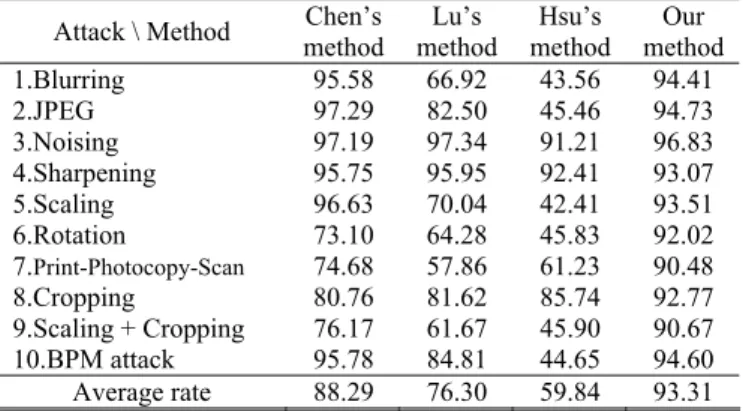
(4) We evaluate the quality between the original image and the attacked image using the peak signal-to-noise ratio (PSNR), which is defined as follows: 2 ⎛ E peak ⎞ PSNR = 10log10 ⎜ ⎟ dB ⎜ MSE ⎟ ⎝ ⎠. (16). where the mean square error (MSE) is defined as follows:. ∑ ∑ (x MSE = N1 −1. N 2 −1. i =0. j =0. i, j. − xi′, j. N1 × N 2. ). 2. (17). unable to withstand geometric distortions. In particular, Hsu’s method can only extract meaningful watermarks under noising, sharpening, and cropping attacks. However, the watermarks extracted from other attacked images are meaningless. Since Hsu’s method is not a lossless one, it can not extract clear and recognizable watermarks under such serious attacks. Obviously, the proposed method is more robust than Chen’s, Lu’s and Hsu’s methods from Table 1 and Table 2. Table 1 The retrieval rates (%) of the binary watermarks extracted from attacked Peppers images using different methods. where N1 and N 2 are the height and width of the image, respectively. xi , j is the original value of the coordinate ( i, j ) and xi′, j is the altered value of the coordinate ( i, j ) . E peak is the largest gray-level of the image pixels. The watermark retrieval rate R is used to evaluate the similarity between the original watermark and the extracted watermark. The retrieval rate R is defined as follows: (18) R = 1 − MAE where the mean absolute error (MAE) is defined as follows:. ∑ MAE =. M1 −1 i =0. ∑. M 2 −1 j =0. wi , j − w% i , j. M1 × M 2. (19). where M 1 and M 2 are the height and width of the watermark, respectively. wi , j is the original value of the coordinate ( i, j ) and w% i , j is the altered value of the coordinate ( i, j ) . To evaluate the robustness of the proposed scheme, we conducted ten different attacks on the original image and compared with Chen’s [5], Lu’s [2] and Hsu’s [3] methods. These ten attacks are blurring, JPEG compression, noising, sharpening, scaling, rotation, print-photocopy-scan, cropping, scaling-cropping, and blind pattern matching (BPM) attacks, respectively. Due to these attacks are identical to Chen’s method [5] and the space limitation, the descriptions of these attacks are omitted. As Table 1 and Table 2 show, our scheme can still extract clear and recognizable watermarks from different attacked images. In the worst case, the proposed method still has a high retrieval rate (up to 90.48%). Despite that Chen’s method has better performance for blurring, JPEG compression, noising, sharpening, scaling, and BPM attacks. The retrieval rates of the proposed method are all higher than 93% under these attacks. Moreover, our scheme has a very high retrieval rate for rotation, print-photocopy-scan, cropping, and scaling-cropping attacks. However, Chen’s method failed in these attacks. In Lu’s method [2], the robust watermark is embedded into the secret key using Huang’s method [1] based on index properties. In Hsu’s method [3], it embeds watermarks into the middle-frequency components of the image to get a tradeoff between imperceptibility and robustness. From Table 1 and Table 2, Lu’s and Hsu’s methods failed in some attacks. Lu’s method is mainly. Attack \ Method 1.Blurring 2.JPEG 3.Noising 4.Sharpening 5.Scaling 6.Rotation 7.Print-Photocopy-Scan 8.Cropping 9.Scaling + Cropping 10.BPM attack Average rate. Chen’s method 96.92 96.85 97.46 97.46 97.53 84.69 86.87 84.69 77.95 97.12 91.75. Lu’s method 76.37 62.87 89.89 91.31 82.67 63.35 55.91 82.25 59.86 94.34 75.88. Hsu’s method 45.07 44.12 87.77 95.04 42.14 45.44 65.97 85.67 47.41 44.02 60.27. Our method 95.24 96.53 97.19 96.24 96.02 90.97 93.36 95.14 90.94 96.22 94.79. Table 2 The retrieval rates (%) of the binary watermarks extracted from attacked Baboon images using different methods Attack \ Method 1.Blurring 2.JPEG 3.Noising 4.Sharpening 5.Scaling 6.Rotation 7.Print-Photocopy-Scan 8.Cropping 9.Scaling + Cropping 10.BPM attack Average rate. Chen’s method 95.58 97.29 97.19 95.75 96.63 73.10 74.68 80.76 76.17 95.78 88.29. Lu’s method 66.92 82.50 97.34 95.95 70.04 64.28 57.86 81.62 61.67 84.81 76.30. Hsu’s method 43.56 45.46 91.21 92.41 42.41 45.83 61.23 85.74 45.90 44.65 59.84. Our method 94.41 94.73 96.83 93.07 93.51 92.02 90.48 92.77 90.67 94.60 93.31. Furthermore, experimental results under different cropping ratios are shown in Table 3. From these results, the retrieval rates of the binary watermarks extracted from cropped Peppers and Baboon images decrease by cropping ratio progressively increases. From Table 3, we concluded that the proposed method can extract meaningful watermarks under 40% of cropping ratio.. 4.2: Discussions In our experiments, the low-low frequency sub-image is obtained through wavelet transformation. Thus, most of noises are excluded for resolving the weakness of Fuzzy ART which is sensitive to noise and outliers. The reason of choosing two-level wavelet transformation is described as follows. For noising attacks, one-level wavelet transform can not completely. - 1160 -.
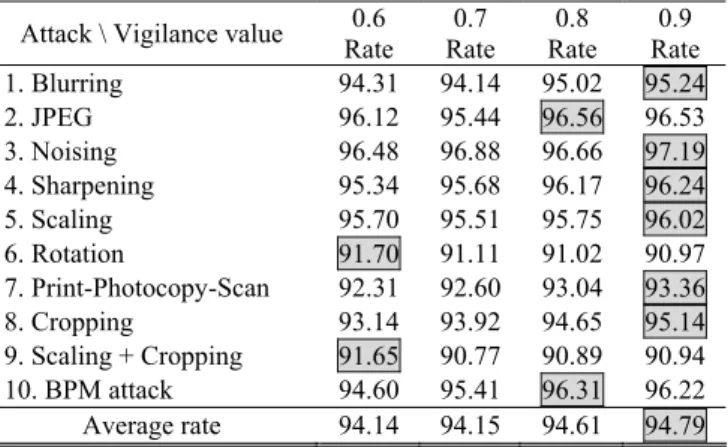
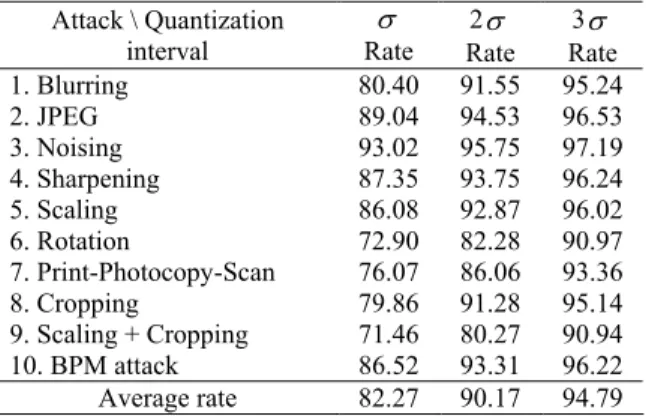
(5) be obtained even though an inadequate vigilance parameter is used.. Table 3 The retrieval rates (%) of the binary watermarks extracted from cropped Peppers and Baboon images under different cropping ratios Cropping ratio \ Image 10 % 20 % 30 % 40 % 50 % 60 % 70 % 80 % 90 % 100 %. Peppers Rate 93.77 93.58 91.72 90.72 70.78 68.92 62.48 58.98 53.86 50.83. Baboon Rate 92.82 92.26 91.31 90.87 65.41 60.86 60.13 56.62 51.93 50.78. Table 4 The retrieval rates (%) of the binary watermarks extracted from attacked Peppers images under different vigilance parameters Attack \ Vigilance value. remove noise. While three-level wavelet transformation can almost remove noise. Nevertheless, three-level wavelet transformation will cause the size of the sub-image LL3 is identical to the watermark W . Accordingly, each input vector with only two elements is applied to the Fuzzy ART network. For classification, it is not suitable due to less information. Hence, we chose two-level wavelet transformation to implement our scheme. In general, the appropriate parameter t depends on the sub-image LLt which has double size of the watermark W . Another advantage is that the training time of the network is very fast since the size of the training patterns is small. The Fuzzy ART has three fundamental parameters need to establish: the choice parameter α , learning rate β , and vigilance parameter ρ . The choice parameter acts on the category selection. The learning rate controls the speed of the network evolution. Since the choice parameter and learning rate slightly affect the quality of the extracted watermark. Thus, only the vigilance parameter is discussed in this section. The number of the categories formed in the category representation field depends on the vigilance parameter. If ρ is too large, it will generate more categories. If ρ is too small, it will generate few categories. Therefore, different vigilance parameters affect the retrieval rates of the watermarks extracted from attacked images. Table 4 and Table 5 show the retrieval rates of the binary watermarks extracted from attacked Peppers and Baboon images under different vigilance parameters. The retrieval rate marked with a gray rectangle represents the highest rate under different attacks. Observing Table 4, we find that it provides the best performance for Peppers image when the vigilance parameter is equal to 0.9. Moreover, the average rate is also the highest. Therefore, the appropriate vigilance parameter should set to as 0.9 for Peppers image. Nevertheless, the appropriate vigilance parameter should set as 0.6 for Baboon image. Therefore, to obtain high retrieval rate, the vigilance parameter should be appropriately selected according to the complexity of image content. The larger vigilance parameter is used for image with low complexity, while the smaller vigilance parameter is used for image with high complexity. Furthermore, the high retrieval rate can. 1. Blurring 2. JPEG 3. Noising 4. Sharpening 5. Scaling 6. Rotation 7. Print-Photocopy-Scan 8. Cropping 9. Scaling + Cropping 10. BPM attack Average rate. 0.6 Rate 94.31 96.12 96.48 95.34 95.70 91.70 92.31 93.14 91.65 94.60 94.14. 0.7 Rate 94.14 95.44 96.88 95.68 95.51 91.11 92.60 93.92 90.77 95.41 94.15. 0.8 Rate 95.02 96.56 96.66 96.17 95.75 91.02 93.04 94.65 90.89 96.31 94.61. 0.9 Rate 95.24 96.53 97.19 96.24 96.02 90.97 93.36 95.14 90.94 96.22 94.79. Table 5 The retrieval rates (%) of the binary watermarks extracted from attacked Baboon images under different vigilance parameters Attack \ Vigilance value 1. Blurring 2. JPEG 3. Noising 4. Sharpening 5. Scaling 6. Rotation 7. Print-Photocopy-Scan 8. Cropping 9. Scaling + Cropping 10. BPM attack Average rate. 0.6 Rate 94.41 94.73 96.83 93.07 93.51 92.02 90.48 92.77 90.67 94.60 93.31. 0.7 Rate 93.02 93.60 96.44 93.41 93.82 91.53 91.53 91.58 91.85 94.78 93.16. 0.8 Rate 94.48 94.65 96.02 93.60 93.56 89.84 89.28 92.14 89.43 93.46 92.65. 0.9 Rate 93.75 94.70 96.12 93.19 92.58 87.89 88.38 92.53 87.79 94.36 92.13. In addition to the vigilance parameter, the quantization parameter is also an important factor for affecting the quality of the extracted watermark. The larger the quantization interval is, the better the quality of the extracted watermark is. Oppositely, the smaller the quantization interval is, the worse the quality of the extracted watermark is. This result is known and experimental results are shown in Table 6 and Table 7. Table 6 and Table 7 show the retrieval rates of the binary watermarks extracted from attacked Peppers and Baboon images under different quantization parameters, respectively. For authenticity, non-hashed images are used to demonstrate the authenticity of the proposed scheme. Figure 4 (a) and (b) show non- hashed Elaine and F16 images. The corresponding watermarks extracted from Fig. 4 (a) and (b) are shown in Fig. 5 (a) and (b), respectively. As these results show, we can not extract meaningful watermarks from the non-hashed Elaine and F16 images. The extracted watermarks are meaningless. Hence, the proposed scheme can extract corresponding watermarks from hashed images rather than non-hashed images.. - 1161 -.
(6) constructed using the concept of the quantization process. Finally, a watermark is embedded in the hash table, i.e. the quantization interval of the variance. In addition, unlike general classification, such as k-mean, fuzzy c-means and so on, we can suitably determine the number of the clusters according to the vigilance parameter of Fuzzy ART. Experimental results demonstrate that the proposed scheme is robust enough to resist common image processing and geometric distortions. Moreover, the original image is not required in the extraction process.. Table 6 The retrieval rates (%) of the binary watermarks extracted from attacked Peppers images under different quantization parameters 2σ 3σ σ Attack \ Quantization. interval 1. Blurring 2. JPEG 3. Noising 4. Sharpening 5. Scaling 6. Rotation 7. Print-Photocopy-Scan 8. Cropping 9. Scaling + Cropping 10. BPM attack Average rate. Rate 80.40 89.04 93.02 87.35 86.08 72.90 76.07 79.86 71.46 86.52 82.27. Rate 91.55 94.53 95.75 93.75 92.87 82.28 86.06 91.28 80.27 93.31 90.17. Rate 95.24 96.53 97.19 96.24 96.02 90.97 93.36 95.14 90.94 96.22 94.79. ACKNOWLEDGMENT This work was supported by the National Science Council, Taiwan, R.O.C. under Grants NSC 95-2221-E-224-059.. Table 7 The retrieval rates (%) of the binary watermarks extracted from attacked Baboon images under different quantization parameters 2σ 3σ σ Attack \ Quantization interval 1. Blurring 2. JPEG 3. Noising 4. Sharpening 5. Scaling 6. Rotation 7. Print-Photocopy-Scan 8. Cropping 9. Scaling + Cropping 10. BPM attack Average rate. Rate 78.66 79.66 91.75 77.49 75.68 72.73 56.64 69.82 71.36 80.47 75.43. Rate 91.80 91.24 95.14 87.01 90.31 89.21 87.72 85.33 87.62 91.72 89.71. Rate 94.41 94.73 96.83 93.07 93.51 92.02 90.48 92.77 90.67 94.60 93.31. (a) (b) Fig. 4 Non-hashed images: (a) Elaine and (b) F16.. (a) (b) Fig. 5 Extracted watermarks: (a) watermark extracted from Fig. 4 (a) and (b) watermark extracted from Fig. 4 (b).. 5: CONCLUSION A robust image hashing scheme based on DWT and Fuzzy ART has been proposed in this paper for content authentication. The proposed scheme, which combines many encouraging characteristics from DWT, Fuzzy ART and quantization process, converts an image into a short and robust hash table. First, the low-low frequency sub-image is obtained through wavelet transformation. Thus, most of noises are excluded for resolving the weakness of Fuzzy ART which is sensitive to noise and outliers. Second, the hash table is. REFERENCES [1] Hsiang-Cheh Huang, Feng-Hsing Wang, and Jeng-Shyang Pan, “Efficient and robust watermarking algorithm with vector quantisation,” Electronics Letters, vol. 37, no. 13, pp. 826-828, 21 Jun. 2001. [2] Zhe-Ming Lu, Dian-Guo Xu, and Sheng-He Sun, “Multipurpose image watermarking algorithm based on multistage vector quantization,” IEEE Trans. on image processing, vol. 14, no. 6, pp. 822-831, Jun. 2005. [3] Chiou-Ting Hsu and Ja-Ling Wu, “Hidden digital watermarks in images,” IEEE Trans. on image processing, vol. 8, no. 1, pp. 58-68, Jan. 1999. [4] Deepa Kundur and Dimitrios Hatzinakos, “Digital watermarking for telltale tamper proofing and authentication,” Proc. IEEE, vol. 87, no. 7, pp.1167-1180, July 1999. [5] Tzung-Her Chen, Gwoboa Horng, and Wei-Bin Lee, “A publicly verifiable copyright-proving scheme resistant to malicious attacks,” IEEE Trans. on industrial electronics, vol. 52, no. 1, pp. 327-334, Feb. 2005. [6] Chun-Shien Lu and Chao-Yong Hsu, “Content-dependent anti-disclosure image watermark,” Proc. 2nd Int. Workshop on Digital Watermarking (IWDW), LNCS 2939, pp. 61-76, Seoul, Korea, 2003. [7] Chun-Shien Lu, Shih-Wei Sun, Chao-Yong Hsu, and Pao-Chi Chang, “Media hash-dependent image watermarking resilient against both geometric attacks and estimation attacks based on false positive-oriented detection,” to Appear in IEEE Trans. on Multimedia. [8] Chun-Shien Lu and Chao-Yong Hsu, “Geometric distortion-resilient image hashing scheme and its applications on copy detection and authentication,” ACM Multimedia Systems Journal, special issue on Multimedia and Security, vol. 11, no. 2, pp. 159-173, Dec. 2005. [9] G.ail A. Carpenter, Stephen Grossberg, and David B. Rosen, “Fuzzy ART: An adaptive resonance algorithm for rapid, stable classification of analog patterns,” in Proc. Int. Joint Conf. Neural Networks, pp. 441-416, 1991.. - 1162 -.
(7)
數據
相關文件
General overview 1-2–1-3 Reference information 6-1–6-15 Emergency Power Off button 6-11 Focusing the video image 4-3 Foot Switches 6-14. General Overview 1-2
Mie–Gr¨uneisen equa- tion of state (1), we want to use an Eulerian formulation of the equations as in the form described in (2), and to employ a state-of-the-art shock capturing
“Find sufficiently accurate starting approximate solution by using Steepest Descent method” + ”Compute convergent solution by using Newton-based methods”. The method of
Taking second-order cone optimization and complementarity problems for example, there have proposed many ef- fective solution methods, including the interior point methods [1, 2, 3,
關鍵詞:1.paratantralakṣaṇa 2.the simile of phantom 3.the three natures of treatment 4.the mental eject and the consciousness 相見二分 5.the thory of self realization
[r]
• Each student might start from a somewhat different point of view and experience the encounters with works of art and ideas in a different way... Postmodern
Retrieval performance of different texture features according to the number of relevant images retrieved at various scopes using Corel Photo galleries. # of top
