New Southbound Policy in India and
South Asia
Mumin Chen
Professor, Graduate Institute of International Politics, Director, Center for Studies on South Asia and the Middle East, National Chung Hsing University
Saheli Chattaraj
Assistant Professor Academy of International Studies, Jamia Millia Islamia, India
Abstract
Aimed at building a comprehensive partnership with ASEAN, South Asia, Australia, and New Zealand by promoting regional exchanges and collaboration, the New Southbound Policy is con-sidered the new grand strategy of President Tsai Ing-wen to reposition Taiwan in Asia and to establish multiple social and business links with Southeast Asia and the Indian subcontinent based on the principles of equality and reciprocity creating more opportunities to sustain existing paths. This paper examines Taiwan’s relations with South Asian countries under the influence of the New Southbound Policy and discusses the problems and challenges for future cooperation. By providing an overview of the New Southbound Policy, the paper assesses and examines its function in different sectors before analyzing Taiwan’s relations with South Asian states, particularly India. On Taiwan-India relations, the paper suggests that Taiwan should initiate a biennial meeting of ministers/special envoys with India, initiating
ECA talks, and look for cooperation with Indian film industries. As for cooperation with other South Asian countries, the Taiwan govern-ment may choose to take advantage of its unique skills and strengths, like developing talent in agriculture and food-processing to provide knowhow to initiate programs in the region. Public health or disaster relief and management are areas with potential for building partnership since such areas generally would not be focused on by mainland China in the South Asian region.
Keywords: New Southbound Policy, Foreign Policy of Taiwan,
Taiwan-India Relations, Relations between Taiwan and South Asian countries, Tsai Ing-wen
I. Introduction
In an era of accelerated economic globalization, the realization of a common region in order to sustain the prosperity, stability, and security of a nation is of paramount importance. China, through the initiative of the “One Belt One Road (OBOR)”; Japan, through its “Official Development Assistance (ODA)”; the “Pivot to Asia” program advocated jointly by the United States and Russia; and the restart of the “Act East Strategy” developed by India all have aimed at promoting a region in order to realize stability and growth as an individual nation and a region at large through intraregional economic interdependence deepening with expansion of manufacturing industries’ production networks, permeation of shared lifestyles, increasing dy-namic people-to-people exchanges, etc. Regional diplomacy has be-come a strong potential force around the world. All states in the in-ternational scenario are aware that neighborhood cooperation and better relationships work for mutual benefit. In this respect, all regions also are keen to adopt and to adapt to new and effective models of successful regional groupings and institutions.
This is good timing for Taiwan to come up with its “New
South-bound Policy”. Taiwan’s President, Tsai Ing-wen, in the 18thAnnual
Conference on Southeast Asian Studies at National Chengchi University in Taipei, remarked that the New Southbound Policy is motivated by the need for Taiwan to redefine its role in Asian development while
the whole world is rebalancing to the region.1 In the 1980s, the
Taiwanese companies have “gone West” through heavy investment in China, primarily through Hong Kong. Nevertheless, since the middle part of the 1990s, Taiwanese companies also have intensely pursued the strategy of “go South” by investing in Southeast Asian countries, like Indonesia, the Philippines, Vietnam, Malaysia, and Thailand. This also has helped Taiwan reshape the economic and political ties among these countries in the Asia-pacific region with significant regional and global consequences. Moreover, Taiwan’s investment in the ASEAN countries has contributed significantly to the comparative economic advantages through efficient division of labor in all of the ASEAN member states, especially in the Philippines, Vietnam, Thailand, Malaysia, Singapore, and Indonesia. Today, more than 11,000 Taiwanese companies have invested about nearly 88 billion US Dollars in the region, making ASEAN the second-largest
destination for foreign investment from Taiwan.2
With this background, the purpose of this paper is to examine Taiwan’s relations with South Asian countries, introduce the new policies and projects under the guidelines of the New Southbound Policy, and discuss the problems and challenges for future cooperation.
Stacy Hsu, “Tsai elaborates on ‘southbound policy,’” Taipei Times, September 23, 2016, <http://www.taipeitimes.com/News/front/archives/2016/09/23/2003 655743>.
“Taiwan-ASEAN investment forum wraps up in Taipei,” Taiwan Today, July 14, 2016, <http://taiwantoday.tw/news.php?unit=6,346&post=12528>.
The first part of the paper provides an overview of the New Southbound Policy, assessing and examining its function in different sectors; followed by an analysis of Taiwan’s relations with South Asian states; and further followed by a section discussing the new policies aiming at building connectivity and cooperation with South Asia over the past year. The final part of the paper focuses more on evaluation of current policies and problems revealed to date.
II. Assessing the New Southbound Policy
Aimed at building comprehensive partnership with ASEAN, South Asia, Australia, and New Zealand by promoting regional exchanges and collaboration, the New Southbound Policy is con-sidered the new grand strategy by President Tsai Ing-wen to reposition Taiwan’s role in Asia and to establish multiple social and business links with Southeast Asia and the Indian subcontinent based on the principles of equality and reciprocity creating more opportunities to sustain existing paths. On September 15, 2016, in a public conference organized jointly by the Center for East Asia Policy Studies at Brookings Institution, The Freeman Chair in China Studies at the Center for Strategic and International Studies (CSIS), and the Institute of International Relations at National Chengchi University in Taipei, Professor Jiann-Fa Yan (顏建發) from Chien Hsin University of Science and Technology remarked that the New Southbound Policy is seen as an external support for the new economy of Taiwan com-plimentary to the development of cross-Strait economic and trade re-lations. President Tsai Ing-wen reiterated that Taiwan’s New South-bound Policy does not intend to compete with China but instead at-tempts to focus on Taiwan’s advantages through mutually beneficial
development in the region.3
The economic situation of Taiwan made rapid progress over the period from 1961-1997, when Taiwan’s real GDP grew at a rate of
9.7 percent from 1961-1980 and around 7.4 percent from 1981-1997.4
Rapid economic growth accompanied by rapid industrialization brought Taiwan to the position of the eighteenth largest economy in the world in terms of GDP in 1997. Nevertheless, over the last twenty-five years, Taiwan’s international trade and investment patterns have reflected growing interdependence with mainland China. In 1992,
China was Taiwan’s 26th most important trading partner, whereas,
by 2002, China became the 4thlargest trading partner of Taiwan with
a total trade worth of US$18.5 billion.5Currently, 21% of Taiwan’s
total trade is with China, a rapid growth from 7% in 2002.6Therefore,
the New Southbound Policy possesses the potential to diversify Taiwan’s economy, reducing its high reliance on China. Along with this, the New Southbound Policy also aims to create a vast and comprehensive network stressing cultural and interpersonal relationships throughout
the region.7 It would provide Taiwan with the opportunity to look
China: Tsai,” Focus Taiwan, May 5, 2017, <http://focustaiwan.tw/news/ aipl/201705050031.aspx>.
Shirley W. Y. Kuo & Christina Y. Liu, “The Development of the Economy of Taiwan,” Asia-Pacific Economic Literature, Vol. 13, Issue 1, May 1999, pp. 36-49. Mainland Affairs Council, R.O.C.(Taiwan), “Table 1 Trade between Taiwan and Mainland China,” Cross-Strait Economic Statistics Monthly, No. 238, February 21, 2013, p. 2-1, Mainland Affairs Council, R.O.C.(Taiwan), <http:// www.mac.gov.tw/public/At tachment/322015413549.pdf>.
Joshua Meltzer, “Taiwan’s Economic Opportunities and Challenges and The Importance of the Trans-Pacific Partnership,” East Asia Policy Paper Series, No. 2, January 2014, pp. 1-15, The Brookings, <https://www.brookings.edu/wp-content/uploads/2016/06/taiwan-trans-pacific-partnership-meltzer-012014.pdf >. Bonnie S. Glaser, Matthew P. Funaiole, & Emily Jin, “Unpacking Tsai Ing-wen’s New Southbound Policy: Can Taiwan’s latest attempt to avoid economic dependence on China success?” The Diplomat, April 1, 2017, <http://thediplomat. com/2017/04/unpacking-tsai-ing-wens-new-southbound-policy/>.
for new economic blocks for cooperation and integration in the region. Taiwanese scholars have expressed their views, saying that it is never wise to put all of one’s eggs in one basket, so the New Southbound Policy is very important for Taiwan at this point. In addition, several small and medium sized Taiwanese companies have lost a significant portion of their investments in China. Therefore, the New Southbound Policy would open new avenues and segments for Taiwanese enterprises. In an interview with journalists from all across Asia on May 5, 2017, President Tsai Ing-wen elaborated that Taiwan should follow the Singaporean model of development, not focusing on its size as a limitation to progress or brooding over China’s OBOR initiative as an obstacle but should manage to build on its own advantages
from a positive vision and ambition.8 Taiwan’s government under
President Lee Teng-hui and President Chen Shui-bian had also proposed southbound policies; however, the focus of the policy ini-tiative both times was primarily trade and economic cooperation seeking cost-effective manufacturing bases and cheap supply of labor for inducing production. Tsai’s New Southbound Policy is not the same as the previous ones as it brings in a shift from labor-intensive
sectors to capital and technology-intensive sectors.9
The New Southbound Policy is classified broadly into four main components: economic and trade cooperation, interactions and ex-changes between professionals and educators, sharing of resources, and connecting the local regions together. In terms of geography, the
“Tsai briefs Asia media on ‘new southbound policy,’” Taipei Times, May 7, 2017, <http://www.taipeitimes.com/News/taiwan/archives/2017/05/07/2003 670116>.
John Chen, “People-centred orientation key to New Southbound Policy,” The Jakarta Post, February 27, 2017, <https://www.pressreader.com/indonesia/the-jakarta-post/20170227/281938837692070>.
New Southbound Policy under President Tsai has diversified its geography by providing a new scope and encouragement to not just limit the Taiwanese enterprises to focus on the ASEAN nations, like Singapore, Vietnam, Indonesia, the Philippines, Malaysia, Thailand, Cambodia, Brunei, Myanmar, and Laos, but also extend its scope to the six South Asian Nations of India, Sri Lanka, Bangladesh, Bhutan, Nepal, and Pakistan, along with New Zealand and Australia. All of these southbound countries included in the policy initiative by President Tsai are developing and emerging economies; therefore, they need infrastructure and energy facilities, which provides space and an opportunity for Taiwan to cooperate and invest. Although Tsai Ing-wen’s New Southbound Policy is a foreign policy initiative to improve economic ties with the Southeast Asian nations, the in-vestment in the energy sector is another potential avenue for enhancing investment. It is a very crucial avenue as well since it is a prerequisite for any developing nation that tries to bring in infrastructure develop-ment.
Under the previous southbound policies, Taiwanese businesses were primarily encouraged to go and invest in the ASEAN countries. In contrast, under the new policy, ASEAN and South Asian businesses also have been invited to come and invest in Taiwan, allowing for a mutual-cooperation system based on a two-way benefit channel. These businesses may be private sector undertakings or civic com-munities. The New Southbound Policy also is more grassroots oriented, requiring both the local and the central government to join hands to-gether in order to promote the policy. Similarly, under the previous southbound policies, students from ASEAN countries were provided with scholarships and opportunities to come and study in Taiwan. Under the New Southbound Policy, Taiwanese students are encouraged and sent to the ASEAN and other South Asian nations for exchanges and summer internships as well. Earlier southbound policies aimed
at “going south” as an opportunity for contract manufacturing and regarded the ASEAN countries more like a cost-efficient overseas manufacturing base. This is unlike the New Southbound Policy, which aims at cooperation with ASEAN and South Asia as an expansion
of Taiwan’s foreign policy and demand.10
Therefore, the New Southbound Policy is a more comprehensive policy framework that tries to incorporate various modes of cooperation between Taiwan and the southbound nations. Under the guidelines of the New Southbound Policy, unveiled on August 16, 2016, the New Southbound Policy is divided into three broad goal periods-short, medium, and long-term goals. This implies that the New South-bound Policy is not a policy initiated to reap short-term immediate investment benefits; on the contrary, President Tsai is attempting to reach out to the southbound countries and build an entrepreneurship relationship based on cooperation and trust for a stable and sustainable future for the island.
Soft power and people-to-people relations are an integral part of the New Southbound Policy. This also implies that Taiwan wishes to attract the ASEAN and South Asian nations not just for economic and trade partnership but also for people-to-people ties and other cul-tural aspects in order to have a bond that can link other sectors, like Tourism, education cooperation, and youth and cultural exchanges. According to the Ministry of Education’s (MOE) policy initiative, Taiwan aims to increase the number of foreign students studying in Taiwan and provide them with scholarships and funding. By 2019, the number of foreign students studying in Taiwan is expected to rise
Conor Stuart, “Opportunities and Challenges: Taiwan’s New Southbound Policy,” October 28, 2016, IP Observer, <http://en.naipo.com/Portals/0/web_en/Knowl edge_Center/Feature/IPNE_161028_0703.htm>.
to 58,000 and increase by 20 percent every year.11This would induce
a positive familiarity and understanding about Taiwan among foreign youth and professionals.
Tourism is outlined as another key area under the New Southbound Policy. The policy aims at boosting the economy of Taiwan through an increase in the number of inbound tourists into Taiwan, especially from the target countries. The policy aims to provide easy and flexible visa regulations for the southbound nations as an incentive for an in-creased number of tourists to visit Taiwan. This also would reduce the dependency of the tourism sector of Taiwan on tourists from mainland China alone. Increased friction in cross-Strait relations from time to time also leads to stringent regulations for mainland tourists to visit Taiwan. This also affects the tourism industry of Taiwan, which has been dependent on the tourist population from mainland China. After the launching of the New Southbound Policy, several Southeast Asian nations and tourists from Indonesia, the Phi-lippines, Vietnam, and India were provided with visa fee waivers and with easier visa application procedures through e-visa facilities. According to a report published by the Ministry of Foreign Affairs (MOFA), Taiwan, this resulted in a surge of 23% in the number of travellers arriving in Taiwan from countries covered under the scope
of the New Southbound Policy in November 2016.12
Taiwan has a rich flora and fauna and a diversified geography, with mountains, hills, and serene beaches stretching across the island.
Yuan-Ling Liang, “New Southbound Policy Q&A,” September 5, 2016, The News Lens, <https://international.thenewslens.com/article/48439>.
Ministry of Foreign Affairs, R.O.C.(Taiwan), “New Southbound Policy energies Taiwan tourism industry,” January 3, 2017, New Southbound Policy Portal, <http://nspp.mofa.gov.tw/nsppe/content_tt.php?post=106647&unit=346>.
Since the launch of the New Southbound Policy, Taiwan has focused on providing a Muslim-friendly cuisine, which is an added advantage for Muslim tourists from Southeast Asian nations and from several South Asian countries. In 2016, following the launch of the New Southbound Policy, travelers arriving in Taiwan from the 18 target New Southbound Policy countries rose by 13.6% and, according to MOFA, the Taiwanese government further plans to spend around 200 million NTD for promoting Taiwan as a tourist destination with a target to expand the tourist base arriving to Taiwan by 16% until the end of 2017.13
III. Overview of Taiwan’s Relations with South Asian
Countries Before New Southbound Policy
In 1995, Taiwan set up the Taipei Economic and Cultural Center (TECC) in New Delhi to provide services similar to functions of an embassy. The Indian government also established an equivalent in-stitution called India Taipei Association in the following year. In 2004, the Taiwan government established the Taipei Economic and Cultural Office (TECO) in Dhaka, the capital of Bangladesh, but TECO failed to function due to PRC’s pressure on the Bangladeshi
government. Taipei finally decided to close TECO in 2009.14Currently,
India is the only country in the South Asian sub-continent maintaining
official contacts with Taiwan.15
In terms of trade, India is ranked 16thof Taiwan’s trade partners,
John Chen, “People-centred orientation key to New Southbound Policy.” “Foreign ministry closes its rep office in Bangladesh,” China Post, July 1, 2009, <http://www.chinapost.com.tw/taiwan/foreign-affairs/2009/07/01/214399/foreign-ministry.htm>.
Mumin Chen, “Taiwan-India Relations Under the Shadow of a Rising China,” in G.V.C. Naidu, Mumin Chen, & Raviprasad Narayanan, eds., India and China in the Emerging Dynamic of East Asia (New Delhi: Springer, 2015), p. 51.
with volume of US$4.86 billion in 2016. Taiwan’s exports to India were US$2.677 billion, and imports from India were US$2.183 billion. A closer look, however, reveals that the trade volume has declined substantially since 2011, when the volume reached the peak of US $7.459 billion (exports were US$4.329 billion and imports were US $3.129 billion). Similar conditions also can be found in Taiwan’s trade with other South Asian states: trade with Bangladesh declined from US$1.209 billion in 2014 to US$987 million in 2016, trade with Nepal declined from US$11.39 million in 2014 to US$8.51 million in 2016, and the trade figure in Sri Lanka slightly declined from US $461.82 million in 2015 to US$454.64 million in 2016.
Taiwan’s investments in South Asian countries have been low, due to lack of official contacts and promotion from both sides. The only country that has continued to attract Taiwanese companies for investment is India; however, according to Indian government statistics, the total amount of Taiwanese investments in India from 2000 to 2014 was US$88.51 million, accounting for 0.04 percent of total FDI
in India in same period (ranked 42nd).16Although this number does
not reflect reality as it did not include Taiwanese investments to India through a third party, at least it shows India was not one of Taiwan’s main investment destinations.
Before Taiwan launched the New Southbound Policy, the number of students from South Asian states registering in universities and colleges in Taiwan was low. According to figures from MOE, there were only 926 students from South Asia in Academic Year 2014-2015,
Planning Commission, Government of India, “Fact Sheet on Foreign Direct In-vestment: From April 2000 to September 2014,” December 22, 2014, pp. 123-126, Planning Commission, Government of India, <http://planningcom mission.nic.in/data/datatable/data_2312/DatabookDec2014%20123.pdf>.
among which 814 were from India, 45 from Nepal, 23 from Pakistan, 16 from both Sri Lanka and Bangladesh, and 12 from Bhutan. This number is relatively small, as it only accounted for 1% of all inter-national students studying in Taiwan (92,685 in Academic Year
2014-2015).17 2007 2008 2009 2010 2011 2012 2013 2014 2015 2016 India 4,837.97 5,233.47 4,112.01 6,397.04 7,459.01 5,922.71 6,101.86 5,839.21 4,760.88 4,860.96 Bangladesh 495.70 577.35 642.37 849.31 1,130.49 1,126.64 1,105.54 1,209.03 982.25 987.50 Nepal 5.47 6.09 7.11 8.11 9.50 8.43 9.74 11.39 7.74 8.51 Sri Lanka 235.26 239.65 191.49 269.16 336.25 385.49 430.57 456.63 461.82 454.64 Pakistan 578.85 526.38 427.60 601.57 879.95 626.81 717.70 983.17 649.23 599.63 0.00 1,000.00 2,000.00 3,000.00 4,000.00 5,000.00 6,000.00 7,000.00 8,000.00 million US$ year
Figure 1: Trade Between Taiwan and South Asian Countries, 2007-2016
Source: Bureau of Trade R.O.C.(Taiwan), “Trade Statistics,” August 10, 2017, Accessed, Bureau of Trade R.O.C.(Taiwan), <http://cus93. trade.gov.tw/FSCE000F/FSCE000F>.
Ministry of Education, R.O.C.(Taiwan),〈大專校院境外學生在臺留學∕研習 人數—按國別分2014-2015〉, August 10, 2017, Accessed, Ministry of Edu-cation, R.O.C.(Taiwan), <https://ois.moe.gov.tw/fs/html/Statistics.html>.
IV. Concrete Policies Under New Southbound Policy
Since the launch of New Southbound Policy, the Taiwan government has introduced a series of policies to promote cooperation with South Asian states. The most remarkable ones include new visa regulations, education, and trade promotion.
1. New Visa Policies
In order to facilitate visits of citizens from South Asian countries, the government issued a series of new policies to relax visa rules. In September 2016, MOFA announced that passport holders from India who hold permanent resident certificates issued by the United States, European Union, Japan, and other Western countries would
be eligible to apply for an e-visa to visit Taiwan.18 In April 2017,
MOFA further granted visa privileges to Sri Lanka and Bhutan. Citizens from both countries would be allowed to apply for tourist visas to Taiwan. At the same time, business people from India, Sri Lanka, Bangladesh, Nepal, Bhutan, and Pakistan would be able to apply for an e-visa to Taiwan if they obtain recommendations from branch offices of Taiwan External Trade Development Council (TAITRA) in the aforementioned countries. Visa policy shows sig-nificant progress in terms of building connectivity among people be-tween both sides because it had been quite difficult for citizens of South Asian countries to obtain a visa to Taiwan. Adjustment of visa policies is meant to attract tourists and business people from those countries.
Taipei Economic and Culture Office in India, “Taiwan relaxes visa rules for nationals of six ASEAN members and India,” September 26, 2016, Ministry of Foreign Affairs, R.O.C.(Taiwan), <http://www.roc-taiwan.org/in_en/post/2136. html>.
2. Education
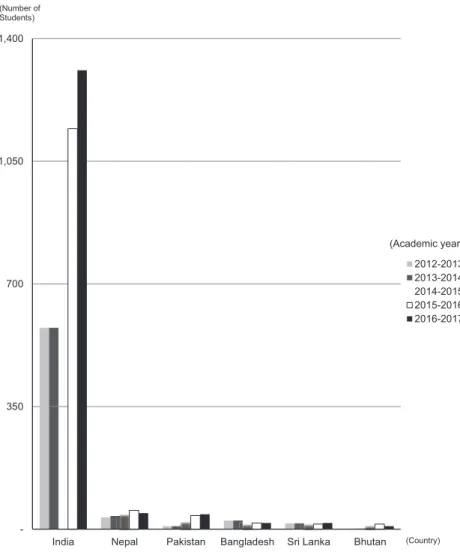
Education is another area that deserves more attention. One of objectives of the New Southbound Policy is to attract more students from ASEAN and South Asian countries to study in Taiwan and en-courage more local students to study or conduct research in target countries. In March 2017, the MOE announced the “New Southbound Talent Development Program (新南向人才培育計畫),” committed to mobilize 1 billion NT Dollars (US$3.3 million) to funding projects aiming at promoting education cooperation with New Southbound Policy target states. As a matter of fact, in academic year 2016-17 (starting from September 2016), the number of students from South Asian countries significantly increased to 1,444, with 1,310 from India, 46 from Nepal, 43 from Pakistan, 18 from Sri Lanka and Ban-gladesh, and 9 from Bhutan. With more financial sponsorship from the MOE, local universities and colleges are more willing to recruit outstanding students from South Asia through scholarships and grants (see Figure 2).
-350 700 1,050 1,400
India Nepal Pakistan Bangladesh Sri Lanka Bhutan
2012-2013 2013-2014 2014-2015 2015-2016 2016-2017 (Number of Students) (Country) (Academic year)
Figure 2: Registered Students from South Asian Countries 2012-2017
Source: Ministry of Education, R.O.C.(Taiwan),〈全國大專校院境外生生 活資訊網〉, August 10, 2017, Accessed, Ministry of Education,
R.O.C.(Taiwan), <https://ois.moe.gov.tw/fs/html/StatisticSearchD.
3. Trade Promotion
Taiwan External Trade Development Council (TAITRA), a semi-official agency promoting trade and investment, has been the major player since the inception of the New Southbound Policy. In April 2017, under the leadership of Chairman James C. F. Huang, TAITRA set up the India Research Center to help open and explore the Indian market for Taiwanese industries. James Huang also promised to set up an Indian project team under the center to provide customized services through industrial trade and investment, talent training, and
assistance to enterprises trying to enter the Indian market.19 In the
following weeks, TAITRA sent a number of high-level trade missions to visit India, Nepal, and Sri Lanka. At the same time, TAITRA also signed memoranda of understanding with the Federation of Chambers of Commerce and Industry of Sri Lanka and Nepal Chamber of Com-merce (NCC) in Taipei to boost economic exchanges and explore
in-vestment opportunities with both countries.20
V. Taiwan-India Cooperation
Among all South Asian countries, India remains the major target for building constructive cooperation under the scheme of the New Southbound Policy. The huge population and economic size makes India the ideal candidate for Taiwan to experiment with the new policies. In fact, the Indian government also has showed enthusiasm in strengthening relations with Taiwan since Narendra Modi became
Prime Minister in May 2014. Being the 6th largest economic entity
Keoni Everington, “Taiwan sets up India Center,” Taiwan News, April 27, 2017, <http://www.taiwannews.com.tw/en/news/3150494>.
Wayne Lee, “TAITRA inks MoU with chambers of commerce of Sri Lanka and Nepal,” May 8, 2017, TAITRA, <https://www.taiwantrade.com/news/taitra-inks-mou-with-chambers-of-commerce-of-sri-lanka-and-nepal-1302182.html>.
and the fastest growing market in the world, India has enough reasons to attract Taiwanese investment. Many in Taiwan also considered Modi’s brave reforms as a great opportunity to build a comprehensive partnership with India. Such beliefs became stronger one year later, when Tsai Ing-wen was elected the new president of Taiwan and sought to reduce Taiwan’s economic over-dependence on Mainland China. 60% of offshore investment of Taiwanese companies goes to China, and 40% of its exports go to China. In a seminar organized by the Institute of Chinese Studies in Delhi in May 2016, I-chung Lai and Mumin Chen anticipated that Taiwan had high expectations for strengthening relations with India, as the relationship between Taiwan and mainland China would become more competitive in the future.21
With Indian Prime Minister Narendra Modi’s vision of the “Make in India” and the vision of creating 100 smart cities in India, investment in these smart city projects are one of the primary requirements. India’s 100 smart cities would require an investment of over US$150 billion. As the first step towards India’s smart city project, the government already has allocated a fund of Rs.480 billion towards upgrading 500 existing Indian cities and has outlined the Atal Mission for Rejuvenation and Urban Transformation (AMRUT). Nevertheless, along with the primary concern of the funding of India’s smart city projects, one of the major challenges is with the development of these projects and the management. Moreover, it would require creating a framework to ensure adequate water supply, electricity supply, sani-tation facilities (including solid waste management), efficient public transport, housing facilities, robust IT connectivity, digitalization,
I-chung Lai & Mumin Chen, “India-Taiwan Relations under the New Southbound Policy of Taiwan,” May 4, 2016, pp. 1-3, Institute of Chinese Studies, <http:// www.icsin.org/uploads/2016/05/18/7b43c74f4182aa57f9abd6c3693e5513.pdf>.
safety and security of citizens, health and education facilities, etc. City-to-city cooperation is another integral part of the New Southbound Policy. Under this situation of booming smart city projects in India, Taiwanese investment could prove to be a welcome move for India. Taiwan has considerable experience in urban development projects and could bring its experience of urban development to help India build its smart city project. India is also one the most rapidly developing economies of the world. Therefore, Taiwan is sure to gain positive returns from investing in India’s urbanization projects. Es-tablishing city-based channels of communication between Taiwan and Southeast Asian Nations and India is another of the core missions of Taiwan’s New Southbound Policy. Taiwan also wishes to counter China’s efforts to marginalize Taiwan in the international community through its non-traditional solution of the New Southbound Policy and create alternative opportunities to enhance cooperation with its
neighbors.22Therefore, city-level cooperation between India and
Taiwan could help create a win-win situation for both India and Taiwan. As early as 2009, India and Taiwan started exploring the possibility of signing a Free Trade Agreement (FTA) through mutual governments’ consent and feasibility studies conducted by academics and researchers from both sides on behalf of the two governments. The study was assigned to Taiwan’s Chung-Hua Institution for Economic Research and the Indian Council for Research on International Economic
Re-lations and was completed in 2013.23The report revealed that
India-Taiwan cooperation has substantial potential, especially in the fields
Yi-hsuan Lu & Jake Chung, “Task force to help promote the ‘new southbound policy,’” Taipei Times, November 1, 2016, <http://www.taipeitimes.com/News/ taiwan/archives/2016/11/01/2003658346>.
of logistics, automobiles, information and communication technology, food processing, distribution and retail, and human resource
develop-ment.24Although economists from both sides highlighted the feasibility
study and called for initiating negotiations between both governments on an Economic Cooperation Agreement (ECA), the talks never started due to lack of political support from both sides. With the Modi government in India and the overemphasis on the Act East Strategy and Taiwan’s unveiling of the New Southbound Policy, the possibility of resuming ECA talks between India and Taiwan has again come to the limelight.
In the field of educational cooperation, the Foundation for In-ternational Cooperation in Higher Education of Taiwan (FICHET) and the Association of Indian Universities signed a Memorandum of Understanding (MoU) in 2010 to mutually recognize academic degrees and certificates. Since then, more Indian students have chosen to pursue higher studies in Taiwan.
When the MOE of Taiwan declared in September 2016 that Taiwan would significantly increase scholarship opportunities to attract more students from South and Southeast Asia, the news certainly encouraged Indian students to come to Taiwan for higher education. Among the university-age population in India, according to 2014 statistics, only 12-15 percent has access to higher education in universities. Thus, Indian students could benefit from these scholar-ships and undertake higher education in Taiwan. Taiwan also could
Taiwan, March 8, 2011, <http://focustaiwan.tw/news/aeco/201103080003.aspx>. Tien-sze Fang, “India-Taiwan Relations: Comprehensive Security Perspective,” Indian Defence Review, Vol. 30, Issue 4, October-December 2015, Indian Defence Review, <http://www.indiandefencereview.com/news/india-taiwan-re lations-a-comprehensive-security-perspective/>.
develop a resource base of foreign talent through these students who come to undertake higher education in Taiwan who could later promote related projects and programs of Taiwan in their respective home countries.
In February 2017, a Taiwanese delegation of members of the parliament from Taiwan and members of the Taiwan-India Parlia-mentary Friendship Association visited India and interacted with Indian parliamentarians in New Delhi. In the interaction during the delegation visit, both sides emphasized the accelerating and positive momentum in bilateral relations between India and Taiwan in several sectors. For example, Foxconn is a successful investor in India and Maxxis has expanded its reach to the western state of Gujrat. India’s vast geography, abundant untapped resources, and great market po-tential are added advantages for Taiwan to engage with India and foster a comprehensive partnership through an increased bilateral trade, investment, cultural, talent, and economic exchanges.
Although the New Southbound Policy currently may seem quite broad in its impact, it could yield positive results for both India and Taiwan if adopted and executed in a planned fashion with the support and participation of both sides, especially from the local governments. India and Taiwan historically do not possess any unresolved disputes or disagreements on border or security aspects. Both sides have a built-in trust factor; therefore, this could link the regional markets and boost the investment and infrastructure development in India through a government-level channel of cooperation and coordination.
VI. Challenges Faced by the New Southbound Policy
The primary challenge for the implementation of the New South-bound Policy is that Taiwan lacks formal diplomatic ties with any
target country in South and Southeast Asia. Therefore, Taiwan does not have bilateral ties with any of these nations. Virtually all governments in both regions stand by the “One China” Policy, meaning they all recognize the People’s Republic of China’s (PRC) position on the status of Taiwan. In addition, Beijing actively has strengthened links with many South and Southeast Asian states through the OBOR Initiative, which may obstruct Taiwan’s ambitions in both regions. Two universities in the Philippines have discarded a proposal by National Sun Yat-sen University, Taiwan, for setting up a Southeast Asian research center. The lack of success in this project was attributed to the fact that Chinese universities have much stronger resources to
invest in such institutes, making it difficult for Taiwan to compete.25
A more substantial challenge is how the Taiwan government formulates appropriate strategies to build constructive cooperation with South Asian countries since Taiwan’s connections with those countries have been weak. Among all South Asian countries, only India has maintained official contacts with Taiwan and falls into the list of Taiwan’s top-20 trade partners. Even though Taiwan and India have signed 12 agreements, none of them have been signed through governments. Lack of direct diplomatic and political relations has remained an issue hindering more ambitious and effective cooperation between both countries.
The main test with the New Southbound Policy, however, still lies in the successful realization of the policy in the region by looking back at the previous southbound policies initiated by Taiwan at earlier stages to avoid retreading old ground. Further, it is a challenge for
Jermyn Chow, “Taiwan’s ‘pivot south’ policy faces obstacles,” The Straits Times, August 14, 2017, <http://www.straitstimes.com/asia/east-asia/taiwans-pivot-south-policy-faces-obstacles>.
Taiwan to sustain the policy initiative long-term and not just limit it to the current period in order to seek immediate gains.
VII. Policy Recommendations for the New Southbound
Policy in South Asia
The New Southbound Policy should aim at signing more bilateral economic and trade agreements and MoUs with partner nations, clearly defining the terms for cooperation emphasizing its own ad-vantages, thereby promoting a mutually-beneficial development path in the regional community. The New Southbound Policy may focus on the asymmetries in the southbound region in order to attain deeper integration of power and regional policy formulation space.
India has been one of the prime foci of Taiwan’s New Southbound Policy, as reiterated by Taiwan President Tsai Ing-wen and other Taiwanese ministers and scholars on several occasions. Therefore, in light of the importance of Taiwan-India cooperation under the scope of the New Southbound Policy, Taiwan can initiate a biennial meeting of ministers/special envoys from both sides in order to engage in dialogue and discuss the primary barriers faced by both in real-time practical experiences and figure out a working solution towards the challenges faced. This also may reduce the probability and pre-valence of conflict and provide for maintenance of regional peace and security. Finally, consistent proper communication also would help in case of any socio-economic disputes.
Taiwanese enterprises have huge potential in tapping the Indian electronics market. Foxconn, one of the largest hardware manufacturers in the world and responsible for manufacturing the Apple phones and iPad, recently declared an investment of UD$5 billion for the Indian market. Other Taiwanese investors also have penetrated deep
into the internal Indian states of Gujarat, Karnataka, and Telangana. Therefore, signing of an ECA could bring in possibilities of larger attraction and incentive for Taiwanese enterprises to shift their bases to India from elsewhere. Perhaps it is a good time for both governments to reconsider initiating ECA talks.
Indian Bollywood movies have a special place in the hearts of many Taiwanese people. President Tsai Ing-wen, during her opening statement in the interview with journalists from India and other Asian countries in May 2017, referred vividly to the Indian film industry and the popular Indian movie called “3 Idiots,” which she had ex-perienced during her visit to India in 2012. Recently, other popular Indian movies, like “Dangal” and “Bahubali,” also have won the hearts of Taiwanese people. Since more Indian Bollywood producers are looking for foreign destinations for filming and since countries where these movies are filmed are likely to attract more tourists from India, the Taiwan government and movie industries might consider signing agreements with Bollywood filmmakers, providing them with special subsidies or other privileges. Taiwan’s unique landscape of picturesque mountains and attractive beaches definitely will make Indian movie directors excited to choose the island as destination for film shooting. As Bollywood movies are popular in the other South Asian states of Bangladesh and Pakistan, films “made in Taiwan” will certainly bring in a huge increase in inbound tourists to Taiwan from South Asia and also get Taiwanese people more interested in India. As for cooperation with other South Asian countries, the Taiwan government may choose to take advantage of its unique skills and strengths, like developing talent in agriculture and food-processing sectors, to provide certain knowhow to initiate certain programs in the region. Public health or disaster relief and management are areas with potential for building partnership since such areas generally
would not be focused on by mainland China in the South Asian region. Therefore, Taiwan would have a unique edge over other com-petitors in the region. In September 2016, Taiwan and India signed a MoU on agricultural cooperation, the first formal agreement in agricultural cooperation with a South Asian country in history. Taiwan’s non-governmental organizations also send more than 1,000 volunteers to Nepal every year to conduct projects in the areas of disaster relief, primary education, and public health. Projects like these mean Taiwan is capable of building a new people-centric partnership, the spirit evinced by President Tsai when she first introduced the New South-bound Policy.
Finally, the New Southbound Policy may consider bringing in further reforms in visa policy with respect to international students, foreign employees, and their families who wish to join Taiwanese enterprises located in Taiwan, since the current visa restricts foreign talents from staying in Taiwan for employment purpose. The government has revised regulations allowing citizens from ASEAN countries to stay in Taiwan for employment purpose but such rules are not applicable to South Asian states. Only by recruiting more young talent to Taiwan from South and Southeast Asia, the island state would be able to maintain a substantial workforce at home and develop in-depth connections with abroad.
References
English
Book Articles
Chen, Mumin, 2015. “Taiwan-India Relations Under the Shadow of a Rising China,” in G.V.C. Naidu, Mumin Chen, & Raviprasad Narayanan, eds., India and China in the Emerging Dynamic of
East Asia. New Delhi: Springer. pp. 43-58.
Journal Articles
Kuo, Shirley W. Y., & Christina Y. Liu, 1999/5. “The Development of the Economy of Taiwan,” Asia-Pacific Economic Literature, Vol. 13, Issue 1, pp. 36-49.
Online Resources
2009/7/1. “Foreign ministry closes its rep office in Bangladesh,”
China Post, <http://www.chinapost.com.tw/taiwan/foreign-af
fairs/2009/07/01/214399/foreign-ministry.htm>.
2016/7/14. “Taiwan-ASEAN investment forum wraps up in Taipei,”
Taiwan Today, <http://taiwantoday.tw/news.php?unit=6,346&
post=12528>.
2017/5/7. “Tsai briefs Asia media on ‘new southbound policy,’”
Taipei Times, <http://www.taipeitimes.com/News/taiwan/archives/
2017/05/07/2003670116>.
Bureau of Trade R.O.C.(Taiwan), 2017/8/10(accessed). “Trade Statistics,” Bureau of Trade R.O.C.(Taiwan), <http://cus93.trade. gov.tw/FSCE000F/FSCE000F>.
Chen, John, 2017/2/27. “People-centred orientation key to New South-bound Policy,” The Jakarta Post, <https://www.pressreader.com/ indonesia/the-jakarta-post/20170227/2819 38837692070>.
obstacles,” The Straits Times, <http://www.straitstimes.com/asia/ east-asia/taiwans-pivot-south-policy-faces-obstacles>.
Everington, Keoni, 2017/4/27. “Taiwan sets up India Center,” Taiwan
News, <http://www.taiwannews.com.tw/en/news/3150494>.
Fang, Tien-sze, 2015/10-12.“India-Taiwan Relations: Comprehensive Security Perspective,” Indian Defence Review, Vol. 30, Issue 4,
Indian Defence Review, <http://www.indiandefencereview.com/
news/india-taiwan-relations-a-comprehensive-security-perspec tive/>.
Glaser, Bonnie S., Matthew P. Funaiole, & Emily Jin, 2017/4/1.“Un-packing Tsai Ing-wen’s New Southbound Policy: Can Taiwan’s latest attempt to avoid economic dependence on China success?”
The Diplomat,
<http://thediplomat.com/2017/04/unpacking-tsai-ing-wens-new-southbound-policy/>.
Ho, Horn-ru & Y. F. Low, 2011/3/8. “Taiwan, India explore feasibility of FTA,” Focus Taiwan, <http://focustaiwan.tw/news/aeco/2011 03080003.aspx>.
Hsu, Stacy, 2016/9/23. “Tsai elaborates on ‘southbound policy,’”
Taipei Times, <http://www.taipeitimes.com/News/front/archives/
2016/09/23/2003655743>.
Lai, I-chung, & Mumin Chen, 2016/5/4. “India-Taiwan Relations under the New Southbound Policy of Taiwan,” Institute of
Chinese Studies, <http://www.icsin.org/uploads/2016/05/18/7b43c
74f4182aa57f9abd6c3693e5513.pdf>.
Lee, Wayne, 2017/5/8. “TAITRA inks MoU with chambers of com-merce of Sri Lanka and Nepal,” TAITRA, <https://www.taiwan trade.com/news/taitra-inks-mou-with-chambers-of-commerce-of-sri-lanka-and-nepal-1302182.html>.
Liang, Yuan-Ling, 2016/9/5. “New Southbound Policy Q&A,” The
News Lens, <https://international.thenewslens.com/article/48439>.
Lu, Yi-hsuan & Jake Chung, 2016/11/1. “Task force to help promote the ‘new southbound policy,’” Taipei Times,
<http://www.taipei-times.com/News/taiwan/archives/2016/11/01/2003658346>. Meltzer, Joshua, 2014/1. “Taiwan’s Economic Opportunities and
Challenges and The Importance of the Trans-Pacific Partnership,”
East Asia Policy Paper Series, No. 2, The Brookings, <https://
www.brookings.edu/wp-content/uploads/2016/06/taiwan-trans-pacific-partnership-meltzer-012014.pdf >.
Ministry of Foreign Affairs, R.O.C.(Taiwan), 2017/1/3. “New South-bound Policy energies Taiwan tourism industry,” New SouthSouth-bound
Policy Portal, <http://nspp.mofa.gov.tw/nsppe/content_tt.php?
post=106647&unit=346>.
Planning Commission, Government of India, 2014/12/22. “Fact Sheet on Foreign Direct Investment: From April 2000 to September 2014,” Planning Commission, Government of India, <http://plan ningcommission.nic.in/data/datatable/data_2312/Databo okDec2014%20123.pdf>.
Stuart, Conor, 2016/10/28. “Opportunities and Challenges: Taiwan’s New Southbound Policy,” IP Observer, <http://en.naipo.com/ Portals/0/web_en/Knowledge_Center/Feature/IPNE_161028_ 0703.htm>.
Taipei Economic and Culture Office in India, 2016/9/26. “Taiwan relaxes visa rules for nationals of six ASEAN members and India,” Ministry of Foreign Affairs, R.O.C.(Taiwan), <http:// www.roc-taiwan.org/in_en/post/2136.html>.
Yeh, Sophia & Ko Lin, 2017/5/5. “Taiwan’s Southbound Policy not about competing with China: Tsai,” Focus Taiwan, <http://fo custaiwan.tw/news/aipl/201705050031.aspx>.
Chinese
Online Resources
Mainland Affairs Council, R.O.C.(Taiwan), 2013/2/21. “Table 1 Trade between Taiwan and Mainland China,” Cross-Strait Economic
Statistics Monthly, No. 238, Mainland Affairs Council, R.O.C. (Taiwan), <http://www.mac.gov.tw/public/Attachment/322015413
549.pdf>.
Ministry of Education, R.O.C.(Taiwan), 2017/8/10(accessed).〈大專
校院境外學生在臺留學∕研習人數—按國別分 2014-2015〉,
Ministry of Education, R.O.C.(Taiwan), <https://ois.moe.gov.tw/
fs/html/Statistics.html>.
Ministry of Education, R.O.C.(Taiwan), 2017/8/10(accessed).〈全國 大專校院境外生生活資訊網〉, Ministry of Education, R.O.C.