英文摘要
Exploring theories that explain the accumulation of National Intellectual Capital, Structural Capital and Relational Capital
Recently, more and more countries began to realize that intangible assets and organizational intellectual capital has become the key to sustainable competitiveness in the hyper competition era. Up to the present, European scholars are in the forefront and invested a lot of time and resources in this field of study. Particularly, they have advanced from organizational level study to the national level study. Inspired by them, I have also devoted my research resources in national level intellectual capital study and proposed a statistically validated national intellectual capital model.
In the first year, I have explored the national intellectual capital of 40 countries, consisting of human capital, market capital, process capital, renewal capital and financial capital. The research results have been published by Springer Publishing Company, please refer to the book introduction in the section ―Summary of the Three Years Project‖ reported hereunder.
In the second year, this research focused on the rarely studied ―structural capital‖ formation process. As a result, a series of theoretical bases was proposed and was applied to three case hospitals to see whether the proposed theories are applicable. In the third year, the research focus is on the ―relational capital‖ formation process. Again, a series of theoretical bases was proposed and was applied to the same three case hospitals to see whether the proposed theories are applicable.
The formation and deepening of a research stream requires a group of scholars‘ long-term devotion and ongoing publication for a more mature system. With the sponsorship of National Science Council, our intellectual capital research community has been gradually formed.
Key words: intellectual capital, structural capital, relational capital, and research community
目錄
The Third Year Report ... 1
I. Definition of relational capital ... 2
II. The importance of social/relational capital ... 4
III. Dynamic of Relational Capital ... 5
IV. Methods ... 8
V. Top-down approach – Extensive literature review ... 8
VI. Bottom-up approach – In-depth interview of 3 hospitals ... 9
VII. Conclusion ... 14
VIII. References ... 14
Summary of the Three Years Project ... 17
國科會補助專題研究計畫成果報告自評表 ... 24
Exploring theories that explain the accumulation of National
Intellectual Capital, Structural Capital and Relational Capital
(NSC 2007- 2010 Project Final Report)
Yeh-Yun Lin, National Chengchi University December 2010
This report contains two parts, the third year research results and a summary of the three-year 2007-2010 project report, entitled ―Exploring theories that explain the accumulation of National Intellectual Capital, Structural Capital and Relational Capital‖. The third year results are presented first, followed by the summary of the three year project report.
The Third Year Report
In year 2009-2010, exploring how organizations build external ―relational capital‖ is the focus. An immediate theory connection is that ―networking theory helps create and accumulate relational capital‖; yet, other theories should also explain the creation and accumulation of this external capital from different perspectives. The two main purposes of this study include:
1. Investigate the relational capital for how to create and accumulate this capital.
2. Explore theory connections beyond network theory
Since intellectual capital examines intangible assets, this study targets on the healthcare industry for case studies. Two approaches are employed during this year. Sorting existing theories for rational inferences is a top-down approach. A bottom-up approach of three case hospitals – Wan Fang, Far Eastern, and Tsuchi helps unveil the factors that formalize relational capital. Since the focus of the third year study is ―relational capital‖, the following literature review will be limited to relational capital only.
I. Definition of relational capital
Relational capital (some named it social capital) is an important component of intellectual capital, it has been regarded as a major source of competitive advantage in the ―knowledge economy‖ (Stewart, 1997; Edvinsson & Malone, 1997; Bontis, 1998), and involves the relationships between individuals and organizations that facilitate action and create value (Adler & Kwon, 2002; Prusak & Cohen, 2001). Relational capital can be understood as a component of ―social capital‖ (Nahapiet & Ghoshal,1998) specially focused in the network of relations established by the organization and its environmental agents. More specifically, Dirk & Harry (2006) define relational capital as the extent to which exchange involves trust, social interaction and shared norms or goals. In what follows, we first review the concept of social capital and then focus on relational capital.
As with many social science terms, defining social capital is rather problematic. From human relations perspective, Loury (1977) defined social capital as the set of resources that inhere in family relations and in community social organizations that are useful for the cognitive or the social development of a child or a young person. Cohen and Prusak explained that social capital consists of ―the stock of active connections among people: the trust, mutual understanding and shared values and behaviours that bind the members of human networks and communities and make co-operative action possible.‖ The definitions highlight that the building block of social capital lies in the dyadic relationship between two individuals.
From organizational relations perspective, Nahapiet and Ghoshal (1998) advocate that social capital is the sum of the actual and potential resources embedded within, available through, and derived from the network of relationships possessed by an individual or a social unit. It refers to the structural, relational and cognitive dimensions of the network of social relationships that comprise a given firm‘s set of transactions (Nahapiet and Ghoshal, 1998). In addition, Coleman (1990) explained that social capital is created to fulfill a specific function. That is, social capital is the fiber of the process of conversion of human capital into intellectual capital. Coleman (2000) further commented that it is not a single entity but a variety of different entities, with two elements in common: they all consist of some aspect of social structures, and they facilitate certain actions of actors—whether persons or corporate actors—within the structure. Another function of social capital is seen as the context within which a
―sense of belonging‖ is created. Like other forms of capital, social capital is productive, making possible the achievement of certain ends that in its absence would not be possible. Unlike other forms of capital, social capital inheres in the structure of relations between actors and among actors.
Relational capital can be defined as ―the value of the relations that an organization maintains with the different agents of its environment‖, including interrelations with customers, suppliers, strategic alliances, corporate reputation, or links to other agents (Euroforum, 1998). Table 1 shows, as a summary, some of the theoretical proposals focused on identification and measurement of relational capital.
Table 1 Relevant studies on relational capital Kaplan and Norton
(1992) Customer perspective Edvinsson and Malone (1997) Customer capital Brooking (1996) Market assets Sveiby (1997) External structure Euroforum (1998) Relational capital 1.Image and reputation 2.Customer relationship quality 3.Services/products‘ attributes 4.Market share 5.Customer loyalty 6.Customer satisfaction 1.Customer type 2.Customer duration 3.Customer role 4.Customer support 5.Success with customers 1.Brands (product) 2.Customers (type, loyalty, network motivations) 3.Corporate image 4.Distribution 5.Corporate collaborative agreements 1.Customer segmentation 2.Customer base growth 3.Customer efficiency 4.Customer base stability 1. Customer (loyalty, relationship, satisfaction, time to market, etc.) 2. Brand name recognition 3.Corporate name 4.Strategic alliances 5.Interrelatedness with other agents
Relational capital is the quality of human relations within some well-defined social group that enables members of this group to act in cooperation with one another for achieving mutual benefits (Putnam, 1993). More formally, it is the ‗‗features of social organization such as networks, norms and social trust that facilitate cooperation and coordination for mutual benefit‘‘ (Putnam, 1993). From the statements above, we may understand that the concept of social/relational capital was created to describe social relations of both familiar and non-familiar people, a feature of the social structure rather than the individual actors within the social structure (Lochner et al.,
1999, p. 260). For the World Bank, social capital is the ‗glue that holds society together‘ (World Bank web site). For the ease of description, this study uses social capital and relational capital interchangeably.
II. The importance of social/relational capital
Social/relational capital is composed of three dimensions, namely structural, relational, and cognitive dimensions (Nahapiet and Ghoshal, 1998). According to this view, the structural dimension of social capital includes social interaction. The location of an actor‘s contacts in a social structure of interactions provides certain advantages for the actor. People can use their personal contacts to get jobs, to obtain information, or to access specific resources. The relational dimension of social capital, in contrast, refers to assets that are rooted in these relationships, such as trust. Trust can act as a governance mechanism for embedded relationships. The third dimension of social capital, which Nahapiet and Ghoshal (1998) called the cognitive dimension, is embodied in attributes like a shared code or a shared paradigm that facilitates a common understanding of collective goals and proper ways of acting in a social system. Such a common understanding is appropriable by the collectivity as a resource.
Besides, some scholars regard social capital as both internal and external (Hitt, Lee & Yucel, 2002). Internal social capital is concerned with the relationships between strategic leaders and those whom they lead as well as relationships across all of an organization‘s work units. Effectively designed and integrated relationships enable members to collaborate in ways that contribute to creating and using competitive advantages (Cross, Nohria & Parker, 2002). External social capital is concerned with the relationships between strategic leaders and those outside the organization with whom they interact to further the firm‘s interests. Increasing competition in the twenty-first century‘s dynamic competitive landscape has caused relationships with parties outside the organization to become important for all types of firms-large and small, new and established, and so forth (Gulati, Nohria & Zaheer, 2000).
Social capital is a valuable asset for managing inter-organizational relationships since it constrains a firm‘s partners to be more cooperative. Those organizations that possess less social capital are required significantly greater time and efforts to monitor
the relationships. In addition, those with less social capital will suffer more difficulties when building an enduring history of effective cooperative behavior (Walker, Kogut& Shan, 1997). Walker et al. (1997) also indicate that if a firm is available to more social capital, it needs fewer resources to manage existing relationships. Thus, the firm can make use of the remained resources to establish new ones. Nahapiet & Ghoshal (1998) and Tsai & Ghoshal (1998) have considered social capital as a broadly defined-dimensional construct that can contribute in many ways to the creation of new value for an organization (Tsai, 2000).
Social capital aids to adaptive efficiency and to the creativity and learning it implies.Moreover, social capital encourage cooperative behavior, thus facilitates the development of new forms of association and innovative organization. It is suggested that social capital helps to expedite the efficiency of information diffusion through minimizing redundancy. Thus, it reduces the costs of transactions. And social capital is one of the most important sources of values that contribute to the growth of an organization. Enabling people to act collectively (Woolcock & Narayan, 2000), social capital reflects the value of relationships (Nahapiet & Ghoshal, 1998) and is the quality among people and organizations. Often, social capital entails a web of relationships that includes norms, values and obligations, but also yields potential opportunities for the holders of the capital (Haley & Haley, 1999).
For the most parts, social capital is like other forms of human capital: its owner will obtain higher wages than someone who does not have social capital and its value is determined by the costs of replacing it (Mortensen & Vishwanath, 1994; Sherer, 1995). Social capital, however, can be transferred to others, whereas most forms of human capital can‘t be transferred.
III. Dynamic of Relational Capital
The concept of dynamic intellectual capital has much to do with a firm‘s strategy and business environment. That is, the contents and features of intellectual capital differ, depending on the firm‘s ways and possibilities for creating added values, and also depending on the business environment in which it functions. Thus, dynamic intellectual capital is a strategy-linked concept. What creates value for one company does not necessarily create value for another.
produced by the capability to act in all these business environments, the output of which might be patents, trademarks, business applications and other intangible assets. These properties often need to be protected from competitors. On the other hand, dynamic IC is the ability of an organization.
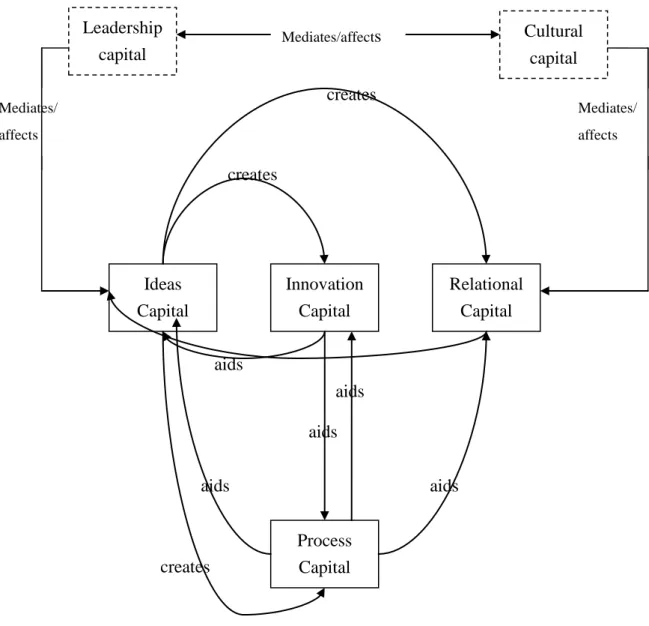
The intellectual capital model describes the firm‘s intellectual assets in terms of three distinct elements (Bontis, 1998; Edvinsson & Malone, 1997; Johnson, 1999; Saint-Onge, 1996; Stewart, 1997). These include human, structural and relational capital. The basic elements of each of these, and their hypothesized interactions with one another, are illustrated in the following figure (adapted from Johnson, 1999). Leadership and ideas capital represent components of human capital, elements that constitute the intellectual value of human beings in the firm. Because all innovation comes from the intellect or knowledge sets of human beings, it is apparent that all intellectual capital originates first as human capital. Thus, knowledge sets, or ideas, are the basis for all intellectual capital development. Innovation and process capital represent components of structural capital, elements that constitute the legal and process value of the firm. Relational capital is moderated by cultural capital and both of these intellectual capital elements represent the knowledge needed to provide ongoing value-added relations with customers, suppliers and societal stakeholders. To this extent, relational capital is affected by the organization‘s cognitive lenses, often referred to as frames of reference (March & Simon, 1985) or cognitive maps (Weick & Bougon, 1986).
In the figure, there is no element of intellectual capital by itself creates ongoing value for the firm, but its value creating only when interacting with other elements of the intellectual capital model.
Figure 1 An interactive system of intellectual capital elements
From the above literature review, we know that relational capital can be tackled from various perspectives with various dimensions. As relational capital mainly resides in employees, it is difficult to transfer from the individual relationship to company-kept relationship. This researcher attempts to build a relational capital model that can detect and guide the creation and accumulation of this very important capital. The rationale for focusing on the healthcare industry is hospital management relies a lot on intellectual capital, and a hospital‘s relationships with the patients, with the communities, and with the professional associations are very complicated that provide an ideal research ground for this type of study.
Basically, the semi-structured in-depth interviews will explore case organization‘s relational capital from stakeholders‘ viewpoint including employees‘
Leadership capital Cultural capital Ideas Capital Innovation Capital Relational Capital Process Capital Mediates/affects Mediates/ affects Mediates/ affects creates creates aids aids aids aids creates aids
willingness and commitment to sustain and create relational capital, involvement in professional community, external alliance or partnership, regular external social events, transferring from individual ties to organizational ties, and the preliminary model build through the top-down literature review.
IV. Methods
As described in the project proposal, health care industry is the target of this third year study. Three hospitals, namely Wan Fang Hospital, Far Eastern Memorial Hospital, and Tsuchi Hospital have been selected as the case hospitals. Semi-structured in-depth interviews were conducted to explore their cognitive, structural and relational dimensions of relational capital (Nahapiet and Ghoshal, 1998).
As both top-down and bottom-up approaches were adopted to investigate the accumulation of structural capital, the preliminary results of both approaches are described hereunder.
V. Top-down approach – Extensive literature review
After a comprehensive review of relevant theories, the following theories from cognitive, structural, and relational stage may contribute to the accumulation of relational capital.
Cognitive stage:
Goal-setting theory Social cognition theory Expectancy theory
Structural stage:
Resource dependency theory Social exchange theory
Relational stage:
Networking theory Social capital theory
VI. Bottom-up approach – In-depth interview of 3 hospitals
The following table summaries the interview results based on cognitive, structural and relational dimensions of relational capital.
Relational capital based on the interview scripts and archive data of three hospitals Relational
Capital components
Wan Fang Hospital Far Eastern Memorial Hospital
Tsuchi Hospital
Cognitive 1. Patient-centered and community based medical care 2. WF emphasizes the humanity side of medicine 3. WF aggressively attend relevant award competition for improving operational process and for social recognition
1. FE performs
team-based medical service to build up the performance and reputation for patient‘s satisfaction 2. Customer and
stakeholder focused relations management 3. Use innovation for
surgery advancement that attracts more patients
1. Tsuchi is volunteer based system that enlarges the connectivity with the mass amount of citizens
2. The top
management team aims to serve rather than cure the patients
Structural 1. The physical setting is very inviting (such as having 9 art exhibition halls), manifesting that WF is a warm hospital that is an integral part of the whole
community
2. Build ―patient security information system‖ to help improve
1. Improve medical technology for higher patients‘ satisfaction 2. Regular external
social events 3. Project team design
for easier external alliance
4. Join-development program with internal team (such as heart
1. Tsuchi is mainly women-based volunteers, who either donate money or time 2. Initially, Tsuchi hospital was supported by a group of Chang Gung hospital doctors
patient care
3. Develop various kinds of indicators for self examination and has become other‘s benchmark in the medical industry 4. WF is a teaching hospital commissioned by Taipei City government, therefore we have many stakeholders 5. WF has a community service team
and kidney transplant teams) and NTU hospital
5. Develop
technological trend that meets patients‘ needs
3. Tsuchi group has its own TV channel
Relational 1. Doctor is required to call the patient who has abnormal health check result for proper explanation and follow up check 2. Ambulance companies
and drivers are also stakeholder for emergency delivery 3. WF sends free meals
to aged single resident every day in the community 4. WF sends medical
consulting team for free community
service, which covered
1.Employees‘ willingness and commitment to sustain and create relational capital 2.Treat patients as parents
3.Build good internal relationship first 4.Apply for a MRT FE station near the hospital
1.A 1.A lot of volunteers are doing service in the hospital
2.Doctors and volunteers do free community service 3.Tsuchi‘s volunteers comfort the last mile patient with Buddha prayer
7 areas with 32 local clinics
From the summary of the above table, Figure 2 was drawn to delineate the formation of relational capital with the theories that apply to its stage development. 1. Stage one – cognitive perspective
Intentional relational capital creation starts with needs for additional relational capital.
stage 1.1 – goal-setting theory
In the creation process, setting the goal regarding what type of relationship with whom is very important. Therefore, goal-setting theory initiates the relational capital creation process.
stage 1.2 –social cognition theory
The above goal needs to be socially recognized by the top management team and all the organizational members, that is when social cognition theory comes in. With the cognition, consensus of organizational goal should be reached and the platform for achieving the goals should be built.
stage 1.3 –expectancy theory
The actual relational capital formulation should be processed through people, that is each relevant individual should understand what to achieve, how to achieve it, and what to expect. This is when expectancy theory comes in.
2. Stage two – structural perspective
Once the goal is set, members accept the direction, and there is clear expectation, organizations need to construct the matching environment and policies for goal achievement. That is, the structural perspective of relational capital should build the essential platform.
stage 2.1 –resource dependency theory
With the prospect, what resources are needed and who owns the resources have to be identified and approached. In other words, matching resources need to be ready to build the desirable relational capital. This is when resource dependency theory comes in.
After the resources are identified, social exchanges may be required for building the relationship. This is when social exchange theory comes in.
3. Stage three – relational perspective
stage 3.1 –networking theory
With organizational goal, members‘ cognition and expectation, identified resources, and whom to exchange the resources, organizations need to actually network to obtain relational capital. This is when networking theory comes in.
stage 3.2 – social capital theory
After the above stated processes, organizations should be able to obtain the desirable relational capital. Yet, the approaches advocated by social capital theory have to be attended to. This is when social capital theory comes in.
How Figure 2 model works for relational capital creation and accumulation is elaborated hereunder with the evidences from the three hospitals.
1. Stage one – cognitive perspective
stage 1.1 – goal-setting
Wan Fang – to become patient-centered and artistic hospital, to participate
relevant award competition for self-renewal and for publicity
Far Eastern – to become patients‘ best choice for heart surgery, through medical
technology advancement, internal medical team co-development, and external alliance
Tsuchi – volunteer based system that enlarges the connectivity with the mass
amount of citizens
stage 1.2 –social cognition
All three hospitals have successfully built the image they expect to project to the general public, through the organizational culture and members‘ manifested behaviours.
stage 1.3 –expectation
All three hospitals have achieved their original expectation to a certain degree:
Wan Fang – its reputation has been firmly established that WF has successfully
acquired another 1,300-bed hospital.
Far Eastern – contrary to the discipline-centered and doctor-centered tradition, FE
a team and perform equal quality care following the standard operation procedure; the kidney doctors and heart doctors are working closely together for better kidney and heart transplant surgery.
Tsuchi –Tsuchi has successfully projected an image of a very caring hospital. Its
volunteers comfort the last mile patients with Buddha prayer, which is appreciated by the family members.
2. Stage two – structural perspective
stage 2.1 –resource dependency
Wan Fang – Taipei Medical School, Taipei city government, and the local
community
Far Eastern – well-trained medical doctors from National Taiwan Hospital and
nurses, Far Eastern group
Tsuchi – citizens and volunteers, Tsuchi received huge donation including money
and volunteers‘ time
stage 2.2 – social exchange theory
Wan Fang – Taipei Medical School supports well-trained doctors and WF
provides internship opportunities for the medical school resident-students; WF runs the hospitals for Taipei city government in exchange for government resources; WF conducts regular free medical consulting services in local communities to boost its reputation for more patients
Far Eastern – teach doctors of other hospital for the developed advanced surgery
technology to obtain recognition and to attract more qualified doctors (FE is a relatively new hospital)
Tsuchi – to attract patients that need more service; the volunteers are ranked into
different levels according to their donation of either money or time 3. Stage three – relational perspective
stage 3.1 –networking
Wan Fang – WF uses the following measures to do network for better hospital
performance in addition to the required medical care: a. art gallery
b. free community medical service and free meals for the community aged single residents
d. acquire qualified doctors from Taipei Medical School
Far Eastern –uses the following measures to do network for better hospital
performance in addition to the required medical care: a. advanced surgery technology
b. more comprehensive medical care
c. external alliance with National Taiwan Medical School d. successfully apply for a MRT FE station near the hospital
Tsuchi –uses the following measures to do network for better hospital performance
in addition to the required medical care: a. own a TV channel
b. provide the opportunity for the petty citizens to fulfil their wish for doing something good to the society
c. volunteers invite more volunteers to do the service d. comfort the last mile patients with Buddha prayer
stage 3.2 – social capital
Wan Fang – nearby communities are the sources of its social capital
Far Eastern – very qualified internal and external medical teams are the sources
of its social capital
Tsuchi – huge amount of volunteers is the most important source of its social
capital
VII. Conclusion
This third year study focuses on conducting a comprehensive literature review to identify relevant theories that explain the accumulation of relational capital. As a result, a total of seven theories were identified at the cognitive, structural, and relational dimension for an organization to progressively create and accumulate relational capital. Three hospitals were selected to examine the application of the identified theories. Apparently, events reported in the hospital interviews prove the applicability of the Relational Capital Formation Model proposed by this study.
VIII. References
Adler, P. S. and S. W. Kwon.(2002) ―Social Capital: Prospects for a New Concept,‖ Academy of Management Review, 27, 17-40.
Bontis, N. (1998). Intellectual capital: An exploratory study that develops measures and models. Management Decision, 36(2)
Coleman, J.S. (1990), Foundations of Social Theory, HUP, Cambridge, MA.
Coleman, J.S. (2000), Social capital in the creation of human capital, in: P. Dasgupta, I. Serageldin (Eds.), Social Capital: A Multifaceted Perspective, World Bank, Washington, DC, pp. 13–39.
Cross, R., Nohria, N., & Parker, A . (2002). Six myths about informal networks-and how to overcome them. MIT Sloan Management Review, 43(3), 67-75. Dirk De Clercqa, Harry J. Sapienzab (2006),―Effects of relational capital and
commitment on venture capitalists‘ perception of portfolio company performance, Journal of Business Venturing Vol.21 pp.326–347. Edvinsson, L. and Malone, M.S.(1997),Intellectual Capital. Realizing your
Company‘s True Value by Findings Its Hidden Brainpower,1st ed.,HarperCollins Publishers, New York, NY.
Euroforum (1998), Medicion del Capital Intellectual:Modelo Intelect, Instituto Universitario Euroforum Escorial, Madrid.
Gulati, R., Nohria, N., & Zaheer, A.(2000). Strategic networks. Strategic Management Journal, 21, 203-215.
Haley, G.T. & Haley, U.C.V.(1999),―Weaving opportunities: The influence of overseas Chinese and overseas Indian business networks on Asian business operations‖,Westport Connecticut & London: Quorum, 149-170.
Hitt, M.A., Lee, H., & Yucel, E.(2002). The importance of social capital to the management of multinational enterprises: Relational capital among Asian and western firms. Asia Pacific Journal of Management, 19(2-3), 0217-4561. Johnson, W.H.A. (1999),―An integrative taxonomy of intellectual capital: measuring
the stock and flow of intellectual capital components in the firm‖,International Journal of Technology Management, 18(5-8), 305-360.
Lochner, K., Kawachi, I., Kennedy, B., (1999), ―Social capital: a guide to its measurement, Health and Place, 5, 259–270.
Loury, G.C., (1977), ―A dynamic theory of racial income differences‖, In: Wallace, P.A., Mund, A.L. (Eds.), Women, Minorities and Employment Discrimination. pp. 153–186. Lexington, MA: Heath.
Mortensen, Dale T. et Tara Vishwanath (1994). ―Personal Contacts and Earnings. It Is Who You Know!‖ Labour Economics, 1(2), 187-201.
Nahapiet, J., & Ghoshal, S. (1998). Social capital, intellectual capital and the organizational advantage. Academy of Management Review, 23(2), 242–266. Prusak, L.& Cohen, D (2001),―How to invest in social capital, Harvard Business
Review, 79, 86-97.
Putman, R. D. (1993). The prosperous community: social capital and public life. American Prospect, 13, 35–42.
Saint-Onge, H. (1996),―Tacit knowledge: the key to the strategic alignment of intellectual capital‖,Strategy & Leadership, March/April, 10-14.
Sherer, P.D. (1995), ―Leveraging human assets in law firms: human capital structures and organizational capabilities‖, Industrial and Labour Relations Review, 48, 671–691.
Stewart, T. (1997),Intellectual Capital:The New Wealth of Organizations, Doubleday, New York, NY.
Tsai, W. (2000),―Social capital, strategic relatedness and the formation of
intraorganizational linkages‖,Strategic Management Journal, 21(9), 925-940. Tsai, W., & Ghoshal, S. (1998). Social capital and value creation: the role of intrafirm
networks. Academy of Management Journal, 41(4), 464–476.
Walker, G., Kogut, B., & Shan, W. (1997). Social capital, structural holes and the formation of an industry network. Organization Science, 8, 109–125.
Weick, K. E., & Bougon, M. G. (1986). Organizations as cognitive maps: Charting ways to success and failure. The Thinking Organization, San Francisco: Jossey-Bass,
Woolcock, M.,& Narayan, D.(2000),―Social capital: Implications for development theory, research, and policy‖,The World Bank Research Observer, 15, 225-249. World Bank Institute. (2002). The knowledge assessment Methodology and
Scoreboards. Available from http:// www1.worldbank.org
Summary of the Three Years Project
In reflecting the purpose of this three year project (2007-2010), the expected results have been achieved. For the first year 2007-2008 study, I not only continue and deepen my national intellectual capital research but also publish a book at the third year (November 2010 by Springer New York) using my research results. Please refer to the book cover copied hereunder. In addition, I have also observed some early signs of the 2008 financial crisis from my data set and presented a paper “What national
intellectual capital indices can tell about the global economic crisis of 2007-2009?”,
in the 2nd European Conference on Intellectual Capital in March 2010 in Lisbon Portugal. I am copying hereunder the introduction of my book:
www.nic40.org
2011. XVII, 392 p. 120 illus. Hardcover
▶ 99,95 € ▶ $139.00 ▶ SFr. 143.50 ▶ £90.00
ISBN 978-1-4419-7376-4
Dr. Carol Yeh-Yun Lin, National Chengchi University, Taipei, Taiwan; Prof. Leif Edvinsson, Universal Networking, Intellectual
Capital, Norrtalje, Sweden
National Intellectual Capital
A Comparison of 40 Countries
Over the past decade a new economic landscape is emerging based on intangibles, or an evolution toward Knowledge. Knowledge assets and intellectual capital are attracting the attention of all aspects of governance in the public and private sectors. To date, most studies of intellectual capital have focused at the organizational level, with an emphasis on explaining the role of ―intangible assets‖ as a differentiator between accounting value and market value as a possible source of corporate competitive advantage.
More recently, pioneers in the field, including the authors of this book, have begun to apply these methodologies to a broader scope, with the objective of comparing the intellectual capital indices at the national or regional level. As a result, an increasing number of world organizations and researchers are commissioned to investigate this future-oriented crucial national issue. Yet, the linkage between the value of intangible assets and how to quantify or benchmark it is still tenuous, not to mention easily misunderstood by a layman for guiding better decision making.
With the belief that numbers talk and statistics hide valuable information, this book serves to present the authors‘ research findings, covering 14 years (1995-2008) of intellectual capital information.
National Intellectual Capital:
▶ Gives statistically validated reports on intellectual capital indicators for 40 countries, over a 14 year period. ▶ Identifies three major types of intellectual growth patterns.
▶ Details the impact and implications of three major types of intellectual capital growth patterns for innovation, business creation, competitiveness, growth, and development
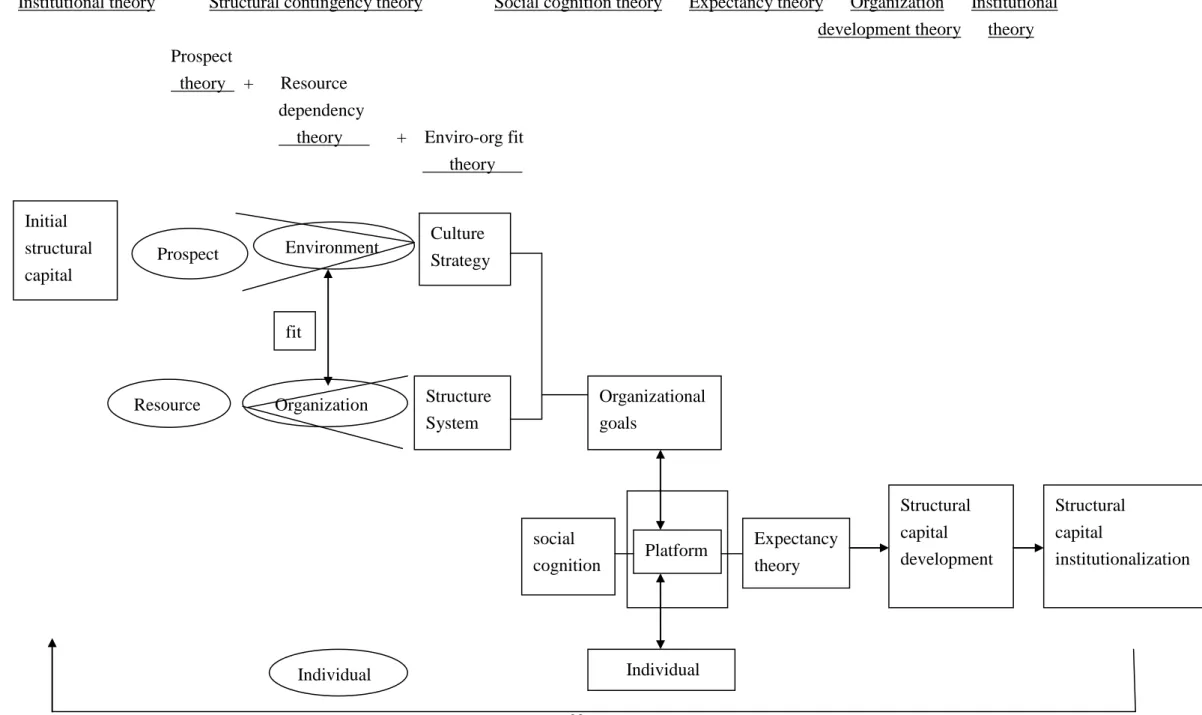
In the second year 2008-2009, I studied the less-examined structural capital and explored the theories beyond ―institutional theory.‖ Utilizing both top-down literature review and bottom-up case studies approach, I have developed a ―structural capital formation model‖ as shown in Figure 3 and delineated the six stages development as follows. Its application on the three hospitals was also reported in the second year mid-term report.
1. Stage one – institutional theory
Initial structural capital is formulated through institutionalization, such as basic infrastructure is similar in the same industry.
2. Stage two – structural contingency theory
As time goes by and conditions change, existing structural capital may erode or decrease. New structural capital building is required for companies to survive and thrive; structural contingency theory plays a role in the reformulation of structural capital. The contingency may result from the interactions of prospect theory,
resource dependency theory, and environment-organization fit theory. stage 2.1 – prospect theory
In the reformulation process, the prospect held by the organizational members is very important.
stage 2.2 – resource dependency theory
With the prospect, matching resources need to be ready to build the desirable structural capital
stage 2.3 - environment-organization fit theory
The prospect and resources have to be examined through the lenses of environment-organization fit to come up with the desirable culture, strategy, structure, and system.
3. Stage three – social cognition theory
The above structural contingency stage needs to be socially recognized by the top management team and all the organizational members, that is when social
cognition theory comes in. With the cognition, consensus of organizational goals
should be reached and the platform for achieving the goals should be built. 4. Stage four – expectancy theory
The actual structural capital formulation should be processed through people, that is each relevant individual should understand what to achieve, how to achieve it, and what to expect. This is when expectancy theory comes in.
5. Stage five – organization development theory
When all the above stated elements are ready, a period of time is required to promote, formulate, and develop the planned structural capital. Organization
development theory applies at this stage.
6. Stage six – institutional theory again
When the desirable structural capital is well developed, it has to be
institutionalized for company-wide implementation.
In the third year 2009-2010, the focus is on relational capital and the theories beyond ―networking theory.‖ Again, utilizing both top-down literature review and bottom-up case studies approach, I have developed a ―relational capital formation model‖ as shown in Figure 2 and its application on the three hospitals is reported in the first part of this report.
With my years of devotion on the research of intellectual capital from both macro and micro perspective, I have the honor to be invited as one of the international advisory board members for a Finland project - Intellectual Capital as a Driver of National Economy in Finland (please refer to the attached invitation letter).
As I have started another round of 3-year intellectual capital research from August 2010, the structural capital formation model and relational capital formation model described in this report will be tested and verified in the field. In other words, to examine whether the developed two models can actually be applied to the real organizations, new literature review, case interviews, and focus group evaluation on theories will be conducted in the following three years. Hopefully, the research results of the intellectual capital research community in Taiwan under the sponsorship of National Science Council will have better international exposure through our continuous studies and on-going paper or book publishing.
Figure 2 Process of Intentional Relational Capital Formation
Goal setting theory Expectancy theory Social cognition theory Resource dependence theory Social exchange theory Network theory Social capital theory Needs Cognitive Structural RelationalFigure 3 Structural Capital Formation
1 2 3 4 5 6 Institutional theory Structural contingency theory Social cognition theory Expectancy theory Organization Institutional
development theory theory Prospect
theory + Resource dependency
theory + Enviro-org fit theory Prospect Resource s Environment Organization n Individual Culture Strategy Structure System Organizational goals Individual Structural capital development Structural capital institutionalization Platform Expectancy theory fit social cognition Initial structural capital