科技部補助專題研究計畫成果報告
(□期中進度報告/■期末報告)
當代中國商管議題之整合研究-中國企業的國際化
計畫類別:整合型計畫
計畫編號:MOST 100-2420-H-004-005-MY3
執行期間: 2013/01/01 ~ 2014/06/30
執行機構及系所:國立政治大學國際貿易及經營學系
計畫主持人:譚丹琪
共同主持人:簡睿哲 (政大國際貿易學系), 陳寶蓮(清大科技管理研究所)
計畫參與人員:
本計畫除繳交成果報告外,另含下列出國報告,共 ___ 份:
□執行國際合作與移地研究心得報告
□出席國際學術會議心得報告
期末報告處理方式:
1. 公開方式:
□非列管計畫亦不具下列情形,立即公開查詢
□涉及專利或其他智慧財產權,□一年□二年後可公開查詢
2.「本研究」是否已有嚴重損及公共利益之發現:□否 □是
3.「本報告」是否建議提供政府單位施政參考 □否 □是, (請列舉提供
之單位;本部不經審議,依勾選逕予轉送)
中 華 民 國 103 年 9 月 29 日
一、中文摘要 本三年期計畫為總計畫"當代中國商管議題之整合研究"之下第九個子計畫。由於總 計劃的預算未得國科會的核准,僅有子計劃的人事經費和差旅費可以支用,而原先 在總計劃所列要取得中國企業資料庫的預算沒有通過,而也無法取得中國企業海外 直接投資的資料,但我們的差旅費可以讓我們接觸到中國的新創企業。因此我們修 正三年期計劃的範疇,由於國際化為中國企業帶來市場制運作的知識, 我們前兩年 聚焦在中國新創企業國際知識的取得對其成長的影響。我們比較兩種中國企業取得 先進管理及科技知識的管道: 與先進國家企業合作及雇用在先進國家受過教育或有 工作經驗的員工。研究發現,新創企業相較國營企業而言,更能從先進國家受過教 育或有工作經驗的員工雇用中受益,相反的,國營企業相較新創企業,更能從先進 國家企業夥伴取得好處。此研究發現對中新興國家企業的升級有重要的意涵。 關鍵詞:中國企業, 國際知識, 新創企業, 國營企業 Abstract
This three-year project is the 9th sub-project of the grand proposal, 當代中國商管議題之 整合研究. Because the budget of the grand proposal did not receive NSC financial sponsor, we do not have the access to the databases for Chinese enterprises (as well as their foreign direct investment). Given that a major benefit for firms that expand into foreign markets is to obtain international knowledge, which is particularly important for the upgrading of emerging market firms, we therefore re-oriented our research scope by focusing on examining how Chinese entrepreneurial firms benefit from international knowledge acquisitions. We focused on two mechanisms through which firms acquire foreign technological and managerial knowledge – collaboration with foreign firms and recruiting returnees, and examines to what extent the two mechanisms benefit emerging market firms in terms of their performance in the local market. Empirical findings indicated that privatized state-owned firms benefit more from collaboration with foreign firms, while entrepreneurial firms benefit more from recruiting returnees. These findings have important implications for emerging market firms that aspire to compete in the global marketplace.
Keywords: China, knowledge acquisition, inter-firm collaboration; returnees; privatized state-owned firms; entrepreneurial firms
二、報告內容
The following report is based on our investigation on how entrepreneurial firms benefit from international knowledge acquisition. The report is now under the second revision for International Business Review.
INTRODUCTION
Institutional transition from central planning toward an open and market-oriented economic system in many emerging economies has increased the competitive intensity of local markets and thus has pressured emerging market firms to learn new ways of doing business and to strengthen their competitive positions at home. To speed up the learning process, many emerging market firms acquire advanced technology and managerial skills from more advanced countries (Luo & Tung, 2007; Meyer & Peng, 2005; Yiu, Bruton, & Lu, 2005). The literature suggests that emerging market firms often acquire such foreign knowledge through collaboration with foreign firms and through recruitment of returnees, who are natives that have studied and/or worked in more developed countries and then returned home (Cho & Lee, 2003; Luo & Rui, 2009; Wright, Liu & Filatotchev, 2012; Saxenian, 2006). 1 It is generally observed that technological and managerial knowledge that
1 It should be noted that emerging market firms may also acquire advanced technological and managerial knowledge through other mechanisms, such as foreign direct investment (FDI), acquiring firms in more advanced countries, hiring foreign managers, spillovers from local subsidiaries of foreign MNCs, and reverse engineering. However, FDI and cross-border acquisitions incur high costs and difficulties (Coombs, Mudambi, & Deeds, 2006; Guillén & García-Canal, 2009; Kale & Singh, 2007; Kotabe et al., 2000; Kuznetsov & Sabel, 2006; Saxenian, 2006; Wright et al., 2012), and are often not a viable approach for local start-up firms, which are a major type of firm in emerging economies and a central focus of our theoretical and empirical context.
firms obtain from both collaborating partners and returnees can enhance the competitiveness of emerging market firms in the global marketplace (e.g., Dai & Liu, 2009; Filatotchev, Liu, Buck, & Wright, 2009; Garcı´a-Canal, Lo´pez Duarte, Rialp Criado, & Valde´s Llaneza, 2002; Liu, Lu, Filatotchev, Buck, & Wright, 2010; Wright, Liu, Buck, & Filatotchev, 2008).
Despite this insight, we have an incomplete understanding regarding inter-firm collaboration and returnees as sources of knowledge for emerging market firms. First, it is unclear whether technological and managerial knowledge that firms obtain from foreign partners or returnees can contribute to the firms’ competitiveness at home; after all, institutional and economic environments are substantially different between developed and emerging economies (Meyer & Peng, 2005; Peng & Luo, 2000). Best practices in developed economies might not be suitable for emerging markets (Prahalad, 2006). Second, while both
foreign partners and returnees are sources of foreign technological and managerial knowledge, they are different in several important aspects. The knowledge to be transferred is usually specified in the contractual agreement when a firm collaborates with foreign partners, but it is not made explicit when a firm hires returnees. Additionally, knowledge transfer takes place between firms in the case of inter-firm collaboration, while it occurs inside the firm when the firm recruits returnees. Thus acquiring knowledge through inter-firm collaboration and through recruitment may post different challenges to emerging market firms. Yet, the extant literature has paid little attention to the differences.
To address these issues, we investigate the impact of the two mechanisms of knowledge
Spillovers from MNEs and reverse engineering provide indirect access to foreign knowledge and are more related to learning by watching and by doing (copying), instead of learning by transferring, which is the interest of our study. Recruitment of foreign experts is not considered in this study because foreign experts who worked in emerging markets typically worked for local subsidiaries of foreign MNCs, and rarely worked for local firms in emerging markets
acquisition – inter-firm collaboration and returnee recruitment – on the performance of emerging market firms in the local market. Given that the two mechanisms may present different challenges and thus demand different organizational capabilities from emerging market firms, we posit that their impacts are contingent on the institutional origins of emerging market firms, which have important implications for the firms’ organizational capabilities (Helfat & Lieberman, 2002; Peng, 2001). In particular, we focus on firms with two distinctive institutional origins – privatized state-owned firms and entrepreneurial firms. Privatized state-owned firms are former state-owned enterprises which were privatized in the process of economic reform, and they typically inherited the organizational culture and the political, physical, and managerial resources that were established under the planned economy (Meyer & Peng, 2005; Newman, 2000; Peng & Heath, 1996). In contrast, entrepreneurial firms are new business entities that were established after the economic reform by private individuals, emerging from farmers, gray individuals, former cadres, and professionals (Newman, 2000; Peng, 2001). They usually have simpler and more flexible structures, but fewer slack resources than privatized state-owned firms (Peng, 2001).
Building on the literature on inter- and intra-organization knowledge transfer and employee mobility, we propose that privatized state-owned firms can extract more benefits from collaboration with foreign partners than entrepreneurial firms because they typically are in better bargaining positions, which could help them either to reach better terms of knowledge transfer or attract more valuable partners, than entrepreneurial firms. On the contrary, we propose that entrepreneurial firms can acquire knowledge from returnees more effectively than privatized state-owned firms because they are more able to offer a cooperative and learning internal culture that is crucial for facilitating sharing of the embedded knowledge in the returnees. Empirical evidence based on a sample of firms that
had initial public offerings (IPO) domestically and from the Zhongguancun Science Park in China provides support for the propositions. The evidence also indicates that the presence of returnees in the top management team actually reduces the benefit that emerging market firms can obtain from collaboration with foreign firms. These empirical results yield important implications for the managers of emerging market firms that are seeking to transfer foreign knowledge effectively.
This paper makes the following contributions. First, we contribute to the emerging line of research on returnees by providing empirical evidence on the positive impact of returnee recruitment on entrepreneurial firms’ performance in domestic competition, not just in global competition. Second, we advance the understanding of knowledge transfer by demonstrating theoretically and empirically how the value of knowledge transfer crucially depends on the match between the type of firm and the conduit of knowledge transfer. In particular, we show the differences between inter-firm collaboration and returnee recruitment as conduits for knowledge transfer and present evidence regarding how privatized state-owned firms and entrepreneurial firms benefit differently from them. Third, we add to the knowledge regarding the rivalry aspect of international collaboration, as our empirical results indicated that, when collaborating with foreign firms, returnees’ presence in a firm might be viewed as a competitive threat to the foreign partners, subsequently hampering the foreign knowledge transfer.
THEORETICAL BACKGROUND
Economic liberalization has led many local firms in emerging markets to actively acquire foreign technological and managerial knowledge in order to strengthen their competitive positions (Chittoor, Sarkar, Ray, & Aulakh, 2009; Elango & Pattnaik, 2007; Luo & Tung,
2007; Wang & Meyer, 2009; Xu & Meyer, 2013). In particular, inter-firm collaboration and
recruitment are two major mechanisms through which emerging market firms acquire technological and managerial knowledge embedded in more advanced countries (Dunning, 1988; Saxenian, 2006; Yamakawa et al., 2008).
Acquiring knowledge through inter-firm collaborations
Inter-firm collaboration is a contractual arrangement between the recipient and the donor firms, which explicitly specifies their exchange, sharing or co-development of knowledge that is embedded in tangible goods such as products and technologies, or intangible goods such as brands, business practices, and services. The mode of collaboration can range from contract-based agreements, such as licensing, to equity-based arrangements, such as joint ventures (Hagedoorn & Narula, 1996). Given that inter-firm collaboration is a contractual agreement over the exchange of strategic resources (including knowledge) between collaborating partners, the extent to which a firm can potentially learn from its partners may be considered as an outcome of negotiation between the partners (Luo, 1999; Yan & Grey, 1994).
However, the learning from foreign partners may not reach its potential because of the difficulties, risks, and conflicts arising during the course of collaboration. First, knowledge is more difficult to transfer when it is tacit and complex (Polanyi, 1958; Nelson & Winter, 1982; Simonin, 1999; Lane, Salk, & Lyles, 2001). To support the transfer of tacit and complex knowledge, firms often find it beneficial to develop contractual, ownership, and relational links with their collaborating partners (Chen, 2004; Dhanaraj, Lyles, Steensma, & Tihanyi, 2004). Second, inter-firm knowledge transfer is subject to the opportunistic behavior of partners (Becerra, Lunnan, & Huemer, 2008; Hamel, 1991; Kale, Singh, & Perlmutter, 2000; Ko, Kirsch, & King, 2005; Kumar & Van Dissel, 1996; Park & Ungson, 2001; Zaheer, Gulati,
& Nohria, 2000). In particular, the donor firms may run the risks of unintended transfer of core proprietary knowledge to and unauthorized use of the transferred knowledge by the recipient firms (Norman, 2002; Kale et al., 2000). Such expropriation and exploitation hazard is especially substantial in emerging markets where intellectual property rights are weakly protected. This concern with expropriation and exploitation hazard would reduce the incentives of foreign partners to share useful and critical knowledge with emerging market firms (Ko et al., 2005; Li, Roberts, Yan, & Tan, 2014). Third, conflicts in inter-firm
collaboration could arise from the difficulties in coordinating partners and in aligning their goals (Park & Ungson, 2001). Such conflicts may be more likely to occur particularly in international inter-firm collaboration as institutional differences between the recipient and the donor firm’s home countries amplify the potential risks and costs (Kostova, 1999).
Typically emerging market firms are incentivized to learn when they collaborate with firms from more advanced countries, but they do not necessarily have the absorptive capacity to learn. The absorptive capacity of the recipient firm is defined as a firm’s ability to recognize the value of new knowledge and to assimilate and use that knowledge (Cohen & Levinthal, 1990). The literature has suggested that a firm’s absorptive capacity is often influenced by its past experiences, culture, and knowledge retention or technology-based capabilities, and is a byproduct from prior investment and knowledge accumulation (Cohen & Levinthal, 1990; Lane & Lubatkin, 1998; Mowery, Oxley, & Silverman, 1996). In particular, one firm’s ability to learn from another firm is argued to depend on the similarity of both firms’ knowledge bases, organizational structures and compensation policies, and dominant logic (Lane & Lubatkin, 1998).
Acquiring knowledge through recruitment
and managerial knowledge is through recruitment of employees who possess such knowledge, which is generally embedded in individuals and their interactions with prior colleagues (Argote & Ingram, 2000). Recruitment is basically a contractual agreement between the hiring firm and the hire, which explicitly specifies the condition of work and the compensation for the hire. The form of a hire’s knowledge ranges from the hire’s scientific, technological, market, task, managerial and relational knowledge. Professional service firms such as law, accounting, consulting, and financial services firms and technology-based firms are typical examples relying on recruitment to renew their knowledge base (Argote & Ingram, 2000). In departure from an inter-firm collaborative agreement, a typical employment contract does not explicitly specify any knowledge to be transferred from the hire to the recruiting firm.2 However, the knowledge of the hire could potentially diffuse to his/her
colleagues in the hiring firm through interactions.
Acquiring knowledge through recruitment is essentially an issue of intra-firm knowledge transfer and therefore faces the following challenges. Prior studies suggest that one major challenge to intra-firm knowledge transfer is that the source (i.e., the hire) and the recipient units might not develop a positive attitude toward cooperation due to potential internal rivalry for promotion, rewards, and status (Menon & Pfeffer, 2003). Specifically, the hire may see knowledge sharing as threats to his or her competitive position within the hiring firm, while knowledge users like colleagues in the same firm concede deference to the hire’ knowledge, and the action implies acknowledgment of the hire’s ability (Menon & Pfeffer, 2003). People will sometimes ignore knowledgeable insiders to avoid painful implication of a social comparison with them (Taylor, 1983) or denigrate them to outshine
2 The individual knowledge to be transferred to the hiring firm can only be assumed implicitly because it is hard to write a complete contract specifying individual tacit knowledge. Even when writing a complete contract is possible, both the hire and the hiring firm would avoid to do so because the contract might become concrete evidence of infringing the intellectual property right of the hire’s prior employer.
them in competition for organizational rewards (Menon & Pfeffer, 2003).
Even when internal rivalry is not a concern, recruiting firms may still find it difficult to effectively acquire the knowledge from the hire due to the costs of adaptation. The knowledge of the hire tends to be accumulated in specific contexts (e.g., task, team, firm, and industry), and difficult to transfer to a new context (Al-Laham, Tzabbar, & Amburgey, 2011; Bailey & Helfat, 2003; Huckman & Pisano, 2006). Consequently, in order for knowledge transfer to be effective, the hire or the recipient unit may have to adapt or be adapted to the new context (Argote & Ingram, 2000). For instance, the division of labor in the recipient unit might need a change to fit the hire’s expertise and skills. Otherwise, the hiring firms need to be selective in whom to hire (for example single individual or the whole team) (Groysberg, Lee, & Nanda, 2008), what knowledge from the hire to be transferred (such as technological expertise distant to the hiring firm), and where to place the hire (such as noncore technological areas in the hiring firm) to fit the hiring firm’s absorptive capacity (Song, Almeida, & Wu, 2003). A further challenge to intra-firm knowledge transfer for firms is the need to develop intra-firm coordination mechanisms (such as cross-functional interfaces, participation in decision making, and job rotation) and socialization mechanisms (such as connectedness and socialization tactics) in order to facilitate knowledge flows within firms (Jansen, Bosch, & Volberda, 2005).
Acquiring knowledge through returnees
The literature most relevant to international knowledge transfer through recruitment is the study of returnees in emerging markets (Dai & Liu, 2009; Filatotchev et al., 2009; Liu et al., 2010; Wright et al., 2008; Wright et al., 2012). Returnees have been suggested to possess a number of important assets, such as managerial skills and foreign networks from their prior education and work experience in more advanced countries, and are a valuable source of
knowledge for emerging market firms. By hiring returnees, organizations can gain knowledge beyond what is available locally and increase their stock of knowledge.
So far, empirical evidence on the effect of knowledge transfer through hiring returnees are limited as existing studies are primarily based on returnees who started their own new ventures rather than returnees who were hired by existing firms at home. For example, empirical findings have shown that, among local firms founded by returnees, those with patents from abroad had stronger employment growth in non-university science parks and that those with commercial experience abroad with MNCs performed better in university-affiliated science parks (Wright et al., 2008). In addition, local firms founded by returnees outperform homegrown firms in exporting and internationalization, but they underperform in number of employees, sales, revenue, profit, and survival (Dai & Liu, 2009; Filatotchev et al., 2009; Li, Zhang, Li, Zhou, & Zhang, 2012; Liu et al., 2010; Obukhova, Wang, & Li, 2012). However, returnee managers differ from returnee entrepreneurs in terms of the ease of knowledge transfer to their firms. The task experience of returnee entrepreneurs should be easier to apply to their own ventures since they can build the organizational culture and routines from the start. In contrast, returnee managers work in pre-determined organizational contexts and thus may find it more challenging to adapt their experience to the firms. Similarly, the attitude of the recipient units towards learning from the returnees is critical (Cooke & Saini, 2012). Despite this important difference, there is little empirical evidence concerning the impact of knowledge transfer through recruiting returnees.
Table 1 summarizes the differences between inter-firm collaboration and recruitment of returnees as mechanisms through which emerging market firms acquire advanced technological and managerial knowledge. First, the knowledge to be transferred in inter-firm
collaborations is pre-specified in contracts whereas in recruitment it is not made explicit in the employment contract. Second, the knowledge to be transferred in inter-firm collaborations is often stored in routines, and hence may be made more explicit, whereas in recruitment it is often embedded in individuals, along with their interactions with others, and hence more tacit. Third, knowledge transfer occurs between firms in inter-firm collaborations whereas it occurs within the firm in recruitment.
HYPOTHESIS DEVELOPMENT
Given inter-firm collaboration and recruitment of returnees are different as sources of advanced technological and managerial knowledge, they post different challenges for emerging market firms. As discussed in the above section, acquiring knowledge effectively through collaboration with foreign firms would hinge on bargaining the terms in the commercial contract and in managing the cross-country and inter-organizational conflicts and difficulties inherent in the collaborations. In contrast, acquiring knowledge effectively through recruiting returnees require firms to motivate returnees to share their knowledge and managing the intra-organizational conflicts and difficulties inherent in the recruitment. We argue that the ability and attitude of emerging market firms to handle these challenges are influenced by their past experience, and thus where they come from. In this section, we develop testable hypotheses regarding how firms with divergent past experiences benefit differently from the two conduits of knowledge transfer. In particular, we focus on two typical and distinctive firm origins in emerging economies: privatized state-owned firms and entrepreneurial firms.
Acquiring knowledge through collaboration with foreign firms: privatized state-owned firms vs. entrepreneurial firms
Inter-firm collaboration is essentially an exchange or sharing of strategic resources between collaborating partners. The strategic resources (including knowledge) to be transferred in the collaboration are typically pre-specified in the contracts. Thus, it is crucial for emerging market firms to have the ability or experience to negotiate the term specificity and contingency adaptability with foreign partners for contract completeness (Luo, 2002). Moreover, successful knowledge transfer from foreign partners often requires local firms to establish structures and management systems and to provide managerial attention/effort (Almeida, Dokko, & Rosenkopf, 2003; Inkpen & Crossan, 1995; Lyles & Salk, 1996; Tsang, 2002). In addition, knowledge acquired through inter-firm collaboration may be context-dependent, and thus emerging market firms must adapt the knowledge to the local setting (Hong, Snell, & Easterby-Smith, 2012). Such adaptation will be less costly when the firms have a better understanding of the interaction between a potential business practice and other parts of the organization (Williams, 2007).
We argue that privatized state-owned firms can acquire knowledge more effectively from their foreign partners than entrepreneurial firms. Privatized state-owned firms typically inherit abundant political, financial and physical resources from their state-own predecessors (Meyer & Peng, 2005; Peng & Heath, 1996), which are often not available to private firms (Nguyen & Meyer, 2004; Stan, Peng & Bruton, 2014) and subsequently could allow them to negotiate better deal with or attract more valuable foreign partners (Luo, 1999). Their long company histories before privatization and stable organizational structures also signal to potential foreign partners that they are reliable, accountable, and reproducible (Hannan & Freeman, 1984). Privatized state-owned firms may also have slack managerial resources that give them the manpower to manage the collaborations. Further, they also have experience and organizational routines for organizational renewal that they gained from the privatization
process during economic reform (Agarwal & Helfat, 2009; Chen, Williams, & Agarwal, 2012; Newman, 2000). Such experiences and routines can be helpful in adapting knowledge from their foreign partners.
Compared to privatized state-owned firms, entrepreneurial firms have lower bargaining positions with multinational firms since firms with a short history typically have limited resources to offer (Helfat & Lieberman, 2002). Their lower bargaining position is likely to limit the extent to which they could gain knowledge access from their collaborating partners. This would constrain their potential to learn from their partners even when they are motivated to learn. In addition, entrepreneurs in high-tech sectors presumably know more about their products and markets ex ante than they know about an organization that they have not yet constructed or staffed (Stan et al., 2014), and thus are less able to develop appropriate routines to effectively manage inter-firm collaborations. Entrepreneurial firms might not have enough manpower to manage collaborative relationships because they are typically subject to resource constraints (Sapienza, Autio, George, & Zahra, 2006). Given their usually small sizes, they are also subject to high appropriation risks in collaboration with larger firms (Yang, Zheng et al. 2014) and are likely to be out learned or even appropriated by foreign firms in the collaborative relationships.
In sum, we argue that the relative advantages of privatized state-owned firms, from the perspectives of bargaining power, resource slack, and adaptive capabilities, enable them to be better than entrepreneurial firms at extracting value from knowledge transfer through collaboration with foreign firms. Hence,
Hypothesis 1: Collaboration with foreign firms is more positively associated with the domestic growth of local privatized state-owned firms than that of local entrepreneurial firms in an emerging economy.
Knowledge to be transferred through recruitment is not pre-specified in the employment contract. Thus, to acquire knowledge from returnees, it would be crucial for the hired returnees to be willing to share their knowledge, and for the other employees in the organization to be willing to learn from the returnees. However, this could be a challenge since both the hired returnees and their colleagues are in competition for internal promotion, rewards, and resources. Thus, organizations need to institute a cooperative and learning culture in order to benefit more from returnee recruitment.
More importantly, the knowledge of returnees is accumulated from their prior education and work experience in foreign countries. Such knowledge can be difficult to transfer because it is embedded in contexts that are dissimilar with the local environment in which they are now recruited (Szulanski, 1996) and the recipients have an imperfect understanding of the idiosyncratic features of the context in which the knowledge has to be put to use. Prior studies suggest that to facilitate sharing of such knowledge, organizations need to institute a linked and flexible structure in order to facilitate interactive learning among peers (Tasi, 2002).
We propose that entrepreneurial firms can acquire knowledge from the hired returnees more effectively than privatized-state owned firms, as they are more likely to foster a cooperative and learning internal culture and to have a flexible organizational structure. A recent study showed that given their resource constraints and the pressure to survive entrepreneurial ventures have greater incentives, as opposed to established firms, to have their managers leverage learning more fully from their individual experience (Sapienza, Autio et al., 2006). Moreover, new positions are more likely to be created in entrepreneurial firms than privatized state-owned firms since the employment relationship is more likely to change in a firm’s earlier years (Hannan, Burton, & Baron, 1996). In addition, in transition
economies, entrepreneurial firms often tend to use a simple organizational structure (Peng, 2001), which could facilitate the development of links among units or peers. Thus, entrepreneurial firms are more likely to motivate internal cooperation, accommodate individual differences, and to internalize the knowledge in pursuit of the firm’s growth.
Compared to entrepreneurial firms, privatized state-owned firms typically inherit structure, routines and culture that had been long established by their predecessor in another institutional regime (Meyer & Peng, 2005; Peng & Heath, 1996), and thus are less likely to change due to organizational inertia (Hannan & Freeman, 1984; Newman, 2000). Moreover, long interaction among employees within the firm creates interdependence, which can lead to relatively rigid routines and implicit norms regarding wage structure, employee promotion and other employee work rules (Doeringer & Piore, 1985). In addition, prior research has indicated that firms with substantial prior experience tend to be path-dependent in their learning and thus are less able to acquire knowledge from the cross-border mobility of human capital (Song et al., 2003). Subsequently, privatized state-owned firms are less likely to make adaptions in order to assimilate returnees’ knowledge, and they are less able to encourage internal cooperation between the hired returnees and their colleagues for adaptation. Hence, the developed logic suggests Hypothesis 2.
Hypothesis 2: The presence of returnee managers is more positively associated with the domestic growth of local entrepreneurial firms than that of local privatized state-owned firms in an emerging economy.
Acquiring knowledge through collaboration with foreign firms when returnees are present
Advanced technological and managerial knowledge acquired from foreign collaborating partners is embedded in foreign social contexts. Returnees, who are embedded in both local and foreign countries, could serve as a bridge for knowledge transfer between local and foreign firms. Accordingly, firms with the presence of returnee managers should be more
able to assimilate the knowledge shared by their foreign collaborating partners. Following this logic, we should expect that a reinforcing relationship exists between learning-by-collaborating and learning-by-hiring. In other words, the domestic growth impact of collaborating with foreign firms may be enhanced by the presence of returnee managers in the local firms.
However, scholars have reminded us that the competitive concerns that take place in international collaborations can affect the willingness of sourcing firms to share their knowledge. In international collaborations, some firms enter into the collaboration primarily to learn their partners’ capabilities in order to become competitors (Hamel, 1991; Parkhe, 1991), and foreign partners seek means of protecting their proprietary knowledge (Kale et al., 2000). The presence of returnee managers in emerging market firms may be seen as a threat to foreign partners, because returnees, in general, understand the value of proprietary foreign knowledge better than non-returnees. As a result, frequent interactions with returnee managers might increase the risk of their proprietary knowledge being appropriated. The presence of returnees in the local partner might also contribute to the premature termination of a partnership because returnees could enhance the pace of the acquisition of foreign knowledge and skill, allowing the local firm to eliminate its dependency on foreign partners (Hamel, 1991; Inkpen & Beamish, 1997). All these suggest that the presence of returnee managers may increase the competitive concern of foreign partners, which would then be less willing to share knowledge with the firms. Accordingly, we might expect that, when collaborating with foreign firms is coupled with the presence of returnee managers in local firms, acquiring comprehensive knowledge from foreign partners is impeded.
In sum, the two divergent views that we draw from the literature lead to two contrasting hypotheses regarding the relationship between learning by collaboration and
learning by hiring. We made no predisposition to either one; rather, we waited to be informed by the empirical analysis.
Hypothesis 3a: The impact of collaboration with foreign firms on the domestic growth of local firms increases with the presence of a returnee manager in local firms.
Hypothesis 3b: The impact of collaboration with foreign firms on the domestic growth of local firms reduces with the presence of returnee managers in local firms.
DATA AND METHODOLOGY Sample
We empirically tested the proposed hypotheses on local firms that were incorporated at the Zhongguancun Science Park in Beijing, China, and went through domestic initial public offerings (IPOs) before 2011. We tracked their performance from the year of the IPO until 2011. This was a suitable setting for examining our research questions. Firms incorporated in Beijing are subject to similar local regulations and governmental influence, which could vary from one province to another in China. In addition, all of the firms that were sampled were from various industries and they focus on either the development of new technology or the application of others’ new technological and market knowledge; thus within the sampled firms, foreign partners and returnees were expected to make the most contributions to the emerging economy due to their advanced technological and managerial knowledge. To be consistent with our theoretical assumptions, we focused only on IPO firms since the information credibility about emerging market firms is often criticized, and IPO is a commitment that a firm makes to operate (and to be scrutinized) under modern market mechanisms. Further, we excluded firms that had their IPOs overseas because they had much richer and better access to foreign knowledge and resources than firms that had their IPOs domestically.
We were interested in two types of firms, i.e., privatized state-owned firms and entrepreneurial firms as defined earlier. We identified the types of firms by tracing their corporate history from companies’ websites, annual reports, and news. Firms that identified themselves as former, state-owned enterprises or business establishments spun off from the restructuring of state-owned enterprises were categorized as privatized state-owned firms. Following the common approach in entrepreneurship studies (Agarwal & Shah, 2014), to be categorized as an entrepreneurial firm or a startup, the firm cannot be identified as a government institution or as an already established entity in other industries before entering the focal industries. In addition, an entrepreneurial firm has not inherited any organizational routines and structures from any already existed firms or government institutes, except for the founder’s personal human and social capital accumulated in his/her prior employers. It should be noted that to be consistent with the prevailing literature, firms established by former employees of state or research-institutes are still categorized as entrepreneurial firms as long as they do not inherit any organizational resources, routines and structures.
The initially list of IPO firms was provided by the administrative office of Zhongguancun Science Park. After dropping the firms that had IPOs overseas, we had 77 firms in the final sample, including 45 privatized state-owned firms and 32 entrepreneurial firms, which went IPO between 1992 and 2011. Our final analysis was based on 356 firm-year observations of these 77 firms.
Model Specification and Estimation
We tested our hypotheses using an empirical growth model, which assessed the effect of explanatory variables on the growth of a firm’s local sales from one year to the next. Following the standard approach to growth models (Geroski, 2005), the typical specification of a firm’s growth regression can be written as:
𝑔𝑖𝑡 = ln ( 𝑙𝑜𝑐𝑎𝑙 𝑠𝑎𝑙𝑒𝑠𝑙𝑜𝑐𝑎𝑙 𝑠𝑎𝑙𝑒𝑠𝑖𝑡−1𝑖𝑡 ) = 𝛼 + γ ln(𝑙𝑜𝑐𝑎𝑙 𝑠𝑎𝑙𝑒𝑠𝑖𝑡−1) + 𝛽𝑋𝑖𝑡−1+ 𝜀, where 𝑔𝑖𝑡 denotes the annual local growth rate of firm i at year t and is measured by the natural logarithms of the ratio of the local sales of firm i at t to the local sales of firm i at t-1, α is an intercept, X is a vector of other explanatory and control variables, β is a vector of the estimated parameter values for those variables, and ε is the error term. Empirically, most inter-firm collaborations in the data occur either in the area of marketing and sales directly aiming to increase domestic sales, or in the areas of operation, procurement, employee training, and technology development directly aiming to improve the quality of products or services to customers. The outcome of inter-firm collaborations are likely to be seen in a very short period of time. Similarly, the outcome of returnees’ new management and business practices can be observed shortly if these practices are directly aimed at increasing domestic sales or quality of products and service. Thus, the explanatory variables were lagged for one year.
We used a random-effects model instead of a fixed-effects model. First, while the limitation of random-effects models is their presumption that all relevant variables accounting for between-firm variance are included in the model (Johnston & Dinardo, 1997) and the fixed-effects model is able to control for all constants and the unobserved heterogeneity among firms (Greene, 2000), there were no definitive criteria for choosing between the random-effects and fixed-effects models (Greene, 2000; Johnston & Dinardo, 1997). Second, our theoretical interest centered on the variance between organizations. The learning-by-collaborating and learning-by-hiring, with which we were concerned, varied primarily across organizations and secondarily within them. Also, the random-effects model produces better estimates of β than fixed-effects models when there are only a few units or
observations per unit (perhaps less than five, on average) (Clark & Linzer, 2012). Our dataset had on average 4.6 observations per firm.
Definitions and Measurements of the Variables
Dependent variable: Growth in local sales. The variable was measured by the natural logarithms of the ratio sales in the Chinese market of firm i at t to the sales in the Chinese market of firm i at t-1. Sales growth is an indication of the extent to which customers value the ideas and products a firm is pursuing (Collins & Clark, 2003). Thus, local sales growth is suitable because if the transferred foreign knowledge is valuable to local markets, the value will be directly reflected in the growth of local sales. In addition, growth in market sales is considered as an important performance indicator to shareholders for firms in emerging industries as few firms are making profit (see Chen, Williams and Agarwal, 2012). Moreover, profitability measurements such as ROA or ROE cannot be used because they do not separate the local performance from the foreign performance.
Key explanatory variables:
Collaboration with foreign firms at t-1. The variable was measured by the number of firms from
countries that are more developed than China with which the focal firm i collaborated in strategic alliances, including equity joint ventures, R&D contracts, joint development agreements, license agreements, marketing agreements, cross-licensing and technology-sharing agreements, and customer-supplier partnerships at year t-1 (Fernhaber, Mcdougall-Covin, & Shepherd, 2009; Mowery et al., 1996; Parkhe, 1991).3
Presence of returnee managers at t-1. The variable was equal to 1 if there were any top
management team (TMT) members who had studied or worked in countries that were more developed than China before joining firm i at year t-1; otherwise, the variable was equal to 0.
3 We also ran a robust test using a dummy measurement for this variable, and the results were consistent.
The presence, not the number, of returnee managers was used because what we argue here theoretically is that the presence matters.
Privatized state-owned firm. The variable was equal to 1 if firm i was originally established and
owned by the government and then privatized after the economic reforms in 1978; the variable was 0 if firm i is an entrepreneurial firm. Following the common approach in entrepreneurship studies (Agarwal & Shah, 2014), to be categorized as an entrepreneurial firm, firm i cannot be identified as a government institution or as an already established entity in other industries before entering the focal industries. In addition, firm i has not inherited any organizational routines and structures from any already existed firms or government institutes, except the founders’ personal human and social capital accumulated in the prior employers.
Control variables:
We controlled for some other firm-specific and industry-specific factors that could potentially affect firms’ growth. Following the tradition of the literature on firms’ growth, we controlled for firm size at t-1, which was measured by the natural logarithms of local sales at
year t-1 and firm age since IPO, which was measured by the number of years since the year of
the IPO (Geroski, 2005). We also controlled for TMT Size because strategic decisions to
enter new markets or products are possible only when adequate resources, including managerial resources, exist (Finkelstein, Hambrick, & Cannella, 2009). In addition, we controlled for Political ties possessed by the focal firm, which were measured by the number
of top five shareholders who were government institutions at year t-1. Ties with government officials enable the firms to obtain more resources and project approvals from the government (Peng & Heath, 1996; Peng & Luo, 2000; Walder, 1995). We also controlled for Venture support, which was measured by the total number of top five shareholders who were
venture capitalists at year t-1. Average industry return on equity (ROE), which was measured by
the average rate of return on equity of the industry in which the firm was located at year t-1, was the industry-specific control variable in our model.
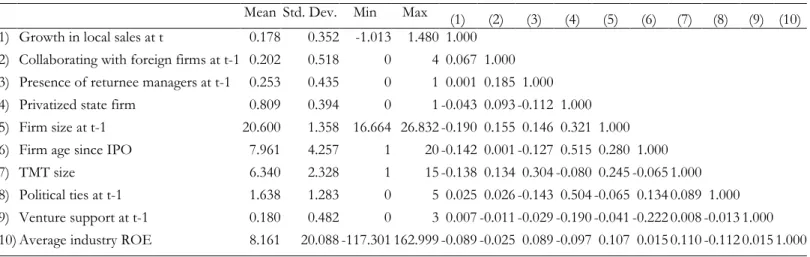
Table 2 provides detailed definitions and measurements of the variables in the paper. Table 3 provides the corresponding summary statistics and correlation matrix. The average
firm age since IPO was nine years for privatized, state-owned firms and 3.5 years for
entrepreneurial firms. While privatized state-owned firm status was a little bit highly correlated
with firm age since IPO and Political ties (at r = 0.515 and 0.504, respectively), the analysis of the
panel data eliminated the concern about multicollinearity (Hsiao, 2003).
RESULTS
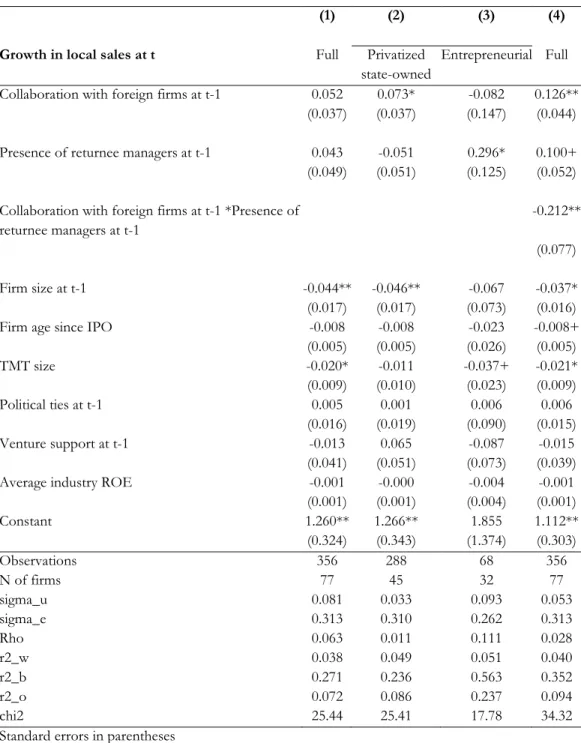
Model 1 in Table 4 was our baseline model, which showed the simple effects of the firm’s foreign collaborations at t-1 and the presence of returnee managers in the full sample. The coefficients for the firm’s foreign collaborations at t-1 and for the presence of returnee managers were both positive, but insignificant (γ = 0.052; γ = 0.043 respectively). Model 2 and Model 3 showed the simple effects of the firm’s foreign collaborations at t-1 and the presence of returnee managers in two sub-samples, i.e., privatized state-owned firms and entrepreneurial firms. The sub-sample analysis was used to test Hypotheses 1 and 2.
Collaboration with foreign firms by privatized state-owned vs. entrepreneurial firms
Hypothesis 1 predicted that the foreign collaborations by privatized state-owned firms would be more associated with firm’s growth in local sales than that by entrepreneurial firms. The results of Model 2 in Table 4 showed that the coefficient for the number of foreign collaborations in privatized state-owned firms was positive and significant (γ = 0.073, p < 0.05). The results of Model 3 in Table 4 showed that the coefficient for the number of foreign collaborations in entrepreneurial firms was negative but insignificant (γ = -0.082).
Thus, the empirical results supported Hypothesis 1.
Presence of returnees in privatized state-owned vs. entrepreneurial firms
Hypothesis 2 predicted that the presence of returnee managers in local firms would be more associated with the domestic growth of entrepreneurial firms than that of privatized state-owned firms. The results of Model 2 in Table 4 showed that the coefficient for the presence of returnee managers in privatized state-owned firms was negative, but insignificant (γ = -0.051). However, the results of Model 3 in Table 4 showed that the coefficient for the presence of returnee managers in entrepreneurial firms was positive and significant (γ = 0.296, p < 0.05). Thus, the empirical results supported Hypothesis 2.
Collaboration with foreign firms and the presence of returnees: reinforcing?
Model 4 in Table 4 was used to test Hypothesis 3a and Hypothesis 3b, which predicted that the impact of collaboration with foreign firms would be enhanced or weakened, respectively, by the presence of returnee managers in local firms. The results of Model 4 showed that the coefficient for the interaction between the firm’s foreign collaborations and the presence of returnee managers was negative and significant (γ = -0.212, p < 0.02). Thus, the empirical results supported Hypothesis 3b.
Our empirical results showed support for Hypotheses 1, 2, and 3b. The results suggested that the impacts of foreign collaborations and returnees at TMTs on a local firm’s growth in local sales depend on the institutional background of the firm. Privatized state-owned firms would benefit more from foreign collaborations than entrepreneurial firms. In contrast, entrepreneurial firms would benefit more from returnees than privatized state-owned firms. Also, the impact of a local firm’s foreign collaborations on domestic growth was weakened by the presence of returnees at TMTs due to foreign partners’ concern about the appropriation of knowledge by local firms.
CONCLUSIONS
Emerging markets firms have tried to upgrade their capabilities through foreign knowledge acquisition in order to compete in the global markets. Collaboration with foreign firms and hiring returnees are two key channels for emerging market firms’ knowledge acquisition. This study examined how acquiring knowledge through collaborating and through hiring can help enhance Chinese firms’ domestic growth. In particular, this study demonstrates that the impact of collaborating and hiring depends on the institutional heritage of emerging market firms. Overall, this study provides a strong theoretical and empirical foundation for understanding how emerging market firms’ can leverage foreign knowledge to further their growth. However, the field is only beginning to emerge and we recommend further research in this promising area of international business.
References
Agarwal, R., & Helfat, C. E. (2009). Strategic renewal of organizations. Organization Science,
20(2), 281-293.
Agarwal, R. & Shah, S. K. (2014). Knowledge sources of entrepreneurship: Firm formation by academic, user and employee innovators. Research Policy, 43(7), 1109–1133
Al-Laham, A., Tzabbar, D., & Amburgey, T. L. (2011). The dynamics of knowledge stocks and knowledge flows: innovation consequences of recruitment and collaboration in biotech.
Industrial and Corporate Change, 20(2), 555-583.
Almeida, P., Dokko, G., & Rosenkopf, L. (2003). Startup size and the mechanisms of external learning: Increasing opportunity and decreasing ability? Research Policy, 32(2),
301-305.
Aguilera, R. V. (2007). Translating theoretical logics across borders: organizational characteristics, structural mechanisms and contextual factors in international alliances. Journal of International Business Studies, 38(1), 38-46.
Argote, L., & Ingram, P. (2000). Knowledge transfer: A basis for competitive advantage in firms. Organizational behavior and human decision processes, 82(1), 150-169.
Firm Performance: An Integrative Analysis. Managerial and Decision Economics, 24(4), 347-369.
Becerra, M., Lunnan, R., & Huemer, L. (2008). Trustworthiness, Risk, and the Transfer of Tacit and Explicit Knowledge Between Alliance Partners. Journal of Management Studies, 45(4),
691.
Bonaglia, F., Goldstein, A., & Mathews, J. A. (2007). Accelerated internationalization by emerging markets multinationals: the case of the white goods sector. Journal of World Business,
42, 369-383.
Chen, C. J. (2004), The effects of knowledge attribute, alliance characteristics, and absorptive capacity on knowledge transfer performance. R&D Management, 34, 311–321.
Chen, P. L., Williams, C., & Agarwal, R. (2012). Growing pains: pre-entry experience and the challenge of transition to incumbency. Strategic Management Journal, 33(3), 252–276.
Chittoor, R., Sarkar, M. B., Ray, S., & Aulakh, P. S. (2009). Third-world copycats to emerging multinationals: institutional changes and organizational transformation in the Indian pharmaceutical industry. Organization Science, 20(1), 187-205.
Cho, H. D., & Lee, J. K. (2003). The developmental path of networking capability of catch‐up players in Korea's semiconductor industry. R&D Management, 33(4), 411-423.
Chung, C.-N. and X. R. Luo (2013). Leadership succession and firm performance in an emerging economy: Successor origin, relational embeddedness, and legitimacy. Strategic Management Journal, 34(3), 338-357
Clark, T. S., & Linzer, D. A. (2012). Should I use fixed or random effects?. Unpublished Paper.
Cohen, W. M., & Levinthal, D. A. (1990). Absorptive capacity: a new perspective on learning and innovation. Administrative Science Quarterly, 128-152.
Collins, C. J., & Clark, K. D. (2003). Strategic human resource practices, top management team social networks, and firm performance: the role of human resource practices in creating organizational competitive advantage. Academy of Management Journal, 46(6), 740-751.
Coombs, J. E., Mudambi, R., & Deeds, D. L. (2006). An examination of the investments in US biotechnology firms by foreign and domestic corporate partners. Journal of Business Venturing, 21(4), 405-428.
Cooke, F. L., & Saini, D. S. (2012). Managing diversity in Chinese and Indian organizations: a qualitative study. Journal of Chinese Human Resource Management, 3(1), 16-32.
Dai, O., & Liu, X. H. (2009). Returnee entrepreneurs and firm performance in Chinese high-technology industries. International Business Review, 18(4), 373–386.
Dhanaraj, C., Lyles, M. A., Steensma, H. K., & Tihanyi, L. (2004). Managing tacit and explicit knowledge transfer in IJVs: the role of relational embeddedness and the impact on performance. Journal of International Business Studies, 35(5), 428-442.
Dunning, J. H. (1988). The eclectic paradigm of international production: a restatement and some possible extensions. Journal of International Business Studies, 19 (Spring), 1-31.
Duysters, G., Jacob, J., Lemmens, C., & Jintian, Y. (2009). Internationalization and technological catching up of emerging multinationals: a comparative case study of China's haier group. Industrial and Corporate Change, 18(2), 325-349.
Easterby-Smith, M., M. A. Lyles and E. W. K. Tsang (2008). Inter-Organizational Knowledge Transfer: Current Themes and Future Prospects. Journal of Management Studies,
45(4), 677-690.
Elango, B., & Pattnaik, C. (2007). Building capabilities for international operations through networks: a study of Indian firms. Journal of International Business Studies, 38(4), 541-555.
Fernhaber, S. A., Mcdougall‐Covin, P. P., & Shepherd, D. A. (2009). International entrepreneurship: Leveraging internal and external knowledge sources. Strategic Entrepreneurship Journal, 3(4), 297-320.
Filatotchev, I., Liu, X., Buck, T., & Wright, M. (2009). The export orientation and export performance of high-technology SMEs in emerging markets: the Effects of Knowledge transfer by returnee entrepreneurs. Journal of International Business Studies, 40(6), 1005–1021.
Finkelstein, S., Hambrick, D., & Cannella, A. A. (2009). Strategic Leadership: Theory and Research on Executives, Top Management teams, and Boards. Oxford University Press.
Garcı´a-Canal, E., Lo´pez Duarte, C., Rialp Criado, J., & Valde´s Llaneza, A. (2002). Accelerating international expansion through global alliances: a typology of cooperative strategies. Journal of World Business, 37(2), 91–107.
Geroski, P. A. (2005). Understanding the implications of empirical work on corporate growth rates. Managerial and Decision Economics, 26(2), 129-138.
Greene, H. (2000). Econometric Analysis. New York: Macmillan.
Groysberg, B., Lee, L. E., & Nanda, A. (2008). Can They Take It With Them? The Portability of Star Knowledge Workers' Performance. Management Science, 54(7), 1213-1230.
Guillén, M. F., & García-Canal, E. (2009). The American model of the multinational firm and the “new” multinationals from emerging economies. Academy of Management Perspectives,
23(2), 23-35.
Hagedoorn, J., & Narula, R. (1996). Choosing organizational modes of strategic technology partnering: international and sectoral differences. Journal of International Business Studies, 27,
265–84.
Hamel, G.(1991). Competition for competence and interpartner learning within international strategic alliances. Strategic Management Journal, 12(S1), 83-103.
Hannan, M. T., Burton, M. D., & Baron, J. N. (1996). Inertia and change in the early years: Employment relations in young, high technology firms. Industrial and Corporate Change, 5(2),
Hannan, M. T., & Freeman, J. (1984). Structural inertia and organizational change. American Sociological Review, 49(2), 149-164.
Helfat, C., & Lieberman, M. B. (2002). The birth of capabilities: market entry and the importance of pre-history. Industry and Corporate Change, 11(4), 725-760.
Hong, J. F., Snell, R. S., & Easterby-Smith, M. (2012). Researching organizational learning in Chinese contexts. Research Methodology in Strategy and Management, 8, 195-216.
Hsiao, C. (2003). Analysis of Panel Data. Cambridge University Press.
Huckman, R. S., & Pisano, G. P. (2006). The firm specificity of individual performance: Evidence from cardiac surgery. Management Science, 52(4), 473-488.
Inkpen, A. C., & P. Beamish, W. (1997). Knowledge, bargaining power, and the instability of international joint ventures. Academy of Management Review, 22(1), 177-202.
Inkpen, A. C., & Crossan, M. M. (1995). Believing is seeing: Joint ventures and organization learning. Journal of Management Studies, 32(5), 595-618.
Jansen, J. J. P., Van Den Bosch, F. A. J., & Volberda, H. W. (2005). Managing Potential and Realized Absorptive Capacity: How Do Organizational Antecedents Matter? Academy of Management Journal, 48(6), 999-1015.
Johnston, J., & Dinardo, J. (1997). Econometric Methods (4th ed.). New York: McGraw-Hill.
Kale, P., & Singh, H. (2007). Building firm capabilities through learning: the role of the alliance learning process in alliance capability and firm‐level alliance success. Strategic Management Journal, 28(10), 981-1000.
Kale, P., Singh, H., & Perlmutter, H. (2000). Learning and protection of proprietary assets in strategic alliances: building relational capital. Strategic Management Journal, 21(3), 217-237.
Ko, D., Kirsch, L., & King, W. (2005). Antecedents of Knowledge Transfer from Consultants to Clients in Enterprise System Implementations. MIS Quarterly, 29(1), 59-85.
Kostova, T. (1999). Transnational transfer of strategic organizational practices: a contextual perspective. Academy of Management Review, 24(2), 308-324.
Kotabe, M., Teegen, H., Aulakh, P. S., Coutinho de Arruda, M. C., Santillán–Salgado, R. J., & Greene, W. (2000). Strategic alliances in emerging Latin America: a view from Brazilian, Chilean, and Mexican companies. Journal of World Business, 35(2), 114-132.
Kumar, K., & Van Dissel, H. G. (1996). Sustainable collaboration: managing conflict and cooperation in interorganizational systems. Mis Quarterly, 279-300.
Kuznetsov, Y., & Sabel, C. (2006). International migration of talent, diaspora networks, and development: Overview of main issues." In: Kuznetsov, Yevgeny (Ed.). Diaspora networks and the international migration of skills: how countries can draw on their talent abroad.
Lane, P. J., & Lubatkin, M. (1998). Relative absorptive capacity and interorganizational learning, Strategic Management Journal, 19(5), 461-477.
Lane, P., Salk, J. E., & Lyles, M.A. (2001). Absorptive capacity, learning, and performance in international joint ventures. Strategic Management Journal, 22(12), 1139–1161.
Li, H., Zhang, Y., Li, Y., Zhou, L.A., & Zhang, W. (2012). Returnees versus locals: who perform better in China's technology entrepreneurship?. Strategic Entrepreneurship Journal,
6,257–272.
Li, X., Roberts, J., Yan, Y., & Tan, H. (2014). Knowledge sharing in China-UK higher education alliances. International Business Review. 23(2), 343-355.
Liu, X., Lu, J., Filatotchev, I., Buck, T., & Wright, M. (2010). Returnee entrepreneurs, knowledge spillovers and innovation in high-tech firms in emerging economies. Journal of International Business Studies, 41(7), 1183–1197.
Luo, Y. (1999). Toward a conceptual framework of international joint venture negotiations.
Journal of International Management, 5, 141-165.
Luo, Y. (2002). Building trust in cross-cultural collaborations: Toward a contingency perspective. Journal of Management, 28(5), 669-694.
Luo, Y., & Rui, H. (2009). An ambidexterity perspective toward multinational enterprises from emerging economies. Academy of Management Perspectives, 23(4), 49-70.
Luo, Y., & Tung, R. L. (2007). International expansion of emerging market enterprises: a springboard perspective. Journal of International Business Studies, 38(4), 481-498.
Lyles, M. A., & Salk, J. E.(1996).Knowledge acquisition from foreign parents in international joint ventures: an empirical examination in the hungarian context. Journal of International Business Studies, 27(5), 877-903.
Menon, T., & Pfeffer, J. (2003). Valuing internal vs. external knowledge: Explaining the preference for outsiders. Management Science, 49(4), 497-513.
Meyer, K. E., & Peng, M. W. (2005). Probing theoretically into central and eastern Europe: transactions, resources, and institutions. Journal of International Business Studies, 36(6), 600-621.
Mowery, D. C., Oxley, J. E., & Silverman, B. S. (1996). Strategic alliances and interfirm knowledge transfer. Strategic Management Journal, 17, 77-91.
Newman, K. L. (2000). Organizational transformation during institutional upheaval. Academy of Management Review, 25(3), 602-619.
Nguyen, H. T., & Meyer, K. (2004). Managing partnerships with state-owned joint venture companies: experiences from Vietnam. Business Strategy Review, 15 (1), pp. 39-50.
Norman, P. M. (2002). Protecting knowledge in strategic alliances – resource and relational characteristics. Journal of High Technology Management Research, 13(2), 177-202.
Obukhova, E., Wang, Y., & Li, J. (2012). The power of local networks: returnee entrepreneurs, school ties, and firm performance. Working Paper.
Park, S. H., & Ungson, G. R. (2001). Interfirm rivalry and managerial complexity: A conceptual framework of alliance failure. Organization Science, 12(1), 37-53.
Parkhe, A. (1991). Interfirm diversity, organizational learning, and longevity in global strategic alliance. Journal of International Business Studies, 22(4), 579-601.
Peng, M. W. (2001). How entrepreneurs create wealth in transition economies. Academy of Management Executive, 15(1), 95-108.
Peng, M. W., & Heath, P. S. (1996). The growth of the firm in planned economies in transition: institutions, organizations, and strategic choice. Academy of Management Review,
21(2), 492-528.
Peng, M. W., & Luo, Y. (2000). Managerial ties and firm performance in a transition economy: the nature of a micro-macro link. Academy of Management Journal, 43(3), 486-501.
Polanyi, M. (1958). Personal Knowledge: Towards a Post-Critical Philosophy. University of Chicago Press, Chicago.
Prahalad, C. K. (2006). The Fortune at the Bottom of the Pyramid. Pearson Education India.
Sapienza, H. J., Autio, E., George, G., & Zahra, S. A. (2006). A capabilities perspective on the effects of early internationalization on firm survival and growth. Academy of Management Review, 31(4), 914-933.
Saxenian, A. L. (2006). The New Argonauts. Cambridge, MA: Harvard University Press.
Simonin, B. L. (1999). Transfer of marketing know-how in international strategic alliances: An empirical investigation of the role and antecedents of knowledge ambiguity, Journal of International Business Studies, 30(3), 463-490.
Simonin, B. L. (2004). An Empirical Investigation of the Process of Knowledge Transfer in International Strategic Alliances. Journal of International Business Studies 35(5), 407-427.
Yang, H., Y. Zheng and X. Zhao (2014). "Exploration or exploitation? Small firms' alliance strategies with large firms." Strategic Management Journal 35(1): 146-157.
Song, J., Almeida, P., & Wu, G. (2003). Learning–by–hiring: when is mobility more likely to facilitate interfirm knowledge transfer?. Management Science, 49(4), 351-365.
Stan, C. V., Peng, M. W., Bruton, G. D. (2014). Slack and the performance of state-owned enterprises. Asia Pacific Journal of Management, 31, 473-495.
Szulanski, G. (1996). Exploring internal stickness: impediments to the transfer of best practice within the firm. Strategic Management Journal, 17(winter special), 27-43.
American Psychologist, 38(11), 1161-1173.
Tsai, W. (2002). Social structure of "coopetition" within a multiunit organization: Coordination, competition, and intraorganizational knowlege sharing. Organization Science,
13(2), 179-190.
Tsang, E. W. K. (2002). Acquiring knowledge by foreign partners from international joint ventures in a transition economy: learning-by-doing and learning myopia. Strategic Management Journal, 23, 835–854.
Walder, A. G. (1995). Local governments as industrial firms: An organizational analysis of China's transitional economy. American Journal of Sociology, 101(2), 263-301.
Wang, T., & Meyer, K. E. (2009). Managerial spillovers: how FDI facilitates changes in managerial mindsets in a transition economy. Working Paper.
Williams, C. (2007). Transfer in context: replication and adaptation in knowledge transfer relationships. Strategic Management Journal, 28(9), 867-889.
Wright, M., Liu, X., Buck, T., & Filatotchev, I. (2008). Returnee entrepreneurs, science park location choice and performance: an analysis of high-technology SMEs in China.
Entrepreneurship Theory and Practice, 32, 131-155.
Wright, M., Liu, X., Filatotchev, I. (2012). Returnee entrepreneurs: resource orchestration, context and knowledge spillovers, in Catherine, L., Wang, K., David, J., Donald, D. Bergh (ed.) west meets east: building theoretical bridges (Research Methodology in Strategy and Management, Volume 8).Emerald Group Publishing Limited, 243-263.
Wright, M., Filatotchev, I., Hoskisson, R. E., & Peng, M. W. (2005). Strategy Research in Emerging Economies: Challenging the Conventional Wisdom. Journal of management studies,
42(1), 1-33.
Xu, D., & Meyer, K. E. (2013). Linking theory and context: ‘Strategy research in emerging economies’ after Wright et al. (2005). Journal of Management Studies, 50, 1322–1346.
Yamakawa, Y., Peng, M. W., & Deeds, D. L. (2008). What drives new ventures to internationalize from emerging to developed economies?. Entrepreneurship Theory and Practice,
32(1), 59-82.
Yan, A., & Gray, B. (1994). Bargaining power, management control, and performance in United States–China joint ventures: a comparative case study. Academy of Management Journal,
37(6), 1478-1517.
Yang, H., Zheng, Y., & Zhao, X. (2014). Exploration or exploitation? Small firms' alliance strategies with large firms. Strategic Management Journal, 35(1),146-157.
Yiu, D., Bruton, G. D., & Lu, Y. (2005). Understanding business group performance in an emerging economy: acquiring resources and capabilities in order to prosper. Journal of Management Studies, 42(1), 183-206.
Table 1. Comparing Knowledge Transfer through Inter-firm Collaboration and Recruitment Inter-firm collaboration Recruitment
What type of contract involved Collaborative agreement Employment What knowledge to be transferred Pre-specified Not specified
Whether the transferred knowledge is stored Routines or technology Individuals and their interactions with others Donor of knowledge Firm Individual
Where knowledge transfer occurs Between organizations Within the organization
Table 2. Variable Measurements
Variables Measurement
Growth in local sales at t =ln (domestic sales of firm i at year t/domestic sales of firm i at year t-1) Collaborating with foreign
firms at t-1 = Number of business associates such as foreign partners in alliances, joint venture, licensing agreements, and contracts from countries whose economic freedom are higher than China, at year t-1 Presence of returnee
managers at t-1 = 1 if at least one TMT member had worked or studied in more developed countries at year t-1; 0 otherwise Privatized state-owned firm =1 if firm i was previously state-owned enterprise and then privatized; 0 otherwise
Firm size at t-1 =ln (domestic sales at year t-1)
Firm age since IPO =Focal year- the year of firm i’s IPO+1
TMT Size =Number of top managers
Political ties at t-1 =Number of top five shareholders who are government institutions at year t-1 Venture support at t-1 =Number of top five shareholders who are venture capitalists at year t-1
Table 3. Summary Statistics and Correlation Matrix
Mean Std. Dev. Min Max (1) (2) (3) (4) (5) (6) (7) (8) (9) (10) (1) Growth in local sales at t 0.178 0.352 -1.013 1.480 1.000
(2) Collaborating with foreign firms at t-1 0.202 0.518 0 4 0.067 1.000
(3) Presence of returnee managers at t-1 0.253 0.435 0 1 0.001 0.185 1.000 (4) Privatized state firm 0.809 0.394 0 1 -0.043 0.093 -0.112 1.000 (5) Firm size at t-1 20.600 1.358 16.664 26.832 -0.190 0.155 0.146 0.321 1.000 (6) Firm age since IPO 7.961 4.257 1 20 -0.142 0.001 -0.127 0.515 0.280 1.000 (7) TMT size 6.340 2.328 1 15 -0.138 0.134 0.304 -0.080 0.245 -0.065 1.000
(8) Political ties at t-1 1.638 1.283 0 5 0.025 0.026 -0.143 0.504 -0.065 0.134 0.089 1.000 (9) Venture support at t-1 0.180 0.482 0 3 0.007 -0.011 -0.029 -0.190 -0.041 -0.222 0.008 -0.013 1.000 (10) Average industry ROE 8.161 20.088 -117.301 162.999 -0.089 -0.025 0.089 -0.097 0.107 0.015 0.110 -0.112 0.015 1.000
Table 4. Domestic growth of local firms from learning through collaborating with foreign firms and through hiring returnees
(1) (2) (3) (4)
Growth in local sales at t Full Privatized
state-owned Entrepreneurial Full
Collaboration with foreign firms at t-1 0.052 0.073* -0.082 0.126**
(0.037) (0.037) (0.147) (0.044)
Presence of returnee managers at t-1 0.043 -0.051 0.296* 0.100+
(0.049) (0.051) (0.125) (0.052)
Collaboration with foreign firms at t-1 *Presence of returnee managers at t-1
-0.212** (0.077)
Firm size at t-1 -0.044** -0.046** -0.067 -0.037*
(0.017) (0.017) (0.073) (0.016)
Firm age since IPO -0.008 -0.008 -0.023 -0.008+
(0.005) (0.005) (0.026) (0.005) TMT size -0.020* -0.011 -0.037+ -0.021* (0.009) (0.010) (0.023) (0.009) Political ties at t-1 0.005 0.001 0.006 0.006 (0.016) (0.019) (0.090) (0.015) Venture support at t-1 -0.013 0.065 -0.087 -0.015 (0.041) (0.051) (0.073) (0.039)
Average industry ROE -0.001 -0.000 -0.004 -0.001
(0.001) (0.001) (0.004) (0.001) Constant 1.260** 1.266** 1.855 1.112** (0.324) (0.343) (1.374) (0.303) Observations 356 288 68 356 N of firms 77 45 32 77 sigma_u 0.081 0.033 0.093 0.053 sigma_e 0.313 0.310 0.262 0.313 Rho 0.063 0.011 0.111 0.028 r2_w 0.038 0.049 0.051 0.040 r2_b 0.271 0.236 0.563 0.352 r2_o 0.072 0.086 0.237 0.094 chi2 25.44 25.41 17.78 34.32
Standard errors in parentheses + p < 0.10, * p < 0.05, ** p < 0.01 Note: Panel data Random-effects Model