Optical fine structures of highly quantized InGaAs/GaAs self-assembled quantum dots
H. Y. Ramirez,1C. H. Lin,1C. C. Chao,1Y. Hsu,1W. T. You,1S. Y. Huang,1Y. T. Chen,1 H. C. Tseng,1W. H. Chang,1S. D. Lin,2 and S. J. Cheng1,
*
1Department of Electrophysics, National Chiao Tung University, Hsinchu 30050, Taiwan 2Department of Electronic Engineering, National Chiao Tung University, Hsinchu 30050, Taiwan
共Received 8 February 2010; revised manuscript received 14 June 2010; published 30 June 2010兲 A theoretical model for the electron-hole exchange interaction in three-dimensionally共3D兲 confining semi-conductor nanostructures is presented to explain the observed decreasing tendency of the fine-structure split-tings共FSSs兲 of small InGaAs/GaAs self-assembled quantum dots 共QDs兲 with increasing the emission energies. The experimentally revealed FSS reduction is shown to be highly associated with the significant 3D spreading of electronic orbitals and reduced overlap of electron and hole wave functions in small and/or Ga-diffused QDs. The combination of quantum size and Ga-diffusion effects substantially reduces the averaged e-h ex-change interaction and leads to the reduced FSSs in the regime of high emission energy.
DOI:10.1103/PhysRevB.81.245324 PACS number共s兲: 71.70.Gm, 78.67.Hc, 78.55.Cr
I. INTRODUCTION
The fine-structure splittings共FSSs兲 of spin excitons 共Xs兲 in quantum dots 共QDs兲 have been confirmed as a main ob-stacle for the fabrication of dot-based entangled photon pair emitters, a key device required in optical quantum teleporta-tion and cryptography.1–4The FSS between the spin bright X states of a QD is widely believed as the consequence of the part of e-h exchange Coulomb interaction arising from the inevitable symmetry breaking of dot structure due to, for instance, shape elongation or strain.5,6 To make the genera-tion of entangled photon pair from a QD feasible, the optical FSSs are required to be smaller or at least comparable to the intrinsic broadening of X emission line, typically at the scale of ⬃1 eV.7–9 In reality, the magnitudes of FSSs of self-assembled QDs共SQDs兲, however, vary from dot to dot in a wide range of 100– 102 eV and mostly are larger than the optical intrinsic broadening.10–14
Experimentally, the measured FSSs of self-assembled QDs are often shown to decrease with the increasing emis-sion energy, and sometimes even drop into the scale compa-rable to the intrinsic broadening of X emission lines in the high-energy regime.15–17 Such an observed feature suggests the usefulness of smaller dots. However, the underlying physics of the useful feature remains a puzzling subject. In a simple picture, the FSSs of smaller dots are actually ex-pected to be larger, rather than nearly vanishing as observed because reducing the QD size increases the local density of confined charged particles and the strength of the e-h ex-change interaction as well.
Seguin et al.16explains such an anomalous energy depen-dence of FSS in terms of the effects of strain-induced piezo-electricity 共PZ兲. Their studies show that the PZ in QDs breaks the e- and h-wave-function symmetry and increases the FSSs. Because the PZ is more significant in larger dots, the observed FSSs show a decrease with reducing dot size. By contrast, the shape asymmetry of QDs was shown mostly as a secondary effect and becomes crucial only in very small QDs.
The roles of strain and shape asymmetry in the optical fine structures of QDs were further distinguished by
Abbar-chi et al.17 in their recent study of unstrained GaAs/AlGaAs QDs fabricated using the technique of droplet epitaxy共DE兲. In spite of lacking of strain and PZ, still similar feature of FSS as a function of the emission energy was observed. The study evidences the crucial role of shape asymmetry in the FSSs of DE-grown QDs, which usually show a close corre-lation between lateral shape elongation and QD size.
In this work we present experimental and theoretical stud-ies of optical FSSs of a serstud-ies of small InGaAs/GaAs QDs emitting lights at high energies ranging from 1.34 to 1.39 eV. The PZ effect is negligible in such small dots. Nevertheless, a distinct monotonic decrease in the measured FSSs for a series of the QDs with increasing the emission energies is observed.
A theoretical model for the e-h exchange interaction in three-dimensionally 共3D兲 confining semiconductor nano-structures is presented to explain the observed decreasing tendency of the FSSs. Our studies establish that, besides the widely discussed effects of PZ and the possible elongation-size correlation,18 quantum size effects and the resulting small e-h wave-function overlap play also significant roles in the reduced FSSs of small InGaAs/GaAs QDs.
The paper is organized as follows. SectionIIpresents the experimental data of polarized photoluminescence 共PL兲 spectra and the optical fine structures of individual QDs. Section IIIpresents the developed theoretical model for the
e-h exchange interactions and the numerical simulation for
the electronic structures of QDs. SectionIVshows our analy-sis of the theoretical and experimental results. SectionV pro-vides the conclusion.
II. EXPERIMENTAL OBSERVATIONS
The investigated QD of sample was grown on a GaAs 共001兲 substrate by molecular-beam epitaxy. A layer of InAs self-assembled QDs was formed by depositing 2.0 monolay-ers of InAs on GaAs at 480 ° C without substrate rotations, yielding a gradient in dot density on the wafer ranging from 108 to 1010 cm2. Finally, an undoped capping GaAs layer was deposited on the dots. The average size of uncapped QDs has been identified by atomic force microscopy共AFM兲,
showing ⬇15 nm in diameter and ⬇2⫾0.5 nm in height. However, after a capping layer is grown, the size of a capped QD is usually further reduced by few nanometers. An alumi-num metal mask with electron-beam patterned apertures ar-rays共0.3 m兲, was used to measure emission spectra from individual QDs. The microphotoluminescence setup includes an He-Ne laser beam focused onto the aperture via a micro-scope objective 共N.A.=0.5兲. The PL signals were collected by the same objective lens, analyzed by a 0.75 m grating monochromator and detected by a liquid-nitrogen-cooled charge-coupled device camera, which yields a resolution-limited spectral linewidth of about 60 eV. We enhance the accuracy to determinate peak position of emission lines by using the Lorentzian line-shape analysis. Thus, peak position resolution is reduced to⬍10 eV.
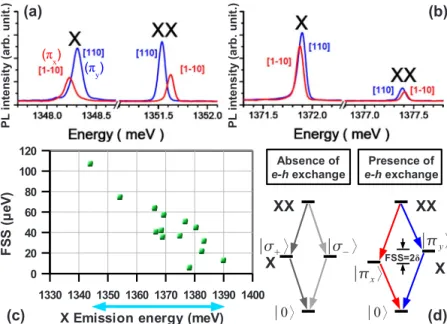
Figures1共a兲and1共b兲show a pair of typical polarized PL spectra taken from two single QDs at T = 5 K with polariza-tion direcpolariza-tions along关11¯0兴 and 关110兴, which are set as the x and y axis, respectively, in this work. Emission lines corre-sponding to X and biexciton共XX兲 recombination have been identified according to their linear and quadratic power de-pendencies of intensities.19In Figs.1共a兲and1共b兲, the X lines consist of linearly cross-polarized共xandy兲 doublets with
the fine-structure splittings 共FFS⬅兩EX共y兲−EX共x兲兩兲 of
about 100 eV and 20 eV, respectively. The FSSs of XX are the same as those of X but with a reversed polarization sequence, indicative of a cascade recombination process from the XX to the X states. The lower energy X lines and the higher energy XX lines are polarized along the 关11¯0兴 direction, in agreement with other studies.15,20
Figure1共c兲shows the measured FSSs for all investigated QDs as a function of their X emission energies. A clear de-creasing tendency of the measured FSSs with inde-creasing the emission energy is observed. The emission energies from the measured dots are high and distribute in a narrow spectral range from 1320 to 1400 meV, as highlighted by a horizontal double arrow line in Fig. 1共c兲. The measured dots are thus speculated to have the same height but slightly varied lateral sizes and/or Ga composition. Similar energy dependences of
optical FSS were observed also in the previous studies of larger strained InGaAs/GaAs self-assembled QDs,16and un-strained GaAs/AlGaAs SQDs.17The similar feature observed here for the measured small strained QDs, however, cannot be completely understood in terms of the PZ effect for large InAs/GaAs QDs, nor the size-elongation correlation for un-strained GaAs/AlGaAs QDs as in Refs. 16and 17, respec-tively. To capture the main underlying physics, a 3D finite-difference simulation for the electronic structure of strained QDs and a theoretical model for the e-h exchange interaction of 3D confining QDs are presented as follows.
III. THEORETICAL MODEL
First, the electronic structures of strained InGaAs/GaAs QDs are examined by performing a 3D finite-difference simulation. We consider truncated-pyramid-shaped In0.67Ga0.33As/GaAs QDs with fixed height of Lz
= 1.8 nm but various lengths of base 共Lx, Ly兲. The 3D
Schrödinger equations for a single electron or a single hole are separately solved in the single-band effective-mass ap-proximation. The strain in a QD is calculated using finite-element method,21and considered in the determination of the interband energy gap and the band-edge offsets between dot and barrier. The Ga interdiffusion has been considered in the strain simulation. The strain parameters are modeled as smooth functions of the composition and position following the formula in Ref.22
The high measured emission energies shown in Fig. 1 could be caused, besides the small sizes of QDs, also by the increased energy-band gap by Ga diffusion. We model the In-Ga interdiffusion between dot, capping layer, and sub-strate using one-dimensional Fick’s theory and describe the Ga- or In-composition profiles using a complementary error function with the characteristic diffusion length lD.23,24
To better focus on the size and diffusion effects, we first fix the lateral elongation to the constant value ⌶=95% for the considered QDs in Figs. 2–4.关The results for the QDs with different shape elongations共⌶=98% and 95%兲 will be
1330 1340 1350 1360 1370 1380 1390 1400 0 20 40 60 80 100 120
X Emission energy (meV)
F SS (μe V ) (a) (c) (d) Absence of
e-h exchange e-h exchangePresence of XX X ∣ ∣ ∣0 X ∣x ∣y ∣0 XX FSS=2δ P L in te nsi ty (a rb . uni t. ) (πx) (πy) (b) P L in te ns it y (a rb . unit .)
FIG. 1. 共Color online兲 共a兲 and 共b兲 Polarized PL spectra taken from two single QDs at T = 5 K with polarization directions along 关110兴 and关11¯0兴. Peaks corresponding to X and XX re-combination are identified according to the power dependences of their intensities. 共c兲 The mea-sured FSSs as a function of X emission energy for 14 quantum dots 共the horizontal line with double arrows lying below the horizontal axis highlights the spectral range of the measured emission energies兲, and 共d兲 schematic diagrams of XX-X cascade decay in the absence and presence of the e-h exchange interaction, respectively.
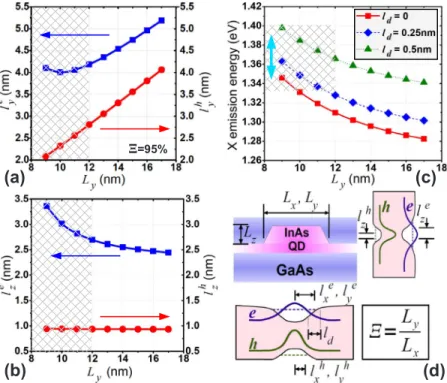
presented and discussed later in Fig.5.兴 Figures2共a兲and2共b兲 show the calculated extent l␣e/h⬅
冑
2具␣2典1/2共␣= x , y , z兲 of the particle共e or h兲 wave functions in the lowest orbitals of the QDs with different base lengths from Ly= 9 to 17 nm. Figure 2共c兲shows the calculated emission energies as functions of the dot size. Comparing the simulated results of Fig.2共c兲and measured emission energies, the measured dots are specu-lated to have the lateral sizes between 9 and 12 nm共see the hatched region兲, consistent with the observation of AFM and measured diamagnetic shifts by magnetophotoluminescence measurement.25In this regime, the energy level of the lowest electronic orbital is raised by strong energy quantization so much as to be very close to the extended continuum states of wetting layer. It turns out that the electron wave-function extents become surprisingly large in the small dots and very sensitive to the varying of QD size关see lye
shown in Fig.2共a兲 for Ly⬍12 nm兴. In particular, the wave-function extent in
the growth 共z兲 direction is shown even more sensitive than the lateral extent in such small QDs 关see lz
e
shown in Fig. 2共b兲 for Ly⬍12 nm兴. This suggests the necessity of a 3D
model for the e-h exchange interactions of the highly quan-tized small QDs.
The fine-structure splitting 共FSS=2␦兲 between bright X states of a QD is mainly determined by the long-range part of
e-h exchange interaction defined as
␦⬅
冕冕
d3r 1d3r2关⇓↑eh共rជ2兲兴ⴱ e2 40r12⇑↓ eh共r ជ1兲, 共1兲 where eh共rជ1兲⬅关⌿0h共r1ជ 兲uv共r1ជ 兲兴ⴱ⫻⌿0 e共r1ជ 兲u c共r1ជ 兲 is definedas the charged density of e-h transition, =↑ / ↓共=⇑ /⇓兲 stands for the up/down spin of electron共valence heavy hole兲 with spin projection sz=+12 /−12共jz=+32 /−32兲, respectively,
⌿0
e共⌿
0
h兲 is the envelope wave function of the lowest orbital
for electron共hole兲, and uc共uv兲 is the corresponding
conduc-tion共valence兲 band Bloch function. The valence hole here is assumed to be a pure heavy hole for highly quantized and strained self-assembled QDs. The considered bright X states are the e-h pairs with opposite electron and hole spins, i.e., 兩⇑,↓典 or 兩⇓,↑典, of total angular momentum M =+1 or −1, respectively.10,26,27 In principle, the long-ranged e-h ex-change interaction ␦ can be evaluated by substituting the numerically calculated e- and h-wave functions into the stan-dard definition above and numerically carrying out the six-dimensional integration.
Here, in order to gain more physical insight into the prob-lem, a theory based on a 3D asymmetric parabolic model is employed for the evaluation, which provides an explicit gen-eralized formulation of e-h exchange interactions transpar-ently in terms of relevant material properties, wave-function extents, and lateral elongation for an asymmetric QD. Via the fitting of wave-function extents, l␣e/h, the wave functions of the lowest orbitals of asymmetric QDs can be modeled by Gaussian functions ⌿0e/h共rជ兲=共3/2lex/h1lye/hlze/h兲1/2exp兵−
1 2关共 x lxe/h兲2 +共ly y e/h兲2+共 z lze/h兲
2兴其. In the analysis, the Coulomb integration is decomposed into a large number of dipole-dipole interac-tions between the microscopic e-h transition densities of dif-ferent unit cells and derived as the summation of all these possible interactions over the whole spatial region of QD. After some algebra, the long-ranged e-h exchange interac-tion is derived for slightly laterally deformed dots as
␦= K ··共1 −兲 · ␥z 共ly
eh兲3, 共2兲
where the form factor K = 3冑e
2ប2E p
共40兲16冑2m0共Egb兲2is given in terms
of universal constants and relevant material parameters 共in-cluding the conduction-valence-band interaction energy Ep,
the bulk energy gap Eg b
, and the dielectric constant兲, and
(b)
(a)
(d)
(c)
Ξ=95%
FIG. 2. 共Color online兲 共a兲 Lateral e 共blue squares兲 and h 共red circles兲 wave-function extent 共ly
e/h兲. 共b兲 Vertical e 共blue squares兲 and h 共red
circles兲 wave-function extent 共lze/h兲. 共c兲 Emission energies as functions of the lateral size for differ-ent diffusion lengths. The vertical cyan solid line with double arrows indicates the observed spec-tral range of light emission from the dots. Ac-cordingly, the lateral sizes of the measured dots are speculated to distribute in the hatched region. 共d兲 Schematic depiction of a truncated-pyramid-shaped QD considered in simulation and the rel-evant defined parameters.
l␣eh⬅
冑
2l␣ e l␣h冑共l
␣e兲2+共l ␣ h兲2, 共3兲is defined as the characteristic extent of the hybridized e- and
h-wave function of X in the direction␣= x , y , z, ⬅x·y·z =
冋
2共lx h/l x e兲 1 +共lx h/l x e兲2册冋
2共ly h/l y e兲 1 +共ly h/l y e兲2册冋
2共lz h/l z e兲 1 +共lz h/l z e兲2册
, 共4兲 is defined to parameterize the e-h wave-function overlap 共= 1 as e- and h-wave functions are perfectly identical兲. The term 共1−兲 with the defined parameter of wave-function elongation⬅ly eh
lx
eh 共5兲
measures the lateral asymmetry of exciton wave function.26 With the nature of dipole-dipole interaction, the interaction strength of Eq.共2兲 is scaled as an inverse of the cubic power of the lateral interaction distance关␦⬀1/共ly
eh兲3兴 and corrected by a factor␥z⬍1 due to the finite extent of wave function in
the z direction. Within the currently used model, the correct-ing factor is derived as
␥z= e共3冑lz eh/4l y eh兲2 erfc
冉
3冑
lz eh 4ly eh冊
. 共6兲The value of ␥z is␥z= 1 for an ideal two-dimensional 共2D兲
dot and decreases 共␥z⬍1兲 with the increasing aspect ratio
lzeh/lyeh. As compared with previous relevant theories,26,28the derived Eq.共2兲 provides an extended formulation of the e-h exchange interaction with the further consideration of 3D features of asymmetric e- and h-wave-function extents, and is suitable for the application of 3D confining nanostructures with arbitrary aspect ratios.
For quasi-2D QDs where lz eh/l y ehⰆ1, Eq. 共 2兲 can be ex-panded as ␦⬇ K ·xyz· 共1 −兲 共ly eh兲3
冉
1 − 3 2 lz eh ly eh+¯冊
. 共7兲In the 2D limit where lz
eh→0 and
z= 1, Eq.共2兲 is reduced
to the known formulation of long-ranged e-h exchange inter-action for ideal 2D QDs, as presented in Refs.26and28.
For a strongly confining QD, the attractive e-h
direct Coulomb interaction in an X can be esti-mated by the Coulomb matrix element, Veh
=兰兰d3r 1d3r2⌿0
hⴱ共r1ជ 兲⌿0eⴱ共r2ជ 兲 e2
40兩rជ −r1 ជ 兩2⌿0
e共r2ជ 兲⌿0h共r1ជ 兲. In the 3D
parabolic model, we derive
Veh⬇ e2 40 2
冑
1冑
共le兲2+共lh兲2 sin−1冉
冑
1 −冉
共lz e兲2+共l z h兲2 共le兲2+共lh兲2冊冊
冑
1 −冉
共lz e兲2+共l z h兲2 共le兲2+共lh兲2冊
, 共8兲 where le=冑
l x e ly e and lh=冑
l x h ly h. According to Eqs. 共2兲 and 共8兲, the correlation between the averaged energy of polarized emission lines EX= Ee+ Eh+ Eg
b
+⌬Eg s
− Vehand the magnitude
of the FSS⬅兩2␦兩 can be simulated for the QDs considered in Fig.2.
The following material parameters are used for the strained In0.67Ga0.33As/GaAs QDs considered in this work:
Ep= 23.3 eV, Eg b
= 0.67 eV, the offset of energy gap caused by strain ⌬Eg
s
= 0.23 eV, =14.5, dot/barrier valence-band offset Vvo= 0.24 eV, dot/barrier conduction-band offset Vco
= 0.41 eV, mHHⴱ = 0.5m0, meⴱ= 0.04m0 共dot兲 and meⴱ= 0.066m0 共barrier兲.29
IV. RESULTS AND DISCUSSIONS
The expression of Eq.共2兲 accounts for the possible factors that determine the magnitude of the FSS of a 3D confining QD, including the intrinsic material properties, the lateral elongation of particle wave function 关parameterized by 共1−兲兴, the e-h wave-function overlap 共parameterized by 兲, and the mean interparticle distance 关related to the quan-tity ␥z/共ly
eh兲3兴.26,28 Figure 3共a兲shows the calculated param-eter of e-h wave-function overlap  and the term of lateral elongation关共1−兲兴/关⌶共1−⌶兲兴, as functions of the X emis-sion energy for the QDs of various sizes. The calculated  values are shown to decrease with the increasing X emission energies. In other words, the e-h wave-function overlaps of the dot-confined Xs in the high emission energy regime de-crease with decreasing the dot sizes. The value ofis even as low as⬃0.35 for the small dot of Ly= 9 nm because of
the significant extension of electron wave function 共espe-cially in the z direction, as mentioned previously兲. By con-trast, the elongation term共1−兲 remains mostly insensitive
(a) (b) Ly=17nm Ly=15nm Ly=13nm Ly=11nm Ly=9nm Ly=16nm Ly=14nm Ly=12nm
Ly=10nm FIG. 3. 共Color online兲 共a兲 Parameters of e-h
wave-function overlap 共blue squares兲, and lat-eral elongation of wave function normalized by dot shape elongation⌶共1−⌶兲共1−兲 共red circles兲, as func-tions of the emission energy. 共b兲 Inverse cubic power of the average in-plane interaction distance 共ly
eh兲−3 共dashed line with squares兲, and damped
inverse cubic power of the in-plane interaction distance关␥共lzeh兲共lyeh兲−3兴 共solid line with circles兲. A diffusion length lD= 0.5 nm is considered here.
to the change in dot size because the dominant hole wave function is well localized in the dot. The reduced substan-tially reduces the e-h exchange interaction, as indicated by Eq. 共2兲.
On the other hand, as shown also by Eq.共2兲, the strength of the e-h exchange interaction is increased by the increase in the quantity ␥z/共ly
eh兲3, i.e., the decrease in the averaged interparticle distance. Figure 3共b兲 shows that the calculated values of␥z/共ly
eh兲3for the same considered dots increase with the increasing X emission energies, showing an opposite be-havior of energy dependence to those of  and . Even though the extent of wave function in the z direction is sig-nificant and makes smaller the value of ␥zin the regime of
small QD,␥z/共ly
eh兲3remains increasing with increasing the X emission energy. Thus, if the e- and h-wave functions were nearly symmetric 共⬇1兲 as described by a simplified hard wall model of QD, the FSS of a spin exciton in the dot should increase with reducing the dot size, as observed in most colloidal nanocrystals.30 However, the FSS of small QDs with finite confining barriers might be suppressed by the strong quantum size effect that leads to the reduced e-h wave-function overlap and diminishes the e-h exchange in-teraction in a dot-confined exciton.
Figure 4 shows the calculated FSSs of the considered QDs as a function of the X emission energy. In the low-energy regime 共Ex⬍1.375 eV兲, the FSSs do increase with
increasing the energy as expected in a simple hard wall model since both electrons and holes are well localized in the dots. As the dot size is further reduced down to Ly
⬍12 nm and EX⬎1.375 eV, significant delocalization of electron-wave function and the resulting small  make the FSSs turn to decrease with increasing the emission energy. To highlight the effect of reduced e-h wave-function overlap, especially that for the vertical wave function in z direction, Fig. 4 presents also the calculated results for the ideal 2D
model,28for the 3D model关Eqs. 共2兲–共5兲兴 but with the param-eters artificially set as =xyz= 1, and forz= 1 as well,
for comparison. We see that, with disregarding the decreas-ing e-h wave-function overlap, the FSSs as a function of the emission energy no longer shows a decreasing tendency in the high-energy regime.
To account for the observed feature of Fig.1, we calculate the FSSs for QDs of various sizes共Ly= 8 – 12 nm兲, diffusion
lengths 共lD= 0 , 0.25, 0.5, 0.75 nm兲, and shape elongations
共⌶=95% and ⌶=98%兲. As shown in Fig. 5, the quantum size effect in the small QDs reduces the FSSs but within a narrow spectral range. With more In-Ga interdiffussion, the FSS of a diffused QD is further reduced while the emission energy is increased. The In-Ga interdiffusion smoothes out the barrier of confining potential and reduces the barrier height so that the particle wave functions become more likely extended into the barrier region. In fact, the electron-wave function is extended more than holes because of the light mass. It turns out that the e- and h-wave functions become even more different and the e-h wave-function over-lap smaller in the diffused dots. In addition, the In-Ga inter-difussion leads also to the increase in the interband gap and makes the emission energies blue shifted. As a result, the FSSs are further reduced with the increased emission ener-gies by introducing more Ga composition into the dot. The Ga-diffusion effects revealed here could also account for the observed small FSSs of QDs under postannealing treatment in previous studies.15 As compared with the results for ⌶ = 5%, the FSSs of the considered QDs with smaller lateral elongation ⌶=2% retain the similar decreasing dependence on the emission energy but are in the smaller range of FSS magnitude between 10 and 35 eV.
This model calculation provides us a qualitatively physi-cal understanding of the main observed feature. It points out
3D model [Eq. (2)] 3D model but withβ= 1 Ly=14nm Ly=13nm Ly=12nm Ly=11nm Ly=10nm Ly=9nm 2D model (Ref. [27]) 3D model but withβz= 1
FIG. 4. 共Color online兲 Calculated FSSs 共⬅兩2␦兩兲 as a function of the X emission energy obtained by using the full 3D formulation of Eq.共2兲 共red squares兲, the 3D formulation but withz= 1 set artifi-cially共blue circles兲, and the 3D formulation but with=1 共identical 3D wave functions of electron and hole are assumed and the e-h wave-function overlap is 100%兲 共green diamonds兲. The result ob-tained using the 2D model共black triangles兲 in Ref.28is also shown for comparison. A diffusion length lD= 0.5 nm is considered here.
1.31 1.33 1.35 1.37 1.39 1.41 1.43 1.45 0 20 40 60 80 100
X em ission energy (eV)
FS S (μ e V ) Experiment Ly= 9nm d l d Ly= 10nm Ly= 11nm Ly= 12nm Simulations Ξ=95% Ly= 8nm Ξ=98% l d=0nmlldd=0.25nm l d=0.5nm l d=0.75nm
FIG. 5.共Color online兲 Measured and calculated FSSs of diffused QDs as functions of the X emission energy. Experimental data are shown by green filled squares. Theoretical results are calculated for different dot sizes and diffusion lengths, and are indicated by vari-ous kinds of different colored symbols. Solid 共Dashed兲 lines: data for the QDs with the lateral shape elongation,⌶=95%共⌶=98%兲.
the significant roles of quantum size and Ga interdiffusion in the decreased fine-structure splitting of small quantum dots. Nevertheless, the calculated FSSs show a slower decrease with increasing the emission energies as compared with the experimental data. The further decrease in FSS might be at-tributed to the neglected effects in the model, such as piezo-electricity, size-elongation correlation, or heavy- and light-hole mixing.27 It is possible to extend the employed model by including piezoelectric potential in the model calculation and using multiband theory to consider the mixing of heavy-and light-hole components in the exciton states to figure out the remaining discrepancy.
V. SUMMARY
In conclusion, we have presented a theoretical and experi-mental study of optical fine structures of highly quantized In1−xGaxAs/GaAs self-assembled quantum dots. A
theoreti-cal model for the electron-hole exchange interaction in three-dimensionally confining nanostructures is presented to ex-plain the observed substantially reduced fine-structure splittings of the measured QDs in the regime of high emis-sion energy. The reduced FSSs are attributed to the quantum size and interdiffusion effects of the small dots, leading to the formation of weakly confined electron wave functions. The delocalization of electron-wave function is especially significant and size sensitive in the growth direction and
re-sults in the substantially reduced overlap of electron- and hole-wave functions of exciton. The quantum size effect re-duces the averaged e-h exchange interaction and leads to the decreased FSSs in the regime of high emission energy. Intro-ducing more Ga composition into a dot via In-Ga interdiffu-sion makes the electron wave function even more extended and the emission energy blueshifted. The model calculation identifies the significant roles of quantum size and Ga inter-diffusion in the decreased fine-structure splitting of small quantum dots. Quantitatively, the calculated FSSs, however, show a slower decrease with increasing the emission ener-gies as compared with the experimental data. The further decrease in the fine-structure splittings of the QDs in the regime of high energy ⬃1.39 eV could be related to other mechanisms beyond the treatment of the model, e.g., piezo-electricity, size-elongation correlation, and mixing of heavy-and light-hole component, heavy-and remains an interesting subject for further study.
ACKNOWLEDGMENTS
The authors acknowledge the National Science Council of Taiwan for financial support under Contract Nos. NSC-98-2112-M-009-011-MY2, NSC-97-2120-M009-004, and NSC97-2221-E009-161. S.J.C also would like to thank the National Center of Theoretical Sciences in Hsinchu and the National Center for High-Performance Computing of Taiwan for supporting.
1D. Gammon, E. S. Snow, B. V. Shanabrook, D. S. Katzer, and D.
Park,Phys. Rev. Lett. 76, 3005共1996兲.
2A. S. Bracker, D. Gammon, and V. L. Korenev,Semicond. Sci.
Technol. 23, 114004共2008兲.
3C. Santori, D. Fattal, M. Pelton, G. S. Solomon, and Y.
Yama-moto,Phys. Rev. B 66, 045308共2002兲.
4K. Edamatsu,Jpn. J. Appl. Phys., Part 1 46, 7175共2007兲. 5E. L. Ivchenko,Phys. Status Solidi A 164, 487共1997兲. 6T. Takagahara,Phys. Rev. B 62, 16840共2000兲.
7R. M. Stevenson, R. J. Young, P. Atkinson, K. Cooper, D. A.
Ritchie, and A. J. Shields,Nature共London兲 439, 179 共2006兲.
8N. Akopian, N. H. Lindner, E. Poem, Y. Berlatzky, J. Avron, D.
Gershoni, B. D. Gerardot, and P. M. Petroff,Phys. Rev. Lett. 96, 130501共2006兲.
9R. Hafenbrak, S. M. Ulrich, P. Michler, L. Wang, A. Rastelli, and
O. G. Schmidt,New J. Phys. 9, 315共2007兲.
10M. Bayer, G. Ortner, O. Stern, A. Kuther, A. A. Gorbunov, A.
Forchel, P. Hawrylak, S. Fafard, K. Hinzer, T. L. Reinecke, S. N. Walck, J. P. Reithmaier, F. Klopf, and F. Schäfer,Phys. Rev. B
65, 195315共2002兲.
11W. Langbein, P. Borri, U. Woggon, V. Stavarache, D. Reuter, and
A. D. Wieck,Phys. Rev. B 69, 161301共R兲 共2004兲.
12A. Greilich, M. Schwab, T. Berstermann, T. Auer, R. Oulton, D.
R. Yakovlev, M. Bayer, V. Stavarache, D. Reuter, and A. Wieck, Phys. Rev. B 73, 045323共2006兲.
13B. D. Gerardot, S. Seidl, P. A. Dalgarno, R. J. Warburton, D.
Granados, J. M. Garcia, K. Kowalik, O. Krebs, K. Karrai, A. Badolato, and P. M. Petroff, Appl. Phys. Lett. 90, 041101 共2007兲.
14M. E. Reimer, M. Korkusiński, D. Dalacu, J. Lefebvre, J.
Lapointe, P. J. Poole, G. C. Aers, W. R. McKinnon, P. Hawrylak, and R. L. Williams,Phys. Rev. B 78, 195301共2008兲.
15R. J. Young, R. M. Stevenson, A. J. Shields, P. Atkinson, K.
Cooper, D. A. Ritchie, K. M. Groom, A. I. Tartakovskii, and M. S. Skolnick,Phys. Rev. B 72, 113305共2005兲.
16R. Seguin, A. Schliwa, S. Rodt, K. Potschke, U. W. Pohl, and D.
Bimberg,Phys. Rev. Lett. 95, 257402共2005兲.
17M. Abbarchi, C. A. Mastrandrea, T. Kuroda, T. Mano, K.
Sa-koda, N. Koguchi, S. Sanguinetti, A. Vinattieri, and M. Gurioli, Phys. Rev. B 78, 125321共2008兲.
18M. C. Xu, Y. Temko, T. Suzuki, and K. Jacobi,J. Appl. Phys. 98,
083525共2005兲.
19W. H. Chang, H. Lin, S. Y. Wang, C. H. Lin, S. J. Cheng, M. C.
Lee, W. Y. Chen, T. M. Hsu, T. P. Hsieh, and J. I. Chyi,Phys. Rev. B 77, 245314共2008兲.
20R. M. Stevenson, R. J. Young, P. See, D. G. Gevaux, K. Cooper,
P. Atkinson, I. Farrer, D. A. Ritchie, and A. J. Shields, Phys. Rev. B 73, 033306共2006兲.
21
COMSOLmultiphysics package.
22O. Stier, M. Grundmann, and D. Bimberg, Phys. Rev. B 59,
5688共1999兲.
23O. Gunawan, H. S. Djie, and B. S. Ooi,Phys. Rev. B 71, 205319
24Y. Wang, H. S. Djie, and B. S. Ooi,Appl. Phys. Lett. 89, 151104
共2006兲.
25M. F. Tsai, H. Lin, C. H. Lin, S. D. Lin, S. Y. Wang, M. C. Lo,
S. J. Cheng, M. C. Lee, and W. H. Chang,Phys. Rev. Lett. 101, 267402共2008兲.
26E. Poem, J. Shemesh, I. Marderfeld, D. Galushko, N. Akopian,
D. Gershoni, B. D. Gerardot, A. Badolato, and P. M. Petroff, Phys. Rev. B 76, 235304共2007兲.
27Y. Léger, L. Besombes, L. Maingault, and H. Mariette, Phys.
Rev. B 76, 045331共2007兲.
28M. M. Glazov, E. L. Ivchenko, O. Krebs, K. Kowalik, and P.
Voisin,Phys. Rev. B 76, 193313共2007兲.
29I. Vurgaftman, J. R. Meyer, and L. R. Ram-Mohan, J. Appl.
Phys. 89, 5815共2001兲.
30H. Htoon, M. Furis, S. A. Crooker, S. Jeong, and V. I. Klimov,