A Novel Ambipolar Spirobifluorene
Derivative that Behaves as an Efficient
Blue-Light Emitter in Organic
Light-Emitting Diodes
Yuan-Li Liao,
†Chi-Yen Lin,
†Ken-Tsung Wong,*
,†Tei-Hung Hou,
‡and
Wen-Yi Hung*
,‡Department of Chemistry, National Taiwan UniVersity, Taipei 106, Taiwan, and Institute of Optoelectronic Sciences, National Taiwan Ocean UniVersity, Keelung, Taiwan 202
[email protected]; [email protected] Received August 15, 2007
ABSTRACT
A novel ambipolar spiro-configured D−A blue-light emitter bearing hole-transporting diphenylamino groups and electron-transporting phenylbenzimidazole groups was synthesized, characterized, and incorporated into an efficient single-layer organic light-emitting diode (OLED) device exhibiting blue-emission Commission International d’Eclairage (CIE) coordinates of 0.15 and 0.14, a turn-on potential of 4 V, a maximum brightness of 2800 cd/m2at 830 mA/cm2(19 V), and a maximum quantum efficiency of 0.53% (0.61 cd/A).
9,9′-Spirobifluorene-cored compounds have been employed widely in organic light-emitting diodes (OLEDs) displaying a variety of functions.1A common strategy toward manipu-lating the electronic structure, emission spectrum, thermal/ morphological stability, or charge carrier mobility of 9,9′ -spirobifluorene-based materials is through tailoring the nature of the substituents and their substitution patterns about the 9,9′-spirobifluorene unit, e.g., with identical or different substituents positioned on the same or different biphenyl branch.2Furthermore, to balance the electron-hole recom-bination efficiency, one promising strategy is that of
devel-oping emitters equipped with an electron-donating moiety (D) that facilitates hole injection and/or transport and an electron-withdrawing moiety (A) that improves electron injection and/or transport.3With appropriate choices of the D and A units, the levels of the highest occupied molecular orbital (HOMO) and lowest unoccupied molecular orbital (LUMO) as well as the emission color of the D-A molecule can be controlled to a fine degree,4 making such systems increasingly attractive for use in a single-layer OLEDs.5This approach has allowed the development of efficient emitters displaying a range of emission colors.1,6However, derivatives
†National Taiwan University. ‡National Taiwan Ocean University.
(1) Saragi, T. P. I.; Spehr, T.; Siebert, A.; Fuhrmann-Lieker, T.; Salbeck, J. Chem. ReV. 2007, 107, 1011.
(2) (a) Pudzich, R.; Salbeck, J. Synth. Met. 2003, 138, 21. (b) Lin, H.-W.; Ku, S.-Y.; Su, H.-C.; Huang, C.-H.-W.; Lin, Y.-T.; Wong, K.-T.; Wu, C.-C. AdV. Mater. 2005, 17, 2489.
(3) Shirota, Y.; Kinoshita, M.; Noda, T.; Okumoto, K.; Ohara, T. J. Am.
Chem. Soc. 2000, 122, 11021.
(4) (a) Zhu, Y.; Kulkarni, A. P.; Jenekhe, S. A. Chem. Mater. 2005, 17, 5225. (b) Chen, C.-T.; Lin, J.-S.; Moturu, M. V. R. K.; Lin, Y.-W.; Yi, W.; Tao, Y.-T.; Chen, C.-H. Chem. Commun. 2005, 16, 3980. (c) Xu, X.; Chen, S.; Yu, G.; Di, C.; You, H.; Ma, D.; Liu, Y. AdV. Mater. 2007, 19, 1281. (d) Haung, T.-H.; Lin, J.-T.; Chen, L.-Y.; Lin, Y.-T.; Wu, C.-C. AdV.
Mater. 2006, 18, 602.
ORGANIC
LETTERS
2007
Vol. 9, No. 22
4511-4514
10.1021/ol701994k CCC: $37.00 © 2007 American Chemical Society Published on Web 10/04/2007
Downloaded by NATIONAL TAIWAN UNIV on September 2, 2009 | http://pubs.acs.org
featuring donors on one biphenyl branch spiro-linked to another biphenyl moiety bearing acceptors exhibit low photoluminescence efficiencies as a result of strong photo-induced electron transfer.7 Thus, a better alternative is to position the D and A moieties on the same biphenyl branch of the spirobifluorene. Unfortunately, strong intramolecular D-A charge transfer normally leads to significant red-shifting of the emission colors, making it difficult to develop efficient blue emitters using this strategy.1,2,6
Herein, we report an efficient spiro-configured D-A bipolar blue emitter, 2,2′-bis(diphenylamino)-7,7′ -bis(diphen-ylbenzimidazole)-9,9′-spirobifluorene (3, Scheme 1). The
phenylbenzimidazole units were introduced as electron-accepting (A) substituents because 1,3,5-tris(N-phenylben-zimidizol-2-yl)benzene (TPBI), which exhibits good electron transport mobility,8 has been used widely as an electron transport material for OLEDs. The diphenylamino groups were introduced as electron-donating (D) groups because the corresponding donor-only analogue 2,2′ -bis(diphenylamino)-9,9′-spirobifluorene (4) has been used successfully as a hole-transporting material in a highly efficient blue electrophos-phorescent device.9The two D-A chromophores are bonded perpendicularly through a tetrahedral carbon atom, leading
to an orthogonal configuration that impedes the π-orbital interactions between the individual D-A chromophore branches. Moreover, the D and A moieties implanted onto a rigid and coplanar fluorene ring result in a blue-emissive molecule exhibiting bipolar character and high thermal stability, forming a multifunctional material having promising potential for application in OLEDs.
Scheme 1 depicts the synthesis of 3. Treatment of 2,2′ -dibromo-7,7′-dicarboxyl-9,9′-spirobifluorene2with an excess of SOCl2gave the diacyl chloride intermediate 1, which was amidated with N-phenyl-o-phenylenediamine in the presence of triethylamine followed by dehydration at 250 °C under vacuum (0.1 Torr) to afford the dibromide 2 (60% for three steps). The diphenylamino groups were introduced through amination of 2 with diphenylamine and NaOtBu in the
presence of catalytic amounts of Pd(OAc)2 and PtBu3, providing 3 in 83% yield. We synthesized the acceptor-only analogue, 2,2′-bis(phenylbenzimidazole)-9,9′-spirobifluorene (5), through a similar path (Scheme S-1, Supporting Infor-mation) for the sake of comparison and as an electron-transporting material in subsequent OLED devices.
Table 1 summarizes the physical properties of compounds 3-5. Differential scanning calorimetry (DSC) indicated that these compounds exhibit distinct glass transition temperatures (Tg) within the range from 115 to 165°C, suggesting that these materials could form homogeneous and amorphous films through thermal evaporation. Thermogravimetric analy-sis (TGA) indicated that these materials exhibit high decomposition temperatures (Td) within the range from 370 to 477 °C (5% weight loss). We attribute these relatively high morphological and thermal stabilities to the perpen-dicular configuration of the spirobifluorene core, which disrupts intermolecular interactions and suppresses the tendency to crystallize.
We first examined the bipolar character of 3 using cyclic voltammetry (CV; Figure S-1 in Supporting Information). The electrochemical properties of spirobifluorene derivatives are dependent mainly on their functional substituents. Thus, compound 4 exhibited only reversible oxidation potentials [0.87 and 0.94 V, assigned by differential pulse voltammetry (DPV)], whereas the acceptor-only counterpart 5 displayed reversible reduction potentials (-1.96 and -2.17 V). Merg-ing these two functionalities, the spiro-configured bipolar D-A molecule 3 exhibited both reversible oxidation and reduction behavior but with slight shifts in the potentials. The existence of stable radical cationic and anionic species for 3 suggested that it had great potential for efficient electron/hole transport and recombination in OLEDs. We estimated the HOMO energy levels from the oxidation potentials of 3 and 4 in relation to the first reversible oxidation potential (0.74 V in CH2Cl2) of N,N′ -bis-(1-naphthyl)-N,N′-diphenyl-1,1′-biphenyl-4,4′-diamine (R-NPB, HOMO ) -5.3 eV).10A band gap energy of 2.86 eV for 3 was calculated from the difference between the reduction and oxidation peak potentials; this value is consistent with the data calculated from the optical absorption threshold. We (5) (a) Li, Z. H.; Wong, M. S.; Fukutani, H.; Tao, Y. Org. Lett. 2006, 8,
4271. (b) Habrard, F.; Ouisse, T.; Stephan, O.; Aubouy, L.; Gerbier, P.; Hirsch, L.; Huby, N.; Van der Lee, A. Synth. Met. 2006, 156, 1262. (c) Lee, T. H.; Tong, K. L.; So, S. K.; Leung, L. M. Synth. Met. 2005, 155, 116.
(6) Chiang, C.-L.; Shu, C.-F.; Chen, C.-T. Org. Lett. 2005, 7, 3717. (7) (a) Chien, Y.-Y.; Wong, K.-T.; Chou, P.-T.; Cheng, Y.-M. Chem.
Commun. 2002, 2874. (b) Ku, S.-Y.; Cheng, M.; Lin, X.-Y.; Hung,
Y.-Y.; Pu, S.-C.; Wong, K.-T.; Chou, P.-T.; Lee, G.-H. J. Org. Chem. 2006,
71, 456.
(8) Hung, W.-Y.; Ke, T.-H.; Lin, Y.-T.; Wu, C.-C.; Hung, T.-H.; Chao, T.-C.; Wong, K.-T.; Wu, C.-I. Appl. Phys. Lett. 2006, 88, 164102.
(9) Tsai, M.-H.; Lin, H.-W.; Su, H.-C.; Ke, T.-H.; Wu, C.-C.; Fang, F.-C.; Liao, Y.-L.; Wong, K.-T.; Wu, C.-I. AdV. Mater. 2006, 18, 1216.
(10) D’Andrade, B. W.; Datta, S.; Forrest, S. R.; Djurovich, P.; Polikarpov, E.; Thompson, M. E. Org. Electron. 2005, 6, 11.
Scheme 1. Synthetic Route toward Molecule 3 and Structures of the Single Functional Counterparts 4 and 5
4512 Org. Lett.,Vol. 9, No. 22, 2007
Downloaded by NATIONAL TAIWAN UNIV on September 2, 2009 | http://pubs.acs.org
deduced the corresponding LUMO energy level of 5 from the difference between the reduction potentials of 3 and 5. Table 1 summarizes the results.
Figure 1 displays the absorption and emission spectra of 3-5 in solid films.
The absorption and emission maxima of 3 are significantly red-shifted relative to those of their single-chromophore counterparts, indicating that theπ conjugation was effectively extended once the D and A groups were connected into the D-A chromophore. This result agrees with the observed lower band gap energy of 3 from the CV experiment. From a close inspection of the dependence of the absorption and emission behavior on solvent polarity (Figure S-2, Supporting Information), we found that the absorption maximum is relatively insensitive to the dielectric environment, whereas the emission characteristics of 3 revealed a strong solvato-chromic effect. For example, the emission spectrum of 3 in cyclohexane exhibits a maximum signal at 412 nm that was red-shifted significantly to 468 nm in MeCN. Because 3 exhibits absorption behavior that is independent of the solvent polarity, we infer that its reduced band gap energy results from π-orbital interactions between the D and A groups, without evident electronic interactions, in the ground state. The dependence of the emission wavelength of 3 on the solvent polarity is indicative of photoinduced charge transfer occurring in the excited state. Importantly, the photolumi-nescence quantum yields of 3 measured in thin film and in CH2Cl2using an integrated sphere system are 0.41 and 0.84, respectively, ensuring the potential use as an efficient emitter. We conducted charge-carrier mobility measurements of 3-5 using time-of-flight (TOF) techniques at ambient
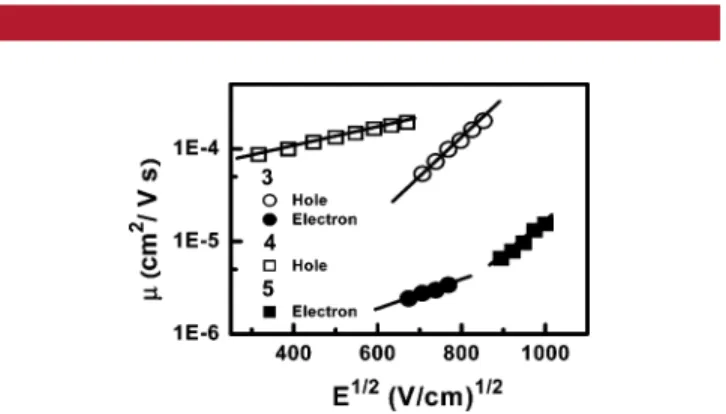
temperature (Figure S-3, Supporting Information).11Figure 2 depicts the mobilities plotted as a function of the square
root of the electric field; the straight lines follow the nearly universal Poole-Frenkel relationship,µ∝exp(βE1/2), where β is the Poole-Frenkel factor.
The observed hole (µh) ca. 10-4 cm2/Vs) and electron (µe) ca. 3 × 10⁻⁶cm2/Vs) mobilities of 3 are comparable to, but slightly lower than, those of its single-chromophore counterparts 4 and 5, respectively. The hybridization of the electron-donating character of the diphenylamino group with the electron-withdrawing character of the phenylbenzimida-zole moiety leads to the novel bipolar 3 system exhibiting ambipolar carrier-transport character. The mobilities are compensated to a certain degree, however, by the spiro configuration of the two D-A chromophore branches hindering efficient intermolecular π-orbital interactions, which is consistent with the observed lower mobilities of 3 and 4 as compared to those of tetraphenylbenzidine (TAD)12 and TBPI,8respectively (Figure S-4, Supporting Information). To examine the potential application of 3 as an emitter in OLEDs, we designed three devices having the configuration ITO/PEDOT-PSS (30 nm)/I: 3 (100 nm); II: 3 (50 nm)/5 (50 nm); III: 4 (40 nm)/3 (30 nm)/5 (30 nm)/LiF (0.5 nm)/ Al (100 nm). Table 2 summarizes the device characteristics. The bipolar transport properties and suitable frontier orbital energies of 3 allowed us to realize a blue single-layer device.5 (11) (a) Borsenberger, P. M.; Weiss, D. S. Organic Photoreceptors for
Imaging Systems; Marcel Dekker: New York, 1993. (b) Liao, Y.-L.; Lin,
C.-Y.; Wong, K.-T.; Hung, W.-Y.; Chen, W.-J. Chem. Commun. 2007, 1831. (12) Sara, T. P. I.; Fuhrmann-Lieker, T.; Salbeck, J. AdV. Funct. Mater. 2006, 19, 966.
Table 1. Physical Properties of Spirobifluorene Derivatives 3-5
compd Tg (°C) Td (°C) E1/2OX (V)a E1/2REV (V)a HOMO (eV)b LUMO (eV) ∆Eg (eV) Abs λmax(nm) solution/film PL λmax(nm) solution/film 3 165 477 0.90, 0.97 -1.96, -2.17 -5.46 -2.60 2.86 307, 386/310, 381 445/460 4 115 370 0.87, 0.94 - -5.43 -2.26 3.17 352/356 394/407 5 154 393 - -2.13 -5.73 -2.43 3.30 331/331 383/392
a Deduced by differential pulse voltammetry.bSee the text.
Figure 1. UV-vis absorption spectra (dotted lines) and
photolu-minescence spectra (solid lines) of 3-5 in solid films.
Figure 2. Mobilities of 3-5 vs E1/2(the solid lines are fits to the
Poole-Frenkel form).
Org. Lett.,Vol. 9, No. 22, 2007 4513
Downloaded by NATIONAL TAIWAN UNIV on September 2, 2009 | http://pubs.acs.org
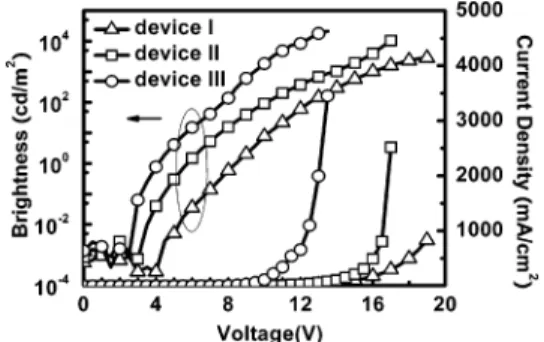
The EL spectrum of device I is identical to the thin-film PL emission spectrum of 3, with Commission International d’Eclairage (CIE) coordinates of 0.15 and 0.14. This single-layer device exhibits a turn-on potential of 4 V and a maximum brightness of 2800 cd/m2at 830 mA/cm2(19 V) and maximum quantum and power efficiencies of up to 0.53% (0.61 cd/A) and 0.14 lm/W, respectively. Neverthe-less, the single-layer device still suffered from imbalanced charge recombination and a possible quenching effect by the cathode, which is a problem encountered frequently in OLED devices.13In an attempt to mitigate the cathode quenching effect and improve electron transport into the emitter, in device II we inserted 5 between the 3 layer and the cathode. Both the brightness and EL efficiency were enhanced substantially relative to those of the single-layer device I (Table 2). This result indicates a more balanced electron-hole recombination, which agrees with our TOF observations; i.e., 5 had better electron-transporting capability than 3. Replacing 5 with TPBI, a widely used electron-transporting and hole-blocking layer, led to a lower device efficiency (1.3%, 0.7 lm/W). To further confine the emissive excitons within the 3 layer, we introduced 4 as a hole-transport layer to give the double-heterojunction device III. Figure 3 indicates that the current densities under the same potential decreased in the order III > II > I, suggesting that the double-heterostructure device enhanced the carrier injection and transport properties. Device III exhibited a rather low turn-on voltage of 2.5 V for a blue OLED, with pure emission from 3. This device achieved a high external quantum efficiency (1.57%, 1.9 cd/A), a power efficiency of 1.55 lm/ W, and a maximum brightness of ca. 2.1 × 10⁴ cd/m2 at 13.5 V. Furthermore, the quantum efficiency remained fairly high at high current densities (1.35% at 100 mA/cm2; Figure S-5, Supporting Information).
In summary, we have synthesized and characterized an unprecedented blue-light emitting spiro-configured bipolar molecule (3), equipped with diphenylamino groups as electron donors and phenylbenzimidazole groups as electron acceptors. 3 exhibits a combination of the physical properties originating from its donor and acceptor groups. Its orthogonal molecular configuration is responsible for its high thermal and morphological stabilities. The bipolar character of 3 was evident from its reversible redox potentials, solvatochromic behavior in the excited state, and ambipolar carrier transport properties. These features allowed us to utilize 3 successfully in a single-layer device exhibiting blue-emission CIE coor-dinates of 0.15 and 0.14, a turn-on potential of 4 V, and a maximum brightness of 2800 cd/m2at 830 mA/cm2(19 V). Employing a double heterostructure of 4/3/5 to confine the excitons in the emissive layer led to a blue OLED device displaying higher performance: brightness reaching as high as 21 000 cd/m2, efficiency of up to 1.9 cd/A, and a value of EQE of 1.57%.
Acknowledgment. This work was financially supported by the National Science Council, Ministry of Education, and Ministry of Economic Affairs of Taiwan.
Supporting Information Available: Detailed experi-mental procedures, spectroscopic characterization of new compounds, cyclic voltammograms, solvent polarity depend-ent UV-vis and PL spectra, TOF photocurrdepend-ent transidepend-ents, and device characteristics. This material is available free of charge via the Internet at http://pubs.acs.org.
OL701994K
(13) (a) Kulkarni, A. P.; Kong, X.; Jenekhe, S. A. AdV. Funct. Mater. 2006, 16, 1057. (b) Wu, C.-C.; Lin, Y.-T.; Wong, K.-T.; Chen, R.-T.; Chien, Y.-Y. AdV. Mater. 2004, 16, 61.
Table 2. EL Properties of Devices I-III
device
turn-on voltage (V)
Lmax
(cd/m2) (mA/cmImax 2) (%, cd/A)ηextmax η(lm/W)pmax (x, y)CIE
I 4 2800 (19 V) 830 0.52%, 0.61 0.14 0.15,0.14 II 3 10600 (17 V) 2500 1.50%, 1.68 1.10 0.16,0.13 III 2.5 21200 (13.5 V) 3500 1.57%, 1.90 1.55 0.16,0.14
Figure 3. Plots of brightness and current density vs voltage for devices I-III.
4514 Org. Lett.,Vol. 9, No. 22, 2007
Downloaded by NATIONAL TAIWAN UNIV on September 2, 2009 | http://pubs.acs.org